Here at Open Culture, we’ve often featured the many sides of Tom Waits: actor, poetry reader, favored David Letterman guest. More rarely, we’ve posted material dedicated to showcasing him practicing his primary craft, writing songs and singing them. But when a full-fledged Tom Waits concert does surface here, prepare to settle in for an unrelentingly (and entertainingly) askew musical experience. In March, we posted Burma Shave, an hour-long performance from the late seventies in which Waits took on “the persona of a down-and-out barfly with the soul of a Beat poet.” Today, we fast-forward a decade to Big Time, by which point Waits could express the essences of “avant-garde composer Harry Partch, Howlin’ Wolf, Frank Sinatra, Astor Piazzolla, Irish tenor John McCormack, Kurt Weill, Louis Prima, Mexican norteño bands and Vegas lounge singers.” That evocative quote comes from Big Time’s own press notes, as excerpted by Dangerous Minds, which calls the viewing experience “like entering a sideshow tent in Tom Waits’s brain.”
Watch the 90-minute concert film in its entirety, though, and you may not find it evocative enough. In 1987, Waits had just put out the album Franks Wild Years, which explores the experience of his alter-ego Frank O’Brien, whom Waits called “a combination of Will Rogers and Mark Twain, playing accordion — but without the wisdom they possessed.” The year before, the singer actually wrote and produced a stage play built around the character, and the Franks Wild Years tour through North America and Europe made thorough use of Waits’ theatrical bent in that era. Its final two shows, at San Francisco’s Warfield Theatre and Los Angeles’ Wiltern Theatre, along with footage from gigs in Dublin, Stockholm and Berlin, make up the bulk of Big Time’s material. As for its sensibility, well, even Waits fans may feel insecure, and happily so, about quite what to expect. (Fans of The Wire, I should note, will find something familiar indeed in this show’s rendition of “Way Down in the Hole.”)
“Many of Mondrian’s pieces explore the relationships between adjacent spaces,” says Bolinger “and in particular the formative role of each on the boundaries and possibilities of the other. I based this painting [see above] off of Wittgenstein’s Tractatus, in which he develops a theory of meaning grounded in the idea that propositions have meaning only insofar as they constrain the ways the world could be; a meaningful proposition is thus very like one of Mondrian’s color squares, forming a boundary and limiting the possible configurations of the adjacent spaces.”
A second-year PhD student in the philosophy program at the University of Southern California, Bolinger studied painting a Biola University before making philosophy her second major. “I actually came to philosophy quite late in my college career,” Bolinger says, “only adding the major in my junior year. I was fortunate to have two particularly excellent and philosophic art teachers, Jonathan Puls and Jonathan Anderson, who convinced me that my two passions were not mutually exclusive, and encouraged me to pursue both as I began my graduate education.”
Bolinger now works primarily on the philosophy of language, with side interests in logic, epistemology, mind and political philosophy. She continues to paint. We asked her how she reconciles her two passions, which seem to occupy opposite sides of the mind. “I do work in analytic philosophy,” she says, “but it’s only half true that philosophy and painting engage opposite sides of the mind. The sort of realist drawing and painting that I do is all about analyzing the relationships between the lines, shapes and color tones, and so still very left-brain. Nevertheless, it engages the mind in a different way than do the syllogisms of analytic philosophy. I find that the two types of mental exertion complement each other well, each serving as a productive break from the other.”
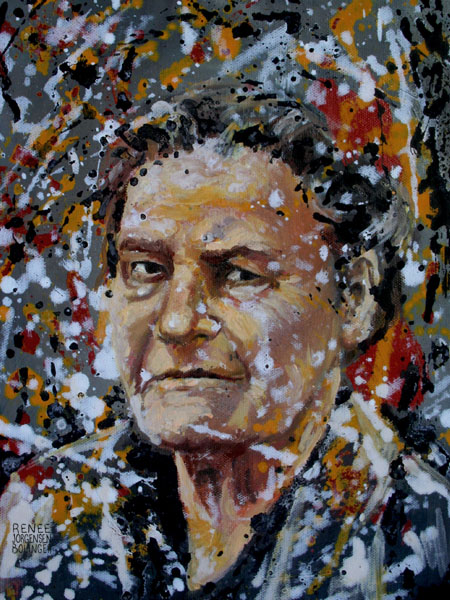
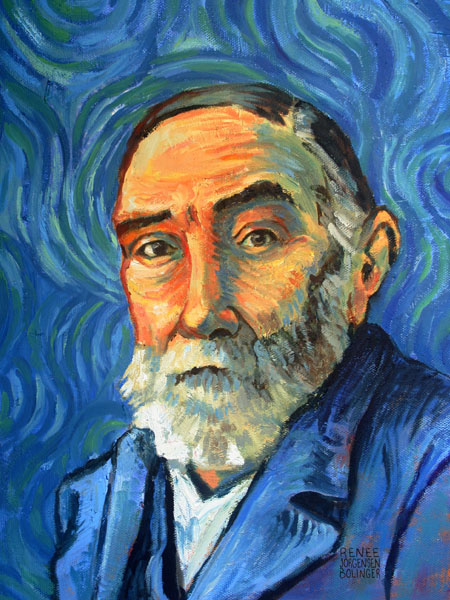
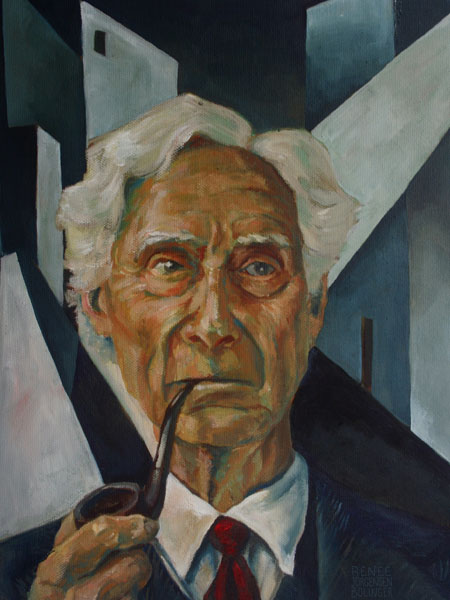
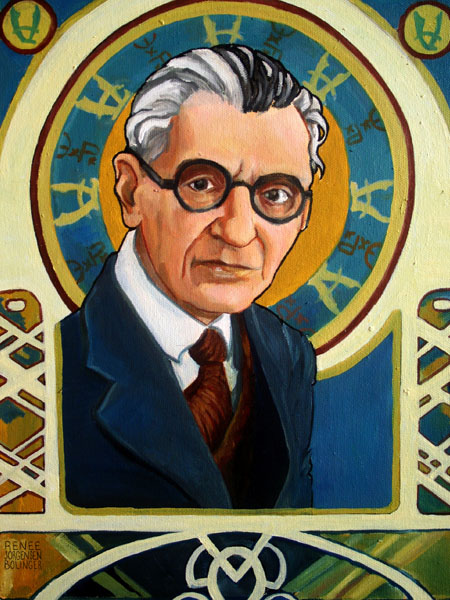
Bolinger has created a series of philosopher portraits, each one pairing a philosopher with an artist, or art style, in an intriguing way. In addition to Wittgenstein, she painted ten philosophers in her first series, many of them by request. They can all be seen on her Web site, where high quality prints can be ordered.
G.E.M. Anscombe/Jackson Pollock:
Bolinger says she paired the British analytic philosopher Elizabeth Anscombe with the American abstract painter Jackson Pollock for two reasons: “First, the loose style of Pollock’s action painting fits the argumentative (and organizational) style of Wittgenstein’s Philosophical Investigations, which Anscombe helped to edit and was instrumental in publishing. Second, her primary field of work, in which she wrote a seminal text, is philosophy of action, which has obvious connections to the themes present in any of Pollock’s action paintings.”
Gottlob Frege/Vincent Van Gogh:
Bolinger paired the German logician, mathematician and philosopher Gottlob Frege with the Dutch painter Vincent Van Gogh as a tongue-in-cheek reference to Van Gogh’s famous painting The Starry Night and Frege’s puzzle concerning identity statements such as “Hesperus is Phosphorus,” or “the evening star is identical to the morning star.”
Bertrand Russell/Art Deco:
Bolinger painted the British logician and philosopher Bertrand Russell in the Art Deco style. “This pairing is a bit more about the gestalt, and a bit harder to articulate,” says Bolinger. “The simplification of form and reduction to angled planes that takes place in the background of this Art Deco piece are meant to cohere with Russell’s locial atomism (the reduction of complex logical propositions to their fundamental logical ‘atoms’).”
Kurt Gödel/Art Nouveau:
Bolinger paired the Austrian logician Kurt Gödel with Art Nouveau. “The Art Nouveau movement developed around the theme of mechanization and the repetition of forms,” says Bolinger, “and centrally involves a delicate balance between organic shapes — typically a figure that dominates the portrait — and schematized or abstracted patterns, often derived from organic shapes, but made uniform and repetitive (often seen in the flower motifs that ornament most Art Nouveau portraits). I paired this style with Kurt Gödel because his work was dedicated to defining computability in terms of recursive functions, and using the notion to prove the Completeness and Incompleteness theorems.”
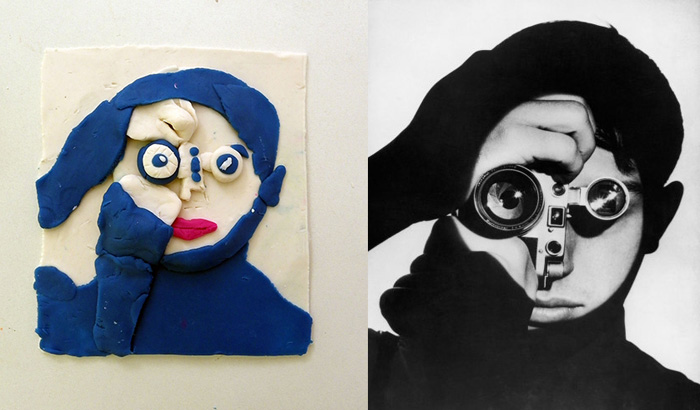
Points for creativity go to Eleanor Macnair, who recently launched the “Photographs rendered in Play-Doh” Tumblr. Given the name of the Tumblr, I probably don’t have to explain the concept. I think you get it. Above we have “Photographer Dennis Stock holds a camera in front of his face, 1955” — the original by Andreas Feininger (right), and the recreation by Ms. Macnair (left). Also on the Tumblr you’ll find, among others:
“Nan and Brian in Bed, New York City, 1983” by Nan Goldin (original — play doh)
“Dovima with elephants, evening dress by Dior, Cirque d’Hiver, August 1955” by Richard Avedon (original — play doh)
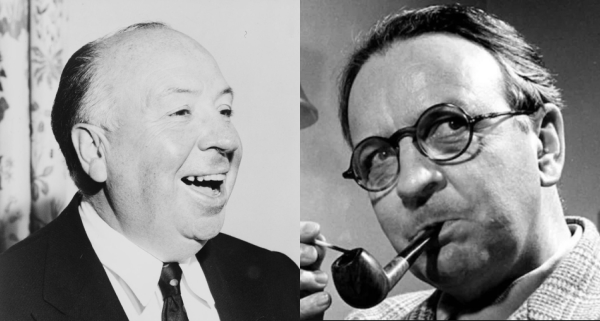
Alfred Hitchcock, like several other of the twentieth century’s best-known auteurs, made some of his most widely seen work by turning books into movies. Or rather, he hired other writers to turn these books into screenplays, which he then turned into movies — which, the way these things go, often bore little ultimate resemblance to their source material. In the case of his 1951 picture Strangers on a Train, based upon The Talented Mr. Ripley author Patricia Highsmith’s first novel of the same name, Hitchcock burned through a few such hired hands. First he engaged Whitfield Cook, whose treatment bolstered the novel’s homoerotic subtext. Then he importuned a series of the brightest living lights of American literature — Thornton Wilder, John Steinbeck, Dashiell Hammett — to have a go at the full screenplay, none of whom could bring themselves sign on to the job. Then along came the only respected “name” writer who could rise — or, given that many at first thought Highsmith’s novel tawdry, sink — to the job: Philip Marlowe’s creator, Raymond Chandler.
The Big Sleep author wrote and submitted a first draft of Strangers on a Train. Then a second. He would hear no feedback from the director except the message informing him of his firing. Hitchcock pursued “Shakespeare of Hollywood” Ben Hecht to come up with the next draft, but Hecht offered his young assistant Czenzi Ormonde instead. Together with Hitchcock’s wife and associate producer, Ormonde completely rewrote the script in less than three weeks. When Chandler later got hold of the film’s final script, he sent Hitchcock his assessment, as featured on Letters of Note:
December 6th, 1950
Dear Hitch,
In spite of your wide and generous disregard of my communications on the subject of the script of Strangers on a Train and your failure to make any comment on it, and in spite of not having heard a word from you since I began the writing of the actual screenplay—for all of which I might say I bear no malice, since this sort of procedure seems to be part of the standard Hollywood depravity—in spite of this and in spite of this extremely cumbersome sentence, I feel that I should, just for the record, pass you a few comments on what is termed the final script. I could understand your finding fault with my script in this or that way, thinking that such and such a scene was too long or such and such a mechanism was too awkward. I could understand you changing your mind about the things you specifically wanted, because some of such changes might have been imposed on you from without. What I cannot understand is your permitting a script which after all had some life and vitality to be reduced to such a flabby mass of clichés, a group of faceless characters, and the kind of dialogue every screen writer is taught not to write—the kind that says everything twice and leaves nothing to be implied by the actor or the camera. Of course you must have had your reasons but, to use a phrase once coined by Max Beerbohm, it would take a “far less brilliant mind than mine” to guess what they were.
Regardless of whether or not my name appears on the screen among the credits, I’m not afraid that anybody will think I wrote this stuff. They’ll know damn well I didn’t. I shouldn’t have minded in the least if you had produced a better script—believe me. I shouldn’t. But if you wanted something written in skim milk, why on earth did you bother to come to me in the first place? What a waste of money! What a waste of time! It’s no answer to say that I was well paid. Nobody can be adequately paid for wasting his time.
(Signed, ‘Raymond Chandler’)
Note that Chandler, ever the writer, points out his own “extremely cumbersome sentence” even as he summons so much vitriol for what he considers a lifeless script. As a longtime resident of Los Angeles by this point, and one who had already worked on the screenplays for The Blue Dahlia and Double Indemnity, he knew well the procedures of “the standard Hollywood depravity.” But nothing, to his mind, could excuse such “clichés,” “faceless characters,” and dialogue that “says everything twice and leaves nothing to be implied.” We could all, no matter what sort of work we do, learn from Chandler’s unwavering attention to his craft, and we’d do especially well to bear in mind his preemptive objection to the argument that, hey, at least he got a big check: “Nobody can be adequately paid for wasting his time.”
Before William Faulkner more or less defined the genre of Southern literature with his folksy short stories, tragicomic epic novels, and studies in the stream of damaged consciousness, he made a very sincere effort as a poet with a 1924 collection called The Marble Faun. Published in 500 copies with the assistance of his friend Phil Stone, who paid $400 dollars to get the work in print, Faulkner’s poetry did not go over well. Although later judgments have been kinder, the publisher called it “not really a very good book of poetry” and most of the print run was remaindered. The young Faulkner fared much better however with another of his early creative endeavors: art.
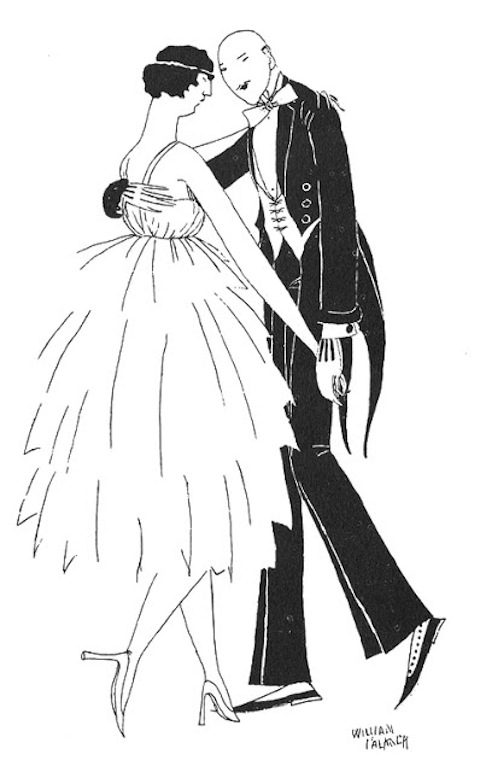
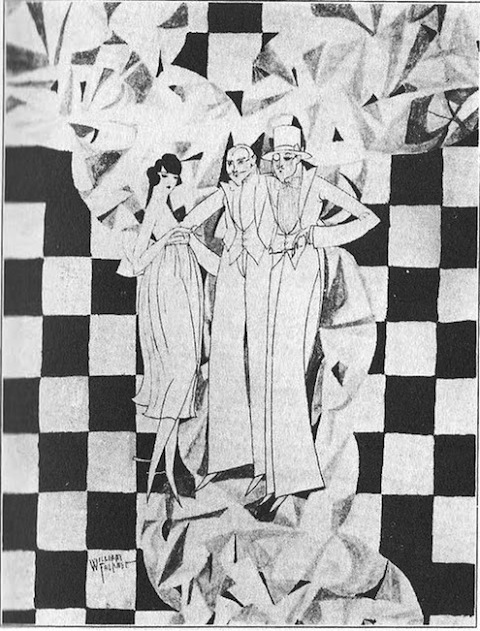
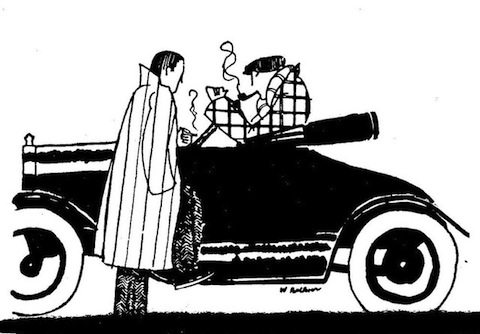
Between 1916 and 1925, the University of Mississippi—which Faulkner attended for three semesters before dropping out in 1920—paid him for drawings published in the university newspaper Ole Miss and its humor magazine The Scream. The drawings, like that of a dancing couple at the top, show the influence of jazz-age art-deco graphic illustration as well as that of English illustrator and aesthete Aubrey Beardsley (who gets a name-check in Faulkner’s 1936 novel Absalom, Absalom!). Beardsley’s influence seems especially evident in the drawing above, from a 1917–18 edition of Ole Miss.
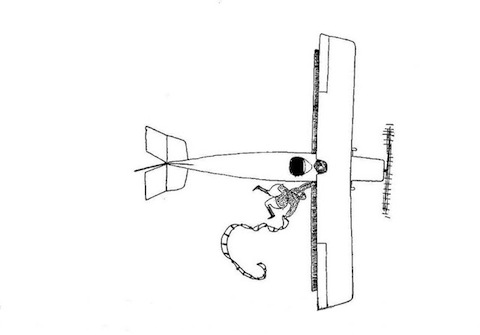
Many of Faulkner’s illustrations are much simpler cartoons, particularly those he did for The Scream, such as the 1925 drawing above of two men and a car. Even simpler, the line drawing of an airplane below recalls the author’s fascination with aviation, manifested in his failed attempt to join the U.S. Air Force, his successful acceptance into the R.A.F., and his non-Mississippi 1935 novel Pylon, about a rowdy crew of barnstormers in a fictionalized New Orleans called “New Valois.” You can see more of Faulkner’s drawings here and read his early prose and poetry in an out-of-print collection housed online at the Internet Archive, which has been now added to our collection of Free eBooks.
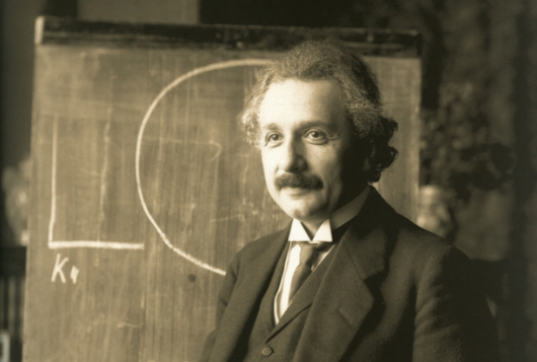
Albert Einstein’s activities as a passionate advocate for peace were well-documented during his lifetime. His celebrity as a famous physicist and one of the world’s most recognizable faces lent a great deal of weight to his pacifism, a view otherwise not given much consideration in the popular press at almost any time in history. However, according to a 2006 book titled Einstein on Race and Racism by Fred Jerome and Roger Taylor, the scientist was also as passionate about combating racism and segregation as he was about combating war. This facet of Einstein’s life was virtually ignored by the media, as was a visit he made in 1946 to Lincoln University in Pennsylvania, the first degree-granting college for African-Americans and the alma mater of Langston Hughes and Thurgood Marshall.
Invited to Lincoln to receive an honorary degree, Einstein gave a lecture on physics but also bluntly addressed the racial animus that held the country in its grip, reportedly calling racism, “a disease of white people” and saying he “did not intend to be quiet” about his opposition to segregation and racist public policy. Lest anyone think the Nobel-prize-winning physicist was pandering to his audience, the Harvard Gazette offers a comprehensive summary of Einstein’s support of progressive anti-racist causes, including his personal support of members of Princeton’s black community (he paid one man’s college tuition), a town Princeton native Paul Robeson once called “the northernmost town in the south.”
Einstein formed relationships with several prominent black leaders—inviting opera singer Marian Anderson to stay in his home after she was refused a room at the Nassau Inn and appearing as a character witness for W.E.B. Dubois when the latter stood accused of “failing to register as a foreign agent.” But it was his 20-year friendship with Robeson that seems central to his involvement in civil rights causes. The Harvard Gazette writes:
Einstein met Paul Robeson when the famous singer and actor came to perform at Princeton’s McCarter Theatre in 1935. The two found they had much in common. Both were concerned about the rise of fascism, and both gave their support to efforts to defend the democratically elected government of Spain against the fascist forces of Francisco Franco. Einstein and Robeson also worked together on the American Crusade to End Lynching, in response to an upsurge in racial murders as black soldiers returned home in the aftermath of World War II.
At the time of the Gazette article, 2007, a movie about Einstein and Robeson’s friendship was apparently in the works, with Danny Glover as Robeson and Ben Kingsley as Einstein. The project is apparently stalled, but with the upsurge in popular interest in the history of civil rights—with the overturning of the Voting Rights Act and the widespread coverage of the 50th anniversary of the March on Washington—perhaps the project will see new life soon. I certainly hope so.
The March on Washington for Jobs and Freedom, one of the largest human rights rallies in American history, took place 50 years ago today in Washington, D.C.. Martin Luther King Jr. spoke that day, delivering his famous “I Have a Dream” speech. Joan Baez sang “We Shall Overcome,” the anthem of the civil rights movement, while Bob Dylan performed “When the Ship Comes In” and Odetta sang “I’m On My Way.”
In 1964, the director James Blue released a documentary called The March. Produced under the auspices of the United States Information Agency, the film proved to be a “visually stunning, moving, and arresting documentary of the hope, determination, and camaraderie embodied by the demonstration.” And while the film initially sparked some controversy (read the account here), it has had a big impact on audiences inside and outside the US throughout the decades.
In 2008, The March was selected for preservation in the United States National Film Registry by the Library of Congress. To celebrate the 50th anniversary of the The March for Jobs and Freedom, the US National Archives has completed a full digital restoration of the film. You can watch it free above, or find it in the Free Documentaries section of our collection of 550 Free Movies Online.
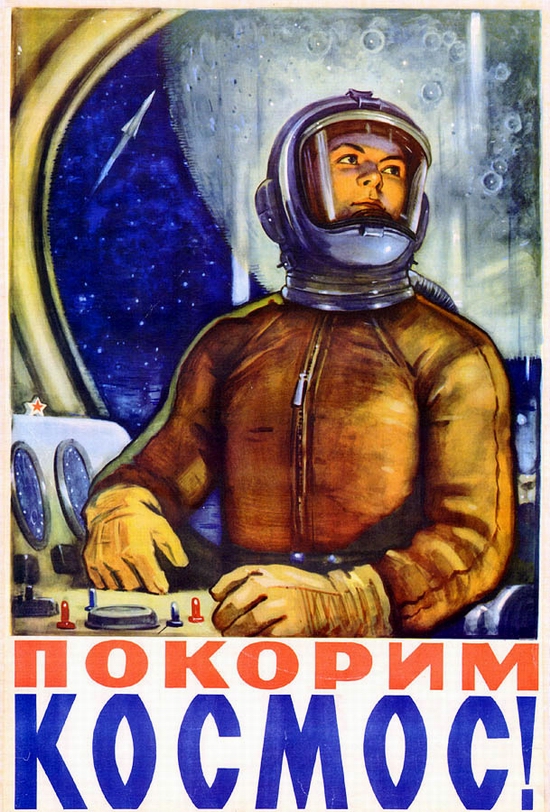
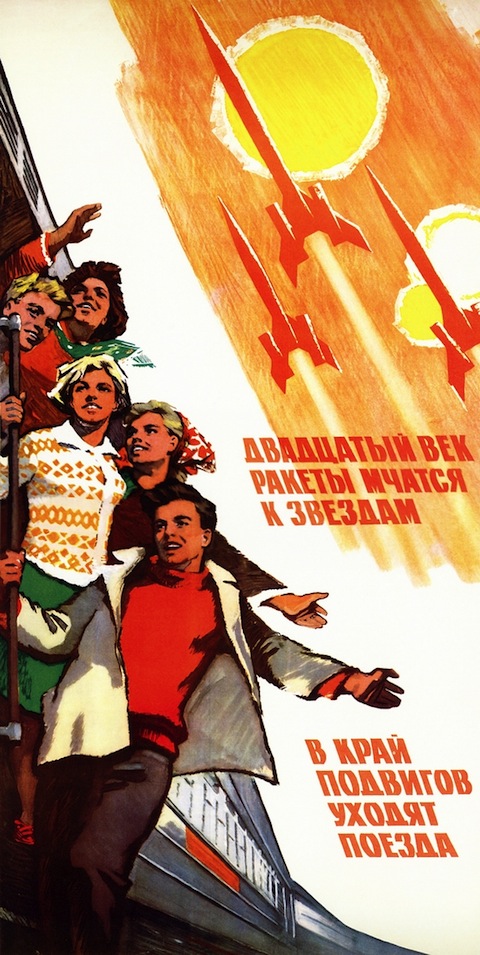
Walking around L.A. just yesterday, I noticed new banners emblazoned with illustrations touting subway stations now under construction. In bold, bright colors, they deliver clear, ambitious imagery of a bright future ahead: dedicated builders, focused students, noble working commuters, surging trains. Why, I thought, those look a bit like Soviet propaganda! I had no political comparisons in mind, only aesthetic ones, and this Retronaut post shows off many perfect examples of the Cold War-era Russian posters the Los Angeles Metro’s brought to my mind. They capture the imagination by exuding even more intense scientific, technological, educational, and social optimism — and doing so in even more visual detail — than I’d remembered.
And boy, speaking of ambition: “From student’s models to spaceships!” “To the Sun! To the stars!” “Glory to the conquerors of the universe!” Children inclined to accept these glorious slogans and the rapturous imagery they accompany could not possibly fail to believe that, thoroughly educated by their country, their generation would go on to usher in a new galaxy-spanning order of peace, prosperity, and socialism. Yet we in the rest of the world now know of the boredom, cynicism, and oppression that attended many Soviet citizens’ everyday lives. A Cold War-specialist college history professor of mine liked to tell a story about a trip to Moscow he took in the sixties, on which he kept seeing adolescents with nothing more productive to do than openly chugging vodka on street corners. Yet, seeing posters like these, you simply want to believe, just like I want to believe in the extension of Los Angeles’ subway — which, at times, seems about as plausible as the conquering of outer space.
“From student’s models to spaceships!”
“Glory to the workers of Soviet science and technology!”
“I am happy — this is my work joining the work of my republic”
“In the 20th century the rockets race to the stars”
“When you’re drowning,” John Lennon told Rolling Stone in 1970, “you don’t say, ‘I would be incredibly pleased if someone would have the foresight to notice me drowning and come and help me.’ You just scream.”
“Don’t Let Me Down” is Lennon’s anguished scream to his lover, Yoko Ono. When he and the Beatles recorded the song during the Let It Be sessions in late January of 1969, Lennon asked Ringo Starr to hit the cymbal very hard at the beginning, to “give me the courage to come screaming in.”
The Beatles were in the process of breaking apart when Lennon wrote the song. It was a dark time in my ways, and he was becoming more and more dependent upon Ono for personal and creative support. As Paul McCartney told writer Barry Miles in Many Years From Now:
It was a very tense period: John was with Yoko and had escalated to heroin and all the accompanying paranoias and he was putting himself out on a limb. I think that as much as it excited and amused him, at the same time it secretly terrified him. So ‘Don’t Let Me Down’ was a genuine plea, ‘Don’t let me down, please, whatever you do. I’m out on this limb, I know I’m doing all this stuff, just don’t let me down.’ It was saying to Yoko, ‘I’m really stepping out of line on this one. I’m really letting my vulnerability be seen, so you must not let me down.’ I think it was a genuine cry for help.
You can get a strong sense of Lennon’s anguish and vulnerability when you listen to the isolated vocal track above. And for the full arrangement, including Starr’s cymbal-crash near the beginning and Billy Preston’s brilliant electric piano playing, see below.
T.S. Eliot’s “The Love Song of J. Alfred Prufrock” contains some of the most unforgettable images in modern poetry: the “pair of ragged claws / Scuttling across the floors of silent seas”; the yellow fog that “rubs its back upon the window panes”; the evening “spread out against the sky / Like a patient etherized upon a table.” The poem’s sudden juxtapositions disrupted and dismantled the staid poetic conventions of its time. Like his beloved metaphysical model John Donne, Eliot pushed the resources of literary language to their outer extremes, while still maintaining a respectful relationship with traditional form, deploying Shakespearean pentameter lines whose music is deceptive, since they are the vehicles of such strange, neurotic content.
“Prufrock,” first published in 1915 in Poetry magazine—at the instigation of literary impresario Ezra Pound—caused a shock at its first appearance. Students today are apt to remember it as a bewildering swirl of references—to Dante, the Bible, Shakespeare—and as sardonic commentary on what Eliot saw as the profoundly enervated and impotent condition of modern man (and of himself). It is a daunting study, to be sure, but the poem’s first readers and critics tended to dismiss it as either shockingly anarchic or trivial and meandering.
By 1947, “Prufrock” was recognized as a modernist classic, and Harvard University recorded Eliot reading the poem (above). His thin voice may not carry the weight of the poem’s dense allusive grandeur, so we have Anthony Hopkins at the top of the post reading “Prufrock” as well. Hopkins seems to rush through the poem a bit, capturing, perhaps, the nervous energy of its title character’s psychic anguish.
We're hoping to rely on loyal readers, rather than erratic ads. Please click the Donate button and support Open Culture. You can use Paypal, Venmo, Patreon, even Crypto! We thank you!
Open Culture scours the web for the best educational media. We find the free courses and audio books you need, the language lessons & educational videos you want, and plenty of enlightenment in between.