John Coltrane Talks About the Sacred Meaning of Music in the Human Experience: Listen to One of His Final Interviews (1966)
A few years ago, the animated series Blank on Blank released a video with five minutes from one of John Coltrane’s last interviews in 1966, eight months before his death from liver cancer at age 40. In the excerpts, Coltrane tells interviewer Frank Kofsky, a Pacifica Reporter, about his intuitive approach to practicing, his switch to soprano sax, and his desire to “be a force for real good.” As juicy as these tidbits are for Coltrane fans, the full interview, above, is even better—an hour-long encounter with the jazz saint, who opens up to Kofsky in his relaxed, yet guarded way.
Coltrane chooses his words carefully. His refusal to elaborate is often its own subtle form of expression. During their opening banter, Kofsky asks him about seeing Malcolm X speak just before the latter’s death. Coltrane calls Malcolm “impressive” and leaves it at that. Kofsky then asks his first pointed question: “Some musicians have said that there’s a relationship between some of Malcom’s ideas and music, especially the new music. You think there’s anything in there?”
Kofsky had his own reasons for pushing this line. Just a few years later, he published Black Nationalism and the Revolution in Music in 1971. The book was reprinted with the more specific, less threatening, title John Coltrane and the Jazz Revolution of the 1960s. Both versions prominently feature Coltrane on the cover. “Dedicated to both John Coltrane and Malcolm X,” notes Soul Jazz Records, the book “places the revolutionary ‘new thing’ music and ideas of Coltrane, Albert Ayler and others in a wider context of 60’s radicalism, African American politics and history.”
An historian and academic who published several books on jazz, Kofsky isn’t subtle about his agenda, but Coltrane is unwilling to be pushed into a political corner, as fans have pointed out in discussions of this interview. He wants to embrace everything. “I think that music, being an expression of the human heart, or the human being itself,” he says, “does express just what is happening. It expresses the whole thing.” He consistently refuses to get drawn into a discussion of racial politics with Kofsky.
When they finally move on to talking about performance, the unflappable Coltrane stops demurring and opens up. We hear him describe his experience of being on stage at one concert as “too busy” to know what was happening in the audience, but the right audience can also be, he says, a participating member of the group. When Kofsky again pushes Coltrane on the relationship between his music and black nationalism, Coltrane coolly replies, “I have consciously made an attempt to change what I’ve found. In other words, I’ve tried to say, ‘this could be better, in my opinion, so I will try to do this to make it better.”
Coltrane’s knack for cutting to the heart of his purpose—to add to the world with his playing, without a need to control what happens afterwards—comes through in the entire hour-long interview. His reticence to engage with Kofsky’s analysis might have something to do with who was asking the questions, but in any case, there’s no doubt that Coltrane was integral to the fierce, uncompromising Black Arts poetry of the 1970s, and many other politically informed movements. He was influential, however, not as the representative of an ideology, but as the inventor—or the vessel, he might say—of an entirely new form of creative expression.
Related Content:
John Coltrane Performs A Love Supreme and Other Classics in Antibes (July 1965)
Read More...Stanley Kubrick’s Eyes Wide Shut, the Most Troubling Christmas Film Ever Made
Those in search of non-standard Christmas movies to watch this holiday season will have long since tired of hearing recommendations of Die Hard. While the cop-versus-terrorists hit that made Bruce Willis an action star does indeed feature an unusually high body count for a picture set at Christmastime, it adheres in other respects to the usual Hollywood contours. For serious Yuletide cinematic subversion you need the work of Stanley Kubrick, who made an entire career out of refusing to honor the expectations of genre. Specifically, you need the final work of Stanley Kubrick: Eyes Wide Shut, which adapts Arthur Schnitzler’s Dream Story, a novella of fin-de-siècle Vienna, into a vision of wealth, sex, and decadence — as well as secrecy and possible murder — in New York at the end of the millennium.
“The film was billed as an erotic thriller starring the two hottest — and, yes, married — actors, at the time,” says Wisecrack’s Jared Bauer in the video above. But since its release 20 years ago, “what was initially dismissed as a failed piece of erotica has proven, upon further inspection, to be something way deeper: an exploration of sociology, dreams, desire — and yes, sex — through the lens of New York City’s elite.”
It all begins when Tom Cruise’s well-to-do doctor Bill Harford hears his wife, played by Nicole Kidman, confess a fantasy she once had about another man. This sends him into an all-night journey into the sexual underworld, one designed to be experienced by the viewer, as Nerdwriter Evan Pucschak has argued, like an immersive virtual-reality experience, and one whose central themes manifest in every single scene.
Kubrick fills Eyes Wide Shut with prostitution, of both the obvious fur-coat-on-the-street-corner variety and its many subtler instantiations at every level of society as well. “At its deeply cynical core,” says Bauer, “the film asks the question: are we all somebody’s whore?” The video’s analysis draws heavily on “Introducing Sociology,” Tim Kreider’s analysis in Film Quarterly. Kreider writes that “almost everyone in this film prostitutes themselves, for various prices”: true on the surface level of the women at the occult masked orgy at which the doctor finds himself in the middle of the night, but just as true on a deeper level of Mr. and Mrs. Harford themselves. “The real pornography in this film,” according to Kreider, “is in its lingering depiction of the shameless, naked wealth of Millennial Manhattan, and of the obscene effect of that wealth on our society, and on the soul.”
It is in a toy store that the film, with what Bauer calls its “metaphor of Christmas as an orgy of consumption,” concludes. As their young daughter looks for things to buy, the Harfords discuss what to do about the revelatory experiences of the past two days. Kidman’s famous final line suggests that the couple is “doomed to repeat the same petty jealousies again and again, while potentially spending beyond their means — you know, the American Dream.” It also “connects to the title of the film, which evokes a sense of enlightened false consciousness. We may know that we’re being screwed over and controlled by the wealthy and powerful, but at least it’s Christmas and we can play with our toys, both commercial and sexual. So our eyes are firmly, deliberately shut, because that’s the only way to tolerate this world.” Kubrick has taken us a long way indeed from It’s a Wonderful Life, but perhaps we can consider the ever-greater resonance and relevance of Eyes Wide Shut his final Christmas gift to us.
Related Content:
Are Stanley Kubrick Films Like Immersive Video Games? The Case of Eyes Wide Shut
Discover the Life & Work of Stanley Kubrick in a Sweeping Three-Hour Video Essay
How Stanley Kubrick Became Stanley Kubrick: A Short Documentary Narrated by the Filmmaker
The Shining and Other Complex Stanley Kubrick Films Recut as Simple Hollywood Movies
Based in Seoul, Colin Marshall writes and broadcasts on cities, language, and culture. His projects include the book The Stateless City: a Walk through 21st-Century Los Angeles and the video series The City in Cinema. Follow him on Twitter at @colinmarshall or on Facebook.
Read More...“The Philosophy of “Flow”: A Brief Introduction to Taoism
“In the West,” the I Ching, or the Book of Changes, “is mainly known as a divination manual,” writes philosopher and novelist Will Buckingham, “part of the wild carnival of spurious notions that is New Age spirituality.” But just as one can use the Tarot as a means of reading the present, rather than predicting future events, so too can the I Ching serve to remind us, again and again, of a principle we are too apt to forget: the critical importance of non-action, or what is called wu wei in Chinese philosophy.
Non-action is not passivity, though it has been mischaracterized as such by cultures that overvalue aggression and self-assertion. It is a way of exercising power by attuning to the rhythms of its mysterious source. In the religious and philosophical tradition that became known as Taoism, non-action achieves its most canonical expression in the Tao Te Ching, the classic text attributed to sixth century B.C.E. thinker Laozi, who may or may not have been a real historical figure.
The Tao Te Ching describes non-action as a paradox in which dualistic tensions like passivity and aggression resolve.
That which offers no resistance,
Overcomes the hardest substances.
That which offers no resistance
Can enter where there is no space.
Few in the world can comprehend
The teaching without words, or
Understand the value of non-action.
Wu wei is sometimes translated as “effortless action” or the “action of non-action,” phrases that highlight its dynamic quality. Arthur Waley used the phrase “actionless activity” in his English version of the Tao Te Ching. In the short video introduction above, “philosophical entertainer” Einzelgänger explains “the practical sense” of wu wei in terms of that which athletes call “the zone,” a state of “action without striving” in which bodies “move through space effortlessly.” But non-action is also an inner quality, characterized by its depth and stillness as much as its strength.
Among the many symbols of wu wei is the action of water against stone—a graceful organic movement that “overcomes the hardest substances” and “can enter where there is no space.” The image illustrates what Einzelgänger explains in contemporary terms as a “philosophy of flow.” We cannot grasp the Tao—the hidden creative energy that animates the universe—with discursive formulas and definitions. But we can meet it through “stillness of mind, curbing the senses, being humble, and the cessation of striving, in order to open ourselves up to the workings of the universe.”
The state of “flow,” or total absorption in the present, has been popularized by psychologists in recent years, who describe it as the secret to achieving creative fulfillment. Non-action has its analogues in Stoicism’s amor fati, Zen’s “backward step,” and Henri Bergson’s élan vital. In the Tao te Ching, the Way appears as both a metaphysical, if enigmatic, philosophy and a practical approach to life that transcends our individual goals. It is an improvisatory practice which, like rivers carving out their beds, requires time and persistence to master.
In a story told by Taoist philosopher Zhuangzi, a renowned butcher is asked to explain his seemingly effortless skill at carving up an ox. He replies it is the product of years of training, during which he renounced the struggle to achieve, and came to rely on intuition rather than perception or brute force. Embracing non-action reveals to us the paths down which our talents naturally take us when we stop fighting with life. And it can show us how to handle what seem like insoluble problems by moving through, over, and around them rather than crashing into them head on.
Related Content:
Slavoj Žižek: What Fullfils You Creatively Isn’t What Makes You Happy
Josh Jones is a writer and musician based in Durham, NC. Follow him at @jdmagness
Read More...Meditation for Artists: Learn Moebius’ Meditative Technique Called “Automatic Drawing”
Meditation and art have an ancient, intertwined history in China, where the beginnings of Chan Buddhism are inseparable from landscape painting. In Japan, Zen art has constituted “a practice in appreciating simplicity,” of disappearing into the creative act, cultivating degrees of egolessness that allow an artist’s movements to become spontaneous and unhampered by second guesses. The “first Japanese artists to work in [ink],” notes the Metropolitan Museum of Art, “were Zen monks who painted in a quick and evocative manner.” They passed their techniques, and their wisdom, on to their students.
Perhaps the closest analogue to this tradition in the west is comic art. Artist Ted Gula has worked with comics legends Frank Frazetta and Moebius and drawn for Disney, Marvel, and DC. As a child, he watched Jack Kirby work. “He wouldn’t speak,” says Gula. “He’d be in a trance…. The pencil would hit the paper and it wouldn’t stop until the page was complete, like it poured out.” How is that possible? Gula asked himself, astonished. Kirby had disappeared into the work. There were no preliminary sketches or rough indicators. He would draw an entire book like that, Gula says in the video above from Proko.
Say what you will about the content of Kirby’s work—superhero comics aren’t to everyone’s liking. But no distaste for the nature of his storytelling diminishes Kirby’s attainment of a purely extemporaneous method he seems never to have explained to Gula in words. Later, however, while working with Moebius, Gula says, he learned the technique of “automatic drawing.” Demonstrating it for us above, Gula describes a way of drawing that shares much in common with other meditative visual art traditions.
“It’s all doing very organic shapes,” he says, showing us how to “draw your mind’s eye. This takes your mind, and your mind’s eye, to a place that normally is unexplored, and it can’t help but enhance your whole view of your ability.” The ego must step aside, executive functioning isn’t needed here. “I have no idea,” Gula says, “it’s all just happening on its own.” Moebius explained it as “just letting my mind relax” and Gula has observed similar practices among all the artists he’s worked with.
Gula describes automatic drawing as a natural process for the artist’s mind and hands. The interviewer, artist and teacher Sam Prokopenko, also mentions Korean artist Kim Jung Gi in their interview, who does “amazingly accurate drawings from his memory without any construction lines,” as Prokopenko says above, in a video from his “12 Days of Proko” series, which interviews well-known artists about their techniques. What’s Kim Jung Gi’s secret? Is he possessed of a superhuman, photographic memory? No, he tells Prokopenko.
The secret to becoming fully immersed in the work—one that surely goes for so many pursuits, both creative and athletic—is just to do it: over and over and over and over and over again. (To many people’s disappointment, this also seems to be the secret of meditation.) In Kim Jung Gi’s case, “of course, some part of it is a talent he was born with, but we can’t overlook how much that talent was developed.” We need no expert talent, either innate or developed, to get started. Automatic drawing seems to require a beginner’s mind.
Related Content:
Moebius Gives 18 Wisdom-Filled Tips to Aspiring Artists
Watch Moebius and Miyazaki, Two of the Most Imaginative Artists, in Conversation (2004)
Moebius’ Storyboards & Concept Art for Jodorowsky’s Dune
Josh Jones is a writer and musician based in Durham, NC. Follow him at @jdmagness
Read More...Music Is Truly a Universal Language: New Research Shows That Music Worldwide Has Important Commonalities

Photo by Jo Dusepo, via Wikimedia Commons
Henry Wadsworth Longfellow’s description of music as a universal language has become a well-worn cliché, usually uttered in a sentimental and not particularly serious way. Maybe this is why it doesn’t inspire a corresponding breadth of appreciation for the music of the world. We are conditioned and acculturated, it can seem, by formative experience to gravitate toward certain kinds of music. We can expand our tastes but that usually requires some careful study and acculturation.
In the sciences, the “universal language” hypothesis in music has been taken far more seriously, and, more recently, so has its critique. “In ethnomusicology,” notes the Universitat Wien’s Medienportal, “universality became something of a dirty word.” The diversity of world music is profound, as Kevin Dickinson writes at Big Think.
Katajjaq, or Inuit throat singing, expresses playfulness in strong, throaty expressions. Japan’s nogaku punctuates haunting bamboo flutes with the stiff punctuation of percussion. South of Japan, the Australian Aborigines also used winds and percussions, yet their didgeridoos and clapsticks birthed a distinct sound. And the staid echoes of medieval Gregorian chant could hardly be confused for a rousing track of thrash metal.
The idea that all of these kinds of music and thousands more are all the same in some way strikes many as “groundless or even offensive.” But even hardcore skeptics might be persuaded by papers published just last month in Science.
University of Vienna Cognitive Biologists W. Tecumseh Fitch and Tudor Popescu begin their article “The World in a Song” with a brief sketch of the history of “the empirical quest for musical universals.” The search began in Berlin in 1900, almost as soon as phonographs could be used to record music. The Nazis stamped out this research in Germany in the 1930s, though it flourished in the U.S.—in the work of Alan Lomax, for example. Yet “by the 1970s ethnomusicologists were discouraged from even discussing musical ‘universals.’ ”
Nonetheless, as a team of researchers led by Harvard’s Samuel Mehr show in their paper “Universality and Diversity in Human Song,” there are indeed universal musical qualities, though they manifest in some specific ways. Using the “tools of computational social science” to analyze a huge archive of audio recordings of world music, the researchers found that “identifiable acoustic features of songs (accent, tempo, pitch range, etc.) predict their primary behavioral context (love, healing, etc.).” Societies around the world use similar musical properties to accompany similar emotional contexts, in other words.
Moreover, the meta-analysis found that “melodic and rhythmic bigrams fall into power-law distributions” and “tonality is widespread, perhaps universal.” Focusing primarily on vocal song, since instrumentation varied too widely, the scientists tested “five sets of hypotheses about universality and variability in musical behavior and musical forms.” All of these analyses make use of ethnographic data. Critics might point out that such data is riddled with bias.
Ethnographers, from the purely academic to popular curators like Lomax, applied their own filters, choosing what to record and what to ignore based on their own assumptions about what matters in music. Nonetheless, Mehr and his co-authors write that they have adjusted for “sampling error and ethnographer bias, problems that have bedeviled prior tests.” Their methodology is rigorous, and their conclusions are backed by some dense analytics.
It would indeed seem from their exhaustive research that, in many respects, music is genuinely universal. The findings should not surprise us. Humans, after all, are biologically similar across the globe, with generally the same propensities for language learning and all the other things that humans universally do. Many previous comparative projects in history have used generalizations to create racial hierarchies and attempt to show the superiority of one culture or another. “Universality is a big word,” said Leonard Bernstein, “and a dangerous one”—a word beloved by empires throughout time.
But the data-driven approach used by the most recent studies adheres more closely to the science. Wide variation is a given, and several indicators show great “variability across cultures” when it comes to music, as the introduction to “Universality and Diversity in Human Song” acknowledges. Nonetheless, forms of music appear in every human society, accompanying ceremonies, rituals, and rites. Echoing the conclusions of modern genetics, the authors point out that “there is more variation in musical behavior within societies than between societies.” Read Mehr and his team’s study here.
via Big Think
Related Content:
Why Catchy Songs Get Stuck in Our Brains: New Study Explains the Science of Earworms
Josh Jones is a writer and musician based in Durham, NC. Follow him at @jdmagness
Read More...What the Great Pyramid of Giza Would’ve Looked Like When First Built: It Was Gleaming, Reflective White
The Great Pyramid at Giza—the oldest and most intact of the seven ancient wonders of the ancient world—became a potent symbol of the sublime in the 19th century, a symbol of power so absolute as to eclipse human understanding. After Napoleon’s first expedition to Giza, “Egytomania… swept through European culture and influenced the plastic arts, fashion, and design,” writes Miroslav Verner in The Pyramids: The Mystery, Culture, and Science of Egypt’s Great Monuments.
At the end of the century, Herman Melville satirized the trend that would eventually give rise to Ancient Aliens, asking in an 1891 poem, “Your masonry—and is it man’s? More like some Cosmic artisan’s.” Egyptomaniacs saw otherworldly magic in the pyramid. For Melville, it “usurped” nature’s greatness, standing as “evidence of humankind’s monumental will to power,” as Dawid W. de Villiers writes.

The ancient Greeks believed the pyramids were built with a massive slave labor force, a theory that has persisted. As Verner exhaustively argues in his book, however, they were not only built by humans—instead of aliens or gods—but they were constructed by tradesmen and artisans whose skills were in high demand and who were paid wages and organized under a complex bureaucracy.
And as you can see reconstructed in the Smithsonian video at the top, one of those artisanal tasks was to polish the monument’s outer limestone to a gleaming white finish that reflected “the powerful Egyptian sun with a dazzling glare.” Once the pyramid was completed, “it must have truly added to the impression of Giza as a magical port city, bathed in sunlight,” says archaeologist Mark Lehner in the clip.
In addition to its glowing, polished limestone sides, “the structure would have likely been topped with a pyramidion, a capstone made of solid granite and covered in a precious metal like gold,” writes Kottke. “No wonder they thought their rulers were gods.” Or did ancient Egyptians see the Great Pyramid as a masterpiece of human engineering, built with the skill and sweat of thousands of their compatriots?
Who can say. But it’s likely that 19th-century European explorers and artists might have characterized things differently had the Great Pyramid still scattered the sun over the desert like an ancient beacon of light instead of sitting “dumb,” as Melville wrote, stripped of its facade, waiting to have all sorts of mysterious meanings wrapped around it.
via Kottke
Related Content:
How the Egyptian Pyramids Were Built: A New Theory in 3D Animation
The Grateful Dead Play at the Egyptian Pyramids, in the Shadow of the Sphinx (1978)
Josh Jones is a writer and musician based in Durham, NC. Follow him at @jdmagness
Read More...For the First Time, Studio Ghibli’s Entire Catalog Will Soon Be Available for Digital Purchase
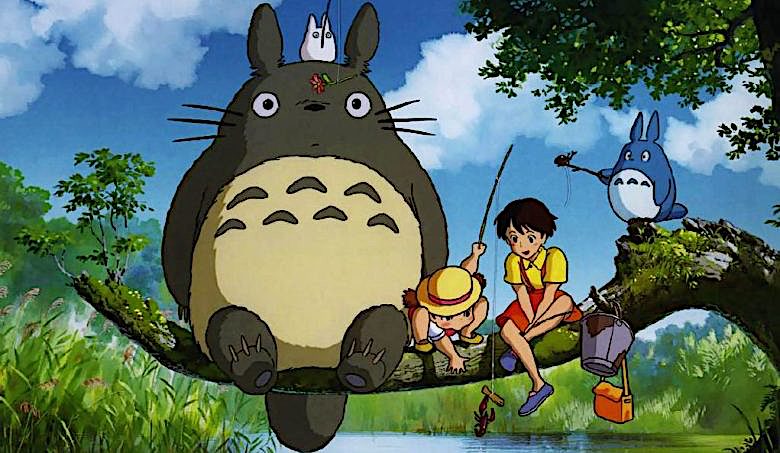
Some describe Studio Ghibli, the animation company founded by Hayao Miyazaki and Isao Takahata, as “the Japanese Disney.” That does justice to the true nature of neither Ghibli nor Disney, though both ventures have displayed an uncanny ability to produce beloved animated films — and beloved animated films that haven’t always been easy to see on demand. Just this past summer we featured the release of Ghibli’s Spirited Away in China, eighteen years after its premiere, but even in less politically sensitive territories, fans have had their challenges: finding a way to stream Ghibli movies, for instance, which (at least in North America) will become much easier on December 17th.
On that date, reports Variety’s Dave McNary, “GKids will release the entire Studio Ghibli catalog of animated films for digital purchase.” From Nausicaä of the Valley of the Wind and My Neighbor Totoro to From Up on Poppy Hill and The Tale of the Princess Kaguya, Ghibli’s films “will be available to purchase in both English and Japanese languages on all major digital transactional platforms.”
This marks “the first time the Studio Ghibli films will be available for digital purchase anywhere in the world,” including the studio’s homeland of Japan — a country, in any case, with a slightly different relationship to the internet than most, and one that tends to result in a preference for physical distribution over digital.
If you’ve never seriously watched Studio Ghibli’s films, don’t be fooled by the name GKids: the American distributor specializes in artisanal animation, mostly but not entirely Japanese (its catalog also includes Nina Paley’s Sita Sings the Blues), and those in charge there know full well the draw of Ghibli for demographics far beyond those still in childhood. One can fairly argue, in fact, that youngsters aren’t Ghibli’s primary audience; whereas Disney makes animation for kids that many grown-ups can enjoy, Ghibli in some sense does the opposite. The films of Miyazaki, Takahata, and Ghibli’s other stalwarts will thus make ideal material for the all-ages at-home movie marathons without which no holiday season is complete, seeing as their animated magic will arrive in the realm of on-demand not a moment too soon.
Related Content:
How the Films of Hayao Miyazaki Work Their Animated Magic, Explained in 4 Video Essays
Watch Hayao Miyazaki’s Beloved Characters Enter the Real World
Based in Seoul, Colin Marshall writes and broadcasts on cities and culture. He’s at work on a book about Los Angeles, A Los Angeles Primer, the video series The City in Cinema, and the crowdfunded journalism project Where Is the City of the Future? Follow him on Twitter at @colinmarshall or on Facebook.
Read More...Watch Life-Affirming Performances from David Byrne’s New Broadway Musical American Utopia
It’s time, writes Kim Stanley Robinson in his essay “Dystopia Now,” to put aside the dystopias. We know the future (and the present) can look bleak. “It’s old news now,” and “perhaps it’s self-indulgence to stay stuck in that place any more.” Of course, David Byrne has never been a dystopian artist. Even his catchy deconstructions of the banality of modern life, in “This Must Be the Place,” for example—or Love Lies Here, his disco musical about Imelda Marcos—are filled with empathetic poignancy and an earnest desire to rehumanize contemporary culture.
Still his oblique take on things has always seemed too skewed to call utopian. Lately, however, Byrne has become unambiguously sunny in his outlook, and not in any kind of starry-eyed Pollyannish way. His web project Reasons to Be Cheerful backs up its optimistic title with incisive longform investigative journalism.
His latest stage project, the musical American Utopia, which he performs with a cast of dancers and musicians from around the world, announces its intentions on the sleeves of the matching monochromatic suits its cast wears.
Barefoot and holding their instruments, Byrne and his backup singers, musicians, and dancers march on the “Road to Nowhere” with smiles hinting it might actually lead to someplace good, They perform this song (see them on Jimmy Fallon at the top), and a couple dozen more from Talking Heads and Byrne solo albums, especially last year’s American Utopia. In the course of the show, Byrne “lets his moralist outrage explode” yet “balances it with levity,” writes Stacey Anderson at Pitchfork. “There is a political engine to this performance… with a clearly humming progressive core… but Byrne’s goal is to urge kinder consideration of how we process the stressors of modernity.”
The musical doesn’t simply urge, it enacts, and proclaims, in spoken interludes, the story of an individual who opens up to the wider world. “Here’s a guy who’s basically in his head at the beginning,” Byrne told Rolling Stone. “And then by the end of the show he’s a very different person in a very different place.” The road to utopia, Byrne suggests, takes us toward community and out of isolation. American Utopia’s minimalist production communicates this idea with plenty of polished musicianship—especially from its six drummers working as one—but also a rigorous lack of spectacle. “I think audiences appreciate when nobody’s trying to fool them,” says Byrne.
See several performances from American Utopia, the musical, above, from The Tonight Show Starring Jimmy Fallon, Late Night with Stephen Colbert, and the Hudson Theatre, where it’s currently running. The musical debuted in England last June, causing NME to exclaim it may “just be the best live show of all time.” Its Broadway run has received similar acclaim. Below, see a trailer for the show arriving just in time, The Fader announces in a blurb, to “fight your cynicism.”
Related Content:
David Byrne Creates a Playlist of Eclectic Music for the Holidays: Stream It Free Online
Josh Jones is a writer and musician based in Durham, NC. Follow him at @jdmagness
Read More...The Cameraman’s Revenge (1912): The Truly Weird Origin of Modern Stop-Motion Animation
These days, ever more ambitions computer-animated spectacles seem to arrive in theaters every few weeks. But how many of them capture our imaginations as fully as works of the thoroughly analog art of stop-motion animation? The uncanny effect (and immediately visible labor-intensiveness) of real, physical puppets and objects made to move as if by themselves still captivates viewers young and old: just watch how the Wallace and Gromit series, Terry Gilliam’s Monty Python shorts, The Nightmare Before Christmas, and even the original King Kong as well as Ray Harryhausen’s monsters in Jason and the Argonauts and The 7th Voyage of Sinbad have held up over the decades.
The filmmakers who best understand the magic of cinema still use stop-motion today, as Wes Anderson has in The Fantastic Mr. Fox and Isle of Dogs. They all owe something to a Polish-Russian animator of the early-to-mid-20th century by the name of Ladislas Starevich. Longtime Open Culture readers may remember the works of Starevich previously featured here, including the Goethe adaptation The Tale of the Fox and the much earlier The Cameraman’s Revenge, a tale of infidelity and its consequences told entirely with dead bugs for actors. Starevich, then the Director of the Museum of Natural History in Kaunas, Lithuania, pulled off this cinematic feat “by installing wheels and strings in each insect, and occasionally replacing their legs with plastic or metal ones,” says Phil Edwards in the Vox Almanac video above.
“How Stop Motion Animation Began” comes as a chapter of a miniseries called Almanac Hollywouldn’t, which tells the stories of “big changes to movies that came from outside Hollywood.” It would be hard indeed to find anything less Hollywood than a man installing wheels and strings into insect corpses at a Lithuanian museum in 1912, but in time The Cameraman’s Revenge proved as deeply influential as it remains deeply weird. Starevich kept on making films, and singlehandedly furthering the art of stop-motion animation, until his death in France (where he’d relocated after the Russian Revolution) in 1965.
And though Starevich may not be a household name today, Edwards reveals while tracing the subsequent history of stop-motion animation that cinema hasn’t entirely failed to pay him tribute: Anderson’s The Fantastic Mr. Fox is in a sense a direct homage to The Tale of the Fox, and Gilliam has called Starevich’s work “absolutely breathtaking, surreal, inventive and extraordinary, encompassing everything that Jan Svankmajer, Walerian Borowczyk and the Quay Brothers would do subsequently.” He suggests that, before we enter the “mind-bending worlds” of more recent animators, we “remember that it was all done years ago, by someone most of us have forgotten about now” — and with little more than a few dead bugs at that.
Related Content:
The Mascot, a Pioneering Stop Animation Film by Wladyslaw Starewicz
The History of Stop-Motion Films: 39 Films, Spanning 116 Years, Revisited in a 3‑Minute Video
Ray Harryhausen’s Creepy War of the Worlds Sketches and Stop-Motion Test Footage
Based in Seoul, Colin Marshall writes and broadcasts on cities, language, and culture. His projects include the book The Stateless City: a Walk through 21st-Century Los Angeles and the video series The City in Cinema. Follow him on Twitter at @colinmarshall or on Facebook.
Read More...Neuroscience & Jazz Improvisation: How Improvisation Shapes Creativity and What Happens Inside Our Brain
Jazz improvisation has become a hot topic in neuroscience lately, and little wonder. “Musical improvisation is one of the most complex forms of creative behavior,” write the authors of a study published in April in Brain Connectivity. Research on the brains of improvisers offers “a realistic task paradigm for the investigation of real-time creativity”—an even hotter topic in neuroscience.
Researchers study jazz players for the same reason they take MRI scans of the brains of freestyle rappers—both involve creating spontaneous works “where revision is not possible,” and where only a few formal rules govern the activity, whether rhyme and meter or chord structure and harmony. Those who master the basics can leap into endlessly complex feats of improvisatory bravado at any moment.
It’s a power most of us only dream of possessing—though it’s also the case that many a researcher of jazz improvisations also happens to be a musician, including study author Martin Norgaard, a trained jazz violinist who “began studying the effects of musical improvisation… while earning his Ph.D. from the University of Texas at Austin,” notes Jennifer Rainey Marquez at Georgia State University Research Magazine.
Norgaard interviewed both students and professional musicians, and he analyzed the solos of Charlie Parker to find patterns related to specific kinds of brain activity. In this recent study, Norgaard, now at Georgia State University, worked with Mukesh Dhamala, associate professor of physics and astronomy, using an fMRI to measure the brain activity of “advanced jazz musicians” who sang both standards and improvisations while being scanned.
The researchers’ findings are consistent with similar studies, like those of John Hopkins surgeon Charles Limb, who also considers jazz a key to understanding creativity. While improvising, musicians show decreased activity in the prefrontal cortex, the area of the brain that generates planning and overthinking, and gets in the way of what psychologists call a state of “flow.” Improvising might engage “a smaller, more focused brain network,” says Norgaard, “while other parts of the brain go quiet.”
Training and practice in improvisation may also have longer-term results as well. A study contrasting the brain activity of jazz and classical players found that the former were much quicker and more adaptable in their thinking. The researchers attributed these qualities to changes in the brain wrought by years of improvising. Norgaard and his team are much more circumspect in their conclusions, but they do suggest a causal link.
In a study of 155 8th graders enrolled in a jazz for kids program, Norgaard found that the half who were given training in improvisation showed “significant improvement in cognitive flexibility.” Research like this not only validates the intuitions of jazz musicians themselves; it also helps define specific questions about the cognitive benefits of playing music, which are generally evident in study after study.
“For nearly three decades,” Norgaard says, “scientists have explored the idea that learning to play an instrument is linked to academic achievement.” But there are “many types of music learning.” It’s certainly not as simple as studying Bach to work on accuracy or Coltrane for flexibility, but different kinds of music creates different structures in the brain. We might next wonder about the mathematical properties of these structures, or how they interact with modern theories of physics. Rest assured, there are jazz-playing scientists out there working on the question.
Related Content:
This is Your Brain on Jazz Improvisation: The Neuroscience of Creativity
Josh Jones is a writer and musician based in Durham, NC. Follow him at @jdmagness.
Read More...Support Us
We're hoping to rely on loyal readers, rather than erratic ads. Please click the Donate button and support Open Culture. You can use Paypal, Venmo, Patreon, even Crypto! We thank you!

About Us

Open Culture scours the web for the best educational media. We find the free courses and audio books you need, the language lessons & educational videos you want, and plenty of enlightenment in between.
Advertise With Us
FREE UPDATES!
GET OUR DAILY EMAIL
Get the best cultural and educational resources on the web curated for you in a daily email. We never spam. Unsubscribe at any time.
FOLLOW ON SOCIAL MEDIA
Open Culture editor Dan Colman scours the web for the best educational media. He finds the free courses and audio books you need, the language lessons & movies you want, and plenty of enlightenment in between.
Advertise With Us


