The Word “Robot” Originated in a Czech Play in 1921: Discover Karel Čapek’s Sci-Fi Play R.U.R. (a.k.a. Rossum’s Universal Robots)
When I hear the word robot, I like to imagine Isaac Asimov’s delightfully Yiddish-inflected Brooklynese pronunciation of the word: “ro-butt,” with heavy stress on the first syllable. (A quirk shared by Futurama’s crustacean Doctor Zoidberg.) Asimov warned us that robots could be dangerous and impossible to control. But he also showed young readers—in his Norby series of kids’ books written with his wife Janet—that robots could be heroic companions, saving the solar system from cosmic supervillains.
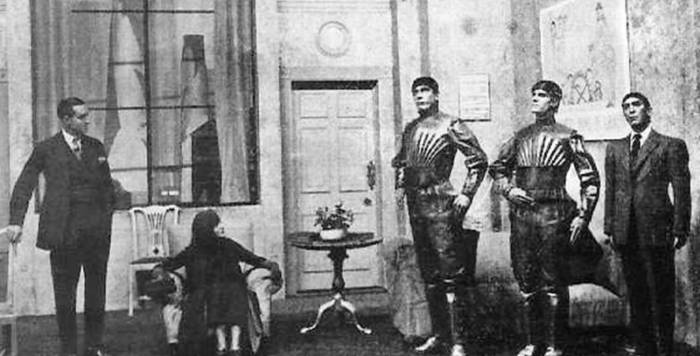
The word robot conjures all of these associations in science fiction: from Blade Runner’s replicants to Star Trek’s Data. We might refer to these particular examples as androids rather than robots, but this confusion is precisely to the point. Our language has forgotten that robots started in sci-fi as more human than human, before they became Asimov-like machines. Like the sci-fi writer’s pronunciation of robot, the word originated in Eastern Europe in 1921, the year after Asimov’s birth, in a play by Czech intellectual Karel Čapek called R.U.R., or “Rossum’s Universal Robots.”
The title refers to the creations of Mr. Rossum, a Frankenstein-like inventor and possible inspiration for Metropolis’s Rotwang (who was himself an inspiration for Dr. Strangelove). Čapek told the London Saturday Review after the play premiered that Rossum was a “typical representative of the scientific materialism of the last [nineteenth] century,” with a “desire to create an artificial man—in the chemical and biological, not mechanical sense.”
Rossum did not wish to play God so much as “to prove God to be unnecessary and absurd.” This was but one stop on “the road to industrial production.” As technology analyst and Penn State professor John M. Jordan writes at the MIT Press Reader, Čapek’s robots were not appliances become sentient, nor trusty, superpowered sidekicks. They were, in fact, invented to be slaves.
The robot… was a critique of mechanization and the ways it can dehumanize people. The word itself derives from the Czech word “robota,” or forced labor, as done by serfs. Its Slavic linguistic root, “rab,” means “slave.” The original word for robots more accurately defines androids, then, in that they were neither metallic nor mechanical.
Jordan describes this history in an excerpt from his book Robots, part of the MIT Press Essential Knowledge Series, and a timelier than ever intervention in the cultural and technological history of robots, who walk (and moonwalk) among us in all sorts of machine forms, if not quite yet in the sense Čapek imagined. But a Blade Runner-like scenario seemed inevitable to him in a society ruled by “utopian notions of science and technology.”
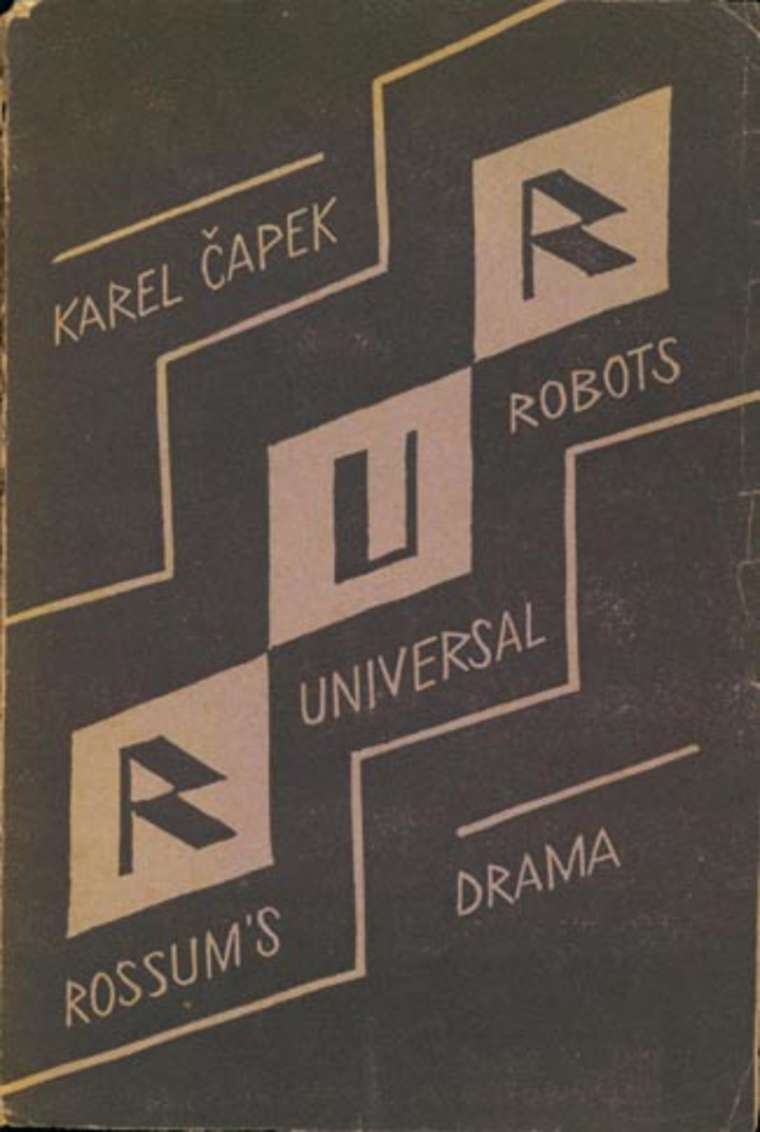
In the time he imagines, he says, “the product of the human brain has escaped the control of human hands.” Čapek has one character, the robot Radius, make the point plainly:
The power of man has fallen. By gaining possession of the factory we have become masters of everything. The period of mankind has passed away. A new world has arisen. … Mankind is no more. Mankind gave us too little life. We wanted more life.
Sound familiar? While R.U.R. owes a “substantial” debt to Mary Shelley’s Frankenstein, it’s also clear that Čapek contributed something original to the critique, a vision of a world in which “humans become more like their machines,” writes Jordan. “Humans and robots… are essentially one and the same.” Beyond the surface fears of science and technology, the play that introduced the word robot to the cultural lexicon also introduced the darker social critique in most stories about them: We have reason to fear robots because in creating them, we’ve recreated ourselves; then we’ve treated them the way we treat each other.
You can find the text of Čapek’s play in book format on Amazon.
via Boing Boing
Related Content:
Isaac Asimov Explains His Three Laws of Robots
Twerking, Moonwalking AI Robots–They’re Now Here
The Robots of Your Dystopian Future Are Already Here: Two Chilling Videos Drive It All Home
Josh Jones is a writer and musician based in Durham, NC. Follow him at @jdmagness
Read More...How Walter Murch Revolutionized the Sound of Modern Cinema: A New Video Essay Explores His Innovations in American Graffiti, The Godfather & More
Walter Murch, perhaps the most famed film editor alive, is acclaimed for the work he’s done for directors like Francis Ford Coppola, George Lucas, and Anthony Minghella. As innovative and influential as his ways for putting images together have been, Murch has done just as much for cinema as a sound designer. In the video above Evan Puschak, better known as the Nerdwriter, examines Murch’s soundcraft through what Murch calls “worldizing,” which Filmsound.org describes as “manipulating sound until it seemed to be something that existed in real space.” This involves “playing back existing recordings through a speaker or speakers in real-world acoustic situations,” recording it, and using that recording on the film’s soundtrack.
In other words, Murch pioneered the technique of not just inserting music into a movie in the editing room, but re-recording that music in the actual spaces in which the characters hear it. Mixing the original, “clean” recording of a song with that song as re-recorded in the movie’s space — a dance hall, an outdoor wedding, a dystopian underground warren — has given Murch a greater degree of control over the viewer’s listening experience. In some shots he could let the viewer hear more of the song itself by prioritizing the original song; in others he could prioritize the re-recorded song and let the viewer hear the song as the characters do, with all the sonic characteristics contributed by the space — or, if you like, the world — around them.
Puschak uses examples of Murch’s worldizing from American Graffiti and The Godfather, and notes that he first used it in Lucas’ debut feature THX 1138. But he also discovered an earlier attempt by Orson Welles to accomplish the same effect in Touch of Evil, a film Murch re-edited in 1998. What Welles had not done, says Murch in an interview with Film Quarterly, “was combine the original recording and the atmospheric recording. He simply positioned a microphone, static in an alleyway outside Universal Sound Studios, re-recording from a speaker to the microphone through the alleyway. He didn’t have control over the balance of dry sound versus reflected sound, and he didn’t have the sense of motion that we got from moving the speaker and moving the microphone relative to one another.”
Doing this, Murch says, “creates the sonic equivalent of depth of field in photography. We can still have the music in the background, but because it’s so diffuse, you can’t find edges to focus on and, therefore, focus on the dialogue which is in the foreground.” In all earlier films besides Welles’, “music was just filtered and played low, but it still had its edges,” making it hard to separate from the dialogue. These days, as Puschak points out, anyone with the right sound-editing software can perform these manipulations with the click of a mouse. No such ease in the 1970s, when Murch had to not only execute these thoroughly analog, labor-intensive processes, but also invent them in the first place. As anyone who’s looked and listened closely to his work knows, that audiovisual struggle made Murch experience and work with cinema in a richly physical way — one that, as generations of editors and sound designers come up in wholly digital environments, may not exist much longer.
Related Content:
How the Sounds You Hear in Movies Are Really Made: Discover the Magic of “Foley Artists”
Based in Seoul, Colin Marshall writes and broadcasts on cities, language, and culture. His projects include the book The Stateless City: a Walk through 21st-Century Los Angeles and the video series The City in Cinema. Follow him on Twitter at @colinmarshall or on Facebook.
Read More...How the Psychedelic Mellotron Works: An In-Depth Demonstration
Recorded music history is filled with instruments that appeared for a brief time, then were never heard from again—relegated to the dustbin of too-quirky, heavy, awkward, tonally-unpleasant, or impossible-to-tune-and-maintain. Then there are instruments—once they assumed their basic shape and form—that have persisted largely unchanged for centuries. The Mellotron falls into neither of these categories. But it may in time transcend them both in a strange way.
“Of all of the strange instruments that’ve worked the edges of popular music,” writes Gareth Branwyn at Boing Boing, “the Mellotron is probably the oddest. Basically an upright organ cabinet filled the tape heads and recorded tape strips that you trigger through the keyboard, the Mellotron is like some crazy one-off contraption that caught on and actually got manufactured.”
First made in England in 1963, it appeared in various models throughout the seventies and eighties. It has reappeared in the nineties and 2000s in improved and upgraded versions, all leading up to what Sound on Sound called “the most technologically sophisticated Mellotron ever,” the 2007 M4000. In the video above Allison Stout from Bell Tone Synth Works, a music shop in Philadelphia, PA, demonstrates a much earlier, far less advanced M400 from 1976.
Not only did the Mellotron beat the odds of remaining an unworkable prototype; the proto-sampler became a psychedelic signature: from “Strawberry Fields Forever” to the Moody Blues and David Bowie’s “Space Oddity.” It populated early prog rock, thanks to Yes’s Rick Wakeman, who played on Bowie’s space rock classic in 1969, and to Ian McDonald, who fell for the instrument that same year as a founding member of King Crimson. (See enthusiastic YouTuber “Doctor Mix” play Mellotron parts from well-known songs above.)
The instrument’s slightly cheesy, Lawrence-Welk-orchestra-like sounds somehow fit perfectly with the loose, spacious instrumentation of prog and psych rock; its sound will live as long as the music of The Beatles, Bowie, and everyone else who put a microphone in front of a Mellotron. Yet in most of its iterations, the Mellotron has lacked the characteristics of a melodic instrument that survives the test of time. It is finicky and prone to frequent breakdowns. It is limited in its tonal range to a series of tape recordings of a limited number of instruments.
In the case of the Mellotron M400 at the top, those instruments are violin, flute, and cello. Do the sounds coming from the Mellotron in any way improve upon or even approximate the qualities of their originals? Of course not. Why would musicians choose to record with a Mellotron at a time when analogue synthesizers were becoming affordable, portable, and capable of an expressive range of tones? The answer is simple. Nothing else makes the weird, warm, warbly, whirring, and entirely otherworldly sound of a Mellotron, and nothing ever will.
Related Content:
Visit an Online Collection of 61,761 Musical Instruments from Across the World
Josh Jones is a writer and musician based in Durham, NC. Follow him at @jdmagness
Read More...Jim Lehrer’s 16 Rules for Practicing Journalism with Integrity
In 1988, stalwart PBS news anchor, writer, and longtime presidential debate moderator Jim Lehrer was accused of being too soft on the candidates. He snapped back, “If somebody wants to be entertained, they ought to go to the circus.” The folksy quote sums up the Texan journalist’s philosophy succinctly. The news was a serious business. But Lehrer, who passed away last Thursday, witnessed the distinction between political journalism and the circus collapse, with the spread of cable infotainment, and corporate domination of the Internet and radio.
Kottke remarks that Lehrer seemed “like one of the last of a breed of journalist who took seriously the integrity of informing the American public about important events.” He continually refused offers from the major networks, hosting PBS’s MacNeil-Lehrer Newshour with cohost Robert MacNeil until 1995, then his own in-depth news hour until his retirement in 2011. “I have an old-fashioned view that news is not a commodity,” he said. “News is information that’s required in a democratic society… That sounds corny, but I don’t care whether it sounds corny or not. It’s the truth.”
To meet such high standards required a rigorous set of journalistic… well, standards—such as Lehrer was happy to list, below, in a 1997 report from the Aspen Institute.
- Do nothing I cannot defend.*
- Do not distort, lie, slant, or hype.
- Do not falsify facts or make up quotes.
- Cover, write, and present every story with the care I would want if the story were about me.*
- Assume there is at least one other side or version to every story.*
- Assume the viewer is as smart and caring and good a person as I am.*
- Assume the same about all people on whom I report.*
- Assume everyone is innocent until proven guilty.
- Assume personal lives are a private matter until a legitimate turn in the story mandates otherwise.*
- Carefully separate opinion and analysis from straight news stories and clearly label them as such.*
- Do not use anonymous sources or blind quotes except on rare and monumental occasions. No one should ever be allowed to attack another anonymously.*
- Do not broadcast profanity or the end result of violence unless it is an integral and necessary part of the story and/or crucial to understanding the story.
- Acknowledge that objectivity may be impossible but fairness never is.
- Journalists who are reckless with facts and reputations should be disciplined by their employers.
- My viewers have a right to know what principles guide my work and the process I use in their practice.
- I am not in the entertainment business.*
In a 2006 Harvard commencement address (at the top), Lehrer reduced the list to only the nine rules marked by asterisks above by Kottke, who goes on to explain in short why these guidelines are so routinely cast aside—“this shit takes time! And time is money.” It’s easier to patch together stories in rapid-fire order when you don’t cite or check sources or do investigative reporting, and face no serious consequences for it.
Lehrer’s adherence to professional ethics may have been unique in any era, but his attention to detail and obsession with accessing multiple points of view came from an older media. He “saw himself as ‘a print/word person at heart’ and his program as a kind of newspaper for television,” writes Robert McFadden in his New York Times obituary. He was also “an oasis of civility in a news media that thrived on excited headlines, gotcha questions and noisy confrontations.”
Lehrer understood that civility is meaningless in the absence of truth, or of kindness and humility. His longtime cohost’s list of journalistic guidelines also appears in the Aspen Institute report. “The values which Jim Lehrer and I observed,” MacNeil writes, “he continues to observe.” Journalism is a serious business—“behave with civility”—but “remember that journalists are no more important to society than people in other professions. Avoid macho posturing and arrogant display.”
Read more about Lehrer’s list of guidelines at Kottke.
Related Content:
Journalism Under Siege: A Free Course from Stanford Explores the Imperiled Freedom of the Press
Journalistic Ethics: A Free Online Course from UCLA
Josh Jones is a writer and musician based in Durham, NC. Follow him at @jdmagness
Read More...How Humans Domesticated Cats (Twice)
Depending on how you feel about cats, the feline situation on the island of Cyprus is either the stuff of a delightful children’s story or a horror film to be avoided at all cost.
Despite being surrounded on all sides by water, the cat population—an estimated 1.5 million—currently outnumbers human residents. The overwhelming majority are feral, though as we learn in the above episode of PBS’ EONS, they, too, can be considered domesticated. Like the other 600,000,000-some living members of Felis Catus on planet Earth—which is to say the type of beast we associate with litterboxes, laser pointers, and Tender Vittles—they are descended from a single subspecies of African wildcat, Felis Silvestris Lybica.
While there’s no single narrative explaining how cats came to dominate Cyprus, the story of their global domestication is not an uncommon one:
An ancient efficiency expert realized that herding cats was a much better use of time than hunting them, and the idea quickly spread to neighboring communities.
Kidding. There’s no such thing as herding cats (though there is a Chicago-based cat circus, whose founder motivates her skateboard-riding, barrel-rolling, high-wire-walking stars with positive reinforcement…)
Instead, cats took a commensal path to domestication, lured by their bellies and celebrated curiosity.
Ol’ Felis (Felix!) Silvestris (Sufferin’ Succotash!) Lybica couldn’t help noticing how human settlements boasted generous supplies of food, including large numbers of tasty mice and other rodents attracted by the grain stores.
Her inadvertent human hosts grew to value her pest control capabilities, and cultivated the relationship… or at the very least, refrained from devouring every cat that wandered into camp.
Eventually, things got to the point where one 5600-year-old specimen from northwestern China was revealed to have died with more millet than mouse meat in its system—a pet in both name and popular sentiment.
Chow chow chow.
Interestingly, while today’s house cats’ gene pool leads back to that one sub-species of wild mackerel-tabby, it’s impossible to isolate domestication to a single time and place.
Both archeological evidence and genome analysis support the idea that cats were domesticated both 10,000 years ago in Southwest Asia… and then again in Egypt 6500 years later.
At some point, a human and cat traveled together to Cyprus and the rest is history, an Internet sensation and an if you can’t beat em, join em tourist attraction.
Such high end island hotels as Pissouri’s Columbia Beach Resort and TUI Sensatori Resort Atlantica Aphrodite Hills in Paphos have started catering to the ever-swelling numbers of uninvited, four-legged locals with a robust regimen of healthcare, shelter, and food, served in feline-specific tavernas.
An island charity known as Cat P.A.W.S. (Protecting Animals Without Shelter) appeals to visitors for donations to defray the cost of neutering the massive feral population.
Sometimes they even manage to send a furry Cyprus native off to a new home with a foreign holidaymaker.
Related Content:
A New Photo Book Documents the Wonderful Homemade Cat Ladders of Switzerland
Ayun Halliday is an author, illustrator, theater maker and Chief Primatologist of the East Village Inky zine. Join her in NYC on Monday, February 3 when her monthly book-based variety show, Necromancers of the Public Domain celebrates New York, The Nation’s Metropolis (1921). Follow her @AyunHalliday.
Read More...When Salvador Dali Met Sigmund Freud, and Changed Freud’s Mind About Surrealism (1938)
The close associations between Surrealism and Freudian psychoanalysis were liberally encouraged by the most famous proponent of the movement, Salvador Dalí, who considered himself a devoted follower of Freud. We don’t have to wonder what the founder of psychoanalysis would have thought of his self-appointed protégé.
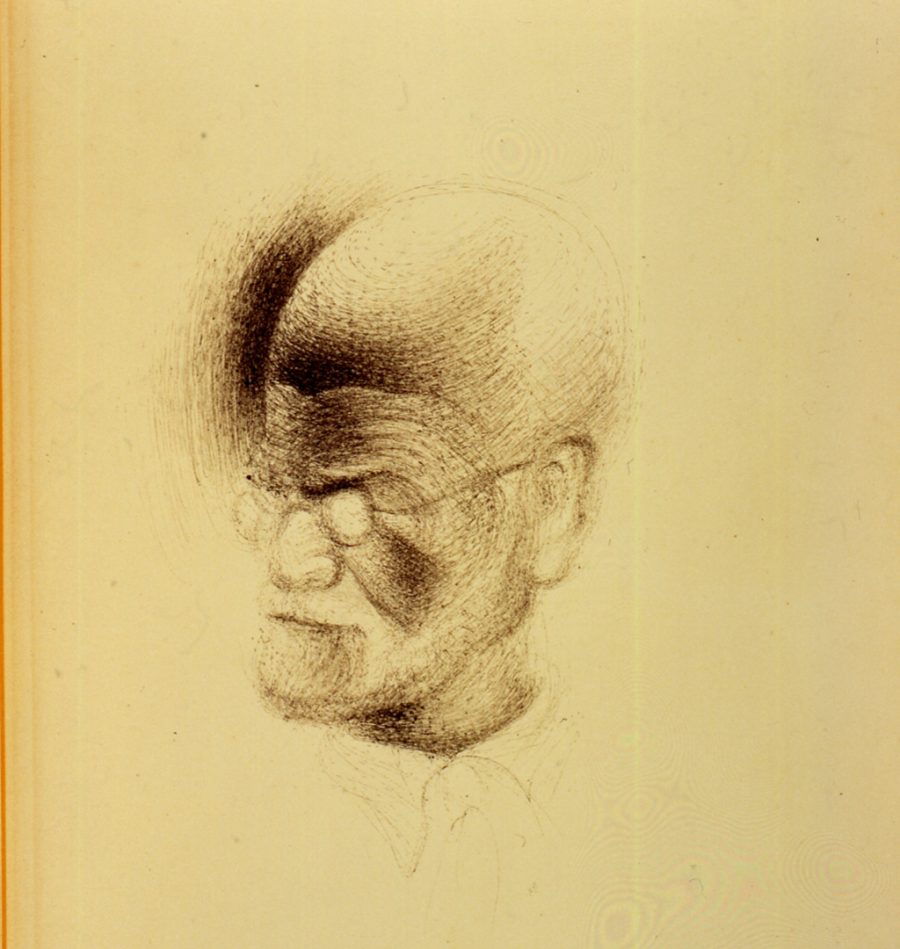
We have them recording, in their own words, their impressions of their one and only meeting—which took place in July of 1938, at Freud’s home in London. Freud was 81, Dali 34. We also have sketches Dali made of Freud while the two sat together. Their memories of events, shall we say, differ considerably, or at least they seemed totally bewildered by each other. (Freud pronounced Dali a “fanatic.”)
In any case, There’s absolutely no way the encounter could have lived up to Dali’s expectations, as the Freud Museum London notes:
[Dalí] had already travelled to Vienna several times but failed to make an introduction. Instead, he wrote in his autobiography, he spent his time having “long and exhaustive imaginary conversations” with his hero, at one point fantasizing that he “came home with me and stayed all night clinging to the curtains of my room in the Hotel Sacher.”
Freud was certainly not going to indulge Dalí’s peculiar fantasies, but what the artist really wanted was validation of his work—and maybe his very being. “Dali had spent his teens and early twenties reading Freud’s works on the unconscious,” writes Paul Gallagher at Dangerous Minds, “on sexuality and The Interpretation of Dreams.” He was obsessed. Finally meeting Freud in ’38, he must have felt “like a believer might feel when coming face-to-face with God.”

He brought with him his latest painting The Metamorphosis of Narcissus, and an article he had published on paranoia. This, especially, Dali hoped would gain the respect of the elderly Freud.
Trying to interest him, I explained that it was not a surrealist diversion, but was really an ambitiously scientific article, and I repeated the title, pointing to it at the same time with my finger. Before his imperturbable indifference, my voice became involuntarily sharper and more insistent.
On being shown the painting, Freud supposedly said, “in classic paintings I look for the unconscious, but in your paintings I look for the conscious.” The comment stung, though Dali wasn’t entirely sure what it meant. But he took it as further evidence that the meeting was a bust. Sketching Freud in the drawing below, he wrote, “Freud’s cranium is a snail! His brain is in the form of a spiral—to be extracted with a needle!”
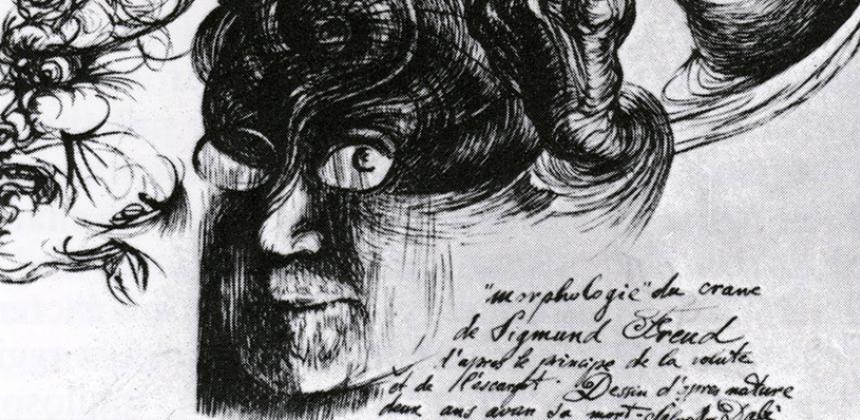
One might see why Freud was suspicious of Surrealists, “who have apparently chosen me as their patron saint,” he wrote to Stefan Zweig, the mutual friend who introduced him to Dali. In 1921, poet and Surrealist manifesto writer André Breton “had shown up uninvited on [Freud’s] doorstep.” Unhappy with his reception, Breton published a “bitter attack,” calling Freud an “old man without elegance” and later accused Freud of plagiarizing him.
Despite the memory of this nastiness, and Freud’s general distaste for modern art, he couldn’t help but be impressed with Dali. “Until then,” he wrote to Zweig, “I was inclined to look upon the surrealists… as absolute (let us say 95 percent, like alcohol), cranks. That young Spaniard, however, with his candid and fanatical eyes, and his undeniable technical mastery, has made me reconsider my opinion.”
Related Content:
The Famous Break Up of Sigmund Freud & Carl Jung Explained in a New Animated Video
Josh Jones is a writer and musician based in Durham, NC. Follow him at @jdmagness
Read More...The First Real Museum of Philosophy Prepares to Launch: See the Museo della Filosofia in Milan
You’ve almost certainly been to more art museums than you can remember, and more than likely to a few museums of natural history, science, and technology as well. But think hard: have you ever set foot inside a museum of philosophy? Not just an exhibition dealing with philosophers or philosophical concepts, but a single institution dedicated wholly to putting the practice of philosophy itself on display. Your answer can approach a yes only if you spent time in Milan last November, and more specifically at the University of Milan, in whose halls the Museo della Filosofia set up shop and proved its surprisingly untested — and surprisingly successful — concept.
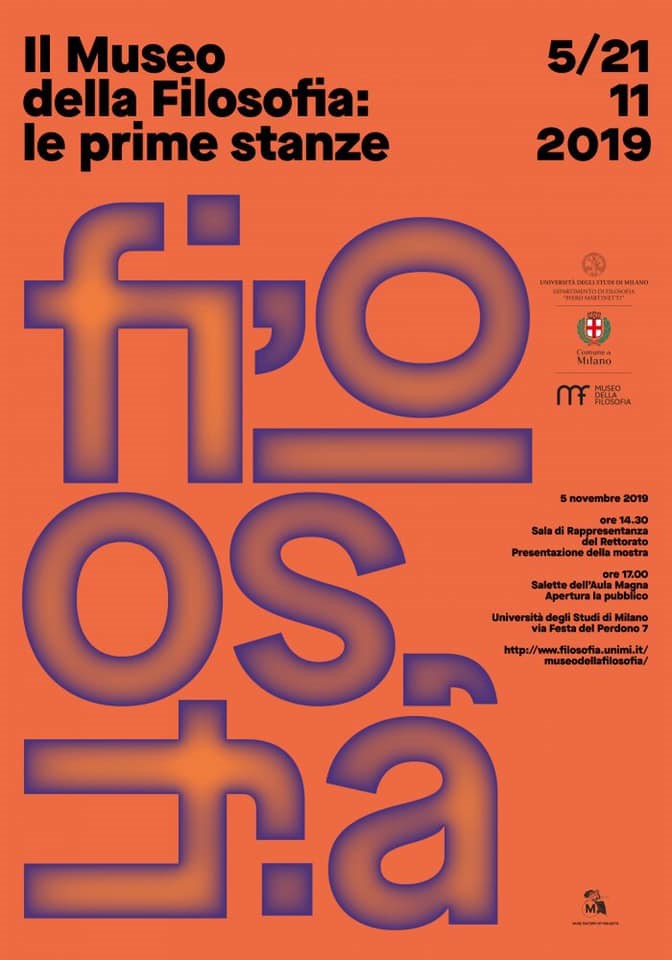
“What we had in mind was not an historically-minded museum collecting relics about the lives and works of important philosophers, but something more dynamic and interactive,” writes University of Milan postdoctoral research fellow Anna Ichino at Daily Nous, “where philosophical problems and theories become intuitively accessible through a variety of games, activities, experiments, aesthetic experiences, and other such things.”
In the first hall, “we used images like Mary Midgely’s ‘conceptual plumbing’ or Wittgenstein’s ‘fly bottle’ to convey the idea according to which philosophical problems are in important respects conceptual problems, which amount to analyzing concepts that we commonly use in unreflective ways.”
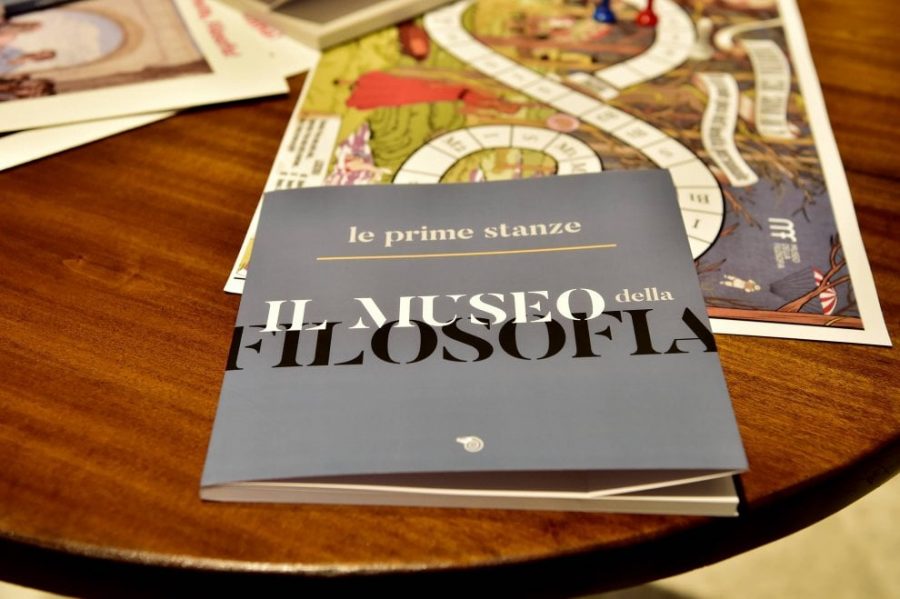
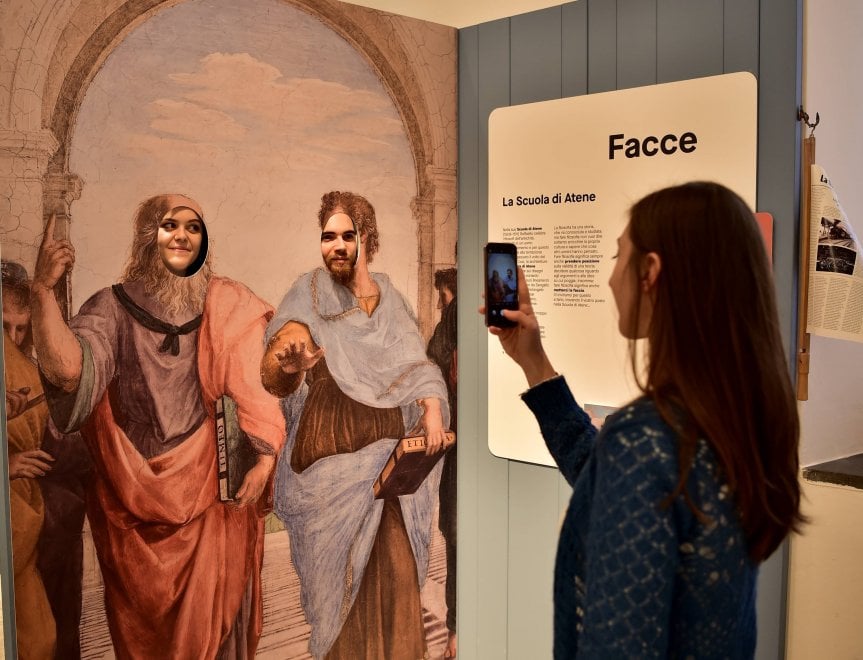
In the second hall, visitors to the Museo della Filosofia “could literally play with paradoxes and thought experiments in order to appreciate their heuristic role in philosophical inquiry.” The experiences available there ranged from using an oversized deck of cards to “solve” paradoxes, the perhaps inevitable demonstration of the well-known “trolley problem” using a model railroad set, and — most harrowing of all — the chance to “eat chocolates shaped as cat excrement” straight from the litter box. Then came the “School of Athens” game, “in which visitors had to decide whether to back Plato or Aristotle; then they could also take a souvenir picture portraying themselves in the shoes (and face!) of one or the other.”
In the third, “programmatic” hall, the museum’s organizers “presented the plan for what still needs to be done,” a to-do list that includes finding a permanent home. Before it does so, you can have a look at the project’s web site as well as its pages on Facebook and Instagram. At the top of the post appears a short video introducing the Museo della Filosofia which, like the rest of the materials, is for the moment in Italian only, but it nevertheless gets across even to non-Italian-speakers a certain idea of the experience a philosophical museum can deliver. Philosophical thinking, after all, occurs prior to language. Or maybe it’s inextricably tied up with language; different philosophers have approached the problem differently. And when the Museo della Filosofia opens for good, you’ll be able to visit and approach a few philosophical problems yourself. Read more about the museum at Daily Nous.
Related Content:
Free Online Philosophy Courses
The History of Philosophy Visualized
A Data Visualization of Modern Philosophy, 1950–2018
Philosophy Explained With Donuts
Watch a 2‑Year-Old Solve Philosophy’s Famous Ethical “Trolley Problem” (It Doesn’t End Well)
Based in Seoul, Colin Marshall writes and broadcasts on cities, language, and culture. His projects include the book The Stateless City: a Walk through 21st-Century Los Angeles and the video series The City in Cinema. Follow him on Twitter at @colinmarshall or on Facebook.
Read More...
Can You Spot Liars Through Their Body Language? A Former FBI Agent Breaks Down the Clues in Non-Verbal Communication
Can you spot a liar? We all know people who think they can, and very often they claim to be able to do so by reading “body language.” Clearing one’s throat, touching one’s mouth, crossing one’s arms, looking away: these and other such gestures, they say, indicate on the part of the speaker a certain distance from the truth. In the WIRED “Tradecraft” video above, however former FBI special agent Joe Navarro more than once pronounces ideas about such physical lie indicators “nonsense.” And having spent 25 years working to identify people presenting themselves falsely to the world — “my job was to catch spies,” he says — he should know, at the very least, what isn’t a tell.
Not that all the throat-clearing and arm-crossing doesn’t indicate something. Navarro calls such behaviors “self-soothers,” physical actions we use to pacify ourselves in stressful moments. Of course, even if self-soothers provide no useful information about whether a person is telling the truth, that doesn’t mean they provide no useful information at all.
But Navarro’s career has taught him that actions decisively indicating deception are much more specific, and without relevant knowledge completely illegible: take the suspected spy he had under surveillance who gave the game away just by leaving a flower shop holding a bouquet facing not upward but downward, “how they carry flowers in eastern Europe.”
For the most part, detecting a liar requires a great deal of what Navarro calls “face time,” a necessity when it comes to observing the full range of and patterns in an individual’s forms of non-verbal communication. In the video he analyzes footage of a poker game, the kind of setting that heightens our awareness of such non-verbal communication. At the table we all know to put on a “poker face” and shut our mouths, but even when we say nothing, Navarro emphasizes, we’re constantly transmitting a high quantity of information about ourselves. Whatever the setting, it comes through in how we dress, how we walk, how we carry ourselves — especially if we think it doesn’t. In the eyes of those who know how to interpret this information, all the world becomes a poker game.
Navarro is the author of two books on this subject: The Dictionary of Body Language: A Field Guide to Human Behavior and What Every Body Is Saying: An Ex-FBI Agent’s Guide to Speed-Reading People. For a contrarian point of view that challenges the idea that we can ever read people accurately, see Malcolm Gladwell’s new book, Talking to Strangers: What We Should Know about the People We Don’t Know.
Related Content:
How to Spot Bullshit: A Primer by Princeton Philosopher Harry Frankfurt
Based in Seoul, Colin Marshall writes and broadcasts on cities, language, and culture. His projects include the book The Stateless City: a Walk through 21st-Century Los Angeles and the video series The City in Cinema. Follow him on Twitter at @colinmarshall or on Facebook.
Read More...Fellini’s Fantastic TV Commercials for Barilla, Campari & More: The Italian Filmmaker Was Born 100 Years Ago Today
To help celebrate the 100th anniversary of the birth of the great Italian filmmaker Federico Fellini, we present a series of lyrical television advertisements made during the final decade of his life.
In 1984, when he was 64 years old, Fellini agreed to make a miniature film featuring Campari, the famous Italian apéritif. The result, Oh, che bel paesaggio! (“Oh, what a beautiful landscape!”), shown above, features a man and a woman seated across from one another on a long-distance train.
The man (played by Victor Poletti) smiles, but the woman (Silvia Dionisio) averts her eyes, staring sullenly out the window and picking up a remote control to switch the scenery. She grows increasingly exasperated as a sequence of desert and medieval landscapes pass by. Still smiling, the man takes the remote control, clicks it, and the beautiful Campo di Miracoli (“Field of Miracles”) of Pisa appears in the window, embellished by a towering bottle of Campari.
“In just one minute,” writes Tullio Kezich in Federico Fellini: His Life and Work, “Fellini gives us a chapter of the story of the battle between men and women, and makes reference to the neurosis of TV, insinuates that we’re disparaging the miraculous gifts of nature and history, and offers the hope that there might be a screen that will bring the joy back. The little tale is as quick as a train and has a remarkably light touch.”
Also in 1984, Fellini made a commercial titled Alta Societa (“High Society”) for Barilla rigatoni pasta (above). As with the Campari commercial, Fellini wrote the script himself and collaborated with cinematographer Ennio Guarnieri and musical director Nicola Piovani. The couple in the restaurant were played by Greta Vaian and Maurizio Mauri. The Barilla spot is perhaps the least inspired of Fellini’s commercials. Better things were yet to come.
In 1991 Fellini made a series of three commercials for the Bank of Rome called Che Brutte Notti or “The Bad Nights.” “These commercials, aired the following year,” writes Peter Bondanella in The Films of Federico Fellini, “are particularly interesting, since they find their inspiration in various dreams Fellini had sketched out in his dream notebooks during his career.”
In the episode above, titled “The Picnic Lunch Dream,” the classic damsel-in-distress scenario is turned upside down when a man (played by Paolo Villaggio) finds himself trapped on the railroad tracks with a train bearing down on him while the beautiful woman he was dining with (Anna Falchi) climbs out of reach and taunts him. But it’s all a dream, which the man tells to his psychoanalyst (Fernando Rey). The analyst interprets the dream and assures the man that his nights will be restful if he puts his money in the Banco di Roma.
The other commercials (watch here) are called “The Tunnel Dream” and “The Dream of the Lion in the Cellar.” (You can watch Roberto Di Vito’s short, untranslated film of Fellini and his crew working on the project here.)
The bank commercials were the last films Fellini ever made. He died a year after they aired, at age 73. In Kezich’s view, the deeply personal and imaginative ads amount to Fellini’s last testament, a brief but wondrous return to form. “In Federico’s life,” he writes, “these three commercial spots are a kind of Indian summer, the golden autumn of a patriarch of cinema who, for a moment, holds again the reins of creation.”
If you would like to support the mission of Open Culture, consider making a donation to our site. It’s hard to rely 100% on ads, and your contributions will help us continue providing the best free cultural and educational materials to learners everywhere. You can contribute through PayPal, Patreon, and Venmo (@openculture). Thanks!
Note: An earlier version of this post appeared on our site in 2012.
Related Content:
Fellini’s Three Bank of Rome Commercials, the Last Thing He Did Behind a Camera (1992)
Watch All of the Commercials That David Lynch Has Directed: A Big 30-Minute Compilation
Ingmar Bergman’s 1950s Soap Commercials Wash Away the Existential Despair
Read More...
Discover the Apprehension Engine: Brian Eno Called It “the Most Terrifying Musical Instrument of All Time”
Apart from the occasional Blair Witch Project, scary movies need scary scores. But much like making a genuinely scary movie, composing genuinely scary music becomes more of a challenge all the time. By now, even the most timid moviegoers among us have surely grown inured to the throbbing bass, the tense strings, and all the other standard, increasingly clichéd instrumental techniques used to generate a sense of ominousness. Given the ever-growing pressure to come up with more effectively dread-inducing music, the invention of the Apprehension Engine was surely inevitable. A part of the studio of film composer Mark Korven, it looks unlike any other musical instrument in existence, and sounds even more so.
With a normal instrument, says Korven in the Great Big Story Video above, “you’re expecting it to have a sound that is pleasing.” But with the Apprehension Engine, “the goal is to just produce sounds that, in this case, are disturbing.” What we hear is less music than a sonic approximation of the abyss itself, which somehow emerges from his manipulation of a variety of strings, bars, wheels, and bows attached to a wooden box — as analog a device as one would ever encounter in the 21st century. “I originally commissioned the Apprehension Engine because I was tired of the same digital samples, which resulted in a lot of sameness,” says Korven. “I was looking for something more experimental, more acoustic, that would give me a little more of an original sound.”
Luthier Tony Duggan-Smith rose to the challenge of crafting the Apprehension Engine. “You’re dealing with things that stir primal emotions and feelings,” says Duggan-Smith of the sound of the instrument. Korven thinks of it as “not music in the traditional sense at all,” but “it definitely evokes emotion, so I would call it music.” In a composition career more than three decades long, Korven has learned a thing or two about how to evoke emotion with sound. His best-known work so far is the score of Robert Eggers’ The Witch, which no less a horror and suspense connoisseur than Stephen King has named as one of his favorite movies of all time. “The Witch scared the hell out of me,” King tweeted. “And it’s a real movie, tense and thought-provoking as well as visceral.” And as the guitar-playing, music-loving King understands, we react to nothing more viscerally than that which we hear.
Though the first Apprehension Engine was built by its very nature as a unique instrument, it hasn’t remained a one-off. The first Apprehension Engine begat an improved second version, or “V2,” and now, according to the instrument’s official site, “there is an official V2+ model which we are ready to produce in small numbers.” Upgrades include custom magnetic pickups, a “Hurdy Gurdy mechanism,” and your choice of two different mounting locations for the reverb tank. A handmade Apprehension Engine of your own won’t come cheap, and all production runs will no doubt sell out as quickly as the first one did, but if you need to strike true horror into the hearts of your listeners, can you afford not to consider what Brian Eno, no stranger to the outer limits of sonic possibility, has called “the most terrifying musical instrument of all time”?
Related Content:
The Strange, Sci-Fi Sounds of Skating on Thin Black Ice
Meet the World’s Worst Orchestra, the Portsmouth Sinfonia, Featuring Brian Eno
Based in Seoul, Colin Marshall writes and broadcasts on cities, language, and culture. His projects include the book The Stateless City: a Walk through 21st-Century Los Angeles and the video series The City in Cinema. Follow him on Twitter at @colinmarshall or on Facebook.
Read More...Support Us
We're hoping to rely on loyal readers, rather than erratic ads. Please click the Donate button and support Open Culture. You can use Paypal, Venmo, Patreon, even Crypto! We thank you!

About Us

Open Culture scours the web for the best educational media. We find the free courses and audio books you need, the language lessons & educational videos you want, and plenty of enlightenment in between.
Advertise With Us
FREE UPDATES!
GET OUR DAILY EMAIL
Get the best cultural and educational resources on the web curated for you in a daily email. We never spam. Unsubscribe at any time.
FOLLOW ON SOCIAL MEDIA
Open Culture editor Dan Colman scours the web for the best educational media. He finds the free courses and audio books you need, the language lessons & movies you want, and plenty of enlightenment in between.
Advertise With Us

