The Books We Can Use to Rebuild Civilization, Selected by Neal Stephenson, Brian Eno, Tim O’Reilly & More

With so many of us across the world stuck at home, humanity’s thoughts have turned to what we’ll do when we can resume our normal lives. This time of quarantine, lockdown, and other forms of isolation urges us to reflect, but also to read — and in many cases to read the important books we’d neglected in our pre-coronavirus lives. Quite a few such volumes appear in the Long Now Foundation’s “Manual for Civilization,” which longtime Open Culture readers will remember us featuring not long after it launched in 2014. Its name refers to a library, one that according to the Foundation’s executive director Alexander Rose “will include the roughly 3500 books most essential to sustain or rebuild civilization.”
“Using this as an curatorial principle,” Rose adds, “is helping us assemble a very interesting collection of books.” So too are their choices of people asked for recommendations of books to put on the Manual for Civilization’s shelves.
Take, for instance, the history-focused list of books provided by Snow Crash, Cryptonomicon, and The Baroque Cycle author Neal Stephenson, a prolific writer in his own right:
- Decline and Fall of the Roman Empire, Volumes 1–6 by Edward Gibbon
- The Odyssey by Homer translated by Robert Fagles
- The Iliad by Homer translated by Robert Fagles
- The Structures of Everyday Life: Civilization & Capitalism, 15th-18th Century, Volumes 1–3 by Fernand Braudel
- 1491: New Revelations of the Americas Before Columbus by Charles C. Mann
- Newton’s Principia for the Common Reader by S. Chandrasekhar
- Leviathan: Or the Matter, Forme, and Power of a Commonwealth Ecclesiasticall and Civil by Thomas Hobbes
- The American Practical Navigator: An Epitome of Navigation by Nathaniel Bowditch
- Pax Britannica: A Three Volume Set (Heaven’s Command, Pax Britannica, and Farewell the Trumpets) by James Morris
- Son Of The Morning Star: Custer and the Little Bighorn by Evan S. Connell
- The Siege at Peking by Peter Fleming
- Marlborough, His Life & Times, Volumes 1–6 by Winston Churchill
- The Making of the Atomic Bomb by Richard Rhodes
- Dark Sun: The Making of the Hydrogen Bomb by Richard Rhodes
- The Road to Reality: A Complete Guide to the Laws of the Universe by Roger Penrose
The Long Now Foundation didn’t just approach Stephenson because they enjoy his novels: he was previously involved with the Foundation’s “Clock of the Long Now” project, a mechanical clock engineered to keep time for 10,000 years and thus serve as a physical reminder of the necessity of long-term thinking. The process of coming up with ideas for the Clock provided Stephenson with inspiration for his novel Anathem, which deals with monastic communities of intellectuals dedicated to safeguarding knowledge against the collapse of society.
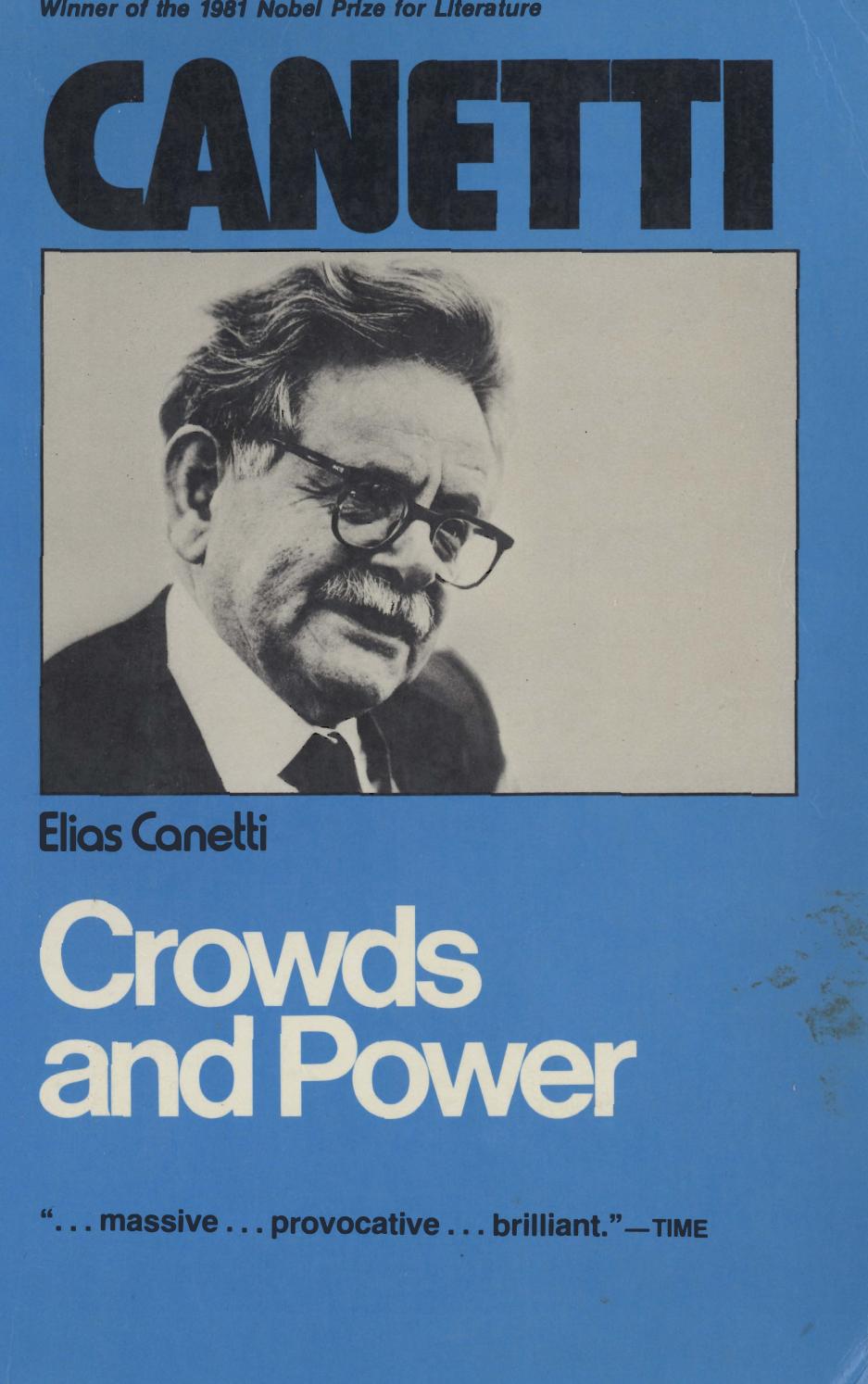
Music producer and visual artist Brian Eno’s album January 07003 / Bell Studies for The Clock of The Long Now also came out of his own work on the Clock, and as a founding member of the Long Now Foundation he naturally also had a list of books (previously featured here on Open Culture) rich with historical, political, philosophical, sociological, architectural, literary, and aesthetic texts to contribute:
- Seeing Like a State by James C Scott
- The Mind in the Cave: Consciousness and the Origins of Art by David Lewis-Williams
- Crowds and Power by Elias Canetti
- The Wheels of Commerce by Fernand Braudel
- Keeping Together in Time by William McNeill
- Dancing in the Streets by Barbara Ehrenreich
- Roll Jordan Roll by Eugene Genovese
- A Pattern Language by Christopher Alexander et al
- The Face of Battle by John Keegan
- A History of the World in 100 Objects by Neil MacGregor
- Contingency, Irony and Solidarity by Richard Rorty
- The Notebooks by Leonardo da Vinci
- The Confidence Trap by David Runciman
- The Discoverers by Daniel Boorstein
- Mother Nature: A History of Mothers, Infants, and Natural Selection by Sarah Hrdy
- War and Peace by Leo Tolstoy
- The Cambridge World History of Food (2‑Volume Set) by Kenneth F. Kiple & Kriemhild Coneè Ornelas
- The Illustrated Flora of Britain and Northern Europe by Marjorie Blamey & Christopher Grey Wilson
- Printing and the Mind of Man by John Carter & Percy Muir
- Peter the Great: His Life and World by Richard Massie
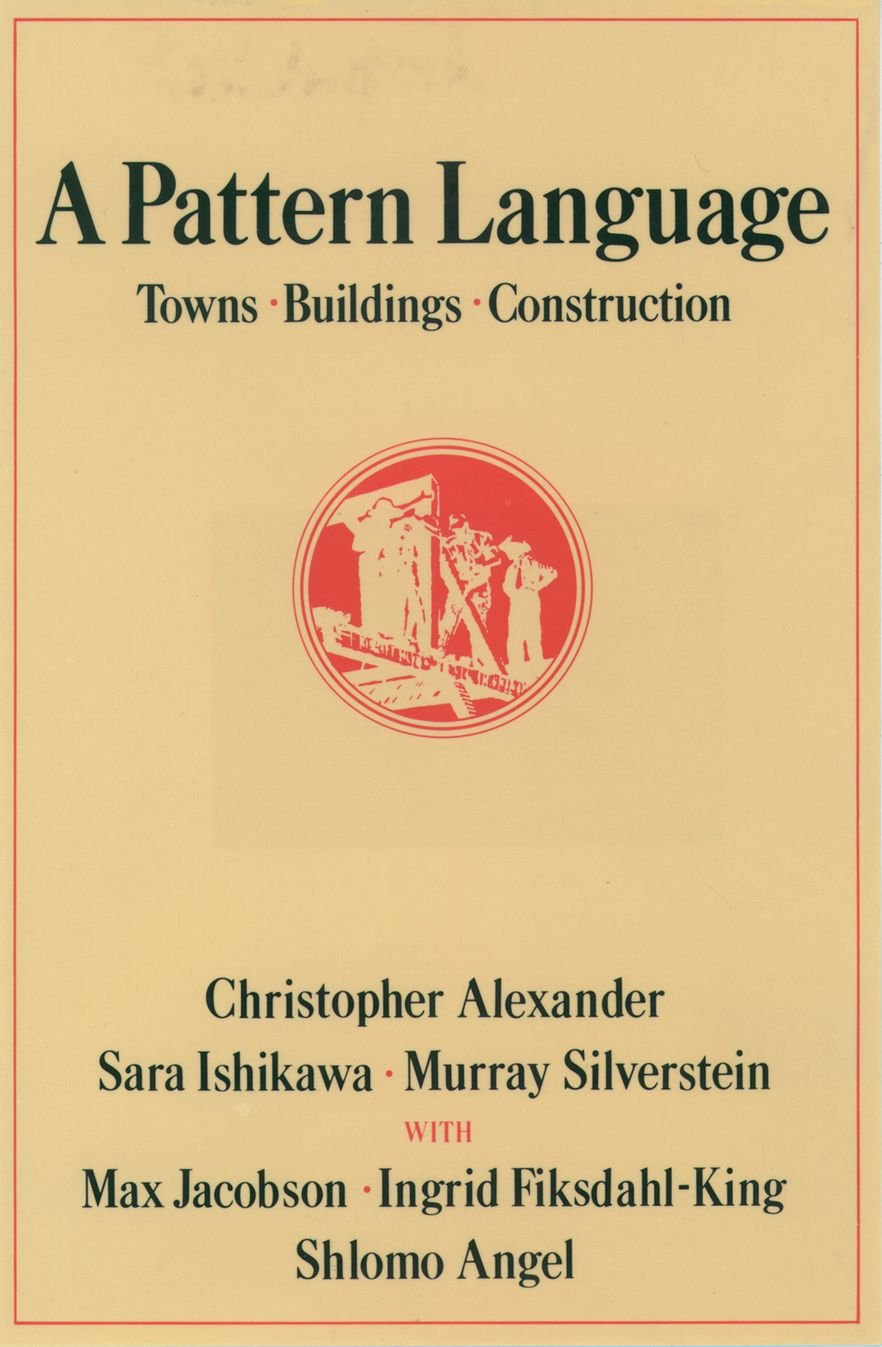
More recently, programmer and publisher Tim O’Reilly drew up an even more expansive list of books for addition to the Manual for Civilization. Owing to the wide and ever-growing array of technical books put out by the publisher that bears his name, you might guess that O’Reilly would mostly recommend volumes pertinent to rebuilding our digital world. In fact he offers a range of highly analog choices, thematically speaking, which he breaks down into four categories. First come the “religious/ philosophical works”:
- The Way of Life According to Lao Tzu translated by Witter Bynner
- The Bhagavad Gita translated by Christopher Isherwood
- The Analects of Confucius translated by Roger Ames and Henry Rosemont
- The Trial and Death of Socrates by Plato (translated by GMA Grube, revised by John Cooper)
- Zen in the Art of Archery by Eugene Herrigel
- The New Testament
- An Introduction to Realistic Philosophy by John Wild
- The Hero With a Thousand Faces by Joseph Campbell
- The Masks of God (4 volumes) by Joseph Campbell
Then the literature:
- The Complete Works of William Shakespeare
- Chapman’s Homer: The Iliad and The Odyssey translated by George Chapman
- Samuel Johnson: Poems and Selected Prose
- To the Lighthouse by Virginia Woolf
- The Palm at the End of the Mind by Wallace Stevens
- The Four Quartets by T.S.Eliot
Then books about “science, technology, and society”:
- A Pattern Language by Christopher Alexander
- The Death and Life of Great American Cities by Jane Jacobs
- Governing the Commons by Elinor Ostrom
- The Pleasure of Finding Things Out by Richard Feynman
- The Feynman Lectures on Physics by Richard Feynman
And finally, “stuff that would be useful if civilization declines”:
- The Foxfire Books edited by Eliot Wigginton (more info)
- The Tracker: The True Story of Tom Brown Jr. by Tom Brown
- Putting Food By by Ruth Hertzberg
- Luther Burbank: His Methods and Discoveries and Their Practical Application by Luther Burbank
- Plant and mushroom identification manuals for every major geography: Edible Wild Plants: A North American Field Guide and Edible Wild Mushrooms of North America
- Guide to Identifying Trees and Shrubs by Mark Zampardo
O’Reilly adds that “you also need engineering, including (bicycles, flight, bridges, and factories), spinning and weaving and the manufacturing technology thereof, metallurgy, materials science, math (including slide rule design and logarithmic tables), chemistry, biology, fundamentals of computer chips (and alternate ways of doing computing without the ability to do a full fab).”
At the Long Now Foundation’s site you’ll find more recommendations by such luminaries as Whole Earth Catalog founder Stewart Brand, Wired founding editor Kevin Kelly, and Brain Pickings curator Maria Popova. Whether your interests incline toward the technical, the historical, the philosophical, or toward practically anything else besides, the Manual for Civilization has more than a few books for you to digest. (Nearly 900 of them are available for free at the Internet Archive.) What’s more, the coronavirus has granted an entirely plausible excuse to spend more of our days reading — and a fairly good reason to consider how we might run society differently in the future.
Related Content:
Stewart Brand’s List of 76 Books for Rebuilding Civilization
Neil deGrasse Tyson Lists 8 (Free) Books Every Intelligent Person Should Read
The 10 Greatest Books Ever, According to 125 Top Authors (Download Them for Free)
Based in Seoul, Colin Marshall writes and broadcasts on cities, language, and culture. His projects include the book The Stateless City: a Walk through 21st-Century Los Angeles and the video series The City in Cinema. Follow him on Twitter at @colinmarshall or on Facebook.
Read More...Hear the Sound of the Hagia Sophia Recreated in Authentic Byzantine Chant
Audio technology has made many exciting advances in the past few years, one of which enables recording engineers to capture the sound of a specific space and recreate it elsewhere. Through a process called “convolution reverb,” the sound of a concert hall or club can be portable, so to speak, and a band or group of singers in a studio can be made to sound as if they were performing in Carnegie Hall, or inside a cave or grain silo.
Also being recreated are the sounds of gothic cathedrals and Byzantine churches—acoustic environments being preserved for posterity in digital recordings as their physical forms decay. This technology has given scholars the means to represent the music of the past as it sounded hundreds of years ago and as it was originally meant to be heard by its devout listeners.
Music took shape in particular landscapes and architectural environments, just as those environments evolved to enhance certain kinds of sound. Medieval Christian churches were especially suited to the hypnotic chants that characterize the sacred music of the time. As David Byrne puts it in his TED Talk on music and architecture:
In a gothic cathedral, this kind of music is perfect. It doesn’t change key, the notes are long, there’s almost no rhythm whatsoever, and the room flatters the music. It actually improves it.
There’s no doubt about that, especially in the case of the Greek Orthodox cathedral Hagia Sophia. Built in 537 AD in what was then Constantinople, it was once the largest building in the world. Though it lost the title early on, it remains on incredibly impressive feat of engineering. While the structure is still very much intact, no one has been able to hear its music since 1453, when the Ottoman Empire seized the city and the massive church became a mosque. “Choral music was banned,” notes Scott Simon on NPR’s Weekend Edition, “and the sound of the Hagia Sophia was forgotten until now.”
Now (that is, in the past ten years or so), well over five centuries later, we can hear what early medieval audiences heard in the massive Byzantine cathedral, thanks to the work of two Stanford professors, art historian Bissera Pentcheva and Jonathan Abel, who teaches in the computer music department and studies, he says, “the analysis, synthesis and processing of sound.”
Now a museum, the Hagia Sophia allowed Pentcheva and Abel to record the sound of balloons popping in the space after-hours. “Abel used the acoustic information in the balloon pops to create a digital filter that can make anything sound like it’s inside the Hagia Sophia,” as Weekend Edition guest host Sam Hartnett explains.
Pentcheva, who focuses her work “on reanimating medieval art and architecture,” was then able to “reanimate” the sound of high Greek Orthodox chant as it would have been heard in the heart of the Byzantine Empire. “It’s actually something that is beyond humanity that the sound is trying to communicate,” she says.” That message needs a larger-than-life space for its full effect.
Hear more about how the effect was created in the Weekend Edition episode above. And in the videos further up, see the choral group Capella Romana perform Byzantine chants with the Hagia Sophia effect applied. Just last year, the ensemble released the album of chants above, Lost Voices of Hagia Sophia, using the filter. It is a collection of music as valuable to our understanding and appreciation of the art of the Byzantine Empire as a restored mosaic or reconstructed cathedral.
via Kottke
Related Content:
David Byrne: How Architecture Helped Music Evolve
Josh Jones is a writer and musician based in Durham, NC. Follow him at @jdmagness.
Read More...10 Rules of Self Discipline from the 1930 Self Help/Business Guru Napoleon Hill
It seems ridiculous to refer to the Golden Rule as a “weapon,” but that is just what it is—a weapon that no resistance on earth can withstand! —Napoleon Hill
Napoleon Hill—whose early books The Law of Success (1928), The Magic Ladder To Success (1930), and Think and Grow Rich (1937) helped establish the self-help genre—would be considered a life coach or motivational speaker in today’s parlance.
And were he alive today, he’d likely he’d be facing charges, or at the very least, cancelled for some of the behaviors, schemes, and whoppers Matt Novak details in an exhaustively researched essay for Gizmodo’s Paleofuture blog.
We think it’s important to tip you off to that shady side, because Hill’s “10 Rules for Profitable Self Discipline,” above, are so sunny, they could spur you to disseminate them immediately, leaving you vulnerable to harsh words from better informed friends and, more crucially, social media followers, who are already het up about any number of things in this election year, and who enjoy the catharsis a good call out affords.
Ergo, if you’re inclined to share, investigate the well from which they sprung, and then decide whether or not you want to proceed.
Why did we proceed?
Because practiced with the purest of intentions, these rules constitute extremely humanistic advice from a man whose outward philosophy continues to be a touchstone for many in the business community.
And as evidenced by the comments left by grateful YouTube viewers, many of whom stumbled across his words by accident, people are thirsty for such explicitly positive guideposts to interpersonal dealings.
(A good number also seem quite taken with the Virginia native’s old timey speech patterns and vintage lingo.)
If nothing else, applying these rules could sweeten your next argument with someone you love, or serve as inspiration if you’re ever called upon to give a commencement speech:
Napoleon Hill’s 10 Rules for Profitable Self Discipline
- Keep a cool head around hot heads. Rage doesn’t have to be contagious,.
- Believe that there are three sides to every argument. If you’re in a dust-up, don’t assume that the fault lays with the other person, but rather that you both shoulder a portion of the blame. This is a pretty compassionate way of ensuring that everyone’s ass will be partially covered for both better and worse.
- Never give directives to a subordinate when you are angry. Given that swift and decisive action is often required of those in leadership positions, you’ll have to learn to ice your own hot head pretty quickly to put this one into consistent play.
- Treat everyone as if they were a rich relative who might leave you a sizable inheritance. Which is kind of a gross way of putting it, but otherwise, we agree with Napoleon Hill that treating others with respect and loving attention is a real “honey” of a concept, especially if the other person can offer little beyond their friendship.
- When you find yourself in an unpleasant circumstance, immediately start searching for the seed of an equivalent benefit within the experience. If Novak’s Gizmodo essay is any indication, Hill probably had a lot of opportunity to put this one into practice, squeezing lemonade from lemons of his own making.
- Ask questions and listen to the answer. If you find yourself inclined to disagree with a statement, employ the phrase, “How do you know?” to get the speaker to do all the heavy lifting. For example, Napoleon Hill might say to Matt Novak, “How do you know?” which would be Matt Novak’s cue to produce a mountain of documentation.
- Never say or do anything before thinking if it will benefit someone or hurt them. The goal is to refrain from hurting others. Let those of us are without sin cast the first stone here. Hill’s karmic spin on this rule is that any injuries you cause that don’t immediately come around to bite you in the ass, will bite you in the ass much harder at some future point, a la compound interest.
- Learn the difference between friendly analysis and unfriendly criticisms. His not entirely foolproof method for distinguishing intent is to consider the nature of your relationship with the one offering the observations, their tone of voice, manner of delivery, and somewhat quaintly, whether or not they throw in any epithets. If it’s friendly, you can set some store by it. Otherwise, disregard.
- A good leader knows how to take orders cheerfully. This pairs nicely with Rule Number 3, don’t you think?
- Be tolerant of your fellow humans. Always.
Related Content:
How Much Money Do You Need to Be Happy? A New Study Gives Us Some Exact Figures
Ayun Halliday is an author, illustrator, theater maker and Chief Primatologist of the East Village Inky zine. Join Ayun’s company Theater of the Apes in New York City for her book-based variety series, Necromancers of the Public Domain, and the world premiere of Greg Kotis’ new musical, I AM NOBODY (March 5 — 28) Follow her @AyunHalliday.
Read More...Judith Butler on Nonviolence and Gender: Hear Conversation with The Partially Examined Life

A new Partially Examined Life interview with Judith Butler, Maxine Elliot Professor of Comparative Literature at UC Berkeley, discusses the ethics and psychology of nonviolence. This follows a three-part treatment on the podcast of her earlier work.
For a first-hand account of her new book, you can watch two 2016 lectures that she gave at UC Berkeley on early versions of the text:
Watch on YouTube. Watch the second lecture.
Butler has been a tremendously influential (and controversial) figure in ongoing intellectual debates about gender and sexuality. Her 1990 book Gender Trouble argues that gender is a “performance,” i.e. a habitual group of behaviors that reflect and reinforce social gender norms. Practices such as dressing in drag satirize this performance, showing how even in “normal” situations, “acting feminine” is not a reflection of one’s inner essence but is a matter of putting on a display of culturally expected mannerisms. The drag performer (on Butler’s analysis) may convey an absurdity that deconstructs the expected accord of biological sex, sexual preference, and gender identity: “I’m dressing like a woman but am really a man; also, in my everyday life, I dress like a man but am really (in the way I actually feel about myself) am a woman.” Most controversially, as a post-structuralist, Butler argues that it’s not the case that there is an uncontroversial biological fact of sex that then culture connects gender behaviors to. Instead, all of our understanding of the so-called biological fact comes through the cultural lens of gender; we literally can’t understand any such raw, biological fact apart from its cultural associations. In other words, it’s not just gender that’s a social construction, but biological sex itself.
This position has been attacked both from the position of naive, common-sense scientism (of course biological differences resulting in babies isn’t just a matter of what concepts a particular society has happened to develop) and as a moral hazard and existential threat: In 2017 while at a conference in Brazil, far-right Christian groups protested her presence and even burned her in effigy.
It should also be noted that Butler’s take on gender departs from current, intuitive explanations of the phenomena of transgenderism, i.e. that one might feel their “true gender” to be different from what society has assigned them. For Butler, there is no inner gender essence that may or may not be displayed authentically. Instead, the “inner” is a cultural construction, itself built out of our external performances and the dynamics of our psychic life, which she discusses within the psychoanalytic tradition.
This use of psychoanalysis to explain our cultural life persists in newly released book, The Force of Nonviolence: An Ethico-Political Bind. Though the theory of nonviolent political protest may seem a far-flung topic from gender studies, both involve the process of defining an identity. In the case of gender, one defines oneself as a particular gender or as being of a particular sexual orientation (as opposed to leaving these attributes ambiguous and fluid) by grasping onto a strict social division between the available sexual options and declaring that one of them is “not me.” In Butler’s discussion of nonviolence, she instead focuses on what counts as “self” in the usually excused exception to nonviolence, self-defense. She’s criticizing a position where most of us claim to be nonviolent (and claim that our government is nonviolent) because we are not the aggressors: We will fight only when we are attacked or threatened.
It’s not that Butler is categorically against using violence to defend oneself, one’s loved ones, one’s country, or anyone else who is in danger of being seriously harmed. She is, however, arguing for an ethic of nonviolence that clearly understands our interrelatedness with everyone else in the world, even and especially those that we might think outside our circle of concern. It’s too easy for us to define “self” as “people like us,” which then leaves out the rest of the populace (and the non-human population, and the environment more generally) from inclusion in our “self-defense” calculations of when violence might be justified. Butler analyzes the fear of immigrants, for instance, as a “phantasmatic transmutation” that projects the potential for violence that always exists within our immediate social relations (and even our own rage against ourselves) onto an invading Other. As in the case of gender, she wants us instead to understand the dynamics of these self-and-other attributions, to behave more rationally and humanely, and to channel our unavoidable rage constructively into forceful non-violence, or what Gandhi calls Satyagraha, “polite insistence on the truth.” The goal of this type of political action is conversion, not coercion, and it’s communication and respecting even a hated other as a grievable equal that provides a real contrast to violence. She wants us to recognize the potential for violence within each relationship, at each moment, and to choose otherwise.
The Partially Examined Life Philosophy Podcast began a discussion of the general concept of social construction back with in Ocotober with episode 227, following this up with applications of this concept to race (discussing Kwame Anthony Appiah and Charles Mills with in episode 228 with guest Coleman Hughes), to the development of science (considering Bruno Latour on episode 230 with guest Professor Lynda Olman), and to gender (considering Simone de Beauvoir’s The Second Sex for episode 232 with Professor Jennifer Hansen. Professor Hansen then continued with hosts Mark Linsenmayer, Wes Alwan, Seth Paskin, and Dylan Casey to discuss Butler’s Gender Trouble. For further explanation of The Force of Nonviolence, see episode 236 at partiallyexaminedlife.com.
Mark Linsenmayer is the host of the Partially Examined Life, Pretty Much Pop, and Nakedly Examined Music podcasts. He is a writer and musician working out of Madison, Wisconsin. Read more Open Culture posts about The Partially Examined Life.
Image by Solomon Grundy.
Read More...Electronic Musician Shows How He Uses His Prosthetic Arm to Control a Music Synthesizer with His Thoughts
The techno-futurist prophets of the late 20th century, from J.G. Ballard to William Gibson to Donna Haraway, were right, it turns out, about the intimate physical unions we would form with our machines. Haraway, professor emeritus of the History of Consciousness and Feminist Studies at the University of California, Santa Cruz, proclaimed herself a cyborg back in 1985. Whether readers took her ideas as metaphor or proleptic social and scientific fact hardly matters in hindsight. Her voice was predictive of the everyday biometrics and mechanics that lay just around the bend.
It can seem we are a long way, culturally, from the decade when Haraway’s work became required reading in “undergraduate curriculum at countless universities.” But as Hari Kunzru wrote in 1997, “in terms of the general shift from thinking of individuals as isolated from the ‘world’ to thinking of them as nodes on networks, the 1990s may well be remembered as the beginning of the cyborg era.” Three decades later, networked implants that automate medical data tracking and analysis and regulate dosages have become big business, and millions feed their vitals daily into fitness trackers and mobile devices and upload them to servers worldwide.
So, fine, we are all cyborgs now, but the usual use of that word tends to put us in mind of a more dramatic melding of human and machine. Here too, we find the cyborg has arrived, in the form of prosthetic limbs that can be controlled by the brain. Psychologist, DJ, and electronic musician Bertolt Meyer has such a prosthesis, as he demonstrates in the video above. Born without a lower left arm, he received a robotic replacement that he can move by sending signals to the muscles that would control a natural limb. He can rotate his hand 360 degrees and use it for all sorts of tasks.
Problem is, the technology has not quite caught up with Meyer’s need for speed and precision in manipulating the tiny controls of his modular synthesizers. So Meyer, his artist husband Daniel, and synth builder Chrisi of KOMA Elektronik set to work on bypassing manual control altogether, with a prosthetic device that attaches to Meyer’s arm where the hand would be, and works as a controller for his synthesizer. He can change parameters using “the signals from my body that normally control the hand,” he writes on his YouTube page. “For me, this feels like controlling the synth with my thoughts.”
Meyer walks us through the process of building his first prototypes in an Inspector Gadget-meets-Kraftwerk display of analogue ingenuity. We might find ourselves wondering: if a handful of musicians, artists, and audio engineers can turn a prosthetic robotic arm into a modular synth controller that transmits brainwaves, what kind of cybernetic enhancements—musical and otherwise—might be coming soon from major research laboratories?
Whatever the state of cyborg technology outside Meyer’s garage, his brilliant invention shows us one thing: the human organism can adapt to being plugged into the unlikeliest of machines. Showing us how he uses the SynLimb to control a filter in one of his synthesizer banks, Meyer says, “I don’t even have to think about it. I just do it. It’s zero effort because I’m so used to producing this muscle signal.”
Advancements in biomechanical technology have given disabled individuals a significant amount of restored function. And as generally happens with major upgrades to accessibility devices, they also show us how we might all become even more closely integrated with machines in the near future.
via Boing Boing
Related Content:
Neurosymphony: A High-Resolution Look into the Brain, Set to the Music of Brain Waves
Twerking, Moonwalking AI Robots–They’re Now Here
Josh Jones is a writer and musician based in Durham, NC. Follow him at @jdmagness
Read More...Moral Philosophy on TV? Pretty Much Pop #32 Judges The Good Place

Mark Linsenmayer, Erica Spyres, and Brian Hirt discuss Michael Schur’s NBC TV show. Is it good? (Yes, or we wouldn’t be covering it?) Is it actually a sit-com? Does it effectively teach philosophy? What did having actual philosophers on the staff (after season one) contribute, and was that enough? We talk TV finales, the dramatic impact of the show’s convoluted structure, the puzzle of heaven being death, and more.
Here are a few articles to get you warmed up:
- “The Good Place’s Final Twist” by Karthryn VanArendonk
- “The Good Place Was a Metaphor All Along” by Sophie Gilbert
- “The Two Philosophers Who Cameoed in the Good Place Finale on What They Made of Its Ending” by Sam Adams
- “5 Moral Philosophy Concepts Featured on The Good Place” by Ellen Gutoskey
If you like the show, you should also check out The Official Good Place Podcast, especially the interviews with Schur himself. There are also supplementary educational videos with professor Todd May like this one on existentialism.
A few clips: What’s the deal with the “Jeremy Bearimy” time measurement? The Trolley Problem, meeting Hypatia, finale clip with Arvo Part’s “Spiegel Im Spiegel.”
This episode includes bonus discussion that you can only hear by supporting the podcast at patreon.com/prettymuchpop. This podcast is part of the Partially Examined Life podcast network.
Pretty Much Pop: A Culture Podcast is the first podcast curated by Open Culture. Browse all Pretty Much Pop posts or start with the first episode.
Read More...Bertrand Russell’s Prison Letters Are Now Digitized & Put Online (1918 — 1961)
Boethius, Henry David Thoreau, Antonio Gramsci, Martin Luther King, Jr…. It’s possible, if one tried, to draw other comparisons between these disparate figures, but readers familiar with the work of all four will immediately recognize their most obvious literary commonality: all wrote some of their most impassioned and persuasive work while unjustly confined to a cell.
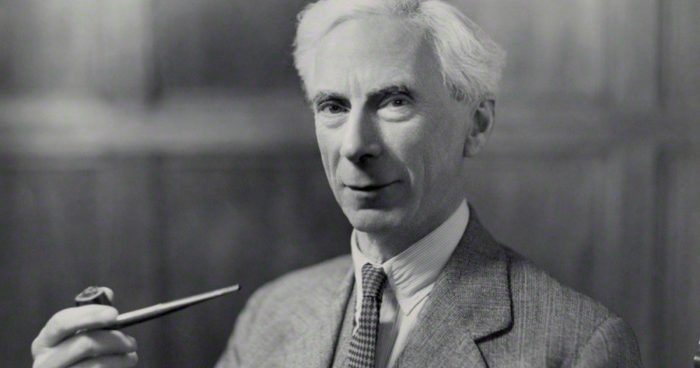
In the case of Bertrand Russell, however, perhaps one of the most famous figures in 20th century philosophy and intellectual life more generally, periods of incarceration in Brixton prison in 1918 and, forty-three years later, in 1961, play a minimal role in the larger drama of his writing life, despite the fact that he did a good deal of writing, including some significant philosophical work, behind bars.
Even scholars well-read in Russell’s work may have little knowledge of his prison writing, and for good reason: most of it has been inaccessible. “Now, for the first time,” writes Erica Balch at McMaster University’s Brighter World blog, “Russell’s prison letters—part of McMaster’s Bertrand Russell Archives—are being made available online through a new digitization project developed by the Bertrand Russell Research Centre. Complete with detailed annotations and fully searchable text, the project is providing scholars from around the world with access to these rarely seen materials.”
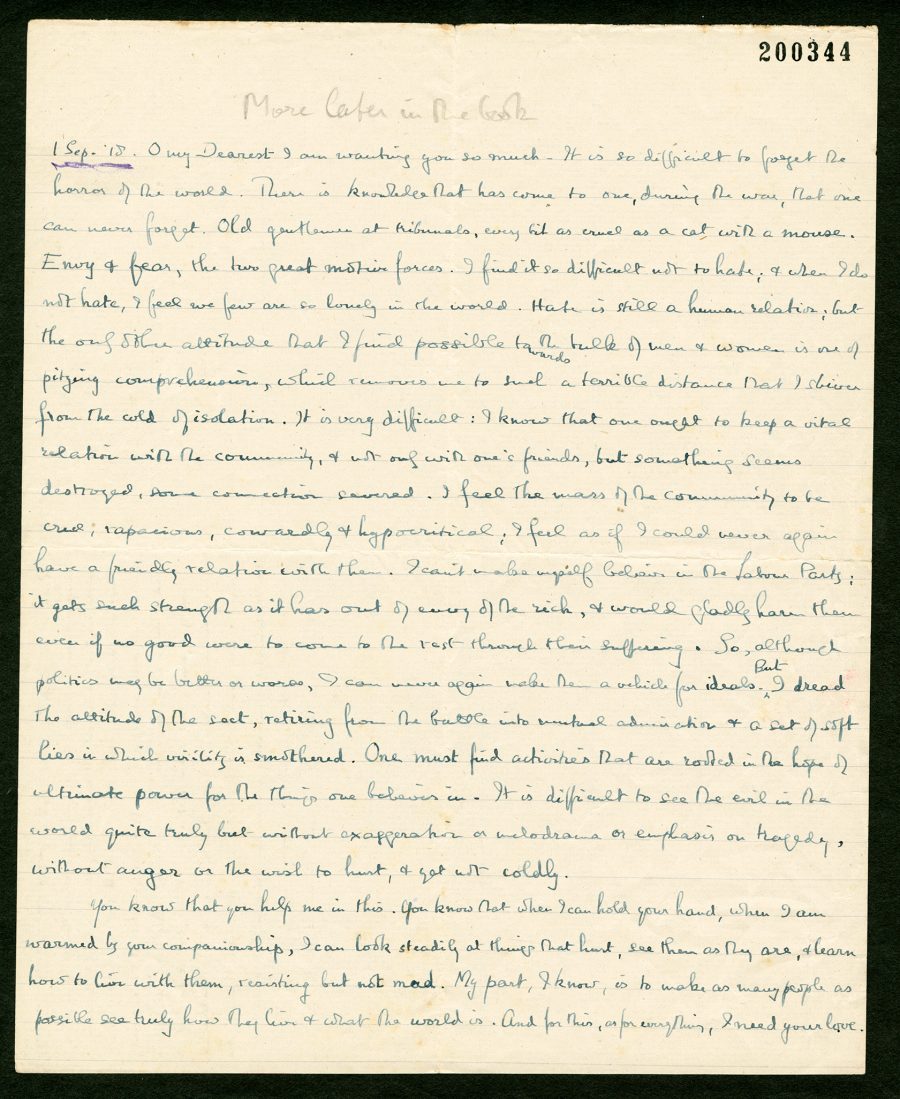
The contents of the letters reveal other reasons that Russell’s prison writing isn’t better known. He did plenty of impassioned and persuasive writing for the public outside of a prison cell—publishing fiery books, essays, and lectures against war and propaganda and in defense of free thought throughout his life. Behind bars, however, Russell’s writing turned almost solely professional and personal, in letters addressed primarily to “his then lover Lady Constance Malleson (known as ‘Colette’) and his former lover, aristocrat and socialite Lady Ottoline Morrell.”
The 105 letters “reveal the private thoughts of one of the 20th century’s most public figures and provide an interesting window on Russell’s inner life,” says Andrew Bone, Senior Research Associate at McMaster’s Bertrand Russell Research Centre. Most of the letters “were written in secret,” Balch notes, “and smuggled out of Brixton by Russell’s friends, concealed between the uncut pages of books.” Russell was only allowed one letter per week; officially sanctioned correspondence is written on prison stationary and bears the Brixton governor’s initials.
A lifelong pacifist, Russell was first jailed for six months in 1918 for a speech opposing U.S. entry into World War I. “I found prison in many ways quite agreeable,” he later wrote in his autobiography. “I had no engagements, no difficult decisions to make, no fear of callers, no interruptions to my work. I read enormously; I wrote a book, ‘Introduction to Mathematical Philosophy’… and began the work for ‘Analysis of Mind,’” a project that never reached fruition. In 1961, at age 89, he was jailed for seven days for participating in a London anti-nuclear demonstration.
During his first stay as a prisoner of Brixton’s “first division,” Russell was “allowed to furnish his cell, wear civilian clothes, purchase catered food, and most importantly, be exempted from prison work while he pursued his profession as an author,” as the Bertrand Russell Research Centre points out. It’s little wonder he looked forward to the experience as a “holiday from responsibility,” he wrote in a letter to his brother, Frank, four days after he began his sentence.
Russell may not have suffered—or acquired a heightened sense of political urgency—while behind bars (at one point he was heard laughing out loud and had to be reminded by the warden that “prison is a place of punishment”). But his prison letters offer significant insight into not only the deeply emotional relationships he had with Malleson and Morrell, but also his relationship with other members of the famous Bloomsbury group and “literary celebrities such as D.H. Lawrence, and T.S. Eliot,” writes Balch, “many of whom are referenced in the letters.”
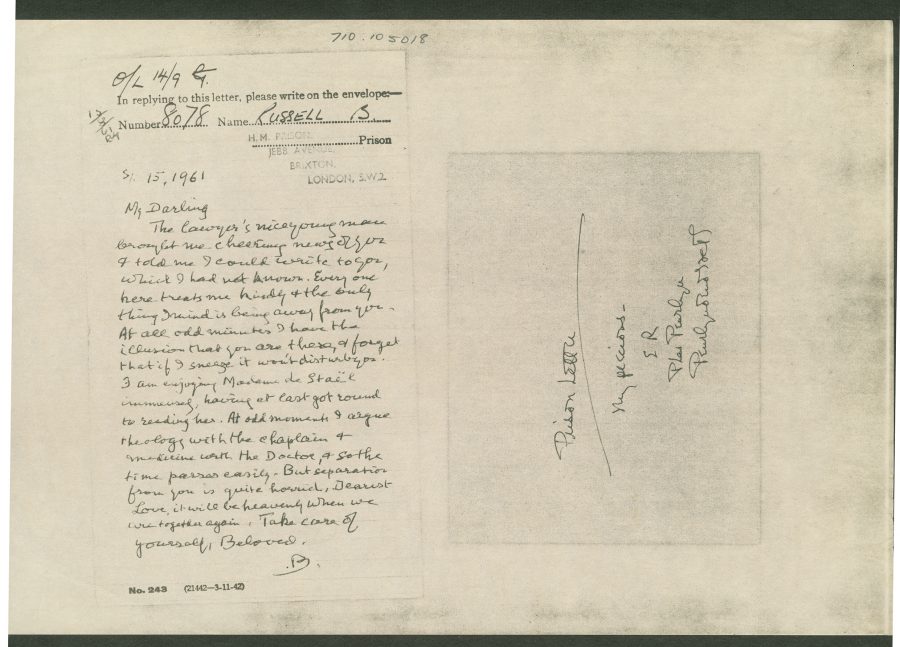
The 104 letters from 1918, including Russell’s correspondence with his brother, his publisher, The Nation magazine and others, are all available in original scans with transcriptions and annotations at the McMaster University Bertrand Russell Research Centre site. The final letter, number 105, the sole piece of correspondence from Russell’s weeklong stay in Brixton in 1961, is addressed to his wife Edith.
My Darling,
The lawyer’s nice young man brought me cheering news of you and told me I could write to you, which I had not known. Every one here treats me kindly and the only thing I mind is being away from you. At all odd minutes I have the illusion that you are there, and forget that if I sneeze it won’t disturb you. I am enjoying Madame de Staël immensely, having at last got round to reading her. At odd moments I argue theology with the chaplain and medicine with the Doctor, and so the time passes easily. But separation from you is quite horrid, Dearest Love, it will be heavenly when we are together again. Take care of yourself, Beloved.
B.
As in most of the earlier letters, Russell avoids politics and keeps things personal. But as in nearly all of his writing, the prose is lively, evocative, and poignant, revealing much about the personality behind it. While these letters may never achieve the status of great literature, by virtue of their private nature and their minor role in Russell’s major canon, that does not mean they aren’t a joy to read, for students of Bertrand Russell and anyone else who appreciates the workings of a brilliant philosophical and ethical mind. Enter the Brixton Letter archive here.
Related Content:
Bertrand Russell Authority and the Individual (1948)
Josh Jones is a writer and musician based in Durham, NC. Follow him at @jdmagness
Read More...Watch Footage from the Psychology Experiment That Shocked the World: Milgram’s Obedience Study (1961)
For decades following World War II, the world was left wondering how the atrocities of the Holocaust could have been perpetrated in the midst of—and, most horrifically, by—a modern and civilized society. How did people come to engage in a willing and systematic extermination of their neighbors? Psychologists, whose field had grown into a grudgingly respected science by the midpoint of the 20th century, were eager to tackle the question.
In 1961, Yale University’s Stanley Milgram began a series of infamous obedience experiments. While Adolf Eichmann’s trial was underway in Jerusalem (resulting in Hannah Arendt’s five-piece reportage, which became one of The New Yorker magazine’s most dramatic and controversial article series), Milgram began to suspect that human nature was more straightforward than earlier theorists had imagined; he wondered, as he later wrote, “Could it be that Eichmann and his million accomplices in the Holocaust were just following orders? Could we call them all accomplices?”
In the most famous his experiments, Milgram ostensibly recruited participants to take part in a study assessing the effects of pain on learning. In reality, he wanted to see how far he could push the average American to administer painful electric shocks to a fellow human being.
When participants arrived at his lab, Milgram’s assistant would ask them, as well as a second man, to draw slips of paper to receive their roles for the experiment. In fact, the second man was a confederate; the participant would always draw the role of “teacher,” and the second man would invariably be made the “learner.”
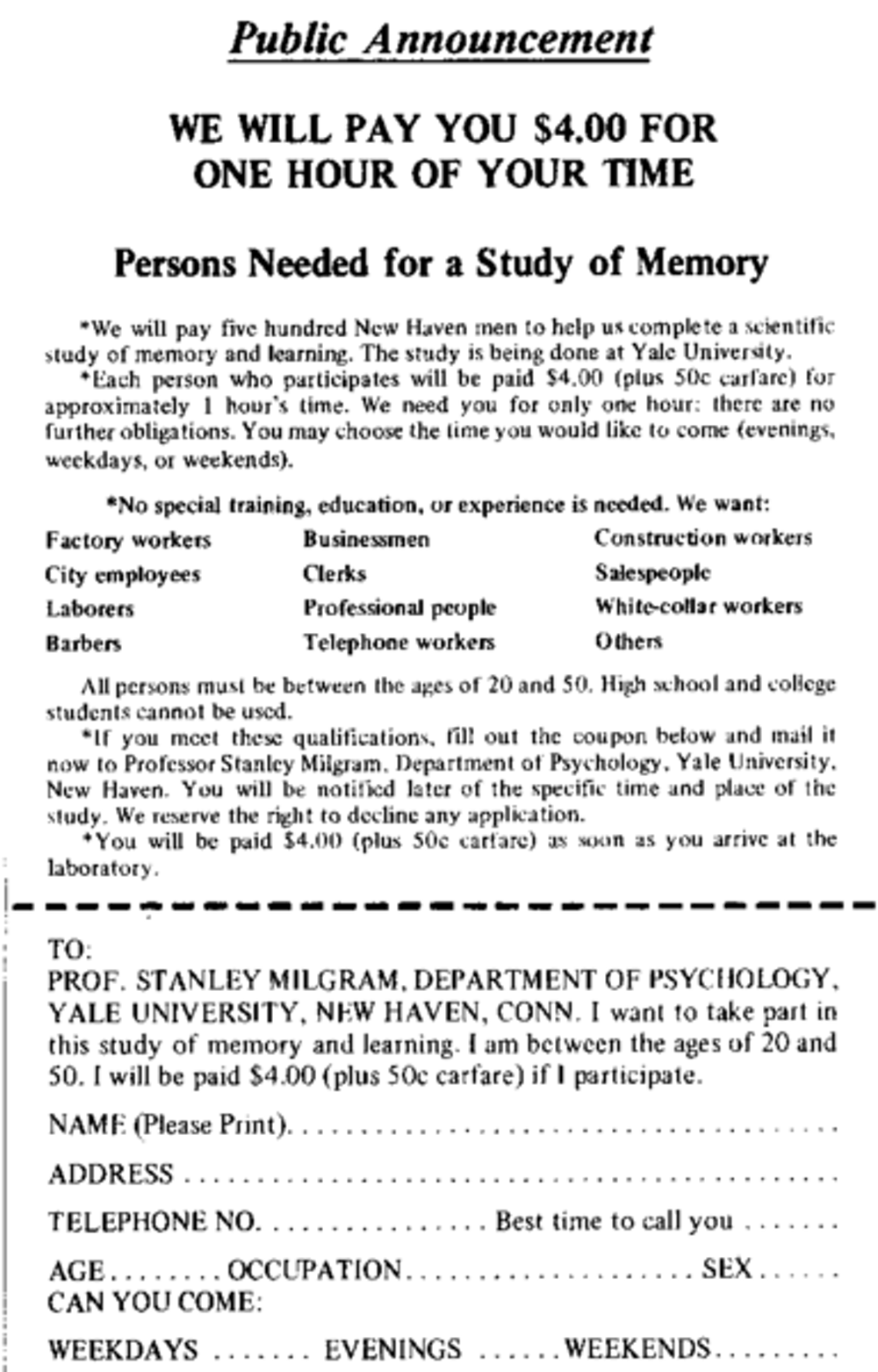
The participants received instructions to teach pairs of words to the confederate. After they had read the list of words once, the teachers were to test the learner’s recall by reading one word, and asking the learner to name one of the four words associated with it. The experimenter told the participants to punish any learner mistakes by pushing a button and administering an electric shock; while they could not see the learner, participants could hear his screams. The confederate, of course, remained unharmed, and merely acted out in pain, with each mistake costing him an additional 15 volts of punishment. In case participants faltered in their scientific resolve, the experimenter was nearby to urge them, using four authoritative statements:
Please continue.
The experiment requires that you continue.
It is absolutely essential that you continue.
You have no other choice, you must go on.
In a jarring set of findings, Milgram found that 26 of the 40 participants obeyed instructions, administering shocks all the way from “Slight Shock,” to “Danger: Severe Shock.” The final two ominous switches were simply marked “XXX.” Even when the learners would pound on the walls in agony after seemingly receiving 300 volts, participants persisted. Eventually, the learner simply stopped responding.
Although they followed instructions, participants repeatedly expressed their desire to stop the experiment, and showed clear signs of extreme discomfort:
“I observed a mature and initially poised businessman enter the laboratory smiling and confident. Within 20 minutes he was reduced to a twitching, stuttering wreck, who was rapidly approaching a point of nervous collapse… At one point he pushed his fist into his forehead and muttered: “Oh God, let’s stop it.” And yet he continued to respond to every word of the experimenter, and obeyed to the end.”
Milgram’s study set off a powder keg whose impact remains felt to this day. Ethically, many objected to the deception and the lack of adequate participant debriefing. Others claimed that Milgram overemphasized human nature’s propensity for blind obedience, with the experimenter often urging participants to continue many more times than the four stock phrases allowed.
In the clip above, you can watch original footage from Milgram’s experiment, frightening in its insidious simplicity. (See a full documentary on the study below.) The man administering the shock grows increasingly uncomfortable with his part in the proceedings, and almost walks out, asking “Who’s going to take the responsibility for anything that happens to that gentleman?” When the experimenter replies, “I’m responsible,” the man, absolving himself, continues. As the person receiving the shocks grows increasingly panicked, complaining about his heart and asking to be let out, the participant makes his objections known but appears paralyzed, sheepishly turning to the experimenter, unable to leave.
Although Milgram’s work has drawn critics, his results endure. While changing the experiment’s procedure may alter compliance (e.g., having the experimenter speak to participants over the phone rather than remain in the same room throughout the experiment decreased obedience rates), replications have tended to confirm Milgram’s initial findings. Whether one is urged once or a dozen times, people tend to take on the yoke of authority as absolute, relinquishing their personal agency in the pain they impart. Human nature, it seems, has no Manichean leanings—merely a pliant bent.
Note: An earlier version of this post appeared on our site in November 2013.
Related Content:
Hermann Rorschach’s Original Rorschach Test: What Do You See? (1921)
Free Online Courses Psychology
Ilia Blinderman is a Montreal-based science and culture writer. Follow him at @iliablinderman
Read More...An Artist Tricks Google Maps Into Creating a Virtual Traffic Jam, Using a Little Red Wagon & 99 Smartphones
Sometimes the miraculous time-saving conveniences we’ve come to depend on can have the opposite effect, as artist Simon Wickert recently demonstrated, ambling about the streets of Berlin at a Huck Finn-ish pace, towing a squeaky-wheeled red wagon loaded with 99 secondhand smartphones.
Each phone had a SIM card, and all were running the Google Maps app.
The result?
A near-instantaneous “virtual traffic jam” on Google Maps, even though bicyclists seem to vastly outnumber motorists along Wickert’s route.
As a Google spokesperson told 9to5 Google’s Ben Schoon shortly after news of Wickert’s stunt began to spread:
Traffic data in Google Maps is refreshed continuously thanks to information from a variety of sources, including aggregated anonymized data from people who have location services turned on and contributions from the Google Maps community.
In other words, had you checked your phone before heading out to the Baumhaus an der Mauer (Treehouse on the Wall), the Urban Art Clash Gallery, OMA’s Café, or some other spot close to Wickert’s little red wagon’s trail of terror—like Google’s Berlin office—you might have thought twice about your intended path, or even going at all, seeing bridges and streets change from a free and easy green to an ostensibly gridlocked red.
As long as Wickert kept moving, he was able to continue fooling the algorithm into thinking 99 humans were all using their phone’s Maps app for navigational purposes in a small, congested area.
Obviously, a couple of buses could easily be responsible for carrying 99 smartphones in active use, but it’s unlikely those phones owners would be consulting the map app in the passenger seats, when they could be scrolling through Instagram or playing Candy Crush.
Wickert also discovered that his virtual traffic jam disappeared whenever a car passed his wagonload.
The spokesperson who engaged with Schoon put a good-natured face on Google’s response to Wickert’s hack, saying, “We’ve launched the ability to distinguish between cars and motorcycles in several countries including India, Indonesia and Egypt, though we haven’t quite cracked traveling by wagon. We appreciate seeing creative uses of Google Maps like this as it helps us make maps work better over time.”
Meanwhile, the artist’s puckish stunt, which he describes as a “performance and installation,” seems anchored by sincere philosophical questions, as evidenced by the inclusion on his website of the below excerpt from “The Power of Virtual Maps,” urban researcher Moritz Ahlert’s recent essay in the Hamburger Journal für Kulturanthropologie, :
The advent of Google’s Geo Tools began in 2005 with Maps and Earth, followed by Street View in 2007. They have since become enormously more technologically advanced. Google’s virtual maps have little in common with classical analog maps. The most significant difference is that Google’s maps are interactive – scrollable, searchable and zoomable. Google’s map service has fundamentally changed our understanding of what a map is, how we interact with maps, their technological limitations, and how they look aesthetically.
In this fashion, Google Maps makes virtual changes to the real city. Applications such as Airbnb and Carsharing have an immense impact on cities: on their housing market and mobility culture, for instance. There is also a major impact on how we find a romantic partner, thanks to dating platforms such as Tinder, and on our self-quantifying behavior, thanks to the nike jogging app. Or map-based food delivery apps like deliveroo or foodora. All of these apps function via interfaces with Google Maps and create new forms of digital capitalism and commodification. Without these maps, car sharing systems, new taxi apps, bike rental systems and online transport agency services such as Uber would be unthinkable. An additional mapping market is provided by self-driving cars; again, Google has already established a position for itself.
With its Geo Tools, Google has created a platform that allows users and businesses to interact with maps in a novel way. This means that questions relating to power in the discourse of cartography have to be reformulated. But what is the relationship between the art of enabling and techniques of supervision, control and regulation in Google’s maps? Do these maps function as dispositive nets that determine the behavior, opinions and images of living beings, exercising power and controlling knowledge? Maps, which themselves are the product of a combination of states of knowledge and states of power, have an inscribed power dispositive. Google’s simulation-based map and world models determine the actuality and perception of physical spaces and the development of action models.
Related Content:
View and Download Nearly 60,000 Maps from the U.S. Geological Survey (USGS)
Ancient Rome in 3D on Google Earth
Ayun Halliday is an author, illustrator, theater maker and Chief Primatologist of the East Village Inky zine. Join Ayun’s company Theater of the Apes in New York City this March for her book-based variety series, Necromancers of the Public Domain, and the world premiere of Greg Kotis’ new musical, I AM NOBODY. Follow her @AyunHalliday.
Read More...Why Every Nominated Film Will Win the 2020 Oscar: A Pretty Much Pop Podcast Debate (ep. 30)

The 2020 Academy Awards are nearly upon us! Realistically, most of you will find this episode well after the winners have already been announced, but seriously, that should not affect your enjoyment of this discussion. Your intrepid non-film-critic Pretty Much Pop: A Culture Podcast hosts have each been randomly assigned three of the best picture nominees to argue for either for why it should with the Oscar, or if we really don’t like it, why we think it will win anyway. The assignments were as follows:
- Mark Linsenmayer: 1917, Little Women, Joker
- Erica Spyres: Jojo Rabbit, Parasite, Once Upon a Time…in Hollywood*
- Brian Hirt: Ford v Ferrari, Marriage Story, The Irishman**
*Covered in our ep. 12.
**Covered in our ep. 29.
As we hash out the relative merits of these films, we reflect on what it is to be an Oscar-winning type-of-film as opposed to one people might actually enjoy watching, patterns of what kinds of films win in which categories, and the effect of viewing conditions, prior knowledge, and preconceptions on our enjoyment.
In preparation, we all watched all nine films and looked at some of the positive and negative reviews about them. Here are a few more articles covering the Oscars more generally that we also used to make ourselves more susceptible to OSCAR FEVER.
- “Why the Oscars Still Matter” by Cheryl Boone Isaacs (last year)
- “The 2020 Oscar Nominations Confirm That Awards Don’t Matter” by Kara Weisenstein
- “This Year’s Oscars Are a Joke” by Gene Seymour
- “Oscars 2020 Nominations: 12 Biggest Snubs” by Brian Tallerico
- “Complete List of Every ‘Best Picture’ Oscar Winner Ever” by Matt Murray
The particular negative 1917 review Mark talks about was by Richard Brody. Here’s an article about Joaquin Phoenix improvising his stunt work as Erica mentions. Speaking of Joker, have you heard the (sub)Text podcast presentation by Mark’s Partially Examined Life co-host Wes Alwan on the psychoanalytic dimensions of that film?
This episode includes bonus discussion musing about past winners and 2020 acting categories that you can only hear by supporting the podcast at patreon.com/prettymuchpop. This podcast is part of the Partially Examined Life podcast network.
Pretty Much Pop: A Culture Podcast is the first podcast curated by Open Culture. Browse all Pretty Much Pop posts or start with the first episode.
Read More...Support Us
We're hoping to rely on loyal readers, rather than erratic ads. Please click the Donate button and support Open Culture. You can use Paypal, Venmo, Patreon, even Crypto! We thank you!

About Us

Open Culture scours the web for the best educational media. We find the free courses and audio books you need, the language lessons & educational videos you want, and plenty of enlightenment in between.
Advertise With Us
FREE UPDATES!
GET OUR DAILY EMAIL
Get the best cultural and educational resources on the web curated for you in a daily email. We never spam. Unsubscribe at any time.
FOLLOW ON SOCIAL MEDIA
Open Culture editor Dan Colman scours the web for the best educational media. He finds the free courses and audio books you need, the language lessons & movies you want, and plenty of enlightenment in between.
Advertise With Us

