Bertrand Russell Remembers His Face-to-Face Encounter with Vladimir Ilyich Lenin
When the Bolsheviks seized control of Russia in the October Revolution of 1917, Bertrand Russell saw it as “one of the great heroic events of the world’s history.”
A renowned philosopher and mathematician, Russell was also a committed socialist. As he would write in his 1920 book The Practice and Theory of Bolshevism:
By far the most important aspect of the Russian Revolution is as an attempt to realize Communism. I believe that Communism is necessary to the world, and I believe that the heroism of Russia has fired men’s hopes in a way which was essential to the realization of Communism in the future. Regarded as a splendid attempt, without which ultimate success would have been very improbable, Bolshevism deserves the gratitude and admiration of all the progressive part of mankind.
But despite his early admiration for the “splendid attempt,” Russell found much in Soviet Russia to be concerned about. Specifically, he was appalled by the rigidly doctrinaire mindset of the Bolsheviks — their zeal for quoting Marx like it was Holy gospel — and the cruel tyranny they were willing to impose.
In May of 1920, a few months before finishing The Practice and Theory of Bolshevism, Russell visited Petrograd (Saint Petersburg) and Moscow with a British Labour delegation. As he says in the book:
I went to Russia a Communist; but contact with those who have no doubts has intensified a thousandfold my own doubts, not as to Communism in itself, but as to the wisdom of holding a creed so firmly that for its sake men are willing to inflict widespread misery.
As Russell would later write in the second volume of his autobiography, his time in Soviet Russia was one of “continually increasing nightmare:”
Cruelty, poverty, suspicion, persecution, formed the very air we breathed. Our conversations were continually spied upon. In the middle of the night one would hear shots, and know that idealists were being killed in prison. There was a hypocritical pretence of equality, and everybody was called ‘tovarisch’ [comrade], but it was amazing how differently this word could be pronounced according as the person who was addressed was Lenin or a lazy servant.
Soon after arriving in Moscow, Russell had a one-hour talk with Soviet leader Vladimir Ilyich Lenin at his spartan office in the Kremlin. “Lenin’s room is very bare,” writes Russell in The Practice and Theory of Bolshevism; “it contains a big desk, some maps on the walls, two book-cases, and one comfortable chair for visitors in addition to two or three hard chairs. It is obvious that he has no love of luxury or even comfort.”
In the audio clip above, taken from a 1961 interview by John Chandos at Russell’s home in north Wales, the old philosopher relates a pair of observations of what he saw as Lenin’s two defining traits: his rigid orthodoxy, and what Russell would later call his “distinct vein of impish cruelty.”
By the time of the interview, Russell’s early ambivalence toward Soviet communism had hardened into antipathy. “Marx’s doctrine was bad enough, but the developments which it underwent under Lenin and Stalin made it much worse,” he writes in his 1956 essay “Why I am Not a Communist.” “I am completely at a loss to understand how it came about that some people who are both humane and intelligent could find something to admire in the vast slave camp produced by Stalin.”
Lenin died on January 21, 1924 — less than four years after his meeting with Russell. A few days later, Russell published an essay, “Lenin: An Impression,” in The New Leader. And although Russell once again mentions the man’s narrow orthodoxy and ruthlessness, he paints a rather glowing picture of Lenin as a historical figure:
The death of Lenin makes the world poorer by the loss of one of the really great men produced by the war [World War I]. It seems probable that our age will go down to history as that of Lenin and Einstein — the two men who have succeeded in a great work of synthesis in an analytic age, one in thought, the other in action. Lenin appeared to the outraged bourgeoisie of the world as a destroyer, but it was not the work of destruction that made him pre-eminent. Others could have destroyed, but I doubt whether any other living man could have built so well on the new foundations. His mind was orderly and creative: he was a philosophic system-maker in the sphere of practice.… Statesmen of his caliber do not appear in the world more than about once in a century, and few of us are likely to live to see his equal.
Related Content:
Bertrand Russell and F.C. Copleston Debate the Existence of God, 1948
Face to Face with Bertrand Russell: ‘Love is Wise, Hatred is Foolish’
Read More...When IBM Created a Typewriter to Record Dance Movements (1973)
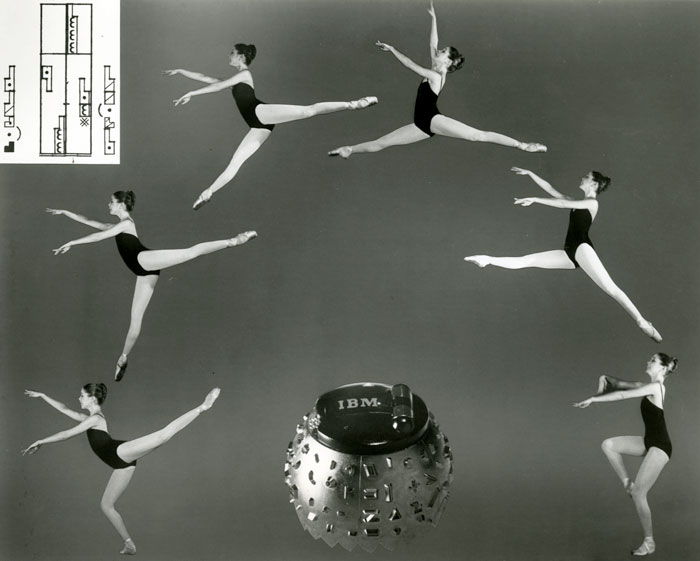
Increasingly many of us in the 21st century have never used a typewriter — indeed, have never seen one in real life. But despite being deep into its obsolescence, the machine has a long cultural half-life. Seeing typewriters in classic and period films, for example, keeps an idea of their look and feel in our minds. Naturally it gets entangled with the romance of the writer, or rather the Writer, whom we imagine pounding away on a culturally iconic model: an Underwood, an Olvetti. “If Olivettis could talk, you’d get the novelist naked,” writes Philip Roth in The Anatomy Lesson. From the then-new electric IBM typewriters, however, you’d hear “only the smug, puritanical workmanlike hum telling of itself and all its virtues: I am a Correcting Selectric II. I never do anything wrong.”
Yet we underestimate the influence of the IBM Selectric, on not just writing but late-20th-century American life in general, at our peril. Introduced in 1961, this technologically revolutionary typewriter replaced the old “typebars” — those thin metal arms that whack a letter onto the page with each keystroke — with a “typeball,” a “compact unit containing all the letters and symbols of a keyboard, rotated and pivoted to the correct position before striking.”
So writes IBM’s Justine Jablonska in an essay on the versatility of the typeball, which could be swapped out and modified according to the needs of the user. In 1973, IBM could say even to those users who needed to type out not words, sentences, and paragraphs but dances that, yes, there’s a typeball for that.
Developed in collaboration with New York City’s Dance Notation Bureau, this unusual typeball “had special Labanotation symbols, developed in the 1920s by Hungarian dancer/choreographer Rudolf Laban to analyze and record movement and dance.” Each symbol’s location “showed which part of the body — arm, leg, torso — was to be used. The symbol’s shape indicated direction. The symbol’s shading showed the level of an arm or leg. And its length controlled the time value of a movement.” In total, writes Karen Hill at Zippy Facts, Labanotation had “88 different symbols, which could be arranged to form a complete vocabulary for recording movement of any kind, from ballet and modern to ethnic, even folk.” Beyond dance, the system could also record “movements in areas like sports, behavioral sciences, physical therapy, and even industrial operations.”
This particular typeball showcased the Selectric’s versatility, but some had higher hopes. In a 1975 paper, dance scholar Drid Williams compares its potential impact to that of “Gutenberg’s invention several centuries ago,” signaling that “the graphic linguistic sign can now be joined by its obvious counterpart, the printed human action sign.” But she also expresses regret that “ ‘the ball’ is being looked on by many as a mere practical aid to recording human movement and it is being associated with specialist fields like dance. As usual, concern with the syntagmata obscures the real issues of the paradigms.” Indeed. A more practical-minded assessment comes from Charles Ditchendorf, employed at the time at IBM’s Office Products Division. “To the best of my knowledge,” Jablonska quotes him as saying, I didn’t sell one.” But then, when has dance ever been enslaved to the market?
Related Content:
The Enduring Analog Underworld of Gramercy Typewriter
Based in Seoul, Colin Marshall writes and broadcasts on cities, language, and culture. His projects include the book The Stateless City: a Walk through 21st-Century Los Angeles and the video series The City in Cinema. Follow him on Twitter at @colinmarshall, on Facebook, or on Instagram.
Read More...Pink Floyd Streaming Free Classic Concert Films, Starting with 1994’s Pulse, the First Live Performance of Dark Side of the Moon in Full
If you’re feeling a little stressed today—maybe a lot stressed today, maybe severely-rationing-your-social-media stressed—it might do you some good to get comfortably numb. And unless the laws of your locality prevent it, you can reach a safe state of bliss at home with historic live concert films from Pink Floyd. “Following the lead of Radiohead and Metallica and launching a YouTube concert series,” notes Consequence of Sound, “the band will release unseen, rare, or archived material from their vault and stream it for free” over the next few weeks.
It may or may not be necessary to qualify that Pink Floyd these days consists of only two people, David Gilmour and drummer Nick Mason, keyboardist Richard Wright having passed away in 2008 and bassist/rock opera impresario Roger Waters having stormed off to make his own records in 1985, never to return. Perhaps only coincidentally, the first film the band has released is 1994’s Pulse, a 22-song set from the Division Bell tour, the second studio album made without Waters. But it’s got quite a lot to recommend it despite his absence.
“Filmed at London’s now-defunct Earls Court during the band’s record-breaking 14-night residency,” this show is notable particularly for “the inclusion of the first-ever film recording of Pink Floyd playing The Dark Side of the Moon in full.” The 1972 album’s sardonic ruminations on the banality of modern life in an economy that cannot stop its constant grind might strike us as particularly grim while we’re facing such huge collective losses of life and livelihood. But as always, the band knows how to make its medicine go down with some sweet eye and ear candy.
Mixed in 5.1 surround sound and digitally re-mastered by James Guthrie, Pulse also includes some of original screen films used for the 1970s concert performances of The Dark Side of the Moon (which were never filmed) as well as the visual components for the piece which were remade for the 1994 tour.
On their Facebook page, the band promises more “interesting and diverting images, music and video to help us all get through this”—as best as we can, in any case. And if you run out of Pink Floyd to help you get through a tough time of day, head over to see another band bringing blues-based psych-rock, American style, to the shut-in masses this spring. The Grateful Dead have their own weekly streaming series of full concert films. Of the first concert posted, they write, “Its excellence is indisputable and is something that we think pretty much everyone will enjoy in the absence of actually being able to see live concerts.”
Take an hour or two to relax with some classic live shows from classic bands of yore, and maybe make a list of all the current bands you want to go out and support as soon as you get out of quarantine. Something tells me after all this livestreaming, there’ll be waves of renewed appreciation for live music. Goodness knows, musicians everywhere will need it.
Visit the Pink Floyd Youtube channel for more lives streams in the future.
Related Content:
An Hour-Long Collection of Live Footage Documents the Early Days of Pink Floyd (1967–1972)
Dead & Company Announces Couch Tour, Letting You Stream Free Concerts at Home
Radiohead Will Stream Concerts Free Online Until the Pandemic Comes to an End
Josh Jones is a writer and musician based in Durham, NC. Follow him at @jdmagness
Read More...Banksy Debuts His COVID-19 Art Project: Good to See That He Has TP at Home
“Who is Banksy?” asked an Artnet roundup of possible suspects in 2016. One might well respond, “who cares?”—a rhetorical question Artnet’s Henri Neuendorf answers. At least a few years ago, before some other things got seriously out of hand, the identity of the notorious guerilla street artist turned international man of mystery was “an obsession that seems to have gripped the world.”
One answer, assessed by curator and street art expert Carlo McCormick, was arrived at through the use of geographic profiling, a “sophisticated statistical analysis technique used in criminology to locate repeat offenders.” McCormick rates its conclusion as probable, but also finds it “scary” to bend such methods to such ends, an anxiety resonant with concerns over surveillance tech used to track COVID-19 vectors.
Another question is whether it matters who Banksy is. “The improbably ornate fiction is always going to be more compelling than the simple mundane truth.” Do we really need to ruin the illusion? If those who want to remain anonymous can be tracked with algorithms—while the rest of us volunteer our personal data daily in a culture of competitive oversharing—is there any room left for privacy? Now that we’re trapped inside for days on end with families, roommates, partners, pets, maybe our only personal space is in the loo (where we’re still inclined to bring our phones).
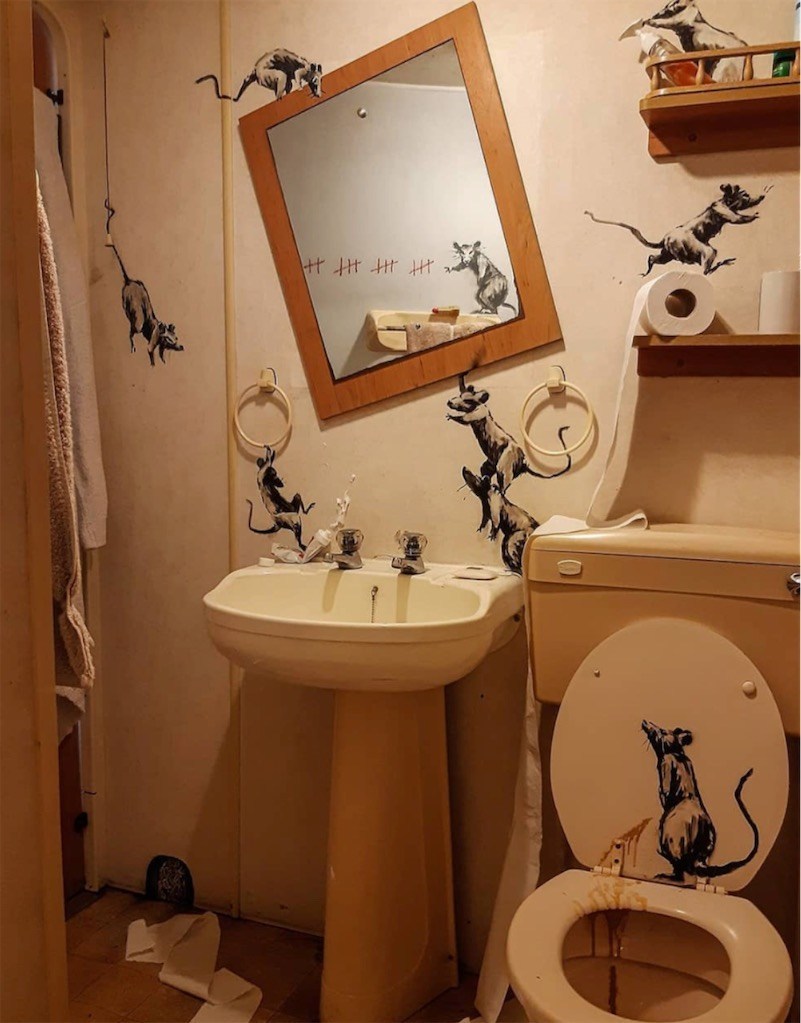
Banksy’s latest work, posted on Instagram, plays with all of these themes and shows he doesn’t have a problem defacing his own property, and sharing an intimate portrait with his millions of followers. Hell, it’s almost a selfie, minus the preening, duck-faced self.
As Daria Harper writes at Artsy:
The notoriously elusive street artist Banksy debuted his latest work in a rather peculiar place: his bathroom. With much of the world on lockdown due to the COVID-19 crisis, artists like Banksy have been forced to get innovative with their artistic practices. The artist posted photos of the new artwork on his Instagram page yesterday with the caption: “My wife hates it when I work from home.”
Is this really Banksy working from home? (“One particularly baffled commenter,” notes Hyperallergic, “wrote: ‘You are one of the world’s most famous artists… and THAT’S YOUR shitty little BATHROOM????’”)
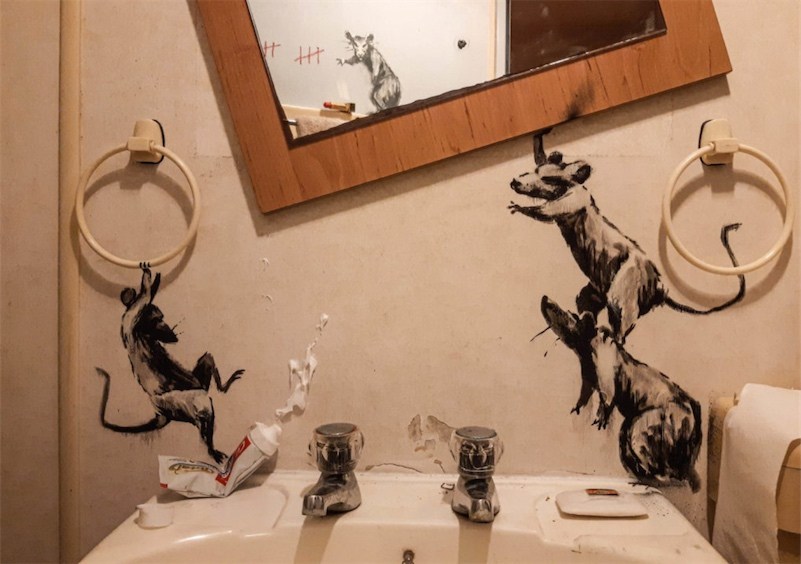
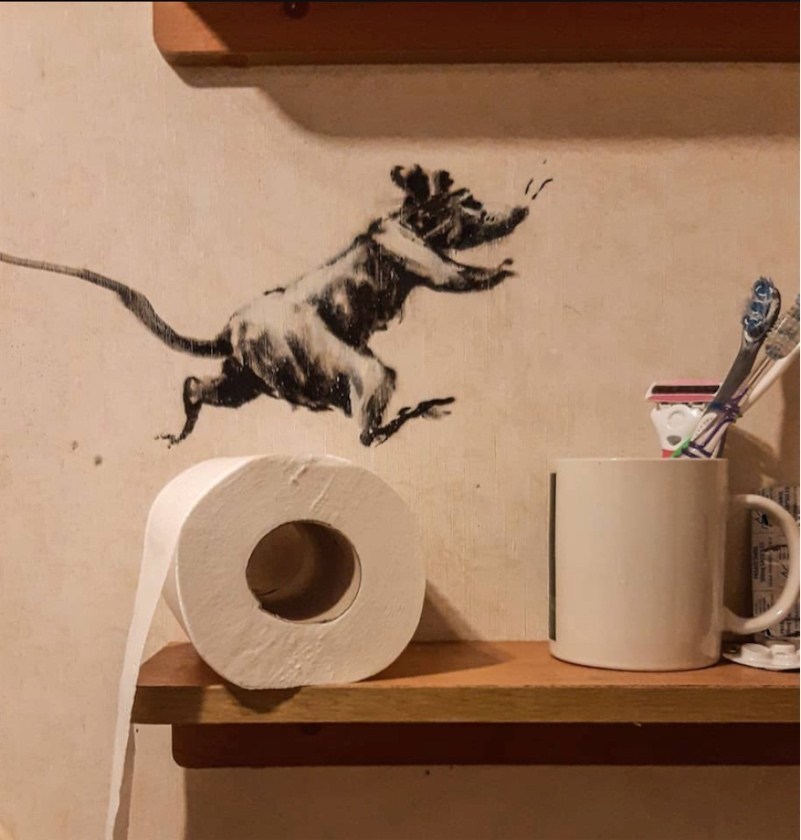
Is there really a Mrs. Banksy? Little Banksies running around the yard, wearing coronavirus facemasks and hoodies? Is he on the verge of outing himself? At least we know he’s still got toilet paper.
Maybe you find this tantalizing window on the artist’s inner sanctum credible evidence of his mundane real life. Maybe the signature rats destroying his crapper are his cabin-fever dream. Or maybe, as usual, he’s just taking the piss with this creative installation. We await comment from Mrs. Banksy.
via Boing Boing
Related Content:
Banksy Strikes Again in Venice
Banksy Paints a Grim Holiday Mural: Season’s Greetings to All
Behind the Banksy Stunt: An In-Depth Breakdown of the Artist’s Self-Shredding Painting
Josh Jones is a writer and musician based in Durham, NC. Follow him at @jdmagness
Read More...See Web Cams of Surreally Empty City Streets in Venice, New York, London & Beyond
The lack of human presence in majorly polluted cities these past couple months has had some people seeing utopias as the skies begin to clear. But empty cities seem a little more dystopian to me. Dystopias are “a kind of surrealism,” writes Kim Stanley Robinson. They unearth the dreamlike dread beneath the veneer of the normal. No matter when they’re set, dystopias don’t depict the future so much as “the feeling of the present… heightened by exaggeration to a kind of dream or nightmare.” The events in dystopian fiction approach the truth of someone’s situation somewhere in the world and make visible what has been hidden.
We know ghost cities exist as ancient disasters like Pompeii and Herculaneum and modern ones like Pripyat, Ukraine, outside Chernobyl. But there are more of them than many of us know. Gleaming cities like Ashgabat, Turkmenistan, which broke ground in 1991 and contains the largest number of marble buildings in the world.
The 4.5 million square meter metropolis has almost no inhabitants, an enormous government folly. Towns and cities around the world have been abandoned for for all sorts of reasons, and they continue to as sea levels rise. Which is what makes viewing live camera footage of some of the world’s most iconic streets—almost completely emptied by the pandemic at the height of tourist season—so… surreal.
It’s true that people haven’t fled these cities, but made cozy bunkers of their apartments. Yet seeing the vacant streets live on camera, in Venice, London, New York, and elsewhere in the world, I get the uncanny feeling of looking at proto-surrealist painter Giorgio de Chirico’s The Enigma of a Day, a depiction of a shadowy, uninhabited street through which we expect the Italian version of a tumbleweed to roll. Surveillance technology has inadvertently become a medium of modernist art.
There is so much beauty in the live view at the top of the Ponte delle Guglie in Venice from the Hotel Filù Venezia, and there is also such lonely melancholy, depending on the time of day and where the shadows fall. See a live view of Times Square, above, and another Times Square view at EarthCam, where you can also catch a feed of a mostly empty Abbey Road (some times of day emptier than others, as in the early-morning screenshot below). Skyline Webcams hosts even more live camera views of Venice, including feeds from the Rialto Bridge and the Piazza San Marco, as well as live feeds from several sites in Padua and other places in Italy.
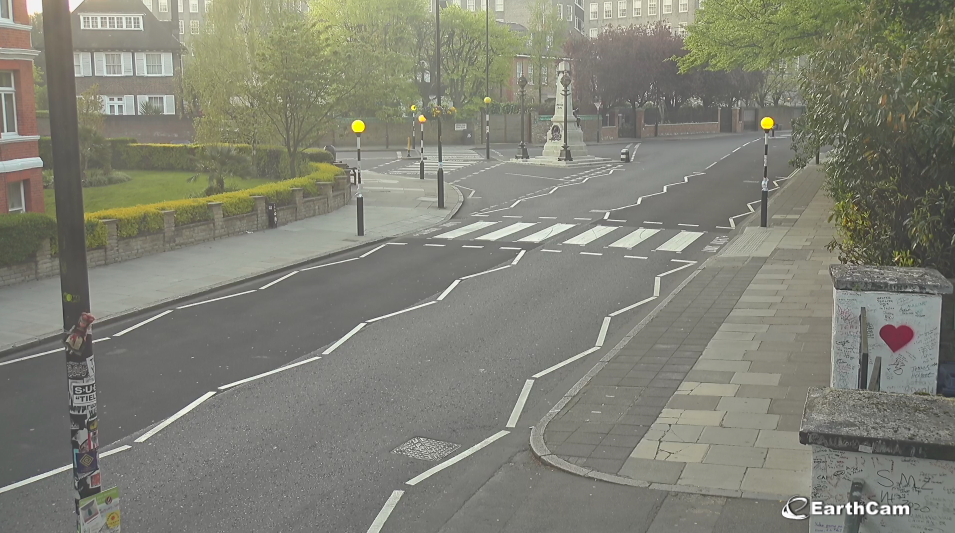
These real-time visions are transporting in their strangeness. Are we living in the present or the future? In a dystopian world, there isn’t any difference. All futures are foreclosed by catastrophe, “all distances in time and space are shrinking,” wrote Martin Heidegger, a thinker who understood disaster, and who fell in line behind it. In that same essay, “The Thing” (as translated by Albert Hofstader), the German philosopher made his famous comment, “the terrible has already happened.”
The terrible that has happened to us is not only a deadly pandemic. The virus is not likely to disappear on its own; who knows how long this will go on? But not far behind the current crisis are more climate events that threaten to empty streets. If we empty cities not only as indicative of temporarily social distancing, but as images of the possible near-future, maybe we’ll be far less inclined to come out of this surreal experience and get right back to business-as-usual.
Related Content:
Take a Virtual Tour of Venice (Its Streets, Plazas & Canals) with Google Street View
Google Lets You Take a 360-Degree Panoramic Tour of Street Art in Cities Across the World
Spring Break vs. COVID-19: Mapping the Real Impact of Ignoring Social Distancing
Josh Jones is a writer and musician based in Durham, NC. Follow him at @jdmagness
Read More...Rare Grooves on Vinyl from Around the World: Hear Curated Playlists of Arabic, Brazilian, Bollywood, Soviet & Turkish Music
Just as the category of “Foreign Language Film” has serious problems, so too does that of “World Music,” which names so many kinds of music that it names nothing at all. World music “might best be described by what it is not,” noted a 1994 Music Library Association report. “It is not Western art music, neither it is mainstream Western folk or popular music.” The report adds some vague qualifications about “ethnic or foreign elements” then gives away the game: “It is simply not our music, it is their music, music which belongs to someone else.”
Perhaps one can see why the idea is now regarded by some as “outdated and offensive.” As the University of Minnesota’s Timothy Brennan argues in a historical analysis of the term, “world music does not exist” except “as an idea in the mind of journalists, critics, and the buyers of records.”
But to whom can music belong? If Japanese musicians play jazz, are they playing American-owned music? Is it “Japanese jazz” or just jazz? Must it have Japanese instruments for it to be “World Music”?
How these questions get answered can determine whether most listeners ever encounter the recorded output of jazz musicians from Japan, such as that in an excellent thirty-minute sampler from the 1970s that we featured just a few days back. In this mix, DJ Zag Erlat showcases names that “will sound familiar,” wrote Open Culture’s Colin Marshall, “to those of us who’ve spent years digging crates around the world for Japanese jazz on vinyl.” That’s a select group, indeed, and one you may be inspired to join once you’ve heard Erlat’s mix.
The Turkish DJ has further done his part to disambiguate World Music on his YouTube channel My Analog Journal. Here, you’ll find Erlat spinning sets of “Brazilian Grooves,” “Arabic Grooves,” “African Grooves,” “Bollywood Grooves,” and so much more—including a set of Jazz from the USSR in his tenth episode that is quite a revealing listen. Who knew such music existed in the Soviet Union? Well, except for those Soviet jazz crate-diggers.
Now you know too, and you’ll learn a lot more about what the world’s been up to, music-wise. These are also, obviously, very broad categories, and one might reasonably object to them. But it’s a great start for getting to know some classic pop sounds from specific regions in the world. Erlat does get more specific in some sets, as in his Japanese jazz from the 70s. (I’d especially recommend his “Turkish Female Singers from the 70s” mix.)
This is music of the modern world—not “ours” or “theirs”—its basic elements embedded in a global cultural marketplace. “It is 25 years since the concept of world music was created by enthusiasts in a north London pub,” wrote The Guardian’s Ian Birrell in 2012. “Perhaps it made sense then, as a marketing device to promote the sounds of the world that were lost in record shops and on the radio. But not now. Not in this mixed-up, messy and shrunken world.” Perhaps it didn’t make sense then, when artists like Fela Kuti or Os Mutantes made music that was as much “Western” as it was African or South American.
It becomes increasingly impossible to segregate artists from different countries. Genre mashups rule, and the more furiously artists from around the world pick up and put down global styles, the more they attract the positive notice of fans and critics in pop music. But perhaps we’ll continue to refer to indigenous folk traditions as “World Music,” and perhaps that’s what the label has always been meant to describe. In that case, as one writer for the Grammy’s official blog put it, “something tells me that the rest of the world has a different definition.”
Get familiar with several other groovy musics from elsewhere at Erlat’s My Analog Journal.
Related Content:
Josh Jones is a writer and musician based in Durham, NC. Follow him at @jdmagness
Read More...A 30-Minute Introduction to Japanese Jazz from the 1970s: Like Japanese Whisky, It’s Underrated, But Very High Quality
“Jazz and Japan shouldn’t mix,” says All-Japan: The Catalogue of Everything Japanese. “After all, the essence of jazz lies in improvisation — a concept largely absent from both traditional Japanese music and Japanese society as a whole. Japan may adapt, but it does not improvise.” And yet, as the book goes on to tell, jazz and Japan do indeed mix, and they began doing so even before the Second World War. Japanese jazz dates back to the 1920s, when it drew inspiration from visiting Filipino bands who had picked the music up from their American occupiers. In the century since then, devoted Japanese players (and their even more devoted Japanese listeners) have developed perhaps the most robust jazz culture in the world.
But please, don’t believe me: have a listen to the mix of 1970s Japanese jazz on vinyl above. Spun by Turkish DJ Zag Erlat on his Youtube channel My Analog Journal, it showcases such musicians as trombonist Hiroshi Suzuki, saxophonist Mabumi Yamaguchi, and guitarist Kiyoshi Sugimoto. These names will sound familiar — though not over-familiar — to those of us who’ve spent years digging crates around the world for Japanese jazz on vinyl.
Thanks to Youtube, they’re now becoming better-known among jazz fans of all stripes: just like the 1980s Japanese high-tech disco-funk now known as city pop, Japanese jazz owes much of its modern recognition to the algorithm. As a result, actual Japanese jazz albums like the ones nonchalantly displayed by Erlat in the video have become a hotter commodity than they used to be.
Like all of Erlat’s “coffee break sessions” (others of which focus on Japanese drama funk, Turkish female singers from the 70s, and “USSR grooves”), this mix runs a brisk 33 minutes. If you enjoy the taste enough to go back for more, allow me to suggest the work of such Japanese jazzmen as Teruo Nakamura, Masayoshi Takanaka, and Terumasa Hino — much of which comes from the 1970s, an era that enthusiasts across the world now see as something of a golden age. You’ll still only have skimmed the surface of Japanese jazz, one of the many Western inventions taken to another level of mastery, and exhilarating new directions, in the Land of the Rising Sun. As one commenter on Youtube puts it, “Japanese Jazz is like Japanese whisky: underrated, but very high quality.”
Related Content:
Acclaimed Japanese Jazz Pianist Yōsuke Yamashita Plays a Burning Piano on the Beach
Haruki Murakami’s Passion for Jazz: Discover the Novelist’s Jazz Playlist, Jazz Essay & Jazz Bar
Hear 2,000 Recordings of the Most Essential Jazz Songs: A Huge Playlist for Your Jazz Education
Based in Seoul, Colin Marshall writes and broadcasts on cities, language, and culture. His projects include the book The Stateless City: a Walk through 21st-Century Los Angeles and the video series The City in Cinema. Follow him on Twitter at @colinmarshall, on Facebook, or on Instagram.
Read More...Customize Your Zoom Virtual Background with Free Works of Art

Limitations stimulate creativity. While that phrasing is credited to business-management scholar Henry Mintzberg, the idea itself has a long history. We know we work more fruitfully when we work within boundaries, and we’ve known ever since our capabilities were limited in ways barely imaginable today. With the ongoing coronavirus pandemic having temporarily redrawn the boundaries of our lives, many of us have already begun to rediscover our own creativity. Some have even done it on Zoom, the teleconferencing software used by businesses and institutions to keep their meetings and classes going even in a time of social distancing.
Instead of their bedrooms or offices, students and office workers have started appearing in settings like a 1970s disco, the Taj Mahal, and the starship Enterprise. The technology making this possible is the “virtual background,” explained in the official Zoom instructional video down below.
Word of the virtual background’s possibilities has spread through institutions everywhere. It certainly has at the Getty, whose digital editor Caitlin Shamberg notes that “the Getty’s Open Content program includes over 100,000 images that are free and downloadable. This means they’re also fair game to use as your own custom background.”
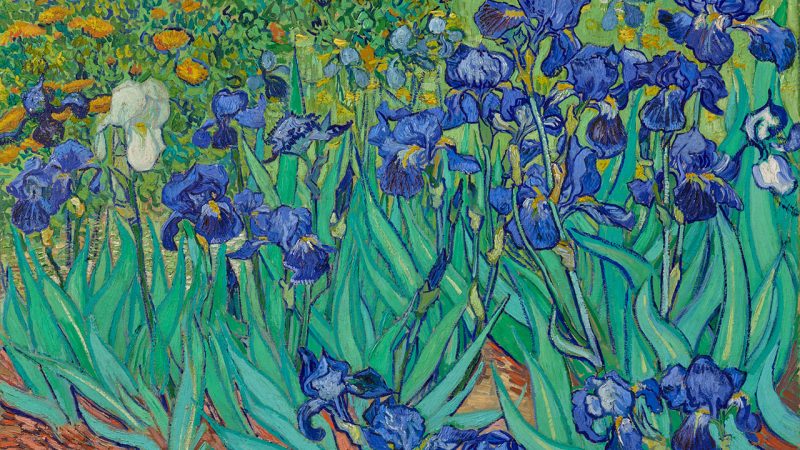
From the Getty’s digital collection Shamberg offers such works suitable for Zoom as Van Gogh’s Irises, Turner’s Van Tromp, going about to please his Masters, Ships a Sea, getting a Good Wetting, and other canvasses of such reliably pleasing settings as 18th-century Venice and a 16th-century forest with a rabbit. The Verge’s Natt Garun recently rounded up a few resources where you can find more promising virtual-background material, from bingo cards to beaches to “pop culture homes” including “Carrie Bradshaw’s apartment from Sex and the City, your favorite Friends lofts, Seinfeld living rooms, and more.”
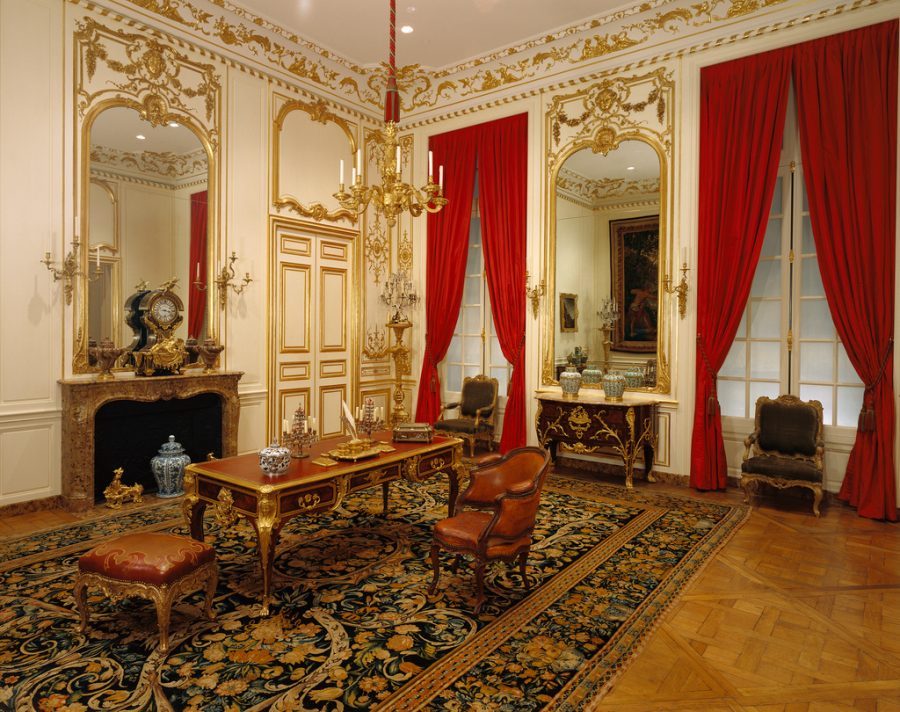
Here at Open Culture, we’ll point you to the thirty world-class museums that have put two million works of art online, many of which institutions have made them available for download. In this post appears, from the Metropolitan Museum of Art, Katsushika Hokusai’s Under the Wave off Kanagawa (whose evolution to the status of an iconic ukiyo‑e print we’ve previously covered); from the Getty, an 18th-century room “originally used as a bedroom or large cabinet in a private Parisian home at number 18 place Vendôme”; and from the Los Angeles County Museum of Art, George Bellows’ The Coming Storm.
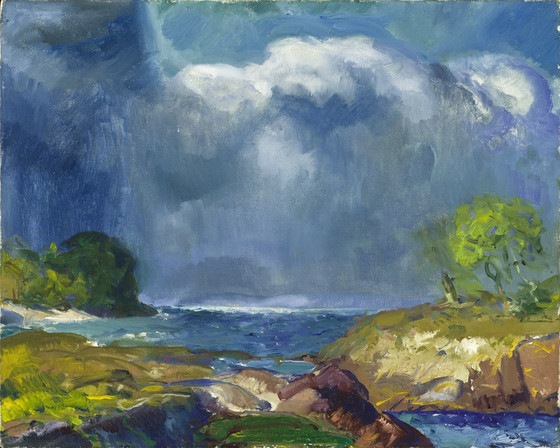
That last work, pictured above, has a certain metaphorical resonance with the situation the world now finds itself in, hoping though we are that the storm of COVID-19 is now passing rather than still coming. But while we’re sheltering from it — and continuing to carry on business as usual as best we can — we might as well get take every opportunity to get artistic. Find many more artistic images to download here.
Related Content:
The Metropolitan Museum of Art Puts 400,000 High-Res Images Online & Makes Them Free to Use
LA County Museum Makes 20,000 Artistic Images Available for Free Download
Take a Virtual Tour of 30 World-Class Museums & Safely Visit 2 Million Works of Fine Art
Based in Seoul, Colin Marshall writes and broadcasts on cities, language, and culture. His projects include the book The Stateless City: a Walk through 21st-Century Los Angeles and the video series The City in Cinema. Follow him on Twitter at @colinmarshall, on Facebook, or on Instagram.
Read More...HBO Is Streaming 500 Hours of Shows for Free: The Sopranos, The Wire, and More
We live, one often hears, in a golden age of television. But when did this age begin? Scholars of prestige TV drama — a field that, for both professionals and amateurs, has expanded in recent years — tend to point to The Sopranos, which premiered in 1999. In its eight-year run, David Chase’s series about a depressed New Jersey mafia boss, a protagonist analyzed in the Behind the Curtain video essay above, set new standards in its medium for craft and complexity. To understand how much of a departure The Sopranos marked from everything else on television, simply compare it to what was airing on major broadcast networks in the 1990s, most of which now looks unwatchably simplistic and repetitive.
Of course, The Sopranos didn’t air on a major broadcast network: it aired on HBO. Originally launched as “Home Box Office” in 1972, the oldest premium cable channel of them all has long since expanded its mandate from airing second-run movies to creating original programming of its own.
Its mid-1990s slogan “It’s Not TV. It’s HBO” reflects an intent to go beyond what was possible on conventional television networks, an enterprise whose promise The Sopranos signaled to the world. Critics lavished even more praise on The Wire, David Simon’s dramatic examination and indictment of American institutions that ran on HBO from 2002 to 2008. In the video essay just above, Thomas Flight explains what makes The Wire, whose fans include everyone from Barack Obama to Slavoj Žižek, “one of the most brilliant TV shows ever.”
If you haven’t seen these or the other acclaimed HBO shows that have done so much to gild this televisual age, now’s your chance to catch up. That’s true not just for the obvious reason — the threat of the coronavirus pandemic keeping so many shut in at home — but also because HBO will make 500 hours of its programming free to stream on its HBO Now and HBO Go platforms. If you’re in the United States or another area served by HBO online, you can watch not just The Sopranos and The Wire in their entirety, but the vampire-themed True Blood, the undertaking-themed Six Feet Under, and such comedic takes on American business and politics as Silicon Valley and Veep, a video essay from The Take on whose “satire in the age of Trump” appears above. Of all the ways we can define HBO-style prestige television, isn’t “TV shows good enough to inspire video essays” the most apt? Get started here.
Related Content:
The Wire as Great Victorian Novel
David Chase Reveals the Philosophical Meaning of The Sopranos’ Final Scene
Based in Seoul, Colin Marshall writes and broadcasts on cities, language, and culture. His projects include the book The Stateless City: a Walk through 21st-Century Los Angeles and the video series The City in Cinema. Follow him on Twitter at @colinmarshall, on Facebook, or on Instagram.
Read More...Why Did LEGO Become a Media Empire? Pretty Much Pop: A Culture Podcast #37
Why has a children’s toy become a brand attached to virtually every media type, partnering with the most ubiquitous franchises, and serving as a pastime for many adult hobbyists who will gut you if you call LEGO a “children’s toy.”
Brian Hirt (our resident AFOL, i.e. adult fan of LEGO) talks with co-hosts Erica Spyres and Mark Linsenmayer about creative play vs. following the printed directions, building purists vs. anthropomorphizers, LEGO qua corporate overlord, the LEGO films and competitive building TV show, and more.
Brian’s LEGO designs that we react to are the Mandelbrot fractal, baby Yoda, dreidel, and swimming pool. “AFOL” is but the first of many LEGO-specific initialisms; see the glossary.
Here are some articles we drummed up to prepare:
- “ ‘The Cult of LEGO’: Inside the World of a Devoted Community” by Maria Popova
- “If You’re an Adult Playing With Legos, Just Don’t. Here’s Why.” by Seth Garben
- “Lego Is the Perfect Toy Even if no one can really agree on what kind of toy it is anymore” by Genevieve Smith
- “Why Adults Are Using Lego to Battle Stress” from GameCentral
- “LEGO Writer Arie Kaplan Discusses Clicking with Star Wars and Batman” by Michal Schick
- “The LEGO Batman Movie Turns Bat Mythology Into a Giant Toybox” by Jesse Hassenger
- “Can LEGO Be Considered Art” by John Baichtal
- “How Does Someone Become a Full-Time LEGO Artist?” by Mariah Eakin
- “LEGO Turned Itself Around by Analyzing Overbearing Parents” by Mikkel Rasmussen
- “Minnesota Professor Explores Link Between Philosophy and Lego” by Richard Chin
- “Top 5 LEGO Podcasts You Must Follow in 2020” from Feedspot
Learn more at prettymuchpop.com. This episode includes bonus discussion that you can only hear by supporting the podcast at patreon.com/prettymuchpop. This podcast is part of the Partially Examined Life podcast network.
Pretty Much Pop: A Culture Podcast is the first podcast curated by Open Culture. Browse all Pretty Much Pop posts or start with the first episode.
Read More...Support Us
We're hoping to rely on loyal readers, rather than erratic ads. Please click the Donate button and support Open Culture. You can use Paypal, Venmo, Patreon, even Crypto! We thank you!

About Us

Open Culture scours the web for the best educational media. We find the free courses and audio books you need, the language lessons & educational videos you want, and plenty of enlightenment in between.
Advertise With Us
FREE UPDATES!
GET OUR DAILY EMAIL
Get the best cultural and educational resources on the web curated for you in a daily email. We never spam. Unsubscribe at any time.
FOLLOW ON SOCIAL MEDIA
Open Culture editor Dan Colman scours the web for the best educational media. He finds the free courses and audio books you need, the language lessons & movies you want, and plenty of enlightenment in between.
Advertise With Us

