An Animated Michael Sandel Explains How Meritocracy Degrades Our Democracy
Imagine if governments and institutions took their policy directives straight from George Orwell’s 1984 or Jonathan Swift’s “A Modest Proposal.” We might veer distressingly close to many a literary dystopia in these times, with duckspeak taking over all the discourse. But some lines—bans on thinking or non-procreative sex, or seriously proposing to eat babies—have not yet been crossed.
When it comes, however, to meritocracy—a term that originated in a 1958 satirical dystopian novel by British sociologist Michael Young—it can seem as if the political class had taken fiction as manifesto. Young himself wrote in 2001, “much that was predicted has already come about. It is highly unlikely the prime minister has read the book, but he has caught on to the word without realizing the dangers of what he is advocating.”
In Young’s historical analysis, what began as an allegedly democratic impulse, a means of breaking up hereditary castes, became itself a way to solidify and entrench a ruling hierarchy. “The new class has the means at hand,” wrote Young, “and largely under its control, by which it reproduces itself.” (Wealthy people bribing their children’s way into elite institutions comes to mind.) Equal opportunity for those who work hard and play by the rules doesn’t actually obtain in the real world, meritocracy’s critics demonstrate—prominent among them the man who coined the term “meritocracy.”
One problem, as Harvard’s Michael Sandel frames it in the short RSA animated video above, is an ancient one, characterized by a very ancient word. “Meritocratic hubris,” he says, “the tendency of winners to inhale too deeply of their success,” causes them to “forget the luck and good fortune that helped them on their way.” Accidents of birth are ignored in a hyper-individualist ideology that insists on narcissistic notions of self-made people and a just world (for them).
“The smug conviction that those on the top deserve their fate” comes with its inevitable corollary—“those on the bottom deserve theirs too,” no matter the historical, political, and economic circumstances beyond their control, and no matter how hard they might work or how talented they may be. Meritocracy obviates the idea, Sandel says, that “there but for the grace of God or accidents of fortune go I,” which promoted a healthy degree of humility and an acceptance of life’s contingency.
Sandel sees meritocratic attitudes as corrosive to democracy, describing their effects in his upcoming book The Tyranny of Merit. Yale Law Professor Daniel Markovits, another ivy league academic and heir to Michael Young’s critique, has also just released a book (The Meritocracy Trap) decrying meritocracy. He describes the system as a “trap” in which “upward mobility has become a fantasy, and the embattled middle classes are now more likely to sink into the working poor than to rise into the professional elite.”
Markovitz, who holds two degrees from Yale and a doctorate from Oxford, admits at The Atlantic that most of his students “unnervingly resemble my younger self: They are, overwhelmingly, products of professional parents and high-class universities.” Once an advocate of the idea of meritocracy as a democratic force, he now argues that its promises “exclude everyone outside of a narrow elite…. Hardworking outsiders no longer enjoy genuine opportunity.”
According to Michael Young, meritocracy’s tireless first critic and theorist (he adapted his satire from his 1955 dissertation), “those judged to have merit of a particular kind,” whether they truly have it or not, always had the potential, as he wrote in The Guardian, to “harden into a new social class without room in it for others.” A class that further dispossessed and disempowered those viewed as losers in the endless rounds of competition for social worth.
Young died in 2002. We can only imagine what he would have made of the exponential extremes of inequality in 2019. A utopian socialist and tireless educator, he also became an MP in the House of Lords and a baron in 1978. Perhaps his new position gave him further vantage to see how “with the coming of the meritocracy, the now leaderless masses were partially disfranchised; a time has gone by, more and more of them have been disengaged, and disaffected to the extent of not even bothering to vote. They no longer have their own people to represent them.”
Related Content:
Michael Sandel’s Famous Harvard Course on Justice Launches as a MOOC on Tuesday
Piketty’s Capital in a Nutshell
Josh Jones is a writer and musician based in Durham, NC. Follow him at @jdmagness
Read More...John Milton’s Hand Annotated Copy of Shakespeare’s First Folio: A New Discovery by a Cambridge Scholar
Perhaps the most well-read writer of his time, English poet John Milton “knew the biblical languages, along with Homer’s Greek and Vergil’s Latin,” notes the NYPL. He likely had Dante’s Divine Comedy in mind when he wrote Paradise Lost. His own Protestant epic, if not a theological response to the Divine Comedy, had as much literary impact on the English language as Dante’s poem did on Italian. Milton would also have as much influence on English as Shakespeare, his near contemporary, who died eight years after the Paradise Lost author was born.
In some sense, Milton can be called a direct literary heir of Shakespeare, though he wrote in a different medium and idiom (almost a different language), and with a very different set of concerns.
Milton’s father was a trustee of the Blackfriar’s Theatre, where Shakespeare’s company of actors, the King’s Men, began performing in 1609, the year after Milton’s birth. And Milton’s first published poem appeared anonymously in the 1632 second folio of Shakespeare’s plays under the title “An Epitaph on the admirable Dramaticke Poet, W. Shakespeare.”
Now known as “On Shakespeare,” the poem laments the sorry state of Shakespeare’s legacy—his monument a “weak witness,” his work an “unvalued book.” It may be difficult to imagine a time when Shakespeare wasn’t revered, but his reputation only began to spread beyond the theater in the early 17th century. Milton’s poem was one of the first to proclaim Shakespeare’s greatness, as a poet who should lie “in such pomp” that “kings for such a tomb would wish to die.”
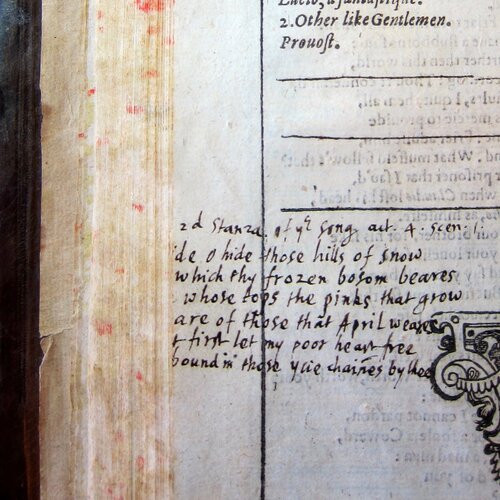
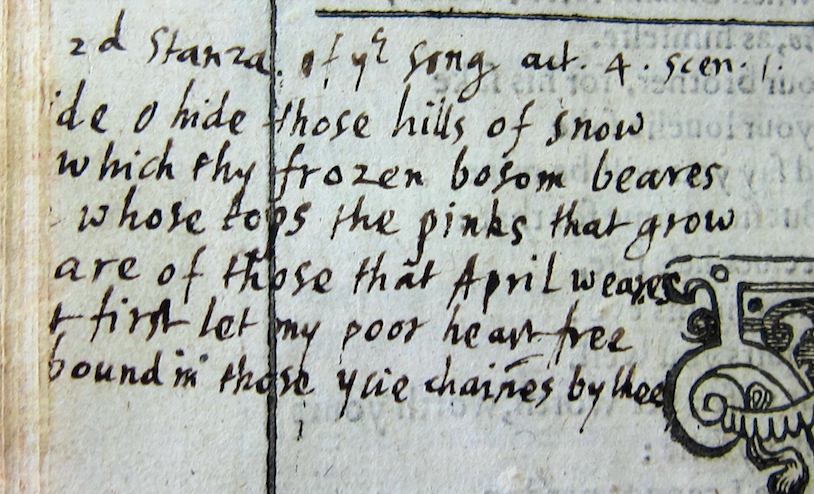
Now, it seems that significant further evidence of Milton’s admiration, and critical appreciation, of Shakespeare has emerged: in the form of Milton’s own, personal copy of the 1623 First Folio edition of Shakespeare’s plays, with annotations in Milton’s own hand. Moreover, it seems this evidence has been sitting under scholar’s noses for decades, housed in the public Free Library of Philadelphia’s Rare Book Department, one of over 230 extant copies of the First Folio.
In a blog post at the Centre for Material Texts, the University of Cambridge’s Jason Scott-Warren makes his case that the annotated First Folio is Milton’s own, primarily, he writes, on the basis of paleography, or handwriting analysis. “This just looks like Milton’s hand,” he says, then walks through several comparisons with other known Milton manuscripts, such as his commonplace book and annotated Bible.
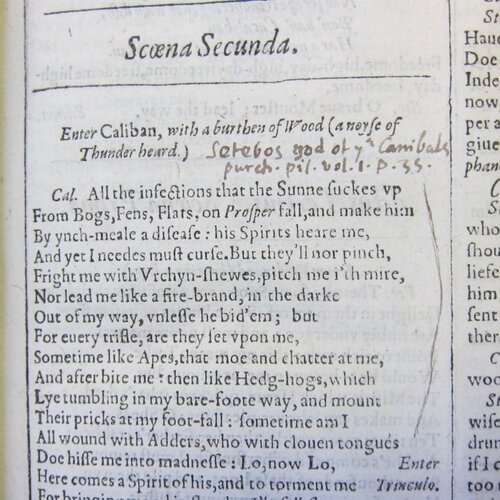
There is also the copious evidence for dating the book to the time Milton would have owned it, from the many marginal references to contemporary works like Samuel Purchas’ 1625 Pilgrimes and John Fletcher’s The Bloody Brother. Milton “added marginal markings to all of the plays except for Henry VI 1–3 and Titus Andronicus,” notes Scott-Warren. His corrections—from the Quarto—emendations, and “smart cross-references” are “intelligent and assiduous.”
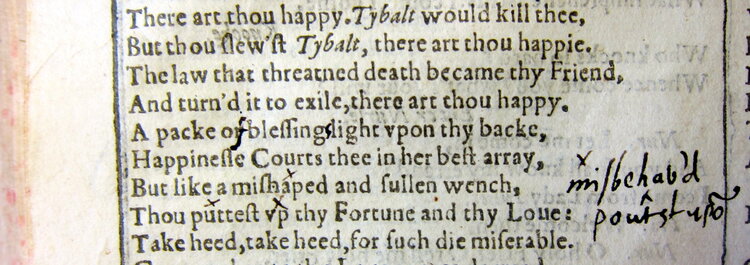
Anticipating blowback for his Milton theory, Scott-Warren asks, “wouldn’t his copy be bristling with cross-references, packed with smart observations and angrily censorious comments?” It would indeed, and “several distinguished Miltonists” have agreed with Scott-Warren’s analysis, many contacting him, he writes in a postscript, to say they’re “confident that this identification is correct.” He adds that he has “been roundly rebuked for understating the significance of the discovery.”
This kind of self-reported validation isn’t exactly peer review, but we don’t have to take his word for it. Said scholars have made their approval publicly, enthusiastically, known on Twitter. And Penn State Assistant Professor of English Claire M.L. Bourne has written a congratulatory essay on her blog. It was Bourne who spurred on Scott-Warren’s investigation with her own essay “Vide Supplementum: Early Modern Collation as Play-Reading in the First Folio,” published just months earlier this year.
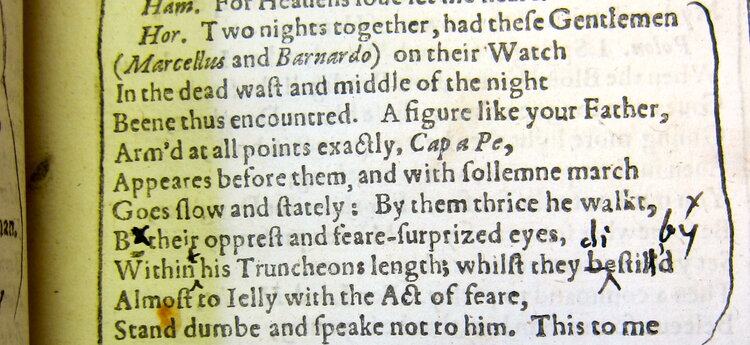
Bourne was one of the first few scholars to thoroughly examine the Free Library of Philadelphia’s copy of the First Folio. But, she admits, she completely missed the Milton connection. “You can work for a decade,” she writes ruefully, “as I did, on a single book… and still be left with gaping holes in the narrative.” This new scholarship may not only have filled in the mystery of the book’s first owner and annotator; it may also show the full degree to which Milton engaged with Shakespeare, and give Milton scholars “a new and significant field of reference” for reading his work.
via MetaFilter
Related Content:
William Blake’s Hallucinatory Illustrations of John Milton’s Paradise Lost
Spenser and Milton (Free Course)
Josh Jones is a writer and musician based in Durham, NC. Follow him at @jdmagness
Read More...Bob Moog Demonstrates His Revolutionary Moog Model D Synthesizer
There are far better players of Bob Moog’s wonderous analog synthesizers than Bob Moog himself–from Wendy Carlos, who reinterpreted Bach for the newfangled instrument in the 60s to Rick Wakeman and Richard Wright to Giorgio Moroder to Gary Numan, to virtually anyone who has ever recorded music with a Moog. Bob Moog was not a musician, he was an engineer who took piano lessons before earning his B.A. in physics, M.A. in electrical engineering, and Ph.D. in engineering physics from Cornell.
Academic credentials have no bearing on what moves us musically, but it’s always worth noting that the Moog synthesizers—which did more to change the sound of modern music than perhaps any instrument since the electric guitar—came out of decades of dogged scientific research, beginning when Moog was only 14 years old and built a homemade Theremin from plans he found printed in the magazine Electronics World. That was 1949. Almost thirty years later, the Minimoog Model D appeared, the revolutionary portable version of studio-sized machine Carlos used to reimagine classical music in the late 60s.
“It’s an analogue monophonic synthesizer,” says Moog in the video above. “That means it makes the waveforms by electronic means and it plays one note at a time.” Sounds rather primitive by our standards, but watch the demonstration below by Marc Doty, who walks us through the sweeping range of functions in the compact machine, made between 1970 and 1981 (and reissued for a limited run in 2016). Its banks of waveform selectors, oscillators, filters, and envelopes produce “something sweeter,” says Doty, than your average synthetic sounds, though he can’t quite put his finger on what it is.
We’ve all heard the difference, whether we know it or not, and discriminating ears can pick a Minimoog out of any lineup of analogue synths. It is, Doty declares in the description for his video, “perhaps the most beautiful, beautiful sounding, and functional synthesizer ever produced.” Called the Model D because it was the fourth iteration of previous versions made in-house between 1969–70, it was truly, says author and composer Albert Glinsky, “the first portable synthesizer where everything is contained in one unit. It really is the prototype, the ancestor, of every portable keyboard in every music shop today.”
One of its innovations, the pitch wheel, now standard issue on almost all of those mass-produced successors of the Minimoog, was the first of its kind. If Moog “had patented [the pitch wheel],” says David Borden, one of the first musicians to play the Minimoog live, “he would have been an extremely wealthy man.” Others have made similar observations about Moog’s pioneering sound-shaping technologies, but as Richard Leon points out at Sound on Sound, it’s a good thing for us all that the inventor wasn’t motivated by profit.
Competition nearly buried the company Moog sold in the mid-70s (only reacquiring rights to his own name in 2002), but had Moog “tried to create a monopoly on these fundamentals,” Leon writes, “it’s likely the synth industry as we know it today would never have happened.”
Related Content:
How the Moog Synthesizer Changed the Sound of Music
Josh Jones is a writer and musician based in Durham, NC. Follow him at @jdmagness
Read More...Watch Babe Ruth and Lou Gehrig Taking Batting Practice in Strikingly Restored Footage (1931)
How would Babe Ruth, Lou Gehrig, and other famous ballplayers of bygone eras fare if put on the diamond today? Variations on that question tend to come up in conversation among enthusiasts of baseball and its history, and different people bring different kinds of evidence to bear in search of an answer: statistics, eyewitness accounts, analogies between particular historical players and current ones. But the fact remains that none of us have ever actually seen the likes of Ruth, who played his last professional game in 1935, and Gehrig, who did so in 1939, in their prime. But now we can at least get a little closer by watching the film clip above, which shows both of the titanic Yankees at batting practice on April 11, 1931.
What’s more, it shows them moving at real-life speed. “Fox Movietone sound cameras made slow-motion captures of Babe Ruth and Lou Gehrig at batting practice during an exhibition practice in Brooklyn, New York,” writes uploader Guy Jones (whose other baseball videos include Ruth hitting a home run on opening day the same year and Ruth’s last appearance at bat a decade later). “With modern technology, we can witness this footage adjusted to a normal speed which results in a very high framerate.”
In other words, the film shows Ruth and Gehrig not just moving in the very same way they did in real life, but captured with a smoothness uncommon in newsreel footage from the 1930s. For comparison, Jones includes at the end of the video “more footage of the practice (shot at typical fps) and the original un-edited slow-mo captures.”
Unfortunately, what this film reveals doesn’t impress observers of modern baseball. “Ruth and Gehrig in no way look like a modern ballplayer,” writes The Big Lead’s Kyle Koster. “Ruth is off-balance, falling into his swing. Gehrig routinely lifts his back foot off the ground. Again, it’s batting practice so the competitive juices weren’t flowing. But even by that standard, the whole exercise looks sloppy and inefficient.” Cut4’s Jake Mintz gets harsher, as well as more technical: “Tell me Ruth’s cockamamie swing mechanics would enable him to hit a 98-mph heater.” As for the Iron Horse, his “hack is a little better,” but still “absurdly low” by today’s standards. It goes to show, Mintz writes, that “these two legends, while undeniably transcendent in their time, would be good Double‑A hitters at best if they played today.” We evolve, our technologies evolve, and so, it seems, do the games we play.
Related Content:
Home Movies of Duke Ellington Playing Baseball (And How Baseball Coined the Word “Jazz”)
Read Online Haruki Murakami’s New Essay on How a Baseball Game Launched His Writing Career
Fritz Lang’s M: The Restored Version of the Classic 1931 Film
Immaculately Restored Film Lets You Revisit Life in New York City in 1911
Based in Seoul, Colin Marshall writes and broadcasts on cities, language, and culture. His projects include the book The Stateless City: a Walk through 21st-Century Los Angeles and the video series The City in Cinema. Follow him on Twitter at @colinmarshall or on Facebook.
Read More...Pretty Much Pop #10 Examines Margaret Atwood’s Nightmare Vision: The Handmaid’s Tale

Mark Linsenmayer, Erica Spyres, and Brian Hirt take on both Margaret Atwood’s 1985 novel plus the Bruce Miller/Hulu TV series through season 3. There’s also a graphic novel and the 1990 film.
We get into what’s needed to move a novel to the screen like that: The character can’t just remain passive as in the novel in order to keep us suffering with her past the first season as storytelling beyond the book begins. We talk about Atwood’s funny neologisms (like “prayvaganza”) that didn’t make it into the show.
How does race play into the story, and how should it? Is the story primarily a political statement or a self-contained work of art? Given the bleakness of the situation depicted, can there be comic relief? How can we have a nominally funny podcast about this work?
Some of the articles we drew on or bring up include:
- “The Differences Between The Handmaid’s Tale Show and Book, Explained” by Eliana Dockterman
- “In Its First Season, The Handmaid’s Tale’s Greatest Failing Is How It Handles Race” by Angelica Jade Bastién
- “The Handmaid’s Tale Could Be So Much Better. But First It Has to Leave Its Star Behind” by Judy Berman
Plus Erica brings up this video of Bill Moyers interviewing Atwood about religion. We also touch on Shindler’s List, Jean-Paul Sartre’s Nausea, David Brin dissing Star Wars as anti-democratic storytelling, and the many conservative dismissals of the show as hysterical propaganda.
Buy the book, the graphic novel, or its new sequel The Testaments.
You may be interested in these related Partially Examined Life episodes (Mark’s long-running philosophy podcast): #181 on Hannah Arendt and the banality of evil, #139 on bell hooks and her historical account of conditions for black women not terribly dissimilar to the ones described by Atwood, #90 interviewing David Brin about the connections between speculative fiction, philosophy, and political speech. PEL has also recorded several episodes on Sartreand Mark ran a supporter-only session that you could listen to on Nausea in particular. Also check out Brian’s Contellary Tales podcast #2 talking about another breeding-related sci-fi story by Octavia Butler.
This episode includes bonus discussion that you can only hear by supporting the podcast at patreon.com/prettymuchpop. This podcast is part of the Partially Examined Life podcast network.
Pretty Much Pop is the first podcast curated by Open Culture. Browse all Pretty Much Pop posts or start with the first episode.
Read More...Demystifying the Falsetto Obsession in Pop & Rock Music
Though its name sounds derogatory, falsetto is not some kind of trickery but a technique used by humans for as long as they have been singing. It has its histories in indigenous, folk, and classical music. Yet modern ears probably associate it most with pop music of all kinds—from the harmonious vocal blends of Doo Wop to the operatic harmonies of Queen (especially Roger Taylor, below) to… well, virtually every song from a male singer today.
Falsetto is different from what’s called “head voice,” as many a vocal coach will point out. “Usually found in the upper registers of male and female singers,” writes one such coach, “the breathy quality of falsetto” is often “used for effect to sound otherworldly and beautiful or young.” Need a fuller exploration of why falsetto has such purchase in popular music? See the above Vox Earworm explainer by Estelle Caswell, tackling “pop music’s falsetto obsession.”
Falsetto has had phases when women adopted it to majorly prominent effect (see the age of Julee Cruise and Mazzy Star). It has of late become a very clear trend among male pop stars, Caswell theorizes: “Justin Bieber, The Weeknd, Bruno Mars, Drake, Charlie Puth, Shawn Mendes, Adam Levine, Sam Smith… the list goes on and on and on.” What’s all this about?
Caswell decided to “crunch the numbers and quantify” the use of falsetto in pop to see if her perception of its current ubiquity could be substantiated. Enlisting the help of data science and detailed analytics from Pandora, she traced falsetto singing in popular music from a yodeler in 1911 to “the iconic voice of Thom Yorke.” The Billboard Hot 100 is fed into the dataset, “fancy programs” do their thing and humans try to correct errors.
Opera singer Anthony Roth Costanzo shows up to explain the difference between falsetto and vocal register, and we learn much more about what falsetto is, and isn’t, and how, and maybe why, it’s so popular a style for male pop vocalists. Caswell also put together a Spotify playlist of falsetto pop and rock, featuring everything from the aforementioned Queen and Radiohead to Curtis Mayfield, Frankie Valli, the Bee Gees, and Childish Gambino.
What does the data say? Caswell is honest to a fault about the problems with a statistical approach—there are too many hit songs missing from the Pandora dataset, and the AI’s falsetto scoring system (yes, such a thing exists) has serious flaws. Turns out it may take a human ear to recognize the technique, and even then, there’s room for disagreement.
But to sum up: millennials might feel like they live in a golden age of falsetto male pop singers because it’s all they’ve ever known. But ask anyone who grew up hearing Queen, the Bee Gees, or Marvin Gaye, or The Four Tops, even the Stones’ “Emotional Rescue,” or the yodeler who had that hit in 1911….
Related Content:
Josh Jones is a writer and musician based in Durham, NC. Follow him at @jdmagness
Read More...Harvard Gives Free Online Access to 40 Million Pages of U.S. Case Law: Explore 6.4 Million Cases Dating Back to 1658

There was a time—a strange time in pop culture history, I’ll grant—when legal dramas were everywhere in television, popular fiction, and film. Next to the barn-burning courtroom set pieces in A Few Good Men and A Time to Kill, for example, scenes of lawyers poring over case law with loosened ties, high heels kicked off, and martinis and scotches in hand were rendered with maximum dramatic tension, despite the fact that case law is a nigh unreadable jumble of jargon, citations, archaic diction and syntax, etc… anything but brimming with cinematic potential.
Do law students and legal scholars disagree with this assessment? It’s beside the point, many might say. The centuries-old web of case law—reinforcing, contradicting, overturning, creating patterns and structures—is the very stuff the law is made of.
It’s a referential tradition, and when most of the documents are in the hands of only a few people, only those people understand why the law works the way it does. The rest of us are left to wonder why the legal system is so Byzantine and incomprehensible. Real life rarely has the clarity of a satisfying courtroom drama.
Last year, The Harvard Crimson reported a seemingly revolutionary shift in that dynamic, when Harvard Law’s Caselaw Access Project “digitized more than 40 million pages of U.S. state, federal, and territorial case law documents from the Law School library,” dating back to 1658. The Crimson issued one caveat: the full database is accessible to the public, but “users are limited to five hundred full case texts per day.” Plan your intense, scotch-soaked all-nighters accordingly.
Is this altruism, civic duty, a move in the right direction of freeing publicly funded research for public use? Several Harvard Law faculty have said as much. “Case law is the product of public resources poured into our court system,” writes Professor I. Glenn Cohen. “It’s great that the public will now have better access to it.” It is indeed, Professor Christopher T. Bavitz says: “If we want to ensure that people have access to justice, that means that we have to ensure that they have access to cases. The text of cases is the law.”
The law is not a set of abstract principles, theories, or rules, in other words, but a series of historical examples, woven together into a social narrative. Machines can analyze data from The Caselaw Access Project far faster and more efficiently than any human, giving us broader views of legal history and precedent, and greatly expanding public understanding of the system. Harvard’s Library Innovation Lab has itself already created several apps for just this purpose.
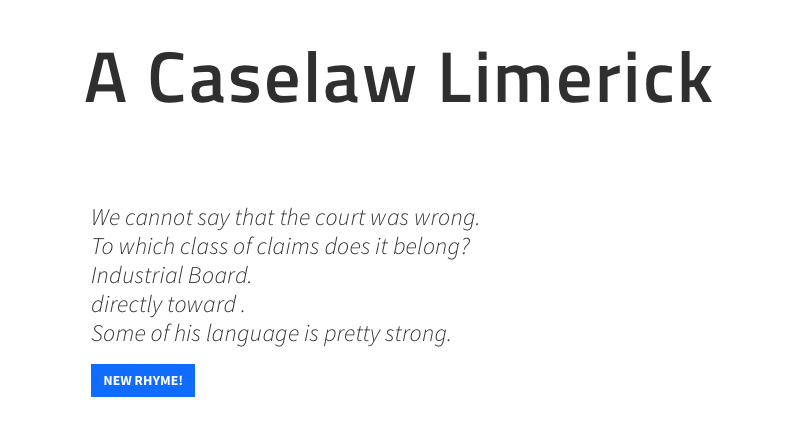
There’s California Wordclouds, which shows the most-used words in California caselaw between 1852 and 2015, and Witchcraft in Caselaw, which does what it says, with an interactive map of all appearances of witchcraft in cases across the country. There’s “Fun Stuff” too, like a Caselaw Limerick Generator, a visual database that analyzes colors in case law, and “Gavelfury,” which analyzes “all instances of ‘!,’” giving us gems like “Do you remember if it was murder!” from Bowling v. State, 229 Ark. 876 (Dec. 22, 1958).
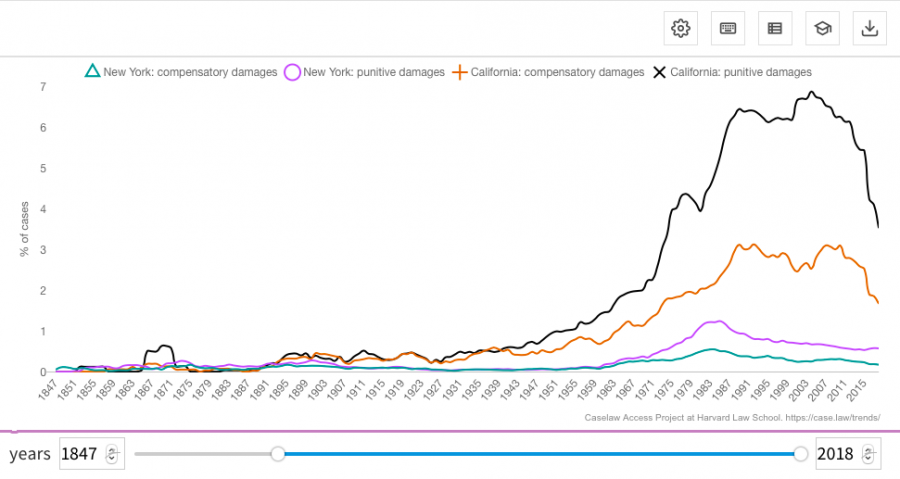
One new graphing tool, Historical Trends, announced in June, makes it easy for users to “visualize word usage in court opinions over time,” writes the Library Innovation Lab. (Examples include comparing the “frequency of ‘compensatory damages’ and ‘punitive damages’ in New York and California” and comparing “privacy” with “publicity.”) Anyone can build their own data visualization using their own search terms. (Learn how and get started here.) Case law may never be glamorous, exactly, or fun to read, but it may be far more interesting, and empowering, than we imagine.
Be aware that the Caselaw Access Project could still find ways to restrict or monetize access, for a short time, at least. “The project was funded partly through a partnership with Ravel, a legal analytics startup founded by two Stanford Law School students,” reports the Crimson. The company “earned ‘some commercial rights’ through March 2024 to charge for greater access to files.” The startup has issued no word on whether this will happen. In the meantime, public interest legal scholars may wish to do their own digging through this trove of caselaw to better understand the public’s right to information of all kinds.
Related Content:
Bound by Law?: Free Comic Book Explains How Copyright Complicates Art
Positive Psychology: A Free Course from Harvard University
Harvard Launches a Free Online Course to Promote Religious Tolerance & Understanding
Josh Jones is a writer and musician based in Durham, NC. Follow him at @jdmagness
Read More...Discover the Spelling Dictionary That Ludwig Wittgenstein Created for Elementary School Students
He only published two books of philosophy, and only one of them in his lifetime, but Ludwig Wittgenstein’s influence on 20th century thought is incalculable. Both of his books, the Tractatus Logico-Philosophicus and the posthumous Philosophical Investigations, constitute major turning points in analytic philosophy—the one inspiring the 1920s logical positivism of the Vienna Circle, the other repudiating Wittgenstein’s earlier thought and invigorating mid-century pragmatism and the Ordinary Language school.
“By the 1930s,” notes Tim Rayner at Philosophy for Change, “Wittgenstein had decided” that the theory of language he had advanced in the Tractatus “was quite wrong. He devoted the rest of his life to explaining why.” This marked a dramatic shift away from the work that first made him famous, but Wittgenstein never did anything halfway. After publishing the Tractatus—partly composed while he fought in World War I—the Austrian son of a wealthy Viennese industrialist announced that he had solved all of the problems in philosophy. Nothing more needed to be said on the matter.
He “retired” to try his hand at several other trades, including grade school teacher, for a period of about six years in rural villages in Austria. “By the time he decided to teach,” Spencer Robins notes at The Paris Review, “Wittgenstein was well on his way to being considered the greatest philosopher alive.” He couldn’t have cared less. “Convinced he was a moral failure, he took extreme steps to change his circumstances, divesting himself of his enormous family fortune” and choosing a profession “influenced by a romantic idea of what it would be like to work with peasants—an idea he’d gotten from reading Tolstoy.”
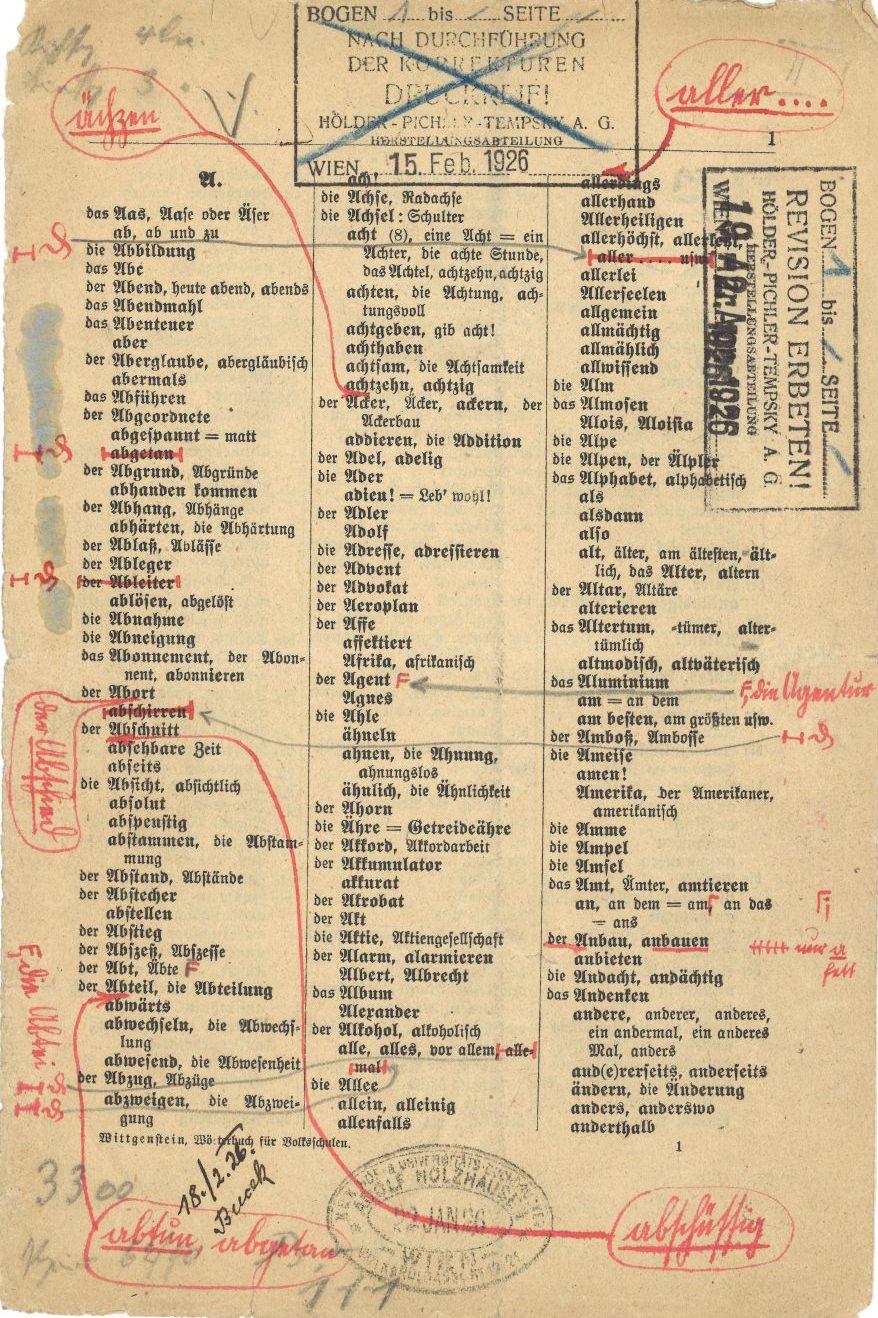
Wittgenstein was an unsparing taskmaster, by all accounts. His brief elementary teaching career ended abruptly in 1926 when he viciously attacked a student. While his personality did not suit him to the role at all, his pedagogy was apparently very effective. Wittgenstein “engaged his students in a sort of ‘project-based learning’ that wouldn’t be out of place in the best elementary classrooms today,” writes Robins. In the last years of teaching, he worked with his students to produce what is technically his second published book—Wörterbuch für Volksschulen, a German spelling dictionary for elementary schools.
One of the shocks that awaited the philosopher when he arrived in rural schools was the expense of books, and students’ inability to obtain them. “I had never realized dictionaries would be so mightily expensive,” he told educationalist Ludwig Hansel. “I think, if I live long enough, I will produce a small dictionary for elementary schools.” Often a pragmatist in life, if not always in his thought, Wittgenstein took the opportunity to turn this promise into a teachable moment, testing drafts of his dictionary in the classroom. “The improvement of spelling was astonishing,” he remarked.
The dictionary, and Wittgenstein’s teaching methods in general during this period, “reveal his continued interest in the philosophy of language and its practical, everyday manifestations,” as Désirée Weber, Assistant Professor of Political Theory at the University of Wooster in Ohio, writes at the British Wittgenstein Society site. Copies of the 42-page book are extremely rare. The page above comes from a set of proof pages discovered and examined by Weber. The pages show the philosopher tailoring his reference guide to the world his students knew and the language they already spoke.
“Although there is some question” which, or whether, the various editorial marks are in Wittgenstein’s own hand, “the contents of the dictionary and the corrections yield a fascinating view of the words that Wittgenstein deemed central to the forms of life and language-games in which his students were immersed.” He captured “the specificity of the rural Austrian dialect,” Weber writes at the Wittgenstein Initiative, as well as “words that pertained to cultural practices that were part of their community and with which they would have been well acquainted.”
Wittgenstein elaborates his practical purpose in an introduction, showing his intent to initiate his students into their “language-using community” and into “the responsibility this carries,” Weber writes. The project also shows him engaging in the theoretical work that would occupy him for the rest of his career.
Related Content:
Ludwig Wittgenstein’s Short, Strange & Brutal Stint as an Elementary School Teacher
In Search of Ludwig Wittgenstein’s Secluded Hut in Norway: A Short Travel Film
Josh Jones is a writer and musician based in Durham, NC. Follow him at @jdmagness
Read More...Marilyn Monroe Recounts Her Harrowing Experience in a Psychiatric Ward (1961)

By the end of 1960, Marilyn Monroe was coming apart.
She spent much of that year shooting what would be her final completed movie – The Misfits (see a still from the trailer above). Arthur Miller penned the film, which is about a beautiful, fragile woman who falls in love with a much older man. The script was pretty clearly based on his own troubled marriage with Monroe. The production was by all accounts spectacularly punishing. Shot in the deserts of Nevada, the temperature on set would regularly climb north of 100 degrees. Director John Huston spent much of the shoot ragingly drunk. Star Clark Gable dropped dead from a heart attack less than a week after production wrapped. And Monroe watched as her husband, who was on set, fell in love with photographer Inge Morath. Never one blessed with confidence or a thick skin, Monroe retreated into a daze of prescription drugs. Monroe and Miller announced their divorce on November 11, 1960.
A few months later, the emotionally exhausted movie star was committed by her psychoanalyst Dr. Marianne Kris to the Payne Whitney Psychiatric Clinic in New York. Monroe thought she was going in for a rest cure. Instead, she was escorted to a padded cell. The four days she spent in the psych ward proved to be among the most distressing of her life.
In a riveting 6‑page letter to her other shrink, Dr. Ralph Greenson, written soon after her release, she detailed her terrifying experience.
There was no empathy at Payne-Whitney — it had a very bad effect — they asked me after putting me in a “cell” (I mean cement blocks and all) for very disturbed depressed patients (except I felt I was in some kind of prison for a crime I hadn’t committed. The inhumanity there I found archaic. They asked me why I wasn’t happy there (everything was under lock and key; things like electric lights, dresser drawers, bathrooms, closets, bars concealed on the windows — the doors have windows so patients can be visible all the time, also, the violence and markings still remain on the walls from former patients). I answered: “Well, I’d have to be nuts if I like it here.”
Monroe quickly became desperate.
I sat on the bed trying to figure if I was given this situation in an acting improvisation what would I do. So I figured, it’s a squeaky wheel that gets the grease. I admit it was a loud squeak but I got the idea from a movie I made once called “Don’t Bother to Knock”. I picked up a light-weight chair and slammed it, and it was hard to do because I had never broken anything in my life — against the glass intentionally. It took a lot of banging to get even a small piece of glass — so I went over with the glass concealed in my hand and sat quietly on the bed waiting for them to come in. They did, and I said to them “If you are going to treat me like a nut I’ll act like a nut”. I admit the next thing is corny but I really did it in the movie except it was with a razor blade. I indicated if they didn’t let me out I would harm myself — the furthest thing from my mind at that moment since you know Dr. Greenson I’m an actress and would never intentionally mark or mar myself. I’m just that vain.
During her four days there, she was subjected to forced baths and a complete loss of privacy and personal freedom. The more she sobbed and resisted, the more the doctors there thought she might actually be psychotic. Monroe’s second husband, Joe DiMaggio, rescued her by getting her released early, over the objections of the staff.
You can read the full letter (where she also talks about reading the letters of Sigmund Freud) over at Letters of Note. And while there, make sure you pick up a copy of the very elegant Letters of Note book.
Note: An earlier version of this post appeared on our site in August 2015.
Related Content:
The 430 Books in Marilyn Monroe’s Library: How Many Have You Read?
Marilyn Monroe Reads Joyce’s Ulysses at the Playground (1955)
Marilyn Monroe Reads Walt Whitman’s Leaves of Grass (1952)
Marilyn Monroe Explains Relativity to Albert Einstein (in a Nicolas Roeg Movie)
Jonathan Crow is a Los Angeles-based writer and filmmaker whose work has appeared in Yahoo!, The Hollywood Reporter, and other publications. You can follow him at @jonccrow. And check out his blog Veeptopus, featuring lots of pictures of vice presidents with octopuses on their heads. The Veeptopus store is here.
Read More...Philosopher Portraits: Famous Philosophers Painted in the Style of Influential Artists
Ludwig Wittgenstein/Piet Mondrian:

What do the Austrian-British philosopher Ludwig Wittgenstein and the Dutch painter Piet Mondrian have in common? For philosopher and artist Renée Jorgensen Bolinger, the two have similar beliefs about the logic of space.
“Many of Mondrian’s pieces explore the relationships between adjacent spaces,” says Bolinger “and in particular the formative role of each on the boundaries and possibilities of the other. I based this painting [see above] off of Wittgenstein’s Tractatus, in which he develops a theory of meaning grounded in the idea that propositions have meaning only insofar as they constrain the ways the world could be; a meaningful proposition is thus very like one of Mondrian’s color squares, forming a boundary and limiting the possible configurations of the adjacent spaces.”
An Assistant Professor at Princeton, Bolinger studied painting a Biola University before making philosophy her second major. “I actually came to philosophy quite late in my college career,” Bolinger says, “only adding the major in my junior year. I was fortunate to have two particularly excellent and philosophic art teachers, Jonathan Puls and Jonathan Anderson, who convinced me that my two passions were not mutually exclusive, and encouraged me to pursue both as I began my graduate education.”
Bolinger now works primarily on the philosophy of language, with side interests in logic, epistemology, mind and political philosophy. She continues to paint. We asked her how she reconciles her two passions, which seem to occupy opposite sides of the mind. “I do work in analytic philosophy,” she says, “but it’s only half true that philosophy and painting engage opposite sides of the mind. The sort of realist drawing and painting that I do is all about analyzing the relationships between the lines, shapes and color tones, and so still very left-brain. Nevertheless, it engages the mind in a different way than do the syllogisms of analytic philosophy. I find that the two types of mental exertion complement each other well, each serving as a productive break from the other.”
Bolinger has created a series of philosopher portraits, each one pairing a philosopher with an artist, or art style, in an intriguing way. In addition to Wittgenstein, she painted ten philosophers in her first series, many of them by request. They can all be seen on her web site, where high quality prints can be ordered.
G.E.M. Anscombe/Jackson Pollock:

Bolinger says she paired the British analytic philosopher Elizabeth Anscombe with the American abstract painter Jackson Pollock for two reasons: “First, the loose style of Pollock’s action painting fits the argumentative (and organizational) style of Wittgenstein’s Philosophical Investigations, which Anscombe helped to edit and was instrumental in publishing. Second, her primary field of work, in which she wrote a seminal text, is philosophy of action, which has obvious connections to the themes present in any of Pollock’s action paintings.”
Gottlob Frege/Vincent Van Gogh:
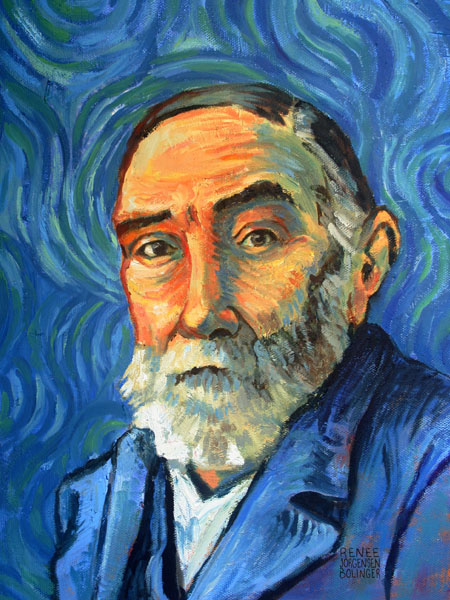
Bolinger paired the German logician, mathematician and philosopher Gottlob Frege with the Dutch painter Vincent Van Gogh as a tongue-in-cheek reference to Van Gogh’s famous painting The Starry Night and Frege’s puzzle concerning identity statements such as “Hesperus is Phosphorus,” or “the evening star is identical to the morning star.”
Bertrand Russell/Art Deco:
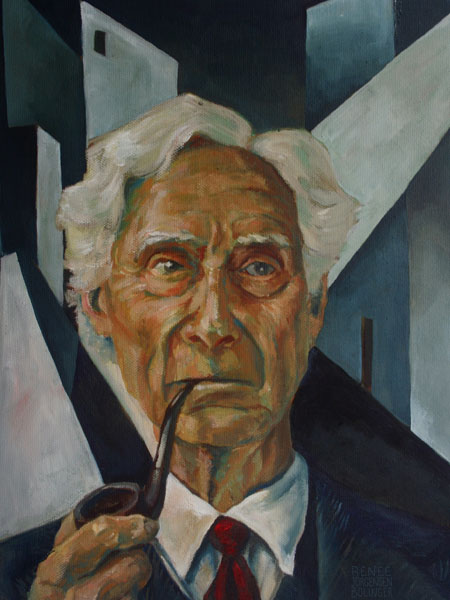
Bolinger painted the British logician and philosopher Bertrand Russell in the Art Deco style. “This pairing is a bit more about the gestalt, and a bit harder to articulate,” says Bolinger. “The simplification of form and reduction to angled planes that takes place in the background of this Art Deco piece are meant to cohere with Russell’s locial atomism (the reduction of complex logical propositions to their fundamental logical ‘atoms’).”
Kurt Gödel/Art Nouveau:
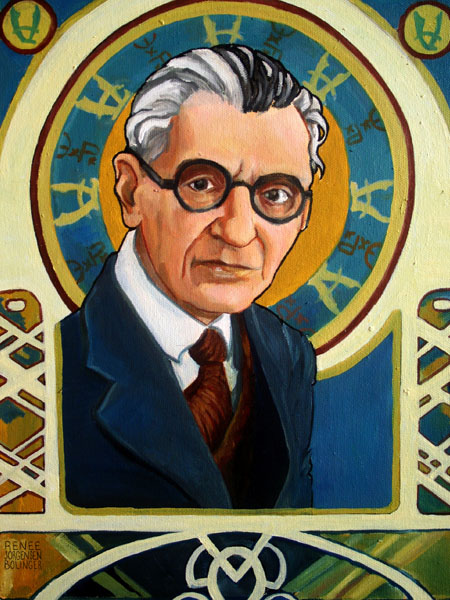
Bolinger paired the Austrian logician Kurt Gödel with Art Nouveau. “The Art Nouveau movement developed around the theme of mechanization and the repetition of forms,” says Bolinger, “and centrally involves a delicate balance between organic shapes — typically a figure that dominates the portrait — and schematized or abstracted patterns, often derived from organic shapes, but made uniform and repetitive (often seen in the flower motifs that ornament most Art Nouveau portraits). I paired this style with Kurt Gödel because his work was dedicated to defining computability in terms of recursive functions, and using the notion to prove the Completeness and Incompleteness theorems.”
To see more of Renée Jorgensen Bolinger’s philosopher portraits, click here to visit her site.
Note: This post originally appeared on our site back in 2013.
If you would like to support the mission of Open Culture, consider making a donation to our site. It’s hard to rely 100% on ads, and your contributions will help us continue providing the best free cultural and educational materials to learners everywhere. You can contribute through PayPal, Patreon, and Venmo (@openculture). Thanks!
Related Content:
A History of Philosophy in 81 Video Lectures: From Ancient Greece to Modern Times
Photography of Ludwig Wittgenstein Released by Archives at Cambridge
180+ Free Philosophy Courses
Read More...Support Us
We're hoping to rely on loyal readers, rather than erratic ads. Please click the Donate button and support Open Culture. You can use Paypal, Venmo, Patreon, even Crypto! We thank you!

About Us

Open Culture scours the web for the best educational media. We find the free courses and audio books you need, the language lessons & educational videos you want, and plenty of enlightenment in between.
Advertise With Us
FREE UPDATES!
GET OUR DAILY EMAIL
Get the best cultural and educational resources on the web curated for you in a daily email. We never spam. Unsubscribe at any time.
FOLLOW ON SOCIAL MEDIA
Open Culture editor Dan Colman scours the web for the best educational media. He finds the free courses and audio books you need, the language lessons & movies you want, and plenty of enlightenment in between.
Advertise With Us

