Manuscript Reveals How Medieval Nun, Joan of Leeds, Faked Her Own Death to Escape the Convent
“The timeworn image of cloistered nuns as escapists, spurned lovers or naïve waifs has little basis in reality today,” wrote Julia Lieblich in a 1983 New York Times article, “The Cloistered Life.” “It takes more than a botched-up love affair to lure educated women in their 20’s and 30’s to the cloister in the 1980’s.”
The devotion that drew women to cloistered life in the fast-paced 80s, or today, also drew women in the middle ages. But in those days, an education was much harder to come by. Many women became nuns because no other opportunities were available. “Convent offerings,” Eudie Pak explains at History.com, “included reading and writing in Latin, arithmetic, grammar, music, morals, rhetoric, geometry and astronomy.” Other pursuits included “spinning, weaving and embroidery,” particularly among more affluent nuns.
Those “from lesser means were expected to do more arduous labor as part of their religious life.” Who knows what kinds of hardships 14th century Benedictine English nun Joan of Leeds endured while at St. Clement priory in York? The tedium alone may have driven her over the edge. Nor do we know why she first entered the convent—whether driven by faith, a desire for self-improvement, a “botched-up love affair,” or a less-than-voluntary commitment.
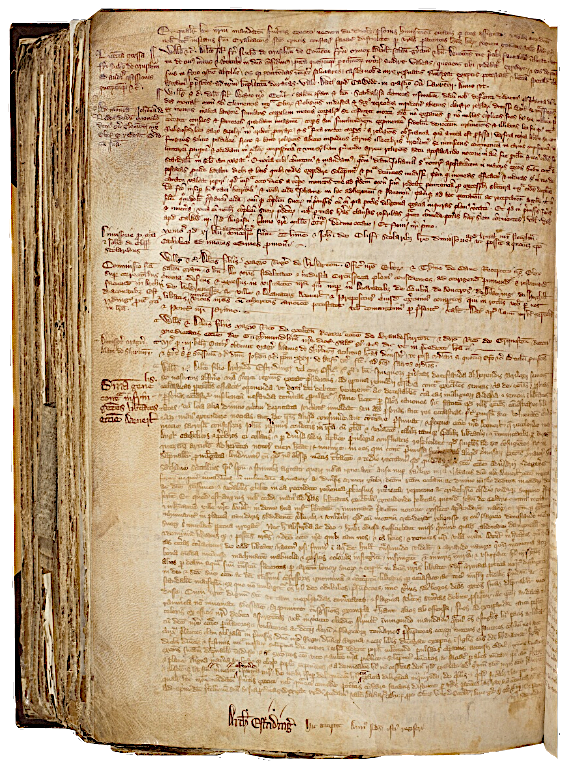
We know almost nothing of Joan’s life, except that at some time in 1318, she faked her death, left behind a fake body to bury, and escaped the convent to pursue what William Melton, then Archbishop of York, called “the way of carnal lust.” Joan’s sisters aided in her great escape, as the archbishop wrote in a letter: “numerous of her accomplices, evildoers, with malice aforethought, crafted a dummy in the likeness of her body in order to mislead the devoted faithful.”
The episode—or what we know of it from Melton’s register—struck University of York professor Sarah Rees Jones as “extraordinary—like a Monty Python sketch.” Joan’s story has become a highlight of The Northern Way, a project that “seeks to assess and analyze the political roles of the Archbishops of York over the period 1306–1406.” A number of records from the period have been digitized, including William Melton’s registry, in which Joan’s escape appears (see the page of scribal notes above).
One of the archbishop’s roles involved interceding in such cases of runaway monks and nuns. “Unfortunately,” Rees Jones remarks, “we don’t know the outcome of the case” of Joan. Often, as one might expect, escapes like hers—though few as picaresque—had to do with “not wanting to be celibate…. Many of the people would have been committed to a religious house when they were in their teens, and then they didn’t all take to the religious life.”
The archbishop put matters rather less charitably: “Having turned her back on decency and the good of religion,” he writes, “seduced by indecency, she involved herself irreverently and perverted her path of life arrogantly to the way of carnal lust and away from poverty and obedience, and, having broken her vows and discarded the religious habit, she now wanders at large to the notorious peril to her soul and to the scandal of all of her order.”
Or, as we might say today, she was ready to embark on a new life path. So desperately ready, it seems, that we might only hope Joan of Leeds remained “at large” and found happiness elsewhere. Learn more about The Northern Way project here.
Related Content:
Why Knights Fought Snails in Illuminated Medieval Manuscripts
Josh Jones is a writer and musician based in Durham, NC. Follow him at @jdmagness.
Read More...Hear Glenn Gould Celebrate the Moog Synthesizer & Wendy Carlos’ Pioneering Album Switched-On Bach (1968)
Glenn Gould made his name as a pianist with his stark, idiosyncratic interpretations of the music of Mozart, Haydn, Beethoven, and especially Bach. He left behind not just a highly respected body of work in the form of recorded performances, but also a host of strong opinions about music itself and all that culturally and commercially surrounded it. His enthusiasms weren’t always predictable: in 1967 he went on CBC radio to lavish praise on the pop singer Petula Clark, and the next year he returned to the airwaves to make a hearty endorsement of a record for which not everyone in the classical music world would admit to an appreciation: Wendy Carlos’ Switched-On Bach.
After voicing his distaste for compilation albums, comparing them to Reader’s Digest condensed literature, Gould informs his listeners that “the record of the year — no, let’s go all the way, the decade — is an unembarrassed compote of Bach’s greatest hits.” The whole record, he claims, “is one of the most startling achievements of the recording industry in this generation, certainly one of the great feats in the history of keyboard performance,” and “the surest evidence, if evidence be needed, that live music never was best.” Gould had retired from the “anachronistic” practice of live performance four years earlier, seeking his own kind of musical perfection within the technologically enhanced confines of the recording studio.
On that level, it makes sense that a meticulously, painstakingly crafted recording — not to mention one impossible, at the time, to reproduce live — like Switched-On Bach would appeal to Gould. He also takes the opportunity on this broadcast to introduce the Moog synthesizer, which Carlos used to produce every note on the record. “Theoretically, the Moog can be encouraged to imitate virtually any instrumental sound known to man, and there are moments on this disc which sound very like an organ, a double bass or a clavichord,” Gould says, “but its most conspicuous felicity is that, except when casting gentle aspersions on more familiar baroque instrumental archetypes, the performer shuns this kind of electronic exhibitionism” — a sure way of scoring points with the restraint-loving Gould.
The broadcast includes not just Gould’s thoughts on Switched On-Bach and the Moog but two interviews, one with poet and essayist Jean Le Moyne on “the human fact of automation, its sociological and theological implications,” and one with Carlos herself. Asked about the choice of Bach, Carlos frames it as a test of how the new technology of the synthesizer would fare when used to play not avant-garde music, as it then usually was, but music with the most impeccable aesthetic credentials possible. “We’re just a baby,” Carlos says of the enterprise of synthesizer-driven electronic music. “Although now we can see that the child is going to grow into a rather exciting adult, we’ve still got to take one step at a time. It will become assimilated. The gimmick value — thank god — is going to be lost, and true musical expression, and that alone, will result.”
via Synthtopia
Related Content:
Watch a 27-Year-Old Glenn Gould Play Bach & Put His Musical Genius on Display (1959)
Listen to Glenn Gould’s Shockingly Experimental Radio Documentary, The Idea of North (1967)
Glenn Gould Explains the Genius of Johann Sebastian Bach (1962)
How the Moog Synthesizer Changed the Sound of Music
Based in Seoul, Colin Marshall writes and broadcasts on cities, language, and culture. His projects include the book The Stateless City: a Walk through 21st-Century Los Angeles and the video series The City in Cinema. Follow him on Twitter at @colinmarshall, on Facebook, or on Instagram.
Read More...How to Focus: Five Talks Reveal the Secrets of Concentration
Disagree though we may about what’s wrong with life in the 21st century, all of us — at least in the developed, high tech-saturated parts of the world — surely come together in lamenting our inability to focus. We keep hearing how distractions of all kinds, but especially those delivered by social media, fragment our attention into thousands of little pieces, preventing us from completing or even starting the kind of noble long-term endeavors undertaken by our ancestors. But even if that diagnosis is accurate, we might wonder, how does it all work? These five video talks offer not just insights into the nuts and bolts of attention, concentration, and focus, but suggestions about how we might tighten our own as well.
In “How to Get Your Brain to Focus,” the TED Talk at the top of the post, Hyperfocus author Chris Bailey relates how his own life devolved into a morning-noon-night “series of screens,” and what resulted when he did away with some of those screens and the distractions they unceasingly presented him — or rather, the overstimulation they inflicted on him: “We think that our brains are distracted,” he says, “but they’re overstimulated.”
Reducing his own level of stimulation further still, he deliberately engaged in such low-stimulation (more commonly known as “boring”) practices as reading iTunes’ entire terms-and-conditions document (and not in graphic-novel form), waiting on hold with Air Canada’s baggage department, counting the zeroes in pi, and finally just watching a clock.
Bailey found that, absent the frequent dopamine hits provided by his screens, his attention span grew and more ideas, plans, and thoughts about the future came to him. “We think that we need to fit more in,” he says, but in reality “we’re doing too much, so much that our mind never wanders.” When we have nothing in particular to focus on, our mind finds its way into new territories: hence, he says, the fact that we so often get our best ideas in the shower. He references data indicating that these mental wanderings take us back into the past 12 percent of the time and remain in the present 28 percent of the time, but most often fast-forward into the future, a habit also explored by neuroscientist Amishi Jha in the TED Talk just above, “How to Tame Your Wandering Mind.”
“Our mind is an exquisite time-traveling master,” says Jha, “and we land in this mental time-travel mode of the past or the future very frequently. “And when this happens, when we mind-wander without an awareness that we’re doing it, there are consequences. We make errors. We miss critical information, sometimes. And we have difficulty making decisions.” In Jha’s view, a wandering mind can be dangerous: she labels its “internal distraction” as one of the three factors, alongside external stress and distraction in the environment, that “diminishes attention’s power.” Her laboratory research has brought her to endorse the solution of “mindfulness practice,” which “has to do with paying attention to our present-moment experience with awareness. And without any kind of emotional reactivity of what’s happening,” keeping our finger on the “play” button “to experience the moment-to-moment unfolding of our lives.”
As a mindfulness practice, meditation does the trick for many, although precision shooting champion Christina Bengtsson recommends staring at leaves. “I focused on a beautiful autumn leaf playing in the wind,” she says of her decisive shot in her TED Talk above. “Suddenly I am completely calm, and the world champion title was mine.” That leaf, she says, “relieved me of distracting thoughts and made me focus,” and the experience led her to come up with a broader theory. “We need to learn to notice disturbing thoughts and to distinguish them from not-disturbing thoughts,” she says, a not-disturbing thought being one that “knocks out all the disturbing and worrying thoughts.” In this framework, the thought of a leaf can drain the distracting power from all those nagging what-ifs about our goals and the future ahead.
“Focus is not about becoming something new or something better, but simply about functioning exactly as well as we already are,” says Bengtsson, “and understanding that this is enough for both general happiness and great achievements.” Among her other, non-leaf-related recommendations is to create a “not-to-do list,” a form suited to a world “no longer about prioritizing, but about prioritizing away.” The not-to-do list also gets a strong endorsement in “How to Focus Intensely,” the Freedom in Thought animated video just above. After opening with an elaborate analogy about robots, boxes, and factory fires, it goes on to break down the key tradeoff of attention: on one side directed focus, “providing undivided attention while ignoring environmental stimuli,” and on the other generalized focus, which does the opposite.
We human beings often don’t make that tradeoff adeptly, and the reasons cited here include stress, engagement in tasks we dislike because they aren’t inherently pleasurable (even when they promise pleasures later on, since the arrival of those pleasures can be uncertain), and the habit of short-term pleasure-seeking. Along with meditation and the not-to-do list come other featured strategies like actively placing boundaries on your media consumption, structuring your day with “blocks” of work separated by short breaks, and drawing up a priority list, all while adhering to the general ratio of spending 80 percent of your time on “activities that produce long-term pleasure” and 20 percent on “activities that produce short-term pleasure.”
The Freedom in Thought video also recommends something called “deep work,” a set of techniques defined by computer scientist Cal Newport in his book of the same name. But to do deep work as Newport himself does it requires that you take a step that may sound radical at first: quit social media. That imperative provides the title of Newport’s TED Talk above, which explains the whys and hows of doing just that. He also deals with the common objections to the notion of quitting social media, framing social media itself as just another slot machine-like form of entertainment — with all the attendant psychological harms — that, because of its sheer commonness and easiness, can hardly be as vital to success in the 21st-century economy as it’s so often claimed to be.
Newport explains that “what the market dismisses, for the most part, are activities that are easy to replicate and produce a small amount of value,” i.e. what most of us spend our days doing on Twitter, Facebook, and Instagram. “It’s instead going to reward the deep, concentrated work required to build real skills and apply those skills to produce things, like a craftsman, that are rare and are valuable.” If you treat your attention with respect, he says, “when it comes time to work, you can actually do one thing after another, and do it with intensity, and intensity can be traded for time.” When you train your mind away from distraction, in other words, you actually end up with more time to work with — an asset that even Bill Gates and Warren Buffett, both of whom famously credit their own success to focus, can’t buy for themselves.
Related Content:
How Information Overload Robs Us of Our Creativity: What the Scientific Research Shows
The Neuroscience & Psychology of Procrastination, and How to Overcome It
Listen to Wake Up to Your Life: Discovering the Buddhist Path of Attention by Ken McLeod
How to Take Advantage of Boredom, the Secret Ingredient of Creativity
Based in Seoul, Colin Marshall writes and broadcasts on cities, language, and culture. His projects include the book The Stateless City: a Walk through 21st-Century Los Angeles and the video series The City in Cinema. Follow him on Twitter at @colinmarshall, on Facebook, or on Instagram.
Read More...How Margaret Hamilton Wrote the Computer Code That Helped Save the Apollo Moon Landing Mission
From a distance of half a century, we look back on the moon landing as a thoroughly analog affair, an old-school engineering project of the kind seldom even proposed anymore in this digital age. But the Apollo 11 mission could never have happened without computers and the people who program them, a fact that has become better-known in recent years thanks to public interest in the work of Margaret Hamilton, director of the Software Engineering Division of MIT’s Instrumentation Laboratory when it developed on-board flight software for NASA’s Apollo space program. You can learn more about Hamilton, whom we’ve previously featured here on Open Culture, from the short MAKERS profile video above.
Today we consider software engineering a perfectly viable field, but back in the mid-1960s, when Hamilton first joined the Apollo project, it didn’t even have a name. “I came up with the term ‘software engineering,’ and it was considered a joke,” says Hamilton, who remembers her colleagues making remarks like, “What, software is engineering?”
But her own experience went some way toward proving that working in code had become as important as working in steel. Only by watching her young daughter play at the same controls the astronauts would later use did she realize that just one human error could potentially bring the mission into ruin — and that she could minimize the possibility by taking it into account when designing its software. Hamilton’s proposal met with resistance, NASA’s official line at the time being that “astronauts are trained never to make a mistake.”
But Hamilton persisted, prevailed, and was vindicated during the moon landing itself, when an astronaut did make a mistake, one that caused an overloading of the flight computer. The whole landing might have been aborted if not for Hamilton’s foresight in implementing an “asynchronous executive” function capable, in the event of an overload, of setting less important tasks aside and prioritizing more important ones. “The software worked just the way it should have,” Hamilton says in the Christie’s video on the incident above, describing what she felt afterward as “a combination of excitement and relief.” Engineers of software, hardware, and everything else know that feeling when they see a complicated project work — but surely few know it as well as Hamilton and her Apollo collaborators do.
Related Content:
Based in Seoul, Colin Marshall writes and broadcasts on cities, language, and culture. His projects include the book The Stateless City: a Walk through 21st-Century Los Angeles and the video series The City in Cinema. Follow him on Twitter at @colinmarshall, on Facebook, or on Instagram.
Read More...What the First Movies Really Looked Like: Discover the IMAX Films of the 1890s
Cinematic legend has it that, back in the early days of motion pictures, audiences would see a train coming toward them on the screen and dive out of the way in a panic. “There turns out to be very little confirmation of that in the actual newspaper reports of the time,” says critic and Museum of Modern Art film curator Dave Kehr in the video above, “but you can still sense the excitement in seeing these gigantic, incredibly sharp, lifelike images being projected.” But aren’t they only sharp and lifelike by the standards of the late-19th century dawn of cinema, an era we filmgoers of the 21st century, now used to 4K digital projection, imagine as one of unrelieved blurriness, graininess, and herky-jerkiness?
By no means. The footage showcased in this video, a MoMA production on “the IMAX of the 1890s,” was shot on 68-millimeter film, a greater size and thus a higher definition than the 35-millimeter prints most of us have watched in theaters for most of our lives.
Only the most ambitious filmmakers, like Paul Thomas Anderson making The Master, have used such large-format films in recent years, but 120 years ago an outfit like the Biograph Company could, in Kehr’s words, “send camera crews around the world, as the Lumière Company had,” and what those crews captured would end up in movie theaters: “Suddenly the world was coming to you in ways that people just could not have imagined. That you could go to Europe, that you could meet the crowned heads, that you could go to see elephants in India…”
Thanks to the efforts of film archivists and preservationists, a few of whom appear in this video to show and explain just what degradation befalls these cinematic time capsules without the kind of work they do, much of this footage still looks and feels remarkably lifelike. “It’s worth returning to these images to remind us that movies used to be analog,” Kehr says. “They saw things in front of the camera in a one-on-one relationship. This was the world. It was an image you could trust. It was an image of physical substance, of reality. Nowadays we tend not to trust images, because we know how easily manipulated they are.” We’ve gained an unfathomable amount of imagery, in terms of both quantity and quality, in our digital age. But as the sheer “ontological impact” of these old 68-millimeter clips reminds us, even when felt in streaming-video reproduction, our images have lost something as well.
via Aeon
Related Contents:
The Art of Creating Special Effects in Silent Movies: Ingenuity Before the Age of CGI
Enjoy the Greatest Silent Films Ever Made in Our Collection of 101 Free Silent Films Online
Hollywood, Epic Documentary Chronicles the Early History of Cinema
The History of the Movie Camera in Four Minutes: From the Lumiere Brothers to Google Glass
Based in Seoul, Colin Marshall writes and broadcasts on cities, language, and culture. His projects include the book The Stateless City: a Walk through 21st-Century Los Angeles and the video series The City in Cinema. Follow him on Twitter at @colinmarshall, on Facebook, or on Instagram.
Read More...Worlds of Ursula K. Le Guin: Stream Online (for a Limited Time) a New Documentary Exploring the Life & Work of the Legendary Sci-Fi Writer
“There are a lot of dystopias around these days,” writes Kim Stanley Robinson in his recent essay “Dystopia Now.” This, of course, “makes sense, because we have a lot of fears about the future.” We also have a lot of fears about the present, which get mapped onto the future in dystopian fiction, a genre that has become “part of our all-encompassing hopelessness.”
Dystopias feel familiar, even comforting, in that no matter how bad things are, they are perhaps not quite as bad yet as the darkest visions of science fiction. We might still change course if we can finally heed the warnings. But literary and cinematic pessimism, either as grim escapism or a wake-up call, “has done its job,” Robinson argues, “it’s old news now, perhaps it’s self-indulgence to stay stuck in that place any more.”
Another legendary sci-fi writer, Ursula K. Le Guin agreed. “We keep writing dystopias,” she remarked in a 2017 essay, “instead of envisioning a better world.” Le Guin, who passed away last year, wrote of “ambiguous,” “clearsighted,” and “troubled” utopias. And she practiced, over the course of her long career, what Robinson calls our current “task at hand”—“to imagine ways forward to that better place.” We may not see much reason for optimism, but utopian thinking, “is realistic: things could be better.”
An anarchist, feminist, and environmentalist, Le Guin might be called an “ideological” writer, but not in the derogatory sense the word implies. All artists have ideological frameworks, whether they’re aware of them or not, and Le Guin was very much aware of the lenses she used to see the world, what Robinson defines as “the imaginary relationship to our real conditions of existence.”
She consciously restructured her work to imagine new worlds in terms outside the oppressively hegemonic norms that govern ours, norms created by what she called the “yang” desire for absolute control. “I had to rethink my entire approach to writing fiction,” she says above in Worlds of Ursula K. Le Guin, a new PBS documentary directed by Arwen Curry, available free to stream for a limited time.
“It was important,” Le Guin goes on, “to think about privilege and power and domination in terms of gender, which is something science fiction and fantasy had not done.” In so doing, Le Guin showed her readers it was possible to imagine functional, believable, even attainable alternatives to stark realities that seem too deeply entrenched to ever change. She showed other sci-fi and fantasy writers that they could do the same.
The documentary features appearances from contemporaries and successors to Le Guin’s world-building brilliance, including Margaret Atwood, Samuel R. Delany, Analee Newitz, China Miéville, Neil Gaiman, Michael Chabon, and David Mitchell, all of whom cite her as an influence and inspiration. (“I read A Wizard of Earthsea,” says Mitchell, “and things rearranged in my head.”)
In a way, reading Le Guin for the first time feels like being given a pair of VR glasses through which to see what’s truly possible, if only we had the will to collectively imagine it into being. She did not think of utopianism as an eternal state of perfection or a thought experiment, but as a “process,”as Kelly Lynn Thomas writes at The Millions, of “reflection and adjustment, learning and growth… communication and respect, self-awareness and honesty.”
Though the word is typically deployed to describe dangerous naivete or pie-in-the-sky thinking, utopianism need not be a grasping after “rational human control of human life,” Le Guin wrote. Utopias always contain some measure of dystopia, she recognized. But she proposed that we find balance by imagining what she calls “yin utopias,” spaces that involve “acceptance of impermanence and imperfection, a patience with uncertainty and the makeshift, a friendship with water, darkness, and the earth.”
Such are the ideals that informed her vast imaginative output over the course of nearly 60 years, including 21 novels, 11 volumes of short stories, essay collections, children’s books, and poetry. In Worlds of Ursula K. Le Guin, we learn how she developed and refined her creative vision, and her critiques of totalizing “yang” utopianism and its despairing opposite. The film is available to stream in full online for a limited time. Watch it above or on PBS’s American Masters page before it’s gone.
Related Content:
Ursula K. Le Guin’s Daily Routine: The Discipline That Fueled Her Imagination
Ursula K. Le Guin Names the Books She Likes and Wants You to Read
Josh Jones is a writer and musician based in Durham, NC. Follow him at @jdmagness
Read More...An Artist Crochets a Life-Size, Anatomically-Correct Skeleton, Complete with Organs

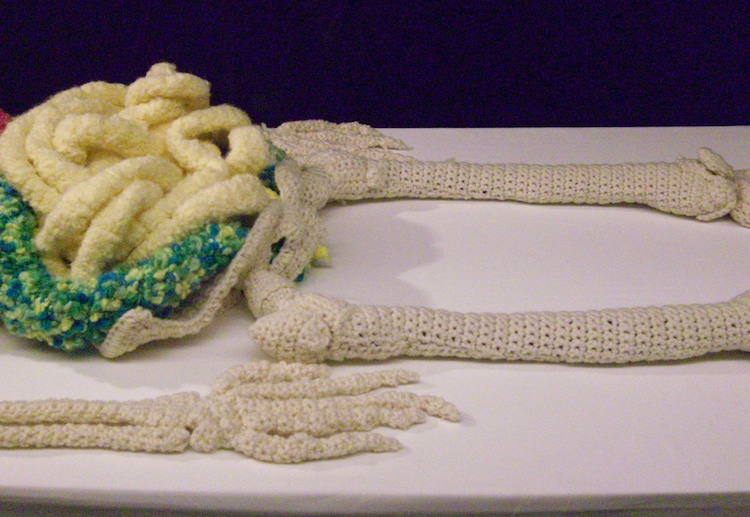
How to make a life-sized facsimile of a human skeleton:
- Download files published under a Creative Commons license, and arrange to have them 3‑D printed.
or
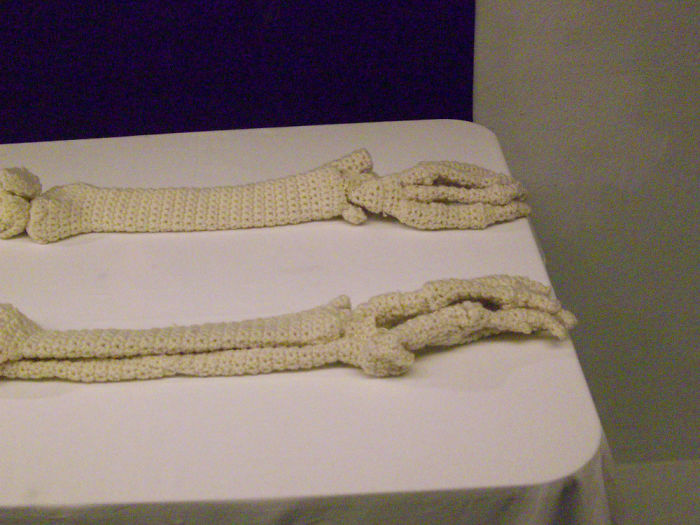
- Do as artist Shanell Papp did, above, and crochet one.
The latter will take considerably more time and attention on your part. Papp gave up all extracurricular activities for four months to hook the woolen skeleton around her work and school schedule. Equipping it with internal organs ate up another four.
To ensure accuracy, Papp armed herself with anatomical textbooks and an actual human skeleton on loan from the University of Lethbridge, where she was an undergrad. The brain has gray and white matter, there’s marrow in the bones, the stomach contains half-digested wool food, and the intestines can be unspooled to a realistic length.
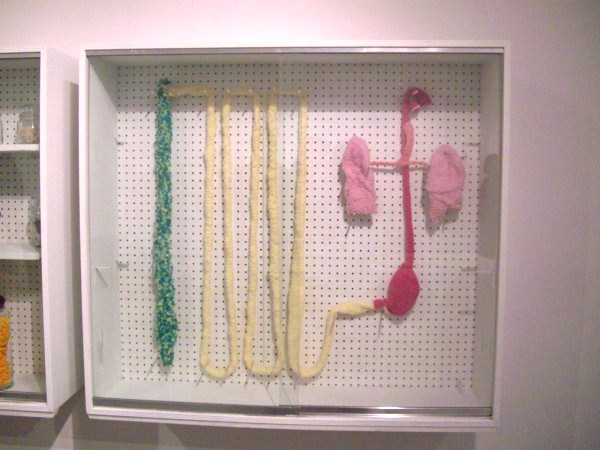
The grueling 2006 project did not exhaust her fascination for the intricacies of human anatomy. The University of Saskatchewan granted her open access to draw in the gross anatomy lab while she pursued her MFA.
As she told MICE magazine:
I wanted this work to illustrate all of the organs and bones everyone shares and to not highlight differences. Much of anatomical history is about defining difference, by comparative analysis. This can set up strange taxonomies and hierarchies. I wasn’t interested in participating in that; I wanted to expose the fragile, common, and unseen things in all of us.
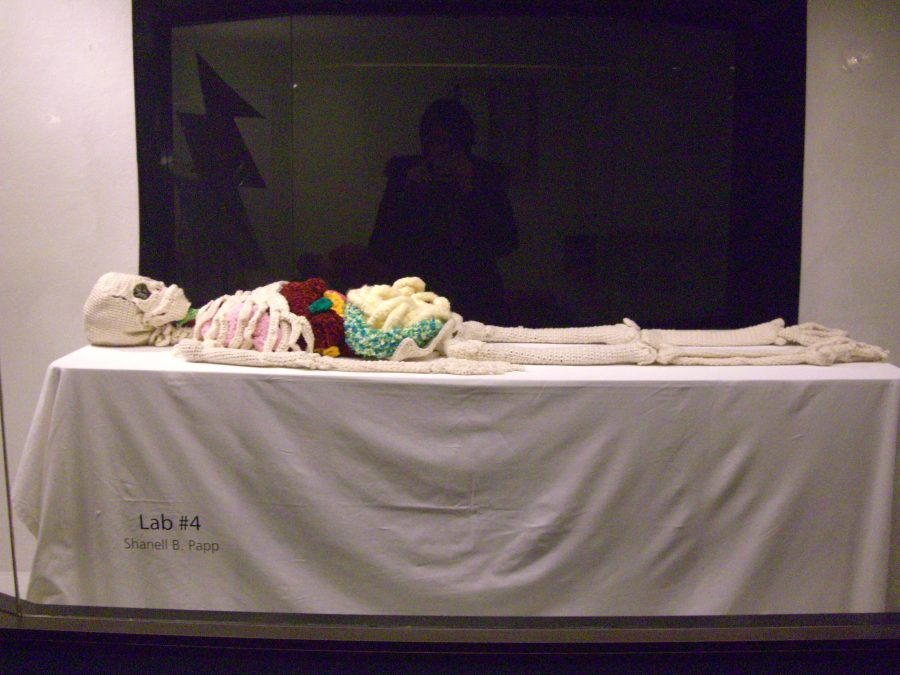
The finished piece, which is displayed supine on a gurney she nabbed for free during a mortuary renovation, incorporates many of Papp’s other abiding interests: horror, medical history, Frankenstein, crime investigation, and mortuary practices.
Papp, who taught herself how to crochet from books as a child, using whatever yarn found its way to her grandma’s junk shop, appreciates how her chosen medium adds a layer of homey softness and familiarity to the macabre.
It’s also not lost on her that fiber arts, often dismissed as too “crafty” by the establishment, were an important component of 70s-era feminist art, though in her view, her work is more of a statement on the history of textile manufacturing, which is to say the history of labor and class struggle.
See more of Shanell Papp’s work here.
All images in this post by Shanell Papp.
Related Content:
Behold an Anatomically Correct Replica of the Human Brain, Knitted by a Psychiatrist
The Beautiful Math of Coral & Crochet
Ayun Halliday is an author, illustrator, theater maker and Chief Primatologist of the East Village Inkyzine. Join her in NYC on Monday, September 9 for another season of her book-based variety show, Necromancers of the Public Domain. Follow her @AyunHalliday.
Read More...How the Yamaha DX7 Digital Synthesizer Defined the Sound of 1980s Music
There is a lot of creatively revised history in the Netflix hit show Stranger Things, and I’m not just talking about extra-dimensional monsters and Soviet scientists under shopping malls. There’s also the pulsing synth score by Kyle Dixon and Michael Stein. Deserving of all its praise, the music nonetheless gives the impression that the sound of the 1980s was made by instruments of the 60s and 70s—analog synthesizers like the MiniMoog Model D and effects like the Roland Space Echo.
Such classic instrumentation does create the perfect weird, fuzzy, wobbly, lush accompaniment to the show’s compelling mix of sci-fi body horror and cuddly nostalgia. But the 80s was the golden age of new sound technology, digital, and the dawn of synthesizers like the Yamaha DX7, released in 1983, the year the saga of the Upside-Down begins. Alongside massively-popular digital synths like the Roland Juno-60, the DX7 defined the 80s like few other electronic instruments, quickly rising “to take over the airwaves,” as the Polyphonic video above explains.
Brian Eno, Kenny Loggins, Whitney Houston, Herbie Hancock, Depeche Mode, Hall & Oates, Vangelis, Steve Winwood, Phil Collins, The Cure… one could go on and on, naming a majority of the artists on the charts throughout the decade. Why was the DX7 more appealing than the analogue sounds we now associate with the height of synth quality? Polyphonic explains how the DX7 used an algorithm called FM (frequently modulated) synthesis, which allowed for more refined control and modulation than the subtractive synthesis of analog synths built by Moog, ARP, Buchla, and other specialized makers in the 70s.
That meant digital keyboards had a wider range of timbres and could convincingly simulate real instruments, like the marimbas in Harold Faltermeyer’s “Axel F.” Digital synths were predictable, and could be programmed and customized, or used for their many already excellent presets. And just as Faltermeyer’s Beverly Hills Cop theme was inescapable in the mid-80s, so too was the sound of the DX7. It was “damned near ubiquitous,” writes Music Radar. “After years of exclusively analogue synths, musicians embraced the DX7’s smooth, crystalline tones and for a while the airwaves were rife with FM bells, digital Rhodes emulations and edgy basses.”
Though it’s hardly as well known, the DX7 may be as influential in 80s music as the Roland TR-808 drum machine. Yamaha’s digital synth was so popular that it “almost single-handedly spawned the third-party sound design industry, and forced other synthesizer manufacturers to take a hard look at how they were building their own instruments.” Learn about the history, versatility, and customization of the DX7 from Polyphonic in the video above. And stream a playlist of songs featuring the DX7 below. While our 80s nostalgia moment favors the richly harmonic tones of analog synths from earlier decades, you’ll learn why the real 1980s belonged to the digital DX7 and its many competitors and successors.
Related Content:
All Hail the Beat: How the 1980 Roland TR-808 Drum Machine Changed Pop Music
How the Moog Synthesizer Changed the Sound of Music
Josh Jones is a writer and musician based in Durham, NC. Follow him at @jdmagness
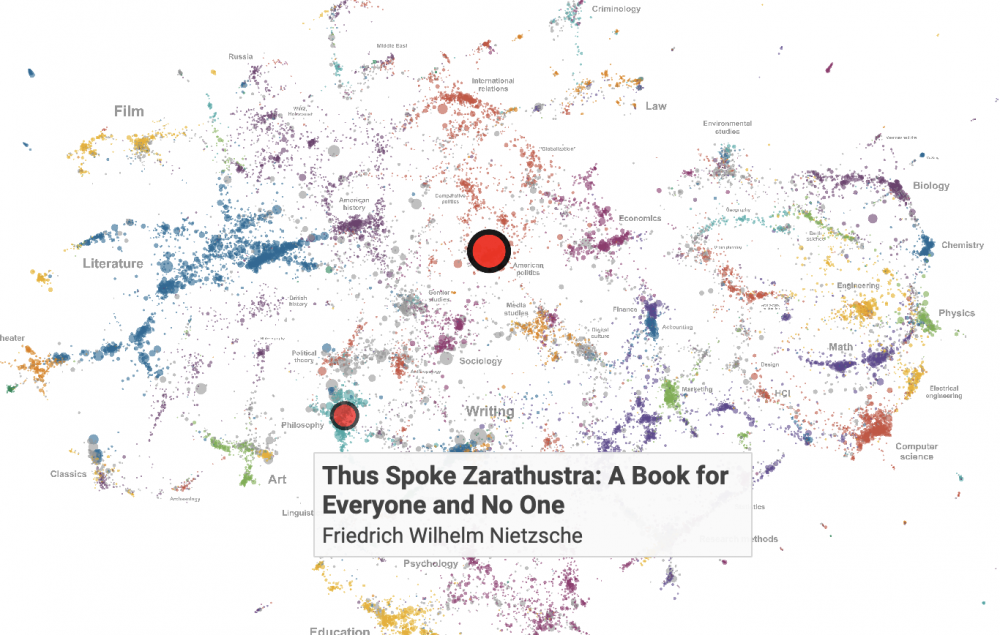
A New Interactive Visualization of the 165,000 Most-Frequently Assigned Texts in College Courses
For some of us, it’s been a little while since college days. For others of us, it’s been a little while longer. We might find ourselves asking, if we hear news of on-campus activism and unrest (surely unheard of in our day)—
“Do they still read the classics down at old Alma Mater U.?”
Maybe that’s the problem, eh? Too much Marxist theory, not enough Plato? Well, you may be pleased, or not, to learn that classics still regularly—routinely, even—appear on college syllabi, including both The Republic and the Communist Manifesto, in courses taught all over the world, from San Antonio to Tokyo to Karlskrona, Sweden.
As we informed Open Culture readers in 2016, Columbia University’s Open Syllabus Project culled data from over 1,000,000 syllabi from university websites worldwide, to find out which books have been most frequently taught over the past decade or so. Since then, that number has risen to 6,000,000 syllabi. Still, the most-taught books at the top of the list remain largely unchanged.
As two of the project’s directors pointed out soon after the site’s launch, “traditional Western canon dominates the top 100, with Plato’s Republic at No. 2, The Communist Manifesto at No. 3, and Frankenstein at No. 5, followed by Aristotle’s Ethics, Hobbes’s Leviathan, Machiavelli’s The Prince, [Sophocles’] Oedipus and [Shakespeare’s] Hamlet.” These numbers have moved a little, edged downward by writing and research guides, but not by very much.
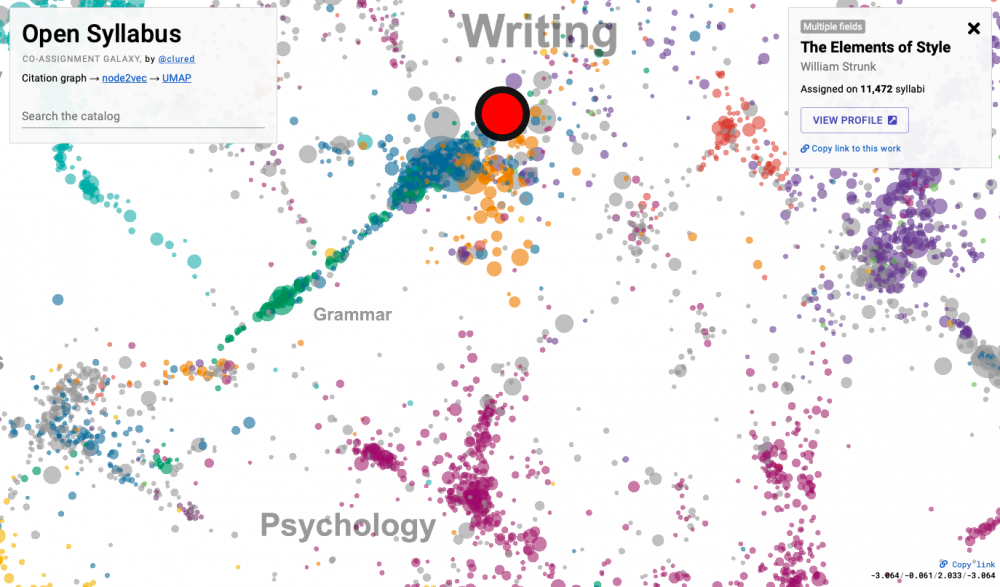
William Strunk’s classic writing guide Elements of Style sits at number one. Other top titles include calculus and anatomy textbooks, other works of Enlightenment philosophy, and texts now central to the Western critical tradition like Martin Luther King, Jr.’s “Letter from Birmingham Jail,” Michel Foucault’s Discipline and Punish, and Edward Said’s Orientalism.
The top 50 is almost totally dominated by male writers, though some of the most frequently-taught novelists include Jane Austen, Toni Morrison, Anne Moody, Leslie Marmon Silko, and Alice Walker. The most-taught books tend to fall into either philosophy, literature, textbook, or guidebook, but the overall range in this list of 165,000 texts encompasses the entire scope of academia around the globe, with more contemporary study areas like gender studies, media studies, digital culture, and environmental studies prominent alongside traditional departments like physics and psychology.
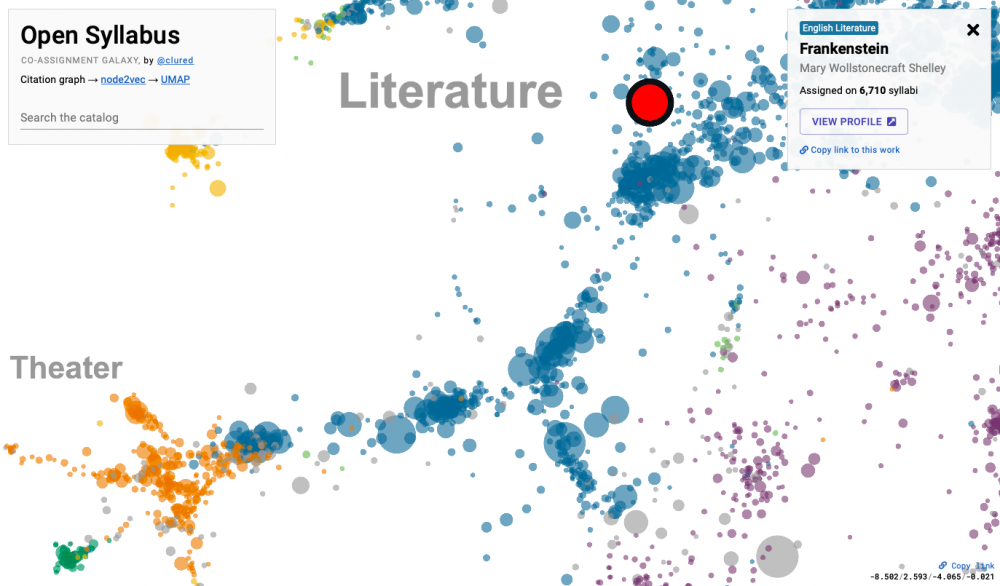
A new interactive visualization from Open Syllabus turns this trove of data into a color-coded stippling of different-sized dots, each one representing a particular text. Float over each dot and a box appears in the corner of the screen, showing the number of syllabi that have assigned the text, and a link to a profile page with more detailed analysis. Called the “Co-Assignment Galaxy,” the infographic does what a list cannot: draws connections between all these works and their respective fields of study.
The Open Syllabus Project was already an impressive achievement, a huge aggregation of freely accessible data for scholars and curious laypeople alike. The addition of this user-friendly cluster map makes the site an even more indispensable resource for the study of how higher education has changed over the past decade or so, and how it has, in some respects, remained the same. Enter the Open Syllabus Project’s Co-Assignment Galaxy map here.
Related Content:
The 20 Most Influential Academic Books of All Time: No Spoilers
Josh Jones is a writer and musician based in Durham, NC. Follow him at @jdmagness
Read More...Richard Feynman’s Technique for Learning Something New: An Animated Introduction
I sometimes wonder: why do people post amateur repair videos, made with smartphones in kitchens and garages, with no obvious commercial value and, often, a level of expertise just minimally above that of their viewers? Then I remember Richard Feynman’s practical advice for how to learn something new—prepare to teach it to somebody else.
The extra accountability of making a public record might provide added motivation, though not nearly to the degree of making teaching one’s profession. Nobel-winning physicist Feynman spent the first half of his academic career working on the Manhattan Project, dodging J. Edgar Hoover’s FBI at the beginning of the Cold War, and making major breakthroughs in quantum mechanics.
But he has become as well-known for his teaching as for his historic scientific role, thanks to the enormously popular series of physics lectures he developed at Caltech; his funny, accessible, best-selling books of essays and memoirs; and his willingness to be an avuncular public face for science, with a knack for explaining things in terms anyone can grasp.
Feynman revealed that he himself learned through what he called a “notebook technique,” an exercise conducted primarily on paper. Yet the method came out of his pedagogy, essentially a means of preparing lecture notes for an audience who know about as much about the subject as you did when you started studying it. In order to explain it to another, you must both understand the subject yourself, and understand what it’s like not to understand it.
Learn Feynman’s method for learning in the short animated video above. You do not actually need to teach, only pretend as if you’re going to—though preparing for an actual audience will keep you on your toes. In brief, the video summarizes Feynman’s method in a three-step process:
- Choose a topic you want to understand and start studying it.
- Pretend you’re teaching the idea to someone else. Write out an explanation on the paper…. Whenever you get stuck, go back and study.
- Finally do it again, but now simplify your language or use an analogy to make the point.
Get ready to start your YouTube channel with homemade language lessons, restoration projects, and/or cooking videos. You may not—nor should you, perhaps—become an online authority, but according to Feyman, who learned more in his lifetime than most of us could in two, you’ll come away greatly enriched in other ways.
Related Content:
The Drawings & Paintings of Richard Feynman: Art Expresses a Dramatic “Feeling of Awe”
Josh Jones is a writer and musician based in Durham, NC. Follow him at @jdmagness
Read More...Support Us
We're hoping to rely on loyal readers, rather than erratic ads. Please click the Donate button and support Open Culture. You can use Paypal, Venmo, Patreon, even Crypto! We thank you!

About Us

Open Culture scours the web for the best educational media. We find the free courses and audio books you need, the language lessons & educational videos you want, and plenty of enlightenment in between.
Advertise With Us
FREE UPDATES!
GET OUR DAILY EMAIL
Get the best cultural and educational resources on the web curated for you in a daily email. We never spam. Unsubscribe at any time.
FOLLOW ON SOCIAL MEDIA
Open Culture editor Dan Colman scours the web for the best educational media. He finds the free courses and audio books you need, the language lessons & movies you want, and plenty of enlightenment in between.
Advertise With Us

