“Odyssey of the Ear”: A Beautiful Animation Shows How Sounds Travel Into Our Ears and Become Thoughts in Our Brain
As all schoolchildren know, we hear with our ears. And as all schoolchildren also probably know, we hear with our brains — or if they don’t know it, at least they must suspect it, given the way sounds around us seem to turn without effort into thoughts in our heads. But how? It’s the interface between ear and brain where things get more complicated, but “Odyssey of the Ear,” the six-minute video above, makes it much clearer just how sound gets through our ears and into our brains. Suitable for viewers of nearly any age, it combines silhouette animation (of the kind pioneered by Lotte Reiniger) with live action, projection, and even dance.
According to the video, which was originally produced as part of HarvardX’s Fundamentals of Neuroscience course, the process works something like this. Our outer ear collects sounds from our environment when things vibrate in the physical world, producing variations in air pressure, or “sound waves” that pass through the air.
The sound waves enter the ear and pass down through the auditory canal, at the end of which they hit the ear drum. The ear drum transfers the vibrations of the sound waves to a “series of little bones,” three of them, called the ossicles, or “hammer, anvil, and stirrup.” These transmit the sounds to the fluid-filled inner ear through a membrane called the “oval window.”
Inside the inner ear is the snail-shaped organ known as the cochlea, and inside the cochlea is the organ of corti, and inside the organ of corti are “thousands of auditory hair cells,” actually receptor neurons called stereocilia, that “convert the motion energy of sound waves into electrical signals that are communicated to the auditory nerve.” From there, “the signal goes into structures deeper in the brain, until at last it reaches the auditory cortex, where we consciously experience sound.” That conscious experience of sound may make it feel as if we immediately recognize and consider all the noises, voices, or music we hear, but as “Odyssey of the Ear” reveals, sound waves have to make quite an epic journey before they reach our brains at all. At that point the waves themselves may have dissipated, but they live on in our consciousness. In other words, “the brain has taken what was outside and made it inside.”
Related Content:
How Did Beethoven Compose His 9th Symphony After He Went Completely Deaf?
The Neuroscience of Bass: New Study Explains Why Bass Instruments Are Fundamental to Music
The Vincent Van Gogh Action Figure, Complete with Detachable Ear
Based in Seoul, Colin Marshall writes and broadcasts on cities, language, and culture. His projects include the book The Stateless City: a Walk through 21st-Century Los Angeles and the video series The City in Cinema. Follow him on Twitter at @colinmarshall or on Facebook.
Read More...Why Should We Read Flannery O’Connor? An Animated Video Makes the Case
Every time a story of mine appears in a Freshman anthology, I have a vision of it, with its little organs laid open, like a frog in a bottle. –Flannery O’Connor, “A Reasonable Use of the Unreasonable”
Why did Flannery O’Connor write? To convert us? The devout Catholic was not immune to a certain apologetic impulse, or a sense of her own purpose as a vessel for divine truth. Or did she, like Greek tragedians, write to inspire pity and terror? “I don’t have any pretensions,” she once demurred, “to being an Aeschylus or Sophocles and providing you in this story with a cathartic experience.” In any case, what drove her may be a less interesting question than what should drive us to read her.
O’Connor wrote, as most great writers do, because she was compelled to write. What we gain as readers is the deeply unsettling, but also deeply pleasurable experience of recognizing our own flawed humanity in her violent, manipulative characters, none of whom, somehow, are ever beyond redemption. O’Connor’s authorial voice does not judge or condemn but exposes to light the flaws that even, or especially, her most respectable characters would rather hide from themselves and others.
By use of what she called “a reasonable use of the unreasonable” she shows murder, contempt, and deception as shockingly ordinary states of affairs, belying the polite fictions of civility and social niceness. Perhaps no setting could better illuminate the contrasts than the piously violent segregated mid-century American South. O’Connor’s “mastery of the grotesque,” notes the TED-Ed video above by Iseult Gillespie, “and her explorations of the insularity and superstitions of the South led her to be classified as a ‘Southern Gothic’ writer.”
The label may fit superficially, but “her work pushed beyond the purely ridiculous and frightening characteristics associated with the genre to reveal the variety and nuance of human character.” O’Connor herself suggested that what set her apart were “the assumptions… of the central Christian mysteries.” Though we need not read her work this way, she grants, there is “none other by which it could have been written.” We might say that her committed belief in the idea of universal human depravity gave her unique insight into the meaninglessness of class and race distinctions. Few writers have taken the idea as seriously, or approached it with more wicked playfulness.
Why did she write? One reason is she “took pleasure in challenging her readers,” as the video explains. But it was pleasure that she chiefly desired to share. We can vivisect her stories, carve them up and seal them in jars labeled with politics and theologies. Yet “properly, you analyze to enjoy,” she wrote. “It’s equally true that to analyze with any discrimination, you have to have enjoyed already, and I think that the best reason to hear a story read is that it should stimulate that primary enjoyment.” Lovers of O’Connor know the answer to the question of why we should read her. Because they take as much pleasure in reading her stories as she did in writing them.
Discover this enjoyment on your own. Hear Studs Terkel read her story “Revelation,” hear Estelle Parsons read “Everything that Rises Must Converge,” and hear O’Connor herself read that 1959 classic of her Southern grotesque style, “A Good Man is Hard to Find.”
Related Content:
Hear a Rare Recording of Flannery O’Connor Reading “A Good Man is Hard to Find” (1959)
Flannery O’Connor Renders Her Verdict on Ayn Rand’s Fiction: It’s As “Low As You Can Get”
Flannery O’Connor’s Satirical Cartoons: 1942–1945
Josh Jones is a writer and musician based in Durham, NC. Follow him at @jdmagness
Read More...George Orwell’s Essay “British Cookery” is Officially Published 70 Years After It Was Rejected by the British Council (1946)
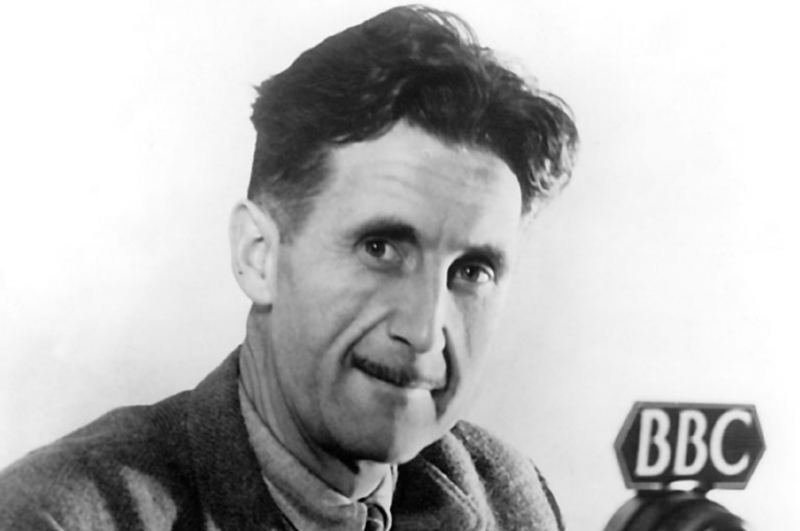
Image by BBC, via Wikimedia Commons
Voltaire once joked that Britain had “a hundred religions and only one sauce.” In my experience, that sauce is a curry, which was already a British staple in Voltaire’s time. No doubt he had something much blander in mind. Of course, it’s all hyperbolic fun until someone takes offense, as did George Orwell in 1946, when he wrote, against Voltairean stereotypes, about the misunderstood pleasures of British food. His essay, “British Cookery,” was commissioned by the British Council, but they subsequently deemed that it would be “’unwise to publish,’” reports the Daily Mail, “so soon after the hungry winter of 1946 and wartime rationing.”
Not that it matters much now, but the Council has formally apologized to the deceased Orwell, over 70 years later. Senior policy analyst Alasdair Donaldson explains they are “delighted to make amends” by publishing the essay in full, alongside “the unfortunate rejection letter.” You can read it here at the British Council site. Orwell grants that the British diet is “simple, rather heavy, perhaps slightly barbarous… with its main emphasis on sugar and animal fats…. Cheap restaurants in Britain are almost invariably bad, while in expensive restaurants the cookery is almost always French, or imitation French.”
Elsewhere, he concedes, “the British are not great eaters of salads.” Indeed, he says, “the two great shortcomings of British cookery are a failure to treat vegetables with due seriousness, and an excessive use of sugar.” He does go on at length, in fact, about what sounds like a national epidemic of sugar addiction. Such lapses of taste are also what we would now label a nutritional emergency. He may seem to grant too much to critics of British cooking. But this is mainly by contrast with spicier, more vegetable-friendly cuisines of the continent and colonies. The kind of cooking he describes makes creatively varied uses of sturdy but limited local resources (except for the sugar).
Orwell’s brutal honesty about British food’s deficiencies makes him sound like a trustworthy guide to its true delights. One of the truths he tells is that “British cookery displays more variety and more originality than foreign visitors are usually ready to allow.” The average visitor encounters British food principally in restaurants, pubs, and hotels, which, “whether cheap or expensive” are not representative of “the diet of the great mass of the people.” This may be said of many regional cuisines. But Orwell is devoted to a native British cooking which had, at the time, almost disappeared after six years of war rationing.
This cooking is rich in roast and cold meats, cheeses, breads, Yorkshire and suet puddings, potatoes and turnips. The British diet is, or was, Orwell writes, eaten by the lower and upper classes alike, under different names and prices. Seasonings are few. “Garlic, for instance, is unknown in British cookery proper.” What stands out is mint, vinegar, butter, dried fruits, jam, and marmalade.
Orwell himself included a marmalade recipe. (A handwritten note reads “Bad recipe! Too much sugar and water.”), which you can see below. Decide for yourself how much sugar to add.
ORANGE MARMALADE
Ingredients:
2 seville oranges
2 sweet oranges (no)
2 lemons (no)
8lbs of preserving sugar
8 pints of water
Method. Wash and dry the fruit. Halve them and squeeze out the juice. Remove some of the pith, then shred the fruit finely. Tie the pips in a muslin bag. Put the strained juice, rind and pips into the water and soak for 48 hours. Place in a large pan and simmer for 1/2 hours until the rind is tender. Leave to stand overnight, then add the sugar and let it dissolve before bringing to the boil. Boil rapidly until a little of the mixture will set into a jelly when placed on a cold plate. Pour into jars which have been heated beforehand, and cover with paper covers.
An increasing number of people are cutting back or quitting nearly every main ingredient in what Orwell describes as authentic British cooking: from meat to dairy to gluten to sugar to suet…. But if we are going to give it a fair shake, he argues, we must try the real thing. Or his version of it anyway. He includes several more recipes: Welsh rarebit, Yorkshire pudding, treacle tart, plum cake, and Christmas pudding.
Orwell’s “British Cookery” wars with itself and comes to terms. He fills each paragraph with frank acknowledgements of British cuisine’s shortcomings, yet he relishes its simple, solid virtues. He writes that “British cookery” is “best studied in private houses, and more particularly in the homes of the middle-class and working-class masses who have not become Europeanized in their tastes.” It’s a kind of cultural nationalism, but perhaps one suggesting those who want others to understand and appreciate a specific kind British culture should invite outsiders in to share a meal.
Related Content:
George Orwell Explains How to Make a Proper Cup of Tea
Try George Orwell’s Recipe for Christmas Pudding, from His Essay “British Cookery” (1945)
Foodie Alert: New York Public Library Presents an Archive of 17,000 Restaurant Menus (1851–2008)
Josh Jones is a writer and musician based in Durham, NC. Follow him at @jdmagness
Read More...A Vintage Grand Piano Gets Reengineered to Play 20 Different Instruments with a Push of Its Keys
The Ukrainian Band “Brunettes Shoot Blondes” took a broken, vintage grand piano and reengineered it, turning it into “a hybrid, containing 20 instruments.” Now, when you press the keys, the “piano hammers beat a marimba, tambourine, cymbals or even castanets. There are also special mechanical devices that allow for the playing of cello, violins and organ.” Watch it in action above…
If you would like to support the mission of Open Culture, consider making a donation to our site. It’s hard to rely 100% on ads, and your contributions will help us continue providing the best free cultural and educational materials to learners everywhere. You can contribute through PayPal, Patreon, and Venmo (@openculture). Thanks!
Related Content:
94-Year-Old Stroke Survivor Plays Jazz Piano for the First Time in Years
Read More...CBGB’s Heyday: Watch The Ramones, The Dead Boys, Bad Brains, Talking Heads & Blondie Perform Live (1974–1982)
There are, I guess, still many things people can do these days to tap into the legacy of CBGB, but I wouldn’t recommend going near most of them. The merchandising empire (do, however, new parents, get your tot a CBGB bib and onesie); the “thuddingly banal” 2013 film version, which… the less said about the better; yes, and CBGB, the restaurant, in the Newark Airport Terminal C—proceed at your own risk.
We must sadly also mention this past summer’s “Potemkin village from hell,” a pop-up “TRGT” shop for the grand opening of the East Village’s new Target at 14th St. and Avenue A. This abomination—which sold CBGB-styled “TRGT” shirts and proffered Target-branded Band-Aids (get it? Bands) sent “Vanishing New York” blogger Jeremiah Moss into “a state of confusion and dysphoria… to see the artifacts of my own life, my cultural and spiritual awakening, my home, displayed above the cash registers in a Target store.”
One cannot get too upset. The venue had been in a decline for a long time. The best of grassroots American culture all ends up in a Target or Starbucks eventually, gets green lit for a biopic and turned into an interactive gallery. At least the CBGB building was added to the National Register of Historic Places in 2013. Maybe a boost for the sales of John Varvatos who moved a store into the former club in 2007, the very same year CBGB’s founder Hilly Kristal died of lung cancer.
Ever-tasteful New York Post announced the takeover with the headline Hobo Goes Haute. “All of Manhattan has lost its soul to money lords,” said Dead Boys guitarist Cheetah Chrome. Twelve years later, the lament seems understated. But time moves on and so should we, the CBGB of the past was a moment in history never to be seen again, as fervid and fertile as late 19th century Symbolism or the Beats—movements that just happened to have very much influenced New York punk.
Like the life and work of Arthur Rimbaud or William S. Burroughs, the only way to commune with the legend of CBGB is through its primary sources. There is no shortage. Recordings, photographs, interviews, and much excellent live footage of the bands that made the T‑shirt famous in the years of punk rock’s glory: The Dead Boys and The Ramones in 1977, Bad Brains, inventing hardcore, in 1982, a very awkward Talking Heads and confident Blondie playing the Velvet Underground all the way back in 75….
Turning cultural moments into monuments and merchandise is shallow, of course, but it’s more than that—it’s impoverishing. It makes us think we understand something without ever having seen it. It’s not enough to know that it happened, we should know how it happened. How was the edgy electrified disco stomper “Psycho Killer” once a rickety, “tense and nervous” acoustic strummer? How did The Dead Boys’ Stiv Bators from Cleveland more or less invent the moves front men and women in punk almost universally adopted? How did Washington DC’s Bad Brains break every unspoken rule of punk—with complex breakdowns, tempo shifts, and shredding solos—yet still conquer every punk stage? How did the Ramones play entire live sets shorter than some of the single songs certain other bands played onstage at the time? How was it to witness Blondie as a killer live covers act? How was it to see The Ramones play “Judy is a Punk” in 1974?
Forget the graveyard of CBGB kitsch out there. If you’re interested in punk rock as a cultural phenomenon, you owe it to yourself to see as much of this historic footage as possible, and to listen to as many live recordings of far-too-often unsung CBGB bands like Television. And if you were there, condolences. Maybe you owe it to the rest of us to tell how it really was.
Related Content:
AC/DC Plays a Short Gig at CBGB in 1977: Hear Metal Being Played on Punk’s Hallowed Grounds
Josh Jones is a writer and musician based in Durham, NC. Follow him at @jdmagness
Read More...How Michel Legrand (RIP) Gave the French New Wave a Sound: Revisit the Influential Music He Composed for Jean-Luc Godard & Jacques Demy’s Films
When he died this past weekend, the prolific composer Michel Legrand left behind a large and varied body of work, one that won him not just five Grammy awards but, for the films he scored, three Oscars as well. Though he composed the music for more than 200 films and television shows, many cinephiles will remember him — and generations of cinephiles to come will know him — as the man who gave the French New Wave a sound. Having appeared on camera as a pianist in Agnès Varda’s Cleo from 5 to 7 in 1961, he went on to score The Umbrellas of Cherbourg, the beloved 1964 musical (and a musical without any dialogue spoken at all, only sung) directed by Varda’s husband Jacques Demy.
Legrand also composed the music for Demy’s next film, the also-musical The Young Girls of Rochefort, in 1967. That same decade, without a doubt the headiest for La Nouvelle Vague, he worked with no less a cinematic rule-breaker than Jean-Luc Godard on 1962’s Vivre sa vie and 1964’s Bande à part (also known as Band of Outsiders).
“I can’t help wondering whether, since the music is dubbed in, so are the claps, foot-stamps, and finger-snaps,” writes New Yorker film critic and Godard scholar Richard Brody of the well-known dance scene in the latter, “or whether, for the take used in the film, there was no music playing at all, and the trio” — none of them trained dancers — “did their dance to the time of music playing in their minds.”
Brody names as “the greatest flourish in the sequence” the moment when “the music cuts out, and Godard speaks, in voice-over: ‘Now it’s time to open a second parenthesis, and to describe the emotions of the characters.’ ” The way the director’s words interrupt the motion of the visuals, and of Legrand’s score, “distinguishes the scene from so many scenes in so many films where so many filmmakers are so concerned with bringing out their characters’ emotions solely by means of action,” the reason for the dull fact that “many movies — and many wrongly hailed — give a sense of being constructed as illustrations of script elements, the connections of dots planted in just the right place to yield a particular portrait.”
Legrand did, of course, compose for a few such less artistically adventurous films as well, but that just goes to show how wide a variety of cinematic visions his musical aesthetic could accommodate. He scored such memorable and even influential pictures as the original The Thomas Crown Affair and Summer of ’42, as well as Orson Welles’ decades-awaited The Other Side of the Wind, which came out just last year as what Brody calls a “belated masterpiece” and “one of the great last dramatic features by any director.” Legrand’s music could fairly be called romantic, even sentimental, but like few other composers working today, he knew exactly what it took — and exactly whom to work with — to keep those qualities from turning saccharine or banal.
Related Content:
An Introduction to Jean-Luc Godard’s Innovative Filmmaking Through Five Video Essays
Jacques Demy’s Lyrical Masterpiece, The Umbrellas of Cherbourg
Based in Seoul, Colin Marshall writes and broadcasts on cities, language, and culture. His projects include the book The Stateless City: a Walk through 21st-Century Los Angeles and the video series The City in Cinema. Follow him on Twitter at @colinmarshall or on Facebook.
Read More...Watch 110 Lectures by Donald Knuth, “the Yoda of Silicon Valley,” on Programming, Mathematical Writing, and More
Many see the realms of literature and computers as not just completely separate, but growing more distant from one another all the time. Donald Knuth, one of the most respected figures of all the most deeply computer-savvy in Silicon Valley, sees it differently. His claims to fame include The Art of Computer Programming, an ongoing multi-volume series of books whose publication began more than fifty years ago, and the digital typesetting system TeX, which, in a recent profile of Knuth, the New York Times’ Siobhan Roberts describes as “the gold standard for all forms of scientific communication and publication.”
Some, Roberts writes, consider TeX “Dr. Knuth’s greatest contribution to the world, and the greatest contribution to typography since Gutenberg.” At the core of his lifelong work is an idea called “literate programming,” which emphasizes “the importance of writing code that is readable by humans as well as computers — a notion that nowadays seems almost twee.
Dr. Knuth has gone so far as to argue that some computer programs are, like Elizabeth Bishop’s poems and Philip Roth’s American Pastoral, works of literature worthy of a Pulitzer.” Knuth’s mind, technical achievements, and style of communication have earned him the informal title of “the Yoda of Silicon Valley.”
That appellation also reflects a depth of technical wisdom only attainable by getting to the very bottom of things, which in Knuth’s case means fully understanding how computer programming works all the way down to the most basic level. (This in contrast to the average programmer, writes Roberts, who “no longer has time to manipulate the binary muck, and works instead with hierarchies of abstraction, layers upon layers of code — and often with chains of code borrowed from code libraries.) Now everyone can get more than a taste of Knuth’s perspective and thoughts on computers, programming, and a host of related subjects on the Youtube channel of Stanford University, where Knuth is now professor emeritus (and where he still gives informal lectures under the banner “Computer Musings”).
Stanford’s online archive of Donald Knuth Lectures now numbers 110, ranging across the decades and covering such subjects as the usage and mechanics of TeX, the analysis of algorithms, and the nature of mathematical writing. “I am worried that algorithms are getting too prominent in the world,” he tells Roberts in the New York Times profile. “It started out that computer scientists were worried nobody was listening to us. Now I’m worried that too many people are listening.” But having become a computer scientist before the field of computer science even had a name, the now-octogenarian Knuth possesses a rare perspective to which anyone in 21st-century technology could certainly benefit from exposure.
Related Content:
Free Online Computer Science Courses
50 Famous Academics & Scientists Talk About God
The Secret History of Silicon Valley
When J.M. Coetzee Secretly Programmed Computers to Write Poetry in the 1960s
Introduction to Computer Science and Programming: A Free Course from MIT
Peter Thiel’s Stanford Course on Startups: Read the Lecture Notes Free Online
Based in Seoul, Colin Marshall writes and broadcasts on cities, language, and culture. His projects include the book The Stateless City: a Walk through 21st-Century Los Angeles and the video series The City in Cinema. Follow him on Twitter at @colinmarshall or on Facebook.
Read More...Discover the Ingenious Typewriter That Prints Musical Notation: The Keaton Music Typewriter Patented in 1936
Nothing could seem more ordinary to anyone who has grown up with a musician in the house, or taken music classes themselves, than sheaves of sheet music: quarter, half, and whole notes tripping through orderly staffs in chords, arpeggios, and melodies. But the process of making those sheets of music is probably far less familiar to most of us. Music printing history, as the site Music Printing History shows, parallels book printing, but uses the technologies differently, from woodblock to lithography to photographic reproduction to perhaps a rarely seen method—the music typewriter.
These ingenious machines do exactly what it sounds like they do, in typewriter-like forms we’ll recognize and other forms we will not. The first patent for such a device, filed in 1885 by Charles Spiro, shows an object resembling a sewing machine.
The next invention, first patented by F. Dogilbert in 1906, resembles a mechanical engraving machine—and indeed, that’s more or less what it was. By contrast, the 1946 Musicwriter, invented by Cecil S. Effinger, looks just like an early IBM typewriter with a QWERTY keyboard. The next version of the machine was, in fact, a word processor made by IBM.
One invention Music Printing History does not mention was made by a woman, Miss Lillian Pavey, in 1961. In the British Pathé newsreel film above, you can see her typewriter in action as she transcribes music from a record in real time. In-between the earliest music typewriters, which were not mass-marketed to consumers, and IBM’s slick, 1988 Musicwriter II, which was, there is the odd Keaton Music Typewriter, first patented with 14 keys in 1936, then again in 1953 in a 33-key version.
See the Keaton’s clunky operation at the top of the post. It looks a little like a seismograph or lie detector machine with a semicircular double ring of keys (in the 33-key design) in the center of a metal carriage. (See the original patent below.) Contrary to the Pathé newsman’s claim that no one had succeeded in making a working music typewriter, the Keaton and other models to follow in the 40s and 50s sold, though not in large quantities, and “made it easier for publishers, educators, and other musicians to produce music copies in quantity.” Typed sheet music could easily be mass-reproduced by photography.
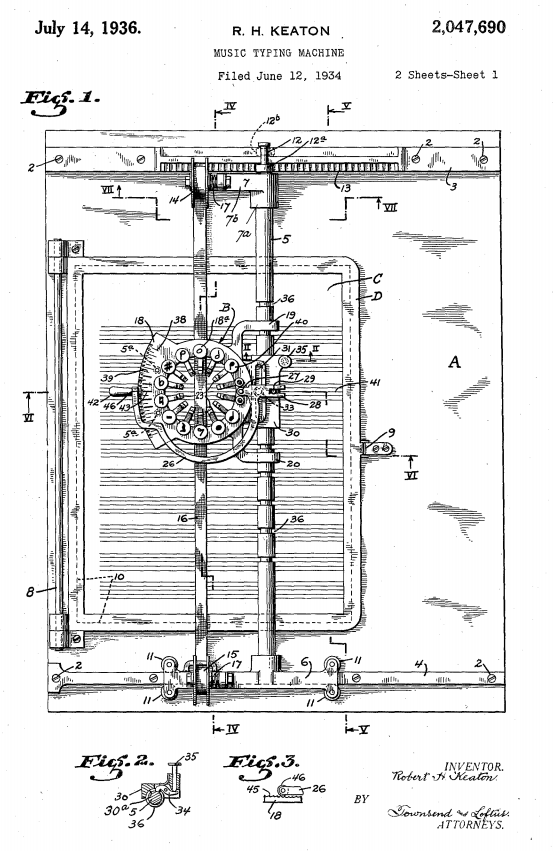
Nonetheless, Music Printing History notes, “composers… preferred to write the music out by hand.” The typewriter was mainly offered as a tool for mechanical reproduction, not spontaneous composition. Computers have changed things such that composers seem to have the same kinds of debates about handwriting verses digital as writers do. But where the typewriter is still a powerful symbol of literary art—for some an instrument as distinctive and worthy of study as the guitars of rock ‘n’ roll greats—the music typewriter is an oddity, a mechanical curiosity no one associates with creation.
Yet, as “the most vintage and wonderfully impractical thing ever,” as Classic Fm dubs the device, unwieldy machines like the Keaton remain high on the list of cool, quirky inventions its most likely customers didn’t really seem to need.
via Boing Boing
Related Content:
Behold Friedrich Nietzsche’s Curious Typewriter, the “Malling-Hansen Writing Ball”
The Enduring Analog Underworld of Gramercy Typewriter
Josh Jones is a writer and musician based in Durham, NC. Follow him at @jdmagness
Read More...America at War: Infographic Reveals How the U.S. Military Is Operating in 40% of the World’s Nations

Earlier this month, NBC reporter and analyst William Arkin ended a 30-year career as a journalist, announcing in a “scathing letter,” Democracy Now! reports, that “he would be leaving the network. Arkin accuses “the media of warmongering while ignoring the, quote, ‘creeping fascism of homeland security.’” He does not equivocate in a follow-up interview with Amy Goodman. “The generals and the national security leadership” are also now, he says, “the commentators and the analysts who populate the news media” (Arkin himself is a former Army intelligence officer).
The problem isn’t only NBC, in his estimation, and it isn’t only supposed journalists cheerleading for war. Most of the conflicts the country is currently engaged in are un- or under-reported in major sources. His letter “applies to all of the mainstream networks, applies to CNN and Fox, as well…. We’ve just become so shallow that we’re not really able even to see the truth, which is that we’re at war right now in nine countries around the world where we’re bombing, and we hardly report any of it on a day-to-day basis.”
This isn’t the case with independent media organizations like Democracy Now!, The Intercept, or Airwars. Secular and religious refugee relief organizations like the International Rescue Committee, World Relief, or Muslim Global Relief are paying attention. Many of these organizations are non‑U.S.-based or connected to the “civilian experts” Arkin says once appeared regularly in the national media and represented opposing views, “people who might be university professors or activists… or experts who were associated with think tanks.”
Airwars, affiliated with the Department of Media and Communications at Goldsmiths, University of London, has monitored conflicts around the world since 2014, with extensive coverage and records of alleged civilian deaths, military reports, and the names of victims. For a comparable U.S.-focused deep dive, see the Costs of War Project at Brown University’s Watson Institute of International & Public Affairs. The project’s website not only tracks the enormous economic costs of wars in the Middle East and Africa since 9/11; it also tracks “the human toll,” as you can see in the video below.
At the top of the post, see a map (view in a larger format here) from the Cost of War Project’s Stephanie Savell, 5W Infographics, and the Smithsonian of all the regions where the U.S. is “combatting terrorism.” While most of the media orgs and non-profits mentioned above would probably dispute the use of that term in some or all of the conflict zones, Savell sticks with the official language to describe the situation—one in which the nation “is now operating in 40 percent of the world’s nations,” as she writes at Smithsonian.com.
Maybe no one needs an editorial to imagine the enormous toll this level of military engagement has taken over the course of 17 years since the inception of the “Global War on Terror.” The map covers the past two, illustrating “80 countries, engaged through 40 U.S. military bases,” and conducting training, exercises, active combat, and air and drone strikes on six continents. The selections, writes Savell, are “conservative,” and sourced from both independent and mainstream media outlets and international government and military sources.
“The most comprehensive depiction in civilian circles of U.S. military and government antiterrorist actions overseas,” the America at War map provides information we don’t often get in our daily—or hourly, or by-the-minute—diet of news. “Contrary to what most Americans believe, the war on terror is not winding down.” It is expanding. Given the country’s history of sustained mass movements against legally suspect, grossly expensive wars with high civilian casualties, disease epidemics, starvation, and refugee crises, one would think that a sizable segment of the population would want to know what their country’s military and civilian defense contractors are doing around the world.
via Smithsonian.com
Related Content:
Josh Jones is a writer and musician based in Durham, NC. Follow him at @jdmagness
Read More...The Bustling Streets of Mumbai, India in 1929: Vintage Footage Captured with Very Early Sound Cameras
“Though hardly a cinematic masterpiece,” film critic Andre Soares writes, “or even a good film,” Al Jolson’s 1927 The Jazz Singer will forever bear the distinction of “the first time in a feature film that synchronized sound and voices could be heard in musical numbers and talking segments.” What usually goes unremarked in film history is that Indian cinema was never far behind its U.S. counterpart. The country’s first feature sound film appeared just four years after The Jazz Singer. Now lost, the love story Alam Ara debuted in March of 1931 and initiated a venerable tradition with its several songs, including the first major filmi music hit.
The movie was so popular, one historian notes, “police aid had to be summoned to control the crowds.” Its director Ardeshir Irani was inspired by another early Hollywood part-talkie musical, 1929’s Show Boat, which, like his film, used the Movietone system to record sound, rather than the Vitaphone system used in The Jazz Singer. Movietone, or Fox Movietone, as it came to be known after William Fox bought the patents in 1926, was also responsible for another early film development, the sound newsreel, a technology that made its way to India almost as soon as it debuted in the U.S.
The first sound newsreel, showing footage of Charles Lindbergh’s taking off in the “Spirit of St. Louis,” debuted in 1927 in New York. In November 1929, Fox opened the first exclusive newsreel theater on Broadway, and in January of that same year, a Movietone camera captured the street scenes of Bombay (now Mumbai) that you see above, over 13 minutes of footage complete with live audio recording of bustling crowds, busy vendors and laundry workers, honking automobiles, and clip-clopping horses.
This incredible document preserves the sights and sounds of a significant Indian slice of life from 90 years ago, and shows how early the technology for making sound films arrived on the subcontinent. When Ardeshir Irani began filming his groundbreaking musical the following year, he would use exactly this same technology, shooting all of the dialogue and music live, on a closed set late at night to avoid unwanted noise like the street sounds you hear above.
Learn more of the Fox Movietone newsreel story here, and here, learn how Indian cinema began in Mumbai in 1899 when Indian photographers, writers, theater impresarios, and entrepreneurs like Irani took the new technology and used it to build a cultural empire of their own.
Related Content:
India on Film, 1899–1947: An Archive of 90 Historic Films Now Online
Immaculately Restored Film Lets You Revisit Life in New York City in 1911
Download 6600 Free Films from The Prelinger Archives and Use Them However You Like
Free: British Pathé Puts Over 85,000 Historical Films on YouTube
Josh Jones is a writer and musician based in Durham, NC. Follow him at @jdmagness
Read More...Support Us
We're hoping to rely on loyal readers, rather than erratic ads. Please click the Donate button and support Open Culture. You can use Paypal, Venmo, Patreon, even Crypto! We thank you!

About Us

Open Culture scours the web for the best educational media. We find the free courses and audio books you need, the language lessons & educational videos you want, and plenty of enlightenment in between.
Advertise With Us
FREE UPDATES!
GET OUR DAILY EMAIL
Get the best cultural and educational resources on the web curated for you in a daily email. We never spam. Unsubscribe at any time.
FOLLOW ON SOCIAL MEDIA
Open Culture editor Dan Colman scours the web for the best educational media. He finds the free courses and audio books you need, the language lessons & movies you want, and plenty of enlightenment in between.
Advertise With Us



/https://public-media.si-cdn.com/filer/76/45/7645fe6c-a982-4828-bdff-7043074884b2/counterterrorismmapweb.png)