How Does the Rorschach Inkblot Test Work?: An Animated Primer
A frightening monster?
Two friendly bears?
Say what!?
As anybody with half a brain and the gift of sight knows, the black and red inkblot below resembles nothing so much as a pair of gnomes, gavotting so hard their knees bleed.
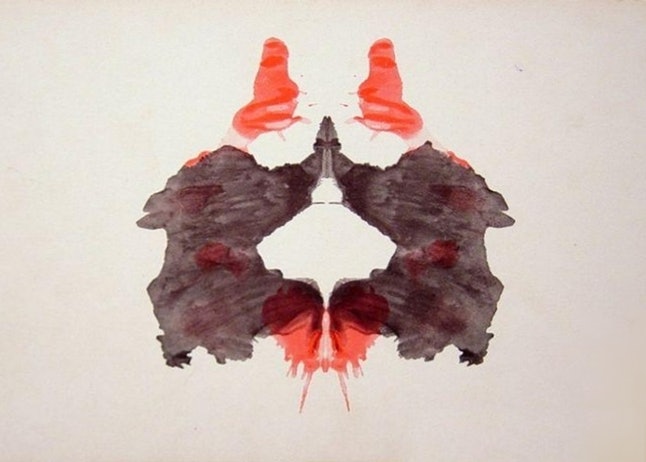
…or perhaps it’s open to interpretation.
Back in 2013, when Open Culture celebrated psychologist Hermann Rorschach’s birthday by posting the ten blots that form the basis of his famous personality test, readers reported seeing all sorts of things in Card 2:
A uterus
Lungs
Kissing puppies
A painted face
Little calfs
Tinkerbell checking her butt out in the mirror
Two ouija board enthusiasts, summoning demons
Angels
And yes, high-fiving bears
As Rorshach biographer Damion Searls explains in an animated Ted-ED lesson on how the Rorschach Test can help us understand the patterns of our perceptions, our answers depend on how we as individuals register and transform sensory input.
Rorshach chose the blots that garnered the most nuanced responses, and developed a classification system to help analyze the resulting data, but for much of the test’s history, this code was a highly guarded professional secret.
And when Rorshach died, a year after publishing the images, others began administering the test in service of their own speculative goals—anthropologists, potential employers, researchers trying to figure out what made Nazis tick, comedians…
The range of interpretative approaches earned the test a reputation as pseudo-science, but a 2013 review of Rorshach’s voluminous research went a long way toward restoring its credibility.
Whether or not you believe there’s something to it, it’s still fun to consider the things we bring to the table when examining these cards.
Do we see the image as fixed or something more akin to a freeze frame?
What part of the image do we focus on?
Our records show that Open Culture readers overwhelmingly focus on the hands, at least as far as Card 2 goes, which is to say the portion of the blot that appears to be high-fiving itself.
Never mind that the high five, as a gesture, is rumored to have come into existence sometime in the late 1970s. (Rorschach died in 1922.) That’s what the majority of Open Culture readers saw six years ago, though there was some variety of perception as to who was slapping that skin:
young elephants
despondent humans
monks
lawn gnomes
Disney dwarves
redheaded women in Japanese attire
chimpanzees with traffic cones on their heads
(In full disclosure, it’s mostly bears.)
Maybe it’s time for a do over?
Readers, what do you see now?
Image 1: Bat, butterfly, moth
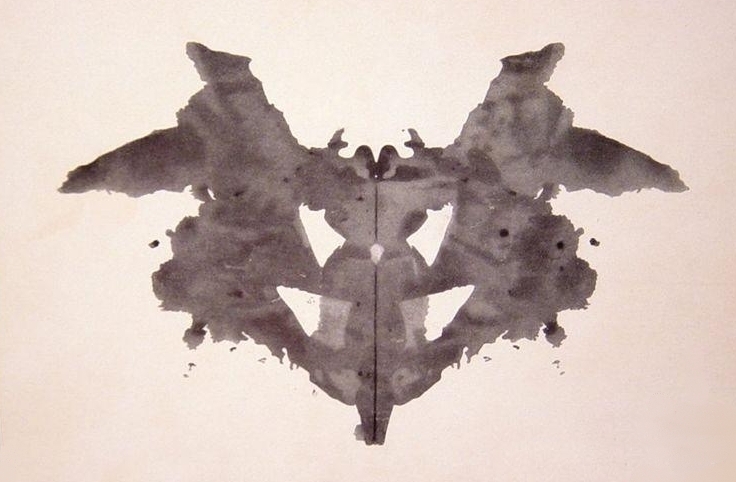
Image 2: Two humans
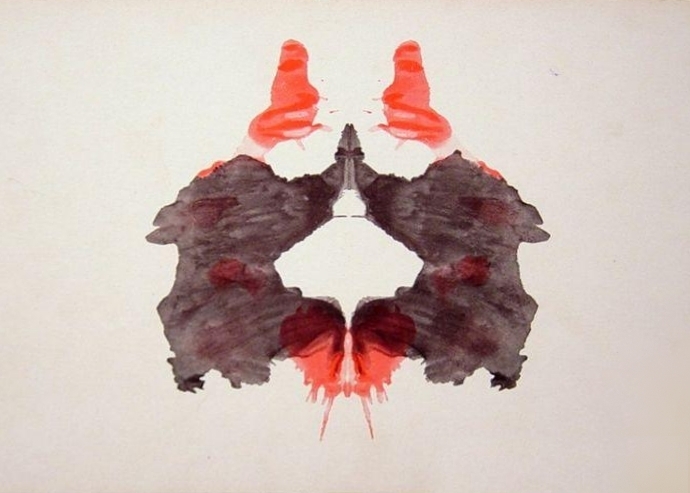
Image 3: Two humans
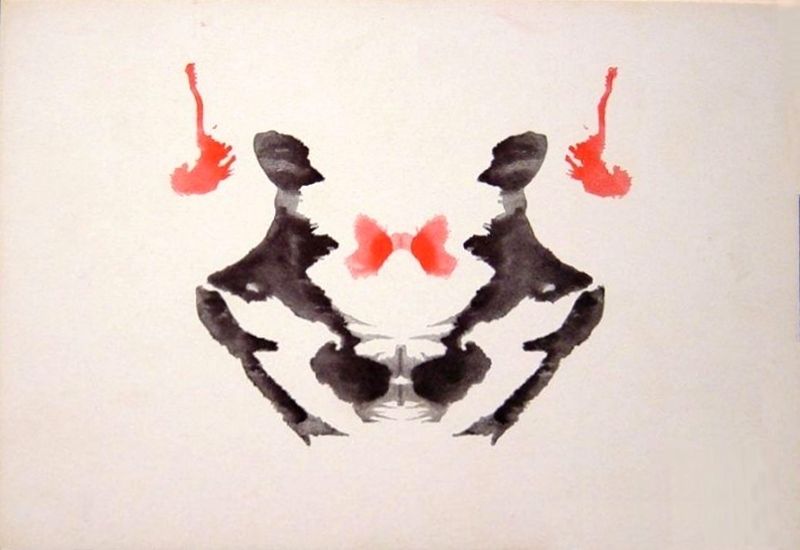
Image 4: Animal hide, skin, rug
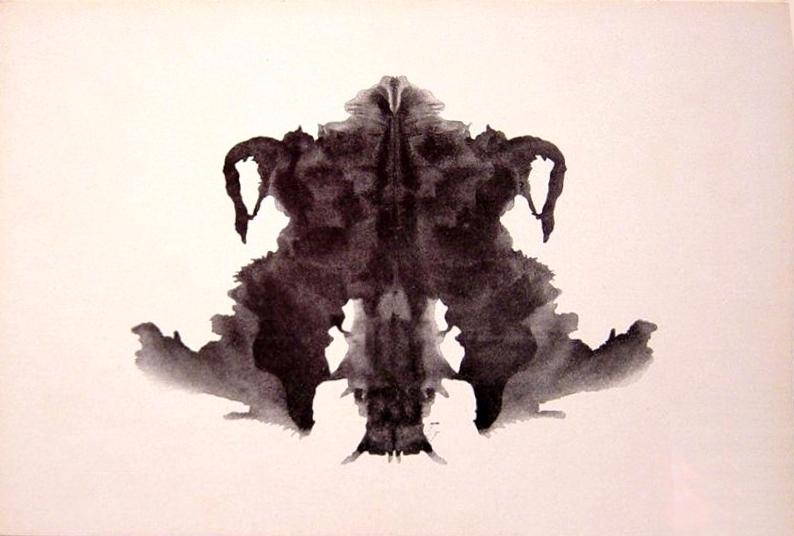
Image 5: Bat, butterfly, moth

Image 6: Animal hide, skin, rug

Image 7: Human heads or faces

Image 8: Animal; not cat or dog

Image 9: Human

Image 10: Crab, lobster, spider,

View Searls’ full TED-Ed lesson here.
Related Content:
Hermann Rorschach’s Original Rorschach Test: What Do You See? (1921)
Introduction to Psychology: A Free Course from Yale University
Ayun Halliday is an author, illustrator, theater maker and Chief Primatologist of the East Village Inky zine. Join her in New York City for the next installment of her book-based variety show, Necromancers of the Public Domain, this April. Follow her @AyunHalliday.
Read More...Natalie Portman Teaches a MasterClass in Acting
This week, MasterClass rolled out its latest course–Natalie Portman teaching a 20-lesson class on acting. The upstart educational venture writes:
One of her generation’s most versatile performers, Academy Award-winning actor Natalie Portman has been captivating audiences for decades. Since her on-screen debut at age 12, she’s worked with some of cinema’s most celebrated directors and showcased her skills through unforgettable roles in Black Swan, Jackie, and the Star Wars franchise.
Having never taken an acting class, Natalie developed her craft over 25 years of observation, collaboration, and countless bold experiments. The consummate dramatic shapeshifter, she has worked across genres and historical periods, imbuing each performance with an authenticity she attributes to intense research, preparation, and an eye for human behavior.
And now, in her first-ever acting class, she “shows how empathy is at the core of every great performance, how to bring real-life details into every role, and how to build your own creative process.”
You can enroll in Portman’s new class (which runs $90) here. You can also pay $180 to get an annual pass to the entirety of MasterClass’ courses–a catalog of about 50 courses, which includes other acting classes by Jodie Foster, Samuel L. Jackson and more.
FYI: If you sign up for a MasterClass course by clicking on the affiliate links in this post, Open Culture will receive a small fee that helps support our operation.
Related Content:
450+ Movie Scenes Where Actors Break the Fourth Wall, Presented in Two Big Supercuts
Read More...Watch an Animated Score for Steve Reich’s Minimalist Piece “Clapping Music“–and Try Your Hardest to Follow Along
Steve Reich’s Clapping Music is one of the simplest scores of modern classical music, and as you might soon find out, one of the most difficult to perform. Written in 1972 while on a European tour and after a night of mediocre flamenco, Clapping Music is for two players. One claps a steady rhythm (technically an African Bell Rhythm).
A second performer claps in unison in the same pattern for eight bars. At the end of the eighth bar, the second performer goes out of sync for one eighth note and after another eight bars, goes out of sync again. This continues until both players are back in unison. (The above video explains this technique visually).
For Reich it was a simpler evolution of “phase” compositions that he had been creating since 1965. The earlier example was “It’s Gonna Rain,” which used two tape loops of a Pentecostal street preacher’s rant going slowly out of sync with each other, revealing first an echo and then, as the two loops wind up 180 degrees out of sync, pure apocalyptic cacophony.
The sync issues were due to the vagaries of the analog machines themselves, but Reich moved on to recreating phase music with actual instruments. In 1967 he composed “Piano Phase,” in which a simple melody is played by two musicians first in unison, and then slowly out of sync. Reich followed up with “Reed Phase” and “Violin Phase,” the latter of which was set to dance by Anne Teresa of Keersmaeker.
Asked about performing “Clapping Music” live, Reich told ClassicFM:
It’s a piece that I’m always standing up there doing, and it makes me nervous every time because you’re very exposed, as it’s just you and the other guy. If you make one little hesitation you can find yourself at a place in the piece where you have to figure out where you are to get things right. So it never ceases to be a challenge; it’s easy on one level, but it’s challenging on another.
If you’d like to have a go at Clapping Music, there is a free app from the London Sinfonietta and Touchpress that plays the steady loop while you try to go out of phase. (It tracks and rates your performance, with the hope you’ll perfect it.) I haven’t had a chance myself to try it out, but if you have, let us know in the comments.
Related Content:
Steve Reich is Calling: A Minimalist Ringtone for the iPhone
Ted Mills is a freelance writer on the arts who currently hosts the artist interview-based FunkZone Podcast and is the producer of KCRW’s Curious Coast. You can also follow him on Twitter at @tedmills, read his other arts writing at tedmills.com and/or watch his films here.
Read More...Buckminster Fuller Rails Against the “Nonsense of Earning a Living”: Why Work Useless Jobs When Technology & Automation Can Let Us Live More Meaningful Lives

We are a haunted species: haunted by the specter of climate change, of economic collapse, and of automation making our lives redundant. When Marx used the specter metaphor in his manifesto, he was ironically invoking Gothic tropes. But Communism was not a boogeyman. It was a coming reality, for a time at least. Likewise, we face very real and substantial coming realities. But in far too many instances, they are also manufactured, under ideologies that insist there is no alternative.
But let’s assume there are other ways to order our priorities, such as valuing human life as an end in itself. Perhaps then we could treat the threat of automation as a ghost: insubstantial, immaterial, maybe scary but harmless. Or treat it as an opportunity to order our lives the way we want. We could stop inventing bullshit, low-paying, wasteful jobs that contribute to cycles of poverty and environmental degradation. We could slash the number of hours we work and spend time with people and pursuits we love.
We have been taught to think of this scenario as a fantasy. Or, as Buckminster Fuller declared in 1970—on the threshold of the “Malthusian-Darwinian” wave of neoliberal thought to come—“We keep inventing jobs because of this false idea that everybody has to be employed at some kind of drudgery…. He must justify his right to exist.” In current parlance, every person must somehow “add value” to shareholders’ portfolios. The shareholders themselves are under no obligation to return the favor.
What about adding value to our own lives? “The true business of people,” says Fuller, “should be to go back to school and think about whatever it was they were thinking about before somebody came along and told them they had to earn a living.” Against the “specious notion” that everyone should have to make a wage to live–this “nonsense of earning a living”–he takes a more magnanimous view: “It is a fact today that one in ten thousand of us can make a technological breakthrough capable of supporting all the rest,” who then may go on to make millions of small breakthroughs of their own.
He may have sounded overconfident at the time. But fifty years later, we see engineers, developers, and analysts of all kinds proclaiming the coming age of automation in our lifetimes, with a majority of jobs to be fully or partially automated in 10–15 years. It is a technological breakthrough capable of dispensing with huge numbers of people, unless its benefits are widely shared. The corporate world sticks its head in the sand and issues guidelines for retraining, a solution that will still leave masses unemployed. No matter the state of the most recent jobs report, serious losses in nearly every sector, especially manufacturing and service work, are unavoidable.
The jobs we invent have changed since Fuller’s time, become more contingent and less secure. But the obsession with creating them, no matter their impact or intent, has only grown, a runaway delusion no one can seem to stop. Should we fear automation? Only if we collectively decide the current course of action is all there is, that “everybody has to earn a living”—meaning turn a profit—or drop dead. As Congresswoman Alexandria Ocasio-Cortez—echoing Fuller—put it recently at SXSW, “we live in a society where if you don’t have a job, you are left to die. And that is, at its core, our problem…. We should not be haunted by the specter of being automated out of work.”
“We should be excited about automation,” she went on, “because what it could potentially mean is more time to educate ourselves, more time creating art, more time investing in and investigating the sciences.” However that might be achieved, through subsidized health, education, and basic services, new New Deal and Civil Rights policies, a Universal Basic Income, or some creative synthesis of all of the above, it will not produce a utopia—no political solution is up that task. But considering the benefits of subsidizing our humanity, and the alternative of letting its value decline, it seems worth a shot to try what economist Bill Black calls the “progressive policy core,” which, coincidentally, happens to be “centrist in terms of the electorate’s preferences.”
Related Content:
Bertrand Russell & Buckminster Fuller on Why We Should Work Less, and Live & Learn More
The Life & Times of Buckminster Fuller’s Geodesic Dome: A Documentary
Everything I Know: 42 Hours of Buckminster Fuller’s Visionary Lectures Free Online (1975)
Josh Jones is a writer and musician based in Durham, NC. Follow him at @jdmagness
Read More...Artificial Intelligence Identifies the Six Main Arcs in Storytelling: Welcome to the Brave New World of Literary Criticism
Is the singularity upon us? AI seems poised to replace everyone, even artists whose work can seem like an inviolably human industry. Or maybe not. Nick Cave’s poignant answer to a fan question might persuade you a machine will never write a great song, though it might master all the moves to write a good one. An AI-written novel did almost win a Japanese literary award. A suitably impressive feat, even if much of the authorship should be attributed to the program’s human designers.
But what about literary criticism? Is this an art that a machine can do convincingly? The answer may depend on whether you consider it an art at all. For those who do, no artificial intelligence will ever properly develop the theory of mind needed for subtle, even moving, interpretations. On the other hand, one group of researchers has succeeded in using “sophisticated computing power, natural language processing, and reams of digitized text,” writes Atlantic editor Adrienne LaFrance, “to map the narrative patterns in a huge corpus of literature.” The name of their literary criticism machine? The Hedonometer.
We can treat this as an exercise in compiling data, but it’s arguable that the results are on par with work from the comparative mythology school of James Frazier and Joseph Campbell. A more immediate comparison might be to the very deft, if not particularly subtle, Kurt Vonnegut, who—before he wrote novels like Slaughterhouse Five and Cat’s Cradle—submitted a master’s thesis in anthropology to the University of Chicago. His project did the same thing as the machine, 35 years earlier, though he may not have had the wherewithal to read “1,737 English-language works of fiction between 10,000 and 200,000 words long” while struggling to finish his graduate program. (His thesis, by the way, was rejected.)
Those numbers describe the dataset from Project Gutenberg fed into the The Hedonometer by the computer scientists at the University of Vermont and the University of Adelaide. After the computer finished “reading,” it then plotted “the emotional trajectory” of all of the stories using a “sentiment analysis to generate an emotional arc for each work.” What it found were six broad categories of story, listed below:
- Rags to Riches (rise)
- Riches to Rags (fall)
- Man in a Hole (fall then rise)
- Icarus (rise then fall)
- Cinderella (rise then fall then rise)
- Oedipus (fall then rise then fall)
How does this endeavor compare with Vonnegut’s project? (See him present the theory below.) The novelist used more or less the same methodology, in human form, to come up with eight universal story arcs or “shapes of stories.” Vonnegut himself left out the Rags to Riches category; he called it an anomaly, though he did have a heading for the same rising-only story arc—the Creation Story—which he deemed an uncommon shape for Western fiction. He did include the Cinderella arc, and was pleased by his discovery that its shape mirrored the New Testament arc, which he also included in his schema, an act the AI surely would have judged redundant.
Contra Vonnegut, the AI found that one-fifth of all the works it analyzed were Rags-to-Riches stories. It determined that this arc was far less popular with readers than “Oedipus,” “Man in a Hole,” and “Cinderella.” Its analysis does get much more granular, and to allay our suspicions, the researchers promise they did not control the outcome of the experiment. “We’re not imposing a set of shapes,” says lead author Andy Reagan, Ph.D. candidate in mathematics at the University of Vermont. “Rather: the math and machine learning have identified them.”
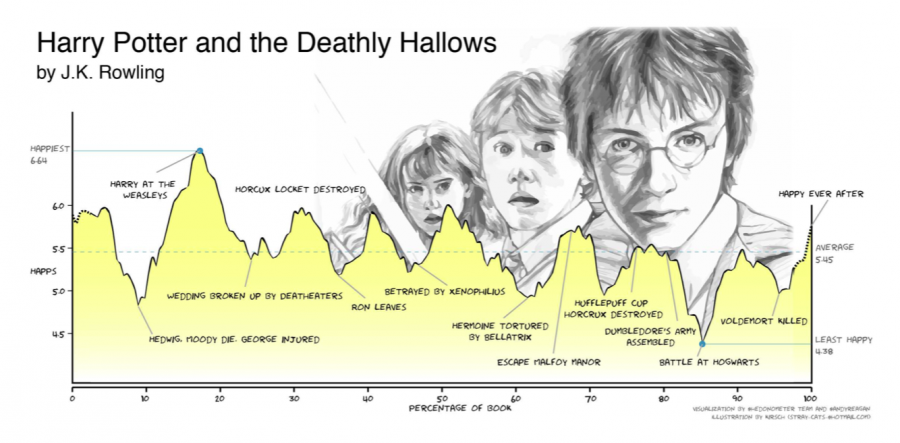
But the authors do provide a lot of their own interpretation of the data, from choosing representative texts—like Harry Potter and the Deathly Hallows—to illustrate “nested and complicated” plot arcs, to providing the guiding assumptions of the exercise. One of those assumptions, unsurprisingly given the authors’ fields of interest, is that math and language are interchangeable. “Stories are encoded in art, language, and even in the mathematics of physics,” they write in the introduction to their paper, published on Arxiv.org.
“We use equations,” they go on, “to represent both simple and complicated functions that describe our observations of the real world.” If we accept the premise that sentences and integers and lines of code are telling the same stories, then maybe there isn’t as much difference between humans and machines as we would like to think.
via The Atlantic
Related Content:
Kurt Vonnegut Diagrams the Shape of All Stories in a Master’s Thesis Rejected by U. Chicago
Kurt Vonnegut Maps Out the Universal Shapes of Our Favorite Stories
Josh Jones is a writer and musician based in Durham, NC. Follow him at @jdmagness
Read More...The Cringe-Inducing Humor of The Office Explained with Philosophical Theories of Mind
“I’m a friend first and a boss second,” says David Brent, middle manager at the Slough branch of paper company Wernham-Hogg. “Probably an entertainer third.” Those of us who’ve watched the original British run of The Office — and especially those of us who still watch it regularly — will remember that and many other of Brent’s pitiable declarations besides. As portrayed by the show’s co-creator Ricky Gervais, Brent constitutes both The Office’s comedic and emotional core, at once a fully realized character and someone we’ve all known in real life. His distinctive combination of social incompetence and an aggressive desperation to be liked provokes in us not just laughter but a more complex set of emotions as well, resulting in one expression above all others: the cringe.
“In David Brent, we have a character so invested in the performance of himself that he’s blocked his own access to others’ feelings.” So goes the analysis of Evan Puschak, a.k.a. the Nerdwriter, in his video interpreting the humor of The Office through philosophical theories of mind.
The elaborate friend-boss-entertainer song-and-dance Brent constantly puts on for his co-workers so occupies him that he lacks the ability or even the inclination to have any sense of what they’re thinking. “The irony is that Brent can’t see that a weak theory of mind always makes for a weak self-performance. You can’t brute force your preferred personality onto another’s consciousness: it takes two to build an identity.”
Central though Brent is to The Office, we laugh not just at what he says and does, but how the other characters (which Puschak places across a spectrum of ability to understand the minds of others) react — or fail to react — to what he says and does, how he reacts to their reactions, and so on. Mastery of the comedic effects of all this has kept the original Office effective more than fifteen years later, though its effect may not be entirely pleasurable: “A lot of people say that cringe humor like this is hard to watch,” says Puschak, “but in the same way that under our confidence, in theory of mind, lies an anxiety, I think that under our cringing there’s actually a deep feeling of relief.” When Brent and others fail to connect, their “body language speaks in a way that is totally transparent: in that moment the embarrassment is not only palpable, it’s palpably honest.” And it reminds us that — if we’re being honest — none of us are exactly mind-readers ourselves.
You can get the complete British run of The Office on Amazon here.
Related Content:
Ricky Gervais Presents “Learn Guitar with David Brent”
The Philosophy of Bill Murray: The Intellectual Foundations of His Comedic Persona
A Romp Through the Philosophy of Mind: A Free Online Course from Oxford
Based in Seoul, Colin Marshall writes and broadcasts on cities, language, and culture. His projects include the book The Stateless City: a Walk through 21st-Century Los Angeles and the video series The City in Cinema. Follow him on Twitter at @colinmarshall or on Facebook.
Read More...John Cleese Revisits His 20 Years as an Ivy League Professor in His New Book, Professor at Large: The Cornell Years

Creative Commons image by Paul Boxley
It takes real intelligence to successfully make dumb comedy. John Cleese and his Monty Python colleagues are a premium example. You can call sketches like the “Ministry of Silly Walks” and “Dead Parrot” surrealist, and they are comparable to the absurdist stunts favored by certain early 20th century modern artists. But you can also call them very smart kinds of stupid, a description of some of the highest forms of comedy, I’d say, and one that applies to so much of Cleese’s best work, from the Pythons, to Fawlty Towers, to A Fish Called Wanda. We are moved by stupidity, Cleese believes, and silliness is the engine of good comedy. “Sometimes very, very silly things,” he says in the interview with Cornell University Press director Dean Smith below, “have the power to touch us deeply.” Then he tells the old joke about a grasshopper named Norman.
Is Cleese still funny? Depends. Many listeners of a recent BBC Radio 4 show found his act a little stale. He has also come off lately as a “classic old man yelling at a cloud,” writes Fiona Sturges at The Guardian. (He called, surely in jest, for the hanging of EU president Jean Claude Juncker, for example, during the Brexit campaign).
In curmudgeonly interviews, he complains about hypersensitivity with examples of jokes contemporary audiences simply don’t find amusing, or at least not coming from him. Cleese has railed about the evils of political correctness, especially on college campuses, while spending the past 20 years as a “professor-at-large” on the prestigious campus of Cornell University, where he has delivered “incredibly popular events and classes—including talks, workshops, and an analysis of A Fish Called Wanda and The Life of Brian.”
These appearances draw hundreds of people, and their enormous popularity should offer Cleese some reassurance that he may not need to fear censorship, and that his wit—while it might not be as well appreciated in today’s mass entertainment—still has plenty of currency in places where smart people gather. From seminars on script writing to lectures on psychology and human development, Cleese’s appearances at Cornell lead to riveting, sometimes hilarious, and often controversial conversations.
In the episodes here from the Cornell University Press podcast, you can hear Cleese’s full conversation with Smith, part of the promotion of his 2018 book Professor at Large: The Cornell Years, in which he includes an interview with Princess Bride screenwriter William Goldman, a lecture about creativity called “Hare Brain, Tortoise Mind,” a discussion of facial recognition technology, and a talk on group dynamics with business students and faculty. Like Cleese’s mind, these lectures and discussions range far and wide, demonstrating, once again in his long career, that it takes real smarts to not only speak with ease on several academic subjects, but to understand the mechanics of stupidity. You can pick up a copy of Professor at Large: The Cornell Years here.
Related Content:
John Cleese Explains the Brain — and the Pleasures of DirecTV
John Cleese’s Philosophy of Creativity: Creating Oases for Childlike Play
Josh Jones is a writer and musician based in Durham, NC. Follow him at @jdmagness
Read More...The British Library Digitizes Its Collection of Obscene Books (1658–1940)
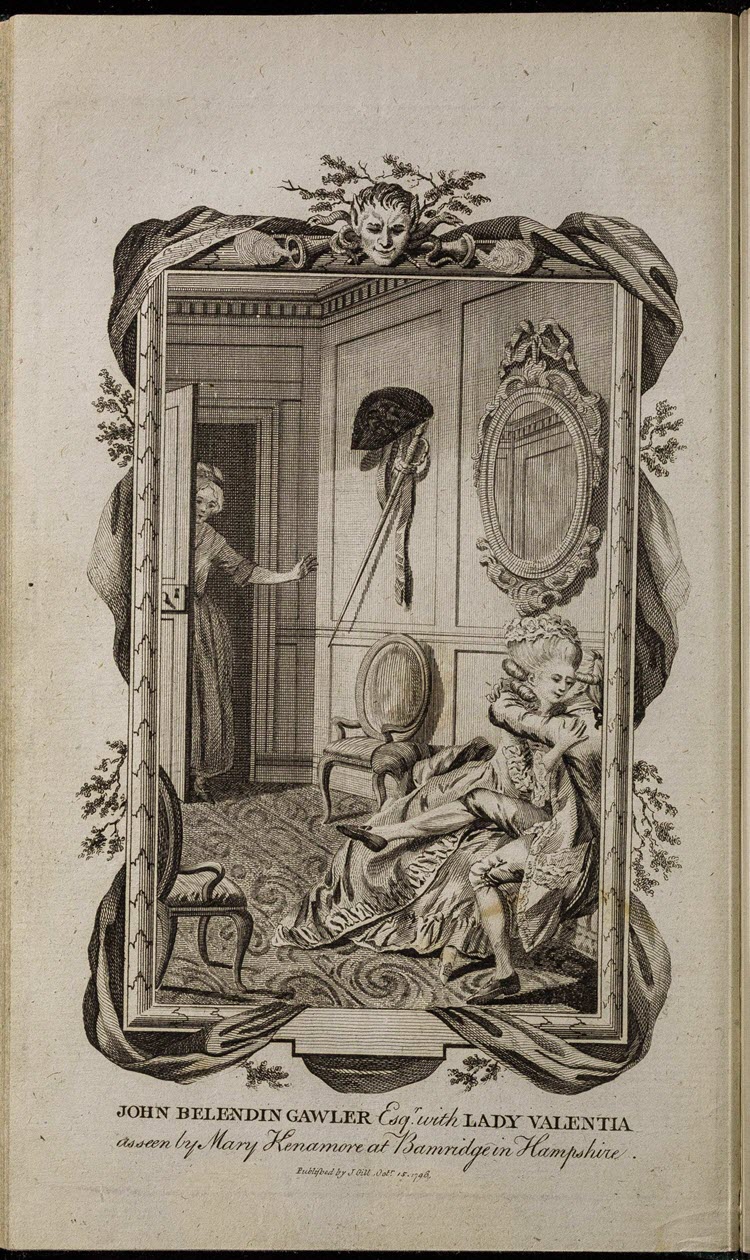
Many people are cheated out of an authentic education in English literature because of a longstanding puritanical approach to its curation. One might spend a lifetime reading the traditional canon without ever, for example, learning much about the long history of popular pornographic British writing, a genre that flourished in the 18th and 19th centuries as the popularity of the novel exploded. Everyone knows the Marquis de Sade, even if they haven’t read him, not least because he lent his name to psychoanalytic theory. Many of us have read Voltaire’s randy satire, Candide. But few know the name John Cleland, author of Fanny Hill, a bawdy British novel published in 1748, over forty years before de Sade’s Justine.
A book that serves up its own wealth of psychosexual insights, Fanny Hill does not disappoint either as pornographic writing or as entertaining fiction. Cleland wrote the book while in debtors’ prison, after he “boasted to James Boswell, himself no mean pornographer… that he could write a sexually exciting story of ‘a woman of pleasure’ without using a single ‘foul’ word,” writes John Sutherland at The Guardian. Cleland succeeded, in a narrative loaded with crudely Shakespearean puns and euphemisms. The wordplay in the title character’s name, an Anglicization of mons veneris (mound of Venus), will be immediately apparent to speakers of British English.
Upon its publication, however, Cleland was prosecuted for “corrupting the king’s subjects,” and the book was “duly buried and went on to become a centuries-long underground bestseller.” Such was the fate of many an obscene British novel. Thousands of these became property of the British Library, which “kept its dirtiest books locked away from the rest of its collections,” notes Brigit Katz at Smithsonian. “All volumes deemed to be in need of extra safeguarding so that members of the public couldn’t get their hands on the saucy stories—or try to destroy them—were placed in the library’s ‘Private Case.’” Now, they are being digitized and made available to Gale subscribers.
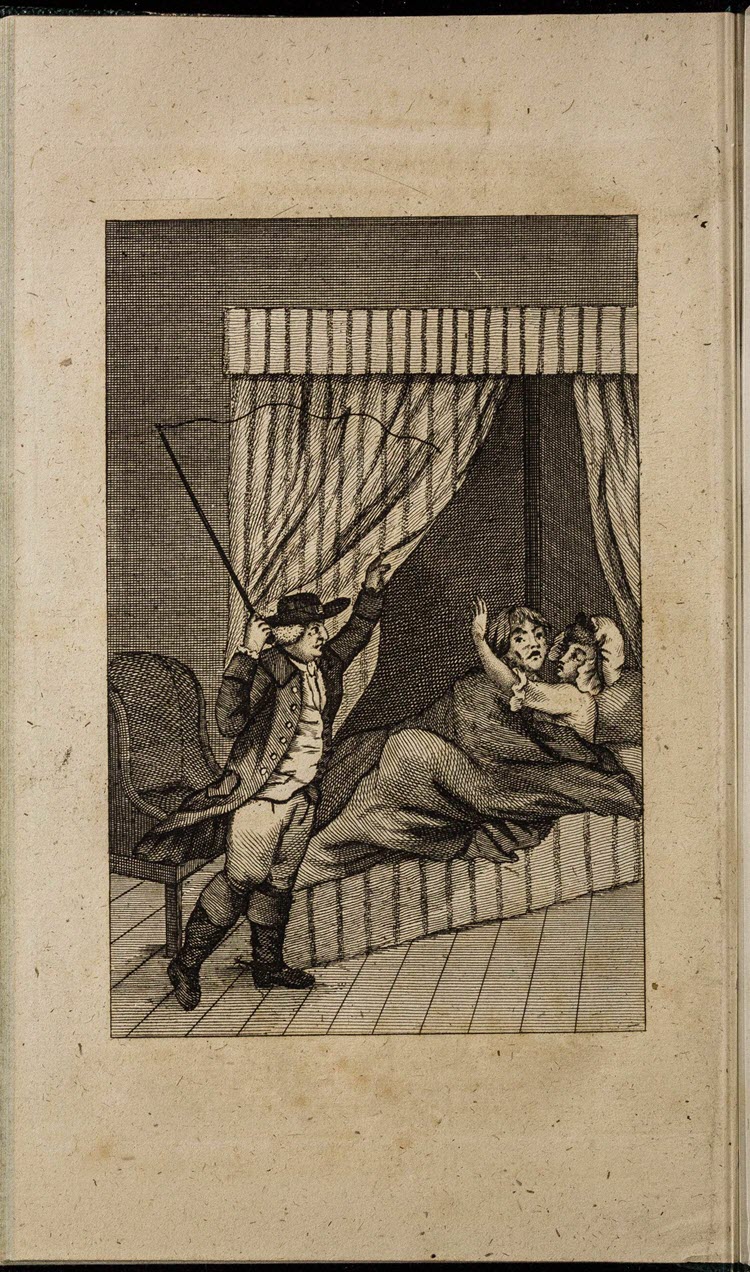
2,500 volumes from the Private Case collection have become part of Gale’s Archives of Sexuality and Gender research library, the first time much of this material has been available. “Pretty much anything to do with sex,” says British Library curator Maddy Smith, was locked away “until around 1960, when attitudes to sexuality were changing.” Librarians only began cataloguing this material in the 1970s, but most of it remained obscure and fairly inaccessible. The collection dates to 1658. It includes a series called the Merryland Books, written in the 1740s by authors who took pseudonyms like “Roger Pheuquewell” and described “the female anatomy metaphorically as land ripe for exploration.”
It is not overall a body of work given to subtleties. Aside from some exceptions, like Teleny or The Reverse of the Medal, a tragic gay romance attributed to Oscar Wilde, these are also largely books “written by men, for men,” about women, Smith points out. “It’s to be expected, but looking back, that’s what is shocking, how male-dominated it is, the lack of female agency.” She might have also pointed out that many women in the mid-18th century were writing and publishing popular novels, largely read by women, with frank coming-of-age descriptions of sexual education, seduction, and even rape. And both men and women wrote about homosexuality and gender fluidity in ways that might surprise us.
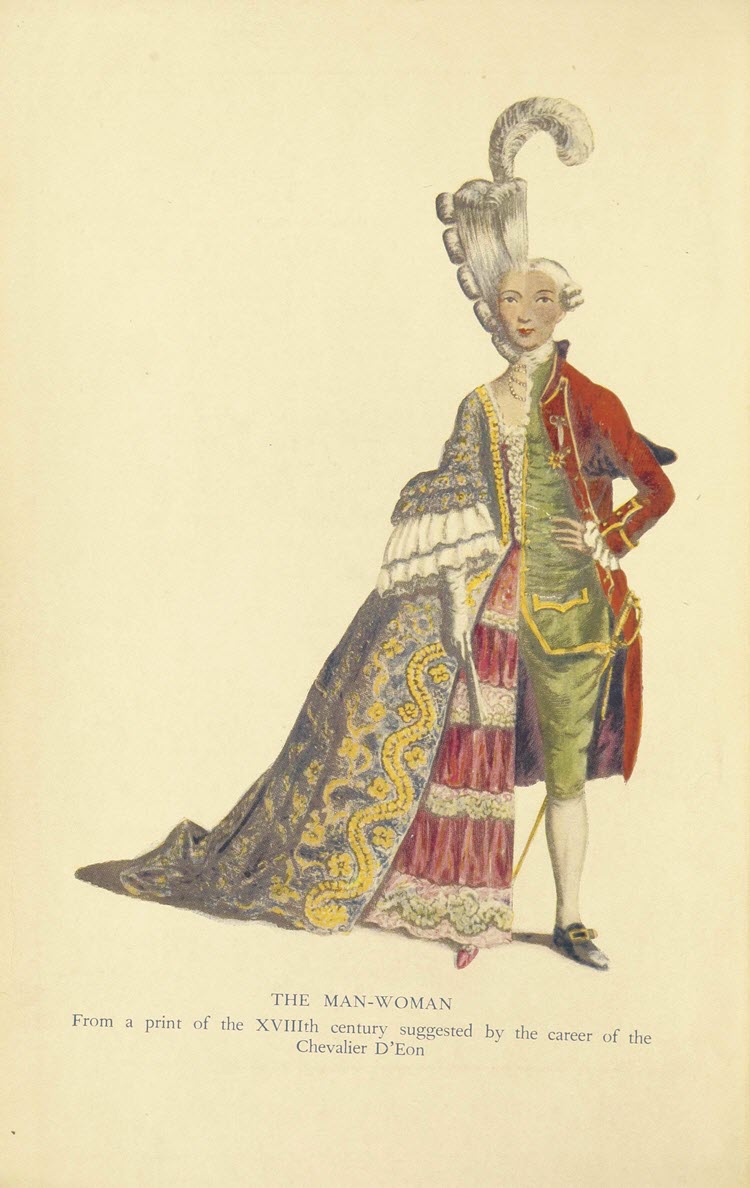
The response to such books tended to be moralistic correction—as in the best-selling Pamela, or Virtue Rewarded by Samuel Richardson—or lascivious satire, as in the Merryland Books, Fanny Hill, and Henry Fielding’s Shamela, a parody that turns Richardson’s chaste heroine into a scheming prostitute. These two novels were massively popular and show the form as we know it developing as a literary conversation between men about women’s supposed vices or virtues. We should read mid-18th century pornographic literature as an essential part of the formation of the British novel tradition.
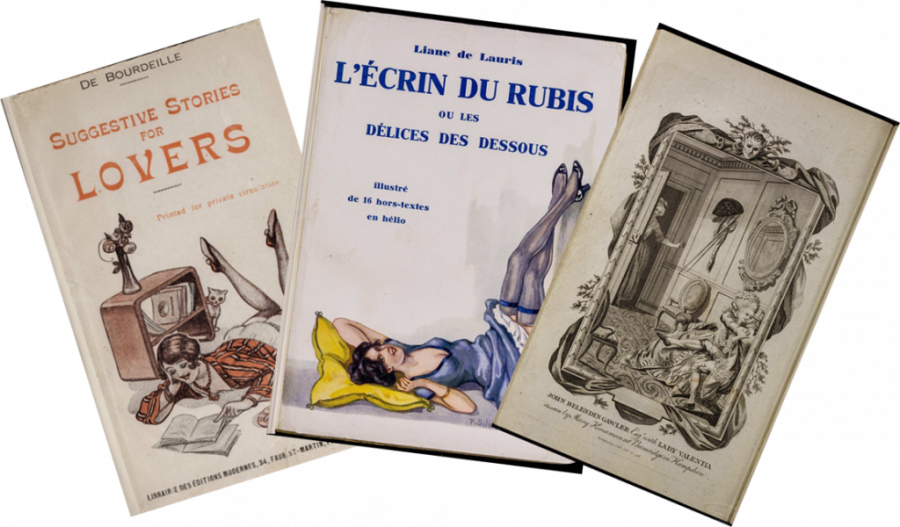
At the Gale online collection of these British Library treasures, one can do just that, then reach back a century earlier and forward 200 years to 1940, the last date in the Gale collection, which “makes available approximately one million pages of content that’s been locked away for many years, available only via restricted access.” (We must note that access is still restricted to Gale subscribers). These pages come not only from the British Library but also from The Kinsey Institute and the New York Academy of Medicine, who have both supplied a share of textbooks and scholarly monographs on sex. The “obscenity” of this material lies in the eyes of its keepers—much will seem unremarkable today, and some can still seem plenty scandalous.
Related Content:
Read 14 Great Banned & Censored Novels Free Online: For Banned Books Week 2014
John Waters Reads Steamy Scene from Lady Chatterley’s Lover for Banned Books Week (NSFW)
Josh Jones is a writer and musician based in Durham, NC. Follow him at @jdmagness
Read More...Discover the KattenKabinet: Amsterdam’s Museum Devoted to Works of Art Featuring Cats

Image by T_Marjorie, via Flickr Commons
There’s been quite a bit of barking in the media lately to herald the reopening of the American Kennel Club Museum of the Dog, relocating from St. Louis to New York City’s Park Avenue.
What’s a cat person to do?
Perhaps decompress within Amsterdam’s KattenKabinet…
In contrast to the Museum of the Dog’s glitzy, glass-fronted HQ, the Cat Cabinet maintains a fairly low profile inside a 17th-century canal house. (Several visitors have noted in their Trip Advisor reviews that the 3‑room museum’s grand environs help justify the €7 admission.)
The Museum of the Dog’s highly toted “digital experiences” and redesigned atrium suggest a certain eagerness to establish itself as a major 21st-century institution.
The KattenKabinet is more of a stealth operation, created as an homage to one J.P. Morgan, a dearly departed ginger tom, who lived upstairs with his owner.
The inaugural collection took shape around presents the formidable Morgan received during his 17 years on earth—paintings, a bronze cat statue, and a facsimile of a dollar bill featuring his likeness and the motto, “We Trust No Dog.”
In spirit, the Kabinet hews closely to America’s eclectic (and fast disappearing) roadside museums.
No apps, no interactive kiosks, a stolidly old fashioned approach when it comes to display…
It does have a gift shop, where one can purchase logo t‑shirts featuring an extremely cat-like specimen, viewed from the rear, tail aloft.
While the KattenKabinet’s holdings include some marquee names—Picasso, Toulouse-Lautrec, and Rembrandt—there’s something compelling about the collection’s less well known artists, many of whom embraced the museum’s pet subject again and again.
Museum founder Bob Meijer rewards virtual visitors with some juicy biographical tidbits about his artists, cat-related and otherwise. Take, for example, Leonor Fini, whose Ubu glowers below:
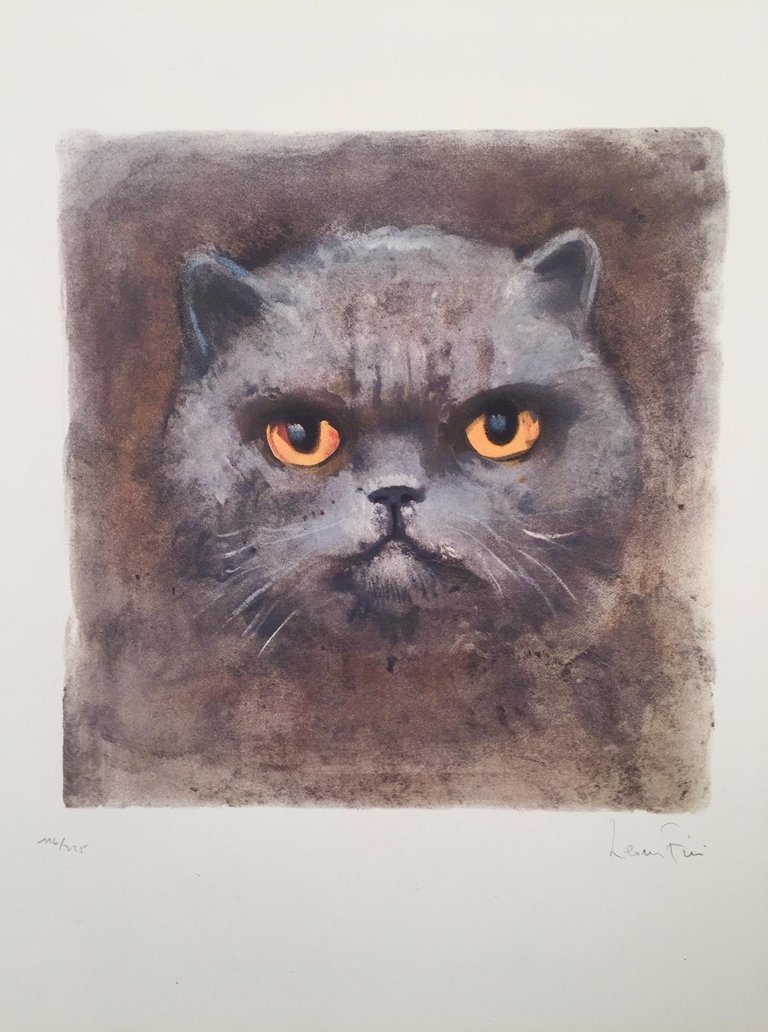
Fini had a three-way relationship with the Italian diplomat-cum-artist Stanislao LePri, who, like Fini, was difficult to pin into a certain style, and the Polish literary writer Constantin Jelenski. The two men were not, however, her only housemates: Fini had dozens of Persian cats around her. Indoors you rarely see a photo of her without a cat in her arms. In the Cat Cabinet you can find many of her works, from cheerfully colored cats to highly detailed portraits of cats. The women depicted in the paintings have that iconic mystique characteristic of Fini’s work.

Tsuguharu Foujita, whose work is a staple of the museum, is another cat-loving-artist-turned-art-himself, by virtue of Dora Kalmus’ 1927 portrait, above.

Hildo Krop is well represented throughout Amsterdam, his sculptures adorning bridges and buildings. Two Cats Making Love, on view at the Kabinet, is, Meijer comments,” clearly one of his smaller projects and probably falls into the category of “free work.” One of his most famous works, and of a different order of magnitude, is the Berlage monument on Victorieplein in Amsterdam.”
In addition to fine art, the Kabinet showcases other feline appearances—in vintage advertising, Tadaaki Narita’s Lucky cat pinball machine, and in the person, er, form of 5 live specimens who have the run of the place.
Those visiting in the flesh can cat around to some of Amsterdam’s other feline-themed attractions, including two cat cafes, a cat-centric boutique, and the floating shelter, De Poezenboot.
And let’s not forget the other cat museums ‘round the globe, from Minsk and Malaysia to Sylva, North Carolina’s American Museum of the House Cat.
Begin your exploration of the collection here.
Related Content:
Edward Gorey Talks About His Love Cats & More in the Animated Series, “Goreytelling”
Ayun Halliday is an author, illustrator, theater maker and Chief Primatologist of the East Village Inky zine. Join her in New York City for the next installment of her book-based variety show, Necromancers of the Public Domain, this March. Follow her @AyunHalliday.E
Read More...Watch the Last Time Peter Tork (RIP) & The Monkees Played Together During Their 1960s Heyday: It’s a Psychedelic Freakout
Peter Tork died yesterday at age 77. You might not have heard the news over the deafening alarms in your social media feeds lately. But a muted response is also noteworthy because of the way Tork’s fame imploded at the end of the sixties, at a time when he might have become the kind of rock star he and his fellow Monkees had proved they could become, all on their own, without the help of any studio trickery, thanks very much. The irony of making this bold statement with a feature film was not lost on the band at all.
The film was Head, co-written and co-produced by Jack Nicholson, who appears alongside the Monkees, Teri Garr, Annette Funicello, Frank Zappa, Sonny Liston, Jerry Lee Lewis, Fats Domino, and Little Richard, among many other famous guest stars and musicians. Dennis Hopper and Toni Basil pop up, and the soundtrack, largely written and played by the band, is a truly groovy psych rock masterpiece and their last album to feature Tork until a reunion in the mid-80s.
Head was a weird, cynical, embittered, yet brilliant, attempt to torpedo everything the Monkees had been to their fans—teen pop idols and goofy Beatles rip-offs at a time when The Beatles had maybe gotten too edgy for some folks. And while it may have taken too much of a toll on the band, especially Tork, for them to recover, it’s clear that they had an absolute blast making both the movie and the record, even as their professional relationships collapsed.
Tork’s best songwriting contribution to Head, and maybe to the Monkees catalog on the whole, is “Can You Dig It,” a meditation on “it” that takes what might have been cheap hipster appropriation in a funky, pseudo-deep, vaguely Eastern direction free of guile—it’s light and breezy, like the Monkees, but also sinister and slinky, like Donovan or the folk rock of Brian Jones, and also spidery and jangly like Roger McGuinn. In the estimation of many a psychedelic rock fan, this is music that deserves a place beside its obvious influences. That Monkees fans could not dig it at the time only reflects poorly on them, but since some of them were fans of what they thought was a slapstick comedy troupe or a backup act for dreamy Davy Jones, they can hardly be blamed.
Cast as the Ringo of the gang (The Monkees and Head director Bob Rafelson compared him to Harpo Marx), Tork brought to it a similarly serious whimsy, and when he was finally allowed to show what he could do—both as a musician and a songwriter—he more than acquitted himself. Where Ringo mastered idiot savant one-liners, Tork excelled in the kind of oblique riffs that characterized his playing—he was the least talented vocalist in the band, but the most talented musician and the only one allowed to play on the band’s first two records. Tork played bass, guitar, keyboards, banjo, harpsichord, and other instruments fluently. He honed his craft, and his “lovable dummy” persona on Greenwich Village coffeehouse stages.
It’s not hard to argue that the Monkees rose above their TV origins to become bona fide pop stars with the songwriting and promotional instincts to match, but Head, both film and album, make them a band worth revisiting for all sorts of other reasons. Now a widely-admired cult classic, in 1968, the movie “surfaced briefly and then sank like a costumed dummy falling into a California canal,” writes Petra Mayer at NPR, in reference to Head’s first scene, in which Micky Dolenz appears to commit suicide. If the Monkees had been trying in earnest to do the same to their careers, they couldn’t have had more success. Head cost $750,000 and made back $16,000. “It was clear they were in free fall,” Andy Greene writes at Rolling Stone.
“After that debacle,” writes Greene, they could have tried a return to the original formula to recoup their losses, but instead “they decided to double down on psychedelic insanity” in an NBC television special, 33⅓ Revolutions per Monkee, greenlighted that year after the huge chart success of “Daydream Believer.” Tork had already announced that he was leaving the band as the cameras rolled on the very loosely plotted variety show. He stuck around till the end of filming, however, and played the last live performance with The Monkees for almost 20 years in the bang-up finale of “Listen to the Band” (top) which “quickly devolves into a wild psychedelic freakout crammed with guest stars.” Tork, behind the keys, first turns the downbeat Neil Young-like, Nesmith-penned tune into the rave-up it becomes. It’s a glorious send-off for a version of the Monkees people weren’t ready to hear in ’68.
Related Content:
Watch Frank Zappa Play Michael Nesmith on The Monkees (1967)
Josh Jones is a writer and musician based in Durham, NC. Follow him at @jdmagness
Read More...Support Us
We're hoping to rely on loyal readers, rather than erratic ads. Please click the Donate button and support Open Culture. You can use Paypal, Venmo, Patreon, even Crypto! We thank you!

About Us

Open Culture scours the web for the best educational media. We find the free courses and audio books you need, the language lessons & educational videos you want, and plenty of enlightenment in between.
Advertise With Us
FREE UPDATES!
GET OUR DAILY EMAIL
Get the best cultural and educational resources on the web curated for you in a daily email. We never spam. Unsubscribe at any time.
FOLLOW ON SOCIAL MEDIA
Open Culture editor Dan Colman scours the web for the best educational media. He finds the free courses and audio books you need, the language lessons & movies you want, and plenty of enlightenment in between.
Advertise With Us


