Alexis De Tocqueville’s Democracy in America: An Animated Introduction to the Most Insightful Study of American Democracy
We cannot rightly see ourselves without honest feedback. Those who surround themselves with sycophants and people just like them only hear what they want to hear, and never get an accurate sense of their capabilities and shortcomings. And so the best feedback often comes from people outside our in-groups. This can be as true of nations as it can be of individuals, provided our critics are charitable, even when unsparingly honest, and that they take a genuine interest in our well-being.
These qualities well describe one of the sharpest critics of the United States in the past two centuries. Alexis de Tocqueville, aristocratic French lawyer, historian, and political philosopher, who traveled to the fledgling country in 1831 to observe a nation then in the grip of a populist fever under Andrew Jackson, a president who became notorious for his expropriation of indigenous land, ruthless relocation policies, and embrace of Southern slavery. But the groups who flourished under Jackson’s rule did so with a tremendous enthusiasm that the French thinker admired but also viewed with a very skeptical eye.
De Tocqueville published his observations and analyses of the United States in a now-famous book, Democracy in America. Though we’ve come to take the idea of democracy for granted, for the young Frenchman, a child of Napoleonic Europe, it was “a highly exotic and new political option,” as Alain de Botton tells us in his animated video introduction above. De Tocqueville “presciently believed that democracy was going to be the future all over the world, and so he wanted to know, ‘what would that be like?’”
With a grant from the French government, De Tocqueville traveled the country (then less than half its current size) for nine months, getting to know its people and customs as best he could, and making a series of general observations that would form the vignettes and arguments in his book. He was “particularly alive to the problematic and darker sides of democracy.” De Botton discusses five critical insights from Democracy in America. See three of them below, with quotes from De Tocqueville himself.
1. Democracy Breeds Materialism.
For De Tocqueville one kind of materialism—the excessive pursuit of wealth—disposed the country to another, “a dangerous sickness of the human mind”—the denial of a spiritual or intellectual life. “While man takes pleasure in this honest and legitimate pursuit of well-being,” he wrote, “it is to be feared that in the end he may lose the use of his most sublime faculties, and that by wanting to improve everything around him, he may in the end degrade himself.”
De Tocqueville, says De Botton, observed that “money seemed to be quite simply the only achievement that Americans respected” and that “the only test of goodness for any item was how much money it happens to make.”
2. Democracy Breeds Envy & Shame
“When all the prerogatives of birth and fortune have been abolished,” wrote De Tocqueville, “when every profession is open to everyone, an ambitious man may think it is easy to launch himself on a great career and feel that he has been called to no common destiny. But this is a delusion which experience quickly corrects.” Unable to rise above his circumstances, and yet believing that he should be equal to his neighbors in achievements, such a person may blame himself and feel ashamed, or succumb to envy and ill will.
De Tocqueville was far too optimistic about the abolishment of “prerogatives of birth and fortune,” but many Americans might recognize themselves still in his general picture, in which “the sense of unlimited opportunity could initially encourage a surface cheerfulness.” And yet, De Botton notes, “as time passed and the majority failed to raise themselves, Tocqueville noted that their mood darkened, that bitterness took hold and choked their spirits, and that their hatred of themselves and their masters grew fierce.”
3. Tyranny of the Majority
De Tocqueville, De Botton says, thought that “democratic culture… often ends up demonizing any assertion of difference, and especially cultural superiority, even though such attitudes might be connected with real merit.” In such a state, “society has an aggressive leveling instinct.”
It wasn’t only attacks on high culture that De Tocqueville feared, but what he called the “Omnipotence of the Majority,” a phrase he used to denote the power of public opinion as an almost totalitarian means of social control. In volume two of his study, published in 1840, De Tocqueville devoted particular attention to “the power which that majority naturally exercises over the mind…. By whatever political laws men are governed in the ages of equality, it may be foreseen that faith in public opinion will become for them a species of religion, and the majority its ministering prophet.”
From this prediction, De Tocqueville foresaw “two tendencies; one leading the mind of every man to untried thoughts, the other prohibiting him from thinking at all.”
De Botton goes on to discuss two closely related critiques: democracy’s suspicion of all authority and its undermining of free thought. Rather than encountering the kind of marketplace of ideas the country prides itself on fostering, he found in few places “less independence of mind, and true freedom of discussion, than in America.” The criticism is harsh, and De Tocqueville did not flatter his hosts often, and yet for all of its “inherent drawbacks,” De Botton writes at the School of Life, the Frenchman “isn’t anti-democratic.”
His aim is “to get us to be realistic” about democratic society and its tendencies to inhibit rather than enlarge many freedoms. As Arthur Goldhammer observes at The Nation, De Tocqueville believed that “True freedom lay not in the pursuit of individualistic aims, but “in ‘slow and tranquil’ action in concert with others sharing some collective purpose.”
Related Content:
Bertrand Russell’s Ten Commandments for Living in a Healthy Democracy
Josh Jones is a writer and musician based in Durham, NC. Follow him at @jdmagness
Read More...A 10-Hour Playlist of Music Inspired by Robert Moog’s Iconic Synthesizer: Hear Electronic Works by Kraftwerk, Devo, Stevie Wonder, Rick Wakeman & More
It’s no secret that we love electronic music here, especially that made with the earliest instruments to hit concert stages and recording studios. The most prominent of these two, respectively, would be the Theremin and the Moog synthesizer, two devices invented by engineers who were not themselves musicians. Ironically, these have remained two electronic instruments with the most harmoniously musical voices—simulating the warmth and quavery vibrato of the human voice while also lending everything they touch an eerie, otherworldly air.
What often goes unremarked is the close, nearly direct influence of one upon the other, as David McNamee at The Guardian notes. Often thought of now as a novelty, the Theremin in its day received serious treatment in the hands of classical performer Clara Rockmore, who inspired Robert Moog, then only 14 years old, to build his own version of Leo Theremin’s device in 1948. “Godfather of electronic music” Raymond Scott took Moog’s instrument and wired it “into a keyboard-controlled contraption Scott called the Clavivox, which had a profound influence on Moog.”
Moog continued to build Theremins (a version of one went on tour with the Beach Boys to play “Good Vibrations”). But he is most famous for his synthesizers. Initially, he had “no interest in replicating existing instruments. They were machines for creating sound that sounded electronic.” Moog first designed a cumbersome studio-only apparatus, debuting in 1964, and his company’s “massive, fragile and impossible to tune” modular synthesizers had little popular appeal, or affordability. “Few of Dr. Moog’s early customers,” McNamee points out, including “sound artists, choreographers, and studios” were “interested in playing conventional melody on the instruments.”
This makes all the more impressive the achievements of Wendy Carlos, who showed the Moog’s capability for dynamic range and musical precision with her hugely popular adaptations of Bach, Mozart, and Beethoven on the Moog synthesizer in 1968 and subsequent years. But by 1970, the Minimoog, the inventor’s first portable keyboard, had made analog synthesizers accessible to musicians worldwide—even though later consumer-grade instruments retained some of the odd properties of the original, like the “shonky” pitch control that sends Moogs quavering off key. (In its earliest incarnations, “making the things stay in tune seemed a low priority.”)
There’s no overstatement in saying that the Moog’s move out of the hands of elite engineers and onto the stage and rock studio changed music history forever in the 70s and 80s. Comprehensive accounts of the Moog revolution fill books and feature-length documentaries. The most direct experience comes from the music itself, of course, and to that end, The Guardian compiled the playlist above of “Moog heroes”—featuring reliable electro-stars like Gary Numan, Kraftwerk, Tangerine Dream, Rick Wakeman, and Herbie Hancock, as well as more esoteric Moog composers like Italian horror-film masters Goblin. Giorgio Morodor’s Moog grooves with Donna Summer are prominent, as are more recent dance hits from Depeche Mode, Franz Ferdinand, and LCD Soundsystem. Surprises come in the form of little heard tunes from classic rock artists, like Neil Young’s “Computer Age” (further up).
We’ll all find bones to pick with this list. Astute music nerds will notice right away that not all of these songs feature Moog synthesizers, and at least one, the Rolling Stones’ “2000 Light Years from Home,” actually uses an instrument that predates Moogs, the Mellotron. One might then reasonably refer to the playlist as in some degree “Moog-inspired.” Missing here are essential contributions from Bob Marley and the Wailers and the recently-departed Bernie Worrell of Parliament-Funkadelic, from the eternal grooves of African pioneers like William Onybear (top), and arguably, from Suicide and electro-psych rockers Silver Apples (who built their own synthesizer). These and other perhaps crucial omissions aside, The Guardian’s “Moog heroes” playlist more than makes its case for the historical significance and utterly distinctive character of the Moog and its imitators and musical children.
Related Content:
How the Moog Synthesizer Changed the Sound of Music
Watch Herbie Hancock Rock Out on an Early Synthesizer on Sesame Street (1983)
Josh Jones is a writer and musician based in Durham, NC. Follow him at @jdmagness
Read More...Why We Love Vivaldi’s “Four Seasons”: An Animated Music Lesson
Remember listening to Peter and the Wolf as a child, how the narrator would explain that certain instruments correspond to particular characters: the duck — an oboe, the wolf — three horns, and so on?
In the above TED-Ed lesson (memorably animated by Compote Collective), music historian Betsy Schwarm fulfills much the same role for The Four Seasons by Antonio Vivaldi. (Stream it here.)
Why are we so drawn to this Baroque concerto? Is it because we associate it with brunch?
The hundreds of movies and commercials that have featured it?
(Director Robert Benton chose Vivaldi rather than an original composer for the score of Kramer vs. Kramer, arguing that “Concerto in C Major for Mandolin & Strings” captured the troubled Manhattan couple’s refined lifestyle far better than the John Williams-esque bombast the ear associates with some many other cinematic hits of the period. The 1979 film’s success sent “The Four Seasons” to the top of the charts.)
These pleasant associations no doubt account for some of our fondness, but Professor Schwarm posits that the stories contained in the melodies are what really reel us in.
Basically, we’re in the thrall of a musical weather report, reveling in the way Vivaldi manages to bring to life both the birdies’ sunny spring song and the sudden thunderstorm that disrupts it.
Summer rolls out the meteorological big guns with a hailstorm.
Autumn’s cooler nighttime temperatures keep the wine-flushed peasants from turning their harvest celebrations into a full-on bacchanal.
Winter? Well perhaps you’re tucked up contentedly in front of the fireplace right now, gratified to be hearing your own comfort echoed in the largo section.
Inspired by the landscape paintings of artist, Marco Ricci, Vivaldi penned four poems that drive the movements of his most famous work. Their translations, below, are nowhere near as eloquent to the modern listener’s ear, but you’ll find that reading them along with your favorite recording of the Four Seasons will corroborate Professor Schwarm’s thesis.
Spring – Concerto in E Major
Allegro
Springtime is upon us.
The birds celebrate her return with festive song,
and murmuring streams are softly caressed by the breezes.
Thunderstorms, those heralds of Spring, roar, casting their dark mantle over heaven,
Then they die away to silence, and the birds take up their charming songs once more.
Largo
On the flower-strewn meadow, with leafy branches rustling overhead, the goat-herd sleeps, his faithful dog beside him.
Allegro
Led by the festive sound of rustic bagpipes, nymphs and shepherds lightly dance beneath the brilliant canopy of spring.
Summer – Concerto in g‑minor
Allegro non molto
Beneath the blazing sun’s relentless heat
men and flocks are sweltering,
pines are scorched.
We hear the cuckoo’s voice; then sweet songs of the turtle dove and finch are heard.
Soft breezes stir the air….but threatening north wind sweeps them suddenly aside. The shepherd trembles, fearful of violent storm and what may lie ahead.
Adagio e piano — Presto e forte
His limbs are now awakened from their repose by fear of lightning’s flash and thunder’s roar, as gnats and flies buzz furiously around.
Presto
Alas, his worst fears were justified, as the heavens roar and great hailstones beat down upon the proudly standing corn.
Autumn – Concerto in F Major
Allegro
The peasant celebrates with song and dance the harvest safely gathered in.
The cup of Bacchus flows freely, and many find their relief in deep slumber.
Adagio molto
The singing and the dancing die away
as cooling breezes fan the pleasant air,
inviting all to sleep
without a care.
Allegro
The hunters emerge at dawn,
ready for the chase,
with horns and dogs and cries.
Their quarry flees while they give chase.
Terrified and wounded, the prey struggles on,
but, harried, dies
Winter – Concerto in F‑minor
Allegro non molto
Shivering, frozen mid the frosty snow in biting, stinging winds;
running to and fro to stamp one’s icy feet, teeth chattering in the bitter chill.
Largo
To rest contentedly beside the hearth, while those outside are drenched by pouring rain.
Allegro
We tread the icy path slowly and cautiously, for fear of tripping and falling.
Then turn abruptly, slip, crash on the ground and, rising, hasten on across the ice lest it cracks up.
We feel the chill north winds coarse through the home despite the locked and bolted doors…
this is winter, which nonetheless brings its own delights.
You can download the Wichita State University Chamber Players’ recording of Vivaldi’s “Four Seasons” for free here.
See how well you retained your TED-ED lesson with a multiple choice quiz, then read more here.
Related Content:
Why We Love Repetition in Music: Explained in a New TED-Ed Animation
Stream 58 Hours of Free Classical Music Selected to Help You Study, Work, or Simply Relax
The World Concert Hall: Listen To The Best Live Classical Music Concerts for Free
Ayun Halliday is an author, illustrator, theater maker and Chief Primatologist of the East Village Inky zine. Her play Zamboni Godot is opening in New York City in less than three weeks. Follow her @AyunHalliday.
Read More...An Introduction to the Life & Thought of Hannah Arendt: Presented by the BBC Radio’s In Our Time
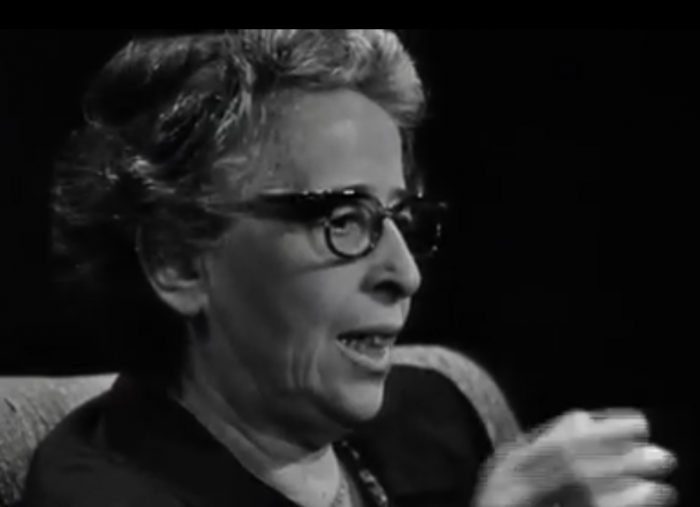
Unsettling historical parallels between the newly-developing world order and the terrors that scourged Europe in the 1930s and 40s now seem undeniable to most informed observers of contemporary geopolitics. Europeans have their own political crises to weather, but all eyes currently seem trained on the military behemoth that is my own country. “These are not normal times,” admits Jane Chong at Lawfare. Though she critiques Nazi comparisons as needlessly alarmist, she “sees no reason for optimism.” While references to history’s greatest villain abound, we’ve also seen Australian scientist Alan Finkel compare the U.S. leader to Joseph Stalin for the suppression and censorship of environmental data.
The devastation Hitler and Stalin visited upon Western and Eastern Europe can hardly be overstated—and we still find it nearly impossible to comprehend. But not soon after the end of World War II, one of the 20th century’s most probing analysts of political thought attempted to do just that.
Hannah Arendt’s 1951 The Origins of Totalitarianism remains one of “several seminal works on tyranny and oppression that have recently gained popularity among readers,” notes Alison Griswold at Quartz. And Arendt’s 1963 classic Eichmann in Jerusalem also continues to inform the moment, offering a “sobering reflection,” writes Maria Popova, on what Arendt called “the fearsome, word-and-thought-defying banality of evil.”
Arendt’s renewed relevance recently prompted Melvyn Bragg, host of the excellent BBC Radio program In Our Time, to bring three guest philosophy professors—Robert Eaglestone, Frisbee Sheffield, and Lyndsey Stonebridge—on air to discuss her ideas and influence. Bragg begins with a brief outline of Arendt’s biography, then turns to Sheffield, a lecturer at Girton College, Cambridge, for elaboration. They immediately address one of the most controversial aspects of Arendt’s young life, her affair with her mentor, Martin Heidegger, who joined the Nazi party and remained a true believer in its ideology.
But the conversation quickly moves on from there to encompass Arendt’s multi-dimensional thought. “There’s a great range to her writings,” says Sheffield. A trained classicist, Arendt wrote her dissertation on the idea of love in St. Augustine. Her most philosophical work, The Human Condition, drew on classical concepts to rank human activity into a hierarchy of labor, work, and action. She “wrote on a great range of topics,” Sheffield notes, though “there is a consistent interest in politics and political themes throughout her work.”
Yet Arendt rejected the label of political philosopher and is herself “hard to pin down” politically. Her 1963 book On Revolution, critiqued leftist and Marxist thought and praised the American Revolution for its constitutionalism. She was skeptical of the notion of universal human rights, and her essay On Violence made the argument that violence appears only in the absence of political power, not its ascendency. As we learn from listening to Bragg’s assembled panel of guests, Arendt consistently emphasized two classical concepts: the value of a civic and political order and the importance of the “life of the mind,” also the title of a two-volume work published posthumously in 1978.
In Our Time’s short, lively conversation provides an excellent introduction to Arendt’s life and work. To dive more deeply into the Arendt corpus, visit Bard College’s Hannah Arendt Center for Politics and Humanities, browse the Library of Congress’s Hannah Arendt Papers, and read Lyndsey Stonebridge’s short online essay “Hannah Arendt’s Refugee History.” You’ll also find an extensive reading list of primary and secondary sources at the In Our Time BBC page.
Related Content:
Hannah Arendt Discusses Philosophy, Politics & Eichmann in Rare 1964 TV Interview
Hannah Arendt’s Original Articles on “the Banality of Evil” in the New Yorker Archive
Josh Jones is a writer and musician based in Durham, NC. Follow him at @jdmagness
Read More...20,000 Letters, Manuscripts & Artifacts From Sigmund Freud Get Digitized and Made Available Online
In his introduction to the 2010 essay collection Freud and Fundamentalism, Stathis Gourgouris defines fundamentalism as “thought that disavows multiplicities of meaning, abhors allegorical elements, and strives toward an exclusionary orthodoxy.” While there may be both religious and secular versions of such ideologies worldwide, we can trace the word itself to an Evangelical movement in the U.S., and to a set of beliefs that endures today among around a third of all Americans and has “animated America’s culture wars for over eighty years,” writes David Adams. The fundamentalist movement first took shape in 1920, just as Sigmund Freud wrote and published his Beyond the Pleasure Principle.
It was in that book that Freud introduced the concept of the “death drive.” Adams argues that “the ‘fundamentalist’ and the ‘death drive,’ are twins: they came into being simultaneously,” and “their simultaneity is not merely an accident. Both of these concepts are responding to the profound cultural and psychological crisis resulting from the First World War.” Every calamity since World War I has seemed to reanimate that early 20th century struggle between modernism—with its pluralist values and emphasis on creativity and experiment—and fundamentalism, with its compulsion for rigid hierarchy and destruction. And we might see, as Adams does, such cultural conflicts as analogous to those Freud wrote of between Eros—the pleasure principle—and the drive toward death.
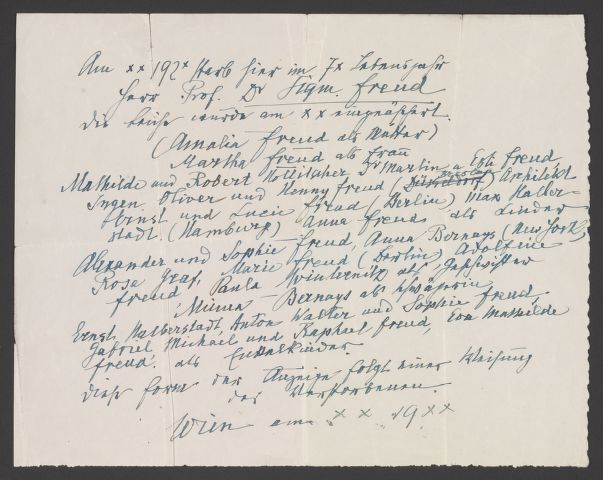
The Great War turned Freud’s thoughts in this direction, as did the racism and anti-Semitism taking hold in both Europe and the U.S. His theory of an instinctual drive toward the destruction of self and others seemed to anticipate the horror of the World War yet to come. Freud integrated the concept into his social theory ten years later in Civilization and its Discontents, in which he wrote that “the inclination to aggression” was “the greatest impediment to civilization.” While meditating on the death instinct as a psychoanalytic and social concept, Freud also pondered his own mortality. Just above, you can see the draft of a death notice that he wrote for himself during the 1920s. This comes to us from the Library of Congress’s new collection of Sigmund Freud papers, which contains artifacts and manuscripts dating from the 6th century B.C.E. (a Greek statue) to correspondence discovered in the late 90s.
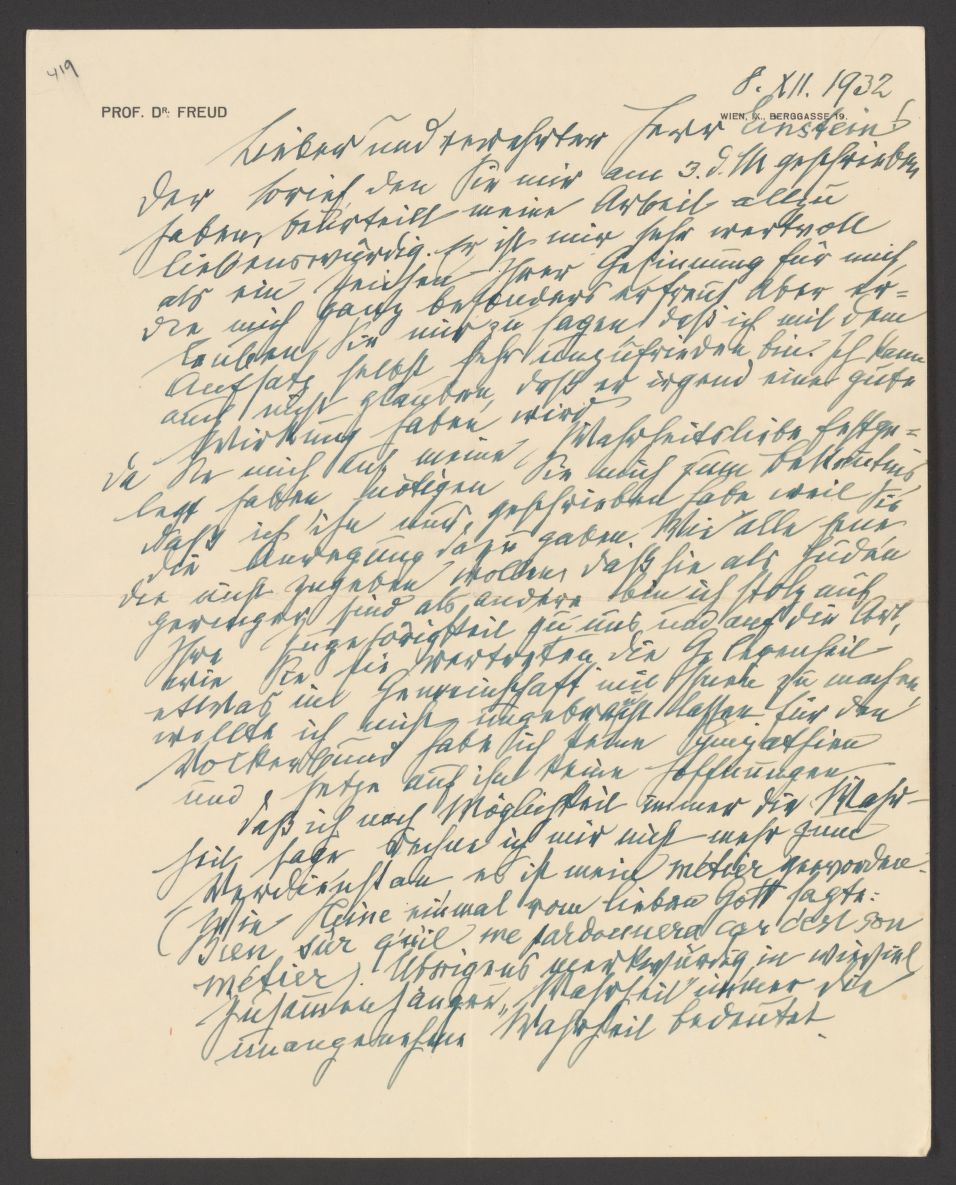
The “bulk of the material,” writes the LoC, dates “from 1891 to 1939,” and the “digitized collection documents Freud’s founding of psychoanalysis, the maturation of psychoanalytic theory, the refinement of its clinical technique, and the proliferation of its adherents and critics.” Much of this archive may be of interest only to the specialist scholar of Freud’s life and work, with “legal documents, estate records… school records” of the Freud children, and other mundane bureaucratic paperwork. But there are also letters representing “nearly six hundred correspondents,” such as Freud’s onetime protégé Carl Jung and Albert Einstein, with whom Freud corresponded in 1932 on the subject of “Why war?” (See Freud’s letter to Einstein above.)
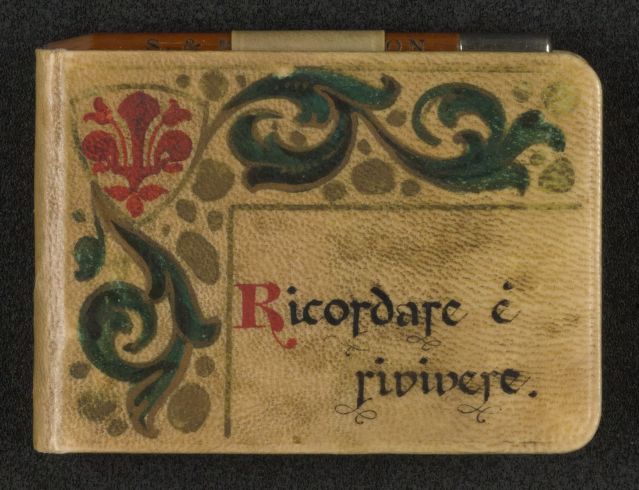
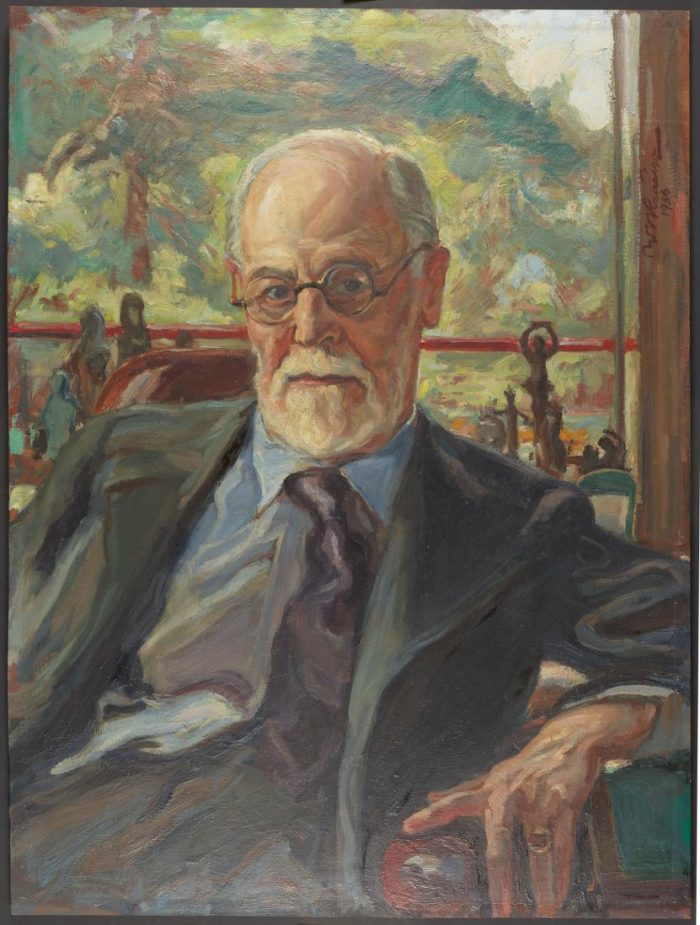
The documents are nearly all in German and the handwritten letters, notes, and drafts will be difficult to read even for speakers of the language. Yet, there are also artifacts like the 1936 portrait of Freud at the top, by Victor Krausz, the pocket notebook Freud carried between 1907 and 1908, just above, and—below—a picture of a pocket watch given to Freud by physician Max Schur, whose family left Austria with Freud’s in 1938. You can browse the online collection of over 20,000 items by date, name, location, and other indices, and all images are downloadable in high resolution scans.

Related Content:
Sigmund Freud Speaks: The Only Known Recording of His Voice, 1938
The Famous Letter Where Freud Breaks His Relationship with Jung (1913)
Josh Jones is a writer and musician based in Durham, NC. Follow him at @jdmagness
Read More...Hannah Arendt on “Personal Responsibility Under Dictatorship:” Better to Suffer Than Collaborate

Image by Bernd Schwabe, via Wikimedia Commons
When Eichmann in Jerusalem—Hannah Arendt’s book about Nazi officer Adolf Eichmann’s trial—came out in 1963, it contributed one of the most famous of post-war ideas to the discourse, the “banality of evil.” And the concept at first caused a critical furor. “Enormous controversy centered on what Arendt had written about the conduct of the trial, her depiction of Eichmann, and her discussion of the role of the Jewish Councils,” writes Michael Ezra at Dissent magazine “Eichmann, she claimed, was not a ‘monster’; instead, she suspected, he was a ‘clown.’”
Arendt blamed victims who were forced to collaborate, critics charged, and made the Nazi officer seem ordinary and unremarkable, relieving him of the extreme moral weight of his responsibility. She answered these charges in an essay titled “Personal Responsibility Under Dictatorship,” published in 1964. Here, she aims to clarify the question in her title by arguing that if Eichmann were allowed to represent a monstrous and inhuman system, rather than shockingly ordinary human beings, his conviction would make him a scapegoat and let others off the hook. Instead, she believes that everyone who worked for the regime, whatever their motives, is complicit and morally culpable.
But although most people are culpable of great moral crimes, those who collaborated were not, in fact, criminals. On the contrary, they chose to follow the rules in a demonstrably criminal regime. It’s a nuance that becomes a stark moral challenge. Arendt points out that everyone who served the regime agreed to degrees of violence when they had other options, even if those might be fatal. Quoting Mary McCarthy, she writes, “If somebody points a gun at you and says, ‘Kill your friend or I will kill you,’ he is tempting you, that is all.”
While this circumstance may provide a “legal excuse,” for killing, Arendt seeks to define a “moral issue,” a Socratic principle she had “taken for granted” that we all believed: “It is better to suffer than do wrong,” even when doing wrong is the law. People like Eichmann were not criminals and psychopaths, Arendt argued, but rule-followers protected by social privilege. “It was precisely the members of respectable society,” she writes, “who had not been touched by the intellectual and moral upheaval in the early stages of the Nazi period, who were the first to yield. They simply exchanged one system of values against another,” without reflecting on the morality of the entire new system.
Those who refused, on the other hand, who even “chose to die,” rather than kill, did not have “highly developed intelligence or sophistication in moral matters.” But they were critical thinkers practicing what Socrates called a “silent dialogue between me and myself,” and they refused to face a future where they would have to live with themselves after committing or enabling atrocities. We must remember, Arendt writes, that “whatever else happens, as long as we live we shall have to live together with ourselves.”
Such refusals to participate might be small and private and seemingly ineffectual, but in large enough numbers, they would matter. “All governments,” Arendt writes, quoting James Madison, “rest on consent,” rather than abject obedience. Without the consent of government and corporate employees, the “leader… would be helpless.” Arendt admits the unlikely effectiveness of active opposition to a one-party authoritarian state. And yet when people feel most powerless, most under duress, she writes, an honest “admission of one’s own impotence” can give us “a last remnant of strength” to refuse.
We have only for a moment to imagine what would happen to any of these forms of government if enough people would act “irresponsibly” and refuse support, even without active resistance and rebellion, to see how effective a weapon this could be. It is in fact one of the many variations of nonviolent action and resistance—for instance the power that is potential in civil disobedience.
We have example after example of these kinds of refusals to participate in a murderous system or further its aims. Arendt was aware these actions can come at great cost. The alternatives, she argues, may be far worse.
Related Content:
Hannah Arendt’s Original Articles on “the Banality of Evil” in the New Yorker Archive
Henry David Thoreau on When Civil Disobedience and Resistance Are Justified (1849)
Josh Jones is a writer and musician based in Durham, NC. Follow him at @jdmagness
Read More...“Calling Bullshit”: See the Syllabus for a College Course Designed to Identify & Combat Bullshit
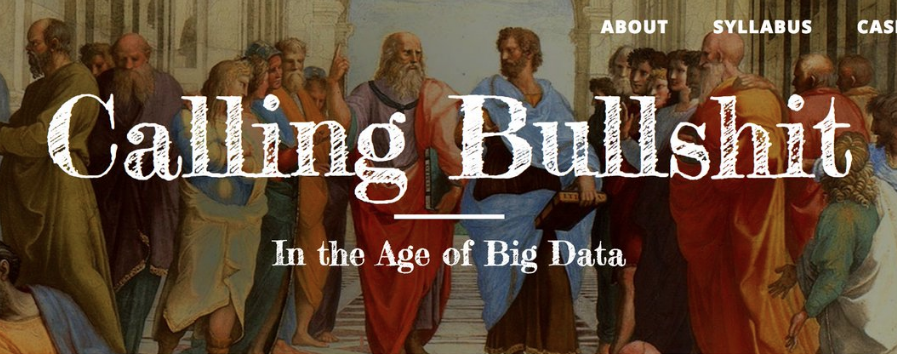
Two professors at the University of Washington, Carl Bergstrom and Jevin West, have created a website meant to accompany a potential college seminar entitled “Calling Bullshit.” Here’s how Bergstrom and West explain the premise of their course. It’s worth quoting them at length.
The world is awash in bullshit. Politicians are unconstrained by facts. Science is conducted by press release. Higher education rewards bullshit over analytic thought. Startup culture elevates bullshit to high art. Advertisers wink conspiratorially and invite us to join them in seeing through all the bullshit — and take advantage of our lowered guard to bombard us with bullshit of the second order. The majority of administrative activity, whether in private business or the public sphere, seems to be little more than a sophisticated exercise in the combinatorial reassembly of bullshit.
We’re sick of it. It’s time to do something, and as educators, one constructive thing we know how to do is to teach people. So, the aim of this course is to help students navigate the bullshit-rich modern environment by identifying bullshit, seeing through it, and combating it with effective analysis and argument.
What do we mean, exactly, by the term bullshit? As a first approximation, bullshit is language, statistical figures, data graphics, and other forms of presentation intended to persuade by impressing and overwhelming a reader or listener, with a blatant disregard for truth and logical coherence.
While bullshit may reach its apogee in the political domain, this is not a course on political bullshit. Instead, we will focus on bullshit that comes clad in the trappings of scholarly discourse. Traditionally, such highbrow nonsense has come couched in big words and fancy rhetoric, but more and more we see it presented instead in the guise of big data and fancy algorithms — and these quantitative, statistical, and computational forms of bullshit are those that we will be addressing in the present course.…
Our aim in this course is to teach you how to think critically about the data and models that constitute evidence in the social and natural sciences.
The “Calling Bullshit” course would sit nicely alongside the work of Princeton philosopher Harry Frankfurt, the author of the fairly recent book, On Bullshit. (In fact, On Bullshit would be read during Week 1 of the “Calling Bullshit“course. See the syllabus here.) There’s a lot of bullshit freely flowing through our world, and it may well take a cross-disciplinary team to help us cut through the crap.
To learn more about the envisioned Calling Bullshit course, visit Bergstrom and West’s website, where they have an FAQ that explains what a study of bullshit might look like.
Update: You can now view the lectures for the course here.
Note: You can download Harry Frankfurt’s “On Bullshit” as a free audiobook (or any other two free audiobooks) if you sign up for Audible.com’s free trial program. Learn more about Audible’s free trial program here.
If you would like to support the mission of Open Culture, consider making a donation to our site. It’s hard to rely 100% on ads, and your contributions will help us continue providing the best free cultural and educational materials to learners everywhere. You can contribute through PayPal, Patreon, and Venmo (@openculture). Thanks!
Related Content:
How to Spot Bullshit: A Primer by Princeton Philosopher Harry Frankfurt
1,700 Free Online Courses from Top Universities
Read More...A Free Online Course on Dante’s Divine Comedy from Yale University
Over the years, we’ve featured the many drawings that have adorned the pages of Dante’s Divine Comedy, from medieval times to modern. Illustrations by Botticelli, Gustave Doré, William Blake and Mœbius, they’ve all gotten their due. Less has been said here, however, about the actual text itself. Perhaps the most important work in Italian literature, Dante Alighieri (1265–1321) wrote the Divine Comedy (consisting of Inferno, Purgatorio, and Paradiso) between the years 1308 and 1320. And that text is largely the subject of Dante in Translation, a free online course taught by Yale’s Giuseppe Mazzotta. The course description reads as follows:
The course is an introduction to Dante and his cultural milieu through a critical reading of the Divine Comedy and selected minor works (Vita nuova, Convivio, De vulgari eloquentia, Epistle to Cangrande). An analysis of Dante’s autobiography, the Vita nuova, establishes the poetic and political circumstances of the Comedy’s composition. Readings of Inferno, Purgatory and Paradise seek to situate Dante’s work within the intellectual and social context of the late Middle Ages, with special attention paid to political, philosophical and theological concerns. Topics in the Divine Comedy explored over the course of the semester include the relationship between ethics and aesthetics; love and knowledge; and exile and history.
You can watch the 24 lectures from the course above, or find them on YouTube and iTunes in video and audio formats. To get more information on the course, including the syllabus, visit this Yale website.
Primary texts used in this course include:
- Dante. Divine Comedy. Translated by John D. Sinclair. New York: Oxford University Press, 1968.
- Dante. Vita Nuova. Translated by Mark Musa. Bloomington: Indiana University Press, 1973.
Dante in Translation will be added to our list of Free Online Literature courses, a subset of our collection, 1,700 Free Online Courses from Top Universities.
If you would like to support the mission of Open Culture, consider making a donation to our site. It’s hard to rely 100% on ads, and your contributions will help us continue providing the best free cultural and educational materials to learners everywhere. You can contribute through PayPal, Patreon, and Venmo (@openculture). Thanks!
Related Content:
Dante’s Divine Comedy: A Free Course from Columbia University
William Blake’s Last Work: Illustrations for Dante’s Divine Comedy (1827)
Botticelli’s 92 Illustrations of Dante’s Divine Comedy
Alberto Martini’s Haunting Illustrations of Dante’s Divine Comedy (1901–1944)
Hear Dante’s Inferno Read Aloud by Influential Poet & Translator John Ciardi (1954)
Physics from Hell: How Dante’s Inferno Inspired Galileo’s Physics
Read More...An Introduction to Hegel’s Philosophy of History: The Road to Progress Runs First Through Dark Times
The question of whether or not genuine human progress is possible, or desirable, lies at the heart of many a radical post-Enlightenment philosophical project. More pessimistic philosophers have, unsurprisingly, doubted it. Arthur Schopenhauer, cast baleful suspicion on the idea. Danish Existentialist Soren Kierkegaard thought of collective progress toward a more enlightened state an unlikely prospect. One modern critic of progress, pessimistic English philosopher John Gray, writes in his book Straw Dogs that “the pursuit of progress” is an idealist illusion ending in “mass murder.” (Gray has been unimpressed by Steven Pinker’s optimistic arguments in The Better Angels of Our Nature.)
These skeptics of progress all in some way write in response to the towering 19th century figure G.W.F. Hegel, the German logician and philosopher of history, politics, and phenomenology whose systematic thinking provided Karl Marx with the basis of his dialectical materialism. Hegel saw the mass murder brought about by massive political and economic change in his revolutionary and imperial age, but in his estimation, such man-made disasters were necessary occurrences, the “slaughter bench of history,” as he famously wrote in the Philosophy of History.
This suggests a very brutal view, and yet Hegel believed overall that “Reason is the Sovereign of the World; that the history of the world therefore, presents us with a rational process.” For Hegel, the individual personality was not important, only collective entities: peoples, states, empires. These moved against each other according to a metaphysical reasoning process working through history which Hegel called the dialectic. In his animated School of Life video above, Alain de Botton describes the dialectic in the terms we usually use—thesis, antithesis, synthesis—though Hegel himself did not exactly formulate the principle this way.
This is the common shorthand way of understanding how Hegel’s nonlinear explanation of history works: “the world makes progress,” summarizes de Botton, “by lurching from one extreme to the other, as it seeks to overcompensate for a previous mistake, and generally requires three moves before the right balance on any issue can be found.” One particularly bloody example is the terror of the French Revolution as an extreme corrective for the monarchy’s oppression. This gave way to the antithesis, the brutal autocratic empire of Napoleon in another extreme swing. Only decades later could these be reconciled in modern French civil society.
In our own time, we have encountered the progressive ideas of Hegel not only through Marx, but through the work of Martin Luther King, Jr., who studied Hegel as a graduate student at Harvard and Boston University and found much inspiration in the Philosophy of History. Though critical of Hegel’s idealism, which, “tended to swallow up the many in the one,” King discovered important first principles there as well: “His analysis of the dialectical process, in spite of its shortcomings, helped me to see that growth comes through struggle.”
We endlessly quote King’s statement, “the arc of history is long, but it bends toward justice,” but we forget his corresponding emphasis on the necessity of struggle to achieve the goal. As Hegel theorized, says de Botton above, “the dark moments aren’t the end, they are a challenging but in some ways necessary part… imminently compatible with events broadly moving forward in the right direction.” King found his own historical synthesis in the principle of nonviolent resistance, which “seeks to reconcile the truths of two opposites,” he wrote in 1954’s Stride Toward Freedom, “acquiescence and violence.” Nonviolent resistance is not passive compliance, but neither is it intentional aggression.
Hegel and his socially influential students like Martin Luther King and John Dewey have generally operated on the basis of some faith—in reason, divine justice, or secular humanism. There are much harsher, more pessimistic ways of viewing history than as a swinging pendulum moving toward some greater end. Pessimistic thinkers may be more rigorously honest about the staggering moral challenge posed by increasingly efficient means of mass killing and the perpetuation of ideologies that commit it. Yet it is partly through the influence of Hegel that modern social movements have embraced the necessity of struggle and believed progress was possible, even inevitable, when it seemed least likely to occur.
Related Content:
How Martin Luther King, Jr. Used Hegel, Kant & Nietzsche to Overturn Segregation in America
Josh Jones is a writer and musician based in Durham, NC. Follow him at @jdmagness
Read More...20 Lessons from the 20th Century About How to Defend Democracy from Authoritarianism, According to Yale Historian Timothy Snyder
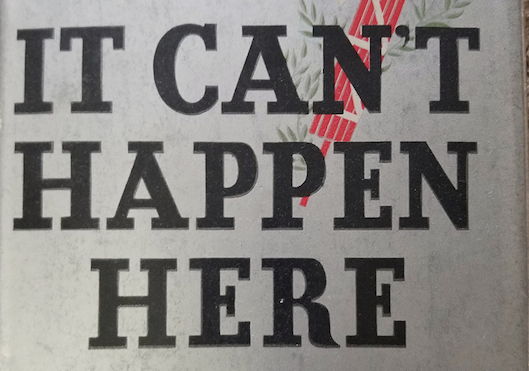
Image by Rob Kall, via Flickr Commons
Timothy Snyder, Housum Professor of History at Yale University, is one of the foremost scholars in the U.S. and Europe on the rise and fall of totalitarianism during the 1930s and 40s. Among his long list of appointments and publications, he has won multiple awards for his recent international bestsellers Bloodlands: Europe between Hitler and Stalin and last year’s Black Earth: The Holocaust as History and Warning. That book in part makes the argument that Nazism wasn’t only a German nationalist movement but had global colonialist origins—in Russia, Africa, and in the U.S., the nation that pioneered so many methods of human extermination, racist dehumanization, and ideologically-justified land grabs.
The hyper-capitalism portrayed in the U.S.—even during the Depression—Snyder writes, fueled Hitler’s imagination, such that he promised Germans “a life comparable to that of the American people,” whose “racially pure and uncorrupted” German population he described as “world class.” Snyder describes Hitler’s ideology as a myth of racialist struggle in which “there are really no values in the world except for the stark reality that we are born in order to take things from other people.” Or as we often hear these days, that acting in accordance with this principle is the “smart” thing to do. Like many far right figures before and after, Hitler aimed to restore a state of nature that for him was a perpetual state of race war for imperial dominance.
After the November election, Snyder wrote a profile of Hitler, a short piece that made no direct comparisons to any contemporary figure. But reading the facts of the historical case alarmed most readers. A few days later, the historian appeared on a Slate podcast to discuss the article, saying that after he submitted it, “I realized there was more.… there are an awful lot of echoes.” Snyder admits that history doesn’t actually repeat itself. But we’re far too quick, he says, to dismiss that idea as a cliché “and not think about history at all. History shows a range of possibilities.” Similar events occur across time under similar kinds of conditions. And it is, of course, possible to learn from the past.
If you’ve heard other informed analysis but haven’t read Snyder’s New York Review of Books columns on fascism in Putin’s Russia or the former Yanukovich’s Ukraine, or his long article “Hitler’s World May Not Be So Far Away,” you may have seen his widely-shared Facebook post making the rounds. As he argued in The Guardian last September, today we may be “too certain we are ethically superior to the Europeans of the 1940s.” On November, 15, Snyder wrote on Facebook that “Americans are no wiser than the Europeans who saw democracy yield to fascism, Nazism, or communism.” Snyder has been criticized for conflating these regimes, and rising “into the top rungs of punditdom,” but when it comes to body counts and levels of suppressive malignancy, it’s hard to argue that Stalinist Russia, any more than Tsarist Russia, was anyone’s idea of a democracy.
Rather than making a historical case for viewing the U.S. as exactly like one of the totalitarian regimes of WWII Europe, Snyder presents 20 lessons we might learn from those times and use creatively in our own where they apply. In my view, following his suggestions would make us wiser, more self-aware, proactive, responsible citizens, whatever lies ahead. Read Snyder’s lessons from his Facebook post below and consider ordering his latest book On Tyranny: Twenty Lessons from the Twentieth Century:
1. Do not obey in advance. Much of the power of authoritarianism is freely given. In times like these, individuals think ahead about what a more repressive government will want, and then start to do it without being asked. You’ve already done this, haven’t you? Stop. Anticipatory obedience teaches authorities what is possible and accelerates unfreedom.
2. Defend an institution. Follow the courts or the media, or a court or a newspaper. Do not speak of “our institutions” unless you are making them yours by acting on their behalf. Institutions don’t protect themselves. They go down like dominoes unless each is defended from the beginning.
3. Recall professional ethics. When the leaders of state set a negative example, professional commitments to just practice become much more important. It is hard to break a rule-of-law state without lawyers, and it is hard to have show trials without judges.
4. When listening to politicians, distinguish certain words. Look out for the expansive use of “terrorism” and “extremism.” Be alive to the fatal notions of “exception” and “emergency.” Be angry about the treacherous use of patriotic vocabulary.
5. Be calm when the unthinkable arrives. When the terrorist attack comes, remember that all authoritarians at all times either await or plan such events in order to consolidate power. Think of the Reichstag fire. The sudden disaster that requires the end of the balance of power, the end of opposition parties, and so on, is the oldest trick in the Hitlerian book. Don’t fall for it.
6. Be kind to our language. Avoid pronouncing the phrases everyone else does. Think up your own way of speaking, even if only to convey that thing you think everyone is saying. (Don’t use the internet before bed. Charge your gadgets away from your bedroom, and read.) What to read? Perhaps “The Power of the Powerless” by Václav Havel, 1984 by George Orwell, The Captive Mind by Czesław Milosz, The Rebel by Albert Camus, The Origins of Totalitarianism by Hannah Arendt, or Nothing is True and Everything is Possible by Peter Pomerantsev.
7. Stand out. Someone has to. It is easy, in words and deeds, to follow along. It can feel strange to do or say something different. But without that unease, there is no freedom. And the moment you set an example, the spell of the status quo is broken, and others will follow.
8. Believe in truth. To abandon facts is to abandon freedom. If nothing is true, then no one can criticize power, because there is no basis upon which to do so. If nothing is true, then all is spectacle. The biggest wallet pays for the most blinding lights.
9. Investigate. Figure things out for yourself. Spend more time with long articles. Subsidize investigative journalism by subscribing to print media. Realize that some of what is on your screen is there to harm you. Learn about sites that investigate foreign propaganda pushes.
10. Practice corporeal politics. Power wants your body softening in your chair and your emotions dissipating on the screen. Get outside. Put your body in unfamiliar places with unfamiliar people. Make new friends and march with them.
11. Make eye contact and small talk. This is not just polite. It is a way to stay in touch with your surroundings, break down unnecessary social barriers, and come to understand whom you should and should not trust. If we enter a culture of denunciation, you will want to know the psychological landscape of your daily life.
12. Take responsibility for the face of the world. Notice the swastikas and the other signs of hate. Do not look away and do not get used to them. Remove them yourself and set an example for others to do so.
13. Hinder the one-party state. The parties that took over states were once something else. They exploited a historical moment to make political life impossible for their rivals. Vote in local and state elections while you can.
14. Give regularly to good causes, if you can. Pick a charity and set up autopay. Then you will know that you have made a free choice that is supporting civil society helping others doing something good.
15. Establish a private life. Nastier rulers will use what they know about you to push you around. Scrub your computer of malware. Remember that email is skywriting. Consider using alternative forms of the internet, or simply using it less. Have personal exchanges in person. For the same reason, resolve any legal trouble. Authoritarianism works as a blackmail state, looking for the hook on which to hang you. Try not to have too many hooks.
16. Learn from others in other countries. Keep up your friendships abroad, or make new friends abroad. The present difficulties here are an element of a general trend. And no country is going to find a solution by itself. Make sure you and your family have passports.
17. Watch out for the paramilitaries. When the men with guns who have always claimed to be against the system start wearing uniforms and marching around with torches and pictures of a Leader, the end is nigh. When the pro-Leader paramilitary and the official police and military intermingle, the game is over.
18. Be reflective if you must be armed. If you carry a weapon in public service, God bless you and keep you. But know that evils of the past involved policemen and soldiers finding themselves, one day, doing irregular things. Be ready to say no. (If you do not know what this means, contact the United States Holocaust Memorial Museum and ask about training in professional ethics.)
19. Be as courageous as you can. If none of us is prepared to die for freedom, then all of us will die in unfreedom.
20. Be a patriot. The incoming president is not. Set a good example of what America means for the generations to come. They will need it.
Related Content:
Umberto Eco Makes a List of the 14 Common Features of Fascism
George Orwell’s Final Warning: Don’t Let This Nightmare Situation Happen. It Depends on You!
Josh Jones is a writer and musician based in Durham, NC. Follow him at @jdmagness
Read More...Support Us
We're hoping to rely on loyal readers, rather than erratic ads. Please click the Donate button and support Open Culture. You can use Paypal, Venmo, Patreon, even Crypto! We thank you!

About Us

Open Culture scours the web for the best educational media. We find the free courses and audio books you need, the language lessons & educational videos you want, and plenty of enlightenment in between.
Advertise With Us
FREE UPDATES!
GET OUR DAILY EMAIL
Get the best cultural and educational resources on the web curated for you in a daily email. We never spam. Unsubscribe at any time.
FOLLOW ON SOCIAL MEDIA
Open Culture editor Dan Colman scours the web for the best educational media. He finds the free courses and audio books you need, the language lessons & movies you want, and plenty of enlightenment in between.
Advertise With Us


