What Did the Voice of Neanderthals, Our Distant Cousins, Sound Like?: Scientists Demonstrate Their “High Pitch” Theory
Scholars have made informed, educated guesses at what Shakespeare sounded like in the original pronunciation. The same applies to what Old Norse sounded like from the 9th through the 13th centuries. And even to Beowulf read in Old English, Homer’s Odyssey read in the original Ancient Greek, and The Epic of Gilgamesh read in Akkadian.
But could we push back much further in time? How about 40,000 years into deep history when our close cousins, the Neanderthals, populated the planet?
Above, you can watch a segment of a BBC documentary, Neanderthal: The Rebirth, where a team of scientists “examine the first full skeleton of a neanderthal ever to be discovered and uncover insights into the most likely sound our primitive cousins would have made.” Anatomists, biometric specialists, paleoanthropologists, and vocal experts–they all worked together to analyze the Neanderthal’s vocal apparatus and came to this conclusion: Homo neanderthalensis likely had a surprisingly high-pitched voice (the original High Pitch). It’s on display above.
If you would like to support the mission of Open Culture, consider making a donation to our site. It’s hard to rely 100% on ads, and your contributions will help us continue providing the best free cultural and educational materials to learners everywhere. You can contribute through PayPal, Patreon, and Venmo (@openculture). Thanks!
Related Content:
What Ancient Greek Music Sounded Like: Hear a Reconstruction That is ‘100% Accurate’
Hear What Shakespeare Sounded Like in the Original Pronunciation
Learn What Old Norse Sounded Like, with UC Berkeley’s “Cowboy Professor, Dr. Jackson Crawford
Hear What Homer’s Odyssey Sounded Like When Sung in the Original Ancient Greek
Hear Beowulf Read In the Original Old English: How Many Words Do You Recognize?
Hear The Epic of Gilgamesh Read in the Original Akkadian and Enjoy the Sounds of Mesopotamia
Read More...How Filmmakers Like Kubrick, Jodorowsky, Tarantino, Coppola & Miyazaki Use Color to Tell Their Stories
Once upon a time, a film could impress simply by using color at all. Now, with a wider field of visual possibilities open to cinema than ever, filmmakers must not simply use color but master it, actively, as a way of conveying emotions, ideas, and even more besides. Channel Criswell’s Lewis Bond, who describes color as his “favorite aspect of visual storytelling,” breaks down some of the main ways filmmakers have used it so far in his video essay on color in cinema.
“Since before we were even able to actualize sound in film, we’ve been obsessed with color,” Bond says, having shown us clips drawn from the work of Stanley Kubrick, Alejandro Jodorowsky, Hayao Miyazaki, Ang Lee, and other directors known for their visually lush pictures.
“Film has always been about the visual, and the primordial age of cinema displays the lengths we were willing to go to just to capture its essence.” Then came Technicolor: when Dorothy passed into the land of Oz, “we became completely free to use color however we wanted, and artists began to understand the disciplines of aesthetics and symbolism.”
Yet “the methods of the silent era,” a time when filmmakers had to hand-tint each black-and-white frame they shot with the properly evocative color, “have held through to the 21st century.” Red, perhaps the strongest color, signals “hate and cruelty” just as forcefully as it does “passion and love.” And while “a luscious green field gives us hope and shows us fertility,” other green locations “show the mundane and lifeless, and the green on a person” — again, The Wizard of Oz provides the go-to example — “tells us who the monster is.”
Bond finds traditions in the use of color that connect the films of the classic era to those of modern masters like the apparently color-obsessed Wes Anderson, whose use of non-contrasting greens, browns, and yellows in Moonrise Kingdom “suits the film’s nostalgic tone,” and who fills The Royal Tenenbaums and The Grand Budapest Hotel of pinks and beiges in order not to pile on emotional weight, but to reduce it, to tell us not to take the events of the story too seriously.
Quentin Tarantino, a fan of both the subtle and the unsubtle, uses color in a variety of ways, from the codenames of the thieves in Reservoir Dogs to the bright yellow track suit (itself a tribute to the films of Bruce Lee) worn by the protagonist of Kill Bill. In Apocalypse Now, subject of another Channel Criswell essay recently featured here on Open Culture, Francis Ford Coppola and cinematographer Vittorio Storaro “used a balanced color scheme in kurtz’s compound, but the orange mist gave a feeling of toxicity in the air.”
In Bernardo Bertolucci’s The Last Emperor, “as the character discovers more about the world around him, the color palette shifts. The world of tradition and the character’s naiveté is displayed by the world of red. However, as the character begins to learn more, the color goes from red to orange, yellow, and finally, once he becomes fully comprehensive of his surroundings, he’s bounded to green.” And so, by the end of the movie, “both the character and the wheel have turned 180 degrees.” Bond means the color wheel, a circular diagram of the colors first developed by Isaac Newton and still central to color theory.
If cinephiles give that subject a little study, they’ll see how their favorite films tell stories in a more, well, vivid way. No matter how many times you’ve seen Vertigo, for example, a working knowledge of color will help you appreciate exactly why it has such an impact when Scottie first sees Madeleine in a green dress surrounded by a field of red. Alfred Hitchcock’s masterpiece stands, of course, as one of the most effective cinematic examples of color as a storytelling device. Should any filmmaker working today bother trying to top it? Bond quotes cinematographer Roger Deakins as saying “that it’s easy to make color look good, but harder to make it service a story. He’s probably right, but let’s try and prove him wrong.”
Related Content:
“Bleu, Blanc, Rouge”: a Striking Supercut of the Vivid Colors in Jean-Luc Godard’s 1960s Films
Wes Anderson Likes the Color Red (and Yellow)
Stanley Kubrick’s Obsession with the Color Red: A Supercut
Early Experiments in Color Film (1895–1935)
Based in Seoul, Colin Marshall writes and broadcasts on cities and culture. He’s at work on a book about Los Angeles, A Los Angeles Primer, the video series The City in Cinema, the crowdfunded journalism project Where Is the City of the Future?, and the Los Angeles Review of Books’ Korea Blog. Follow him on Twitter at @colinmarshall or on Facebook.
Read More...How Did Beethoven Compose His 9th Symphony After He Went Completely Deaf?
You don’t need to know anything at all about classical music, nor have any liking for it even, to be deeply moved by that most famous of symphonies, Ludwig van Beethoven’s 9th—“perhaps the most iconic work of the Western musical tradition,” writes The Juilliard Journal in an article about its handwritten score. Commissioned in 1817, the sublime work was only completed in 1824. By that time, its composer was completely and totally deaf. At the first performance, Beethoven did not notice that the massive final choral movement had ended, and one of the musicians had to turn him around to acknowledge the audience.
This may seem, says researcher Natalya St. Clair in the TED-Ed video above, like some “cruel joke,” but it’s the truth. Beethoven was so deaf that some of the most interesting artifacts he left behind are the so-called “conversation books,” kept from 1818 onward to communicate with visitors who had to write down their questions and replies. How then might it have been possible for the composer to create such enduringly thrilling, rapturous works of aural art?
Using the delicate, melancholy “Moonlight Sonata” (which the composer wrote in 1801, when he could still hear), St. Clair attempts to show us how Beethoven used mathematical “patterns hidden beneath the beautiful sounds.” (In the short video below from documentary The Genius of Beethoven, see the onset of Beethoven’s hearing loss in a dramatic reading of his letters.) According to St. Clair’s theory, Beethoven composed by observing “the mathematical relationship between the pitch frequency of different notes,” though he did not write his symphonies in calculus. It’s left rather unclear how the composer’s supposed intuition of mathematics and pitch corresponds with his ability to express such a range of emotions through music.
We can learn more about Beethoven’s deafness and its biological relationship to his compositional style in the short video below with research fellow Edoardo Saccenti and his colleague Age Smilde from the Biosystems Data Analysis Group at Amsterdam’s Swammerdam Institute for Life Sciences. By counting the high and low frequencies in Beethoven’s complete string quartets, a task that took Saccenti many weeks, he and his team were able to show how three distinct compositional styles “correspond to stages in the progression of his deafness,” as they write in their paper (which you can download in PDF here).
The progression is unusual. As his condition worsened, Beethoven included fewer and fewer high frequency sounds in his compositions (giving cellists much more to do). By the time we get to 1824–26, “the years of the late string quartets and of complete deafness”—and of the completion of the 9th—the high notes have returned, due in part, Smilde says, to “the balance between an auditory feedback and the inner ear.” Beethoven’s reliance on his “inner ear” made his music “much and much richer.” How? As one violinist in the clip puts it, he was “given more freedom because he was not attached anymore to the physical sound, [he could] just use his imagination.”
For all of the compelling evidence presented here, whether Beethoven’s genius in his painful later years is attributable to his intuition of complex mathematical patterns or to the total free rein of his imaginative inner ear may in fact be undiscoverable. In any case, no amount of rational explanation can explain away our astonishment that the man who wrote the unfailingly powerful, awesomely dynamic “Ode to Joy” finale (conducted above by Leonard Bernstein), couldn’t actually hear any of the music.
Related Content:
Stream the Complete Works of Bach & Beethoven: 250 Free Hours of Music
Slavoj Žižek Examines the Perverse Ideology of Beethoven’s Ode to Joy
Beethoven’s Ode to Joy Played With 167 Theremins Placed Inside Matryoshka Dolls in Japan
Leonard Bernstein Conducts Beethoven’s 9th in a Classic 1979 Performance
Josh Jones is a writer and musician based in Durham, NC. Follow him at @jdmagness
Read More...An Animated Introduction to Noam Chomsky’s Manufacturing Consent and How the Media Creates the Illusion of Democracy
For nearly as many years as he’s occupied the public eye, famed linguist and anarchist philosopher Noam Chomsky has made claims that might have discredited other academics. Perhaps his many books, articles, lectures, interviews, etc. carry such weight because of his “famed linguist” status and his longtime tenure at MIT. But there’s more to his longevity as a respected critic of U.S. state power. His voice also carries significant authority because he substantiates his arguments with erudite, granular analyses of economic theory, history, and political philosophy.
We’ve seen him do exactly this in his fierce opposition to the Vietnam War at the beginning of his activist career, and in his critiques of proxy wars, imperialistic repression, and corporate resource grabs in Latin America and Southeast Asia in decades since.
When it comes to the U.S. domestic scene, one of Chomsky’s most pointed and continually relevant critiques addresses the way in which we’re led to believe the country’s actions overseas justify themselves, as well as its actions upon its own citizens. We might debate whether the U.S. is a democracy or a republic, but according to Chomsky, both notions may well be illusory.
Instead, Chomsky argues in Manufacturing Consent—his 1988 critique of “the political economy of the mass media” with Edward S. Herman—that the mass media sells us the idea that we have political agency. Their “primary function… in the United States is to mobilize support for the special interests that dominate the government and the private sector.” Those interests may have changed or evolved quite a bit since 1988, but the mechanisms of what Chomsky and Herman identify as “effective and powerful ideological institutions that carry out a system-supportive propaganda function” might work in the age of Twitter just as they did in one dominated by network and cable news.
Those mechanisms largely divide into what the authors called the “Five Filters.” The video at the top of the post, produced by Marcela Pizarro and narrated by Democracy Now’s Amy Goodman, provides a quick introduction to them, in a jarring animated sequence that’s part Monty Python, part Residents video. See the five filters listed below in brief, with excerpts from Goodman’s commentary:
1. Media Ownership—The endgame of all mass media orgs is profit. “It is in their interest to push for whatever guarantees that profit.”
2. Advertising—Media costs more than consumers will pay: Advertisers fill the gap. What do advertisers pay for? Access to audiences. “It isn’t just that the media is selling you a product. They’re also selling advertisers a product: you.”
3. Media Elite—“Journalism cannot be a check on power, because the very system encourages complicity. Governments, corporations, and big institutions know how to influence the media. They feed it scoops and interviews with supposed experts. They make themselves crucial to the process of journalism. If you want to challenge power, you’ll be pushed to the margins…. You won’t be getting in. You’ll have lost your access.”
4. Flack—“When the story is inconvenient for the powers that be, you’ll see the flack machine in action: discrediting sources, trashing stories, and diverting the conversation.”
5. The Common Enemy—“To manufacture consent, you need an enemy, a target: Communism, terrorists, immigrants… a boogeyman to fear helps corral public opinion.”
Chomsky and Herman’s book offers a surgical analysis of the ways corporate mass media “manufactures consent” for a status quo the majority of people do not actually want. Yet for all of the recent agonizing over mass media failure and complicity, we don’t often hear references to Manufacturing Consent these days. This may have something to do with the book’s dated examples, or it may testify to Chomsky’s marginalization in mainstream political discourse, though he would be the first to note that his voice has not been suppressed.
It may also be the case that media theory and criticism like Chomsky’s, or the work of Marshall McLuhan, Theodor Adorno, or Jean Baudrillard (all very different kinds of thinkers), has fallen out of favor in a 140-character world. In the late-80s and 90s, however, such theory received a good deal of attention, and Chomsky appeared in the many venues you’ll see in the short video above, excerpted from an almost 3‑hour 1992 documentary called Manufacturing Consent, a film made by “die-hard fans,” wrote Colin Marshall in an earlier post, that “curates instances of Chomsky going from interview to interview, debate to debate, forum to forum, making sharp-sounding points about the relationship between business elites and the media.”
Our desire for instant reward and settled opinion may have overtaken our ability to subject the entire phenomenon of mass media to critical analysis, as we leap from cliffhanger to cliffhanger and crisis to crisis. But should we take the time to watch this film and, preferably also, read Chomsky’s book, we may find ourselves somewhat better equipped to evaluate the onslaught of propaganda to which we’re subjected on what seems like an hourly basis.
Related Content:
Noam Chomsky Defines What It Means to Be a Truly Educated Person
Noam Chomsky & Michel Foucault Debate Human Nature & Power (1971)
Noam Chomsky Talks About How Kids Acquire Language & Ideas in an Animated Video by Michel Gondry
Josh Jones is a writer and musician based in Durham, NC. Follow him at @jdmagness
Read More...Akira Kurosawa’s Adaptation of Edgar Allan Poe’s The Masque of the Red Death Finally in Production, Coming in 2020
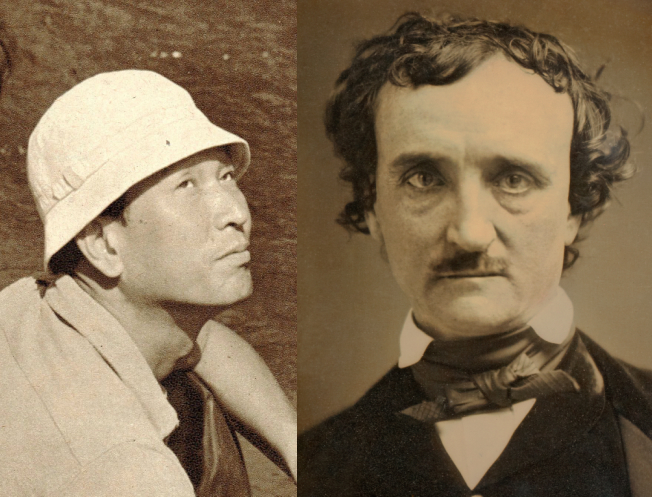
The filmmakers we most respect tend not to stop working until the very end, and so almost always leave pieces of incomplete projects behind. Stanley Kubrick did, giving Steven Spielberg the chance to pick up where his elder colleague left off on the sci-fi drama A.I.: Artificial Intelligence. That film began in the late 1970s as an adaptation of Brian Aldiss’ short story “Supertoys Last All Summer Long,” but over the decades became something more technically complex, and — given Spielberg’s involvement — more emotional. What, now, will emerge from the resurrection of Akira Kurosawa’s The Mask of the Black Death, a similarly unmade adaptation of Edgar Allan Poe’s “The Masque of the Red Death”?
“Chinese studios Huayi Brothers and CKF Pictures will produce the film based on the late Japanese filmmaker’s screenplay,” reported Indiewire’s Yoselin Acevedo last week. “He started penning the film right after his 1975’s Dersu Uzala.
Originally, the project was supposed to be filmed in 1998, but was shelved after Kurosawa suffered a stroke, and later died that same year.” Kurosawa intended to set his version of “The Masque of the Red Death” in Russia, where he’d made Dersu Uzala, and in an early twentieth century when, according to a Cinephilia & Beyond post featuring an English translation of the screenplay, “humanity is faced with a deadly contagion, and people’s characters, resilience and survival are being tested as the society is pushed well into the brinks of despair and possible annihilation.”
“The ‘Red Death,’ ” wrote Poe, “had long devastated the country. No pestilence had ever been so fatal, or so hideous.” A prince of this unnamed land summoned “a thousand hale and light-hearted friends from among the knights and dames of his court, and with these retired to the deep seclusion of one of his castellated abbeys,” lavishly supplied behind its tightly barred doors. “With such precautions the courtiers might bid defiance to contagion. The external world could take care of itself. In the meantime it was folly to grieve, or to think.” But months later, at the stroke of midnight during one of the prince’s masquerade balls, a “masked figure which had arrested the attention of no single individual before” makes itself seen, provoking “a buzz, or murmur, expressive of disapprobation and surprise — then, finally, of terror, of horror, and of disgust.”
One imagines that such a milieu, as anyone who’s seen the ominous revelry on display in Eyes Wide Shut, might have appealed to Kubrick as well. It certainly appealed to prolific “B‑movie” producer Roger Corman, the man responsible for a 1964 adaptation starring Vincent Price and another 25 years later starring Adrian Paul from Highlander. But Kurosawa, a filmmaker who showed a strong thematic interest in the upper classes’ disregard for the rest of society in everything from katana-and-topknots period pieces like Seven Samurai to modern-day crime stories like High and Low, could have done Poe’s chilling Gothic tale special justice. As for whether Huayi Brothers and CKF Pictures can do justice to Kurosawa’s vision, his fans will find out in 2020 — perhaps walled tightly up in their home theaters with his classic pictures until then.
Related Content:
Akira Kurosawa’s Advice to Aspiring Filmmakers: Write, Write, Write and Read
William S. Burroughs Reads Edgar Allan Poe’s “The Masque of the Red Death”
Download The Complete Works of Edgar Allan Poe: Macabre Stories as Free eBooks & Audio Books
Based in Seoul, Colin Marshall writes and broadcasts on cities and culture. He’s at work on a book about Los Angeles, A Los Angeles Primer, the video series The City in Cinema, the crowdfunded journalism project Where Is the City of the Future?, and the Los Angeles Review of Books’ Korea Blog. Follow him on Twitter at @colinmarshall or on Facebook.
Read More...Women Have Always Worked: A New Online Course Premieres Today
It’s been said that the greatest achievement in American history in the 20th century is the progress that was made – although the journey continues – toward woman’s equality, what with women’s right to vote codified in the 19th amendment (1920), women’s reproductive rights affirmed by the Supreme Court over a half century later (1973), and every advance in between and since. Our national government has done what it can to recognize that progress, and to remind us whence we came. The National Park Service, for example, tells us that when our country started:
The religious doctrine, written laws, and social customs that colonists brought with them from Europe asserted women’s subordinate position. Women were to marry, tend the house, and raise a family. Education beyond basic reading and writing was unusual. When a woman took a husband she lost what limited freedom she might have had as a single adult. Those few married women who worked for pay could not control their own earnings. Most could neither buy nor sell property or sign contracts; none could vote, sue when wronged, defend themselves in court, or serve on juries. In the rare case of divorce, women lost custody of their children and any family possessions.…
And that … “Women actually lost legal ground as a result of the new United States Constitution.”
What if there were an opportunity to study this struggle and the progress we have made in great depth – in an online course from Columbia University and the New-York Historical Society featuring its star women’s historian, Alice Kessler-Harris, now emerita, and a lineup of guest voices from all around the country interviewed under her leadership to provide their expertise on matters of progress and equality? And what if there were a new Center for the Study of Women’s History launching at the same time, even on the same day – March 8, 2017 – to provide a more permanent place for examining and understanding how to make this progress even more expansive?
Women Have Always Worked, a 20-week online class, premieres its first 10 weeks today – free on the edX platform. The offering (enroll here) is unique in the history of education. The course introduces the first collaboration between a university and a historical society to present knowledge to the world – with extended video-recorded conversations and artifact and document discussions with renowned scholars and authors including Baruch’s Carol Berkin; Deborah Gray White from Rutgers; Iowa’s Linda Kerber; Carroll Smith Rosenberg from Michigan; Thavolia Glymph from Duke; St. John’s Lara Vapnek; Blanche Wiesen Cook from CUNY; Louise Bernikow; Harvard’s Nancy Cott; Elaine Tyler May at the University of Minnesota; NYU’s Linda Gordon; the great New York writer Vivian Gornick; and more.
The course page lists some of the questions covered:
• How women’s participation in, exclusion from, and impact on American economic, political, and social life have altered American history.
• How key figures and events have challenged the role of women in the home and workplace.
• How ideas, such as democracy, citizenship, liberty, patriotism, and equality have differently shaped the lives of women and men.
• How women of different races and classes have experienced work, both inside and outside the home.
• How historians of women and gender study America’s past, including hands-on opportunities to practice analyzing primary sources from the present and the past.
• How women’s history has developed and changed over time.
And did we say it’s free?
The second part of the course will launch in June, in association with the annual meeting of the Berkshire Women’s History Conference at Hofstra University – the largest meeting of women’s historians anywhere. The MOOC is inspired by Kessler-Harris’s book, Women Have Always Worked: A Historical Overview, first published by the Feminist Press in 1981 and coming out in a newly updated edition also in 2017 from the University of Illinois, publisher of Kessler-Harris’s landmark Gendering Labor History (2007). The original book brings forth a million gems of knowledge and analysis in text and images; the online course brings forward video and audio and documents and artifacts such as few media can accomplish. Intelligent Television had the opportunity to produce many of the video interviews, conversations, and testimonials.
The struggle of women at work is the struggle of all who seek a better and more just world. The course is a little miracle alight within it.
Peter B. Kaufman runs Intelligent Television (www.intelligenttelevision.com) and twice served as Associate Director of the Center for Teaching and Learning at Columbia.
Related Content:
Odd Vintage Postcards Document the Propaganda Against Women’s Rights 100 Years Ago
Download Images From Rad American Women A‑Z: A New Picture Book on the History of Feminism
The First Feminist Film, Germaine Dulac’s The Smiling Madame Beudet (1922)
1,700 Free Online Courses from Top Universities
Read More...Talking Heads Featured on The South Bank Show in 1979: How the Groundbreaking New Wave Band Made Normality Strange Again
“I think suburban life is something that almost any American can understand,” says Talking Heads drummer Chris Frantz near the beginning of The South Bank Show’s 1979 episode on the band. “They might dislike or like it, but they can relate to it. It’s a nice metaphor, or whatever, for modern life.” That observation functions as well as any as an introduction to the band who, after having debuted as openers for the Ramones just four years earlier at CBGB, went on to build a worldwide fan base enthralled with the way their music, their performances, and even their self-presentation rendered American normality and banality new and strange.
Originally called “The Artistics,” the band found its true name through a dissolution, reformation, and glance at the pages of TV Guide. “All of us could immediately relate to that name,” says bassist Tina Weymouth. “We also thought it could have many connotations, the most important of which was that it had no connotation with any existing music form. It’s TV, video — supposedly the most boring format.” This ethos extended to the songwriting procedure of lead vocalist and guitarist David Byrne, who deliberately used language and references “that were no more interesting than normal speech and no more dramatic and yet somehow, in the song context, might become more interesting.”
The result: albums like 1978’s More Songs About Buildings and Food. From a distance of nearly forty years, the Talking Heads of those days look a bit like pioneers of “normcore,” the fashion, much discussed in recent years, of deliberately looking as aesthetically average as possible. “I’m glad we don’t have to dress up in uniforms every day,” says Frantz of their refusal of the dueling “punk” and “glam” modes of dress sported by so many rockers at the time. Byrne speaks of originally wanting to wear the most normal outfits possible, as determined by observing people out on the street, but it turned out that “a lot of average clothes require more upkeep than I’m willing to do. Like, they need ironing and things like that.”
The idea of normcore draws its power from the contradiction at its core, and Talking Heads never feared contradiction. “We write songs that have a particular point of view, and we’re not worried if the next song has the opposite point of view,” says keyboard and guitar player Jerry Harrison. “We feel that people have different ideas, feel different at different times of the day as well as at different times of their life, and we don’t really want to have a manifesto or, you know, an ideology.” (“We’ve gone through so many ideologies lately,” he adds.)
Despite that, Talking Heads always seemed to adhere to certain principles: “I believe a lot of those moral cliches,” admits Byrne, “like ‘Two wrongs don’t make a right’ or ‘There’s no free lunch’ or ‘If you do bad things it’ll come back to you,’ and all those sort of stupid things.” But they never really inhabited mainstream America; culturally hyper-aware urbanites made up much of their audience, and the band members themselves — players, one says, of quintessentially “city music” — were very much denizens of pre-gentrification Manhattan. “It’s stimulating to go out and see dirt everywhere and people falling over,” says Byrne. “I lived out in the suburbs and had a nice place with a big lawn or whatever — although I can’t afford that — if I did live somewhere like that, I would be afraid that I would get too comfortable and wouldn’t work.”
But work they did, so diligently and wholly without the extravagances of the rock star lifestyle that Frantz, after describing his early-to-rise lifestyle, says he sometimes considers himself “just a glorified manual laborer, and that if anybody it’s the other members of the band that are that artists. Another day I’ll think, wow, these people, the Talking Heads, working together — some day it’s going to be remembered in music history, and I think it’s a very artistic thing we’re doing. I’m not trying to sound highfalutin’, but this is the way I really feel sometimes.”
Related Content:
Watch Talking Heads Play Live in Dortmund, Germany During Their Heyday (1980)
Watch Talking Heads Play a Vintage Concert in Syracuse (1978)
Hear the Earliest Known Talking Heads Recordings (1975)
Talking Heads Live in Rome, 1980: The Concert Film You Haven’t Seen
Talking Heads Play CBGB, the New York Club that Shaped Their Sound (1975)
Based in Seoul, Colin Marshall writes and broadcasts on cities and culture. He’s at work on a book about Los Angeles, A Los Angeles Primer, the video series The City in Cinema, the crowdfunded journalism project Where Is the City of the Future?, and the Los Angeles Review of Books’ Korea Blog. Follow him on Twitter at @colinmarshall or on Facebook.
Read More...Leni Riefenstahl’s Triumph of the Will Wasn’t a Cinematic Masterpiece; It Was a Staggeringly Effective Piece of Propaganda
“Triumph of the Will,” says Dan Olson of the analytical video series Folding Ideas, “is not a triumph of cinema.” Already the proposition runs counter to what many of us learned in film studies classes, whose professors assured us that Leni Riefenstahl’s 1935 glorification of Nazi Germany, despite its thoroughly propagandistic nature, still counts as a serious achievement in film art. “None of the ideas or techniques were new,” Olson explains. “It is simply that no one had previously thrown enough money and resources at propaganda on this scale before.”
If it has value as nothing but sheer spectacle, does Triumph of the Will (watch it below) amount to the Transformers of its day — and with motives that make Michael Bay blockbusters look like noble, altruistic endeavors at that? Despite doing nothing new with its medium, the film does still showcase certain qualities of propaganda that, more than 70 years after the fall of the Third Reich, we’d all do well to keep in mind and keep an eye on.
Olson quotes “Ur-Fascism,” an essay by Umberto Eco (who spent a couple formative years “among the SS, Fascists, Republicans, and partisans shooting at one another”) explaining that, for fascist leaders to convince people to follow them,
the followers must feel humiliated by the ostentatious wealth and force of their enemies. When I was a boy I was taught to think of Englishmen as the five-meal people. They ate more frequently than the poor but sober Italians. Jews are rich and help each other through a secret web of mutual assistance. However, the followers must be convinced that they can overwhelm the enemies. Thus, by a continuous shifting of rhetorical focus, the enemies are at the same time too strong and too weak. Fascist governments are condemned to lose wars because they are constitutionally incapable of objectively evaluating the force of the enemy.
Here we have summarized both a message that Triumph of the Will wants to convey and the intellectual Achilles’ heel of fascist propaganda. It must imply the strength of the enemies even as it makes the strength of the regime crushingly explicit. “To the modern viewer it may seem aimless and shoddily paced,” says Olson, “with montages that just go on and on and on long after the point has been made, but that’s the point: it is not merely a demonstration of presence, but of volume. The indulgence of it, the conspicuous cost, is as much a message of the film as any other.”
The words of Hannah Arendt, who once called science “only a surrogate for power,” also enter into the analysis. Olson uses the quote to get into the idea that “one of the main mechanisms of propaganda is to plant the idea of precedent, to alter the audience’s own sense of history and the world and appeal to the seemingly objective authorities of god, history and science” in order to, through what Eco called the “cult of tradition,” make “new institutions seem older than they really are.”
We might find all this a bit funny, given the highly premature termination of a reign the Nazis insisted could endure for a thousand years, but in some sense their propagandists had the last laugh. Whatever its cinematic merits or lack thereof, Riefenstahl’s film remains essentially effective. “To this day we continue to use Triumph of the Will as a reference point for our mental construct of the Nazi regime,” says Olson. “Our idea of the Nazis is deeply informed by a propaganda film produced by the Nazis for the explicit purpose of creating that mental construct.” When we think of the Nazis, in other words, we still think of the images manufactured more than eighty years ago by Triumph of the Will — “exactly the image they wanted you to think of when you thought of them.”
Related Content:
Watch Lambeth Walk—Nazi Style: The Early Propaganda Mash Up That Enraged Joseph Goebbels
Umberto Eco Makes a List of the 14 Common Features of Fascism
Noam Chomsky on Whether the Rise of Trump Resembles the Rise of Fascism in 1930s Germany
Based in Seoul, Colin Marshall writes and broadcasts on cities and culture. He’s at work on a book about Los Angeles, A Los Angeles Primer, the video series The City in Cinema, the crowdfunded journalism project Where Is the City of the Future?, and the Los Angeles Review of Books’ Korea Blog. Follow him on Twitter at @colinmarshall or on Facebook.
Read More...Theory of City Form: A Free Course from MIT
From MIT’s Julian Beinart comes “Theory of City Form,” which covers the following:
This course covers theories about the form that settlements should take and attempts a distinction between descriptive and normative theory by examining examples of various theories of city form over time. Case studies will highlight the origins of the modern city and theories about its emerging form, including the transformation of the nineteenth-century city and its organization. Through examples and historical context, current issues of city form in relation to city-making, social structure, and physical design will also be discussed and analyzed.
Over at MIT’s website, you can find a syllabus for the course, along with lecture notes and readings. The video lectures–26 in total–can be viewed above, or on YouTube.
“Theory of City Form” will be permanently housed in our collection, 1,700 Free Online Courses from Top Universities.
If you would like to support the mission of Open Culture, consider making a donation to our site. It’s hard to rely 100% on ads, and your contributions will help us continue providing the best free cultural and educational materials to learners everywhere. You can contribute through PayPal, Patreon, and Venmo (@openculture). Thanks!
Read More...Cormac McCarthy Explains Why He Worked Hard at Not Working: How 9‑to‑5 Jobs Limit Your Creative Potential
Last summer, a rumor circulated that Cormac McCarthy, one of America’s most beloved living writers, had passed away. In the midst of a devastating year for famous artists and their fans, the announcement appeared on Twitter, but it “was, in fact, a hoax.” As McCarthy’s publisher—recently merged juggernaut Penguin Random House—confirmed, the author of such modern classics as Blood Meridian, All the Pretty Horses, and No Country for Old Men “is alive and well and still doesn’t care about Twitter.” The literary community is better off not only for McCarthy’s good health, but for his disregard of what may be the most fiendishly distracting social media platform of them all. He is still hard at work, on a novel called The Passenger, tentatively slated for release this year.
You can hear excerpts of The Passenger read in the dim, shaky video below, from an event in 2015 at the Santa Fe Institute, an independent scientific think tank where McCarthy keeps an office and where he has plied a secondary trade as a copy-editor for science-themed books, including Quantum Man, physicist Lawrence Krauss’s biography of Richard Feynman. (McCarthy’s “knowledge of physics and maths,” writes Alison Flood at The Guardian, is said to exceed “that of many professionals in the field.”) McCarthy’s latest work seems like a departure for him.
His earlier novels mined the richness of Southern Gothic and Western traditions, and “have subtly woven in science,” writes Babak Dowlatshahi at Newsweek. But The Passenger “will place science in the foreground.” Santa Fe Institute president David Krakauer calls it “full-blown Cormac 3.0—a mathematical [and] analytical novel.”
So we know Cormac McCarthy is a genius, but how is it that he found the time to become a Pulitzer Prize, National Book Award, and Guggenheim and MacArthur Fellowship-winning novelist and, on the side, a student of theoretical physics and math? His secret involves more than staying off Twitter. As McCarthy tells Oprah Winfrey in the video at the top of the post, excerpted from his first television interview ever in 2007, he has made his work the central focus of his life, to the exclusion of everything else, including money and public adulation from fans and admirers. For example, he answers a question about why he turned down lucrative speaking engagements with, “I was busy. I had other things to do.”
It’s not that I don’t like things, I mean some things are very nice, but they certainly take a distant second place to being able to live your life and being able to do what you want to do. I always knew that I didn’t want to work.
How did he pull off not working? “You have to be dedicated… I thought, ‘you’re just here once, life is brief and to have to spend every day of it doing what somebody else wants you to do is not the way to live it.’” McCarthy doesn’t “have any advice for anybody” about how to avoid the daily grind, except, he says, “if you’re really dedicated, you can probably do it.” As Oprah puts it, “you have worked at not working?” To which he replies, “absolutely, it’s the number one priority.”
Lest we immediately dismiss McCarthy’s philosophy as cluelessness or privilege, we should bear in mind that he willingly endured extreme and “truly, truly bleak” poverty to keep working at not working—or working, rather, on the work he wanted to do. There’s a bit more to becoming a multiple award-winning novelist and MacArthur “Genius” than simply avoiding the 9‑to‑5. But McCarthy suggests that unless artists make their own work their first priority, and material comfort and economic security a “distant second,” they may never truly find out what they’re capable of.
Related Content:
Charles Bukowski Rails Against 9‑to‑5 Jobs in a Brutally Honest Letter (1986)
The Employment: A Prize-Winning Animation About Why We’re So Disenchanted with Work Today
Cormac McCarthy’s Three Punctuation Rules, and How They All Go Back to James Joyce
Werner Herzog and Cormac McCarthy Talk Science and Culture
Werner Herzog Reads From Cormac McCarthy’s All the Pretty Horses
Josh Jones is a writer and musician based in Durham, NC. Follow him at @jdmagness
Read More...Support Us
We're hoping to rely on loyal readers, rather than erratic ads. Please click the Donate button and support Open Culture. You can use Paypal, Venmo, Patreon, even Crypto! We thank you!

About Us

Open Culture scours the web for the best educational media. We find the free courses and audio books you need, the language lessons & educational videos you want, and plenty of enlightenment in between.
Advertise With Us
FREE UPDATES!
GET OUR DAILY EMAIL
Get the best cultural and educational resources on the web curated for you in a daily email. We never spam. Unsubscribe at any time.
FOLLOW ON SOCIAL MEDIA
Open Culture editor Dan Colman scours the web for the best educational media. He finds the free courses and audio books you need, the language lessons & movies you want, and plenty of enlightenment in between.
Advertise With Us

