Wynton Marsalis Gives 12 Tips on How to Practice: For Musicians, Athletes, or Anyone Who Wants to Learn Something New
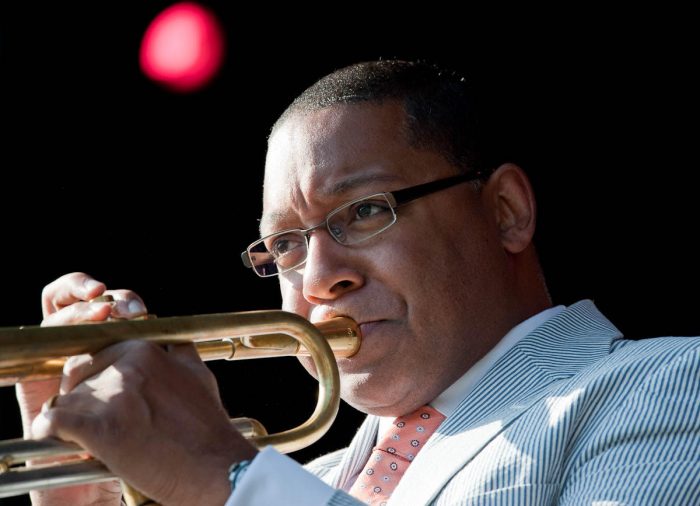
Image by Eric Delmar, via Wikimedia Commons
Practicing for countless hours before we can be good at something seems burdensome and boring. Maybe that’s why we’re drawn to stories of instant achievement. The monk realizes satori (and Neo learns kung fu); the superhero acquires great power out of the blue; Robert Johnson trades for genius at the crossroads. At the same time, we teach children they can’t master a skill without discipline and diligence. We repeat pop psych theories that specify the exact number hours required for excellence. The number may be arbitrary, but it comforts us to believe that practice might, eventually, make perfect. Because in truth we know there is no way around it. As Wynton Marsalis writes in “Wynton’s Twelve Ways to Practice: From Music to Schoolwork,” “practice is essential to learning music—and anything else, for that matter.”
For jazz musicians, the time spent learning theory and refining technique finds eloquent expression in the concept of woodshedding, a “humbling but necessary chore,” writes Paul Klemperer at Big Apple Jazz, “like chopping wood before you can start the fire.”
Yet retiring to the woodshed “means more than just practicing…. You have to dig deep into yourself, discipline yourself, become focused on the music and your instrument.” As beginners, we tend to look at practice only as a chore. The best jazz musicians know there’s also “something philosophical, almost religious” about it. John Coltrane, for example, practiced ceaselessly, consciously defining his music as a spiritual and contemplative discipline.
Marsalis also implies a religious aspect in his short article: “when you practice, it means you are willing to sacrifice to sound good… I like to say that the time spent practicing is the true sign of virtue in a musician.” Maybe this piety is intended to dispel the myth of quick and easy deals with infernal entities. But most of Marsalis’ “twelve ways to practice” are as pragmatic as they come, and “will work,” he promises “for almost every activity—from music to schoolwork to sports.” Find his abridged list below, and read his full commentary at “the trumpeter’s bible,” Arban’s Method.
- Seek out instruction: A good teacher will help you understand the purpose of practicing and can teach you ways to make practicing easier and more productive.
- Write out a schedule: A schedule helps you organize your time. Be sure to allow time to review the fundamentals because they are the foundation of all the complicated things that come later.
- Set goals: Like a schedule, goals help you organize your time and chart your progress…. If a certain task turns out to be really difficult, relax your goals: practice doesn’t have to be painful to achieve results.
- Concentrate: You can do more in 10 minutes of focused practice than in an hour of sighing and moaning. This means no video games, no television, no radio, just sitting still and working…. Concentrated effort takes practice too, especially for young people.
- Relax and practice slowly: Take your time; don’t rush through things. Whenever you set out to learn something new – practicing scales, multiplication tables, verb tenses in Spanish – you need to start slowly and build up speed.
- Practice hard things longer: Don’t be afraid of confronting your inadequacies; spend more time practicing what you can’t do…. Successful practice means coming face to face with your shortcomings. Don’t be discouraged; you’ll get it eventually.
- Practice with expression: Every day you walk around making yourself into “you,” so do everything with the proper attitude…. Express your “style” through how you do what you do.
- Learn from your mistakes: None of us are perfect, but don’t be too hard on yourself. If you drop a touchdown pass, or strike out to end the game, it’s not the end of the world. Pick yourself up, analyze what went wrong and keep going….
- Donʼt show off: It’s hard to resist showing off when you can do something well…. But my father told me, “Son, those who play for applause, that’s all they get.” When you get caught up in doing the tricky stuff, you’re just cheating yourself and your audience.
- Think for yourself: Your success or failure at anything ultimately depends on your ability to solve problems, so don’t become a robot…. Thinking for yourself helps develop your powers of judgment.
- Be optimistic: Optimism helps you get over your mistakes and go on to do better. It also gives you endurance because having a positive attitude makes you feel that something great is always about to happen.
- Look for connections: If you develop the discipline it takes to become good at something, that discipline will help you in whatever else you do…. The more you discover the relationships between things that at first seem different, the larger your world becomes. In other words, the woodshed can open up a whole world of possibilities.
You’ll note in even a cursory scan of Marsalis’ prescriptions that they begin with the imminently practical—the “chores” we can find tedious—and move further into the intangibles: developing creativity, humility, optimism, and, eventually, maybe, a gradual kind of enlightenment. You’ll notice on a closer read that the consciousness-raising and the mundane daily tasks go hand-in-hand.
While this may be all well and good for jazz musicians, students, athletes, or chess players, we may have reason for skepticism about success through practice more generally. Researchers at Princeton have found, for example, that the effectiveness of practice is “domain dependent.” In games, music, and sports, practice accounts for a good deal of improvement. In certain other “less stable” fields driven by celebrity and networking, for example, success can seem more dependent on personality or privileged access.
But it’s probably safe to assume that if you’re reading this post, you’re interested in mastering a skill, not cultivating a brand. Whether you want to play Carnegie Hall or “learn a language, cook good meals or get along well with people,” practice is essential, Marsalis argues, and practicing well is just as important as practicing often. For a look at how practice changes our brains, creating what we colloquially call “muscle memory,” see the TED-Ed video just above.
Related Content:
Wynton Marsalis Takes Louis Armstrong’s Trumpet Out of the Museum & Plays It Again
Sonny Rollins Describes How 50 Years of Practicing Yoga Made Him a Better Musician
Playing an Instrument Is a Great Workout For Your Brain: New Animation Explains Why
Josh Jones is a writer and musician based in Durham, NC. Follow him at @jdmagness
Read More...The Philosophy of The Matrix: From Plato and Descartes, to Eastern Philosophy
Do you take the red pill or the blue pill? The question, which at its heart has to do with either accepting or rejecting the illusions that constitute some or all of life as you know it, became part of the culture almost immediately after Morpheus, Lawrence Fishburne’s character in The Matrix, put it to Keanu Reeves’ protagonist Neo. That film, a career-making success for its directors the Wachowski sisters (then the Wachowski brothers), had its own elaborate vision of a false reality entrapping humanity as the actual one surrounds it, a vision made realizable by the finest late-1990s computer-generated special effects. But the ideas behind it, as this Film Radar video essay shows, go back a long way indeed.
The first and by far the most respected of the trilogy, The Matrix “largely interprets Plato’s Allegory of the Cave. Imagine a cave. Inside are people who were born and have spent their entire lives there, chained into a fixed position, only able to see the wall in front of them. As far as they know, this is the entire world.” The Wachowskis ask the same question Plato does: “How do we know what our reality really is?”
When they have Morpheus bring Neo out of his “cave” of everyday late-20th-century existence, they do it in a manner analogous to Plato’s Analogy of the Sun, in which “the sun is a metaphor for the nature of reality and knowledge concerning it,” and the eyes of the fearful few forced out of their cave need some time to adjust to it.
But when one “unplugs” from the illusion-generating Matrix of the title — a concept now in consideration again thanks to the popularity of the “simulation argument” — a longer journey toward that really-real reality still awaits. The second and third installments of the trilogy involve a dive into “religious philosophy from the East,” especially the idea of escape from the eternal soul’s reincarnation “into other physical forms in an infinite cycle where the soul is left to wander and suffer” by means of a spiritual quest for “enlightenment, by uniting body and mind with spirit.” This leads, inevitably, to self-sacrifice: by finally “allowing himself to die,” Neo “is reunited with spirit” and “becomes the true savior of humanity” — a narrative element not unknown in religious texts even outside the East.
These count as only “a few of the philosophical ideas the Wachowskis explore in the Matrix trilogy,” the others including Robert Nozick’s “Experience Machine,” Descartes’ “Great Deceiver,” and other concepts from Kant and Hume “questioning reality, causality, and free will, not to mention the obvious commentary on technology or a submissive society.” Of course, philosophical exploration in The Matrix involve countless flying — and gravity-defying — fists and bullets, much of it performed by characters clad in reflective sunglasses and black leather. Perhaps that datedness has prompted the recent announcement of a Matrix reboot: though the styles may change, if it happens, the ideas would no doubt remain recognizable to Plato himself.
Related Content:
Daniel Dennett and Cornel West Decode the Philosophy of The Matrix
The Matrix: What Went Into The Mix
Free Online Philosophy Courses
Based in Seoul, Colin Marshall writes and broadcasts on cities and culture. He’s at work on a book about Los Angeles, A Los Angeles Primer, the video series The City in Cinema, the crowdfunded journalism project Where Is the City of the Future?, and the Los Angeles Review of Books’ Korea Blog. Follow him on Twitter at @colinmarshall or on Facebook.
Read More...The Philosophy, Storytelling & Visual Creativity of Ghost in the Shell, the Acclaimed Anime Film, Explained in Video Essays
“Ghost in the Shell is not in any sense an animated film for children,” wrote Roger Ebert twenty years ago. “Filled with sex, violence and nudity (although all rather stylized), it’s another example of anime, animation from Japan aimed at adults.” Now, when no critic any longer needs to explain the term anime to Western readers, we look back on Ghost in the Shell (1995) as one of the true masterpieces among Japanese animated feature films, mature not just in its content but in its form. Evan Puschak, better known as the Nerdwriter, takes a look at how it expresses its philosophical themes through its still-striking cyberpunk setting in his video essay “Identity in Space.”
Puschak first highlights the presence (in the middle of this “sci-fi action thriller” about the hunt for a wanted hacker turned self-aware artificial intelligence) of an action-free interlude: a “three minute and twenty-ish second-long scene” consisting of nothing but “34 gorgeous, exquisitely detailed atmospheric shots of a future city in Japan that’s modeled after Hong Kong.”
Its plot-suspending visual exploration of the film’s Blade Runner-esque urban space of “a chaotic multicultural future city dominated by the intersections of old and new structures, connected by roads, canals, and technology,” emphasizes that “spaces, like identities, are constructed. Though space often feels neutral or given, like we could move anywhere within it, our movements, our activities, our life, is always limited by the way space is produced.”
Just as all of Ghost in the Shell’s characters exist in space, the main ones also exist in cybernetic bodies, regarding their identities as stored in their effectively transplantable brains all connected over a vast information network. The half-hour-long analysis from AnimeEveryday just above gets into the philosophical dilemma this presents to the film’s protagonist, the cyborg police officer Motoko Kusanagi, examining in depth several of the scenes that — through dialogue, imagery, symbolism, or subtle combinations of the three that viewers might not catch the first time around — illuminate the story’s central questions about the nature of man, the nature of machine, and the nature of what emerges when the two intersect.
Film Herald’s briefer explanation of Ghost in the Shell (which contains potentially NSFW images) points to three main themes: identity, Cartesian dualism, and evolution, all concepts that come into question — or at least demand a thorough revision — when the boundary between the natural and the synthetic blurs to the film’s imagined extent. “My intuition told me that this story about a futuristic world carried an immediate message for our present world,” said director Mamoru Oshii, and now, more than two decades later, Hollywood has even got around to remaking it in a live-action version starring Scarlett Johansson in the Kusanagi role. That does provides a chance to update some of the now-dated-looking technology seen in the animated original, but there’s no improving on its artistry.
Related Content:
Blade Runner Spoofed in Three Japanese Commercials (and Generally Loved in Japan)
Early Japanese Animations: The Origins of Anime (1917–1931)
How the Films of Hayao Miyazaki Work Their Animated Magic, Explained in 4 Video Essays
The Matrix: What Went Into The Mix
Based in Seoul, Colin Marshall writes and broadcasts on cities and culture. He’s at work on a book about Los Angeles, A Los Angeles Primer, the video series The City in Cinema, the crowdfunded journalism project Where Is the City of the Future?, and the Los Angeles Review of Books’ Korea Blog. Follow him on Twitter at @colinmarshall or on Facebook.
Read More...Download 437 Issues of Soviet Photo Magazine, the Soviet Union’s Historic Photography Journal (1926–1991)
The early years of the Soviet Union roiled with internal tensions, intrigues, and ideological warfare, and the new empire’s art reflected its uneasy heterodoxy. Formalists, Futurists, Suprematists, Constructivists, and other schools mingled, published journals, critiqued and reviewed each other’s work, and like modernists elsewhere in the world, experimented with every possible medium, including those just coming into their own at the beginning of the 20th century, like film and photography.
These two mediums, along with radio, also happened to serve as the primary means of propagandizing Soviet citizens and carrying the messages of the Party in ways everyone could understand. And like much of the rest of the world, photography engendered its own consumer culture.
Out of these competing impulses came Soviet Photo (Sovetskoe foto), a monthly photography magazine featuring, writes Ksenia Nouril at the Museum of Modern Art’s site, “editorials, letters, articles, and photographic essays alongside advertisements for photography, photographic processes, and photographic chemicals and equipment.”

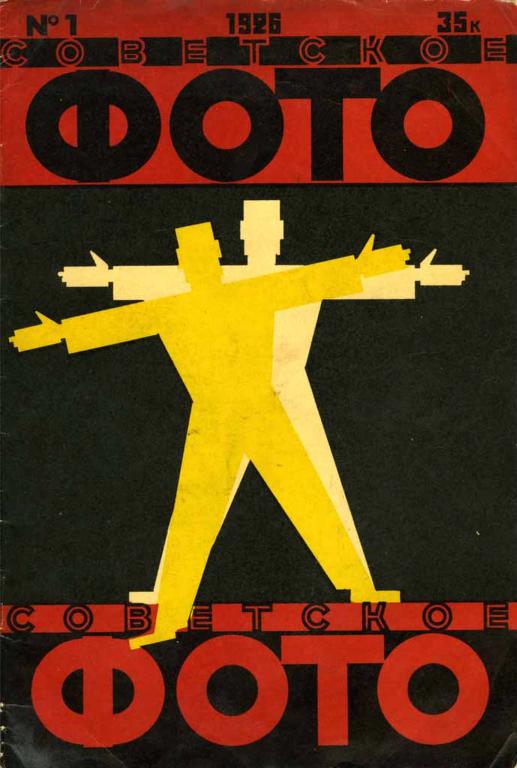
Soviet Photo was not founded by artists, but by a photojournalist, Arkady Shaikhet, in 1926 (see the first issue’s cover at the top). Though its audience primarily consisted of a “Soviet amateur photographers and photo clubs,” its early years freely mixed documentary, didacticism, and experimental art. It published the “works of international and professional photographers” and that of avant-gardists like Constructivist painter and graphic designer Aleksander Rodchenko.
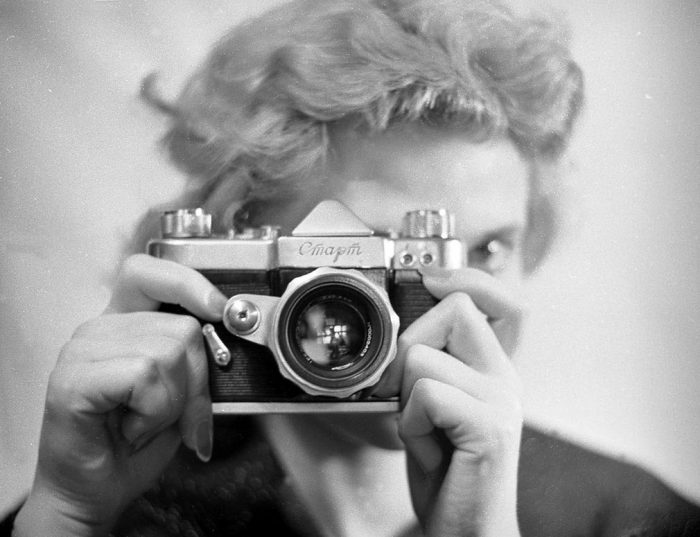
The aesthetic purges under Stalin—in which artists and writers one after another fell victim to charges of elitism and obscurantism—also played out in the pages of Soviet Photo. “Even before Socialist Realism was decreed to be the official style of the Soviet Union in 1934,” Nouril writes, “the works of avant-garde photographers,” including Rodchenko, “were denounced as formalist (implying that they reflected a foreign and elitist style).” Soviet Photo boycotted Rodchenko’s work in 1928 and “throughout the 1930s this state-sanctioned journal became increasingly conservative,” emphasizing “content over form.”
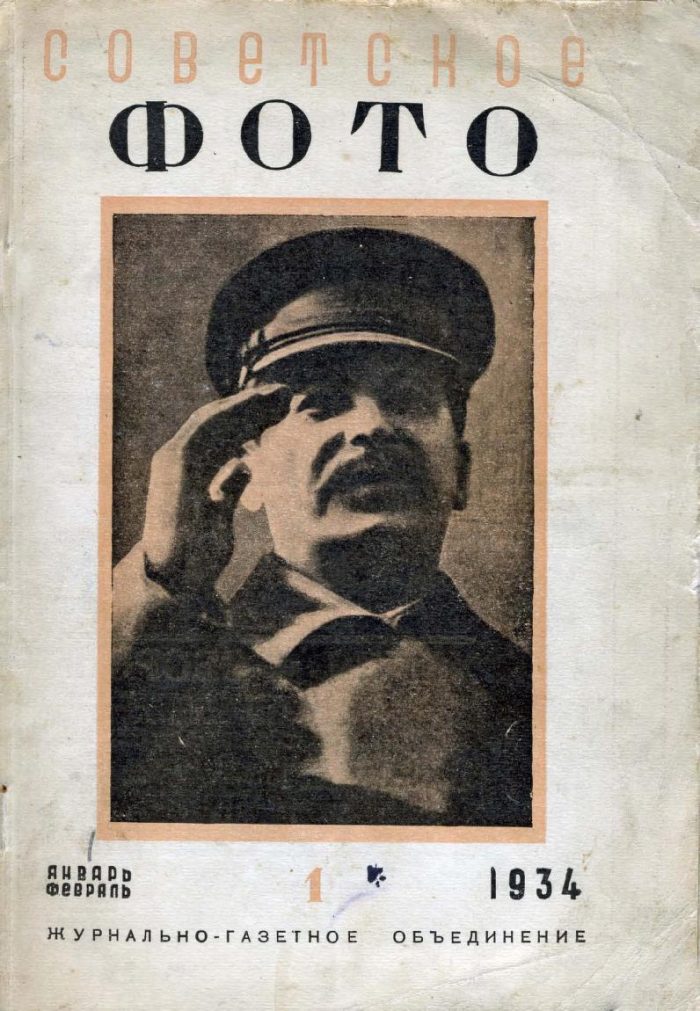
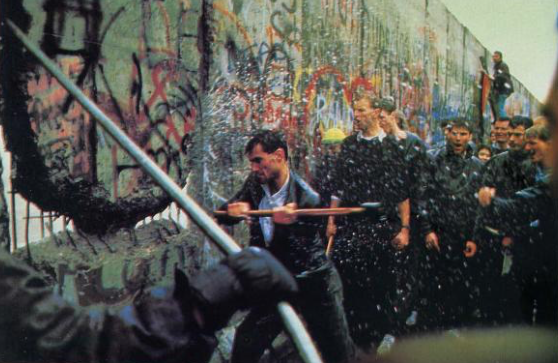
This does not mean that that the contents of the magazine were inelegant or pedestrian. Though it once briefly bore the name Proletarskoe foto (Proletariat Photography), and tended toward monumental and industrial subjects, war photography, and idealizations of Soviet life during the Stalinist years. After the 60s thaw, experimental photomontages returned, and more abstract compositions became commonplace. Soviet Photo also kept pace with many glossy magazines in the West, with stunning full-color photojournalism and, after glasnost and the fall of the Berlin wall, high fashion and advertising photography.
Fans of photography, Soviet history, or some measure of both, can follow Soviet Photo’s evolution in a huge archive featuring 437 digitized issues, published between 1926 and 1991. Expect to find a gap between 1942 and 1956, when publication ceased “due to World War II and the war’s aftereffects.” Aside from these years and a few other missing months, the archive contains nearly every issue of Soviet Photo, free to browse or download in various formats. “Dig deep enough,” writes photo blog PetaPixel, “and you’ll find some really interesting (and surprisingly familiar) things in there.” Enter the archive here.

via PetaPixel
Related Content:
Behold a Beautiful Archive of 10,000 Vintage Cameras at Collection Appareils
Josh Jones is a writer and musician based in Durham, NC. Follow him at @jdmagness
Read More...Hear Jimi Hendrix’s Virtuoso Guitar Performances in Isolated Tracks: “Fire,” “Purple Haze,” “Third Stone from the Sun” & More
A garden of musical curiosities—lush with rarities, outtakes, obscurities, and live performances spanning the globe—Youtube has fulfilled many a superfan’s dream of instant access to recorded musical history. One rarified bloom, the isolated track, can prove a divisive strain. Why, aesthetes and purists ask, rip a performance from its setting, place it before listeners in a way musicians never meant for it to be heard? Though at times expressed in ranty tones, the criticism has merit.
Thinking of the “isolated track” as pure solo virtuosity does great injustice to the processes that produce these performances. As musicians well know, whether live or recorded at separate times in the studio, most group performances result from countless hours of rehearsal, revision, sometimes numbing repetition, and deviations that become standard over time.
For any band that plays together regularly, parts emerge from the matrix of group dynamics or musical “chemistry.” Throw a different musician into the mix, and other individual performances change as well.
That’s not even to mention the role of producers, recording and mixing engineers, etc. on shaping and refining the sound. Many studio productions nowadays come from the layering of beats, sequences, and samples produced in isolation from each other. The results can sound sterile and inorganic. But in the 60s and 70s heyday of album-oriented rock, it was about the band, and almost no one put together bands that better complemented his playing than Jimi Hendrix. Conversely, no one played guitar like Hendrix, in any context.
I would offer this in defense of hearing isolated tracks from Hendrix, or from Freddie Mercury and David Bowie (who bucked the trend and wrote, arranged, rehearsed, and recorded “Under Pressure” in the same night), Paul McCartney, Grace Slick, or any other hugely talented performer: We know these songs well enough already. So many of us have internalized how their parts fit together into something greater than themselves. To have the individual tracks revealed only enhances our appreciation for the whole. When we return to the full arrangement we may hear nuances and quirks we’d never noticed before, and notice afresh how these moments call and respond to the other players.
The isolated Hendrix guitar tracks here are subjects of study and appreciation, for guitarists, musicologists, critics, and ordinary fans. They allow us to hear very clearly what Hendrix was doing in these songs under his captivating vocal delivery, Mitch Mitchell’s rolling fills, and Noel Redding’s traveling lines. We gain a new appreciation for his rhythm playing, his deft transitions, and how his cool underplaying in verses made space for his indelibly flashy leads and intros.
Is it artificial? Sure, but so is the recording process. And so is excerpting parts of, say, Citizen Kane or Vertigo to analyze their editing, camera work, or use of color. We don’t do it because we only want see part of the film, but because we want to better understand the technical intricacies of the work as a whole. Hear Hendrix’s isolated guitar takes above (with some faint bleed from other instruments) in “Fire,” “Purple Haze,” “The Wind Cries Mary,” “Spanish Castle Magic,” “Stone Free,” and, my personal favorite, “Third Stone from the Sun.”
You can listen to many more isolated Hendrix performances, and those from several other musicians, at the Daily Motion channel of Joh Phe. Then, by all means, return to the full recordings and see how little bits of color, shape, and texture that you hadn’t heard before now leap out at you.
Related Content:
Listen to Grace Slick’s Hair-Raising Vocals in the Isolated Track for “White Rabbit” (1967)
Josh Jones is a writer and musician based in Durham, NC. Follow him at @jdmagness
Read More...I’m Just a Pill: A Schoolhouse Rock Classic Gets Reimagined to Defend Reproductive Rights in 2017
Like many American children of the 70s and 80s, my understanding of how our government is supposed to function was shaped by Schoolhouse Rock.
Immigration, separation of legislative, executive and judicial powers and of course, the promise of the Constitution (“a list of principles for keepin’ people free”) were just a few of the topics the animated musical series covered with clarity and wit.
The new world order in which we’ve recently found ourselves suggests that 2017 would be a grand year to start rolling out more such videos.
The Lady Parts Justice League, a self-declared “cabal of comics and writers exposing creeps hellbent on destroying access to birth control and abortion” leads the charge with the above homage to Schoolhouse Rock’s 1976 hit, “I’m Just a Bill,” recasting the original’s glum aspirant law as a feisty Plan B contraceptive pill. The red haired boy who kept the bill company on the steps of the Capital is now a teenage girl, confused as to how any legal, over-the-counter method for reducing the risk of unwanted pregnancy could have so many enemies.
As with the original series, the prime objective is to educate, and comic Lea DeLaria’s Pill happily obliges, explaining that while people may disagree as to when “life” begins, it’s a scientific fact that pregnancy begins when a fertilized egg lodges itself in the uterus. (DeLaria plays Big Boo on Orange is the New Black, by the way.) That process takes a while—72 hours to be exact. Plenty of time for the participants to scuttle off to the drugstore for emergency contraception, aka Plan B, the so called “morning-after” pill.
As per the drug’s website, if taken within 72 hours after unprotected sex, Plan B can reduce the risk of pregnancy by up to 89%. Taken within 24 hours, it is about 95% effective.
And yes, teenagers can legally purchase it, though Teen Vogue has reported on numerous stores who’ve made it difficult, if not impossible, for shoppers to gain access to the pill.
(The Reproductive Justice Project encourages consumers to help them collect data on whether Plan B is correctly displayed on the shelves as available for sale to any woman of childbearing age.)
There’s a helpful football analogy for those who may be a bit slow in understanding that Plan B is indeed a bonafide contraceptive, and not the abortifacient some mistakenly make it out to be. It’s NSFW, but only just, as a team of cartoon penis-outlines push down the field toward the uterine wall in the end zone.
The other bills who once stood in line awaiting the president’s signature have been reimagined as sperm, while songwriter Holly Miranda pays tribute to Dave Frishberg’s lyrics with a pizzazz worthy of the original:
I’m just a pill
A helpful birth control pill
No matter what they say on Capital Hill
So now you know my truth
I’m all about prevention
If your condom breaks
I’m here for intervention
Join me take a stand today
I really hope and pray that you will
Drop some facts
Tell the world
I’m a pill.
Let’s hope the resistance yields more catchy, educational animations!
And here, for comparison’s sake, is the magnificent original:
Via BUST Magazine
Related Content:
Schoolhouse Rock: Revisit a Collection of Nostalgia-Inducing Educational Videos
Conspiracy Theory Rock: The Schoolhouse Rock Parody Saturday Night Live May Have Censored
Ayun Halliday is an author, illustrator, theater maker and Chief Primatologist of the East Village Inky zine. Follow her @AyunHalliday.
Read More...Albert Camus Explains Why Happiness Is Like Committing a Crime—“You Should Never Admit to it” (1959)
Note: You can read a translation below.
Happiness, as it has been conceived for at least the past couple thousand years in Western philosophy, is a problem. For the Greeks, happiness was only one component of Eudaimonia, a general human flourishing that must be developed along with ethics, personal growth, and social and civic duty in order for a life to have purpose and meaning. “Positive psychology speaker” Dr. Nico Rose reminds us that the concept contrasts with Hedonia (as in “hedonism”), which relates solely to personal pleasure and enjoyment, such as the kind famously indulged in by many an ancient tyrant.
These are not mutually exclusive categories. “Meaningful experiences can certainly bring about pleasure,” writes Rose, “and taking care of ourselves can certainly add meaning to our lives.” We should, he cautions “refrain from equating the pursuit of hedonia with shallowness.”
The problem, as the Greeks understood it—and as proponents of positive psychology like Jonathan Haidt and founder Martin Seligman recognize as well—is that subjective happiness for some can mean deep unhappiness, or tyranny, for others. It can mean pettiness, apathy, and emotional immaturity, qualities that may not necessarily be immoral but are certainly unpleasant and socially corrosive.
But we might refer to the difference between Hedonia and Eudaimonia another way. Matthew Pianalto at Philosophy Now discusses the contrast as one between “psychological and philosophical concepts of happiness.”
When happiness is equated with subjective well-being, the vast majority of people turn out to be relatively happy. Aristotle and the other Greeks, however, were not concerned with relative or subjective happiness – they wanted to know what the objective features of a truly happy life would be. Greek inquiries into the nature of the good life were really inquiries into the nature of the best life. Thus, when the various Greek philosophers recommended the cultivation of virtue in order to live happily, and since the word we translate as ‘virtue’ really means ‘excellence’, the Greeks were basically telling us that the happiest (and the best) life is the most excellent life.
Is this moralization really necessary for human flourishing, and does it actually promote a superior form of happiness? Or does it simply introduce a means for controlling other people’s behavior and shaming them for their supposed lack of virtue? If you were to ask Albert Camus this question, he might have suggested the latter, and anyone who has read The Stranger and thought about the social coercion the novel portrays will hardly be surprised. In the video above, Camus strongly implies his own view with an imagined Stranger-like dialogue, in French. A translation (generously provided by @TOS1892) roughly reads:
“Today happiness is like a crime—never admit it. Don’t say ‘I’m happy’ otherwise you will hear condemnation all around.”
“’So you’re happy, young man? What do you do with orphans from Kashmir? Or the New Zealand lepers who aren’t “happy” as you say?’”
“Yes what to do with the lepers? How to get rid of them as Ionesco would say? And all of a sudden, we are sad as toothpicks.”
As Maria Popova points out at Brain Pickings, Camus considered this kind of labored, almost rigorous, kind of unhappiness a “self-imposed prison,” writing in a 1956 letter that “those who prefer their principles over their happiness… refuse to be happy outside the conditions they seem to have attached to their happiness. If they are happy by surprise, they find themselves disabled, unhappy to be deprived of their unhappiness.” (I can’t help but think of these lines: “And if the day came when I felt a natural emotion / I’d get such a shock I’d probably jump in the ocean.”)
Camus recognized emotions not as abstract principles, but as deeply connected to “the solidarity of our bodies, unity at the center of the mortal and suffering flesh.” The corrective to a shallow hedonism that might override our ethics is not a striving after philosophical notions of “excellence,” but another emotion, unhappiness, which we should also not be ashamed to feel. “No,” wrote Camus, “it is not humiliating to be unhappy.” The philosopher wrote these words to a hospitalized friend who was suffering physically, a condition, he admits, that is “sometimes humiliating.” But the more existential “suffering of being cannot be” a humiliation. “It is life,” and it forces us to see things we would rather not see.
Do these alternations of happiness and unhappiness point toward something larger than the fleeting whims of physical pain or personal satisfaction? Yes, Camus thought, but the fact that we need them does not speak especially well of people in what he called a “servile century.” In his notebooks, Camus considered how, through sorrow, Oscar Wilde came to understand art as something that “must blend with all” rather than transcend ordinary life. “It is the culpability of this era,” he writes, “that it always needed sorrow… to catch a glimpse of a truth also found in happiness.”
It is entirely possible to be happy and virtuous, authentic, and truthful, Camus suggests, “when the heart is worthy.” In some ways, it seems, he reframed the ancient Greeks’ idea of Eudaimonia from an abstract philosophical principle to a subjective psychological state, since there is no clear, objective way in an absurd universe, he thought, to know what an “excellent” life should look like. Still, like Aristotle, Camus suggests that pursuing meaningful happiness is a “moral obligation” writes Popova. But he understands this pursuit as perilous and potentially devastating, necessitating “an equal capacity for contact with absolute despair.”
via @pbkauf
Related Content:
Hear Albert Camus Read the Famous Opening Passage of The Stranger (1947)
Albert Camus Talks About Nihilism & Adapting Dostoyevsky’s The Possessed for the Theatre, 1959
Josh Jones is a writer and musician based in Durham, NC. Follow him at @jdmagness
Read More...Social and Political Philosophy: A Free Online Course
From John Sanders, Professor of Philosophy at the Rochester Institute of Technology, comes the course, Social and Political Philosophy. In 10 lectures, Sanders “examines some of the main problems of social and political philosophy through an analysis, comparison and critical examination of various views concerning the natures of individuality and society and the relations between them.” Thinkers covered include Aristotle, Hobbes, Locke, Mills, Marx, Engels, Hayek and Rawls. You can stream all the lectures above, or find them all on this YouTube playlist.
Social and Political Philosophy will be added to our list of Free Philosophy Courses, a subset of our collection, 1,700 Free Online Courses from Top Universities.
Read More...Marshall McLuhan in Two Minutes: A Brief Animated Introduction to the 1960s Media Theorist Who Predicted Our Present
Marshall McLuhan, writes novelist and artist Douglas Coupland, entered the zeitgeist in the 1960s as “a guru or as a villain – as a harbinger of the flowering of culture, or of its death,” a “fuddy-duddy fiftysomething English lit professor from Toronto” whose distinctive research interests and even more distinctive habits of mind empowered him to come up with still-resonant insights into the modern media landscape. He knew “that the point of much of technology, TV, for instance, wasn’t the content of the shows you were watching on it. Rather, what mattered was merely the fact that you were watching TV. The act of analyzing the content of TV – or of other mediums – is either sentimental or it’s beside the point.” The medium, in other words, is the message.
That best-known of McLuhan’s prophetic one-liners (on which he expands in the ABC Radio National talk below) remains as true now as it was when it first appeared in his book Understanding Media: The Extensions of Man in 1964.
Coupland emphasizes that different kinds of media, then as now, “force you to favor certain parts of your brain over others,” which we denizens of the 21st century know from intensive daily experience: “that hour you spent on Facebook came at the expense of some other way of using your brain, most likely TV viewing or book-reading, though as books and TV recede, ever more web-mediated activities will replace each other to the point where we’ll have long forgotten what the pre-electronic mind was to begin with.”
Coupland once wrote a kind of biography of McLuhan that distilled the thinker’s life, work, and current relevance into less than 250 pages, but the video at the top of the post, commissioned by Al Jazeera from animator Daniel Savage and narrated by Hong Kong activist Alex Chow, does it in just over two minutes. Chow reminds us that, even today, “if you don’t understand the medium, you don’t fully understand the message,” looking back to the invention of the printing press, and thus of mass media, and how its forms “changed our collective experience. It informed our collective identity, how we imagined ourselves.” In what McLuhan called the “electric environment,” where “everything happens at once. There’s no continuity, there’s no connection, there’s no follow-through. It’s just all now,” we will experience the end of secrecy, and with it “the end of monopolies of knowledge.”
55 years ago, McLuhan wrote that “the next medium, whatever it is – it may be the extension of consciousness – will include television as its content, not as its environment. A computer as a research and communication instrument could enhance retrieval, obsolesce mass library organization, retrieve the individual’s encyclopedic function and flip it into a private line to speedily tailored data of a salable kind.” As we’ve since discovered, these developments have both their upsides and downsides. But as Coupland writes, consider that passage seriously and “see if it doesn’t give you a chill.”
Related Content:
The Visionary Thought of Marshall McLuhan, Introduced and Demystified by Tom Wolfe
Marshall McLuhan on the Stupidest Debate in the History of Debating (1976)
McLuhan Said “The Medium Is The Message”; Two Pieces Of Media Decode the Famous Phrase
Hear Marshall McLuhan’s The Medium is the Massage (1967)
Based in Seoul, Colin Marshall writes and broadcasts on cities and culture. He’s at work on a book about Los Angeles, A Los Angeles Primer, the video series The City in Cinema, the crowdfunded journalism project Where Is the City of the Future?, and the Los Angeles Review of Books’ Korea Blog. Follow him on Twitter at @colinmarshall or on Facebook.
Read More...Every Front Page of The New York Times in Under a Minute: Watch the Evolution of “The Gray Lady” from 1852 to Present
Buckling under information overload?
The long view can be soothing, as filmmaker Josh Begley proves in just under a minute, above. The data artist reduced 165 years worth of chronologically ordered New York Times front pages—every single one since 1852—to a grid of inky rectangles flashing past at lightning speed.
You won’t be able to make out the headlines as the front page news whips past to the somewhat ominous strains of composer Philip Glass’ ”Dead Things.”
Instead the impression is of watching something—or someone—steadily bearing witness.
Obviously, any reputable new source does more than simply note the unfolding of events. Its readers look to it as a source of analysis and critique, in addition to well-researched factual information.
The Gray Lady, as the Times has long been known, has recently weathered an uptick in slings and arrows from both the left and the right, yet her longevity is not easily dismissed.
Blogger Jason Kottke watched the video with an eye toward some of the paper’s most notable design changes. His findings also remind us of some of the historic events to appear on the Times’ front page—Lincoln’s assassination, Nixon’s resignation, and the election of our first Black president, which it described as a “national catharsis—a repudiation of a historically unpopular Republican president and his economic and foreign policies.”
How many of the over 50,000 front pages featured above were deemed personally significant enough to squirrel away in a trunk or an attic?
Have digital archives decreed that this practice will soon gasp its last, along with the print media that inspired it?
What will we use to wrap our fish and line our bird cages?
Read the New York Times 2012 (non-front page) coverage of Apple’s rejection of Josh Begley’s Drone+ app here.
Related Content:
Ayun Halliday is an author, illustrator, and theater maker in New York City. Her play Zamboni Godot is playing at The Brick in Brooklyn through tomorrow night. Follow her @AyunHalliday.
Read More...Support Us
We're hoping to rely on loyal readers, rather than erratic ads. Please click the Donate button and support Open Culture. You can use Paypal, Venmo, Patreon, even Crypto! We thank you!

About Us

Open Culture scours the web for the best educational media. We find the free courses and audio books you need, the language lessons & educational videos you want, and plenty of enlightenment in between.
Advertise With Us
FREE UPDATES!
GET OUR DAILY EMAIL
Get the best cultural and educational resources on the web curated for you in a daily email. We never spam. Unsubscribe at any time.
FOLLOW ON SOCIAL MEDIA
Open Culture editor Dan Colman scours the web for the best educational media. He finds the free courses and audio books you need, the language lessons & movies you want, and plenty of enlightenment in between.
Advertise With Us