New Film Project Features Citizens of Alabama Reading Walt Whitman’s “Song of Myself,” a Poetic Embodiment of Democratic Ideals
In times of national anxiety, many of us take comfort in the fact that the U.S. has endured political crises even more severe than those at hand. History can be a teacher and a guide, and so too can poetry, as Walt Whitman reminds us again and again. Whitman witnessed some of the greatest upheavals and revolutionary changes the country has ever experienced: the Civil War and its aftermath, the assassination of Abraham Lincoln, the failure of Reconstruction, the massive industrialization of the country at the end of the 19th century.…
Perhaps this is why we return to Whitman when we make what critics call a “poetic turn.” His expansive, multivalent verse speaks for us when beauty, shock, or sadness exceed the limits of everyday language. Whitman contained the nation’s warring voices, and somehow reconciled them without diluting their uniqueness. This was, indeed, his literary mission, to “create a unified whole out of disparate parts,” argues Karen Swallow Prior at The Atlantic. “For Whitman, poetry wasn’t just a vehicle for expressing political lament; it was also a political force in itself.” Poetry’s importance as a binding agent in the fractious, fragile coalition of states, meant that for Whitman, the country’s “Presidents shall not be their common referee so much as their poets shall.”
Whitman wrote as a gay man who, by the time he published the first edition of Leaves of Grass in 1855, had gone from being an “ardent Free-Soiler” to fully supporting abolition. His poetry proclaimed a “radically egalitarian vision,” writes Martin Klammer, “of an ideal, multiracial republic.” A country that was, itself, a poem. “The United States themselves are essentially the greatest poem,” wrote Whitman in his preface. The nation’s contradictions inhabit us just as we inhabit them. The only way to resolve our differences, he insisted, is to embody them fully, with openness toward other people and the natural world. Understanding Whitman’s mission makes filmmaker Jennifer Crandall’s project Whitman, Alabama all the more poignant.
For two years, Crandall “crisscrossed this deep Southern state, inviting people to look into a camera and share part of themselves through the words of Walt Whitman.” To the question “Who is American?,” Crandall—just as Whitman before her—answers with a multitude of voices, weaving in and out of a collaborative reading of the epic “Song of Myself,” beginning with 97-year-old Virginia Mae Schmitt of Birmingham, at the top, who reads Whitman’s lines, “I, now thirty-seven years old in perfect health begin / Hoping to cease not till death.” No one watching the video, Crandall remarks, should ask, “Why isn’t’ a thirty-seven year old man reading this?” To do so is to ignore Whitman’s design for the universal in the particular.
When Whitman penned the first lines of “Song of Myself,” the country had not yet “Unlimber’d” the cannons “to begin the red business,” as he would later write, but the 1850 Fugitive Slave Act had clearly lain the foundation for civil war. The poet’s many revisions, additions, and subsequent editions of Leaves of Grass after his first small run in 1855 continued until his death in 1892. He was obsessed with the hugeness and dynamism of the country and its people, in their darkest, bloodiest moments and at their most flourishing. His vision lets everyone in, without qualification, constantly rewriting itself to meet new faces in the ever-changing nation.
As Mariam Jalloh, a 14-year old Muslim girl from Guinea, recites in her short portion of the reading further up, “every atom belonging to me as good belongs to you.” Jollah quite literally makes Whitman’s language her own, translating into her native Fulani the line, “If they are not just as close as they are distant, they are nothing.” Jalloh “may seem like a surprising conduit for the writing of Whitman, a long-dead queer socialist poet from Brooklyn,” writes Christian Kerr at Hyperallergic, “but such incongruity is the active agent in Whitman, Alabama’s therapeutic salve.” It is also, Whitman suggested, the matrix of American democracy.
See more readings from the project above from Laura and Brandon Reeder of Cullman, the Sullivan family of Mobile, and by Demetrius Leslie and Frederick George, and Patricia Marshall and Tammy Cooper, inmates at mens’ and womens’ prisons in Montgomery. Whitman’s voice winds through these bodies and voices, settling in, finding a home, then, restless, moving on, inviting us all to join in the chorus, yet also—in its contrarian way—telling us to find our own paths. “You shall no longer take things at second or third hand.…,” wrote Whitman, “nor look through the eyes of the dead, nor feed on the spectres in books, / You shall not look through my eyes either, nor take things from me, / You shall listen to all sides and filter them from yourself.”
Find many more readings at the Whitman, Alabama website. And stay tuned for new readings as they come online.
Also find works by Walt Whitman on our lists of Free Audio Books and Free eBooks.
Related Content:
The Civil War & Reconstruction: A Free Course from Yale University
Josh Jones is a writer and musician based in Durham, NC. Follow him at @jdmagness
Read More...What Makes a Coen Brothers Movie a Coen Brothers Movie? Find Out in a 4‑Hour Video Essay of Barton Fink, The Big Lebowski, Fargo, No Country for Old Men & More
What could movies as different as Barton Fink, The Big Lebowski, No Country for Old Men, and True Grit have in common? Even casual cinephiles will take that as a silly question, knowing full well that all of them came from the same sibling writing-directing team of Joel and Ethan Coen, better known as the Coen brothers. But to those who really dig deep into movies, the question stands: what, aesthetically, formally, intellectually, or emotionally, does unify the filmography of the Coen brothers? Though it boasts more than its fair share of critical, commercial, and cult fan favorites, its auteurs seemingly prefer to mark their work with many subtle signatures rather than one bold and obvious one.
Cameron Beyl, creator of The Directors Series (whose examinations of Stanley Kubrick and David Fincher we’ve previously featured here on Open Culture), finds out just what makes a Coen brothers movie a Coen brothers movie in his seven-part, nearly four-hour set of video essays on the two Jewish brothers from the Minnesota suburbs who went on to make perhaps the most distinctive impact on the zeitgeist of their generation of American filmmakers.
He begins with the Coen brothers’ Texas noir debut Blood Simple and sophomore southwestern slapstick Raising Arizona, then goes on to their larger-scale postmodern period pieces Miller’s Crossing, Barton Fink, and the Hudsucker Proxy.
The next chapter covers their breakout films of the late 1990s Fargo and The Big Lebowski, and then two highly stylized pictures, the Odyssey-inspired prison break O Brother, Where Art Thou? and the black-and-white noir The Man Who Wasn’t There. Then come Intolerable Cruelty and The Ladykillers, two 21st-century screwball comedies, followed by their “prestigious pinnacle,” the acclaimed four-picture stretch of No Country for Old Men, Burn After Reading, A Serious Man, and True Grit.
The final chapter (below) looks at the Coen brothers’ two most recent works, both of which take on the culture industry: Inside Llewyn Davis, the tale of a would-be 1960s folk star, and Hail, Caesar!, one of early-1950s Hollywood.
Beyl’s analysis brings to the fore both the more and the less visible common elements of the Coen brothers’ movies. The former include their fondness for historical and “middle American” settings, their repeated use of actors like John Goodman, Steve Buscemi, Frances McDormand, and John Turturro, and their tendency to move the camera with what Beyl several times describes as “breakneck speed.” The latter include easily missable place and character interconnections (for instance, how Barton Fink and Hail, Caesar!, set a decade apart and made a quarter-century apart, involve the same fictional Hollywood studio) and their simultaneous deployment and subversion of genre conventions, possibly owing to their lifelong “outsider” perspective.
But above all, nothing signals the work of the Coen brothers quite so clearly as their ever-more-refined mixture of zaniness and brutality, which Beyl puts in terms of their mixture of disparate filmmaking influences: Preston Sturges on one hand, for example, and Sam Peckinpah on the other. This comes with their films’ built-in resistance to straightforward interpretation, a kind of pleasurable complexity that prevents any one simple historical, social, or political reading from making much headway. In fact, as Beyl acknowledges in the first of these video essays, the Coen brothers would probably consider this sort of long-form examination of their work a waste of time, but if it sends viewers back to that work — and especially if it sends them back watching and noticing more closely — it does a favor to the rare kind of modern cinema that actually merits the word unique.
Related Content:
How the Coen Brothers Storyboarded Blood Simple Down to a Tee (1984)
Is The Big Lebowski a Great Noir Film? A New Way to Look at the Coen Brothers’ Iconic Movie
Tuileries: A Short, Slightly Twisted Film by Joel and Ethan Coen
World Cinema: Joel and Ethan Coen’s Playful Homage to Cinema History
Discover the Life & Work of Stanley Kubrick in a Sweeping Three-Hour Video Essay
How Did David Fincher Become the Kubrick of Our Time? A New Series of Video Essays Explains
Based in Seoul, Colin Marshall writes and broadcasts on cities and culture. He’s at work on a book about Los Angeles, A Los Angeles Primer, the video series The City in Cinema, the crowdfunded journalism project Where Is the City of the Future?, and the Los Angeles Review of Books’ Korea Blog. Follow him on Twitter at @colinmarshall or on Facebook.
Read More...5 Animations Introduce the Media Theory of Noam Chomsky, Roland Barthes, Marshall McLuhan, Edward Said & Stuart Hall
We watch it happen in real time, aghast as the media cannibalizes itself, turning reality into a parody of the kind we laughed at in goofy dystopian scenarios from Back to the Future, The Simpsons, Idiocracy. A brave new world of hypercredulity and monstrous disingenuousness arrived on our smart phones and TVs. It was gaudy and pernicious and lied to us like we couldn’t trust our lying eyes. We saw reality TV mainlined into reality. The response was to shout, “Fake News,” a phrase almost immediately redigested and spun into flimsy conspiracy theories. It now serves little purpose but to get the snake gnawing its tail again.
How?, many wondered in despair. Haven’t people read the theory? Noam Chomsky, Marshall McLuhan, Stuart Hall, Edward Said, Roland Barthes.… Didn’t we see them proven right time and again? But chances are if you know all these names, you’ve spent time in university English, Communications, or Media Studies departments.
You’ve hung around hip bookstores and coffeeshops in cities and puzzled over critical theory, pretending, perhaps, to have read at least one of these writers you hadn’t. You gave up your TV years ago and kept your kids away from screens (or told people you did). You fit, in other words, a certain profile, and while there’s nothing wrong with that, it was, in the scheme of things, a pretty narrow niche, and an often pretty smug one at that.
Maybe academics, critics, and journalists need to be better at talking and listening to ordinary people? Maybe fashionable waves of anti-intellectualism need to be resisted with almost religious vigor…? Whatever the solution(s) for mass media illiteracy, we can treat the video series here from Al Jazeera as a step in the right direction. Called “Media Theorized: Reading Against the Grain,” the project takes as its subtitle a quote from Roland Barthes, the French philosopher and literary critic who distilled cultural studies into highly readable essays, dissecting everything from wrestling to tourism to advertising. Barthes showed how these genres constitute symbolic texts, just like romantic novels and morality plays, but purport to show us unmediated truth.
“Media Theorized” surveys five cultural critics who have, in five different ways, made similar analyses of mass media. Marshall McLuhan famously declared the medium as the message: its signal inseparable from its noise; Noam Chomsky demonstrated how popular consent is engineered by a narrow set of shady special interests with influence over the media; Stuart Hall showed how mass media manipulates discourses of race, class, gender, and religion to misrepresent outsiders and marginalized people and keep them in their place in the social imaginary; and Edward Said documented the long tradition of “Orientalism”—a totalizing Euro-American discourse that estranges, belittles, and dehumanizes whole countries, cultures, and religious communities.
While it’s impossible to do justice to the richness and depth of their arguments with quick summaries and pithy animation, what “Media Theorized” does well is to present this handful of academics as accessible and uniquely relevant to our current situation. This works especially well because the presenters are people used to putting theory into practice, communicating with the public, and critiquing mass media. Activists and journalists from all over the world, who have not only contributed short videos on YouTube, but thoughtful supplementary essays and interviews at the “Media Theorized” site (which also includes high resolution posters from each video.) The project is an invitation for each of us to take several steps back and ask some highly pertinent questions about how and why the stories we’re told get told, and for whose benefit.
Millions of people have had enough and are demanding accountability from individual figures in the media—a positive development, to be sure, though it seems like too little too late. We need to understand the damage that’s been done, and continues to be done, by the systems mass media enable and sell. This series introduces “critical tools” we can use in our “everyday encounters” with such salesmanship.
Related Content:
Sci-Fi Author J.G. Ballard Predicts the Rise of Social Media (1977)
Josh Jones is a writer and musician based in Durham, NC. Follow him at @jdmagness
Read More...New, Interactive Web Site Puts Online Thousands of International Folk Songs Recorded by the Great Folklorist Alan Lomax

These days everyone’s hung up on identity. But I don’t mean to talk politics, though my point is maybe inescapably political: the identities our jobs and incomes give us—the status or lack thereof—become so central to who we are in the world that they eclipse other essential aspects, eclipse the things we do strictly because it gives us pleasure to do them.
Music, dance, art, poetry.… These fall under what Alan Lomax called an experience of “the very core” of existence, “the adaptive style” of culture, “which enables its members to cohere and survive.” Culture, for Lomax, was neither an economic activity nor a racial category, neither an exclusive ranking of hierarchies nor a redoubt for nationalist insecurities. Cultures, plural, were peculiarly regional expressions of shared humanity across one interrelated world.
Lomax did have some paternalistic attitudes toward what he called “weaker peoples,” noting that “the role of the folklorist is that of the advocate of the folk.” But his advocacy was not based in theories of supremacy but of history. We could mend the ruptures of the past by adding “cultural equity… to the humane condition of liberty, freedom of speech and religion, and social justice,” wrote the idealistic Lomax. “The stuff of folklore,” he wrote elsewhere, “the orally transmitted wisdom, art and music of the people, can provide ten thousand bridges across which men of all nations may stride to say, ‘You are my brother.’”

Lomax’s idealism may seem to us quaint at best, but I dare you to condemn its results, which include connecting Lead Belly and Woody Guthrie to their global audiences and preserving a good deal of the folk music heritage of the world through tireless field and studio recording, documentation and memoir, and institutions like the Association for Cultural Equity (ACE), founded by Lomax in 1986 to centralize and make available the vast amount of material he had collected over the decades.
In another archival project, Lomax’s Global Jukebox, we get to see rigorous scholarly methods applied to examples from his vast library of human expressions. The online project catalogues the work in musicology of Lomax and his father John, who both took on a “life long mission to document not only America’s cultural roots, but the world’s as well,” notes an online brochure for the Global Jukebox. Lomax believed that “music, dance and folklore of all traditions have equal value” and are equally worthy of study. The Global Jukebox carries that belief into the 21st century.
Since 1990, the Global Jukebox has functioned as a digital repository of music from Lomax’s global archive, as you can see in the very dated 1998 video above, featuring ACE director Gideon D’Arcangelo. Now, updated and put online, the newly-launched Global Jukebox web site provides an interactive interface, giving you access to detailed analyses of folk music from all over the world, and highly technical “descriptive data” for each song. You can learn the systems of “Choreometrics and Cantometrics”—specialized analytical tools for scientists—or you can casually browse the incredible diversity of music as a layperson, through a beautifully rendered map view or the colorfully attractive graphic “tree view,” below.
Stop by the Global Jukebox’s “About” page to learn much more about its technical specificities and history, which dates to 1960 when Lomax began working with anthropologist Conrad Arensberg at Columbia and Hunter Universities to study “the expressive arts” with scientific tools and emerging technologies. The Global Jukebox represents a highly schematic way of looking at Lomax’s body of work, and its ease of use and level of detail make it easy to leap around the world, sampling the thrilling variety of folk music he collected.
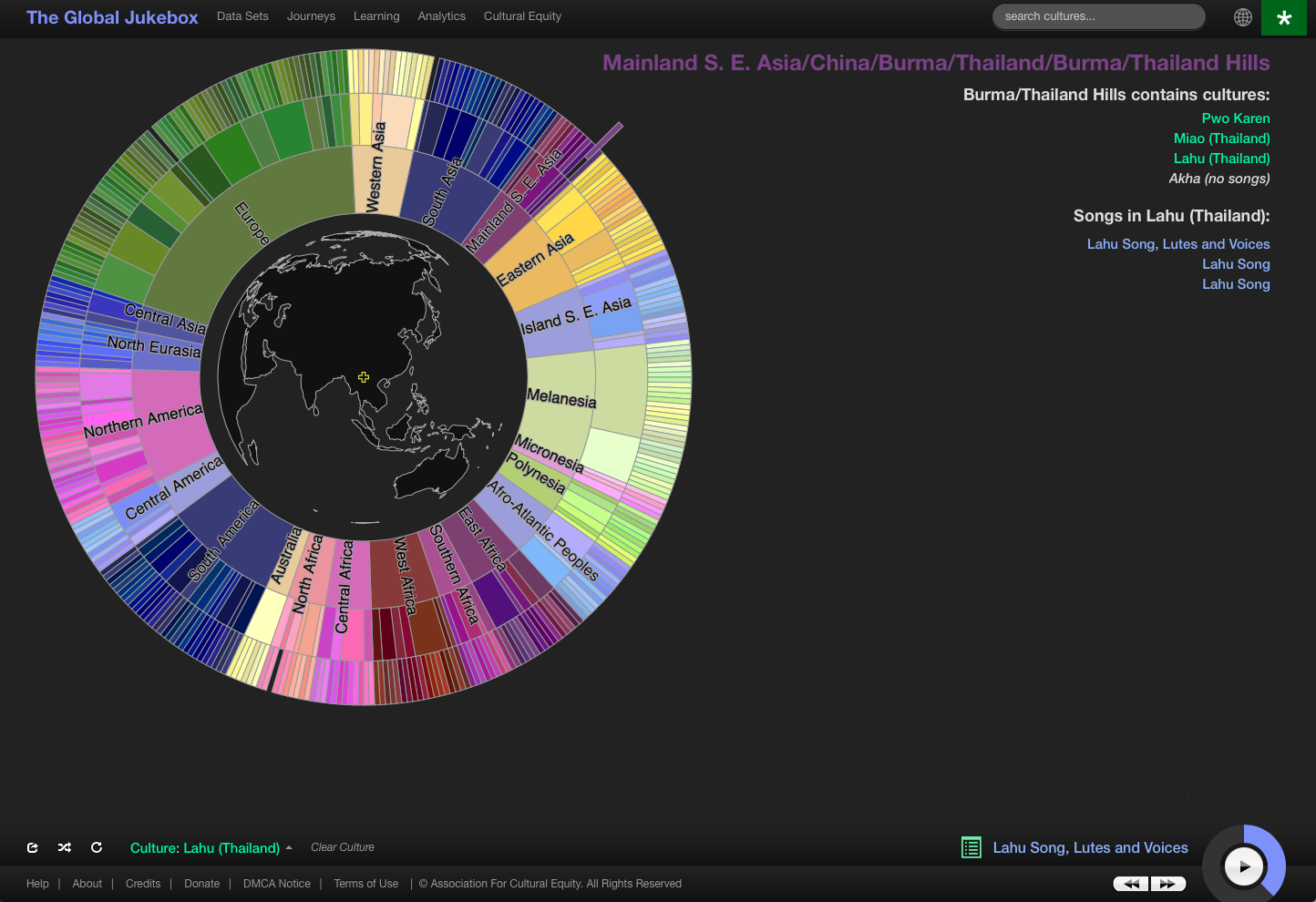
It is not, and is not meant as, a substitute for the living traditions Lomax helped safeguard, and the incredible music they have inspired professional and amateur musicians to make over the years. But the Global Jukebox gives us several unique ways of organizing and discovering those traditions—ways that are still evolving, such as a coming function for building your own cultural family tree with a playlist of songs from your musical ancestry.
Related Content:
Hear 17,000+ Traditional Folk & Blues Songs Curated by the Great Musicologist Alan Lomax
Legendary Folklorist Alan Lomax: ‘The Land Where the Blues Began’
Josh Jones is a writer and musician based in Durham, NC. Follow him at @jdmagness
Read More...138 Short Animated Introductions to the World’s Greatest Ideas: Plato, Michel Foucault, Simone de Beauvoir & More
The Open Culture audience, by my estimation, divides into two basic groups: those who’ve read the collected works of the likes of Simone de Beauvoir, Michel Foucault, and Plato, and those who’d like to. Whichever body of oft-referenced ideas you’ve been wanting to dig deep into yourself, getting a brief, concept-distilling primer beforehand can make the task easier, improving your understanding and ability to contextualize the original texts when you get around to them. Online education company Macat has produced 138 such primers in the form of animated videos freely available on YouTube which can put you in the right frame of mind to study a variety of ideas in literature, economics, sociology, politics, history, and philosophy.
De Beauvoir, in Macat’s analysis, argued in The Second Sex that “the views of individuals are socially and culturally produced. Femininity is not inherent,” but a societal mechanism long used “to keep men dominant.”
According to their video on Foucault’s Discipline and Punish, that famous book “explores the evolution of power since the Middle Ages,” culminating in the argument that “modern states have moved away from exploring their authority physically to enforcing it psychologically,” a phenomenon exemplified as much by late 18th- and early 19th-century philosopher Jeremy Bentham’s Panopticon as by modern closed-circuit television urban omni-surveillance (a technology now spread far beyond the infamously CCTV-zealous London all the way to Seoul, where I live). In The Republic, Plato asks more basic questions about society: “What would an ideal state look like, and how would it work?”
For that ancient Greek, says the video’s narrator, “the ideal society offered the guarantee of justice and would be ruled over not by a tyrant, but by an all-powerful philosopher-king.” Whether or not that strikes you as an appealing prospect, or indeed whether you agree with de Beauvoir and Foucault’s bold propositions, you stand to sharpen your mind by engaging with these and other influential ideas, including (as covered in Macat’s other three- to four-minute analyses) those of Machiavelli, David Hume, Edward Said, and Thomas Piketty. “Critical thinking is about to become one of the most in-demand set of skills in the global jobs market,” insists Macat’s marketing. “Are you ready?” Whether or not you’ll ever reference these thinkers on the job, preparing yourself to read them with an active mind will put you on the fast track to the examined life.
You can find the complete list of animations here.
Related Content:
Free Online Philosophy Courses
47 Animated Videos Explain the History of Ideas: From Aristotle to Sartre
Plato’s Cave Allegory Animated Monty Python-Style
An Animated Introduction to the Feminist Philosophy of Simone de Beauvoir
Edward Said Recalls His Depressing Meeting With Sartre, de Beauvoir & Foucault (1979)
Based in Seoul, Colin Marshall writes and broadcasts on cities and culture. He’s at work on a book about Los Angeles, A Los Angeles Primer, the video series The City in Cinema, the crowdfunded journalism project Where Is the City of the Future?, and the Los Angeles Review of Books’ Korea Blog. Follow him on Twitter at @colinmarshall or on Facebook.
Read More...The Great War and Modern Philosophy: A Free Online Course
Above, you can watch the lectures from a course called The Great War and Modern Philosophy. Taught by Nicolas de Warren, Research Professor in Philosophy at KU Leuven University, the course covers this basic ground:
World War 1 was the original catastrophe of the 20th-century. This course investigates the complex ways in which the First World War mobilized philosophical reflection during the war and the varied ways in which philosophical thought responded to the war.
Students in this course will be introduced to different philosophical reactions to the First World War through discussion and analysis of texts, documents, images, artworks, film, and music. The relation between philosophy and poetry will also be explored. In this course, students will gain historical knowledge, conceptual understanding, and literacy for a clearer grasp of the complex ways in which philosophy and the Great War intersected.
Periodically, this course is offered as a MOOC, featuring more polished lectures, over on edX.
Thinkers covered in the course include: Carl von Clausewitz, Carl Schmitt, Franz Rosenzweig, Edmund Husserl, and more.
The Great War and Modern Philosophy will be added to our list of Free Philosophy Courses, part of our collection, 1,700 Free Online Courses from Top Universities.
Read More...How Henry David Thoreau Revolutionized the Pencil
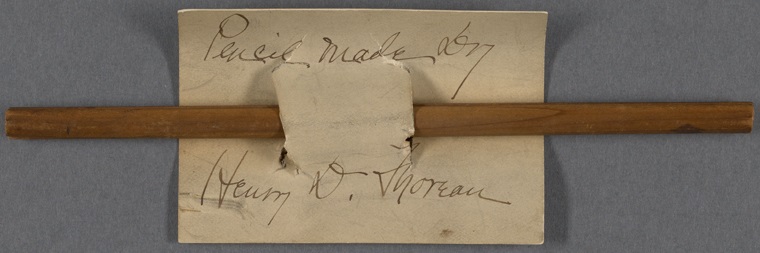
Last Thursday was National Pencil Day, which commemorates, according to The New York Public Library (NYPL), “the day in 1858 when Philadelphia immigrant Hymen Lipman patented his invention for a pencil with an eraser on top, creating the conveniently-designed pencil we know and love.”
Of course, Lipman’s invention didn’t take place in a vacuum. Throughout the 18th and 19th centuries, American inventors were hard at work, trying to find ways to make improvements to the pencil, whose history traces back to 1564. During those early days of our republic, “American pencil-making was in sorry shape,” writes NYPL. “Poor materials made domestic pencils smudgy and frail, in comparison to their superior British counterparts, which were made of purer graphite.” So the pressing question became: how to improve the quality of the graphite? Enter Henry David Thoreau, America’s great essayist, poet, philosopher, abolitionist, naturalist and tax resister. And apparently innovator too:
Seeking employment after studying at Harvard, [Thoreau] worked at his father’s pencil factory, which Edward Emerson — son of Ralph Waldo Emerson — recalled as being somewhat better than the typical American pencil factory at the time. Still, Henry David Thoreau aspired to improve the family business, so he hit the books at the Harvard College library to find out more.
…Having no knowledge of chemistry, Henry David nevertheless came up with a formula to make a pencil rivaling that made in Europe. It was the first of its kind in America.
Soon, Thoreau pencils were taking over the market, and the family’s business grew and grew. Thoreau pencils were awarded twice by Mechanic Associations and gained a local reputation in Boston for their quality. Ralph Waldo Emerson himself praised them. News of Thoreau’s pencils spread quickly, and soon, Petroski writes, they were “without peer in this country.”
Add an eraser to Thoreau’s pencil, and you’ve got Hymen Lipman’s patent for the pencil you’re pretty much using today. You can see pictures of Thoreau’s pencil over at The New York Public Library.
If you would like to support the mission of Open Culture, consider making a donation to our site. It’s hard to rely 100% on ads, and your contributions will help us continue providing the best free cultural and educational materials to learners everywhere. You can contribute through PayPal, Patreon, and Venmo (@openculture). Thanks!
Related Content:
Henry David Thoreau on When Civil Disobedience and Resistance Are Justified (1849)
David Rees Presents a Primer on the Artisanal Craft of Pencil Sharpening
David Rees and His One-Man Artisanal Pencil Sharpening Service
Read More...Hear How Clare Torry’s Vocals on Pink Floyd’s “The Great Gig in the Sky” Made the Song Go from Pretty Good to Downright Great
Smack in the middle of Pink Floyd’s classic Dark Side of the Moon sits a song many listeners may hear as an extended bridge between the two true centerpieces, “Time” and “Money.” But I’ve always thought of “The Great Gig in the Sky” as the album’s true center, a swirling, swinging, soulful prog-rock masterpiece, carried to stratospheric heights by British singer Clare Torry. The song’s wordless gospel vocal makes it an ecstatic, even hopeful, tent pole supporting Dark Side’s brilliantly cynical songs about the banality and injustice of modern life.
“The Great Gig in the Sky,” that is to say, provides much-needed emotional release in an album that can sound, writes Alexis Petridis, “like one long sigh.” Yet if you know the story of Dark Side of the Moon and of Clare Torry’s defining contribution, you’ll know that her incredible soaring vocal was sheer happenstance, an improvisation by a young unknown singer brought in at the last minute by producer Alan Parsons—and one who wasn’t a particular fan of the band. (“If it had been The Kinks,” she remembered, “I’d have been over the moon.”)
Torry reluctantly stepped into the studio and asked the band, “’Well, what do you want?’” Basically, she says, “they had no idea.” An early instrumental mix of the song from 1972 (top), foregrounds Nick Mason’s propulsive drums, Richard Wright’s Hammond organ, and samples from Apollo 17 transmissions. (These were replaced in the final version with a snippet from conservative writer Malcolm Muggeridge.)
When Torry went into the vocal booth and put on the headphones, she would have heard an even more stripped-down mix. Given no other instruction than “we don’t want any words,” she decided, “I have to pretend to be an instrument.”
Torry’s vocal is so distinctive that she eventually won a settlement in 2004 for a co-songwriting credit with Wright—an outcome some songwriting experts agree was fully justified since she essentially created a new melody for the song. In the interview above, hear Torry describe how she “had a little go” and, after some guidance from David Gilmour and a can of Heineken, casually knocked out one of the most thrilling vocal performances in rock history.
Related Content:
Watch Documentaries on the Making of Pink Floyd’s Dark Side of the Moon and Wish You Were Here
Dark Side of the Rainbow: Pink Floyd Meets The Wizard of Oz in One of the Earliest Mash-Ups
Pink Floyd’s “Echoes” Provides a Soundtrack for the Final Scene of Kubrick’s 2001: A Space Odyssey
Josh Jones is a writer and musician based in Durham, NC. Follow him at @jdmagnessd
Read More...An Animated Introduction to Roland Barthes’s Mythologies and How He Used Semiotics to Decode Popular Culture
In 1979, French theorist Jean-François Lyotard declared the end of all “grand narratives”—every “theory or intellectual system,” as Blackwell’s dictionary defines the term, “which attempts to provide a comprehensive explanation of human experience and knowledge.” The announcement arrived with all the rhetorical bombast of Nietzsche’s “God is Dead,” sweeping not only theology into the dustbin but also overarching scientific theories, Freudian psychology, Marxism, and every other “totalizing” explanation. But as Lyotard himself explained in his book The Postmodern Condition, the loss of universal coherence—or the illusion of coherence—had taken decades, a “transition,” he wrote, “under way since at least the end of the 1950s.”
We might date the onset of Postmodernism and the end of “master narratives” even earlier—to the devastation at the end of World War II and the appearance of Theodor Adorno and Max Horkheimer’s Dialectic of Enlightenment and of Roland Barthes’ slim volume Mythologies, a collection of essays written between 1954 and 56 in which the French literary theorist and cultural critic put to work his understanding of Ferdinand de Saussure’s semiotics.
As a result of reading the Swiss linguist, Barthes wrote in a preface to the 1970 edition of his book, he had “acquired the conviction that by treating ‘collective representations’ as a sign-systems, one might hope to go further than the pious show of unmasking them and account in detail for the mystification which transforms petit-bourgeois culture into a universal nature.”
While generally lumped into the category of “structuralist” thinkers, as opposed to “post-structuralists” like Lyotard, Barthes nonetheless paved the way for a particularly French mistrust of “petit-bourgeois culture” and its populist spectacles and all-knowing talking heads. He was an opponent of totalizing narratives just as he was “an unrelenting opponent of French imperialism,” writes Richard Brody at The New Yorker. Like Adorno and many other post-war European intellectuals, Barthes riffed on Marx’s notion of “false consciousness”—the mental fog produced by dogmatic education, mass media, and popular culture—and applied the idea relentlessly to his analysis of the post-industrial West.
“Barthes’s work on myths,” writes Andrew Robinson at Ceasefire Magazine, “prefigures discourse-analysis in media studies.” He directed his focus to “certain insidious myths… particularly typical of right-wing populism and of the tabloid press.” Barthes though of populist mythology as a “metalanguage” that “removes history from language,” making “particular signs appear natural, eternal, absolute, or frozen” and transforming “history into nature.” Through its normalization, we lose sight of the artifice of cable news, for example, and take for granted its formatting as a universal standard for high seriousness and credibility (as in the portentous signification of “Breaking News”), even when we know we’re being lied to.
The Al Jazeera video at the top of the post asks us to consider the “rhetorical motifs” of such media, which construct “the biggest myth of all: that what we are watching is unmediated reality.” The observation may seem elementary, but Barthes sought to go further than “the pious show of unmasking,” as he wrote. He “would have seen,” the video’s narrator says, “the TV screen as a cultural text, and he would have unveiled its myths,” as he did the myths proffered by wrestling, advertising, popular film and novels, tourism, photography, dining, and other seemingly mundane popular phenomena.
The video above from educational company Macat offers a more formal summary of Barthes’ Mythologies. The French critic and semiotician made significant contributions to literary and critical theory, demonstrating—with the wide-ranging wit and erudition of his humanist countryman Michel de Montaigne—how “dominant ideologies successfully present themselves as simply the way the world should be.” Looking back on his book over twenty years later, after the events in Paris of May 1968, Barthes remarked that the need for “ideological criticism” had been “again made brutally evident.” Indeed, we have ample reason to think that, over sixty years since Barthes published his classic analysis, the need for a rigorously critical view of mass media, advertising, and political spectacle has become more pressing than ever.
Related Content:
Hear Roland Barthes Present His 40-Hour Course, La Préparation du roman, in French (1978–80)
Animated Introductions to Edward Said’s Groundbreaking Book Orientalism
Josh Jones is a writer and musician based in Durham, NC. Follow him at @jdmagness
Read More...Søren Kierkegaard: A Free Online Course on the “Father of Existentialism”
The playlist above features roughly eight hours of video lectures on Søren Kierkegaard, the “father of existentialism.” They’re presented by Jon B. Stewart, currently a fellow at Harvard’s Radcliffe Institute for Advanced Study, and before that Associate Professor at the Søren Kierkegaard Research Center at the University of Copenhagen. You can watch them independently, or as part of an online course regularly offered by Coursera. Here’s the description for the course:
It is often claimed that relativism, subjectivism and nihilism are typically modern philosophical problems that emerge with the breakdown of traditional values, customs and ways of life. The result is the absence of meaning, the lapse of religious faith, and feeling of alienation that is so widespread in modernity.
The Danish thinker Søren Kierkegaard (1813–55) gave one of the most penetrating analyses of this complex phenomenon of modernity. But somewhat surprisingly he seeks insight into it not in any modern thinker but rather in an ancient one, the Greek philosopher Socrates.
In this course created by former associate professor at the Søren Kierkegaard Research Centre, Jon Stewart, we will explore how Kierkegaard deals with the problems associated with relativism, the lack of meaning and the undermining of religious faith that are typical of modern life. His penetrating analyses are still highly relevant today and have been seen as insightful for the leading figures of Existentialism, Post-Structuralism and Post-Modernism.
The lecture series is available on YouTube. Or find them indexed in our collection of 150 Free Philosophy Courses, a subset of our meta collection, 1,700 Free Online Courses from Top Universities.
Related Content:
Download Walter Kaufmann’s Lectures on Nietzsche, Kierkegaard, Sartre & Modern Thought (1960)
Existential Philosophy of Kierkegaard, Sartre, Camus Explained with 8‑Bit Video Games
Read More...Support Us
We're hoping to rely on loyal readers, rather than erratic ads. Please click the Donate button and support Open Culture. You can use Paypal, Venmo, Patreon, even Crypto! We thank you!

About Us

Open Culture scours the web for the best educational media. We find the free courses and audio books you need, the language lessons & educational videos you want, and plenty of enlightenment in between.
Advertise With Us
FREE UPDATES!
GET OUR DAILY EMAIL
Get the best cultural and educational resources on the web curated for you in a daily email. We never spam. Unsubscribe at any time.
FOLLOW ON SOCIAL MEDIA
Open Culture editor Dan Colman scours the web for the best educational media. He finds the free courses and audio books you need, the language lessons & movies you want, and plenty of enlightenment in between.
Advertise With Us

