Take a Trip Through the History of Modern Art with the Oscar-Winning Animation Mona Lisa Descending a Staircase
The artistic morphing is already underway before the very first frame of filmmaker Joan Gratz’ 1992 Oscar-winning animation, Mona Lisa Descending a Staircase.
Most viewers will recognize the title as a mashup of Leonardo Da Vinci’s famous work and Marcel Duchamp’s modernist classic Nude Descending a Staircase, No. 2.
What follows is a constantly morphing, chronological trip through the history of modern art, beginning with Impressionism and passing through Cubism and Surrealism en route to Pop art and hyper-realism.
The seamless transitions were created by painstakingly manipulating small pieces of oil-based modeling clay on a solid easel-mounted surface, a technique Gratz developed as an architecture student at the University of Oregon.
Van Gogh’s self-portrait reconfigures itself into Gaugin’s. Andy Warhol’s Gold Marilyn Monroe becomes Roy Lichtenstein’s Woman with Flowered Hat—a far trickier transition than had Gratz started with Picasso’s 1941 Dora Maar au Chat, the original inspiration for Lichtenstein’s 1963 work.
As Gratz told Olivier Cotte, author of Secrets of Oscar-Winning Animation:
The transitions were the most interesting aspect of the work. A great deal of what they show consists of providing information about the style of the paintings…. The relationship between the images depends on the era, the artistic movement and the interconnection between the artists.
Thus the work is not just about capturing the 55 selected images, but also their texture, from the Expressionists’ thick impasto to the post-painterly slickness of 60s pop artists.
The paintings were chosen over nearly eight years of research and planning, but not the minutiae of the transitions, as Gratz preferred to improvise in front of the camera. Just as in more narrative claymations, each painstaking adjustment required her to stop and shoot a frame, a process that ended up taking two-and-a-half years, fit in around Gratz’s schedule for such paying gigs as Return to Oz and the feature-length claymation, The Adventures of Mark Twain.
Given the spontaneous nature of the transformations from one painting to the next, the exact length of the finished film was impossible to predict. When it was at last complete, composer Jamie Haggerty and sound designer Chel White were brought in to provide further historical and cultural context, via music, environmental sounds, and conspicuous use of a digeridoo.
See more of Gratz’s clay painting technique in the music video for Peter Gabriel’s “Digging in the Dirt,” and ads for Coca-Cola and Microsoft.
Read Olivier Cotta’s analysis of Mona Lisa Descending a Staircase, including a longer interview with Joan Gratz here.
Mona Lisa Descending a Staircase will be added to our list of Animations, a subset of our collection, 4,000+ Free Movies Online: Great Classics, Indies, Noir, Westerns, Documentaries & More.
Related Content:
Van Gogh’s 1888 Painting, “The Night Cafe,” Animated with Oculus Virtual Reality Software
Hear Marcel Duchamp Read “The Creative Act,” A Short Lecture on What Makes Great Art, Great
Ayun Halliday is an author, illustrator, theater maker and Chief Primatologist of the East Village Inky zine. She’ll be appearing onstage in New York City this June as one of the clowns in Paul Young’s Faust 3. Follow her @AyunHalliday.
Read More...Huge Hands Rise Out of Venice’s Waters to Support the City Threatened by Climate Change: A Poignant New Sculpture
Upon arriving in Venice in the late 1930s, columnist and Algonquin Round Table regular Robert Benchley immediately sent a telegram back home to America: “Streets full of water. Please advise.” The line has taken its place in the canon of American humor, but in more recent times the image of water-filled streets — unintentionally water-filled streets, that is — has arisen most often in the conversation about climate change. Some of the potential disaster scenarios envision every major coastal city on Earth eventually turning into a kind of Venice, albeit a much less pleasant version thereof.

And so what better place than the one that hosts perhaps the world’s best known art exhibition, the Venice Biennale, to express climate-change anxiety in the form of public sculpture? “Venice is known for its gondolas, canals, and historic bridges,” writes Condé Nast Traveler’s Sebastian Modak, “but visitors will now also be greeted by another, albeit temporary, reminder of the city’s intimate relationship with water: a giant pair of hands reaching out of the Grand Canal and appearing to support the walls of the historic Ca’ Sagredo Hotel.” The piece is called Support, and it’s created by Barcelona-based Italian sculptor Lorenzo Quinn.
“I have three children, and I’m thinking about their generation and what world we’re going to pass on to them,” Quinn told Mashable’s Maria Gallucci. “I’m worried, I’m very worried.” The hands of his 11-year-old son actually provided the model for the polyurethane-and-resin hands of Support, weighing 5,000 pounds each, that stand on 30-foot pillars at the bottom of the Grand Canal. Modak quotes one of Quinn’s Instagram posts which describes the work as speaking to the people “in a clear, simple and direct way through the innocent hands of a child and it evokes a powerful message, which is that united we can make a stand to curb the climate change that affects us all.”
Those arguing in favor of more aggressive political measures to counteract the effects of climate change have gone to great lengths to point out what forms those effects have so far taken. But the fact that, apart from a stretch of hot summers, few of those effects have yet manifested undeniably in most people’s lives has certainly made their job harder. But nobody who visits Venice during the Biennale could fail to pause before Support, a work whose visual drama demands a reaction that temperature charts or data-filled studies can’t hope to provoke by themselves. And even apart from the issue at hand, as it were, Quinn’s sculpture reminds us that art, even in as deeply historical a setting as Venice, can also keep us thinking about the future.
Related Content:
Global Warming: A Free Course from UChicago Explains Climate Change
132 Years of Global Warming Visualized in 26 Dramatically Animated Seconds
A Song of Our Warming Planet: Cellist Turns 130 Years of Climate Change Data into Music
How Climate Change Is Threatening Your Daily Cup of Coffee
Frank Capra’s Science Film The Unchained Goddess Warns of Climate Change in 1958
Watch Episode 1 of Years of Living Dangerously, The New Showtime Series on Climate Change
Based in Seoul, Colin Marshall writes and broadcasts on cities and culture. He’s at work on a book about Los Angeles, A Los Angeles Primer, the video series The City in Cinema, the crowdfunded journalism project Where Is the City of the Future?, and the Los Angeles Review of Books’ Korea Blog. Follow him on Twitter at @colinmarshall or on Facebook.
Read More...The MC5 Performs at the 1968 Chicago Democratic National Convention, Right Before All Hell Breaks Loose
With some rare exceptions (Sid and Nancy, I’m Not There, maybe Walk the Line and Cadillac Records), biopics usually stumble badly when they try to recreate the personalities and atmospheres of famous musicians. For this reason I am grateful that no studio has yet attempted a narrative of one of my favorite bands, the not-quite-famous MC5. On the other hand, it’s hard to believe there’s no script in development somewhere. If there’s one band whose story—and music—deserves a wider audience, it’s this one. Sadly, guitarist Wayne Kramer has suppressed a very well-reviewed documentary that might do them as much justice as any film can.
Formed in Lincoln Park Michigan in 1964, the “Motor City 5” became synonymous with Detroit’s leftist political scene. They were also some of the most uncompromising garage rockers to emerge from the era, along with proto-punks The Stooges, with whom they often performed.
By the time of the infamous 1968 Democratic convention in Chicago—well-known for the brutal attacks of police against thousands of aggrieved protesters—the MC5 had become heavily influenced by Fred Hampton and Huey Newton. Under their manager John Sinclair, they became prominent representatives of the “White Panthers,” an anti-racist analogue of the Black Panthers formed on a suggestion of Newton’s.
In September of 1968, Sinclair would be indicted for taking part in the bombing a CIA office in Ann Arbor. But exactly one month prior, he presided over the MC5’s appearance at the riotous Chicago Democratic National Convention. The band was booked as part of Abbie Hoffman’s attempt to stage a “Festival of Life,” bringing 100,000 young people to the city “for five days of peace, love, and music,” writes the site Chicago ’68, to “redirect youth culture and music toward political ends.” Fittingly, perhaps, the MC5 was the only band that showed up after Hoffman and his Yippies failed to secure the permits. They played for less than an hour to a crowd of a few thousand. Kramer remembered the day in a 2008 interview:
There was no stage, there was no flatbed truck, there was no sound system, there were no porta-toilets, there was no electricity. We had to run an electrical cord from the hot dog stand to power our gear. We played on the ground in the middle of Lincoln Park in Chicago with the crowd all around us sitting on the ground, in the back standing. I’m going to guess there were maybe 3,000 young people there. And it was very tense. The Chicago police had been very aggressive and very intimidating all day, and even though it was a rock concert and we were the only band to play, it didn’t feel like a rock concert. There was a dark cloud over the day because we knew the likelihood of people being hurt was great.
The only film we seem to have of the event is silent surveillance footage at the top of the post. Further down, see clips of the rioting that ensued, with the band’s hit “Kick Out the Jams” played over it. And just below, see a video of them playing the song over a backdrop of riot footage. They released their debut album, Kick Out the Jams , the following year. It was an uneven collection of performances, but “when they got it right,” says Michael Hann, “they simply got it completely right.” It was certainly their philosophy to go all in. As Kramer described it, “You have to come early, and you have to stay late. The song doesn’t say, ‘Slide out the jams.” It doesn’t say, ‘Stroll out the jams.” It says, ‘Kick out the jams!’”
What I find fascinating about the emergence of the MC5 at this time in history is how great of a contrast they presented to the weary blues of the Rolling Stones, who became grimly linked in ’69 at Altamont with the cynical end of flower power. Despite their association with the violent spectacle of the DNC riots—another sign of the hippie apocalypse—the MC5 became the soundtrack for people power, and in a way bridged the R&B, garage rock, psychedelia, punk, and metal of the gritty 1970s to come. But addiction, political repression, and censorship killed the band a few years later. Lead singer Rob Tyner died in 1991, and guitarist Fred “Sonic” Smith, who married Patti Smith, passed away in 1994.
Kramer has carried on, and still tours (and gives lectures). When he revisited the DNC in 2008 for an unofficial performance and anti-war protest, he reflected on the politics of the day. “It will be helpful not to have to battle as hard as we have with the Bush administration,” he told The Huffington Post, “but Barack Obama cannot save us. It’s really a matter of people themselves taking action in their own neighborhoods, at their own jobs, in their own homes, with their own friends, their own co-workers, to move us into the future, a more just world.” The people power the MC5 represented lives on even into this grim era, and the band itself will always live in legend, if not—for good or ill—in cinema.
Related Content:
A Gallery of Visually Arresting Posters from the May 1968 Paris Uprising
New Jim Jarmusch Documentary on Iggy Pop & The Stooges Now Streaming Free on Amazon Prime
Josh Jones is a writer and musician based in Durham, NC. Follow him at @jdmagness
Read More...“Calling Bullshit”: Watch Lectures for the College Course Designed to Combat the BS in our Information Age
This past January, we highlighted a syllabus for a tentative course called “Calling Bullshit,” designed by two professors at the University of Washington, Carl Bergstrom and Jevin West.
The course–also sometimes called “Calling Bullshit in the Age of Big Data”–ended up being offered this spring. And now you can see how it unfolded in the classroom. The 10 video lectures from the class are available online. Watch them above, or at this YouTube playlist. Also find them housed in our collection, 1,700 Free Online Courses from Top Universities.
According to The Seattle Times, the course “achieved the academic version of a chart-topping pop single: At the UW [University of Washington], it reached its 160-student capacity shortly after registration opened this spring.” And now colleges “in Canada, France, Portugal, England and Australia have contacted the professors about teaching a version of the course this fall.”
The course itself was premised on this basic idea: “Bullshit is everywhere, and we’ve had enough. We want to teach people to detect and defuse bullshit wherever it may arise.”
A longer overview of the course appears below. It was cited in our original post. And it’s worth highlighting again:
The world is awash in bullshit. Politicians are unconstrained by facts. Science is conducted by press release. Higher education rewards bullshit over analytic thought. Startup culture elevates bullshit to high art. Advertisers wink conspiratorially and invite us to join them in seeing through all the bullshit — and take advantage of our lowered guard to bombard us with bullshit of the second order. The majority of administrative activity, whether in private business or the public sphere, seems to be little more than a sophisticated exercise in the combinatorial reassembly of bullshit.
We’re sick of it. It’s time to do something, and as educators, one constructive thing we know how to do is to teach people. So, the aim of this course is to help students navigate the bullshit-rich modern environment by identifying bullshit, seeing through it, and combating it with effective analysis and argument.
What do we mean, exactly, by the term bullshit? As a first approximation, bullshit is language, statistical figures, data graphics, and other forms of presentation intended to persuade by impressing and overwhelming a reader or listener, with a blatant disregard for truth and logical coherence.
While bullshit may reach its apogee in the political domain, this is not a course on political bullshit. Instead, we will focus on bullshit that comes clad in the trappings of scholarly discourse. Traditionally, such highbrow nonsense has come couched in big words and fancy rhetoric, but more and more we see it presented instead in the guise of big data and fancy algorithms — and these quantitative, statistical, and computational forms of bullshit are those that we will be addressing in the present course….
Our aim in this course is to teach you how to think critically about the data and models that constitute evidence in the social and natural sciences.
If you’re interested in watching the course, get started with Lecture 1: Introduction to Bullshit.
To learn more about the course, please visit this website.
If you would like to support the mission of Open Culture, consider making a donation to our site. It’s hard to rely 100% on ads, and your contributions will help us continue providing the best free cultural and educational materials to learners everywhere. You can contribute through PayPal, Patreon, and Venmo (@openculture). Thanks!
Related Content:
How to Spot Bullshit: A Primer by Princeton Philosopher Harry Frankfurt
Read More...How Filmmakers Tell Their Stories: Three Insightful Video Essays Demystify the Craft of Editing, Composition & Color
Everyone knows that if you want to make a movie, you first have to write down its story. Many of us have tried our hands at writing movie stories ourselves — as treatments, screenplays, or whichever other forms the industry has come up with — and some have made careers out of it. But even if a film begins on the page, it doesn’t, of course, remain there; up on screen, the final product has to tell its story visually as much as it does with words, and usually even more so. Lewis Bond, the video essayist behind the cinema-analyzing Youtube channel Channel Criswell, understands that better than most, hence his three essays dedicated to the three most important elements of visual storytelling, the first chapter of which, “Colour in Storytelling,” we featured a couple months ago here on Open Culture.
The second, “Composition in Storytelling,” explores the possibilities inherent in arranging people, places, and things within a shot. “Deciding the placement of subjects through the viewfinder of a camera isn’t merely a technical decision,” says Bond, “it’s an expressive one.”
Beyond showing the audience what they need to see to understand the story, filmmakers have relied on “tried and tested formulas to make an image pleasing to the eye” such as the rule of thirds, the golden ratio, and triangular composition. But beyond those basics opens up the vast creative space of composing images in order to carefully guide the audience’s attention, craft symbols and subtexts, and make the power of a scene felt — all as dependent upon what gets left out of the picture as what gets put in.
Finally, “Editing in Storytelling” covers the step of the filmmaking process widely considered one of the most important, even more so than writing the story in the first place. “Beyond the basic function of putting a film together,” says Bond, “the craftsmanship of editing can be dealt with such subtlety that it can be the foundation of a film’s pace, its atmosphere — it can even be the enriching ingredient to strengthen all the film’s themes, and you may not even notice.” Though the editor holds “total manipulation over our emotions,” deciding what we see, when we see it, and how we see it, they also labor under the responsibility of knowing the film will stand or fall on their skill. Watch Channel Criswell’s entire visual storytelling essay trilogy and you’ll notice all their techniques much more easily while watching movies — especially if you start watching them, as you might well find yourself inspired to do, with the sound off.
Related Content:
Alfred Hitchcock’s 7‑Minute Master Class on Film Editing
“Bleu, Blanc, Rouge”: a Striking Supercut of the Vivid Colors in Jean-Luc Godard’s 1960s Films
Wes Anderson Likes the Color Red (and Yellow)
Stanley Kubrick’s Obsession with the Color Red: A Supercut
Based in Seoul, Colin Marshall writes and broadcasts on cities and culture. He’s at work on a book about Los Angeles, A Los Angeles Primer, the video series The City in Cinema, the crowdfunded journalism project Where Is the City of the Future?, and the Los Angeles Review of Books’ Korea Blog. Follow him on Twitter at @colinmarshall or on Facebook.
Read More...The Love Letters of Hannah Arendt and Martin Heidegger
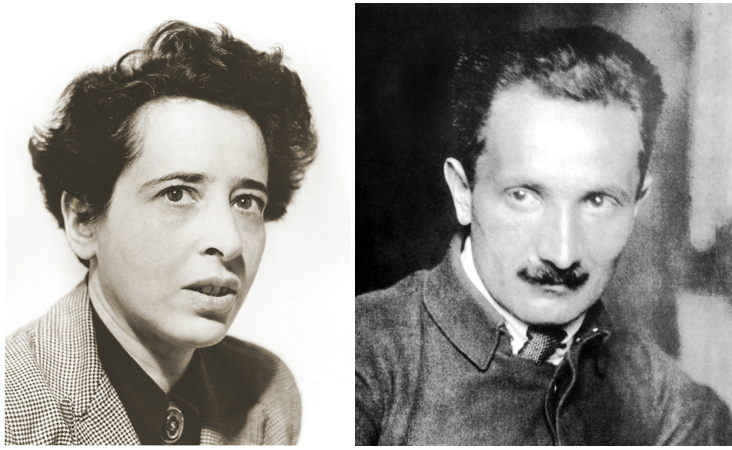
The notorious four-year affair between Hannah Arendt and Martin Heidegger has occasioned many a bitter academic debate, for reasons with which you may already be familiar. If not, Alan Ryan sums it up succinctly in a 1996 New York Review of Books essay:
She was a Jew who fled Germany in August 1933, a few months after Hitler’s assumption of power. He was elected Rector of the University of Freiburg in the spring of 1933, and in a notorious inaugural address hailed the presence of the brown-shirted storm-troopers in his audience, claimed that Hitler would restore the German people to spiritual health, and ended by giving the familiar stiff-armed Nazi salute to cries of “Sieg Heil.” The thought that these two were ever soulmates is hard to swallow.
Arendt went on to write The Origins of Totalitarianism and Eichmann in Jerusalem, in which she used the phrase “banality of evil” for the Nazi functionary on trial at Nuremberg. Heidegger refused to discuss his collaboration publicly and “remained silent about the extermination of the Jews, about the terrorism of Hitler’s regime.” But as we’ve learned from his recently published journals, the so-called Black Notebooks, he was privately a “convinced Nazi,” as Peter Gordon observes, who “did not awaken from his philosophical-political fantasies. They only grew more extreme.”
But indeed, Arendt and Heidegger were in love, during an affair that began when she was an 18-year-old student and he her married 36-year-old professor. Their letters show an illicit relationship developing from caution to infatuation. Heidegger waxed romantically philosophical:
.…we become what we love and yet remain ourselves. Then we want to thank the beloved, but find nothing that suffices.
We can only thank with our selves. Love transforms gratitude into loyalty to our selves and unconditional faith in the other. That is how love steadily intensifies its innermost secret.
But both of them knew the relationship could not last, and Heidegger suggested that moving on from him would be in her best interest as a young scholar. In 1929, Arendt met and became engaged to a German journalist and classmate in Heidegger’s seminar. She sent her professor a note on her wedding day which begins, “Do not forget me, and do not forget how much and how deeply I know that our love has become the blessing of my life.”
Before his Nazi appointment, Arendt wrote to her former lover and mentor in 1932 or 33 upon hearing rumors “about Heidegger’s sympathy with National Socialism.” (Her letter has been lost.) He replied with a number of excuses for specific acts—such as refusing to supervise Jewish students—and assured her of his feelings, but “nowhere in the letter is there any denial of Nazi sympathies,” writes Adam Kirsch at The New Yorker. The two met after the war in Freiburg, and Heidegger later sent Arendt a passionate, poetic letter in 1950, extolling the “exciting, still almost unspoken understanding” between them, “emerging from an affinity that was created so quickly, that comes from so far away, that has not been shaken by evil and confusion.”
Later, in a 1969 birthday tribute essay “Martin Heidegger at Eighty,” Arendt penned what has generally been taken as an exoneration of Heidegger. In it, she “compared Heidegger to Thales,” writes Gordon, “the ancient philosopher who grew so absorbed in contemplating the heavens that he stumbled into the well at his feet.” The truth is quite a bit more complicated than that, and quite a bit less lofty. But as Maria Popova eloquently writes, their relationship “exposes the complexity and contradiction of which the human spirit is woven, its threads nowhere more ragged than in love.” Read many more excerpts from their letters at Brain Pickings. And find complete letters collected in the volume, Letters: 1925–1975 — Martin Heidegger and Hannah Arendt.
via Brain Pickings
Related Content:
Heidegger’s “Black Notebooks” Suggest He Was a Serious Anti-Semite, Not Just a Naive Nazi
Martin Heidegger Talks Philosophy with a Buddhist Monk on German Television (1963)
Josh Jones is a writer and musician based in Durham, NC. Follow him at @jdmagness
Read More...The History of Electronic Music Visualized on a Circuit Diagram of a 1950s Theremin: 200 Inventors, Composers & Musicians

No historical leap forward has changed human culture more than the harnessing and commercialization of electricity. It may seem banal to point out such a truism—of course, nothing in the modern world would be what it is without the furious activity of Thomas Edison, Nikola Tesla, and so many other inventors and early electrical engineers. But the scope of electricity’s role in the music of the past hundred plus years becomes truly awe-inspiring when we see it mapped out in the blueprint-like graphic above, “Electric Love,” inspired by circuit diagrams from the 1950s for a Theremin. (You can view the graphic in a larger, zoomable fashion here.)
As we noted in an earlier post, designer of “Electric Love” James Quail has created a similar diagram for Alternative and Indie rock, based on the circuit layout for a 1954 transistor radio. In the electronic music version here, not only does Quail draw on older technology, but he reaches back to earlier ancestors as well: to Edison, Alexander Graham Bell rival Elisha Gray, and Édouard-Léon Scott de Martinville, inventor of the obscure early recording device the phonautograph.
It’s a choice that foregrounds just how much technicians and engineers contributed directly to the sound of the modern world. Among them, of course, is the late Robert Moog, inventor of the portable analog synthesizer that become ubiquitous in nearly every genre of modern music, and whose work “was actually based,” notes Wired, “on technology from the 1800s.”

When it comes to the musicians who took this technology and transformed it into avant-gardism and dance records, the relationships are complex and perhaps impossible to fully represent in simple terms given the number of indirect influences through sampling technology. But “Electric Love” does an admirable job of showing how diffuse and diverse the music made by analog and digital technology has been. From the musique concrete of Pierre Schaffer, the experimentalism of Karlheinz Stockhausen and Arnold Schoenberg, commercial avant-garde of Delia Derbyshire and Wendy Carlos, minimalism of Steve Reich and Philip Glass, new wave of Kraftwerk, house and hip hop of Derrick May, Afrika Bambaataa and Kool DJ Herc, ambient soundscapes of Brian Eno, jittery electronica of Aphex Twin, synthpop of Depeche Mode and New Order…

It’s seemingly all there, and everything in-between, connected, Quail says, according to “common link[s]—whether that’s a style, or an instrument, or an influence on one another.” Even The Beatles and Pink Floyd show up, presumably for their creative studio experiments. On the whole, however, most of the smaller names here are much less familiar by comparison to Quail’s Alternative chart, but for true fans of electronic music, this only means there’s more to discover in this visual compendium of “over 200 inventors, innovators, artists, composers and musicians.” You can purchase “Electric Love” as a print from design house Dorothy.
Related Content:
The History of Electronic Music in 476 Tracks (1937–2001)
Josh Jones is a writer and musician based in Durham, NC. Follow him at @jdmagness
Read More...Holocaust Survivor Viktor Frankl Explains Why If We Have True Meaning in Our Lives, We Can Make It Through the Darkest of Times
In one school of popular reasoning, people judge historical outcomes that they think are favorable as worthy tradeoffs for historical atrocities. The argument appears in some of the most inappropriate contexts, such as discussions of slavery or the Holocaust. Or in individual thought experiments, such as that of a famous inventor whose birth was the result of a brutal assault. There are a great many people who consider this thinking repulsive, morally corrosive, and astoundingly presumptuous. Not only does it assume that every terrible thing that happens is part of a benevolent design, but it pretends to know which circumstances count as unqualified goods, and which can be blithely ignored. It determines future actions from a tidy and convenient story of the past.
We might contrast this attitude with a more Zen stance, for example, a radically agnostic “wait and see” approach to everything that happens. Not-knowing seems to give meditating monks a great deal of serenity in practice. But the theory terrifies most of us. Effects must have causes, we think, causes must have effects, and in order to predict what’s going to happen next (and thereby save our skins), we must know why we’re doing what we’re doing. The deep impulse is what psychologist and psychotherapist Viktor Frankl identifies, in his pre-gender-neutrally titled book, as Man’s Search for Meaning. Despite the misuse of this faculty to create neurotic or dehumanizing myths, “man’s search for meaning,” writes Frankl, “is the primary motivation in his life and not a ‘secondary rationalization’ of instinctual drives.”
Frankl understood perfectly well how the construction of meaning—through narrative, art, relationships, social fictions, etc.—might be perverted for murderous ends. He was a survivor of four concentration camps, which took the lives of his parents, brother, and wife. The first part of his book, “Experiences in a Concentration Camp,” recounts the horror in detail, sparing no one accountability for their actions. From these experiences, Frankl draws a conclusion, one he explains in the interview above in two parts from 1977. “The lesson one could learn from Auschwitz,” he says, “and in other concentration camps, in the final analysis was, those who were oriented toward a meaning—toward a meaning to be fulfilled by them in the future—were most likely to survive” beyond the experience. “The question,” Frankl says, “was survival for what?” (See a short animated summary of Frankl’s book below.)
Frankl does not excuse the deaths of his family, friends, and millions of others in his psychological theory, which he calls logotherapy. He certainly does not trivialize the most unimaginable of in-human experiences. “We all said to each other in camp,” he writes, “that there could be no earthly happiness which could compensate for all we had suffered.” But it was not the hope of happiness that “gave us courage,” he writes. It was the “will to meaning” that looked to the future, not to the past. In Frankl’s existentialist view, we ourselves create that meaning, for ourselves, and not for others. Logotherapy, Frankl writes, “defocuses all the vicious-circle formations and feedback mechanisms which play such a great role in the development of neuroses.” We must acknowledge the need to make sense of our lives and fill what Frankl called the “existential vacuum.” And we alone are responsible for writing better stories for ourselves.
To dig deeper in Frankl’s philosophy, you can read not only Man’s Search for Meaning but also The Will to Meaning: Foundations and Applications of Logotherapy.
Related Content:
Albert Camus’ Historic Lecture, “The Human Crisis,” Performed by Actor Viggo Mortensen
Josh Jones is a writer and musician based in Durham, NC. Follow him at @jdmagness
Read More...Montblanc Unveils a New Line of Miles Davis Pens … and (Kind of) Blue Ink

Got spare cash burning a hole in your pocket? An urge to commodify your favorite jazz artist? The need for an admittedly beautiful writing instrument? All of the above, you say? Good, because Montblanc recently unveiled a new line of Miles Davis pens. They’ve got the Miles Davis ballpoint pen, fountain pen, and roller pen. But surely the pièce de résistance is the Miles Davis Limited Edition 1926 Fountain Pen, which “tells the story of one of the greatest jazz personalities.” “The surface of the cap and barrel is engraved with symbolic motifs that refer to the five major jazz periods he helped to create.” What’s more, “a star, set with a diamond, is engraved on the barrel, and Miles Davis’s famous album Kind of Blue is reflected in the blue color on the cone.” Swank.
And what’s a pen without ink? It’s blue, of course. Get a close up view of that here.
If you would like to support the mission of Open Culture, consider making a donation to our site. It’s hard to rely 100% on ads, and your contributions will help us continue providing the best free cultural and educational materials to learners everywhere. You can contribute through PayPal, Patreon, and Venmo (@openculture). Thanks!
Related Content:
The Night When Miles Davis Opened for the Grateful Dead in 1970: Hear the Complete Recordings
Read More...The Career of Paul Thomas Anderson: A 5‑Part Video Essay on the Auteur of Boogie Nights, Punch-Drunk Love, The Master, and More
For at least the past decade and a half, each of Paul Thomas Anderson’s movies has arrived in theaters as a major cinematic event. By pure chance, I got an especially powerful taste of this a few years ago in Los Angeles when, after a revival screening of The Shining, we in the audience were told to stay right there in our seats for the rest of the night’s surprise double-feature, the second half being Anderson’s as yet unreleased and almost completely unseen The Master — projected in 70-millimeter. Needless to say, nobody left, so palpable was the desire to experience the next phase of the cinematic vision of the auteur who has, to that point, given us Hard Eight, Boogie Nights, Magnolia, Punch-Drunk Love, and There Will Be Blood.
So what makes Anderson’s cinematic vision so compelling? Video essayist Cameron Beyl, creator of The Directors Series (whose explorations of Stanley Kubrick, David Fincher, and the Coen brothers we’ve previously featured here on Open Culture), attempts an answer in this analysis of Anderson’s films, each of whose chapters reflect a chapter of the auteur’s journey to his current prominence. The first of them finds him, at seventeen after a childhood in the San Fernando Valley, shooting a porn-star mockumentary called The Dirk Diggler Story, elements of which would later shape his 1997 porn-industry epic Boogie Nights. Having ditched film school after just two days, the slightly older Anderson set out to make Cigarettes & Coffee, a short tale of low life told in high style that would expand into his first feature, the mistreated but rediscovered Hard Eight.
Beyl’s miniseries of video essays, which runs nearly three hours in total, continues from Anderson’s early Sundance success (a success that did much to raise the profile of the festival itself) to his much larger-budget “California chronicles” Boogie Nights and Magnolia, his “concept comedies” Punch-Drunk Love and various other shorts made at the time, his “portraits of power” There Will Be Blood and The Master, and his ascent to “higher states” in the Thomas Pynchon adaptation Inherent Vice and the documentary Junjun.
Beyl describes Anderson as undeniably “born to be a filmmaker,” and so it stands to reason that, though his favorite themes including family, power, and sexual dysfunction remain constant, each new phase of the director’s life results in a new phase in his filmmaking — or indeed, the other way around. And so everyone who takes film seriously eagerly awaits his next chapter.
Related Content:
The Hidden Secrets in “Daydreaming,” Paul Thomas Anderson’s New Radiohead Music Video
Two Short Films on Coffee and Cigarettes from Jim Jarmusch & Paul Thomas Anderson
Discover the Life & Work of Stanley Kubrick in a Sweeping Three-Hour Video Essay
Based in Seoul, Colin Marshall writes and broadcasts on cities and culture. He’s at work on a book about Los Angeles, A Los Angeles Primer, the video series The City in Cinema, the crowdfunded journalism project Where Is the City of the Future?, and the Los Angeles Review of Books’ Korea Blog. Follow him on Twitter at @colinmarshall or on Facebook.
Read More...Support Us
We're hoping to rely on loyal readers, rather than erratic ads. Please click the Donate button and support Open Culture. You can use Paypal, Venmo, Patreon, even Crypto! We thank you!

About Us

Open Culture scours the web for the best educational media. We find the free courses and audio books you need, the language lessons & educational videos you want, and plenty of enlightenment in between.
Advertise With Us
FREE UPDATES!
GET OUR DAILY EMAIL
Get the best cultural and educational resources on the web curated for you in a daily email. We never spam. Unsubscribe at any time.
FOLLOW ON SOCIAL MEDIA
Open Culture editor Dan Colman scours the web for the best educational media. He finds the free courses and audio books you need, the language lessons & movies you want, and plenty of enlightenment in between.
Advertise With Us

