Watch an Epic, 4‑Hour Video Essay on the Making & Mythology of David Lynch’s Twin Peaks
If you’re like me, every little bit of information doled out for the upcoming third season of Twin Peaks is like a series of clues found along a dark path through the Ghostwood National Forest. We’ve seen brief views of some major characters. We’ve heard Angelo Badalamenti confirm he’s back to score the series. We picked up and speed read the Mark Frost-written Secret History. We know that it will be 18 hours of pure David Lynch and Mark Frost, and that whatever it may do, it won’t go all wonky and not-so-good like the terrible trough in the middle of Season Two. And now we have a date for the premiere: May 21.
So it’s not time to brew coffee, or put a cherry pie in the oven, just yet. Instead, it’s time to bone up on the series itself and ask ourselves, is Twin Peaks a failed series that needs to be rectified? Or if Lynch and Frost had never agreed to revisit their iconic work, would we still have a cohesive work?
Video essayist Joel Bocko says yes, and has made what is probably the definitive and most thorough analysis of the series out there on the web.
I first stumbled across Journey Through Twin Peaks one night, and thinking that it was only one short video essay I started watching. My mistake: episode one was only the first in a 28-chapter series that totaled over four hours, arranged in four parts. And, yes, I sat and watched the whole damn thing.
Bocko is good, real good. This is not uncritical fan worship. This is a man, like many of us, who fell in love with the transcendent heights of the show and suffered through its miserable lows, but, through that misery, figured out what made the show such a game-changer.
One important thing Bocko does is give Mark Frost his due. Usually hidden behind the art and the mythos of Lynch, Frost brought much to the show, from the detective procedural framework to themes of the occult and Theosophy. Bocko shows how Lynch came out of the Twin Peaks experience with a completely different and much more complex idea of character. Before Peaks, Lynch’s work saw good and evil existing not just on opposite sides of the spectrum, but as different characters. (Think of Blue Velvet.) In the films he makes afterwards, doppelgangers, fugue states, and self-negation, along with the spiritual confusion that come with it, are central to Lynch’s work.
But that’s just one of the many insights waiting for you in this rewarding analytical work, which also takes in Fire Walk With Me and Mulholland Dr. through to Inland Empire. Suffice it to say, it’s full of spoilers, so proceed with caution.
On the other hand, if you don’t have time before the premiere, you can always watch the first season in under a minute here.
Related Content:
Twin Peaks Tarot Cards Now Available as 78-Card Deck
David Lynch’s Twin Peaks Title Sequence, Recreated in an Adorable Paper Animation
Ted Mills is a freelance writer on the arts who currently hosts the artist interview-based FunkZone Podcast. You can also follow him on Twitter at @tedmills, read his other arts writing at tedmills.com and/or watch his films here.
Read More...Photographer Creates Stunning Realistic Portraits That Recreate Surreal Scenes from Hieronymus Bosch Paintings
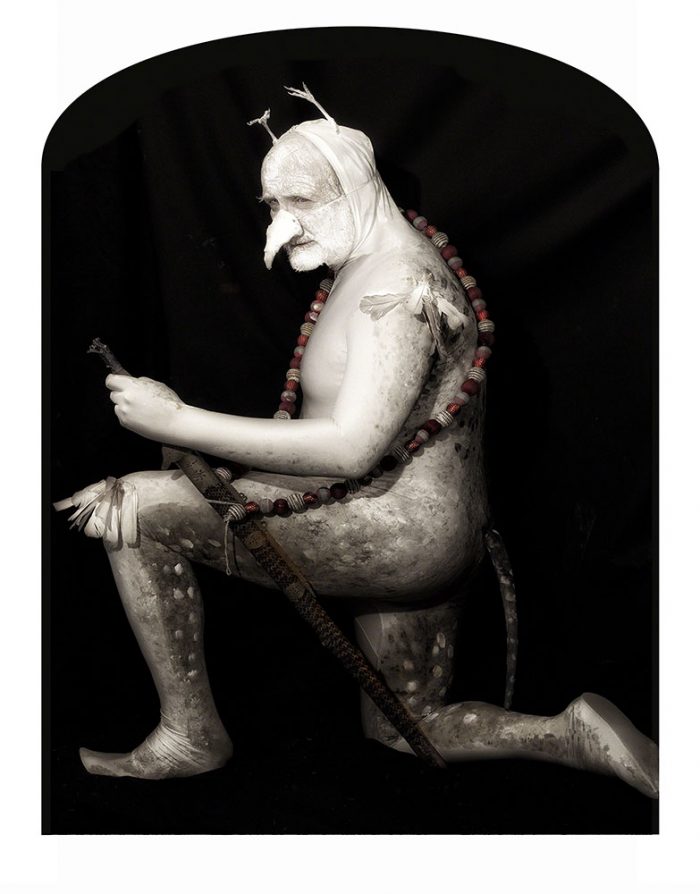
All images courtesy of Lori Pond
It is not often noted that the surrealist movement in the 1920s originated with poets like Paul Éluard and André Breton, himself a trained psychologist, who drew explicitly from the work of Sigmund Freud, “the private world of the mind,” as the Metropolitan Museum of Art puts it. And yet we certainly see the influence of Freudian poetry in the work of Giorgio de Chirico, Marcel Duchamp, Salvador Dalí, Joan Miró, and Man Ray. We also see it, inexplicably, in the work of Hieronymus Bosch, that 15th century Dutch painter of bizarre works like The Garden of Earthly Delights, a triptych that becomes exponentially more nightmarish as one scans across it from left to right. (Take a virtual tour of the painting here), and from which photographer Lori Pond draws in the astonishing photographs you see here.
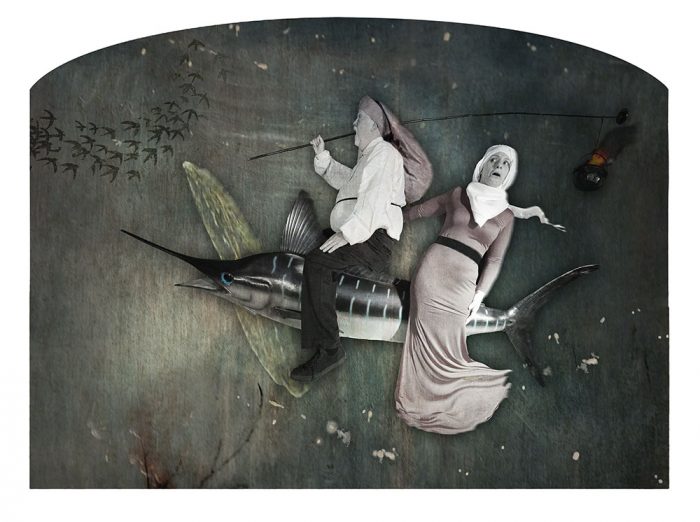
How does such a faraway figure as Bosch, whom we know so little about, seem to communicate so closely with our epoch’s artistic movements? The Garden of Earthly Delights, writes Stephen Holden at the New York Times, “outstrips in boldness many of the extreme digital fantasies in Hollywood horror films.” Bosch’s incredibly detailed paintings “feel startlingly contemporary.… Reproductions of his paintings have adorned rock album covers, been parodied on The Simpsons and printed on silk bodices designed by Alexander McQueen.” And he was, in fact, named “Trendiest Apocalyptic Medieval Painter of 2014.”
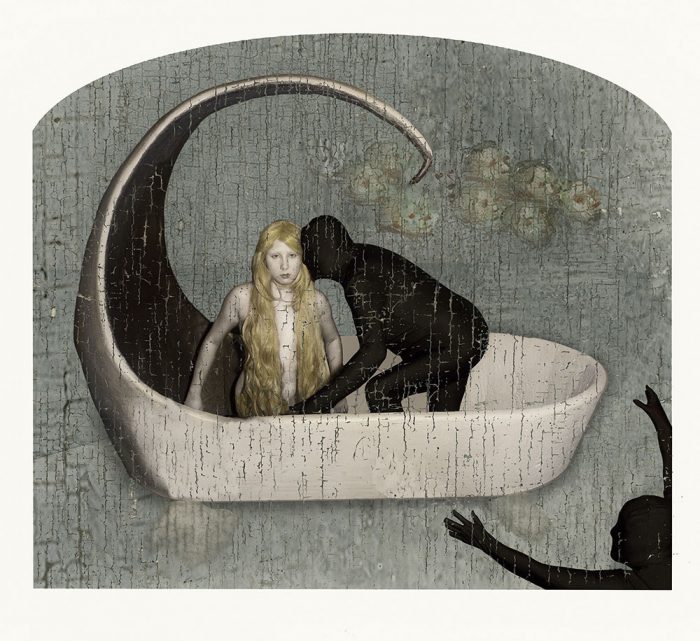
We might well wonder what Bosch would have done with the same technologies as those who now pay him tribute. Perhaps something very much like Pond has with her Bosch Redux series, a collection of photographs of very close-up details in several of Bosch’s paintings, featuring one or two characters. To make these photos, writes Alyssa Coppelman at Adobe’s Create blog, Pond “bought props online, in antique stores, and at swap meets, and friends donated her old Halloween costumes.” She hired a prosthetics designer and her “taxidermy teacher.” For photos like that above from the central panel of the triptych, Pond even hired a set builder to create a life-sized boat that could fit the two real-life models.
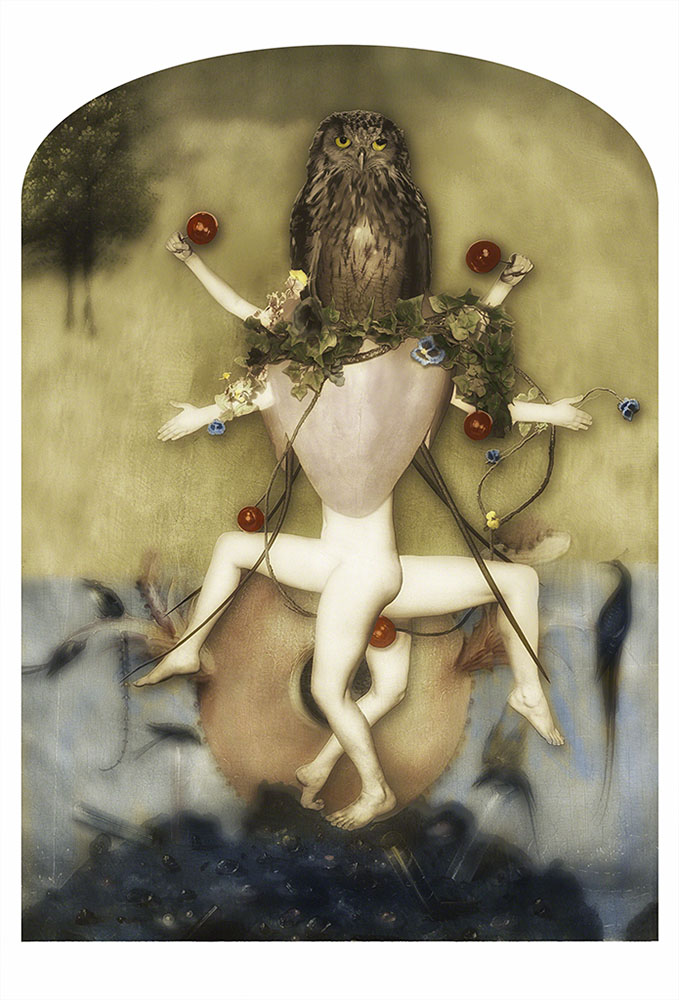
Many of these effects might have been accomplished by early twentieth century surrealists, and indeed, when these details from Bosch’s work are amplified they resemble nothing so much as those psychoanalytic modernists. But Pond admits, “I fully abide by the maxim, ‘A photograph isn’t a photograph until it goes through Photoshop.’” She makes the usual adjustments, adds filters and effects, then employs “textures, backgrounds, and other small details from the original paintings,” making Bosch a collaborator in these close-up remixes, which come from The Last Judgment, The Temptation of St. Anthony, and The Garden of Earthly Delights, of course—the painting that first gave her the inspiration when Pond saw it at the Prado in Madrid. You can see many more examples of the series at Pond’s website, sixteen surreally apocalyptic visions in all.
Related Content:
Josh Jones is a writer and musician based in Durham, NC. Follow him at @jdmagness
Read More...Alan Turing Gets Channeled in a New Opera: Hear Audio from The Life And Death(S) Of Alan Turing
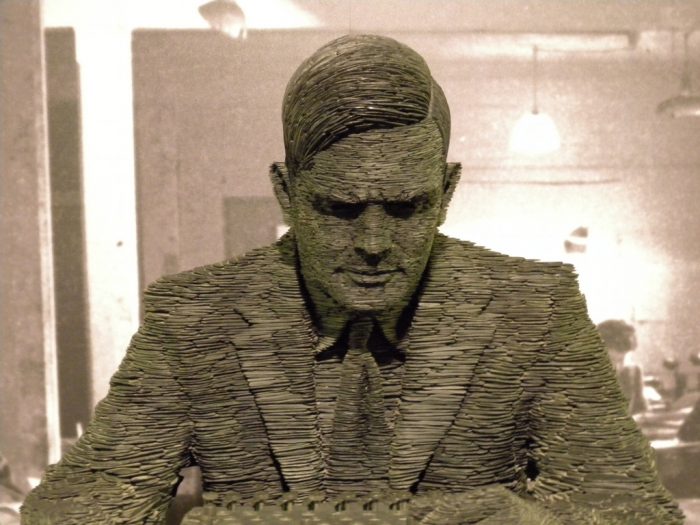
Creative Commons image by Steve Parker
It can seem like a cruel irony that some of the most celebrated people of our day didn’t receive the same acclaim during their sometimes troubled lives. Van Gogh may have been on the cusp of fame when he died despairing and broke, but few could have imagined then that he would be the universally beloved and admired artist he became in the following decades. (A recent Doctor Who episode poignantly imagined Van Gogh traveling to our time to witness his legacy.) In a more recent example in the sciences, the book—now film—Hidden Figures celebrates three previously unsung African-American women: mathematicians, or “human computers,” whose calculations were instrumental to NASA’s success but whose accomplishments were obscured by prejudice.
The same could not quite be said for Alan Turing, another genius recently celebrated in a multiple-award-winning Hollywood film, award-winning documentary, and spate of articles, essays, and books. Turing was viciously persecuted for his homosexuality by the state, and he has often been unfairly characterized in many portrayals since.
In 1952, he was convicted of “gross indecency” for a relationship with another man and given the choice between prison and chemical castration. The brilliant English mathematician, codebreaker, and father of modern computing and artificial intelligence chose the latter, and the physical and psychological effects were so demoralizing that he took his own life two years later—perhaps grimly inspiring the Apple logo as he enacted his favorite scene from Snow White (a matter in some dispute, it should be noted).
Turing “left behind a lasting legacy,” note the makers of the docu-drama Codebreakers, “and lingering questions about what else he might have accomplished if society had embraced his unique genius instead of rejecting it.” It’s not fair to say that society rejected his genius—perhaps even more tragically, it rejected his full humanity. Turing’s genius, though cut short at 41, received its due, inspiring, since 1966, the highest award in computer science. His famed “Turing test” became the standard by which nearly all attempts at artificial intelligence have been measured. In addition to those films, books, and essays, Turing has been much lauded in musical productions, namely the Pet Shop Boys “orchestral pop biography” A Man From the Future and a 30-minute oratorio by Adam Gopnik and composer Nico Muhly called Sentences.
And now, a new two-act opera, The Life and Death(s) of Alan Turing, was presented to the public for the first time, in its entirety, on January 12th at New York’s American Lyric Theater (ALT). Commissioned in 2012, and written by composer Justine Chen with a libretto by David Simpatico, the opera is “a historic-fantasia on Turing’s life” that does not obscure the man as it acknowledges his genius. Many critics felt that 2014’s The Imitation Game “obfuscated his sexuality and desexualized him in an attempt to make the story more mainstream,” remarks Shawn Milnes at The Daily Beast. “He was not a sexual creature in this movie,” agrees Simpatico. “He was in the closet.” That impression of Turing’s personal life has almost become commonplace. And yet the truth “couldn’t be more opposite,” Simpatico argues.
He was completely out. He was out upon meeting people. He would say, ‘How are you doing? I’m a homosexual. Will you have a problem with that? No.’ He was out to everybody. The movie makes it feel like he had something to hide.
Fully acknowledging all of the dimensions of Turing’s life allows the opera–The Life and Death(s) of Alan Turing– to draw deeply moving arias from his biography like “Cave of Wonders,” above, in which Turing expresses “his grief over the loss of his first love,” Christopher Morcom, a fellow grade school student who died young in 1930. Turing was “openly devastated” by the event, writes L.V. Anderson at Slate, “and he subsequently developed a relationship with Morcom’s family, going on vacations with them and maintaining a correspondence with Morcom’s mother for years. In The Imitation Game, by contrast, he “denies having known Christopher very well” in a flashback scene.
The music of the opera’s Prologue, above, owes a debt to composers like Steve Reich and John Adams, with its pulsing piano and cacophony of voices, simulating, perhaps, the rush of thought in Turing’s brilliant mind. At the ALT site, you can hear a further excerpt from the opera, “The Social Contract,” which dramatizes the pressure Turing’s mother put on him to marry, and his subsequent consideration of a marriage of convenience to his colleague in cryptoanalysis, Joan Clarke. In the opera, writes Milnes, Simpatico had the idea of “fusing sex and intellect on stage” in order to balance Turing’s portrayal and “see who the person was,” as he puts it. As Simpatico says, the tragically persecuted genius “had no division between his sexual, sensual, physical carnal self and his intellectual, cerebral, interior self.” Only people who couldn’t take them both together seemed to have found it necessary to separate the two, and thus do terrible damage to the man as a whole.
Related Content:
The Books on Young Alan Turing’s Reading List: From Lewis Carroll to Modern Chromatics
Josh Jones is a writer and musician based in Durham, NC. Follow him at @jdmagness
Read More...How the World’s Oldest Computer Worked: Reconstructing the 2,200-Year-Old Antikythera Mechanism
In 1900, Greek sponge divers discovered a shipwreck off the Greek island of Antikythera. The artifacts they came back up with included money, statues, pottery, and various other works of art and craft, as well as a curious lump of bronze and wood that turned out to be by far the most important item onboard. When an archaeologist named Valerios Stais took a look at it two years later, he noticed that the lump had a gear in it. Almost a half-century later, the science historian Derek J. de Solla Price thought this apparently mechanical object might merit further examination, and almost a quarter-century after that, he and the nuclear physicist Charalambos Karakalos published their discovery–made by using X‑ray and gamma-ray images of the interior–that those divers had found a kind of ancient computer.
“Understanding how the pieces fit together confirmed that the Antikythera mechanism was capable of predicting the positions of the planets with which the Greeks were familiar — Mercury, Venus, Mars, Jupiter and Saturn — as well as the sun and moon, and eclipses,” writes Big Think’s Robby Berman. “It even has a black and white stone that turns to show the phases of the moon.”
Determining how it really worked has required the building of various different models of various different kinds, one of which you can see assembled, operated, and disassembled before your very eyes in the CGI rendering at the top of the post. Its design comes from the work of historian of mechanism Michael T. Wright, who also put together the physical recreation of the Antikythera mechanism you can see him explain just above.
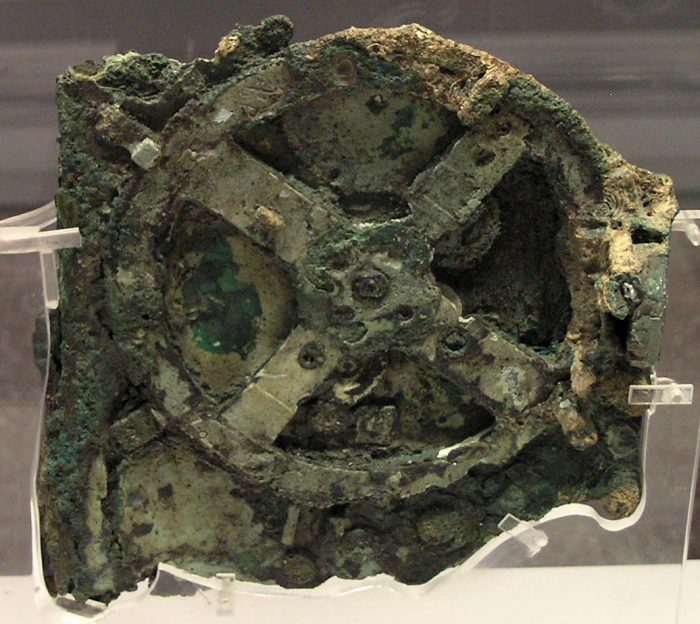
Image via Wikimedia Commons
By its very nature, an artifact as fascinating and as incomplete as this draws all sorts of theories about the specifics of its design, purpose, and even its age. (It dates back to somewhere between 205 and 100 BC.) In 2012, Tony Freeth and Alexander Jones published their own model, different from Wright’s, of this “machine designed to predict celestial phenomena according to the sophisticated astronomical theories current in its day, the sole witness to a lost history of brilliant engineering, a conception of pure genius, one of the great wonders of the ancient world,” — but one which “didn’t really work very well.” Some of the problems has to do with the limitations of ancient Greek astronomical theory, and some with the unreliability of its layers of handmade gears.
More recent research, adds Berman, has discovered that “the device was built by more than one person on the island of Rhodes, and that it probably wasn’t the only one of its kind,” indicating that the ancient Greeks, despite the apparent deficiencies of the Antikythera mechanism itself, “were apparently even further ahead in their astronomical understanding and mechanical know-how than we’d imagined.” Now watch the video just above, in which the Apple engineer makes his own Antikythera mechanism with an entirely more modern set of components, and just imagine what the ancient Greeks could have accomplished had they developed Lego.
Related Content:
Introduction to Ancient Greek History: A Free Online Course from Yale
How the Ancient Greeks Shaped Modern Mathematics: A Short, Animated Introduction
How Ancient Greek Statues Really Looked: Research Reveals their Bold, Bright Colors and Patterns
Modern Artists Show How the Ancient Greeks & Romans Made Coins, Vases & Artisanal Glass
Based in Seoul, Colin Marshall writes and broadcasts on cities and culture. He’s at work on a book about Los Angeles, A Los Angeles Primer, the video series The City in Cinema, the crowdfunded journalism project Where Is the City of the Future?, and the Los Angeles Review of Books’ Korea Blog. Follow him on Twitter at @colinmarshall or on Facebook.
Read More...Watch 100 Randomly Ticking Metronomes Miraculously Achieve Synchronicity
It’s always satisfying to impose order on chaos, especially if it doesn’t involve bellowing at a roomful of jacked up teenagers.
Witness the experiment above.
Members of Ikeguchi Laboratory, a Japanese organization dedicated to the analysis and prediction of nonlinear phenomena, placed 100 randomly ticking metronomes on a hanging platform, curious as to how long it would take them to synchronize.
(SPOILER ALERT! They start synching up around the 1 minute, 20 second mark.)
How? Why? Is this some mystical, musical variant of menstrual synchrony?
Nope. Physics is doing the heavy lifting here.
The key is that the platform holding the metronomes is not fixed. It affects their movement by moving in response to theirs.
To put it another way, KE = 0.5 • m • v2. Which is to say Kinetic Energy = 0.5 • mass of object • (speed of object)2.
If you’re looking for another scientific explanation, here’s how Gizmodo puts it: “the metronomes are transferring energy to the platform they’re on, which then transfers that energy back to the metronomes—until they all sync up and start hitting the beat in one glorious wavelength.”
By the two and a half minute mark, some viewers will be raring to delve into further study of energy transference.
Others, their brains imploding, may elect to downshift into a purely auditory experience.
Close your eyes and listen as the last hold outs fall into rhythmic step with the rest of the herd. A pleasantly harmonious sound, not unlike that moment when a roomful of jacked up teens simmers down, achieving the sort of blissful hive mind that’s a balm to teacher’s frazzled soul.
Craving more? Ikeguchi Laboratory also filmed their metronomes in triangular, circular and X‑shaped formations, available for your viewing pleasure on the lab’s YouTube channel.
Related Content:
The Remarkable Physics of Ants: Watch Them Turn into Fluids and Solids at Will
The Mysterious Physics Behind How Bikes Ride by Themselves
Ayun Halliday is an author, illustrator, theater maker and Chief Primatologist of the East Village Inky zine. Her play Zamboni Godot is opening in New York City in March 2017. Follow her @AyunHalliday
Read More...An Introduction to Confucius’ Life & Thought Through Two Animated Videos
Though it isn’t widely acknowledged, there’s been a longstanding and robust debate at least since the nineteenth century over whether or not a historical Jesus existed. The majority of Christians dismiss the evidence, or lack thereof, for reasons of belief, but on a wider view it’s not at all unique that the historical founder of a religion or school might be an invention, or might have been nothing at all like the tradition suggests. Such questions have arisen about the reality of the Buddha, for example, or the authorship of Lao Tzu, writer of the Tao Te Ching, or the historical existence of his supposed contemporary Confucius, founder of the system of philosophy and ethics simply known as Confucianism.
What do we know about Confucius? “Very little for certain,” says Alain de Botton in his School of Life introductory video above. “He’s said to have been born in 551 BC in China,” and he may have been a student of Lao Tzu. Confucius supposedly served as minister of crime under the ruler of the state of Lu. Many mundane stories about the Chinese thinker make his existence seem quite plausible, though his legend picked up miraculous features over time. But the sayings supposedly by and about Confucius, historical or otherwise—like those of Jesus and the Buddha—were only written down many years after his death, collected in the famous Analects (Lunyu, or “edited conversations”).
These sayings became enormously popular during the European Enlightenment and the 20th century, writes Charlotte Allen at The Atlantic, in part because Confucius remained “agnostic on whether a supernatural world actually exists.” Though he encouraged participation in religious rituals, “The Master,” one of the analects remarks, “never talked of: miracles; violence; disorders; spirits.” What he did talk about what was “the Golden Mean: all things in moderation, even moderation itself.” Confucius was a conservative thinker—in the sense that word once had of holding fast to tradition, encouraging adherence to “ritual propriety” and family observances, and respecting the rule of law.
His sayings include a version of the Golden Rule, and he “is said to have taught his disciples the cultivation of personal virtue.… veneration of one’s parents, love of learning, loyalty to one’s superiors, kindness to one’s subordinates, and a high regard for all of the customs, institutions, and rituals that make for civility.” One can see his appeal to many liberal Western philosophers, who have often advanced radical theses alongside the conservative values Max Weber characterized as the Protestant ethic. Thomas Paine, writes Allen, “listed Confucius with Jesus and the Greek philosophers as the world’s great moral teachers” in the Age of Reason, and Ezra Pound had a particularly high regard for the Chinese thinker.
This kind of veneration has meant that “to many educated Westerners, Confucius is the very emblem of Chinese civilization and religious belief.” Or as the TED-Ed video above puts it, “most people recognize his name and know that he is famous for having said… something.” In this video introduction to Confucius, the philosopher’s biography plays a very prominent role, and it does make for an engaging story. But we should be aware that the details of his life are highly contested by scholars in the East and West. The only sources date from “well after his death,” notes the Stanford Encyclopedia of Philosophy, and “taken together paint contradictory pictures of his personality and the events in his life.” Some scholars even claim he was an invention of the Jesuits, who may have created the Confucius character to accord with their Western desire for a personal founder.
But we need not believe biographical details or decide between scholarly controversies to appreciate Confucian thought. As de Botton makes clear, Confucius’ respect for tradition—though certainly patriarchal and hierarchical—also gives us a lot of insight into how and why we should heed people with expertise and superior knowledge, why we should value education and difficult study, and why personal integrity matters in civic life. Though we cannot verify his life story, we can see it as a popular narrative allegory for his ideas. Confucius exhorted his disciples to obey their leaders, yet he also insisted that those leaders be benevolent and honorable.
It is said that Confucius left Lu, where he had served faithfully as a minister, when the Duke received a gift of courtesans and horses from a neighboring ruler, and began to spend all his time cavorting, and misusing the state’s resources. Thus, according to the tradition, began a period of wandering as the philosopher pondered the cultivation of character. You can read the Analects for yourself in a number of translations—including this free online version from Robert Eno. And if you wish to immerse yourself more fully in the study of Confucianism and Chinese philosophy and culture more generally, you can do so for free through Harvard’s edX course on China or, through Coursera’s “Classics of Chinese Humanities: Guided Readings,” taught by Ou Fan Leo Lee, Professor of Chinese Culture at The Chinese University of Hong Kong.
Related Content:
Free Online Philosophy Courses
Eastern Philosophy Explained with Three Animated Videos by Alain de Botton’s School of Life
Josh Jones is a writer and musician based in Durham, NC. Follow him at @jdmagness
Read More...Download 243 Free eBooks on Design, Data, Software, Web Development & Business from O’Reilly Media
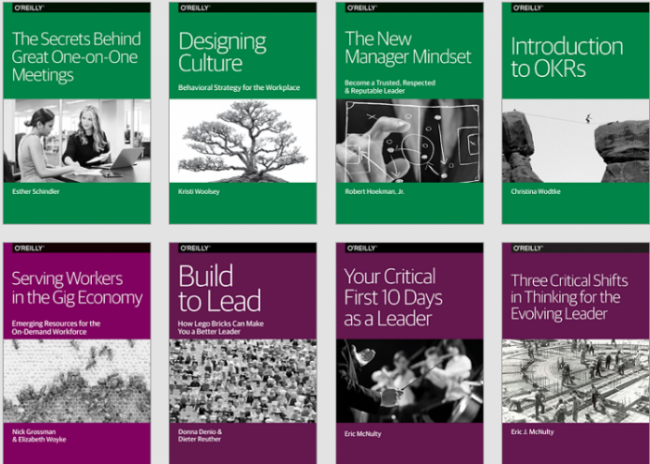
Last week we highlighted for you 20 Free eBooks on Design from O’Reilly Media. Little did we know that we were just scratching the surface of the free ebooks O’Reilly Media has to offer.
If you head over to this page, you can access 243 free ebooks covering a range of different topics. Below, we’ve divided the books into sections (and provided links to them), indicated the number of books in each section, and listed a few attractive/representative titles.
You can download the books in PDF format. An email address–but no credit card–is required. Again the complete list is here.
- Business & Leadership (10 ebooks total)
- Data, Artificial Intelligence & Big Data (95 ebooks total)
- Design (20 ebooks)
- Hardware & the Internet of Things (24 ebooks)
- Software/Programming (36 ebooks)
- Security (8 ebooks)
- Web Development & Performance (19 ebooks)
- Web Performance & DevOps (31)
If you would like to support the mission of Open Culture, consider making a donation to our site. It’s hard to rely 100% on ads, and your contributions will help us continue providing the best free cultural and educational materials to learners everywhere. You can contribute through PayPal, Patreon, and Venmo (@openculture). Thanks!
Related Content:
Download 20 Free eBooks on Design from O’Reilly Media
Read 700 Free eBooks Made Available by the University of California Press
A New Free eBook Every Month from the University of Chicago Press
800 Free eBooks for iPad, Kindle & Other Devices
Read More...Edward Hopper’s Iconic Painting Nighthawks Explained in a 7‑Minute Video Introduction
If any one painting stands for mid-twentieth-century America, Nighthawks does. In fact, Edward Hopper’s 1942 canvas of four figures in a late-night New York City diner may qualify as the most vivid evocation of that country and time in any form. For Evan Puschak, better known as the video essayist Nerdwriter, the experience of Nighthawks goes well beyond the visual realm. “I’ve always thought of him in a sort of aromatic way,” says Puschak of the artist, “because his paintings evoke the same kinds of feelings and memories that I get from the sense of smell, as if he was channeling directly into my limbic system, excavating moments that were stored deeply away.”
But Puschak wouldn’t have experienced the early 1940s first-hand, much less the turn-of-the-century period in which Hopper grew up. Nor would have most of the people captivated by Nighthawks today, much less those countless appreciators as yet unborn. How does Hopper, in his most famous painting and many others, at once capture a time and a place while also resonating on a deeper, more universally human level?
Puschak takes up that question in “Look through the Window,” a video essay that examines the power of Hopper’s art, “clean, smooth, and almost too real,” through a breakdown of Nighthawks, an expression of all of the artist’s themes: “loneliness, alienation, voyeurism, quiet contemplation, and more.”
The effectiveness of the painting’s composition, in Puschak’s analysis, comes from such elements as the ambiguity of the relationships between its characters, the strong diagonal lines of the diner’s architecture, the use of light in the darkness, and the windows so clear as to look “as if they’re not even there,” all so memorably realized by Hopper’s painstaking dedication to his work. (His long and involved process, which we’ve previously featured here, even included a kind of storyboarding.) “As slowly and deliberately as he painted,” Puschak says, “he wanted us to look — really look, and to be made vulnerable, as a viewer always is.”
Many Americans must have felt such vulnerability with a special acuteness at the time Hopper finished painting Nighthawks, “the weeks and days following the bombing of Pearl Harbor, when everyone in New York City was paranoid about another attack.” Everyone, that is, except Edward Hopper, who kept his studio light on and kept on painting beneath it. “The future was very uncertain at this moment in time, as uncertain as the darkness that frames the patrons of this diner, a darkness they’re launched into by Hopper’s composition and our gaze.” Some might say that times, in America and elsewhere, haven’t become much more certain since. We, like Hopper, could do much worse than continuing to create ever more deliberately, and to see ever more clearly.
Related Content:
How Edward Hopper “Storyboarded” His Iconic Painting Nighthawks
Painters Painting: The Definitive Documentary Portrait of the New York Art World (1940–1970)
Whitney Museum Puts Online 21,000 Works of American Art, By 3,000 Artists
The Museum of Modern Art (MoMA) Puts Online 65,000 Works of Modern Art
Based in Seoul, Colin Marshall writes and broadcasts on cities and culture. He’s at work on a book about Los Angeles, A Los Angeles Primer, the video series The City in Cinema, the crowdfunded journalism project Where Is the City of the Future?, and the Los Angeles Review of Books’ Korea Blog. Follow him on Twitter at @colinmarshall or on Facebook.
Read More...Hemingway, Fitzgerald, Faulkner: A Free Yale Course
This course taught by Yale professor Wai Chee Dimock examines major works by three iconic American authors–Ernest Hemingway, F. Scott Fitzgerald, and William Faulkner. Along the way, Dimock explores these authors’ “interconnections on three analytic scales: the macro history of the United States and the world; the formal and stylistic innovations of modernism; and the small details of sensory input and psychic life.” You can access the 24 lectures in Hemingway, Fitzgerald, Faulkner on YouTube, or on iTunes in video and audio. Texts discussed in the course include:
Faulkner, William. As I Lay Dying.
Faulkner, William. Light in August.
Faulkner, William. The Sound and the Fury.
Fitzgerald, F. Scott. The Great Gatsby.
Fitzgerald, F. Scott. The Short Stories of F. Scott Fitzgerald: A New Collection.
Fitzgerald, F. Scott. Tender is the Night.
Hemingway, Ernest. For Whom the Bell Tolls.
Hemingway, Ernest. In Our Time.
Hemingway, Ernest. To Have and Have Not.
Find more information about this course, including the syllabus, over at this Yale site.
Hemingway, Fitzgerald, Faulkner has been added to our list of Free Online Literature courses, a subset of our meta collection, 1,700 Free Online Courses from Top Universities.
If you would like to support the mission of Open Culture, consider making a donation to our site. It’s hard to rely 100% on ads, and your contributions will help us continue providing the best free cultural and educational materials to learners everywhere. You can contribute through PayPal, Patreon, and Venmo (@openculture). Thanks!
Read More...How to Make a Replica of 1900-Year-Old Glass Fish: A Brilliant Video from the British Museum
All due respect to the British Museum, but the title of its “How to Make a Glass Fish Replica” video, above is a tad misleading.
I’m sure no malice was intended, but “making” a DIY fish-shaped vessel reminiscent of some 22 found in the ancient Kushan storerooms at Begram, Afghanistan is no one’s definition of an easy craft project. (Unless you’re willing to fudge with some Elmer’s, some blue felt, and an empty peanut butter jar…)
Glass Specialist Bill Gudenrath of the Corning Museum of Glass is an historian of glassworking techniques from ancient Egypt through the Renaissance and clearly expert at his craft, but he doesn’t appear to be too keen on supplying explanatory blow-by-blows. Nor would I be, bustling around a red hot glass oven, without so much as a Johnny Tremain-style leather apron to protect me. I’m not even sure I’d want the distraction of a video camera in my face.
But if, as the title implies, the goal is to produce a duplicate of this whimsical 1900-year-old guppy, the process must be broken down.
From what this casual viewer was able to piece together, the steps would go something like:
1. Twirl a red hot metal pipe in the forge until you have a healthy glob of molten glass. Apparently it’s not so different from making cotton candy.
2. Roll the glass blob back and forth on a metal tray.
3. Blow into the pipe’s non-glowing end to form a bubble.
4. Repeat steps 1–3
5. Roll the pipe back and forth on a metal sawhorse while seated, applying pinchers to taper the blob into a recognizably fishy-shape.
(Don’t worry about its proximity to your bare forearms and khaki-covered thighs! What could possibly go wrong?)
6. Twirl it like a baton.
(Depending on the length of your arms, your nascent glass fish may come dangerously close to the cement floor. Try not to sweat it.)
7. Use scissors and pinchers to tease out a nipple-shaped appendage that will become the fish’s lips.
8. Use another poker to apply various bloops of molten glass. (Novices may want to practice with a hot glue gun to get the hang of this — it’s trickier than it looks!) Pinch, prod and drape these bloops into eye and fin shapes. A non-electric crimping iron will prove handy here.
9. Use blue glass, tweezers and crimping iron to personalize your fish-shaped vessel’s distinctive dorsal and anal fins.
10. Tap on the pipe to crack the fish loose. (Careful!)
11. Score the distal end with a glass cutting tool.
(This step should prove a cinch for anyone who ever used a craft kit to turn empty beer and soda bottles into drinking glasses!)
12. Smooth rough edges with another loop of molten glass and some sort of electric underwater grinding wheel.
Optional 13th step: Read this description of a furnace session, to better acquaint yourself with both best glassblowing practices and the proper names for the equipment. Or get the jump on Christmas 2017 with this true how-to guide to producing hand blown glass ornaments.
Not planning on blowing any glass, fish-shaped or otherwise, any time soon?
Explore the somewhat mysterious history of the 1900-year-old fish-shaped original here, compliments of the British Museum’s St John Simpson, senior curator for its pre-Islamic collections from Iran and Arabia.
Related Content:
Modern Artists Show How the Ancient Greeks & Romans Made Coins, Vases & Artisanal Glass
Glass: The Oscar-Winning “Perfect Short Documentary” on Dutch Glassmaking (1958)
How to Bake Ancient Roman Bread Dating Back to 79 AD: A Video Primer
Ayun Halliday is an author, illustrator, theater maker and Chief Primatologist of the East Village Inky zine. Her play Zamboni Godot is opening in New York City in March 2017. Follow her @AyunHalliday.
Read More...Support Us
We're hoping to rely on loyal readers, rather than erratic ads. Please click the Donate button and support Open Culture. You can use Paypal, Venmo, Patreon, even Crypto! We thank you!

About Us

Open Culture scours the web for the best educational media. We find the free courses and audio books you need, the language lessons & educational videos you want, and plenty of enlightenment in between.
Advertise With Us
FREE UPDATES!
GET OUR DAILY EMAIL
Get the best cultural and educational resources on the web curated for you in a daily email. We never spam. Unsubscribe at any time.
FOLLOW ON SOCIAL MEDIA
Open Culture editor Dan Colman scours the web for the best educational media. He finds the free courses and audio books you need, the language lessons & movies you want, and plenty of enlightenment in between.
Advertise With Us


