Foundations of Modern Social Theory: A Free Yale Course
Taught by professor Iván Szelényi, this Yale course “provides an overview of major works of social thought from the beginning of the modern era through the 1920s. Attention is paid to social and intellectual contexts, conceptual frameworks and methods, and contributions to contemporary social analysis.” And the writers covered “include Hobbes, Locke, Rousseau, Montesquieu, Adam Smith, Marx, Weber, and Durkheim.”
The 25 lectures can be found on YouTube and iTunes (in audio and video). A complete syllabus can be found be on this Yale web site.
Foundations of Modern Social Theory has been added to our collection, 1,700 Free Online Courses from Top Universities.
If you would like to support the mission of Open Culture, consider making a donation to our site. It’s hard to rely 100% on ads, and your contributions will help us continue providing the best free cultural and educational materials to learners everywhere. You can contribute through PayPal, Patreon, and Venmo (@openculture). Thanks!
Read More...75 Years of CIA Maps Now Declassified & Made Available Online
Satellite-connected devices do all the hard work of navigation for us: plan journeys, plot distances, tell us where we are and where we’re going. The age of the highly skilled cartographer may be coming to an end. But in the past few hundred years—since European states began carving the world between them—the winners of colonial contests, World War battles, and Cold War skirmishes were often those who had the best maps. In addition to their indispensable role in seafaring and battle strategy, “good maps,” writes Danny Lewis at Smithsonian, have been “an integral part of the tradecraft of espionage.”
The CIA will tell you as much… or they will now, at least, since they’ve declassified decades of once-secret maps from the days when they “relied on geographers and cartographers for planning and executing operations around the world” rather than on “digital mapping technologies and satellite images.”
Now celebrating its 75th anniversary, the CIA’s Cartography Center boasts of “a long, proud history of service to the Intelligence Community,” at the Agency’s friendly website; “Since 1941, the Cartography Center maps have told the stories of post-WWII reconstruction, the Suez crisis, the Cuban Missile crisis, the Falklands War, and many other important events in history.”

Whatever noble or nefarious roles the Agency may have played in these and hundreds of other events, we can now see–thanks to this new online gallery at Flickr–what presidents, Directors, and field agents saw when they planned their actions, beginning with the country’s first “non-departmental intelligence organization,” the COI (Office of the Coordinator of Information). Once the U.S. entered WWII, it became the Office of Strategic Services (OSS). The Cartography Center’s first chief, Arthur Robinson, was only 26 and a graduate student in geography when COI director William Donovan recruited him to lead the organization. The office rapidly expanded during the war, and by 1943, “geographers and cartographers amassed what would be the largest collection of maps in the world.”

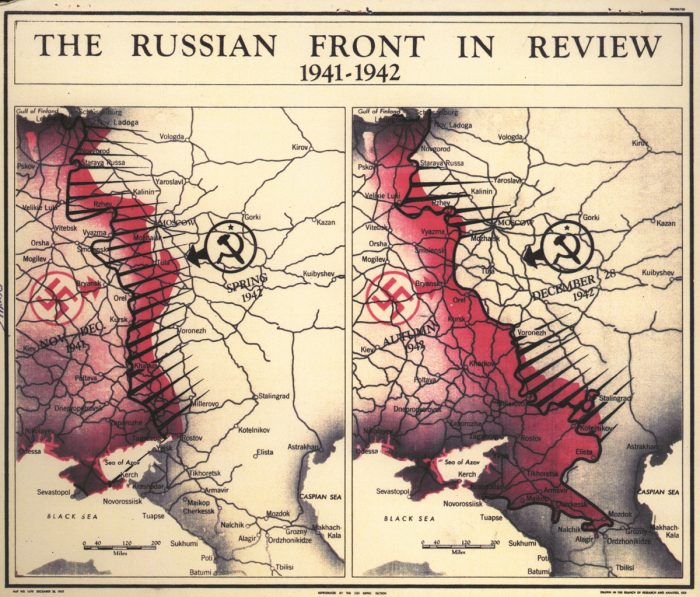
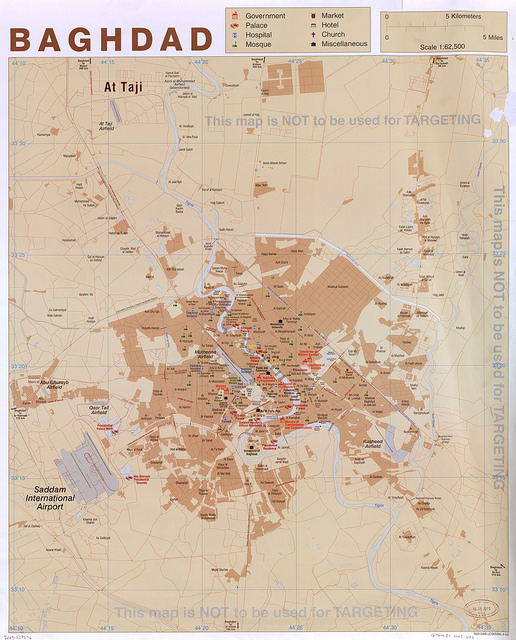
In the early forties, “map layers were drafted by hand using pen and ink on translucent acetate sheets mounted on large Strathmore boards.” These drafts were typically four times larger than the printed maps themselves, one of which you can see at the top of the post, “The Russian Front in Review.” In the fifties, “improved efficiency in map compilation and construction” produced visually striking documents like that further up from 1955, “USSR: Regional Distribution of Gross National Product.” Not a map, but what we would call an infographic, this image shows how the Cartography Center performed services far in excess of the usual map app—visualizing threats to the U.S. from Cuban surface-to-air missile sites in 1962 (above) and threats to the African elephant population from poachers in 2013 (below). Further down, you can see a 2003 map of Baghdad, with the ominously non-threatening note printed at the top and right, “This map is NOT to be used for TARGETING.”

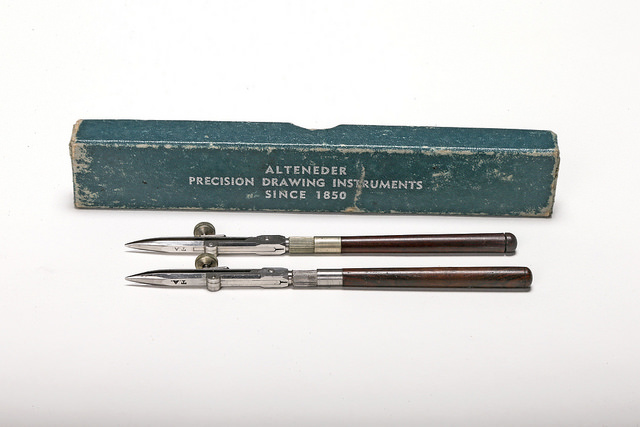
These maps and many more can be found at the CIA Cartography Flickr account, which has a category for each decade since the 1940s. Each map is downloadable in low to high resolution scans. In addition, one category, “Cartography Tools,” features high-quality photography of vintage draughtsman’s instruments, all of them, like the German-made ink pens further down, symbols of the painstaking handicraft mapmaking once required. While we can probably draw any number of political lessons or historical theses from a deep analysis of this deep state archive, what it seems to ask of us first and foremost is that we consider cartography as not only a useful discipline but as a fine art.
As the Cartography Center’s first director put it, “a map should be aesthetically pleasing, thought-provoking, and communicative.” Given these standards we might see how current technology, for all its tremendous ease of use and undeniable utility, might improve by looking to maps of the past. Visit the CIA’s flickr gallery here.
via Smithsonian
Related Content:
New York Public Library Puts 20,000 Hi-Res Maps Online & Makes Them Free to Download and Use
19th Century Maps Visualize Measles in America Before the Miracle of Vaccines
Josh Jones is a writer and musician based in Durham, NC. Follow him at @jdmagness
Read More...Nietzsche’s 10 Rules for Writing with Style (1882)
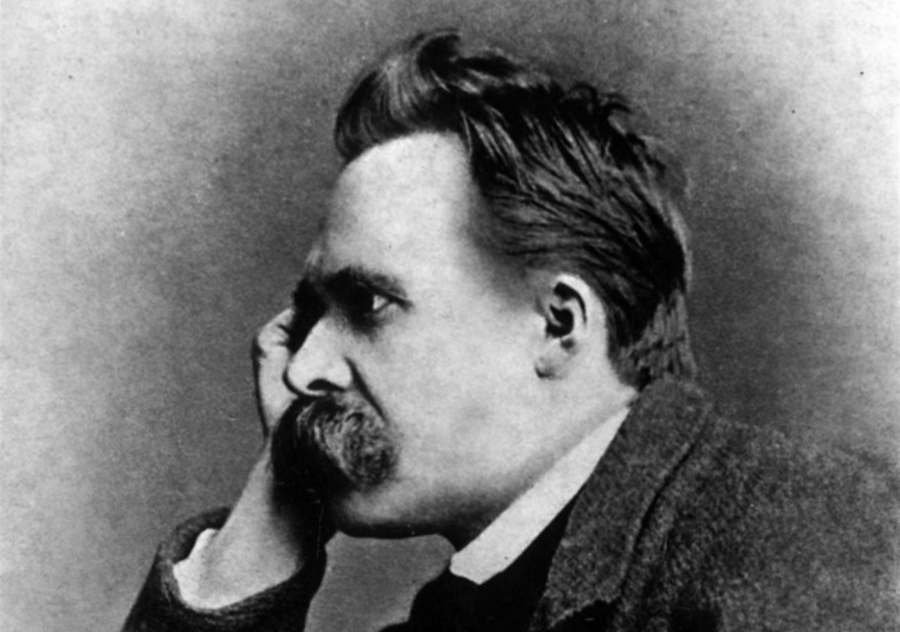
The life of Russian-born poet, novelist, critic, and first female psychologist Lou Andreas-Salomé has provided fodder for both salacious speculation and intellectual drama in film and on the page for the amount of romantic attention she attracted from European intellectuals like philosopher Paul Rée, poet Rainer Maria Rilke, and Friedrich Nietzsche. Emotionally intense Nietzsche became infatuated with Salomé, proposed marriage, and, when she declined, broke off their relationship in abrupt Nietzschean fashion.
For her part, Salomé so valued these friendships she made a proposal of her own: that she, Nietzsche and Rée, writes D.A. Barry at 3:AM Magazine, “live together in a celibate household where they might discuss philosophy, literature and art.” The idea scandalized Nietzsche’s sister and his social circle and may have contributed to the “passionate criticism” Salomé’s 1894 biographical study, Friedrich Nietzsche: The Man and His Works, received. The “much maligned” work deserves a reappraisal, Barry argues, as “a psychological portrait.”
In Nietzsche, Salomé wrote, we see “sorrowful ailing and triumphal recovery, incandescent intoxication and cool consciousness. One senses here the close entwining of mutual contradictions; one senses the overflowing and voluntary plunge of over-stimulated and tensed energies into chaos, darkness and terror, and then an ascending urge toward the light and most tender moments.” We might see this passage as charged by the remembrance of a friend, with whom she once “climbed Monte Sacro,” she claimed, in 1882, “where he told her of the concept of the Eternal Recurrence ‘in a quiet voice with all the signs of deepest horror.’”
We should also, perhaps primarily, see Salomé’s impressions as an effect of Nietzsche’s turbulent prose, reaching its apotheosis in his experimentally philosophical novel, Thus Spake Zarathustra. As a theorist of the embodiment of ideas, of their inextricable relation to the physical and the social, Nietzsche had some very specific ideas about literary style, which he communicated to Salomé in an 1882 note titled “Toward the Teaching of Style.” Well before writers began issuing “similar sets of commandments,” writes Maria Popova at Brain Pickings, Nietzsche “set down ten stylistic rules of writing,” which you can find, in their original list form, below.
1. Of prime necessity is life: a style should live.
2. Style should be suited to the specific person with whom you wish to communicate. (The law of mutual relation.)
3. First, one must determine precisely “what-and-what do I wish to say and present,” before you may write. Writing must be mimicry.
4. Since the writer lacks many of the speaker’s means, he must in general have for his model a very expressive kind of presentation of necessity, the written copy will appear much paler.
5. The richness of life reveals itself through a richness of gestures. One must learn to feel everything — the length and retarding of sentences, interpunctuations, the choice of words, the pausing, the sequence of arguments — like gestures.
6. Be careful with periods! Only those people who also have long duration of breath while speaking are entitled to periods. With most people, the period is a matter of affectation.
7. Style ought to prove that one believes in an idea; not only that one thinks it but also feels it.
8. The more abstract a truth which one wishes to teach, the more one must first entice the senses.
9. Strategy on the part of the good writer of prose consists of choosing his means for stepping close to poetry but never stepping into it.
10. It is not good manners or clever to deprive one’s reader of the most obvious objections. It is very good manners and very clever to leave it to one’s reader alone to pronounce the ultimate quintessence of our wisdom.
As with all such prescriptions, we are free to take or leave these rules as we see fit. But we should not ignore them. While Nietzsche’s perspectivism has been (mis)interpreted as wanton subjectivity, his veneration for antiquity places a high value on formal constraints. His prose, we might say, resides in that tension between Dionysian abandon and Apollonian cool, and his rules address what liberal arts professors once called the Trivium: grammar, rhetoric, and logic: the three supports of moving, expressive, persuasive writing.
Salomé was so impressed with these aphoristic rules that she included them in her biography, remarking, “to examine Nietzsche’s style for causes and conditions means far more than examining the mere form in which his ideas are expressed; rather, it means that we can listen to his inner soundings.” Isn’t this what great writing should feel like?
Salomé wrote in her study that “Nietzsche not only mastered language but also transcended its inadequacies.” (As Nietzsche himself commented in 1886, notes Hugo Drochon, he needed to invent “a language of my very own.”) Nietzsche’s bold-yet-disciplined writing found a complement in Salomé’s boldly keen analysis. From her we can also perhaps glean another principle: “No matter how calumnious the public attacks on her,” writes Barry, “particularly from [his sister] Elisabeth Förster-Nietzsche during the Nazi period in Germany, Salomé did not respond to them.”
Related Content:
The Daily Habits of Highly Productive Philosophers: Nietzsche, Marx & Immanuel Kant
Walter Kaufmann’s Classic Lectures on Nietzsche, Kierkegaard and Sartre (1960)
Writing Tips by Henry Miller, Elmore Leonard, Margaret Atwood, Neil Gaiman & George Orwell
Josh Jones is a writer and musician based in Durham, NC. Follow him at @jdmagness
Read More...Architecture Studio: Building in Landscapes (A Free Course from MIT)
Taught by Jan Wampler, professor of architecture at MIT, this undergraduate course “introduces skills needed to build within a landscape establishing continuities between the built and natural world. Students learn to build appropriately through analysis of landscape and climate for a chosen site, and to conceptualize design decisions through drawings and models.”
The 12 courses lectures can be viewed above, or found via playlists on YouTube. You can find more information on the course, including course materials and course syllabus, on MIT’s website.
Architecture Studio: Building in Landscapes has been added to our collection, 1,700 Free Online Courses from Top Universities.
Related Content:
Roman Architecture: A Free Course from Yale
Free Art & Art History Courses
Read More...The Surreal Filmmaking of David Lynch Explained in 9 Video Essays
The internet is full of people who don’t understand David Lynch movies: some ask for appreciation assistance on Quora, others defend their distaste on Reddit, and others still simply declare both the filmmaker and his fans a lost cause. But the internet is also full of people who, whether they claim to understand them or not, genuinely love David Lynch movies, and some of them make video essays explaining, or at least shedding additional light on, just what makes the seemingly inscrutable likes of Eraserhead, Blue Velvet, Mulholland Drive, and the television series Twin Peaks (as well as Lynch’s less-acclaimed projects) such high cinematic achievements.
The latest, “David Lynch — The Elusive Subconscious,” comes from Lewis Bond’s Channel Criswell, the source for video essays on Andrei Tarkovsky, Yasujiro Ozu, Stanley Kubrick, Akira Kurosawa, and the horror genre previously featured here on Open Culture. It includes a clip of Charlie Rose asking Lynch himself the meaning of the word “Lynchian.” The director’s reply: “I haven’t got a clue. When you’re inside of it, you can’t see it.”
Bond looks for Lynchian by diving right in, finding how Lynch’s movies go about their signature work of “producing the unfamiliarity in that which was once familiar” by using just the right kinds of vagueness, ambiguity, incompleteness, inconsistency, unpredictability, and dualism in their images, sounds and stories to produce just the right kinds of doubt, fear, and distress in their characters and viewers alike.
A further definition of the Lynchian comes in “What is ‘Lynchian’?” by Fandor’s Kevin B. Lee, which adapts a section of film critic and Lynch scholar Dennis Lim’s David Lynch: The Man from Another Place. It, too, draws on an episode of Charlie Rose, though not any of Lynch’s appearances at the table but David Foster Wallace’s. “What the really great artists do is, they’re entirely themselves,” Wallace says in response to a question about his interest in Lynch’s work. “They’ve got their own vision, their own way of fracturing reality, and if it’s authentic and true, you will feel it in your nerve endings. And this is what Blue Velvet did for me.”
Wallace had appeared on the show ostensibly to promote his essay collection A Supposedly Fun Thing I’ll Never Do Again, which contains the expanded version of “David Lynch Keeps His Head,” the 1996 Premiere magazine article that took him to the set of Lost Highway and on the intellectual mission of pinning down what, exactly, gives Lynch’s work at its best so much and so strange a power. Lee, via Lim, quotes Wallace’s working definition of “Lynchian,” which for many fans remains the best anyone has ever come up with: that it “refers to a particular kind of irony where the very macabre and the very mundane combine in such a way as to reveal the former’s perpetual containment within the latter.”
As one of the most visually oriented of all living filmmakers, Lynch expresses this particular kind of irony much less in words than in imagery, specifically the kind of imagery that viewers describe in terms of dreams — and not always the good kind. “Beautiful Nightmares: David Lynch’s Collective Dream” by Indiewire’s Nelson Carvajal gathers some of the elements of Lynch’s visions: the dancing, the picket-fence domesticity, the red curtains, the blondes, the creepy stares, the disfigurement, the voyeurism. “I grew up in the northwest, in a very, very beautiful world,” says Lynch, fairly summing up the experience of his own movies in the video’s only spoken words. “A lot of my life has been discovering this strange sickness. It’s got a fascination to me. I love the idea of going into something and discovering a world, being able to watch it and experience it. It’s a disturbing thing, because it’s a trip beneath a beautiful surface, but to a fairly uneasy interior.”
Several of Lynch’s techniques come in for more thorough analysis in a trilogy of video essays Andreas Halskov made for the Danish film-studies journal 16:9. “Between Two Worlds” deals with the host of “competing moods, genres and tonalities” that manifest in each one of his films and produce “an ambivalent or uncanny experience on the part of the viewer.” “What’s the Frequency, David?” explores the presence in Lynch’s work of “noise and faulty wiring, hiccups and miscommunication,” and “electronic devices that don’t work,” all of which illustrate “the constant battle between the conscious and the unconscious world” so important to his stories. “Moving Pictures” identifies the influence of painters like René Magritte, Francis Bacon, Edward Hopper, Vilhelm Hammershøi, and Salvador Dalí on Lynch who, having started out as a painter himself, begins his films not with stories but images and builds them from there.
Whatever has influenced Lynch’s movies, Lynch’s movies have exerted plenty of influence of their own. Critic Pauline Kael called Lynch “the first popular surrealist,” and with that popularity has come an integration of his brand of surrealism into the wider cinematic zeitgeist. Jacob T. Swinney’s “Not Directed By David Lynch” cuts together five minutes’ worth of especially Lynchian moments from other directors’ movies over the past quarter-century, a formidable selection including Adrian Lyne’s Jacob’s Ladder, Darren Aronofsky’s Pi and Requiem for a Dream, Richard Kelly’s Donnie Darko, Gaspar Noé’s Irréversible and Jonathan Glazer’s Under the Skin.
But while some filmmakers have consciously or unconsciously drawn inspiration from or paid homage to Lynch, other filmmakers have tried to cash in on the popularity of his style in much less creative ways. Or at least so argues “David Lynch’s Lost Highway as a Commentary on Other Directors” by Jeff Keeling, a video essay that puts Lynch’s 1997 neo-noir up against a few other pieces of film and television that came out in the years preceding it, especially the Oliver Stone-directed feature Natural Born Killers and the Oliver Stone-produced series Wild Palms. Pointing out the numerous ways in which Lynch references the too-direct borrowings that Stone and others had recently made from his own work, Keeling not unconvincingly frames Lost Highway as, among other things, a cinematic j’accuse.
Though poorly reviewed upon its original release, Lost Highway has put together a decent following in the nearly two decades since. But whatever acclaim it now draws can’t compare to the praise lavished upon Lynch’s 2001 television-pilot-turned-feature-film Mulholland Drive, which a BBC critics poll recently named the best movie of the 21st century so far. In “Mulholland Drive: How Lynch Manipulates You,” Evan Puschak, better known as the Nerdwriter, breaks down how it subverts the expectations we’ve developed through moviegoing itself, one of the storytelling strategies Lynch uses to make this particular tale of death, sex, Hollywood, the sudden loss of identity (and, needless to say, a platinum-haired ingenue, menacing heavies, and a mysterious dwarf) so very compelling indeed.
If, however, none of these video essays get you believing in Lynch as a creative genius, then you’ll surely enjoy a hearty laugh with Joe McClean’s “How to Make a David Lynch Film,” a short but elaborate satire of the tropes of Lynchianism presented as an instructional film — made in the style of Lynch’s beloved 1950s — inside the setting of Lost Highway. Its commandments, many of which overlap in one way or another with the points made in the analytical video essays higher above, include “Start by having dramatic pauses between every line of dialogue,” “There must be ominous music or sounds in every scene,” “When in doubt, add close-ups of lips and eyes,” and “There should be nudity for absolutely no reason.” (The video contains some potentially NSFW content, though only in service of parodying the NSFW content of Lynch’s movies themselves.)
“I watch David Lynch movies and I just don’t understand them,” writes McClean. “I decided I was going to try and figure them out so I stapled my eyes open and had a Lynch-a-thon. It didn’t help. I thought if I forced myself to watch, at some point it would just click and it would all make since. That never happened.” But perhaps he tried too hard to understand them, rather than not enough. Lynch, in the words of Lewis Bond, “intentionally misguides our perceptions through offering plots that embrace a subconscious manner of storytelling. Our expectations so often go unfulfilled in his movies because he shows that we expect so much from life, yet know so little.”
Related Content:
A Young David Lynch Talks About Eraserhead in One of His First Recorded Interviews (1979)
David Lynch Presents the History of Surrealist Film (1987)
An Introduction to Jean-Luc Godard’s Innovative Filmmaking Through Five Video Essays
A Complete Collection of Wes Anderson Video Essays
Four Video Essays Explain the Mastery of Filmmaker Abbas Kiarostami (RIP)
Based in Seoul, Colin Marshall writes and broadcasts on cities and culture. He’s at work on a book about Los Angeles, A Los Angeles Primer, the video series The City in Cinema, the crowdfunded journalism project Where Is the City of the Future?, and the Los Angeles Review of Books’ Korea Blog. Follow him on Twitter at @colinmarshall or on Facebook.
Read More...How To Understand a Picasso Painting: A Video Primer
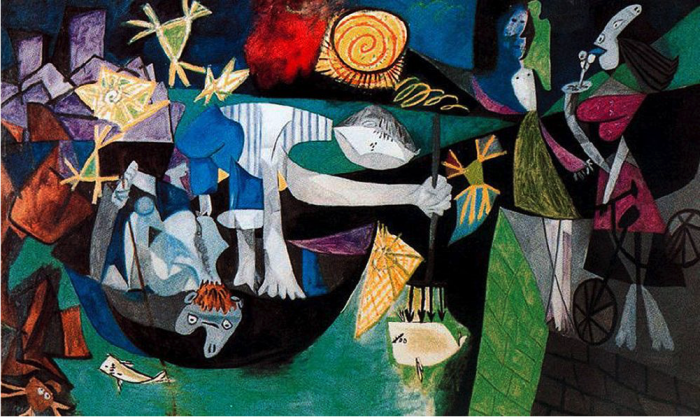
Sometimes it’s hard for the untrained eye to figure out what exactly is going on in a Picasso.
Fortunately, the artist leaned toward informative, workmanlike titles.
Had he titled “Night Fishing at Antibes,” below, something a bit more opaque—“Untitled No. 2,” say—the uneducated eye might well perceive the narrative as something closer to “Drunken Night in a Conveyer Belt Sushi Joint.”
Even knowing the correct title, my gut still argues that the boomerang-headed lady with boobs like lips is singing karaoke…
But after watching the above video by Evan Puschak, aka The Nerdwriter, I’m willing to concede that she’s standing on a jetty, a likely amalgamation of two of Picasso’s lovers.
(The less voluptuous creature standing next to her is his wife, and my gut is eager to know why it looks like she’s topless, a point on which Pushak is frustratingly mum.)
His process for understanding a Picasso takes the gut response into account, but then fleshes things out with four additional steps. You can apply them to many other artists’ work too.
- First reaction
- Content
- Form
- Historical context
- Personal context
It’s certainly helpful to know that the painting was made in 1939.
You probably don’t need the Internet to guess what world events were likely a source of preoccupation for the artist, whose “Guernica” was completed just two years earlier.
Content-wise, Puschak truffles up some interesting geographical references that elude most online analysis of the work. For instance, those purple blocks in the upper left corner now house the Musée Picasso.
There may well be a sixth step. Earlier, when a fan of the Nerdwriter’s weekly video essay series asked Puschak how to understand art, he responded:
All good art is trying to tell you something about your life. Your life… specifically. So understanding art is a process of understanding yourself, and vice versa. In both cases, you only learn by engaging. Watching isn’t enough, neither is reading or listening or thinking for that matter. From my perspective, engagement means writing. An idea that’s been snaking around in my videos for a long time is that we learn by saying, not thinking. You know something when you can articulate it, and for that you need words and sentences and paragraphs. So introspect, write down what your mind is doing. And when you watch a movie or look at a painting, write down how you feel about it. You’ll be amazed how one informs the other, and before long you’ll see some beautiful sparks.
Below are some of the resources Puschak credits with informing this Nerdwriter episode:
Rudolf Arnheim, “Picasso’s Night Fishing at Antibes” The Journal of Aesthetics and Art Criticism — Vol. 22, No. 2 (Winter, 1963), pp. 165–167
Douglas N. Morgan, “Picasso’s People: A Lesson in Making Sense” The Journal of Aesthetics and Art Criticism Vol. 22, No. 2 (Winter, 1963), pp. 167–171
Nina Corazzo, “Picasso’s ‘Night Fishing at Antibes’: A New Source” The Burlington Magazine Vol. 132, No. 1043 (Feb., 1990), pp. 99–101
Mark Rosenthal, “Picasso’s Night Fishing at Antibes: A Meditation on Death” The Art Bulletin Vol. 65, No. 4 (Dec., 1983), pp. 649–658
Albert Boime, “Picasso’s “Night Fishing at Antibes”: One More Try” The Journal of Aesthetics and Art Criticism Vol. 29, No. 2 (Winter, 1970), pp. 223–226
Timothy Anglin Burgard, “Picasso’s Night Fishing at Antibes: Autobiography, Apocalypse, and the Spanish Civil War” The Art Bulletin Vol. 68, No. 4 (Dec., 1986), pp. 657–672
Lawrence D. Steefel, Jr., “Body Imagery in Picasso’s “Night Fishing at Antibes” Art Journal Vol. 25, No. 4 (Summer, 1966), pp. 356–363+376
You can view the Nerdwriter’s other videos on his website or subscribe to his YouTube channel where a new video is published every Wednesday.
Related Content:
Watch Picasso Create Entire Paintings in Magnificent Time-Lapse Film (1956)
The Mystery of Picasso: Landmark Film of a Legendary Artist at Work, by Henri-Georges Clouzot
How to Look at Art: A Short Visual Guide by Cartoonist Lynda Barry
Ayun Halliday is an author, illustrator, theater maker and Chief Primatologist of the East Village Inky zine. Her play Zamboni Godot is opening in New York City in March 2017. Follow her @AyunHalliday.
Read More...George Orwell Tries to Identify Who Is Really a “Fascist” and Define the Meaning of This “Much-Abused Word” (1944)
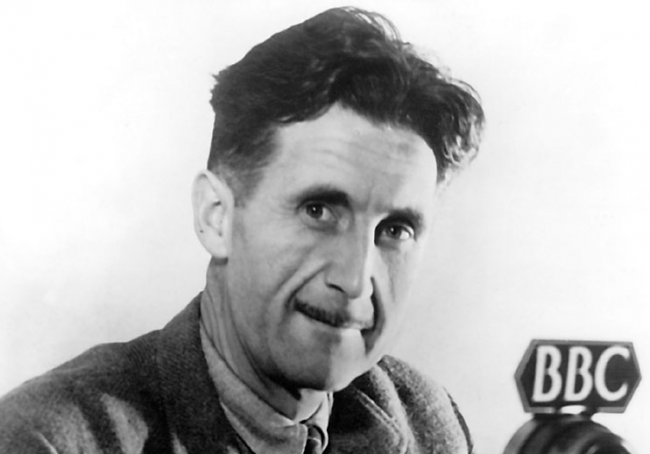
Image via Wikimedia Commons
Two neologisms, “Post-truth” and “Alt-right,” have entered political discourse in this year of turmoil and upheaval, words so notorious they were chosen as the winner and runner-up, respectively, for Oxford Dictionaries’ word of the year. These “Orwellian euphemisms,” argues Noah Berlatsky “conceal old evils” and “whitewash fascism,” recalling “in form and content… Orwell’s old words—specifically some of the newspeak from 1984. ‘Crimethink,’ ‘thoughtcrime,’ and ‘unperson’.… They even sound the same, with their simple, thunk-thunk construction of single syllables mashed together.”
“The sheer ugly clumsiness is supposed to make the language seem futuristic and cutting edge,” Berlatsky writes, “The world to come will be utilitarian, slangy, and up-to-the-minute in its inelegance. So the future was in Orwell’s day; so it is in 2016.” As in Orwell’s day, our current jargon gets mobilized in “defense of the indefensible”—as the novelist, journalist, and revolutionary fighter wrote in his 1946 essay “Politics and the English Language.” And just as in his day, the euphemisms pretty up constant, blatant lying and racist ideologies. We can also draw another linguistic comparison to Orwell’s time: the widespread use of the word “fascism.”
Berlatsky uses the word without defining it (when he talks about “whitewashing fascism”), except to say that “fascism thrives on falsehoods.” That may well be the case, but is it enough of a criterion for an entire political and economic system? The word begs for a cogent analysis. Even Umberto Eco, who grew up under Mussolini’s rule, felt the need for clarity, given that “American radicals,” he wrote in 1995, abused the phrase “fascist pig” as a pejorative for any authority, such that the word hardly meant anything thirty years after World War II.
But surely Orwell—who fought fascism in Spain in 1936, and whose ominous postwar dystopian novels have done more than any literary work to illustrate its menace—could define the word with confidence? Alas, when we look to his work, even before the war had ended, we find him writing, “‘Fascism,’ is almost entirely meaningless.” His short 1944 essay, “What is Fascism?” does not, however, push to abolish the word. He calls instead for “a clear and generally accepted definition of it” against the tendency to “degrade it to the level of a swearword.”
But Orwell (being Orwell) is not optimistic. One reason a definition had been so difficult to come by, he writes, is that any group to whom it is applied would have to make “admissions” most of them are not “willing to make”—admissions as to the real nature of their ideology and objectives, behind the euphemisms, lies, and double-speak. If no one is a fascist, then everyone potentially is. Even in the 40s, Orwell wrote, “if you examine the press you will find that there is almost no set of people—certainly no political party or organized body of any kind—which has not been denounced as Fascist.”
He enumerates those so accused: “Conservatives, Socialists, Communists, Trotskyists, Catholics, War Resisters, Supporters of the war, Nationalists.…” What of the textbook examples just on the other side of the front lines? “When we apply the term ‘Fascism’ to Germany or Japan or Mussolini’s Italy,” Orwell concedes, “we know broadly what we mean.” But appealing to these extreme governments does little good, “because even the major Fascist states differ from one another a good deal in structure and ideology.” Umberto Eco is content to say that fascism adopts the cultural trappings of the nations in which it arises, yet still shares several constant, if contradictory, ideological traits. Orwell isn’t so sure he knows what those are.
So what can Orwell say about the word, one he is eager to hold on to but at a loss to pin down? Though he believes it must name a “political and economic” system as well, Orwell finally opts for an ordinary language definition, to which we “attach at any rate an emotional significance.” Whether we “recklessly fling” the word “in every direction” or use it in more precise ways, we always mean “roughly speaking, something cruel, unscrupulous, arrogant, obscurantist, anti-liberal, and anti-working class. Except for the relatively small number of Fascist sympathizers, almost any English person would accept ‘bully’ as a synonym for ‘Fascist.’” Those today who are not bullies—or unapologetic fascist sympathizers—and who don’t need euphemisms for these words, would likely agree.
You can read “What is Fascism?” here. You can find the short essay published in this volume, The Collected Essays, Journalism and Letters of George Orwell.
Related Content:
Umberto Eco Makes a List of the 14 Common Features of Fascism
George Orwell Reviews Mein Kampf: “He Envisages a Horrible Brainless Empire” (1940)
George Orwell Explains in a Revealing 1944 Letter Why He’d Write 1984
Josh Jones is a writer and musician based in Durham, NC. Follow him at @jdmagness
Read More...An Introduction to Jean-Luc Godard’s Innovative Filmmaking Through Five Video Essays
Even though Jean-Luc Godard turned 86 this past Saturday, cinema scholar David Bordwell would no doubt still call him “the youngest filmmaker at work today” — as he did just two years ago, in an essay on Godard’s most recent picture Goodbye to Language. Over his more than 65-year-long career, which began in film criticism and arguably never left it, the man who directed the likes of Breathless, Alphaville, and Weekend in his very first decade of filmmaking has kept his work intellectually and aesthetically innovative when most movies seem resigned, and even content, to explore the same trampled patch of cinema’s creative space over and over again.
“Godard has been the liberator of weirdness,” wrote New Yorker film critic and Godard biographer Richard Brody on the occasion of the auteur’s 82nd birthday. “He was always ahead of the game in terms of movie-madness, recognizing that the habit of thinking in terms of images and sounds didn’t detach him from emotional engagement with his subjects but added a new dimension to it.”
He secured creative freedom for himself from the beginning when he “cast amateurs alongside professionals, mixed genres and tones, called attention to the artifices of movies he loved and of genres he rejuvenated, overturned convention with an anarchic fury and an analytical passion.”
Godard, Brody concludes, “hasn’t just rethought movies; he has reconceived the cinema, as a practice and as an experience.” But what does that look like for the audience? These five video essays plunge into Godard’s work, isolating and celebrating elements that have merited our close cinephilic attention. At the top of the post, we have a brief aesthetic overview in the Criterion Collection-sponsored “Godard in Fragments,” wherein video essayist kogonada (creator of pieces previously featured here on Wes Anderson, Alfred Hitchcock, Stanley Kubrick, Andrei Tarkovsky, and neorealism) spends six and a half minutes mesmerizingly “highlighting the iconic director’s signature themes and devices,” from cameras and handguns to women’s faces and bottoms to the very concept of death.
But to understand Godard requires first understanding Breathless, his 1960 debut feature and, in the words of the Nerdwriter in his video essay on the film, “an extended investigation of a French filmic identity in the shadow of Hollywood dominance — of, indeed, whether an identity informed by another nation’s culture can exist at all.” Godard and his collaborators made the movie a little more than a decade after the end of World War II, which meant just over a decade after French restrictions on the screening of American films had vanished, plunging Godard’s impressionable generation straight and deep into the sights, sounds, style, and tropes of Hollywood filmmaking.
Breathless, in all its low-budget excitement and illustration of the notion that the severest limitations create the most favorable conditions for art, also functions as a piece of film criticism: it interprets and repurposes all that Godard and his collaborators had learned, consciously as well as unconsciously, from and about American movies, and especially America’s breathless (as it were) genre pictures. “It wants to participate in the Hollywood filmmaking it admires, but it knows that such an identification is impossible, so it deals with this by being self-conscious, by using jump cuts, awkward transitions, by robbing the classic moments of their force or making the hero’s bloody final steps way longer that it could ever possibly be, forcing you outside the film’s text — or back into it again.”
Five years later came Alphaville, another simultaneous tribute to and assault on genre from Godard and company. In it, according to Patricia Pisters’ “Despair Has No Wings: a Tribute to Godard’s Alphaville,” he “plays with film noir elements to tell a science-fiction story that unfolds many other layers,” dropping the extant pulp-fiction detective Lemmy Caution into a new, “strange” context. “Popular audiences were shocked by this worn-out and alienating version of their hero,” turned by Godard into a “cosmonautic secret agent who travels in his Ford Galaxie” into a futuristic, authoritarian Paris of ruling supercomputers, seemingly mechanical citizens, “useless vending machines,” and stark, imposing modern architecture.
But Godard’s use of architecture started before Alphaville and continued after it, argues Richard Martin in the British Film Institute video essay “Jean-Luc Godard as Architect.” He uses the term in a broad sense to mean “someone interested in building, capturing, and arranging, spaces,” an interest manifest in Breathless’ “almost joyful” Paris of “people running through the Louvre, jukeboxes, cafés, diners, and bars,” Pierrot le Fou and Weekend’s presentation of “the car crash as a kind of architectural scenario,” and Contempt’s journey from the grandly “dilapidated lots of the Cinecittà film studios on the outskirts of Rome” to its thirty-minute centerpiece in one of that city’s new modern apartments to Capri’s Casa Malaparte, “one of the most thrilling pieces of architecture not just in Godard’s career, but in the whole history of cinema.”
Maybe it makes sense that someone who first got behind the camera to make a construction documentary (watch online here) would continue to pursue an interest in the organization of space. But as Godard’s attitudes, ideas, tastes, and even politics have changed, the other qualities of his movies have changed along with them. Having worked in black-and-white, color — its use examined in the supercut “Bleu, Blanc, Rouge” below — and with Goodbye to Language even in 3D, Godard has long shown a willingness to enter new visual territories as well.
Not only will his work past, present, and future continue to give video essays a wealth of material to work with, he himself, according to Richard Brody, made the form possible, having understood since the 1970s that “home video would be the basis for a newly analytical understanding of film history, because it would allow for the easy copying of clips and their manipulation via video editing with such techniques as slow motion, freeze-frame, and superimpositions of other images and text.” Thus “every video essay that turns up online owes him a debt of gratitude,” as do many of the other innovative types of visual media to which Godard has shown the way.
Related Content:
4,000+ Free Movies Online: Great Classics, Indies, Noir, Westerns, Documentaries & More
Jean-Luc Godard Takes Cannes’ Rejection of Breathless in Stride in 1960 Interview
The Entirety of Jean-Luc Godard’s Breathless Artfully Compressed Into a 3 Minute Film
Watch Meetin’ WA: Jean-Luc Godard Films Woody Allen in 1986 Short Film
Jean-Luc Godard’s Debut, Opération béton (1955) — a Construction Documentary
Jean-Luc Godard’s After-Shave Commercial for Schick (1971)
A Young Jean-Luc Godard Picks the 10 Best American Films Ever Made (1963)
Based in Seoul, Colin Marshall writes and broadcasts on cities and culture. He’s at work on a book about Los Angeles, A Los Angeles Primer, the video series The City in Cinema, the crowdfunded journalism project Where Is the City of the Future?, and the Los Angeles Review of Books’ Korea Blog. Follow him on Twitter at @colinmarshall or on Facebook.
Read More...Blade Runner Gets Re-Created, Shot for Shot, Using Only Microsoft Paint
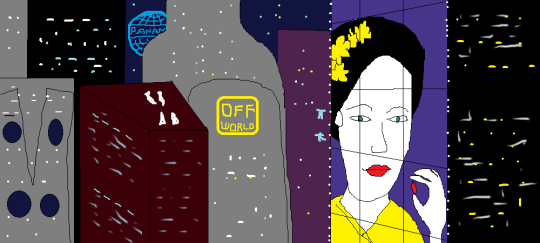
Blade Runner came out in June 1982. Microsoft’s Paint came out in November 1985. Little could the designers of that rebranded version of ZSoft’s PC Paintbrush packaged in with Windows 1.0 know that the paths of their humble graphics application and that elaborate sci-fi cinematic vision would cross just over 30 years later. Surely nobody involved in either project could have imagined the form the intersection would take: MSP Blade Runner, a fan’s shot-by-shot Tumblr “remake” (and gentle parody) of the film using only Microsoft Paint, starting with the Ladd Company tree logo.
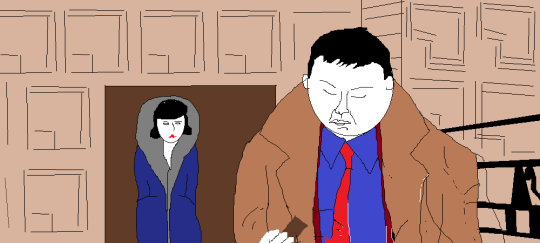
Why make such a thing? “I like the idea of having a blog but basically feel as if I have very little to say about things, at least things that are original or interesting,” creator David MacGowan told Motherboard’s Rachel Pick. “I gravitated to Tumblr with some idea of just posting pictures, but still felt I needed to be posting something I’d actually made myself… [Y]ears ago I used to draw really crappy basic MS Paint pics for a favourite pop group’s fan site, and they always seemed to raise a smile. The idea of doing something else with MS Paint, a kind of celebration of my not being deterred by lack of artistic talent, never really went away.”
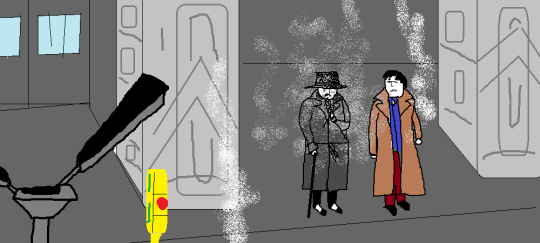
The mixture of technological and aesthetic sensibilities inherent in using a severely outdated but ever-present digital tool to re-create the enduringly compelling analog visuals of a movie from that same era goes well with the original Blade Runner’s project of updating the conventions of film noir to depict a then-newly imagined future. Even more fittingly, a work like MSP Blade Runner could only make sense in the 2010s, the very decade the movie tried to envision. Will it go all the way to the shot of Deckard and Rachel’s final exit into the elevator? “I don’t really think about giving up,” McGowan told Pick. “The idea of actually completing something I start out to do (for once in my life) is very appealing.” Spoken like a 21st-century man indeed.

You can find every frame painted so far, and every new one to come, here.
Related Content:
Watch an Animated Version of Ridley Scott’s Blade Runner Made of 12,597 Watercolor Paintings
Based in Seoul, Colin Marshall writes and broadcasts on cities and culture. He’s at work on a book about Los Angeles, A Los Angeles Primer, the video series The City in Cinema, the crowdfunded journalism project Where Is the City of the Future?, and the Los Angeles Review of Books’ Korea Blog. Follow him on Twitter at @colinmarshall or on Facebook.
Read More...Hear a 20 Hour Playlist Featuring Recordings by Electronic Music Pioneer Pauline Oliveros (RIP)
We can all surely recite some version of the difference between listening and hearing. It’s usually explained by a parent or guardian, with the intent of making us better at following instructions. On the whole, it’s for our own good as children that we pay heed to our elders. But genuine, critical listening is about so much more than perceiving gestures of authority. The avant-garde composer Pauline Oliveros, who died this past Thursday at 84, would argue that true listening, what she called “deep listening,” opens us up in radical ways to the world around us, and frees us from the sociopolitical constraints that hem in our senses. “Take a walk at night,” says one Oliveros’ 1974 “Sonic Meditations,” a set of 25 instructions for deep listening, “Walk so silently that the bottom of your feet become ears.”
“Sonic Meditations” emerged after “a period of intense introspection prompted by the Vietnam War,” writes Steve Smith in a New York Times obituary, during which Oliveros “changed creative course” to begin favoring improvisatory works. “All societies admit the power of music or sound,” she wrote in the preface.
“Sonic Meditations,” wrote Oliveros, “are an attempt to return the control of sound to the individual alone, and within groups especially for humanitarian purposes; specifically healing.” Her approach represented the composer giving up control and the primacy of authorship in order to play other roles: healer, guide, and teacher, a role she inhabited for decades as a college professor and author of several books of musical theory.
As you can see in her TEDx lecture at the top of the post, Oliveros always returned from her sonic explorations—such as the 1989 recording titled Deep Listening (hear an excerpt below)—with lessons for us in how to become better, more engaged and empowered listeners, rather than distracted consumers, of music and sound. Even before the 70s, and her turn to music as a meditative discipline informed by Buddhism and Native American ritual, Oliveros’ work disrupted the usual hierarchies of sound. An early adopter of technology, she “was quickly at the vanguard of electronics,” wrote Tom Service in a 2012 Guardian profile, but her “relationship with technology is philosophically ambivalent” given the role of research and development in creating weapons of war.
In early compositions like 1965’s “Bye Bye Butterfly,“ the composer “manipulated a recording of Puccini’s opera ‘Madama Butterfly’ on a turntable,” Smith writes, “augmenting its sounds with oscillators and tape delay.” In the beautifully moving results, further up, she aimed for a critique that “bids farewell not only to the music of the 19th century,” she wrote, “but also to the system of polite morality of that age and its attendant institutionalized oppression of the female sex.” Music has always been produced and consumed within the social constructions of gender binaries, Oliveros maintained. In a 1970 New York Times essay “And Don’t Call Them ‘Lady’ Composers,” she observed that “unless she is super-excellent, the woman in music will always be subjugated, while men of the same or lesser talent will find places for themselves.”
Throughout her long career, Oliveros created a place for herself, with as much theoretical rigor, playfulness, elegance, and sophistication as her friend and contemporary John Cage. That her substantial body of work has received a fraction of the attention as his may offer an instructive gloss on her contentions of persistent bias. But Oliveros’ work was not reactive; it was constructive, such that her concepts gave rise to what she called a Deep Listening Institute, an “ever-growing community of musicians, artists, scientists, and certified Deep Listening practitioners,” who strive “for a heightened consciousness of the world of sound and the sound of the world.”
But you don’t need specialized certification or training to experience the meditative, consciousness-expanding techniques of Oliveros’ music. On the contrary, she sought to foster “creative innovation across boundaries and across abilities, among artists and audience, musicians and nonmusicians, healers and the physically or cognitively challenged, and children of all ages.” In the Spotify playlist above, hear—or rather listen to—20 hours of Oliveros compositions, many featuring her early experiments with analog electronics, her “expanded instrument system,” and her signature instrument, a digitally-enhanced accordion.
As in the orchestral movement of Deep Listening, the album, Oliveros frequently dialogues with musical traditions, but she refused to allow them any particularly elevated authority over her work. “I’m not dismissive of classical music and the Western canon,” she said in 2012, “It’s simply that I can’t be bound by it. I’ve been jumping out of categories all my life.” As listeners, and readers, of her work, we can all learn to do the same.
Related Content:
The Music of Avant-Garde Composer John Cage Now Available in a Free Online Archive
Josh Jones is a writer and musician based in Durham, NC. Follow him at @jdmagness
Read More...Support Us
We're hoping to rely on loyal readers, rather than erratic ads. Please click the Donate button and support Open Culture. You can use Paypal, Venmo, Patreon, even Crypto! We thank you!

About Us

Open Culture scours the web for the best educational media. We find the free courses and audio books you need, the language lessons & educational videos you want, and plenty of enlightenment in between.
Advertise With Us
FREE UPDATES!
GET OUR DAILY EMAIL
Get the best cultural and educational resources on the web curated for you in a daily email. We never spam. Unsubscribe at any time.
FOLLOW ON SOCIAL MEDIA
Open Culture editor Dan Colman scours the web for the best educational media. He finds the free courses and audio books you need, the language lessons & movies you want, and plenty of enlightenment in between.
Advertise With Us


