Metallica Playing “Enter Sandman” on Classroom Toy Instruments
Things getting too serious around here? You want it lighter? Here’s Metallica playing “Enter Sandman” on classroom toy instruments. It features James Hetfield on the toy clarinet, Lars Ulrich on the Fisher Price Drum and toy cymbals, Kirk Hammett on the Melodica, and Robert Trujillo on the Baby Electric Axe. They’re joined by Jimmy Fallon on the kazoo. Next up, stunning, breathtaking timelapse films of boats sailing through Venetian canals.
If you would like to support the mission of Open Culture, consider making a donation to our site. It’s hard to rely 100% on ads, and your contributions will help us continue providing the best free cultural and educational materials to learners everywhere. You can contribute through PayPal, Patreon, and Venmo (@openculture). Thanks!
Related Content
A Bluegrass Version of Metallica’s Heavy Metal Hit, “Enter Sandman”
Finnish Musicians Play Bluegrass Versions of AC/DC, Iron Maiden & Ronnie James Dio
Read More...Hear Leonard Cohen’s Final Interview: Recorded by David Remnick of The New Yorker

Image by Rama, via Wikimedia Commons
We’ve heard very few details about Leonard Cohen’s death this week, and that is by design. The Cohen family requested privacy for his funeral and received it. While most outlets reported that he passed away on Thursday night, he actually died on Wednesday and was buried on Thursday. This collective graciousness on the part of the press comes, I’d say, at a time when little grace abounds. Grace is a word that I particularly associate with Cohen. He was a graceful man, always impeccably coiffed and dressed (his father was a tailor), his handsome, hangdog face never anything but perfectly direct.
For several days before his death, New Yorker editor David Remnick sat down with Cohen for the first interview he’d given in several years. The poet and folk singer/songwriter legend had terminal cancer, we learn, and was confined to a medical chair. Nonetheless, says Remnick, introducing the edited audio interview below, Cohen was “in an ebullient mood for a man… who knew exactly where he was going, and he was headed there in a hurry. And at the same time, he was incredibly gracious. The most gracious host this side of my mother.” Cut to Cohen offering him a few slices of cheese, and Reminick declining.
Cohen kept his illness secret (though he made allusions to it in a letter to his dying girlfriend Marianne this past summer). Remnick reveals that he recorded almost the entirety of his incredible final album You Want It Darker while confined to that chair. His voice rubbed raw with age, like Johnny Cash’s in his American Recordings sessions, Cohen’s last songs carry all the spiritual urgency and ragged vigor of the best work of his career. Where did it come from? Unsurprisingly, the first subject in Remnick’s interview is death. Cohen has been writing about death since his first album in 1967.
He begins with his father’s death when he was nine, “a kind of origin story for his career as a writer.”
The funeral was held in our house. When we came down the stairs, the coffin was in the living room. And it was open. It was winter, you know. And I was thinking, like, it must be hard to dig.
Remembering this scene, Cohen’s Montreal accent strengthens, then relaxes as he describes how, after the funeral, he went to his father’s closet, cut a bow tie in half, wrote “some kind of farewell to my father” on the wing of the tie, and buried it in the backyard. “It was just some attraction to a ritual response,” he says, “to an impossible event.”
This tragic vignette, and Cohen’s reflection on it, is, as Remnick says, like a superhero origin story. With the same measured, rhythmic voice and clear expressions as his songs, Cohen connects the mortal to the mysteriously divine act of writing, which accomplishes “some kind of farewell” whose effects are unknown to us. What possible significance the act had for Cohen, he cannot say, but it was simply the appropriate response. Cohen’s final album seemed to be the right response to his own death.
This dwelling on mortality is of course hugely significant and in the foreground of this interview-slash-tribute from Remnick, but it isn’t a morbid piece at all. In a retrospective of Cohen’s career, we learn how he went from an acclaimed but struggling poet and novelist to folk singer in 1967, and how crippling stage fright led to him drinking three bottles of wine before he performed. At a 1972 concert in Israel, Cohen apologized, left the stage partway through a song, and dropped two hits of acid in his dressing room. The audience began singing loudly, and he returned to sing “So Long, Marianne” while hallucinating wildly.
The story is hilarious, told with the same dry wit that undercuts all of Cohen’s observations about sex, death, and God. For all the deepness we associate with Leonard Cohen, says Remnick, he seemed reluctant to analyze his work in religious terms. But when he does open up about it, he gives us a backdrop against which to understand much of his spiritual philosophy: prayers, he says, “are to remind God, it was once a harmonious unity.… “ as well as his writing philosophy: “I only know,” says Cohen, “that if I write enough verses, and keep discarding the slogans, even the hip ones, even the subtle ones, that something will emerge that represents.”
You can also listen to Remnick’s New Yorker Radio Hour podcast at the WNYC site (and above) and read Remnick’s article on his last meetings with Cohen at The New Yorker.
Related Content:
Leonard Cohen Has Passed at Age 82: His New and Now Final Album Is Streaming Free Online
Leonard Cohen Plays a Spellbinding Set at the 1970 Isle of Wight Festival
Ladies and Gentlemen… Mr. Leonard Cohen: The Poet-Musician Featured in a 1965 Documentary
Josh Jones is a writer and musician based in Durham, NC. Follow him at @jdmagness
Read More...Carl Sagan’s Ambitious College Reading List: Plato, Shakespeare, Gide, and Plenty of Philosophy, Math & Physics (1954)
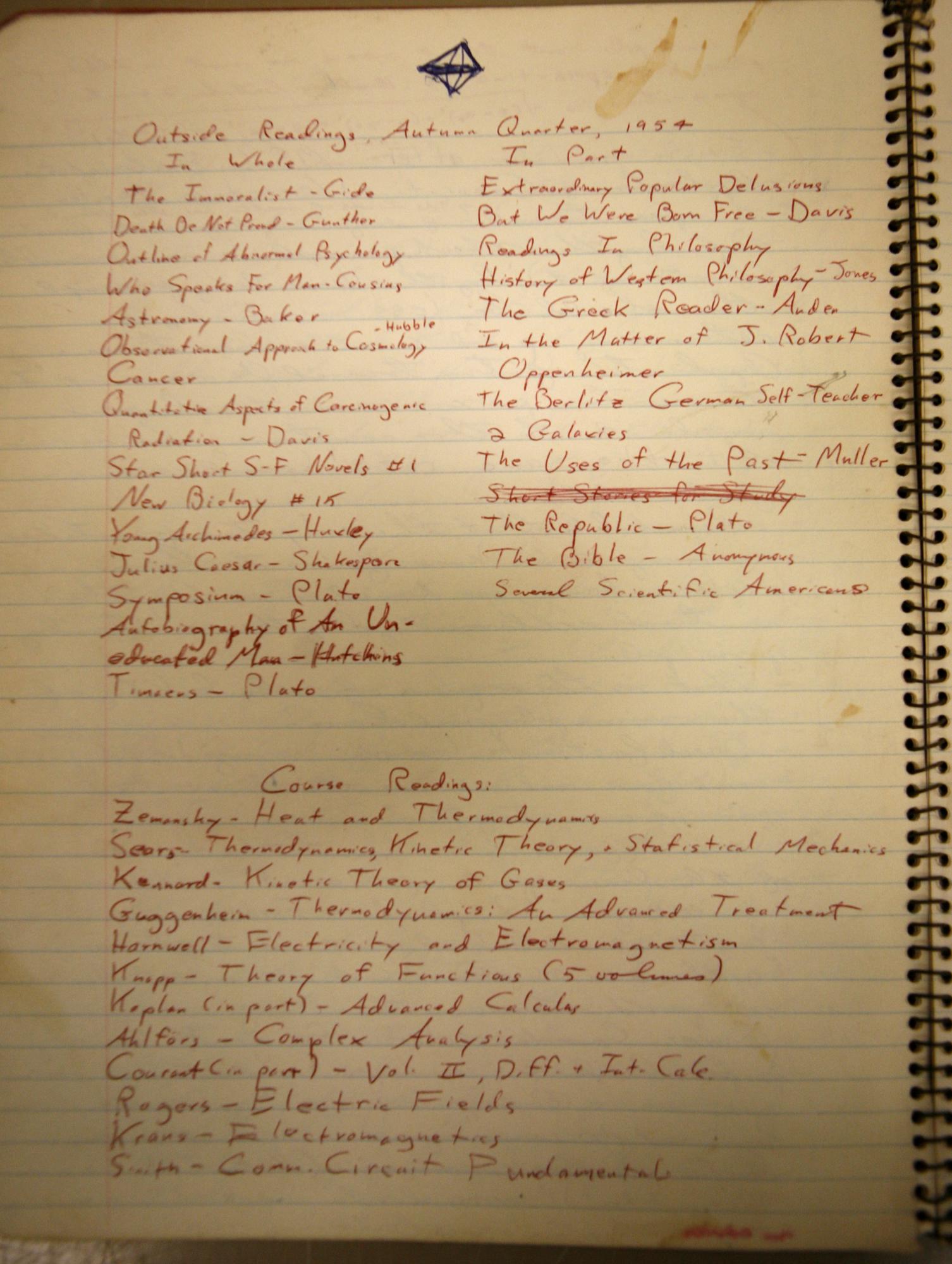
Carl Sagan may have passed away almost twenty years ago, but he continues to influence minds of all generations through intellectual heirs like Neil DeGrasse Tyson (host of the remake of Sagan’s beloved 1980 TV series Cosmos) as well as through the books he wrote in his lifetime. But what books influenced Sagan, launching him on the journey toward astronomy, cosmology, astrophysics, astrobiology, and global celebrity? Thanks to the Library of Congress’ Carl Sagan Archive, we now know at least forty titles from the no doubt voluminous amount of reading material he digested during his youth and education.
Sagan wrote this reading list (which a fan has transcribed with links and posted to Reddit) in 1954, as an undergraduate at the University of Chicago. On it he identifies the books, as a young Charles Darwin once wrote on his own list, to be read, whether wholly, partially, or as a part of his coursework:
In Whole
- The Immoralist — Andre Gide
- Death, Be Not Proud — John Gunther
- Outline of Abnormal Psychology - Gardner Murphy
- Who Speaks For Man — Norman Cousins
- Astronomy — Robert Baker
- Observational Approach to Cosmology — Robert Hubble
- Cancer
- Quantitative Aspects of Carcinogenic Radiation — Harold Thayer Davis
- Star Short Science Fiction Novels #1
- New Biology #15
- Young Archimedes — Aldous Huxley
- Julius Caesar — Shakespeare
- Symposium — Plato
- Autobiography of An Uneducated Man — Hutchins
- Timaeus — Plato
In Part
- Extraordinary Popular Delusions — Charles MacKay
- But We Were Born Free — Elmer Davis
- Readings In Philosophy
- History of Western Philosophy — W.T. Jones
- The Greek Reader — W.H. Auden
- In the Matter of J. Robert Oppenheimer
- The Berlitz German Self-Teacher
- Sigma Galaxies
- The Uses of the Past — Herbert J. Muller
- Short Stories for Study
- The Republic — Plato
- The Bible — Anonymous
- Several Scientific Americans
Course Readings:
- Heat and Thermodynamics - Mark Waldo Zemansky
- Thermodynamics, Kinetic Theory, Statistical Theory - Francis W. Sears
- Kinetic Theory of Gases — E.H. Kennard
- Thermodynamics: An Advanced Treatment — E.A. Guggenheim
- Electricity and Electromagnetism — Hornwell
- Theory of Functions (5 Volumes) — Konrad Knopp
- Advanced Calculus (in part) — Wilfred Kaplan
- Complex Analysis — Lars Ahlfors
- Vol. II, Differential and Integral Calculus — Richard Courant (Author)
- Electric Fields — Rugers
- Electromagnetics — John Daniel Kraus
- Communication Circuit Fundamentals — Carl Edwin Smith
Pretty ambitious material for a twenty-year-old, but remember: we’re talking about someone who, around a decade earlier, had already sketched out his ideas for humanity’s spacefaring future. It makes sense that such a child would grow up to read science fiction — and with the publication of Contact thirty years after that, write it — and even that he would take up mathematics and physics as a course of academic study.
But it takes a mind like Sagan’s not to lose sight of the importance of communicating with the nonspecialist public, as evidenced by the presence on his list of Scientific American and Extraordinary Popular Delusions. Nor did he neglect, even before his career began, the need to contextualize scientific discoveries in the realm of human thought and feeling, which extends from Plato and the Bible to Shakespeare, André Gide, and John Gunther — that last writer’s work, and certain other volumes on his list, also showing an advanced consciousness of human limitations and mortality. All of it placed Sagan well, despite his truncated time on Earth, to do work that will outlast us all.
Related Content:
See Carl Sagan’s Childhood Sketches of The Future of Space Travel
Carl Sagan Presents His “Baloney Detection Kit”: 8 Tools for Skeptical Thinking
Carl Sagan on the Virtues of Marijuana (1969)
Neil deGrasse Tyson Lists 8 (Free) Books Every Intelligent Person Should Read
Based in Seoul, Colin Marshall writes and broadcasts on cities and culture. He’s at work on a book about Los Angeles, A Los Angeles Primer, the video series The City in Cinema, the crowdfunded journalism project Where Is the City of the Future?, and the Los Angeles Review of Books’ Korea Blog. Follow him on Twitter at @colinmarshall or on Facebook.
Read More...Decoding the Screenplays of The Shining, Moonrise Kingdom & The Dark Knight: Watch Lessons from the Screenplay
“A screenplay isn’t meant to be read,” said no less a directing-screenwriting auteur than Stanley Kubrick. “It’s to be realized on film.” The quote comes up in “The Shining — Quietly Going Insane Together,” an episode of the video essay series Lessons from the Screenplay. Creator Michael Tucker uses it to explain his lack of access to the actual “shooting script” of the film, meaning the sort of script typically written before production and then more or less adhered to on set. But Kubrick worked differently. On his projects “the words of the script and the design of the film were created together.” (Or as star Jack Nicholson says in a bit of archival footage, “I quit usin’ my script. I just take the ones they type up each day.”)
Tucker goes on to break down The Shining’s writing process in a way that will fascinate not just screenwriters but anyone with an interest in artistic structure, beginning with the segmentation implied by the film’s memorably stark title cards: “THE INTERVIEW,” “THURSDAY,” “8am,” and so on. He does this in service of one important overarching question: “What, exactly is so creepy about The Shining?” (I’ve been asking it myself ever since watching it at a Halloween party nearly twenty years ago.) In “Moonrise Kingdom: Where Story Meets Style” he gets into the question of what storytelling functions Anderson’s signature abundance of vivid, whimsical, or askew details perform, and how they do it effectively.
As far as what makes Christopher Nolan’s second Batman movie The Dark Knight work so well, Tucker has the answer in two words: the Joker. Different actors have portrayed Batman’s most famous rival with different levels of effectiveness, with Heath Ledger’s Joker generally acknowledged as the Joker, or at least one of the Jokers, to beat. But like any character, this Joker began on the page, and in “The Dark Knight — Creating the Ultimate Antagonist,” we learn which screenwriting guru-approved qualities instilled there give him so much power: his exceptional skill at attacking Batman’s weaknesses, how he pressures Batman into difficult choices, and how he and Batman ultimately compete for the same goal, the soul of Gotham, and become two sides of the same coin.
You can learn other lessons that Tucker draws from the screenplays of movies like Nightcrawler, Gone Girl, Independence Day, Ghostbusters, and a two-parter on American Beauty. While elements of cinema like the directing, the acting, the editing, and even the music might capture our attention more aggressively, we shouldn’t forget that every narrative film, large or small, traditional or unconventional, grows from words someone wrote down. “It’s not what a movie is about,” declared Roger Ebert, “it’s how it is about it” — and the decisions of how to be about it happen in the screenplay.
Related Content:
Akira Kurosawa’s Advice to Aspiring Filmmakers: Write, Write, Write and Read
10 Tips From Billy Wilder on How to Write a Good Screenplay
Woody Allen’s Typewriter, Scissors and Stapler: The Great Filmmaker Shows Us How He Writes
How Ray Bradbury Wrote the Script for John Huston’s Moby Dick (1956)
Raymond Chandler: There’s No Art of the Screenplay in Hollywood
Based in Seoul, Colin Marshall writes and broadcasts on cities and culture. He’s at work on a book about Los Angeles, A Los Angeles Primer, the video series The City in Cinema, the crowdfunded journalism project Where Is the City of the Future?, and the Los Angeles Review of Books’ Korea Blog. Follow him on Twitter at @colinmarshall or on Facebook.
Read More...When Akira Kurosawa Watched Solaris with Andrei Tarkovsky: I Was “Very Happy to Find Myself Living on Earth”
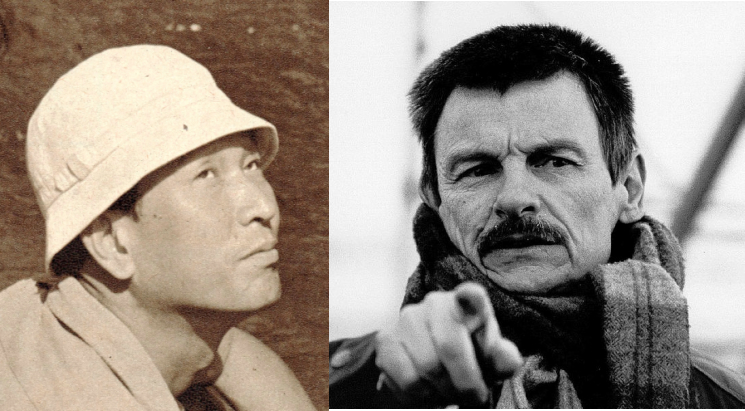
Image of Kurosawa and Tarkovsky via NPR
Though Akira Kurosawa and Andrei Tarkovsky occupy the same plane in the pantheon of auteurs — the highest one — neither their lives nor their films had much obviously in common. The older, longer-lived Kurosawa started his career earlier and ended it later, but during those cinematically glorious decades of the 1960s and 70s, the two brought into the world such pictures as Yojimbo, Ivan’s Childhood, High and Low, Red Beard, Andrei Rublev, Dodesukaden, Solaris, The Mirror, Dersu Uzala (Kurosawa’s sole Japanese-Soviet co-production, though Tarkovsky wasn’t involved), and Stalker.
They actually met around the middle of that period, when Kurosawa came to visit the set of Solaris (watch Solaris online along with many other major Tarkovsky films). “Tarkovsky guided me around the set, explaining to me as cheerfully as a young boy who is given a golden opportunity to show someone his favorite toybox,” Kurosawa writes in an essay originally run in the Asahi Shinbun in 1977 and republished at Cinephilia & Beyond.
“[Director Sergei] Bondarchuk, who came with me, asked him about the cost of the set, and left his eyes wide open when Tarkovsky answered it. The cost was so huge: about six hundred million yen as to make Bondarchuk, who directed that grand spectacle of a movie War and Peace, agape in wonder.”
But the work, as Kurosawa soon found out, merited the cost and then some:
Marvelous progress in science we have been enjoying, but where will it lead humanity after all? Sheer fearful emotion this film succeeds in conjuring up in our soul. Without it, a science fiction movie would be nothing more than a petty fancy.
These thoughts came and went while I was gazing at the screen.
Tarkovsky was together with me then. He was at the corner of the studio. When the film was over, he stood up, looking at me as if he felt timid. I said to him, “Very good. It makes me feel real fear.” Tarkovsky smiled shyly, but happily. And we toasted vodka at the restaurant in the Film Institute. Tarkovsky, who didn’t drink usually, drank a lot of vodka, and went so far as to turn off the speaker from which music had floated into the restaurant, and began to sing the theme of samurai from Seven Samurai at the top of his voice.
As if to rival him, I joined in.
For I was at that moment very happy to find myself living on Earth.
Solaris makes a viewer feel this, and even this single fact shows us that Solaris is no ordinary SF film. It truly somehow provokes pure horror in our soul. And it is under the total grip of the deep insights of Tarkovsky.
Kurosawa pays special attention to the sequence, which you can watch above analyzed by film scholars Vida Johnson and Graham Petrie, filmed in his own homeland: “What makes us shudder is the shot of the location of Akasakamitsuke, Tokyo, Japan. By a skillful use of mirrors, he turned flows of head lights and tail lamps of cars, multiplied and amplified, into a vintage image of the future city. Every shot of Solaris bears witness to the almost dazzling talents inherent in Tarkovsky.”
Like all of Tarkovsky’s features, Solaris only holds up more firmly with time and thus still enjoys revival screenings all over the world, but you can also watch it free online right now. Just get ready, when you descend to Earth afterward, to feel your own gratitude at finding yourself back here.
Related Content:
Watch Solaris (1972), Andrei Tarkovsky’s Haunting Vision of the Future
Andrei Tarkovsky’s Solaris Shot by Shot: A 22-Minute Breakdown of the Director’s Filmmaking
Based in Seoul, Colin Marshall writes and broadcasts on cities and culture. He’s at work on a book about Los Angeles, A Los Angeles Primer, the video series The City in Cinema, the crowdfunded journalism project Where Is the City of the Future?, and the Los Angeles Review of Books’ Korea Blog. Follow him on Twitter at @colinmarshall or on Facebook.
Read More...What Does Jorge Luis Borges’ “Library of Babel” Look Like? An Accurate Illustration Created with 3D Modeling Software

Sketchup renderings of the Library of Babel. Images courtesy of Jamie Zawinski.
Fulfilling the maxim “write what you know,” Argentine fabulist Jorge Luis Borges penned one of his most extraordinary and bewildering stories, “The Library of Babel,” while employed as an assistant librarian. Borges, it has been noted—by Borges himself in his 1970 New Yorker essay “Autobiographical Notes”—found the work dreary and unfulfilling: “nine years of solid unhappiness,” as he put it plainly. “Sometimes in the evening, as I walked the ten blocks to the tramline, my eyes would be filled with tears.”

And yet, for all of its tedium, his library position suited his needs as a writer like none other could. “I would do all my library work in the first hour,” he remembers, “and then steal away to the basement and pass the other five hours in reading or writing.” During those stolen hours, Borges dreamed up a library the size of the universe, “composed of an indefinite and perhaps infinite number of hexagonal galleries, with vast air shafts between, surrounded by very low railings.” Like so many of the objects and places in Borges’ stories, this fantastic structure, Escher-like, is both vividly described and impossible to imagine.

Many have tried their hand at visually rendering the Library of Babel, but according to programmer Jamie Zawinski, “past attempts,” writes Carey Dunne at Hyperallergic, “aren’t faithful to the text,” omitting crucial structures like the “sleep chamber, lavatory, and hallway” and screwing up “the placement of the spiral stairway.” You can see Zawinski’s various critiques of these supposed failures on his blog, JWZ. And you may wonder how it’s even possible to construct an accurate model of a structure that may have no finite boundaries and whose internal architecture the story itself calls into question. Nonetheless, Zawinski has boldly given it a try.

Using the 3D modeling program Sketchup, he has designed what he believes to be a model superior to the rest, though he admits “I don’t think this is quite right either.” If you’re wondering “Why is he doing this?” Zawinski writes, “you and I have that in common.” The Borgesian task, like that of the librarian, is an endless one, pursued with scholastic rigor for its own sake rather than for some great reward. And once one enters the labyrinth of his twisting designs, there may be no way out but eternally through. “The possibility of a man’s finding his Vindication,” writes Borges wearily of certain librarians’ attempts to solve the library’s riddles, “or some treacherous variation thereof, can be computed as zero.”

So Zawinski trudges on. His “wrestling with the details of his rendering,” writes Dunne, “his obsessive analysis of the wording of Borges’ description, recalls the library inhabitants’ futile quests to decipher the mysteries of the library.” The programmer’s admirable attention to the physics of the space may at times sound like a rather leaden way to approach what is essentially an elaborate metaphor: “I can’t help but think about the weight and pressure of a column of air that high,” he muses in his initial explorations, “and what is it sitting on, and how to route the plumbing from all of those toilets, and that toilets imply digestion, so where does the food come from?”
Such questions take him far afield of Borges’ theo-philosophical parable: “Is there a section of the library devoted to farming, and metallurgy?” Nonetheless, Zawinski’s detailed analysis has produced a visualization of the space like none other, and he admits to “overthinking a sub-infinite but nearly boundless hill of beans.” Borges’ imaginary librarian has abandoned trying to solve the library’s mysteries. Humbled by the failures of those who came before him, he persists in the “elegant hope” that the library “is unlimited and cyclical… repeated in the same disorder… which, thus repeated, would be an order: the Order.” He wisely leaves the ultimate metaphysical discovery, however, to “an eternal traveler” with infinite time on their hands.
You can view Zawinski’s commentary here, and see his designs here. On the bottom of this page, he lets you download his Sketchup file.
via Hyperallergic
Related Content:
Jorge Luis Borges Selects 74 Books for Your Personal Library
Jorge Luis Borges’ Favorite Short Stories (Read 7 Free Online)
Josh Jones is a writer and musician based in Durham, NC. Follow him at @jdmagness
Read More...Kurt Vonnegut’s Term Paper Assignment from the Iowa Writers’ Workshop Teaches You to Read Fiction Like a Writer
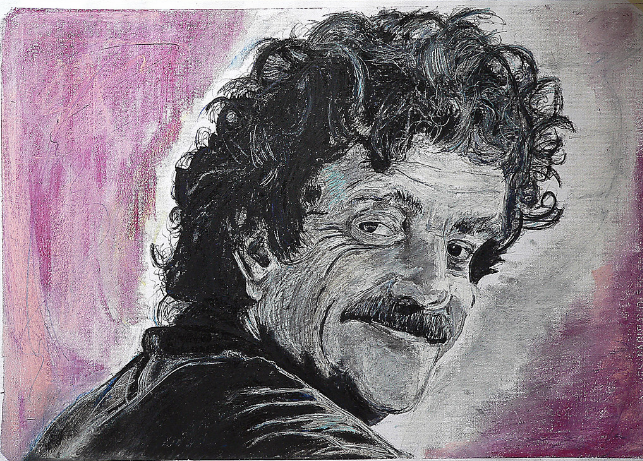
Image by Daniele Prati, via Flickr Commons
I wish I’d had a teacher who framed his or her assignments as letters…
Which is really just another way of saying I wish I’d been lucky enough to have taken a class with writers Kurt Vonnegut or Lynda Barry.
There’s still hope of a class with Barry, aka Professor Chewbacca, Professor Old Skull, and most recently, Professor Drogo. Those of us who can’t get a seat at the Wisconsin Institute for Discovery, the Omega Institute, or the Clarion Science Fiction and Fantasy Writers’ Workshop can play along at home, using assignments she generously makes available in her books and on her Near-Sighted Monkey Tumblr.
Vonnegut fans long for this level of access, which is why we are doubly grateful to writer Suzanne McConnell, who took Vonnegut’s “Form of Fiction” (aka “Surface Criticism” aka “How to Talk out of the Corner of Your Mouth Like a Real Tough Pro”) course at the Iowa Writers’ Workshop in the mid-60s.
The goal was to examine fiction from a writer’s perspective and McConnell (who is soon to publish a book about Vonnegut’s advice to writers) preserved one of her old teacher’s term paper assignments—again in letter form. She later had an epiphany that his assignments were “designed to teach something much more than whatever I thought then… He was teaching us to do our own thinking, to find out who we were, what we loved, abhorred, what set off our tripwires, what tripped up our hearts.”
For the term paper, the eighty students—a group that included John Irving, Gail Godwin, and Andre Dubus II—were addressed as “Beloved” and charged with assigning a letter grade to each of the fifteen stories in Masters of the Modern Short Story (Harcourt, Brace, 1955, W. Havighurst, editor).
(A decade and a half later, Vonnegut would subject his own novels to the same treatment.)
A noted humanist, Vonnegut instructed the class to read these stories not in an overly analytical mindset, but rather as if they had just consumed “two ounces of very good booze.”
The ensuing letter grades were meant to be “childishly selfish and impudent measures” of how much—or little—joy the stories inspired in the reader.
Next, students were instructed to choose their three favorite and three least favorite stories, then disguise themselves as “minor but useful” lit mag editors in order to advise their “wise, respected, witty and world-weary superior” as to whether or not the selected stories merited publication.
Here’s the full assignment, which was published in Kurt Vonnegut: Letters (Delacorte Press, 2012). And also again in Slate.
Beloved:
This course began as Form and Theory of Fiction, became Form of Fiction, then Form and Texture of Fiction, then Surface Criticism, or How to Talk out of the Corner of Your Mouth Like a Real Tough Pro. It will probably be Animal Husbandry 108 by the time Black February rolls around. As was said to me years ago by a dear, dear friend, “Keep your hat on. We may end up miles from here.”
As for your term papers, I should like them to be both cynical and religious. I want you to adore the Universe, to be easily delighted, but to be prompt as well with impatience with those artists who offend your own deep notions of what the Universe is or should be. “This above all …”
I invite you to read the fifteen tales in Masters of the Modern Short Story (W. Havighurst, editor, 1955, Harcourt, Brace, $14.95 in paperback). Read them for pleasure and satisfaction, beginning each as though, only seven minutes before, you had swallowed two ounces of very good booze. “Except ye be as little children …”
Then reproduce on a single sheet of clean, white paper the table of contents of the book, omitting the page numbers, and substituting for each number a grade from A to F. The grades should be childishly selfish and impudent measures of your own joy or lack of it. I don’t care what grades you give. I do insist that you like some stories better than others.
Proceed next to the hallucination that you are a minor but useful editor on a good literary magazine not connected with a university. Take three stories that please you most and three that please you least, six in all, and pretend that they have been offered for publication. Write a report on each to be submitted to a wise, respected, witty and world-weary superior.
Do not do so as an academic critic, nor as a person drunk on art, nor as a barbarian in the literary market place. Do so as a sensitive person who has a few practical hunches about how stories can succeed or fail. Praise or damn as you please, but do so rather flatly, pragmatically, with cunning attention to annoying or gratifying details. Be yourself. Be unique. Be a good editor. The Universe needs more good editors, God knows.
Since there are eighty of you, and since I do not wish to go blind or kill somebody, about twenty pages from each of you should do neatly. Do not bubble. Do not spin your wheels. Use words I know.
poloniøus
McConnell supplied further details on the extraordinary experience of being Vonnegut’s student in an essay for the Brooklyn Rail:
Kurt taught a Chekhov story. I can’t remember the name of it. I didn’t quite understand the point, since nothing much happened. An adolescent girl is in love with this boy and that boy and another; she points at a little dog, as I recall, or maybe something else, and laughs. That’s all. There’s no conflict, no dramatic turning point or change. Kurt pointed out that she has no words for the sheer joy of being young, ripe with life, her own juiciness, and the promise of romance. Her inarticulate feelings spill into laughter at something innocuous. That’s what happened in the story. His absolute delight in that girl’s joy of feeling herself so alive was so encouraging of delight. Kurt’s enchantment taught me that such moments are nothing to sneeze at. They’re worth a story.
via Slate
Related Content:
Kurt Vonnegut Diagrams the Shape of All Stories in a Master’s Thesis Rejected by U. Chicago
In 1988, Kurt Vonnegut Writes a Letter to People Living in 2088, Giving 7 Pieces of Advice
Kurt Vonnegut’s 8 Tips on How to Write a Good Short Story
Kurt Vonnegut Urges Young People to Make Art and “Make Your Soul Grow”
Ayun Halliday is an author, illustrator, theater maker and Chief Primatologist of the East Village Inky zine. Her play Zamboni Godot is opening in New York City in March 2017. Follow her @AyunHalliday.
Read More...Bob Dylan Wins Nobel Prize in Literature for Creating “New Poetic Expressions within the Great American Song Tradition”
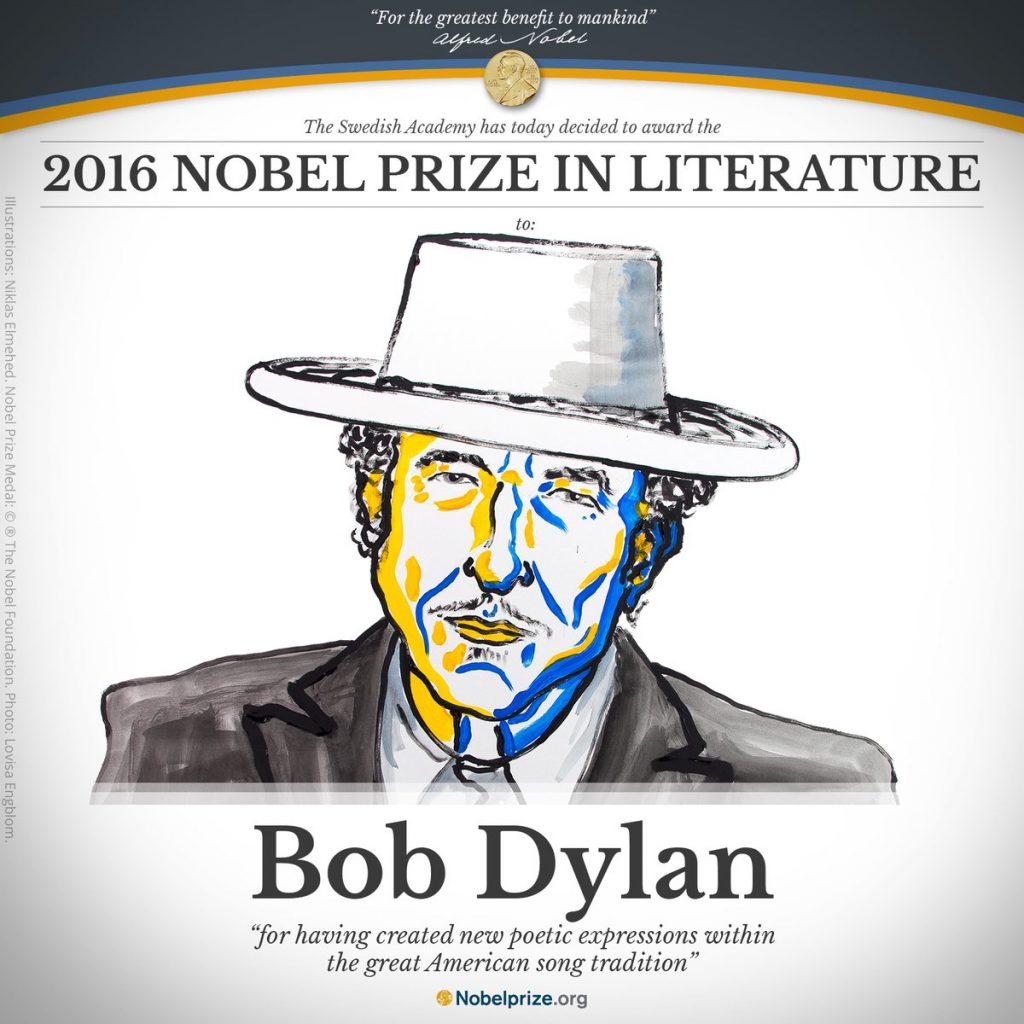
Image courtesy of The Nobel Prize’s Twitter stream.
His apocalyptic poetry plucks images and forms from the blues, the Bible, the Beats, Symbolists, William Blake, T.S. Eliot, and a balladeer tradition dating from medieval French and English minstrelsy to Appalachian settlement to Woody Guthrie, his first muse. His narrative voice shifts from work to work as he has fully embodied various American characters for over half a century—folk troubadour, rock and roll trickster, earnest country crooner, evangelist, weary bluesman, starry-eyed jazz singer. “There is no systematic way of analyzing Dylan’s song lyrics or poems,” writes Julia Callaway at the Oxford Dictionaries blog; “they span more than five decades of historical context and musical style. But perhaps one of the most interesting sides of Dylan is how he uses language and his lyrics to project certain identities, including folksinger and protest-musician.”
Dylan began in that tradition with songs like “The Times They Are A‑Changin’” and “A Hard Rains A‑Gonna Fall”—picking up Guthrie’s inflections and mannerisms in ballads much more sophisticated than they seemed at first listen. “A Hard Rain’s A‑Gonna Fall” is a “seven minute epic,” writes Rolling Stone, “that warns against a coming apocalypse while cataloging horrific visions—gun-toting children, a tree dripping blood—with the wide-eyed fervor of John the Revelator.” The song “began life as a poem, which Dylan likely banged out on a typewriter owned by his buddy… Wavy Gravy.” Dylan has been ambivalent about whether or not we should call him a poet, but this is how so much of his work took shape—banged out on typewriters in New York apartments—as poetry set to music. “Every line in [A Hard Rain’s A‑Gonna Fall] is actually the start of a whole song,” said Dylan, “but when I wrote it, I thought I wouldn’t have enough time alive to write all those songs, so I put all I could into this one.”
After over five decades of lyrics packed with allusion and densely woven themes and meanings, Dylan has had time to write those songs—several more apocalyptic epics set to a few chords on the acoustic guitar. “There are some novels, some trilogies, in fact, with less actual content than Bob Dylan’s ‘All Along the Watchtower,’” says the Nerdwriter in the analysis of that cryptic John Wesley Harding song above. One could say the same about certain songs that appear on nearly every Dylan record, like the 11-minute “Desolation Row,” below. Amid only a few missteps, Dylan has released album after album, decade after decade, that showcase his unparalleled wordcraft in various song forms. And some of his finest work has appeared only in recent years, when it seems his career might have come to a close. Despite some mixed reactions—and some concern for Philip Roth—most people have responded to news this morning of his win for the Nobel Prize in Literature with a decided, “yes, of course.”
Dylan’s recognition by the Nobel Committee validates not only the songwriter himself, but the form he embraced and shaped. As permanent secretary of the Swedish Academy Sara Danius remarked in her announcement, Dylan “created new poetic expressions within the American song tradition.” The award represents “a recognition of the whole tradition that Bob Dylan represents,” says critic David Hadju, “so it’s partly a retroactive award for Robert Johnson and Hank Williams and Smokey Robinson and the Beatles. It should have been taken seriously as an art form a long time ago.” One could argue that American song has already been taken as seriously as any art form, but that it isn’t literature.
Several people have done so. As New York Times writer Hiroko Tabuchi put it, “this might be a disappointing day for booksellers and publishers.” Hardly. Not only does Dylan have a memoir out, Chronicles: Volume One, the first of a planned trilogy, but we may also find renewed appreciation for his first book, 1966’s Tarantula. Dylan’s songs and drawings have been turned into picture books, published in collections, and pored over in biography after biography, commentary after commentary. And next month, Dylan himself will release The Lyrics: Since 1962, a comprehensive, definitive collection of the songwriter’s lyrics, complete with expert annotations. You can pre-order a copy here.
The literary output by and about Dylan should keep booksellers busy for many months after this announcement. But Dylan’s is primarily a living, bardic tradition, lest we forget that all literature began as song. So congratulations to Dylan and for perhaps long-overdue recognition of American songcraft as a genuinely literary art form.
Related Content:
Josh Jones is a writer and musician based in Durham, NC. Follow him at @jdmagness
Read More...A Master List of 800 Free Classic eBooks for iPad, Kindle & Other Devices

Maybe you’re an eBooks holdout, a late adopter, a disdainer of the book as a branded “device”? I get it. Is there anything more ridiculous than putting down a book because its batteries have run out? No amount of crowing about the supremacy of tech will make me love the smell and feel of paper less…
And yet…
Within the charming heft of printed books reside their limitation. Traveling students, researchers, or avid readers must lug several pounds of bound paper along with them on long journeys, or to work sessions at the local coffee shop. An eReader or smartphone can hold an entire library—which one can expand ad infinitum, it seems, on the fly.
This feature—along with the ease of copying quotes and passages and sending them across platforms—eventually sold me on the eBook as a robust supplement to print. And if it sounds like I’m making a sales pitch, I am: for hundreds of free books, available to read on the device of your choosing. Entry-level Kindle, budget smartphone, or latest, fanciest iPad—most all will accommodate the range of formats available in our collection of 800 Free eBooks.
Can you freely download the latest New York Times bestsellers? Not here, and I’d hope—for the sake of those hard-working writers—that you’d pay to read new releases. Can you carry along with you on your next business trip or vacation the works of Aristotle and Freud, several novels by Jane Austen and Joseph Conrad, the masterworks of Hegel, Hume, and Kant, the complete Shakespeare, and Proust’s multi-volume À la recherche du temps perdu? Quite easily. Here’s a small sample of what’s on our list:
- Austen, Jane - Pride & Prejudice
- Carroll, Lewis - Through the Looking-Glass
- Conrad, Joseph - Heart of Darkness
- Dostoevsky, Fyodor - Brothers Karamazov
- Eliot, George - Middlemarch
- Fitzgerald, F. Scott - Tales of the Jazz Age
- Freud, Sigmund - Dream Psychology: Psychoanalysis for Beginners
- Tolstoy, Leo - Anna Karenina
- Whitman, Walt - Leaves of Grass
- Wollstonecraft, Mary — A Vindication of the Rights of Women
See the full list of 800 offerings here. They may lack the sensory pleasure of print, but the ability to carry an entire library of classic literature in your pocket has its advantages, to say the least. And if your travels include long drives, you’ll also want to check out our master list of Free Audio Books.
Note: If you need help uploading .mobi files to your Kindle, you might find it useful to watch this video.
Related Content:
Free Audio Books: Fiction & Literature
Book Readers Live Longer Lives, According to New Study from Yale University
Josh Jones is a writer and musician based in Durham, NC. Follow him at @jdmagness
Read More...A Complete List of the 533 Movies & TV Shows Watched on the International Space Station
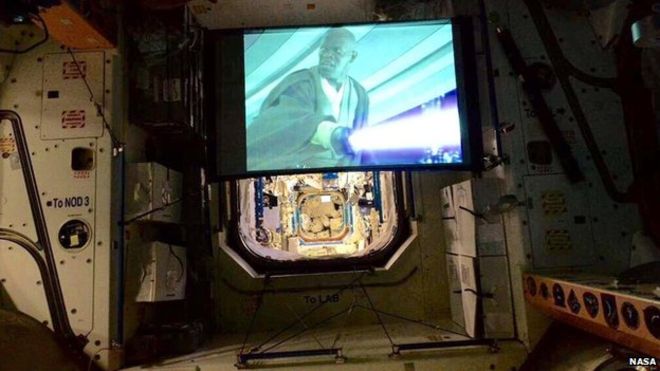
Image courtesy of NASA
To keep some measure of sanity, the astronauts living aboard the International Space Station (ISS), some 220 miles above our planet Earth, make a point of unwinding. According to NASA, the astronauts get weekends off. And, “on any given day, crew members can watch movies, play music, read books, play cards and talk to their families.” Earlier this year, PaleoFuture gave us a further glimpse into what astronaut downtime looks like, when its editor, Matt Novak, printed a Complete List of Movies and TV Shows On Board the International Space Station. Acquired through a Freedom of Information request, the list is a catalogue of every film and TV show in the ISS media library. As Matt notes, there are many classics (e.g. Alfred Hitchcock’s North by Northwest), “plenty of space-themed and dystopian sci-fi movies” (2001: A Space Odyssey, Alien and Blade Runner), and a helpful serving of comedy (Airplane). Below, you can find the first 100 items on the list. Get the complete list–all 533 movies and TV shows–at Paleofuture.
- 1941
- 12 Monkeys
- 12 Years a Slave
- 2 Fast 2 Furious
- 20,000 Leagues Under the Sea
- 2001: A Space Odyssey
- 21 Jump Street
- 24 (Seasons 1–8)
- 48 Hours
- 8 Mile
- A Christmas Carol
- A Christmas Story
- A Knights Tale
- A Man and a Woman
- A Night at the Opera
- A Night at the Roxbury
- A Perfect Murder
- A Prairie Home Companion
- A Room with a View
- Absolutely Fabulous (Series 1–3)
- Air Force One
- Airplane
- Alias Season 1
- Alien
- Alien 3
- Alien Resurrection
- Aliens
- All Good Things
- Along Came Polly
- Always
- American Gangster
- American Sniper
- American Wedding
- An American in Paris
- An Article of Hope
- Analyze This
- Anchorman
- Anchorman 2
- Animal House (1978)
- Argo
- Armageddon
- Around the World in 80 Days (1956)
- Around the World in 80 Days (2004)
- Arrow Season 1
- Arsenic and Old Lace
- As Good as it Gets
- Austin Powers International Man of Mystery
- Austin Powers The Spy Who Shagged Me
- Australia
- Avatar
- Baby Mama
- Back to Bataan
- Back to the Future
- Back to the Future Part II
- Back to the Future Part III
- Backdraft
- Band of Brothers Season 1
- Bataan
- Batman Forever
- Batman Returns
- Battle for the Planet of the Apes
- Battle of Britain
- Battleship
- Beneath the Planet of the Apes
- Ben-Hur
- Better Call Saul Season 1
- Beverly Hills Cop II
- Beverly Hills Cop III
- Big Bang Theory (Seasons 1–8)
- Big Eyes
- Big Jake
- Billy Jack
- Birdman, or the Unexpected Virtue of Ignorance
- Black Hawk Down
- Black Mask
- Black Swan
- Blade Runner
- Blazing Saddles Blended
- Blue Planet Frozen Seas
- Blue Planet Ocean World
- Blues Brothers
- Bob Newhart Button-Down Concert
- Body of Lies
- Braveheart
- Breaking Bad Seasons 1–6
- Bridesmaids
- Bull Durham
- Caddyshack
- Cahill United States Marshal
- Captain America: The First Avenger
- Captain America: The Winter Soldier Captain Phillips
- Casablanca
- Cast Away
- Catch-22
- Celtic Woman Songs from the Heart
- Chance Are
- Chariots of Fire
- Charlie St Cloud
- Children of Men
- Chisum
Find the complete list of 533 films and TV shows here.
If you would like to support the mission of Open Culture, consider making a donation to our site. It’s hard to rely 100% on ads, and your contributions will help us continue providing the best free cultural and educational materials to learners everywhere. You can contribute through PayPal, Patreon, and Venmo (@openculture). Thanks!
Related Content:
Everything You Wanted to Know About Going to the Bathroom in Space But Were Afraid to Ask
If Astronauts Cry in Space, Will Their Tears Fall?
Read More...Support Us
We're hoping to rely on loyal readers, rather than erratic ads. Please click the Donate button and support Open Culture. You can use Paypal, Venmo, Patreon, even Crypto! We thank you!

About Us

Open Culture scours the web for the best educational media. We find the free courses and audio books you need, the language lessons & educational videos you want, and plenty of enlightenment in between.
Advertise With Us
FREE UPDATES!
GET OUR DAILY EMAIL
Get the best cultural and educational resources on the web curated for you in a daily email. We never spam. Unsubscribe at any time.
FOLLOW ON SOCIAL MEDIA
Open Culture editor Dan Colman scours the web for the best educational media. He finds the free courses and audio books you need, the language lessons & movies you want, and plenty of enlightenment in between.
Advertise With Us



