Artificial Intelligence Program Tries to Write a Beatles Song: Listen to “Daddy’s Car”
Last May, we told you about Flow Machine, an artificial intelligence-driven music composer that analyses composer’s styles and then creates new works from that data. Developed by François Pachet at Sony CSL-Paris, the initial experiments demonstrated Beethoven’s “Ode to Joy” as played in the style of bossa nova, the Beatles’ “Penny Lane,” and Ennio Morricone’s romantic work. Admittedly, it wasn’t the most stunning moment in A.I.—a computer was now doing what arrangers have been doing for years, applying genre rules to a melody created in another genre.
However, Flow Machine has returned with an interesting development: two upcoming albums of A.I.-created songs, from which two tunes have been released to give you a taste of computer creativity. French composer and musician Benoît Carré helped out with the arrangements and production of the songs, and also wrote the lyrics, so it’s not completely an A.I. creation, we should note.
So what should we make of “Daddy’s Car,” above, an attempt to create an A.I song in the style of the Beatles? The opening seconds feature the three-part harmony of “Because,” but when the band kicks in, it’s closer to the Beach Boys’ Pet Sounds than the Fab Four. (If anything, it’s closer to the High Llamas.)
But does it sound like it was written by a human? Yes.
For something stranger, try the other song released so far: “Mr. Shadow,” written “in the style of American songwriters such as Irving Berlin, Duke Ellington, George Gershwin and Cole Porter.”
Now this is much odder, a mix of country twang, Daniel Lanois-style ambience, along with a vocal that sounds like a corrupted audio file. If you are looking for a true glimpse of the future, wrap your ears and sanity around this one. Musicians and music fans, let us know in the comments what you think about this brave new world that has such hit singles in it.
Related Content:
Noam Chomsky Explains Where Artificial Intelligence Went Wrong
Ted Mills is a freelance writer on the arts who currently hosts the FunkZone Podcast. You can also follow him on Twitter at @tedmills, read his other arts writing at tedmills.com and/or watch his films here.
Read More...The Art of Making Old-Fashioned, Hand-Printed Books
Reports of traditional books’ death are greatly exaggerated, thanks in part to the success of print-on-demand publishing and other digital innovations.
As thrilled as we are about the survival of the printed page—it’s a relief to have something to read after Wi-Fi fails during the zombie invasion—the craftsmanship that goes into hand-printed, hand-bound volumes is an almost-lost art.
The Victoria and Albert Museum’s video, above, documents the painstaking process, beginning with the arranging of metal type that will result in an octavo, the most common type of book.
It’s a quiet endeavor, though surely a bit louder than the V&A’s silent documentation, an unusual choice given a certain segment of the millennial populace’s appetite for well-edited artisanal craft videos in which music plays a big part.
A well-deployed tune could elevate these lovely visuals to the realms of the advanced elegy.
YouTube user, Kraftsman Sheng, attempts to remedy the situation by reproducing the video (sans attribution) with a soundtrack of his own choosing—pianist Roger Williams’ syrupy 1965 rendition of “Softly As I Leave You,” below.
An unconventional choice, to be sure. I should think something baroque would go better with all of this meticulous folding, cutting, and binding.
Though perhaps something a little more robust could highlight the hardcore heroism of the artisans toiling to keep this ancient art alive. Electric Lit has a round up of great book-inspired punk songs, of which “Time” by Richard Hell and the Voidoids seems particularly apt.
Print’s not dead!
via Atlas Obscura
Related Content:
Oxford University Presents the 550-Year-Old Gutenberg Bible in Spectacular, High-Res Detail
Ayun Halliday is an author, illustrator, theater maker and Chief Primatologist of the East Village Inky zine. Her play Zamboni Godot is opening in New York City in March 2017. Follow her @AyunHalliday.
Read More...W.E.B. Du Bois Creates Revolutionary, Artistic Data Visualizations Showing the Economic Plight of African-Americans (1900)
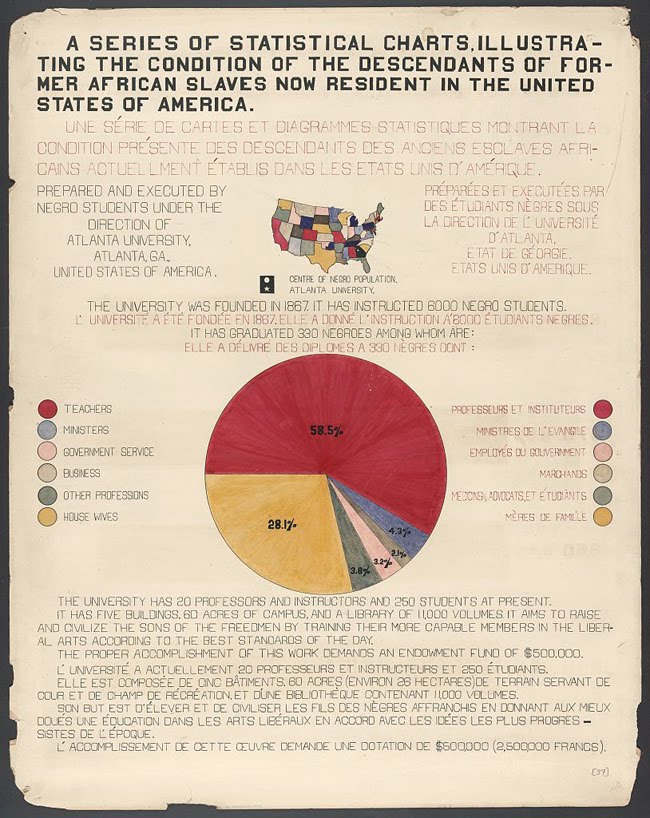
Few people have done more to accurately foresee and help shape the century ahead of them as W.E.B. Du Bois. And perhaps few intellectuals from the early twentieth century still have as much critical relevance to our contemporary global crises. Du Bois’ incisive sociology of racism in The Souls of Black Folk, Black Reconstruction in America, and his articles for the NAACP’s journal, The Crisis, remained rooted in a transcontinental awareness that anticipated globalism as it critiqued tribalism. Du Bois, who studied in Berlin and traveled widely in Europe, Africa, and Latin America, also became one of the most influential of Pan-Africanist thinkers, uniting the anti-colonial concerns of African and Caribbean nations with the post-Reconstruction issues of Black Americans.
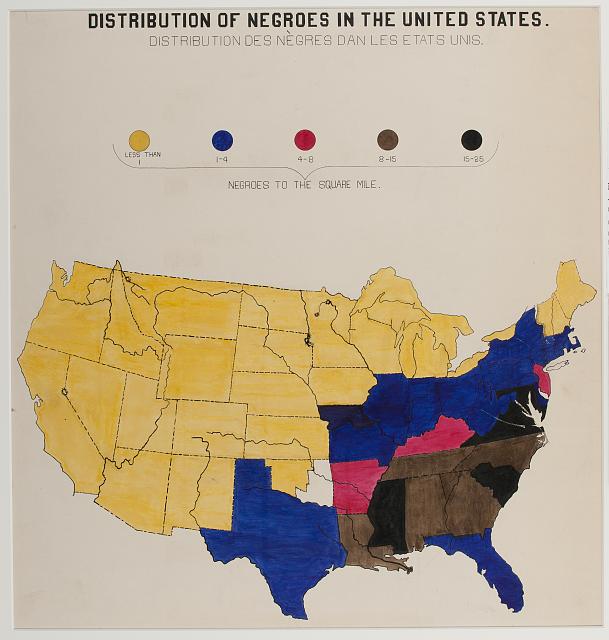
In 1900, Du Bois attended the First Pan-African Conference, held in London at Westminster Hall just prior to the Paris Exhibition. Attendees presented papers on “the African origins of human civilization,” writes Ramla Bandele at Northwestern’s Global Mappings, on African self-government, and on the imperial aggression of European countries (including the host country). Du Bois arrived armed with what might have seemed like a dull offering to some: a collection of statistics. But not just any collection of statistics. Though they’re now an often banal staple of our everyday working lives, his presentation used then-innovative charts and graphs to condense his data into a powerful set of images.
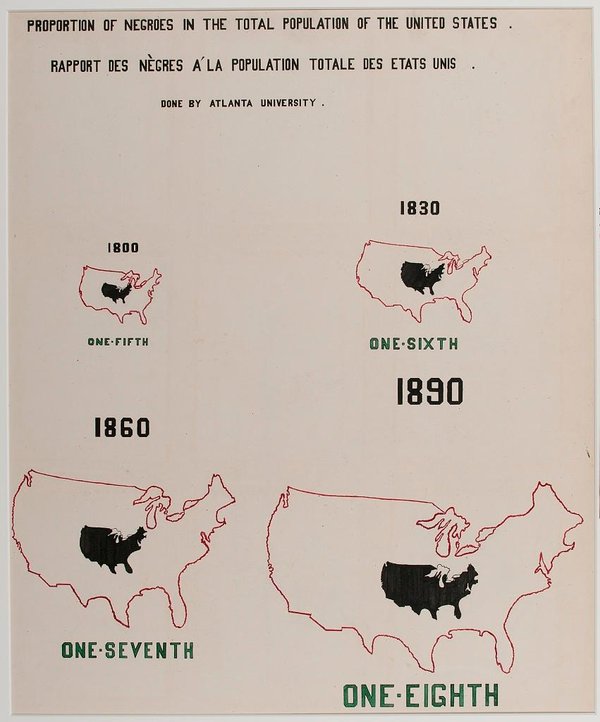
Once again anticipating global trends of over a century hence, the activist and sociology professor at Atlanta University created around 60 eye-catching data visualizations, “charts and maps,” writes the blog All My Eyes, “hand drawn and colored at the turn of the 19th century” by Du Bois and his students.
For audiences at the time, these must have packed the evidentiary punch that Michelle Alexander’s The New Jim Crow or Ta-Nehisi Coates’ “The Case for Reparations” have recently. Du Bois and his students’ charts show us—as the first “slide” at the top of the post notes—“the condition of the descendants of former African slaves now resident in the United States of America.”

The collection of infographics, Danny Lewis argues at The Smithsonian, “is just as revolutionary now as it was when it was first created,” for an exhibit Du Bois organized with a lawyer named Thomas J. Calloway and his occasional rival Booker T. Washington. “This was less than half a century after the end of American slavery,” writes Allison Meier at Hyperallergic, “and at a time when human zoos displaying people from colonized countries in replicas of their homes were still common.” In the U.S., the grotesque stereotypes of blackface minstrels provided the primary depiction of African-American life.
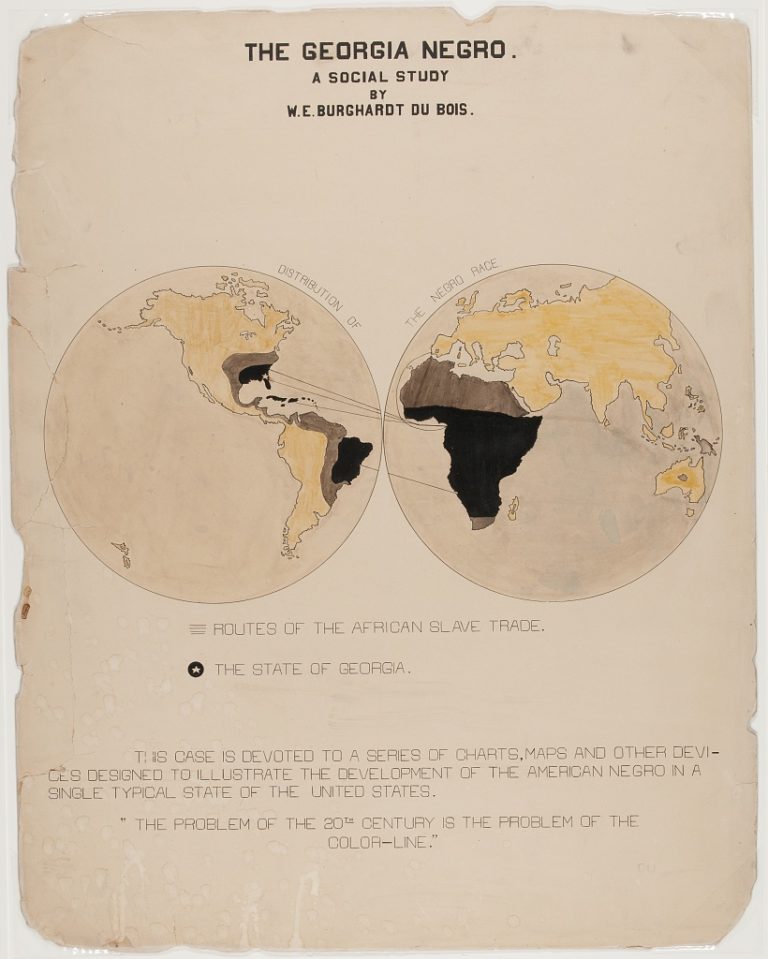
“Du Bois’ students,” writes data blog Seeing Complexity, “made a radical decision when they visualized the economic plight of a group explicitly excluded from statistical analysis and thus hidden from international attention.” The level of detail—for Du Bois’ time and ours—is overwhelming, reminding us that “the simple act of disseminating information can, in itself, be a radically and potentially transformative act.” In one of Du Bois’ graphic studies, “The Georgia Negro,” he quotes his key line from The Souls of Black Folk, “The problem of the 20th century is the problem of the color-line.” Far too much current data demonstrates that the statement still holds true in the 21st century, as gross disparities in wealth and in the criminal justice system grimly persist, or worsen, along racial lines.
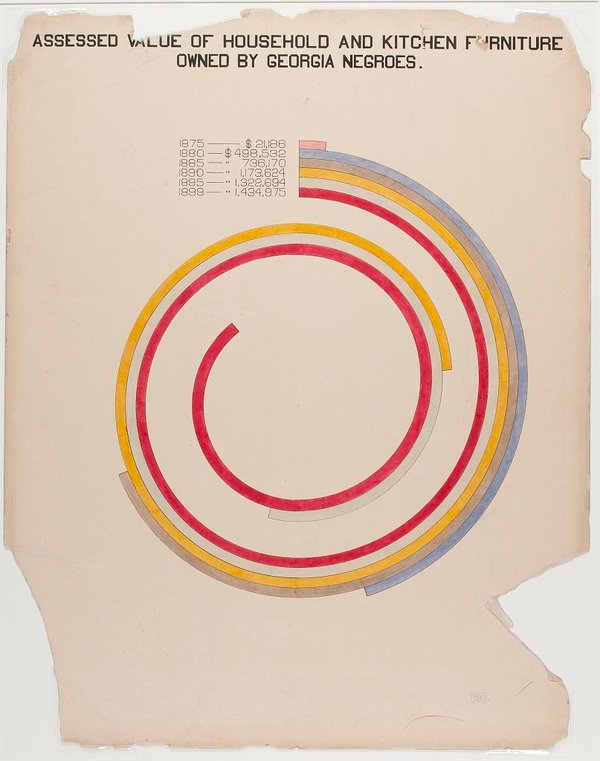
Data may not be as transformative as Du Bois had hoped, but it forces us to confront the reality of the situation—and either rationalize the status quo or seek to change it. One of three parts of the exhibit, The Georgia Negro study was Du Bois’ “most important contribution to the project,” writes Professor Eugene Provenzo in his book on the subject. The charts are truly impressive for their distillation of “an enormous amount of statistical data,” drawn from “sources such as the United States Census, the Atlanta University Reports, and various governmental reports that had been compiled by Du Bois for groups such as the United States Bureau of Labor.” (Much of the data would have gone uncollected were it not for Du Bois’ tireless efforts.)
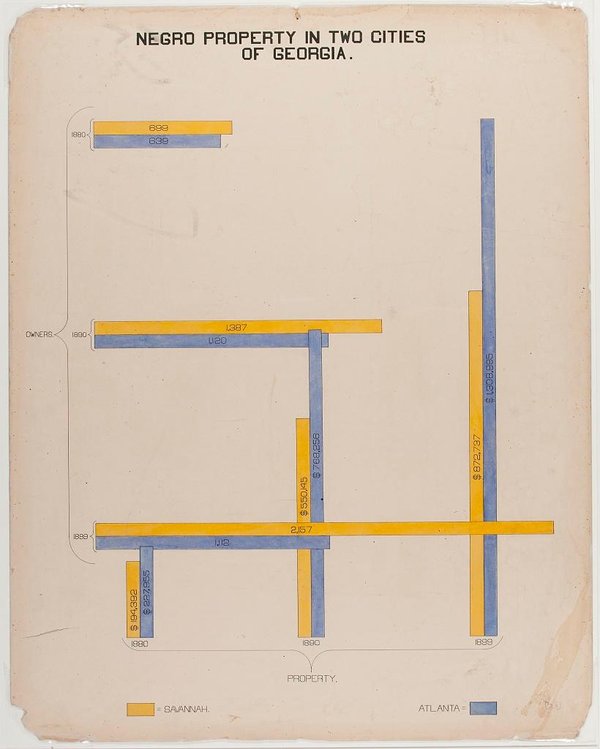
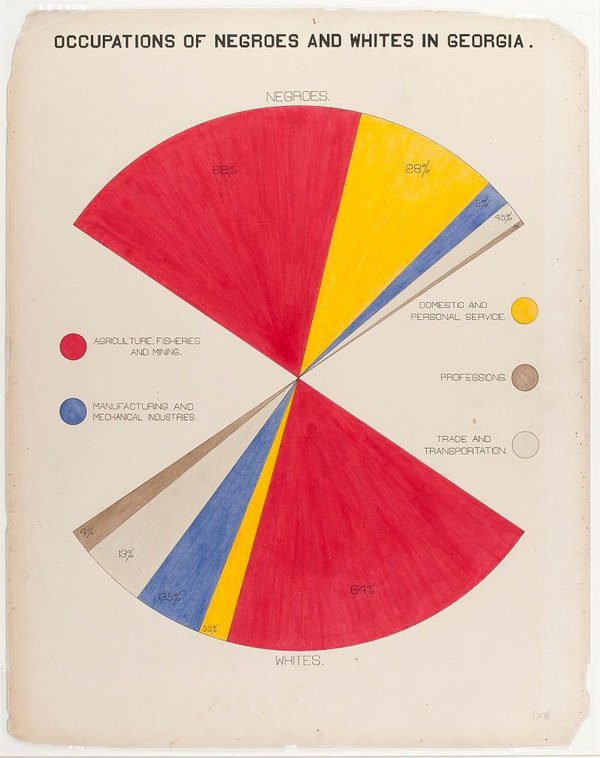
The charts are also, Provenzo notes, “remarkable in terms of their design,” as you can see for yourself. Du Bois and his students committed to “examining everything,” Meier writes, quoting Slate’s Rebecca Onion, “from the value of household and kitchen furniture to the ‘rise of the negroes from slavery to freedom in one generation.’” And they did so in a way that still looks “strikingly vibrant and modern, almost anticipating the crossing lines of Piet Mondrian or the intersecting shapes of Wassily Kandinsky.” However much their creators had explicitly modernist intentions, these designs also draw from historical techniques in data visualization—from 17th century scientific texts to Florence Nightingale’s revolutionary 19th century epidemiological maps.
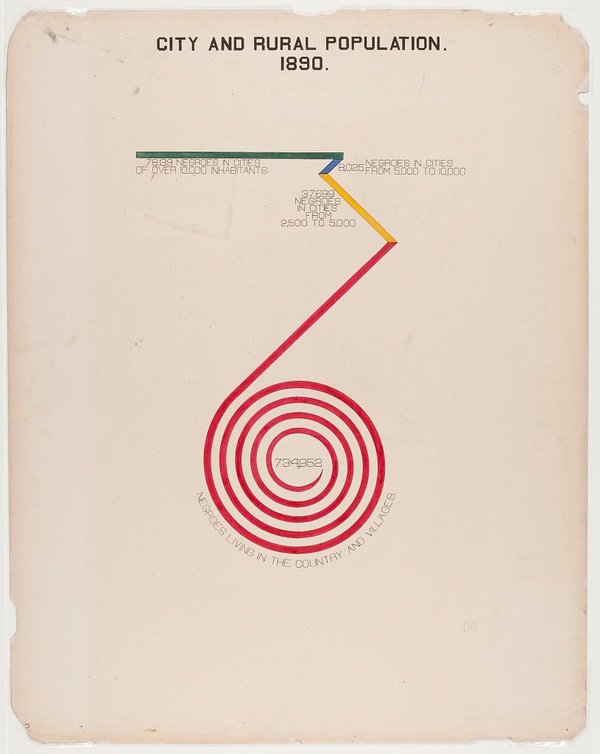
You can view and download scans of all the hand-drawn Du Bois’ Pan-African Conference charts and graphs at the Library of Congress. There, you’ll also find other features of the Du Bois/Calloway/Washington Exhibit, including photographs of several African-American men who had “received appointment as clerks in civil service departments… through competitive examinations” and a “hand-lettered description of Hampton Normal and Agricultural Institute” in Virginia. Du Bois’ description of his project says as much about his sense of Black Nationalism as it does about pride in the progress made a generation after slavery: “an honest straightforward exhibit of a small nation of people, picturing their life and development without apology or gloss, and above all made by themselves.”
via Hyperallergic/All My Eyes/Seeing Complexity/Slate
Related Content:
Visualizing Slavery: The Map Abraham Lincoln Spent Hours Studying During the Civil War
The Art of Data Visualization: How to Tell Complex Stories Through Smart Design
Josh Jones is a writer and musician based in Durham, NC. Follow him at @jdmagness
Read More...Jorge Luis Borges Creates a List of 16 Ironic Rules for Writing Fiction

“Jorge Luis Borges 1951, by Grete Stern” via Wikimedia Commons.
When we first read the work of Jorge Luis Borges, we may wish to write like him. When we soon discover that nobody but Borges can write like Borges, we may wish instead that we could have collaborated with him. Once, he and his luminary-of-Argentine-literature colleagues, friend and frequent collaborator Adolfo Bioy Casares and Bioy Casares’ wife Silvina Ocampo, got together to compose a story about a writer from the French countryside. Though they never did finish it, one piece of its content survives: a list of sixteen rules, drawn up by Borges, for the writing of fiction.
Or at least that’s how Bioy Casares told it to the French magazine L’Herne, which reprinted the list. Instead of sixteen recommendations for what a writer of fiction should do, Borges playfully provided a list of sixteen prohibitions–things writers of fiction should never let slip into their work.
- Non-conformist interpretations of famous personalities. For example, describing Don Juan’s misogyny, etc.
- Grossly dissimilar or contradictory twosomes like, for example, Don Quixote and Sancho Panza, Sherlock Holmes and Watson.
- The habit of defining characters by their obsessions; like Dickens does, for example.
- In developing the plot, resorting to extravagant games with time and space in the manner of Faulkner, Borges, and Bioy Casares.
- In poetry, characters or situations with which the reader can identify.
- Characters prone to becoming myths.
- Phrases, scenes intentionally linked to a specific time or a specific epoch; in other words, local flavor.
- Chaotic enumeration.
- Metaphors in general, and visual metaphors in particular. Even more concretely, agricultural, naval or banking metaphors. Absolutely un-advisable example: Proust.
- Anthropomorphism
- The tailoring of novels with plots that are reminiscent of another book. For example, Ulysses by Joyce and Homer’s Odyssey.
- Writing books that resemble menus, albums, itineraries, or concerts.
- Anything that can be illustrated. Anything that may suggest the idea that it can be made into a movie.
- Critical essays, any historical or biographical reference. Always avoid allusions to authors’ personalities or private lives. Above all, avoid psychoanalysis.
- Domestic scenes in police novels; dramatic scenes in philosophical dialogues. And, finally:
- Avoid vanity, modesty, pederasty, lack of pederasty, suicide.
The astute reader will find much more of the counterintuitive about this list than its focus on what not to do. Didn’t Borges himself specialize in non-conformist interpretations, especially of existing literature? Don’t some of his most memorable characters obsess over things, like imagining a human being into existence or creating a map the size of the territory, to the exclusion of all other characteristics? Couldn’t he conjure up the most exotic settings — even when drawing upon memories of his native Buenos Aires — in the fewest words? And who else better used myths, metaphors, and games with time and space for his own, idiosyncratic literary purposes?
But those who’ve spent real time reading Borges know that he also always wrote with a strong, if subtle, sense of humor. He had just the kind of sensibility that would produce an ironic, self-parodying list such as this, though history hasn’t recorded whether his, Bioy Casares’, and Ocampo’s young provincial writer would have perceived it in that way or piously honored its dictates. Borges does, however, seem to have followed the bit about never writing “anything that may suggest the idea that it can be made into a movie” to the letter. I yield to none in my appreciation for Alex Cox’s cinematic interpretation of Death and the Compass, but I enjoy even more the fact that Borges’ imagination has kept Hollywood stumped.
Related Content:
Jorge Luis Borges’ Favorite Short Stories (Read 7 Free Online)
Jorge Luis Borges Selects 74 Books for Your Personal Library
Jorge Luis Borges’ 1967–8 Norton Lectures On Poetry (And Everything Else Literary)
Buddhism 101: A Short Introductory Lecture by Jorge Luis Borges
7 Tips from Edgar Allan Poe on How to Write Vivid Stories and Poems
Kurt Vonnegut’s 8 Tips on How to Write a Good Short Story
Based in Seoul, Colin Marshall writes and broadcasts on cities and culture. He’s at work on a book about Los Angeles, A Los Angeles Primer, the video series The City in Cinema, the crowdfunded journalism project Where Is the City of the Future?, and the Los Angeles Review of Books’ Korea Blog. Follow him on Twitter at @colinmarshall or on Facebook.
Read More...Watch 222 Great Films in the Public Domain: Alfred Hitchcock, Fritz Lang, Buster Keaton & More
Want to learn about film history? You can take a class on the subject, where you’ll likely need a copy of Kristin Thompson and David Bordwell’s standard text Film History: An Introduction, and possibly the companion book, Film Art: An Introduction. These are phenomenal resources written by two top-notch scholars who have spent their lives watching and analyzing films, and should you have the time and money to study their comprehensive introductions, by all means do so. But of course, there’s no substitute for actually watching the hundreds of films they reference, from the early days of the medium through its many re-visions and innovations in the 20th century.
But why, ask Thompson and Bordwell, “should anybody care about old movies?” The obvious answer is that they “offer intense artistic experiences or penetrating visions of human life in other times and places.” Another key scholarly thesis these theorists advance is that in studying narrative film history, we see the development of film (and later, by extension, television, video games, and other visual media) as an international visual language—one nearly everyone on the planet learns to read from a very young age.
In films like The Great Train Robbery (1903) and the technically groundbreaking, if narratively deplorable, Birth of a Nation (1915), we see the creation and refinement of cross-cutting as an essential cinematic technique used in every visual storytelling medium. In Georges Méliès’ brilliant fantasies A Trip to the Moon (1902) and The Impossible Voyage (1904), we see the joyful origins of the special effects film. In Sergei Eisenstein’s Battleship Potemkin (1925), we see montage theory brought to life onscreen. And in the many films of Alfred Hitchcock, we see the ingenious camera and editing moves that define horror and suspense.
All of these films, and many hundreds more, are in the public domain and free to view online as many times as you like, whether you do so as part of a formal course of study or simply for sheer enjoyment. Nathan Heigert at MUBI has compiled a list of 222 “Public Domain Greats” that represents a wide spectrum of film history, “from the silents of Griffith, Keaton and Chaplin, to neglected noirs and the low-budget bliss of Roger Corman, plus nearly all of Hitchcock’s British films—all free for download or streaming (though, naturally, not in Criterion quality)” from the Internet Archive. Heigert’s itemized list offers a tremendous range and breadth, and contains a great many of the essential films referenced in most film history texts.
- A Man with a Movie Camera (Dziga Vertov, 1929)
- Scarlet Street (Fritz Lang, 1945)
- M (Fritz Lang, 1931)
- D.O.A. (Rudolph Mate, 1950)
- Nanook of the North (Robert Flaherty, 1922)
- Nosferatu (F.W. Murnau, 1922)
- The Cabinet of Dr. Caligari (Robert Wiene, 1920)
- Night of the Living Dead (George Romero, 1968)
- His Girl Friday (Howard Hawks, 1940)
- The 39 Steps (Alfred Hitchcock, 1935)
- The Lodger (Alfred Hitchcock, 1927)
- Sabotage (Alfred Hitchcock, 1936—find many more Hitchcock films at our Hitchcock list)
- Intolerance (D.W. Griffith, 1915)
- The General (Buster Keaton, 1926)
- Carnival of Souls (Herk Harvey, 1962)
- Little Shop of Horrors (Roger Corman, 1960)
Most of the films on Heigert’s list can also be found in Open Culture’s collection, 4,000+ Free Movies Online: Great Classics, Indies, Noir, Westerns, Documentaries & More. That includes 16 films above that we’ve previously featured with helpful context on our site. So start watching!
Note: You can find a list with links to all 222 films on Archive.org here.
Related Content:
The History of Stop-Motion Films: 39 Films, Spanning 116 Years, Revisited in a 3‑Minute Video
Hollywood, Epic Documentary Chronicles the Early History of Cinema
A Trip to the Moon (and Five Other Free Films) by Georges Méliès, the Father of Special Effects
The 5 Essential Rules of Film Noir
Thomas Edison & His Trusty Kinetoscope Create the First Movie Filmed In The US (c. 1889)
Free: British Pathé Puts Over 85,000 Historical Films on YouTube
Josh Jones is a writer and musician based in Durham, NC. Follow him at @jdmagness
Read More...Hear 9 Hours of Ennio Morricone’s Scores for Classic Western Films: From Sergio Leone’s Spaghetti Westerns to Tarantino’s The Hateful Eight
What goes into the making of a great film score? And how does a director/composer team like David Lynch and Angelo Badalamenti, or Sergio Leone and Ennio Morricone, form such a perfect partnership? Several days ago, we brought you video of Badalementi in a spirited, detailed recreation of how he and Lynch composed the unforgettable Twin Peaks’ themes, without which, I’d argue, there may have been no Twin Peaks.
Likewise, without the music of Morricone behind them, Leone’s spare, stylish, hard-boiled-yet-comic westerns may never have spearheaded the almost classical genre of the “Spaghetti Western,” known just as often for its music as for its visual language.
What does Morricone have to say about this? Precious little. Or so discovered Steely Dan’s Donald Fagen when he interviewed Morricone for Premiere magazine in August of 1989. Fagen is well known for his obsessive knowledge of culture high and low and his hip, theoretical bent. Morricone, we learn, works more intuitively. But the results are the same. We may equally find ourselves humming the refrain to “Peg” as the theme to The Good, the Bad & the Ugly.
And we may find ourselves pleasurably analyzing “Peg”’s ironic redeployment of soft rock tropes, just as we may approach Morricone’s inimitable style as critical theorists, as Fagen does when he asks the question below. Likely the most leading question in all of music journalism (with the exception of this Brian Eno interview):
But isn’t it true that the Leone films, with their elevation of mythic structures, their comic book visual style and extreme irony, are now perceived as signaling an aesthetic transmutation by a generation of artists and filmmakers? And isn’t it also true that your music for those films reflected and abetted Leone’s vision by drawing on the same eerie catalog of genres — Hollywood western, Japanese samurai, American pop, and Italian Opera? That your scores functioned both “inside” the film as a narrative voice and “outside” the film as the commentary of a winking jester? Put it all together and doesn’t it spell “postmodern,” in the sense that there has been a grotesque encroachment of the devices of art and, in fact, an establishment of a new narrative plane founded on the devices themselves? Isn’t that what’s attracting lower Manhattan?
Morricone: [shrugs]
Fagen quickly adapts, switches to rapid-fire questions to which Morricone gives a breezy one-word answer. “Bellissimo!” He’s a very busy man. He doesn’t live in the same world as those La Dolce Vita people, a “small group of people who got up at 11 P.M. and lived at night.” He wakes up at 5 in the morning. Morricone needn’t indulge us with stories or bore us with theoretical poses. His last words to Fagen, “I have always wanted to compose,” tell us what we need to know about him. Everything else is in the music.
Hear that music above in a five-hour playlist of some of Morricone best-known scores from his storied past—The Good, the Bad & the Ugly, A Fistful of Dollars, For a Few Dollars More, Once Upon a Time in the West, and non-Leone western, The Mercenary.
And Morricone’s still speaking through his western scores, as he did just recently in the work of another chatty, obsessive, heavily referential admirer—Quentin Tarantino’s The Hateful Eight, also in the playlist above. Bellissimo!
If you need Spotify’s free software, download it here.
Related Content:
The Classical Music in Stanley Kubrick’s Films: Listen to a Free, 4 Hour Playlist
Josh Jones is a writer and musician based in Durham, NC. Follow him at @jdmagness
Read More...Hear 21 Hours of Lectures & Talks by Howard Zinn, Author of the Bestselling A People’s History of the United States
Regularly in these pressure cooker days we hear plausible arguments from liberals and conservatives about how democratic institutions have recently failed us, and how uniquely polarized we have become as a people. We also hear often highly implausible claims about how current contenders intend to restore some kind of justice or fairness. Readers of Howard Zinn’s A People’s History of the United States will have a different perspective, one in which supposedly democratic institutions were never designed to work for the majority of the country’s inhabitants. And in which, by design, certain minorities have always remained at the bottom of the hierarchy.
“There is not a country in world history,” writes Zinn in his famous radical history, “in which racism has been more important, for so long a time, as the United States.” Far from a flawed yet exceptional form of government, the U.S. system, Zinn argued, began as a means by which the founders seized the prerogatives of the British for themselves, with no intention of expanding these liberties widely. On the contrary. As Zinn puts it in a chapter called “Tyranny is Tyranny”:
Around 1776, certain important people in the English colonies made a discovery that would prove enormously useful for the next two hundred years. They found that by creating a nation, a symbol, a legal unity called the United States, they could take over land, profits, and political power from favorites of the British Empire. In the process, they could hold back a number of potential rebellions and create a consensus of popular support for the rule of a new, privileged leadership.
The American Revolution swapped out one rule by elites for another, in other words, and one empire for another. Or as Zinn wrote in his memoir, there is “something rotten at the root.” Those who object to Zinn’s work may find flaws in his scholarly methodology. Accusations of bias, however—even couched in polite pejoratives like “polemical” and “revisionist”—are pretty much moot. Zinn, who died in 2010, would agree. The necessity of taking a position, after all, was integral to the historian and activist’s entire ethos, such that he titled his autobiography You Can’t Be Neutral on a Moving Train. “The state and its police were not neutral referees in a society of contending interests,” wrote Zinn, “They were on the side of the rich and powerful.” He always made it plain whose side he took, an approach by nature controversial.
Was he a liberal partisan? Hardly. After taking a beating by police at a protest, Zinn writes, “I was no longer a liberal, a believer in the self-correcting character of American democracy. I was a radical, believing that something fundamental was wrong in this country.” A Communist? “Marx,” wrote Zinn, “was often wrong, often dogmatic… too insistent that the industrial working class must be the agent of revolution.” Zinn admired Marx. He wrote a play about him, Marx in Soho, and describes in the forward how his early reading of Marx, while growing up in working-class Brooklyn, greatly influenced his view of the world.


But after “growing evidence of the horrors of Stalinism” and his experience with the grassroots “participatory democracy” of the Student Nonviolent Coordinating Committee (SNCC), Zinn became drawn to anarchism. Decidedly leftist and fundamentally egalitarian, Zinn’s analysis has proven broad enough to warrant admiration from several different political persuasions: from modern liberals to Marxists to libertarian communists to free market libertarians like Reason’s Thaddeus Russell, who pronounced him “no better exemplar of that thoroughgoing, anti-statist left.”
Like another famous anarchist intellectual of the radical campus left, Noam Chomsky, Zinn first came to national prominence in the 60s while organizing protests against the Vietnam War—and like Chomsky, he debated conservative standard-bearer William F. Buckley. Zinn previously protested segregation with SNCC while he taught at Spelman College, writing an influential history of the organization. His tireless activism continued until the very end of his life, and he delivered notable speeches and lectures throughout his involvement in the civil rights, anti-war, environmental, and economic justice movements.
In the Spotify playlist above, you can hear 22 of those talks for a total of 21 hours of Zinn, including that historic Buckley debate, which you can also hear in full at the top of the post. (If you need Spotify’s free software, download it here.) After their Tufts University meeting, notes Ed Welchel, Zinn reflected, “I found it curious that Buckley did not seem to understand that unsparing criticism of government is an essential element of a democratic society.”
The playlist of Zinn lectures and talks will be added to our collection, 1,000 Free Audio Books: Download Great Books for Free.
Related Content:
Illustrated Video: Howard Zinn’s “What the Classroom Didn’t Teach Me About the American Empire”
Adorn Your Garden with Howard the Zinn Monk
Noam Chomsky vs. William F. Buckley, 1969
Josh Jones is a writer and musician based in Durham, NC. Follow him at @jdmagness
Read More...Take a Free Course on Digital Photography from Stanford Prof Marc Levoy
Photography and video have advanced to such a degree that any one of us, for a modest investment of capital, can own the requisite equipment to make productions at the same level of quality as the pros. And most of us already hold in our hands computers capable of producing and editing hundreds of rich still and moving images. What we may lack, what most of us lack, are the skills and experience of the professionals. No amount of fancy photo gear can make up the difference, but you can at least acquire the education—a very thorough, technical education in digital photography—online, and for free.
Taught by Stanford professor Emeritus of Computer Science Marc Levoy, the course above, simply called “Lectures on Digital Photography,” covers seemingly everything you might need to know and then some: from the parts of a digital camera (“every screw”), to the formula for depth of field, the principles of high dynamic range, and the history and art of photographic composition.
Beware, this course may not suit the casual Instagrammer—it requires aspiration and “a cell phone won’t suffice.” Additionally, though Levoy says he assumes no prior knowledge, he does expect a few non-camera-related academic skill sets:
The only knowledge I assume is enough facility and comfort with mathematics that you’re not afraid to see the depth-of-field formula in all its glory, and an integral sign here or there won’t send you running for the hills. Some topics will require concepts from elementary probability and statistics (like mean and variance), but I define these concepts in lecture. I also make use of matrix algebra, but only at the level of matrix multiplication. Finally, an exposure to digital signal processing or Fourier analysis will give you a better intuition for some topics, but it is not required.
Sound a little daunting? You will not need an expensive SLR camera (single lens reflex), though it would help you get the most out of complex discussions of settings. The topics of some interactive features may sound mystifying—“gamut-mapping,” “cylindrical-panoramas”—but Levoy’s lectures, all in well-shot video, move at a brisk pace, and he contextualizes new scientific terms and concepts with a facility that will put you at ease. Levoy formerly taught the course at Stanford between 2009 and 2014. The version he teaches online here comes from a Google class given this year—eighteen lectures spanning 11 weeks.
Find all of the course materials—including interactive applets and assignments—at Levoy’s course site. As he notes, since the course has “gone viral,” many videos embedded on the site won’t play properly. Levoy directs potential students to his Youtube channel. You can see the full playlist of lectures at the top of this post as well. For more resources in photography education—practical and theoretical, beginner to advanced—see PetaPixel’s list of “the best free online photography courses and tutorials.”
“Lectures on Digital Photography” will be added to our collection, 1,700 Free Online Courses from Top Universities.
via PetaPixel
Related Content:
Hunter S. Thompson’s Advice for Aspiring Photographers: Skip the Fancy Equipment & Just Shoot
The Photographer Reveals the Philosophy, Techniques & Artistry of Edward Weston (1948)
See the First Known Photograph Ever Taken (1826)
Museum of Modern Art (MoMA) Launches Free Course on Looking at Photographs as Art
Josh Jones is a writer and musician based in Durham, NC. Follow him at @jdmagness
Read More...An Animated Introduction to French Philosopher Jacques Derrida
Since the bold arrival of his book Of Grammatology in 1967, French philosopher Jacques Derrida has been understood—or misunderstood—as many things: a radical relativist who ”rejects all of metaphysical history,” a fashionable intellectual playing language games, a brilliant phenomenologist of language…. One association he vehemently rejected was with the kind of ironic, laissez faire postmodernism represented by Seinfeld. But when it came to clarifying his work for puzzled readers and onlookers, Derrida could seem as willfully, frustratingly evasive in person as he was on the page. His work, writes Williams College professor Mark C. Taylor, can “seem hopelessly obscure… to people addicted to sound bites and overnight polls.”
Most people familiar with some of Derrida’s work know a few key terms of his thought: différance, trace, aporia, pharmakon. Those who’ve only heard the name probably know only one: Deconstruction, a “way of doing philosophy,” says Alain de Botton in his video introduction to Derrida above, that “fundamentally altered our understanding of many academic fields, especially literary studies.” But what exactly is “Deconstruction”? Rather than a method, Derrida himself described it as a process already occurring within a written work, one we can observe when we “do not assume that what is conditioned by history, institutions, or society is natural.”
Derrida’s meditations on the inability of language to contain or communicate natural or metaphysical truth developed in unique life circumstances. Born into a Jewish family in French colonial Algeria in 1930, the philosopher grew up very conscious of “having been in an inferior position at the nexus of three different religions, Judaism, Christianity, and Islam, all of which claimed to speak the truth,” says de Botton. Upon arriving in Paris to study in 1949, Derrida found himself even further on the social margins. “Though Derrida was not an autobiographical writer, it’s hard not to read his work as a response to bigotry and exclusion.”
The claim that the philosopher—whose name has almost become synonymous with post-modernism, for good or ill—was not an autobiographical writer may seem strange to some. One of his most-read books in college courses, Monolingualism of the Other, proceeds from an investigation into his fraught relationship with the French language because of his upbringing as a religious minority in a European colony. Later, Derrida delivered a ten-hour address to a conference called The Autobiographical Animal, published posthumously (and excerpted here).
Nonetheless, Derrida would not have made much of his place as the author, this being only a rhetorical occasion for analysis. Derrida, writes Nazenin Ruso at Philosophy Now, argued that “once the text is written, the author’s input loses its significance.” The person of the author—his or her physical presence, biographical experiences, emotions, desires, and intentions—becomes irretrievable for readers, one of many absences in the text that we mistake for presence.
It’s hard to see, then, how we can speak of what Derrida’s “hope” was for his readers’ self-improvement, as de Botton says in his video introduction. This being the School of Life, we are treated to a rather utilitarian reading of the philosopher, one he would perhaps reject. But Derrida bristled at the idea that language could suffice to tell us how and who to be in the world. His suspicion of logocentrism, “an over-hasty, naïve devotion to reason, logic, and clear definition,” says de Botton, means he felt that “many of the most important things we feel can never be expressed in words.” To hear Derrida talk about the problem of privileging language over other means of expression with an artist who uniquely agreed with his position, read his interview with jazz great Ornette Coleman.
Related Content:
140 Free Online Philosophy Courses
Jacques Derrida on Seinfeld: “Deconstruction Doesn’t Produce Any Sitcom”
Josh Jones is a writer and musician based in Durham, NC. Follow him at @jdmagness
Read More...
Hear 508 Hours of Songs Recorded by Rudy Van Gelder (1924–2016), the Engineer Who Created the Sound of Modern Jazz
The art of audio engineering is mostly a dark one, an alchemy performed behind closed studio doors by people who speak a technical language most of us don’t recognize. That is until recently. Musicians amateur and professional have had to get behind the controls themselves and learn how to record their own music, a function of decimated studio budgets and easily available digital versions of once rarified and prohibitively expensive analog equipment. As with all technological developments that put more control into the hands of laypeople, the results are mixed: a proliferation of quirky, interesting, homemade music, yes, and artists with total control over their production methods and the means to release their music when and how they please…
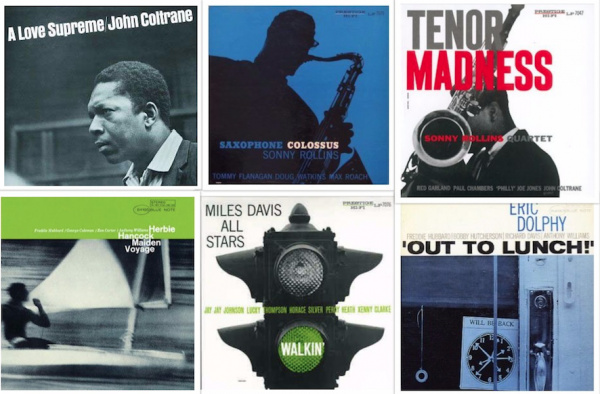
But with the democratization of recording technology, I fear we may begin to forget what really great, really expensive, audio engineering sounds like, an unheard-of consideration in the fifties and sixties, when the process may as well have been magic to most record buyers, and when engineer Rudy Van Gelder recorded some of the greatest—and best sounding—jazz albums ever made. A Love Supreme? That was Van Gelder. Also Miles Davis’ Walkin’, Herbie Hancock’s Maiden Voyage, Sonny Rollins’ Saxophone Colossus, Horace Silver’s Song for My Father… Dexter Gordon, Donald Byrd, Wayne Shorter, Art Blakey…. You’re getting the idea. “Thelonious Monk composed a tribute to Van Gelder’s home studio,” writes The Guardian, and “recorded it there in 1954.”
What made Van Gelder’s albums so amazing, his skills so in-demand? Hear for yourself, in the incredible playlist below featuring 508 hours of music recorded by the man. (Need Spotify? Download it here.) We can also let the engineer—who died at his New Jersey home and studio at 91 last Thursday—tell us himself in rare interviews, and demystify some of the intrinsic properties of the recording process. “When people talk about my albums,” Van Gelder said, “they often say the music has ‘space.’ I tried to reproduce a sense of space in the overall sound picture.” His use of “specific microphones” located around the room to create “a sensation of dimension and depth” show us that recording isn’t simply reproducing the sound of the instruments and players, but of the space around them, which is why studio owners spend millions to build acoustically treated rooms.
But for all his professionalism and pioneering use of top equipment like German-made Neumann microphones, we should note that Van Gelder got his start, and did some of his best work, in his bedroom, so to speak. The fastidious recording engineer, who wore gloves while recording and dressed like a corporate accountant, actually worked as an optometrist by day for over a decade, making records, The New York Times writes, “out of a studio in his parents’ living room in Hackensack, N.J. Not until 1959—by which time he had already engineered some of the most celebrated recordings in jazz history—could he afford to make engineering his full-time occupation.”
That same studio in Van Gelder’s parents’ living room is the one to which Monk paid homage in ’54. Not only that, but like many of today’s self-taught home engineers, Van Gelder “was involved in every aspect of making records, from preparation to mastering.” Which goes to show, perhaps, that maybe great engineering, like great musicianship, isn’t about access to expensive gear or highly specialized training. Maybe it’s about something else. Van Gelder “had the final say in what the records sounded like, and he was, in the view of countless producers and listeners, better at that than anyone.” How? Aside from vague talk of “space” and “dimension,” writes Tape Op, Van Gelder “never discussed his techniques,” even in an interview with the respected recording magazine. Maybe there really was a kind of magic involved.
Related Content:
The Story of John Coltrane’s A Love Supreme, Released 50 Years Ago This Month
Jazz on the Tube: An Archive of 2,000 Classic Jazz Videos (and Much More)
Josh Jones is a writer and musician based in Durham, NC. Follow him at @jdmagness
Read More...Support Us
We're hoping to rely on loyal readers, rather than erratic ads. Please click the Donate button and support Open Culture. You can use Paypal, Venmo, Patreon, even Crypto! We thank you!

About Us

Open Culture scours the web for the best educational media. We find the free courses and audio books you need, the language lessons & educational videos you want, and plenty of enlightenment in between.
Advertise With Us
FREE UPDATES!
GET OUR DAILY EMAIL
Get the best cultural and educational resources on the web curated for you in a daily email. We never spam. Unsubscribe at any time.
FOLLOW ON SOCIAL MEDIA
Open Culture editor Dan Colman scours the web for the best educational media. He finds the free courses and audio books you need, the language lessons & movies you want, and plenty of enlightenment in between.
Advertise With Us


