Gene Wilder Recalls the Beginnings of His Creative Life in Two Hilarious, Poignant Stories
We’d grown accustomed to his face—that wry, distinctive mug, smirking at us from beneath his Willy Wonka purple top hat in millions of proliferating Condescending Wonka memes, the epitome of archness and smug condescension. Apologies to Johnny Depp, but no one else could have so perfectly inhabited Roald Dahl’s mercurial candyman like Gene Wilder, who passed away yesterday from Alzheimer’s at the age of 83. Wilder’s Wonka may casually torture his spoiled child guests, but we remember him as a sadist with a heart of gold.
Willy Wonka and the Chocolate Factory, like Pee Wee’s Big Adventure, is one of those rare films beloved both by children and adults (or at least I remember them that way); many future generations will discover Wilder’s manic brilliance in his collaborations with Mel Brooks—Blazing Saddles, Young Frankenstein, The Producers—and with Richard Pryor, his friend and frequent comic foil. And those who lived through the 80s will also remember Wilder for one of the great romances of the decade.
Wilder and Gilda Radner were a comedy power couple whose marriage ended tragically with her death from ovarian cancer in 1989. That same year he received a diagnosis of non-Hodgkin’s lymphoma. “Wilder was devastated by Radner’s death,” writes Variety, “and only worked intermittently after that.” But he never lost his sharp, madcap sense of humor and deep well of genuine vulnerability as his career shifted into lower gears in the ensuing decades. (He won an Emmy in 2003 for a guest role on Will & Grace and published a novel in 2007).
Wilder was always happy to share his creative insights and stories with fans, giving frequent interviews in the last few years and appearing on panels like that above, a 1999 forum on “The Wonders of Creativity” with Jane Alexander, Danny Glover, and others. Wilder shares a hilariously irreverent story from his childhood about how he learned to consciously make other people laugh by practicing on his mother after she’d had a heart attack.
This anecdote gives way to another, both laugh out loud funny and heartbreaking at once, of young, 1st-grade Gene (then Jerry Silberman) facing rejection from a teacher (“That stupid lady”) who told him his artwork wasn’t good enough to hang on the wall. The hurt stayed with him, so that in 1984, he tells us, “I began painting. Now I try to paint every day of my life.” Wilder communicates his creative philosophy through personal vignettes like these, colorfully illustrating how he became an actor Pauline Kael called “a superb technician… [and] an inspired original.”
In the animated Blank on Blank interview clip above—taken from his 2007 conversation with Letty Cottin Pogrebin at the 92nd Street Y after the debut of his novel—Wilder opens with another version of the story about his mother, the source, he says of his confidence as an actor. He began his career in the theater in the early sixties, and says he “felt on stage, or in the movies, I could do whatever I wanted to. I was free.” He also talks about actors’ mysterious motivations:
If you ask an actor, “Why do you want to act?,” I don’t think most of them know the real reasons. After seven and a half years of analysis, I have a fairly good idea why. My analyst said, “Well, it’s better than running around naked in Central Park, isn’t it?”
Wilder then tells the story of how he suggested Willy Wonka’s dramatic entrance to the film’s director—insisted on it, in fact, as a condition for taking the part. “From that time on,” he said of the character’s first moments on screen, “no one will know if I’m lying or telling the truth.” That was the comedic genius of Gene Wilder, may it live forever in some of the most sweetly hysterical and wickedly funny characters in film history. Learn more about Wilder’s life and long career in the retrospective documentary below.
Related Content:
Anne Bancroft and Mel Brooks Sing “Sweet Georgia Brown” Live…and in Polish
John Cleese’s Philosophy of Creativity: Creating Oases for Childlike Play
Richard Pryor Does Early Stand-Up Comedy Routine in New York, 1964
Josh Jones is a writer and musician based in Durham, NC. Follow him at @jdmagness
Read More...A 12-Hour Eastern Spirituality Playlist: Features Lectures & Readings by Joseph Campbell, Christopher Isherwood, the Dalai Lama & Others

Krishna teaching Arjuna, from the Bhagavata Gita, by Arnab Dutta, via Wikimedia Commons
Opening with 19th century British Prime Minister Benjamin Disraeli’s quote, “The East is a career,” Edward Said’s Orientalism traced the lineage of “the Orient” as “almost a European invention.” Through discourses scientific, political, philosophical, cultural, and otherwise, European thinkers, artists, and statesmen, Said contended, “accepted the basic distinction between East and West as the starting point for elaborate theories, epics, novels, social descriptions and political accounts.” But at the root of a long academic tradition of comparative analyses of “East” and “West,”—a relationship of dominance—there lay the recognition, however dim, that “The Orient is not only adjacent to Europe; it is also… the source of its civilizations and languages.”
The cultural debts that Europe owed its colonies were not the kind of thing most politicians liked to discuss, but many European and U.S. writers and scholars fascinated with the East have long recognized religious and philosophical continuities between the two hemispheres. The number of conversations between so-called Western and Eastern traditions only increased as the 20th century wore on and European Empires crumbled, giving rise mid-century to a whole society of comparative East/West religionists and writers: D.T. Suzuki, Alan Watts, Herman Hesse, Aldous Huxley, Allen Ginsberg.… Although many Western scholars’ pronouncements may have overgeneralized or distorted, interest in a dialogue has only grown since the 50s and 60s, and sympathetic presentations of Buddhism, Taoism, Hinduism, and other “Eastern religions” proliferated.
From this atmosphere emerged the work of Joseph Campbell, famous for The Hero with a Thousand Faces, published in 1949, a work of comparative religion that adopted a philological approach to myth like that of Campbell’s own hero, Nietzsche. Campbell may have seen East and West as distinct cultural entities—titling one lecture “The Eastern Way” and another “The Western Quest”—but his theory did not allow for a strict cultural hierarchy. In his many recorded lectures, Campbell stresses the similarities and common origins of world traditions, which inhabit, he says, a “single constellation.” We have a few of those talks in full in the 12 hour Spotify playlist on Eastern Spirituality above, including lectures on “Imagery of Rebirth Yoga” and “Hinduism,” delivered in the late sixties.
We also have Christopher Isherwood reading selections from his translation with Swami Prabhavananda of the Bhagavad-Gita. Isherwood’s famed embrace of Vedanta did much to foster inter-religious dialogue, and he left behind a “tremendous cache of self-revelatory works,” writes American Vedantist, “including essays, lectures, novels, his diaries, and the autobiographical My Guru and His Disciple.” Next to Campbell and Isherwood, we have Tibetan Buddhist authority the Dalai Lama giving an introductory lecture on Buddhism and a talk on “Cultivating Happiness.” Rounding out the playlist is another introduction to Buddhism by Emma Hignett, a reading of the Tao te Ching, and a reading by Robert Hamilton of his fascinating comparative study of world religions, Caduceus.
While each of us could, of course, take it upon ourselves to learn Sanskrit, or Pali, or Chinese, translate ancient religious literature and draw our own conclusions, we can also partake of the work of scholars and writers who have invested deeply in their subject, personally and professionally, and returned with a great deal of wisdom about global spiritual traditions. The lectures on this playlist (if you need Spotify’s free software, download it here) offer an excellent sampling of that wisdom and scholarship. You’ll find much more on our site in work by Jorge Luis Borges, Alan Watts, Robert Thurman, the Dalai Lama, Herbie Hancock, Sonny Rollins, Leonard Cohen, and many more.
Related Content:
Free Online Religion Courses
Martin Heidegger Talks Philosophy with a Buddhist Monk on German Television (1963)
The Wisdom of Alan Watts in Four Thought-Provoking Animations
The Dalai Lama’s Introduction to Buddhism
48 Hours of Joseph Campbell Lectures Free Online: The Power of Myth & Storytelling
Josh Jones is a writer and musician based in Durham, NC. Follow him at @jdmagness.
Read More...James Joyce: An Animated Introduction to His Life and Literary Works
So maybe you didn’t take a class on James Joyce’s Ulysses in college with a wizened professor from Dublin who explained in excruciating detail, week after week, why the famed modernist writer is the greatest novelist that ever lived and also some kind of secular sage and conduit of the collective genius of humanity. Maybe your encounter with Joyce began and ended with a few stories from Dubliners or with the thinly veiled memoir, A Portrait of an Artist as a Young Man. In that case, you may wonder why he inspires such cult-like devotion, even to the point of having his own holiday, Bloomsday, in which, Jonathan Goldman writes, “academics and professionals mingle with obsessives and cranks”—many of either camp-dressed in period garb, quoting Ulysses from memory, and re-enacting major scenes from the novel.
If you don’t know Joyce at all, or haven’t read Ulysses, there’s no time like the present to discover why you should. In his short School of Life animated video above, Alain de Botton lays out just a few of the reasons for the Joyce-worship, including the writer’s “devotion to some crucial themes” like “the idea of the grandeur of ordinary life” and “his determination to portray what actually goes on through our heads moment by moment, what we now know, partly thanks to him, as the ‘stream-of-consciousness.’” That phrase did not originate with Joyce, however, but with William James in the 1890s and his description of the collective characteristics of “personal consciousness.”
But since Joyce’s literary use of interior monologues that mimic the random associations of thought, we use “stream-of-consciousness” to mean “the presentation of thoughts and sense impressions in a lifelike fashion.” The “lifelikeness” of Joyce’s approach explains its appeal to so broad a range of readers, and its influence upon so many writers. Ulysses may principally be a novel about Dublin, as are all of Joyce’s books, but it also retells the epic story of the Odyssey, a “pinnacle of high culture,” Botton pronounces, through the workaday meanderings, routines, and distractions of ordinary, undistinguished people.
Ancient literature like Homer gives us great men of action—archetypes ruled by fate—and the Victorian novel Joyce replaced offers extremes of aristocracy and destitution. In Ulysses, shopkeepers, bartenders, seamstresses, students, and advertising men become three-dimensional, psychologically real actors in a historical drama, simply by being who they are. Ulysses’ protagonist, Leopold Bloom, is “very unlike a traditional hero, but he is representative of our average, unimpressive, fragile, but still rather likeable everyday selves.”
The novel’s catalogue of Bloom’s thoughts and actions over the course of an unexceptional day communicate to us that “the apparently little things that happen in daily life… aren’t really little things at all. If we look at them through the right lens, they are revealed as beautiful, serious, deep and fascinating. Our own lives are just as fascinating as those of the traditional heroes.” We must also note, however, that Ulysses makes huge demands on its reader. As one early reviewer of the novel wrote, “few intuitive, sensitive visionaries may understand and comprehend ‘Ulysses’… without going through a course of training or instruction.” Like Dante’s Divine Comedy, which greatly influenced Joyce, Ulysses is laden with local and historical references, poetic allusions, and arcane philosophical and theological debates… one may need a Virgil to finish the tour.
If we’re speculating about Joyce’s intentions in giving us ordinary characters through extraordinary literary means, they may have been less didactic than pedagogical. Yes, we can see our ordinary selves—the shape and form of our “personal consciousness”—looking back at us from Ulysses’ pages. To use a current buzzword, Joyce was a “master of literary mindfulness.” We must become better, more patient and diligent readers to appreciate the epic scope of human interiority in his best known novel. In that regard, Joyce teaches us not only to think of ourselves as heroes, but also to move through our seemingly banal modern environment with the same level of curiosity, excitement, and awe that moves us through the world of Odysseus. They are ultimately, he suggests, the same world.
Related Content:
The Very First Reviews of James Joyce’s Ulysses: “A Work of High Genius” (1922)
James Joyce’s Dublin Captured in Vintage Photos from 1897 to 1904
Carl Jung Writes a Review of Joyce’s Ulysses and Mails It To The Author (1932)
Free Online Literature Courses
Josh Jones is a writer and musician based in Durham, NC. Follow him at @jdmagness
Read More...Carl Jung Explains Why His Famous Friendship with Sigmund Freud Fell Apart in Rare 1959 Audio
Sigmund Freud and Carl Jung—legendary friends and colleagues, then rivals—“were not good for one another,” wrote Lionel Trilling in a 1974 review of their newly-published correspondence. Their friendship, begun in 1907, “made them susceptible to false attitudes and ambiguous tones.” Freud first thought of Jung as “the Joshua to his Moses,” his “heir” and “successor and crown prince.” Twenty years his mentor’s junior, Jung swore fealty to Freud’s program, hoping not to disappoint the man. But this was inevitable.
Freud’s harsh 1913 break-up letter to his former disciple shows us the limits of the Viennese doctor’s kindness as he recounts the “lingering effect of past disappointments” that has severed his “emotional tie” with Jung. Forty-six years later, and twenty years after Freud’s death, Jung remained taciturn about the personal details of their relationship. In the 1959 interview above, Jung tells us how their “long and penetrating conversations” began after he sent Freud a book he’d written on schizophrenia. In answer to the question, “what kind of man was Freud?” Jung gives us only a hint of his mentor’s obstinacy, saying he “soon discovered that when [Freud] had thought something, then it was settled.”
As for himself, Jung says he “was doubting all the time,” a consequence of his devoted study of Kant, where Freud “had no philosophical education.” Their methodological impasse only grew as Jung pursued the symbolic depths of the collective unconscious, and their theories began to diverge on almost metaphysical grounds. And yet, Jung credits their turbulent relationship for inspiring his “later investigation of psychological types.” During their acquaintance, the two analyzed each other frequently; asked about “the significant features of Freud’s dreams,” Jung refuses to answer on the grounds of keeping “professional secrets.”
Jung died two years after this interview, and in 1970 the Freud and Jung families made what Trilling called “the enlightened decision” to publish their correspondence together in one volume, in German and English. You’ll hear Jung above discuss his unwillingness to release the letters before his death. At the very end of the short interview he talks more explicitly about his break with Freud. While Freud may have felt let down by his onetime disciple, Jung expresses his own disappointment with Freud’s “purely personal approach and his disregard of the historical conditions of man.”
Related Content:
The Famous Letter Where Freud Breaks His Relationship with Jung (1913)
Carl Jung’s Hand-Drawn, Rarely-Seen Manuscript The Red Book: A Whispered Introduction
Sigmund Freud Speaks: The Only Known Recording of His Voice, 1938
Josh Jones is a writer and musician based in Durham, NC. Follow him at @jdmagness
Read More...Marie Osmond Performs the Dadaist Poem “Karawane” on the TV Show, Ripley’s Believe It or Not (1985)
Remember Donny and Marie Osmond, the toothy, teenage Mormon siblings whose eponymous television variety show was a wholesome 70’s mix of skits, songs, and ice skating?
Their surprisingly enduring theme song reduced their popularity to an easily graspable binary formula:
She was a little bit country. He was a little bit rock and roll.
Turns out Marie was also more than a little bit Dada.
From 1985 to 1986, Marie served as actor Jack Palance’s cohost on Ripley’s Believe It or Not, a TV series exploring strange occurrences, bizarre historical facts, and other such crowd-pleasing oddities… one of which was apparently the aforementioned European avant-garde art movement, founded a hundred years ago this week.
If you don’t know as much about Dada as you’d like, Ms. Osmond’s brief primer is a surprisingly sturdy introduction.
No cutesy bootsy, easy references to melting clocks here.
The highlight is her performance of Dada poet and manifesto author Hugo Ball’s nonsensical 1916 sound poem “Karawane.”
Lose the yellow bathrobe and she could be a captive warrior princess on Game of Thrones, fiercely petitioning the Mother of Dragons on behalf of her people. (Invent some subtitles for extra Dada-inflected fun!)
A sharp eyed young art student named Ethan Bates did catch one error in Marie’s lesson. The ’13’ costume she pulls from a handy dressing room niche was not worn by Hugo Ball, but rather Dutch painter Theo Van Doesburg, one of the founders of the De Stijl movement.
Still you’ve got to hand it to Marie, who was slated to perform just a single line of the poem. When it came time to tape, she abandoned the cue cards, blowing producers’ and crew’s minds by delivering the poem in its unhinged entirety from memory.
Now that’s rock and roll.
Below you’ll find footage of Ball himself performing the work in 1916.
Marie’s version was eventually released by Rough Trade Records as a track on Lipstick Traces, a companion soundtrack to Greil Marcus’ seminal book.
Related Content:
Hear the Experimental Music of the Dada Movement: Avant-Garde Sounds from a Century Ago
Ayun Halliday is an author, illustrator, and Chief Primatologist of the East Village Inky zine. Follow her @AyunHalliday
Read More...
Download All 8 Issues of Dada, the Arts Journal That Publicized the Avant-Garde Movement a Century Ago (1917–21)
Surrealism, Discordianism, Frank Zappa, Situationism, punk rock, the Residents, Devo… the anarchists of counterculture in all their various guises may never have come into being—or into the being they did—were it not for an anti-art movement that called itself Dada. And like many of those anarchist countercultural movements and artists, Dada came about not as a playful experiment in “disrupting” the art world for fun and profit—to use the current jargon—but as a politically-charged response to rationalized violence and complacent banality. In this case, as a response to European culture’s descent into the mass-murder of World War One, and to the domestication of the avant-garde’s many proliferating isms.
The explicit tenets of Dada, in their intentionally scrambled way, were ecumenical, international, anti-elitist, and concerned with questions of craft. “The hospitality of the Swiss is something to be profoundly appreciated,” wrote poet Hugo Ball in his 1916 Dada manifesto, “And in questions of aesthetics the key is quality.” Ball conceived Dada as a means of reaching back toward primal origins, “to show how articulated language comes into being…. I shall be reading poems that are meant to dispense with conventional language, no less, and to have done with it.” Risking a lapse into solipsism, Ball sneered at “The word, the word, the word outside your domain, your stuffiness, this laughable impotence, your stupendous smugness, outside all the parrotry of your self-evident limitedness.” And yet, he concluded, “The word, gentlemen, is a public concern of the first importance.”
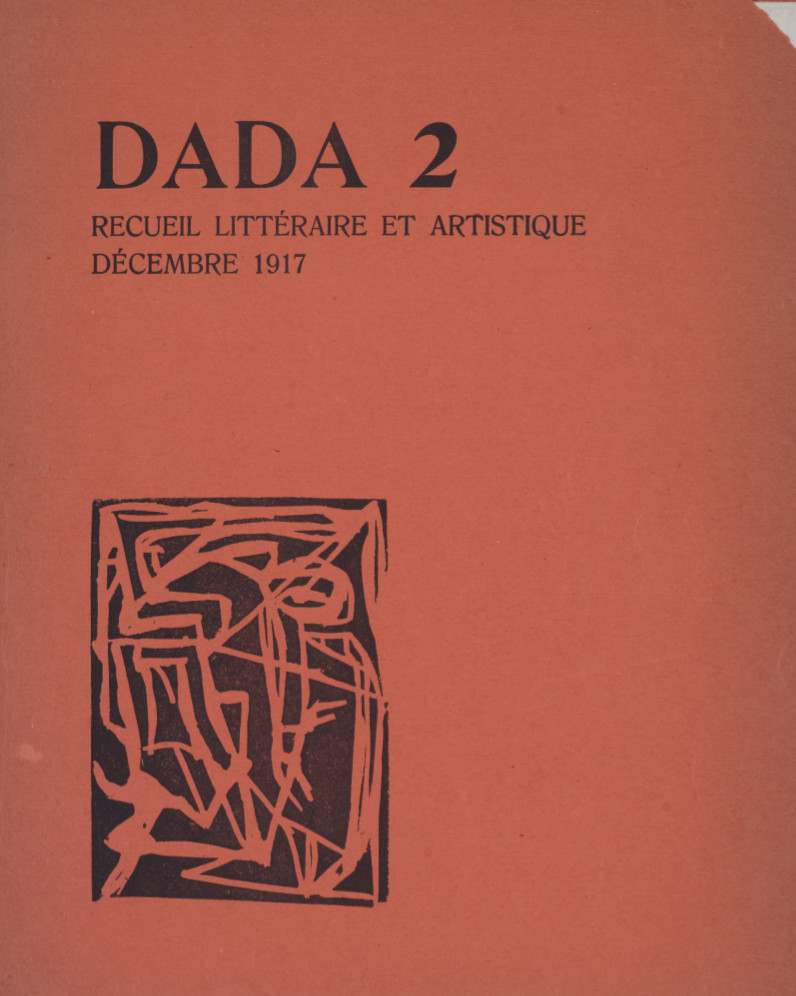
Two years later, artist Tristan Tzara issued a more bilious Dada manifesto with similar intent: “a need for independence… a distrust toward unity.” At once intensely political and anti-theoretical, he wrote, “Those who are with us preserve their freedom…. Here we are dropping our anchor in fertile ground.” How right he was, we can say 100 years later. “However short-lived,” writes Corinna da Fonseca-Wollheim in a New York Times celebration of Dada’s 100th anniversary, “Dada constitutes something like the Big Bang of Modernism.” Both Ball and Tzara positioned Dada as a collective, international movement. As such, it needed a publication to both centralize and spread its anti-establishment messages: thus Dada, the arts journal, first published in 1917 and printing 8 issues in Zurich and Paris until 1921.
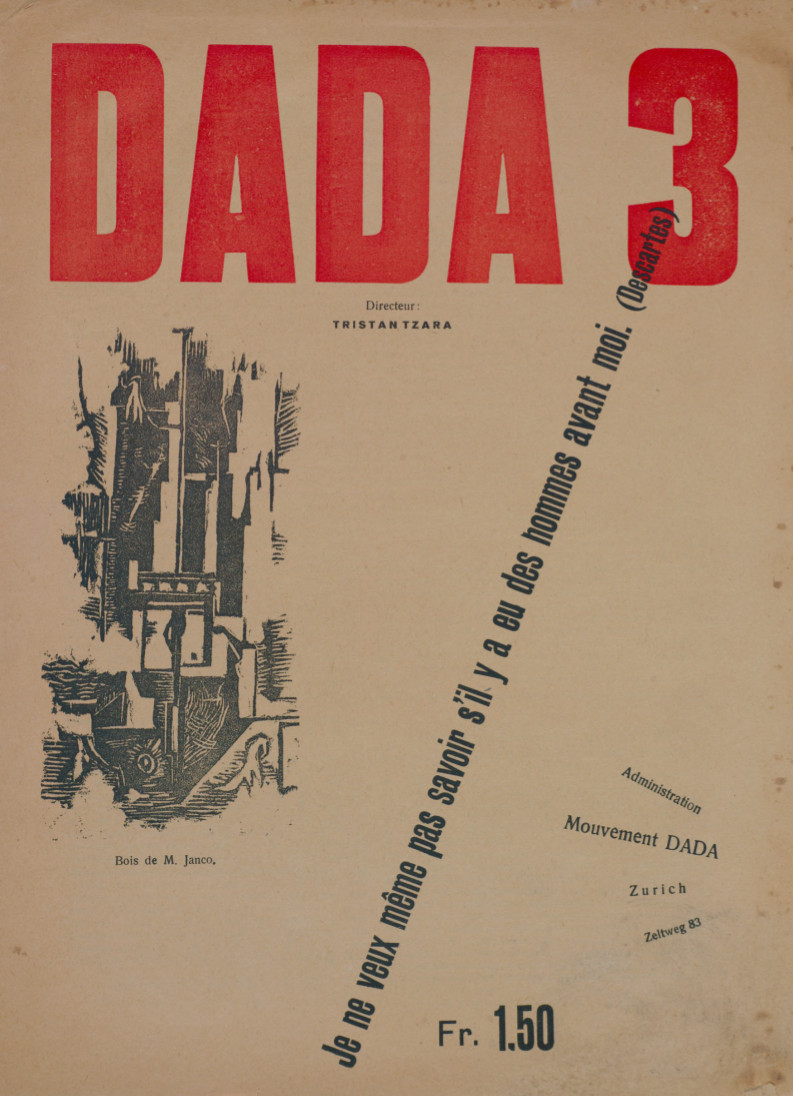
Edited by Tzara and including his manifesto in issue 3, the magazine “served to distinguish and define Dada in the many cities it infiltrated,” writes the Art Institute of Chicago, “and allowed its major figures to assert their power and position.” Dada succeeded a previous attempt by Ball at a journal called Cabaret Voltaire—named for his Zurich theater—which survived for one issue in 1917 before folding, along with the first version of the cabaret. That year, Tzara, “an ambitious and skilled promoter… began a relentless campaign to spread the ideas of Dada…. As Dada gained momentum, Tzara took on the role of a prophet by bombarding French and Italian artists and writers with letters about Dada’s activities.” Whatever Dada was, it wasn’t shy about promoting itself.
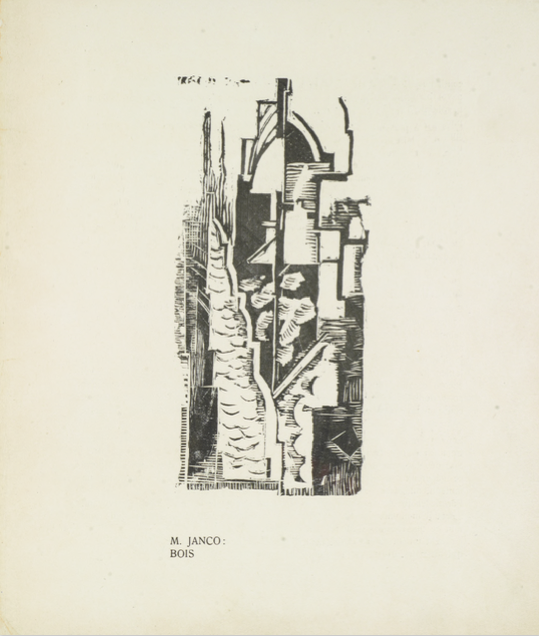
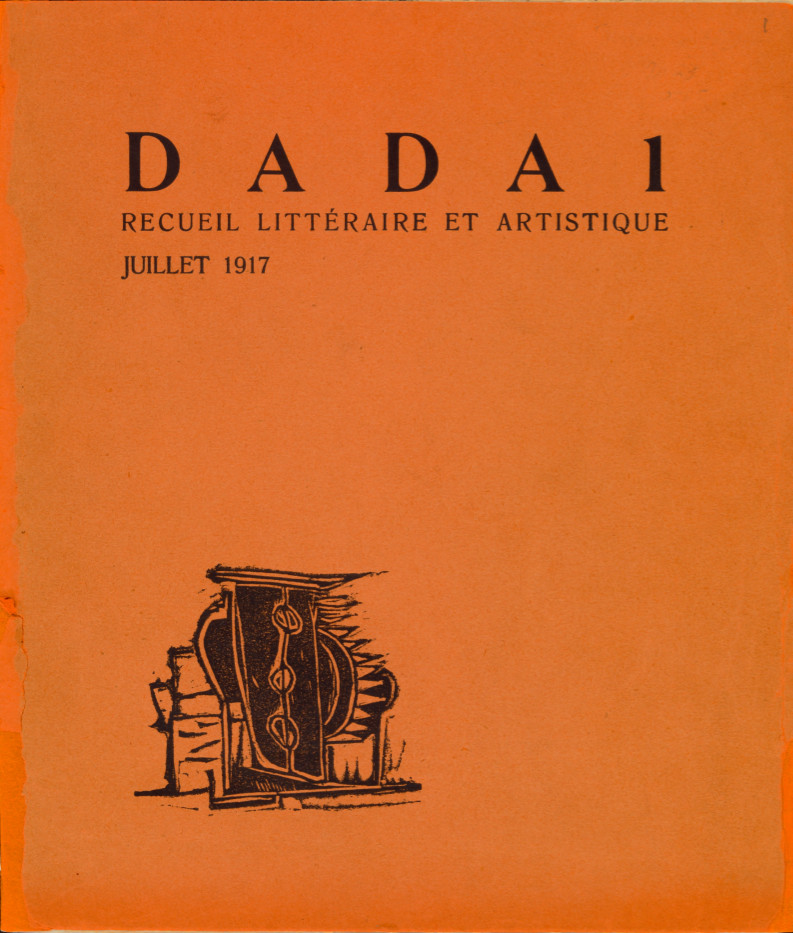
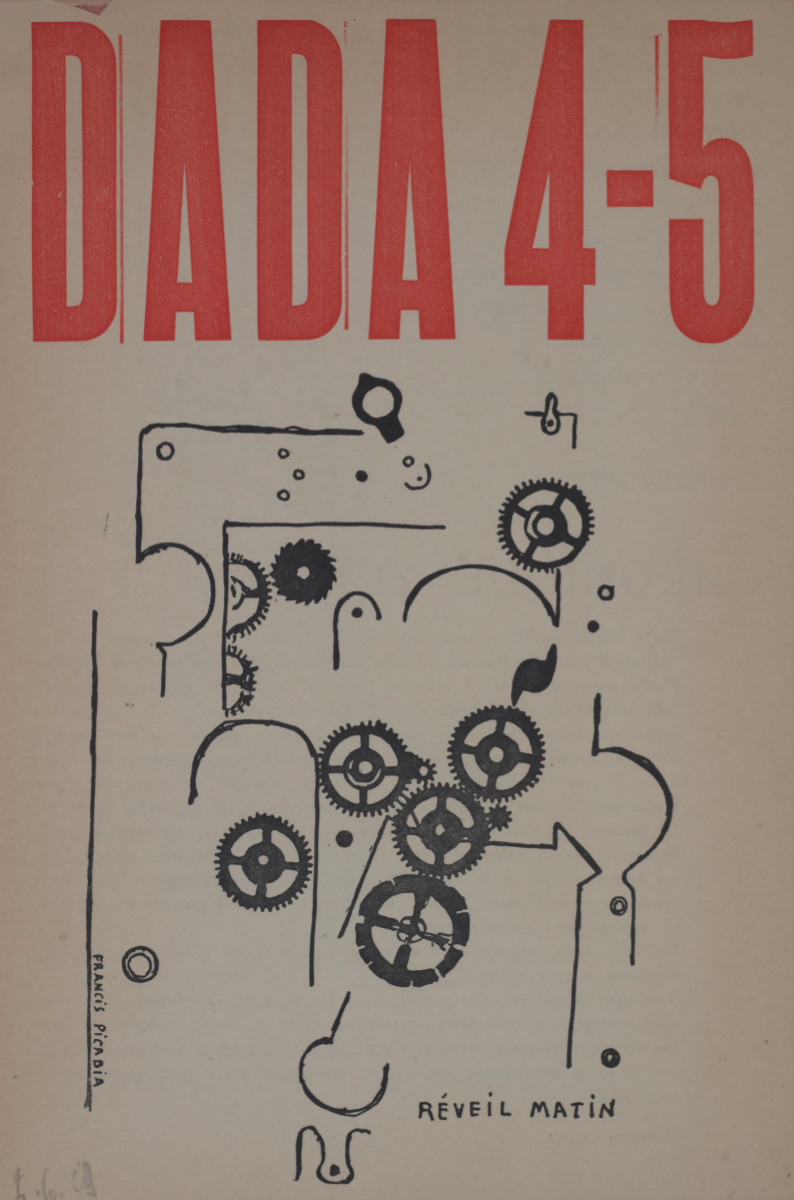
The first issue (cover at the top), contained commentary and poetry in French and Italian, and artwork like that above by important Romanian Dada artist, architect, and theorist Marcel Janco. Issues 4 and 5 were published together as an anthology, then World War I ended, and with travel again possible, Tzara, several Dada compatriots, and the journal moved to Paris. The final issue, Number 8, appeared in a truncated form. You can download each issue as a PDF from Monoskop or from Princeton University’s Blue Mountain Project, which also has an online viewer that allows you to preview each page before downloading.
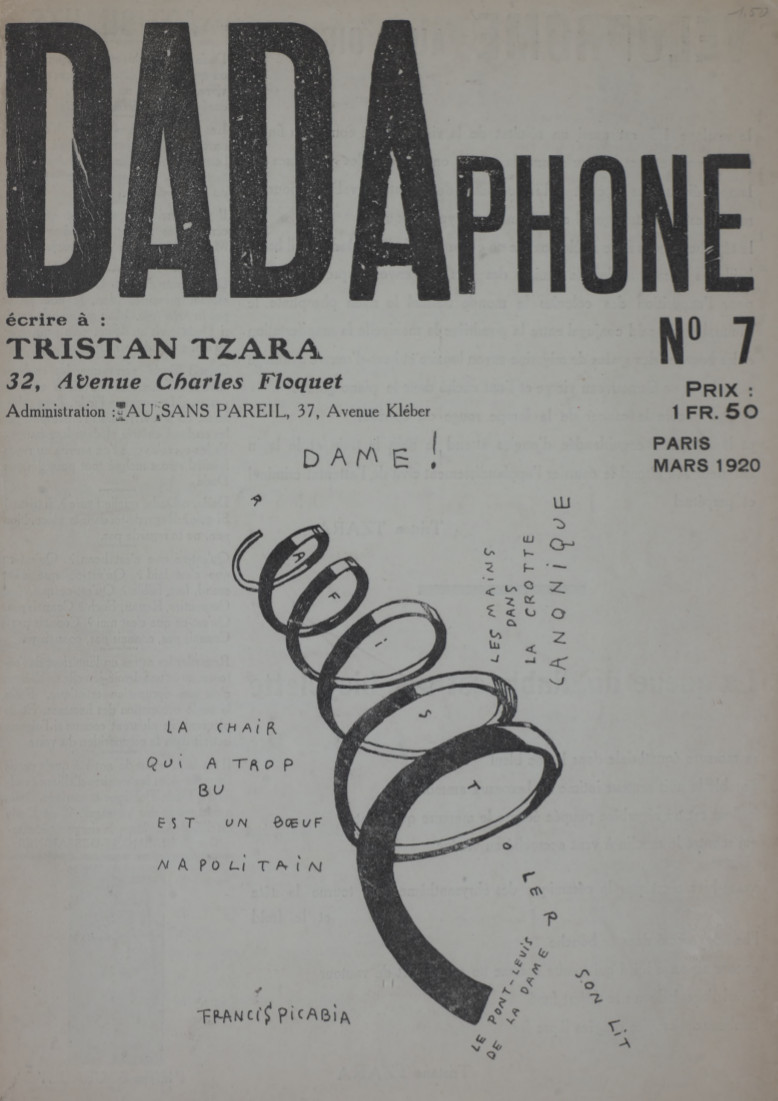
Ball and Tzara were not the only assertive disseminators of Dada’s art and aims. The Art Institute of Chicago notes that in Berlin a “highly aggressive and politically involved Dada group” published its own short-lived journal, Der Dada, from 1919–1920. Download all three issues of that publication from the University of Iowa here.
Related Content:
Hear the Experimental Music of the Dada Movement: Avant-Garde Sounds from a Century Ago
Extensive Archive of Avant-Garde & Modernist Magazines (1890–1939) Now Available Online
Josh Jones is a writer and musician based in Durham, NC. Follow him at @jdmagness
Read More...Watch “The Corridor,” a Tribute to the Music Video Stanley Kubrick Planned to Make Near the End of His Life
When Stanley Kubrick died, he left behind numerous film ideas that would never see the light of day. There was his epic Napoleon film; an adaptation of a Jim Thompson novel; his long-talked about Holocaust film Aryan Papers; and so much more.
But this was a new one to hear about: in 1996 Kubrick agreed to direct a music video for UNKLE’s upcoming Psyence Fiction album. You may recall, back when MTV played music videos, seeing Jonathan Glazer’s “Rabbit in Your Headlights” video, or Jake Scott’s “Be There,” both from UNKLE’s album. Alas, Kubrick’s video never got made. He had started filming Eyes Wide Shut and then passed away upon its release.
Now “The Corridor,” a glimpse of which you can see above, is an attempt to bring Kubrick and UNKLE back together. It’s not what actually might have been filmed by the director, but something that captures the project in spirit. It’s also a loving tribute to Kubrick’s career and his love of single-point perspective, which has been video essayed elsewhere.
Director Toby Dye, who has directed videos like “Paradise Circus” for Massive Attack and “Another Night Out” for UNKLE, took on the job of bringing “The Corridor” to the screen, co-designed by Ridley Scott Associates, working with Dye’s Black Dog Films.
“The Corridor” uses the one song off Psyence Fiction that never got a video, the Richard Ashcroft-sung “Lonely Souls,” as its backdrop. Dye has created four narratives that play on Kubrick’s iconic films–The Shining, A Clockwork Orange, Barry Lyndon,and 2001–but then interweaves time and character along a long corridor tracking shot, starring Joanna Lumley and Aiden Gillen.
In addition, “The Corridor” is a video centerpiece to what sounds like a very cool exhibition. Curated by Mo’Wax and UNKLE founder James Lavelle, “Daydreaming with Stanley Kubrick” opened yesterday at Somerset House in London and runs through August 24, 2016. Along with the video, the exhibition features artworks celebrating Kubrick’s influence on generations of artists. (The stack of heaters on top of the Overlook carpet is great.)
Said Dye:
‘For me, the unblinking red eye of 2001 A Space Odyssey’s HAL 9000 perfectly encapsulates the cinema of Stanley Kubrick. For all his films share that same coolly analytical gaze, studying from afar mankind and all its many foibles. Kubrick’s camera never appeared to follow the action, it was as if it moved of its own accord and the tableau of life simply unfurled before it. It was his seemingly never-ending camera zooms from Barry Lyndon that first sparked the seed of the idea behind “The Corridor,” before that idea grew, and grew into something that was, at times, infuriatingly ambitious, but I hope in the best tradition of the man who inspired it.’
Those who can’t attend will have to wait and see if and when the full video for “The Corridor” appears online. In the meantime, Somerset House awaits.
Related Content:
Napoleon: The Greatest Movie Stanley Kubrick Never Made
A Tour of Stanley Kubrick’s Prized Lens Collection
The Shining and Other Complex Stanley Kubrick Films Recut as Simple Hollywood Movies
Lost Kubrick: A Short Documentary on Stanley Kubrick’s Unfinished Films
Ted Mills is a freelance writer on the arts who currently hosts the artist interview-based FunkZone Podcast. You can also follow him on Twitter at @tedmills, read his other arts writing at tedmills.com and/or watch his films here.
Read More...Hear Electronic Ladyland, a Mixtape Featuring 55 Tracks from 35 Pioneering Women in Electronic Music
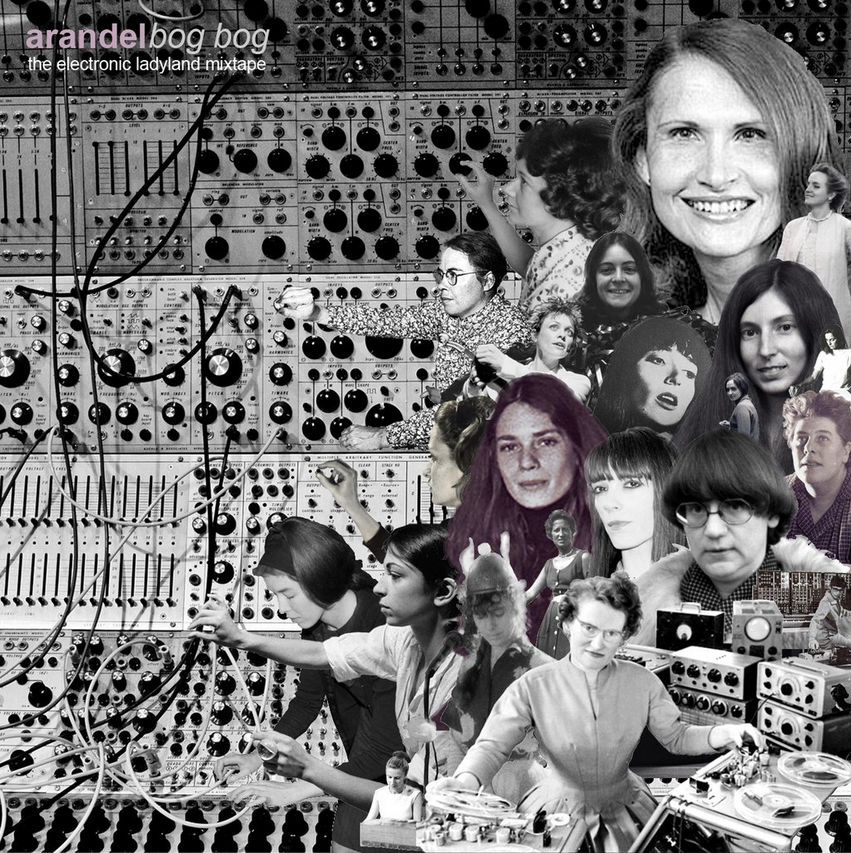
Given that we’ve previously featured two documentaries on electronic music pioneer Delia Derbyshire, an introduction to four other female composers who pioneered electronic music (Daphne Oram, Laurie Spiegel, Éliane Radigue & Pauline Oliveros), and seven hours of electronic music made by women between 1938 and 2014, no loyal Open Culture reader could claim ignorance on the theme of this new mixtape, Electronic Ladyland. It comes from the French musical project Arandel, whose members remain anonymous and could therefore be of any gender, but who, in these 45 minutes (made of 55 different tracks by 35 female composers), display a mastery of the field.
“We realized that an unconscious feminine electronic music Internationale has existed throughout the ages and we wondered whether a secret intuition might have gathered around shared research,” says Arandel in a translated interview. “Was their mutual desires achieved differently in different countries, with different tools in different timezones? The idea was to see what would happen if we gathered them in the same fictitious room for 45 minutes, and built a choir from all their productions.”
Arandel’s interviewer describes the musicians in the mix as coming from “very different musical horizons: we find academic learned musicians, research music composers and experimenters who used to do DIY works composed for advertising or television in a pop or easy listening context, some eccentric women like The Space Lady or Ruth White.” We also hear from famous names like Laurie Anderson and Wendy Carlos, and Delia Derbyshire. “What she accomplished is fascinating,” says Arandel of Derbyshire, “as is listening to her talk about her interesting work in documentaries,” and they’ve also included work from Daphne Oram, Laurie Spiegel, Eliane Radigue, and Pauline Oliveiros, subjects of the other documentaries we’ve posted here.
Electronic Ladyland drops you right into a retro-futuristic sonic landscape equally danceable and haunting, one with great variety as well as an unexpected consistency. It provides not just a kind of brief overview of what certain generations of female composers discovered with their new and then-strange electronic instruments and other devices, but one you may well want to keep in your library for frequent listening. It will also, according to Arandel, make you think: “There is an almost magic link between women and electronic music, from the 50’s / 60’s. Have you asked yourself the question of social, artistic, maybe magic reasons behind this link?” Hit the play button, and you may start. Find the list of tracks below.
1. Glynis Jones : Magic Bird Song (1976)
2. Doris Norton : Norton Rythm Soft (1986)
3. Colette Magny : « Avec » Poème (1966)
4. Daphne Oram : Just For You (Excerpt 1)
5. Laurie Spiegel : Clockworks (1974)
6. Pauline Oliveiros : Bog Bog (1966)
7. Megan Roberts — I Could Sit Here All Day (1977)
8. Suzanne Ciani : Paris 1971
9. Laurie Anderson : Tape Bow Trio (Say Yes) (1981)
10. Glynis Jones : Schlum Rooli (1975)
11. Ruth White : Mists And Rains (1969)
12. Wendy Carlos : Spring (1972)
13. Ann McMillan : Syrinx (1978)
14. Delia Derbyshire : Restless Relays (1969)
15. Maggi Payne : Flights Of Fancy (1986)
16. Else Marie Pade : Syv Cirkler (1958)
17. Daniela Casa : Ricerca Della Materia (1975)
18. The Space Lady : Domine, Libra Nos (1990)
19. Johanna Beyer : Music Of The Spheres [1938]
20. Maddalena Fagandini : Interval Signal (1960)
21. Eliane Radigue : Chryptus I (1970)
22. Ruth White : Owls (1969)
23. Ursula Bogner : Speichen (1979)
24. Beatriz Ferreyra — Demeures Aquatiques (1967)
25. Doris Norton : War Mania Analysis (1983)
26. Tera De Marez Oyens : Safed (1967)
27. Daphne Oram : Rhythmic Variation II (1962)
28. Mireille Chamass-Kyrou : Etude 1 (1960)
29. Laurie Spiegel : Drums (1983)
30. Teresa Rampazzi : Stomaco 2 (1972)
31. Teresa Rampazzi : Esofago 1 (1972)
32. Suzanne Ciani : Fourth Voice: Sound Of Wetness (1970)
33. Ursula Bogner : Expansion (1979)
34. Alice Shields : Sacrifice (1993)
35. Megan Roberts and Raymond Ghirardo : ATVO II (1987)
36. Laurie Anderson : Drums (1981)
37. Doris Hays : Somersault Beat (1971)
38. Lily Greenham : Tillid (1973)
39. Ruth Anderson : Points (1973–74)
40. Pril Smiley : Kolyosa (1970)
41. Catherine Christer Hennix : The Electric Harpsichord (1976)
42. Joan La Barbara : Solo for Voice 45 (from Songbooks) (1977)
43. Slava Tsukerman, Brenda Hutchinson & Clive Smith : Night Club 1 (1983)
44. Monique Rollin : Motet (Etude Vocale) (1952)
45. Sofia Gubaidulina : Vivente – Non Vivente (1970)
46. Ruth White : Spleen (1967)
47. Doris Hays : Scared Trip (1971)
48. Daphne Oram : Pulse Persephone (Alternate Parts For Mixing)
49. Maggi Payne : Gamelan (1984)
50. Laurie Spiegel : The Unquestioned Answer (1980)
51. Ursula Bogner : Homöostat (1985)
52. Wendy Carlos : Summer (1972)
53. Suzanne Ciani : Princess With Orange Feet
54. Pauline Oliveiros : Poem Of Change (1993)
55. Suzanne Ciani : Thirteenth Voice: And All Dreams Are Not For Sale (1970)
Related Content:
Hear Seven Hours of Women Making Electronic Music (1938- 2014)
Two Documentaries Introduce Delia Derbyshire, the Pioneer in Electronic Music
The History of Electronic Music in 476 Tracks (1937–2001)
Based in Seoul, Colin Marshall writes and broadcasts on cities and culture. He’s at work on a book about Los Angeles, A Los Angeles Primer, the video series The City in Cinema, the crowdfunded journalism project Where Is the City of the Future?, and the Los Angeles Review of Books’ Korea Blog. Follow him on Twitter at @colinmarshall or on Facebook.
Read More...Watch “Don’t Be a Sucker!,” the 1947 US Government Anti-Hatred Film That’s Relevant All Over Again
If you aren’t seriously disturbed, even alarmed, that we in the U.S. have a presidential candidate from a major political party who succeeds by whipping up xenophobic fervor and telling us the country must not only reinstitute torture, but must do “the unthinkable”… well…. I don’t really know what to say to you. Perhaps more symptom than cause of a global turn toward tribal hatred, the GOP candidate has lent his name to a phenomenon characterized by cultish devotion to an authoritarian strongman, serial falsehood, and easy, uncritical scapegoating. We needn’t look far back in time to see the historical analogues, whether in the early 20th century, at the end of the 19th, or during any number of historical moments before and after.
We also needn’t look very far back to find a history of resistance to authoritarian bigotry, and not only from Civil Rights campaigners and leftists, but also, as you can see above, from the U.S. War Department. In 1947, the Department released the short propaganda film, “Don’t Be a Sucker!”, aimed at middle-class American Joes. Shot at Warner Studios, the film opens with some typical noirish crime scenarios, complete with convincingly noir lighting and camera angles, to visually set up the character of the “sucker” who gets taken in by sinister but seductive characters—“people who stay up nights trying to figure out how to take away” what the everyman has. What do naïve potential marks in this analogy have to lose? American plenty: “plenty of food, big factories to make things a man can use, big cities to do the business of a big country, and people, lots of people.”
“People,” the narrator says, working the farms and factories, digging the mines and running the businesses: “all kinds of people. People from different countries with different religions, different colored skins. Free people.” Is this disingenuous? You bet. We’re told this aggregate of people is “free to vote”—and we know this to be largely untrue in practice for many, necessitating the Voting Rights Act almost twenty years later. Free to “pick their own jobs”? Employment discrimination, segregation, and sexism effectively prevented that for millions. But the sentiments are noble, even if the facts don’t fully fit. As our average Joe wanders along, contemplating his advantages, he happens upon a reactionary streetcorner demogague haranguing against foreigners, African-Americans, Catholics, and Freemasons (?) on behalf of “real Americans.” Sounds plenty familiar.
The voice of reason comes from a naturalized Hungarian professor who witnessed the rise of Nazism in Berlin and who explains to our everyman the strategy of fanatics and fascists—divide and rule. “We human beings are not born with prejudices,” says the wise professor, “always they are made for us. Made by someone who wants something. Remember that when you hear this kind of talk. Somebody’s going to get something out of it. And it isn’t going to be you.” The remainder of the film mostly consists of the Hungarian professor’s recollections of how the Nazis won over ordinary Germans.
“Don’t Be a Sucker!” uses a clever rhetorical strategy, appealing to the self-interest and vanity of the everyman while couching that appeal in egalitarian values. The very recent historical example of fascist Europe carries significant weight, where too often today that history gets treated like a joke, turned into crude and muddled memes. This film would have had real impact on the viewing audience, who would have seen it before their feature in theaters across the country.
It’s worth noting that this film came out during a period of increasing American prosperity and comparative economic equity. The jobs “Don’t Be a Sucker!” lists with pride have disappeared. Today’s everyman, we might say, has even more reason for susceptibility to the demagogue’s appeals. The Internet Archive notes an irony here “in the light of Cold War anti-Communist politics, which really came into their own in the year this film was made.” The streetcorner populist calls to mind people like Joseph McCarthy and J. Edgar Hoover (and he looks like George Wallace)—powerful government authorities who cast suspicion on every movement for Civil Rights and social equality.
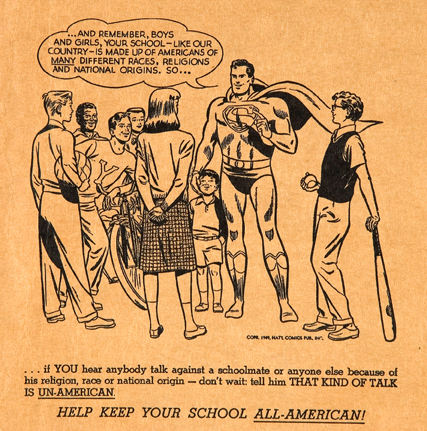
“Don’t Be a Sucker!” may seem like an outlier, but it’s reminiscent of another piece of patriotic, anti-racist-and-religious-bigotry propaganda—the Superman cartoon above, which first appeared in 1949, distributed to school children as a book cover by something called The Institute for American Democracy. You may have seen versions of a full-color poster, reprinted in subsequent years. Here, Superman expresses the same egalitarian values as “Don’t Be a Sucker!” only instead of calling racism a con-job, he calls it “Un-American,” using the favorite denunciation of HUAC and other anti-Communist groups.
History and the present moment may often prove otherwise—showing us just how very American racism and bigotry can be, but so too are numerous counter-movements on the left and, as these examples show, from more conservative, establishment corners as well.
“Don’t Be a Sucker!” will be added to our collection, 4,000+ Free Movies Online: Great Classics, Indies, Noir, Westerns, Documentaries & More.
Related Content:
Bertolt Brecht Testifies Before the House Un-American Activities Committee (1947)
Josh Jones is a writer and musician based in Durham, NC. Follow him at @jdmagness
Read More...Laurie Anderson’s Top 10 Books to Take to a Desert Island
Her avant-garde performance art endeared her to the New York art world long before she dated, then married, one of the most influential men in rock and roll. Her work has at times been overshadowed by her more conventionally famous partner and collaborator, but after his death, she continues to make challenging, far ahead-of-its-time work and redefine herself as a creative force.
No, I don’t mean Yoko Ono, but the formidable Laurie Anderson. In addition to her experimental art, Anderson is a filmmaker, sculptor, photographer, writer, composer, and musician. Her surprise electronic hit “O Superman” (above) from her debut 1982 album Big Science, “warns of ever-present death from the air in an era of jingoism,” writes David Graham at The Atlantic.
Anderson herself explains the song as based on a “beautiful 19th-century aria by Massenet… a prayer to authority. The lyrics are a one-sided conversation, like a prayer to God. It sounds sinister—but it is sinister when you start talking to power.”
“O Superman” speaks, mockingly, to American military hegemony and to a particular historical event, the Iran hostage crisis. As such, it is representative of much of her work, melding classical instincts and musicianship with electronic experimentation and a darkly comic sensibility that she often wields like a critical scalpel on U.S. political attitudes—from her huge, five-record 1984 live album United States (with songs like “Yankee See” and “Democratic Way”) to her 2010 project Homeland.
One of Anderson’s most recent pieces, Dirtday, “responds,” she says above, to “a very tragic situation… a decade after 9/11… so much fear. Dirtday was really inspired by trying to look at that fear… almost from a point of view of ‘what is it when a whole nation gets hypnotized?’” Her art may be politically oppositional, but she also admits, that “as a storyteller, I find my ‘colleagues’ in politics, you know, a little bit closer than I thought.” The admission belies Anderson’s ability to incorporate multiple perspectives into her complex narratives, as all great writers do. And great writers begin as readers, their work in dialogue with the books that move and shape them.
So what does Laurie Anderson read? Below, you’ll find a list of her top ten books, curated by One Grand, a “bookstore in which celebrated thinkers, writers, artists, and other creative minds share the ten books they would take to their metaphorical desert island.” Her choices include great comic storytellers, like Laurence Sterne, and chroniclers of the lumbering beast that is the U.S., like Herman Melville. Other well-known novelists, like Nabokov and Annie Dillard, sit next to Buddhist texts and creative nonfiction. It’s a fascinating list, and if you’re as intrigued and inspired by Anderson’s work as I am, you’ll want to read, or re-read, everything on it.
- Within the Contexts of No Context, George W.S. Trow: “Hilarious and Dangerous. Dead-on analysis of what makes America so big.”
- The Tibetan Book of the Dead: “The most visual language of any book I know.”
- Moby Dick, Herman Melville: “The words were songs, the flow embraced the way we actually think.”
- The Life and Opinions of Tristram Shandy, Gentleman, Laurence Sterne: “The ultimate shaggy dog story.”
- Pale Fire, Vladimir Nabokov: “Poetry disguised as prose.”
- Autobiography of Red, Anne Carson: “An epic poem. Plus very, very funny.”
- The Well-Tempered City, Jonathan F.P. Rose: “Deeply Inspiring.”
- Peter the Great, Robert K. Massie: “Immediately made me want to read all his other books.”
- Pilgrim at Tinker Creek, Annie Dillard: “Reminds me to be in the present.”
- When Things Fall Apart, Pema Chodron: “Reminds me that disasters can be positive.”
Skip on over to One Grand to read Anderson’s complete, witty commentaries on each of her choices.
Also check out, UBUweb, which has a nice collection of Laurie Anderson’s early video work.
via The New York Times Magazine
Related Content:
Patti Smith’s List of Favorite Books: From Rimbaud to Susan Sontag
David Foster Wallace’s Surprising List of His 10 Favorite Books, from C.S. Lewis to Tom Clancy
Josh Jones is a writer and musician based in Durham, NC. Follow him at @jdmagness
Read More...Support Us
We're hoping to rely on loyal readers, rather than erratic ads. Please click the Donate button and support Open Culture. You can use Paypal, Venmo, Patreon, even Crypto! We thank you!

About Us

Open Culture scours the web for the best educational media. We find the free courses and audio books you need, the language lessons & educational videos you want, and plenty of enlightenment in between.
Advertise With Us
FREE UPDATES!
GET OUR DAILY EMAIL
Get the best cultural and educational resources on the web curated for you in a daily email. We never spam. Unsubscribe at any time.
FOLLOW ON SOCIAL MEDIA
Open Culture editor Dan Colman scours the web for the best educational media. He finds the free courses and audio books you need, the language lessons & movies you want, and plenty of enlightenment in between.
Advertise With Us


