Slavoj Žižek Explains the Artistry of Andrei Tarkovsky’s Films: Solaris, Stalker & More
Though a filmmaker of strong personal convictions, artistic and otherwise, Andrei Tarkovsky made films that endure in part because they open themselves to a multiplicity of interpretations. Nothing in the Tarkovsky canon opens itself up to quite such a multiplicity of interpretations as Stalker, which continues to produce fascinating new works derived from their creators’ experience of the film, such as Geoff Dyer’s Zona: A Book About a Film About a Journey to a Room, the S.T.A.L.K.E.R. series of video games, and even a segment of the Slavoj Žižek-starring documentary The Pervert’s Guide to Cinema, which you can watch above.
“We need the excuse of a fiction to stage what they truly are,” declares the philosophical, cultural, and political provocateur over footage of what many consider Tarkovsky’s masterpiece. He describes it as “a film about a ‘Zone,’ a prohibited space where there are debris, remainders of aliens visiting us.” The titular professionals he describes as “people who specialize in smuggling foreigners who want to visit into this space where you get many magical objects.” The ultimate goal of all who make the harrowing journey to the Zone? “The room in the middle of this space, where it is claimed your desires will be realized.”
Not a bad summing-up of the premise of a movie even whose biggest fans struggle to explain. But Žižek, of course, takes his analysis further, bringing in Solaris, Tarkovsky’s 1972 adaptation of Stanislaw Lem’s science fiction novel about a planet that can read the minds of the humans in orbit around it, “an id machine as an object which realizes your nightmares, desires, fears, even before you ask for it.” With Stalker, Tarkovsky envisions the opposite, “a zone where your desires, your deepest wishes, get realized on condition that you are able to formulate them. Which, of course, you are never able.”
If you subscribe to Žižek’s reading of the films, it actually makes perfect sense that they could continue to find new, enthralled audiences: the human relationship to desire remains as fraught as ever — and perhaps has only gained fraughtness as we find ways to satisfy our desires — and both Solaris and Stalker find artistically striking new ways to dramatize it. And according to Žižek, the respected filmmaker also provides a solution: “religious obscurantism,” a “gesture of self-sacrifice” of the kind we see made in his final films, Nostalghia and The Sacrifice. Tarkovsky also sacrificed himself, but for cinema, and so created some of the most formally remarkable motion pictures ever made, ones in which, in Žižek’s words, “we are made to feel this inertia, drabness of time,” and even “the density of time itself.” If you wonder what he means by that, as ever, you’ve just got to experience Tarkovsky for yourself. A number of his major films you can watch free online.
Related Content:
Watch Stalker, Andrei Tarkovsky’s Mind-Bending Masterpiece Free Online
Andrei Tarkovsky’s Masterpiece Stalker Gets Adapted into a Video Game
Andrei Tarkovsky’s Advice to Young Filmmakers: Sacrifice Yourself for Cinema
Slavoj Žižek Names His Favorite Films from The Criterion Collection
Based in Seoul, Colin Marshall writes and broadcasts on cities and culture. He’s at work on a book about Los Angeles, A Los Angeles Primer, the video series The City in Cinema, the crowdfunded journalism project Where Is the City of the Future?, and the Los Angeles Review of Books’ Korea Blog. Follow him on Twitter at @colinmarshall or on Facebook.
Read More...Photographer Bill Cunningham (RIP) on Living La Vie Boheme Above Carnegie Hall
New York City lost some of its charm this weekend, with the news that Bill Cunningham, the Times’ beloved, on-the-street fashion photographer, had passed away at the age of 87.
Much has been made over the fact that he was designated a living landmark by the New York Landmarks Conservancy. It’s an honor he earned, hitting the streets daily in his usual mufti of khakis, sneakers, and bleu de travail cotton jacket to hunt his quarry by bicycle, but one could never accuse him of courting it.
His employer frequently sent him to cover the elite, but he had no interest in joining their ranks, despite his own growing celebrity. His “Evening Hours” column documented the dressed up doings on the “party circuit.” (This living New York landmark never shook his Boston accent, one of the chief delights of his weekly video series for the Times.) A recent installment suggests that shooting the likes of actress Nicole Kidman and Vogue Editor-in-Chief Anna Wintour during tony private functions at MoMA and the Metropolitan Museum of Art (“aht”) was far less exciting than encountering colorfully clad Himalayan dancers and a children’s craft table at an entirely free Sunday afternoon street fair sponsored by the Rubin Museum of Art.
Playwright Winter Miller shared this anecdote the morning Cunningham’s death was announced:
…he didn’t give a fk about who was famous or not. I once met Bill Murray in the lobby of the old New York Times building. He’d shown up to see if he could track down a photo of him and his then-wife that Bill had shot. I brought one Bill to the other, but Bill (Cunningham) was out on the streets with his blue jacket, white bike and camera. When he returned, I explained how I’d come to take Bill Murray under my wing to help him track down this photo. Bill had no idea who Bill Murray was and not unkindly told me (that) none of his photos were digital, so it would involve him personally digging through old files and he didn’t have time. I admired that he knew his priorities and never strayed from his task. I had been eager to get Bill Murray the thing he’d wanted and would have combed though vast files myself… but I never looked. Bill Cunningham’s files were impenetrable to an outsider.
One likes to think that Murray, who’s known for using his fame as his ticket to hang with ordinary mortals, would find much to love about that.
In fact, Murray strikes me as the perfect candidate to play Cunningham in a biopic covering the six decades spent living and working in a studio over Carnegie Hall. As far as I know, Bill Cunningham New York, a feature length documentary, is the only time his story has been captured on the silver screen. How can it be that no one has thought to make a movie centered on the lost bohemian period Cunningham recalls so fondly in the slideshow above? It sounds like an American spin on the Lost Generation—sneaking down to the unlocked stage for photographer Editta Sherman’s impromptu amateur performances of The Dying Swan, an elderly circus performer and her dog roaming the halls on a unicycle, someone always in a state of undress…
Perhaps Murray’s frequent collaborator, Wes Anderson, could be enlisted to set these wheels in motion. The colorful cast of characters seem tailor-made for this director, already a fashion world favorite.
Prior to acquiring an Olympus Pen D half-frame camera from a friend in 1966, Cunningham worked as a milliner. Marilyn Monroe used to crack herself up, trying them on in between classes at the Actor’s Studio. The wife of a Carnegie Hall neighbor and Cunningham’s boss, fashion photographer Ray Solowinski, served as his model. After he was established as a fashion expert in his own right, Cunningham admitted that his designs were “a little too exotic – you know, for normal people”.
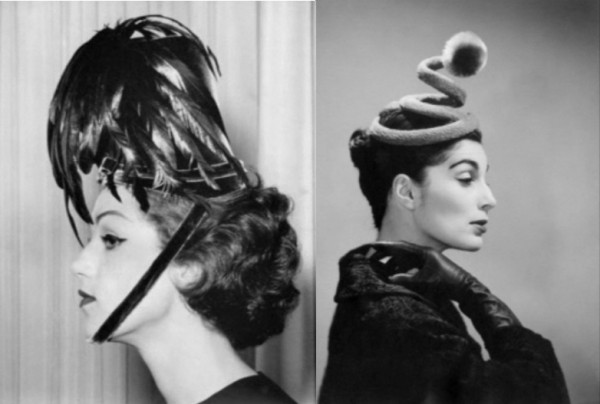
I think they’re wonderful, and hopefully, Bill Murray, Wes Anderson and you will agree. See below. I think they’re wonderful, and hopefully, Bill Murray, Wes Anderson and you will agree. Hats off to the inimitable Bill Cunningham, as much a fixture of New York as Carnegie Hall.
Related Content:
Hunter S. Thompson’s Advice for Aspiring Photographers: Skip the Fancy Equipment & Just Shoot
Alfred Stieglitz: The Eloquent Eye, a Revealing Look at “The Father of Modern Photography”
Stanley Kubrick’s Jazz Photography and The Film He Almost Made About Jazz Under Nazi Rule
Ayun Halliday is an author, illustrator, and Chief Primatologist of the East Village Inky zine. Follow her @AyunHalliday
Read More...Free: Hear 24 Hours of Noam Chomsky’s Lectures & Talks on the Powers That Subvert Our Democracies
Noam Chomsky is optimistic. Yes, the world seems to teeter on the brink of… well, name your dystopian scenario, but Noam Chomsky is optimistic. The same Chomsky who, for decades, has sought to show the myriad ways our most revered institutions are largely sham operations behind which powerful elites conduct secret wars, propaganda campaigns, environmental destruction, and concerted efforts to defraud the people and disable democratic processes… well, he tells us, in a recent interview with James Resnick, that we too “can be very optimistic. Things like this have happened before and they’ve been overcome.”
By “things like this,” the renowned linguist and anarchist political philosopher specifically means astounding levels of wealth inequality and the ascendency, once again, of far-right extremism in Europe and the U.S., a phenomenon he first observed in the years prior to World War II. Chomsky began his career of social and political critique in 1938 at the age of 10, “writing articles for the school newspaper on the rise of fascism in Europe and the threats to the world as I saw them.”
He went on to completely revolutionize the field of linguistics, an achievement that, stunningly, can seem secondary to his political writing and activism, given the sheer number of his books, essays, interviews, and speeches critical of state power, war, and media manipulation over the past several decades. (Some of his books you can read free online here.) I suppose if Chomsky weren’t something of an optimist, he would have given up a long time ago. He tells Resnik what keeps him going:
The things I consider inspiring is seeing people struggling: poor suffering people, with limited resources, struggling to really achieve anything. Some of them are very inspiring. For example, a remote very poor village in southern Colombia organizing to try to prevent a Canadian gold-mining operation from destroying their water supply and the environment; meanwhile, fending off para-military and military violence and so on. That kind of thing which you see all over the world is very inspiring.
Are you inspired? Maybe it depends on how many of these grassroots struggles you’ve witnessed. The worldwide, ground-level resistance Chomsky describes—and refers to again and again in his political work—is largely hidden from us, by a mass media that sees no dollar value in it, or perhaps obscures it for more sinister reasons. As Chomsky has argued since the sixties—most comprehensively in his 1988 Manufacturing Consent with Edward S. Herman—the campaigns of war and economic depredation conducted by the West against minorities, indigenous people, and small nations around the world mostly occur with the consent of Western people: a consent manufactured by a massive propaganda operation called the Free Press.
His position should not sound especially controversial to anyone who has paid the least bit of attention in the last few years. The seeming collusion of respected news organizations like The Washington Post and The New York Times in the push for the second Iraq War led to well over a decade of post-hoc introspection by journalists. Recent months have seen those same organs—for perhaps more baldly profit-seeking motives—provide a couple of billion dollars-worth of free PR for Donald Trump, a candidate who has on multiple occasions threatened to retaliate against the press for any criticism, and who recently revoked the Post’s credentials to cover his events. (A recent Harvard study concluded that during this protracted, ugly primary season, “the press became [Trump’s] dependable if unwitting ally.”)
As in these examples, the role of the British press in spreading fear and misinformation prior to this month’s Brexit vote has become its own significant story. We constantly see the press turning in agonized circles, trying to come to grips with its complicity in pushing various agendas. Whether or not mainstream media organizations take direct orders from government bodies or economic elites, they accede to the interests of the powerful all the same, and they wield enormous influence over a voting public who depend upon them for information. The situation presents a serious problem for the health of a functioning democracy, which itself depends upon an informed and educated electorate.
But as Chomsky has often argued—drawing as always on primary sources and directly quoting the West’s most influential political philosophers, policy architects, and business leaders—elites since the 17th and 18th centuries have intentionally thwarted the ability of the public to make informed decisions, and have shut the populace out of the most important decision-making processes. As he wrote in his 1999 critique of Neoliberalism, Profit Over People, “the general population must be excluded entirely from the economic arena, where what happens in the society is largely determined. Here the public is to have no role, according to prevailing democratic theory.”
Chomsky follows this line of reasoning in his talk “When Elites Fail,” at the top of the post, delivered as the keynote address for the Ecoconvergence Conference in Portland, Oregon in 2009. You can also hear this talk, along with 19 others, in the Spotify playlist just above—a total of 24 hours of Chomskyan social, political, and economic analysis, delivered by the man himself in his calm, measured, understated way. (If you need Spotify’s free software, download it here.) Chomsky addresses “The Tyranny of Corporations,” the “U.S. Media as Propaganda System,” “Politics and Language,” “Iraq: The Forever War,” and more—levying criticisms against the systems of power, whether Republican, Democratic, or international, that doggedly seek to increase their domains and, in the approving words of James Madison, to “protect the minority of the opulent against the majority.”
Related Content:
Noam Chomsky on Whether the Rise of Trump Resembles the Rise of Fascism in 1930s Germany
Clash of the Titans: Noam Chomsky & Michel Foucault Debate Human Nature & Power on Dutch TV, 1971
Read 9 Free Books By Noam Chomsky Online
Josh Jones is a writer and musician based in Durham, NC. Follow him at @jdmagness
Read More...James Joyce’s Finnegans Wake Gets Turned into an Interactive Web Film, the Medium It Was Destined For
Two radical modernists, James Joyce and Sergei Eisenstein, once met in Paris in 1929 and, “depending on who you read,” writes Dan McGinn, “are purported to have discussed a film version of ‘Ulysses’ and how Karl Marx’s ‘Das Kapital’ could be depicted onscreen.” For many years, an adaptation of Marx’s dense political-economic critique seemed about as plausible as a film version of Joyce’s famously dense novel, which takes place on a single day, June 16th—forever after known as Bloomsday.
A great admirer of Joyce’s cinematic imagination, Eisenstein once remarked that “formally Joyce went as far as literature could go.” Given the conventionally narrative, realist route film eventually traveled, Ulysses, with its recursive digressions and hyperallusive interiority, seemed unfilmable until Joseph Strick’s admirable effort in 1967.
Just as Eisenstein admired Joyce’s literary experimentation, Joyce was a lover of Eisenstein’s experiments in film. He founded Ireland’s first movie house, the Volta, in 1909, and though the venture flopped a year later, Joyce’s investment in the aesthetics of film survived. Colm McAuliffe observes that Ulysses “deployed a whole range of techniques such as montage and rapid scene dissolves which are more commonly associated with the cinema.” Eisenstein “raved about the way Joyce had adopted a scientific approach to the story of a day in the life of one man,” writes McGinn, “putting almost every aspect of that day under the microscope.” After Joyce, Eisenstein said, “the next leap is to film.”
But if Ulysses went as far as the novel could go, Finnegans Wake exploded the form altogether, dissolving the boundaries between prose and poetry, subject and object, history and myth. Ulysses employed the techniques of film; Finnegans Wake imagined technology which did not even exist. It is a novel—if we are to call it such—written for the 21st century, and perhaps the only way it can be adapted in other media is through the internet’s nonlinear, labyrinthine structures; the online project First We Feel Then We Fall does just that, creating a multimedia adaptation of Finnegans Wake that “transfers” the novel “to audiovisual language,” and demonstrates the novel as—in the words of The Guardian’s Billy Mills—“the book the web was invented for.”
Conceived and executed by Polish artist Jakub Wróblewski and scholar Katarzyna Bazarnik, the project’s “main goal,” its press release announces, “is to show complexity of narration, language and meanings included in this masterpiece. Based on an interdisciplinary analysis, the work translates the text into the cinematic form.” As you can see in the short clips here, it’s a form much like we might imagine Eisenstein adopting to film Finnegans Wake, had Eisenstein had access to web technology. Central to the project is “an interactive video app… designed in order to enhance an experience of Joycean stream of consciousness.”
Selected passages and within them specific words, phrases or sentences serve as the basis for video sequences. Shots illustrating a passage are divided into four separate channels. The viewers have the opportunity to choose in real time which channel they would like to watch…. This system is supposed to reflect the tenets of Joyce’s fiction: that the book can be read in different ways, while the readers can solve its verbal puzzles, yield to the melodious rhythm or look for hidden meanings.
The project’s creators base their adaptation on the novel’s conceptual principles: “Based on a cyclical vision of history, the book is a textual merry-go-round, too: it begins mid sentence and ends with another one broken in the middle, which finds it continuation on the first page: the same anew.” And although they don’t say so explicitly, they also employ Eisenstein’s theoretical principles of montage: “Primo: photo-fragments of nature are recorded; secundo: these fragments are combined in various ways.”
In addition to a jumble of abstract images, the project’s short videos—as you can see in these excerpts—incorporate a wide range of voices, accents, and musical and sonic accompaniment. The only way to experience the full effect of First We Feel Then We Fall is to visit the site’s player and spend some time cycling through its dizzying collection of images and voices reading from the text, using the up and down arrows on your keyboard to move from video to video. As a key to understanding Joyce’s work and their own adaptation, the project’s artists chose the Joycean words “Meandertale” and “Meanderthalltale,”—“two of innumerable puns making up the textual labyrinth of Finnegans Wake,” neologisms that nudge us to read the book “as a ‘tall tale” wandering waywardly, looping backward and flashing forward, into the pre-historic past, and the origins of the human species.”
If Ulysses seemed unfilmable, Finnegans Wake truly is—at least in the conventional narrative language film has settled into since Eisenstein’s time. But in using the abstract vocabulary of avant-garde film and the post-modern technology of the internet, First We Feel Then We Fall has created an adaptation that seems worthy of the book’s innovations, and that authentically translates its vertiginously playful poetic strangeness to the screen. Enter First We Feel Then We Fall here.
Related Content:
Hear James Joyce’s Finnegans Wake Read Unabridged & Set to Music By 17 Different Artists
James Joyce Reads From Ulysses and Finnegans Wake In His Only Two Recordings (1924/1929)
Josh Jones is a writer and musician based in Durham, NC. Follow him at @jdmagness
Read More...The Books on Young Alan Turing’s Reading List: From Lewis Carroll to Modern Chromatics
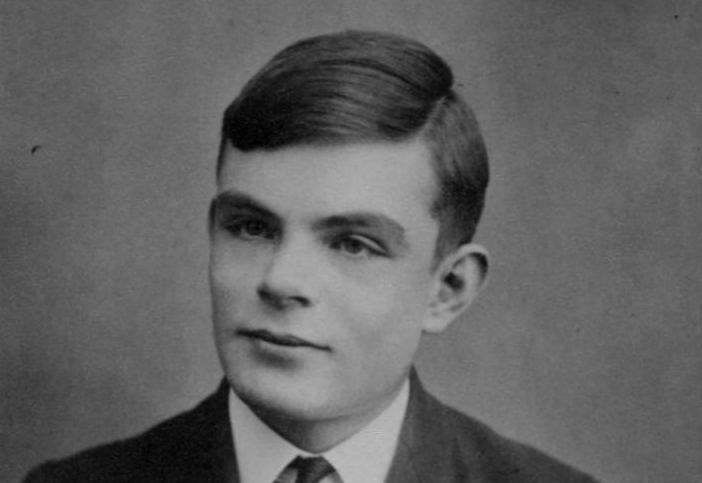
Image via Wikimedia Commons
We now regard Alan Turing, the troubled and ultimately persecuted cryptanalyst (and, intellectually, much more besides)—who cracked the code of the German Enigma machine in World War II—as one of the great minds of history. His life and work have drawn a good deal of serious examination since his early death in 1954, and recently his legacy has even given rise to popular portrayals such as that by Benedict Cumberbatch in the film The Imitation Game. So what, more and more of us have started to wonder, forms a mind like Turing’s in the first place?
A few years ago, mathematics writer Alex Bellos received, from “an old friend who teaches at Sherborne, the school Turing attended between 1928 and 1930,” some “new information about the computer pioneer and codebreaker’s school years” in the form of “the list of books Turing took out from the school library while he was a pupil.” Bellos lists them as follows:
- Illusions
- Journal of the Chemical Society, vols. 95, 96, 97
- Lead
- Modern Electric Theory
- Money
- Isotopes by Frederick William Aston
- Mathematical Recreations and Essays by W. W. Rouse Ball
- Alice’s Adventures in Wonderland, Game of Logic and Through The Looking Glass by Lewis Carroll.
- The Common Sense of the Exact Sciences by William Kingdon Clifford
- Space, Time and Gravitation and The Nature of the Physical World by Sir Arthur Stanley Eddington.
- Sidelights on Relativity by Albert Einstein
- The Escaping Club by A. J. Evans
- Contributions to Mental Philosophy by Immanuel Hermann Fichte, translated and edited by J.D. Morell
- The New Physics by Arthur Haas
- Supply and Demand by Hubert D. Henderson
- The Stars in their Courses by Sir James Hopwood Jeans
- Atoms and Rays and Phases of Modern Science by Sir Oliver Lodge.
- Matter and Motion by James Clerk Maxwell
- The Theory of Heat by Thomas Preston
- A Selection of Photographs of Stars, Star-Clusters & Nebulae, together with information concerning the instruments & the methods employed in the pursuit of celestial photography by Isaac Roberts
- Modern Chromatics, with applications to art and industry by Ogden Nicholas Rood
- Celestial Objects for Common Telescopes by Thomas William Webb
- The Recent Development of Physical Science by William Cecil Dampier Whetham
- Science and The Modern World by Alfred North Whitehead
- Sound Waves and their Uses by Alexander Wood
“As you can see, and as you might expect,” writes Bellos, “heavy on the sciences. The AJ Evans, a memoir about the author’s escape from imprisonment in the First World War, is the only non-scientific book.” He also notes that “the physics books he took out all look very serious, but the maths ones are lighthearted: the Lewis Carroll and the Rouse Ball, which for decades was the classic text in recreational maths problems.” Sherborne archivist Rachel Hassall, who provided Bellos with the list, also told him that “the book chosen by Turing for his school prize was a copy of the Rouse Ball. Even teenage geniuses like to have fun.”
If you, too, would like to do a bit of the reading of a genius — or, depending on how quantitatively your own mind works, just have some fun — you can download for free most of these books the young Turing checked out of the school library. Programmer and writer John Graham-Cumming originally found and organized all the links to the texts on his blog; you can follow them there or from the list in this post. And if you know any youngsters in whom you see the potential to achieve history’s next Turing-level accomplishment, send a few e‑books their way. Why read Harry Potter, after all, when you can read A Selection of Photographs of Stars, Star-Clusters & Nebulae, together with information concerning the instruments & the methods employed in the pursuit of celestial photography?
Related Content:
The Enigma Machine: How Alan Turing Helped Break the Unbreakable Nazi Code
Based in Seoul, Colin Marshall writes and broadcasts on cities, language, and style. He’s at work on a book about Los Angeles, A Los Angeles Primer, the video series The City in Cinema, the crowdfunded journalism project Where Is the City of the Future?, and the Los Angeles Review of Books’ Korea Blog. Follow him on Twitter at @colinmarshall or on Facebook.
Read More...1,000-Year-Old Manuscript of Beowulf Digitized and Now Online
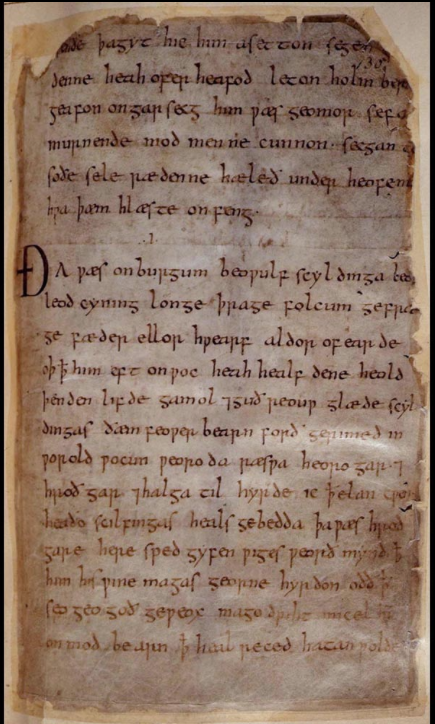
One outcome of the upcoming “Brexit” vote, we’re told, might free the UK to pursue its own unfettered destiny, or might plunge it into isolationist decline. The economic issues are beyond my ken, but as a reader and student of English literature, I’ve always been struck by the fact that the oldest poem in English, Beowulf, shows us an already internationalized Britain absorbing all sorts of European influences. From the Germanic roots of the poem’s Anglo-Saxon language to the Scandinavian roots of its narrative, the ancient epic reflects a Britain tied to the continent. With pagan, native traditions mingled with later Christian echoes, and local legends with those of the Danes and Swedes, Beowulf preserves many of the island nation’s polyglot, multi-national origins.
Irish poet Seamus Heaney—whose work engaged with the ironies and complications of tribalism and nationalism—had a deep respect for Beowulf; in the introduction to his translation of the poem, Heaney describes it as a tale “as elaborate as the beautiful contrivances of its language. Its narrative elements may belong to a previous age but as a work of art it lives in its own continuous present, equal to our knowledge of reality in the present time.” Though we’ve come to think of it as an essential work of English literature, Beowulf might have disappeared into the mists of history had not the only manuscript of the poem survived “more or less by chance.” The “unique copy,” writes Heaney, “(now in the British Library) barely survived a fire in the eighteenth century and was then transcribed and titled, retranscribed and edited, translated and adapted, interpreted and taught, until it has become an acknowledged classic.”
Now, the British Library’s digitization of that sole manuscript allows us to peel back the layers of canonization and see how the poem first entered a literary tradition. Originally “passed down orally over many generations, and modified by each successive bard,” writes the British Library, Beowulf took this fixed form when “the existing copy was made at an unknown location in Anglo-Saxon England.” Not only is the location unknown, but the date as well: “its age has to be calculated by analyzing the scribes’ handwriting. Some scholars have suggested that the manuscript was made at the end of the 10th century, others in the early decades of the 11th, perhaps as late as the reign of King Cnut, who ruled England from 1016 until 1035.”
These scholarly debates may not interest the average reader much. The poem survived long enough to be written down, then became known as great literature these many centuries later, because the rich poetic language and the compelling story it tells captivate us still. Nonetheless, though we may all know the general outlines of its hero’s contest with the monster Grendel and his mother, many of the cultural concepts from the world of Beowulf strike modern readers as totally alien. Likewise the poem’s language, Old English, resembles no form of English we’ve encountered before. Scholars like J.R.R. Tolkien and poets like Heaney have done much to shape our appreciation for the ancient work, and we might say that without their interventions, it would not live, as Heaney writes, “in its own continuous present” but in a distant, unrecognizable past.
You can hear Heaney read his translation of the poem on Youtube. Read Tolkien’s famous essay on the poem here, and hear it read in its original language at our previous post. Learn more about the single manuscript that preserved the epic poem for posterity at the British Library’s website.
Find Beowulf listed in our collection, 800 Free eBooks for iPad, Kindle & Other Devices.
Related Content:
Seamus Heaney Reads His Exquisite Translation of Beowulf and His Memorable 1995 Nobel Lecture
Hear Beowulf Read In the Original Old English: How Many Words Do You Recognize?
Josh Jones is a writer and musician based in Durham, NC. Follow him at @jdmagness
Read More...1,300 Photos of Famous Modern American Homes Now Online, Courtesy of USC

“For average prospective house owners the choice between the hysterics who hope to solve housing problems by magic alone and those who attempt to ride into the future piggy back on the status quo, the situation is confusing and discouraging.” Those words, as much as they could describe the situation today, actually came printed in Arts & Architecture magazine’s issue of June 1945.
“Therefore it occurs to us that the only way in which any of us can find out anything will be to pose specific problems in a specific program on a put-up-or-shut-up basis.” What the magazine, at the behest of its publisher John Entenza, put up was the Case Study Houses, which defined the ideal of the midcentury modern American home.

More specifically, they defined the ideal of the midcentury modern southern Californian home. Los Angeles provided a promising environment for many of the formidable European minds who came to America around the Second World War, including writers like Aldous Huxley, composers like Arnold Schoenberg, and philosophers like Theodor Adorno. Architects, such as the earlier arrival Richard Neutra, especially thrived in the young city’s vast space and under its bright sun, giving shape to a new kind of twentieth-century house, one influenced by the rigorously clean aesthetics of the German Bauhaus movement but adapted to a much friendlier climate, both in terms of the weather and the freedom from strict tradition.

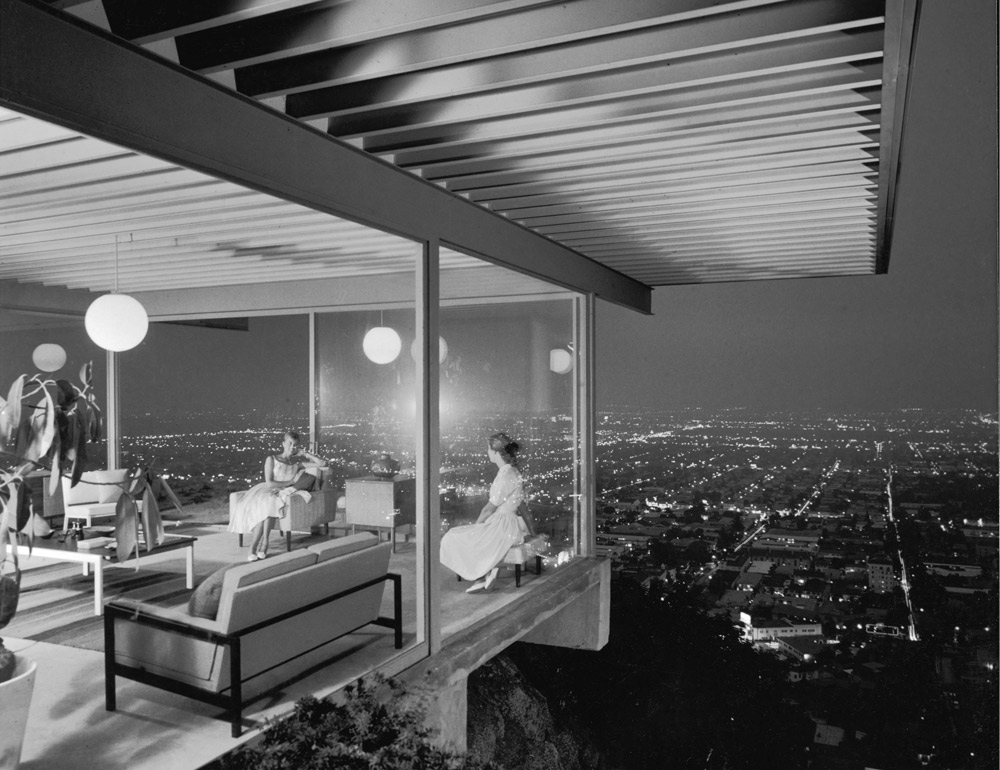
Even if you don’t know architecture, you know the Case Study houses from their countless appearances in movies, television, and print over the past seventy years. Sooner or later, everyone sees an image of Neutra’s Stuart Bailey House, Charles and Ray Eames’ Eames House, or Pierre Koenig’s Stahl House. The decades have turned these and other houses from the peak of midcentury modernism into priceless architectural treasures — or at least extremely high-priced architectural treasures. Some open themselves to tours now and again, but very few of us will ever have a chance to experience these houses as not quasi-museums but actual livable spaces.
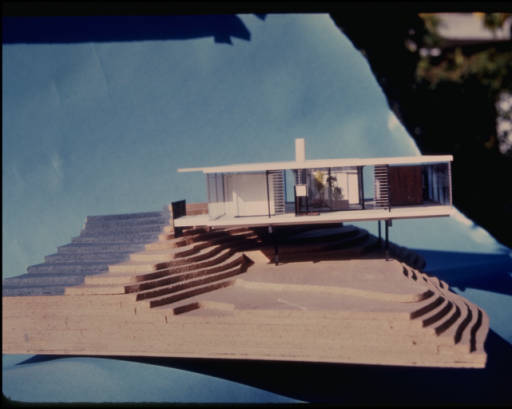
Now we have the next best thing in the form of the University of Southern California’s Architectural Teaching Slide Collection, which collects about 1300 rarely seen photographs of midcentury modern houses shot all over the western United States from the 1940s to the 1960s by Koenig himself, along with his colleague Fritz Block, who also happened to own a color slide company. “Instead of the polished tableaus you might find in the pages of Architectural Digest,” writes Hyperallergic’s Carey Dunne, “these spontaneous snapshots capture quirky and more intimate views.” Koenig and Block captured these houses “with an architect’s geometrically minded and detail-oriented eye, never presenting them as mere real estate.” The archive also offers images of models, blueprints, and other such technical materials.
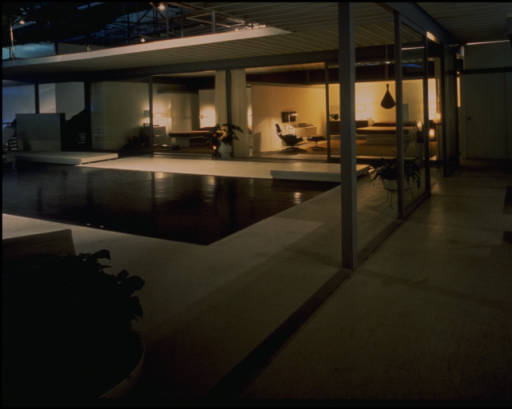
Arts & Architecture meant to commission ideas for the everyman’s house of the future, “subject to the usual (and sometimes regrettable) building restrictions,” “capable of duplication,” and “in no sense… an individual ‘performance.’ ” Yet American midcentury modern houses, from the Case Study Program or elsewhere, all came out as individual performances, but also the first works of architecture many of us get to know as works of art. And the work of architectural photographers like Julius Shulman, especially his iconic shot of the Stahl House high above the illuminated grid of Los Angeles, has done much to instill in viewers a reverence suited to art. A collection of non-standard views like these, though, reminds us that even the most visionary house is a real place. Enter the USC archive here.
All Images: via USC Digital Library
via Hyperallergic/Fast Co Design
Related Content:
A Quick Animated Tour of Iconic Modernist Houses
Bauhaus, Modernism & Other Design Movements Explained by New Animated Video Series
Gehry’s Vision for Architecture
Based in Seoul, Colin Marshall writes and broadcasts on cities, language, and style. He’s at work on a book about Los Angeles, A Los Angeles Primer, the video series The City in Cinema, the crowdfunded journalism project Where Is the City of the Future?, and the Los Angeles Review of Books’ Korea Blog. Follow him on Twitter at @colinmarshall or on Facebook.
Read More...Download 336 Issues of the Avant-Garde Magazine The Storm (1910–1932), Featuring the Work of Kandinsky, Klee, Moholy-Nagy & More
It’s easy to think of Expressionism—the art form that flourished in Germany during the early decades of the 20th century—as a kind of inchoate release of emotion onto the canvas. The name itself suggests the common idea of art as a means of “expressing oneself.” Often intensely childlike, such as the work of Paul Klee, or completely abstract, such as Wassily Kandinsky’s many geometric compositions, expressionist styles influenced artists throughout the century whom we tend to associate with emotion over reason, passion over restraint: Willem de Kooning and Jackson Pollack, Jean-Michel Basquiat and Francis Bacon.
But let us return to the movement’s roots and we see from its very beginnings that Expressionism was highly theoretical in its emotionalism. Its high priest, Kandinsky, pioneered non-representational painting, and explained his method in coolly analytical terms in his treatise Concerning the Spiritual in Art. Expressionism—not only in painting, but in drama, sculpture, dance, film, and literature—early on communicated its ideas in a weekly magazine, Der Sturm (The Storm), founded in 1910 by artist and critic Herwarth Walden and running weekly until 1914, then quarterly from 1924 to 1932. In that time, the publication amassed quite a few issues, and you can read (in German) and download all 336 of them here.
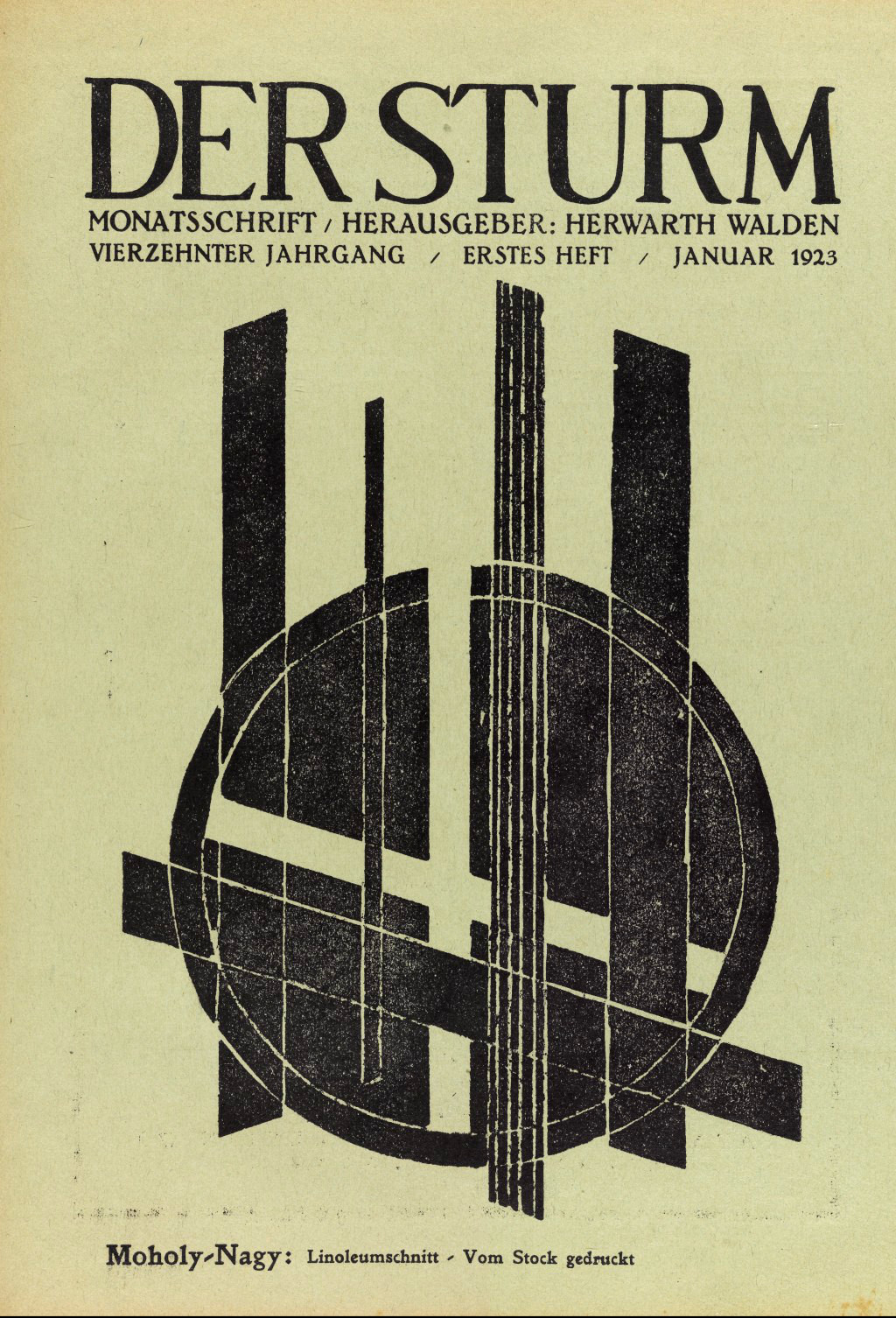
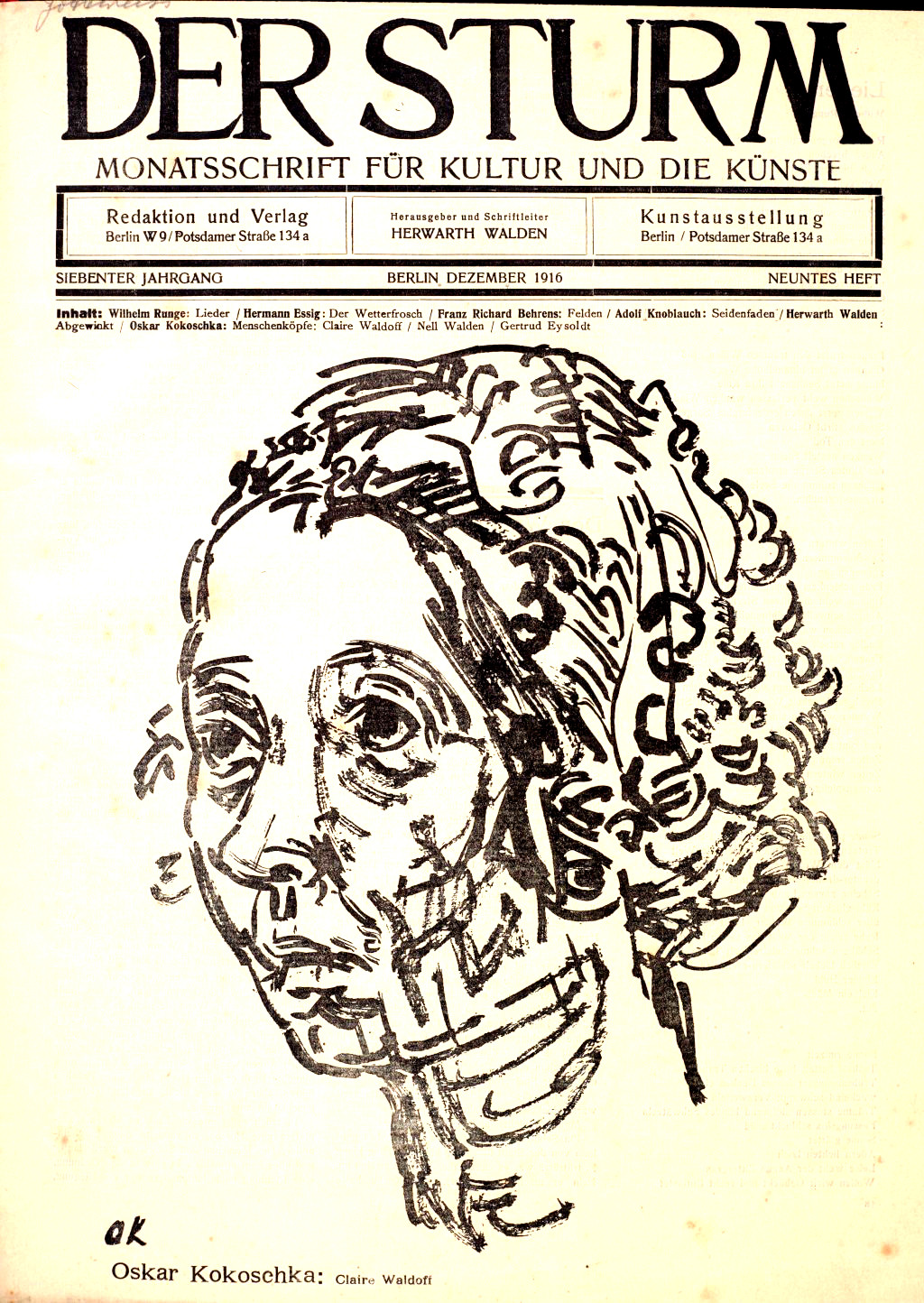
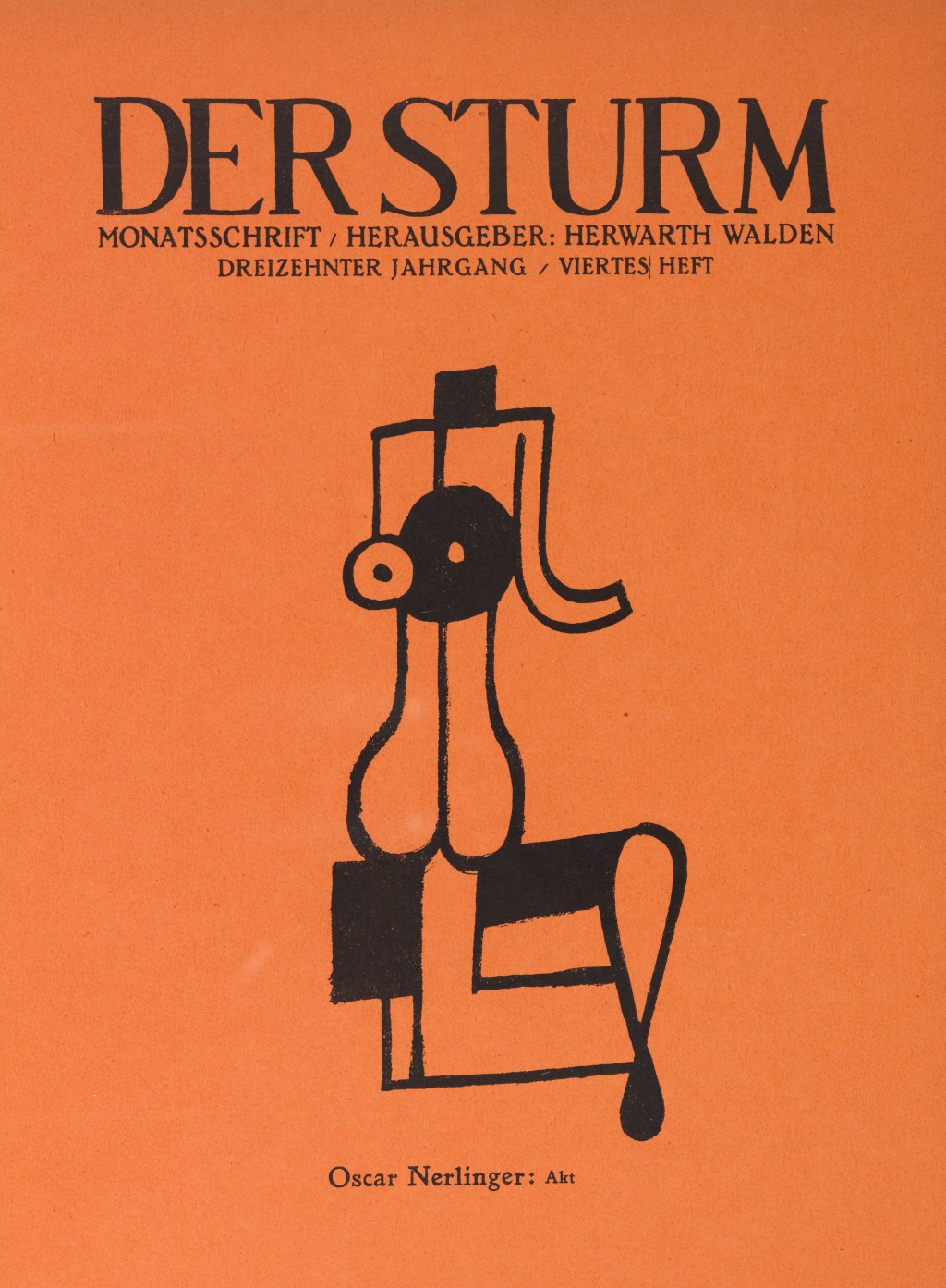
You can also see some of the inspired cover designs Der Sturm used over its decades of publication. “The magazine became well known for the inclusion of woodcuts and linocuts,” writes the Guggenheim, “including works by Guggenheim collection artists Marc Chagall,Vasily Kandinsky, Paul Klee, Oscar Kokoschka, Franz Marc, László Moholy-Nagy, and others.” The museum site features several of Der Sturm’s graphic designs by Moholy-Nagy, such as the cover above, and Monoskop adds the covers further up and at the top of the post, by Oscar Nerlinger and Oskar Kokoschka, respectively. Monoskop also provides a good deal of historical context for the magazine and the gallery it fostered, Galerie Der Sturm, “started by Walden to celebrate its 100th edition, in 1912.”
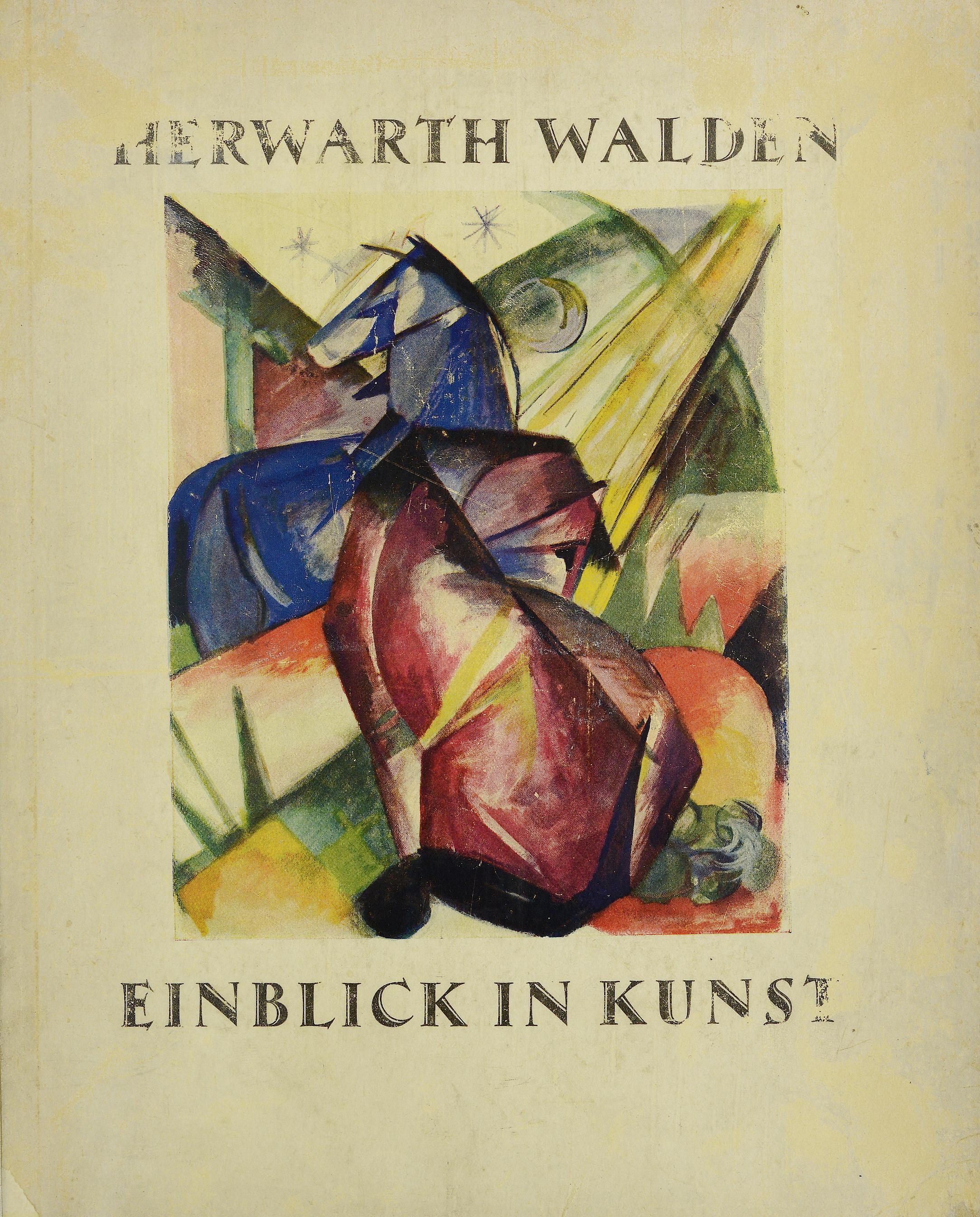
The gallery’s many exhibitions demonstrate how much Expressionism overlapped with a host of other modernist –isms of the period. It started “with an exhibition of Fauves and Der Blaue Reiter [a group including Kandinsky and Paul Klee that formed the core of first Expressionist painters], followed by the introduction in Germany of the Italian Futurists, Cubists and Orphists.” Edvard Munch exhibited there, as did Georges Braque and Pablo Picasso. Walden expanded the gallery’s activities after WWI to include lectures and a theater, and he began publishing books and portfolios by Expressionist artists. Just above see the cover of Walden’s own book Einblick in Kunst, and see several more book covers and a bibliography at Monoskop.
A product of the Weimar Republic’s high culture, the German Expressionist movement largely came to an end, along with Der Sturm and its associated work, as the Nazis came to power. But the current of Expressionism moved powerfully through the century, inspiring among others the mid-century American Abstract Expressionists, who often broke away from detached, theoretical understandings of art and engaged in direct and sometimes brutal ways with paint and canvas. But one can’t imagine these later painters taking the subjective license they did without the groundwork laid by the tireless Kandinsky and his contemporaries or Walden’s expansive Der Sturm movement.
You can peruse the entire collection of Der Sturm here.
via Monoskop
Related Content:
Extensive Archive of Avant-Garde & Modernist Magazines (1890–1939) Now Available Online
Josh Jones is a writer and musician based in Durham, NC. Follow him at @jdmagness
Read More...Noam Chomsky on Whether the Rise of Trump Resembles the Rise of Fascism in 1930s Germany
No matter where you are in the world, you must by now be well-acquainted with the political chaos in the United States. No one can confidently predict what’s going to happen next. A certain privileged few still find the situation amusing; a certain few have found a tremendous opportunity to increase profit and standing, embracing the madness by embracing Donald Trump, the celebrity real estate mogul some on the right have dubbed their “Great White Hope.”
A column last week by the far-right nationalist Pat Buchanan— whom Trump once denounced as a “Hitler-Lover”—ran with the idea, expressing the paranoiac fantasies of thousands of white supremacists who have rallied behind the Republican nominee. Rhetoric like Buchanan’s and David Duke’s—another supporter Trump once disavowed (then famously didn’t, then eventually did again)—has demolished the “Overton window,” we hear. America’s racist table talk is now a major party platform: the proverbial crank uncle who immiserates Christmas dinner with wild conspiracy theories now airs grievances 24 hours a day on cable news, unbound by “political correctness” or standards of accuracy of any kind.
Granted, a majority of the electorate is hardly thrilled by the likely alternative to Trump, but as even conservative author P.J. O’Rourke quipped in his backhanded endorsement of Hillary Clinton, “She’s wrong about absolutely everything, but she’s wrong within normal parameters.” There’s nothing “normal” about Donald Trump’s candidacy. Its freakishness enthralls his adoring fans. But the millions of Americans who aren’t among them have legitimate cause for alarm.
Comparisons to Hitler and Mussolini may have worn out their usefulness in elections past—frivolous as they often were—but the Trump campaign’s overt demagoguery, vicious misogyny, racism, violent speech, actual violence, complete disregard for truth, threats to free speech, and simplistic, macho cult of personality have prompted plausible shouts of fascism from every corner.
Former Republican Massachusetts governor (and recently rejected Libertarian vice-presidential candidate) William Weld equated Trump’s immigration plan with Kristallnacht, an analogy, writes Peter Baker in The New York Times that is “not a lonely one.” (“There is nobody less of a fascist than Donald Trump,” the candidate retorted.) Likewise, conservative columnist Robert Kagan recently penned a Times op-ed denouncing Trump as a fascist, a position, he writes, without a “coherent ideology” except its nationalist attacks on racial and religious others and belief in “the strongman, the leader (Il Duce, Der Führer), in whom could be entrusted the fate of the nation.”
On the liberal left, figures like former labor secretary Robert Reich and actor and Democratic Party organizer George Clooney have made the charge, as well as columnists in the New Republic and elsewhere. In the video above from Democracy Now, Mexican president Enrique Pena Nieto compares Trump to Hitler, and Columbia University’s Robert Paxton—who has written articles and a book on his theory of fascism—discusses the possibility of Trump-as-fascist.
At the top of the post, Noam Chomsky (MIT professor and author of the new book, Who Rules the World?) weighs in, with his analysis of the “generalized rage” of “mainly working class, middle class, and poor white males” and their “traditional families” coalescing around Trump. (Anyone who objects to Chomsky’s characterization of Trump as a circus clown should take a moment to revisit his reality show career and performance in the WWE ring, not to mention those debates.)
In Chomsky’s assessment, we need only look to U.S. history to find the kind of “strong” racialized nativism Trump espouses, from Benjamin Franklin’s aversion to German and Swedish immigrants, who were “not pure Anglo-Saxons like us,” to later parties like the 19th century Know Nothings. Perhaps, as John Cassidy wrote in The New Yorker last year, that’s what Trump represents.
The history of nativism, Chomsky goes on, “continues into the 20th century. There’s a myth of Anglo-Saxonism. We’re pure Anglo-Saxons. (If you look around, it’s a joke.)” Now, there’s “the picture of us being overwhelmed by Muslims and Mexicans and the Chinese. Somehow, they’ve taken our country away.” This notion (which people like David Duke call “white genocide”) is
Based on something objective. The white population is pretty soon going to become a minority (whatever ‘white’ means)…. The response to this is generalized anger at everything. So every time Trump makes a nasty comment about whoever, his popularity goes up. Because it’s based on hate, you know. Hate and fear. And it’s unfortunately kind of reminiscent of something unpleasant: Germany, not many years ago.
Chomsky discusses Germany’s plummet from its cultural and political heights in the 20s—when Hitler received 3% of the vote—to the decay of the 30s, when the Nazis rose to power. Though the situations are “not identical,” they are similar enough, he says, to warrant concern. Likewise, the economic destruction of Greece, says Chomsky may (and indeed has) lead to the rise of a fascist party, a phenomenon we’ve witnessed all over Europe.
The fall of the Weimar Republic has a complicated history whose general outlines most of us know well enough. Germany’s defeat in WWI and the punitive, post-Treaty of Versailles’ reparations that contributed to hyperinflation and total economic collapse do not parallel the current state of affairs in the U.S.—anxious and agitated as the country may be. But Hitler’s rise to power is instructive. Initially dismissed as a clown, he struggled for political power for many years, and his party barely managed to hold a majority in the Reichstag in the early 30s. The historical question of why few—in Germany or in the U.S.—took Hitler seriously as a threat has become a commonplace. (Partly answered by the amount of tacit support both there and here.)
Hitler’s struggle for dominance truly catalyzed when he allied with the country’s conservatives (and Christians), who made him Chancellor. Thus began his program of Gleichschaltung—“synchronization” or “bringing into line”—during which all former opposition was made to fully endorse his plans. In similar fashion, Trump has fought for political relevance on the right for years, using xenophobic bigotry as his primary weapon. It worked. Now that he has taken over the Republican Party—and the religious right—we’ve seen nearly all of Trump’s opponents on the right, from politicians to media figures, completely fold under and make fawning shows of support. Even some Bernie Sanders supporters have found ways to justify supporting Trump.
But Trump is “not Hitler,” as his wife Melania claimed in his defense after his supporters swarmed journalist Julia Ioffe with grotesque anti-Semitic attacks. Although he has an obvious affinity for white nationalists and neo-Nazis (see his activity on social media and elsewhere) and perhaps a fondness for Hitler’s speeches, the comparison has serious drawbacks. Trump is something else—something perhaps more farcical and bumbling, but maybe just as dangerous given the forces he has unified and elevated domestically, and the dangers of such an unstable, petty, vindictive person taking over the world’s largest military, and nuclear arsenal.
Perhaps he’s just a tasteless, cynical con-man entertainer using hate as another means of self-advancement. He has non-white and Jewish supporters!, his voters claim. He holds “corrupt and liberal New York values”! say conservative detractors. These objections ring hollow given all Trump has said and done in recent years. His campaign, and the response it has drawn, looks enough like those of previous far-right racist leaders that calling Trump a fascist doesn’t seem far-fetched at all. That should seriously alarm any honest person who isn’t a far-right xenophobic nationalist.
Related Content:
Noam Chomsky Defines What It Means to Be a Truly Educated Person
Noam Chomsky Slams Žižek and Lacan: Empty ‘Posturing’
How to Spot Bullshit: A Primer by Princeton Philosopher Harry Frankfurt
Rare 1940 Audio: Thomas Mann Explains the Nazis’ Ulterior Motive for Spreading Anti-Semitism
Josh Jones is a writer and musician based in Durham, NC. Follow him at @jdmagness
Read More...Daily Meditation Boosts & Revitalizes the Brain and Reduces Stress, Harvard Study Finds
I don’t mean to sound dramatic, but meditation may have saved my life. During a particularly challenging time of overwork, underpay, and serious family distress, I found myself at dangerous, near-stroke levels of high cholesterol and blood pressure, and the beginnings of near-crippling early-onset arthritis. My doctors were alarmed. Something had to change. Unable to make stressful outer circumstances disappear, I had to find constructive ways to manage my responses to them instead. Yoga and meditation made the difference.
I’m hardly alone in this journey. The leading cause of death in the U.S. is heart disease, followed closely by stroke, diabetes, and depression leading to suicide—all conditions exacerbated by high levels of stress and anxiety. In my own case, a changed diet and daily exercise played a crucial role in my physical recovery, but those disciplines would not even have been possible to adopt were it not for the calming, centering effects of a daily meditation practice.
Anecdotes, however, are not evidence. We are bombarded with claims about the miracle magic of “mindfulness,” a word that comes from Buddhism and describes a kind of meditation that focuses on the breath and body sensations as anchors for present-moment awareness. Some form of “mindfulness based stress reduction” has entered nearly every kind of therapy, rehabilitation, corporate training, and pain management, and the word has been a marketing totem for at least a solid decade now. No one ever needs to mention the B‑word in all this meditation talk. As one meditation teacher tells his beginner students, “Buddhism cannot exist without mindfulness, but mindfulness can exist perfectly well without Buddhism.”
So, no need to believe in reincarnation, renunciation, or higher states of consciousness, fine. But does meditation really change your brain? Yes. Academic researchers have conducted dozens of studies on how the practice works, and have nearly all concluded that it does. “There’s more than an article a day on the subject in peer-reviewed journals,” says University of Toronto psychiatrist Steven Selchen, “The research is vast now.” One research team at Harvard, led by Harvard Medical School psychology instructor Sara Lazar, published a study in 2011 that shows how mindfulness meditation results in physical changes to the brain.
The paper details the results of MRI scans from 16 subjects “before and after they took part in the eight-week Mindfulness-Based Stress Reduction (MBSR) Program at the University of Massachusetts Center for Mindfulness,” reports the Harvard Gazette. Each of the participants spent “an average of 27 minutes each day practicing mindfulness exercises.” After the program, they reported significant stress reduction on a questionnaire, and analysis of their MRIs “found increased gray-matter density in the hippocampus, known to be important for learning and memory, and in structures associated with self-awareness, compassion, and introspection.”
The Harvard Business Review points to a another survey study in which scientists from the University of British Columbia and the Chemnitz University of Technology “were able to pool data from more than 20 studies to determine which areas of the brain are consistently affected. They identified at least eight different regions.” Highlighting two areas “of particular concern to business professionals,” the HBR describes changes to the anterior cingulate cortex (ACC), an area of the frontal lobe associated with self-regulation, learning, and decision-making. The ACC “may be particularly important in the face of uncertain and fast-changing conditions.” Like Lazar’s Harvard study, the researchers also identified “increased amounts of gray matter” in the hippocampus, an area highly subject to damage from chronic stress.
These studies and many others bring mindfulness together with another current psychological buzzword that has proven to be true: neuroplasticity, the idea that we can change our brains for the better—that we are not “hardwired” to repeat patterns of behavior despite our best efforts. In the TEDx Cambridge talk at the top of the post, Lazar explains her results, and connects them with her own experiences with meditation. She is, you’ll see right away, a skeptic, not inclined to accept medical claims proffered by yoga and meditation teachers. But she found that those practices worked in her own life, and also had “scientifically validated benefits” in reducing stress, depression, anxiety, and physical pain. In other words, they work.
None of the research invalidates the Buddhist and Hindu traditions from which yoga and meditation come, but it does show that one needn’t adopt any particular belief system in order to reap the health benefits of the practices. For some secular introductions to meditation, you may wish to try UCLA’s free guided meditation sessions or check out the Meditation 101 animated beginner’s guide above. If you’re not too put off by the occasional Buddhist reference, I would also highly recommend the Insight Meditation Center’s free six-part introduction to mindfulness meditation. Chronic stress is literally killing us. We have it in our power to change the way we respond to circumstances, change the physical structure of our brains, and become happier and healthier as a result.
Related Content:
Free Guided Meditations From UCLA: Boost Your Awareness & Ease Your Stress
Meditation 101: A Short, Animated Beginner’s Guide
David Lynch Explains How Meditation Enhances Our Creativity
Josh Jones is a writer and musician based in Durham, NC. Follow him at @jdmagness
Read More...Support Us
We're hoping to rely on loyal readers, rather than erratic ads. Please click the Donate button and support Open Culture. You can use Paypal, Venmo, Patreon, even Crypto! We thank you!

About Us

Open Culture scours the web for the best educational media. We find the free courses and audio books you need, the language lessons & educational videos you want, and plenty of enlightenment in between.
Advertise With Us
FREE UPDATES!
GET OUR DAILY EMAIL
Get the best cultural and educational resources on the web curated for you in a daily email. We never spam. Unsubscribe at any time.
FOLLOW ON SOCIAL MEDIA
Open Culture editor Dan Colman scours the web for the best educational media. He finds the free courses and audio books you need, the language lessons & movies you want, and plenty of enlightenment in between.
Advertise With Us