10 Digital Editions of Surrealist Journals from Argentina, Chile & Spain (1928–67)

Fans of magical realism know that Latin American writers seem to possess a unique mastery of the tradition, and anyone who thinks of surrealism in visual art will soon think of Salvador Dalí, who began and ended his distinctive career in his native Spain. Why have Spanish-speaking cultures proven so conducive to the kinds of creativity that bend reality just enough to make a deep and lasting impact on their audience? Those searching for answers would do well to look through the Autonomous University of Madrid’s digital trove of Spanish, Chilean, and Argentine surrealist journals from 1928–76.
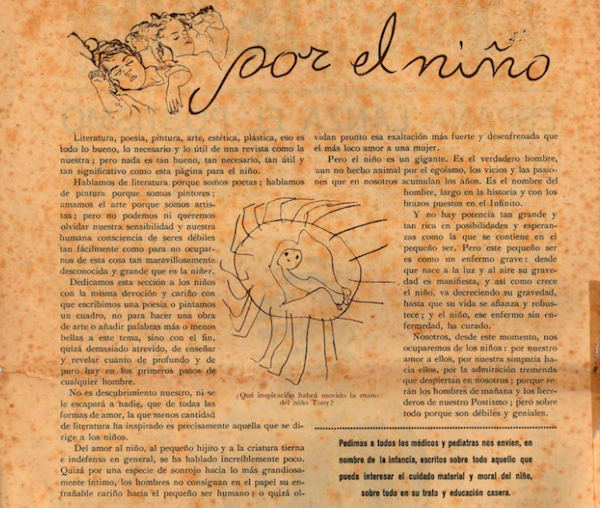
They all appear as part of an investigative project whose name translates to “Toward a Characterization of Hispanic Surrealism.” The archive includes, from Argentina:
- Qué (What),
- Ciclo (Cycle),
- Cero (Zero) and
- A Partir de Cero (From Zero On).
From Chile:
- Mandrágora (Mandrake) and
- Leit Motiv;.
And from Spain:
- the Boletín Internacional del Surrealismo (International Bulletin of Surrealism),
- La Cerbatana (The Blowpipe),
- Postismo, and
- the surrealism-dedicated issues of Gaceta de Arte (Art Gazette)
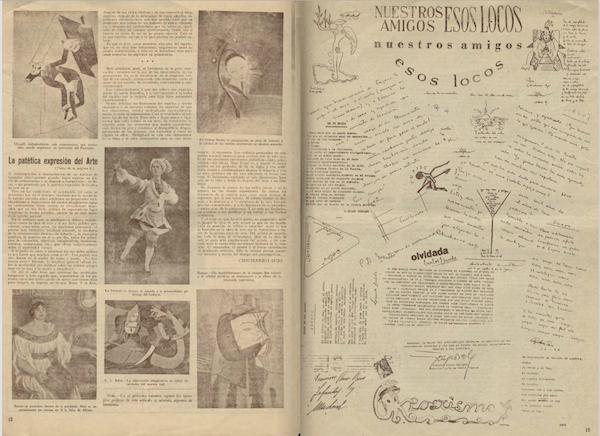
When you click on one of the magazines in the archive, the site will take you to a page with more information describing the magazine as well as placing it in the proper historical and cultural context of surrealism’s history. (Non-Spanish-speakers can get some translation if they view the page with Google Chrome.) From there, you can click on an individual issue to read it.
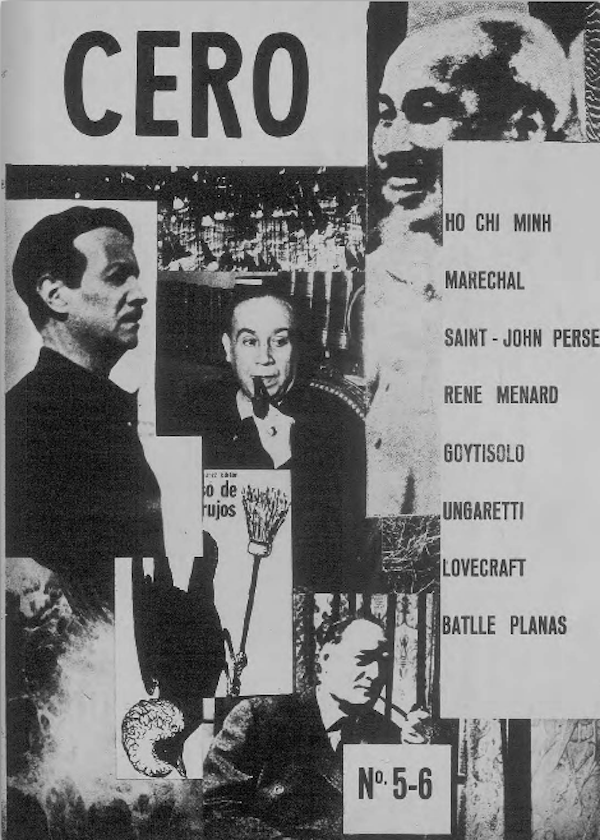
As you flip through these records of an artistically fascinating time in a series of places well suited to it, you’ll get a sense of how much the discourse varied even just within the realm of Spanish-speaking surrealists: some have a more playful tone while others have a more serious one (though mixing the two did become something of a surrealist specialty); some look out to the rest of the world while others look inward; and some come filled with striking illustrations while others stick to the analysis of relevant ideas through text — and lots of it.
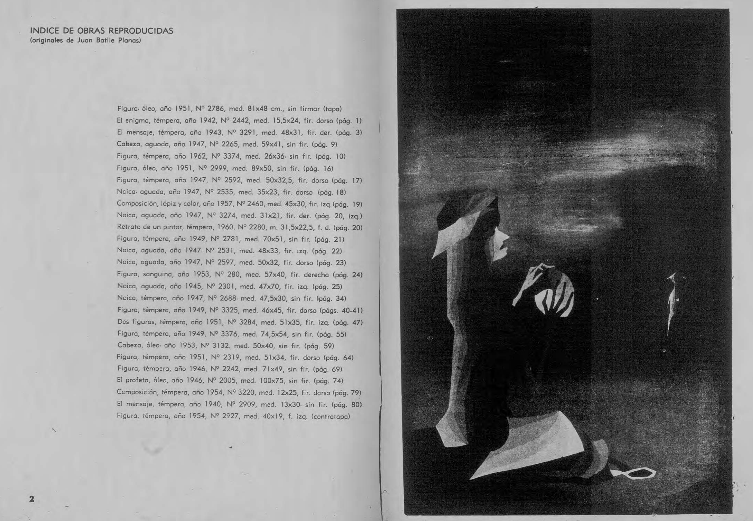
Even though the most recent of these publications came off the presses nearly half a century ago, any visitor to Spain, Argentine, or Chile, as well as other countries in the Hispanophone world, will find they still have a certain surrealistic sensibility to them. Long may they retain it.
via Monoskop, an always interesting resource that you can follow on Twitter.
Related Content:
Extensive Archive of Avant-Garde & Modernist Magazines (1890–1939) Now Available Online
Restored Version of Un Chien Andalou: Luis Buñuel & Salvador Dalí’s Surreal Film (1929)
David Lynch Presents the History of Surrealist Film (1987)
Salvador Dalí’s Avant-Garde Christmas Cards
Based in Seoul, Colin Marshall writes and broadcasts on cities, language, and style. He’s at work on a book about Los Angeles, A Los Angeles Primer, the video series The City in Cinema, the crowdfunded journalism project Where Is the City of the Future?, and the Los Angeles Review of Books’ Korea Blog. Follow him on Twitter at @colinmarshall or on Facebook.
Read More...Can You Pass This Test Originally Given to 8th Graders Living in Kentucky in 1912?

Can you spell “conceive”?
Of course you can! All it takes is a device with a built-in spelling app, an innovation of which no eighth grader in the far western reaches of bluegrass area Kentucky could have conceived back in 1912.
They were, however, expected to be able to name the waters though which an English vessel would pass en route to Manila via the Suez Canal.
Can you?
While we’re at it, how much do you really know about the human liver? Enough to locate it, identify its secretions, and discourse on its size relative to other bodily glands?
If you answered yes, congratulations. There’s a good chance you’d be promoted to high school back in 1912. Not bad for a kid attending a one-room school in rural Bullit County.
And now for some extra credit, name the last battles of the Civil War, the War of 1812, and the French and Indian War. Commanding officers, too…
That’s the sort of multipart question that awaited the eighth graders converging on the Bullit County courthouse for 1912’s common exam, above. The very same courthouse in which the modern day Bullitt County History Museum is located. A civic-minded individual donated a copy of the test to this institution, and the staff put it online, thinking it might be fun for latter-day specimens like you and me to see how we measure up.
So—just for fun—try typing the phrase “commanding officer last battle french & indian war” into your search engine of choice. Forget instant gratification. Embrace the anxiety!
Common wisdom holds that standardized tests are a lot harder than they used to be. But looking at the sort of stuff your average eighth grader had to regurgitate two years prior to the start of WW1, I’m not so sure…
Thank god the Internet was there to define “kalsomining” for me. Even with the aid of a calculator, math is not my strong suit. That said, I’m usually good enough with words to get the narrative gist of any story problem.
Usually.
I confess, I was so demoralized by my ignorance, I couldn’t have dreamed of attempting to figure out how much it would cost to “kalsomine” a 20 x 16 x 9 foot room, especially with a door and window involved.
Fortunately, the Bullit County Genealogical Society has seen fit to provide an online answer sheet, a digital luxury that would have gobsmacked their forebears.
SPOILER: $8.01. That’s the amount it would’ve cost to kalsomine your room at 1912 prices. (A steal, considering that a quart of White Wash Pickling Water Based Stain will run you $12.37 a quart at a nationally known hardware superstore today.)
Go ahead, take that test.
If you quail at the prospect of faring poorly against a rural 1912 eighth grader, just imagine how well he or she would do, teleported to 2016, and forced to contend with such mysteries as cyber bullying, gender politics, and offensive eggplant emojis…
via The Paris Review.
Related Content:
Take the 146-Question Knowledge Test Thomas Edison Gave to Prospective Employees (1921)
Take The Near Impossible Literacy Test Louisiana Used to Suppress the Black Vote (1964)
Ayun Halliday is an author, illustrator, and Chief Primatologist of the East Village Inky zine. She lives in fear that her youngest child will pen a memoir titled I Was a Homeschooled 8th Grader and Other Chillling True Life Tales. Follow her @AyunHalliday
Read More...Hear the Greatest Hits of Isao Tomita (RIP), the Father of Japanese Electronic Music
During his childhood in the Japan of the 1930s, Isao Tomita would have barely had the chance to hear Western music. But when the Second World War came to an end, the introduction of local U.S. Army broadcasts must have felt like the opening of a sonic floodgate: “I thought I was listening to music from outer space,” remembered the man that child grew up to become a respected composer as well as a pioneer of electronic music known for his cutting-edge, intergalactically-minded interpretations of the work of such Western predecessors as Claude Debussy, Igor Stravinsky, and Gustav Holst.
That telling quote comes from Tomita’s New York Times obituary of this past Wednesday, which describes some of the composer’s struggles to not just master but press into a new kind of artistic service the practically experimental analog synthesizers with which he made his best-known albums, like 1974’s Snowflakes Are Dancing and The Planets. Just getting his first Moog synthesizer past Japanese customs proved a struggle (“I told them that it was an instrument, and they didn’t believe me”), let alone figuring out how to use the new device “to even generate something that’s not just noise.”
Tomita had little in the way of precedent besides Wendy Carlos’ Switched-On Bach, which had come out in 1968 (and whose cover Tomita had held up before those customs inspectors, trying in vain to provide evidence of his strange imported machine’s nature). He followed suit in 1972 with his own first album Electric Samurai: Switched on Rock, on which he electronically covered songs like “Let It Be,” “Jail House Rock,” and “Bridge Over Troubled Water.” Then came his Grammy-nominated bestselling Debussy tribute Snowflakes Are Dancing, which showed the listening world what he could do: specifically, reinterpreting the classical canon with sounds few had ever heard before.
You can discover some of his music by listening to albums available on Spotify, one Tomita’s 1978 album Kosmos and the other a greatest-hits collection. (Find both above. If you don’t have Spotify’s free software, you can download it here.) Or peruse an even wider-ranging Youtube playlist. We have, of course, now had around half a century to get used to electronic music, and the gear has made enormous evolutionary leaps since Tomita first sat down amid his unwieldy “thicket” of filters, oscillators, generators, amplifiers, controllers, modulators, recorders, mixers, echo units, and phasers. But his music still retains its fascination, especially now in our digital world where its analog sounds seem to come from the past, the future, and outer space all at once.
Related Content:
How the Moog Synthesizer Changed the Sound of Music
Hear Seven Hours of Women Making Electronic Music (1938- 2014)
The History of Electronic Music in 476 Tracks (1937–2001)
Based in Seoul, Colin Marshall writes and broadcasts on cities, language, and style. He’s at work on a book about Los Angeles, A Los Angeles Primer, the video series The City in Cinema, the crowdfunded journalism project Where Is the City of the Future?, and the Los Angeles Review of Books’ Korea Blog. Follow him on Twitter at @colinmarshall or on Facebook.
Read More...Monty Python’s Philosopher’s Football Match: The Epic Showdown Between the Greeks & Germans (1972)
Last year, we witnessed a very tense, unpleasant showdown between Germany and Greece as the topmost nation in the European Union drove its most indebted country to make painful, perhaps punishing compromises. In one analysis of this hard-to-watch economic humiliation—for Greece, that is—The Washington Post made use of a much more lighthearted contest between the two countries, one in which Greece emerged the victor after scoring the only goal of the match.
The soccer match, that is, or, if you must, football—played between German and Greek philosophers in 1972 and staged by Monty Python. On one side, Hegel, Leibniz, Kant, Marx, Nietzsche, Wittgenstein, and more (including actual footballer Franz Beckenbauer, a “surprise inclusion”)… on the other, Socrates, Archimedes, Heraclitus, Plato, Democritus, Epictetus, etc…. On the sidelines of this showdown between Western schools of thought, Confucius served as the referee. Even after that single goal, scored after two full halves of meandering, the two teams came into conflict—in heated arguments about the nature of existence….
I won’t continue to bore you by explaining the gags—watch the sketch above. It’s great fun, if by some chance you haven’t seen it, and great fun to watch again if you have.
Filmed at the Grünwalder Stadion in Munich (presumably giving the Germans home field advantage), the sketch, Terry Jones recalled many years later, is about the “clash of opposites.” No, not the two European countries, but the opposites of sports and intellectual exercise. “You can’t think about football too much,” said Jones, “you just have to do it.” This proves challenging for our deep thinkers.
Why football? Because it’s “a team activity,” Jones answered, “which philosophy, as a general rule, isn’t.” Well, mostly. The Pythons weren’t the first to make the “incongruous” connection. Albert Camus played the game, as a goalkeeper, and played it quite well by all accounts. He once wrote, “all I know most surely about morality and obligations, I owe to football.”
The injunction to “just do it” wouldn’t present too much of a challenge for an existentialist, one would think. Philosopher Julian Baggini puts the Pythons firmly in that school of thought, their take on it a “coherent, Anglo-Saxon” one. Indeed, like Camus, the British comedians recognized the absurdity of life, and showed us that “the right response is to laugh at it.” They also showed us that philosophy could be hilarious, and made a classic sketch academics could use to refute charges they’re a dour, humorless lot.
It should come as no surprise that the Python “most interested in the subject” of philosophy and comedy was John Cleese—whom we’ve featured here many times for his talents in combining the two. Cleese, writes Baggini, is “on record as saying that comedy and deep thought can go hand in hand. ‘You and I could talk about the meaning of life, or education, or marriage,’ Cleese once told a journalist, ‘and we could be laughing a lot, and it doesn’t mean that what we’re talking about isn’t serious.’”
Inspired by the Pythons’ serio-comic love of learning, Baggini, and other philosophers like A.C. Grayling and Nigel Warburton, along with comedians, historians, and journalists, decided to restage the Germany-Greek match in 2010. Where the Pythons indirectly boosted intellectual pursuits in the course of mocking them, the participants in this “game”—such as it was—explicitly sought to promote “Reasoning,” the “fourth R” in “Reading, W®iting, and A®ithmetic.”
See them bumble around on the pitch here and generally have a good time making philosophical fools of themselves to the strains of Monty Python’s rowdy anthem “The Philosopher’s Song.”
Related Content:
Monty Python and the Holy Grail Re-Imagined as an Epic, Mainstream Hollywood Film
Josh Jones is a writer and musician based in Durham, NC. Follow him at @jdmagness
Read More...Edward Snowden & Jean-Michel Jarre Record a Techno Protest Song, “Exit”
For his new album, Electronica Volume II: The Heart Of Noise, Jean-Michel Jarre, a pioneer in electronic and ambient music, collaborated on a recording with Edward Snowden, the former CIA computer analyst-turned-whistleblower. Cue up their song, “Exit,” above.
At first glance, it perhaps seems like an unlikely pairing. But if you give Jarre, the son of a French resistance fighter, a chance to explain, it all makes perfect sense. Recently, he told The Guardian:
The whole Electronica project is about the ambiguous relationship we have with technology: on the one side we have the world in our pocket, on on the other, we are spied on constantly. There are tracks about the erotic relationship we have with technology, the way we touch our smartphones more than our partners, about CCTV surveillance, about love in the age of Tindr. It seemed quite appropriate to collaborate not with a musician but someone who literally symbolises this crazy relationship we have with technology.
A lot of what Jarre and Snowden were trying to accomplish with the song–musically, conceptually, ideologically, etc.–gets explained in the video below. Listening to Snowden talk about the meaning of the song’s title (“Exit” means “things have to change,” “it’s time to leave, it’s time to do something else, it’s time to find a better way”), you’ll get the sense that “Exit” is an electronic protest song befitting our digital age. Out with the folk music, in with the techno.
Electronica Volume II: The Heart Of Noise also features songs with the Pet Shop Boys, Gary Numan and the rapper Peaches.
Related Content:
Recalling Albert Camus’ Fashion Advice, Noam Chomsky Pans Glenn Greenwald’s Shiny, Purple Tie
The History of Electronic Music in 476 Tracks (1937–2001)
Hear Seven Hours of Women Making Electronic Music (1938- 2014)
How the Moog Synthesizer Changed the Sound of Music
Read More...Download Sigmund Freud’s Great Works as Free eBooks & Free Audio Books: A Digital Celebration on His 160th Birthday
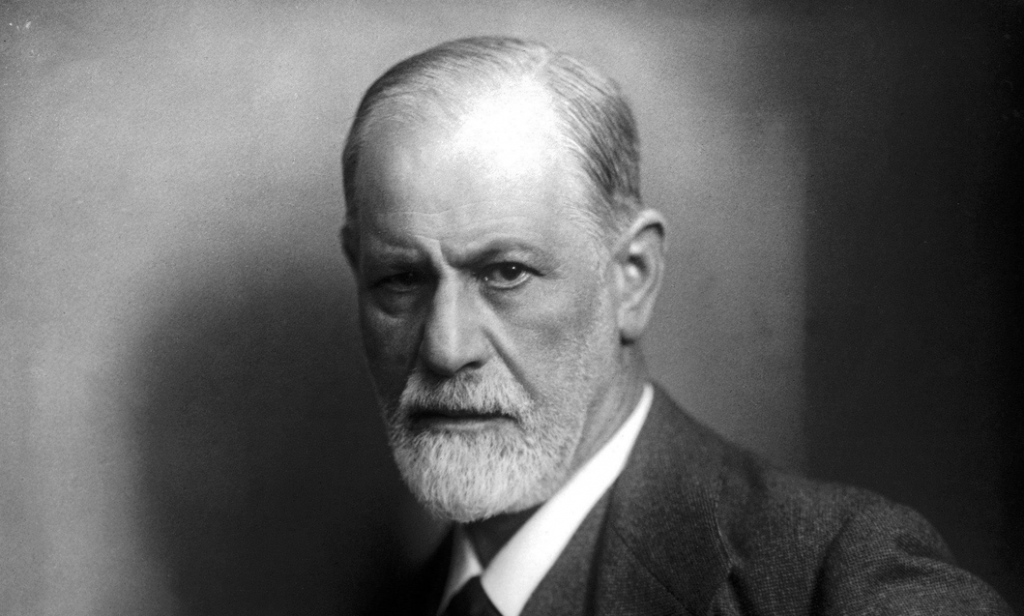
Image by Max Halberstadt via Wikimedia Commons
Anyone with a passing familiarity with the work of Sigmund Freud—which is just about everyone—knows at least a handful of things about his famous psychoanalytic theory: Ego, Super-ego, and Id, sex and death drives, Oedipal complex, “Freudian slip,” “sometimes a cigar is just a cigar”… (a quote that didn’t come from Freud). Most of these terms, except that cigar thing, originate from Freud’s later period—from about 1920 to his death in 1939—perhaps his most productive from a literary standpoint, starting with Beyond the Pleasure Principle, in which he began to develop his well-known structural model of the mind.
During these later years Freud built on ideas from 1913’s Totem and Taboo and fully expanded his psychological analysis into a philosophical and cultural theory in books like The Future of an Illusion, Civilization and its Discontents, and Moses and Monotheism. For those who have primarily encountered Freud in intro to psych classes, these works can seem strange indeed, given the sweeping speculative claims the Viennese doctor makes about religion, war, ancient history, and even prehistory. Though peppered with terminology from psychoanalysis, Freud’s more philosophical works roam far afield of his medical specializations and direct observations.
When and how did Freud’s psychiatry become philosophy, and what possessed him to apply his psychological theories to analyses of broad social and historical dynamics? We see hints of Freud the philosopher throughout his career, but it’s during his middle period—when his tripartite model of the psyche still consisted of the conscious, preconscious, and unconscious—that he began to move more fully from case studies of individual psychosexual development and interpretations of dreams to studies of human development writ large. These books are almost Darwinian expansions of what Freud called “metapsychology”—which included his theories of Oedipal neuroses, narcissism, and sadomasochism.
From 1914 to 1915, after his break with Jung, Freud worked on a series of papers on “metapsychology,” intended, he wrote “to clarify and carry deeper the theoretical assumptions on which a psycho-analytic system could be founded.” Seven of the manuscripts from this period vanished, seemingly lost forever. In 1983, psychoanalyst Ilse Grubich-Simitis discovered one of these essays in an old trunk belonging to a friend and colleague of Freud. Published as A Phylogenetic Fantasy, this fascinating, unfinished work points the way forward for Freud, providing some connective tissue between his “ontogeny,” the development of the individual, and “phylogeny,” the development of the species.
It is here, his translators write in their introduction to this rare work, that Freud “concludes that each individual contains somewhere within himself or herself the history of all mankind; further, that mental illness can usefully be understood as a vestige of responses once necessary and highly adaptive to the exigencies of each era. Accordingly, mental illness can be understood as a set of formerly adaptive responses that have become maladaptive as the climatic and sociological threats to the survival of mankind have changed.”
These basic, yet radical, ideas may be said to form a backdrop against which we might read so much of Freud’s mature work as a means for decoding what seems puzzling, irrational, and downright maddening about human behavior. Freud’s scientific work has long been superseded, and many of the specifics of his psychoanalytic theory deemed unworkable, irrelevant, or even damaging. But there are very good reasons why his work has thrived in literary theory and philosophy. There is even a case to be made the Freud was the first evolutionary psychologist, roughly bringing Darwinian concepts of adaptation to bear on the development of the human psyche from prehistory to modernity.
For all the negative criticism his work has endured, Freud dared to explain us to ourselves, drawing on every resource at his disposal—including our most foundational narratives in mythology and ancient poetry. For that reason, his relevance, writes Jane Ciabattari, as a “theoretical catalyst” in the 21st century remains potent, and his work remains well worth reading and pondering, for any student of human behavior.
Today, on the 160th birthday of the father of psychoanalysis, we bring you a collection of Freud’s major works available free to read online or download as ebooks in the links below. Further down, find a list of Freud audiobooks to download as mp3s or stream.
Whether rooted in clinical study and research, detective-like case studies, philosophical speculations, or poetic flights of fancy, Freud’s writing draws us deeper into strange, obsessive, profound, and disturbing ways of thinking about our uneasy relationships with ourselves, our families, and our unstable social order.
eBooks
- A General Introduction to Psychoanalysis
- Beyond the Pleasure Principle
- Delusion and Dream
- Dream Psychology: Psychoanalysis for Beginners
- Group Psychology and the Analysis of the Ego
- Interpretation of Dreams
- Leonardo da Vinci
- Moses And Monotheism
- Origin and Development of Psychoanalysis
- Psychopathology of Everyday Life
- Reflections on War and Death
- Selected Papers on Hysteria and Other Psychoneuroses
- The History of the Psychoanalytic Movement
- Three Contributions to the Sexual Theory
- Totem and Taboo
- Wit and Its Relation to the Unconscious
Audio Books
- A General Introduction to Psychoanalysis
- Dream Psychology
- Psychopathology of Everyday Life
- Reflections on War and Death
- The Interpretation of Dreams
- Totem and Taboo
Related Contents:
The Famous Letter Where Freud Breaks His Relationship with Jung (1913)
Sigmund Freud Appears in Rare, Surviving Video & Audio Recorded During the 1930s
How a Young Sigmund Freud Researched & Got Addicted to Cocaine, the New “Miracle Drug,” in 1894
Josh Jones is a writer and musician based in Durham, NC. Follow him at @jdmagness
Read More...How Japanese Things Are Made in 309 Videos: Bamboo Tea Whisks, Hina Dolls, Steel Balls & More
The Japanese term kaizen, which just means something like “good change,” has come to signify in global management culture a process of continuous small-scale improvement — an element of the “Japanese business philosophy” so enviously scrutinized during that country’s postwar economic boom. Toyota has done the most to associate themselves with the idea of kaizen-as-continuous-improvement, but it has made its way to countless other businesses, including foreign ones selling completely different products; even the American grocery store Trader Joe’s has worked the word into their internal customer-service lexicon.
But the nature of kaizen comes most clearly into view in the systems of Japanese manufacturing. Japan has long possessed a strong culture of hand-craftsmanship, and, for almost as long, a strong culture of automation as well. You can see both at work in The Making, a series of videos from the Japan Science and Technology Agency’s Science Channel on Youtube. “There are from 2 to 150, and 151 to 309 videos to choose from,” writes Metafilter user aroweofshale, who highlights the episodes on mayonnaise, “the making of steel balls (available in English), the construction and testing of sewing machines, how rice crackers are made, a thermos factory, the recycling of PET bottles, a matcha tea factory and the creation of bamboo whisks.”
These mini-documentaries take in-depth looks at the nuts and bolts (sometimes literally) of production systems that have evolved, small improvement after small improvement, over decades or indeed centuries. You can see in action every stage of these hybrid processes of advanced and highly specialized technology with skilled and sometimes even artisanal human labor, somehow at once elaborate and elegant. This goes for every product featured, no matter how important or trivial it may seem. (I got hooked myself after watching one on chicken-shaped sweets.)
Even non-Japanese-speakers can enjoy all of The Making’s clear and almost completely visual-driven episodes, but the JST has also made select ones available with English subtitles (see top playlist) in order to tell the world all about what it takes to make what it has come to see as quintessentially Japanese, like urban railroad cars, steel balls (of many uses, including but not limited to pachinko machines), and Hina dolls.
Any American old-timer will tell you that, back in their day — a time when the United States’ former enemy had yet to fully rebuild its economy, let alone to become a technological leader — the “made in Japan” stamp signified a piece of junk. These videos show us, in detail, what it took to refute that notion for good.
Related Content:
Discover Japan’s Earthquake Proof Underground Bike Storage System: The Future is Now
Watch a Japanese Craftsman Lovingly Bring a Tattered Old Book Back to Near Mint Condition
Cookpad, the Largest Recipe Site in Japan, Launches New Site in English
Let’s Learn Japanese: Two Classic Video Series to Get You Started in the Language
Based in Seoul, Colin Marshall writes and broadcasts on cities, language, and style. He’s at work on a book about Los Angeles, A Los Angeles Primer, the video series The City in Cinema, the crowdfunded journalism project Where Is the City of the Future?, and the Los Angeles Review of Books’ Korea Blog. Follow him on Twitter at @colinmarshall or on Facebook.
Read More...The Poetic Harmony of Andrei Tarkovsky’s Filmmaking: A Video Essay
“What words would best describe a Tarkovsky film?” asks Lewis Bond, creator of the cinephile video-essay Youtube channel Channel Criswell. He offers a few right away: “Haunting, ethereal, hypnotic, serene.” But appreciators, scholars, and even critics of the work of Andrei Tarkovsky, the Soviet director of such austere yet visually rich, serious-minded yet dreamlike, and long artistically scrutinized pictures as Andrei Rublev, Solaris, Stalker, and The Mirror (watch them all free online here), could come up with many more. And though the man himself may have denied drawing any inspiration from similarly respected filmmakers — Bresson, Antonioni, Bergman, Kurosawa, Mizoguchi, “I have no desire to imitate any of them” — few could avoid exposure to his own widespread and lasting influence on cinema.
Why has Tarkovsky’s work made such an impact? One might argue that the answer has do to with his commitment to “pure cinema,” or in Bond’s words, “to do with film that which couldn’t be done with other art forms.” Solaris may have emerged, extensively rethought, out of the source material of Stanislaw Lem’s eponymous science fiction novel, and Stalker may have more recently provided the elements of a video game (which went on to become a series of novels itself), but none of Tarkovsky’s works can truly exist outside the medium, with all its emotional and experiential power, in which he and his collaborators made them.
In this video essay called “Poetic Harmony,” Bond identifies the purely cinematic qualities of Tarkovsky’s films: from the textures of their visual composition to their selective use of sound (and quietness as well) to build moods and the resistance of their abstraction and ambiguity to intellectual analysis (despite how much viewers continue to fling at them); from their lack of symbolism to their building of characters through not words but action, the connection of scenes through metaphor (as in Nostalghia, which cuts from a man who lights himself on fire to a man who struggles to light a candle), and their use of long takes to build the “pressure of time.” Tarkovsky enthusiasts could hardly disagree, though the time soon comes to put away what The Sacrifice’s central character calls “words, words, words” and simply watch.
When you’re done watching Bond’s video, you can watch many of Tarkovsky’s major films free online, thanks to Russian film studio Mosfilm.
Related Content:
A Poet in Cinema: Andrei Tarkovsky Reveals the Director’s Deep Thoughts on Filmmaking and Life
“Auteur in Space”: A Video Essay on How Andrei Tarkovsky’s Solaris Transcends Science Fiction
Andrei Tarkovsky’s Solaris Shot by Shot: A 22-Minute Breakdown of the Director’s Filmmaking
Based in Seoul, Colin Marshall writes and broadcasts on cities, language, and style. He’s at work on a book about Los Angeles, A Los Angeles Primer, the video series The City in Cinema, the crowdfunded journalism project Where Is the City of the Future?, and the Los Angeles Review of Books’ Korea Blog. Follow him on Twitter at @colinmarshall or on Facebook.
Read More...How Steely Dan Wrote “Deacon Blues,” the Song Audiophiles Use to Test High-End Stereos
Every Steely Dan fan remembers the first time they listened to their music — not just heard it, but listened to it, actively taking notice of Walter Becker and Donald Fagen’s complexly anachronistic lyrics (long scrutinized by the band’s exegetes), jazz-and-rock-spanning compositional technique, ultra-discerning selection of session musicians, and immaculate studio craft which, by the standards of the 1970s, raised popular music’s bar through the ceiling.
Often, that first real listening session happens in the neighborhood of a high-end stereo dealer. For me, the album was Two Against Nature, their turn-of-the-21st century comeback, but for many more, the album was Aja, which came out in 1977 and soon claimed the status of Steely Dan’s masterpiece. At the end of side one comes “Deacon Blues,” one of their best-loved songs as well as a production that puts audiophile listening equipment to the test. You can see a breakdown of what went into it in Nerdwriter’s new video “How Steely Dan Composes a Song” above.
“There’s a reason why audiophiles use Steely Dan records to test the sound quality of new speakers,” says host Evan Puschak. “The band is among the most sonically sophisticated pop acts of the 20th and 21st centuries,” in both the technical and artistic senses. He goes on to identify some of the signature elements in the mix, including something called the “mu major cord”; the recording methods that allow “every instrument its own life” (especially those played by masters like guitarist Larry Carlton and drummer Bernard Purdie); the striking effect of “middle register horns sliding against each other”; and even saxophone soloist Pete Christlieb, whom Becker and Fagen discovered by chance on a Tonight Show broadcast.
Puschak doesn’t ignore the lyrics, without a thorough analysis of which no discussion of Steely Dan’s work would be complete. He mentions the band’s typically wry, sardonic tone, their detached perspective and notes of uncertainty, but in the case of this particular song, it all comes with a “hidden earnestness” that makes it one of the most poignant in their entire catalog. “ ‘Deacon Blues’ is about as close to autobiography as our tunes get,” admits Fagen in the television documentary clip just above, which puts him and Becker back into the studio to look back at the song track by isolated track.
“We’re both kids who grew up in the suburbs. We both felt fairly alienated. Like a lot of kids in the fifties, we were looking for some kind of alternative culture — some kind of escape, really — from where we found ourselves.” Becker describes the song’s eponymous protagonist, who dreams of learning to “work the saxophone” in order to play just how he feels, “drink Scotch whiskey all night long, and die behind the wheel,” as not a musician but someone who “just sort of imagines that would be one of the mythic forms of loserdom to which he might aspire. Who’s to say that he’s not right?”
You can learn even more about the making (and the magic) of “Deacon Blues” in Marc Myers’ interview with Becker and Fagen in the Wall Street Journal last year. “It’s the only time I remember mixing a record all day and, when the mix was done, feeling like I wanted to hear it over and over again,” says Becker. “It was the comprehensive sound of the thing.” Fagen acknowledges “one thing we did right” in the making of the song: “We never tried to accommodate the mass market. We worked for ourselves and still do.”
Related Content:
Neil Young on the Travesty of MP3s
Based in Seoul, Colin Marshall writes and broadcasts on cities, language, and style. He’s at work on a book about Los Angeles, A Los Angeles Primer, the video series The City in Cinema, the crowdfunded journalism project Where Is the City of the Future?, and the Los Angeles Review of Books’ Korea Blog. Follow him on Twitter at @colinmarshall or on Facebook.
Read More...What Makes the Stradivarius Special? It Was Designed to Sound Like a Female Soprano Voice, With Notes Sounding Like Vowels, Says Researcher
What makes violins made by the Stradivari and Guarneri families as valuable to musicians as they are to collectors? And how do we measure the optimal sound quality of a violin? One answer comes from violin maker Anton Krutz, who speculates that these highly-prized classical instruments sing so sweetly because they are “made with proportions and spirals based on Golden Ratio geometry.”
Perhaps. But Joseph Nagyvary, a professor emeritus in biochemistry at Texas A&M University, discovered another, less lofty reason for the distinctive sound of these coveted instruments. As Texas A&M Today reports, during his 25 years of research on Stradivarius and Guarneri violins, Nagyvary found that the two makers “soaked their instruments in chemicals such as borax and brine to protect them from a worm infestation that was sweeping through Italy in the 1700s. By pure accident the chemicals used to protect the wood had the unintended result of producing the unique sounds that have been almost impossible to duplicate in the past 400 years.”
Though violins have always been made to imitate the human voice, the uniqueness of the Stradivari and Guarneri violins, Nagyvary set out to prove, results in especially humanlike tones. In a recent 2013 study published in the stringed instrument science periodical Savart Journal, Nagyvary presented research showing, writes Live Science, that these prized Italian instruments “produced several vowel sounds, including the Italian ‘i’ and ‘e’ sounds and several vowel sounds from French and English.” Whether by chemical accident or grand geometric design, “the great violin masters were making violins with more humanlike voices than any others of the time.”
Seeking, as Nagyvary says in the short video above, to “define what was the standard of excellence for the violin sound,” he decided to measure the Stradivari and Guarneri-made instruments against the original model for their timbre: the female soprano voice. To compare the two, he had Itzhak Perlman record a scale on a 1743 Guarneri violin, then asked Metropolitan Opera soprano Emily Pulley to record her voice while she sang various vowel sounds. Nagyvary analyzed the harmonic content of both recordings with a computer program and mapped the results against each other.
His project, writes Texas A&M Today, effectively “proved that the sounds of Pulley’s voice and the violin’s could be located on the same map… and their respective graphic images can be directly compared.” The Guarneri violin does indeed exactly mimic the tones of the singing human voice, replicating vowel sounds from Old Italian and other European languages.
Nagyvary thinks his findings “could change how violins may be valued”—for their sound rather than for the label inside the instrument. A violin maker himself, the former biochemistry professor also suggests a more practical application for his research findings: they might teach violin makers how to improve the quality of their instruments. Nagyvary’s scientific approach may offer luthiers the exact chemical composition and the measurable tonal qualities of the Stradivarius, enabling them to finally duplicate these beloved Renaissance instruments.
Related Content:
Why Violins Have F‑Holes: The Science & History of a Remarkable Renaissance Design
Musician Plays the Last Stradivarius Guitar in the World, the “Sabionari” Made in 1679
The Art and Science of Violin Making
Josh Jones is a writer and musician based in Durham, NC. Follow him at @jdmagness
Read More...Support Us
We're hoping to rely on loyal readers, rather than erratic ads. Please click the Donate button and support Open Culture. You can use Paypal, Venmo, Patreon, even Crypto! We thank you!

About Us

Open Culture scours the web for the best educational media. We find the free courses and audio books you need, the language lessons & educational videos you want, and plenty of enlightenment in between.
Advertise With Us
FREE UPDATES!
GET OUR DAILY EMAIL
Get the best cultural and educational resources on the web curated for you in a daily email. We never spam. Unsubscribe at any time.
FOLLOW ON SOCIAL MEDIA
Open Culture editor Dan Colman scours the web for the best educational media. He finds the free courses and audio books you need, the language lessons & movies you want, and plenty of enlightenment in between.
Advertise With Us


