Scientific Study Reveals What Made Freddie Mercury’s Voice One of a Kind; Hear It in All of Its A Cappella Splendor
Rock and roll hagiography presents us with a canon of instrumental saints, guitar gods, drum demiurges, bass demons. It’s true, the frontman has often enjoyed a near-messianic status (it’s almost always been a man), but rock history has granted less authority to the voice as an instrument and allowed for all kinds of non-traditional—and not always particularly pleasant or accomplished—voices. The influence and imitation of folk and blues and the rise of punk and metal has given rock singers plenty of license to growl, howl, mumble, scream, and moan instead of singing in any classical sense.
But then there’s Freddie Mercury, who elevated rock vocals to operatic heights. Whether you love his intense, soaring vibrato or not, there’s no denying his unmatched virtuosity. Now—as they often do when it comes to music—scientists have “confirmed the obvious,” as Consequence of Sound puts it: Freddie Mercury’s voice was something special.
The specific findings of a new study, however, tell us things we probably didn’t intuit. Like Tuvan throat singers, it seems that Mercury’s singing and speaking voice vibrated both ventricular and vocal folds, creating rich subharmonics and a vibrato faster than that of any other singer.
To put that in plainer terms, researchers found, Consequence of Sound writes, that Mercury “was vibrating something in his throat even Pavarotti couldn’t move.” That is indeed surprising. But we must be cautious in interpreting the results obtained by this group of Austrian, Czech, and Swedish researchers, who published their study on April 15th in the infelicitously named journal Logopedics Phoniatrics Vocology. Since Mercury died in 1991, the scientists were unable to gather what they refer to as “physiological or biomechanical data of vocal fold vibration” from the subject himself. Instead, they examined, among others, recordings from The Acapella Collection, a bootleg compilation of isolated Mercury vocal tracks, and attempted to correct for studio manipulation.
You can hear a few of those amazing recordings here (“We are the Champions” at the top, “Somebody to Love” below it, “Keep Yourself Alive” further down, “I Want to Break Free,” above, “I Want it All” below, and “Bohemian Rhapsody” at the bottom.) To examine Mercury’s speaking voice, they analyzed samples from six different interviews. To get a further sense of how Mercury made the sounds he did, the team used a ringer, a Mercury imitator named Daniel Zangger-Borch. As he duplicated Mercury’s vocals, they filmed his larynx at 4,000 frames per second to visualize how the Queen singer might have employed his own instrument.
But of course, this is only an approximation, and—given that Mercury’s voice was in a class of its own—it’s difficult to understand how another singer could have recreated his one-of-a-kind technique. In any case, the research conclusions are intriguing, especially since the study suggests that not only did Mercury’s vibrato and subharmonic technique create his thoroughly unique vocal sound, but that they also may have contributed to his “eccentric and flamboyant stage persona.” The researchers were unable to substantiate, however, the popular idea that Mercury’s voice spanned a full four octaves. You can read the full study, in all its minute technical detail, here.
Related Content:
Watch Behind-the-Scenes Footage From Freddie Mercury’s Final Video Performance
Queen Documentary Pays Tribute to the Rock Band That Conquered the World
Josh Jones is a writer and musician based in Durham, NC. Follow him at @jdmagness
Read More...How Ink is Made: The Process Revealed in a Mouth-Watering Video
As depicted above, ink making is as voluptuous a process as making a high end candy bar. Having grown up around the printing floor of a daily newspaper, I know that ink’s pungent aroma is the opposite of chocolate‑y, but my mouth still started to water. Was it the commercial-ready classical soundtrack or hearing Chief Ink Maker Peter Welfare comparing the pigment’s gooey “vehicle” to honey?
I won’t be dipping my tongue in the ink pot any time soon, but the multistep four color process by which powdered cyan, magenta, yellow, and black hues become press-bound ink proved far more sensual than expected.
Ink making in the 21st-century is a combination of Old and New World techniques.
The history of ink and printing is very old indeed. The Chinese developed moveable type around 1045 and used it to print paper money. The Gutenberg Press was up and running by 1440. The rollers, vats, and mixing tools in use at the Printing Ink Company, Welfare’s family business, are not so far removed from the tools used by early practitioners.
Workers at the Printing Ink Compnany use their fingers to test their product’s tackiness, a predictor of its on-press performance. Presumably, you develop a feel for it after a while.
State of the art computer programs provide further quality control, analyzing for consistency of color and gloss with an accuracy that eludes even the most practiced human eye.
The results can be seen on everything from brochures to fine art prints.
Related Content:
Learn How Crayons Are Made, Courtesy of 1980s Videos by Sesame Street and Mr. Rogers
How Vinyl Records Are Made: A Primer from 1956
How Film Was Made in 1958: A Kodak Nostalgia Moment
Ayun Halliday is an author, illustrator, and Chief Primatologist of the East Village Inky zine. Her play, Fawnbook, opens in New York City later this fall. Follow her @AyunHalliday
Read More...11 Shakespeare Tragedies Mapped Out with Network Visualizations
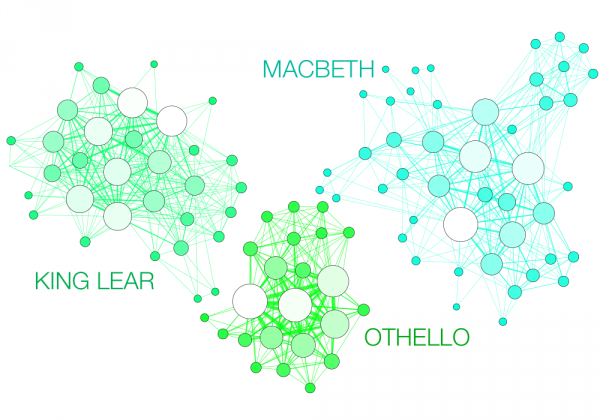
Every story has its architecture, its joints and crossbeams, ornaments and deep structure. The boundaries and scope of a story, its built environment, can determine the kind of story it is, tragedy, comedy, or otherwise. And every story also, it appears, generates a network—a web of weak and strong connections, hubs, and nodes.
Take Shakespeare’s tragedies. We would expect their networks of characters to be dense, what with all those plays’ intrigues and feasts. And they are, according to digital humanities, data visualization, and network analysis scholar Martin Grandjean, who created the charts you see here: “network visualization[s] in which each character is represented by a node connected with the characters that appear in the same scenes.”
The result speaks for itself: the longest tragedy (Hamlet) is not the most structurally complex and is less dense than King Lear, Titus Andronicus or Othello. Some plays reveal clearly the groups that shape the drama: Montague and Capulets in Romeo and Juliet, Trojans and Greeks in Troilus and Cressida, the triumvirs parties and Egyptians in Antony and Cleopatra, the Volscians and the Romans in Coriolanus or the conspirators in Julius Caesar.
Grandjean’s visualizations show us how varied the density of these plays is. While Macbeth has 46 characters, it only achieves 25% network density. King Lear, with 33 characters, reaches 45%.
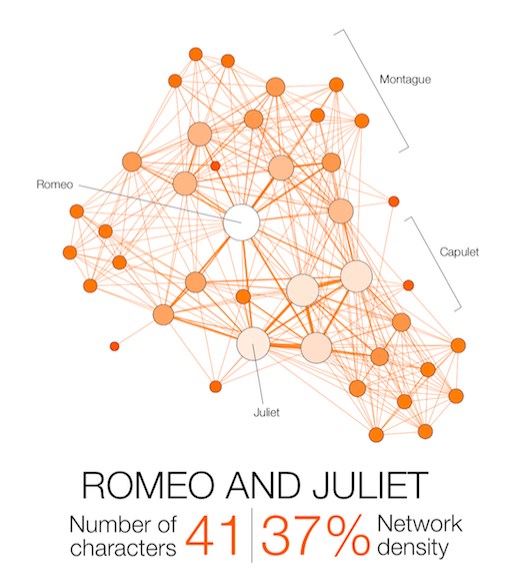
Hamlet’s density score nearly matches its number of characters, while Titus Andronicus’ density number exceeds its character number, as does that of Othello by over twice as much. Why is this? Grandjean doesn’t tell us. These data maps only provide an answer to the question of whether “Shakespeare’s tragedies” are “all structured in the same way.”
But does Grandjean’s “result speak for itself,” as he claims? Though he helps us visualize the way characters cluster around each other, most obviously in Romeo and Juliet, above, it’s not clear what a “density” score does for our understanding of the drama’s intent and purposes. With the exception of the most prominent few characters, the graphics only show various plays’ personae as nameless shaded circles, whereas Shakespeare’s skill was to turn most of those characters, even the most minor, into antitypes and anomalies. Perhaps as important as how they are connected is the question of who they are when they connect.
You can view and download a complete poster of all 11 of Shakespeare’s tragedies at Grandjean’s website.
Related Content:
Read All of Shakespeare’s Plays Free Online, Courtesy of the Folger Shakespeare Library
Josh Jones is a writer and musician based in Durham, NC. Follow him at @jdmagness
Read More...Watch City Out of Time, A Short Tribute to Venice, Narrated by William Shatner in 1959
Last month, Canada lost one of its important filmmakers, Colin Low. Over a career spanning six decades, Low worked on over 200 productions at the National Film Board of Canada. He won countless awards, including two Short Film Palme d’Or awards at the Cannes Film Festival. His work inspired other soon-to-be-influential filmmakers, like Ken Burns and Stanley Kubrick. And he helped pioneer the giant-screen IMAX format.
Above you can watch City Out of Time, Low’s short tribute to Venice. The 1959 film, writes the National Film Board of Canada, “depicts Venice in all its splendor. In the tradition of Venetian painter Canaletto, the film captures the great Italian city’s elusive beauty and fabled landscapes, where spired churches and turreted palaces soar into a blue Mediterranean sky.” The film also features a narration by a young William Shatner, then only 28 years old, whose voice sounds nothing like the one we’d hear several years later in Star Trek, never mind those unforgettable spoken-word albums he started releasing in the late 1960s.
City Out of Time will be added to our list of Free Documentaries, a subset of our collection 4,000+ Free Movies Online: Great Classics, Indies, Noir, Westerns, Documentaries & More.
The second film on the page is Low’s 1952 animation, The Romance of Transportation in Canada, which won a Short Film Palme d’Or at the Cannes Film Festival.
Related Content:
William Shatner Narrates Space Shuttle Documentary
National Film Board of Canada Launches Free iPad App
Take a Virtual Tour of Venice (Its Streets, Plazas & Canals) with Google Street View
A Short History of the Venice Biennale, the World’s Most Important Art Exhibition
Read More...Google Makes Its $149 Photo Editing Software Now Completely Free to Download

Google’s Nik Collection, a photo editing software package designed for professional photographers, once retailed for $149. Today it’s absolutely free to download, for both Windows and Mac users.
Here you can read Google’s announcement, which includes more information on the software package and its capabilities.
Today we’re making the Nik Collection available to everyone, for free.
Photo enthusiasts all over the world use the Nik Collection to get the best out of their images every day. As we continue to focus our long-term investments in building incredible photo editing tools for mobile, including Google Photos and Snapseed, we’ve decided to make the Nik Collection desktop suite available for free, so that now anyone can use it.
The Nik Collection is comprised of seven desktop plug-ins that provide a powerful range of photo editing capabilities — from filter applications that improve color correction, to retouching and creative effects, to image sharpening that brings out all the hidden details, to the ability to make adjustments to the color and tonality of images.
Starting March 24, 2016, the latest Nik Collection will be freely available to download: Analog Efex Pro, Color Efex Pro, Silver Efex Pro, Viveza, HDR Efex Pro, Sharpener Pro and Dfine. If you purchased the Nik Collection in 2016, you will receive a full refund, which we’ll automatically issue back to you in the coming days.
We’re excited to bring the powerful photo editing tools once only used by professionals to even more people now.
Once you’ve downloaded the software, head over to the Nik Collection channel on YouTube where you’ll find video tutorials, including the one below called “Introduction to the Nik Complete Collection.” It’s a good place to start.
PS: Some readers have asked whether this software can work as a standalone program, or whether it needs to run with a program like Photoshop. Here’s what PC Magazine has to say about that: “Though you can run the seven different plugins in the collection as standalone products, they tend to work better when you integrate them into an existing image editing program, like Adobe’s PhotoShop. ‘(On Windows) You can make shortcuts to the individual .exe files on your desktop and then just drag stacks of images onto them,’ suggested one Google+ user.” In short, you have some options.
If you would like to support the mission of Open Culture, consider making a donation to our site. It’s hard to rely 100% on ads, and your contributions will help us continue providing the best free cultural and educational materials to learners everywhere. You can contribute through PayPal, Patreon, and Venmo (@openculture). Thanks!
Related Content:
Museum of Modern Art (MoMA) Launches Free Course on Looking at Photographs as Art
Software Used by Hayao Miyazaki’s Animation Studio Becomes Open Source & Free to Download
Download Free NASA Software and Help Protect the Earth from Asteroids!
Read More...Scientists Discover That James Joyce’s Finnegans Wake Has an Amazingly Mathematical “Multifractal” Structure
It has long been thought that the so-called “Golden Ratio” described in Euclid’s Elements has “implications for numerous natural phenomena… from the leaf and seed arrangements of plants” and “from the arts to the stock market.” So writes astrophysicist Mario Livio, head of the science division for the institute that oversees the Hubble Telescope. And yet, though this mathematical proportion has been found in paintings by Leonardo da Vinci to Salvador Dali—two examples that are only “the tip of the iceberg in terms of the appearances of the Golden Ratio in the arts”—Livio concludes that it does not describe “some sort of universal standard for ‘beauty.’” Most art of “lasting value,” he argues, departs “from any formal canon for aesthetics.” We can consider Livio a Golden Ratio skeptic.
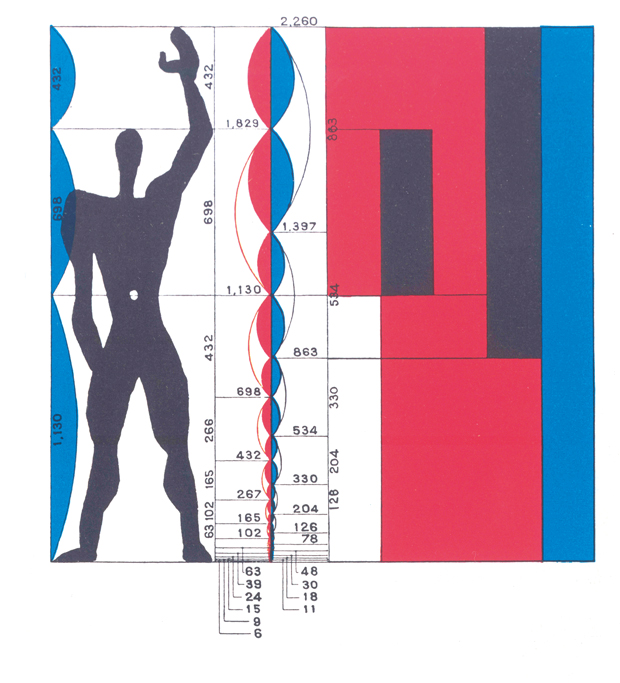
Far on the other end of a spectrum of belief in mathematical art lies Le Corbusier, Swiss architect and painter in whose modernist design some see an almost totalitarian mania for order. Using the Golden Ratio, Corbusier designed a system of aesthetic proportions called Modulor, its ambition, writes William Wiles at Icon, “to reconcile maths, the human form, architecture and beauty into a single system.”
Praised by Einstein and adopted by a few of Corbusier’s contemporaries, Modulor failed to catch on in part because “Corbusier wanted to patent the system and earn royalties from buildings using it.” In place of Leonardo’s Vitruvian Man, Corbusier proposed “Modulor Man” (below) the “mascot of [his] system for reordering the universe.”
Perhaps now, we need an artist to render a “Fractal Man”—or Fractal Gender Non-Specific Person—to represent the latest enthusiastic findings of math in the arts. This time, scientists have quantified beauty in language, a medium sometimes characterized as so imprecise, opaque, and unscientific that the Royal Society was founded with the motto “take no one’s word for it” and Ludwig Wittgenstein deflated philosophy with his conclusion in the Tractatus, “Whereof one cannot speak, thereof one must be silent.” (Speaking, in this sense, meant using language in a highly mathematical way.) Words—many scientists and philosophers have long believed—lie, and lead us away from the cold, hard truths of pure mathematics.
And yet, reports The Guardian, scientists at the Institute of Nuclear Physics in Poland have found that James Joyce’s Finnegans Wake—a novel we might think of as perhaps the most self-consciously referential examination of language written in any tongue—is “almost indistinguishable in its structure from a purely mathematical multifractal.” Trying to explain this finding in as plain English as possible, Julia Johanne Tolo at Electric Literature writes:
To determine whether the books had fractal structures, the academics looked at the variation of sentence lengths, finding that each sentence, or fragment, had a structure that resembled the whole of the book.
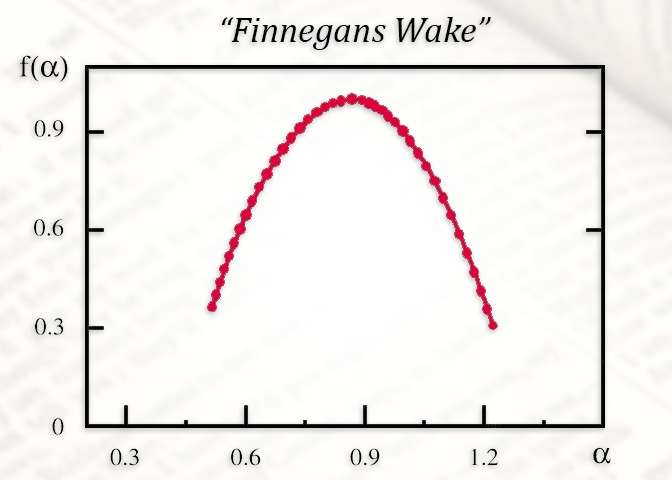
And it isn’t only Joyce. Through a statistical analysis of 113 works of literature, the researchers found that many texts written by the likes of Dickens, Shakespeare, Thomas Mann, Umberto Eco, and Samuel Beckett had multifractal structures. The most mathematically complex works were stream-of-consciousness narratives, hence the ultimate complexity of Finnegans Wake, which Professor Stanisław Drożdż, co-author of the paper published at Information Sciences, describes as “the absolute record in terms of multifractality.” (The graph at the top shows the results of the novel’s analysis, which produced a shape identical to pure mathematical multifractals.)
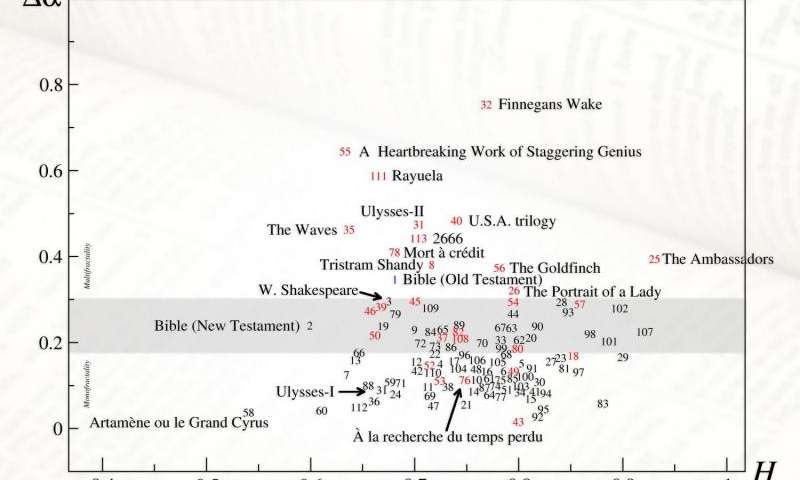
This study produced some inconsistencies, however. In the graph above, you can see how many of the titles surveyed ranked in terms of their “multifractality.” A close second to Joyce’s classic work, surprisingly, is Dave Egger’s post-modern memoir A Heartbreaking Work of Staggering Genius, and much, much further down the scale, Marcel Proust’s Remembrance of Things Past. Proust’s masterwork, writes Phys.org, shows “little correlation to multifractality” as do certain other books like Ayn Rand’s Atlas Shrugged. The measure may tell us little about literary quality, though Professor Drożdż suggests that “it may someday help in a more objective assignment of books to one genre or another.” Irish novelist Eimear McBride finds this “upshot” disappointing. “Surely there are more interesting questions about the how and why of writers’ brains arriving at these complex, but seemingly instinctive, fractals?” she told The Guardian.
Of the finding that stream-of-consciousness works seem to be the most fractal, McBride says, “By its nature, such writing is concerned not only with the usual load-bearing aspects of language—content, meaning, aesthetics, etc—but engages with language as the object in itself, using the re-forming of its rules to give the reader a more prismatic understanding…. Given the long-established connection between beauty and symmetry, finding works of literature fractally quantifiable seems perfectly reasonable.” Maybe so, or perhaps the Polish scientists have fallen victim to a more sophisticated variety of the psychological sharpshooter’s fallacy that affects “Bible Code” enthusiasts? I imagine we’ll see some fractal skeptics emerge soon enough. But the idea that the worlds-within-worlds feeling one gets when reading certain books—the sense that they contain universes in miniature—may be mathematically verifiable sends a little chill up my spine.
Related Content:
Hear All of Finnegans Wake Read Aloud: A 35 Hour Reading
See What Happens When You Run Finnegans Wake Through a Spell Checker
James Joyce Reads From Ulysses and Finnegans Wake In His Only Two Recordings (1924/1929)
Josh Jones is a writer and musician based in Durham, NC. Follow him at @jdmagness
Read More...Discovering Electronic Music: 1983 Documentary Offers a Fun & Educational Introduction to Electronic Music
The late sixties and seventies produced an explosion of electronic music that arrived on the scene as an almost entirely new art form. So much so that when composer Wendy Carlos released an album of Bach compositions played on the Moog synthesizer, it was as though she had invented another genre of music, rather than played baroque pieces on a new instrument. We had foremothers like Delia Derbyshire, experimental bands like Silver Apples and Suicide, innovators like Brian Eno and David Bowie and Kraftwerk, disco pioneers like Giorgio Moroder and Donna Summer… the list of electronic musicians at work creating the genre before the 1980s could go on and on.
You won’t learn any of that from the 1983 documentary above, Discovering Electronic Music, which is not at all to damn the short film; on the contrary, what this presentation offers us is something entirely different from the usual survey course in great men and women of commercial music. With an understated, pedagogical tone, Discovering Electronic Music gently leads its viewers through a thoughtful introduction to electronic music itself—what it consists of, how it differs from acoustic music, what kind of equipment produces it, and how that equipment works.
There are many musicians featured here, but none of them stars. They demonstrate, with competency and professionalism, the ways various electronic instruments and (now seemingly prehistoric) computer systems work. We do hear lots of classical music played on synthesizers, though not by the enigmatic and reclusive Wendy Carlos. And we hear modern compositions as well, though few you’re likely to recognize, from “Jean-Claude Risset, Douglas Leedy, F.R. Moore, Stephan Soomil, Rory Kaplan, Geral Strang and more forgotten geniuses of early electronic music,” writes Electronic Beats.
Early in the film, its presenter talks about the specifically modern appeal of electronic music: composers can work directly with sound like a sculptor or painter, rather than composing on paper and waiting to hear that written music performed by musicians. Much of Discovering Electronic Music shows us composers and musicians doing just that, with the thoroughly matter-of-fact manner of the most compellingly dry public television documentaries and with the strangely soothing quality common to both Mr. Rogers’ Neighborhood and Bob Ross’s painting lessons. Like the sound of the analog synthesizers and antique computer sequencers it features, the documentary has an eerie beauty all its own.
Find more documentaries in our collection, 4,000+ Free Movies Online: Great Classics, Indies, Noir, Westerns, Documentaries & More.
Related Content:
How the Moog Synthesizer Changed the Sound of Music
The History of Electronic Music in 476 Tracks (1937–2001)
Two Documentaries Introduce Delia Derbyshire, the Pioneer in Electronic Music
Josh Jones is a writer and musician based in Durham, NC. Follow him at @jdmagness
Read More...Jean-Paul Sartre on How American Jazz Lets You Experience Existentialist Freedom & Transcendence
In Jean-Paul Sartre’s 1938 philosophical novel Nausea, which he considered one of his finest works of fiction or otherwise, the stricken protagonist Antoine Roquentin cures his existential horror and sickness with jazz—specifically with an old recording of the song “Some of These Days.” Which recording? We do not know. “I only wish Sartre had been more specific about the names of the musicians on the date,” writes critic Ted Gioia in a newly published essay, “I would love to hear the jazz record that trumps Freud, cures the ill, and solves existential angst.”
The song was first recorded in 1911 by a Ukranian-Jewish singer named Sophie Tucker, who made her name with it, and was written by a black Canadian named Shelton Brooks. But Sartre’s hero refers to the singer as an African-American, or as “the Negress,” and to its writer as “a Jew with Black eyebrows.” Was this a mix-up? Or did Sartre refer to another of the hundreds of recordings of the song? (Perhaps Ethel Waters, below?). Or, this being a work of fiction, and Roquentin himself a failed writer, are these identifications made up in his imagination?
In his description of the recording, Roquentin reduces the singer and composer to two broad types: the jazz singing “Negress” and the “Jew”—“a clean-shaven American with thick black eyebrows,” who sits in a “New York skyscraper.”
This stereotyping creates what Miriama Young calls “an objectification of the voice and the persona behind it.” In the novel’s strangely happy ending, Roquentin recovers his disintegrating self by attaching it to these nameless, static figures, who are as repetitious as the record playing over and over on the phonograph, and who are themselves somehow “saved” by the music.
Sartre,” James Donald argues, “still believed in the redemptive power of art.” In the last mention of the record, Roquentin asks to hear “the Negress sing…. She sings. So two of them are saved: the Jew and the Negress. Saved.” And yet, rather than discovering in the music a redemptive authenticity, argues Donald, Sartre’s use of jazz in Nausea is more like Al Jolson’s in The Jazz Singer, a “creative act of mishearing and ventriloquism,” or a “generative inauthenticity.”
Sartre’s early conception of “the redemptive power of art” depended on such inauthenticity; “the work of art is an irreality,” he writes in 1940 in The Imaginary: A Phenomenological Psychology of the Imagination. As in Roquentin’s diary, writes Adnan Menderes, or the novel itself, “in a work of art the here-and-now existence of human being could be shown as interwoven in necessary relations. But in contrast to the work of art, in the real world the existence of human being is contingent and for this very reason it is free.” It is that very freedom and contingency out in the world, the inability to ground himself in reality, that produces Roquentin’s nausea and the existentialist’s crisis. And it is the jazz recording’s “irreality” that resolves it.
Sartre’s use of the racialized types of “Negress” and “Jew” as foils for the complicated, troubled European psyche is reminiscent of Camus’ later use of “the Arab” in The Stranger. Though he critically explored issues of racism and anti-Semitism at length in his later writing, he was perhaps not immune to the primitivist tropes that dominated European modernism and that, for example, made Josephine Baker famous in Paris. (“The white imagination sure is something when it comes to blacks,” Baker herself once wearily observed.) But these types are themselves unreal, like the work of art, projections of Roquentin’s imaginative search for solidity in the exotic otherness of jazz. Nearly ten years after the publication of Nausea, Sartre wrote of the pull jazz had on him in a short, tongue-in-cheek essay called “I Discovered Jazz in America,” which Michelman describes as “like an anthropologist describing an alien culture.”
In the 1947 essay, Sartre writes of the music he hears at “Nick’s bar, in New York” as “dry, violent, pitiless. Not gay, not sad, inhuman. The cruel screech of a bird of prey.” The music is animalistic, immediate, and strange, unlike European formalism: “Chopin makes you dream, or Andre Claveau,” writes Sartre, “But not the jazz at Nick’s. It fascinates.” Like Roquentin’s recording, the Nick’s Bar jazz band is “speaking to the best part of you, to the toughest, to the freest, to the part which wants neither melody nor refrain, but the deafening climax of the moment.”
Gioia recommends that we abandon Theodor Adorno as the go-to European academic reference for jazz writing (I’d agree!) and instead refer to Sartre. But I’d be hesitant to recommend this description. Jazz, improvisatory or otherwise, does extraordinary things with melody and refrain, tearing apart traditional song structures and putting them back together. (See, for example, Dizzy Gillespie’s “Salt Peanuts” from 1947, above.) But it does not abandon musical form altogether in a sustained, formless “climax of the moment,” as Sartre’s sexualized phrase alleges.
Yet in this new jazz—the crashing, chaotic bebop so unlike the crooning big band and show tunes Sartre admired in the 30s—it would be easy for the enthusiast to hear only climax. This music excited Sartre very much, writes Gioia; he “called jazz ‘the music of the future’ and made an effort to get to know Miles Davis and Charlie Parker [above and below], and listen to John Coltrane,” though “his writings on the subject are more atmospheric than analytical.”
With humor and vivid description, Sartre’s essay does a wonderful job of conveying his experience of hearing live jazz as an amused and overawed outsider, though he seems to have some difficulty understanding exactly what the music is on terms outside his excitable emotional response. “The whole crowd shouts in time,” writes Sartre, “you can’t even hear the jazz, you watch some men on a bandstand sweating in time, you’d like to spin around, to howl at death, to slap the face of the girl next to you.”
Perhaps what Sartre heard, experienced, and felt in live bebop was what he had always wanted to hear in recorded jazz, an analogue to his own philosophical yearnings. In an article on one of his major influences, Husserl, written the year after the publication of Nausea, Sartre describes the way we “discover ourselves” as “outside, in the world, among others,” not “in some hiding place.” Strong emotions, “hatred, love, fear, sympathy—all those famous ‘subjective reactions that were floating in the malodorous brine of the mind…. They are simply ways of discovering the world.”
We come to authentic existence, writes Sartre—using a phrase that would soon resound in Jack Kerouac’s coming existential appropriation of jazz—“on the road, in the town, in the midst of the crowd, a thing among things, a human among humans.” In this way, Gioia speculates, Sartre likely “saw jazz as the musical manifestation of the existential freedom he described in his philosophical texts.” Sartre may have misread the formal discipline of jazz, but he describes hearing it live, among a sweating, throbbing crowd, as an authentic experience of freedom, unlike the recording that saves Roquentin through repetition and “irreality.” In both cases, however, Sartre finds in jazz a means of transcendence.
Related Content:
Lovers and Philosophers — Jean-Paul Sartre & Simone de Beauvoir Together in 1967
Jazz ‘Hot’: The Rare 1938 Short Film With Jazz Legend Django Reinhardt
Josh Jones is a writer and musician based in Durham, NC. Follow him at @jdmagness
Read More...
Walter Benjamin’s 13 Oracular Writing Tips
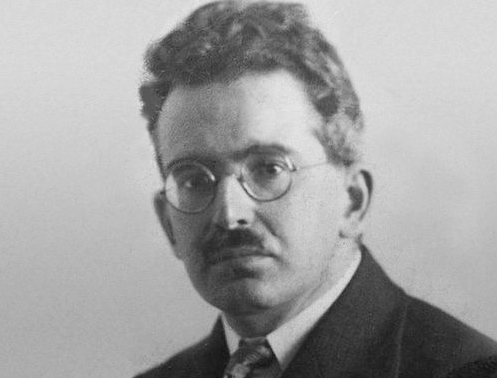
Image by Walter Benjamin Archiv, via Wikimedia Commons
The probability of Walter Benjamin’s name coming up in your average MFA workshop, or fiction writers’ group of any kind, likely approaches zero. But head over to a name-your-critical-political-literary-theory class and I’d be surprised not to hear it dropped at least once, if not half a dozen times. Benjamin, after all, mentored or befriended the first generation Frankfurt School, Hannah Arendt, Bertolt Brecht, Leo Strauss, and nearly every other twentieth-century German intellectual who escaped the Nazis. Tragically, Benjamin himself did not fare so well. It has long been believed that he killed himself rather than face Nazi capture. Another theory speculates that Stalin had him murdered.
Since his death, the legend of Benjamin as a kind of heterodox Marxist prophet—an image he fostered with his embrace of Jewish mysticism—has grown and grown. And yet, despite his rarified academic pedigree, I maintain that writers of all kinds, from the most pedantic to the most visceral, can learn much from him.
Benjamin did not strictly confine himself to the arcane textual analysis and literary-theological hermeneutics for which he’s best known; he spent most of his career working as a freelance critic and journalist, writing almost casual travelogues, personal reminiscences of Weimar Berlin, and approachable essays on a variety of subjects. For a few years, he even wrote and presented popular radio broadcasts for young adults—acting as a kind of “German Ira Glass for teens.”
And, like so many writers before and since, Benjamin once issued a list of “writer’s tips”—or, as he called it, “The Writer’s Technique in Thirteen Theses,” part of his 1928 treatise One-Way Street, one of only two books published in his lifetime. In Benjamin’s hands, that well-worn, well meaning, but often less than helpful genre becomes a series of oracular pronouncements that can seem, at first read, comical, superstitious, or puzzlingly idiosyncratic. But read them over a few times. Then read them again. Like all of his writing, Benjamin’s suggestions, some of which read like commandments, others like Nietzschean aphorisms, reveal their meanings slowly, illuminating the postures, attitudes, and physical and spiritual disciplines of writing in surprisingly humane and astute ways.
The Writer’s Technique in Thirteen Theses:
- Anyone intending to embark on a major work should be lenient with himself and, having completed a stint, deny himself nothing that will not prejudice the next.
- Talk about what you have written, by all means, but do not read from it while the work is in progress. Every gratification procured in this way will slacken your tempo. If this regime is followed, the growing desire to communicate will become in the end a motor for completion.
- In your working conditions avoid everyday mediocrity. Semi-relaxation, to a background of insipid sounds, is degrading. On the other hand, accompaniment by an etude or a cacophony of voices can become as significant for work as the perceptible silence of the night. If the latter sharpens the inner ear, the former acts as a touchstone for a diction ample enough to bury even the most wayward sounds.
- Avoid haphazard writing materials. A pedantic adherence to certain papers, pens, inks is beneficial. No luxury, but an abundance of these utensils is indispensable.
- Let no thought pass incognito, and keep your notebook as strictly as the authorities keep their register of aliens.
- Keep your pen aloof from inspiration, which it will then attract with magnetic power. The more circumspectly you delay writing down an idea, the more maturely developed it will be on surrendering itself. Speech conquers thought, but writing commands it.
- Never stop writing because you have run out of ideas. Literary honour requires that one break off only at an appointed moment (a mealtime, a meeting) or at the end of the work.
- Fill the lacunae of inspiration by tidily copying out what is already written. Intuition will awaken in the process.
- Nulla dies sine linea [‘No day without a line’] — but there may well be weeks.
- Consider no work perfect over which you have not once sat from evening to broad daylight.
- Do not write the conclusion of a work in your familiar study. You would not find the necessary courage there.
- Stages of composition: idea — style — writing. The value of the fair copy is that in producing it you confine attention to calligraphy. The idea kills inspiration, style fetters the idea, writing pays off style.
- The work is the death mask of its conception.
via Clarion 18/BrainPickings
Related Content:
Walter Benjamin’s Radio Plays for Kids (1929–1932)
Umberto Eco Dies at 84; Leaves Behind Advice to Aspiring Writers
David Ogilvy’s 1982 Memo “How to Write” Offers 10 Pieces of Timeless Advice
Josh Jones is a writer and musician based in Durham, NC. Follow him at @jdmagness
Read More...How the Moog Synthesizer Changed the Sound of Music
In my little corner of the world, we’re eagerly anticipating the arrival of Moogfest this May, just moved down the mountains from Asheville—where it has convened since 2004—to the scrappy town of Durham, NC. Like SXSW for electronic music, the four-day event features dozens of performances, workshops, talks, films, and art installations. Why North Carolina? Because that’s where New York City-born engineer Robert Moog (rhymes with “vogue”)—inventor of one of the first, and certainly the most famous, analog synthesizer—moved in 1978 and set up shop for his handmade line of modular synths, “Minimoog”s, and other unique creations. “One doesn’t hear much talk of synthesizers here in western North Carolina,” Moog said at the time, “From this vantage point, it’s easy to get a good perspective on the electronic musical instrument scene.”
The perspective characterizes Moog’s influence on modern music since the late-sixties—as a non-musician outsider whose musical technology stands miles above the competition, its unmistakable sound sought after by nearly everyone in popular music since it debuted on a number of commercial recordings in 1967. A curious development indeed, since Moog never intended the synthesizer to be used as a standalone instrument but as a specialized piece of studio equipment. However, in the mid-sixties, a forward-looking jazz musician named Paul Beaver happened to get his hands on a modular Moog synthesizer, and began to use it on odd, psychedelic albums like Mort Garson’s The Zodiac Cosmic Sounds and famed Wrecking Crew drummer Hal Blaine’s Psychedelic Percussion (hear “Love-In (December)” above).
Shortly after these releases, Mike Bloomfield’s psych-rock outfit The Electric Flag made heavy use of the Moog in their soundtrack for Roger Corman’s sixtiesploitation film The Trip (hear “Fine Jung Thing” above), and the analog synthesizer was on its way to becoming a staple of popular music. In late ’67, The Doors called Beaver into the studio during the recording of Strange Days, and he used the Moog throughout the album to alter Jim Morrison’s voice and provide other effects (hear “Strange Days” at the top). Contrary to popular misconceptions, Brian Wilson did not use a Moog synthesizer for the recording of “Good Vibrations” the year prior, but an “electro-theremin” built and played by Paul Tanner. He did, however, have Bob Moog build a replica of that instrument to play the song live. (The Moog theremin is still in production today.)
Then, in 1968 Wendy Carlos used a Moog Synthesizer to reinterpret several Bach compositions, and Switched-On Bach became a novelty hit that led to many more classical Moog recordings from Carlos, as well as to her original contributions to Stanley Kubrick’s A Clockwork Orange and The Shining. (Unfortunately, few of Carlos’ recordings are available online, but you can hear The Shining’s main theme above.) Switched-On Bach took the Moog synthesizer mainstream—it was the first classical album to go platinum. (Glenn Gould called it “one of the most startling achievements of the recording industry in this generation and certainly one of the great feats in the history of keyboard performance.”) And after the release of Carlos’ futuristic classical albums, and an evolution of Moog’s instruments into more musician-friendly forms, analog synths began to appear everywhere.
Artists like Carlos explored the synthesizer’s use as not only a generator of weird, spaced-out sounds and effects, but as an instrument in its own right, capable of all of the nuance required to play the finest classical music. The modular synthesizer, however, was still an awkwardly bulky instrument, suited for the studio, not the road. That changed in 1971 when the “Minimoog Model D” was born. You can see a short history of that revolutionary instrument above. The Minimoog and its siblings drove prog rock, disco, jazz fusion, the ambient work of Brian Eno, Teutonic electro-pop of Kraftwerk, and soothing Gallic new age soundscapes of Jean-Michel Jarre. Bob Marley incorporated the Minimoog into his roots reggae, and Gary Numan charted the path of the New Wave future with the portable synthesizer.
And as anyone who’s heard Daft Punk’s now-ubiquitous Random Access Memories knows, the forefather of their sound was Italian superproducer Giorgio Moroder, who brought us nearly all of Donna Summer’s disco hits, including the futuristic “I Feel Love,” above, in 1977. Although nothing really sounded like this at the time—nor for many years afterward—we can hear in this pioneering track that it’s only a short hop from Moroder’s pulsing, flanging, synth arpeggios to most of the modern dance music we hear today.
Though we certainly credit all of the composers, producers, and musicians who embraced analog synthesizers and pushed their development forward, all of their musical innovation would have meant little without the inventiveness of the man who, from his mountaintop retreat in Asheville, North Carolina, personally oversaw the technology of a musical revolution. For more on the genius of Bob Moog, watch Hans Fjellestad’s documentary Moog, or listen to the Sound Opinions podcast above, featuring onetime official Moog Foundation historian Brian Kehew.
Related Content:
Thomas Dolby Explains How a Synthesizer Works on a Jim Henson Kids Show (1989)
Watch Herbie Hancock Rock Out on an Early Synthesizer on Sesame Street (1983)
The Mastermind of Devo, Mark Mothersbaugh, Shows Off His Synthesizer Collection
Josh Jones is a writer and musician based in Durham, NC. Follow him at @jdmagness
Support Us
We're hoping to rely on loyal readers, rather than erratic ads. Please click the Donate button and support Open Culture. You can use Paypal, Venmo, Patreon, even Crypto! We thank you!

About Us

Open Culture scours the web for the best educational media. We find the free courses and audio books you need, the language lessons & educational videos you want, and plenty of enlightenment in between.
Advertise With Us
FREE UPDATES!
GET OUR DAILY EMAIL
Get the best cultural and educational resources on the web curated for you in a daily email. We never spam. Unsubscribe at any time.
FOLLOW ON SOCIAL MEDIA
Open Culture editor Dan Colman scours the web for the best educational media. He finds the free courses and audio books you need, the language lessons & movies you want, and plenty of enlightenment in between.
Advertise With Us


