Umberto Eco Explains the Poetic Power of Charles Schulz’s Peanuts
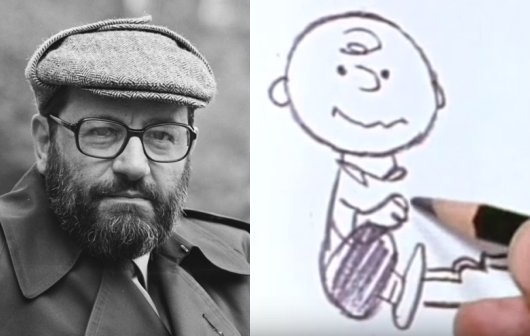
Image via Wikimedia Commons and Snoopy’s YouTube Channel
Anthropology, authenticity, medieval aesthetics, the media, literary theory, conspiracy theory, semiotics, ugliness: the late Umberto Eco, as anyone who’s read a piece of his bibliography (which includes such intellectually serious but thoroughly entertaining novels as The Name of the Rose, Foucault’s Pendulum, and the still-new Numero Zero) can attest, had the widest possible range of interests. That infinite-seeming list extended even to comic strips, and especially Charles Schulz’s Peanuts (which did tend to fascinate literati, even those of very different traditions).
Just over thirty years ago, the Italian novelist-essayist-critic-philosopher-semiotician wrote an essay in The New York Review of Books about what made that strip one of the most, if not the most compelling of the twentieth century.
“The cast of characters is elementary,” writes Eco, rattling off the names and later enumerating the resonant qualities of Charlie Brown, Lucy, Violet, Patty, Frieda, Linus, Schroeder, Pig Pen, and “the dog Snoopy, who is involved in their games and their talk.” But from this simple design arises a rich and complex reader experience:
Over this basic scheme, there is a steady flow of variations, following a rhythm found in certain primitive epics. (Primitive, too, is the habit of referring to the protagonist always by his full name—even his mother addresses Charlie Brown in that fashion, like an epic hero.) Thus you could never grasp the poetic power of Schulz’s work by reading only one or two or ten episodes: you must thoroughly understand the characters and the situations, for the grace, tenderness, and laughter are born only from the infinitely shifting repetition of the patterns, and from fidelity to the fundamental inspirations. They demand from the reader a continuous act of empathy, a participation in the inner warmth that pervades the events.
In this sense, Peanuts succeeds on the same level as Krazy Kat, George Herriman’s highly absurd, highly artistic, and enormously respected strip (though it sometimes took up entire pages) that ran from 1913 to 1944. Thanks only to the earlier work’s rigorous adherence to themes and variations, Eco writes, “the mouse’s arrogance, the dog’s unrewarded compassion, and the cat’s desperate love could arrive at what many critics felt was a genuine state of poetry, an uninterrupted elegy based on sorrowing innocence.” But Peanuts’ cast of children adds another dimension entirely:
The poetry of these children arises from the fact that we find in them all the problems, all the sufferings of the adults, who remain offstage. These children affect us because in a certain sense they are monsters: they are the monstrous infantile reductions of all the neuroses of a modern citizen of industrial civilization.
They affect us because we realize that if they are monsters it is because we, the adults, have made them so. In them we find everything: Freud, mass culture, digest culture, frustrated struggle for success, craving for affection, loneliness, passive acquiescence, and neurotic protest. But all these elements do not blossom directly, as we know them, from the mouths of a group of children: they are conceived and spoken after passing through the filter of innocence. Schulz’s children are not a sly instrument to handle our adult problems: they experience these problems according to a childish psychology, and for this very reason they seem to us touching and hopeless, as if we were suddenly aware that our ills have polluted everything, at the root.
But the capacious mind of Eco finds even more than that in the outwardly humble Schulz’s work. If we read enough of it, “we realize that we have emerged from the banal round of consumption and escapism, and have almost reached the threshold of meditation.” And astonishingly, it works equally well for all audiences: “Peanuts charms both sophisticated adults and children with equal intensity, as if each reader found there something for himself, and it is always the same thing, to be enjoyed in two different keys.” And Schultz continues, even sixteen years after his own death and the strip’s end, to show us, “in the face of Charlie Brown, with two strokes of his pencil, his version of the human condition.”
You can read Eco’s complete essay, On ‘Krazy Kat’ and ‘Peanuts,’ over at The New York Review of Books.
Related Content:
Charles Schulz Draws Charlie Brown in 45 Seconds and Exorcises His Demons
Umberto Eco Dies at 84; Leaves Behind Advice to Aspiring Writers
Based in Seoul, Colin Marshall writes and broadcasts on cities, language, and style. He’s at work on a book about Los Angeles, A Los Angeles Primer, the video series The City in Cinema, the crowdfunded journalism project Where Is the City of the Future?, and the Los Angeles Review of Books’ Korea Blog. Follow him on Twitter at @colinmarshall or on Facebook.
Read More...Existentialist Psychiatrist, Auschwitz Survivor Viktor Frankl Explains How to Find Meaning in Life, No Matter What Challenges You Face
Free will often seems like nothing more than a cruel illusion. We don’t get to choose the times, places, and circumstances of our birth, nor do we have much control over the state of our states, regions, or nations. Even the few who can design conditions such that they are always secure and comfortable find themselves unavoidably subject to what Buddhists call the “divine messengers” of sickness, aging, and death. Biology may not be destiny, but it is a force more powerful than many of our best intentions. And though most of us in the West have the privilege of living far away from war zones, millions across the world face extremities we can only imagine, and to which we are not immune by any stretch.
Among all of the psychiatrists, philosophers, and religious figures who have wrestled with these universal truths about the human condition, perhaps none has been put to the test quite like neurologist and psychotherapist Viktor Frankl, who survived Auschwitz, but lost his mother, father, brother, and first wife to the camps.
While imprisoned, he faced what he described as “an unrelenting struggle for daily bread and for life itself.” After his camp was liberated in 1945, Frankl published an extraordinary book about his experiences: Man’s Search for Meaning, “a strangely hopeful book,” writes Matthew Scully at First Things, “still a staple on the self-help shelves” though it is “inescapably a book about death.” The book has seen dozens of editions in dozens of languages and ranks 9th on a list of most influential books.
Frankl’s thesis echoes those of many sages, from Buddhists to Stoics to his 20th century Existentialist contemporaries: “Everything can be taken from a man but one thing: the last of the human freedoms—to choose one’s attitude in any given set of circumstances, to choose one’s own way.” Not only did he find hope and meaning in the midst of terrible suffering, but after his unimaginable loss, he “remarried, wrote another twenty-five books, founded a school of psychotherapy, built an institute bearing his name in Vienna,” and generally lived a long, happy life. How? The interview above will give you some idea. Frankl maintains that we always have some freedom of choice, “in spite of the worst conditions,” and therefore always have the ability to seek for meaning. “People are free,” says Frankl, no matter their level of oppression, and are responsible “for making someone or something out of themselves.”
Frankl’s primary achievement as a psychotherapist was to found the school of “logotherapy,” a successor to Freudian psychoanalysis and Adlerian individual psychology. Drawing on Existentialist philosophy (Frankl’s book was published in Germany with the alternate title From Concentration Camp to Existentialism)—but turning away from an obsession with the Absurd—his approach, writes his institute, “is based on three philosophical and psychological concepts… Freedom of Will, Will to Meaning, and Meaning in Life.”
You can hear how Frankl works these principles into his philosophy in the fascinating interview, as well as in the short clip above from an earlier lecture, in which he rails against a crude and ultimately unfulfilling form of meaning-making: the pursuit of wealth. Even us materialistic Americans, renowned for our greed, Frankl notes with good humor, respond to surveys in overwhelming numbers saying our greatest desire is to find meaning and purpose in life. Like no other secular voice, Frankl was confident that we could do so, in spite of life’s seeming chaos, through—as he explains above—a kind of idealism that brings us closer to reality.
Note: You can download Frankl’s major book, “Man’s Search for Meaning,” as a free audio book if you join Audible’s 30-Day Free Trial program. Find details on that here.
Related Content:
Josh Jones is a writer and musician based in Durham, NC. Follow him at @jdmagness
Read More...You Can Now Get a Master’s Degree in Samuel Beckett: Here’s How to Apply, and Maybe Get a Scholarship

Image by Bibliothèque nationale de France, via Wikimedia Commons
FYI: The University of Reading now offers students the chance to enroll in a new Master’s degree program focusing on the work of the avant-garde novelist, playwright, theater director & poet Samuel Beckett. He’s been the subject of many past posts here on Open Culture.
Here’s what the program has to offer:
This innovative new taught MA programme on the work of Samuel Beckett is taught by world leading experts on his work: Professor Jonathan Bignell, Professor Anna McMullan, Theatre & Television and Professor Steven Matthews, Dr Mark Nixon and Dr Conor Carville in English. Here you will engage in advanced archival research techniques using the extensive holdings of the university’s world leading Samuel Beckett Collection, applying these skills to the analysis of Beckett’s writing and performance work. The MA will also provide the opportunity to explore the complex and fascinating interdisciplinary relationship Beckett demonstrated in his lifetime through his work in a variety of multimedia including film, theatre, television and radio.
You can find more information on the program here, including details on application process and the scholarship that’s being offered for the 206‑2017 academic year. If you’re looking to get better acquainted with Beckett’s work, don’t miss the items in the Relateds below.
If you would like to support the mission of Open Culture, consider making a donation to our site. It’s hard to rely 100% on ads, and your contributions will help us continue providing the best free cultural and educational materials to learners everywhere. You can contribute through PayPal, Patreon, and Venmo (@openculture). Thanks!
Related Content:
Take a “Breath” and Watch Samuel Beckett’s One-Minute Play
Hear Samuel Beckett’s Avant-Garde Radio Plays: All That Fall, Embers, and More
Samuel Beckett Directs His Absurdist Play Waiting for Godot (1985)
Monsterpiece Theater Presents Waiting for Elmo, Calls BS on Samuel Beckett
Rare Audio: Samuel Beckett Reads Two Poems From His Novel Watt
Free Online Literature Courses
Read More...The 120 Minutes Archive Compiles Clips & Playlists from 956 Episodes of MTV’s Alternative Music Show (1986–2013)
In the first couple years after MTV’s 1981 debut, the fledgling cable network more or less reproduced the 70’s album-oriented rock radio format with video accompaniment, to the exclusion of a number of emerging popular artists (a fact David Bowie bemoaned in ’83). In the mid-80s, the network diversified: Michael Jackson’s “Billie Jean” broke the color barrier in 1984, and in the following years, the network moved toward edgier music with shows like Headbanger’s Ball in ’85 (originally Heavy Metal Mania) and, a few years later, Yo! MTV Raps.
In 1986, another show appeared that solidified MTV’s status—for a few years at least—as a genuine source for new, “alternative” music, before that term became an empty marketing word. Tucked away in a midnight to 2 A.M. slot, 120 Minutes initially “guided viewers through the late ‘80s college rock landscape, which was largely inspired by trends happening in the UK at the time.”
So writes Tyler at Tylerc.com, who hosts the hugely impressive 120 Minutes Archive, a recreation of the 27-year run of the two-hour music video, news, and interview show that broke many an “alternative” artist in the U.S. and gave many more a platform to promote their music, causes, and personalities. Enter the archive here.
I well remember staying up late, the volume turned down as low as possible so as not to wake the family, and catching videos for the Pixies’ “Here Comes Your Man” (above) and R.E.M.’s “It’s the End of the World (As We Know It),” among so many other bands art-pop, new wave, post-punk, industrial, etc. The show was like a video analogue to Trouser Press—and browsing the online database of that “’bible’ of alternative rock” will give you a good sense of 120 Minutes’ breadth. Though it featured a very healthy mix of hardcore, electronic, and new wave music from both sides of the pond, the show often seemed to be dominated by British bands like the Cure (whose Robert Smith once guest hosted), Depeche Mode, the Psychedelic Furs, and (second from top) Big Audio Dynamite, Mick Jones’ post-Clash project, which Lou Reed discusses briefly in the clip at the top from his 1986 stint as a guest host. (See several more clips of his hosting here.)
In the 90s, 120 Minutes became a showcase for much more homegrown product as the “blender of post-punk, goth, industrial, and jangle-rock gave way… to a coalesced grunge movement” after the seismic debut of Nirvana’s “Smells Like Teen Spirit” in 1991, with the likes of Mudhoney, Soundgarden, the Dandy Warhols, and the Smashing Pumpkins taking over for much of the British new wave. Those who came of age in the 90s will remember the show’s host Matt Pinfield’s obsessive, rock critic’s approach to “the rise and fall of alternative rock.” Soon, the show became a heavily eclectic mix: Brit pop arrived (along with the baggy Madchester of the Happy Mondays, Stone Roses, etc.), and “post-grunge bands, left of center singer-songwriters, west coast ska-inspired bands, and alternative hip hop acts” joined the playlist.
The mid-nineties seem like golden years in retrospect. Flush with cash, record companies threw money at anything vaguely Nirvana-shaped, which enabled a number of excellent bands and artists to break out of their local scenes and into larger studios and stages like the traveling circus of Lollapalooza. (The situation also produced a drag of derivative, dumbed-down awfulness.) Scroll through the playlists Tyler C has compiled for 1994, for example, a year I fondly, mostly, remember, to get a sense of the range of artists and genres the show embraced by this time—from the hammering industrial-metal of Ministry (above) to the hazy, ethereal psych-folk of Mazzy Star (below). Post-Nirvana “alternative rock” went so mainstream that the network eventually ran a companion show every weeknight called Alternative Nation, so named despite the fact that “alternative” came to mean precisely the opposite of the outsider status it had once described.
The boom times couldn’t last. As the millennium waned, so did the heyday of alt-rock music videos. Reality TV and bubblegum pop took over. “In the era of TRL,” writes Tyler C, “the future of 120 Minutes on MTV was uncertain.” As MTV relegated music videos—once its raison d’etre—to the margins, 120 Minutes became MTV’s “de facto rock show,” then moved to MTV 2, then off the air altogether in 2003 after a 17-year run. Then, as indie rock ascended to popularity, the show was revived for a 2003–2011 run as Subterranean and again as 120 Minutes until 2013.
Though Tyler C’s exhaustive archive contains few actual clips from the show, it does document 120 Minutes’ entire history, from its underground late 80s inception, through the mainstream 90s, and into the subdued 2000’s, with playlists from each episode and, writes Buzzfeed, “histories of what bands played, descriptions of tours the show appeared on, and anecdotes where possible.” You can watch full episodes of the show’s last couple years with Matt Pinfield on MTV Hive (Many, like this one, broadcast from New York’s Cake Shop).
The archive, Tyler told Buzzfeed, resonates with Gen X’ers because “it’s all about nostalgia”—and I can certainly testify to that effect—and appeals to younger people “because that era of music in the ’90s was so important. It was the age of EVERYTHING alternative.” For those of us who lived through the decade, and who aged out of MTV’s demographic around the time that Tyler aged in, it’s also an opportunity to catch up with later seasons of the show we probably missed. They may be as essential someday—in their own way—as the ones we so wistfully recall.
Related Content:
The First Live Performance of Nirvana’s “Smells Like Teen Spirit” (1991)
Jim Jarmusch’s Anti-MTV Music Videos for Talking Heads, Neil Young, Tom Waits & Big Audio Dynamite
The First 10 Videos Played on MTV: Rewind the Videotape to August 1, 1981
Josh Jones is a writer and musician based in Durham, NC. Follow him at @jdmagness
Read More...Music in the Brain: Scientists Finally Reveal the Parts of Our Brain That Are Dedicated to Music
The late neurologist and writer Oliver Sacks had a big hit back in 2007 with his book Musicophilia: Tales of Music and the Brain, addressing as it did from Sacks’ unquenchably brain- and music-curious perspective a connection almost all of us feel instinctively. We know we love music, and we know that love must have something to do with how our brains work, but for most of human history we haven’t had many credible explanations for what’s going on. But science has discovered more about the relationship between music and the brain, and we’ve posted about some of those fascinating discoveries as they come out. (Have a look at all the related posts below.)
But now, a study from MIT’s McGovern Institute for Brain Research has revealed exactly which parts of our brains respond specifically to music. They’ve put out a brief video of this research, which you can watch above, explaining their process, which involved putting subjects into an MRI and playing them various sounds, then studying how their brains responded differently to music than to, say, the spoken word or a flushing toilet. Not looking to test any hypothesis in particular, the research team found “striking selectivity” in which regions of the brain lit up, in their specially designed analytical model, in response to music.
“Why do we have music?” asks the McGovern Institute’s Dr. Nancy Kanwisher in a New York Times article on the research by Natalie Angier. “Why do we enjoy it so much and want to dance when we hear it? How early in development can we see this sensitivity to music, and is it tunable with experience? These are the really cool first-order questions we can begin to address.” The piece also quotes Josef Rauschecker, director of the Laboratory of Integrative Neuroscience and Cognition at Georgetown University, citing “theories that music is older than speech or language,” and that “some even argue that speech evolved from music,” which “works as a group cohesive. Music-making with other people in your tribe is a very ancient, human thing to do.” Which all, of course, goes to support the bold hypothesis put forth by the late Tower Records: No Music, No Life.
Related Content:
The Neuroscience of Bass: New Study Explains Why Bass Instruments Are Fundamental to Music
The Neuroscience of Drumming: Researchers Discover the Secrets of Drumming & The Human Brain
Playing an Instrument Is a Great Workout For Your Brain: New Animation Explains Why
New Research Shows How Music Lessons During Childhood Benefit the Brain for a Lifetime
Why We Love Repetition in Music: Explained in a New TED-Ed Animation
This is Your Brain on Jazz Improvisation: The Neuroscience of Creativity
Free Online Psychology & Neuroscience Courses
Based in Seoul, Colin Marshall writes and broadcasts on cities, language, and style. He’s at work on a book about Los Angeles, A Los Angeles Primer, the video series The City in Cinema, the crowdfunded journalism project Where Is the City of the Future?, and the Los Angeles Review of Books’ Korea Blog. Follow him on Twitter at @colinmarshall or on Facebook.
Read More...Take a Virtual Tour of Hieronymus Bosch’s Bewildering Masterpiece The Garden of Earthly Delights
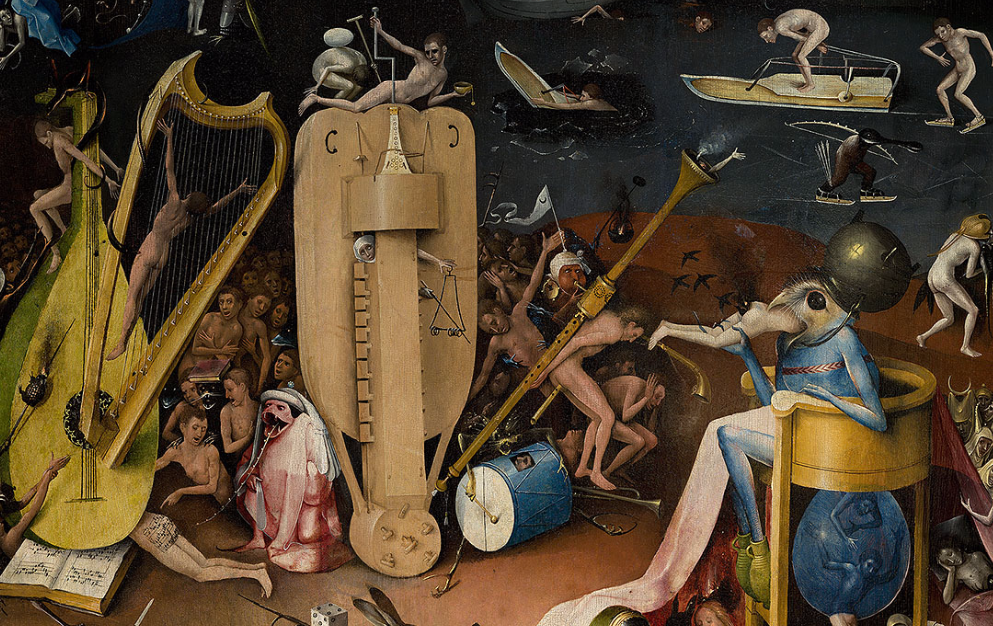
Art historians have argued about the meaning of The Garden of Earthly Delights—Hieronymus Bosch’s enormously sized, lavishly detailed, and compellingly grotesque late 14th- or early 15th-century triptych—more or less since the painter’s death. What does it really say about the appearance and fall of man on Earth that it seems to depict? How seriously or ironically does it say it? Does it offer us a warning against temptation, or a celebration of temptation? Does it take a religious or anti-religious stance? And what’s with all those creepy animals and bizarre pseudo-sex acts? “In spite of all the ingenious, erudite and in part extremely useful research devoted to the task,” said scholar Erwin Panofsky, “I cannot help feeling that the real secret of his magnificent nightmares and daydreams has still to be disclosed.”
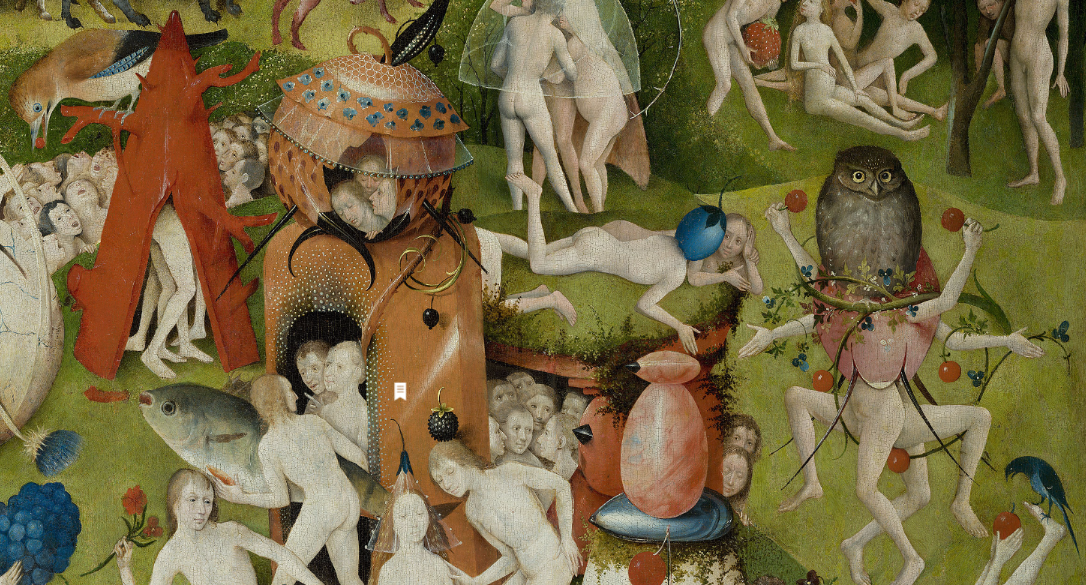
Panofsky said that in the 1950s, by which era he summed up the accumulated efforts to decode Bosch as having “bored a few holes through the door of the locked room; but somehow we do not seem to have discovered the key.” Now you can at least try your own hand at knocking on the door with this “interactive documentary” of The Garden of Early Delights, which allows you to explore the painting in depth, reading and hearing what stories we know of the many images nightmarishly and often hilariously presented within, while you zoom far closer than you could while even standing before the real thing at the Prado.
(Assuming you could successfully elbow your way past all the tour groups.) “The visitor of the interactive documentary will get a better understanding of what it was like to live in the Late Middle Ages,” says the official description, which also assures us we can “come back after a visit and pick up the book again from the shelf to further explore.”
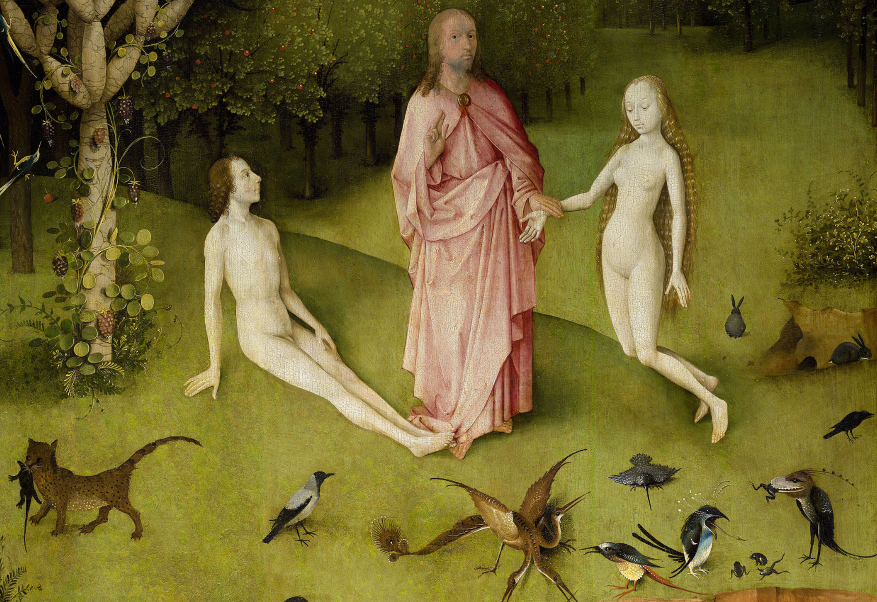
The project comes as part of a larger “transmedia tryptich,” which also consists of the traditional documentary film Hieronymus Bosch, Touched by the Devil (whose trailer you can see below) and a “virtual reality documentary” called Hieronymus Bosch, the Eyes of the Owl. I find that last title especially appropriate, since I’ve long enjoyed Bosch’s recurring owls and appreciate the ability this highly zoomable Garden of Earthly Delights offers me to count them one by one. Spend some time roaming Bosch’s vision’s paradise, bacchanal, and damnation and, whether you take the guided tour through them or not, you’ll find much to stare at in sheer fascination — and, as often as not, disbelief.
Related Content:
Dutch Book From 1692 Documents Every Color Under the Sun: A Pre-Pantone Guide to Colors
300+ Etchings by Rembrandt Now Free Online, Thanks to the Morgan Library & Museum
Rijksmuseum Digitizes & Makes Free Online 210,000 Works of Art, Masterpieces Included!
16th-Century Amsterdam Stunningly Visualized with 3D Animation
Master of Light: A Close Look at the Paintings of Johannes Vermeer Narrated by Meryl Streep
Based in Seoul, Colin Marshall writes and broadcasts on cities and culture. He’s at work on a book about Los Angeles, A Los Angeles Primer, the video series The City in Cinema, the crowdfunded journalism project Where Is the City of the Future?, and the Los Angeles Review of Books’ Korea Blog. Follow him on Twitter at @colinmarshall or on Facebook.
Read More...“20 Rules For Writing Detective Stories” By S.S. Van Dine, One of T.S. Eliot’s Favorite Genre Authors (1928)
Every generation, it seems, has its preferred bestselling genre fiction. We’ve had fantasy and, at least in very recent history, vampire romance keeping us reading. The fifties and sixties had their westerns and sci-fi. And in the forties, it won’t surprise you to hear, detective fiction was all the rage. So much so that—like many an irritable contrarian critic today—esteemed literary tastemaker Edmund Wilson penned a cranky New Yorker piece in 1944 declaiming its popularity, writing “at the age of twelve… I was outgrowing that form of literature”; the form, that is, perfected by Edgar Allan Poe, Arthur Conan Doyle, and Wilkie Collins, and imitated by a host of pulp writers in Wilson’s day. Detective stories, in fact, were in vogue for the first few decades of the 20th century—since the appearance of Sherlock Holmes and a derivative 1907 character called “the Thinking Machine,” responsible, it seems, for Wilson’s loss of interest.
Thus, when Wilson learned that “of all people,”Paul Grimstad writes, T.S. Eliot “was a devoted fan of the genre,” he must have been particularly dismayed, as he considered Eliot “an unimpeachable authority in matters of literary judgment.” Eliot’s tastes were much more ecumenical than most critics supposed, his “attitude toward popular art forms… more capacious and ambivalent than he’s often given credit for.” The rhythms of ragtime pervade his early poetry, and “in his later years he wanted nothing more than to have a hit on Broadway.” (He succeeded, sixteen years after his death.) Eliot peppered his conversation and poetry with quotations from Arthur Conan Doyle and wrote several glowing reviews of detective novels by writers like Dorothy Sayers and Agatha Christie during the genre’s “Golden Age,” publishing them anonymously in his literary journal The Criterion in 1927.
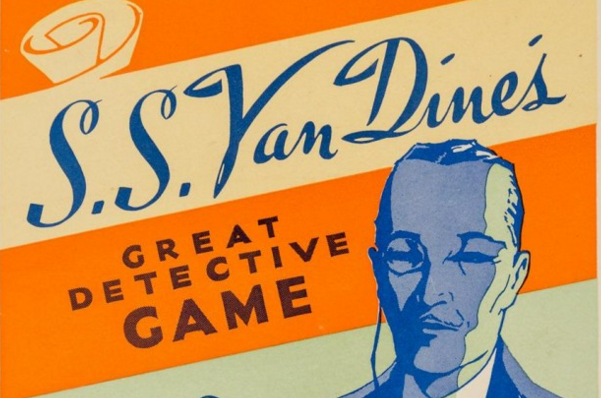
One novel that impressed him above all others is titled The Benson Murder Case by an American writer named S.S. Van Dine, pen name of an art critic and editor named Willard Huntington Wright. Referring to an eminent art historian—whose tastes guided those of the wealthy industrial class—Eliot wrote that Van Dine used “methods similar to those which Bernard Berenson applies to paintings.” He had good reason to ascribe to Van Dine a curatorial sensibility. After a nervous breakdown, the writer “spent two years in bed reading more than two thousand detective stories, during with time he methodically distilled the genre’s formulas and began writing novels.” The year after Eliot’s appreciative review, Van Dine published his own set of criteria for detective fiction in a 1928 issue of The American Magazine. You can read his “Twenty Rules for Writing Detective Stories” below. They include such proscriptions as “There must be no love interest” and “The detective himself, or one of the official investigators, should never turn out to be the culprit.”
Rules, of course, are made to be broken (just ask G.K. Chesterton), provided one is clever and experienced enough to circumvent or disregard them. But the novice detective or mystery writer could certainly do worse than take the advice below from one of T.S. Eliot’s favorite detective writers. We’d also urge you to see Raymond Chandler’s 10 Commandments for Writing Detective Fiction.
THE DETECTIVE story is a kind of intellectual game. It is more — it is a sporting event. And for the writing of detective stories there are very definite laws — unwritten, perhaps, but none the less binding; and every respectable and self-respecting concocter of literary mysteries lives up to them. Herewith, then, is a sort Credo, based partly on the practice of all the great writers of detective stories, and partly on the promptings of the honest author’s inner conscience. To wit:
1. The reader must have equal opportunity with the detective for solving the mystery. All clues must be plainly stated and described.
2. No willful tricks or deceptions may be placed on the reader other than those played legitimately by the criminal on the detective himself.
3. There must be no love interest. The business in hand is to bring a criminal to the bar of justice, not to bring a lovelorn couple to the hymeneal altar.
4. The detective himself, or one of the official investigators, should never turn out to be the culprit. This is bald trickery, on a par with offering some one a bright penny for a five-dollar gold piece. It’s false pretenses.
5. The culprit must be determined by logical deductions — not by accident or coincidence or unmotivated confession. To solve a criminal problem in this latter fashion is like sending the reader on a deliberate wild-goose chase, and then telling him, after he has failed, that you had the object of his search up your sleeve all the time. Such an author is no better than a practical joker.
6. The detective novel must have a detective in it; and a detective is not a detective unless he detects. His function is to gather clues that will eventually lead to the person who did the dirty work in the first chapter; and if the detective does not reach his conclusions through an analysis of those clues, he has no more solved his problem than the schoolboy who gets his answer out of the back of the arithmetic.
7. There simply must be a corpse in a detective novel, and the deader the corpse the better. No lesser crime than murder will suffice. Three hundred pages is far too much pother for a crime other than murder. After all, the reader’s trouble and expenditure of energy must be rewarded.
8. The problem of the crime must he solved by strictly naturalistic means. Such methods for learning the truth as slate-writing, ouija-boards, mind-reading, spiritualistic se’ances, crystal-gazing, and the like, are taboo. A reader has a chance when matching his wits with a rationalistic detective, but if he must compete with the world of spirits and go chasing about the fourth dimension of metaphysics, he is defeated ab initio.
9. There must be but one detective — that is, but one protagonist of deduction — one deus ex machina. To bring the minds of three or four, or sometimes a gang of detectives to bear on a problem, is not only to disperse the interest and break the direct thread of logic, but to take an unfair advantage of the reader. If there is more than one detective the reader doesn’t know who his codeductor is. It’s like making the reader run a race with a relay team.
10. The culprit must turn out to be a person who has played a more or less prominent part in the story — that is, a person with whom the reader is familiar and in whom he takes an interest.
11. A servant must not be chosen by the author as the culprit. This is begging a noble question. It is a too easy solution. The culprit must be a decidedly worth-while person — one that wouldn’t ordinarily come under suspicion.
12. There must be but one culprit, no matter how many murders are committed. The culprit may, of course, have a minor helper or co-plotter; but the entire onus must rest on one pair of shoulders: the entire indignation of the reader must be permitted to concentrate on a single black nature.
13. Secret societies, camorras, mafias, et al., have no place in a detective story. A fascinating and truly beautiful murder is irremediably spoiled by any such wholesale culpability. To be sure, the murderer in a detective novel should be given a sporting chance; but it is going too far to grant him a secret society to fall back on. No high-class, self-respecting murderer would want such odds.
14. The method of murder, and the means of detecting it, must be be rational and scientific. That is to say, pseudo-science and purely imaginative and speculative devices are not to be tolerated in the roman policier. Once an author soars into the realm of fantasy, in the Jules Verne manner, he is outside the bounds of detective fiction, cavorting in the uncharted reaches of adventure.
15. The truth of the problem must at all times be apparent — provided the reader is shrewd enough to see it. By this I mean that if the reader, after learning the explanation for the crime, should reread the book, he would see that the solution had, in a sense, been staring him in the face-that all the clues really pointed to the culprit — and that, if he had been as clever as the detective, he could have solved the mystery himself without going on to the final chapter. That the clever reader does often thus solve the problem goes without saying.
16. A detective novel should contain no long descriptive passages, no literary dallying with side-issues, no subtly worked-out character analyses, no “atmospheric” preoccupations. such matters have no vital place in a record of crime and deduction. They hold up the action and introduce issues irrelevant to the main purpose, which is to state a problem, analyze it, and bring it to a successful conclusion. To be sure, there must be a sufficient descriptiveness and character delineation to give the novel verisimilitude.
17. A professional criminal must never be shouldered with the guilt of a crime in a detective story. Crimes by housebreakers and bandits are the province of the police departments — not of authors and brilliant amateur detectives. A really fascinating crime is one committed by a pillar of a church, or a spinster noted for her charities.
18. A crime in a detective story must never turn out to be an accident or a suicide. To end an odyssey of sleuthing with such an anti-climax is to hoodwink the trusting and kind-hearted reader.
19. The motives for all crimes in detective stories should be personal. International plottings and war politics belong in a different category of fiction — in secret-service tales, for instance. But a murder story must be kept gemütlich, so to speak. It must reflect the reader’s everyday experiences, and give him a certain outlet for his own repressed desires and emotions.
20. And (to give my Credo an even score of items) I herewith list a few of the devices which no self-respecting detective story writer will now avail himself of. They have been employed too often, and are familiar to all true lovers of literary crime. To use them is a confession of the author’s ineptitude and lack of originality. (a) Determining the identity of the culprit by comparing the butt of a cigarette left at the scene of the crime with the brand smoked by a suspect. (b) The bogus spiritualistic se’ance to frighten the culprit into giving himself away. © Forged fingerprints. (d) The dummy-figure alibi. (e) The dog that does not bark and thereby reveals the fact that the intruder is familiar. (f)The final pinning of the crime on a twin, or a relative who looks exactly like the suspected, but innocent, person. (g) The hypodermic syringe and the knockout drops. (h) The commission of the murder in a locked room after the police have actually broken in. (i) The word association test for guilt. (j) The cipher, or code letter, which is eventually unraveled by the sleuth.
You can find S.S. Van Dine’s detective novels on Amazon.
Related Content:
Raymond Chandler’s Ten Commandments for Writing a Detective Novel
H.P. Lovecraft Gives Five Tips for Writing a Horror Story, or Any Piece of “Weird Fiction”
Stephen King’s Top 20 Rules for Writers
Josh Jones is a writer and musician based in Durham, NC. Follow him at @jdmagness
Read More...The Wisdom & Advice of Maurice Ashley, the First African-American Chess Grandmaster
I don’t know about you, but when I’ve thought of chess grandmasters, I’ve often thought of Russians, northern Europeans, the occasional American, the guy on the Chessmaster box — purely by stereotype, in other words. I’ve never thought of anyone from, say, Jamaica, the country of birth of Maurice Ashley, not just a chess grandmaster but a chess commentator, writer, app and puzzle designer, speaker and Fellow at the Media Lab at MIT. Since we’ve only just entered February, known in the United States as Black History Month, why not highlight the Brooklyn-raised (and Brooklyn-park trained) Ashley’s status as, in the words of his official web site, “the first African-American International Grandmaster in the annals of the game”?
Given the impressiveness of his achievements, we might also ask what we can learn from him, whether or not we play chess ourselves. You can learn a bit more about Ashley, the work he does, and the work his students have gone on to do, in The World Is a Chess Board, the five-minute Mashable documentary at the top of the post. Even in that short runtime, he has much to say about how the game (which, he clarifies, “we consider an art form”) not only reflects life, and reflects the personalities of its players, but teaches those players — especially the young ones who may come from less-than-ideal beginnings — all about focus, determination, choice, and consequence. Perhaps the most important lesson? “You’ve got to be ready to lose.”
Ashley expounds upon the value of chess as a tool to hone the mind in “Working Backward to Solve Problems,” a clip from his TED Ed lesson just above. He begins by waving off the misperception, common among non-chess-players, that grandmasters “see ahead” ten, twenty, or thirty moves into the game, then goes on to explain that the sharpest players do it not by looking forward, but by looking backward. He provides a few examples of how using this sort of “retrograde analysis,” combined with pattern recognition, applies to problems in a range of situations from proofreading to biology to law enforcement to card tricks. If you ever have a chance to enter into a bet with this man, don’t.
That’s my advice, anyway. As far as Ashley’s advice goes, if we endorse any particular takeaway from what he says here, we endorse the first step of his chess-learning strategy for absolute beginners, which works equally well as the first step of a learning strategy for absolute beginners in anything: “The best advice I could give a young person today is, go online and watch some videos.” Stick with us, and we’ll keep you in all the videos you need.
Related Content:
Kasparov Talks Chess, Technology and a Little Life at Google
Free App Lets You Play Chess With 23-Year-Old Norwegian World Champion Magnus Carlsen
Watch Bill Gates Lose a Chess Match in 79 Seconds to the New World Chess Champion Magnus Carlsen
A Famous Chess Match from 1910 Reenacted with Claymation
Chess Rivals Bobby Fischer and Boris Spassky Meet in the ‘Match of the Century’
Vladimir Nabokov’s Hand-Drawn Sketches of Mind-Bending Chess Problems
Based in Seoul, Colin Marshall writes and broadcasts on cities and culture. He’s at work on a book about Los Angeles, A Los Angeles Primer, the video series The City in Cinema, the crowdfunded journalism project Where Is the City of the Future?, and the Los Angeles Review of Books’ Korea Blog. Follow him on Twitter at @colinmarshall or on Facebook.
Read More...85 Compelling Films Starring and/or Directed By Women of Color: A List Created by Director Ava DuVernay & Friends on Twitter

Image by Marie Maye, via Wikimedia Commons
If you follow film news—or really, just news—you’re well aware of the controversy surrounding the current crop of Academy Award nominees. While awards extravaganzas seem like little more than popularity contests, it is curious that neither the acclaimed lead actors nor the directors received nominations for two of the most popular films of the year—Creed and Straight Outta Compton. (See SNL’s satirical take on this.) There’s been no shortage of critical praise for the talent in those films and others, casting doubt on claims that actors, writers, directors, etc. of color simply weren’t up to snuff. The truth is likely more banal: most of the Academy voters are older white men. (“Older and more dude-heavy than just about any place in America,” says The Atlantic, “and whiter than all but seven states.”) No need to allege outright conspiracy when implicit bias operates to exclude people all the time without malicious intent.
Nor do corporate buzzwords like “diversity” carry much weight when it comes to creating a more inclusive industry. “It’s a medicinal word,” says Selma director Ava DuVernay, “that has no emotional resonance… Diversity’s like, ‘Ugh, I have to do diversity.’ ” No one wants to attend a “diversity training” or read a hiring manual about how to “do diversity”; recognizing talent shouldn’t be a forced, procedural matter, but a matter of course. The Academy has vowed to make changes by retiring many inactive members to non-voting emeritus status and—in an Orwellian turn of phrase—“doubling the number of diverse members” by 2020, whatever that means. The aforementioned DuVernay has been sowing seeds of discontent with the status quo for quite some time now, online and in the industry itself with her distribution company AFFRM+Array Releasing, which attempts to counterbalance the racial and gender disparities in the film world.
In a tweet last year, written off the cuff during a writing break, she put out a call to followers to “name three films you like with black, brown, native or Asian women leads” or directors. Indiewire comments that “it seems like common sense that these films exist,” yet “the question proved to be a serious challenge for Twitter.” Eventually, DuVernay and the Twitter denizens came up with a list of 85 titles starring and/or directed by women of color, and you can see them all listed below. If you find yourself watching movie after movie about the same kinds of experiences, maybe consider making your own viewing habits more “diverse” by checking out some of these excellent, and in most cases little-seen movies, including two well-reviewed films from DuVernay herself, 2010’s I Will Follow and 2012’s Middle of Nowhere.
“35 Shots of Rum” by Claire Denis (2008)
“A Different Image” by Alile Sharon Larkin (1982)
“A Girl Walks Home Alone at Night” by Ana Lily Amirpour (2014)
“Advantageous” by Jennifer Phang (2015)
“Ala Modalaindi” by Nandini Bv Reddy (2011)
“All About You” by Christine Swanson (2001)
“Alma’s Rainbow” by Ayoka Chenzira (1994)
“Appropriate Behavior” by Desiree Akhavan (2014)
“B For Boy” by Chika Anadu (2013)
“Bande de Filles/Girlhood” by Céline Sciamma (2014)
“Belle” by Amma Asante (2013)
“Bend it Like Beckham” by Gurinder Chadha (2002)
“Bessie” by Dee Rees (2015)
“Beyond the Lights” by Gina Prince-Bythewood (2014)
“Bhaji on the Beach” by Gurinder Chadha (1993)
“Caramel” by Nadine Labaki (2007)
“Circumstance” by Maryam Keshavarz (2011)
“Civil Brand” by Neema Barnette (2002)
“Compensation” by Zeinabu irene Davis (199)
“Daughters of the Dust” by Julie Dash (1991)
“Double Happiness ” by Mina Shum (1994)
“Down in the Delta” by Maya Angelou (1998)
“Drylongso” by Cauleen Smith (1988)
“Earth” by Deepa Mehta (1998)
“Elza” by Mariette Monpierre (2011)
“Endless Dreams” by Susan Youssef (2009
“Eve’s Bayou” by Kasi Lemmons (1997)
“Fire” by Deepa Mehta (1996)
“Frida” by Julie Taymor (2002)
“Girl in Progress” by Patricia Riggen (2012)
“Girlfight” by Karyn Kusama (2000)
“Habibi Rasak Kharban” by Susan Youssef (2011)
“Hiss Dokhtarha Faryad Nemizanand (Hush! Girls Don’t Scream)” by Pouran Derahkandeh (2013)
“Honeytrap” by Rebecca Johnson (2014)
“I Like It Like That” by Darnell Martin (1994)
“I Will Follow” by Ava DuVernay (2010
“In Between Days” by So-yong Kim (2006)
“Introducing Dorothy Dandridge” by Martha Coolidge (1999)
“It’s a Wonderful Afterlife” by Gurinder Chadha (2010)
“Jumpin Jack Flash” by Penny Marshall (1986)
“Just Another Girl on the IRT” by Leslie Harris (1992)
“Just Wright” by Sanaa Hamri (2010)
“Kama Sutra” by Mira Nair (1996)
“Losing Ground” by Kathleen Collins (1982)
“Love & Basketball” by Gina Prince-Bythewood (2000)
“Luck by Chance” by Zoya Akhtar (2009)
“Mi Vida Loca” by Allison Anders (1993)
“Middle of Nowhere” by Ava DuVernay (2012)
“Mississippi Damned” by Tina Mabry (2009)
“Mississippi Masala” by Mira Nair (1991)
“Mixing Nia” by Alison Swan (1998)
“Monsoon Wedding” by Mira Nair (2001)
“Mosquita y Mari” by Aurora Guerrero (2012)
“Na-moo-eobs-neun san (Treeless Mountain)” by So-yong Kim (2008)
“Night Catches Us” by Tanya Hamilton (2010)
“Pariah” by Dee Rees (2011)
“Picture Bride” by Kayo Hatta (1994)
“Rain” by Maria Govan (2008)
“Real Women Have Curves” by Patricia Cardoso (2002)
“Saving Face” by Alice Wu (2004)
“Second Coming” by Debbie Tucker Green (2014)
“Something Necessary” by Judy Kibinge (2013)
“Something New” by Sanaa Hamri (2006)
“Still the Water” by Naomi Kawase (2014)
“Stranger Inside” by Cheryl Dunye (2001)
“Sugar Cane Alley/Black Shack Alley” by Euzhan Palcy (1983)
“The Kite” by Randa Chahal Sabag (2003)
“The Rich Man’s Wife” by Amy Holden Jones (1996)
“The Secret Life of Bees” by Gina Prince-Bythewood (2008)
“The Silence of the Palace” by Moufida Tlatli (1994)
“The Watermelon Woman” by Cheryl Dunye (1996)
“The Women of Brewster Place” by Donna Deitch (1989)
“Their Eyes Were Watching God” by Darnell Martin (2005)
“Things We Lost in the Fire” by Susanne Bier (2007)
“Wadjda” by Haifaa Al-Mansour (2012)
“Water” by Deepa Mehta (2005)
“Whale Rider” by Niki Caro (2002)
“What’s Cooking?” by Gurinder Chadha (2000)
“Where Do We Go Now?” by Nadine Labaki (2011)
“Whitney” by Angela Bassett (2015)
“Woman Thou Art Loosed: On The 7th Day” by Neema Barnette (2012)
“Xiu Xiu: The Sent-Down Girl” by Joan Chen (1998)
“Yelling to the Sky” by Victoria Mahoney (2011)
“Young and Wild” by Marialy Rivas (2012)
via Indiewire
Related Content:
Spike Lee’s List of 95 Essential Movies – Now with Women Filmmakers
The 10 Greatest Films of All Time According to 358 Filmmakers
725 Free Movies Online: Great Classics, Indies, Noir, Westerns, etc.
Josh Jones is a writer and musician based in Durham, NC. Follow him at @jdmagness
Read More...Producer Tony Visconti Breaks Down the Making of David Bowie’s Classic “Heroes,” Track by Track
Those familiar with David Bowie lore may know one or two things about the recording of his seminal 1978 track “Heroes.” One is that the recording studio did, in fact, look out over the Berlin Wall and the lovers that Bowie saw made it into the lyrics (“I can remember standing by the wall/And the guns shot above our heads/And we kissed as though nothing could fall”). The other is the microphone set up in Hansa’s expansive recording studio: one next to Bowie’s mouth, another 15 — 20 feet away, and another at the far end of the room to catch the reverb. (Hands up how many of us learned about that when Steve Albini copied it for Nirvana’s “All Apologies”? Anybody?) But as this video above with producer Tony Visconti shows, that’s only a few of the magical inventions and daring decisions made for this recording. The session contains lessons for any young producer endlessly fiddling about with their ProTools and the millions of choices afforded by a $2.99 synth app for the iPad.
When Bowie added his vocals at the end of the recording session, there was only one track left on the tape, having filled up the 23 other tracks with the band’s backing track, Eno’s synths, extra percussion, three (!) tracks of Robert Fripp commanding the gods through his guitar pickup and feedback, and more. If they didn’t like the take, they’d erase over it with the new one. Those were the analog days. But as Visconti says, that scary decision electrified Bowie. As an artist, everything was at stake. It’s like they knew they were making a song for the ages. Maybe it’s Visconti’s 20/20 hindsight, but they were right.
This small segment above is part of a longer three-hour tour through Visconti’s career, recorded in 2011 for the Red Bull Academy lecture series. Visconti talks about working with Marc Bolan, Morrissey, Paul McCartney and others, along with his thoughts on producing, and a great deal about Bowie’s “Berlin Trilogy.” (The second half of the talk is here.)
But there’s so much more to be discovered among those 24 audio tracks of “Heroes.” In this wonderful BBC documentary from 2012 (also see up top), Visconti sits down with the digitally transferred master tapes and takes us through the construction of the song. Here we get to hear Robert Fripp’s raw guitar tracks which sound so incredibly abrasive it’s hard to believe they exist in the song; Visconti’s “cowbell,” which is him hitting a pipe outside in the yard; Eno’s synth in a briefcase, the EMS Synthi‑A; and numerous painterly daubs of audio that all make up the mix. And then there’s that vocal, which Visconti lets play without any of the music, a song for the history books, a voice that couldn’t be constrained to just one mic. The video unfortunately couldn’t be embedded on our site, but it’s definitely worth your time.
Related Content:
Hear Demo Recordings of David Bowie’s “Ziggy Stardust,” “Space Oddity” & “Changes”
Dave: The Best Tribute to David Bowie That You’re Going to See
Ted Mills is a freelance writer on the arts who currently hosts the FunkZone Podcast. You can also follow him on Twitter at @tedmills, read his other arts writing at tedmills.com and/or watch his films here.
Read More...Support Us
We're hoping to rely on loyal readers, rather than erratic ads. Please click the Donate button and support Open Culture. You can use Paypal, Venmo, Patreon, even Crypto! We thank you!

About Us

Open Culture scours the web for the best educational media. We find the free courses and audio books you need, the language lessons & educational videos you want, and plenty of enlightenment in between.
Advertise With Us
FREE UPDATES!
GET OUR DAILY EMAIL
Get the best cultural and educational resources on the web curated for you in a daily email. We never spam. Unsubscribe at any time.
FOLLOW ON SOCIAL MEDIA
Open Culture editor Dan Colman scours the web for the best educational media. He finds the free courses and audio books you need, the language lessons & movies you want, and plenty of enlightenment in between.
Advertise With Us



