How Old School Records Were Made, From Start to Finish: A 1937 Video Featuring Duke Ellington
We’re moving back in time, before the mp3 player and the CD. We’re going back to the analog age, a moment when the shellac (and later vinyl) record reigned supreme. The month is June 1937. And the short film you’re watching is “Record Making with Duke Ellington and His Orchestra.” How the film came into being was described in the July 1937 edition of Melody News:
Last month, a crew of cameramen, electricians and technicians from the Paramount film company set up their paraphernalia in the recording studios of Master Records, Inc. for the purpose of gathering ‘location’ scenes for a movie short, now in production, showing how phonograph records are produced and manufactured. Duke Ellington and his orchestra was employed for the studio scenes, with Ivie Anderson doing the vocals.
Narrated by Alois Havrilla, a pioneer radio announcer, the film shows you how records were actually recorded, plated and pressed. It’s a great relic from the shellac/vinyl era, which you will want to couple with this 1956 vinyl tutorial from RCA Victor.
If you would like to support the mission of Open Culture, consider making a donation to our site. It’s hard to rely 100% on ads, and your contributions will help us continue providing the best free cultural and educational materials to learners everywhere. You can contribute through PayPal, Patreon, and Venmo (@openculture). Thanks!
Related Content
How Vinyl Records Are Made: A Primer from 1956
A Celebration of Retro Media: Vinyl, Cassettes, VHS, and Polaroid Too
How to Clean Your Vinyl Records with Wood Glue
How Film Was Made in 1958: A Kodak Nostalgia Moment
Read More...
Pioneering Electronic Composer Karlheinz Stockhausen Presents “Four Criteria of Electronic Music” & Other Lectures in English (1972)
?si=jXFbzCCx1Za0_486
Where did modern electronic music come from? Whatever the genre markers—EDM, house, glitch, dubstep, ambient—any discussion of the history will inevitably pay homage to a few founding names: Brian Eno, Kraftwerk, Afrika Bambaataa, synthesizer inventor Robert Moog, Daft Punk’s personal hero Giorgio Moroder, superstar DJs Larry Levan and Frankie Knuckles… the list could go on. In most mainstream discussions, it will often leave out the name Karlheinz Stockhausen. And yet, though he decidedly did not make dance music, no history of electronica writ large is complete without him, something filmmaker Iara Lee recognized when she featured him prominently in her 1999 electronica documentary Modulations.
In an introduction to Lee’s transcribed interview with Stockhausen, James Wesley Johnson describes the experimental German electronic composer and theorist as “his own best spokesman,” for the way he “describes the theoretical underpinnings of his work with a simple clarity which belies its complexity.”
Trying to describe Stockhausen’s work proves difficult, since “he’s always experimenting.” Anyone who thinks they “ ‘know’ what to expect from him,” Johnson remarks, is “destined to be surprised by further mutations.”
Stockhausen, who died in 2007, began his career as a student in the 1950s, studying under influential French composer Olivier Messiaen while developing his own concept of musical spatialization. Throughout the fifties and sixties, he pioneered live performance and recorded compositions with tape recorders, microphones, ring modulators, Hammond Organ, and other analog electronic devices, along with traditional instruments, voice, and musique concrete techniques.
Stockhausen combined—writes Ed Chang at the Stockhausen blog Sounds in Space—the results of his experimentation with the “harmonically-liberating methods of the 2nd Viennese School (basically Arnold Schönberg, Alban Berg and Anton Webern, who explored the chromatic scale through the use of unique ordered tone rows and intervals).” This fusion gave rise to the lecture at the top of the post, delivered at the Oxford Union in England on May 6th, 1972, in which Stockhausen lays out his “Four Criteria of Electronic Music.” They are as follows:
- Unified Time Structuring
- Splitting of the Sound
- Multi-Layered Spatial Composition
- Equality of Sound and Noise
Chang provides a detailed, technical summary of each point. Much more entertaining, however, is watching the eccentric and enthusiastic Stockhausen elaborate his theory. “One might ask,” he says at the opening of his lecture, “why are [the four criteria] interesting, as there is electronic music, and everybody can make up his mind about what to think about this music?” His answer is classic Stockhausen—cryptic, elliptical, intriguingly vague yet self-assured:
New means change the method; new methods change the experience, and new experiences change man. Whenever we hear the sounds we are changed: we are no longer the same after hearing certain sounds, and this is the more the case when we hear organized sounds, sounds organized by another human being: music.
Thus he launches into his fascinating—if not always fully comprehensible—theory of music as “organized sound,” with animated gestures and several examples from his own composition from the late 50s, Kontakte. “Four Criteria of Electronic Music” is the fifth in a long series of lectures Stockhausen delivered in London that year. If you have any interest in music theory, avant-garde composition, or in how electronic music—and hence how our world—came to sound the way it does, you should not miss these. You can watch them all on Youtube (or below) or at Ubuweb. If you cannot sit in front of the screen and watch Stockhausen’s strangely compelling delivery, you can also download a PDF of a published version of “Four Criteria of Electronic Music” at Monoskop.
Related Content:
The Fascinating Story of How Delia Derbyshire Created the Original Doctor Who Theme
Hear Seven Hours of Women Making Electronic Music (1938- 2014)
Josh Jones is a writer and musician based in Durham, NC. Follow him at @jdmagness
Read More...Björk Takes Us Inside Her Creative Process and Explains How She Writes a Song
Some songs are so straightforward there’s no need to debate their meanings with friends and Reddit users. Others remain opaque, despite fans’ best attempts to crack lyrical codes.
“Stonemilker,” the first track on Björk’s self-described “complete heartbreak album” Vulnicura, seems to fall into the former category:
Show me emotional respect, oh respect, oh respect
And I have emotional needs, oh needs, oh ooh
I wish to synchronize our feelings, our feelings, oh ooh
“Probably the most obvious lyrics I’ve ever written” she remarks in her above appearance on Hrishikesh Hirway’s Song Exploder, a podcast wherein musicians deconstruct a song’s meaning, origin, and recording process.
Björk was walking on a beach when the simple lyrics of “Stonemilker” popped into her head. She quickly realized that she should steer clear of the impulse to make them more clever, and chose the primal over the poetic.
As to its inspiration, she diplomatically refrains from naming her ex-husband, filmmaker Matthew Barney, on the podcast, saying only that “Stonemilker”’s narrator has achieved emotional clarity, unlike “the person” to whom she is singing, someone who prefers for things to stay foggy and complex.
She strove for arrangements that would support that feeling of clarity, waiting for the right microphone, hammering out every beat with producer Alejandro “Arca” Ghersi, and releasing a second, strings only version.
“I decided to become a violin nerd,” she told Pitchfork:
I had like twenty technological threads of things I could have done, but the album couldn’t be futuristic. It had to be singer/songwriter. Old-school. It had to be blunt. I was sort of going into the Bergman movies with Liv Ullmann when it gets really self-pitying and psychological, where you’re kind of performing surgery on yourself, like, What went wrong?
The accompanying 360-degree virtual reality music video, above, can now be viewed online as well as with Oculus Rift. Every instrument was miked and if you can’t get clear on an Icelandic beach, well then…
As for those plaintive, crystalline vocals, Björk intentionally held off, waiting for the sort of day when impulsiveness reigns. (I know she’s a classically trained musician, but isn’t that pretty much every day when you’re Björk?)
Having some insights into what the artist was aiming for can guide listeners toward deeper appreciation. Björk obligingly offers Song Exploder listeners a vast buffet. Surely something will resonate:
A tower of equilibrium…
Smooth cream-like perfection…
A net…
A cradle…
Compare those simple goals to Flavorwire’s Moze Halperin’s analysis of what he calls “Vulnicura’s most tragic track — and perhaps the saddest Björk has ever written”:
“Stonemilker” has the grandiose sound of having been sung in a cathedral, but like one tiny person confronted by the largeness of ideas of God or the architectural complexity of one such structure, Björk’s voice sounds distant, echoing, fighting not to get sucked in by the threat of a vast abyss. When, in the coming songs, she actually confronts the abyss, her voice becomes stronger. The crushing sadness of this song is that it’s the beginning of the end, and in listening to it, we feel at once closest to the love that was recently lost, while also being aware of the turmoil ahead.
The song’s near-nonchalant melancholy — its false impression that it can afford nonchalance because the lovers’ disconnect is just a bump in the road — makes it more unbearably sad than the rest of the album. In this song, she carries all of her previous work on her back like arrows in a quiver, pulling references out one by one and shooting them at listeners to remind them of the manifold ways she once documented the complexities of her love. For now, she’s about to document the complexities of its disappearance.
Basically, if you wind up feeling like you’re “lying at home in the moss looking at the sky,” Björk’s mission has been accomplished.
Want more? You can unpack other artists’ definitive meanings and song midwifery by subscribing to Song Exploder.
Related Content:
Hear the Album Björk Recorded as an 11-Year-Old: Features Cover Art Provided By Her Mom (1977)
Watch Björk’s 6 Favorite TED Talks, From the Mushroom Death Suit to the Virtual Choir
Ayun Halliday is an author, illustrator, and Chief Primatologist of the East Village Inky zine. Follow her @AyunHalliday
Read More...The New York Public Library Lets You Download 180,000 Images in High Resolution: Historic Photographs, Maps, Letters & More
Most of us Open Culture writers and readers surely grew up thinking of the local public library as an endless source of fascinating things. But the New York Public Library’s collections take that to a whole other level, and, so far, they’ve spent the age of the internet taking it to a level beyond that, digitizing ever more of their fascinating things and making them freely available for all of our perusal (and even for use in our own work). Just in the past couple of years, we’ve featured their release of 20,000 high-resolution maps, 17,000 restaurant menus, and lots of theater ephemera.
This week, The New York Public Library (NYPL) announced not only that their digital collection now contains over 180,000 items, but that they’ve made it possible, “no permission required, no hoops to jump through,” to download and use high-resolution images of all of them.
You’ll find on their site “more prominent download links and filters highlighting restriction-free content,” and, if you have techier interests, “updates to the Digital Collections API enabling bulk use and analysis, as well as data exports and utilities posted to NYPL’s GitHub account.” You might also consider applying for the NYPL’s Remix Residency program, designed to foster “transformative and creative uses of digital collections and data, and the public domain assets in particular.”
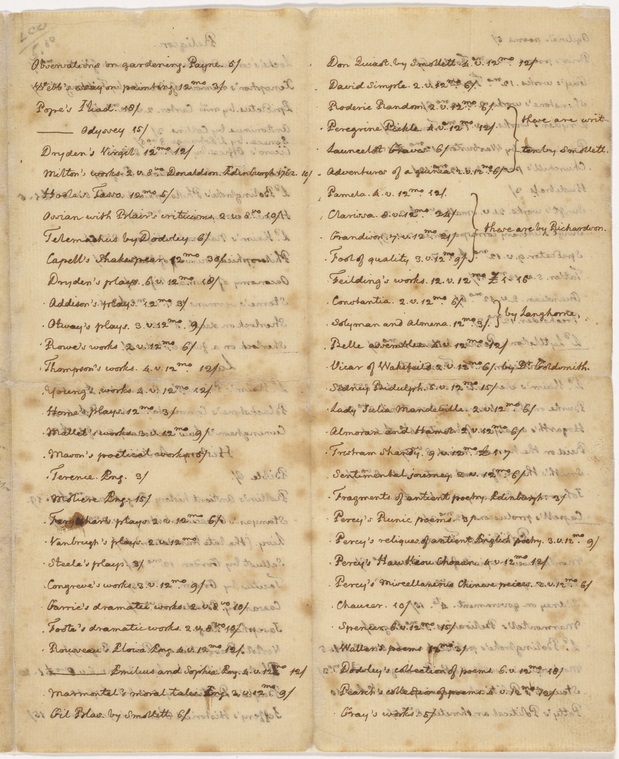
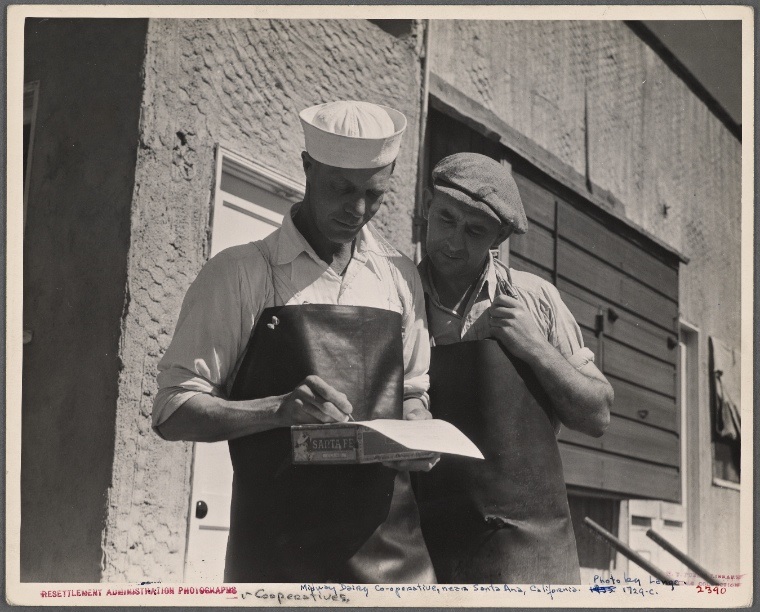
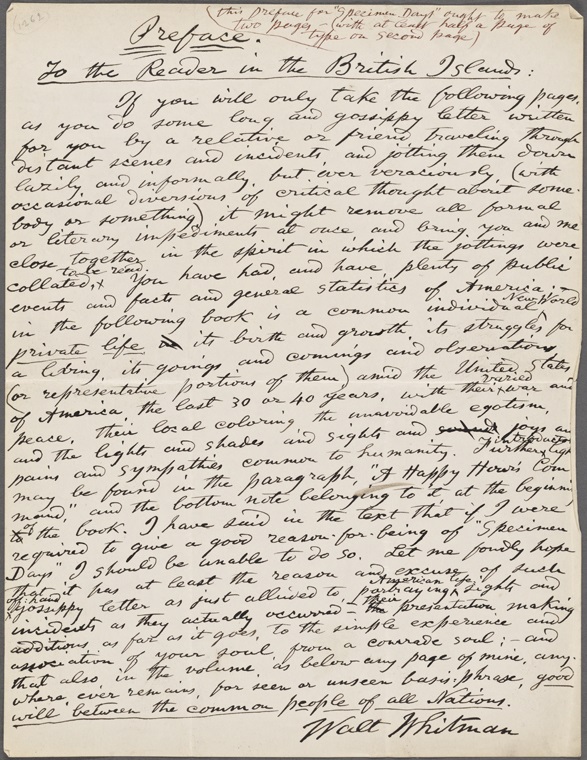
And what do those assets include? Enduring pieces of American documentary art like the Farm Security Administration photographs taken during the Great Depression by Dorothea Lange, Walker Evans, and Gordon Parks. Lange’s shot of the Midway Dairy Cooperative near Santa Ana, California appears at the top of the post. Artifacts from the creative processes of such icons of American literature as Henry David Thoreau, Nathaniel Hawthorne, and Walt Whitman, whose handwritten preface to Specimen Days you’ll find second from the top. The letters and other papers of the Founding Fathers, including Thomas Jefferson’s list of books for a private library just above. And, of course, all those maps, like the 1868 Plan of New York and Brooklyn just below.

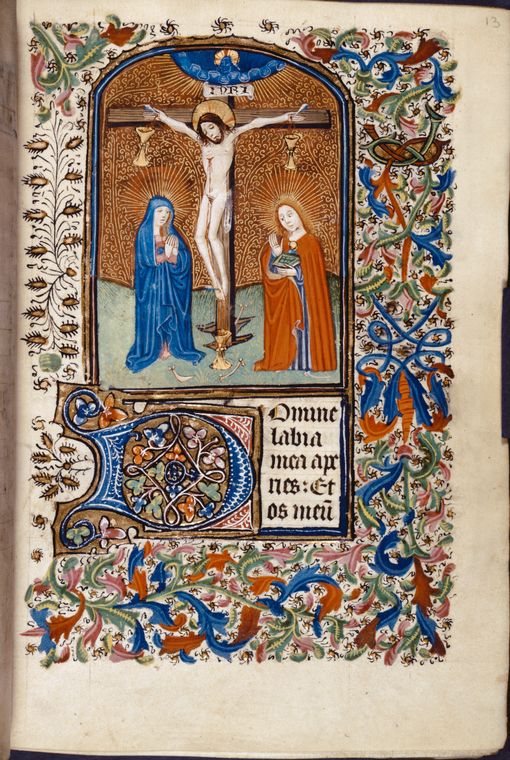
These selections make the NYPL’s digital collection seem strongly America-focused, and to an extent it is, but apart from hosting a rich repository of the history, art, and letters of the United States, it also contains such fascinating international materials as medieval European illuminated manuscripts; 16th-century handscrolls illustrating The Tale of Genji, the first novel; and 19th-century cyanotypes of British algae by botanist and photographer Anna Atkins, the first person to publish a book illustrated with photos. You can start your own browsing on the NYPL Digital Collections front page, and if you do, you’ll soon find that something else we knew about the library growing up — what good places they make in which to get lost — holds even truer on the internet.
Related Content:
100,000+ Wonderful Pieces of Theater Ephemera Digitized by The New York Public Library
Foodie Alert: New York Public Library Presents an Archive of 17,000 Restaurant Menus (1851–2008)
New York Public Library Puts 20,000 Hi-Res Maps Online & Makes Them Free to Download and Use
Based in Seoul, Colin Marshall writes and broadcasts on cities and culture. He’s at work on a book about Los Angeles, A Los Angeles Primer, the video series The City in Cinema, the crowdfunded journalism project Where Is the City of the Future?, and the Los Angeles Review of Books’ Korea Blog. Follow him on Twitter at @colinmarshall or on Facebook.
Read More...An Artful, Animated Tribute to The Wire, Created by a Fan of the Critically-Acclaimed TV Series
From director, designer, and animator Elliot Lim comes an animated tribute to his “favorite show of all time,” HBO’s The Wire – a sentiment that he shares with Pres. Obama, countless critics, and many casual TV viewers. As much as the episodes themselves, fans fondly remember The Wire’s opening credits, which functioned, Andrew Dignan once wrote, as short films that “distill each season’s themes, goals, and motifs.” The opening credits are what get the animated treatment in Lim’s video. Whether his video distills a particular set of themes, goals and motifs, I’m not yet sure. I’ll need to watch it a few more times and report back soon.
For more on The Wire and the Art of the Credit Sequence watch this 2012 video essay.
Follow Open Culture on Facebook and Twitter and share intelligent media with your friends. Or better yet, sign up for our daily email and get a daily dose of Open Culture in your inbox. And if you want to make sure that our posts definitely appear in your Facebook newsfeed, just follow these simple steps.
Related Content:
President Obama Chats with David Simon About Drugs, The Wire & Omar
The Wire as Great Victorian Novel
Charles Mingus’ Instructions For Toilet Training Your Cat, Read by The Wire’s Reg E. Cathey
Read More...How a Good Night’s Sleep — and a Bad Night’s Sleep — Can Enhance Your Creativity

Creative Commons image, “Sleep,” by Masha Krasnova-Shabaeva
You decide you need some medical advice, so you take to the internet. Whoops! There’s your first mistake. Now you are bombarded with contradictory opinions from questionable sources and you begin to develop symptoms you never knew existed. It’s all downhill from there. So I’ll say this upfront: I have no medical qualifications authorizing me to dispense information about sleep disorders. The only advice I’d venture, should you have such a problem, is to go see a doctor. It might help, or not. I can certainly sympathize. I am a chronic insomniac.
The downside to this condition is obvious. I never get enough sleep. Whenever I consult the internet about this, I learn that it’s probably very dire and that I may lose my mind or die young(ish). The upside—which I learned to master after years of trying and failing to sleep like normal people—is that the nights are quiet and peaceful, and thus a fertile time creatively.
Medical issues aside, what do we know about sleep, insomnia, and creativity? Let us wade into the fray, with the proviso that we will likely reach few conclusions and may have to fall back on our own experience to guide us. In surveying this subject, I was pleased to have my experience validated by an article in Fast Company. Well, not pleased, exactly, as the author, Jane Porter, cites a study in Science that links a lack of sleep to Alzheimer’s and the accumulation of “potentially neurotoxic waste products.”
And yet, in praise of sleeplessness, Porter also recommends turning insomnia into a “productivity tool,” naming famous insomniacs like Margaret Thatcher, Bill Clinton, Charles Dickens, Marcel Proust, and Madonna (not all of whom I’d like to emulate). She then quotes psychologist Tomas Chamorro-Premuzic of University College London, who made the dubious-sounding claim in Psychology Today that “insomnia is to exceptional achievement what mental illness is to creativity.” Everything about this analogy sounds suspect to me.
But there are more substantive views on the matter. Another study, published in Creativity Research Journal, suggests insomnia may be a symptom of “notable creative potential,” though the authors only go as far as saying the two phenomenon are “associated.” The arrow of causality may point in either direction. Perhaps the most pragmatic view on the subject comes from Michael Perlis, psychology professor at the University of Pennsylvania, who says, “What is insomnia, but the gift of more time?”
Dennis Drabelle at The Washington Post, also an insomniac, refers to a recent study (as of 2007) from the University of Canterbury that suggests “insomnia and originality may go hand in hand.” He also points out that the notion of sleeplessness as productive, though “counterintuitive,” has plenty of precedent. Drabelle mentions many more famous cases, from W.C. Fields to Theodore Roosevelt to Franz Kafka. The list could go on and on.
Actor and musician Matt Berry tells The Guardian how, after years of tossing and turning, he finally harnessed his sleepless hours to write and record an album, Music for Insomniacs. “I knew that this was dead time,” says Berry, “and I could be doing something instead of sitting worrying about not being asleep.” Another musician, Dave Bayley of band Glass Animals, “owes his career in music to insomnia,” The Guardian writes, then notes a phenomenon sleep researchers call—with some skepticism—“creative insomnia.” Other musicians like Chris Martin, Moby, Tricky, and King Krule have all suffered the condition and turned it to good account.
The Guardian also notes that each of these poor souls has found “sleepless nights inspiring as well as tormenting.” Insomnia is not, in fact a gift or talent, but a painful condition that Porter and Drabelle both acknowledge can be associated with depression, addiction, and other serious medical conditions. One might make good use of the time—but perhaps only for a time. A site called Sleepdex—-which offers “resources for better sleep”—puts it this way:
Occasional insomnia appears to help some people produce new art and work, but is a detriment to others. It is perhaps true that more people find it a detriment than find it useful. Long-term insomnia and the accompanying sleep debt are almost surely negative for creativity.
This brings us to the subject of sleep—good, restful sleep—and its relationship to creativity. Sleepdex cites several research studies from Swiss and Italian universities, UC San Diego, and UC Davis. The general conclusion is that REM sleep—that period during which dreams “are the most narratively coherent of any during the night”—is also an important stimulus for creativity. There are the numerous anecdotes from artists like Salvador Dali, Paul McCartney, and countless others about famous works of art taking shape in dream states (Keith Richards says he heard the riff from “Satisfaction” in a dream).
And there are the experimental data, purportedly confirming that REM sleep enhances “creative problem solving.” European scientists have found that people were more likely to have creative insights after a long period of restful sleep, when the right brain gets a boost. Likewise, Tom Stafford at the BBC describes the “post-sleep, dreamlike mental state—known as sleep inertia or the hypnopompic state” that infuses our “waking, directed thoughts with a dusting of dreamworld magic.” It isn’t that insomniacs don’t experience this, of course, but we have less of it, as periods of REM sleep can be shorter and often interrupted by the need to scramble out of bed and get to work or get the kids to school not long after hitting the pillow.
Stafford points us toward a UC Berkeley study (apparently the University of California has some sort of monopoly on sleep research) “that helps illustrate the power of sleep to foster unusual connections, or ‘remote associates’ as psychologists call them.” Like nearly all of the scientific literature on sleep, this study expresses little doubt about the importance of sleep to memory function and problem solving. Big Think collects several more studies that confirm the findings.
On the whole, when it comes to the links between sleep—or sleeplessness—and creativity, the data and the stories point in different directions. This is hardly surprising given the slipperiness of that thing we call “creativity.” Like “love” it’s an abstract quality everyone wants and no one knows how to make in a laboratory. If it’s extra time you’re after—and very quiet time at that—I can’t recommend insomnia enough, though I wouldn’t recommend it at all as a voluntary exercise. If it’s the special creative insights only available in dream states, well, you’d best get lots of sleep. If you can, that is. Creative insomniacs—like those wandering in the confines of a dream world—know all too well they don’t have much choice in the matter.
Related Content:
Why You Do Your Best Thinking In The Shower: Creativity & the “Incubation Period”
David Lynch Explains How Meditation Enhances Our Creativity
Josh Jones is a writer and musician based in Durham, NC. Follow him at @jdmagness
Read More...Shot-By-Shot Breakdowns of Spielberg’s Filmmaking in Jaws, Scorsese’s in Cape Fear, and De Palma’s in The Untouchables
This past summer, we featured a shot-by-shot breakdown of several sequences in Andrei Tarkovsky’s Solaris by filmmaker and video essayist Antonios Papantoniou. Solaris, as well as the rest of Tarkovsky’s oeuvre, has given and will continue to give detail-oriented cinephiles a seemingly infinite amount of material to break down, scrutinize, and explain the genius of.
But what of big Hollywood films? Do they have nothing of interest to offer? Papantoniou clearly doesn’t think so: his other Shot by Shot video essays include looks, and very close looks indeed, at Brian De Palma’s The Untouchables, Martin Scorsese’s remake of Cape Fear, and even the mother of all blockbusters, Steven Spielberg’s Jaws.
These three auteurs, all of the same generation, came up in the 1970s cohort of filmmakers who brought about the “New Hollywood,” a movement wherein young directors like Spielberg, De Palma, and Scorsese (as well as Francis Ford Coppola, George Lucas, Paul Schrader, and many others) changed the rules of classical cinema, introducing a host of subjects and techniques previously unheard of in mainstream American films. Yet they still did make mainstream American films, which required a kind of hybridization of cutting-edge sensibilities with silver-screen expectations. Papantoniou specifically examines how these directors accomplish it through the kind of shots they capture and how they cut them together.
Papantoniou’s analyses identify the visual evidence of Spielberg’s “appetite for nonstop dynamic filmmaking,” De Palma’s “own unique post-modern style” expressed through techniques like point-of-view-shots, and of how “Scorsese distincts [sic] himself by adopting more rebellious techniques.” You might get the sense of a slight awkwardness in the language here, but the images selected speak for themselves — and besides, if you took film studies classes in college, you no doubt had at least one or two professors who compensated for their odd turns of phrase with their rigorous love of cinema, and from whom you ultimately learned a great deal. Video essays like these have increasingly made it possible for anyone, without going back to college or even going in the first place, to do that kind of learning — and, whether watching Tarkovsky or Spielberg, to never watch them inattentively again.
Related Content:
Andrei Tarkovsky’s Solaris Shot by Shot: A 22-Minute Breakdown of the Director’s Filmmaking
Spielberg Reacts to the 1975 Oscar Nominations: ‘Commercial Backlash!’
Watch Steven Spielberg’s Rarely Seen 1968 Film, Amblin’
Martin Scorsese Makes a List of 85 Films Every Aspiring Filmmaker Needs to See
Revisit Martin Scorsese’s Hand-Drawn Storyboards for Taxi Driver
The 10 Hidden Cuts in Rope (1948), Alfred Hitchcock’s Famous “One-Shot” Feature Film
Chaos Cinema: A Breakdown of How 21st-Century Action Films Became Incoherent
Learn the Elements of Cinema: Spielberg’s Long Takes, Scorsese’s Silence & Michael Bay’s Shots
Signature Shots from the Films of Stanley Kubrick: One-Point Perspective
Based in Seoul, Colin Marshall writes and broadcasts on cities and culture. He’s at work on a book about Los Angeles, A Los Angeles Primer, the video series The City in Cinema, the crowdfunded journalism project Where Is the City of the Future?, and the Los Angeles Review of Books’ Korea Blog. Follow him on Twitter at @colinmarshall or on Facebook.
Read More...George Saunders Demystifies the Art of Storytelling in a Short Animated Documentary
An interesting thing happens when you read certain of George Saunders’ stories. At first, you see the satirist at work, skewering American meanness and banality with the same unsparing knife’s edge as earlier postmodernists like John Barth or Donald Barthelme. Then you begin to notice something else taking shape… something perhaps unexpected: compassion. Rather than serving as paper targets of Saunders’ dark humor, his misguided characters come to seem like real people, people he cares about; and the real target of his satire becomes a culture that alienates and devalues those people.
Take the oft-anthologized “Sea Oak,” a farcical melodrama about a dead aunt who returns reanimated to annoy and depress her downwardly mobile family members. The stage is set for a series of buffoonish episodes that, in the hands of a less mature writer, might play out to emphasize just how ridiculous these characters’ lives are, and how justifiably we—author and reader—might mock them from our perches. Saunders does not do this at all. Rather than distancing, he draws us closer, so that the characters in the story become more sympathetic and three-dimensional even as events become increasingly outlandish.
All of this humanizing is by design, or rather, we might say that empathy is baked into Saunders’ ethos—one he has articulated many times in essays, interviews, and a moving 2013 Syracuse University commencement speech. Now we can see him in a candid filmed appearance above, in a documentary titled “George Saunders: On Story” by Redglass Pictures (executive produced by Ken Burns). Created from a two-hour interview with Saunders, the short video at the top offers “a direct look at the process by which he is able to take a single mundane sentence and infuse it with the distinct blend of depth, compassion, and outright magic that are the trademarks of his most powerful work.”
In Saunders’ own words, “a good story is one that says, at many different levels, ‘we’re both human beings, we’re in this crazy situation called life, that we don’t really understand. Can we put our heads together and confer about it a little bit at a very high, non-bullshitty level?’ Then, all kinds of magic can happen.” The rest of Saunders’ fascinating monologue on story gets an animated treatment that illustrates the magic he describes. If you haven’t read Saunders, this is almost as good an introduction to him as, say, “Sea Oak.” His thoughts on the role fiction plays in our lives and the ways good stories work are always lucid, his examples vividly inventive. The effect of listening to him mirrors that of sitting in a seminar with one of the best teachers of creative writing, which Saunders happens to be as well.
I would love to take a class with him, but barring that, I’m very happy for the chance to hear him discuss writing techniques and philosophy in the short film at the top and in the interview extras below it: “On the relationship between reader and writer,” “On the tricks of the writing process,” and “In defense of darkness.” Praised by no less a postmodernist luminary than Thomas Pynchon, Saunders’ story collections like CivilWArLand in Bad Decline, Pastoralia, and In Persuasion Nation get at much of what ails us in these United States, but they do so always with an underlying hopefulness and a “non-bullshitty” conviction of shared humanity.
You can read 10 of Saunders’ stories free—including “Sea Oak” and the excellent “The Red Bow”—here.
Related Content:
The Importance of Kindness: An Animation of George Saunders’ Touching Graduation Speech
Kurt Vonnegut’s 8 Tips on How to Write a Good Short Story
Ray Bradbury Gives 12 Pieces of Writing Advice to Young Authors (2001)
Josh Jones is a writer and musician based in Durham, NC. Follow him at @jdmagness
Read More...Musicians Play Bach on the Octobass, the Gargantuan String Instrument Invented in 1850
Take a look at the live performance above of a Johann Sebastian Bach chaconne. See that monstrous stringed instrument in the back? The one that looks like a movie prop? It’s real, and it’s called the octobass, a triple bass made in 1850 by prolific French instrument maker and inventor Jean-Baptiste Vuillaume, whom German violin maker Corilon calls “the most significant violin maker of modern times.”
The huge instrument can play a full octave below the standard double bass and create sound down to 16 Hz, at the lowest threshold of human hearing and into the realm of what’s called infrasound. The octobass is so large that players have to stand on a platform, and use special keys on the side of the instrument to change the strings’ pitch since the neck is far too high to reach. (See this photo of a young boy dwarfed by an octobass for scale.)
One of two playable replicas of the original three octobasses Vuillaume made resides at the Musical Instrument Museum (MIM) in Phoenix, AZ. In the video below, MIM curator Colin Pearson gets us up close to the gargantuan bass, created, he tells us, to “add a low end rumble to any large orchestra.” That it does.
The description of the video just below advises you to “turn up your subs” to hear the demonstration by Nico Abondolo, double bass player of the LA Chamber orchestra. (Abondolo is also principle bass for several Hollywood orchestras, and he came to MIM to record samples of the octobass for the Hunger Games soundtrack.) As you’ll see in the video, the octobass is so massive, it takes five people to move it.
Abondolo plays the octobass with both his fingers and with the 3‑stringed instrument’s specially made bow, and demonstrates its system of keys and levers. “Playing the instrument is a twofold, or maybe threefold physical exertion,” he remarks. It’s also a journey into a past where “people were as crazy, or crazier about music than we are now.” Perhaps needless to say, the instrument’s bulk and the awkward physical movements required to play it mean that it cannot be played at faster tempos. And if the first thing that comes to mind when you hear Abondolo strum those low bass notes is the theme from Jaws, you’re not alone.
A number of other musicians visiting the octobass at MIM took the opportunity to goof around on the comically oversized bass and play their versions of the ominous shark approach music (above). You won’t get the full effect of the instrument unless you’re listening with a quality subwoofer with a very low bass response, and even then, almost no sub—consumer or pro—can handle the lowest pitch the octobass is capable of producing. But if you were to stand in the same room while someone played the huge triple bass, you’d certainly feel its lowest register rumbling through you.
Related Content:
The Story of the Bass: New Video Gives Us 500 Years of Music History in 8 Minutes
100 Great Bass Riffs Played in One Epic Take: Covers 60 Years of Rock, Jazz and R&B
Jazz Legend Jaco Pastorius Gives a 90 Minute Bass Lesson and Plays Live in Montreal (1982)
The Neuroscience of Bass: New Study Explains Why Bass Instruments Are Fundamental to Music
Josh Jones is a writer and musician based in Durham, NC. Follow him at @jdmagness
Read More...Immanuel Kant’s Life & Philosophy Introduced in a Short Monty Python-Style Animation
Philosopher Immanuel Kant (1724–1804) is perhaps best known for his systematic philosophical ethics, conceived of as a post-religious framework for secular morality. His primary ethical mandate, which he called the “categorical imperative,” enables us—Alain de Botton tells us in his short School of Life video above—to “shift our perspective, to get us to see our own behavior in less immediately personal terms.” It’s a philosophical version, de Botton says, of the Golden Rule. “Act only according to that maxim,” Kant famously wrote of the imperative in his Groundwork of the Metaphysics of Morals, “by which you can at the same time will that it should become a universal law.”
This guide to moral behavior seems on its face a simple one. It asks us to imagine the consequences of behavior should everyone act in the same way. However, “almost every conceivable analysis of the Groundwork has been tried out over the past two centuries,” writes Harvard professor Michael Rosen, “yet all have been found wanting in some way or other.” Friedrich Nietzsche alluded to a serious problem with what Rosen calls Kant’s “rule-utilitarianism.” How, Nietzsche asks in On the Genealogy of Morals, are we to determine whether an action will have good or bad consequences unless we have “learned to separate necessary events from chance events, to think in terms of cause and effect, to see distant events as if they were present, to anticipate them….”
Can we ever have that kind of foresight? Can we formulate rules such that everyone who acts on them will predict the same positive or negative outcomes in every situation? The questions did not seem to personally disturb Kant, who lived his life in a highly predictable, rule-bound way—even, de Botton tells us, when it came to structuring his dinner parties. But while the categorical imperative has seemed unworkably abstract and too divorced from particular circumstances and contingencies, an elaboration of the maxim has had much more appeal to contemporary ethicists. We should also, Kant wrote, “act so as to treat people always as ends in themselves, never as mere means.” De Botton provides some helpful context for why Kant felt the need to create these ethical principles.
Kant lived in a time when “the identifying feature of his age was its growing secularism.” De Botton contends that while Kant welcomed the decline of traditional religion, he also feared the consequences; as “a pessimist about human character,” Kant “believed that we are by nature intensely prone to corruption.” His solution was to “replace religious authority with the authority of reason.” The project occupied all of Kant’s career, from his work on political philosophy to that on aesthetics in the Critique of Pure Judgment. And though philosophers have for centuries had difficulty making Kant’s ethics work, his dense, difficult writing has nevertheless occupied a central place in Western thought. In his defense of the authority of reason, Kant provided us with one of the most comprehensive means for understanding how exactly human reason works—and for recognizing its many limitations.
To read Kant’s work for yourself, download free versions of his major texts in a variety of digital formats from our archive of Free Philosophy eBooks. Kant is no easy read, and it helps to have a guide. To learn how his work has been interpreted over the past two hundred years, and how he arrived at many of his conclusions, consider taking one of many online classes on Kant we have listed in our archive of Free Philosophy Courses.
Related Content:
Philosophers Drinking Coffee: The Excessive Habits of Kant, Voltaire & Kierkegaard
Man Shot in Fight Over Immanuel Kant’s Philosophy in Russia
Philosophers Drinking Coffee: The Excessive Habits of Kant, Voltaire & Kierkegaard
Josh Jones is a writer and musician based in Durham, NC. Follow him at @jdmagness
Read More...Support Us
We're hoping to rely on loyal readers, rather than erratic ads. Please click the Donate button and support Open Culture. You can use Paypal, Venmo, Patreon, even Crypto! We thank you!

About Us

Open Culture scours the web for the best educational media. We find the free courses and audio books you need, the language lessons & educational videos you want, and plenty of enlightenment in between.
Advertise With Us
FREE UPDATES!
GET OUR DAILY EMAIL
Get the best cultural and educational resources on the web curated for you in a daily email. We never spam. Unsubscribe at any time.
FOLLOW ON SOCIAL MEDIA
Open Culture editor Dan Colman scours the web for the best educational media. He finds the free courses and audio books you need, the language lessons & movies you want, and plenty of enlightenment in between.
Advertise With Us


