Slavoj Zizek Explains What’s Wrong with Online Dating & What Unconventional Technology Can Actually Improve Your Love Life
I once read a book by Larry King called How to Talk to Anyone, Anytime, Anywhere. Slavoj Zizek might well consider writing a book of his own called How to Make Intellectual Pronouncements About Anything, Anytime, Anywhere. From Beethoven’s “Ode to Joy” to political correctness to the Criterion Collection to Starbucks (and those just among the topics we’ve featured here on Open Culture) the Slovenian philosopher-provocateur has for decades demonstrated a willingness to expound on the widest possible variety of subjects, to the point where his career has begun to look like one continuous, free-associative analytical monologue, which in the Big Think video above reaches the inevitable subject: your love life.
Perhaps you’ve tried online dating — a practice that, given the increasingly thorough integration of the internet and daily life, we’ll probably soon just call “dating.” Perhaps you’ve had positive experiences with it, perhaps you’ve had negative ones, and most probably you’ve had a mixture of both, but how often can you take your mind off the awkward fact that you have to first “meet” the other person through an electronic medium, creating a version of yourself to suit that medium? Zizek calls this online dating’s problematic “aspect of self-commodification or self-manipulation.”
“When you date online,” he says, “you have to present yourself there in a certain way, putting forward certain qualities. You focus on your idea of how other people should perceive you. But I think that’s not how love functions, even at the very simple level. I think the English term is ‘endearing foibles’ — an elementary ingredient in love. You cannot ever fall in love with the perfect person. There must be some tiny small disturbing element, and it is only through noticing this element that you say, ‘But in spite of that imperfection, I love him or her.’ ”
Fair enough. But what to do about it? Zizek thinks that the way forward for romantic technologies lies not in a less technological approach, but a more technological approach — or at least a stranger technological approach. He imagines a world of “ideal sexual attraction” where “I meet a lady; we are attracted to each other; we say all the usual stuff — your place, my place, whatever, we meet there. What happens then? She comes with her plastic penis, electric dildo. I come with some horrible thing — I saw it, it’s called something like stimulating training unit — it’s basically a plastic vagina, a hole.”
Dare we examine where this scenario goes? The outcome may surprise you. They simply insert her electric dildo into his stimulating training unit, and voilà, “the machines are doing it for us, buzzing in the background, and I’m free to do whatever I want, and she.” With full tribute paid to the superego by their vulgar devices, “we have a nice talk; we have tea; we talk about movies. I talk with a lady because we really like each other. And, you know, when I’m pouring her tea, or she to me, quite by chance our hands touch. We go on touching. Maybe we even end up in bed. But it’s not the usual oppressive sex where you worry about performance. No, all that is taken care of by the stupid machines. That would be ideal sex for me today.”
Related Content:
Slavoj Žižek Examines the Perverse Ideology of Beethoven’s Ode to Joy
Slavoj Žižek Names His Favorite Films from The Criterion Collection
Slavoj Žižek Calls Political Correctness a Form of “Modern Totalitarianism”
Slavoj Žižek on the Feel-Good Ideology of Starbucks
Based in Seoul, Colin Marshall writes and broadcasts on cities and culture. He’s at work on a book about Los Angeles, A Los Angeles Primer, the video series The City in Cinema, and the crowdfunded journalism project Where Is the City of the Future? Follow him on Twitter at @colinmarshall or on Facebook.
Read More...Classic Blues Songs By John Lee Hooker, B.B. King & Muddy Waters Played on the Gayageum, a Traditional Korean Instrument
To say that most political discussions on social media lack nuance seems tantamount to pointing out that most pornography lacks romance. The thrusts, parries, and asides of the Facebook comment skirmish and the Twitterfight generally constitute performative acts rather than thoughtful interpersonal engagement. It’s more the nature of the medium than the fault of the participants; ever-churning controversy keeps the machines running. One controversial subject now trending on a network near you is the issue of Cultural Appropriation—broadly defined as the use of the symbols, language, dress, hairstyles, music, art, and other signifiers of one culture by another.
A problem arises when we leave the subject broadly defined. Power dynamics are key, but to condemn all acts of cultural appropriation as theft leaves us in a bind. How do we generate culture without it? Not all acts of borrowing are equally respectful, but without them, we could not have had the musical revolutions of rock and roll—with its appropriation of the blues—or of hip-hop, with its appropriation of disco, pop, Kung Fu movies, and everything else in a DJ’s record and video collection. Negative and positive examples can easily get jumbled together under these rubrics. To avoid getting tangled in analytical brambles, why don’t we turn instead to what I would consider a positive example of cultural appropriation: the pieces you hear in the videos here, interpretations of blues songs performed by musician Luna Lee on a Gayageum, a traditional Korean zither-like instrument.
We’ve featured Luna’s Gayageum covers before—of Jimi Hendrix’s “Voodoo Chile” and Stevie Ray Vaughan’s take on Hendrix’s “Little Wing.” Both Hendrix songs demonstrate the degree to which the rock guitarist borrowed heavily from blues idioms. Traditional blues artists themselves, of course, created and innovated through borrowing from each other and from myriad traditional sources. Are Luna’s blues performances any different? She clearly demonstrates a love and respect for the source material, and she plays it with deftness and skill, taking pleasure in musicianship, not salesmanship. Her blues covers don’t seem to have much commercial appeal, but they greatly appeal to listeners judging by the number of people her videos reach.
At the top of the post, you can hear her play John Lee Hooker’s “Boom Boom.” Below it, we have Albert King’s “Born Under a Bad Sign,” and above, B.B. King’s “The Thrill is Gone.” Lower down, hear Muddy Waters “Rollin’ and Tumblin’” (first recorded by Hambone Willie Newborn) and Elmore James’ “Dust My Broom.” Each interpretation relies on multitrack recording—Luna is either accompanied by a generic backing track or accompanies herself with a rhythm track that she plays over. Her covers of American blues classics on a traditional Korean instrument bring to the fore the intercultural accessibility of the songs and their adaptability to an instrumental context we might also consider “roots.” But as you can see from Luna’s Youtube channel, she doesn’t only adapt “roots” music. She also covers Radiohead, Frank Sinatra, Led Zeppelin, and AC/DC.
It’s likely my own bias for the blues—and for more traditional blues in particular—that makes me say so, but I think the covers represented here are her most successful. (Whether Messrs Hooker, King, King, Waters, and James would approve, I cannot say.) There’s something about hearing the Gayageum in dialogue with these songs that feels… well, if not exactly authentic at least less gimmicky than than a cover of One Republic. But ultimately, whatever your preference, if you can appreciate Luna’s instrumental skill and devotion to her source material, you’ll find something to love on her page.
She’s not in it for the money, but like every struggling artist, Luna has dreams and bills to pay. To support her work, visit her Patreon page and help contribute to her goal of playing music full time and hiring additional collaborators. In the pitch video below, Luna gives us some of her musical background and explains how she adapted the traditionally acoustic Gayageum for more rocking contemporary tunes.
Related Content:
Watch Jimi Hendrix’s ‘Voodoo Chile’ Performed on a Gayageum, a Traditional Korean Instrument
Led Zeppelin, Rolling Stones & The Beatles Played on a 3‑String Electric Mountain Dulcimer
Josh Jones is a writer and musician based in Durham, NC. Follow him at @jdmagness
Read More...When David Lynch Directed a Mini-Season of Twin Peaks in the Form of Japanese Coffee Commercials
I recently read Merry White’s Coffee Life in Japan, a history of the west’s favorite beverage in the Land of the Rising Sun. As with so many cultural imports, the Japanese first entertained a fascination with coffee, then got more serious about drinking it, then made an official place for it in their society, then got even more serious about not just drinking it but artisanally preparing and serving it, winding up with an originally foreign but now unmistakably Japanese suite of products and associated experiences. Having spent a fair bit of time in Japanese cafés myself, I can tell you that the country has some damn fine coffee.
But what about its cherry pie? Only one man could take that case: FBI Special Agent Dale Cooper, the main character of David Lynch’s groundbreakingly strange ABC television drama Twin Peaks. A great many Japanese people love coffee, but no small number also love David Lynch.
And so, when the opportunity arose to take simultaneous advantage of local enthusiasm for beverage and filmmaker alike, Georgia Coffee seized it, working in the robust tradition of Japanese advertisements starring American celebrities to reunite members of Twin Peaks’ cast, reconstruct the fictional town of Twin Peaks itself, and have Lynch direct a new mini-mini-mini-season of the show, each episode a forty-second Georgia Coffee commercial.
The first episode, “Mystery of G,” finds Cooper in the Twin Peaks Sheriff’s Department, enlisted in the search for a missing Japanese woman named Asami. He and Asami’s husband examine the first piece of evidence: an origami crane with a G on it. The second, “Lost,” introduces two more inscrutable artifacts: a photo of Asami beside a rare roadster, and a mounted deer’s head. The latter leads him to Big Ed’s Gas Farm, where in the third episode, “Cherry Pie,” he spots the car and, on its passenger seat, a mysterious wedge of red billiard balls (which, of course, reminds him of his favorite dessert). The fourth, “The Rescue,” closes the case in the woods, where Cooper finds Asami, trapped and backwards-talking, in — where else? — the red-curtained room of the extra-dimensional Black Lodge.
Every step of the solution to this mystery requires a cup of Georgia Coffee — or, rather, a can of Georgia Coffee, Georgia being one of the best-known varieties of that vending machine-ready category of beverage. The west may never have gone in for canned coffee, but Japan drinks it in enormous quantities. What better way to advertise a Japanese interpretation of coffee in the early 1990s, then, than with a Japanese interpretation of Twin Peaks? Alas, the higher-ups at Georgia Coffee didn’t ultimately think that way, giving the axe to the planned second series of Twin Peaks commercials. Maybe that’s for the best since, as for the actual taste of Georgia Coffee — well, I’ve had damn finer.
Related Content:
Japanese Movie Posters of 10 David Lynch Films
Coffee is for People, Not Robots: The New Ad for David Lynch’s Line of Organic Coffee
David Lynch’s Unlikely Commercial for a Home Pregnancy Test (1997)
David Lynch’s Perfume Ads Based on the Works of Hemingway, F. Scott Fitzgerald & D.H. Lawrence
Based in Seoul, Colin Marshall writes and broadcasts on cities and culture. He’s at work on a book about Los Angeles, A Los Angeles Primer, the video series The City in Cinema, and the crowdfunded journalism project Where Is the City of the Future? Follow him on Twitter at @colinmarshall or on Facebook.
Read More...Get to Know Socrates, Camus, Kierkegaard & Other Great Philosophers with the BBC’s Intelligent Radio Show, In Our Time
When writer, politician, and BBC radio and television personality Melvyn Bragg began his long-running radio program In Our Time, which brings academics together to discuss philosophy, history, science, religion, and culture, he didn’t think the show would last very long: “Six months,” he told The Scotsman in 2009, “but I’ll have a go.” Now, seventeen years after the show began in 1998, In Our Time is going strong, with millions of listeners from around the world who tune in on the radio, or download the In Our Time podcast. Though it’s easy to despair when faced with the onslaught of mass media devoted to triviality and sensationalism, Bragg has shown there’s still a sizable audience that cares about thoughtful engagement with matters of import, and in particular that cares about philosophy.
Though the subject takes a beating these days, especially in unfavorable comparisons to the hard sciences, the concerns articulated by philosophers over the centuries still inform our views of ethics, language, politics, and human existence writ large. In Our Time’s philosophy programs follow the same format as the show’s other topics—in Bragg’s words, he gets “three absolutely top-class academics to discuss one subject and explore as deeply as time allow[s].” In this case, the “subject,” is often a proper name, like Simone Weil, David Hume, Albert Camus, Simone de Beauvoir or Socrates.
The show just as often tackles philosophical movements like Skepticism, Neoplatonism, or The Frankfurt School, that aren’t associated with only one thinker; likewise, Bragg and his guests have devoted their discussions to longstanding philosophical problems, like the existence of Free Will, and historical developments, like the Continental-Analytic Split in Western philosophy.
Though there is certainly no shortage of high quality resources for people who wish to learn more about philosophy—such as the many free courses, podcasts, and lectures we’ve featured on this site—few are as immediately accessible as In Our Time’s philosophy discussions. Bragg describes his preparation for each show as “swotting”—or cramming. He’s not an expert, but he’s knowledgeable enough to ask pertinent questions of his guests, who then go on to educate him, and the listeners, for the almost hour-long conversation. Hear how well the approach works in the In Our Time philosophy programs featured here. At the top, Bragg discusses the philosophy and activism of Bertrand Russell with academic philosophers A.C. Grayling, Mike Beaney, and Hilary Greaves. Below that, he talks Kierkegaard with Jonathan Ree, Clare Carlisle, and John Lippitt. Just above, hear Bragg discuss Jean-Paul Sartre with Jonathan Rée, Benedict O’Donohoe, and Christina Howells. Finally, below, hear his conversation on Karl Marx with Anthony Grayling, Francis Wheen, and Stedman Jones.
These four examples are but a small sampling of the many compelling In Our Time philosophy discussions. Explore, stream, and download dozens more at the BBC Radio 4 site or hear them on Youtube and iTunes here. And if any these conversations whet your appetite for more, then head over to our expansive archive of Free Philosophy Courses, and Free Philosophy eBooks.
Related Content:
Learn The History of Philosophy in 197 Podcasts (With More to Come)
Download 100 Free Philosophy Courses and Start Living the Examined Life
Take First-Class Philosophy Courses Anywhere with Free Oxford Podcasts
Josh Jones is a writer and musician based in Durham, NC. Follow him at @jdmagness
Read More...Three Historic Performances at Paris’ Le Bataclan: The Velvet Underground (1972), Genesis with Peter Gabriel (1973) & Jeff Buckley (1995)
After every terrible tragedy in the West, we expect celebrities to weigh in. And they do, with comments insightful and heartfelt, appalling and boorish, perfunctory and banal. Often, the larger the public profile, the more self-serving the soundbite. One take in particular has provoked sneers and ridicule: Bono—who paid respects with his band at music venue Le Bataclan—told an interviewer, “this is the first direct hit on music we’ve had in this so-called War on Terror.” Twitterati, the Commentariat, and, well, folks, did not take kindly to the statement, with many pointing out an earlier “hit on music” in February and accusing U2’s frontman of making the monstrous attacks on the Paris music venue about himself.
One can understand the sentiment, without excusing the verbiage. Le Bataclan—scene of what has rightly been called a “bloodbath”—has occupied a significant place in pop music history since it started booking rock bands in the 1970s; and it has hosted famous musicians and singers—like Edith Piaf—since its opening in 1864. It does not minimize the tremendous pain of the horrific murder of 89 Eagles of Death Metal fans this past Friday to say that the assault has also deeply disturbed musicians and music fans worldwide.
Grief leads us to remembrance, and we can memorialize le Bataclan (named after the French operetta Ba-ta-clan) for its long history before last Friday’s horror. One of the most historic concerts there occurred in 1972, when John Cale reunited with his former Velvet Underground bandmates Lou Reed and Nico for acoustic renditions of “Heroin,” “The Black Angel’s Death Song,” and “Femme Fatale.” We covered that concert in a previous post. See it again at the top of this one. The following year, a band at the height of its career—or the first phase of it anyway—graced le Bataclan’s stage before going on to blow minds at London’s Shepperton Studios. Just above, see the Peter Gabriel-fronted Genesis play “The Musical Box,” “Supper’s Ready,” “Return of the Giant Hogweed,” and “The Knife.”
Too many others to name have played le Bataclan through the years—from Prince (who jammed out Zeppelin’s “Whole Lotta Love”) to Oasis. Perhaps one of the most moving performances the venue hosted came from Jeff Buckley in 1995, whose concert there was released as a live album the following year. Buckley sang his medley of Edith Piaf’s “Je N’en Connais Pas La Fin/Hymne A L’Amour” (above)—in hindsight an especially poignant rendition two years before his untimely death. “By the time Buckley switches over to French,” writes Allmusic, “the crowd erupts at the end of every phrase, catching him off guard with their enthusiasm.” He ended the show with the nearly 10-minute version of Leonard Cohen’s “Hallelujah” below, a song he became known for and that serves as well as any other as a tribute to le Bataclan in these dark days of mourning, war, and retribution. “Love is not a victory march,” sings Buckley, his voice cracking, “It’s a cold and it’s a broken Hallelujah.”
Related Content:
Watch Genesis (from the Peter Gabriel Era) Perform in a Glorious, 1973 Restored Concert Film
Lou Reed, John Cale & Nico Reunite, Play Acoustic Velvet Underground Songs on French TV, 1972
Édith Piaf’s Moving Performance of ‘La Vie en Rose’ on French TV, 1954
Josh Jones is a writer and musician based in Durham, NC. Follow him at @jdmagness
Read More...NASCAR Meets the Paranormal in Terry Gilliam’s Short Film, The Legend of Hallowdega
I think we here at Open Culture can freely own up to a deficiency in our content: despite its outsized presence in American culture, we’ve really neglected to post much about NASCAR. Luckily, film director, animator, and Monty Python member Terry Gilliam has given us reason to change our ways by shooting a short film at Alabama’s Talladega Superspeedway, one of the best-known venues for NASCAR races. But The Legend of Hallowdega, made to promote something called AMP Energy Juice, tells not a straight (or rather, constantly left-turning) story about racing, but adds another layer of intrigue: the paranormal.
That might sound like a random conceptual mashup, but a little bit of research reveals Talladega as a regular Overlook Hotel, what with its history of mysterious compulsions, freak injuries and deaths, and unexplained acts of sabotage. (Some even chalk all this up to a curse placed on the Talladega’s valley by its original Native American inhabitants, driven out for their collaboration with Andrew Jackson.) Enter tattooed, Fu-Manchu’d, bead-festooned ghost hunter Kiyash Monsef, here to answer the question, “What is the truth? And what is truer that the truth?” — the words of the khaki-wrapped host of World of the Unexplained, the fictitious, highly sensationalistic, and not especially competent television show that frames The Legend of Hallowdega’s story.
Nothing in the first few minutes of the film gives it away as a Terry Gilliam project, but as soon as it enters Monsef’s elaborate yet makeshift, thoroughly analog lair — located underneath Talladega itself — the famously imaginative director starts making his touch apparent. We could easily dismiss David Arquette’s performance as Monsef as over-the-top, but to many of us, he surely comes off as no more unfamiliar than some of the locals providing their own testimony about the curse in the interview segments. Where has the oft-lamented “old, weird America” gone? In (the American-born but British-naturalized and thus sufficiently distanced) Terry Gilliam’s eyes, it lives on, especially in places like Talladega.
Related Content:
Terry Gilliam Reveals the Secrets of Monty Python Animations: A 1974 How-To Guide
Terry Gilliam’s Lost Animations from Monty Python and the Holy Grail Are Now Online
Watch Terry Gilliam’s Animated Short, The Christmas Card (1968)
4,000+ Free Movies Online: Great Classics, Indies, Noir, Westerns, Documentaries & More
Colin Marshall writes elsewhere on cities, language, Asia, and men’s style. He’s at work on a book about Los Angeles, A Los Angeles Primer, the video series The City in Cinema, and the crowdfunded journalism project Where Is the City of the Future? Follow him on Twitter at @colinmarshall or on Facebook.
Read More...Hear the Writing of French Theorists Jacques Derrida, Jean Baudrillard & Roland Barthes Sung by Poet Kenneth Goldsmith
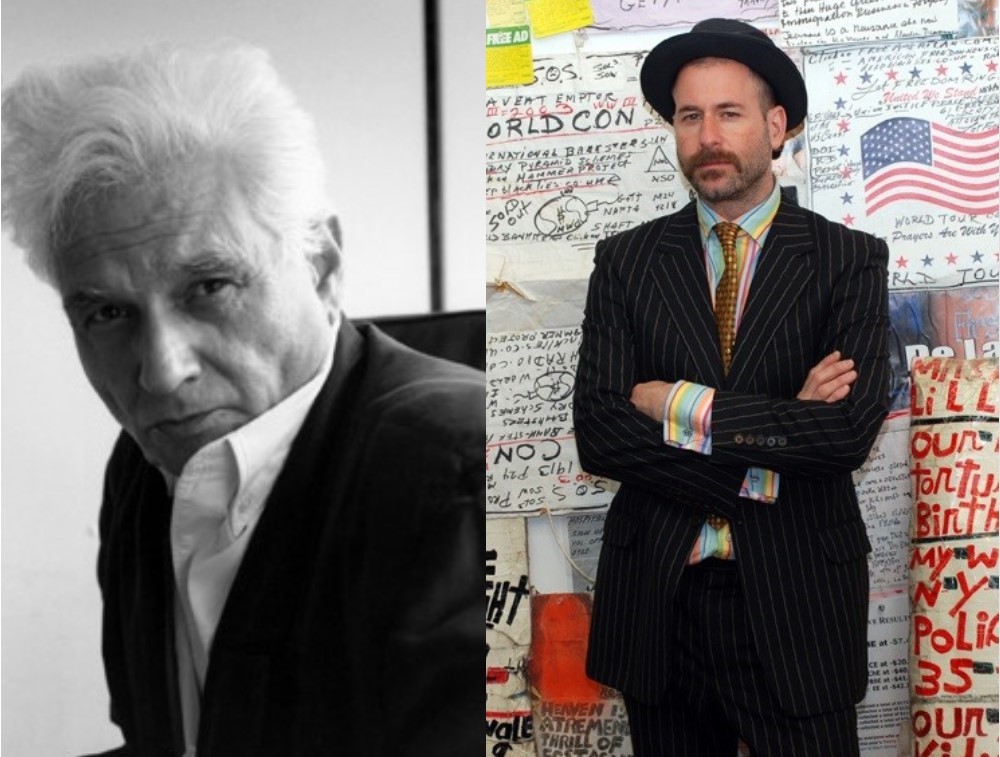
Jacques Derrida, Jean Baudrillard, Roland Barthes… to my freshman ears, the names of these French theorists sounded like passwords to an occult world of strange and forbidding ideas. I started college in the mid-90s, when English departments gleefully claimed poststructuralism as their birthright. Academic campaigns against the fuzzy logic of these thinkers had not yet gathered much steam, though conservative culture warriors were already on the warpath against postmodernism. Very shortly after my introduction to French poststructuralist thought, analytical positivists launched formidable campaigns to banish critical theory to the margins.
The backlash against obscurantist theory made a good case, with public shamings like the “Sokal Hoax” and Philosophy and Literature’s Bad Writing Contest. Such displays made the work of many European philosophers and their adherents seem indeed—as Noam Chomsky said of Derrida, Slavoj Žižek, and Jacques Lacan—like so much vacuous “posturing.” But as potent as these critiques may be, I’ve never cared much for them; they seem to miss the point of more creative kinds of theory, which is not, I think (as philosophy professor Eric Schwitzgebel alleges) “intellectual authoritarianism and cowardice,” but instead an exploratory attempt to expand the rigid boundaries of language and cognition, and to enact the meanderings of discursive thought in prose that captures its “errantry” (to take a term from Martiniquan poet, novelist, and academic Edouard Glissant.)
In any case, the debate was not new at all, but only a later iteration of the old Continental/Analytic divide that has long pitted exponents of Anglophone clarity against the sometimes awkward prose of thinkers like Kant and Hegel. And I happen to think that Kant, Hegel, and, yes, even later Continentals like Derrida—despite the deliberate obscurity of their writing—are interesting thinkers who deserve to be read. They even deserve to be sung, badly, by poets—namely by conceptual poet Kenneth Goldsmith, who is also founding editor of Ubuweb, senior editor of PennSound, and onetime host of a radio show on gloriously weird, free-form radio station WFMU.
With his natty sense of style and serious appreciation for absurdity, Goldsmith has sung to listeners the work of Walter Benjamin, Ludwig Wittgenstein, and Sigmund Freud; he has given us an avant-garde musical rendition of Harry Potter; and he has turned selections of Theodor Adorno’s grim Minima Moralia into 80s hardcore punk. Now, we bring you more of Goldsmith’s musical interventions: his goofball singing of Derrida over an icy minimalist composition by Anton Webern (top); of Baudrillard over a lounge-pop instrumental by Francis Lai (middle); and of Roland Barthes over the Allman Brothers (above).
As an added bonus, if you can call it that, hear Goldsmith warble Marxist theorist Frederic Jameson over Coltrane, just above. Do these ridiculous musical exercises make these thinkers any easier to digest? I doubt it. But they do seem to say to the many haters of critical theory and postmodern French philosophy, “hey, lighten up, will ya?”
Related Content:
Noam Chomsky Slams Žižek and Lacan: Empty ‘Posturing’
John Searle on Foucault and the Obscurantism in French Philosophy
30 Minutes of Harry Potter Sung in an Avant-Garde Fashion by UbuWeb’s Kenneth Goldsmith
Theodor Adorno’s Critical Theory Text Minima Moralia Sung as Hardcore Punk Songs
Josh Jones is a writer and musician based in Durham, NC. Follow him at @jdmagness
Read More...How Cultured Are You? Test Your Knowledge With Cultural Quizzes from 1958
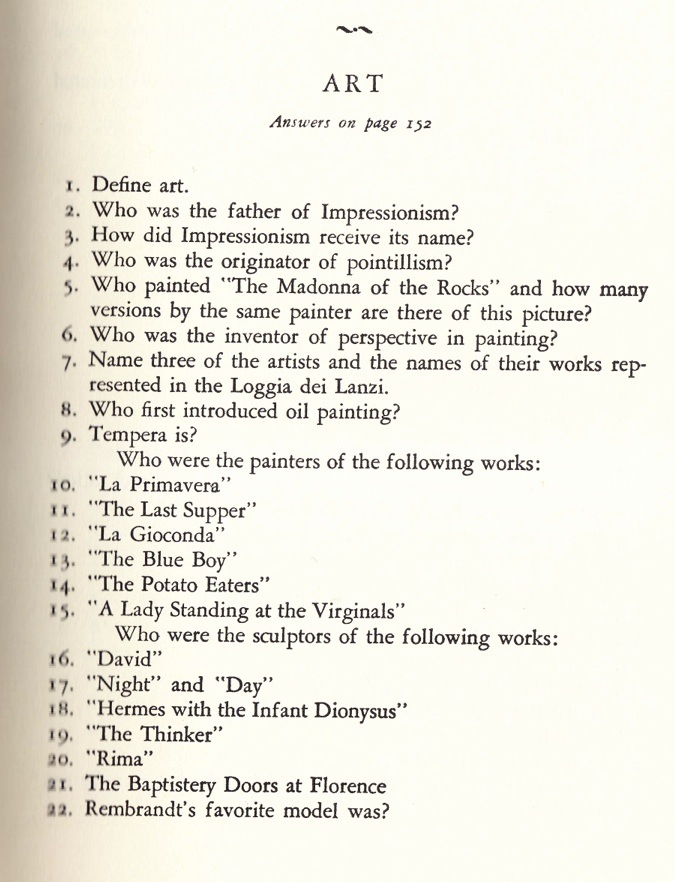
Do you consider yourself well-educated? Cultured, even? By whose standards?
We may superficially assume these terms name immutable qualities, but they are in any analysis dependent on where and when we happen to be situated in history. The most sophisticated of Medieval doctors—a title then closer to the European “docent” than our general use of Dr.—would appear profoundly ignorant to us; and we, with our painfully inadequate grasp of church Latin, Aristotelianism, and arcane theological arguments, would appear profoundly ignorant to him.
What does it mean to be cultured? Is it the acquisition of mostly useless cultural capital for its own sake, or of a set of codes that helps us navigate the world successfully? In an attempt to address these fraught questions, Ashley Montagu, a student of hugely influential German-born anthropologist Franz Boas, wrote The Cultured Man in 1958. Rebecca Onion at Slate describes the book as containing “quizzes for 50 categories of knowledge in the arts and sciences, with 30 questions each.” In the page above, we have the first 22 questions of Montagu’s “Art” quiz (with the answers here).
You’ll probably notice right away that while most of the questions have definite, unambiguous answers, others like “Define art,” seem patently unanswerable in all but the most general and unsatisfactory ways. Montagu defines art in one succinct sentence: “Art is the making or doing of things that have form and beauty”—which strikes me as anemic, though functional enough.
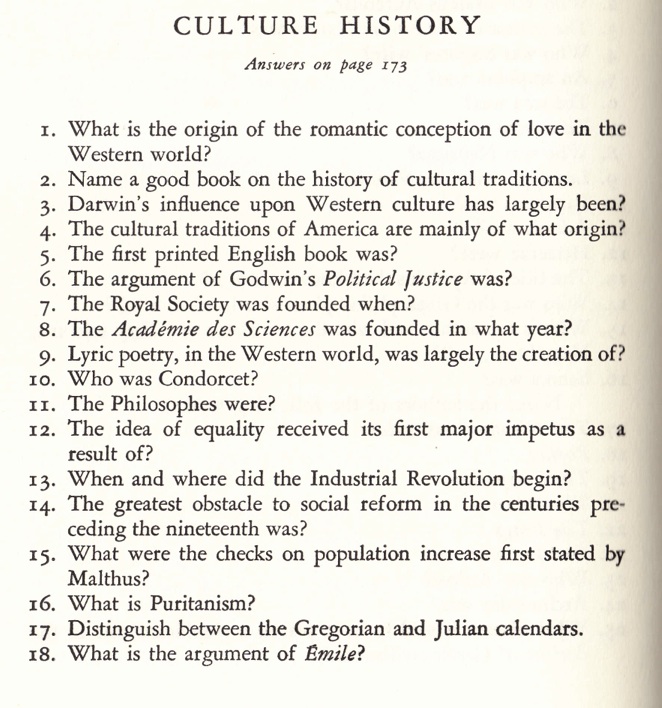
Montagu intended his book to test not only knowledge of cultural facts, but also of “attitudes”: a person “considered ‘cultured,’” writes Onion, “would not just be able to readily summon facts, but also to access humane feelings, which would necessarily come about after contact with culture.” Many administrators of “culture”—curators, art historians, literature professors, etc—would agree with the premise: ideally, the more cultural knowledge we acquire, the more empathy and understanding of other peoples and cultures we should manifest. Whether this routinely occurs in practice is another matter. For Montagu, Onion remarks, a “cultured man” is “curious, unprejudiced, rational, and ethical.”

Given Montagu’s enlightened philosophical bent, we can charitably ascribe language in his book that itself seems prejudiced to our viewing this artifact from a distance of almost seventy years in the future. We might also find that many of his questions push us to examine our 21st century biases more carefully. His approach may remind us of frivolous internet diversions or the standardized tests we’ve grown to think of as the precise opposite of lively, critically-engaged educational tools. Yet Montagu intended his quizzes to be “both dynamic and constructive,” to alert readers to areas of ignorance and encourage them to fill gaps in their cultural knowledge. Many of his answers offer references for further study. “No one grows who stands still,” he wrote.
To see more of Montagu’s quiz questions—such as those above from the “Culture History” category (get the answers here)—and find out how you stack up against the cultured elite of the 50s, head over to Rebecca Onion’s post at Slate.
Related Content:
Hermann Rorschach’s Original Rorschach Test: What Do You See? (1921)
Take the 146-Question Knowledge Test Thomas Edison Gave to Prospective Employees (1921)
Josh Jones is a writer and musician based in Durham, NC. Follow him at @jdmagness
Read More...What Is Déjà Vu? Michio Kaku Wonders If It’s Triggered by Parallel Universes
I’ve spent the past week on a road trip across America, and, during it, experienced perhaps my most intense case of déjà vu ever. Rolling into Memphis for the first time in my life, I walked into the lobby of the hotel at which I’d reserved a room for the night and immediately felt, in every fiber of my being, that I’d walked into that lobby before. But I then realized exactly why: it followed the same floor plan, to the last detail — the same front desk, the same business center computers, the same café with the same chalkboard asking me to “Try Our Classic Oatmeal” — of the one I’d visited the previous day in Oklahoma City.
Should we chalk this up to generic American placemaking at its most efficient, or can we find a more interesting psychological phenomenon at work? Michio Kaku, though best known for his work with physics, has some ideas of his own about what we experience when we experience déjà vu. “There is a theory,” says Kaku in the Big Think video above,“that déjà vu simply elicits fragments of memories that we have stored in our brain, memories that can be elicited by moving into an environment that resembles something that we’ve already experienced.”
But wait! “Is it ever possible on any scale,” he then tantalizingly asks, “to perhaps flip between different universes?” And does déjà vu tell us anything about our position in those universes, giving us signs of the others even as we reside in just one? Kaku quotes an analogy first made by physicist Steven Weinberg which frames the notion of a “multiverse” in terms of our vibrating atoms and the frequency of a radio’s signal: “If you’re inside your living room listening to BBC radio, that radio is tuned to one frequency. But in your living room there are all frequencies: radio Cuba, radio Moscow, the Top 40 rock stations. All these radio frequencies are vibrating inside your living room, but your radio is only tuned to one frequency.” And sometimes, for whatever reason, we hear two signals on our radio at once.
Given that, then, maybe we feel déjà vu when the atoms of which we consist “no longer vibrate in unison with these other universes,” when “we have decoupled from them, we have decohered from them.” It may relieve you to know there won’t be an exam on all this. While Kaku ultimately grants that “déjà vu is probably simply a fragment of our brain eliciting memories and fragments of previous situations,” you may get a kick out of putting his multiverse idea in context with some more traditional explanations, such as the ones written about in venues no less dependable than Scientific American and Smithsonian. But in any case, I beg you, Marriott Courtyard hotels: change up your designs once in a while.
Related Content:
Michio Kaku Explains the Physics Behind Absolutely Everything
Michio Kaku Schools a Moon Landing-Conspiracy Believer on His Science Fantastic Podcast
Colin Marshall writes elsewhere on cities, language, Asia, and men’s style. He’s at work on a book about Los Angeles, A Los Angeles Primer, the video series The City in Cinema, and the crowdfunded journalism project Where Is the City of the Future? Follow him on Twitter at @colinmarshall or on Facebook.
Read More...The Worlds of Hitchcock & Kubrick Collide in a Surreal Mashup, The Red Drum Getaway
If you read Open Culture even casually, you know we love Alfred Hitchcock, Stanley Kubrick, and videos that make us see film in a new way. It only makes sense, then, that we’d jump right on Adrien Dezalay, Emmanuel Delabaere, and Simon Philippe’s The Red Drum Getaway, which mashes Hitchcock and Kubrick up into a four-minute shot of distilled cinematic collision. “Jimmy was having a rather beautiful day,” reads the video’s preparatory description, “until he bumped into Jack and things got weird.”
“Jimmy” refers, of course, to Jimmy Stewart as seen in the work of Alfred Hitchcock. “Jack” refers to Jack Nicholson seen in the work of Stanley Kubrick — which, of course, means Jack Nicholson of The Shining. Strange enough, you might think, that those two would ever encounter each other, but what might happen if the gang of droogs from A Clockwork Orange also turned up? Or if poor mild-mannered Jimmy found himself at the aristocratic, NSFW fetish party from Eyes Wide Shut?
When an auteur successfully taps into our subconscious minds, as Hitchcock and Kubrick so often did, we describe their work, in a complimentary sense, as “dreamlike.” But art that feels like a dream can also feed material to our nightmares, and as The Red Drum Getaway more closely intertwines these two disparate cinematic worlds as it goes, it begins to resemble the most harrowing filmic freakouts any of us have ever endured. It makes a perfect setting for Jack, who, as we know, has already gone insane due to his own alcoholism and the goading of the spirits who haunt the Overlook Hotel. And as for Jimmy, surely Vertigo put him through enough of the surreal to prepare him for the psychedelic end of 2001.
Related Content:
The Two Gentlemen of Lebowski: What If The Bard Wrote The Big Lebowski?
Dark Side of the Rainbow: Pink Floyd Meets The Wizard of Oz in One of the Earliest Mash-Ups
Watch Steven Soderbergh’s Creative Mashup of Hitchcock and Gus Van Sant’s Psycho Films
Discover the Life & Work of Stanley Kubrick in a Sweeping Three-Hour Video Essay
Alfred Hitchcock’s Seven-Minute Editing Master Class
Salvador Dalí Creates a Dream Sequence for Spellbound, Hitchcock’s Psychoanalytic Thriller
Colin Marshall writes elsewhere on cities, language, Asia, and men’s style. He’s at work on a book about Los Angeles, A Los Angeles Primer, the video series The City in Cinema, and the crowdfunded journalism project Where Is the City of the Future? Follow him on Twitter at @colinmarshall or on Facebook.
Read More...Support Us
We're hoping to rely on loyal readers, rather than erratic ads. Please click the Donate button and support Open Culture. You can use Paypal, Venmo, Patreon, even Crypto! We thank you!

About Us

Open Culture scours the web for the best educational media. We find the free courses and audio books you need, the language lessons & educational videos you want, and plenty of enlightenment in between.
Advertise With Us
FREE UPDATES!
GET OUR DAILY EMAIL
Get the best cultural and educational resources on the web curated for you in a daily email. We never spam. Unsubscribe at any time.
FOLLOW ON SOCIAL MEDIA
Open Culture editor Dan Colman scours the web for the best educational media. He finds the free courses and audio books you need, the language lessons & movies you want, and plenty of enlightenment in between.
Advertise With Us

