Download Original Bauhaus Books & Journals for Free: Gropius, Klee, Kandinsky, Moholy-Nagy & More
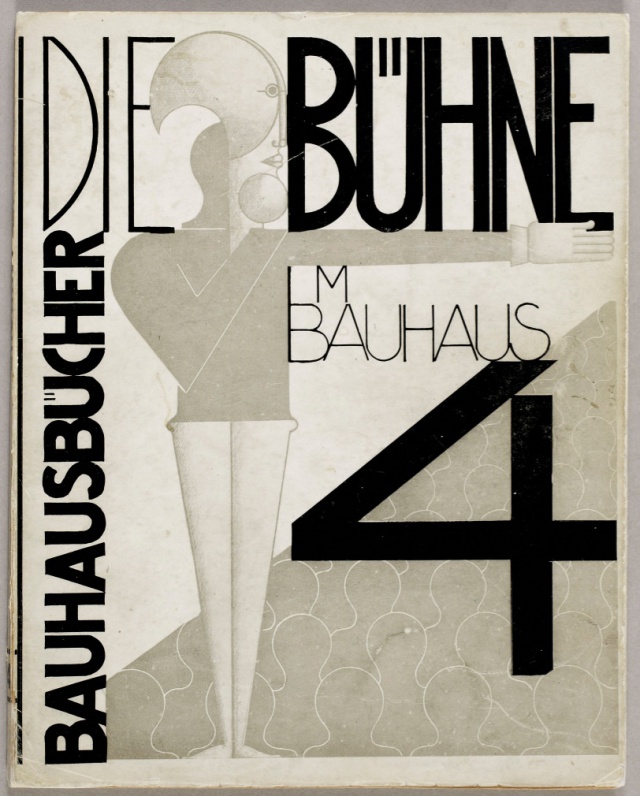
In 1919, German architect Walter Gropius founded Bauhaus, the most influential art school of the 20th century. Bauhaus defined modernist design and radically changed our relationship with everyday objects. Gropius wrote in his manifesto Programm des Staatlichen Bauhauses Weimar that “There is no essential difference between the artist and the artisan.” His new school, which featured faculty that included the likes of Paul Klee, László Moholy-Nagy, Josef Albers and Wassily Kandinsky, did indeed erase the centuries-old line between applied arts and fine arts.
Bauhaus architecture sandblasted away the ornate flourishes common with early 20th century buildings, favoring instead the clean, sleek lines of industrial factories. Designer Marcel Breuer reimagined the common chair by stripping it down to its most elemental form. Herbert Bayer reinvented and modernized graphic design by focusing on visual clarity. Gunta Stölzl, Marianne Brandt and Christian Dell radically remade such diverse objects as fabrics and tea kettles.
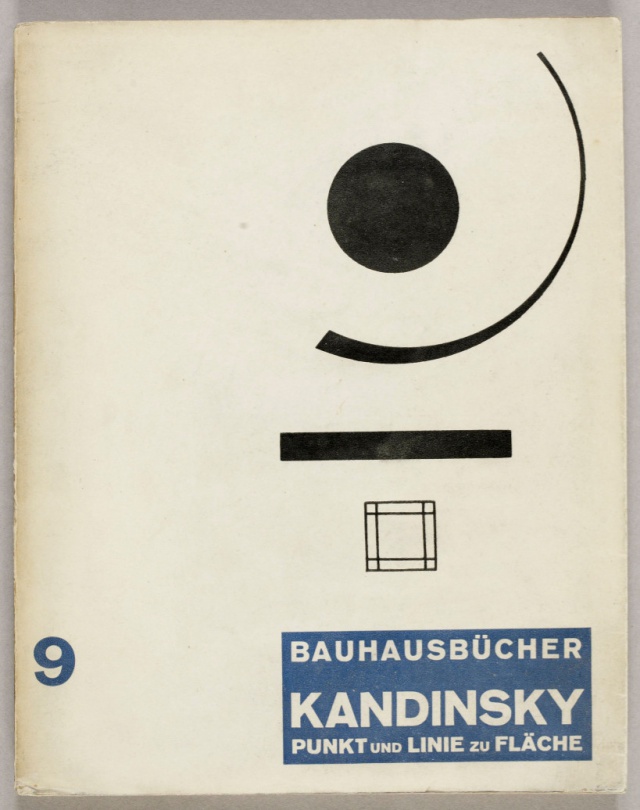
Nowadays, of course, getting one of those Bauhaus tea kettles, or even an original copy of Gropius’s manifesto, would cost a small fortune. Fortunately for design nerds, typography mavens and architecture enthusiasts everywhere, the good folks over at Monoskop have posted online a whole set of beautifully designed publications from the storied school.
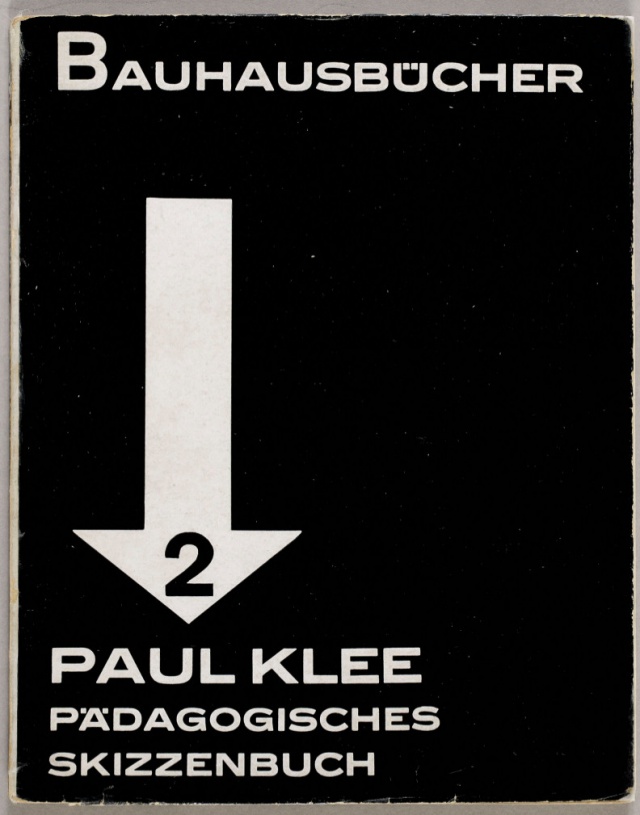
Click here to pick out individual works or here to just get all of them. Sadly, though, you can’t download a teakettle.
The list of Books in the Monoskop Bauhaus archive includes:
- 1. Walter Gropius (ed.), Internationale Architektur, Munich: Albert Langen, 1925.
- 2. Paul Klee, Pädagogisches Skizzenbuch, Munich: Albert Langen, 1925, 50 pp.
- Pedagogical Sketchbook, intro. & trans. Sibyl Moholy-Nagy, New York: Frederick A. Praeger, 1953 (in English)
- Παιδαγωγικό Σημειωματάριο, trans. Β. Λαγοπούλου, 1976. (in Greek)
- Pedagogikheskie eskizy, trans. N. Druzhkovoy, 2005. (in Russian)
- 3. Adolf Meyer (ed.), Ein Versuchshaus des Bauhauses in Weimar, Munich: Albert Langen, 1924.
- 4. Die Bühne am Bauhaus, Munich: Albert Langen, 1925.
- The Theater of the Bauhaus, trans. Arthur S. Wensinger, Middletown, Conn.: Wesleyan University Press, 1961. (in English)
- 5. Piet Mondrian, Neue Gestaltung, Neoplastizimus, Nieuwe Beelding, Munich: Albert Langen, 1925.
- 6. Theo van Doesburg, Grundbegriffe der neuen gestaltenden Kunst, Munich: Albert Langen, 1925.
- Principles of Neo-Plastic Art, London: Lund Humphries, 1969. (in English)
- 7. Walter Gropius (ed.), Neue Arbeiten der Bauhauswerkstäffen, Munich: Albert Langen, 1925.
- 8. L. Moholy-Nagy, Malerei, Fotografie, Film, Munich: Albert Langen, 1925, 115 pp; 2nd ed., 1927, 140 pp. Incl. “Dynamik der Gross-Stadt.”
- Painting Photography Film, trans. Janet Seligman, London: Lund Humphries, 1969. (in English)
- 9. Kandinsky, Punkt und Linie zu Fläche: Beitrag zur Analyse der malerischen Elemente, Munich: Albert Langen, 1926.
- Point and Line to Plane: Contribution to the Analysis of the Pictorial Elements, trans. Howard Dearstyne and Hilla Rebay, New York: Solomon R. Guggenheim Foundation, 1947, 200 pp. (in English)
- 10. J.J.P. Oud, Holländische Architektur, Munich: Albert Langen, 1929.
- 11. Kasimir Malewitsch, Die gegenstandslose Welt, Munich: Albert Langen, 1927.
- 12. Walter Gropius, Bauhausbauten Dessau, Munich: Albert Langen, 1930.
- 13. Albert Gleizes, Kubismus, Munich: Albert Langen, 1928.
- 14. László Moholy-Nagy, Von Material zur Architektur, Munich: Albert Langen, 1929, 241 pp; facsimile repr., Mainz and Berlin: Florian Kupferberg, 1968.
- The New Vision: From Material to Architecture, trans. Daphne M. Hoffman, New York: Breuer Warren and Putnam, 1930; exp.rev.ed. as The New Vision and Abstract of an Artist, New York: George Wittenborn, 1947, 92 pp. (in English)
And here are some key Bauhaus journals:
- bauhaus 1 (1926). 5 pages, 42 cm. Download (23 MB).
- bauhaus: zeitschrift für bau und gestaltung 2:1 (Feb 1928). Download (17 MB).
- bauhaus: zeitschrift für gestaltung 3:1 (Jan 1929). Download (17 MB).
- bauhaus: zeitschrift für gestaltung 3:2 (Apr-Jun 1929). Download (15 MB).
- bauhaus: zeitschrift für gestaltung 3:3 (Jul-Sep 1929). Download (16 MB).
- bauhaus: zeitschrift für gestaltung 2 (Jul 1931). Download (15 MB).
Get more in the Monoskop Bauhaus archive.
Related Content:
The Homemade Hand Puppets of Bauhaus Artist Paul Klee
Time Travel Back to 1926 and Watch Wassily Kandinsky Create an Abstract Composition
Bauhaus, Modernism & Other Design Movements Explained by New Animated Video Series
Jonathan Crow is a Los Angeles-based writer and filmmaker whose work has appeared in Yahoo!, The Hollywood Reporter, and other publications. You can follow him at @jonccrow. And check out his blog Veeptopus, featuring lots of pictures of vice presidents with octopuses on their heads. The Veeptopus store is here.
Read More...100,000+ Wonderful Pieces of Theater Ephemera Digitized by The New York Public Library
Living in New York, it’s not unusual to encounter ardent theater lovers who’ve carefully preserved decades worth of programs, tickets, and ephemera from every play they’ve ever seen. These collections can get a bit hoarder‑y, as anyone who’s ever sorted through the belongings of a recently departed lifelong audience member can attest.
If theater is dead — as gloomy Cassandras have been predicting since the advent of screens — these monoliths of Playbills and stubs constitute one hell of a tomb.
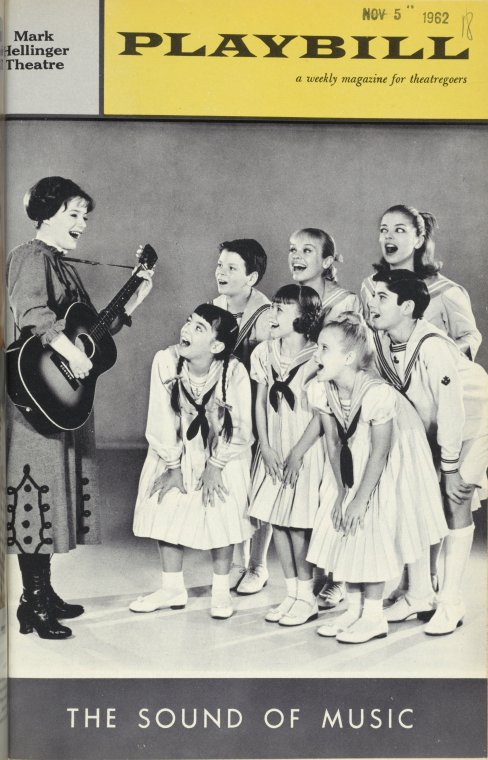
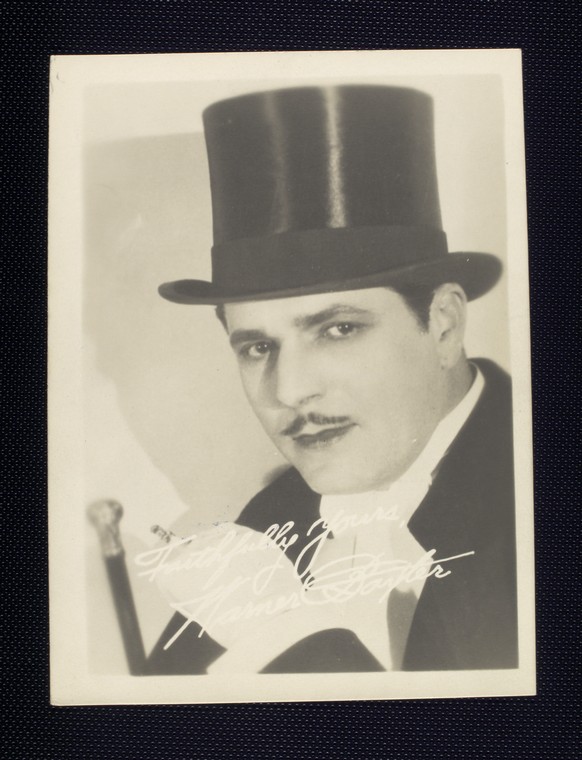
(Go ahead, toss that 1962 program to The Sound of Music…and why not drive a stake through poor Uncle Maurice’s cold, dead heart while you’re at it? All he ever wanted was to sit, eyes shining in the dark, and maybe hang around the stage door in hopes of scoring Academy Award winner, Warner Baxter’s autograph, below. )
For those of us who conceive of theatre as a still-living entity, the New York Public Library’s recent decision to start digitizing its Billy Rose Theatre Division archive is cause for celebration. Such grand scale commitment to this art form’s past ensures that it will enjoy a robust future. Hopefully someday all of the approximately 10 million items in the Billy Rose archive can be accessed from anywhere in the world. But, for now, you can start with over 100,000 items. The comparatively small percentage available now is still a boon to directors, designers, writers, and performers looking for inspiration.
It’s also wildly fun for those of us who never made it much past playing a poinsettia in the second grade holiday pageant.
Truly, there’s something for everyone. The library singles out a few tantalizing morsels on its website:
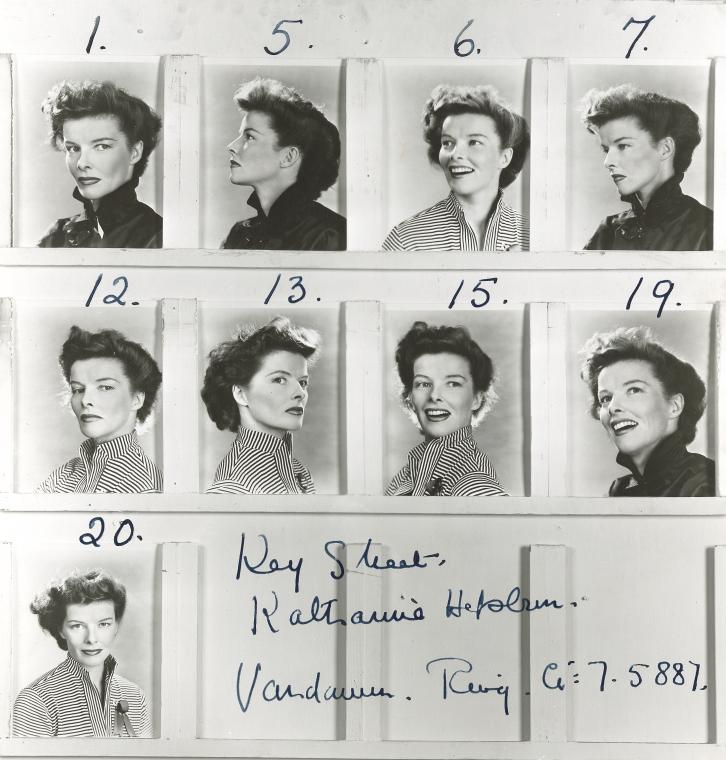
A researcher can examine a 1767 program for a performance of Romeo and Juliet in Philadelphia, study Katharine Hepburn’s personal papers (ed. note: witness the many moods of Kate, above), review Elia Kazan’s working script and notes for the original production of A Streetcar Named Desire, examine posters for Harry Houdini’s performances, read a script for an episode of Captain Kangaroo, view set designs for the original production of Guys & Dolls and costume designs for the Ziegfeld Follies, analyze a videotape of the original production of A Chorus Line, and find rich subject files and scrapbooks that document the most popular and obscure performances from across the centuries.
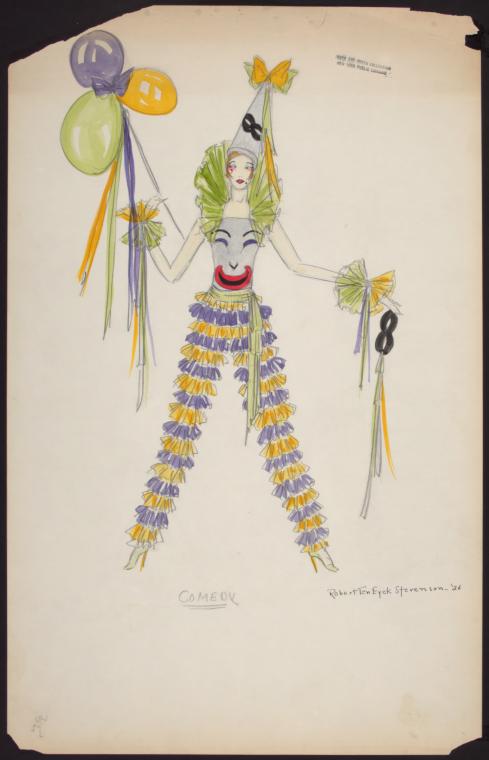
You might also prowl for Halloween costumes. What kid wouldn’t want to trick or treat as one of Robert Ten Eyck Stevenson’s 1926 designs for the Greenwich Village Follies?
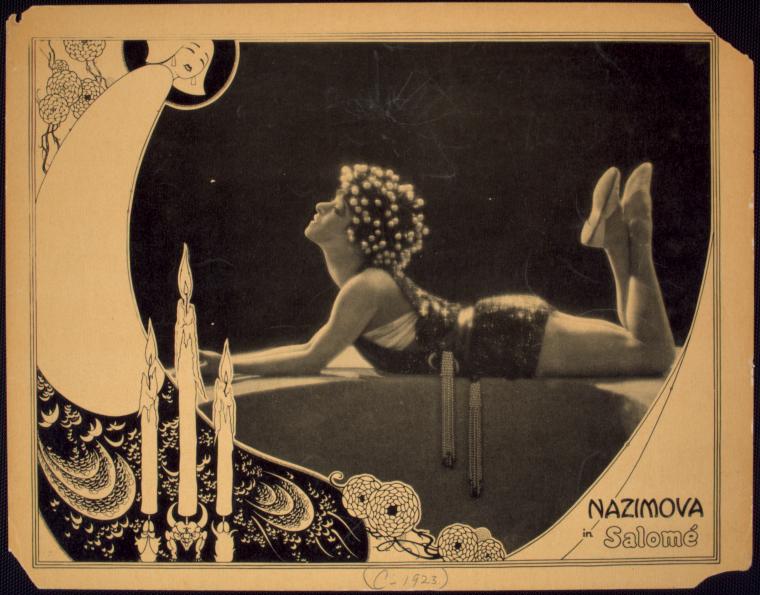
There’s certainly no shame in mooning over a forgotten star… for the record, the one above is Alla Nazimova in Salomé.

And there’s something galvanizing about seeing a familiar star escaping the confines of her best known role, the only one for which she is remembered, truth be told…
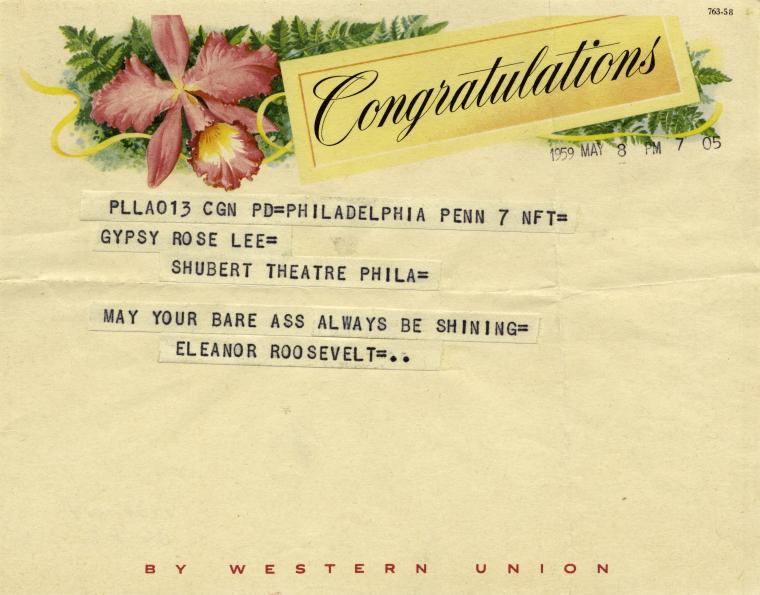
For me, the hands down pearl of the collection is the telegram at the top of the page. Former First Lady Eleanor Roosevelt sent it Gypsy Rose Lee to herald the re-opening of Gypsy, the musical based on her life.
For the uninitiated, telegrams were once an opening night tradition, as was staying up to read the review in the early edition, hot off the press.
More information on visiting the archive, online or in person, can be found here.
Related Content:
Take a Virtual Tour of Shakespeare’s Globe Theatre
New York Public Library Puts 20,000 Hi-Res Maps Online & Makes Them Free to Download and Use
2,200 Radical Political Posters Digitized: A New Archive
Ayun Halliday is an author, illustrator, and performer, whose latest play, Fawnbook, opens in New York this fall. Follow her @AyunHalliday
Read More...The Drawings & Paintings of Richard Feynman: Art Expresses a Dramatic “Feeling of Awe”
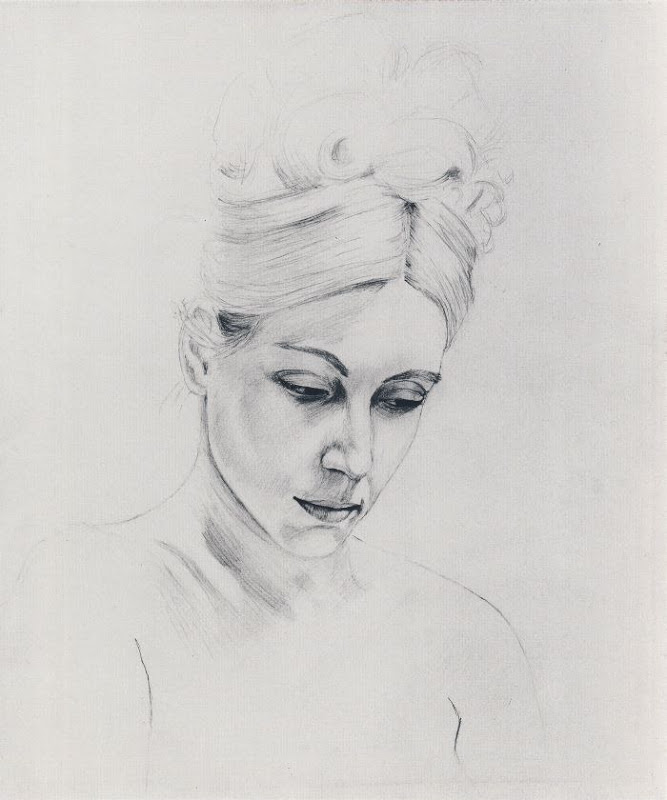
I first encountered bongo-playing physicist Richard Feynman in a college composition class geared toward science majors. I was not, mind you, a science major, but a disorganized sophomore who registered late and grabbed the last available seat in a required writing course. Skeptical, I thumbed through the reading in the college bookstore. As I browsed Surely You’re Joking, Mr. Feynman!—the first of many popular memoirs released by the affable contrarian scientist—the humanist in me perked up. Here was a guy who knew how to write; a theoretical physicist who spoke the language of everyday people.

Feynman cultivated his populist persona to appeal to those who might be otherwise turned off by abstract, abstruse scientific concepts. Like Carl Sagan and Neil deGrasse Tyson, his name has come to stand for the best examples of popular science communication. It is often through one of Feynman’s accessible, non-specialist books or presentations that people learn of his work with the Manhattan project, his contributions to quantum mechanics, and his Nobel Prize. But Feynman’s extracurricular pursuits—from safe-cracking to drumming to experimenting with LSD—were also genuine expressions of his idiosyncratic character, as was another of his passions for which he is not very well known: art.
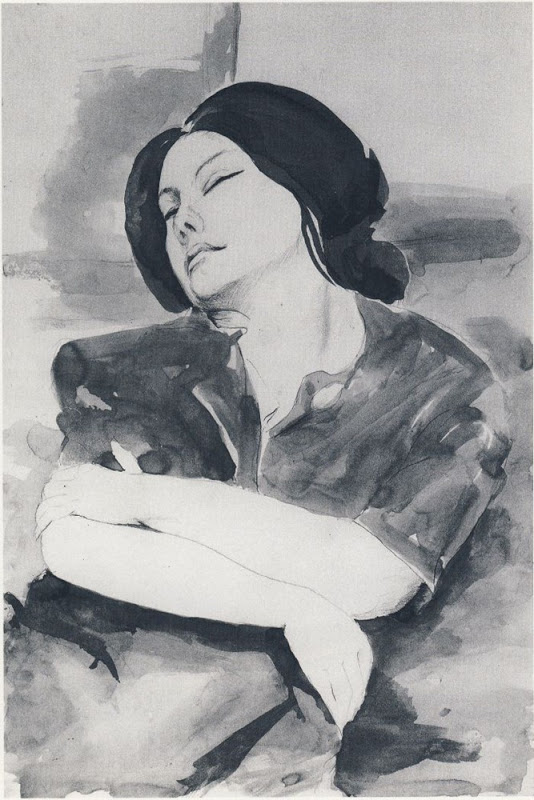
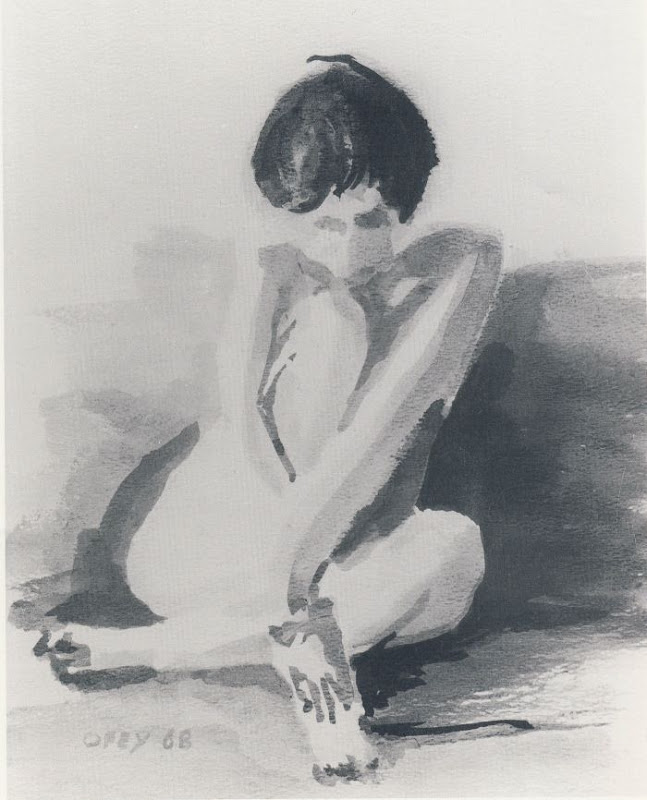
Feynman took up the pursuit at the age of 44, and continued to draw and paint for the rest of his life, signing his work “Ofey.” Many of his drawings display the awkward, off-kilter perspective of the beginner, and a great many others look very accomplished indeed. In an introductory essay to a published collection of his artwork, Feynman describes what motivated him to take up this particular avocation:
I wanted very much to learn to draw, for a reason that I kept to myself: I wanted to convey an emotion I have about the beauty of the world. It’s difficult to describe because it’s an emotion. It’s analogous to the feeling one has in religion that has to do with a god that controls everything in the universe: there’s a generality aspect that you feel when you think about how things that appear so different and behave so differently are all run ‘behind the scenes’ by the same organization, the same physical laws. It’s an appreciation of the mathematical beauty of nature, of how she works inside; a realization that the phenomena we see result from the complexity of the inner workings between atoms; a feeling of how dramatic and wonderful it is. It’s — of scientific awe — which I felt could be communicated through a drawing to someone who had also had that emotion. I could remind him, for a moment, of this feeling about the glories of the universe.
As you can see above, he took his work seriously. Most of his drawings consist of portraits and nudes, with the occasional landscape or still life. You can see more extensive galleries of Feynman’s art at AmusingPlanet, Museum Syndicate and Brain Pickings.
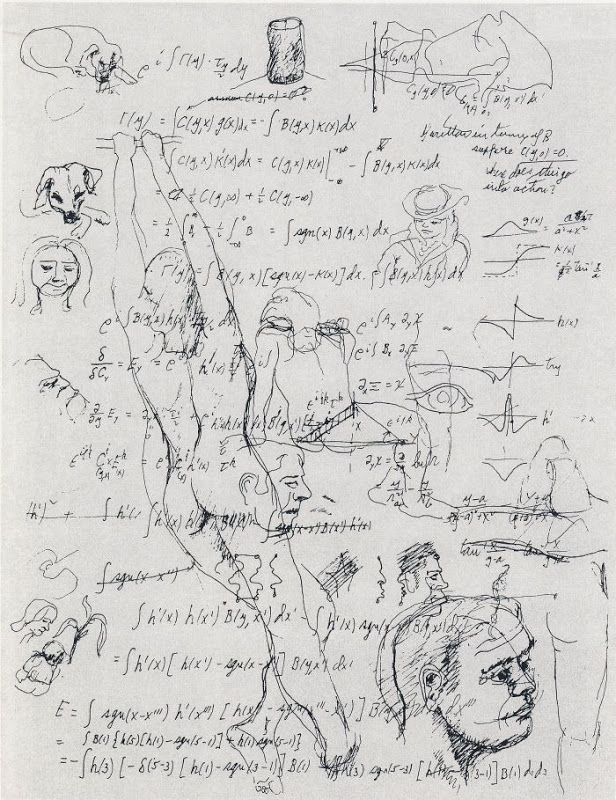
Feynman’s preoccupation—and full immersion—in the relationship between the arts and sciences marks him as a Renaissance man in perhaps the purest definition of the term: his approach closely resembles that of Leonardo da Vinci, a likeness that comes to the fore in the work below, which is either a collection of sketches doodled over with formulae, or a collection of formulae covered with doodles. Either way, it’s a perfect representation of the visionary mind of Feynman and his regard for ordinary language, people, and objects—and for “scientific awe.”
Related Content:
Learn How Richard Feynman Cracked the Safes with Atomic Secrets at Los Alamos
Josh Jones is a writer and musician based in Durham, NC. Follow him at @jdmagness
Read More...How Did David Fincher Become the Kubrick of Our Time? A New, 3.5 Hour Series of Video Essays Explains
Most film-lovers must long for the next Stanley Kubrick, a new thematically adventurous, aesthetically rigorous, big budget-commanding, and take-after-take perfectionistic cinematic visionary for our time. But some film-lovers believe our time already has its own Stanley Kubrick in David Fincher, director of such highly acclaimed pictures as Fight Club, Zodiac, The Social Network, The Game, and Seven — excuse me, Se7en. And just like Kubrick, Fincher didn’t start off at that level of the game. No, his career first gathered momentum with commercials, a bunch of music videos for the likes of The Motels, Paula Abdul, and Rick Springfield, and of course, Alien 3 — excuse me, Alien3.
So what exactly went wrong with that critically savaged yet (we now realize) auteur-directed chapter of the Alien franchise? That question gets addressed in detail early on in the latest multi-part video essay from Cameron Beyl’s Directors Series.
You may remember that we featured the Directors Series’ previous essay in April, but if you don’t, it shouldn’t surprise you to learn that it examined the Kubrick oeuvre. Beyl ended it with a declaration of his own membership in the aforementioned Fincher-Is-Our-Kubrick club, and cinephiles all over the internet thrilled to his announcement of Fincher as his next object of analysis.
To date, five episodes of The Directors Series: David Fincher have come out, which deal with Fincher’s career as follows:
- “Baptism By Fire” (Rick Springfield’s music videos and The Beat of the Life Drum, assorted music videos and commercials, Alien 3)
- “Redemption & Triumph” (assorted commercials, Se7en)
- “Capturing the Zeitgeist” (The Game, Fight Club, Panic Room)
- “Into the Digital Realm” (various commercials and music videos, Zodiac, The Curious Case of Benjamin Button)
- “The Bleeding Edge”
Even though the series hasn’t yet reached The Social Network, The Girl with the Dragon Tattoo, and Gone Girl, you won’t come away from the case Beyl has assembled so far unconvinced of Fincher’s influences, preferences, and obsessions: crime, decay, punk, obsolete technology, architecture, surveillance, corporate and personal wealth, unusual illustrative visual effects, colors like blue and orange in high contrast, nihilism, predecessors like Ridley and Tony Scott — the list goes on, and will go on as long as Fincher’s career does. It says a great deal about his filmmaking skill and style that his work has become so widely known for both its overwhelmingly “gritty, grimy” and overwhelmingly “cold, clinical” look and feel. But if any director can ever arrive at this sort of towering, contradictory reputation, Fincher can, and if any video essays can explain how he did, the Directors Series can.
Related Content:
The Filmmaking Craft of David Fincher Demystified in Two Video Essays
Discover the Life & Work of Stanley Kubrick in a Sweeping Three-Hour Video Essay
Colin Marshall writes elsewhere on cities, language, Asia, and men’s style. He’s at work on a book about Los Angeles, A Los Angeles Primer, the video series The City in Cinema, and the crowdfunded journalism project Where Is the City of the Future? Follow him on Twitter at @colinmarshall or on Facebook.
Read More...Jack Kerouac’s Poetry & Prose Read/Performed by 20 Icons: Hunter S. Thompson, Patti Smith, William S. Burroughs, Johnny Depp & More

Image by Tom Palumbo, via Wikimedia Commons
Last year, we featured a few readings and performances of the work of Jack Kerouac by musicians like Patti Smith, John Cale, Thurston Moore, and Joe Strummer. Those tracks got laid down for 1997’s Kerouac: Kicks Joy Darkness , a tribute to the author of On the Road and The Dharma Bums and an American cultural presence as resonant as they come. Now, you can listen to the whole thing on Spotify (whose free software you can download here) and revel in renditions of Kerouac’s poetry and prose by an even wider selection of beloved alternative musicians: Warren Zevon, Pearl Jam’s Eddie Vedder, REM’s Michael Stipe, Sonic Youth’s Lee Ranaldo show up on the roster, to name but a few.
It also features contributions from a great many subculture-defining non-musicians, including writers like Hunter S. Thompson and William S. Burroughs, comedian Richard Lewis, actor Matt Dillon, poet Maggie Estep, and a genuine Beat eminence like Lawrence Ferlinghetti. It even brings in cultural figures who, though known for other pursuits, also established enough of a side career in music to hold their own in the recording studio, like Johnny Depp and The Basketball Diaries author Jim Carroll. We even hear Kerouac as interpreted with the help of no less a lifelong musician — and no less unexpected a musician on an album like this — than Aerosmith’s Steven Tyler.
“Fourteen of the 25 tracks on this 79½-minute disc are drawn from Kerouac’s poetry book Pomes All Sizes ,” writes All Music Guide’s William Ruhlmann. “The rest come from his novels (nothing from On the Road, though) and letters, with some unpublished work also included.” Ruhlmann points out Kerouac’s own lack of enthusiasm for rock and preference for jazz, highlighting Ranaldo, Zevon, Dillon, and Lewis’ contributions as closest to the man’s own sensibility. But altogether, he writes, they “present a good sampling of Kerouac’s literary concerns, and, whether appropriate or not, the recordings demonstrate his extensive influence” — a perfect demonstration of how the cool of one era can inspire the cool of another.
Kerouac: Kicks Joy Darkness will be added to our list of collection, 1,000 Free Audio Books: Download Great Books for Free.
Related Content:
Jack Kerouac Lists 9 Essentials for Writing Spontaneous Prose
Pull My Daisy: 1959 Beatnik Film Stars Jack Kerouac and Allen Ginsberg
Jack Kerouac Reads from On the Road (1959)
Jack Kerouac’s Naval Reserve Enlistment Mugshot, 1943
Colin Marshall writes on cities, language, Asia, and men’s style. He’s at work on a book about Los Angeles, A Los Angeles Primer, and the video series The City in Cinema. Follow him on Twitter at @colinmarshall or on Facebook.
Read More...Albert Einstein & Sigmund Freud Exchange Letters and Debate How to Make the World Free from War (1932)
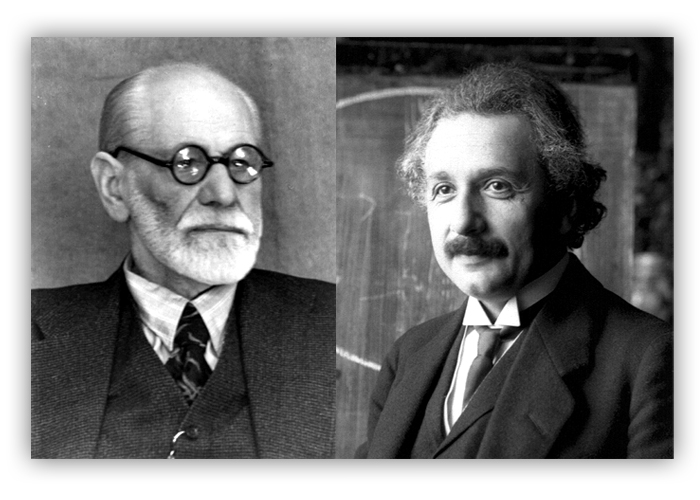
The problem of violence, perhaps the true root of all social ills, seems irresolvable. Yet, as most thoughtful people have realized after the wars of the twentieth century, the dangers human aggression pose have only increased exponentially along with globalization and technological development. And as Albert Einstein recognized after the nuclear attacks on Hiroshima and Nagasaki—which he partly helped to engineer with the Manhattan Project—the aggressive potential of nations in war had reached mass suicidal levels.
After Einstein’s involvement in the creation of the atomic bomb, he spent his life “working for disarmament and global government,” writes psychologist Mark Leith, “anguished by his impossible, Faustian decision.” Yet, as we discover in letters Einstein wrote to Sigmund Freud in 1932, he had been advocating for a global solution to war long before the start of World War II. Einstein and Freud’s correspondence took place under the auspices of the League of Nation’s newly-formed International Institute of Intellectual Cooperation, created to foster discussion between prominent public thinkers. Einstein enthusiastically chose Freud as his interlocutor.
In his first letter to the psychologist, he writes, “This is the problem: Is there any way of delivering mankind from the menace of war?” Well before the atomic age, Einstein alleges the urgency of the question is a matter of “common knowledge”—that “with the advance of modern science, this issue has come to mean a matter of life and death for Civilization as we know it.”
Einstein reveals himself as a sort of Platonist in politics, endorsing The Republic’s vision of rule by elite philosopher-kings. But unlike Socrates in that work, the physicist proposes not city-states, but an entire world government of intellectual elites, who hold sway over both religious leaders and the League of Nations. The consequence of such a polity, he writes, would be world peace—the price, likely, far too high for any world leader to pay:
The quest of international security involves the unconditional surrender by every nation, in a certain measure, of its liberty of action—its sovereignty that is to say—and it is clear beyond all doubt that no other road can lead to such security.
Einstein expresses his proposal in some sinister-sounding terms, asking how it might be possible for a “small clique to bend the will of the majority.” His final question to Freud: “Is it possible to control man’s mental evolution so as to make him proof against the psychosis of hate and destructiveness?”
Freud’s response to Einstein, dated September, 1932, sets up a fascinating dialectic between the physicist’s perhaps dangerously naïve optimism and the psychologist’s unsentimental appraisal of the human situation. Freud’s mode of analysis tends toward what we would now call evolutionary psychology, or what he calls a “’mythology’ of the instincts.” He gives a mostly speculative account of the prehistory of human conflict, in which “a path was traced that led away from violence to law”—itself maintained by organized violence.
Freud makes explicit reference to ancient sources, writing of the “Panhellenic conception, the Greeks’ awareness of superiority over their barbarian neighbors.” This kind of proto-nationalism “was strong enough to humanize the methods of warfare.” Like the Hellenistic model, Freud proposes for individuals a course of humanization through education and what he calls “identification” with “whatever leads men to share important interests,” thus creating a “community of feeling.” These means, he grants, may lead to peace. “From our ‘mythology’ of the instincts,” he writes, “we may easily deduce a formula for an indirect method of eliminating war.”
And yet, Freud concludes with ambivalence and a great deal of skepticism about the elimination of violent instincts and war. He contrasts ancient Greek politics with “the Bolshevist conceptions” that propose a future end of war and which are likely “under present conditions, doomed to fail.” Referring to his theory of the competing binary instincts he calls Eros and Thanatos—roughly love (or lust) and death drives—Freud arrives at what he calls a plausible “mythology” of human existence:
The upshot of these observations, as bearing on the subject in hand, is that there is no likelihood of our being able to suppress humanity’s aggressive tendencies. In some happy corners of the earth, they say, where nature brings forth abundantly whatever man desires, there flourish races whose lives go gently by; unknowing of aggression or constraint. This I can hardly credit; I would like further details about these happy folk.
Nonetheless, he says wearily and with more than a hint of resignation, “perhaps our hope” that war will end in the near future, “is not chimerical.” Freud’s letter offers no easy answers, and shies away from the kinds of idealistic political certainties of Einstein. For this, the physicist expressed gratitude, calling Freud’s lengthy response “a truly classic reply…. We cannot know what may grow from such seed.”
This exchange of letters, contends Humboldt State University philosophy professor John Powell, “has never been given the attention it deserves.… By the time the exchange between Einstein and Freud was published in 1933 under the title Why War?, Hitler, who was to drive both men into exile, was already in power, and the letters never achieved the wide circulation intended for them.” Their correspondence is now no less relevant, and the questions they address no less urgent and vexing. You can read the complete exchange at professor Powell’s site here.
Related Content:
Albert Einstein Reads ‘The Common Language of Science’ (1941)
Listen as Albert Einstein Calls for Peace and Social Justice in 1945
The Famous Letter Where Freud Breaks His Relationship with Jung (1913)
Sigmund Freud Appears in Rare, Surviving Video & Audio Recorded During the 1930s
Josh Jones is a writer and musician based in Durham, NC. Follow him at @jdmagness
Read More...Marilyn Monroe Recounts Her Harrowing Experience in a Psychiatric Ward in a 1961 Letter

By the end of 1960, Marilyn Monroe was coming apart.
She spent much of that year shooting what would be her final completed movie – The Misfits (see a still from the trailer above). Arthur Miller penned the film, which is about a beautiful, fragile woman who falls in love with a much older man. The script was pretty clearly based on his own troubled marriage with Monroe. The production was by all accounts spectacularly punishing. Shot in the deserts of Nevada, the temperature on set would regularly climb north of 100 degrees. Director John Huston spent much of the shoot ragingly drunk. Star Clark Gable dropped dead from a heart attack less than a week after production wrapped. And Monroe watched as her husband, who was on set, fell in love with photographer Inge Morath. Never one blessed with confidence or a thick skin, Monroe retreated into a daze of prescription drugs. Monroe and Miller announced their divorce on November 11, 1960.
A few months later, the emotionally exhausted movie star was committed by her psychoanalyst Dr. Marianne Kris to the Payne Whitney Psychiatric Clinic in New York. Monroe thought she was going in for a rest cure. Instead, she was escorted to a padded cell. The four days she spent in the psych ward proved to be among the most distressing of her life.
In a riveting 6‑page letter to her other shrink, Dr. Ralph Greenson, written soon after her release, she detailed her terrifying experience.
There was no empathy at Payne-Whitney — it had a very bad effect — they asked me after putting me in a “cell” (I mean cement blocks and all) for very disturbed depressed patients (except I felt I was in some kind of prison for a crime I hadn’t committed. The inhumanity there I found archaic. They asked me why I wasn’t happy there (everything was under lock and key; things like electric lights, dresser drawers, bathrooms, closets, bars concealed on the windows — the doors have windows so patients can be visible all the time, also, the violence and markings still remain on the walls from former patients). I answered: “Well, I’d have to be nuts if I like it here.”
Monroe quickly became desperate.
I sat on the bed trying to figure if I was given this situation in an acting improvisation what would I do. So I figured, it’s a squeaky wheel that gets the grease. I admit it was a loud squeak but I got the idea from a movie I made once called “Don’t Bother to Knock”. I picked up a light-weight chair and slammed it, and it was hard to do because I had never broken anything in my life — against the glass intentionally. It took a lot of banging to get even a small piece of glass — so I went over with the glass concealed in my hand and sat quietly on the bed waiting for them to come in. They did, and I said to them “If you are going to treat me like a nut I’ll act like a nut”. I admit the next thing is corny but I really did it in the movie except it was with a razor blade. I indicated if they didn’t let me out I would harm myself — the furthest thing from my mind at that moment since you know Dr. Greenson I’m an actress and would never intentionally mark or mar myself. I’m just that vain.
During her four days there, she was subjected to forced baths and a complete loss of privacy and personal freedom. The more she sobbed and resisted, the more the doctors there thought she might actually be psychotic. Monroe’s second husband, Joe DiMaggio, rescued her by getting her released early, over the objections of the staff.
You can read the full letter (where she also talks about reading the letters of Sigmund Freud) over at Letters of Note. And while there, make sure you pick up a copy of the very elegant Letters of Note book.
Related Content:
The 430 Books in Marilyn Monroe’s Library: How Many Have You Read?
Marilyn Monroe Reads Joyce’s Ulysses at the Playground (1955)
Marilyn Monroe Reads Walt Whitman’s Leaves of Grass (1952)
Marilyn Monroe Explains Relativity to Albert Einstein (in a Nicolas Roeg Movie)
Jonathan Crow is a Los Angeles-based writer and filmmaker whose work has appeared in Yahoo!, The Hollywood Reporter, and other publications. You can follow him at @jonccrow. And check out his blog Veeptopus, featuring lots of pictures of vice presidents with octopuses on their heads. The Veeptopus store is here.
Read More...Judy!: 1993 Judith Butler Fanzine Gives Us An Irreverent Punk-Rock Take on the Post-Structuralist Gender Theorist
Punk rock and its accoutrements—including the handmade, Xeroxed ‘zine—pass into history, replaced by Taylor Swift and Snapchat, or whatever. But as a piece of history, the ‘zine will always stand as a marker of a particular era, of the 80s/early 90s explosion of critical consciousness fostered by young kids reading Nietzsche, Foucault, and Camus, then forming their own bands, labels, and networks. Crucial to the period is the emergence of Riot Grrrl bands like Bikini Kill and their assault on oppressive gender politics, in punk rock and everywhere else. And crucial to many such punks’ understanding of gender was the work of critical theorist Judith Butler.
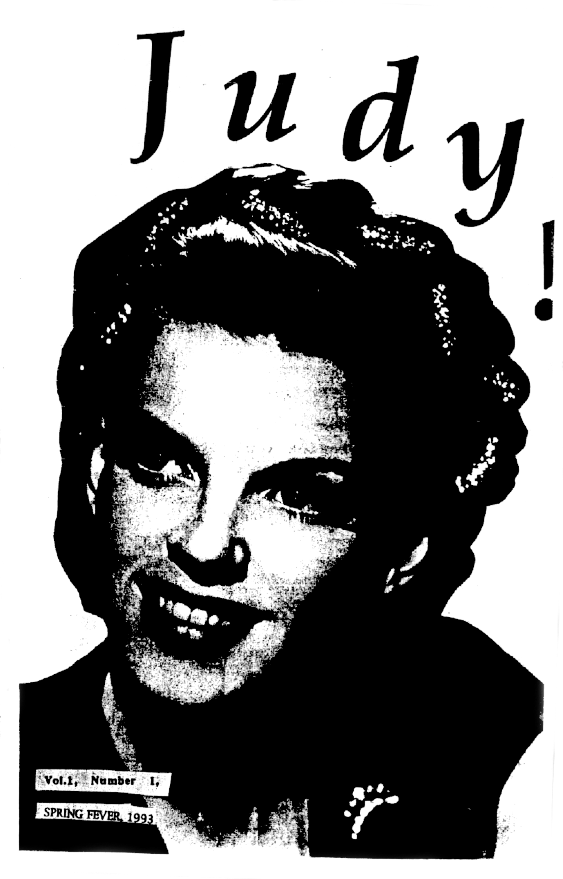
“Riot Grrrl didn’t herald the beginnings of third wave feminism,” writes Sophia Satchell Baeza in Canvas, “we’ll give that to the emergence of post-structuralist Queer theory, and the work of Judith Butler—but it did help define it aesthetically as much as formally for a new generation of indignant feminists.” An essential part of that aesthetic—the ‘zine—spread the tenets of Riot Grrrl anger, determination, and irony to cities far and wide. And, in 1993, a group of intellectual scenesters created the ultimate punk homage to Butler’s undeniable influence: Judy!, an honest-to-goodness Judith Butler fanzine, complete with murky, mimeographed photo spreads and serial killer typescript. (See the cover at the top, with photo of Judy Garland.) “Let’s talk about that real glamour gal of theory, Judy Butler,” begins one free-form introductory essay.
She’s especially good to see live, if you can. Her performances are rife with witty repartee about her mom or whatever and the three times I’ve seen her, she’s been sporting little tailored black jackets. She’s a bit Gap but she’s still a fox.
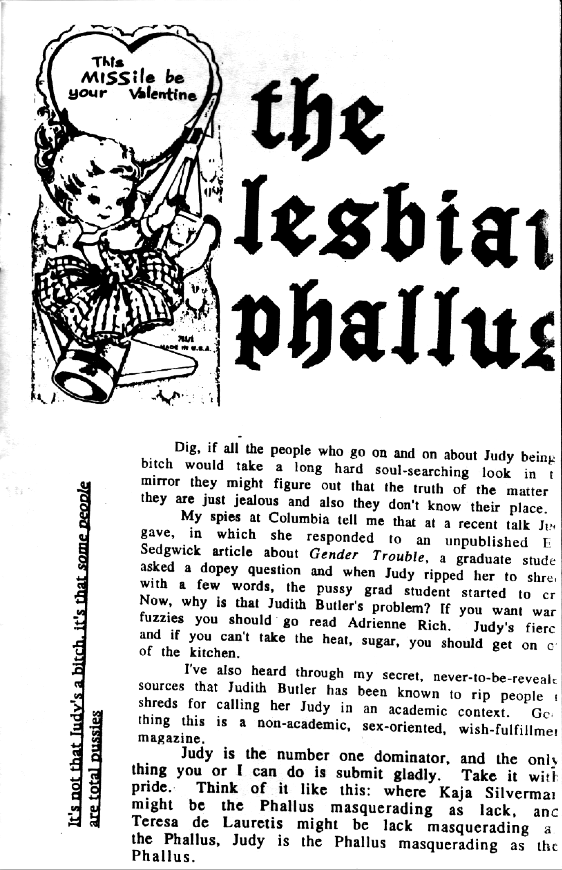
This cavalier hipster tone hides the voice of a likely grad student, who mentions M.L.A. (the Modern Language Association’s conference), and other post-structuralist theorists like Gayatri Spivak, Eve Sedgwick, and Julia Kristeva. There are footnotes and references to Butler’s classic Gender Trouble amidst much more irreverent, catty rhetoric like “Judy is the number one dominator, and the only thing you or I can do is submit gladly.” It’s great fun, if that’s what you’re into—and if you get the combo of ‘zine aesthetic and academic feminist theory. There’s even a quiz to test your knowledge of the latter’s high priestess professors and inscrutable argot: “are you a theory-fetishizing biscuithead?”
As much as it knowingly pokes fun at itself, in both form and content the artifact represents a perfect hybridization of streetwise mid-nineties punk rock and challenging mid-nineties high feminist theory. Central to the latter, Judith Butler challenges cultural norms in ways that very much inform our popular understanding of gender and sexuality today. And ‘zine culture, though it may appear mostly in museums and retrospectives these days, lives on in spirit in the work of hip, cultural mavens like Rookie’s Tavi Gevinson. Above, see Butler discuss her theory of gender performativity. And Read the entire issue of Judy!, the fanzine, here.
via Progressive Geographies
44 Essential Movies for the Student of Philosophy
Josh Jones is a writer and musician based in Durham, NC. Follow him at @jdmagness.
Read More...How Can I Know Anything at All? BBC Animations Feature the Philosophy of Wittgenstein, Hume, Popper & More
How did everything begin? What makes us human? What is the self? How do I live a good life? What is love? We’ve all asked these questions, if only within our heads, and recently a series of BBC animations written by philosopher Nigel Warburton and narrated by a variety of celebrities have done their level best to answer them–or at least to point us in the direction of answering them for ourselves by not just telling but wittily showing us what great minds have thought and said on the issues before we came along. Most recently, they’ve taken on that eternal conundrum, “How can I know anything at all?”
The already philosophically inclined will have recognized this as the foundational question of epistemology, that formidable branch of philosophy concerned with what we know, how we know, and whether we can know in the first place. Many familiar names in the history of philosophy have stepped onto this field, including Ludwig Wittgenstein, with whose thoughts this series of extremely brief explanatory videos begins. It lays out his analogy of the beetle in a box, wherein each person holds a box containing what they call a “beetle,” but nobody can look inside another’s box to confirm whether their idea of a beetle aligns with anyone else’s.
In Wittgenstein’s view, says actor Aidan Turner, “there can’t be more to the public meaning of a language than we’re capable of teaching each other, and the private ‘something’—the ‘beetle’—can’t have a role in that teaching, because we can’t get at it.” The next video, in asking whether we should believe in miracles, brings in Scottish Enlightenment thinker David Hume, who thought that “if we follow the rule of proportioning our beliefs to the available evidence, there will always be more evidence that the eyewitness accounts were mistaken than not.” Hume’s predecessor George Berkeley makes an appearance to weigh in on whether anything exists—or, more precisely, whether anything exists besides our minds, which convince us that we experience real things out there in the world.
Finally, the series lands on a method we can use to know, one science has relied on, with seeming success, for quite some time now: Karl Popper’s idea of falsification. “Rather than looking for supporting evidence, Popper argued that scientists go out of their way to refute their own hypotheses, testing them to destruction,” leaving those that remain, at least provisionally, as knowledge. Though none of these videos exceed two minutes in length, each one, dense with both philosophical and pop-cultural references, will leave you with more knowledge about epistemology than you went in with—assuming they don’t leave you disbelieving in knowledge itself.
Related Content:
140 Free Online Philosophy Courses
What is Love? BBC Philosophy Animations Feature Sartre, Freud, Aristophanes, Dawkins & More
What Makes Us Human?: Chomsky, Locke & Marx Introduced by New Animated Videos from the BBC
Colin Marshall writes on cities, language, Asia, and men’s style. He’s at work on a book about Los Angeles, A Los Angeles Primer, and the video series The City in Cinema. Follow him on Twitter at @colinmarshall or on Facebook.
Read More...How to Bake Ancient Roman Bread Dating Back to 79 AD: A Video Primer
Ecce panis—try your hand at the kind of loaf that Mel Brooks’ 2000-year-old man might have sunk his teeth into. Literally.
In 1930 a loaf of bread dating to AD 79 (the year Vesuvius claimed two prosperous Roman towns) was excavated from the site of a bakery in Herculaneum.
Eighty-three years later, the British Museum invited London chef Giorgio Locatelli, above, to take a stab at creating an edible facsimile for its Pompeii Live exhibition.
The assignment wasn’t as easy as he’d anticipated, the telegenic chef confesses before whipping up a lovely brown miche that appears far more mouth watering than the carbonized round found in the Herculaneum oven.
His recipe could be mistaken for modern sourdough, but he also has a go at several details that speak to bread’s role in ancient Roman life:
Its perimeter has a cord baked in to provide for easy transport home. Most Roman homes were without ovens. Those who didn’t buy direct from a bakery took their dough to community ovens, where it was baked for them overnight.
The loaf was scored into eight wedges. This is true of the 80 loaves found in the ovens of the unfortunate baker, Modestus. Locatelli speculates that the wedges could be used as monetary units, but I suspect it’s more a business practice on par with pizza-by-the-slice.
(Nowadays, Roman pizza is sold by weight, but I digress.)
The crust bears a telltale stamp. Locatelli takes the opportunity to brand his with the logo of his Michelin-starred restaurant, Locanda Locatelli. His inspiration is stamped ‘Property of Celer, Slave of Q. Granius Verus.’ To me, this suggests the possibility that the bread was found in a communal oven.
Locatelli also introduces a Flintstonian vision when he alludes to specially-devised labor saving machines to which Roman bakers yoked “animals,” presumably donkeys…or knowing the Romans and their class system, slaves.
His published recipe is below. Here is a conversion chart for those unfamiliar with metric measurements.
INGREDIENTS
400g biga acida (sourdough)
12g yeast
18g gluten
24g salt
532g water
405g spelt flour
405g wholemeal flour
Melt the yeast into the water and add it into the biga. Mix and sieve the flours together with the gluten and add to the water mix. Mix for two minutes, add the salt and keep mixing for another three minutes. Make a round shape with it and leave to rest for one hour. Put some string around it to keep its shape during cooking. Make some cuts on top before cooking to help the bread rise in the oven and cook for 30–45 minutes at 200 degrees.
For an even more artisanal attempt (and extremely detailed instructions) check out the Artisan Pompeii Miche recipe on the Fresh Loaf bread enthusiast community.
True Roman bread for true Romans!
via Metafilter/Make
Related Content:
Cook Real Recipes from Ancient Rome: Ostrich Ragoût, Roast Wild Boar, Nut Tarts & More
Animation Gives You a Glimpse of What Life Was Like for Teenagers in Ancient Rome
Building The Colosseum: The Icon of Rome
Ayun Halliday is an author, illustrator, and Chief Primatologist of the East Village Inky zine. Follow her @AyunHalliday
Read More...Support Us
We're hoping to rely on loyal readers, rather than erratic ads. Please click the Donate button and support Open Culture. You can use Paypal, Venmo, Patreon, even Crypto! We thank you!

About Us

Open Culture scours the web for the best educational media. We find the free courses and audio books you need, the language lessons & educational videos you want, and plenty of enlightenment in between.
Advertise With Us
FREE UPDATES!
GET OUR DAILY EMAIL
Get the best cultural and educational resources on the web curated for you in a daily email. We never spam. Unsubscribe at any time.
FOLLOW ON SOCIAL MEDIA
Open Culture editor Dan Colman scours the web for the best educational media. He finds the free courses and audio books you need, the language lessons & movies you want, and plenty of enlightenment in between.
Advertise With Us


