A Look Inside Hannah Arendt’s Personal Library: Download Marginalia from 90 Books (Heidegger, Kant, Marx & More)

It does seem possible, I think, to overvalue the significance of a writer’s library to his or her own literary productions. We all hold on to books that have long since ceased to have any pull on us, and lose track of books that have greatly influenced us. What we keep or don’t keep can be as much a matter of happenstance or sentiment as deliberate personal archiving. But while we may not always be conscious curators of our lives’ effects, those effects still speak for us when we are gone in ways we may never have intended. In the case of famous—and famously controversial—thinkers like Hannah Arendt, what is left behind will always constitute a body of evidence. And in some cases—such as that of Arendt’s teacher and onetime lover Martin Heidegger’s glaringly anti-Semitic Black Notebooks—the evidence can be irrevocably damning.
In Arendt’s case, we have no such smoking gun to substantiate arguments that, despite her own background, Arendt was anti-Jewish and blamed the victims of the Holocaust. During the so-called “Eichmann wars” in the mid-twentieth century, a torrent of criticism bombarded Arendt’s Eichmann in Jerusalem, the compilation of dispatches she penned as an observer of the Nazi arch-bureaucrat’s trial. These days, writes Corey Robin in The Nation, “while the controversy over Eichmann remains, the controversialists have moved on.” The debate now seems more centered on Arendt’s book itself than on her motivations. What do Arendt’s observations reveal to us today about the logic of totalitarianism and genocidal state actions? One way to approach the questions of meaning in Eichmann, and in her monumental The Origins of Totalitarianism, is to examine the sources of her thought—and her use of those sources.
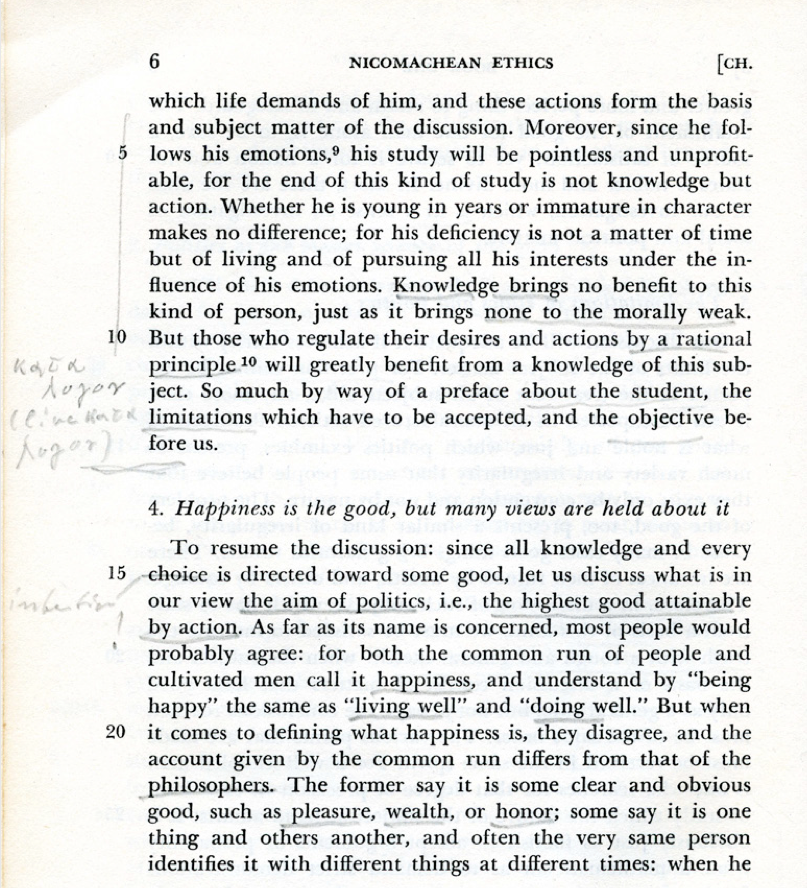
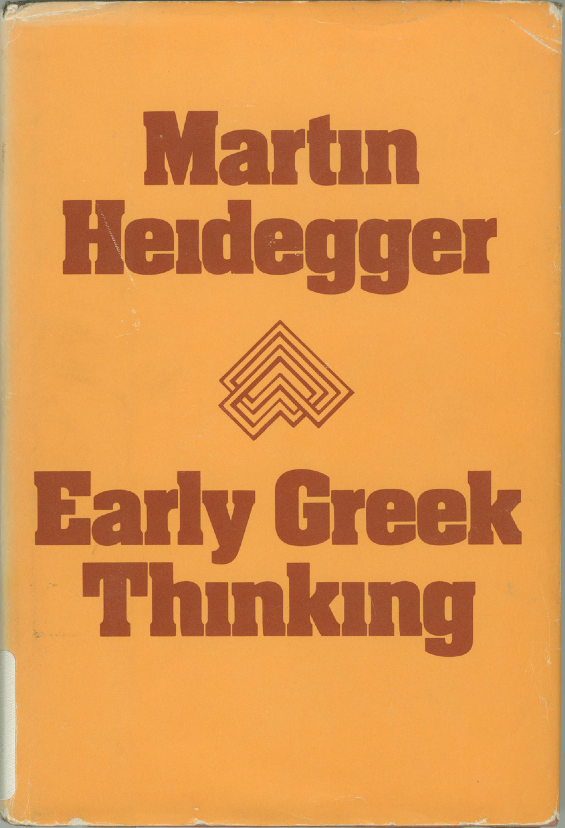
Arendt’s library—much of it on view online thanks to Bard college—offers us a unique opportunity to do just that, not only by giving us access to the specific editions and translations that she herself read and saved (for whatever reason), but also by offering insight into what Arendt considered important enough in those texts to underline and annotate. In Bard’s digital collection of “Arendt Marginalia”—selections of her annotated books in downloadable PDFs—we see a political philosophy informed by Aristotle (see a page from her copy of Nicomachean Ethics above), Plato, and Kant, but also by conservative German political theorist Carl Schmitt, a member and active supporter of Nazism, and of course, by Heidegger, whose work occupies a central place in her library: in German and English (like his Early Greek Thinking above, inscribed by the translator), and in primary and secondary sources.
While it may go too far to claim, as prominent scholar Bernard Wasserstein did in 2009, that an examination of Arendt’s sources shows her internalizing the values of Nazis and anti-Semites, the preponderance of conservative German thinkers in her personal library does give us a sense of her intellectual leanings. But we cannot draw broad conclusions from a cursory survey of a lifetime of reading and re-reading, though we do see a particularly Aristotelian strain in her thinking: that the individual is only as healthy as his or her political culture. What scholars of Arendt will find in Bard’s digital collection are ample clues to the development and evolution of her philosophy over time. What lay readers will find is the outline of a course on the sources of Arendt-ian thought, including not only Greeks and Germans, but the American poet Robert Lowell, who wrote a glowing profile of Arendt and contributed at least four signed books of his to her library.
I say “at least” because the Bard digital collection is yet incomplete, representing only a portion of the physical media in the college’s physical archive of “approximately 4,000 volumes, ephemera and pamphlets that made up the library in Hannah Arendt’s last apartment in New York City.” What we don’t have online are books inscribed to her by Jewish scholar and mystic Gershom Scholem, by W.H. Auden and Randall Jarrell, and many others. Nonetheless the “Arendt Marginalia” gives us an opportunity to peer into a writer and scholar’s process, and see her wrestle with the thought of her predecessors and contemporaries. The full Arendt collection gives us even more to sift through, including private correspondence and recordings of public speeches. The digitization of these sources offers many opportunities for those who cannot travel to New York and access the physical archives to delve into Arendt’s intellectual world in ways previously only available to professional academics.
Related Contents:
Hannah Arendt Discusses Philosophy, Politics & Eichmann in Rare 1964 TV Interview
Hannah Arendt’s Original Articles on “the Banality of Evil” in the New Yorker Archive
Josh Jones is a writer and musician based in Durham, NC. Follow him at @jdmagness
Read More...Pipes with Cannabis Traces Found in Shakespeare’s Garden, Suggesting the Bard Enjoyed a “Noted Weed”

Not more than 10 days ago, Jonathan Crow highlighted for you Adam Bertocci’s Two Gentlemen of Lebowski, a book that asks you to suspend disbelief and imagine, What if…William Shakespeare had written The Big Lebowski?
Now comes news that makes the collision of the Bard’s and Lebowski’s worlds somewhat more plausible. According to The Telegraph, “South African scientists have discovered that 400-year-old tobacco pipes excavated from the garden of William Shakespeare contained cannabis, suggesting the playwright might have written some of his famous works while high.” Lebowski could relate.
If you want to get into the specifics, you can read the précis published in The South African Journal of Science called “Shakespeare, plants, and chemical analysis of early
17th century clay ‘tobacco’ pipes from Europe.” It details how a team, led by anthropologist Francis Thackeray at the University of the Witwatersrand in Johannesburg, used a “sophisticated technique called gas chromatography mass spectrometry (GCMS)” to analyze “pipes [that] had been excavated from the garden of William Shakespeare.” The results of their study? They “indicated Cannabis in eight samples, nicotine (from tobacco leaves of the kind associated with Raleigh) in at least one sample, and (in two samples) definite evidence for Peruvian cocaine from coca leaves of the kind which Thackeray et al. associated with Drake who had himself been to Peru before 1597.”
Thackeray also finds literary support for the idea that Shakespeare had a taste for Cannabis, noting that in “Sonnet 76 Shakespeare writes about ‘invention in a noted weed’. This can be interpreted to mean that Shakespeare was willing to use ‘weed’ … for creative writing (‘invention’).” The précis goes on to add: “In the same sonnet it appears that [Shakespeare] would prefer not to be associated with ‘compounds strange’, which can be interpreted, at least potentially, to mean ’strange drugs’ (possibly cocaine).” You can read Sonnet 76 in full here:
Why is my verse so barren of new pride,
So far from variation or quick change?
Why with the time do I not glance aside
To new-found methods and to compounds strange?
Why write I still all one, ever the same,
And keep invention in a noted weed,
That every word doth almost tell my name,
Showing their birth and where they did proceed?
O, know, sweet love, I always write of you,
And you and love are still my argument;
So all my best is dressing old words new,
Spending again what is already spent:
For as the sun is daily new and old,
So is my love still telling what is told.
Related Content:
Free Online Shakespeare Courses: Primers on the Bard from Oxford, Harvard, Berkeley & More
Read All of Shakespeare’s Plays Free Online, Courtesy of the Folger Shakespeare Library
Take a Virtual Tour of Shakespeare’s Globe Theatre
Read More...Read Arthur C. Clarke’s Super Short, 31-Word Sci-Fi Story, “siseneG”
As brevity in fiction goes, who can top “For sale: baby shoes, never worn”? That much-referenced six-word story, often attributed to Ernest Hemingway, certainly packs an impressive amount of human drama into its short length. But what about other genres? What would a six-word science- fiction story look like? i09 crowdsourced countless such works in 2014: responses, which tended toward the eschatological, included “The Universe died. He did not,” “New world. Cryogenic failure. Seeds dead,” and “Finally sentient, it switched itself off.”
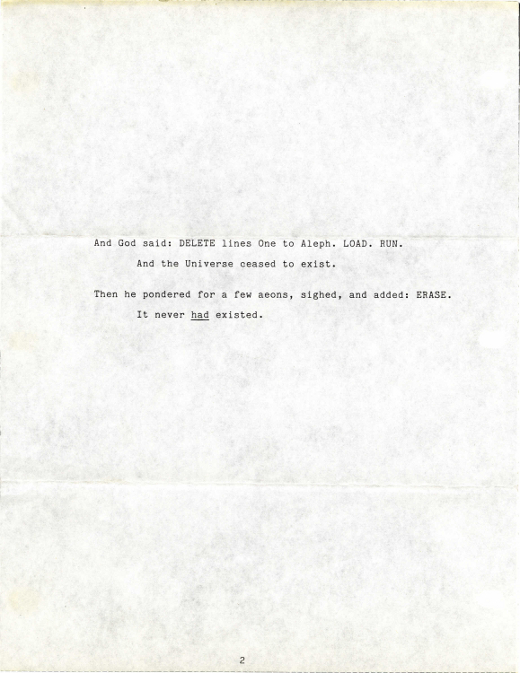
Not bad, but what would we get if we went to the professionals? Alas, Sir Arthur C. Clarke, prolific author of such respected sci-fi novels as 2001: A Space Odyssey and Rendezvous with Rama, passed away just five years before i09 issued its challenge. Still, we have an idea of the direction his entry might have gone in from of “siseneG,” a story story — a very short story indeed — Clarke sent in to Analog magazine in 1984:
And God said: DELETE lines One to Aleph. LOAD. RUN.
And the Universe ceased to exist.Then he pondered for a few aeons, sighed, and added: ERASE.
It never had existed.
“This is the only short story I’ve written in ten years or so,” Clarke wrote in the accompanying note. “I think you’ll agree that they don’t come much shorter.” We now know that they can come somewhat shorter, at least 25 words shorter than “siseneG,” but surely we can all agree that Clarke set a high standard for scientific (or perhaps technological-existential) flash fiction decades before the coinage of the term. But then, we always knew the man had a knack for looking ahead.
via Letters of Note
Related Content:
In 1964, Arthur C. Clarke Predicts the Internet, 3D Printers and Trained Monkey Servants
Arthur C. Clarke Predicts in 2001 What the World Will Look By December 31, 2100
Arthur C. Clarke Narrates Film on Mandelbrot’s Fractals; David Gilmour Provides the Soundtrack
Free Science Fiction Classics on the Web: Huxley, Orwell, Asimov, Gaiman & Beyond
Colin Marshall writes on cities, language, Asia, and men’s style. He’s at work on a book about Los Angeles, A Los Angeles Primer, and the video series The City in Cinema. Follow him on Twitter at @colinmarshall or on Facebook.
Read More...Isaac Asimov’s Foundation Trilogy: Hear a Radio Dramatization (1973)
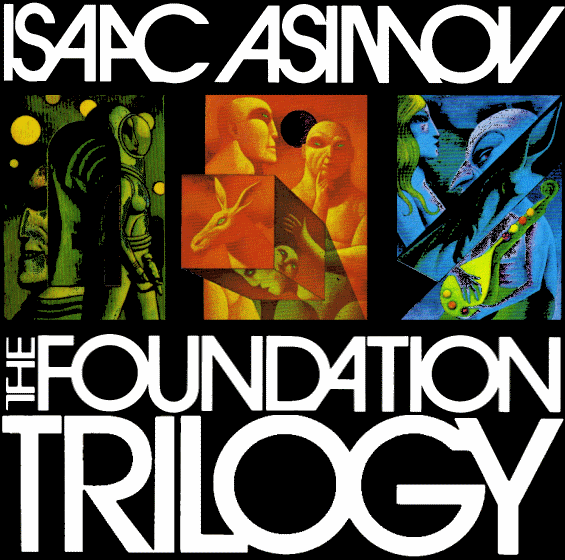
Last year Jonathan Nolan–screenwriter of Memento and Interstellar and not coincidentally director Christopher Nolan’s brother–announced that he would be developing Isaac Asimov’s legendary Foundation trilogy for HBO as a series. And we assume he’s still doing that, because there’s been nary a peep from the channel since. So far the Internet consensus has been a collective “well, that could be good!” instead of groans, which is a heartening thing these days.
For those who haven’t read the classic books, but would like to get the jump on ol’ Nolan, we submit this BBC Radio production from 1973, which is now available on Spotify below. (Download Spotify software here.) The recording also lives on Archive.org as well.
Right from the beginning we know we are in good hands, with the analog drones of the BBC Radiophonic Workshop ushering us into a stereo landscape filled with plummy British accents and atmospheric sound effects. It’s like the best ever episode of Doctor Who without a Tardis, corridors, or the enfeebled cries of a lost companion.
The Foundation Trilogy is heavily indebted to Edward Gibbon’s The History of the Decline and Fall of the Roman Empire, as well as a belief in the circular nature of history.
Asimov’s hero in the first book, Hari Seldon, using a science called psychohistory, can see the inevitable collapse of the Galactic Empire in which he lives and sets about trying to change it by setting up an opposition called the Foundation. The novels then jump decades ahead, checking in with this essential conflict, much like Gibbon’s work goes from emperor to emperor, marking the decline of empire and its inevitability. Free of aliens and shoot-em-ups, Foundation is very human despite its galactic scope.
Adapted by Patrick Tull and Mike Stott, the eight part radio series does a good job of presenting the novels as a character-driven drama, and while it is talky (it’s radio after all), it was Orson Scott Card who said of Foundation, it is “all talk, no action — but Asimov’s talk is action.”
It also influenced many future sci-fi writers. No doubt somewhere along the way Douglas Adams was listening to the radio play’s talking encyclopedia and thinking, hmm, what if this had jokes?
And once you get through the trilogy–maybe after an eight-hour flight?–there’s more Asimov radio plays for your listening pleasure on Spotify: Hostess, Pebble in the Sky, and Nightfall.
If you would like to support the mission of Open Culture, consider making a donation to our site. It’s hard to rely 100% on ads, and your contributions will help us continue providing the best free cultural and educational materials to learners everywhere. You can contribute through PayPal, Patreon, and Venmo (@openculture). Thanks!
Related Content:
Isaac Asimov’s Favorite Story “The Last Question” Read by Isaac Asimov— and by Leonard Nimoy
Two Documentaries Introduce Delia Derbyshire, the Pioneer in Electronic Music
1,000 Free Audio Books: Download Great Books for FreeTed Mills is a freelance writer on the arts who currently hosts the FunkZone Podcast. You can also follow him on Twitter at @tedmills, read his other arts writing at tedmills.com and/or watch his films here.
Read More...800 Free eBooks for iPad, Kindle & Other Devices
Download 800 free eBooks to your Kindle, iPad/iPhone, computer, smart phone or ereader. Collection includes great works of fiction, non-fiction and poetry, including works by Asimov, Jane Austen, Philip K. Dick, F. Scott Fitzgerald, Neil Gaiman, Tolstoy, Dostoevsky, Shakespeare, Ernest Hemingway, Virginia Woolf & James Joyce. Also please see our collection 1,000 Free Audio Books: Download Great Books for Free, where you can download more great books to your computer or mp3 player.
- Aeschylus - Prometheus Bound
- Aesop - Aesop’s Fables
- Andersen, Hans Christian - Andersen’s Fairy Tales
- Anderson, Sherwood — Winesburg, Ohio
- Anonymous - Beowulf
- Anonymous — Epic of Gilgamesh
- Anonymous - The Arabian Nights
- Aquinas, Thomas — Summa Theologiae
- Aristophanes — Lysistrata
- Aristophanes - The Birds
- Aristophanes - The Clouds
- Arnold, Matthew - Culture and Anarchy
- Aristotle — Collected Works
- Aristotle — Nicomachean Ethics
- Aristotle — Physics
- Aristotle - Politics
- Aristotle — The Categories
- Asimov, Isaac — “How People Get New Ideas”
- Asimov, Isaac — “Jokester”
- Asimov, Isaac — “Let’s Get Together”
- Asimov, Isaac - “Living Space”
- Asimov, Isaac — “Silly Asses”
- Asimov, Isaac - “Youth”
- Aurelius, Marcus - Meditations
- Austen, Jane - Emma
- Austen, Jane — Lady Susan
- Austen, Jane - Love and Friendship
- Austen, Jane - Mansfield Park
- Austen, Jane - Northanger Abbey
- Austen, Jane - Persuasion
- Austen, Jane - Pride & Prejudice
- Austen, Jane — Sense & Sensibility
- Ayer, Alfred — Language, Truth and Logic
- Bacon, Sir Francis — Novum Organum
- Balzac, Honoré de - Le Père Goriot
- Barthes, Roland — Incidents
- Basho, Matsuo — Various Poems
- Baudelaire, Charles - Les Fleurs du Mal (in French)
- Baudelaire, Charles - Flowers of Evil (in English)
- Baudelaire, Charles - The Generous Gambler
- Baudelaire, Charles - The Poem of Hashish (translated by Aleister Crowley)
- Barrie, JM- Peter Pan


- Baum, L. Frank - The Wizard of Oz (Vol 1)
- Baum, L. Frank - The Marvelous Land of Oz (Vol 2)
- Baum, L. Frank — Ozma of Oz (Vol 3)
- Baum L. Frank — Dorothy and the Wizard in Oz (Vol 4)
- Baum L. Frank — The Road to Oz (Vol 5)
- Baum, L. Frank — The Emerald City of Oz (Vol 6)
- Baum, L. Frank — The Patchwork Girl of Oz (Vol 7)
- Baum, L. Frank — Tik-Tok of Oz (Vol 8)
- Baum, L. Frank - The Scarecrow of Oz (Vol 9)
- Baum, L. Frank — Rinkitink in Oz (Vol 10)
- Baum L. Frank — The Lost Princess of Oz (Vol 11)
- Baum L. Frank — The Tin Woodman of Oz (Vol 12)
- Baum L. Frank — The Magic of Oz (Vol 13)
- Baum, L. Frank — Glinda of Oz (Vol 14)
- Benjamin, Walter — “The Work of Art in the Age of Mechanical Reproduction”
- Read Online in English — Read Online in German
- Bergerac, Cyrano de — Voyage to the Moon
- Berkeley, George — Three Dialogues between Hylas and Philonous
- Berlin, Isaiah - Concepts and Categories
- Read Online Now
- Berlin, Isaiah - The Arts in Russia Under Stalin
- Berryman, John - Card Trick
- Berryman, John — Modus Vivendi
- Berryman, John — The Right Time
- Berryman, John — Trouble With Telstar
- Berryman, John — Vigorish
- Blake, William — Songs of Innocence and of Experience
- Blake, William - Selected Poems
- Boethius — Consolation of Philosophy
- Bradbury, Ray — “The Jar”
- Bradbury, Ray — “The Last Night of the World”
- Bronte, Charlotte - Jane Eyre
- Bronte, Emily - Wuthering Heights
- Buchan, John - The Thirty Nine Steps
- Bukowski, Charles — His Last (Faxed) Poem
- Bukowski, Charles — Dostoevsky
- Burke, Edmund - Reflections on the Revolution in France
- Burke, Edmund - On the Sublime and Beautiful
- Burckhardt, Jacob- The Civilisation of the Renaissance in Italy
- Burroughs, Edgar Rice - A Princess of Mars
- Calvino, Italo — “The Daughters of the Moon”
- Calvino, Italo — “Why Read the Classics?”
- Carroll, Lewis - Alice’s Adventures in Wonderland
- Carroll, Lewis — Symbolic Logic
- Carroll, Lewis — The Game of Logic
- Carroll, Lewis - Through the Looking-Glass
- Carver, Raymond — “Beginners” (early draft of “What We Talk About When We Talk About Love”)
- Carver, Raymond - “Cathedral”
- Cervantes - Don Quixote
- Chandler, Raymond - “The Simple Art of Murder”
- Chaucer - Canterbury Tales
- Chekhov, Anton - Plays
- Chekhov, Anton — Short Stories
- Chekhov, Anton - The Kiss
- Chekhov, Anton - The Lady with the Dog
- Chekhov, Anton — The Chorus Girl and Other Stories (by Constance Garnett)
- Chekhov, Anton - Uncle Vanya
- Chomsky, Noam — Deterring Democracy
- Chomsky, Noam — Excerpts from Powers and Prospects: Reflections on Human Nature and the Social Order
- Chomsky, Noam — Keeping the Rabble in Line
- Chomsky, Noam — Necessary Illusions: Thought Control in Democratic Societies
- Chomsky, Noam — Rethinking Camelot: JFK, the Vietnam War, and U.S. Political Culture
- Chomsky, Noam — Secrets, Lies and Democracy
- Chomsky, Noam — The Prosperous Few and the Restless Many
- Chomsky, Noam — What Uncle Sam Really Wants
- Chopin, Kate - The Awakening
- Christie, Agatha - The Mysterious Affair at Styles
- Christie, Agatha - The Secret Adversary
- Cicero — Orations
- Clarke, Arthur C. — “Second Dawn”
- Clarke, Arthur C. — “The Deep Range”
- Clarke, Arthur C. — “The Nine Billion Names of God”
- Clarke, Arthur C. — “The Parasite”
- Clarke, Arthur C. — “The Star”
- Clarke, Arthur C. — “The Stroke of the Sun”
- Clarke, Arthur C. — “A Walk in the Dark”
- Coleridge, Samuel - Ancient Mariner and Select Poems
- Confucius — The Analects
- Confucius — The Great Learning
- Conrad, Joseph - Lord Jim
- Conrad, Joseph - Heart of Darkness
- Conrad, Joseph — Nostromo
- Conrad, Joseph - The Secret Agent
- Conrad, Joseph - Victory
- Crane, Stephen - The Red Badge of Courage
- Crowley, Aleister — Book of Law
- Crowley, Aleister — Household Gods
- Cummings E.E. — The Enormous Room
- da Vinci, Leonardo — A Treatise on Painting
- da Vinci, Leonardo — Anatomy Drawings
- Dante - The Divine Comedy
- Dante — The Divine Comedy (Digital Version from Columbia University)
- Dante — Intertextual Dante
- Darwin, Charles - On the Origin of Species
- Darwin, Charles — The Descent of Man
- Darwin, Charles — The Voyage of the Beagle
- Defoe, Daniel - Robinson Crusoe
- Denton, Bradley — Buddy Holly is Alive and Well on Ganymede (Background)
- Derrida, Jacques — “Structure, Sign, and Play in the Discourse of the Human Sciences”
- Descartes, Rene - Discourse on the Method
- Dewey, John - Democracy & Education
- Diaz, Junot — 7 Free Stories
- Dick, Philip K. — “Adjustment Team”
- Dick, Philip K. — “Beyond the Door”
- Dick, Philip K. — “Beyond Lies the Wub”
- Dick, Philip K. — “Breakfast at Twilight”
- Dick, Philip K. — “Exhibit Piece”
- Dick, Philip K. — “Foster You’re Dead”
- Dick, Philip K. — “Human Is”
- Dick, Philip K. — “James P. Crow”
- Dick, Philip K. — “Meddler”
- Dick, Philip K. — “Mr. Spaceship”
- Dick, Philip K. — “Piper in the Woods”
- Dick, Philip K. — “Progeny”
- Dick, Philip K. — “Prominent Author”
- Dick, Philip K. — “Sales Pitch”
- Dick, Philip K. — “Second Variety”
- Dick, Philip K. — “Shell Game”
- Dick, Philip K. — “Small Town”
- Dick, Philip K. — “Souvenir”
- Dick, Philip K. — “Survey Team”
- Dick, Philip K. — “The Crawlers”
- Dick, Philip K. — “The Crystal Crypt”
- Dick, Philip K. — “The Defenders”
- Dick, Philip K. — “The Eyes Have It”
- Dick, Philip K. — “The Golden Man”
- Dick, Philip K. — “The Gun”
- Dick, Philip K. — “The Hanging Stranger”
- Dick, Philip K. — “The Last of tbe Masters”
- Dick, Philip K. — “The Skull”
- Dick, Philip K. — “The Turning Wheel”
- Dick, Philip K. — “The Variable Man”
- Dick, Philip K. — “Tony and the Beetles”
- Dick, Philip K. — “Upon the Dull Earth”:
- Dick, Philip K. — “We Can Remember It For You Wholesale”
- iPad/iPhone
- Dickens, Charles - A Christmas Carol
- Dickens, Charles - A Tale of Two Cities
- Dickens, Charles - Bleak House
- Dickens, Charles - David Copperfield
- Dickens, Charles - Great Expectations
- Dickens, Charles - Hard Times
- Dickens, Charles — Little Dorrit
- Dickens, Charles - Mystery of Edwin Drood
- Dickens, Charles - Nicholas Nickleby
- Dickens, Charles - Oliver Twist
- Dickens, Charles - Our Mutual Friend
- Dickens, Charles — The Pickwick Papers
- Dickinson, Emily - Poems
- Didion, Joan — 12 Masterful Essays
- Dostoevsky, Fyodor - A Raw Youth (Translated by Constance Garnett)
- Dostoevsky, Fyodor - Brothers Karamazov
- Dostoevsky, Fyodor - Crime and Punishment
- Dostoevsky, Fyodor - Notes from the Underground
- Dostoevsky, Fyodor - Poor Folk
- Dostoevsky, Fyodor — The Double
- Dostoevsky, Fyodor — “The Dream of a Ridiculous Man”
- Dostoevsky, Fyodor - The Gambler
- Dostoevsky, Fyodor - The Idiot
- Dostoevsky, Fyodor - The Possessed
- Dostoevsky, Fyodor - White Nights and Other Stories
- Douglass, Frederick — Narrative of the Life of Frederick Douglass
- Doyle, Arthur Conan - The Adventures of Sherlock Holmes
- Doyle, Arthur Conan- The Complete Sherlock Holmes
- Doyle, Arthur Conan — The Hound of Baskerville
- Doyle, Arthur Conan - The Lost World
- Doyle, Arthur Conan - The Poison Belt
- Dreiser, Theodore - An American Tragedy
- Dreiser, Theodore - Sister Carrie
- Dumas, Alexandre - The Count of Monte Cristo
- Dumas, Alexandre - The Man in the Iron Mask
- Dumas, Alexandre - The Three Musketeers
- Durkheim, Emile — Le suicide: Étude de sociologie
- Eliot, Charles - The Harvard Classics (51 Volumes)
- Einstein, Albert — Relativity : The Special and General Theory
- Eisenstein, Sergei — Notes of a Film Director
- Eliot, George - Daniel Deronda
- Eliot, George - Middlemarch
- Eliot, George - Silas Marner
- Eliot, T.S. — Eeldrop and Appleplex
- Eliot, T.S. - Ezra Pound: His Metric and Poetry by T. S. Eliot
- Eliot, T.S. — Four Quartets
- Eliot, T.S. - Poems (Including “The Love Song of J. Alfred Prufrock”)
- Eliot, T.S. — The Hollow Men
- Eliot, T.S. — The Love Song of J. Alfred Prufrock
- Eliot, T.S. — The Sacred Wood
- Eliot, T.S. — “Tradition and the Individual Talent”
- Eliot, TS - The Waste Land
- Eisenstein, Sergei — Notes on a Film Director
- Emerson, Ralph Waldo — Essays
- Emerson, Ralph Waldo - The Complete Works
- Erasmus - The Praise of Folly
- Euripides - Medea
- Euripides — The Bacchae
- Faulkner, William - The Collected Stories of William Faulkner
- Faulkner, William — Early Prose and Poetry
- Feynman, Richard; Leighton, Robert; Sands, Matthew - The Feynman Lectures on Physics
- Volume 1: Read Online Now
- Volume 2: Read Online Now
- Volume 3: Read Online Now
- Fitzgerald, F. Scott — “Babylon Revisited”
- Fitzgerald, F. Scott — “Bernice Bobs Her Hair”
- Fitzgerald, F. Scott - Collected Stories
- Fitzgerald, F. Scott — All the Sad Young Men
- Fitzgerald, F. Scott - Flappers and Philosophers
- Fitzgerald, F. Scott - Tales of the Jazz Age
- Fitzgerald, F. Scott - Tender is the Night
- Fitzgerald, F. Scott - The Beautiful and Damned
- Fitzgerald, F. Scott - The Curious Case of Benjamin Button
- Fitzgerald, F. Scott - The Great Gatsby
- Fitzgerald, F. Scott - This Side of Paradise
- Flaubert, Gustave - Madame Bovary
- Flaubert, Gustave - Salammbo
- Flaubert, Gustave — Three Short Works
- Fontane, Theodor — Effi Briest
- Ford, Madox Ford - The Good Soldier
- Forster, E.M. — A Room with a View
- Forster, E.M. - Howards End
- Forster, E.M. - The Machine Stops
- Foucault, Michel - Die Ordnung des Diskurses
- Franklin, Benjamin - Autobiography
- Freud, Sigmund — A General Introduction to Psychoanalysis
- Freud, Sigmund - Beyond the Pleasure Principle
- Freud, Sigmund — Delusion and Dream
- Freud, Sigmund - Dream Psychology: Psychoanalysis for Beginners
- Freud, Sigmund - Leonardo da Vinci
- Freud, Sigmund - Interpretation of Dreams
- Freud, Sigmund - Moses And Monotheism
- Freud, Sigmund — Origin and Development of Psychoanalysis
- Freud Sigmund — Psychopathology of Everyday Life
- Freud, Sigmund - Reflections on War and Death
- Freud, Sigmund - Selected Papers on Hysteria and Other Psychoneuroses
- Freud, Sigmund - The History of the Psychoanalytic Movement
- Freud, Sigmund — Three Contributions to the Sexual Theory
- Freud, Sigmund — Totem and Taboo
- Freud, Sigmund — Wit and Its Relation to the Unconscious
- Frost, Robert - A Boy’s Will
- Frost, Robert — Miscellaneous Poems to 1920
- Frost, Robert — Mountain Interval
- Frost, Robert — North of Boston
- Frost, Robert — “The Road Not Taken
- Gaiman, Neil — “A Study in Emerald”
- Gaiman, Neil - “Bitter Grounds”
- Gaiman, Neil - “Cinnamon”
- Gaiman, Neil - “I Cthulhu”
- Gaiman, Neil - “The Case of the Four and Twenty Blackbirds”
- Gaiman, Neil - “The Day the Saucers Came”
- Gaiman, Neil — The Truth Is a Cave in the Black Mountains
- Garcia Marquez, Gabriel — The Autumn of the Patriarch
- Garcia Marquez, Gabriel — 10 Stories Online
- Gibbon, Edward - The History Of The Decline And Fall Of The Roman Empire
- Ginsberg, Allen — America
- Ginsberg, Allen — Homework
- Ginsberg, Allen — Howl
- Ginsberg, Allen, — America, Kaddish Part 1, A Supermarket in California, Sunflower Sutra
- Read Online Now
- Ginsberg, Allen — Taking a Walk through Leaves of Grass
- Goethe — Faust
- Goethe — Faust (Illustrated by Delacroix)
- Goethe — The Sorrows of Young Werther
- Goethe — Theory of Colors (background info)
- Gogol, Nikolai - The Dead Souls
- Gogol, Nikolai - The Nose
- Gogol, Nikolai — Taras Bulba
- Gramsci, Antonio — Selected Writings
- Grimm Brothers - Grimm’s Fairy Tales
- Harbou, Thea von — Metropolis
- Hardy, Thomas - Collected Stories
- Hawthorne, Nathaniel - The House of the Seven Gables
- Hawthorne, Nathaniel - The Scarlet Letter
- Hegel, GWF — Lectures on the History of Philosophy
- Hegel, GWF — Philosophy of Mind
- Hegel, GWF — Philosophy of Right
- Hegel, GWF — The Phenomenology of the Spirit
- Hemingway, Ernest - The First Forty Nine Stories (includes “The Snows of Kilimanjaro”)
- Hayek, Friedrich - The Use of Knowledge in Society
- Henley - Invictus
- Herodotus — The History of Herodotus V. 1 (Macaulay translation)
- Herodotus, The History of Herodotus V. 2 (Macaulay translation)
- Hesse, Hermann - Siddhartha
- Hobbes, Thomas - Leviathan
- Homer — The Iliad
- Homer — The Odyssey
- Hope, Anthony — The Prisoner of Zenda
- Hughes, Langston and Hurston, Zora Neale - The Mule Bone
- Hugo, Victor - Hunchback of Notre Dame
- Hugo, Victor - Les Miserables
- Hume, David - A Treatise of Human Nature
- Hume, David - Dialogues Concerning Natural Religion
- Hume, David - Enquiry into the Principles of Morals
- Hume, David ‑An Enquiry Concerning Human Understanding
- Hurston, Zora Neale - Poker!
- Hurston, Zora Neale - Three Plays (Lawing and Jawing; Forty Yards; Woofing)
- Huxley, Aldous - Brave New World
- Huxley, Aldous — Crome Yellow
- Huxley, Aldous — Mortal Coils
- Ibsen, Henrik - A Doll’s House
- Ibsen, Henrik — An Enemy of the People
- Ibsen, Henrik - Hedda Gabler
- Ibsen, Henrik - Peer Gynt
- Irving, Washington - The Legend of Sleepy Hollow
- James, Henry - The Ambassadors
- James, Henry — The American
- James, Henry - The Wings of the Dove
- James, Henry - Turn of the Screw
- James, William — Essay in Radical Empiricism
- James, William - Pragmatism
- James, William - Varieties of Religious Experience
- Joyce, James - A Portrait of the Artist as a Young Man
- Joyce, James - Chamber Music
- Joyce, James - Dubliners
- Joyce, James - Finnegans Wake
- Joyce, James - Ulysses
- Kafka, Franz - “A Hunger Artist”
- Kafka, Franz — “A Country Doctor”
- Kafka, Franz — Amerika (German Edition)
- Kafka, Franz — “A Report to an Academy”
- Kafka, Franz — “Before the Law”
- Kafka, Franz - “In the Penal Colony”
- Kafka, Franz — The Castle/Das Schloß (in German)
- Kafka, Franz — “The Great Wall of China”
- Kafka, Franz - The Metamorphosis
- Kafka, Franz — The Neighbour
- Kafka, Franz - The Trial
- Kant, Immanuel - Critique of Judgement
- Kant, Immanuel - Critique of Practical Reason
- Kant, Immanuel - Critique of Pure Reason
- Kant, Immanuel - Groundwork for the Metaphysics of Morals
- Kant, Immanuel - Perpetual Peace
- Kant, Immanuel - What is Enlightenment?
- Keats, John - The Poems of John Keats
- Keats, John — Poems, 1817
- Keats, John — Poetical Works
- Kenner, Hugh — Chuck Jones: A Flurry of Drawings
- Keynes, John Maynard - The Economic Consequences of the Peace
- Keynes, John Maynard - The General Theory of Employment, Interest and Money
- Kierkegaard, Søren - Fear and Trembling
- Kierkegaard, Søren — Philosophical Fragments
- Kierkegaard, Søren - Purity of Heart Is to Will One Thing
- Kierkegaard, Søren — The Sickness Unto Death
- Kierkegaard, Søren - Two Discourses on God and Man
- Kipling, Rudyard - Just So Stories for Little Children
- Kipling, Rudyard - Kim
- Kipling, Rudyard - The Jungle Book
- Lao-tzu — The Tao-te Ching
- Lawrence, D.H — Lady Chatterley’s Lover
- Lawrence, D.H. - Sons and Lovers
- Lawrence, D.H. — Women in Love
- Leibniz — Theodicy
- LeRoux, Gaston — Phantom of the Opera
- Lévi-Strauss, Claude - Tristes tropiques
- Lewis, C.S. — Spirits in Bondage: A Cycle of Lyrics
- Lewis, C.S. — The Abolition of Man
- Lewis, Sinclair — Arrowsmith
- Lewis, Sinclair - Babbitt
- Lewis, Sinclair — It Can’t Happen Here
- Locke, John — An Essay on Human Understanding
- Locke, John - Second Treatise on Government
- London, Jack - The Call of the Wild
- London, Jack - White Fang
- Lovecraft, HP - Collected Stories
- Lovecraft, HP — Supernatural Horror in Literature
- Lovecraft, HP — Free Complete, Works of H.P. Lovecraft
- Lucretius - On the Nature of the Things
- Machiavelli, Niccolò - The Prince
- Madison, Hamilton & Jay - The Federalist Papers
- Malthus, Thomas — An Essay on the Principle of Population
- Maimonides — Guide for the Perplexed
- Mann, Thomas — Death in Venice
- Marx and Engels - The Communist Manifesto
- Marx, Karl — The Works of Karl Marx (mostly in German)
- Marx, Karl — Das Kapital
- Marx, Karl - The Eighteenth Brumaire of Louis Bonaparte
- Mayakovsky, Vladimir — The Collected Poems of Vladimir Mayakovsky
- Mayakovsky, Vladimir - Whom Should I Be?
- Maupassant, Guy de - Original Short Stories
- McCrae, John — “In Flanders Fields”
- Melville, Herman - Billy Budd
- Melville, Herman - Moby Dick
- Melville, Herman — Pierre
- Mencken, H.L. — The American Language
- Mencken, H.L. — The Philosophy of Friedrich Nietzsche
- Mill, John Stuart- On Liberty
- Mill, John Stuart - Utilitarianism
- Miller, Henry — The Books in My Life
- Milton, John - Paradise Lost
- Milton, John — Paradise Regained
- Milton, John - The Poetical World
- Mirbeau, Octave — La 628-E8 (in French)
- Molière - Collected Works (in French)
- Read Online Now
- Molière - Le Bourgeois gentilhomme
- Molière - Tartuffe
- Montaigne — Essays
- Montesquieu - The Persian Letters
- Montesquieu - The Spirit of the Laws
- Montgomery, Lucy Maud — Anne of Green Gables
- More, Thomas - Utopia
- Morrison, Toni — “Sweetness”
- Muir, John — My First Summer in the Sierra
- Muir, John — The Mountains of California
- Muir, John — The Yosemite
- Muir, John — Travels in Alaska
- Munro, Alice — Collection of 18 Stories
- Murakami, Haruki — 6 Short Stories
- Murakami, Haruki — “On Seeing the 100% Perfect Girl One Beautiful April Morning”
- Nabokov, Vladimir - “Cloud, Castle, Lake”
- Nabokov, Vladimir — “Signs and Symbols”
- Nabokov, Vladimir — Lectures on Russian Literature
- Kindle Format (mobi) — Other Formats
- Nabokov, Vladimir — Lecture on The Metamorphosis
- Nabokov, Vladimir - “The Aurelian”
- Nabokov, Vladimir — “The Art of Translation”
- Newton, Isaac — Opticks
- Newton, Isaac — Principia
- Nietzsche, Friedrich - Beyond Good and Evil
- Nietzsche, Friedrich- Ecce Homo
- Nietzsche, Friedrich — Genealogy of Morals
- Nietzsche, Friedrich - Homer and Classical Philology
- Nietzsche, Friedrich - Human, All Too Human
- Nietzsche, Friedrich — On the Future of our Educational Institutions
- Nietzsche, Friedrich - Selected Letters
- Kindle + Read Online Now
- Nietzsche, Friedrich - The Anti Christ
- Nietzsche, Friedrich — The Birth of Tragedy
- Nietzsche, Friedrich - The Case Against Wagner
- Nietzsche, Friedrich — The Dawn of Day
- Nietzsche, Friedrich - The Gay Science
- Nietzsche, Friedrich - Thus Spake Zarathustra
- Nietzsche, Friedrich - Twilight of the Idols
- Norris, Frank — McTeague
- Northup, Solomon — Twelve Years a Slave
- O’Neill, Eugene - Anna Christie
- O’Neill, Eugene - Beyond the Horizon
- O’Neill, Eugene - The Hairy Ape
- O’Neill, Eugene - The Iceman Cometh
- Orwell, George — 50 Essays
- Orwell, George - 1984
- Orwell, George — A Clergyman’s Daughter
- Orwell, George - Animal Farm
- Orwell, George - Burmese Days
- Orwell, George - Down and Out in Paris and London
- Orwell, George - Homage to Catalonia
- Orwell, George - Politics and the English Language
- Orwell, George — Review of Mein Kampf
- Orwell, George — Review of Jean-Paul Sartre’s Portrait of the Antisemite
- Orwell, George - Looking Back on the Spanish war
- Orwell, George — New Words
- Orwell, George — Rudyard Kipling
- Orwell, George — The Lion and the Unicorn: Socialism and the English Genius
- Orwell, George — War Time Diaries (1938–1942)
- Ovid — Metamorphoses
- Paine, Thomas - Common Sense
- Paine, Thomas - Rights of Man
- Paine, Thomas — The Age of Reason
- Pascal, Blaise — The Pensées
- Pascal, Blaise — The Provincial Letters
- Perrault, Charles — Cinderella
- Planck, Max — Eight Lectures on Theoretical Physics
- Plath, Sylvia — A Lesson in Vengeance
- Plath, Sylvia - Ariel
- Plath, Sylvia — Blackberrying
- Plath, Sylvia — Daddy
- Plath, Sylvia — Dream with Clam-Diggers
- Plato — Collected Works
- Plato — Three Illustrated Dialogues by Plato: Euthyphro, Meno, Republic Book I
- Read Online Now
- Plato - Symposium
- Plato - The Apology, Phaedo, and Crito of Plato
- Plato - The Republic
- Plutarch - Lives
- Poe, Edgar Allan — The Works of Edgar Allan Poe — Volume 1
- Poe, Edgar Allan — The Works of Edgar Allan Poe — Volume 2
- Poe, Edgar Allan — The Works of Edgar Allan Poe — Volume 3
- Poe, Edgar Allan — The Works of Edgar Allan Poe — Volume 4
- Poe, Edgar Allan — The Works of Edgar Allan Poe — Volume 5
- Poe, Edgar Allan — Tales of Mystery and Imagination
- Poe, Edgar Allan - The Complete Poetical Works
- Poe, Edgar Allan - The Raven (Illustrated by Gustave Doré)
- Poe, Edgar Allan - The Narrative of Arthur Gordon Pym of Nantucket
- Popper, Karl — The Logic of Scientific Discovery
- Read Online Now
- Potter, Beatrix — The Tale of Peter Rabbit
- Pound, Ezra — Canto I
- Pound, Ezra — Canto XVI
- Pound, Ezra - Cathay
- Pound, Ezra — Personae
- Proust, Marcel - Swann’s Way
- Proust, Marcel - Within a Budding Grove
- Proust, Marcel - The Guermantes Way
- Proust, Marcel - Cities on the Plain
- Proust, Marcel - The Captive
- Proust, Marcel - The Sweet Cheat Gone
- Proust, Marcel - Time Regained
- Proust, Marcel — À la recherche du temps perdu
- Pushkin, Alexander — Eugene Onegin
- Rabelais — Gargantua and Pantagruel
- Racine, Jean — Andromaque
- Racine, Jean — Phaedre (English)
- Rand, Ayn - Anthem
- Reed, Lou — O Delmore how I miss you
- Reed, John - The Ten Days That Shook the World
- Richardson, Samuel — Clarissa
- Rilke, Rainer Maria — Duino Elegies
- Roth, Philip — “Epstein”
- Roth, Philip — “The Conversion of the Jews”
- Rousseau, Jean-Jacques — Emile
- Rousseau, Jean Jacques — Julie; ou, la Nouvelle Héloïse
- Rousseau, Jean-Jacques - The Confessions
- Rousseau, Jean-Jacques - The Social Contract & Discourses
- Rucker, Rudy — Postsingular
- Rucker, Rudy — The Hollow Earth
- Rucker, Rudy — The Ware Tetralogy (Background)
- Russell, Bertrand — Free Thought and Official Propaganda
- Russell, Bertrand - Introduction to Mathematical Philosophy
- Russell, Bertrand — Mysticism and Logic and Other Essays
- Russell, Bertrand - Political Ideals
- Russell, Bertrand — The Conquest of Happiness
- Kindle + Other Format — Read Online Now
- Russell, Bertrand - The Problems of Philosophy
- Russell, Bertrand - Western Philosophy
- Russell, Bertrand — Why I Am Not a Christian
- Ryle, Gilbert — The Concept of Mind
- Read Online Now
- Salinger, JD — Slight Rebellion Off Madison
- Santayana, George — Some Turns of Thought in Modern Philosophy: Five Essays
- Santayana, George — The Life of Reason
- Santayana, George — These Sense of Beauty
- Santayana, George — Three Philosophical Poets: Lucretius, Dante and Goethe
- Sartre, Jean-Paul - Existentialism Is a Humanism
- Sartre, Jean-Paul — Nausea
- Read Online Now (French version)
- Scott, Sir Walter - Ivanhoe
- Schopenhauer, Arthur - The World as Will and Representation
- Schopenhauer, Arthur — The Essays of Arthur Schopenhauer; On Human Nature
- iPad/iPhone — Kindle + Other Formats (find German version here)
- Schopenhauer, Arthur — Studies in Pessimism
- Seneca — The Tao of Seneca: Practical Letters from a Stoic Master (3 volumes)
- Seneca - On Benefits
- Sewell, Anna — Black Beauty
- Shackleton, Ernest - South: The Story of Shackleton’s Last Expedition
- Shakespeare, William — Complete Works in an HTML Edition by the Folger Shakespeare Library
- Shakespeare, William - The Complete Works
- Shakespeare, William - All’s Well Ends Well
- Shakespeare, William — Antony and Cleopatra
- Shakespeare, William — As You Like It
- Shakespeare, William - A Midsummer’s Night Dream
- Shakespeare, William — Coriolanus
- Shakespeare, William — Cymbeline
- Shakespeare, William - Hamlet
- Shakespeare, William — Henry IV (Part 1)
- Shakespeare, William — Henry IV (Part 2)
- Shakespeare, William — Henry V
- Shakespeare, William — Henry VI Part 1
- Shakespeare, William — Henry VI Part 2
- Shakespeare, William — Henry VI Part 3
- Shakespeare, William — Henry VIII
- Shakespeare, William - Julius Caesar
- Shakespeare, William — King John
- Shakespeare, William — King Lear
- Shakespeare, William — Love’s Labor’s Lost
- Shakespeare, William - Macbeth
- Shakespeare, William — Measure for Measure
- Shakespeare, William — Much Ado About Nothing
- Shakespeare, William - Othello
- Shakespeare, William — Pericles
- Shakespeare, William — Richard II
- Shakespeare, William — Richard III
- Shakespeare, William - Romeo & Juliet
- Shakespeare, William — The Comedy of Errors
- Shakespeare, William - The Merchant of Venice
- Shakespeare, William — The Merry Wives of Windsor
- Shakespeare, William - The Taming of the Shrew
- Shakespeare, William — The Tempest
- Shakespeare, William — The Two Noble Kinsmen
- Shakespeare, William — The Winter’s Tale
- Shakespeare, William — Timon of Athens
- Shakespeare, William — Titus Andronicus
- Shakespeare, William — Troilus and Cressida
- Shakespeare, William — Twelfth Night
- Shakespeare, William — Two Gentleman of Verona
- Shaw, George Bernard — Pygmalion
- Shelley, Mary - Frankenstein
- Shelley, Percy Bysshe — Complete Works
- Sinclair, Upton - The Jungle
- Smith, Adam - The Theory of Moral Sentiments
- Smith, Adam - The Wealth of Nations
- Sophocles - Antigone
- Sophocles - Oedipus Trilogy
- Spenser, Edmund - The Faerie Queene
- Spinoza — The Chief Works of Benedict de Spinoza, 2 vols.
- Spinoza — Ethics
- St. Augustine — Confessions
- Stein, Gertrude - Matisse Picasso and Gertrude Stein
- Stein, Gertrude - Tender Buttons
- Stein, Gertrude - Three Lives : stories of the Good Anna, Melanctha and the Gentle Lena
- Stein, Gertrude - The Autobiography of Alice B. Toklas
- Saint-Exupéry, Antoine de
- Stendhal — The Red and the Black
- French: Kindle + Other Formats
- English: Read Online Now
- Sterne, Laurence — The Life and Opinions of Tristram Shandy, Gentleman
- Stevenson, Robert Louis - Olalla
- Stevenson, Robert Louis - The Strange Case of Dr. Jekyll and Mr. Hyde
- Stevenson, Robert Louis - Treasure Island
- Stoker, Bram - Dracula
- Stoker, Bram — The Mystery of the Sea
- Stowe, Harriet Beecher - Uncle Tom’s Cabin
- Strunk Jr., William — The Elements of Style
- Suetonius - The Lives of the Twelve Caesars
- Sun Tzu - The Art of War
- Swift, Jonathan - A Tale of the Tub
- Swift, Jonathan - Gulliver’s Travels
- Thackeray, William Makepeace — Vanity Fair
- Thoreau, Henry David - Walden
- Thompson, Hunter S. — Collection of 10 Essays
- Thompson, Hunter S. — Fear and Loathing in Las Vegas
- Thucydides — The History of the Peloponnesian War
- Tocqueville, Alexis de - Democracy in America Vol 1.
- Tocqueville, Alexis de - Democracy in America Vol 2.
- Tolkien, J.R.R. — A Middle English Vocabulary
- Tolstoy, Leo — A Letter to a Hindu
- Tolstoy, Leo - Anna Karenina
- Tolstoy, Leo — Fables for Children
- Tolstoy, Leo - Master and Man
- Tolstoy, Leo — The Cossacks
- Tolstoy, Leo — The Death of Ivan Ilych
- Tolstoy, Leo — The Kingdom of God is Within You
- Tolstoy, Leo — The Kreutzer Sonata and Other Stories
- Tolstoy, Leo - The Pathways of Life (aka Wise Thoughts for Every Day)
- Tolstoy, Leo — Tolstoy on Shakespeare
- Tolstoy, Leo - War and Peace
- Tolstoy, Leo — What is Art?
- Tolstoy, Leo - What Men Live by and Other Tales
- Trollope, Anthony - The Life of Cicero
- Turgenev, Ivan Sergeevich - Fathers and Children
- Twain, Mark — On the Decay of the Art of Lying
- Twain, Mark - The Adventures of Huckleberry Finn
- Twain, Mark - The Adventures of Tom Sawyer
- Twain, Mark - The $30,000 Bequest
- Twain, Mark — The Prince and the Pauper
- U. Chicago — The Chicago Manual of Style, 16th Edition
- Untermeyer, Louis (editor) — Modern British Poetry
- Vasari, Giorgio — The Lives of the Artists
- Vasari, Giorgio — The Lives of the Most Excellent Painters, Sculptors, and Architects
- Vatsyayana - The Kama Sutra
- Veblen, Thorstein - The Theory of the Leisure Class
- Verne, Jules - 20,000 Leagues Under the Sea
- Verne, Jules - Around the World in 80 Days
- Verne, Jules - A Journey into the Center of the Earth
- Verne, Jules — The Mysterious Island
- Voltaire - Candide
- Voltaire — Micromégas
- Voltaire — Socrates
- Voltaire — The Philosophical Dictionary
- Voltaire — The Works of Voltaire
- Virgil - The Aeneid
- Vonnegut, Kurt — 2 B R O 2 B
- Vonnegut, Kurt - The Big Trip Up Yonder
- Vonnegut, Kurt - “The Drone”
- Wallace, David Foster - “9/11: The View From the Midwest”
- Wallace, David Foster - “All That”
- Wallace, David Foster - “An Interval”
- Wallace, David Foster - “Asset”
- Wallace, David Foster - “Backbone”
- Wallace, David Foster - “Brief Interviews with Hideous Men”
- Wallace, David Foster - “Consider the Lobster”
- Wallace, David Foster - “David Lynch Keeps His Head”
- Wallace, David Foster - “E Unibus Pluram: Television and U.S. Fiction”
- Wallace, David Foster - “Everything is Green”
- Wallace, David Foster - “Federer as Religious Experience”
- Wallace, David Foster - “Good People”
- Wallace, David Foster - “Host”
- Wallace, David Foster- “Incarnations of Burned Children”
- Wallace, David Foster - Little Expressionless Animals
- Wallace, David Foster - “Several Birds”
- Wallace, David Foster - “Shipping Out: On the (nearly lethal) comforts of aluxury cruise”
- Wallace, David Foster - “The String Theory”
- Wallace, David Foster - “Ticket to the Fair”
- Wallace, David Foster - “Wiggle Room”
- Weber, Max — Essays in Sociology
- Weber, Max — The Protestant Ethic and the Spirit of Capitalism
- Wells, H.G. — A Short History of the World
- Wells, H.G. — Experiment in Autobiography
- Wells, H.G. — The Invisible Man
- Wells, H.G.- The Island of Dr. Moreau
- Wells, H.G. - The Time Machine
- Wells, H.G. - The War of the Worlds
- Wells, H.G. — Twelve Stories and a Dream
- Wharton, Edith - The Age of Innocence
- Whitman, Walt — Complete Prose Works
- Whitman, Walt - Leaves of Grass
- Whitman, Walt — Song of Myself
- Wilde, Oscar - Picture of Dorian Gray
- Wilde, Oscar — The Happy Prince and Other Stories
- Wilde, Oscar - The Importance of Being Earnest
- Wilde, Oscar — The Complete Works
- Wilde, Oscar — Selected Poems
- William, Margery — The Velveteen Rabbit
- Wittgenstein, Ludwig — The Brown Book
- Wittgenstein, Ludwig - Notebooks, 1914–1916
- Wittgenstein, Ludwig — Notes on Logic
- Wittgenstein, Ludwig — Philosophical Investigations (German)
- Wittgenstein, Ludwig - Tractatus Logico-Philosophicus
- Wittgenstein, Ludwig - Tractatus Logico-Philosophicus (German-English Side by Side Edition)
- Wollstonecraft, Mary — A Vindication of the Rights of Women
- Woolf, Virginia - A Room of One’s Own
- Woolf, Virginia - Mrs Dalloway
- Woolf, Virginia - To the Lighthouse
What Beatboxing and Opera Singing Look Like Inside an MRI Machine
Beatboxing, the practice of producing drum machine-like beats (especially TR-808-like beats) with one’s voice, has long since made the transition from parlor trick to acknowledged musical art form. But we still have much to understand about it, as the recently-emerged first generation of beatboxing scholars knows full well. “A team of linguistics and engineering students at USC wanted to learn more about the mechanics behind the rhythms,” writes Los Angeles Times music critic Randall Roberts. “By using MRI technology, they recorded an unnamed local beatboxer working his magic, broke down the most commonly employed sounds by examining the movements of his mouth and then analyzed the data.”
This resulted in a paper called “Paralinguistic Mechanisms of Production in Human ‘Beatboxing’: A Real-Time Magnetic Resonance Imaging Study.” Roberts describes it as “predictably heavy with linguistic jargon, but even to a civilian, the results are illuminating,” especially the video the research team recorded, “which reveals how the human mouth can so convincingly create the pop of a snare drum.” At the top of the post, you can see this sort of thing for yourself: in this video “The Diva and the Emcee,” featured at the International Society for Magnetic Resonance in Medicine (ISMRM) Scientific Sessions in Seattle, we see how a beatboxer’s technique compares to that of an opera singer.
You can find out more at the site of the Speech Production and Articulation Knowledge group (SPAN), the USC team that performed this pioneering research into an important component of one of the pillars of hip hop. Keep their findings in mind next time you watch a beatboxing clip that goes viral (such as the Goldberg Variations one we featured back in 2012) for a richer listening experience. After all, it does no harm to the romance of the beatbox, to paraphrase Carl Sagan, to know a little bit about it.
Related Content:
Beatboxing Bach’s Goldberg Variations
All Hail the Beat: How the 1980 Roland TR-808 Drum Machine Changed Pop Music
Do Rappers Have a Bigger Vocabulary Than Shakespeare?: A Data Scientist Maps Out the Answer
Colin Marshall writes on cities, language, Asia, and men’s style. He’s at work on a book about Los Angeles, A Los Angeles Primer, and the video series The City in Cinema. Follow him on Twitter at @colinmarshall or on Facebook.
Read More...An Animated Intro to G.W.F. Hegel, and Everything Else You Wanted to Know About the Daunting German Philosopher
There’s no way around it, German philosopher George Wilhelm Friedrich Hegel is incredibly difficult to understand. And yet, his work, like few others since Plato, has been reduced over and over again to one idea—the “Hegelian dialectic” of “thesis, antithesis, synthesis.” As a 1996 beginner’s guide to Hegel phrases it, this “triadic structure” is the “organic, fractal form” of the effusive thinker’s logic. The formula is what most lay people learn of Hegel, and often no more. So it may come as a surprise to learn that Hegel himself never used these terms in this way. As Gustav E. Mueller has written of this “most vexing and devastating legend,” Hegel “does not use this ‘triad’ once” in all twenty volumes of his complete works, nor “does it occur in the eight volumes of Hegel texts, published for the first time in the twentieth century.” So where does the idea come from?
From Hegel’s interpreters, who—baffled by his “obscurity” and “peculiar terminology and style”—have imposed all sorts of clarifying (or distorting) concepts on his work. In his animated School of Life video introduction above, Alain de Botton begins with the problem of Hegel’s famous difficulty. Hegel’s writing has generally been thought of as “horrible”—obscure, overstuffed, tangled, “confusing and complicated when it should be clear and direct.” I can’t speak to his German, but this certainly seems to be the case in English. Yet, whether anyone can say what a philosopher’s work “should be” seems like a matter of interpretive bias. How can we, after all, separate a thinker’s ideas from his or her prose, as though these things can exist independently of each other? De Botton continues with another should:
He tapped into a weakness of human nature: to be trustful of grave-sounding, incomprehensible prose. This has made philosophy much weaker in the world than it should be, and it’s made it much harder to hear the valuable things that Hegel has to say to us.
The video goes on to make a short list of “a small number of lessons” we can take from Hegel. I’ll leave it to you to find out what de Botton thinks those are. Some may find in his tidy summations a useful guide to Hegel’s thought, others a further oversimplification of a philosophy that deliberately resists easy reading. No doubt, whatever we make of Hegel, we need to disabuse ourselves of the notion that his thinking easily boils down to a “Hegelian dialectic.”
For those seeking to understand why his work has been so influential despite, or because of, its legendary difficulty, there are numerous resources online. One might start with “Hegel by Hypertext,” a huge compendium of introductory and biographical material, analysis, discussion, links, and Hegel’s own writing. Hegel.net collects excerpts and full texts of the philosopher’s work in both German and English, as well as “works of Hegel’s 19th century followers” on both the right and left. Hegel’s most famous interpreter was of course Karl Marx, and you will find in every archive a number of commentaries and critiques from Marx himself and several Marxist thinkers.
The Hegel Society of America also gives us articles on Hegel from a range of thinkers across the political spectrum. Finally, we should attempt, as best we can, to grapple with Hegel’s own words, and we can do so with all of his major works in translation at Project Gutenberg’s eBooks library. For two very different ways of reading Hegel, see professor Rick Roderick’s lecture on “Hegel and Modern Life” and Slavoj Žižek’s lecture on “The Limits of Hegel,” above. And should you feel that any or all of these interpreters misrepresent the formidable German philosopher, have a listen to the lecture below by Dr. Justin Burke entitled, appropriately, “Everything You Know About Hegel is Wrong.”
Find courses on Hegel in our collection of 140 Free Online Philosophy Courses, and texts by the philosopher on our list of 135 Free Philosophy eBooks.
Related Content:
Download Walter Kaufmann’s Lectures on Nietzsche, Kierkegaard, Sartre & Modern Thought (1960)
Josh Jones is a writer and musician based in Durham, NC. Follow him at @jdmagness
Read More...Miles Davis Covers Michael Jackson’s “Human Nature” (1983)
What happens when the Prince of Darkness covers the King of Pop?
Miles Davis’ decision to record a studio version of Michael Jackson’s 1983 hit, “Human Nature,” caused Al Foster, his friend and drummer, to walk out mid-session, thus putting an end to their longtime collaboration. Davis chalked it up to Foster’s unwillingness to “play that funky backbeat,” and brought in his nephew, Vince Wilburn, Jr., to finish the job.
Foster must’ve really hated that song.
Say what you will, “Human Nature” is–like most Jackson hits–an ear worm.
Depending on who you talk to, Davis’ studio track, above, is a either a straightforward homage in which his horn recreates “Jackson’s breathy intimacy” or “flat, schmaltzy elevator music.”
People’s feelings for it tend to echo their response to Jackson’s original, to which Davis cleaved pretty closely.
“Human Nature” was written by Toto’s keyboardist Steve Porcaro, the son of a jazz musician who idolized Davis. He was understandably honored that his dad’s hero chose to cover his work along with Cyndi Lauper’s “Time after Time,” on 1985’s You’re Under Arrest, one of the prolific artist’s final albums.
Davis’ association no doubt contributes to the tune’s ongoing popularity. Those who want to compare and contrast, can take their pick of reggae, hip-hop, electronica and funked up New Orleans brass versions.
But back to “Human Nature” as rendered by Miles Davis. Most critics prefer the live version, below, captured July 7, 1988, at Montreux. Slate’s Fred Kaplan described it as “an upbeat rouser” through which Davis “prances.”
As Davis himself explained in a 1985 interview with Richard Cook:
On a song like “Human Nature,” you have to play the right thing. And the right thing is around the melody. I learned that stuff from Coleman Hawkins. Coleman could play a melody, get ad-libs, run the chords – and you still heard the melody. I play “Human Nature,” varies every night. After I play the melody, that tag on the end is mine to have fun with. It’s in another key … uh, D natural. Move up a step or so to F natural. Then you can play it any way you want to.
Another remark from the same interview proved prescient:
You don’t have to do like Wynton Marsalis and play “Stardust “and that shit… Why can’t “Human Nature” be a standard? It fits. A standard fits like a thoroughbred. The melody and everything is just right, and every time you hear it you want to hear it some more. And you leave enough of it to know what you want to hear again. When you hear it again, the same feeling comes over you.
Related Content:
The Night When Miles Davis Opened for the Grateful Dead in 1970: Hear the Complete Recordings
Miles Davis Opens for Neil Young and “That Sorry-Ass Cat” Steve Miller at The Fillmore East (1970)
Ayun Halliday is an author, illustrator, and Chief Primatologist of the East Village Inky zine. Follow her @AyunHalliday
Read More...How ABC Television Introduced Rap Music to America in 1981: It’s Painfully Awkward
Of all the various types of professional explainers out there, none may come across as more clueless than the television news reporter faced with a minority youth culture and trying to account for its existence—one he or she had previously been unaware of. Every description gets reduced to the broadest of judgements, easy stereotypes fill in for appreciation. The larger the media outlet, the more these tendencies seem to manifest; in fact a string of such sensualized reportage put together seems to constitute both the rise and the fall of a corporate news career.
All of the above should prepare you for what you are about to see in ABC’s 20/20 special “Rappin’ to the Beat” from 1981. Investigative reporter Steve Fox journeys into the world of rap music, a form—his condescending co-anchor tells us in a back-handed remark—“so compelling, you’ll never miss the fact there’s no melody.” “It’s a music that is all beat,” he says, “strong beat, and talk.” With the tone established, enter Fox to tell us that Blondie’s “Rapture” is the main reason rap caught on. It only gets worse. I suppose you could blame Debbie Harry, but she didn’t ask to be the first voice of rap we hear in a 20/20 special. That decision was the special purview of “Rappin’ to the Beat”’s producers.
But like all archival film and video of emerging creative movements, these clips redeem themselves with footage of the scene’s pioneers, including a performance from a 22-year-old Kurtis Blow and some early breakdancing—or, as one NYC Transit cop calls it, a riot. The second part, above, gives us some insightful commentary from NYC radio DJ Pablo Guzman, folklorist John Szwed (who wrote the definitive biography of Sun Ra), and syndicated rock columnist Lisa Robinson, who reminds us of how “very black and very urban” rap is, then goes on to say, “people hated rock and roll 15 years ago.”
It’s certainly true that 15 years or so after this clumsy attempt at capturing the moment, rap and hip-hop became ubiquitous—at a time when punk rock also hit the suburbs. Punk also had its 20/20 moment in the late 70s (above); it symbolized, the announcer tells us, “the dreadful possibility of riot which has always seemed to cling to rock and roll.” Metal got the Geraldo treatment in “Heavy Metal Moms”—the examples abound. Which of them is more banal, condescending, or just painfully awkward is impossible to say, but they make fascinating windows onto the media’s consistently weirded-out response to outsiders they can’t ignore. As a counterpoint, check out the way Fred Rogers welcomed to his show a 12-year-old breakdancer or a couple of experimental electronic musicians, making no effort to be cool, knowledgeable, or detached, only kind and curious. It’s just my opinion, but I always thought TV news needed more Mr. Rogers and less.… whatever the journalistic approach in “Rappin’ to the Beat” is supposed to be.
via Mental Floss
Related Content:
The “Amen Break”: The Most Famous 6‑Second Drum Loop & How It Spawned a Sampling Revolution
Mr. Rogers Takes Breakdancing Lessons from a 12-Year-Old (1985)
Josh Jones is a writer and musician based in Durham, NC. Follow him at @jdmagness.
Read More...Jean-Paul Sartre Reviews Orson Welles’ Masterwork (1945): “Citizen Kane Is Not Cinema”
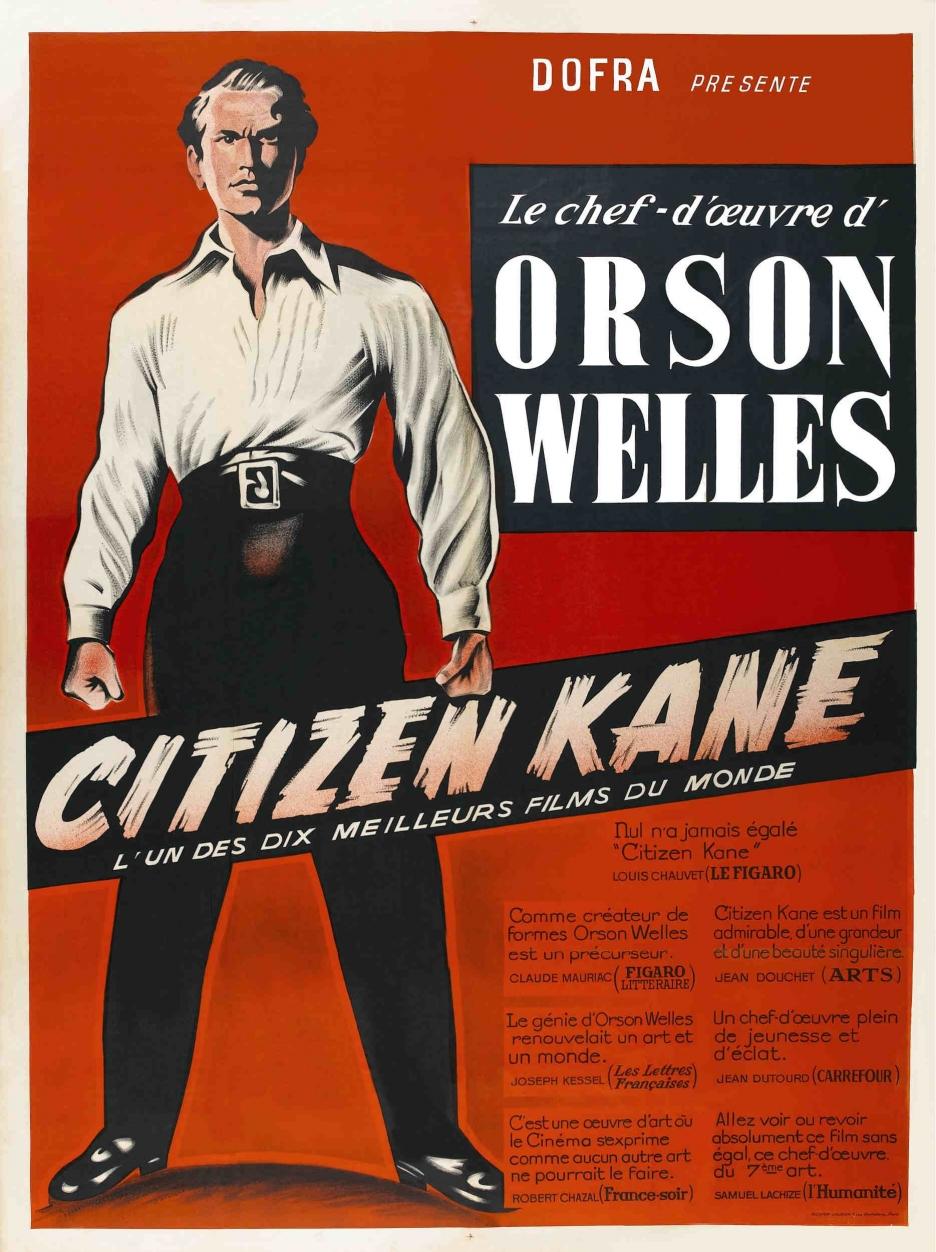
You may recall our posting last year of Jorge Luis Borges’ review of Orson Welles’ Citizen Kane — surely one of the most Open Culture-worthy intersections of 20th century luminaries ever to occur. Borges described Welles’ masterwork as possessed of one side that, “pointlessly banal, attempts to milk applause from dimwits,” and another, a “kind of metaphysical detective story” whose “subject (both psychological and allegorical) is the investigation of a man’s inner self, through the works he has wrought, the words he has spoken, the many lives he has ruined.” On the whole, the author of Labyrinths called the picture “not intelligent, though it is the work of genius.”
Not long after our post, the Paris Review’s Dan Piepenbring wrote one that also quoted another, later review of Citizen Kane by none other than Jean-Paul Sartre:
Kane might have been interesting for the Americans, [but] it is completely passé for us, because the whole film is based on a misconception of what cinema is all about. The film is in the past tense, whereas we all know that cinema has got to be in the present tense. ‘I am the man who is kissing, I am the girl who is being kissed, I am the Indian who is being pursued, I am the man pursuing the Indian.’ And film in the past tense is the antithesis of cinema. Therefore Citizen Kane is not cinema.
The 1945 review originally ran in high-minded film journal L’Écran français under the headline “Quand Hollywood veut faire penser … Citizen Kane d’Orson Welles,” or, “When Hollywood Wants to Make Us Think … Orson Welles’ Citizen Kane.” According to The Writings of Jean-Paul Sartre: A Bibliographical Life, “in re-reading this [review], which he did not remember at all, Sartre hardly recognized his style and expressed some doubt about the authenticity of his signature. On the other hand, he did find in it the ideas Citizen Kane suggested to him when he first saw it in the United States. After he saw the film again in France, Sartre had a slightly more favorable opinion of it, but he still thinks it is undoubtedly no masterpiece.”
But at the time, writes Simon Leys, “the impact of this condemnation was devastating. The Magnificent Ambersons was shown soon afterwards in Paris but failed miserably. The cultivated public always follows the directives of a few propaganda commissars: there is much more conformity among intellectuals than among plumbers or car mechanics.” Or at least the cultivated public did so in 1940s Paris; the mechanics of culture have changed somewhat since then, but as far as Citizen Kane goes, high-profile opinions about it have grown only more positive over time. Sure, Vertigo recently knocked it down a peg in the Sight and Sound poll, but that just makes me wonder what Sartre thought of Hitchcock’s masterwork — a film that might have had a resonance or two in the mind of an existentialist.
Related Content:
Jorge Luis Borges, Film Critic, Reviews Citizen Kane — and Gets a Response from Orson Welles
Orson Welles Explains Why Ignorance Was His Major “Gift” to Citizen Kane
Jean-Paul Sartre Rejects the Nobel Prize in Literature in 1964: “It Was Monstrous!”
Jean-Paul Sartre Breaks Down the Bad Faith of Intellectuals
Human, All Too Human: 3‑Part Documentary Profiles Nietzsche, Heidegger & Sartre
Download Walter Kaufmann’s Lectures on Nietzsche, Kierkegaard, Sartre & Modern Thought (1960)
Colin Marshall writes on cities, language, Asia, and men’s style. He’s at work on a book about Los Angeles, A Los Angeles Primer, and the video series The City in Cinema. Follow him on Twitter at @colinmarshall or on Facebook.
Read More...Support Us
We're hoping to rely on loyal readers, rather than erratic ads. Please click the Donate button and support Open Culture. You can use Paypal, Venmo, Patreon, even Crypto! We thank you!

About Us

Open Culture scours the web for the best educational media. We find the free courses and audio books you need, the language lessons & educational videos you want, and plenty of enlightenment in between.
Advertise With Us
FREE UPDATES!
GET OUR DAILY EMAIL
Get the best cultural and educational resources on the web curated for you in a daily email. We never spam. Unsubscribe at any time.
FOLLOW ON SOCIAL MEDIA
Open Culture editor Dan Colman scours the web for the best educational media. He finds the free courses and audio books you need, the language lessons & movies you want, and plenty of enlightenment in between.
Advertise With Us

