MIT’s Introduction to Poker Theory: A Free Online Course
Taught by Kevin Desmond, a graduate student in MIT’s Sloan School of Management, Poker Theory and Analytics introduces “students to poker strategy, psychology, and decision-making in eleven lectures.” Along with giving students the chance to play endless rounds of poker, the class–according to MIT News–featured guest speakers “Bill Chen, a professional player best known for his appearances on the Game Show Network’s High Stakes Poker television show, Matt Hawrilenko, a Princeton graduate who won more than $1 million at the World Series of Poker in 2009, and Aaron Brown, chief risk manager at AQR Capital Management.” And it culminated with a live tournament.
You can access all of the lectures for the Poker Theory and Analytics course on YouTube, iTunes or Archive.org. (You can watch the complete playlist of lectures above.) And if you click here, you can get the syllabus, lectures notes, assignments, poker software, and more.
Poker Theory and Analytics will be added to our ever-growing collection, 1,700 Free Online Courses from Top Universities, in both the Business and Economics sections.
Related Content:
Peter Thiel’s Stanford Course on Startups: Read the Lecture Notes Free Online
150 Free Online Business Courses
MIT Teaches You How to Speak Italian & Cook Italian Food All at Once (Free Online Course)
Read More...This Is Your Brain on Jane Austen: The Neuroscience of Reading Great Literature

I freely admit it—like a great many people these days, I have a social media addiction. My drug of choice, Twitter, can seem like a particularly schizoid means of acquiring and sharing information (or knee-jerk opinion, rumor, innuendo, nonsense, etc.) and a particularly accelerated form of distractibility that never, ever sleeps. Given the profound degree of over-stimulation such outlets provide, we might be justified in thinking we owe our short attention spans to 21st century technological advances. Not necessarily, says Michigan State University professor Natalie Phillips—who studies 18th and 19th century English literature from the perspective of a 21st century cognitive theorist, and who cautions against “adopting a kind of historical nostalgia, or assuming those of the 18th century were less distracted than we are today.”
Early modern writers were just as aware of—and as concerned about—the problem of inattention as contemporary critics, Phillips argues, “amidst the print-overload of 18th-century England.” We might refer, for example, to Alexander Pope’s epic satire “The Dunciad,” a hilariously apocalyptic jeremiad against the proliferation of careless reading and writing in the new media environment of his day. (A world “drowning in print, where everything was ephemeral, of the moment.”)
Phillips focuses on the work of Jane Austen, whom, she believes, “was drawing on the contemporary theories of cognition in her time” to construct distractible characters like Pride and Prejudice’s Elizabeth Bennett. Taking her cues from Austen and other Enlightenment-era writers, as well as her own inattentive nature, Phillips uses contemporary neuroscience to inform her research, including the use of brain imaging technology and computer programs that track eye movements.
In collaboration with Stanford’s Center for Cognitive and Biological Imaging (CNI), Phillips devised an experiment in 2012 in which she asked literary PhD candidates—chosen, writes Stanford News, “because Phillips felt they could easily alternate between close reading and pleasure reading”—to read a full chapter from Austen’s Mansfield Park, projected onto a mirror inside an MRI scanner. At times, the subjects were instructed to read the text casually, at others, to read closely and analytically. Afterwards, they were asked to write an essay on the passages they read with attention. As you’ll hear Phillips describe in the short NPR piece above, the neuroscientists she worked with told her to expect only the subtlest of differences between the two types of reading. The data showed otherwise. Phillips describes her surprise at seeing “how much the whole brain, global activations across a number of different regions, seems to be transforming and shifting between the pleasure and the close reading.” As CNI neuroscientist Bob Dougherty describes it, “a simple request to the participants to change their literary attention can have such a big impact on the pattern of activity during reading,” with close reading stimulating many more areas of the brain than the casual variety. What are we to make of these still inconclusive results? As with many such projects in the emerging interdisciplinary field of “literary neuroscience,” Phillips’ goal is in part to demonstrate the continued relevance of the humanities in the age of STEM. Thus, she theorizes, the practice and teaching of close reading “could serve—quite literally—as a kind of cognitive training, teaching us to modulate our concentration and use new brain regions as we move flexibly between modes of focus.”
The study also provides us with a fascinating picture—quite literally—of the ways in which the imaginative experience of reading takes place in our bodies as well as our minds. Close, sustained, and attentive reading, Phillips found, activates parts of the brain responsible for movement and touch, “as though,” writes NPR, “readers were physically placing themselves within the story as they analyzed it.” Phillips’ study offers a scientific look at a mysterious experience serious readers know well—“how the right patterns of ink on a page,” says Dougherty, “can create vivid mental imagery and instill powerful emotions.” As with the so-called “hard problem of consciousness,” we may not understand exactly how this happens anytime soon, but we can observe that the experience of close reading is a rewarding one for our entire brain, not just the parts that love Jane Austen. While not everyone needs convincing that “literary study provides a truly valuable exercise of people’s brains,” Phillips’ research may prove exactly that.
Related Content:
Jane Austen, Game Theorist: UCLA Poli Sci Prof Finds Shrewd Strategy in “Cluelessness”
This is Your Brain on Jazz Improvisation: The Neuroscience of Creativity
What Happens When Your Brain is on Alfred Hitchcock: The Neuroscience of Film
Josh Jones is a writer and musician based in Durham, NC. Follow him at @jdmagness
Read More...Venice in Beautiful Color Images 125 Years Ago: The Rialto Bridge, St. Mark’s Basilica, Doge’s Palace & More
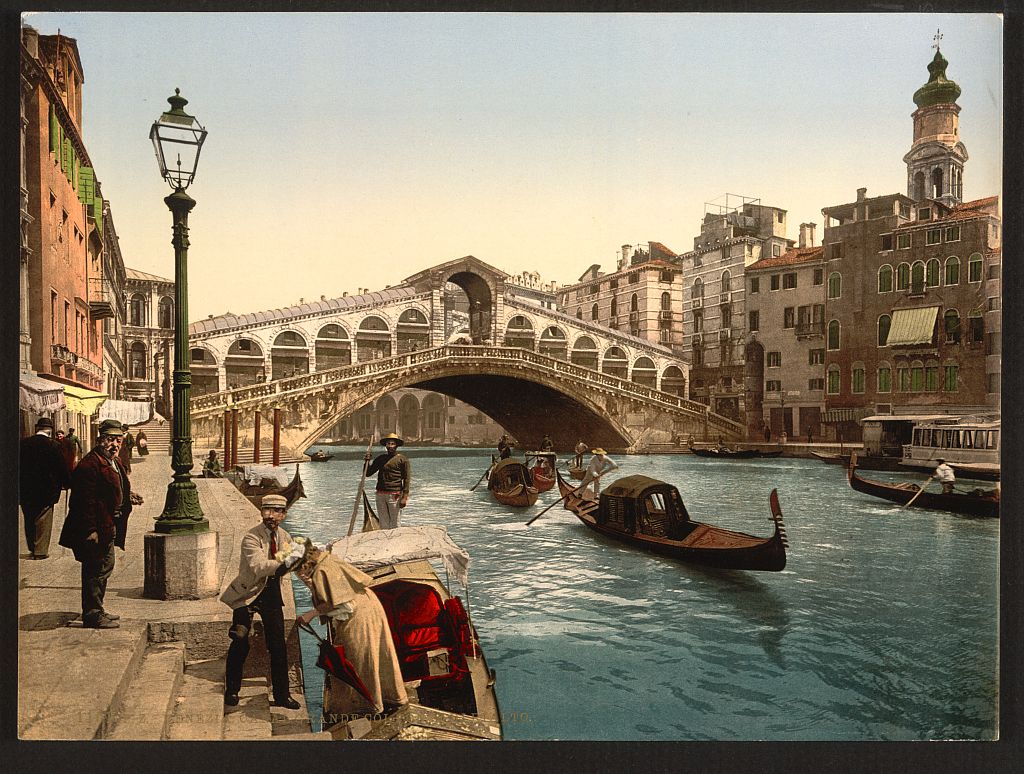
A few months ago, Mental Floss put up a post of “Fantastic 120-Year-Old Color Pictures of Ireland.” Fantastic pictures indeed, although the nature of the technology that produced them seems as interesting to me as the 19th-century Irish life captured in the images themselves. They came from the Library of Congress’ geographically organized archive of photocrom prints, a method perhaps known only to die-hard historical photography enthusiasts. For the rest of us, the Library of Congress’ page on the photocrom process explains it: “Photochrom prints are ink-based images produced through ‘the direct photographic transfer of an original negative onto litho and chromographic printing plates.’ ”
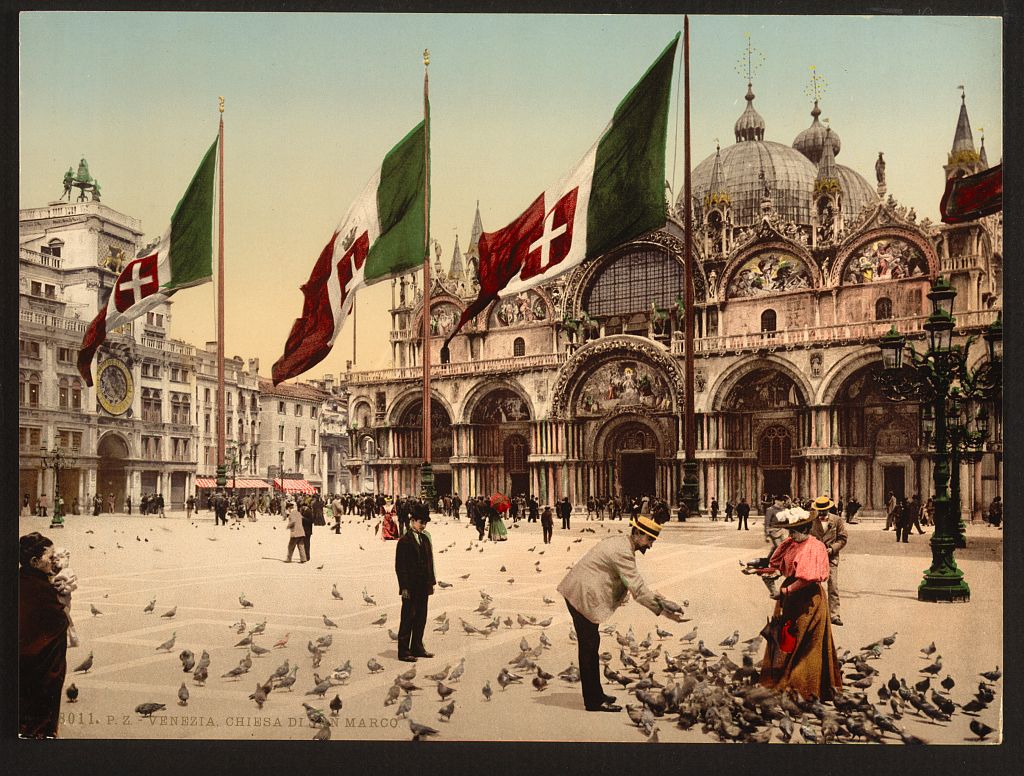
Its inventor Hans Jakob Schmid came up with the technique in the 1880s, a decade that began with color photography consigned to the realm of theory. While Photocrom prints may look an awful lot like color photographs, look at them through a magnifying glass and “the small dots that comprise the ink-based photomechanical image are visible.” “The photomechanical process permitted mass production of the vivid color prints,” each color requiring “a separate asphalt-coated lithographic stone, usually a minimum of six stones and often more than ten stones.”
But that unwieldy-sounding technology and laborious-sounding process has given us, among other striking pieces of visual history, these lush images of fin de siècle Venice, which the writer of place Jan Morris once described as “less a city than an experience.”
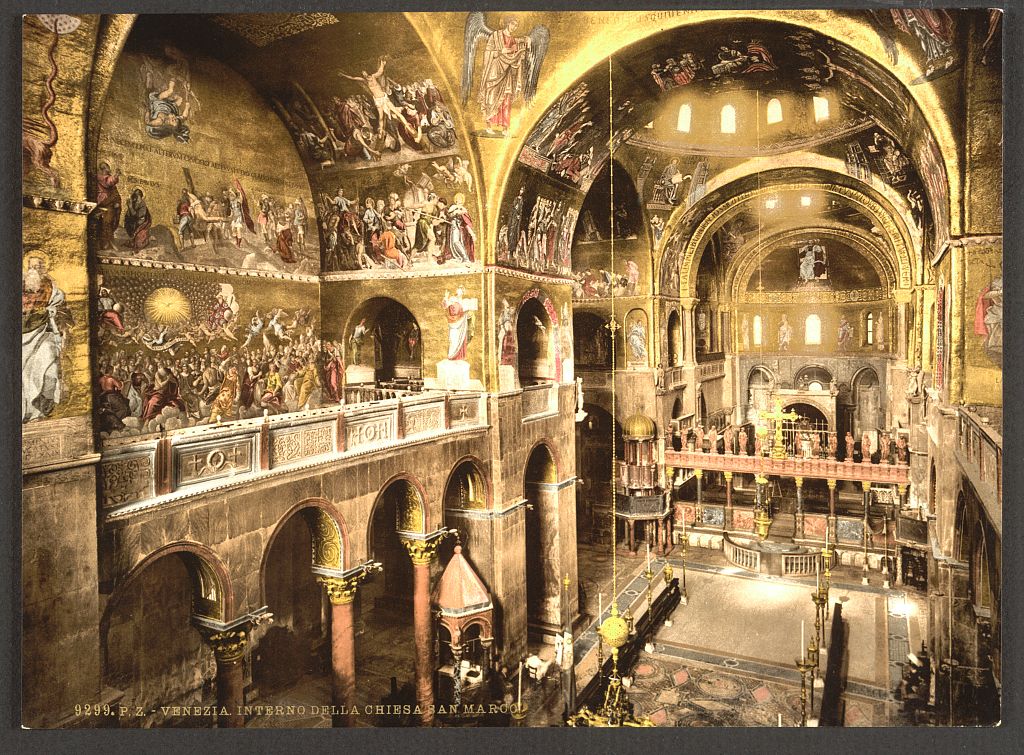
At the top of the post, we have a view of the Rialto Bridge, which spans one of the city’s famous canals; below that a scene of pigeon-feeding in St. Mark’s Piazza; the image just above leaves the pigeons behind to view the interior of St. Mark’s Basilica.
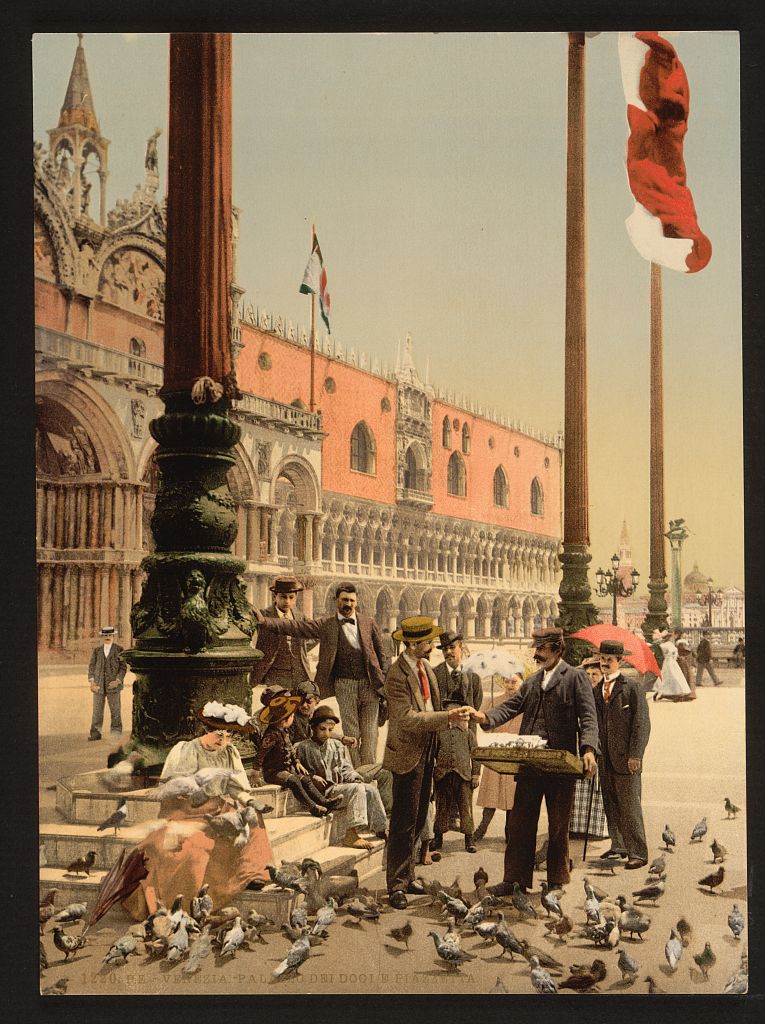
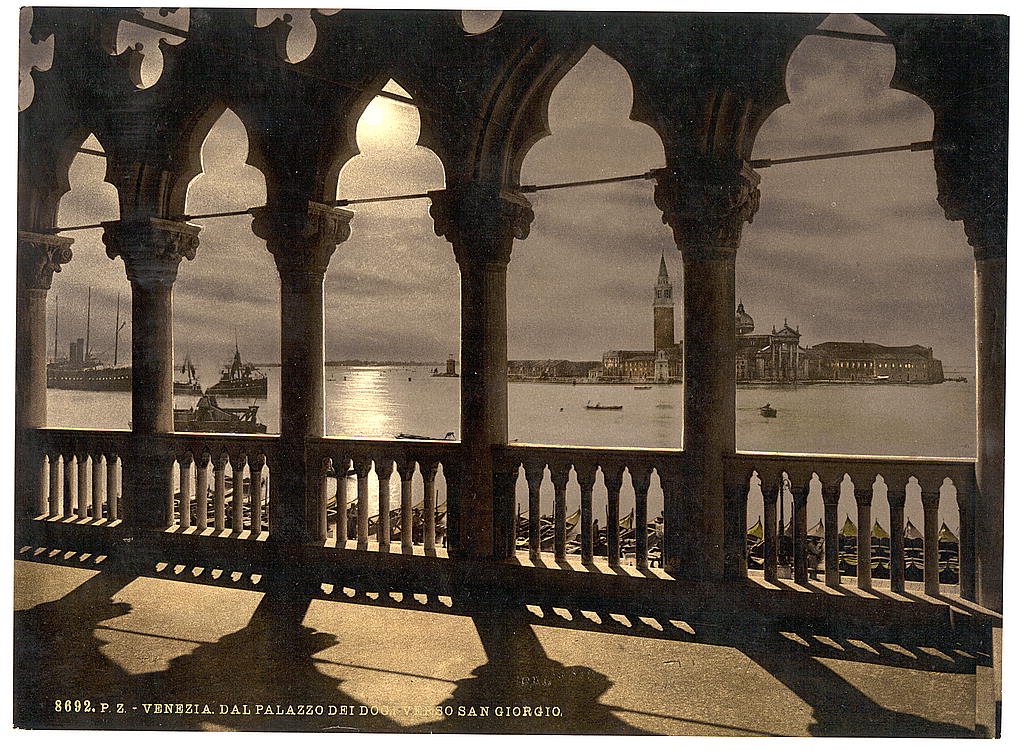
The photos below, all also taken between 1890 and 1900, depict the exterior and interior of the Doge’s Palace, as well as its view of San Giorgio Island by moonlight.
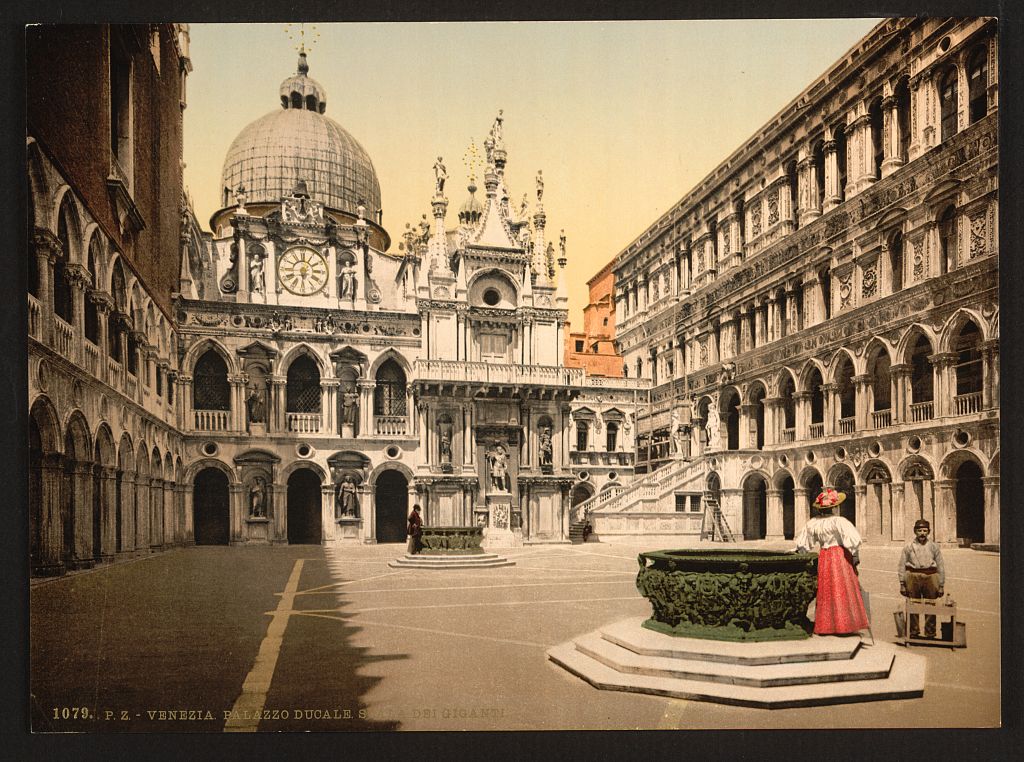
We may not consider these “real” color photographs, but the colors they present, vividly applied in the printing process, somehow more accurately represent the spirit of late 19th-century Europe — one of history’s truly vivid periods, in one of its enduringly vivid human environments. More color images of fin-de-siecle Venice can be viewed here.
Related Content:
Take a Virtual Tour of Venice (Its Streets, Plazas & Canals) with Google Street View
How Venice Works: A Short Film
Venice in a Day: From Daybreak to Sunset in Timelapse
Hand-Colored Photographs of 19th Century Japan
The First Color Photos From World War I: The German Front
The Oldest Color Movies Bring Sunflowers, Exotic Birds and Goldfish Back to Life (1902)
Colin Marshall writes on cities, language, Asia, and men’s style. He’s at work on a book about Los Angeles, A Los Angeles Primer, and the video series The City in Cinema. Follow him on Twitter at @colinmarshall or on Facebook.
Read More...Two Documentaries Introduce Delia Derbyshire, the Pioneer in Electronic Music
With her buttoned-up style, work with the UN, and name like a plucky character in a certain English wizard series, Delia Derbyshire may not seem a likely pioneer of experimental electronic music. But her work in the sixties and seventies indeed made her a forerunner of so much contemporary electronic music that most every current legend in the business—from Aphex Twin and the Chemical Brothers to Paul Hartnoll of Orbital, who calls her work “quite amazing” and “timeless”—credits her in some way or another. If you’ve never heard of Derbyshire, you can learn about her life and work in the 2010 BBC Radio 4 documentary above, “Sculptress of Sound.”
As we recently noted in an earlier post, Derbyshire occupies a prominent place in the history of women in the field. She has also worked with everyone from Doctor Who composer Ron Grainer (who took sole credit for their work together) to Paul McCartney. Well almost. McCartney—a huge fan of Derbyshire’s work with the BBC’s Radiophonic Workshop—considered collaborating with her on an early version of “Yesterday,” then went with strings instead. But her near hit with the Beatles showed just how far she had come since joining the BBC as a trainee studio manager in 1960. The previous year, Decca records rejected her application, telling her point blank that they did not hire women for studio work.
For contractual reasons, Derbyshire made many of her radio compositions under pseudonyms, and she may have been frustrated by her near-obscurity. She did withdraw from music in the mid-seventies, not to reappear until a few years before her death in 2001. But perhaps her departure had nothing to do with lack of fame. Derbyshire had the highest of technical standards and a mathematical approach to making music. Once commercial synthesizers became available, she felt that making electronic music had become too easy and her enthusiasm waned. The new music bored her, and instead of trying to hold on to her relevance, she made a graceful exit.
It’s only in recent years that Derbyshire has become recognized for the pioneer she was. See her above profiled in a 2009 short documentary, “The Delian Mode,” by Kara Blake. Featured are Derbyshire’s innovative techniques with manipulated tape machines and found sounds for her TV and film scores and her original compositions under her own name and with influential early electro-pop band White Noise. The Guardian called Derbyshire’s way of making music “an analytical approach to synthesiz[ing] complex sounds from electronic sources.” Her degree in mathematics informed her way of working, as did her conception of herself not primarily as a composer, but also as a scientist. “I suppose in a way,” she said of her painstakingly-created scores, “I was experimenting in psycho-acoustics.” Many of her experiments sound as fresh today as they did at the time, ready to inspire several more generations of composers and musicians.
You can dip into an archive of Derbyshire’s music over at UBU.com.
Related Content:
Hear Seven Hours of Women Making Electronic Music (1938- 2014)
Josh Jones is a writer and musician based in Durham, NC. Follow him at @jdmagness.
Read More...Andrei Tarkovsky’s Solaris Shot by Shot: A 22-Minute Breakdown of the Director’s Filmmaking
“What is Bresson’s genre? He doesn’t have one. Bresson is Bresson,” wrote master filmmaker Andrei Tarkovsky in his seminal book Sculpting in Time. “The very concept of genre is as cold as the tomb.”
Nonetheless, Tarkovsky made two of the most praised, best-regarded science fiction films in cinema. Stalker (watch it online) is a metaphysical riddle wrapped in the trappings of a sci-fi thriller. In the verdant area called the Zone, ringed off by miles of barbed wire and armed soldiers, pilgrims come to behold an uncanny landscape ruled by a powerful, otherworldly intelligence. The film seemed to prefigure the Chernobyl disaster that happened years later and proved to be the unlikely inspiration for a video game.
Adapted from a novel by Stanislaw Lem, Solaris (watch online) is about a space station that orbits a sentient planet that causes hallucinations in the cosmonauts. The hyper-rational protagonist, Kris Kelvin, is thrown for a loop when he is confronted by a doppelganger of his dead wife who killed herself years earlier. The logical side of him knows that this is a hallucination but he falls in love anyway, only to lose her again. Kelvin is caught in a hell of repeating the mistakes of his past.
Solaris was seen as a Cold War-era response to Stanley Kubrick’s 2001: A Space Odyssey. Both movies are mind-altering deep-space epics that raise more questions than they answer. Yet Tarkovsky hated 2001’s ostentatious use of cutting-edge special effects. “For some reason, in all the science-fiction films I’ve seen, the filmmakers force the viewer to examine the details of the material structure of the future,” he told Russian film journalist Naum Abramov in 1970. “More than that, sometimes, like Kubrick, they call their own films premonitions. It’s unbelievable! Let alone that 2001: A Space Odyssey is phony on many points, even for specialists. For a true work of art, the fake must be eliminated.”
Indeed, Tarkovsky seemed to deliberately half-ass the generic elements of film. He used leisurely shots of tunnels and highways of 1971 Tokyo to depict the city of the future. He devoted only a couple minutes of the film’s nearly three hour running time to things like spaceships. And you have to love the fact that the space station in Solaris has such distinctly unfuturistic design elements as a chandelier and a wood-paneled library.
Tarkovsky, of course, isn’t interested in science. He’s interested in art and its way to evoke the divine. And his primary way of doing this is with long takes; epic shots that resonate profoundly even if the meaning of those images remains elusive. Solaris opens with a shot of water flowing in a brook and then, later in the scene, there is a sudden downpour. The camera presses into a shot of a teacup filling with rain. It’s a beautiful, memorable, evocative shot. Maybe the image means something. Maybe its beauty is, in and of itself, its meaning. Either way, Tarkovsky forces you to surrender to his deliberate cinematic rhythm and his pantheistic view of the world.
In a piece called Tarkovsky Shot by Shot, video essayist Antonios Papantoniou dissects a few scenes from Solaris, breaking down each according to camera angle, shot type and duration while pointing out recurring visual motifs. “Diametrically different from Hollywood’s extravagant moviemaking Tarkovsky’s Solaris is in a cinematic universe of its own,” writes Papantoniou in one of the video’s copious intertitles. “Symbolic images and metaphysical manifestations are created and expressed in a poetic way where every visual detail matters.” Watching Shot by Shot, you get a real sense of just how beautifully his films unfold with those gorgeously choreographed long takes. You can watch the full video above.
Related Content:
Tarkovsky Films Now Free Online
Watch Stalker, Andrei Tarkovsky’s Mind-Bending Masterpiece Free Online
The Masterful Polaroid Pictures Taken by Filmmaker Andrei Tarkovsky
Tarkovsky’s Advice to Young Filmmakers: Sacrifice Yourself for Cinema
A Poet in Cinema: Andrei Tarkovsky Reveals the Director’s Deep Thoughts on Filmmaking and Life
Jonathan Crow is a Los Angeles-based writer and filmmaker whose work has appeared in Yahoo!, The Hollywood Reporter, and other publications. You can follow him at @jonccrow. And check out his blog Veeptopus, featuring lots of pictures of vice presidents with octopuses on their heads. The Veeptopus store is here.
Read More...Animated Introductions to Three Sociologists: Durkheim, Weber & Adorno
Is sociology an art or a science? Is it philosophy? Social psychology? Economics and political theory? Surveying the great sociologists since the mid-19th century, one would have to answer “yes” to all of these questions. Sociologists like Karl Marx, Émile Durkheim, Max Weber, and Theodor Adorno conducted serious scholarly and social-scientific analyses, and wrote highly speculative theory. Though it may seem like we’re all sociologists now, making critical judgments about large groups of people, the sociologists who created and carried on the discipline generally did so with sound evidence and well-reasoned argument. Unlike so much current knee-jerk commentary, even when they’re wrong they’re still well worth reading.
Having already surveyed Marx in his series on Euro-American political philosophers, School of Life founder Alain de Botton now tackles the other three illustrious names on the list above, starting with Durkheim at the top, then Weber above, and Adorno below. The first two figures were contemporaries of Marx, the third a later interpreter. Like that bearded German scourge of capitalism, these three—in more measured or pessimistic ways—levied critiques against the dominant economic system. Durkheim took on the problem of suicide, Weber the anxious religious underpinnings of capitalist ideology, and Adorno the consumer culture of instant gratification.
That’s so far, at least, as de Botton’s very cursory introductions get us. As with his other series, this one more or less ropes the thinkers represented here into the School of Life’s program of promoting a very particular, middle class view of happiness. And, as with the other series, the thinkers surveyed here all seem to more or less agree with de Botton’s own views. Perhaps others who most certainly could have been included, like W.E.B. Dubois, Jane Addams, or Hannah Arendt, would offer some very different perspectives.
De Botton again makes his points with pithy generalizations, numbered lists, and quirky, cut-out animations, breezily reducing lifetimes of work to a few observations and moral lessons. I doubt Adorno would approach these less-than-rigorous methods charitably, but those new to the field of sociology or the work of its practitioners will find here some tantalizing ideas that will hopefully inspire them to dig deeper, and to perhaps improve their own sociological diagnoses.
Note: For those interested, Yale has a free open course on Sociology called “Foundations of Modern Social Theory,” which covers most of the figures listed above. You can always find it in our collection, 1,700 Free Online Courses from Top Universities.
Related Content:
Josh Jones is a writer and musician based in Durham, NC. Follow him at @jdmagness
Read More...David Bowie, Mick Jagger, Queen & Elvis Presley Star in Delightfully Absurd Musicless Music Videos
Sometime in the last decade, as both YouTube and smart phones became our primary means of cultural transmission, the isolated vocal track meme came into being, reaching its summit in the sublime ridiculousness of David Lee Roth’s unadorned “Running With the Devil” vocal tics. His yelps, howls, and “Whoooohoooos!” produced the very best version of that virtual novelty known as the soundboard app, and welcomed many a caller to many a kooky voicemail greeting. The isolated track has since become a phenomenon worthy of study, and we’ve done our share here of poring over various voices and instruments stripped from their song’s context and placed before us in ways we’d never heard before.
Perhaps serious analysis too shall be the fate of a goofy visual meme that also thrives on the ridiculousness of pop music’s presentation: the musicless music video. The idea is a similar one, isolating the image instead of the sound: popular videos, already weirdly over the top, become exercises in choreographed awkwardness or voyages into uncanny valleys as we watch their stars pose, preen, and contort themselves in weird costumes for seemingly no reason, accompanied only by the mundane sounds of their shuffling feet and grunts, belches, nervous laughter, etc. Take the particularly funny examples here: Mick Jagger and David Bowie prancing through the bizarre “Dancing in the Streets” video (original here); the members of Queen performing domestic chores in “I Want to Break Free” (original); Elvis Presley squeaking and spasming onstage in a TV take of “Blue Suede Shoes”; Nirvana moping and swaying in that high school gym while a nearby custodian goes about his business…..
Though these skewed re-evaluations of famous moments in pop history make use of a similar premise as the isolated track, the sounds we hear are not—as they sometimes seem—vérité audio recordings from the videos’ sets. They are the creation of Austrian sound designer, editor, and mixer Mario Wienerroither, who, The Daily Dot informs us, “works from a sound library that he’s spent years amassing.” The results, as you will hear for yourself, “range from humorous to disturbing and everywhere in between.” Musicless music videos remind us of how silly and artificial these kinds of staged, mimed pseudo-performances really are—they only become convincing to us through the magical editing together sound and image on cue and on beat.
Wienerroither began his project with the Queen video, inspired when he caught it playing while his TV was on mute. The moment, he says, was “a vital spark.” Since then, dozens of musicless music videos, and TV and film clips, have popped up on YouTube (see a sizeable playlist here.) One of the most awkward, The Prodigy’s “Firestarter,” helped rocket the phenomenon into major popularity. Imitators have since posted musicless videos of the Friends intro and Miley Cyrus’ “Wrecking Ball.” What can we learn from these videos? Nothing, perhaps, we didn’t already know: that pop culture’s most enduring moments are also its most absurd, that nostalgia is a dish best served remixed, that the internet—a powerful force for good as well as ill—is often at its best when it is a powerful force for weird. Though the medium may be frivolous, these are messages worth remembering.
Related Content:
Kurt Cobain’s Isolated Vocal Track From ‘Smells Like Teen Spirit,’ 1991
Josh Jones is a writer and musician based in Durham, NC. Follow him at @jdmagness
Read More...David Bowie Paper Dolls Recreate Some of the Style Icon’s Most Famous Looks

Perform an internet search on the phrase “David Bowie Paper Doll” and what do you get? Hint: it’s not a cover of the Mills Brothers hit. David Bowie paper dolls are proliferating in astonishing numbers.
Sharpen your scissors and behold!
The most comprehensive career representation is the Thin White Paper Doll Cutout Heather Collett designed for the Canadian Broadcasting Corporation (above). There’s even a printer friendly version for those who are serious about playing with Aladdin Sane, Ziggy Stardust, Labyrinth’s Goblin King, and other Bowie alter egos.
But wait! There’s more…

Elusive designer Vodka Caramel’s Amazing 70’s Bowie Paper Doll celebrates some of our hero’s most glamorous looks, but saddles him with the crotch of a Ken doll and no fewer than four interchangeable heads! And we thought the Thin White Paper Doll’s crew socks were an indignity.
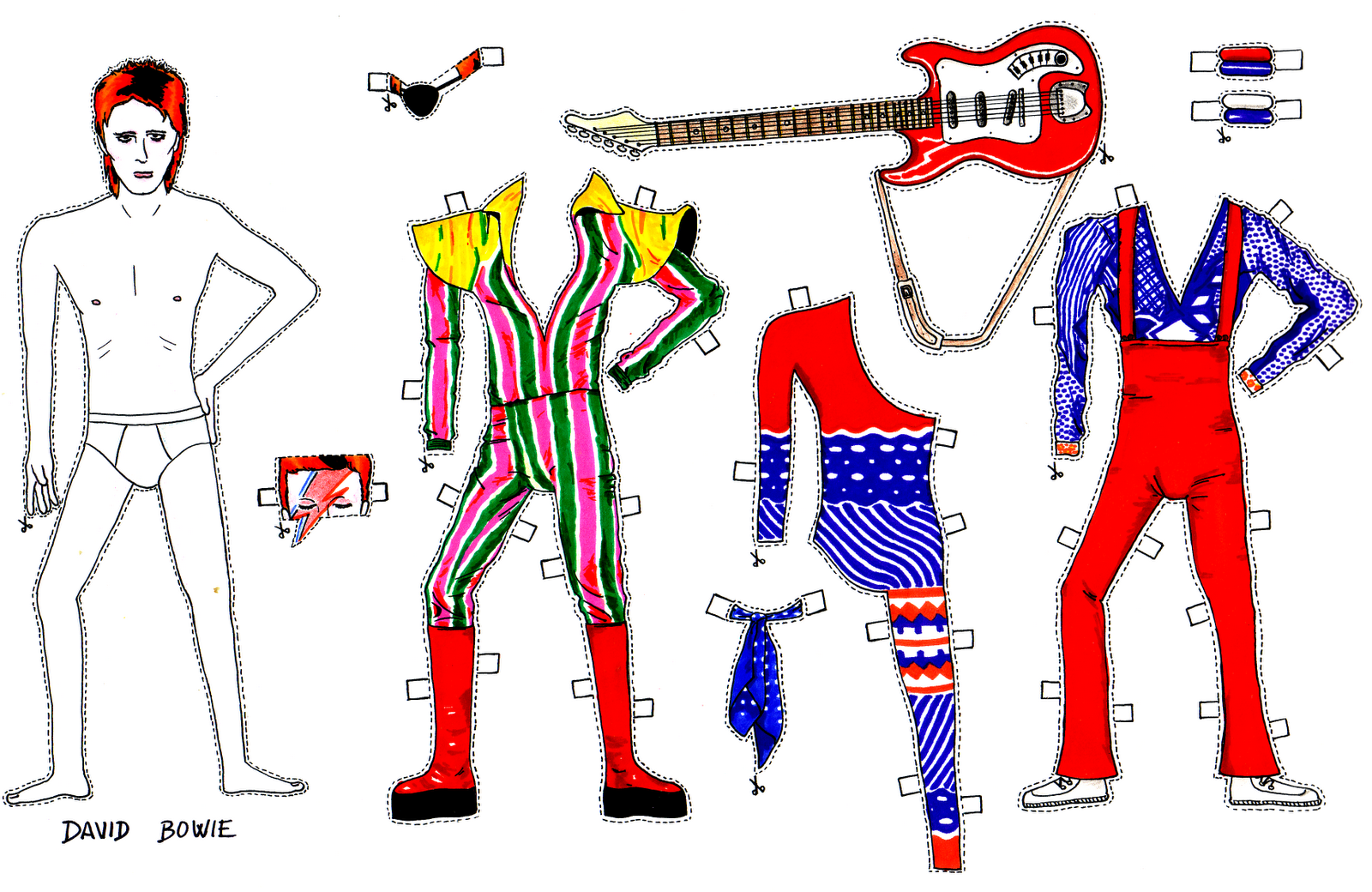
A Spanish fan observed Bowie’s 65th birthday by updating the abbreviated tighty whities of a notorious 1973 photo shoot to a modest pair of standard issue Y‑fronts. Interestingly, this paper doll’s suspendered Halloween Jack suit arrives with bulge intact.

Points to Serge Baeken above for recognizing the paper doll possibilities in the Pierrot costume Bowie sported in the video for 1980’s “Ashes to Ashes.” (Fun fact: Bowie made his theatrical debut—and wrote the music for—a bizarre 1968 pantomime about Pierrot.… His character’s name was “Cloud”)

Artist Claudia Varosio’s entry in the Bowie paper doll stakes could pass as illustrations for a 1970’s children’s book. Title? Boys Keep Swinging, after a cut from Bowie’s 1979 Lodger album. Chaste young girls would love the t‑shirted, non-threatening Bowie.
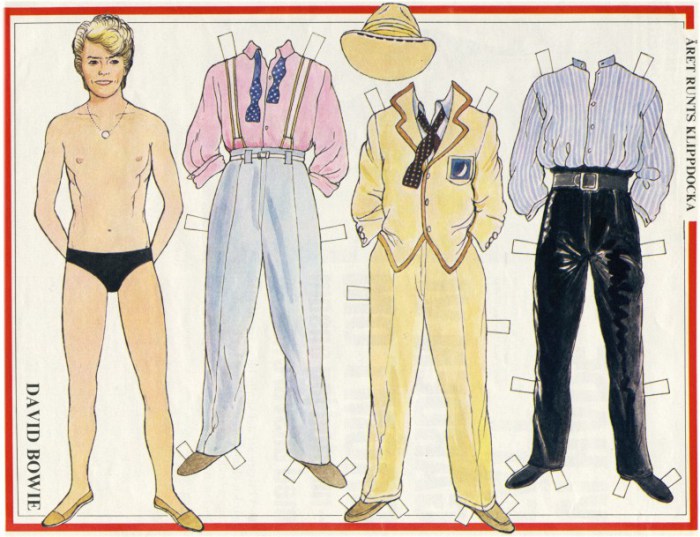
The comparatively conservative, full-faced Bowie above comes to us via Swedish family magazine Året Runt. I may never learn another word of Swedish, but thanks to David Bowie, I can now say paper doll (klippdockor). In appreciation, allow me to share another example of David Bowie klippdockor…

If it all starts seeming a bit rote, mix things up by having artist Mel Elliot’s paper doll Bowie swap duds with fellow pop star / style icon paper dolls, Beyonce, Debbie Harry, and Rihanna.
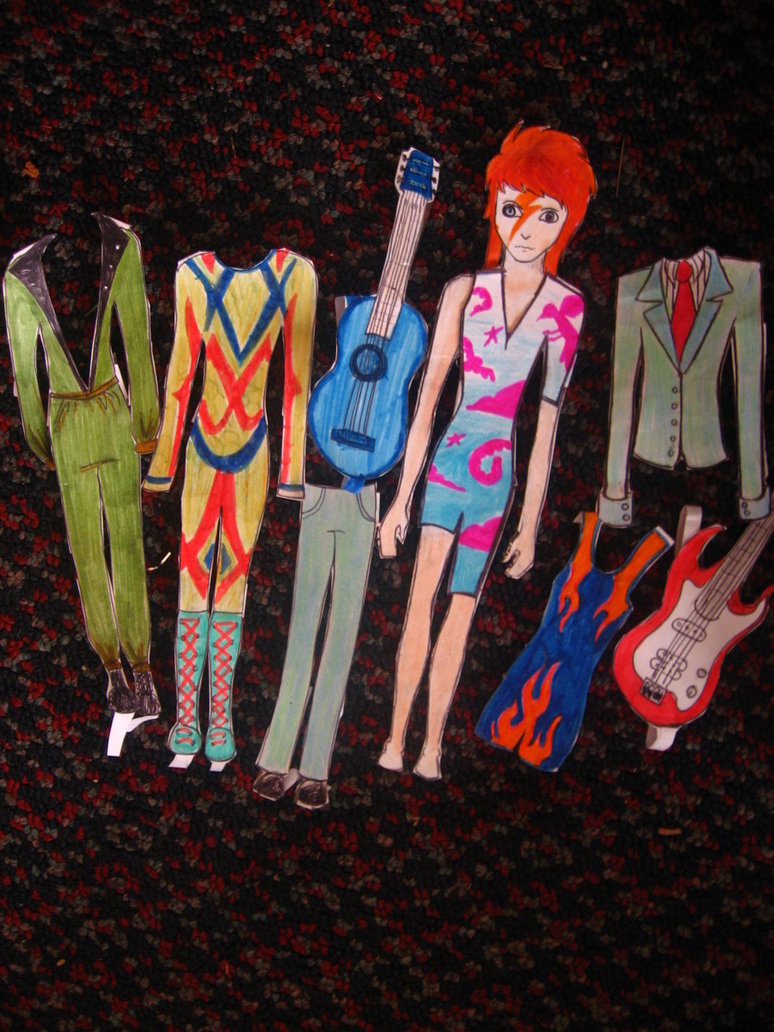
(image by Electric Sorbet)
There is only one David Bowie, but there can never be too many David Bowie paper dolls. Make your own today!
Related Content:
96 Drawings of David Bowie by the “World’s Best Comic Artists”: Michel Gondry, Kate Beaton & More
50 Years of Changing David Bowie Hair Styles in One Animated GIF
The Musical Career of David Bowie in One Minute … and One Continuous Take
Ayun Halliday is an author, illustrator, and Chief Primatologist of the East Village Inky zine. Follow her @AyunHalliday
Read More...High School Teacher Reads Allen Ginsberg’s Explicit Poem “Please Master” and Loses His Job

Image by Michiel Hendryckx.
Although the boundaries of what should pass for free speech in high school English classrooms will be forever in debate, most everyone would agree some boundaries must exist. But what of the speech of famous authors? Of towering figures of 20th century poetry? Should their speech be subject to review? What of an English teacher who allows the most risqué Beat poem you’ve ever heard to be read aloud in class by the poet himself, Allen Ginsberg, via an online video (perhaps this one)? Award-winning English teacher David Olio, a beloved 19-year veteran, did just that when a student asked to share Ginsberg’s ecstatic, and very explicit, poem “Please Master” with the class.
After complaints from several students, the school administration suspended Olio, then forced him to resign. Whether or not this decision was just is a debate that extends beyond the scope of this post. The variables are many, as Slate’s sympathetic Mark Joseph Stern admits, including the fact that Olio did not exactly prepare his students for what was to come, nor give them the opportunity to opt out. The high school seniors—on the threshold of adulthood and some already with one foot in college—may not have had their “emotional health” endangered, as Olio’s termination letter alleged, but it’s little wonder some of them found the material shocking.
Ginsberg’s poem, which you can hear him read above, describes a “fantasized sexual encounter between Ginsberg and Neal Cassady, the inspiration for the Dean Moriarty character in Jack Kerouac’s On the Road.” It is graphic, writes Stern, but “not obscene.” Instead—in its allusions to St. Teresa’s angelic visitation in a “profane description of anal sex as a nearly divine act”—Ginsberg’s poem is “dangerous because it juxtaposes tenderness with masochism; dangerous because it rapturously celebrates a vision of same-sex intimacy we are only supposed to whisper about.” Read the poem, listen to Ginsberg read it, and judge for yourself.
Of course, this is hardly the first time Ginsberg’s work has caused controversy. His Beat epic “Howl” (1955), with its sexually charged lines, irked the U.S. government, who seized copies of the poem and put its publisher, poet and City Lights’ bookseller Lawrence Ferlinghetti, on trial for obscenity. Well over sixty years later, Ferlinghetti has written in defense of David Olio. We can safely assume that Ginsberg, who died in 1997, also would approve. And while we have every right to be shocked by Ginsberg’s poem, or not, and find the decision to fire Olio warranted, or not, I tend to agree with Stern when he writes “if every English teacher were that enthusiastic about his subject, America would be a much more literate, educated and interesting place.”
Related Content:
The First Recording of Allen Ginsberg Reading “Howl” (1956)
Allen Ginsberg Reads a Poem He Wrote on LSD to William F. Buckley
Allen Ginsberg Talks About Coming Out to His Family & Fellow Poets on 1978 Radio Show (NSFW)
Josh Jones is a writer and musician based in Durham, NC. Follow him at @jdmagness.
Read More...The Art of Collotype: See a Near Extinct Printing Technique, as Lovingly Practiced by a Japanese Master Craftsman
When I was a kid, I spent a lot of time at the Indianapolis Star, where my mother worked in what was then referred to as the “women’s pages.” She kept me busy returning the photos that accompanied marriage and engagement announcements, using the SASEs the young brides had supplied. After that, I’d hit the printing floor, where veteran workers sported square caps folded from the previous day’s edition, as that day’s issue clacked on tracks overhead. If I was lucky, someone would make me a gift of my name, set in hot type.
The Star still publishes — I shudder to report that its website seems to have renamed it IndyStar… — but cultural and digital advances have relegated all of the particulars mentioned above to the scrap pile.
They came rushing back with wild, Proustian urgency when Osamu Yamamoto, a master printer at Benrido Collotype Atelier in Kyoto, mentions the smell of the ink, in the short documentary above, how over the years, it has seeped into his skin, and become a part of his being.
Collotype, defined by the Getty Conservation Institute as “a screenless photomechanical process that allows high-quality prints from continuous-tone photographic negatives,” has been on the way out since the 70s. As master printer Yamamoto notes, it’s a low-efficiency, small batch operation, involving messy matrixes, hand-operated presses, and heavy iron machines that give off a sort of animal warmth when working.
Rather than pressmen’s caps, Benrido’s shirtless printers wear hachimaki, rubber aprons, and purple disposable gloves.
Filmmaker Fritz Schumann (whose film on the oldest hotel in Japan we previously featured before) evokes the workplace — one of two remaining collotype companies in the world — through small details like the plastic-wrapped digital Hamtaro clock and also by drawing viewers’ attention to the number of years logged by each employee. The art of collotype takes a long time to master and novices appear to be in short supply.
Should we conceive of this operation as a quaint relic, creeping along thanks to the whimsy of a few nostalgia buffs?
Surprisingly, no. The laborious collotype process remains the best way to duplicate precious artworks and historic documents. The way the ink interacts with reticulations in the gelatin surface atop results in subtleties that pixellated digital images cannot hope to achieve.
Visitors to the studio may support the enterprise by picking up a handful of collotype-printed postcards in the gift shop, but the office of the Japanese Emperor is the one who’s really keeping them in business, with orders to copy hundreds of delicate, centuries old scrolls, paintings and letters.
Like a circle in a circle…cultural preservation via cultural preservation! Perhaps the smell of the ink will prevail.
Related Content:
Hōshi: A Short Film on the 1300-Year-Old Hotel Run by the Same Family for 46 Generations
Mark Twain Wrote the First Book Ever Written With a Typewriter
- Ayun Halliday is an author, illustrator, and Chief Primatologist of the East Village Inky zine. Follow her @AyunHalliday
Read More...
Support Us
We're hoping to rely on loyal readers, rather than erratic ads. Please click the Donate button and support Open Culture. You can use Paypal, Venmo, Patreon, even Crypto! We thank you!

About Us

Open Culture scours the web for the best educational media. We find the free courses and audio books you need, the language lessons & educational videos you want, and plenty of enlightenment in between.
Advertise With Us
FREE UPDATES!
GET OUR DAILY EMAIL
Get the best cultural and educational resources on the web curated for you in a daily email. We never spam. Unsubscribe at any time.
FOLLOW ON SOCIAL MEDIA
Open Culture editor Dan Colman scours the web for the best educational media. He finds the free courses and audio books you need, the language lessons & movies you want, and plenty of enlightenment in between.
Advertise With Us


