Yoko Ono Lets Audience Cut Up Her Clothes in Conceptual Art Performance (Carnegie Hall, 1965)
Back before it was common practice to preface one’s web posts with the phrase “trigger warning” (which, BTW, might well apply here)…
Before the Internet…
And slightly before the public revelation of her relationship with John Lennon turned a Japanese avant-garde artist into an American household name…
Yoko Ono maintained an aura of imperviousness onstage at Carnegie Hall, as audience members accepted the challenge to cut away her clothing one piece at a time.
This now-famous conceptual performance was documented by filmmakers Albert and David Maysles, who captured nervous laughter and audience commentary along with the onstage action. (Ono had previously performed the piece twice in Japan where—with the exception of one man who wielded the scissors as if intending to stab her—audiences proved reticent and respectful.)
What does Cut Piece mean?
The motionlessness Ono imposed upon herself (and all subsequent performers of the work) keeps things open to interpretation.
It’s been hailed as a deeply symbolic feminist work and represented in the press of the time as an uninhibited, interactive strip show. Many an academic paper has been written.
With so much control ceded to the audience, even the performer couldn’t predict for certain whether the intention of the piece would synch with the reality.
Cut Piece cannot be mistaken for pure improvisation, however. Like John Cage’s 4’33”, it has a score, complete with variations:
Cut Piece
First Version for single performer:
Performer sits on stage with a pair
of scissors placed in front of him.
It is announced that members of the audience
may come on stage–one at
a time–to cut a small piece of the
performer’s clothing to take with them.
Performer remains motionless
throughout the piece.
Piece ends at the performer’s
option.
Ono has said that the impulse for Cut Piece came from the desire to create art free from ego, the “mentality of saying, ‘here you are, take anything you want, any part you want,’ rather than pushing something you chose on someone else.”
She also took inspiration from a familiar childhood story about the Buddha selflessly giving his own body to provide food for a hungry tiger. It seems an apt metaphor, given the facial expressions of certain audience participants. Were they faking a confidence they didn’t feel, or were they just jerks?
Did I mention the trigger warning?
Documentation, as any performance artist will tell you, is not quite the same as being there. Reenactments, too, may fall short of the original.
Ono reprised the work in 2003, at the age of 70, noting that her motivation had shifted from rage to love, and a desire for world peace.
When artist Jon Hendricks performed it in 1968, he did so in a thrift store suit, thus ignoring its creator’s conviction that part of its power came from starting out in one’s best clothes.
It’s all very ballsy, and horrifying, and compelling, and a little hard to watch.
Would you consider trying it in your local library, community hall, or as part of a school fundraiser?
A longer analysis and history of Yoko Ono’s Cut Piece can be found here courtesy of Kevin Concannon.
Related Content:
Download the John Lennon/Yoko Ono “War is Over (If You Want It)” Poster in 100+ Languages
John Lennon & Yoko Ono’s Two Appearances on The Dick Cavett Show in 1971 and 72
Ayun Halliday is an author, illustrator, and Chief Primatologist of the East Village Inky zine. Follow her @AyunHalliday
Read More...6 Political Theorists Introduced in Animated “School of Life” Videos: Marx, Smith, Rawls & More
“It may come as a surprise to some academics,” writes leftist political theorist Michael Parenti in his sprawling textbook Democracy for the Few, “but there is a marked relationship between economic power and political power.” Parenti exaggerates—I have never met such an academic in a humanities department, though it may be true in the worlds of political philosophy and political science.
Yet in centuries past, philosophers and scholars had no trouble drawing conclusions about the intertwining of the political and the economic. One may immediately think of Karl Marx, who—according to the above video from a new School of Life series on famous political theorists—was “capitalism’s most famous and ambitious critic.” The practical effects of Marx’s political ideas may be anathema for good reason, Alain de Botton admits, but his economic analysis deserves continued attention.
“Capitalism is going to have to be reformed,” de Botton says, “and Marx’s analyses are going to be part of any answer.” One might imagine many academics objecting to his certainty. Marx’s relevance is in question across the political spectrum, in part because the kind of capitalism he so painstakingly documented is hardly recognizable to us now.
70 years before Marx diagnosed the social and economic ills of Victorian capitalism, Scottish philosopher Adam Smith made similar observations of its 18th century precursor. Regularly cited in defense of so-called free market principles, Smith’s Wealth of Nations as often shows how little freedom actually exists in capitalist societies because of the undue influence of “the masters” and the hyper-specialization of the work force, who were unable in Smith’s time, and often in ours, to organize for their mutual interests.
Smith may not have gone as far as Marx in his conclusions, but he did advocate progressive taxation and a robust welfare state. In the 20th century, John Rawls argued for a stricter standard of political and economic equality than Smith’s appeal to sympathy. Rawls’ 1971 Theory of Justice introduced a “simple, economical, and polemical way to show people how their societies were unfair”: the “veil of ignorance.”
This thought experiment asks us to eliminate unfairness by presuming we might potentially have been born into the circumstances of any other living person on earth. Though it may not be particularly apparent, Rawls’ ideas have had some influence on policy. As de Botton points out above, he dined regularly at the Clinton White House. But his principles haven’t much changed the way we live our economic lives, in part because of his critique of the rags-to-riches story, almost a sacred myth in American society.
Like Adam Smith, Henry David Thoreau’s politics seem a little harder to pin down. A contemporary of Marx, Thoreau thought in terms of the individual, penning perhaps a founding text for both hippie homesteaders and survivalists. In Walden—written while he lived alone in a cabin on land owned by his friend and patron Ralph Waldo Emerson—Thoreau makes the case for near total self-reliance. In his Civil Disobedience, he writes, “I heartily accept the motto—‘That government is best which governs least.’”
Thoreau also believed “That government is best which governs not at all.” Yet, despite its author’s fierce libertarian bent (he refused to pay his taxes on principle), Civil Disobedience has served a founding text of progressive social and environmental movements worldwide. Speaking “practically and as a citizen, unlike those who call themselves no-government men,” Thoreau went on, “I ask for, not at once no government, but at once a better government.”
De Botton’s series on political theory profiles two more Victorian-era thinkers—poet and writer on political economy William Morris, above, and art and literary critic John Ruskin, below. Both thinkers—with rarified focus on craft and aesthetics—made their own critiques of capitalism from positions of relative luxury. Though the School of Life series doesn’t say so directly, it seems as though the six philosophers it surveys—very cursorily, I should add—were chosen as historical counterexamples to the idea that political theorists don’t observe the relationship between the political and the economic. It may be the case today in certain academic departments, but it certainly was not for over the first two hundred years of capitalism’s existence.
Related Content:
David Harvey’s Course on Marx’sCapital: Volumes 1 & 2 Now Available Free Online
Eastern Philosophy Explained with Three Animated Videos by Alain de Botton’s School of Life
Leo Strauss: 15 Political Philosophy Courses Online
Free Online Philosophy Courses
Josh Jones is a writer and musician based in Durham, NC. Follow him at @jdmagness
Read More...Do Not Track: Interactive Film Series Reveals the Personal Information You’re Giving Away on the Web
If Facebook knows everything about you, it’s because you handed it the keys to your kingdom. You posted a photo, liked a favorite childhood TV show, and willingly volunteered your birthday. In other words, you handed it all the data it needs to annoy you with targeted advertising.
(In my case, it’s an ancient secret that helped a middle aged mom shave 5 inches off her waistline. Let me save you a click: acai berries.)
Filmmaker Brett Gaylor (a “lefty Canadian dad who reads science fiction) seeks to set the record straight regarding the web economy’s impact on personal privacy.
Watching his interactive documentary web series, Do Not Track, you’ll inevitably arrive at a crossroads where you must decide whether or not to share your personal information. No biggie, right? It’s what happens every time you consent to “log in with Facebook.”
Every time you choose this convenience, you’re allowing Google and other big time trackers to stick a harpoon (aka cookie) in your side. Swim all you want, little fishy. You’re not exactly getting away, particularly if you’re logged in with a mobile device with a compulsion to reveal your whereabouts.
You say you have nothing to hide? Bully for you! What you may not have considered is the impact your digital easy-breeziness has on friends. Your network. And vice versa. Tag away!
In this arena, every “like”—from an acquaintance’s recently launched organic skincare line to Star Trek—helps trackers build a surprisingly accurate portrait, one that can be used to determine how insurable you are, how worthy of a loan. Gender and age aren’t the only factors that matter here. So does your demonstrated extraversion, your degree of openness.
(Ha ha, and you thought it cost you nothing to “like” that acquaintance’s smelly strawberry-scented moisturizer!)
To get the most out of Do Not Track, you’ll want to supply its producers with your email address on your first visit. It’s a little counter-intuitive, given the subject matter, but doing so will provide you with a unique configuration that promises to lift the veil on what the trackers know about you.
What does it say about me that I couldn’t get my Facebook log-in to work? How disappointing that this failure meant I would be viewing results tailored to Episode 3’s star, German journalist Richard Gutjahr?
(Your profile… says that your age is 42 and your gender is male. But the real gold mine is your Facebook data over time. By analyzing the at least 129 things you have liked on Facebook, we have used our advanced algorithm techniques to assess your personality and have found you scored highest in Openness which indicates you are creative, imaginative, and adventurous. Our personality evaluation system uses Psycho-demographic trait predictions powered by the Apply Magic Sauce API developed at the University of Cambridge Psychometrics Centre.)
I think the takeaway is that I am not too on top of my privacy settings. And why would I be? I’m an extrovert with nothing to hide, except my spending habits, browsing history, race, age, marital status…
Should we take a tip from our high school brethren, who evade the scrutiny of college admissions counselors by adopting some ridiculous, evocative pseudonym? Expect upcoming episodes of Do Not Track to help us navigate these and other digital issues.
Tune in to Do Not Track here. You can find episodes 1, 2 and 3 currently online. Episodes 4–6 will roll out between May 12 and June 9.
Related Content:
The Internet’s Own Boy: New Documentary About Aaron Swartz Now Free Online
How Brewster Kahle and the Internet Archive Will Preserve the Infinite Information on the Web
Ayun Halliday an author, illustrator, and Chief Primatologist of the East Village Inky zine invites you to look into her very soul @AyunHalliday
Read More...High-Tech Japanese Camera Proves That the Shape of a Wine Glass Affects the Flavor of Wines
Japanese scientists have developed a camera that confirms what we’ve long sensed: “wine glass shape has a very sophisticated functional design for tasting and enjoying wine.” That’s what Kohji Mitsubayashi, a researcher at the Tokyo Medical and Dental University, told Chemistry World.
It’s a little complicated, and I’d encourage you to read this Chemistry World article, but the upshot is this: Mitsubayashi’s team used a special camera to analyze “different wines, in different glasses – including different shaped wine glasses, a martini glass and a straight glass – at different temperatures.” And they found that “different glass shapes and temperatures can bring out completely different bouquets and finishes from the same wine.”
In the video above, you can see the new-fangled camera in action, demonstrating how wines at different temperatures (something that’s affected by the geometry of the glass) release different vapors. And those translate into different flavors. Get more on this at Chemistry World.
Follow us on Facebook, Twitter, Google Plus and LinkedIn and share intelligent media with your friends. Or better yet, sign up for our daily email and get a daily dose of Open Culture in your inbox.
Related Content:
How to Open a Wine Bottle with Your Shoe for the DIY Connoisseur
The Physics of Guinness Beer Demystified
The Physics of Coffee Rings Finally Explained
Read More...Watch Björk’s 6 Favorite TED Talks, From the Mushroom Death Suit to the Virtual Choir

Image by Zach Klein
Singer-songwriter Björk, currently enjoying a career retrospective at the Museum of Modern Art, celebrated TED’s billionth video view with a playlist of six treasured TED Talks. What do her choices say about her?
In this talk, artist Jae Rhim Lee models her Mushroom Death Suit, a kicky little snuggy designed to decompose and remediate toxins from corpses before they leech back into the soil or sky. Despite Björk’s fondness for outré fashion, I’m pretty sure this choice goes beyond the merely sartorial.
For more information, or to get in line for a mushroom suit of your own, see the Infinity Burial Project.
Continuing with the mushroom / fashion theme, Björk next turns to designer Suzanne Lee, who demonstrates how she grows sustainable textiles from kombucha mushrooms. The resulting material may variously resemble paper or flexible vegetable leather. It is extremely receptive to natural dyes, but not water repellent, so bring a non-kombucha-based change of clothes in case you get caught in the rain.
For more information on Lee’s homegrown, super green fabric, visit BioCouture.
Björk’s clearly got a soft spot for things that grow: mushrooms, mushroom-based fabric, and now…building materials? Professor of Experimental Architecture Rachel Armstrong’s plan for self-regenerating buildings involves protocols, or “little fatty bags” that behave like living things despite an absence of DNA. I’m still not sure how it works, but as long as the little fatty bags are not added to my own ever-growing edifice, I’m down.
For more information on what Dr. Armstrong refers to as bottom up construction (including a scheme to keep Venice from sinking) see Black Sky Thinking.
Björk’s next choice takes a turn for the serious… with games. Game Designer Brenda Romero began exploring the heavy duty emotional possibilities of the medium when her 9‑year-old daughter returned from school with a less than nuanced understanding of the Middle Passage. The success of that experiment inspired her to create games that spur players to engage on a deeper level with thorny historical subjects. (The Trail of Tears required 50,000 individual reddish-brown pieces).
Learn more about Romero’s analog games at The Mechanic is the Message.
Remember those 50,000 individual pieces? As photographer Aaron Huey documented life on Pine Ridge Reservation, he was humbled by hearing himself referred to as “wasichu,” a Lakota word that can be translated as “non-Indian.” Huey decided not to shy away from its more pointed translation: “the one who takes the best meat for himself.” His TED Talk is an impassioned history lesson that begins in 1824 with the creation of the Bureau of Indian Affairs and ends in an activist challenge.
Proof that Björk is not entirely about the quirk.
See Huey’s photos from the National Geographic cover story, “In the Spirit of Crazy Horse.”
Björk opts to close things on a musical note with excerpts from composer Eric Whitacre’s “Lux Aurumque” and “Sleep” performed by a crowdsourced virtual choir. Its members—they swell to 1999 for “Sleep”—record their parts alone at home, then upload them to be mixed into something sonically and spiritually greater than the sum of its parts.
Listen to “Sleep” in its entirety here.
Related Content:
Hear the Album Björk Recorded as an 11-Year-Old: Features Cover Art Provided By Her Mom (1977)
Björk and Sir David Attenborough Team Up in a New Documentary About Music and Technology
Ayun Halliday is an author, illustrator, and Chief Primatologist of the East Village Inky zine. Follow her @AyunHalliday
Read More...Discover the Life & Work of Stanley Kubrick in a Sweeping Three-Hour Video Essay
For at least fifty years, the work of Stanley Kubrick has constituted an ideal object of study for serious cinephiles. Now that the technological democratization of the past decade has allowed some of the most serious cinephiles to become video essayists, that study has flowered into a host of mini-documentaries closely examining the techniques of all of film history’s most scrutinizable auteurs. The subfield of Kubrick-themed video essayism recently reached a new high watermark with filmmaker Cameron Beyl’s five-part, three-hour Directors Series study of the man’s life and work.
“Every living filmmaker today works under the shadow of Stanley Kubrick,” says Beyl in his narration toward the end of the series. “His roller-coaster ride of a career lasted 45 years and spanned two continents, leaving fourteen features and countless innovations in its wake.
In making his films, Kubrick ultimately wanted to change the form of cinema itself. His exploration of alternative story structures and new forms of expression resulted in several groundbreaking contributions to the development of the craft itself.”
If you want to find out much more about the nature of those groundbreaking contributions, block out the time and watch Beyl’s analyses of each period of Kubrick’s career: the time of his early independent features (Fear & Desire, Killer’s Kiss, The Killing), the Kirk Douglas years (Paths of Glory and Spartacus), the Peter Sellers comedies (Lolita and Dr. Strangelove or: How I Learned to Stop Worrying and Love the Bomb), the masterworks (2001: A Space Odyssey, A Clockwork Orange, Barry Lyndon, and The Shining), and the final features (Full Metal Jacket and Eyes Wide Shut.)
The project leaves no aspect of Kubrick’s mastery unmentioned: his painstaking research habits, his much-discussed take-after-take-after-take shooting method on set, his careful method of discovering each film’s form in the editing room, his eagerness to incorporate new technology into his productions, and his finished pictures’ simultaneous embodiment and subversion of genre. It makes us ask the obvious but seemingly unanswerable question: who’s the next Stanley Kubrick? But Beyl actually has an answer, and one that has become the subject of his next series, already in progress: David Fincher. The director of The Game, Fight Club, and The Social Network has big shoes to fill — or so he’ll realize even more clearly if he watches the Kubrick series himself.
Related Content:
Signature Shots from the Films of Stanley Kubrick: One-Point Perspective
The Shining and Other Complex Stanley Kubrick Films Recut as Simple Hollywood Movies
Lost Kubrick: A Short Documentary on Stanley Kubrick’s Unfinished Films
Napoleon: The Greatest Movie Stanley Kubrick Never Made
Explore the Massive Stanley Kubrick Exhibit at the Los Angeles County Museum of Art
The Making of Stanley Kubrick’s A Clockwork Orange
Terry Gilliam: The Difference Between Kubrick (Great Filmmaker) and Spielberg (Less So)
Colin Marshall hosts and produces Notebook on Cities and Culture as well as the video series The City in Cinema and writes essays on cities, language, Asia, and men’s style. He’s at work on a book about Los Angeles, A Los Angeles Primer. Follow him on Twitter at @colinmarshall or on Facebook.
Read More...Read An Illustrated Book of Bad Arguments: A Fun Primer on How to Strengthen, Not Weaken, Your Arguments
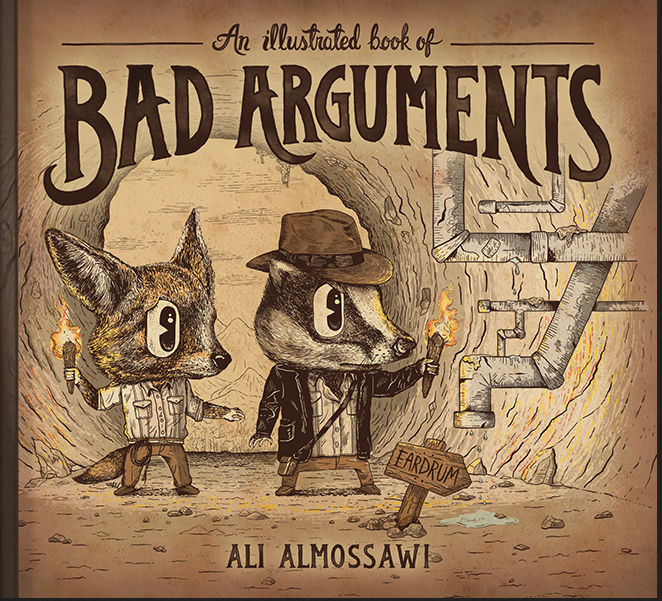
The science of argumentation can seem complicated, but in day-to-day terms, it quite often comes down to competing emotions. Political disagreements thrive on disgust and fear; we shut down our reasoning when we feel stressed or angry; and it is difficult to get opponents to hear us, whether they agree or not, if we do not exhibit any sympathy for their position, hard as that may be.
However, subjects in tests told not to feel anything about an issue before viewing media about it tend to be more supportive. They’ve had some opportunity to access higher order thinking skills and to override knee-jerk reactions. Most arguments take place in the fray—family dinners, online forum wars—but even in these cases, applying the best of our reasoning, before, during, or after, can put us in better stead. As Ali Almossawi, author of An Illustrated Book of Bad Arguments (read online version here) puts it in his preface:
… formalizing one’s reasoning [can] lead to useful benefits such as clarity of thought and expression, objectivity and greater confidence. The ability to analyze arguments also help[s] provide a yardstick for knowing when to withdraw from discussions that would most likely be futile.
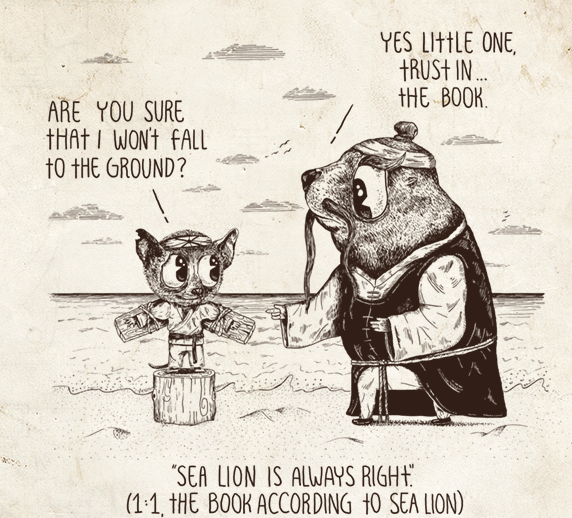
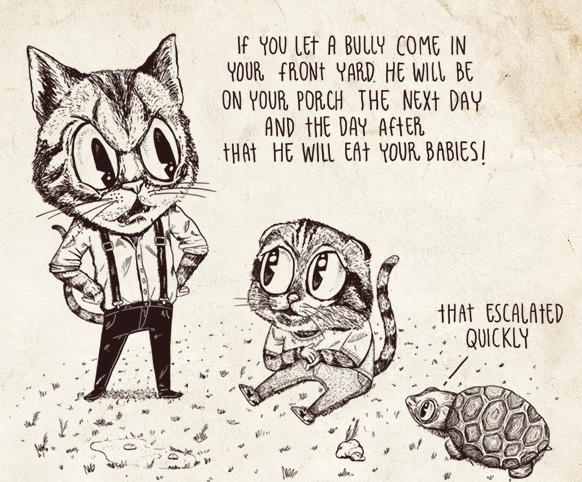
Almossawi’s strategy to mitigate bad, or wasted, thinking comes in the form of an inoculation. He quotes Stephen King, who “describes his experience of reading a particularly terrible novel as, ‘the literary equivalent of a smallpox vaccination.’” Rather than a Ciceronian treatise on what makes a good argument, Almossawi presents us with nineteen examples of the bad: informal logical fallacies we may be familiar with—Appeal to Authority (below), Circular Reasoning (further down), Slippery Slope (bottom)—as well as many we may not be.
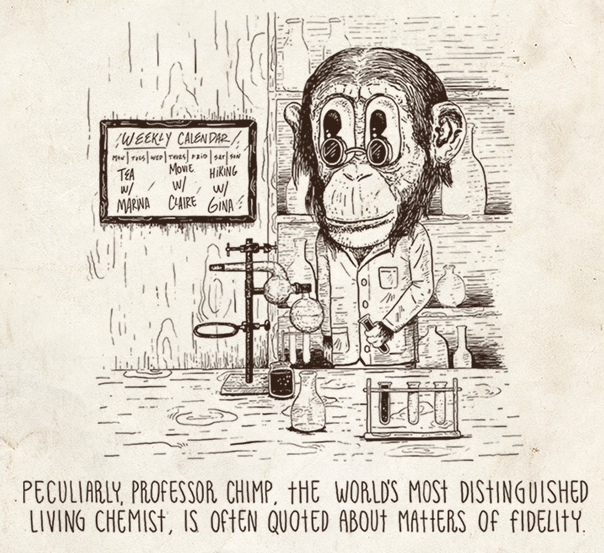
The twist here is in Alejandro Giraldo’s playful illustrations, and the memorable examples that follow Almossawi’s descriptions. Inspired partly by “allegories such as Orwell’s Animal Farm and partly by the humorous nonsense of works such as Lewis Carroll’s stories and poems,” the drawings are also highly reminiscent, if not very much inspired by, the baroque cartoons of Tony Millionaire. The art is rich and full of surprises; the sample arguments silly but effective at making the point.
The next time you find yourself melting down over a disagreement, it will likely help to take a time out and refresh yourself with this useful primer. If nothing else, it will give you some insight into the shortcomings of your own arguments, and maybe some measure of when to drop the subject altogether. As Richard Feynman—quoted in an epilogue to the book—once remarked, “The first principle is that you must not fool yourself and you are the easiest person to fool.” Find the book online here, or purchase a copy here.
Related Content:
130+ Free Online Philosophy Courses
Philosopher Daniel Dennett Presents Seven Tools For Critical Thinking
Josh Jones is a writer and musician based in Durham, NC. Follow him at @jdmagness
Read More...How Can I Know Right From Wrong? Watch Philosophy Animations on Ethics Narrated by Harry Shearer
The history of moral philosophy in the West hinges principally on a handful of questions: Is there a God of some sort? An afterlife? Free will? And, perhaps most pressingly for humanists, what exactly is the nature of our obligations to others? The latter question has long occupied philosophers like Immanuel Kant, whose extreme formulation—the “categorical imperative”—flatly rules out making ethical decisions dependent upon particular situations. Kant’s famous example, one that generally gets repeated with a nod to Godwin, involves an axe murderer showing up at your door and asking for the whereabouts of a visiting friend. In Kant’s estimation, telling a lie in this case justifies telling a lie at any time, for any reason. Therefore, it is unethical.
In the video at the top of the post, Harry Shearer narrates a script about Kant’s maxim written by philosopher Nigel Warburton, with whimsical illustrations provided by Cognitive. Part of the BBC and Open University’s “A History of Ideas” series, the video—one of four dealing with moral philosophy—also explains how Kant’s approach to ethics differs from those of utilitarianism.
In the video above, Shearer describes that most utilitarian of thought experiments, the “Trolley Problem.” As described by philosopher Philippa Foot, this scenario imagines having to sacrifice the life of one for those of many. But there is a twist—the second version, which involves the added crime of physically murdering one person, up close and personal, to save several. An analogous but converse theory is that of Princeton philosopher Peter Singer (below) who proposes that our obligations to people in peril right in front of us equal our obligations to those on the other side of the world.
Finally, the last video surveys one of the thorniest issues in moral philosophical history—the “is/ought” divide, as problematic as the ancient Euthyphro dilemma. How, asked David Hume, are we to deduce moral principles from facts about the world that have no moral dimension? Particularly when those facts are never conclusive, are subject to revision, and when new ones get uncovered all the time? The question introduces a seemingly unbridgeable chasm between facts and values. Moral judgments founded on what is or isn’t “natural” flounder before our terror of much of what nature does, and the very partial and fallible nature of our knowledge of it.
The problem is as startling as Hume’s critique of causality, and in part caused Kant to remark that Hume had awakened him from a “dogmatic slumber.” What may strike viewers of the series is just how abstract these questions and examples are—how divorced from the messiness of real world politics, with the exception, perhaps, of Peter Singer. It may be instructive that political philosophy forms a separate branch in the West. While these problems are certainly difficult enough to trouble the sleep of just about any thoughtful person, in our day-to-day lives, our decision making process seems to be much messier, and much more situational, than we’re probably ever aware of.
Related Content:
Free Online Philosophy Courses
What Makes Us Human?: Chomsky, Locke & Marx Introduced by New Animated Videos from the BBC
Josh Jones is a writer and musician based in Durham, NC. Follow him at @jdmagness
Read More...
The Talking Heads’ First TV Appearance Was on American Bandstand, and It Was a Little Awkward (1979)
“I guess he’s…organically shy.”–Tina Weymouth
As Talking Heads went from CBGBs (see some vintage video) to college radio to a European tour opening for The Ramones in 1977, the band was slowly making its way out of New York City poverty while their art school rock was seeping into American culture at large. When “Take Me To the River,” their airy, nervous but still funky Eno-produced cover of the Al Green song became their first Billboard Top 30 hit, the band took a step towards national recognition.
And that leads us to this awkward March 17, 1979 appearance of the band on ABC’s American Bandstand, their first on American TV. Longtime host Dick Clark was pretty square–rock critic Nik Cohn described him as “a disc jockey who looked like an all-American choirboy”–but American Bandstand was a prime opportunity. In 1979, the New Wave and Post-Punk scenes were raging at the show’s doors. Talking Heads were one of the few acts that year from NYC’s creative cauldron of a music scene, apart from Blondie and Grace Jones, to make it onto Bandstand.
In the above clip, Clark apologizes for getting Tina Weymouth’s name wrong, then jumps in to interview David Byrne, who responds to Clark’s questions by shutting them down with embarrassed looks and matter-of-fact answers. Clark then turns back to Tina for some psychoanalytic help. “Is he always this enthusiastic?” he asks. It crumbles from there.
Weymouth remembered it slightly differently in this recent (2014) interview in New York Magazine:
I couldn’t explain to the record-label people why David’s behavior could be so incredibly odd. He had a freak-out on our first television appearance, on Dick Clark, on American Bandstand. David sort of froze, and Dick Clark sort of whirled around, and hands the microphone to me. And there were other things going on, too. I don’t think any person is one thing, or defined by a condition that they might have.
It’s not exactly freezing, but it is odd…for rock frontmen. And asking Byrne “Do you flog yourself into this?” tells you a bit more about Clark’s state of mind than anything else.
You can see the mimed performance of their hit here:
The other song they performed on the broadcast “Thank You for Sending Me an Angel” has not popped up on YouTube…yet.
Parting note: The other guest that night on Bandstand was twee, blue-eyed disco act Brooklyn Dreams with their single Make It Last.
Related content:
Hear the Earliest Known Talking Heads Recordings (1975)
Talking Heads Live in Rome, 1980: The Concert Film You Haven’t Seen
Jim Jarmusch’s Anti-MTV Music Videos for Talking Heads, Neil Young, Tom Waits & Big Audio Dynamite
The Talking Heads Play CBGB, the New York Club that Shaped Their Sound (1975)
Ted Mills is a freelance writer on the arts who currently hosts the FunkZone Podcast. You can also follow him on Twitter at @tedmills and/or watch his films here.
Read More...Umberto Eco’s How To Write a Thesis: A Witty, Irreverent & Highly Practical Guide Now Out in English
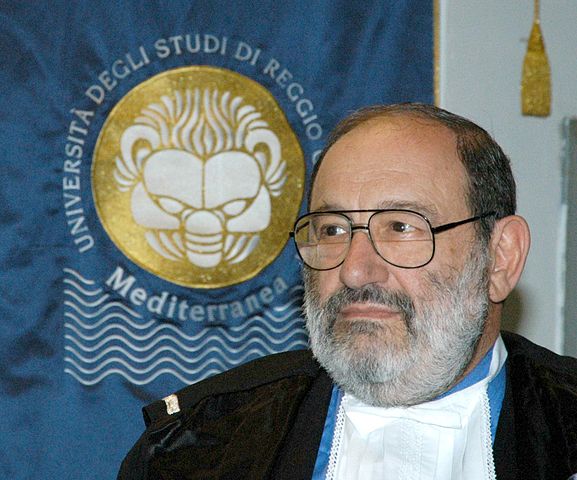
Image by Università Reggio Calabria, released under a C BY-SA 3.0 license.
In general, the how-to book—whether on beekeeping, piano-playing, or wilderness survival—is a dubious object, always running the risk of boring readers into despairing apathy or hopelessly perplexing them with complexity. Instructional books abound, but few succeed in their mission of imparting theoretical wisdom or keen, practical skill. The best few I’ve encountered in my various roles have mostly done the former. In my days as an educator, I found abstract, discursive books like Robert Scholes’ Textual Power or poet and teacher Marie Ponsot’s lyrical Beat Not the Poor Desk infinitely more salutary than more down-to-earth books on the art of teaching. As a sometime writer of fiction, I’ve found Milan Kundera’s idiosyncratic The Art of the Novel—a book that might have been titled The Art of Kundera—a great deal more inspiring than any number of other well-meaning MFA-lite publications. And as a self-taught audio engineer, I’ve found a book called Zen and the Art of Mixing—a classic of the genre, even shorter on technical specifications than its namesake is on motorcycle maintenance—better than any other dense, diagram-filled manual.
How I wish, then, that as a onetime (longtime) grad student, I had had access to the English translation, just published this month, of Umberto Eco’s How to Write a Thesis, a guide to the production of scholarly work worth the name by the highly celebrated Italian novelist and intellectual. Written originally in Italian in 1977, before Eco’s name was well-known for such works of fiction as The Name of the Rose and Foucault’s Pendulum, How to Write Thesis is appropriately described by MIT Press as reading: “like a novel”: “opinionated… frequently irreverent, sometimes polemical, and often hilarious.”
For example, in the second part of his introduction, after a rather dry definition of the academic “thesis,” Eco dissuades a certain type of possible reader from his book, those students “who are forced to write a thesis so that they may graduate quickly and obtain the career advancement that originally motivated their university enrollment.” These students, he writes, some of whom “may be as old as 40” (gasp), “will ask for instructions on how to write a thesis in a month.” To them, he recommends two pieces of advice, in full knowledge that both are clearly “illegal”:
(a) Invest a reasonable amount of money in having a thesis written by a second party. (b) Copy a thesis that was written a few years prior for another institution. (It is better not to copy a book currently in print, even if it was written in a foreign language. If the professor is even minimally informed on the topic, he will be aware of the book’s existence.
Eco goes on to say that “even plagiarizing a thesis requires an intelligent research effort,” a caveat, I suppose, for those too thoughtless or lazy even to put the required effort into academic dishonesty.
Instead, he writes for “students who want to do rigorous work” and “want to write a thesis that will provide a certain intellectual satisfaction.” Eco doesn’t allow for the fact that these groups may not be mutually exclusive, but no matter. His style is loose and conversational, and the unseriousness of his dogmatic assertions belies the liberating tenor of his advice. For all of the fun Eco has discussing the whys and wherefores of academic writing, he also dispenses a wealth of practical hows, making his book a rarity among the small pool of readable How-tos. For example, Eco offers us “Four Obvious Rules for Choosing a Thesis Topic,” the very bedrock of a doctoral (or masters) project, on which said project truly stands or falls:
1. The topic should reflect your previous studies and experience. It should be related to your completed courses; your other research; and your political, cultural, or religious experience.
2. The necessary sources should be materially accessible. You should be near enough to the sources for convenient access, and you should have the permission you need to access them.
3. The necessary sources should be manageable. In other words, you should have the ability, experience, and background knowledge needed to understand the sources.
4. You should have some experience with the methodological framework that you will use in the thesis. For example, if your thesis topic requires you to analyze a Bach violin sonata, you should be versed in music theory and analysis.
Having suffered the throes of proposing, then actually writing, an academic thesis, I can say without reservation that, unlike Eco’s encouragement to plagiarism, these four rules are not only helpful, but necessary, and not nearly as obvious as they appear. Eco goes on in the following chapter, “Choosing the Topic,” to present many examples, general and specific, of how this is so.
Much of the remainder of Eco’s book—though written in as lively a style and shot through with witticisms and profundity—is gravely outdated in its minute descriptions of research methods and formatting and style guides. This is pre-internet, and technology has—sadly in many cases—made redundant much of the footwork he discusses. That said, his startling takes on such topics as “Must You Read Books?,” “Academic Humility,” “The Audience,” and “How to Write” again offer indispensable ways of thinking about scholarly work that one generally arrives at only, if at all, at the completion of a long, painful, and mostly bewildering course of writing and research.
FYI: You can download Eco’s book, How to Write a Thesis, as a free audiobook if you want to try out Audible.com’s no-risk, 30-day free trial program. Find details here.
Related Content:
Werner Herzog’s Rogue Film School: Apply & Learn the Art of Guerilla Filmmaking & Lock-Picking
Josh Jones is a writer and musician based in Durham, NC. Follow him at @jdmagness
Read More...Support Us
We're hoping to rely on loyal readers, rather than erratic ads. Please click the Donate button and support Open Culture. You can use Paypal, Venmo, Patreon, even Crypto! We thank you!

About Us

Open Culture scours the web for the best educational media. We find the free courses and audio books you need, the language lessons & educational videos you want, and plenty of enlightenment in between.
Advertise With Us
FREE UPDATES!
GET OUR DAILY EMAIL
Get the best cultural and educational resources on the web curated for you in a daily email. We never spam. Unsubscribe at any time.
FOLLOW ON SOCIAL MEDIA
Open Culture editor Dan Colman scours the web for the best educational media. He finds the free courses and audio books you need, the language lessons & movies you want, and plenty of enlightenment in between.
Advertise With Us

