Rome Reborn: Take a Virtual Tour of Ancient Rome, Circa 320 C.E.
A few years ago, we featured Rome Reborn, which is essentially “a 3D digital model of the Eternal City at a time when Ancient Rome’s population had reached its peak (about one million) and the first Christian churches were being built.” Rome Reborn offers, declared Matthias Rascher, “a truly stunning bird’s‑eye view of ancient Rome that makes you feel as if you were actually there.” You may also remember our posts on video analyses of great works of art by Khan Academy’s Smarthistory. Today, the two come together in the video above, “A Tour Through Ancient Rome in 320 C.E.”
In it, we not only see and move through ancient Rome reconstructed, we have our extended tour guided by renowned “virtual archaeologist” and overseer of the Rome Reborn project Dr. Bernard Frischer, professor emeritus at the University of Virginia. He picks 320 C.E. as the year of the tour, “the peak of Rome’s development, certainly in terms of public architecture, for the simple reason that the Emperor at this time was Constantine the Great.” Shortly after this year, Constantine would move the capital from Rome to his city, Constantinople.
We hear Frischer in dialogue with Dr. Steven Zucker, whose voice you may recognize from previous Smarthistory videos. Zucker’s questions ensure that, while we take in the spectacle of Rome’s impressive architecture (to say nothing of its equally impressive aqueducts) as it looked back in 320, we also think about what the real flesh-and-blood people who once lived there actually did there: the jobs they did, the chariot races they watched. “When I was studying ancient Rome,” admits Zucker, “one of the most difficult things for me to understand was how all these ancient ruins fit together.” Now, with Frischer’s expertise, he and we can finally understand how the Forum, the Basilica, the Coliseum, the Pantheon and more all fit onto this early but still majestic urban fabric.
Related Content:
Free Courses in Ancient History, Literature & Philosophy
Rome Reborn – An Amazing Digital Model of Ancient Rome
How the Egyptian Pyramids Were Built: A New Theory in 3D Animation
Visit Pompeii (also Stonehenge & Versailles) with Google Street View
Animation Gives You a Glimpse of What Life Was Like for Teenagers in Ancient Rome
The History of Rome in 179 Podcasts
Discover 100 Great Works of Art with Videos Created by Khan Academy & Google Art Project
Colin Marshall hosts and produces Notebook on Cities and Culture as well as the video series The City in Cinema and writes essays on cities, language, Asia, and men’s style. He’s at work on a book about Los Angeles, A Los Angeles Primer. Follow him on Twitter at @colinmarshall or on Facebook.
Read More...Heidegger’s “Black Notebooks” Suggest He Was a Serious Anti-Semite, Not Just a Naive Nazi
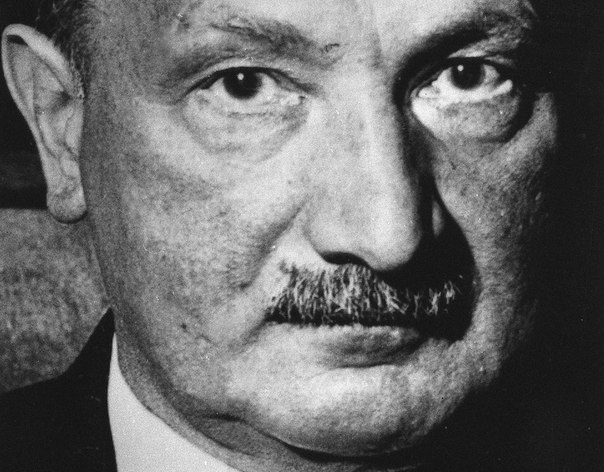
German philosopher Martin Heidegger, widely considered one of the most influential philosophers of the 20th century, was a Nazi, a fact known to most anyone with more than a passing knowledge of the subject. In a New York Review of Books essay, Harvard intellectual historian Peter E. Gordon points out that “the philosopher’s complicity with the Nazis first became a topic of controversy in the pages of Les Temps modernes shortly after the war.” The issue arose again when a former student of Heidegger published “a vigorous denunciation” in 1987. In these cases, and others—like his protégé and onetime lover Hannah Arendt’s defense of her former teacher—the scandal tends to “always end with the same unsurprising discovery that Heidegger was a Nazi.”
What stirs up controversy isn’t Heidegger’s membership in the party, but his motivations. Was he simply a shrewd, if craven, careerist, or a genuinely hateful anti-Semite, or a little from each column? Whatever the explanation, Heideggerians have been able to wall off the philosophy from supposed moral or political lapses in judgment. Arendt did so by claiming that Heidegger, and all of philosophy, was politically naïve. Recalls Adam Kirsch in the Times:
The seal was set on his absolution by Hannah Arendt, in a birthday address broadcast on West German radio. Heidegger’s Nazism, she explained, was an “escapade,” a mistake, which happened only because the thinker naïvely “succumbed to the temptation … to ‘intervene’ in the world of human affairs.” The moral to be drawn from the Heidegger case was that “the thinking ‘I’ is entirely different from the self of consciousness,” so that Heidegger’s thought cannot be contaminated by the actions of the mere man.
The publication of Heidegger’s so-called “black notebooks,” journals that he kept assiduously from 1931–1941, may change all that. They show Heidegger formulating a philosophy of anti-Semitism—using the central categories of his thought—one that operates, as Michel Foucault might say, along “the rules of exclusion.”
In published excerpts of a translation by Richard Polt, an executive member of the Heidegger Circle, Critical Theory shows how much Heidegger turned his own conceptual apparatus against Jews. At one point, he writes:
One of the most secret forms of the gigantic, and perhaps the oldest, is the tenacious skillfulness in calculating, hustling, and intermingling through which the worldlessness of Jewry is grounded.
In this short passage alone, Heidegger invokes lazy stereotypes of Jews as “calculating” and “hustling.” He also, more importantly, describes the Jewish people as “worldless.” As Critical Theory writes, “Being-in-the-world (In-der-Welt-sein) is the basic activity of human existing. To say that the Jews are ‘worldless’… is more than a confused stereotype.” It is Heidegger’s way of casting Jews out of Dasein, his most important category, a word that means something like “being-there” or “presence.” Jews, he writes, are “historyless” and “are not being, but merely ‘calculate with being.’”
Moreover, Heidegger took up the Nazi characterization of Jews as corrupt underminers of society. As representatives of modernity, and its technocratic domination of humanity, the Jews threatened “being” in another way:
What is happening now is the end of the history of the great inception of Occidental humanity, in which inception humanity was called to the guardianship of be-ing, only to transform this calling right away into the pretension to re-present beings in their machinational unessence…
The except goes on at length in this vein, with Jewish “technological machinery” posing a threat to civilization. Perhaps most shockingly, Heidegger attributed Nazi concentration camps to “self-destruction,” completely absolving by omission, and minimizing and excusing, the crimes of his party. An article in Italian newspaper Corriere Della Sera documents Heidegger’s defense of Nazism and his claim in 1942 that “the community of Jews” is “the principle of destruction” and that the camps were only a logical outcome of this principle, the “supreme fulfillment of technology,” “corpse factories.” The real victims, of course, are the Germans, and the Allies are guilty of ”repressing our will for the world.”
Heidegger intended the “black notebooks,” so damning that several scholars of Heidegger fought their publication, to be released after all of his work was published. As with all of the philosopher’s difficult work, the notebooks are often obscure; it is not always clear what he means to say. But major Heidegger scholars have responded in a variety of ways—including resigning a chairship of the Martin Heidegger Society—that suggest the worst. According to Daily Nous, a website about the philosophy profession, when Günter Figal resigned his position in January as chair of the Martin Heidegger Society, he said:
As chairman of a society, which is named after a person, one is in certain way a representative of that person. After reading the Schwarze Hefte [Black Notebooks], especially the antisemitic passages, I do not wish to be such a representative any longer. These statements have not only shocked me, but have turned me around to such an extent that it has become difficult to be a co-representative of this.
Whether or not this new evidence will cause more of his adherents to renounce his work remains to be seen, but the notebooks, writes Peter Gordon, will surely “cast a dark shadow over Heidegger’s legacy.” A very dark shadow.
Related Content:
Martin Heidegger Talks About Language, Being, Marx & Religion in Vintage 1960s Interviews
Martin Heidegger Talks Philosophy with a Buddhist Monk on German Television (1963)
Human, All Too Human: 3‑Part Documentary Profiles Nietzsche, Heidegger & Sartre
Find courses on Heidegger in our collection, 1,700 Free Online Courses from Top Universities
Josh Jones is a writer and musician based in Durham, NC. Follow him at @jdmagness
Read More...Read Chez Foucault, the 1978 Fanzine That Introduced Students to the Radical French Philosopher
The recent “adjunct walk out day” has reminded people outside academia—at least those who paid any attention—of the decaying state of American higher education, a condition driven in part by a searing undercurrent of anti-intellectualism in U.S. political culture. It’s a trend historian Richard Hofstadter identified last century in his Pulitzer Prize-winning 1963 study Anti-Intellectualism in American Life. But not long after Hofstadter’s book appeared, another, more vital current took hold in the 60s and 70s, one brought on by the broadening possibilities for those previously denied access to elite universities, and by reciprocal relationships between radicals and scholars. Academics like Timothy Leary became figureheads of the counterculture, revolutionaries like Huey Newton earned Ph.D.s, and activist professors like Angela Davis held the line between the worlds of higher ed and popular dissent. The universities became not only sites of student protest, but also matrices of revolutionary theory.
Into this fomenting intellectual culture stepped French theorist Michel Foucault, who first lectured in the U.S. in 1975 after the publication of his History of Sexuality. Foucault was a true product of the French university system and an academic superstar of sorts, as well as a gadfly of revolutionary movements from Paris in ’68, to Iran in ’79, to Berkeley in the 80s. His work as a philosopher and political dissident prompted one biographer to refer to him as a “militant intellectual,” though his politics could sometimes be as obscure as his prose. By 1981, he had risen to such cultural prominence in the States that Time magazine published a profile of him and his “growing cult.” One of Foucault’s American acolytes, Simeon Wade, befriended the philosopher in the mid-seventies and wrote an unpublished, 121-page account of Foucault’s alleged 1975 LSD trip in Death Valley (referred to in James Miller’s The Passion of Michel Foucault). Wade, along with a number of other University of California students, also interviewed Foucault the following year.
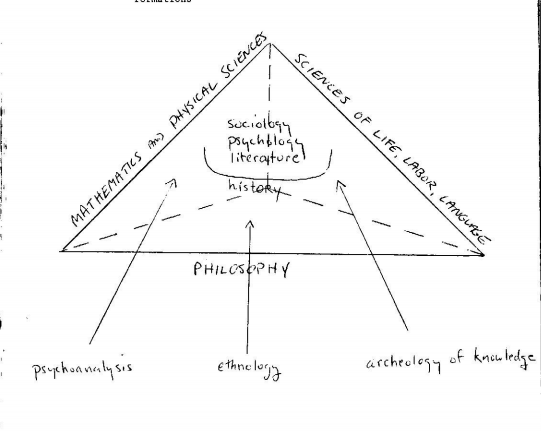
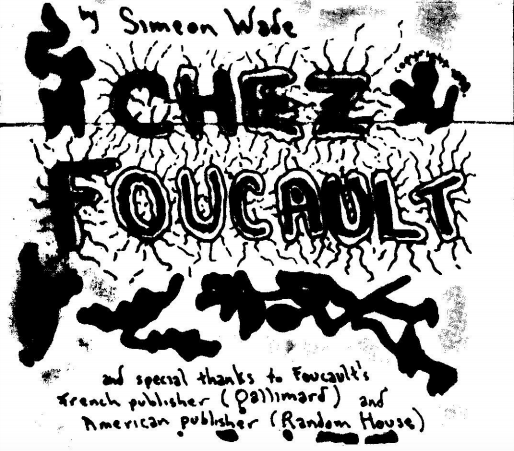
In 1978, Wade published the interview in what may be the most populist of mediums—the fanzine. Titled Chez Foucault, with a dedication “for Michael Stoneman,” the mimeographed document looks on its face like a typical handmade self-publication from the period, with its murky lettering and generally haphazard design. But inside, Chez Foucault is far denser than any chapbook or rock ‘zine. In his preface, Wade describes Chez Foucault as “a workbook I tinkered together for teachers and students in the humanities, social sciences and natural sciences.” Accordingly, in addition to the interview, he includes a synopsis of Foucault’s Discourse on Language, a “transcription” of his Discipline and Punish, a sketch of “The Early Foucault,” and a bibliography, glossary, reading and film list, and veritable course outline. It’s a very rich text that provides a thorough introduction to many of Foucault’s major works. Of principle interest, however, is the interview, seemingly unpublished anywhere else. In it, Foucault elaborates on several of his key concepts, such as the relationship between discourse and power:
I do not want to try to find behind the discourse something which would be the power and which would be the source of the discourse […]. We start from the discourse as it is! […] The kind of analysis I make does not deal with the problem of the speaking subject, but looks at the ways in which the discourse plays a role inside the strategical system in which the power is involved, for which power is working. So power won’t be something outside the discourse. Power won’t be something like a source or the origin of discourse. Power will be something which is working through the discourse.
This concise explanation offers a key to Foucault’s method. Disavowing the labels of both philosopher and historian (he calls himself a “journalist”), Foucault defines his program as “an analysis of discourse, but not with the perspective of ‘point of view.’” (If the distinction is confusing, a reading of his essay “What is an Author?” may help clarify things.) Foucault discusses the biopolitics of power, calling the human body “a productive force,” which “exists in and through a political system.” He also talks about the “political use” of a critical theory such as his, and the possibility of revolutionary philosophy:
I do not think there is such a thing as a conservative philosophy or a revolutionary philosophy. Revolution is a political process; it is an economic process. Revolution is not a philosophical ideology. And that’s important. That’s the reason why something like Hegelian philosophy has been both a revolutionary ideology, a revolutionary method, a revolutionary tool, but also a conservative one. Look at Nietzsche. Nietzsche brought forth wonderful ideas, or tools if you like. He was used by the Nazi Party. Now a lot of Leftist thinkers use him. So we cannot be sure if what we are saying is revolutionary or not.
There is much more worth reading in Foucault’s interview with Wade and his fellow students, and students and teachers of Foucault will find all of Chez Foucault worthwhile. You can read and download the entire Foucault ‘zine here. And lest you think it’s the only one of its kind, don’t miss Judy!, the 1993 fanzine devoted to philosopher Judith Butler.
via Progressive Geographies and Monoskop
Related Content:
Watch a “Lost Interview” With Michel Foucault: Missing for 30 Years But Now Recovered
Josh Jones is a writer and musician based in Durham, NC. Follow him at @jdmagness
Read More...Dostoyevsky’s The Brothers Karamazov Strikingly Illustrated by Expressionist Painter Alice Neel (1938)
Images belong to The Estate of Alice Neel.
We all know the reputation of 19th-century Russian novels: long, dense bricks of pure prose, freighted with deep moral concerns and, to the uninitiated, enlivened only by a confusing farrago of patronymics. And sure, while they may have a bit of a learning curve to them, these classic works of literature also, so their advocates assure us, boast plenty to keep them relevant today — just the quality, of course, that makes them classic works of literature in the first place.
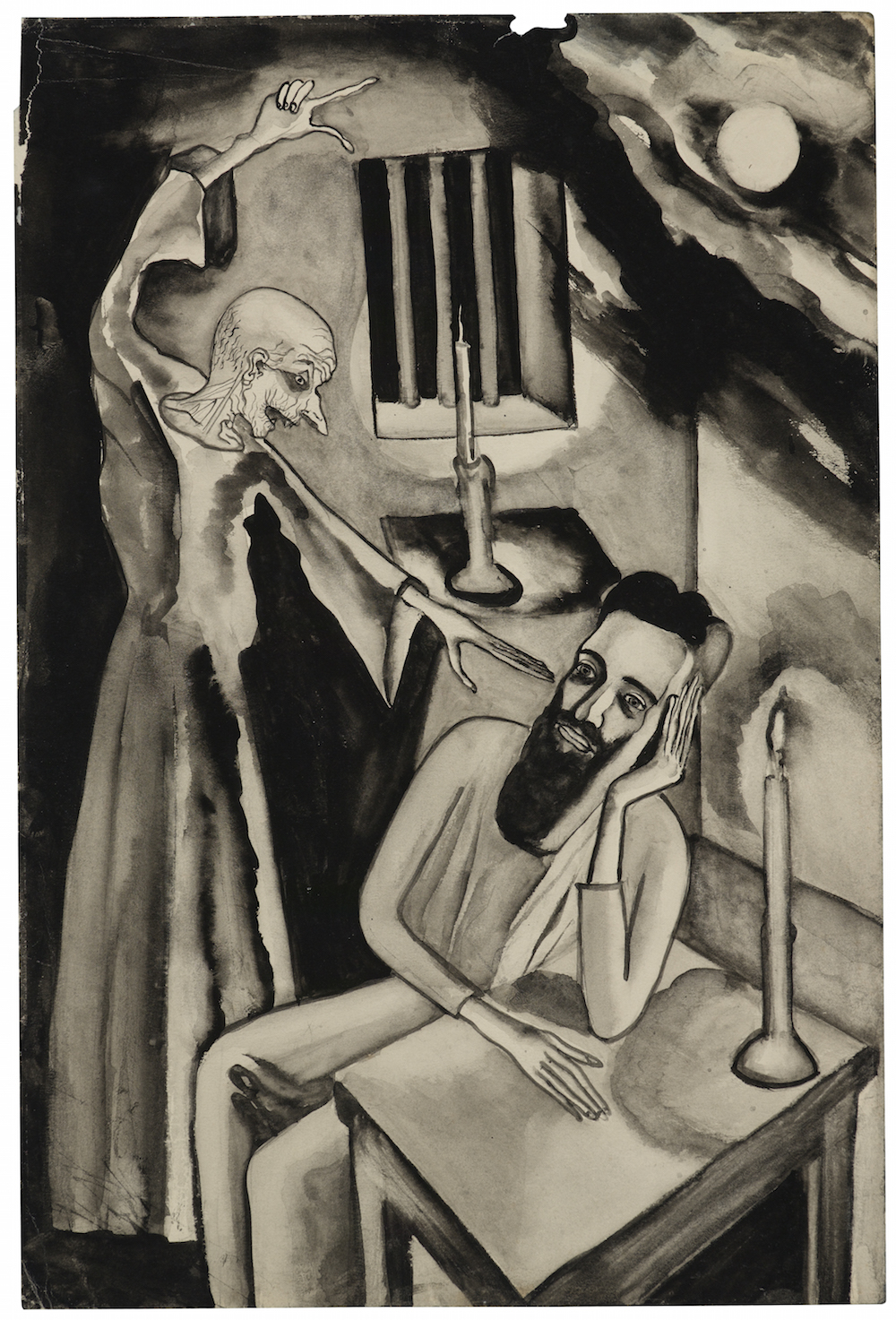
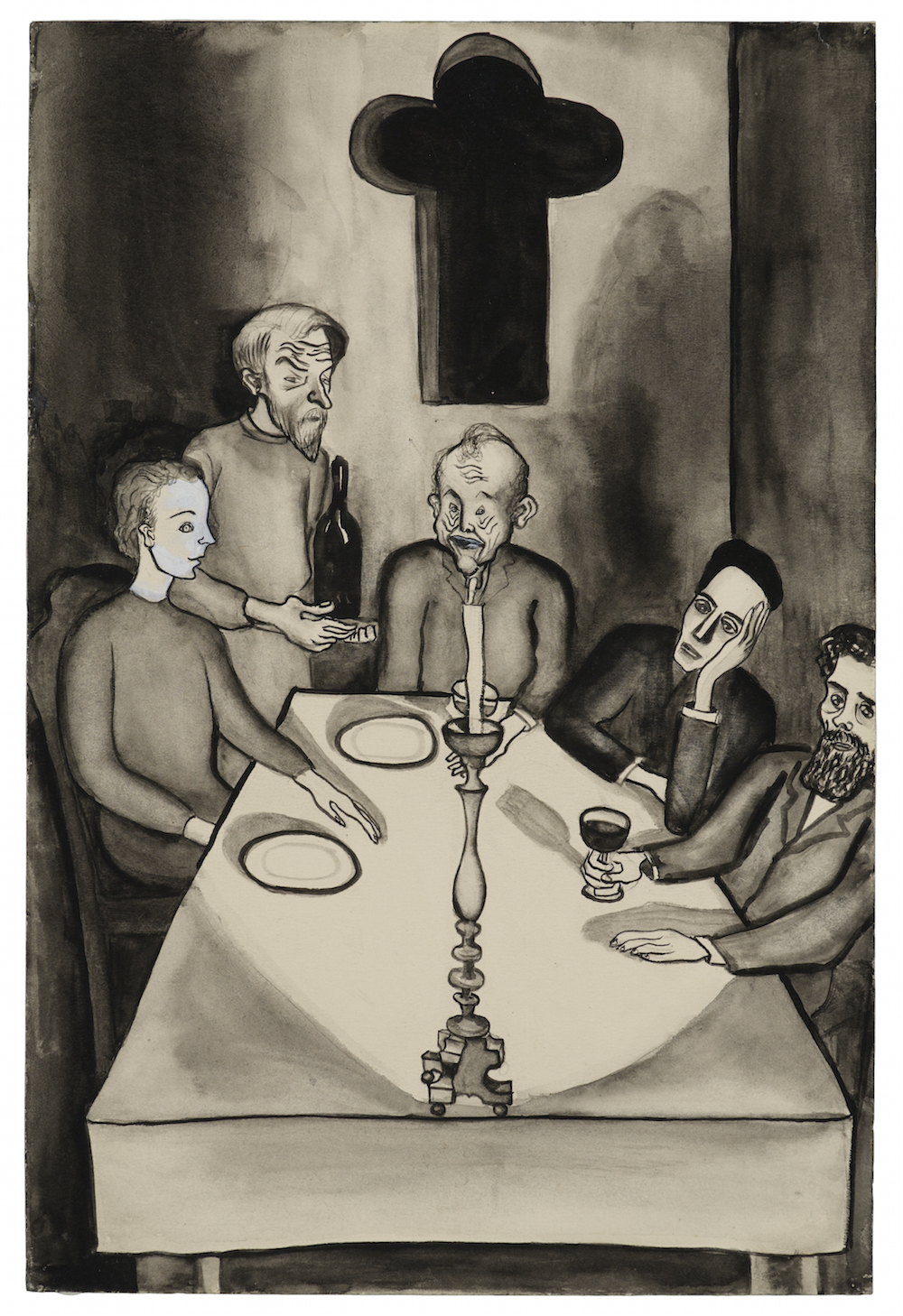
While we should by all means read them, that doesn’t mean we can’t get a taste of these much-discussed books before we heft them and turn to page one by, for example, checking out their illustrations. These vary in quality with the editions, of course, but how much of the art that has ever accompanied, say, Fyodor Dostoyevsky’s The Brothers Karamazov has looked quite as evocative as the never-published illustrations here? They come from the hand of the Pennsylvania-born artist Alice Neel, commissioned in the 1930s for an edition of the novel that never saw the printing press.
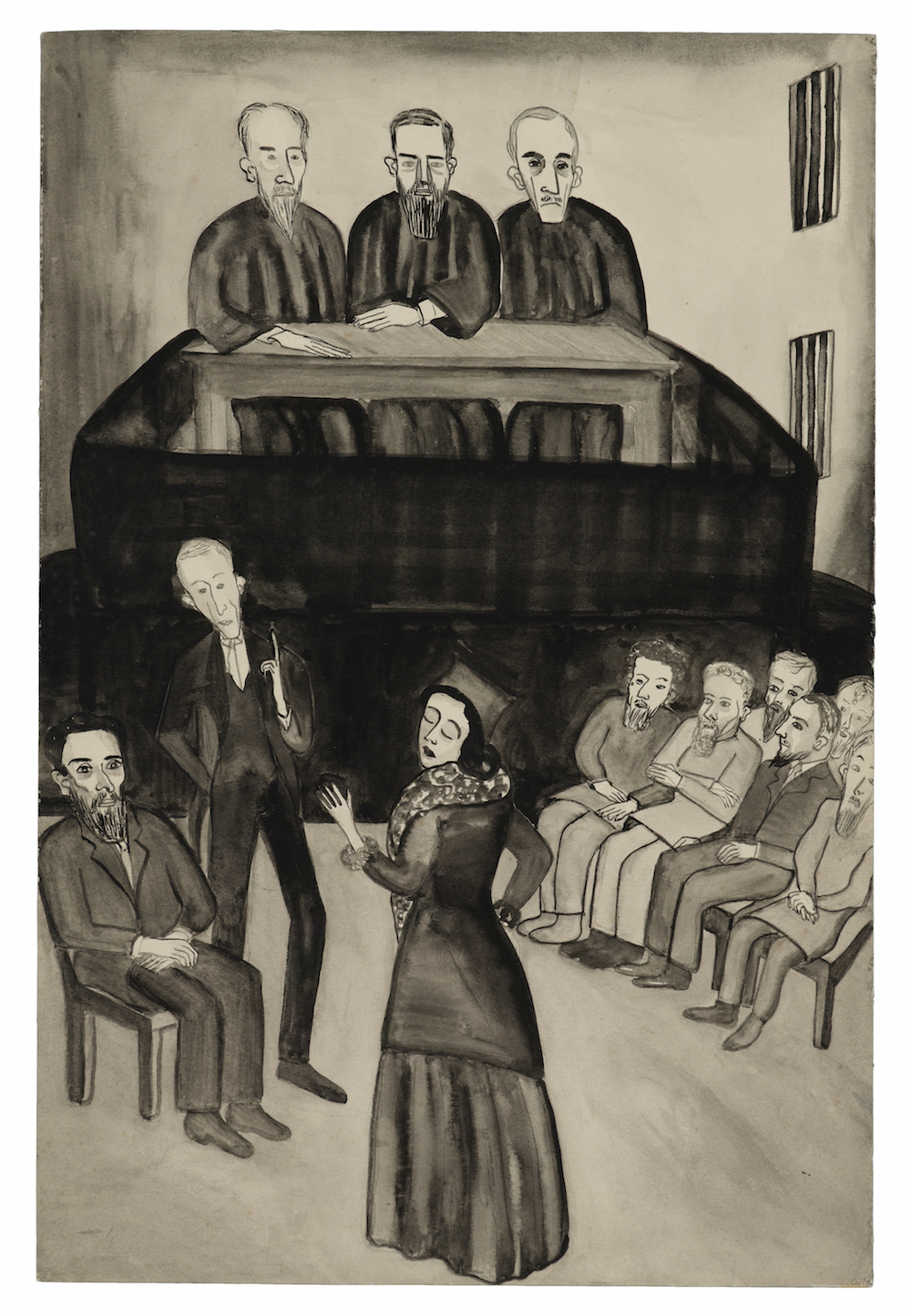
The Paris Review’s Dan Piepenberg, posting eight of Neel’s illustrations, highlights “how attuned these two sensibilities are: it’s the marriage of one kind of darkness to another”; “the black storm cloud of Neel’s pen is well suited to Dostoyevsky’s questions of God, reason, and doubt.” And yet Neel also manages to express the novel’s “madness and comedy,” bringing “a manic bathos to these scenes that lends them both gravity and levity; in every wide, glassy pair of eyes, grave questions of moral certitude are undercut by the absurd.”
You can see all of eight of Neel’s Karamazov illustrations at The Paris Review, not that they provide a substitute for reading the novel itself (which you can find in our collection of Free eBooks). After all, that’s the only way to find out what exactly happens at that bacchanal just above.
Related Content:
Fyodor Dostoevsky Draws Elaborate Doodles In His Manuscripts
Albert Camus Talks About Adapting Dostoyevsky for the Theatre, 1959
Colin Marshall hosts and produces Notebook on Cities and Culture as well as the video series The City in Cinema and writes essays on cities, language, Asia, and men’s style. He’s at work on a book about Los Angeles, A Los Angeles Primer. Follow him on Twitter at @colinmarshall or on Facebook.
Read More...George Orwell Creates a Who’s Who List of “Crypto” Communists for British Intelligence Forces (1949)
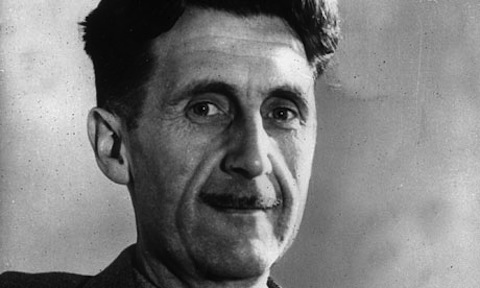
Journalist and novelist Eric Blair, known for all of his professional life by the pen name George Orwell, staunchly identified himself as a democratic socialist. For example, in his slim 1946 publication Why I Write, he declared, “Every line of serious work I have written since 1936 has been written, directly or indirectly, against totalitarianism and for democratic socialism as I understand it.” Despite the widespread blurring of lines these days between socialism and communism—whether through ignorance or deliberate misleading—the distinction was not lost on Orwell. Though he supported an equitable distribution of wealth and public institutions for the common good, he fiercely opposed Soviet communism as anti-democratic and oppressive. As Orwell biographer John Newsinger writes, one “crucial dimension to Orwell’s socialism was his recognition that the Soviet Union was not socialist. Unlike many on the left, instead of abandoning socialism once he discovered the full horror of Stalinist rule in the Soviet Union, Orwell abandoned the Soviet Union and instead remained a socialist.”
Of course, Orwell’s anti-communist sentiments are familiar to every student who has read Animal Farm. Less well known is the degree to which he contributed to anti-communist propaganda, even corresponding with British secret services and keeping a blacklist of writers he deemed either “cryptos” (secret communists), “fellow travellers” (communist sympathizers), or outright members of the Communist Party. Orwell’s involvement with the Information Research Department (IRD), a propaganda unit formed in 1948 under the UK’s Foreign Office to combat Stalinism at home and abroad has received a good deal of attention in the past few decades, in part because of the discovery in 2003 of a private notebook containing his original list. Even before this revelation, biographers and historians had known about the list, which Orwell included, in part, in a letter to his love interest Celia Kirwan, who worked for the IRD, with the instructions that she keep it secret due to its “libelous” nature. Orwell intended that the writers on the list not be asked to work for the IRD because, in his estimation, they were people who could not be trusted.
Reactions to Orwell’s list have been very mixed. When the story first broke in the late nineties, Orwell’s longtime friend Michael Foot said he found the list “amazing” and out of character. One of the people named, Norman Mackenzie, ascribed the list to Orwell’s illness, saying that the writer was “losing his grip on himself” in 1949 during his final struggle with the tuberculosis that killed him that year. Orwell biographer Bernard Crick defended his actions, writing, “He did it because he thought the Communist Party was a totalitarian menace. He wasn’t denouncing these people as subversives. He was denouncing them as unsuitable for counter-intelligence operation.” On the other hand, late leftist firebrand journalist Alexander Cockburn condemned Orwell as a “snitch” and thought the list was evidence of Orwell’s bigotry, given his suspicion of Paul Robeson as “anti-white” and his denouncing of others due to their rumored homosexuality or Jewish background. He makes a compelling case. Whatever Orwell’s motivations, the effect on the named individuals’ professional and political lives was mild, to say the least. This was hardly a McCarthyite witch-hunt. Nonetheless, it’s a little hard for admirers of Orwell not to wince at this collaboration with the state secret service.
Below, see the list he submitted to Kirwan in his letter. Further down is a list of names, including those of Orson Welles and Katherine Hepburn, that appeared in his notebook but not on the list he gave to the IRD.
Writers and journalists
- “Aldred,” novelist (first name unknown)
- John Anderson, journalist, Industrial correspondent for Manchester Guardian
- John Beavan, editor
- Arthur Calder-Marshall, writer
- H. Carr, historian
- Isaac Deutscher, former Trotskyist writer, correspondent for The Economist and The Observer (1942–1947)
- Cedric Dover, journalist
- Walter Duranty, New York Times Moscow correspondent
- Douglas Goldring, novelist
- “Major Hooper”, writer on military history
- Alaric Jacob, Moscow Correspondent for the Daily Express during the Second World War
- Marjorie Kohn, journalist
- Stefan Litauer, journalist
- Norman MacKensie, historian and a founding member of the SDP
- Kingsley Martin, editor of the New Statesman
- Hugh McDiarmid, poet and Scottish nationalist
- Naomi Mitchison, novelist
- Nicholas Moore, poet
- Iris Morley, Moscow Correspondent for The Observer during the Second World War
- Neumann, novelist
- George Padmore, Trinidadian journalist and anti-imperialist campaigner
- Ralph Parker, journalist, News Chronicle
- B. Priestley, novelist and playwright
- Peter Smollett, Daily Express journalist later identified as a Soviet agent, Smolka recruited by Kim Philby.
- Margaret Stewart, industrial/labour correspondent
- Alexander Werth, journalist
Academics and scientists
- Patrick Blackett, physicist
- Gordon Childe, archaeologist
- John Macmurray, philosopher
- Tibor Mende, Foreign Affairs analyst
- G. Crowther, The Guardian’s first science correspondent
Actors
Labour MPs
Others
- Joseph Macleod
- Peadar O’Donnell, Irish socialist
- The Reverend Leonard Schiff, clergyman
- Commander Edgar Young
People named in Orwell’s notebook, but not appearing on the final IRD list:
- Bessie Braddock, Labour MP
- Alex Comfort, pacifist writer
- Nancy Cunard, heiress and left-wing activist
- Katharine Hepburn, actress
- Harold Laski, economist
- Cecil Day-Lewis, poet.
- Alan Nunn May, scientist
- John Platts-Mills, Labour MP
- Sean O’Casey, playwright
- George Bernard Shaw, playwright
- John Steinbeck, novelist
- Randall Swingler, poet
- Stephen Swingler, Labour MP
- J. P. Taylor, historian
- Orson Welles, film director
- Solly Zuckerman, scientist
Related Content:
George Orwell Explains in a Revealing 1944 Letter Why He’d Write 1984
George Orwell Reviews Mein Kampf (1940)
Josh Jones is a writer and musician based in Durham, NC. Follow him at @jdmagness
Read More...Michel Gondry’s Finest Music Videos for Björk, Radiohead & More: The Last of the Music Video Gods
We didn’t realize it at the time, but Michel Gondry was one of the last great music video directors, creating mini-epics just before the music industry collapsed, budgets disappeared, and now your cousin with a Canon 7D is following his friend’s band around in a field and putting *that* up on Vimeo. Maybe Gondry too saw the writing on the wall, because, by the beginning of the ‘aughts, he was inching his way into Hollywood, first with Human Nature and then striking paydirt with the Charlie Kaufman-scripted Eternal Sunshine of the Spotless Mind, one of the best French films ever made that wasn’t French (apart from the director).
But in the twilight of music videos, Gondry’s best work combined new technology with the homemade, DIY aesthetic. His interest in fractals, mathematics, and logical paradoxes and loops went into the mix. As did his interest in the machinery and artifice of movie making. And as did his romantic, autobiographical side. What follows is a small selection of some of his best, most complex music videos.
Gondry directed several videos for Björk, starting with “Human Behavior,” her first solo single, but 1997’s “Bachelorette” (top) goes beyond playful into heartbreaking. A riff on an infinitely recursive poem, a story that is about the telling of itself, the video finds Björk discovering a book in the woods that begins to write itself. As she finds a publisher, gains success, and sees the book turned into a musical, the story is told again, and then again, a play within a play within a play. But each version is analog, not digital, and loses something in the process, and the forest creeps back in to claim its work.
Similarly, in this video for The Chemical Brothers’ song “Let Forever Be” (1999) Gondry sets up two worlds, one on digital video, where our heroine attempts to wake up and go to work at a department store; and another shot on film, where the girl’s numerous doppelgängers parody her struggle and her grip on sanity through choreographed dance numbers. This illustrates a familiar Gondry equation: If A and B, then A+B equals freakout madness time. The colorbars of video production loom nearby to further the idea of irreality, and a cheesy VideoToaster-style effect rescues us at the end.
As far as we know, Radiohead’s “Knives Out” (2001) has nothing to do with hospitals, but Gondry took this cannibalistic song and made one of his most personal videos. Here Thom Yorke stands in for the director, as Gondry offers a mea culpa about a relationship that went past its expiration date, when his girlfriend developed an illness and he couldn’t bear to break up with her. All of that is laid out, in sad, fever-dream detail, in this single-take video that features a lot of his obsessions: toys, television, loops, and a shuffling of symbols and motifs. Look for Gondry’s son briefly playing on the floor.
And finally:
Not to go out with a sour note, here’s Gondry’s adventurous 1994 video for the swallowed-by-history Lucas. “Lucas with the Lid Off” is one of Gondry’s first one-take masterpieces that shows how the magic is made while still being magical. (The current kings of single-take music videos, OK Go, owe their success to Gondry.) It’s also a video that tries to give each sampled loop its own element within the video, looking forward to his work for Daft Punk (“Around the World”) and The Chemical Brothers (“Star Guitar”).
Gondry continues to make videos–he made one last year for Metronomy’s “Love Letters,” but his attention is really elsewhere. Enjoy these gems from his classic era.
Note: Gondry’s 1988 short animated film, Jazzmosphere, an exploration of jazz and images, has been added to our collection, 4,000+ Free Movies Online: Great Classics, Indies, Noir, Westerns, Documentaries & More.
Ted Mills is a freelance writer on the arts who currently hosts the FunkZone Podcast. You can also follow him on Twitter at @tedmills and/or watch his films here.
Read More...What’s the Big Deal About Wes Anderson’s The Grand Budapest Hotel? Matt Zoller Seitz’s Video Essay Explains
Toward the end of 2013, we featured a series of video essays by Matt Zoller Seitz on the films of Wes Anderson. They first came out to accompany The Wes Anderson Collection, the critic’s coffee-table retrospective of that auteur of whimsical handcrafted films’ career to date — to the date of late 2013, anyway. Even then, fans had already geared themselves up in anticipation of the then-imminent release of The Grand Budapest Hotel, Anderson’s eighth and latest picture, which at the moment has resurfaced in awards-season buzz.
The diminishing number of you who have proven still impervious to Anderson’s peculiar brand of movie magic might, actually, feel you’ve heard a bit too much about The Grand Budapest Hotel over the past year or so. What, pray tell, is the big deal? Here to answer that question, we have Zoller Seitz’s brand new video essay on Anderson’s tale of that titular once-grand mountain hotel and the 20th-century Europe of the imagination (eventually giving way to the 20th-century Europe of history) that swirls around and through it.
“All of Wes Anderson’s films are comedies,” says Zoller Seitz, “and none are.” Throughout the following fifteen minutes, he analyzes exactly how, with The Grand Budapest Hotel, Anderson climbs to the top of both of his personal twin peaks of frivolity and seriousness — or seriousness expressed through frivolity, or vice versa. In the director’s “most structurally ambitious film,” we see not just layers of comedy and melancholy but of history, literature, artistry, and anxiety, all tied in with the Andersonian characters’ endless quest to master their own sense of loss by mastering the world around them — which Anderson shows us, to a fuller extent in The Grand Budapest Hotel, than in any of his live-action movies before, with his own mastery of the world he and his collaborators create.
For another look into what this requires in filmmaking terms, see also “Here’s How Wes Anderson Uses Matte Paintings in His Incredible Set Designs” by The Creators Project’s Beckett Mufson. That interview with Grand Budapest Hotel matte painter Simone de Salvatore reveals, by looking at just one aspect of the whole, how much goes into the design of a Wes Anderson production. Viewers who love Anderson’s pictures, of course, love them in large part for exactly that, and even viewers who hate them have to concede their impeccability on that count. Both groups now have only to wait for this Sunday to see how the Academy feels about it.
Related Content:
The Perfect Symmetry of Wes Anderson’s Movies
A Glimpse Into How Wes Anderson Creatively Remixes/Recycles Scenes in His Different Films
Watch Wes Anderson’s Charming New Short Film, Castello Cavalcanti, Starring Jason Schwartzman
Wes Anderson’s First Short Film: The Black-and-White, Jazz-Scored Bottle Rocket (1992)
Watch 7 New Video Essays on Wes Anderson’s Films: Rushmore, The Royal Tenenbaums & More
Colin Marshall hosts and produces Notebook on Cities and Culture as well as the video series The City in Cinema and writes essays on cities, language, Asia, and men’s style. He’s at work on a book about Los Angeles, A Los Angeles Primer. Follow him on Twitter at @colinmarshall or on Facebook.
Read More...How Martin Luther King, Jr. Used Nietzsche, Hegel & Kant to Overturn Segregation in America
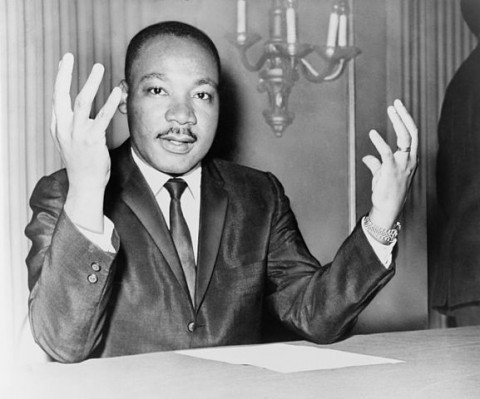
Image by Dick DeMarsico, via Wikimedia Commons
The influence of Georg Wilhelm Friedrich Hegel on the revolutionary philosophy of Karl Marx and Frederich Engels is well known. Marx wrote a critique of Hegel’s Philosophy of Right and claimed to have turned the German idealist philosopher on his head, and the development of Marxist theory among a school of neo-Hegelians, wrote Rebecca Cooper in 1925, occurred in a period “peculiarly auspicious for the birth of a revolutionary social philosophy.”
A century later, on another continent, Hegel’s thought influenced the course of a very different struggle. And while the historical conditions of mid-nineteenth century Europe and mid-twentieth century America present entirely different sets of specific concerns, the same general observation applies: the time and place of such radical thinkers as Malcolm X, Angela Davis, Huey Newton and a host of other activists presented “peculiarly auspicious” circumstances for revolutionary social philosophy.
But while these figures appear today as the vanguard of radical black thought, Martin Luther King, Jr., the most widely celebrated of Civil Rights leaders, “is often conflated with neoliberal multiculturalism,” writes Critical Theory, his program associated with “the failure of the civil rights movement to dismantle the ongoing systemic white supremacy of the status quo.” And yet, King’s movement not only succeeded in ending legal segregation and hastening the passing of the Civil Rights Act; it also provided direction for nearly every nonviolent social movement from his day to ours. King’s legacy is not only that of an inspiring organizer and orator, but also of a radical thinker who engaged critically with philosophy and social theory and brought it to bear on his activism.
We are generally well aware of King’s debt to Gandhi and the Satyagraha movement that won Indian independence in 1947, yet we know little of his debt to the same thinker who inspired Marx and his contemporaries—G.W.F. Hegel. As philosopher and “Ethicist for Hire” Nolen Gertz has recently demonstrated on his blog, King was highly influenced by Hegelianism, as much as, or perhaps even more so, than he was by Gandhi’s movement. Marx may have turned Hegel’s system on its head, but King, writes Gertz, “fought White America… by turning the ideas of dead white men against the oppressive practices of living white men.”
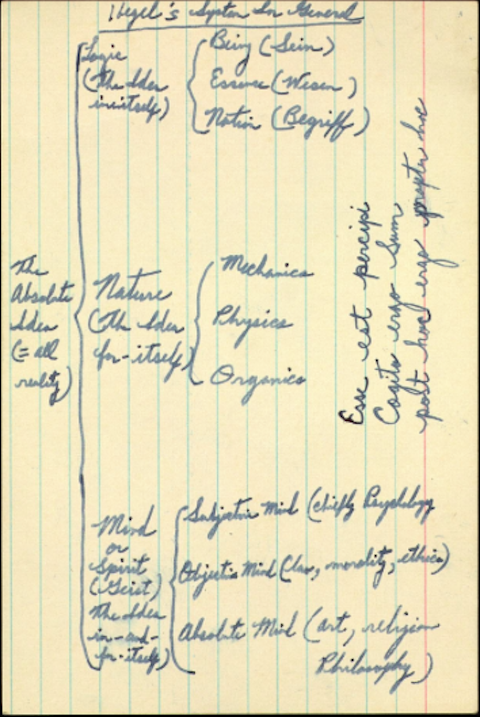
King read and wrote on Hegel as a graduate student at Boston University and Harvard in the mid-50s, where he studied theology and the history of philosophy and religion. He took a yearlong seminar on Hegel with his advisor at BU, Edgar Brightman (see King’s diagram notes of Hegel’s system above), and found a great deal to admire in the “dead white” philosopher’s logical system, as well as a good deal to critique. The two-semester class, King wrote in his autobiography, was “both rewarding and stimulating”:
Although the course was mainly a study of Hegel’s monumental work, Phenomenology of Mind, I spent my spare time reading his Philosophy of History and Philosophy of Right. There were points in Hegel’s philosophy that I strongly disagreed with. For instance, his absolute idealism was rationally unsound to me because it tended to swallow up the many in the one. But there were other aspects of his thinking that I found stimulating. His contention that “truth is the whole” led me to a philosophical method of rational coherence. His analysis of the dialectical process, in spite of its shortcomings, helped me to see that growth comes through struggle.
While King may have disagreed with Hegel’s idealism, he found support for his own philosophy of nonviolence in Hegel’s dialectical method, a mode of analysis that seems particularly well suited to socially revolutionary thought. In Stride Toward Freedom, King wrote,
The third way open to oppressed people in their quest for freedom is the way of nonviolent resistance. Like the synthesis in Hegelian philosophy, the principle of nonviolent resistance seeks to reconcile the truths of two opposites—acquiescence and violence—while avoiding the extremes and immoralities of both.
King’s critical appraisal of Hegel extended to other radical philosophical thinkers as well, including Kant, Spinoza, Kierkegaard, Marx, and Nietzsche. Gertz offers many samples of the budding civil rights leader’s notes on various thinkers and philosophies, including the first paragraph of an essay entitled “Pilgrimage to Nonviolence” (below), in which King confesses that his encounter with Existentialism often “shocked” him, especially since he had “been raised in a rather strict fundamentalist tradition.” And yet, he writes—in an allusion to Kant’s reaction to David Hume—he acquired “a new appreciation for objective appraisal and critical analysis” that “knocked me out of my dogmatic slumber.”
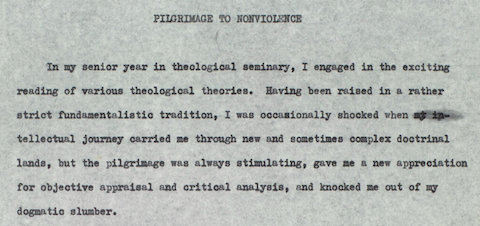
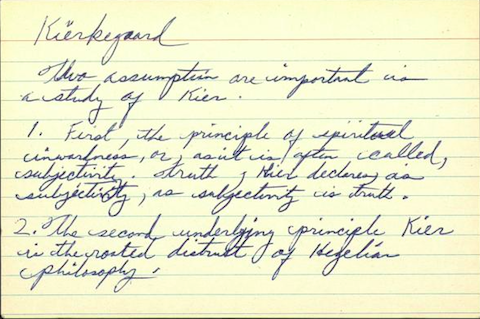
In the essay, King writes, “I became convinced that existentialism, in spite of the fact that it had become all too fashionable, had grasped certain basic truths about man.” He seems particularly drawn to Kierkegaard (see his notes on the philosopher below). Yet it is Hegel who seems most responsible for awakening his philosophical curiosity. As King scholar John Ansbro discovered, King “stated in a January 19, 1956 interview with The Montgomery Adviser that Hegel was his favorite philosopher.” Later that year, King gave an address to the First Annual Institute on Nonviolence and Social Change in which he used Hegelian terms to characterize the Civil Rights struggle: “Long ago, the Greek philosopher Heraclitus argued that justice emerges from the strife of opposites, and Hegel, in modern philosophy, preached a doctrine of growth through struggle.”
Independent scholar Ralph Dumain has further catalogued King’s many approving references to Hegel, including a paper he wrote entitled “An Exposition of the First Triad of Categories of the Hegelian Logic—Being, Non-Being, Becoming,” the “last of six essays that King wrote” for his two-semester course on the philosopher. King also approached Hegel by way of an earlier Civil Rights leader—W.E.B. Dubois, who read the German philosopher while studying with prominent social scientists in Berlin, and who applied Hegelian logic to his own analysis of racial consciousness and struggle in America.
Interestingly, what neither King nor Dubois remarked on is the fact that Hegel was likely himself inspired by black revolutionaries. The Haitian Revolution, argues scholar Susan Buck-Morss, gave Hegel the impetus for his analysis of power and his “metaphor of the ‘struggle to death’ between the master and slave, which for Hegel provided the key to the unfolding of freedom in world history.” While Hegel’s thought is a philosophical thread that winds through the work of radical thinkers throughout the nineteenth and twentieth centuries, his own philosophy may not have taken the direction it did without the revolutionary struggles against oppression waged by former slaves in the New World centuries before King led his nonviolent war on the oppressive system of segregation in the United States.
H/T Nolen Gertz
Related Content:
‘You Are Done’: The Chilling “Suicide Letter” Sent to Martin Luther King by the F.B.I.
200,000 Martin Luther King Papers Go Online
Josh Jones is a writer and musician based in Durham, NC. Follow him at @jdmagness
Read More...Joni Mitchell’s Application for a Tenure Track Philosophy Position

Image by Asylum Records (Billboard page 2) [Public domain], via Wikimedia Commons
Michael Stipe has a teaching gig at NYU. Lynda Barry has one at UW-Madison. Sun Ra gave a classic lecture at UC-Berkeley. So why can’t we imagine Joni Mitchell landing a job at a university too? That’s what Jedidiah Anderson did, when he wrote a satirical piece over at McSweeney’s called “Joni Mitchell Applies for a Tenure Track Philosophy Position.” It begins:
Dear Search Committee:
I am applying for the position of Assistant Professor in Philosophy. I am an advanced doctoral candidate in Philosophy (with minors in Urban Studies and English), and expect to defend my dissertation in May, 2015.
My dissertation, Both Sides Now applies a bilateral, hylomorphic analysis to the phenomenon that is described by the signifier “clouds.” Having been constituted in Western discourse both positively as “rows and flows of angel hair,” “ice cream castles in the air,” “feather canyons everywhere,” and negatively as objects that exist solely to obscure the sun, express rain and snow, and hinder the achievement of various goals, we can conclude that after the application of this bilateral, hylomorphic analysis that due to these contradictory “up” and “down” epistemologies of cloud tropes, the reality of clouds is somehow still understudied, having been ignored in favor of their Platonic form/sign, and that we really don’t “know” clouds at all.
You can read the rest of her “application” here and then spend the evening dreaming about taking Joni’s classes on Plato, Existentialism, and Urban Development. I know I will.
You can find more great Joni Mitchell material below.
Related Content:
Vintage Video of Joni Mitchell Performing in 1965 — Before She Was Even Named Joni Mitchell
James Taylor and Joni Mitchell, Live and Together (1970)
The Music, Art, and Life of Joni Mitchell Presented in a Superb 2003 Documentary
Free Online Philosophy Courses
Read More...Junot Díaz’s Syllabi for His MIT Writing Classes, and the Novels on His Reading List
We can probably all agree that it’s a little premature, but all the same, the BBC has barreled ahead with its list of “The 21st Century’s 12 greatest novels.” Topping the list of excellent, if not especially surprising, picks is The Brief Wondrous Life of Oscar Wao, Junot Díaz’s Pulitzer Prize-winning debut novel about, as he puts it in the interview above, “a closeted nerd writing about an absolutely out nerd, and using their shared mutual language to tell the story.” The book has connected with such a wide swath of readers for more than its appeal to fellow nerds, though that’s no small thing. A great many readers have seen their own lives reflected in Díaz’s characters—Dominican immigrants growing up in New Jersey—or have found their experiences illuminating. And even though Yunior and Oscar’s very male point of view might have alienated female readers in the hands of a lesser author, Díaz has the sensitivity and self-awareness to—as Joe Fassler argues in The Atlantic—write sexist characters, but not sexist books. As the author himself says above, “if it wasn’t for women readers, I wouldn’t have a career.”
Díaz’s ear for dialogue and idiom and his facility for constructing completely believable characters with completely distinctive voices are matched by his commitment to representing the experiences of people who still get routinely left out of the contemporary canon. Despite the attention given to such stellar non-white, non-male writers as Toni Morrison, Maxine Hong-Kingston, Arundhati Roy, and Jamaica Kincaid, most MFA programs, Diaz argued in a recent essay for The New Yorker, are still “too white,” reproducing “exactly the dominant culture’s blind spots and assumptions around race and racism (and sexism and heteronormativity, etc).” In his own MFA workshop experiences at Cornell, he found that “the default subject position of reading and writing—of Literature with a capital L—was white, straight and male.”
The problem is more than just personal, though he certainly found the experience personally alienating, and it isn’t a matter of redressing historical wrongs or enforcing an abstract PC notion of diversity. Instead, as Díaz told Salon, it’s a problem of accurately representing reality. “If race or gender (or any other important social force) are not part of your interpretive logic—if they’re not part of what you consider the real—then you’re leaving out most of what has made our world our world.” In his own role at a professor at MIT, teaching undergraduate writing courses for the Comparative Media Studies/Writing Department, Díaz is very thoughtful about his approach, emphasizing, “it’s not the books you teach, but how you teach them.” In addition to novels by authors like Haitian-born Edwidge Danticat and Zimbabwean author NoViolet Bulawayo, he has his students read “classic Gothic texts which are themselves not very diverse by our standards,” but, he says, “the critical lens I deploy helps my students understand how issues of race, gender, coloniality etc. are never far.”
Salon tracked down the syllabi and reading lists for two of Díaz’s MIT courses, “World-Building” and “Advanced Fiction.” We do find one classic Gothic text—Bram Stoker’s Dracula—and also much of what we might expect from the self-confessed nerd, including work from such well-regarded comic writers as Frank Miller and Alan Moore and classic sci-fi from Tarzan creator Edgar Rice Burroughs. In addition to these white, male writers, we have fiction from African-American sci-fi authors Octavia Butler and N.K. Jemisin. Díaz’s “Advanced Fiction” list is even more wide-ranging, inclusive of writers from Chile, Zimbabwe, China, and Haiti, as well as the U.S. See both lists below.
World-Building:
Description: “This class concerns the design and analysis of imaginary (or constructed) worlds for narrative media such as roleplaying games, films, comics, videogames and literary texts. … The class’ primary goal is to help participants create better imaginary worlds – ultimately all our efforts should serve that higher purpose.”
Prerequisites: “You will need to have seen Star Wars (episode four: A New Hope) and read The Lord of the Rings by JRR Tolkien.”
Reading List:
“A Princess of Mars” by ER Burroughs
“Dracula” by Bram Stoker
“Batman: The Dark Knight Returns” by Frank Miller
“Sunshine” by Robin McKinley
“V for Vendetta” by Alan Moore
“The Hunger Games” by Suzanne Collins
“The Hundred Thousand Kingdoms” by NK Jemisin
“Lilith’s Brood” by Octavia Butler
“Perdido Street Station” by China Miéville
“Snow Crash” by Neal Stephenson (Recommended)Some things to consider always when taking on a new world: What are its primary features—spatial, cultural, biological, fantastic, cosmological? What is the world’s ethos (the guiding beliefs or ideals that characterize the world)? What are the precise strategies that are used by its creator to convey the world to us and us to the world? How are our characters connected to the world? And how are we the viewer or reader or player connected to the world?
Advanced Fiction
Description: “An advanced workshop on the writing and critiquing of prose.”
Reading List:
“Clara” by Roberto Bolaño
“Hitting Budapest” by NoViolet Bulawayo
“Whites” by Julie Otsuka
“Ghosts” by Edwidge Danticat
“My Good Man” by Eric Gansworth
“Gold Boy, Emerald Girl” by Yiyun Li
“Bounty” by George Saunders
For more from Díaz himself on his approach to writing fiction, listen to his interview with NPR’s Teri Gross. And just below, hear Díaz read from The Brief Wondrous Life of Oscar Wao at the Key West Literary Seminar in 2008.
Related Content:
Free Online Literature Courses
Junot Díaz Annotates a Selection of The Brief Wondrous Life of Oscar Wao for “Poetry Genius”
David Foster Wallace’s 1994 Syllabus: How to Teach Serious Literature with Lightweight Books
Donald Barthelme’s Syllabus Highlights 81 Books Essential for a Literary Education
Josh Jones is a writer and musician based in Durham, NC. Follow him at @jdmagness.
Read More...Support Us
We're hoping to rely on loyal readers, rather than erratic ads. Please click the Donate button and support Open Culture. You can use Paypal, Venmo, Patreon, even Crypto! We thank you!

About Us

Open Culture scours the web for the best educational media. We find the free courses and audio books you need, the language lessons & educational videos you want, and plenty of enlightenment in between.
Advertise With Us
FREE UPDATES!
GET OUR DAILY EMAIL
Get the best cultural and educational resources on the web curated for you in a daily email. We never spam. Unsubscribe at any time.
FOLLOW ON SOCIAL MEDIA
Open Culture editor Dan Colman scours the web for the best educational media. He finds the free courses and audio books you need, the language lessons & movies you want, and plenty of enlightenment in between.
Advertise With Us


