The Origins of Pleasure: Paul Bloom Explains Why We Like Expensive Wines & Original Paintings
Let’s say you spend a considerable amount of money for a painting by a noted artist. Or maybe you get it for a steal. Either way, the painting hangs prominently in your home, where it is admired by guests and brings you pleasure every time you look at it, which is often. Years later, you accidentally discover that your painting is not the work of the artist whose signature graces the lower right hand corner of the canvas, but rather a heretofore anonymous forger. How do you react?
Do you laugh and say, “When I think of all the happiness that living with this beautiful image has brought me over the years, I feel I have gotten my money’s worth many times over. I don’t care who painted it!”
Or do you look as though you’ve just realized that evil exists in the world, which is how Hitler’s right hand man, Hermann Göring, reputedly looked when, as a prisoner at Nuremberg, he was informed that his beloved Vermeer, ”Christ with the Woman Taken in Adultery” (below), was actually the work of the Dutch dealer who had sold it to him.
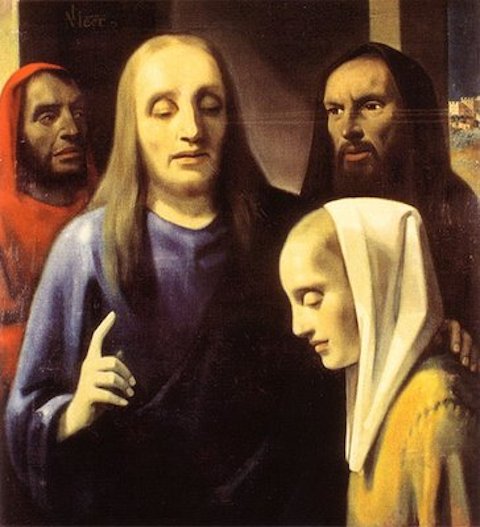
Göring’s reaction may have been the most human thing about him. According to Yale psychologist Paul Bloom, the pleasure we take in the things we love is deeply informed by their perceived origins. Forget monetary value. Forget bragging rights. We need to believe that our painting was not just painted by Vermeer, but handled by him, breathed upon him. If only that Vermeer of mine could talk…I bet it could settle once and for all the exact nature of his relationship with that little serving girl. Remember? The one with the pearl earring?
Oh, wait. She was fictional. I forgot.
But that’s the sort of provenance we crave. The kind that comes with a story we can sink our teeth into.
The story must also fit the circumstances, as Bloom makes plain in his wonderfully entertaining TED talk on the Origins of Pleasure.
Unknowingly hopping in the sack with a blood relative or eating rat meat are intriguing narratives, provided they happen to someone else. Knowledge of such stories could deepen your connection to a particular piece of art.
(Can’t you feel the sexual anguish oozing out of my Vermeer? Did you know he had to choose between buying brushes and buying food?)
Not the sort of origin story you’d want to find at the bottom of your own personal soup bowl, however.
Ergo, let us say that when it comes to pleasure emanating from food, we savor tastes we perceive as coming from wholesome organic farms, artisanal operations, restaurants that are known to have passed the Board of Health’s sanitary inspection with flying colors.
And when it comes to drink, we will willingly believe in the superior flavor of anything poured under the auspices of an acclaimed label. Scientific evidence confirms this.
(On a related note, I once hung on to a bottle after drinking the luxury vodka it once contained, thinking I’d refill it with a cheap liquor hack I had read about. The experiment ended when my husband complained that the water in our Brita pitcher tasted funny.)
Speaking of romantic partners, it turns out that beauty truly is not so much in the eye, but the brain of the beholder. And it’s probably not a bad idea to make sure you’ve got the facts regarding a potential lover’s age, gender, and bloodlines. Caveat emptor, as anyone who’s ever seen the Crying Game will attest.
Note: Paul Bloom has taught a free course through Yale called “Introduction to Psychology,”. It’s available in our collection of Free Online Psychology Courses, part of our larger collection, 1,700 Free Online Courses from Top Universities.
Related Content:
Why We Love Repetition in Music: Explained in a New TED-Ed Animation
A Darwinian Theory of Beauty, or TED Does Its Best RSA
1756 TED Talks Listed in a Neat Spreadsheet
Ayun Halliday is an author, homeschooler, and Chief Primatologist of the East Village Inky zine. Follow her @AyunHalliday
Read More...Hear Albums from Brian Eno’s 1970s Label, Obscure Records
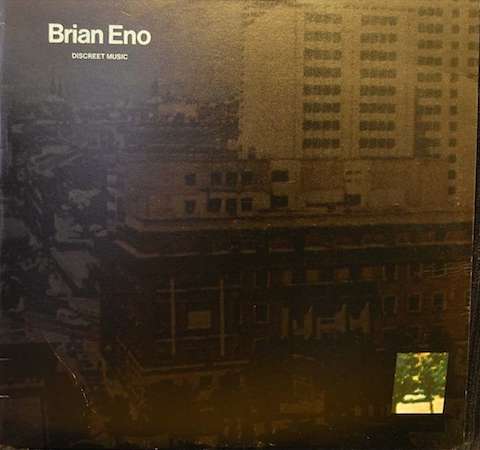
Given his celebrity status in the realms of both music and visual art, I don’t know that we can really call anything Brian Eno does obscure. But at one point, he did call his own efforts obscure — or at least those efforts required to establish and run the label Obscure Records, which he did between 1975 and 1978. In that short period, Obscure Records managed to put out ten albums, from Gavin Bryars’ The Sinking of the Titanic (catalog no. 1) to Michael Nyman’s Decay Music (no. 6) to Harold Budd’s Pavilion of Dreams (no. 10), all of which we might broadly categorize as “contemporary classical music,” with a strong bent toward new compositional techniques and what we’d now call ambient textures.
“The label provided a venue for experimental music,” says Ubuweb’s Obscure Records page, “and its association with Eno gave increased public exposure to its composers and musicians.” There, you freely can listen to all ten Obscure releases — which, I suppose, effectively makes them obscure no more — although they don’t include the famously detailed original liner notes “analyzing the compositions and providing a biography of the composer.”
Though he mostly acted as producer on Obscure recordings, Eno also used the label to put out his seminal 1975 solo album Discreet Music (no. 3), which contains a composition made using the then unheard-of technique of running several tape loops simultaneously and letting the sound recorded on them run gradually out of sync. Obscure’s fifth release, Jan Steele and John Cage’s 1976 Voices and Instruments, features “The Wonderful Widow Of Eighteen Springs,” previously featured here on Open Culture as interpreted by Joey Ramone.
This may seem colorful enough for any label’s lifetime, but Eno did have an eleventh Obscure record planned. It ultimately made more sense, however, to found an entirely new operation to put out this work, a certain Music for Airports. It came out as the flagship release from Eno’s Ambient Records — and the rest, my friends, is popular-experimental music history.
Albums from Obscure Records can be sampled over at UBU.
Related Content:
David Bowie & Brian Eno’s Collaboration on “Warszawa” Reimagined in Comic Animation
Jump Start Your Creative Process with Brian Eno’s “Oblique Strategies”
Brian Eno on Creating Music and Art As Imaginary Landscapes (1989)
How David Byrne and Brian Eno Make Music Together: A Short Documentary
Hear Joey Ramone Sing a Piece by John Cage Adapted from James Joyce’s Finnegans Wake
Colin Marshall hosts and produces Notebook on Cities and Culture as well as the video series The City in Cinema and writes essays on cities, language, Asia, and men’s style. He’s at work on a book about Los Angeles, A Los Angeles Primer. Follow him on Twitter at @colinmarshall or on Facebook.
Read More...In Lost Letter, Allen Ginsberg Tells The Paris Review He Tried LSD Again & Experienced “No Snake Universe Hallucinations” (1966)
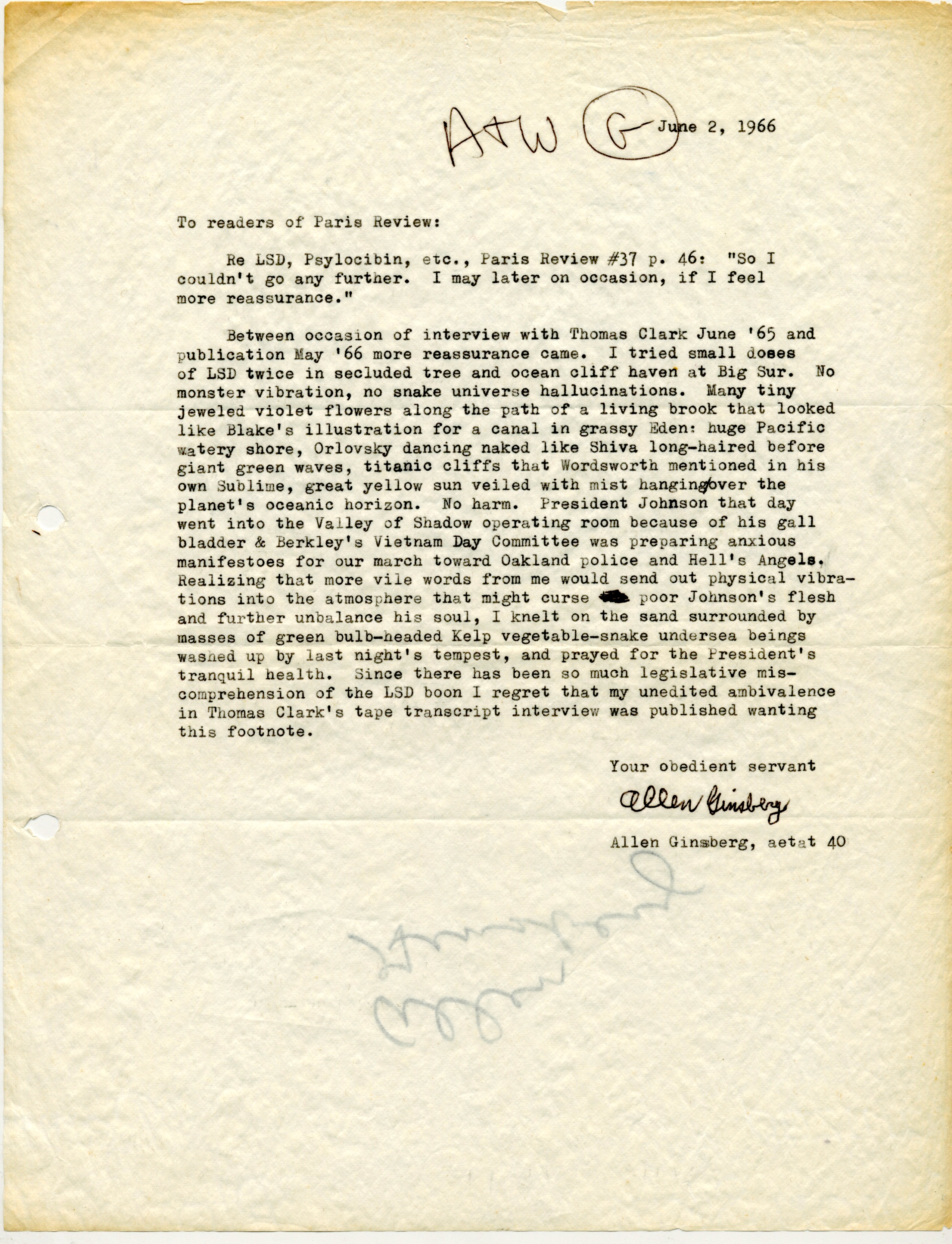
(click for larger version)
In June 1965, Allen Ginsberg was interviewed at length by fellow poet Tom Clark. They touched on such topics as poetic meter, William S. Burroughs, and Blake’s “The Sick Rose.” When the conversation turned to hallucinogens, Ginsberg, a famously early adopter of LSD, describes a vision so ominous it could’ve turned an entire generation off drugs:
If I close my eyes on hallucinogens, I get a vision of great scaly dragons in outer space, they’re winding slowly and eating their own tails. Sometimes my skin and all the room seem sparkling with scales, and it’s all made out of serpent stuff. And as if the whole illusion of life were made of reptile dream.
He also mentioned that drugs made him barf. That alone seems a persuasive reason to stop taking them.
Despite his strong desire to continue his pursuit of ever higher levels of consciousness, the cons were beginning to outweigh the pros.
It took nearly a year for the Paris Review to publish the interview. So long that the subject felt the need to revise his earlier statements, via the typewritten letter above.
His post-interview psychedelic excursions appear to have transpired in the sort of benign universe typically imagined by a preschooler with a big box of crayons: “tiny jeweled violet flowers,” “giant green waves,” a “great yellow sun.” Otherwise known as Big Sur on acid.
The level of goodness present in those later trips was such strong medicine, Ginsberg decided to experiment further, directing some of his good vibes toward then-President Lyndon Johnson, who was undergoing surgery to remove his gall bladder. Love thy enemy, and all of that.
I wonder if Johnson ever found out he had a rabidly anti-war Beat Poet (and “masses of green bulb-headed Kelp vegetable-snake undersea beings”) praying for his recovery.
Apparently it worked.
The complete June 1965 interview can be read in the Paris Review’s archives. Those who’ve grown unaccustomed to reading courier font as executed by a midcentury manual typewriter will find the complete text of Ginsberg’s letter below.
June 2, 1966
To readers of Paris Review:
Re LSD, Psylocibin [sic], etc., Paris Review #37 p. 46: “So I couldn’t go any further. I may later on occasion, if I feel more reassurance.”
Between occasion of interview with Thomas Clark June ’65 and publication May ’66 more reassurance came. I tried small doses of LSD twice in secluded tree and ocean cliff haven at Big Sur. No monster vibration, no snake universe hallucinations. Many tiny jeweled violet flowers along the path of a living brook that looked like Blake’s illustration for a canal in grassy Eden: huge Pacific watery shore, Orlovsky dancing naked like Shiva long-haired before giant green waves, titanic cliffs that Wordsworth mentioned in his own Sublime, great yellow sun veiled with mist hanging over the planet’s oceanic horizon. No harm. President Johnson that day went into the Valley of Shadow operating room because of his gall bladder & Berkley’s Vietnam Day Committee was preparing anxious manifestoes for our march toward Oakland police and Hell’s Angels. Realizing that more vile words from me would send out physical vibrations into the atmosphere that might curse poor Johnson’s flesh and further unbalance his soul, I knelt on the sand surrounded by masses of green bulb-headed Kelp vegetable-snake undersea beings washed up by last night’s tempest, and prayed for the President’s tranquil health. Since there has been so much legislative mis-comprehension of the LSD boon I regret that my unedited ambivalence in Thomas Clark’s tape transcript interview was published wanting this footnote.
Your obedient servant
Allen Ginsberg, aetat 40
Related Content:
Allen Ginsberg Reads His Famously Censored Beat Poem, Howl (1959)
Allen Ginsberg Reads a Poem He Wrote on LSD to William F. Buckley
Ayun Halliday is an author, illustrator, and Chief Primatologist of the East Village Inky zine. Follow her @AyunHalliday
Read More...Hear Gandhi’s Famous Speech on the Existence of God (1931)
A perfect symbol of the mechanisms of British rule over India, the Salt Acts prohibited Indians from access and trade of their own resources, forcing them to buy salt from British monopolies, who taxed the mineral heavily. In 1930, in one of the defining acts of his Satyagraha movement, Mohandas Gandhi decided to defy the Salt Act with a very grand gesture—a march, with thousands of his supporters, over a distance of over 200 miles, to the Arabian Sea. Once there, following Gandhi’s lead, the crowd proceeded to collect sea salt, prompting British colonial police to arrest over 60,000 people, including Gandhi himself.
The 1930 action, the first organized act of civil disobedience after the Indian National Congress’ declaration of independence, got the attention of the Viceroy, Lord Irwin, who had been directing harsh repressive measures against the growing independence movement, and in January of 1931, after his release, Gandhi and Irwin signed a pact. Gandhi agreed to end the movement; Irwin agreed to allow the Indians to make their own salt, and the Indians would have an equal role in negotiating India’s future. British officials were outraged and disgusted. Winston Churchill, for example, staunchly opposed to independence, called the meeting of the two leaders a “nauseating and humiliating spectacle,” saying “Gandhi-ism and everything it stands for will have to be grappled with and crushed.” (Churchill favored letting Gandhi die if he went on hunger strike.)
The terms of the pact, of course, did not hold, and the movement would continue until eventual independence in 1947. But Gandhi had not only succeeded in incurring the wrath of the British colonialists; he had also won many supporters in England. One of them, Muriel Lester, invited the Indian leader to stay with her in London at a community center she had founded called Kingsley Hall. “He enjoyed his stay here,” says the current Kingsley Hall manager David Baker, “and it was wise because if he had stayed in the West End the press would have lampooned him. He wouldn’t have had a life, but here he was left alone and walked around in the streets. He wanted to stay with the people that he lived with in India, i.e. the poor.” However, Gandhi wasn’t totally ignored by the press. While at Kingsley, he delivered a short speech, which you can hear above, and the BBC was there to record it.
In the speech, Gandhi says absolutely nothing about Indian independence, British oppression, or the aims and tactics of the movement. He says nothing at all about politics or any worldly affairs whatsoever. Instead, he lectures on the existence of God, “an indefinable mysterious power that pervades everything,” and which “defies all proof.” Gandhi testifies to “an unalterable law governing everything and every being that exists or lives,” though he also confesses “that I have no argument to convince through reason.” Instead relies on analogies, on things he “dimly perceives,” on the “marvelous researches of [Indian engineer and scientist] Sir J.C. Bose,” and on “the experiences of an unbroken line of prophets and sages in all countries and climes.” It’s not a speech likely to persuade anyone who isn’t already some sort of a believer, I think, but it’s of much interest to anyone interested in the history of Indian independence and in Gandhi’s life and message.
You can read the full text of the speech here, and see footage of Kingsley Hall and a filmed interview with Muriel Lester, discussing Gandhi’s stay, here.
Related Content:
Mahatma Gandhi’s List of the 7 Social Sins; or Tips on How to Avoid Living the Bad Life
Mahatma Gandhi Talks (in First Recorded Video)
Albert Einstein Expresses His Admiration for Mahatma Gandhi, in Letter and Audio
Josh Jones is a writer and musician based in Durham, NC. Follow him at @jdmagness
Read More...Kubrick’s 2001: A Space Odyssey Gets Turned Into “The Weirdest Sci-Fi Comic Ever Made” by Jack Kirby
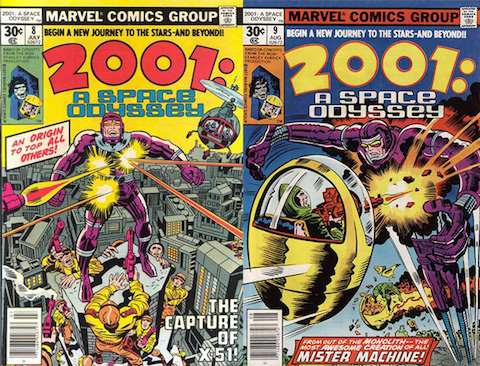
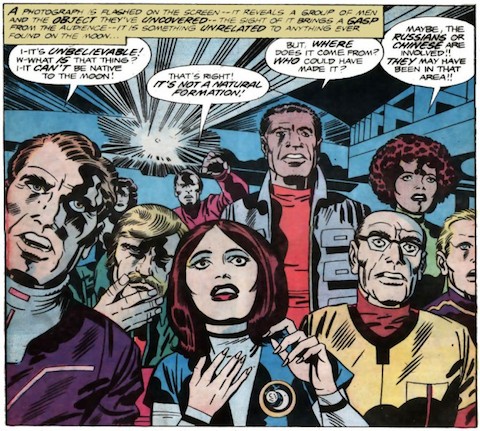
Sure, we all enjoyed the adaptation of 2001: A Space Odyssey presented on the Howard Johnson’s children’s menu from 1968 that we featured last May. But would you believe that, when you swap out the name Howard Johnson for that of Jack Kirby, you get a work of higher artistic merit? In his long career, the widely respected comic book artist, writer, and editor put in time on both the DC and Marvel sides of the fence. 1976’s 2001: A Space Odyssey comic book, a meeting of Kirby’s mind with those of Stanley Kubrick and Arthur C. Clarke, marked his return to Marvel after spending the early 70s at DC.
Kubrickonia, which calls the commission “a match made in bizarro world heaven,” describes the product: “The adaptation was written & penciled by Kirby with inking duties carried out by Frank Giacoia. The almost 2 times larger than the regular comic-book format suited Kirby’s outlandish pop style, but this was a great talent merely going through the motions.” The Sequart Organization’s Julian Darius calls it “surely one of the strangest sci-fi franchise comics ever published,” a stuffy marriage between Kirby’s “bombastic,” “action-oriented,” “in-your-face” art and the style of Kubrick’s film, one “all about the subtle. No one ever accused Kirby of being subtle. Indeed, his almost complete lack of subtlety is part of his charm, but it’s not a charm one could possibly imagine fitting 2001.”
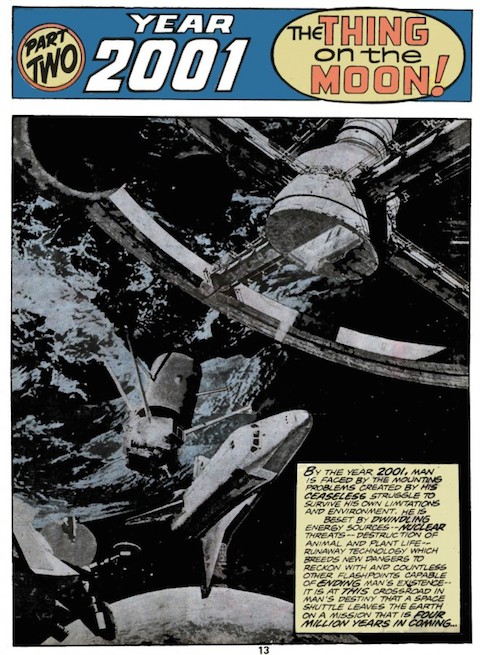
At The Dissolve, Noel Murray includes an examination of Kirby’s 2001 in the site’s “Adventures in Licensing” column. Kirby’s description of Kubrick’s immortal millennia-spanning match cut, which the article quotes as an opener, tells you everything you need to know:
As the surge of elation sweeps through him, Moonwatcher shouts in victory and throws his weapon at the sky!! Higher and higher, it sails — aimed at the infinite where the countless stars wait for the coming of man… And, man comes to space!! Across the agonizing ages he follows the destiny bequeathed to him by the monolith.
2001: A Space Odyssey in comics, which comprises not just the oversized book but ten monthly issues that expanded upon the film — taking it in, shall we say, a different direction than either Kubrick or Clarke might have envisioned — has, as you can see, inspired no small amount of discussion among science fiction and comic book enthusiasts. Darius wrote a whole book called The Weirdest Sci-Fi Comic Ever Made. At SciFiDimensons, Robert L. Bryant Jr. and Robert B. Cooke offer two more analyses of this unusual chapter in the history of American sequential art. Whatever its merits as reading material, it shows us that genius plus genius doesn’t always produce genius — but it never fails to produce something fascinating.
You can check out scans of the first issue of 2001: A Space Odyssey over on this web site.
Related Content:
Howard Johnson’s Presents a Children’s Menu Featuring Kubrick’s 2001: A Space Odyssey (1968)
Isaac Asimov Predicts in 1964 What the World Will Look Like Today — in 2014
Arthur C. Clarke Predicts the Future in 1964 … And Kind of Nails It
Colin Marshall hosts and produces Notebook on Cities and Culture as well as the video series The City in Cinema and writes essays on cities, language, Asia, and men’s style. He’s at work on a book about Los Angeles, A Los Angeles Primer. Follow him on Twitter at @colinmarshall or on Facebook.
Read More...How Did Everything Begin?: Animations on the Origins of the Universe Narrated by X‑Files Star Gillian Anderson
Back in November, we brought you the BBC series of short animated videos, A History of Ideas. Produced in collaboration with the UK’s Open University and narrated by Harry Shearer, these fun introductions to such philosophers as Simone de Beauvoir and Edmund Burke, and such weighty philosophical topics as free will and the problem of evil, make challenging, abstract concepts accessible to non-philosophers. Now the series is back with a new chapter, “How Did Everything Begin?,” a survey of several theories of the origins of the universe, from Thomas Aquinas’ philosophical speculations, to Hindu cosmology; and from theologian William Paley’s design argument (below), and the theory of the Big Bang (above).
The two videos here present an interesting counterpoint between the origin theories of astrophysics and theology. Though current day intelligent design proponents deny it, there is still much of William Paley’s argument, at least in style, in their explanations of creation. First propounded in his 1802 work Natural Theology, the theologian’s famous watchmaker analogy—which he extended to the design of the eye, and everything else—gave Charles Darwin much to puzzle over, though David Hume had supposedly refuted Paley’s arguments 50 years earlier. The Big Bang theory—a term created by its foremost critic Fred Hoyle as a pejorative—offers an entirely naturalistic account of the universe’s origins, one that presupposes no inherent purpose or design.
As with the previous videos, these are scripted by former Open University professor and host of the Philosophy Bites podcast, Nigel Warburton. This time around the videos are narrated by Gillian Anderson, whose voice you may not immediately recognize. Rather than sounding like Dana Scully, her famous X‑Files character, Anderson speaks in a British accent, which she slips into easily, having lived in the UK for much of her childhood and now again as an adult. (You may have seen Anderson in many of the English period dramas she has appeared in, or in British crime drama The Fall or Michael Winterbottom’s uproarious adaptation of Tristram Shandy.)
These fascinating speculative theories—whether scientific or mythological—are sure to appeal to fans of the X‑Files, who can perhaps begin to believe again, or remain skeptical, thanks to news that Anderson may reteam with Chris Carter and David Duchovny for a reboot of the classic sci-fi series.
Watch the remaining videos in the series below:
Thomas Aquinas and the First Mover Argument
Hindu Creation Stories
Related Content:
The History of Philosophy Without Any Gaps – Peter Adamson’s Podcast Still Going Strong
Free Online Philosophy Courses (130 in Total)
Josh Jones is a writer and musician based in Durham, NC. Follow him at @jdmagness
Read More...Cab Calloway’s “Hepster Dictionary,” a 1939 Glossary of the Lingo (the “Jive”) of the Harlem Renaissance
The lists are in. By overwhelming consensus, the buzzword of 2014 was “vape.” Apparently, that’s the verb that enables you to smoke an e‑cig. Left to its own devices, my computer will still autocorrect 2014’s biggest word to “cape,” but that could change.
Hopefully not.
Hopefully, 2015 will yield a buzzword more piquant than “vape.”
With luck, a razor-witted teen is already on the case, but just in case, let’s hedge our bets. Let’s go spelunking in an era when buzzwords were cool, but adult…insouciant, yet substantive.
Lead us, Cab Calloway!
The charismatic bandleader not only had a way with words, his love of them led him to compile a “Hepster’s Dictionary” of Harlem musician slang circa 1938. It featured 200 expressions used by the “hep cats” when they talk their “jive” in the clubs on Lenox Avenue. It was also apparently the first dictionary authored by an African-American.
If only every amateur lexicographer were foxy enough to set his or her definitions to music, and creep them out like the shadow, as Calloway does above. The complete list is below.
What a blip!
By my calculation, we’ve got eleven months to identify a choice candidate, resurrect it, and integrate it into everyday speech. With luck some fine dinner whose star is on the rise will beef our word in public, preferably during a scandalous, much analyzed performance.
It’s immaterial which one we pick. Gammin’? Jeff? Hincty? Fruiting? Whatever you choose, I’m in. Let’s blow their wigs.
Bust your conks in the comments section. I’m ready.
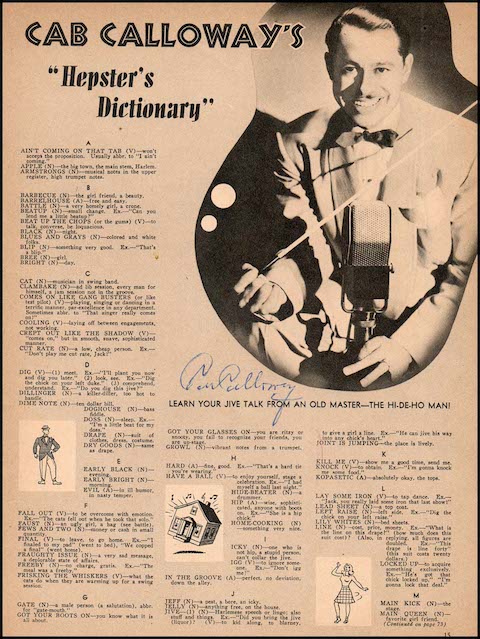
HEPSTER’S DICTIONARY
A hummer (n.) — exceptionally good. Ex., “Man, that boy is a hummer.”
Ain’t coming on that tab (v.) — won’t accept the proposition. Usually abbr. to “I ain’t coming.”
Alligator (n.) — jitterbug.
Apple (n.) — the big town, the main stem, Harlem.
Armstrongs (n.) — musical notes in the upper register, high trumpet notes.
Barbecue (n.) — the girl friend, a beauty
Barrelhouse (adj.) — free and easy.
Battle (n.) — a very homely girl, a crone.
Beat (adj.) — (1) tired, exhausted. Ex., “You look beat” or “I feel beat.” (2) lacking anything. Ex, “I am beat for my cash”, “I am beat to my socks” (lacking everything).
Beat it out (v.) — play it hot, emphasize the rhythym.
Beat up (adj.) — sad, uncomplimentary, tired.
Beat up the chops (or the gums) (v.) — to talk, converse, be loquacious.
Beef (v.) — to say, to state. Ex., “He beefed to me that, etc.”
Bible (n.) — the gospel truth. Ex., “It’s the bible!”
Black (n.) — night.
Black and tan (n.) — dark and light colored folks. Not colored and white folks as erroneously assumed.
Blew their wigs (adj.) — excited with enthusiasm, gone crazy.
Blip (n.) — something very good. Ex., “That’s a blip”; “She’s a blip.”
Blow the top (v.) — to be overcome with emotion (delight). Ex., “You’ll blow your top when you hear this one.”
Boogie-woogie (n.) — harmony with accented bass.
Boot (v.) — to give. Ex., “Boot me that glove.”
Break it up (v.) — to win applause, to stop the show.
Bree (n.) — girl.
Bright (n.) — day.
Brightnin’ (n.) — daybreak.
Bring down ((1) n. (2) v.) — (1) something depressing. Ex., “That’s a bring down.” (2) Ex., “That brings me down.”
Buddy ghee (n.) — fellow.
Bust your conk (v.) — apply yourself diligently, break your neck.
Canary (n.) — girl vocalist.
Capped (v.) — outdone, surpassed.
Cat (n.) — musician in swing band.
Chick (n.) — girl.
Chime (n.) — hour. Ex., “I got in at six chimes.”
Clambake (n.) — ad lib session, every man for himself, a jam session not in the groove.
Chirp (n.) — female singer.
Cogs (n.) — sun glasses.
Collar (v.) — to get, to obtain, to comprehend. Ex., “I gotta collar me some food”; “Do you collar this jive?”
Come again (v.) — try it over, do better than you are doing, I don’t understand you.
Comes on like gangbusters (or like test pilot) (v.) — plays, sings, or dances in a terrific manner, par excellence in any department. Sometimes abbr. to “That singer really comes on!”
Cop (v.) — to get, to obtain (see collar; knock).
Corny (adj.) — old-fashioned, stale.
Creeps out like the shadow (v.) — “comes on,” but in smooth, suave, sophisticated manner.
Crumb crushers (n.) — teeth.
Cubby (n.) — room, flat, home.
Cups (n.) — sleep. Ex., “I gotta catch some cups.”
Cut out (v.) — to leave, to depart. Ex., “It’s time to cut out”; “I cut out from the joint in early bright.”
Cut rate (n.) — a low, cheap person. Ex., “Don’t play me cut rate, Jack!”
Dicty (adj.) — high-class, nifty, smart.
Dig (v.) — (1) meet. Ex., “I’ll plant you now and dig you later.” (2) look, see. Ex., “Dig the chick on your left duke.” (3) comprehend, understand. Ex., “Do you dig this jive?”
Dim (n.) — evening.
Dime note (n.) — ten-dollar bill.
Doghouse (n.) — bass fiddle.
Domi (n.) — ordinary place to live in. Ex., “I live in a righteous dome.”
Doss (n.) — sleep. Ex., “I’m a little beat for my doss.”
Down with it (adj.) — through with it.
Drape (n.) — suit of clothes, dress, costume.
Dreamers (n.) — bed covers, blankets.
Dry-goods (n.) — same as drape.
Duke (n.) — hand, mitt.
Dutchess (n.) — girl.
Early black (n.) — evening
Early bright (n.) — morning.
Evil (adj.) — in ill humor, in a nasty temper.
Fall out (v.) — to be overcome with emotion. Ex., “The cats fell out when he took that solo.”
Fews and two (n.) — money or cash in small quatity.
Final (v.) — to leave, to go home. Ex., “I finaled to my pad” (went to bed); “We copped a final” (went home).
Fine dinner (n.) — a good-looking girl.
Focus (v.) — to look, to see.
Foxy (v.) — shrewd.
Frame (n.) — the body.
Fraughty issue (n.) — a very sad message, a deplorable state of affairs.
Freeby (n.) — no charge, gratis. Ex., “The meal was a freeby.”
Frisking the whiskers (v.) — what the cats do when they are warming up for a swing session.
Frolic pad (n.) — place of entertainment, theater, nightclub.
Fromby (adj.) — a frompy queen is a battle or faust.
Front (n.) — a suit of clothes.
Fruiting (v.) — fickle, fooling around with no particular object.
Fry (v.) — to go to get hair straightened.
Gabriels (n.) — trumpet players.
Gammin’ (adj.) — showing off, flirtatious.
Gasser (n, adj.) — sensational. Ex., “When it comes to dancing, she’s a gasser.”
Gate (n.) — a male person (a salutation), abbr. for “gate-mouth.”
Get in there (exclamation.) — go to work, get busy, make it hot, give all you’ve got.
Gimme some skin (v.) — shake hands.
Glims (n.) — the eyes.
Got your boots on — you know what it is all about, you are a hep cat, you are wise.
Got your glasses on — you are ritzy or snooty, you fail to recognize your friends, you are up-stage.
Gravy (n.) — profits.
Grease (v.) — to eat.
Groovy (adj.) — fine. Ex., “I feel groovy.”
Ground grippers (n.) — new shoes.
Growl (n.) — vibrant notes from a trumpet.
Gut-bucket (adj.) — low-down music.
Guzzlin’ foam (v.) — drinking beer.
Hard (adj.) — fine, good. Ex., “That’s a hard tie you’re wearing.”
Hard spiel (n.) — interesting line of talk.
Have a ball (v.) — to enjoy yourself, stage a celebration. Ex., “I had myself a ball last night.”
Hep cat (n.) — a guy who knows all the answers, understands jive.
Hide-beater (n.) — a drummer (see skin-beater).
Hincty (adj.) — conceited, snooty.
Hip (adj.) — wise, sophisticated, anyone with boots on. Ex., “She’s a hip chick.”
Home-cooking (n.) — something very dinner (see fine dinner).
Hot (adj.) — musically torrid; before swing, tunes were hot or bands were hot.
Hype (n, v.) — build up for a loan, wooing a girl, persuasive talk.
Icky (n.) — one who is not hip, a stupid person, can’t collar the jive.
Igg (v.) — to ignore someone. Ex., “Don’t igg me!)
In the groove (adj.) — perfect, no deviation, down the alley.
Jack (n.) — name for all male friends (see gate; pops).
Jam ((1)n, (2)v.) — (1) improvised swing music. Ex., “That’s swell jam.” (2) to play such music. Ex., “That cat surely can jam.”
Jeff (n.) — a pest, a bore, an icky.
Jelly (n.) — anything free, on the house.
Jitterbug (n.) — a swing fan.
Jive (n.) — Harlemese speech.
Joint is jumping — the place is lively, the club is leaping with fun.
Jumped in port (v.) — arrived in town.
Kick (n.) — a pocket. Ex., “I’ve got five bucks in my kick.”
Kill me (v.) — show me a good time, send me.
Killer-diller (n.) — a great thrill.
Knock (v.) — give. Ex., “Knock me a kiss.”
Kopasetic (adj.) — absolutely okay, the tops.
Lamp (v.) — to see, to look at.
Land o’darkness (n.) — Harlem.
Lane (n.) — a male, usually a nonprofessional.
Latch on (v.) — grab, take hold, get wise to.
Lay some iron (v.) — to tap dance. Ex., “Jack, you really laid some iron that last show!”
Lay your racket (v.) — to jive, to sell an idea, to promote a proposition.
Lead sheet (n.) — a topcoat.
Left raise (n.) — left side. Ex., “Dig the chick on your left raise.”
Licking the chops (v.) — see frisking the whiskers.
Licks (n.) — hot musical phrases.
Lily whites (n.) — bed sheets.
Line (n.) — cost, price, money. Ex., “What is the line on this drape” (how much does this suit cost)? “Have you got the line in the mouse” (do you have the cash in your pocket)? Also, in replying, all figures are doubled. Ex., “This drape is line forty” (this suit costs twenty dollars).
Lock up — to acquire something exclusively. Ex., “He’s got that chick locked up”; “I’m gonna lock up that deal.”
Main kick (n.) — the stage.
Main on the hitch (n.) — husband.
Main queen (n.) — favorite girl friend, sweetheart.
Man in gray (n.) — the postman.
Mash me a fin (command.) — Give me $5.
Mellow (adj.) — all right, fine. Ex., “That’s mellow, Jack.”
Melted out (adj.) — broke.
Mess (n.) — something good. Ex., “That last drink was a mess.”
Meter (n.) — quarter, twenty-five cents.
Mezz (n.) — anything supreme, genuine. Ex., “this is really the mezz.”
Mitt pounding (n.) — applause.
Moo juice (n.) — milk.
Mouse (n.) — pocket. Ex., “I’ve got a meter in the mouse.”
Muggin’ (v.) — making ‘em laugh, putting on the jive. “Muggin’ lightly,” light staccato swing; “muggin’ heavy,” heavy staccato swing.
Murder (n.) — something excellent or terrific. Ex., “That’s solid murder, gate!”
Neigho, pops — Nothing doing, pal.
Nicklette (n.) — automatic phonograph, music box.
Nickel note (n.) — five-dollar bill.
Nix out (v.) — to eliminate, get rid of. Ex., “I nixed that chick out last week”; “I nixed my garments” (undressed).
Nod (n.) — sleep. Ex., “I think I’l cop a nod.”
Ofay (n.) — white person.
Off the cob (adj.) — corny, out of date.
Off-time jive (n.) — a sorry excuse, saying the wrong thing.
Orchestration (n.) — an overcoat.
Out of the world (adj.) — perfect rendition. Ex., “That sax chorus was out of the world.”
Ow! — an exclamation with varied meaning. When a beautiful chick passes by, it’s “Ow!”; and when someone pulls an awful pun, it’s also “Ow!”
Pad (n.) — bed.
Pecking (n.) — a dance introduced at the Cotton Club in 1937.
Peola (n.) — a light person, almost white.
Pigeon (n.) — a young girl.
Pops (n.) — salutation for all males (see gate; Jack).
Pounders (n.) — policemen.
Queen (n.) — a beautiful girl.
Rank (v.) — to lower.
Ready (adj.) — 100 per cent in every way. Ex., “That fried chicken was ready.”
Ride (v.) — to swing, to keep perfect tempo in playing or singing.
Riff (n.) — hot lick, musical phrase.
Righteous (adj.) — splendid, okay. Ex., “That was a righteous queen I dug you with last black.”
Rock me (v.) — send me, kill me, move me with rhythym.
Ruff (n.) — quarter, twenty-five cents.
Rug cutter (n.) — a very good dancer, an active jitterbug.
Sad (adj.) — very bad. Ex., “That was the saddest meal I ever collared.”
Sadder than a map (adj.) — terrible. Ex., “That man is sadder than a map.”
Salty (adj.) — angry, ill-tempered.
Sam got you — you’ve been drafted into the army.
Send (v.) — to arouse the emotions. (joyful). Ex., “That sends me!”
Set of seven brights (n.) — one week.
Sharp (adj.) — neat, smart, tricky. Ex., “That hat is sharp as a tack.”
Signify (v.) — to declare yourself, to brag, to boast.
Skins (n.) — drums.
Skin-beater (n.) — drummer (see hide-beater).
Sky piece (n.) — hat.
Slave (v.) — to work, whether arduous labor or not.
Slide your jib (v.) — to talk freely.
Snatcher (n.) — detective.
So help me — it’s the truth, that’s a fact.
Solid (adj.) — great, swell, okay.
Sounded off (v.) — began a program or conversation.
Spoutin’ (v.) — talking too much.
Square (n.) — an unhep person (see icky; Jeff).
Stache (v.) — to file, to hide away, to secrete.
Stand one up (v.) — to play one cheap, to assume one is a cut-rate.
To be stashed (v.) — to stand or remain.
Susie‑Q (n.) — a dance introduced at the Cotton Club in 1936.
Take it slow (v.) — be careful.
Take off (v.) — play a solo.
The man (n.) — the law.
Threads (n.) — suit, dress or costuem (see drape; dry-goods).
Tick (n.) — minute, moment. Ex., “I’ll dig you in a few ticks.” Also, ticks are doubled in accounting time, just as money isdoubled in giving “line.” Ex., “I finaled to the pad this early bright at tick twenty” (I got to bed this morning at ten o’clock).
Timber (n.) — toothipick.
To dribble (v.) — to stutter. Ex., “He talked in dribbles.”
Togged to the bricks — dressed to kill, from head to toe.
Too much (adj.) — term of highest praise. Ex., “You are too much!”
Trickeration (n.) — struttin’ your stuff, muggin’ lightly and politely.
Trilly (v.) — to leave, to depart. Ex., “Well, I guess I’ll trilly.”
Truck (v.) — to go somewhere. Ex., “I think I’ll truck on down to the ginmill (bar).”
Trucking (n.) — a dance introduced at the Cotton Club in 1933.
Twister to the slammer (n.) — the key to the door.
Two cents (n.) — two dollars.
Unhep (adj.) — not wise to the jive, said of an icky, a Jeff, a square.
Vine (n.) — a suit of clothes.
V‑8 (n.) — a chick who spurns company, is independent, is not amenable.
What’s your story? — What do you want? What have you got to say for yourself? How are tricks? What excuse can you offer? Ex., “I don’t know what his story is.”
Whipped up (adj.) — worn out, exhausted, beat for your everything.
Wren (n.) — a chick, a queen.
Wrong riff — the wrong thing said or done. Ex., “You’re coming up on the wrong riff.”
Yarddog (n.) — uncouth, badly attired, unattractive male or female.
Yeah, man — an exclamation of assent.
Zoot (adj.) — exaggerated
Zoot suit (n.) — the ultimate in clothes. The only totally and truly American civilian suit.
BONUS MUSICAL INSTRUMENT SUPPLEMENT
Guitar: Git Box or Belly-Fiddle
Bass: Doghouse
Drums: Suitcase, Hides, or Skins
Piano: Storehouse or Ivories
Saxophone: Plumbing or Reeds
Trombone: Tram or Slush-Pump
Clarinet: Licorice Stick or Gob Stick
Xylophone: Woodpile
Vibraphone: Ironworks
Violin: Squeak-Box
Accordion: Squeeze-Box or Groan-Box
Tuba: Foghorn
Electric Organ: Spark Jiver
Related Content:
A 1932 Illustrated Map of Harlem’s Night Clubs: From the Cotton Club to the Savoy Ballroom
Duke Ellington’s Symphony in Black, Starring a 19-Year-old Billie Holiday
Ayun Halliday is an author, homeschooler, and Chief Primatologist of the East Village Inky zine. Follow her @AyunHalliday
Read More...Edward Said Recalls His Depressing Meeting With Sartre, de Beauvoir & Foucault (1979)

Image via Wikimedia Commons
I have not had the occasion to meet my intellectual or literary heroes, those still alive, of course. And from most of the accounts of those who have, it’s probably for the best. I’ve heard stories from mentors and friends—of drunken indiscretions, boorish rudeness, unforgiveable utterances, arrogance, pettiness, petulance, and every other kind of offputting behavior. Our idols, after all, are only human.
Such disappointment was the experience of Palestinian American scholar and writer Edward Said when he met three intellectual French giants—Jean Paul Sartre, Simone de Beauvoir, and Michel Foucault—in 1979. Invited to France by Sartre and de Beauvoir for a conference on Middle East peace after the end of the war between Egypt and Israel, Said leapt at the chance, although not before ensuring that the telegram he had received was genuine.
“At first I thought the cable was a joke of some sort,” wrote Said in the London Review of Books in 2000, “It might just as well have been an invitation from Cosima and Richard Wagner to come to Bayreuth, or from T.S. Eliot and Virginia Woolf to spend an afternoon at the offices of the Dial.”
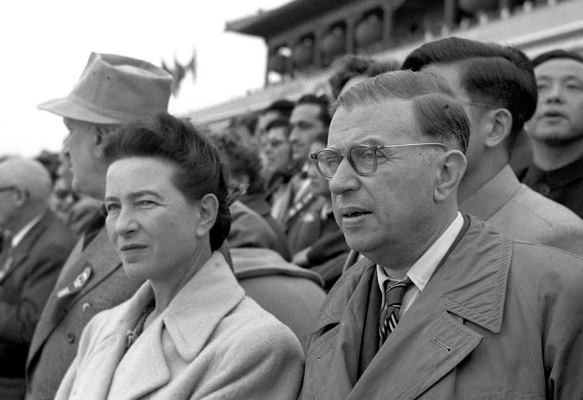
Image via Wikimedia Commons
The invitation was for real, and weeks later, Said was off to Paris. Upon arrival, he learned that for undefined “security reasons,” the conference had been moved to Foucault’s apartment, and once there, he encountered de Beauvoir, who quickly left an unfavorable impression on him, then disappeared.
Beauvoir was already there in her famous turban, lecturing anyone who would listen about her forthcoming trip to Teheran with Kate Millett, where they were planning to demonstrate against the chador; the whole idea struck me as patronising and silly, and although I was eager to hear what Beauvoir had to say, I also realised that she was quite vain and quite beyond arguing with at that moment. Besides, she left an hour or so later (just before Sartre’s arrival) and was never seen again.
Not long afterwards, Said writes, Foucault informed him he would be leaving as well, “for his daily bout of research at the Bibliothèque Nationale.” Said describes Foucault as a “solitary philosopher” and “rigorous thinker” but also “unwilling to say anything to me about Middle Eastern politics”—with the exception of the Iranian Revolution (for which he was partly present). Foucault described his time in Iran as “very exciting, very strange, crazy.” “I think (perhaps mistakenly) I heard him say that in Teheran he had disguised himself in a wig,” Said writes, “although a short while after his articles appeared, he rapidly distanced himself from all things Iranian.” Foucault also, apparently, distanced himself from the discussion at hand because, Said surmises, of his support for Israel.
Sartre, it appears from Said’s account, was very much at the center of the event. And yet, he seemed “old and frail,” and “was constantly surrounded, supported, prompted by a small retinue of people on whom he was totally dependent.” At lunch, Said finds the “great man” almost as absent mentally as his partner was physically. Where “Beauvoir had been a serious disappointment,” he was later “convinced she would have livened things up.”
Sartre’s presence, what there was of it, was strangely passive, unimpressive, affectless. He said absolutely nothing for hours on end. At lunch he sat across from me, looking disconsolate and remaining totally uncommunicative, egg and mayonnaise streaming haplessly down his face. I tried to make conversation with him, but got nowhere. He may have been deaf, but I’m not sure. In any case, he seemed to me like a haunted version of his earlier self, his proverbial ugliness, his pipe and his nondescript clothing hanging about him like so many props on a deserted stage.
In his sole discourse at the event, Said tells us, Sartre read “a prepared text of about two typed pages” full of “the most banal platitudes imaginable” and “about as informative as a Reuters dispatch.” Afterwards, “Sartre resumed his silence, and the proceedings continued as before.” The politics of the conference were by nature complicated and sensitive, to say the least. Relationships—such as that between Foucault and Gilles Deleuze, it seems (or so Deleuze told Said)—have broken off after disagreements over Israel and Palestine.
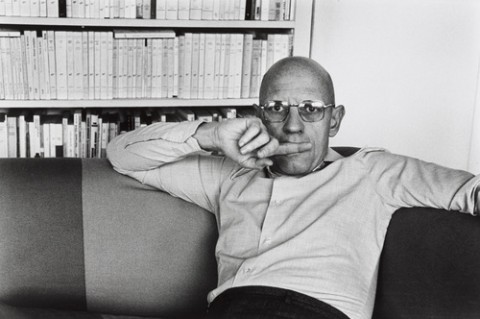
Image by Wikimedia Commons
Nevertheless, on the basis of Sartre’s former anti-colonial, anti-war stance and passionate defense of Algerian independence—a position “which as a Frenchman must have been harder to hold than a position critical of Israel”—Said had hoped Sartre would have at least some sympathy for the Palestinian cause. He was mistaken. “Gone forever, he writes, “was that Sartre.” In a concluding rumination, he attempts to explain what he observed:
I guess we need to understand why great old men are liable to succumb either to the wiles of younger ones, or to the grip of an unmodifiable political belief. It’s a dispiriting thought, but it’s what happened to Sartre. With the exception of Algeria, the justice of the Arab cause simply could not make an impression on him, and whether it was entirely because of Israel or because of a basic lack of sympathy – cultural or perhaps religious – it’s impossible for me to say.
For all its unpleasantness, however, the encounter did not lessen Said’s fondness for Sartre. The author of Orientalism and The Question of Palestine (who is not without his own fierce critics) begins his recollection of the meeting with a glowing appraisal of Sartre’s work, which had fallen far out of favor at the time of the meeting. “A year after our brief and disappointing Paris encounter Sartre died,” he concludes, “I vividly remember how much I mourned his death.”
You can read Said’s complete diary entry here.
Related Content:
Jean-Paul Sartre Breaks Down the Bad Faith of Intellectuals
Josh Jones is a writer and musician based in Durham, NC. Follow him at @jdmagness
Read More...7 Tips from Edgar Allan Poe on How to Write Vivid Stories and Poems
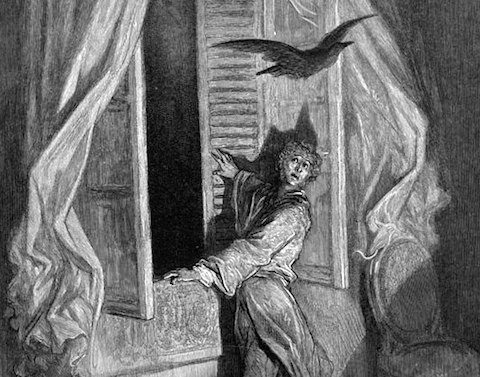
There may be no more a macabrely misogynistic sentence in English literature than Edgar Allan Poe’s contention that “the death… of a beautiful woman” is “unquestionably the most poetical topic in the world.” (His perhaps ironic observation prompted Sylvia Plath to write, over a hundred years later, “The woman is perfected / Her dead / Body wears the smile of accomplishment.”) The sentence comes from Poe’s 1846 essay “The Philosophy of Composition,” and if this work were only known for its literary fetishization of what Elisabeth Bronfen calls “an aesthetically pleasing corpse”—marking deep anxieties about both “female sexuality and decay”—then it would indeed still be of interest to feminists and academics, though not perhaps to the average reader.
But Poe has much more to say that does not involve a romance with dead women. The essay delivers on its title’s promise. It is here that we find Poe’s famous theory of what good literature is and does, achieving what he calls “unity of effect.” This literary “totality” results from a collection of essential elements that the author deems indispensable in “constructing a story,” whether in poetry or prose, that produces a “vivid effect.”
To illustrate what he means, Poe walks us through an analysis of his own work, “The Raven.” We are to take for granted as readers that “The Raven” achieves its desired effect. Poe has no misgivings about that. But how does it do so? Against commonplace ideas that writers “compose by a species of fine frenzy—an ecstatic intuition,” Poe has not “the least difficulty in recalling to mind the progressive steps of any of my compositions”—steps he considers almost “mathematical.” Nor does he consider it a “breach of decorum” to pull aside the curtain and reveal his tricks. Below, in condensed form, we have listed the major points of Poe’s essay, covering the elements he considers most necessary to “effective” literary composition.
- Know the ending in advance, before you begin writing.
“Nothing is more clear,” writes Poe, “than that every plot, worth the name, must be elaborated to its dénouement before any thing be attempted with the pen.” Once writing commences, the author must keep the ending “constantly in view” in order to “give a plot its indispensable air of consequence” and inevitability.
- Keep it short—the “single sitting” rule.
Poe contends that “if any literary work is too long to be read at one sitting, we must be content to dispense with the immensely important effect derivable from unity of impression.” Force the reader to take a break, and “the affairs of the world interfere” and break the spell. This “limit of a single sitting” admits of exceptions, of course. It must—or the novel would be disqualified as literature. Poe cites Robinson Crusoe as one example of a work of art “demanding of no unity.” But the single sitting rule applies to all poems, and for this reason, he writes, Milton’s Paradise Lost fails to achieve a sustained effect.
- Decide on the desired effect.
The author must decide in advance “the choice of impression” he or she wishes to leave on the reader. Poe assumes here a tremendous amount about the ability of authors to manipulate readers’ emotions. He even has the audacity to claim that the design of the “The Raven” rendered the work “universally appreciable.” It may be so, but perhaps it does not universally inspire an appreciation of Beauty that “excites the sensitive soul to tears”—Poe’s desired effect for the poem.
- Choose the tone of the work.
Poe claims the highest ground for his work, though it is debatable whether he was entirely serious. As “Beauty is the sole legitimate province of the poem” in general, and “The Raven” in particular, “Melancholy is thus the most legitimate of all poetical tones.” Whatever tone one chooses, however, the technique Poe employs, and recommends, likely applies. It is that of the “refrain”—a repeated “key-note” in word, phrase, or image that sustains the mood. In “The Raven,” the word “Nevermore” performs this function, a word Poe chose for its phonetic as much as for its conceptual qualities.
Poe claims that his choice of the Raven to deliver this refrain arose from a desire to reconcile the unthinking “monotony of the exercise” with the reasoning capabilities of a human character. He at first considered putting the word in the beak of a parrot, then settled on a Raven—“the bird of ill omen”—in keeping with the melancholy tone.
- Determine the theme and characterization of the work.
Here Poe makes his claim about “the death of a beautiful woman,” and adds, “the lips best suited for such topic are those of a bereaved lover.” He chooses these particulars to represent his theme—“the most melancholy,” Death. Contrary to the methods of many a writer, Poe moves from the abstract to the concrete, choosing characters as mouthpieces of ideas.
- Establish the climax.
In “The Raven,” Poe says, he “had now to combine the two ideas, of a lover lamenting his deceased mistress and a Raven continuously repeating the word ‘Nevermore.’” In bringing them together, he composed the third-to-last stanza first, allowing it to determine the “rhythm, the metre, and the length and general arrangement” of the remainder of the poem. As in the planning stage, Poe recommends that the writing “have its beginning—at the end.”
- Determine the setting.
Though this aspect of any work seems the obvious place to start, Poe holds it to the end, after he has already decided why he wants to place certain characters in place, saying certain things. Only when he has clarified his purpose and broadly sketched in advance how he intends to acheive it does he decide “to place the lover in his chamber… richly furnished.” Arriving at these details last does not mean, however, that they are afterthoughts, but that they are suggested—or inevitably follow from—the work that comes before. In the case of “The Raven,” Poe tells us that in order to carry out his literary scheme, “a close circumscription of space is absolutely necessary to the effect of insulated incident.”
Throughout his analysis, Poe continues to stress—with the high degree of repetition he favors in all of his writing—that he keeps “originality always in view.” But originality, for Poe, is not “a matter, as some suppose, of impulse or intuition.” Instead, he writes, it “demands in its attainment less of invention than negation.” In other words, Poe recommends that the writer make full use of familiar conventions and forms, but varying, combining, and adapting them to suit the purpose of the work and make them his or her own.
Though some of Poe’s discussion of technique relates specifically to poetry, as his own prose fiction testifies, these steps can equally apply to the art of the short story. And though he insists that depictions of Beauty and Death—or the melancholy beauty of death—mark the highest of literary aims, one could certainly adapt his formula to less obsessively morbid themes as well.
Related Contents:
Gustave Doré’s Splendid Illustrations of Edgar Allan Poe’s “The Raven” (1884)
Edgar Allan Poe’s “The Raven,” Read by Christopher Walken, Vincent Price, and Christopher Lee
H.P. Lovecraft Gives Five Tips for Writing a Horror Story, or Any Piece of “Weird Fiction”
Josh Jones is a writer and musician based in Durham, NC. Follow him at @jdmagness
Read More...Andrei Tarkovsky’s Masterpiece Stalker Gets Adapted into a Video Game
Of all the movies out there, Andrei Tarkovsky’s maddeningly oblique masterpiece Stalker (1979) doesn’t seem like a likely choice to be adapted into a video game. Yet it was.
The movie, Tarkovsky’s last in the USSR, is dense and enigmatic with none of the narrative pay-offs that you see in most films. The story centers on a region called the Zone, which after some unnamed disaster, has the power to fulfill your greatest wish. Naturally, the area has been ringed off by the authorities with razor wire and armed guards. At the film’s opening, a guide, called a Stalker, takes two clients, a writer and a scientist, into the Zone. And yet after nearly three hours of meandering and philosophical monologues, none of the characters make a wish nor are any wishes granted. The end. But the reason the movie has such a fervent, cultish following is not for its dramatics. Instead, the film’s power is found in the cumulative effect of its hypnotically slow pacing, its spiritual longing and its gorgeous imagery. You can watch the film online here. Find more Tarkovsky films here.
And there’s the uncanny fact that Stalker seemed to prefigure a global disaster that struck seven years after the movie premiered. It is just about impossible to look at those eerie photos of irradiated ghost towns within Chernobyl’s 30 square kilometer exclusion zone and not think about Stalker.
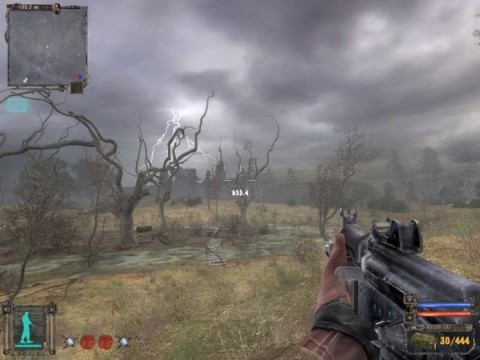
Enter Ukrainian game developer GSC Game World, which explicitly connected the disaster with Tarkovsky’s movie when, in 2007, it released S.T.A.L.K.E.R.: Shadow of Chernobyl, the first in a whole series of games. (The title might just feature the most tortured acronym this side of the USAPATRIOT Act, standing for Scavenger, Trespasser, Adventurer, Loner, Killer, Explorer, Robber.) On first blush, the game and the movie seem to have little in common aside from the name. There are relatively few machine gun battles or zombified mutants in the film. Yet Gabriel Winslow-Yost argues in The New York Review of Books that there are more similarities than might be first apparent.
As games, the S.T.A.L.K.E.R. series are remarkable.… While they all have the elements of a standard action game—guns, monsters, missions, traps, loot—much of the player’s activity is oddly in keeping with Stalker’s spirit, sometimes even managing to expand upon it. […] Watching Stalker, one is occasionally brought up short by remembering that it was not filmed in Chernobyl, so perfect an analogue does that event seem for the film’s images of technology and nature, beauty and danger in strange alliance. The games, at their best, can seem like a sort of miracle: a dead man’s masterpiece, come home at last.
Stalker was based on a novella called Roadside Picnic by Arkady and Boris Strugatsky. Winslow-Yost points out the games are actually more in keeping with the source material than Tarkovsky’s film. “The stalkers are numerous and mercenary. The elements of the Zone are many, and named, if not quite explained—there’s ‘Mosquito Mange’ and ‘Burning Fluff,’ ‘Full Empties’ and ‘Black Sprays.’ In the film most of these are not present—Tarkovsky leaves in only one, the ‘meatgrinder,’ though his Stalker is clearly terrified of many more.”
The games proved to be so successful, especially in Russia, that they were turned into novels. No word if anyone has bothered to buy the film rights to those books. If you want to see what the game looks like, there’s a video of it above.
But the real question is what other art house landmarks are going to get remade into video games? A version of Second Life inspired by Yasujiro Ozu’s Tokyo Story? A mash up of Grand Theft Auto and Jean-Luc Godard’s Weekend? Last Year at Marienbad as a first-person shooter?
Related Content:
Tarkovsky Films Now Free Online
Watch Stalker, Andrei Tarkovsky’s Mind-Bending Masterpiece Free Online
The Masterful Polaroid Pictures Taken by Filmmaker Andrei Tarkovsky
Tarkovsky’s Advice to Young Filmmakers: Sacrifice Yourself for Cinema
A Poet in Cinema: Andrei Tarkovsky Reveals the Director’s Deep Thoughts on Filmmaking and Life
Jonathan Crow is a Los Angeles-based writer and filmmaker whose work has appeared in Yahoo!, The Hollywood Reporter, and other publications. You can follow him at @jonccrow. And check out his blog Veeptopus, featuring lots of pictures of badgers and even more pictures of vice presidents with octopuses on their heads. The Veeptopus store is here.
Read More...Support Us
We're hoping to rely on loyal readers, rather than erratic ads. Please click the Donate button and support Open Culture. You can use Paypal, Venmo, Patreon, even Crypto! We thank you!

About Us

Open Culture scours the web for the best educational media. We find the free courses and audio books you need, the language lessons & educational videos you want, and plenty of enlightenment in between.
Advertise With Us
FREE UPDATES!
GET OUR DAILY EMAIL
Get the best cultural and educational resources on the web curated for you in a daily email. We never spam. Unsubscribe at any time.
FOLLOW ON SOCIAL MEDIA
Open Culture editor Dan Colman scours the web for the best educational media. He finds the free courses and audio books you need, the language lessons & movies you want, and plenty of enlightenment in between.
Advertise With Us



