Marilyn Monroe’s Go-Getter List of New Year’s Resolutions (1955)
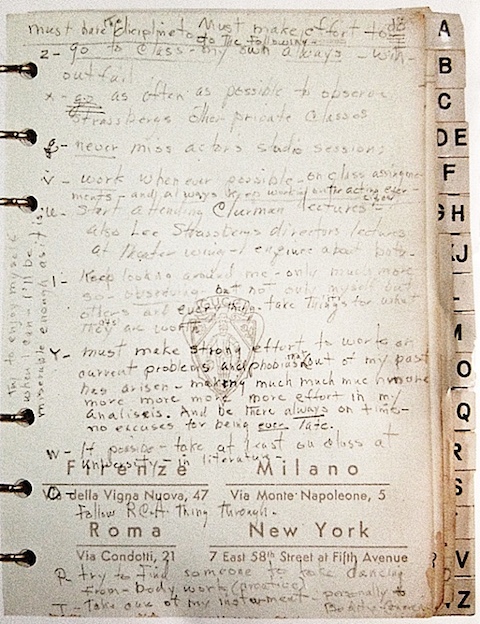
The common conception of New Year’s resolutions frames them as disposable ideals, not to be taken too seriously or followed through past the first few months of winter; by spring, we all assume, we’ll be right back to our slothful, gluttonous ways. Perhaps the problem lies in the way we approach this yearly ritual. Lists of the most common resolutions tend towards the almost shockingly banal, such that most people’s desires for change are interchangeable with their friends and neighbors and might as well be scripted by greeting card companies. I’d hazard it’s impossible to be passionate about half-thoughts and boilerplate ambition.
But there are those few people who really pour their hearts into it, creating lists so individualized and authentic that the documents expose their inner lives, their hopes, fears, loves, struggles, and deep, personal yearnings and aspirations. One such list that circulates often, and which we featured last year, is this gem from Woody Guthrie circa 1943. It’s so completely him, so much in his voice, that no one else could have written it, even in parody. This year, we direct your attention to the list above, from Marilyn Monroe, written at the end of 1955 when the star was 29.
Already well-known for her acting in such fine films as All About Eve, Gentlemen Prefer Blondes, and The Seven Year Itch, Monroe had recently been accepted to Lee Strasberg’s Actors Studio. As Lists of Note puts it, “judging by this list, she was determined to make the most of her opportunities.” I’m not sure what to make of the odd use of random letters at the beginning of each resolution, but what the list does offer us is a glimpse into Monroe’s deep commitment—despite her feeling that her life was “miserable”—to growing and developing as an actor and a person.
See a full transcript of her list of resolutions below.
Must make effort to do
Must have the dicipline to do the following –
z – go to class – my own always – without fail
x – go as often as possible to observe Strassberg’s other private classes
g – never miss actor’s studio sessions
v – work whenever possible – on class assignments – and always keep working on the acting exercises
u – start attending Clurman lectures – also Lee Strassberg’s directors lectures at theater wing – enquire about both
l – keep looking around me – only much more so – observing – but not only myself but others and everything – take things (it) for what they (it’s) are worth
y – must make strong effort to work on current problems and phobias that out of my past has arisen – making much much much more more more more more effort in my analisis. And be there always on time – no excuses for being ever late.
w – if possible – take at least one class at university – in literature –
o – follow RCA thing through.
p – try to find someone to take dancing from – body work (creative)
t – take care of my instrument – personally & bodily (exercise)
try to enjoy myself when I can – I’ll be miserable enough as it is.
via Lists of Note
Related Content:
The 430 Books in Marilyn Monroe’s Library: How Many Have You Read?
Woody Guthrie’s Doodle-Filled List of 33 New Year’s Resolutions From 1943
The Top 10 New Year’s Resolutions Read by Bob Dylan
Josh Jones is a writer and musician based in Durham, NC. Follow him at @jdmagness
Read More...Werner Herzog Plays Himself in Cartoon That Satirizes Obama’s 2008 Election & Race in America
The United States has two important cultural means of self-examination—the work of foreign observers and of domestic satirists. In the former category, we have the longstanding example of political theorist Alexis de Tocqueville and the much bleaker, contemporary vision of Werner Herzog. As for the latter, we have venerable literary heroes like Mark Twain and more populist, contemporary voices like Chris Rock, Stephen Colbert, and cartoonist Aaron McGruder, creator of the comic strip-turned-animated series The Boondocks. In 2010, the Season 3 debut episode of the biting Adult Swim show brought these two traditions together, as McGruder took on the election of America’s first black president by imagining a German documentarian—Herzog—who examines the nation’s response through interviews with the show’s characters.
The clip above will give you an idea of the general tone. Herzog plays an exaggerated version of himself, complete with stereotypically German expressions of existential despair. The Freeman family, the show’s center, represents an also-exaggerated range of responses from black Americans to Obama’s election. Huey, the young black radical (“retired”), expresses a deep, cynical skepticism. His brother Riley has a total disregard for the social and political import of the election, confident instead that a black president will give him a license to do what he wants. And the brothers’ grandfather Robert, a Civil Rights veteran, displays an unqualified optimism and nostalgic pride for his activist days. The full episode also satirizes a certain ill-informed rapper with a character called Thugnificent and certain superficial white progressives (“Obama Guy” and “Obama Girl”). And, of course, belligerent reactionary Uncle Ruckus gets his say.
If you would like to support the mission of Open Culture, consider making a donation to our site. It’s hard to rely 100% on ads, and your contributions will help us continue providing the best free cultural and educational materials to learners everywhere. You can contribute through PayPal, Patreon, and Venmo (@openculture). Thanks!
By the time of its airing, the episode was already nearly two years late in its comment on the events, making it feel, wrote the A.V. Club’s Todd VanDerWerff, “like an instant period piece.” Perhaps now it seems downright paleolithic in the timescale of political commentary. Making this kind of cultural critique seem relevant outside of the immediate moment is a challenge writers on The Daily Show confront, well, daily. But here, the content holds up, not only because Herzog has a way of making everything timeless, but also because “the episode takes us back to… the way [Barack Obama] managed to make almost every single one of his supporters believe that he was going to do what THEY most wanted him to do and not what he had actually promised to do.” In many ways, the country is still recovering from a brutal hangover after this post-2008 election high.
Whether the president is fully to blame for encouraging false hopes—and fears—is highly debatable. In any case, the characters’ outsized expectations or expressions of apathy or virulent outrage mirror many of the responses of both liberals and conservatives. But it seems that both the left and right shared at least one hope: that the election of the country’s first black president would put an end to its oldest, deepest, most persistent ill. “At the end of the episode,” writes VanDerWerff, “most of the characters seem disappointed that Obama didn’t completely rewrite the space-time continuum, that America still struggles with race.” An understatement perhaps even in 2010, the phrase “still struggles with race” is even more so today, for reasons both obvious and less so.
That the United States—despite the continued efforts of a great many activists and some few legislators—is still riven with deep racial divides, and that these represent the persistence of a historical legacy, should not be matters in much dispute. A multitude of academic analyses on “staggering disparities” in policing practices, imbalances in the justice system, and profound wealth inequality and discrimination in housing and employment bear out the claim. How we talk about these issues, who is authorized to do so, and what can be done about it, on the other hand, are matters of considerable, seemingly unending debate. It has always seemed particularly ironic that many comedians—from Richard Pryor to Chris Rock and Louis CK—have achieved much of their mainstream success by telling hard truths about the state of race in America, truths few people seem to want to hear. When those messages come from non-entertainers, for example, the backlash can be swift and vicious.
But this is nothing new. From the candor of Shakespeare’s jesters to Swift’s poison pen to, yes, The Boondocks, humor and satire have served as vehicles for what we would otherwise suppress or repress. (No need to be a Freudian to acknowledge the point). In this episode, the satirical target isn’t only Obama’s supporters and detractors at home—though they get their due. Herzog’s editorial intrusions also satirize some woefully naïve, ahistorical expectations of a global, or at least European, community. As the Herzog character puts it in his second question to Huey, “now that it looks like Obama is going to win, as a black African American Negro, are you merely excited, or are you extremely excited that everything is going to change forever.” VanDerWerff reads Huey’s apathetic response to such grandiosity as an expression of McGruder’s view that idealism is “both an unsustainable tragedy and the only rational response to a world that’s hopelessly screwed.” But in the face of unbridled idealism, Huey’s hard-bitten realism is tonic: “Hope,” he says, “is irrational.” So also, perhaps, is despair.
Watch the full episode here and read a complete summary here.
Related Content:
Werner Herzog’s Eye-Opening New Film Reveals the Dangers of Texting While Driving
Steven Spielberg’s Obama, Starring Daniel Day Lewis as the President
Josh Jones is a writer and musician based in Durham, NC. Follow him at @jdmagness
Read More...How the “Paul McCartney is Dead” Hoax Started at an American College Newspaper and Went Viral (1969)
Next time you see the still-youthful and musically prolific Paul McCartney, take a good hard look and ask yourself, “is it really him?” Can you be sure? Because maybe, just maybe, the conspiracy theorists are right—maybe Paul did die in a car accident in 1966 and was replaced by a double who looks, sounds, acts, and writes almost exactly like him. Almost. It’s possible. Entirely implausible, wholly improbable, but within the realm of physical possibility.
In fact, the rumor of Paul’s death and replacement by some kind of pod person imposter cropped up not once, but twice during the sixties. First, in January, 1967, immediately after an accident involving McCartney’s Mini Cooper that month. The car, driven by Moroccan student Mohammad Hadjij, crashed on the M1 after leaving McCartney’s house en route to Keith Richard’s Sussex Mansion. Hadjij was hospitalized, but not killed, and Paul, riding in Mick Jagger’s car, arrived at the destination safely.
The following month, the Beatles Book Monthly magazine quashed rumors that Paul had been driving the Mini and had died, writing, “there was absolutely no truth in it at all, as the Beatles’ Press Officer found out when he telephoned Paul’s St. John’s Wood home and was answered by Paul himself who had been at home all day with his black Mini Cooper Safely locked up in the garage.” “The magazine,” writes the Beatles Bible, “downplayed the incident, and claimed the car was in McCartney’s possession.”
In 1969, rumors of Paul’s death and a conspiracy to cover it up began circulating again, this time with an impressive apparatus that included publications in college and local newspapers, discussions on several radio shows, a university research team, and enough esoteric clues to keep highly suspicious, stoned, and/or paranoid, minds guessing for decades afterward. The formless gossip first officially took shape in print in the article “Is Beatle Paul McCartney Dead?” in Iowa’s Drake University student newspaper, the Times-Delphic. Cataloguing “an amazing series of photos and lyrics on the group’s albums” that pointed to “a distinct possibility that McCartney may indeed be insane, freaked out, even dead,” the piece dives headfirst into the kind of bizarre analysis of disparate symbols and tenuous coincidences worthy of the most dogged of today’s conspiracy-mongers.
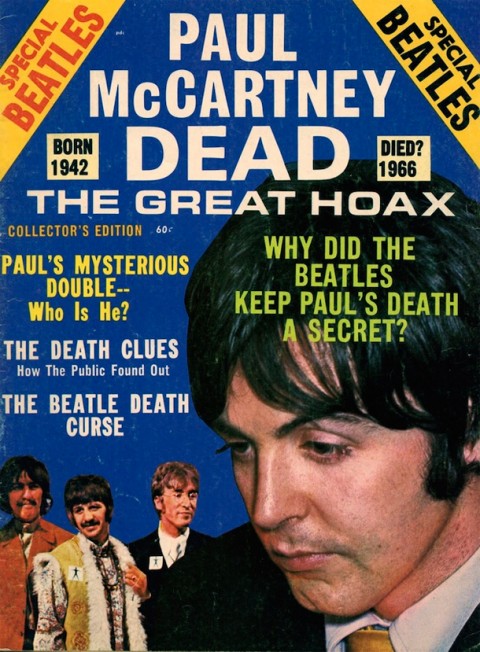
Invoked are ephemera like “a mysterious hand” raised over Paul’s head on the Sgt. Pepper’s cover—“an ancient death symbol of either the Greeks or the American Indians”—and Paul’s bass, lying “on the grave at the group’s feet.” The lyric “blew his mind out in a car” from “A Day in the Life” comes up, and more photographic evidence from the album’s back cover and centerfold photo. Evidence is produced from Magical Mystery Tour and The White Album. Of the latter, you’ve surely heard, or heard of, the voice seeming to intone, “Turn me on, dead man,” and “Cherish the dead,” when “Revolution No. 9” is played backwards. Only a college dorm room could have nurtured such a discovery.
The article reads like a parody—similar to the subversive, half-serious satirical weirdness common to the mid-sixties hippie scene. But whether or not its author, Tim Harper, meant to pull off a hoax, the Paul is dead meme went viral when it hit the airwaves the following month. First, a caller to Detroit radio station WKNR transmitted the theory to DJ Russ Gibb. Their hour-long conversation lead to a review of Abbey Road in The Michigan Daily titled “McCartney Dead; New Evidence Brought to Light.” With tongue in cheek, writer Fred LaBour called the death and replacement of Paul “the greatest hoax of our time and the subsequent founding of a new religion based upon Paul as Messiah.” In the mode of paranoid conspiracy theory so common to the time—a genre mastered by Thomas Pynchon as a literary art—LaBour invented even more clues, inadvertently feeding a public hungry for this kind of thing. “Although clearly intended as a joke,” writes the Beatles Bible, “it had an impact far wider than the writer and his editor expected.”
Part of the aftermath came in two more radio shows that October of 1969. First, in two parts at the top, New York City DJ Roby Yonge makes the case for McCartney’s death on radio station WABC-AM. Recycling many of the “clues” from the previous sources, he also contends that a research team of 30 students at Indiana University has been put on the case. Yonge plainly states that some of the clues only emerge “if you really get really, really high… on some, you know, like, mind-bending drug,” but this proviso doesn’t seem to undermine his confidence in the shaky web of connections.
Was Yonge’s broadcast just an attention grabbing act? Maybe. The next Paul is Dead radio show, just above, is most certainly an Orson Welles-like publicity stunt. Broadcast on Halloween night, 1969, on Buffalo, NY’s WKBW, the show employs several of the station’s DJs, who construct a detailed and dramatic narrative of Paul’s death. The broadcast indulges the same album-cover and lyric divination of the earlier Paul is Dead media, but by this time, it’s grown pretty hoary. But for a small contingent of die-hards, the rumor was mostly put to rest just a few days later when Life magazine published a cover photograph of Paul—who had been out of the public eye after the Beatles’ breakup—with his wife Linda and their kids. Paraphrasing Mark Twain, McCartney famously remarked in the interview inside, “Rumors of my death have been greatly exaggerated,” and added, “If I was dead, I’m sure I’d be the last to know.”
In later interviews, the Beatles denied having anything to do with the hoax. Lennon told Rolling Stone in 1970 that the idea of them intentionally planting obscure clues in their albums “was bullshit, the whole thing was made up.” The hoax did make for some interesting publicity—even featuring in the storyline of a Batman comics issue—but the band mostly found it baffling and annoying. Certain fans, however, refused to let it die, and there are those who still swear that Paul’s imposter, allegedly named Billy Shears and sometimes called “Faul,” still walks the earth. Paul is Dead websites proliferate on the internet—some more, some less convincing; all of them outlandish, and all offering a fascinating descent into the seemingly bottomless rabbit hole of conspiracy theory. If that’s your kind of trip, you can easily get lost—as did pop culture briefly in 1969—in endless “Paul is Dead” speculation.
Related Content:
Paul McCartney’s Conceptual Drawings For the Abbey Road Cover and Magical Mystery Tour Film
Chaos & Creation at Abbey Road: Paul McCartney Revisits The Beatles’ Fabled Recording Studio
Hear Isolated Tracks From Five Great Rock Bassists: McCartney, Sting, Deacon, Jones & Lee
Josh Jones is a writer and musician based in Durham, NC. Follow him at @jdmagness
Read More...Ayn Rand Helped the FBI Identify It’s A Wonderful Life as Communist Propaganda
If you wanted to know what life was really like in the Cold War Soviet Union, you might take the word of an émigré Russian writer. You might even take the word of Ayn Rand, as the House Un-American Activities Committee (HUAC) did during the Red Scare, though Rand had not lived in her native country since 1926. Nonetheless, as you can see above, she testified with confidence about the daily lives of post-war Soviet citizens. Rand also testified, with equal confidence, about the nefarious influence of Communist writers and directors in her adopted home of Hollywood, where she had more recent experience working in the film industry.
The 1947 HUAC hearings, writes the blog Aphelis, led to “the systematic blacklisting of Hollywood artists.” Among the witnesses deemed “friendly” to capitalism were Gary Cooper, Walt Disney, and Ayn Rand. Prior to her testimony, the FBI had consulted Rand for an enormous, 13,533-page report entitled “Communist Infiltration of the Motion Picture Industry” (find it online here), which quoted from a pamphlet published by her group:
The purpose of the Communists in Hollywood is not the production of political movies openly advocating Communism. Their purpose is to corrupt non-political movies — by introducing small, casual bits of propaganda into innocent stories and to make people absorb the basic principles of Collectivism by indirection and implication. Few people would take Communism straight, but a constant stream of hints, lines, touches and suggestions battering the public from the screen will act like drops of water that split a rock if continued long enough. The rock that they are trying to split is Americanism.
Rand and her associates helped design a “film regime” that dissected other post-war movies like William Wyler’s The Best Years of Our Lives and George Cukor’s Keeper of the Flame. These McCarthy-era film critics sought to root out “ideological termites” in the industry; they were especially distrustful of movies that elevated what Rand called, with contempt, “the little man.” One of the films identified as particularly pernicious to the “rock” of Americanism was Frank Capra’s classic It’s a Wonderful Life, a movie that today seems built on bedrock U.S. nationalist values—commitment to family, redemption through faith, contentment with modest small-town living….
Listening to Capra’s motivation for the film—as quoted in The Los Angeles Times—makes it hard to believe he had anything like promoting a worker’s paradise in mind: “There are just two things that are important,” he said, “One is to strengthen the individual’s belief in himself, and the other, even more important right now, is to combat a modern trend toward atheism.”
But in the FBI’s analysis—and possibly Rand’s, though it’s not clear how much, if any, of the report she authored directly—the tale of George Bailey manifested several subversive tendencies. Flavorwire sums up the charges succinctly: “Written by Communist sympathizers,” “Attempting to instigate class warfare,” and “Demonizing bankers.”
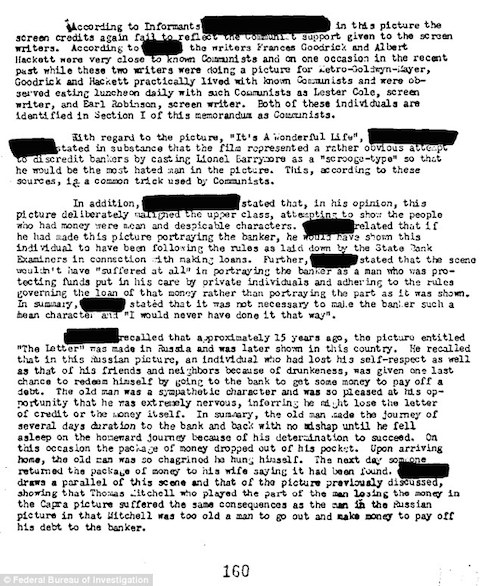
We live in odd times, such that this rhetoric—which seemed so quaint just a couple short decades or so ago—sounds jarringly contemporary again as the politics of the mid-20th century reappear everywhere. The charges against the seemingly innocuous Capra film hinged in part on the alleged Communist ties of its principle screenwriters, Francis Goodrich and Albert Hackett. In their report, part of which you can see above, the FBI wrote that the screen writers “practically lived with known Communists and were observed eating luncheon daily with such Communists as Lester Cole, screen writer, and Earl Robinson.” Palling around, as it were.
In addition to naming the writers’ acquaintances and lunch buddies, the report quotes a redacted individual who “stated that, in his opinion, this picture deliberately maligned the upper class.” Another blacked-out source “stated in substance that the film represented a rather obvious attempt to discredit bankers by casting Lionel Barrymore as a ‘scrooge-type’ so that he would be the most hated man in the picture. This, according to these sources, is a common trick used by Communists.” Finally, a third redacted source compares the plot of Capra’s movie with that of a Russian film called The Letter, screened in the U.S. fifteen years earlier.
We cannot say for certain, but it’s reasonable to assume that many of these hidden FBI sources were associates of Rand. In any case, Rand—in vogue after the success of her novel The Fountainhead—appeared before HUAC and re-iterated many of the general claims made in the report. During her testimony, she focused on a 1944 film called Song of Russia (you can hear her mention it briefly in the short clip at the top). She chiefly critiques the film for its idealized portrait of life in the Soviet Union, hence her enumeration of the many evils of actual life there.
Curiously, many critical treatments of It’s A Wonderful Life have said more or less the same thing of that work, calling the film “sentimental hogwash,” for example, and a representative of “American capitalist ideology.” These readings seem persuasive to me, but for those like Rand and her followers, as well as J. Edgar Hoover and his paranoid underlings, no film it seems—no matter how celebratory of U.S. nationalist mythology—could go far enough in glorifying heroic capitalists, ignoring class conflict, and minimizing the struggles of “the little man.”
As Raw Story notes, testimony from others at the HUAC hearings brought “redemption of an odd sort” for Capra’s movie, which “has been more than redeemed as it slowly became a sentimental and beloved holiday perennial.” But even if It’s A Wonderful Life may now look like apple pie on celluloid, Flavorwire points out that it’s still liable to raise suspicions among certain aggressive pundits and culture warriors who push a “war on Christmas” narrative and see socialist subversion even in acts of charity, like those displayed so extravagantly in the film’s mushy ending (above).
It’s A Wonderful Life “is a holiday movie that doesn’t mention Christmas until the 99-minute mark…. It takes a mostly secular reading of the holiday as a time to take stock of your life, of the true blessings of family and friends. To those obsessed with the preferred holiday greeting or the color of Santa’s skin… this must sound like quite the Communist subversion indeed.”
Read much more about the HUAC investigation of Hollywood at Aphelis, who include links to a redacted version of the FBI “Communist Infiltration” report and many other fascinating documents.
Related Content:
How the CIA Secretly Funded Abstract Expressionism During the Cold War
When Ayn Rand Collected Social Security & Medicare, After Years of Opposing Benefit Programs
Free Audio: Ayn Rand’s 1938 Dystopian Novella Anthem
The CIA’s Style Manual & Writer’s Guide: 185 Pages of Tips for Writing Like a Spy
Bertolt Brecht Testifies Before the House Un-American Activities Committee (1947)
Josh Jones is a writer and musician based in Durham, NC. Follow him at @jdmagness
Read More...Watch Art on Ancient Greek Vases Come to Life with 21st Century Animation
Every student of history surely feels impressed by one achievement or another of the ancient Greeks, whether in the field of engineering, art, or the convergence of the two. Even a bored college undergrad in a thousand-seat lecture hall has to admire ancient Greek vases when they pop up in the lecturer’s Powerpoint slides. That much-studied culture’s penchant for stylizing images of their society on their pottery has allowed us to see their world as, in some sense, a living, breathing one — or to see it through the eyes of the artisans who lived to see it themselves. But for all their mastery of the art of the vase, they never actually got their images to live nor breathe. For that, we must turn to 21st-century technology, specifically as applied by Panoply, a project animator of Steve K. Simons and ancient Greece scholar Sonya Nevin, which was designed to bring these vases to life.
“Panoply covers a lot of aspects of culture as method tying the artifacts to information about Greek life,” writes io9’s Katharine Trendacosta. “There are ones on myths, sport, and warfare,” the last of which, “Hoplites!,” you can watch at the top of the post. Simons and Nevin made this seven-minute battle scene out of the foot soldiers actually depicted on a vase dating to about 550 BCE currently held by the Ure Museum of Greek Archaeology at the University of Reading.
Just above, we have “The Cheat,” a short and humorous scene from the ancient Olympics that plays out on the surface of a shard. The animation below features a figure of Greek myth that even the most inattentive student will know: a certain Pandora, and far be it from her to resist the temptation to open a certain box. (Actually it was a vase/pithos.) You can watch more on Panoply’s Youtube channel. As unconventional means of visualizing ancient Greece go, it’s got to beat 300 for accuracy.
via io9
Related Content:
Modern Artists Show How the Ancient Greeks & Romans Made Coins, Vases & Artisanal Glass
What Ancient Greek Music Sounded Like: Hear a Reconstruction That is ‘100% Accurate’
How the Ancient Greeks Shaped Modern Mathematics: A Short, Animated Introduction
Hear Homer’s Iliad Read in the Original Ancient Greek
Download 78 Free Online History Courses: From Ancient Greece to The Modern World
Colin Marshall hosts and produces Notebook on Cities and Culture and writes essays on cities, language, Asia, and men’s style. He’s at work on a book about Los Angeles, A Los Angeles Primer. Follow him on Twitter at @colinmarshall or on Facebook.
Read More...Every Frame a Painting Explains the Filmmaking Techniques of Martin Scorsese, Jackie Chan, and Even Michael Bay
How does Martin Scorsese deliver dramatic moments with such impact? Why do Jackie Chan’s kicks and punches, even those performed in service of jokes, land with such impact? And why do Michael Bay movies, despite their near-fetishistic inclusion of things crashing into other things, seem to lack any kind of impact at all (apart from that on audience adrenaline and box office numbers)? Questions like these keep cinephiles, filmmakers, and cinephilic filmmakers up at night, and they also apparently drive editor and video essayist Tony Zhou to make his series Every Frame a Painting. At the top of the post, you can watch his analysis of Scorsese’s use of silence; below, of how Jackie Chan does action comedy; and at the bottom, how Michael Bay crafts his unique brand of cinematic “Bayhem.”
Michael Bay, you might incredulously ask — the guy who directed the Transformers movies? Indeed. But as Zhou puts it, “Even if you dislike him (as I do), Bay has something valuable to teach us about visual perception.” His video essays aim to learn from all films, drawing lessons from those that succeed at every level (as some say several of Scorsese’s do) to those that exemplify a kind of highly specialized mastery (as Jackie Chan’s best surely do), to those that fail at even their own aims (as Jackie Chan’s American productions tend to do), to those that aggressively and successfully pursue questionable aesthetic ends (as, well… perhaps you can guess).
Having watched these three videos and thus come to understand what situations bring on a Scorsesean silence, why Hong Kong money allows Jackie Chan to perfectly kick a bad guy down a staircase, and which traditions Michael Bay exaggerates to achieve his brand of visual maximalism, you’ll want to move on to Zhou’s other analyses, which break down the techniques of directors like Edgar Wright, David Fincher, and Steven Spielberg. Evidently a fan of both East Asian cinema and animation, he also looks hard at what working outside live reality allows Japanese director Satoshi Kon to do, and what superstar Korean filmmaker Bong Joon-ho gets out of telephoto profile shots in Mother. “There’s actually a lot of great videos on the internet analyzing movie content or themes,” he says in the latter essay, “but I think we’re missing stuff about the actual form — you know, the pictures and the sound.” Every Frame a Painting shows us exactly what we’re missing.
Related Content:
Signature Shots from the Films of Stanley Kubrick: One-Point Perspective
Chaos Cinema: A Breakdown of How 21st-Century Action Films Became Incoherent
Watch 7 New Video Essays on Wes Anderson’s Films: Rushmore, The Royal Tenenbaums & More
The Perfect Symmetry of Wes Anderson’s Movies
Colin Marshall hosts and produces Notebook on Cities and Culture and writes essays on cities, language, Asia, and men’s style. He’s at work on a book about Los Angeles, A Los Angeles Primer. Follow him on Twitter at @colinmarshall or on Facebook.
Read More...Noam Chomsky Almost Appeared on Saturday Night Live During the 90s

Image by jeanbaptisteparis
There are those guest hosts on Saturday Night Live who immediately become exemplary cast members they fit in so well. I’m thinking mostly of Alec Baldwin. Then there are those—certain pop stars and athletes—who are too awkward even to make for unintentional humor. Sometimes the show will choose a host for obvious cultural or political reasons, whether or not that person has any sense of humor whatsoever. Lorne Michaels even once considered asking notoriously stiff then-presidential candidate Mitt Romney to host in 2012, a prospect that excited no one except maybe Romney.
Given the show’s many questionable choices, it’s maybe not too surprising that it would consider asking an academic to host. Some extroverted public intellectuals, like Cornell West and Slavoj Zizeck, are natural entertainers. But that they would think of Noam Chomsky—known for his rumpled sweaters and incisive, unsparing geopolitical analysis, delivered in the driest monotone this side of Ben Stein’s Ferris Bueller’s Day Off character—is, well, pretty odd.
It does make a little bit more sense considering that they only asked Professor Chomsky to play himself on the show, not deliver a monologue or do impersonations. According to his assistant Bev Stohl, the show called sometime in the late 90s and told her that the “writers had written a loose script for Noam. The only thing he needed to do was show up on the set and play it straight, answering the questions that were put to him. Sort of like, ‘I’m Noam Chomsky, and I play myself on TV.’” Mostly, writes Stohl on her blog, “I liked the idea of Noam appearing in mainstream media, something that was just beginning to happen in small ways in the 1990’s.”
And how did Chomsky himself feel about the request? It seems he was vaguely familiar with the show and open to the idea. His wife, on the other hand, was not. “After a brief exchange” with her, writes Critical Theory, “he informed Stohl that ‘Carol says no.’” We’ll never know if we were “robbed of either the greatest SNL skit ever” or spared “another terribly unfunny segment,” but the question of whether Chomsky can be funny is still an open one. Matthew Alford at The Guardian writes that during the Q&A after a lecture he attended, “Chomsky was successful not only at conveying his radical political message but also at raising belly laughs from the audience with dark-laced, insightful humour about his politics.” Alford says he measured “a laugh every couple of minutes—very high for a public intellectual but of course not close to the professional comic’s benchmark of one gag every 20 seconds.” He offers some typical Chomsky-an one-liners, such as:
“[The Bush administration’s] moral values are very explicit: shine the boots of the rich and powerful, kick everyone else in the face, and let your grandchildren pay for it.”
“If you’ve resisted the temptation to tell the teacher ‘you’re an asshole’ which maybe he or she is, and if you don’t say ‘that’s idiotic’ when you get a stupid assignment… you will end up at a good college and eventually with a good job.”
And “It’s to the point where Ronald Reagan could put on his cowboy boots and cowboy hat and declare a national emergency because the national security of the United States was in danger from the government of Nicaragua… whose troops were two days from Texas.”
Above, you can catch a glimpse of the lighter side of Chomsky.
Related Content:
Noam Chomsky Went Gangnam Style … Ever So Briefly?
Filmmaker Michel Gondry Presents an Animated Conversation with Noam Chomsky
Noam Chomsky Spells Out the Purpose of Education
Josh Jones is a writer and musician based in Durham, NC. Follow him at @jdmagness
Read More...David Lynch’s Music Videos: Nine Inch Nails, Moby, Chris Isaak & More
David Lynch gets sound like few other directors. There’s an unforgettable scene in Twin Peaks: Fire Walk With Me where Laura Palmer leads her best friend Donna Hayward into what looks like a den of iniquity for lumberjacks. It’s filled with burly men and cheap women grinding to music blaring from the speakers. Lynch lets the music roll right over top the dialogue. It was a shocking choice back in 1992 but it was the right one. The banter was intentionally banal and obscure. The grotesque faces, the ominous crimson lighting and, most of all, that utterly hypnotic music are all you need to tell the story, creating a mood of dread and decadence. The scene is a stunning fusion of image, sound and editing in an otherwise flawed work.
Since that movie, Lynch became more and more interested in the possibilities of sound design. He eventually ditched film altogether for a career in music. So perhaps it shouldn’t come as a surprise that, along with creating at least three cinematic masterpieces, one of the most influential TV series ever made, and a string of television commercials, Lynch has also made a handful of music videos. You can watch them above and below.
Lynch’s first music video was for “I Predict” by the band The Sparks. It was made back in 1982 when MTV was still in its infancy and Lynch’s career was just taking off. Perhaps for that reason, the video has little of the stylistic obsessions that mark his later work. No weird flashing lights. No smoke or fire. No hollow-eyed models. Instead Lynch goes for a more direct, if silly, form of surrealism – a guy (band member Ron Mael) with a Hitler mustache in drag doing a striptease. Does it feel Lynchian? No, not really. But it’s still kind of distressing.
There are two videos for Chris Isaak’s “Wicked Games.” One, which was on heavy rotation on MTV, was shot by Herb Ritts and featured Isaak and supermodel Helena Christensen rolling around half-naked in the Hawaiian surf. And then there is Lynch’s video made as a tie-in to his strange, Wizard of Oz obsessed noir Wild at Heart, which has much less nudity – which is odd considering the movie is pretty much non-stop boinking. Instead, the video is pretty straightforward – just Isaaks and the band playing the tune intercut with shots from the flick.
After Mulholland Drive, Lynch turned his back on celluloid film, preferring the endless possibilities of digital. His enthusiasm for this new technology resulted in a flurry of projects including Dumbland, a crudely animated series presented in stark black and white. The video of Moby’s “Shot in the Back of the Head” is a moodier animated work but it is definitely in the same vein. Check it out above.
Lynch’s video for Nine Inch Nail’s “Came Back Haunted” can quite literally mess with your head. The piece is packed with flashing red and white lights and as a result comes with the following warning: “This video has been identified by Epilepsy Action to potentially trigger seizures for people with photosensitive epilepsy. Viewer discretion is advised.” You have been warned.
And finally here’s a music video for Lynch’s own song called appropriately “Crazy Clown Time.” Not only is the video a catalogue Lynch’s obsessions – Americana, naked women, fire – but it also features Lynch singing, who, after a bunch of effects, sounds like a castrated Keebler Elf.
Related Content:
David Lynch’s Unlikely Commercial for a Home Pregnancy Test (1997)
David Lynch Teaches You to Cook His Quinoa Recipe in a Weird, Surrealist Video
What David Lynch Can Do With a 100-Year-Old Camera and 52 Seconds of Film
Jonathan Crow is a Los Angeles-based writer and filmmaker whose work has appeared in Yahoo!, The Hollywood Reporter, and other publications. You can follow him at @jonccrow. And check out his blog Veeptopus, featuring lots of pictures of badgers and even more pictures of vice presidents with octopuses on their heads. The Veeptopus store is here.
Read More...Leonardo Da Vinci’s To Do List (Circa 1490) Is Much Cooler Than Yours
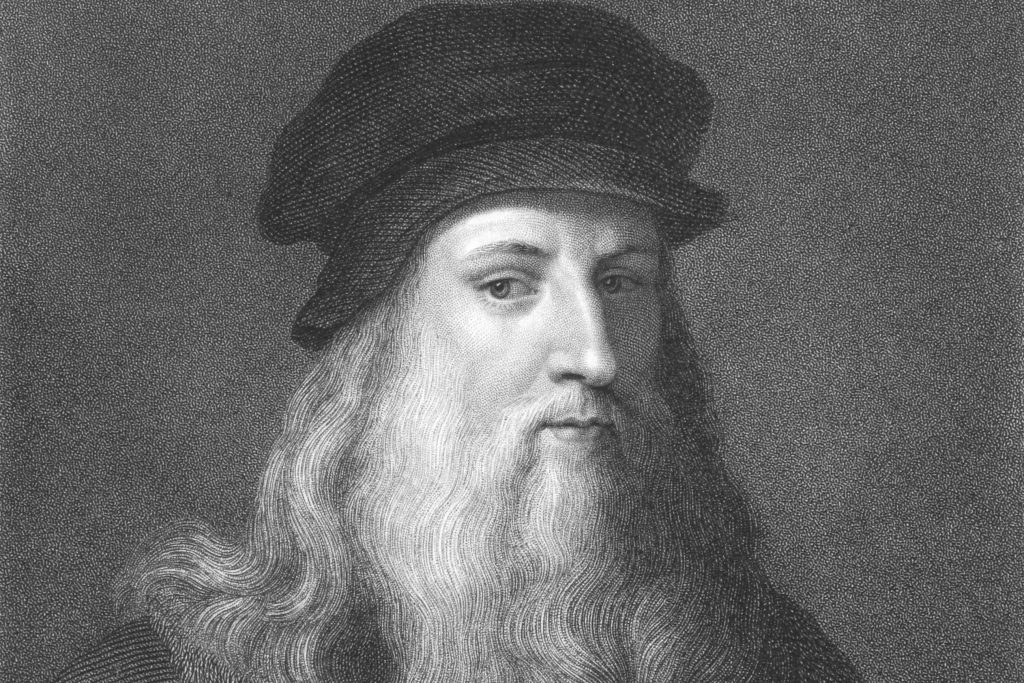
Most people’s to-do lists are, almost by definition, pretty dull, filled with those quotidian little tasks that tend to slip out of our minds. Pick up the laundry. Get that thing for the kid. Buy milk, canned yams and kumquats at the local market.
Leonardo Da Vinci was, however, no ordinary person. And his to-do lists were anything but dull.
Da Vinci would carry around a notebook, where he would write and draw anything that moved him. “It is useful,” Leonardo once wrote, to “constantly observe, note, and consider.” Buried in one of these books, dating back to around the 1490s, is a to-do list. And what a to-do list.
NPR’s Robert Krulwich had it directly translated. And while all of the list might not be immediately clear, remember that Da Vinci never intended for it to be read by web surfers 500 years in the future.
[Calculate] the measurement of Milan and Suburbs
[Find] a book that treats of Milan and its churches, which is to be had at the stationer’s on the way to Cordusio
[Discover] the measurement of Corte Vecchio (the courtyard in the duke’s palace).
[Discover] the measurement of the castello (the duke’s palace itself)
Get the master of arithmetic to show you how to square a triangle.
Get Messer Fazio (a professor of medicine and law in Pavia) to show you about proportion.
Get the Brera Friar (at the Benedictine Monastery to Milan) to show you De Ponderibus (a medieval text on mechanics)
[Talk to] Giannino, the Bombardier, re. the means by which the tower of Ferrara is walled without loopholes (no one really knows what Da Vinci meant by this)
Ask Benedetto Potinari (A Florentine Merchant) by what means they go on ice in Flanders
Draw Milan
Ask Maestro Antonio how mortars are positioned on bastions by day or night.
[Examine] the Crossbow of Mastro Giannetto
Find a master of hydraulics and get him to tell you how to repair a lock, canal and mill in the Lombard manner
[Ask about] the measurement of the sun promised me by Maestro Giovanni Francese
Try to get Vitolone (the medieval author of a text on optics), which is in the Library at Pavia, which deals with the mathematic.
You can just feel Da Vinci’s voracious curiosity and intellectual restlessness. Note how many of the entries are about getting an expert to teach him something, be it mathematics, physics or astronomy. Also who casually lists “draw Milan” as an ambition?
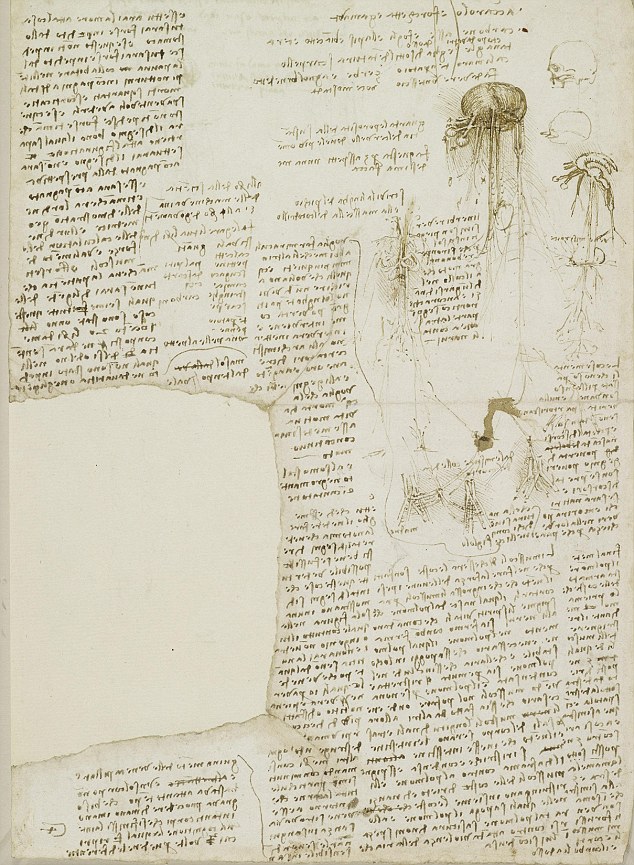
Later to-do lists, dating around 1510, seemed to focus on Da Vinci’s growing fascination with anatomy. In a notebook filled with beautifully rendered drawings of bones and viscera, he rattles off more tasks that need to get done. Things like get a skull, describe the jaw of a crocodile and tongue of a woodpecker, assess a corpse using his finger as a unit of measurement.
On that same page, he lists what he considers to be important qualities of an anatomical draughtsman. A firm command of perspective and a knowledge of the inner workings of the body are key. So is having a strong stomach.
You can see a page of Da Vinci’s notebook above but be warned. Even if you are conversant in 16th century Italian, Da Vinci wrote everything in mirror script.
If you would like to support the mission of Open Culture, consider making a donation to our site. It’s hard to rely 100% on ads, and your contributions will help us continue providing the best free cultural and educational materials to learners everywhere. You can contribute through PayPal, Patreon, and Venmo (@openculture). Thanks!
Related Content:
Thomas Edison’s Hugely Ambitious “To-Do” List from 1888
The Anatomical Drawings of Renaissance Man, Leonardo da Vinci
An Animated History Of Aviation: From da Vinci’s Sketches to Apollo 11
1,700 Free Online Courses from Top Universities
Jonathan Crow is a Los Angeles-based writer and filmmaker whose work has appeared in Yahoo!, The Hollywood Reporter, and other publications. You can follow him at @jonccrow. And check out his blog Veeptopus, featuring lots of pictures of badgers and even more pictures of vice presidents with octopuses on their heads. The Veeptopus store is here.
Read More...120 Artists Pick Their Top 10 Films in the Criterion Collection
Some of us get our education at film school. More of us get it from The Criterion Collection, that formidably cinephilic restorer, curator, and packager of classic motion pictures from every era. In addition to their elegant, supplementary material-rich home video releases — they’ve put them out on Laserdisc, on DVD, on Blu-ray, streaming over the internet, and will presumably continue to do so on whichever formats come next — they also do intriguing collaborations with the various cultural figures with whom they’ve worked, such as asking them to name their ten favorite Criterion releases. You may recall that, back in June, we featured actor, director, and 1990s “Indiewood” icon Steve Buscemi’s Criterion top ten list, which included such choice pieces of film history as Gus Van Sant’s My Own Private Idaho, Franco-Dutch horror classic The Vanishing, and long-unreleased “faux-documentary” Symbiopsychotaxiplasm.
Of the many more lists criterion.com offers, you can find this surprisingly classic-oriented one from Richard Linklater, maker of films like Slacker, the Before Sunrise/Before Sunset/Before Midnight trilogy, and this year’s Boyhood (and another architect of Indiewood):
- Andrei Rublev (Andrei Tarkovsky)
- Au hasard Balthazar (Robert Bresson)
- The Flowers of St. Francis (Roberto Rossellini)
- Day of Wrath (Carl Theodor Dreyer)
- Tokyo Story (Yasujiro Ozu)
- The Last Temptation of Christ (Martin Scorsese)
- Unfaithfully Yours (Preston Sturges)
- Fanny and Alexander — The Television Version (Ingmar Bergman)
- Pickpocket (Robert Bresson)
- I Know Where I’m Going! (Michael Powell and Emeric Pressburger)
Or this one by four members of the New York no-wave rock band Sonic Youth, who turned the whole top-ten list concept up to twelve, giving their props to Ozu like Linkater and The Vanishing like Buscemi (“It gets veeerrry weird,” adds guitarist Thurston Moore):
- Floating Weeds (Yasujiro Ozu)
- Jeanne Dielman, 23, quai du Commerce, 1080 Bruxelles (Chantal Akerman)
- Ali: Fear Eats the Soul (Rainier Werner Fassbinder)
- Masculin féminin (Jean-Luc Godard)
- Double Suicide (Masahiro Shinoda)
- The Vanishing (George Sluizer)
- Mamma Roma (Pier Paolo Pasolini)
- Black Orpheus (Marcel Camus)
- Ace in the Hole (Billy Wilder)
- Night on Earth (Jim Jarmusch)
- Fat Girl (Catherine Breillat)
- Days of Heaven (Terrence Malick)
Or lists from vital creators who have more recently arrived on the scene, such as this one from Tiny Furniture director and Girls creator Lena Dunham, an inveterate fan of Agnès Varda (who “manages to be both deeply emotional and utterly in control of the technical elements of filmmaking [ … ] that had seemed to me to be an impossible line to straddle, and she does it so beautifully”). She also makes room for Malick’s Days of Heaven, (also a pick of Sonic Youth’s Kim Gordon), two from Fassbinder (also a director of choice for Sonic Youth’s Lee Ranaldo), and one from Bergman (who should make everyone’s favorite-films lists, but also made Linklater’s):
- Fish Tank (Andrea Arnold)
- Days of Heaven (Terrence Malick)
- Broadcast News (James L. Brooks)
- Weekend (Andrew Haigh)
- La Pointe Courte, Cléo from 5 to 7, Le bonheur, and Vagabond (Agnès Varda)
- The Marriage of Maria Braun and Ali: Fear Eats the Soul (Rainier Werner Fassbinder)
- Picnic at Hanging Rock (Peter Weir)
- Straw Dogs (Sam Peckinpah) and Dead Ringers (David Cronenberg)
- Through a Glass Darkly (Ingmar Bergman)
- The War Room (Chris Hegedus and D. A. Pennebaker)
D.A. Pennebaker, by the way, has his own Criterion top ten list, as do other filmmakers named here, like Andrew Haigh and Martin Scorsese. But this leaves me with one burning question: if directors like Ozu and Fassbinder had lived to see The Criterion Collection, which volumes would they have put on their own DVD shelves?
Enter the complete collection of Criterion Top Tens here.
Related Content:
4,000+ Free Movies Online: Great Classics, Indies, Noir, Westerns, Documentaries & MoreSteve Buscemi’s Top 10 Film Picks (from The Criterion Collection)
A Young Jean-Luc Godard Picks the 10 Best American Films Ever Made (1963)
Martin Scorsese Reveals His 12 Favorite Movies (and Writes a New Essay on Film Preservation)
Colin Marshall hosts and produces Notebook on Cities and Culture and writes essays on cities, language, Asia, and men’s style. He’s at work on a book about Los Angeles, A Los Angeles Primer. Follow him on Twitter at @colinmarshall or on Facebook.
Read More...Support Us
We're hoping to rely on loyal readers, rather than erratic ads. Please click the Donate button and support Open Culture. You can use Paypal, Venmo, Patreon, even Crypto! We thank you!

About Us

Open Culture scours the web for the best educational media. We find the free courses and audio books you need, the language lessons & educational videos you want, and plenty of enlightenment in between.
Advertise With Us
FREE UPDATES!
GET OUR DAILY EMAIL
Get the best cultural and educational resources on the web curated for you in a daily email. We never spam. Unsubscribe at any time.
FOLLOW ON SOCIAL MEDIA
Open Culture editor Dan Colman scours the web for the best educational media. He finds the free courses and audio books you need, the language lessons & movies you want, and plenty of enlightenment in between.
Advertise With Us


