Behold a Beautiful Archive of 10,000 Vintage Cameras at Collection Appareils
Digital photography has bestowed many gifts, and some few horrors: selfies, naturally, as well as even less dignified self-portraits, of the sort certain politicians send out; mass surveillance, as well as the ability of average citizens to produce important pieces of evidence and to document history; hard times for professional photographers, as well as the full democratization of the medium. What it has almost rendered obsolete is the mechanism that enabled photographic images in the first place. In place of cameras, we have smartphones, the hated Glass… maybe sometime in the future no external device at all. Given this trajectory, it’s entirely understandable that all sorts of people—steampunks, antiquarians, Luddites, analog fetishists, middle-age hipsters, etc.—would grow nostalgic not only for the cracked, striated monochrome patina of vintage photographs, but also for the boxes—large and small, simple and highly complicated—that produced them.

And what wonderful boxes they were! Before the onslaught of identical, cheap consumer point-and-shoots and (gasp!) disposables, or the utilitarian bricks of professional gear, the camera was very often a work of art in its own right. Today, we bring you a sampling of these objets—elegant, intricate, streamlined, and downright adorable. These are but a tiny fraction of the vintage camera treasures you’ll find represented at Collection Appareils, an online reference of 10,000 analog cameras run by Sylvain Halgand, a Frenchman sorely afflicted with the “insidious disease” of collecting.
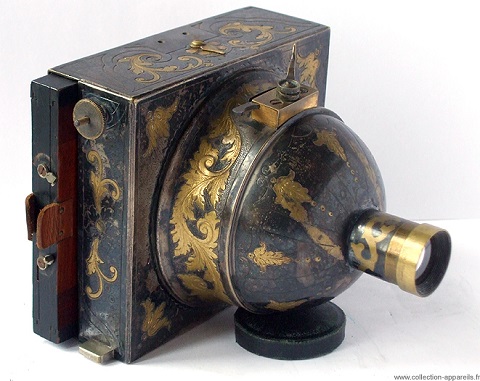
Witness at the top the Photosphere No. 1, manufactured by the Compagnie Francaise de Photographie in 1899—a truly beautiful artifact. No less stylish, but far more camera-like to our eyes, see the Argus A above. Made in the U.S. between 1936 and 1941, this may have been the most popular 35mm of all time. Though not as well known as the Leica A, “it’s a safe bet that Argus sold more cameras in their first twenty years than Leica has sold in their first 70 years.”

Above, we have the first “point and shoot,” the Gap Box 6x9, a curiously attractive device made in France in 1950. This camera “played a very important role by making photography accessible to the general public,” allowing “anyone to take pictures at the lowest price and in the most simple way.”

Then there are the stylized and the streamlined. Just above, see a very fine machine called The Compass, manufactured by Swiss watchmaker Le Coultre between 1937 and 1940. And below, gaze upon the graceful Haneel Tri-Vision, made in Los Angeles in 1946.

Almost equally appealing in their design simplicity are the irresistibly cute miniature cameras, such as the “Mickey Mouse” below. Manufactured in Germany in 1958, these tiny things—despite the “copyright” notice on the lens—may have disappeared quickly “due to them not actually being sanctioned by the Disney Corporation.” They were, however, sold with a “large cardboard Mickey Mouse that ‘held’ the camera.”

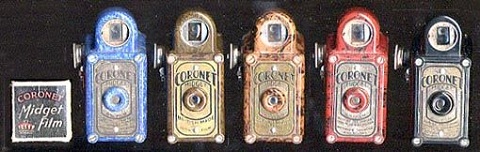
See also the Coronet Midget. Made in England in 1934, this 5‑shilling camera “must be one of the most popular of all small cameras to collect.” The company marketed its own 6‑exposure film for the Midget, which came in a choice of five colors.

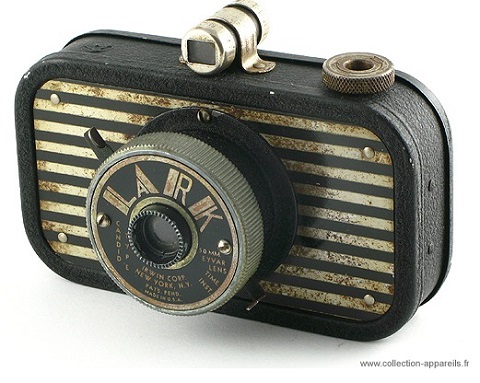
From the couture to the high-tech to the quirky and inventive (like the Lark “Sardine Can” below), the French vintage camera archive makes available a visual history of the camera that may exist nowhere else. It is the history of an object that defined the 20th century, and that may fully disappear sometime soon in the 21st. And while we can spend several hours a day marveling over the products of these fine devices, it’s a rare treat to see the things themselves in such an astonishing variety of shapes, sizes, colors, and degrees of design ingenuity. Take some time to get acquainted with the evolution of the handheld camera before digital technology finally renders it extinct.
Via Laughing Squid/ Messy Nessy Chic/PetaPixel
Images courtesy of Collection Appareils.
Related Content:
Yale Launches an Archive of 170,000 Photographs Documenting the Great Depression
Alfred Stieglitz: The Eloquent Eye, a Revealing Look at “The Father of Modern Photography”
Josh Jones is a writer and musician based in Durham, NC. Follow him at @jdmagness
Read More...The Crazy, Iconic Life of Nico; Andy Warhol Muse, Velvet Underground Vocalist, Enigma in Amber
There’s no denying that train wrecks make great documentary subjects.
Not that Abraham Lincoln doesn’t, but watching someone come unglued is a whole ‘nother sort of compelling. Upsetting, even.
Docs in this genre usually require the subject to have left the building in order to reach a satisfying conclusion. The final word belongs to an assortment of friends, colleagues, admirers, enemies…some of whom may be harboring ulterior motives.
Surely German chanteuse Nico’s appearance factored into Andy Warhol’s decision to elevate her to Factory superstar status. (See his video of her immediately above.) She was a model after all, arresting enough to have appeared as herself in La Dolce Vita. She romanced rock gods, film directors, and movie stars, many of whom have their say in Susanne Ofteringer’s documentary Nico-Icon, viewable in its entirety up top.
It’s a fascinating, cautionary portrait, but as the backseat psychoanalysis mounted, I found myself wanting to hear from the subject more. With apologies to Neil Diamond fans, we decided it was only fitting to show you Nico having her own say.
Maybe she was a nightmare. Former keyboardist, James Young, wrote a book about his time on tour with her. He’s in the documentary, of course. Aspiring icons, you’ve been forewarned:
When I worked with her her looks were gone and she wasn’t this Chelsea Girl creature, this peroxide blonde Marlene Dietrich moon goddess vamp. She was a middle aged junkie.
Nice. You reckon he might have gone easier on her, had she been one of John Waters’ superstars, the late Edith Massey or the still-thriving Mink Stole?
Forget sticks and stones. It takes a lot more heroin and hard living to kill the looks of anyone with her bone structure.
Did Nico really have such little use for anyone’s approval but her own? The art she made after her iconic work with the Velvet Underground convinces me that her embrace of ugly–what Chelsea Girls director referred to as her “stupid German perversity”–was sincere.
She’s still an enigma trapped in amber. She’ll be your mirror.
Find 200 free documentaries in our collection, 4,000+ Free Movies Online: Great Classics, Indies, Noir, Westerns, Documentaries & More.
Related Content:
Andy Warhol Shoots “Screen Tests” of Nico, Bob Dylan & Salvador Dalí
Nico Sings “Chelsea Girls” in the Famous Chelsea Hotel
Lou Reed, John Cale & Nico Reunite, Play Acoustic Velvet Underground Songs on French TV, 1972
Ayun Halliday is an author, homeschooler, and Chief Primatologist of the East Village Inky zine. Follow her @AyunHalliday
Read More...Hear Aldous Huxley Read Brave New World. Plus 84 Classic Radio Dramas from CBS Radio Workshop (1956–57)
We are, it appears, in the midst of a “podcasting renaissance,” as Colin Marshall has recently pointed out. And yet, like him, I too was unaware that “podcasting had gone into a dark age.” Nevertheless, its current popularity—in an age of ubiquitous screen technology and perpetual visual spectacle—speaks to something deep within us, I think. Oral storytelling, as old as human speech, will never go out of style. Only the medium changes, and even then, seemingly not all that much.
But the differences between this golden age of podcasting and the golden age of radio are still significant. Where the podcast is often off-the-cuff, and often very intimate and personal—sometimes seen as “too personal,” as Colin writes—radio programs were almost always carefully scripted and featured professional talent. Even those programs with man-on-the street features or interviews with ordinary folks were carefully orchestrated and mediated by producers, actors, and presenters. And the business of scoring music and sound effects for radio programs was a very serious one indeed. All of these formalities—in addition to the limited frequency range of old analog recording technology—contribute to what we immediately recognize as the sound of “old time radio.” It is a quaint sound, but also one with a certain gravitas, an echo of a bygone age.
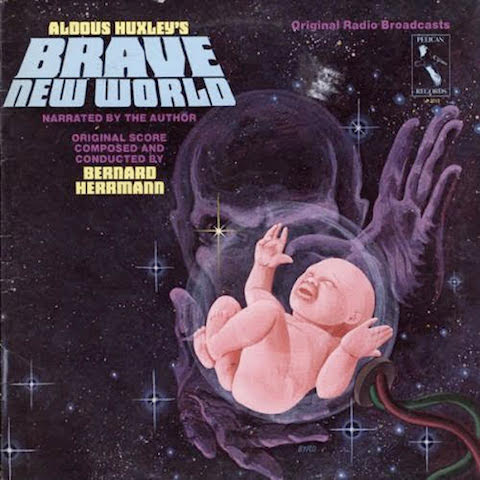
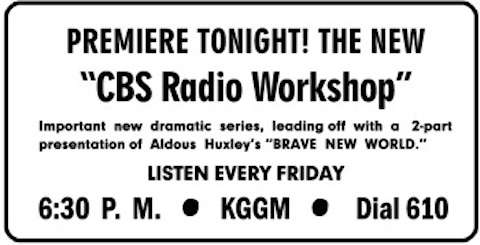
That golden age waned as television came into its own in the mid-fifties, but near its end, some broadcast companies made every effort to put together the highest quality radio programming they could in order to retain their audience. One such program, the CBS Radio Workshop, which ran from January, 1956 to September, 1957, may have been “too little too late”—as radio preservationist site Digital Deli writes—but it nonetheless was “every bit as innovative and cutting edge” as the programs that came before it. The first two episodes, right below, were dramatizations of Aldous Huxley’s Brave New World, read by the author himself. (Find it also on Spotify here.) The series’ remaining 84 programs drew from the work of Antoine de Saint-Exupéry, James Thurber, H.L. Mencken, Mark Twain, Robert Heinlein, Eugene O’Neil, Balzac, Carl Sandburg, and so many more. It also featured original comedy, drama, music, and This American Life-style profiles and storytelling.
Huxley returned in program #12, with a story called “Jacob’s Hands,” written in collaboration with and read by Christopher Isherwood. The great Ray Bradbury made an appearance, in program #4, introducing his stories “Season of Disbelief” and “Hail and Farewell,” read by John Dehner and Stacy Harris, and scored by future film and TV composer Jerry Goldsmith. Other programs, like #10, “The Exurbanites,” narrated by famous war correspondent Eric Sevareid, conducted probing investigations of modern life—in this case the growth of suburbia and its relationship to the advertising industry. The above is but a tiny sampling of the wealth of quality programming the CBS Radio Workshop produced, and you can hear all of it—all 86 episodes—courtesy of the Internet Archive.
Sample streaming episodes in the player above, or download individual programs as MP3s and enjoy them at your leisure, almost like, well, a podcast. See Digital Deli for a complete rundown of each program’s content and cast, as well as an extensive history of the series. This is the swan song of golden age radio, which, it seems, maybe never really left, given the incredible number of listening experiences we still have at our disposal. Yes, someday our podcasts will sound quaint and curious to the ears of more advanced listeners, but even then, I’d bet, people will still be telling and recording stories, and the sound of human voices will continue to captivate us as it always has.
Related Content:
Free: Listen to 298 Episodes of the Vintage Crime Radio Series, Dragnet
How to Listen to the Radio: The BBC’s 1930 Manual for Using a New Technology
Josh Jones is a writer and musician based in Durham, NC. Follow him at @jdmagness
Read More...David Harvey’s Course on Marx’s Capital: Volumes 1 & 2 Now Available Free Online
For many people, the arguments and analysis of Karl Marx’s three-volume Das Kapital (or Capital: A Critique of Political Economy) are as relevant as ever. For many others, the work is a historical curiosity, dated relic, or worse. Before forming an opinion either way, it’s probably best to read the thing—or as much of the huge set of tomes as you can manage. (Vol. 1, Vol. 2. and Vol. 3.) Few thinkers have been as frequently misquoted or misunderstood, even, or especially, by their own adherents. And as with any dense philosophical text, when embarking on a study of Marx, it’s best to have a guide. One could hardly do better than David Harvey, Distinguished Professor of Anthropology and Geography at the City University of New York’s Graduate Center.
Harvey’s work as a geographer focuses on cities, the increasingly predominant mode of human habitation, and he is the author of the highly popular, two-volume Companion to Marx’s Capital. The books grow out of lectures Harvey has delivered in a popular course at the City University. They’re very readable (check them out here and here), but you don’t have to read them—or attend CUNY—to hear Harvey himself deliver the goods. We’ve previously featured his Capital: Volume 1 lectures (at top, preceded by an interview with a colleague). Now Harvey has made his lectures on Capital, Volume II and some of Volume III available. Watch all twelve classes above or view them individually here. As Harvey admits in an interview before the first lecture, the neglected second volume of Marx’s masterwork is “a very difficult volume to get through,” due to its style, structure, and subject matter. With Harvey’s patient, enthusiastic guidance, it’s worth the trouble.
You can view the lectures from Harvey’s course on multiple platforms. Below we provide an easy-to-access list. You can also see all lectures on David Harvey’s website, where you can also download class notes.
Youtube
iTunes
Vimeo
Related Content:
Piketty’s Capital in a Nutshell
The Karl Marx Credit Card – When You’re Short of Kapital
Free Online Economics Courses
Josh Jones is a writer and musician based in Durham, NC. Follow him at @jdmagness
Read More...Handmade Animation Shows You “How To Make a 1930 Paramount Record”
The history of American music—the blues, jazz, gospel, etc.—has been told, and sold, so many times over that it seems hard to justify yet another retrospective. And yet, I for one am very happy to see the huge two-volume box set The Rise & Fall of Paramount Records appear on the scene. Granted, I can’t cough up $800 for, in total, 1600 remastered digital tracks, 12 LPs, 900 pages of artist bios, portraits, discographies, and fully-restored advertisements from the Midwestern musical powerhouse of the 20s and 30s. And that’s not to mention the beautiful, period packaging, “first-of-its-kind music and image player app… housed on custom metal USB drive,” and more. But even those of us too skint to afford all the glorious swag can sample some of the fruit of the enormous labors that went into this joint production of Jack White’s Third Man Records and folk guitar hero John Fahey’s Revenant Records (if only by proxy). And we can learn a little about the labors that went in to making the original records themselves.
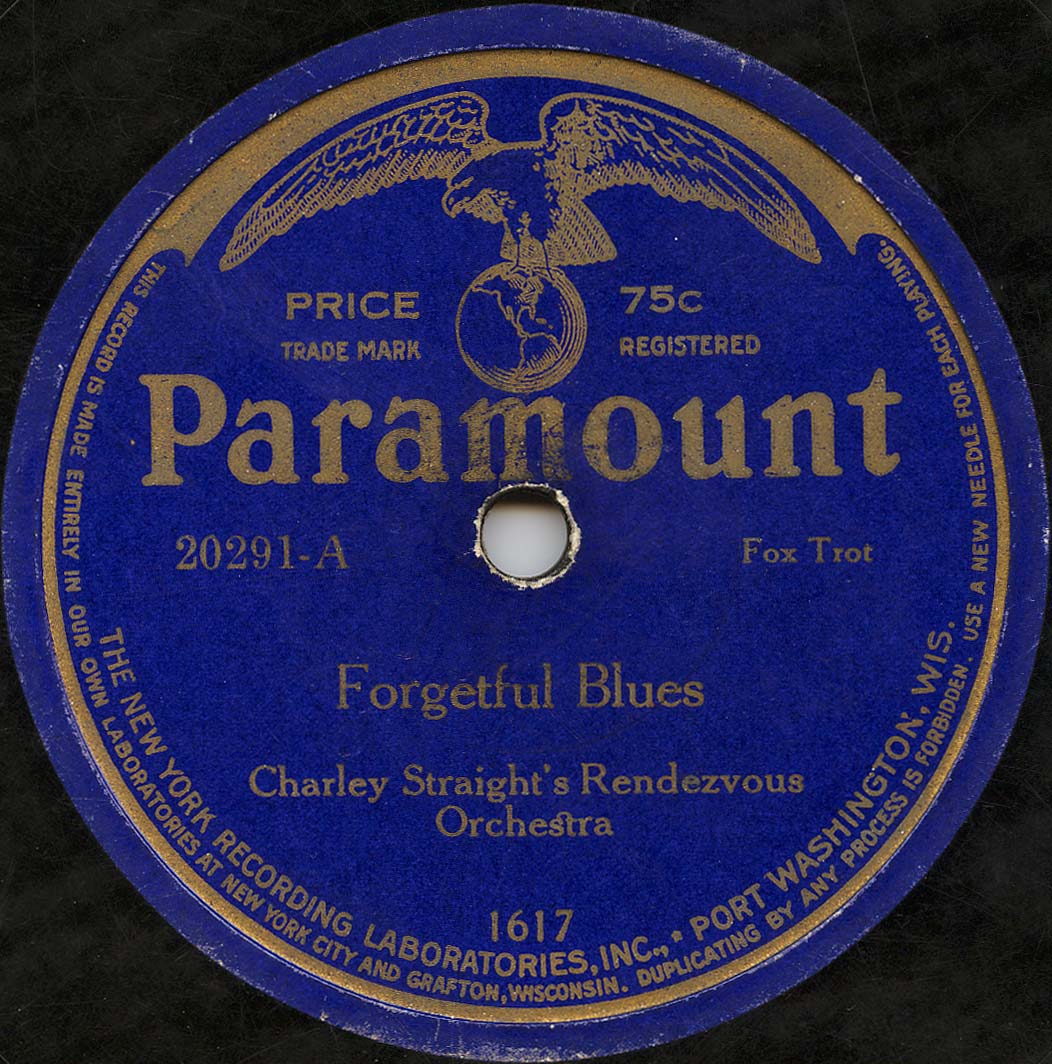
Just above, we have a beautiful handmade video by Kelli Anderson which “recreates the inner workings of the defunct Paramount Records Factory (where records by artists like Blind Lemon Jefferson, Louis Armstrong and Charley Patton were pressed in the 1920s and ‘30s).” Made “entirely from paper atop a plywood set,” the stop-motion animation simulates the production of Paramount’s “race records,” accompanied by Charley Patton’s 1930 “High Water Everywhere, Part 1,” whose “thick, analog noise,” Anderson writes on her blog, “is a reminder that some of history’s most inventive musicians were recorded on the most inferior equipment of their day.” She quotes Dean Blackwood of Revenant, who writes that the Paramount factory “sat perched above the Milwaukee River riverbed. Dirt from that riverbed was one of the key ingredients in their shellac dough, which was lower on shellac content and higher on unexpected components like riverbed clay, cotton flock, and lamp black.”
But from these humble, dirty, cheap materials came a sound like no other—one that can never be duplicated and which deserves the highest quality preservation. Just above, see a video trailer for volume 1 of the massive box set, and read much more about this project at Third Man’s site (Volume 1, Volume 2).
Related Content:
‘Boom Boom’ and ‘Hobo Blues’: Great Performances by John Lee Hooker
Josh Jones is a writer and musician based in Durham, NC. Follow him at @jdmagness
Read More...The Red Menace: A Striking Gallery of Anti-Communist Posters, Ads, Comic Books, Magazines & Films
By its very nature, propaganda distorts the truth or tells outright lies. It targets our basest impulses—fear and anger, flight or fight. While works of pure propaganda may pretend to make logical arguments, they eliminate nuance and oversimplify complicated issues to the point of caricature. These general tendencies hold true in every case, but nowhere, perhaps, is this gross exaggeration and fear mongering more evident than in times of war.

And while we’ve all seen our share of wartime propaganda, we may be less familiar with the decades-long propaganda war the U.S. and Western Europe waged against socialism and Communism, even decades before the Cold War era. It may surprise you to learn that this offensive began even before the start of World War One, as you can see above in a British Conservative Party poster from 1909.

Representing socialism as an ape-like demon strangling some sort of goddess of “prosperity,” this striking piece of poster art sets the tone for almost all of the anti-Communist propaganda to come in the wake of the Russian Revolution. At least since this early graphic salvo, Communists and socialists have generally been depicted as terrifying monsters. See, for example, an early, post-WWI example of Russian anti-Communist propaganda above, portraying the Communist threat as an apocalyptic horseman of death.

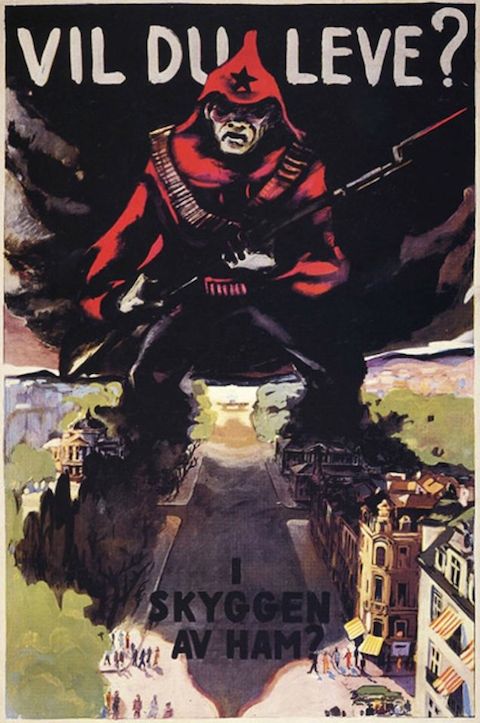
As the perceived threat increased, so too did the scale of the monstrous caricatures. In the post-WWI era German and Norwegian posters above, Godzilla-sized Communists lay waste to entire cities. Below, in “Bolshevism Unmasked,” an example from the Second World War, the skeletal Communist destroyer straddles the entire globe.

Occasionally the racial dimensions of these depictions were explicit. More often, they were strongly implied. But a 1953 Cold War example below is particularly unsubtle. Showing a scene literally right out of a schlocky Paramount horror film, featuring actress Janet Logan, the text tells us, “In case the Communists should conquer, our women would be helpless beneath the boots of the Asiatic Russians.” At the top of this rather lurid piece of agit-prop, we’re also told that “many American men would be sterilized” should Russia win the “next world war.”

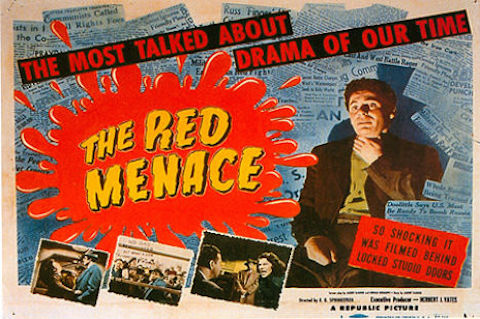
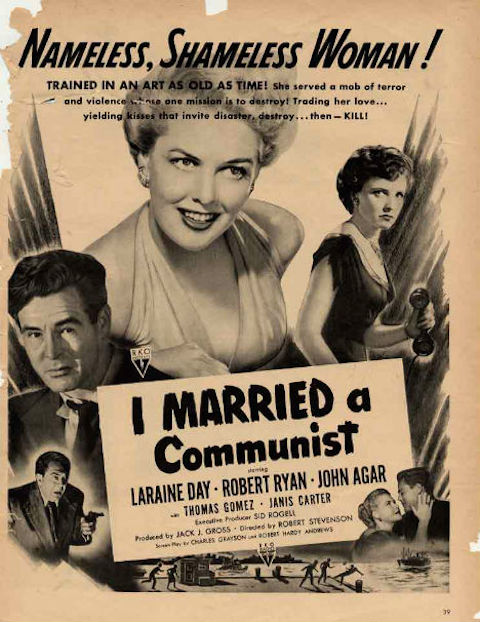
In the 50s and 60s, pop culture media like film and comic books lent themselves particularly well to anti-Communist propaganda, and they were exploited relentlessly by government agencies, production companies, and corporations. Films like I Married a Communist (below) and The Red Menace (top), both from 1949, offered sensationalized pulpy takes on the red scare.
In these peak Cold War decades, anti-Communist sentiment flourished as the U.S.’s former ally the Soviet Union became its primary enemy. Comic books provided the perfect platform for the broad strokes of anti-Communist propaganda. As psychiatrist Fredric Wertham waged war against the corrupting influence of comic books, advertisers and the government found them increasingly effective at spreading messages. “If there was any entity that believed in the power of comic books to indoctrinate and instruct as Wertham did,” writes Greg Beato at Reason, “it was the U.S. government.”

But private entities did their share in the comic book war against Communism as well. Witness a particularly wild example, Is This Tomorrow?, above. Published by the “Catechetical Guild Educational Society” in St. Paul, MN, this 1947 comic implicates government regulation of business, social welfare programs, anti-religious sentiment, and “people giving up their silly ideas about ‘sacredness’ of life” in a fiendishly orchestrated plot to take over America. Workers who embrace Communist doctrine are little more than dupes and pawns. You can read the whole feverish scenario here.

These cartoon scare tactics may seem outlandish, but of course we know that red scare propaganda had real effects on the lives and livelihoods of real Americans, particularly those in the arts and academia. Freethinking, left-leaning creative types and intellectuals have long been targets of anti-Communist paranoia. The American Legion Magazine cover above illustrates the fear—one still very prevalent now—that college professors were bent on corrupting young, malleable minds. “Parents,” the magazine states, “can rid campuses of communists who cloak themselves in ‘academic freedom.’” At the height of the red scare, many college professors, like Stanley Moore at Reed College, were dragged before the House Un-American Activities Committee and summarily fired.

More confident, it seems, than the propaganda of previous decades, the Cold War variety shrunk the Communist threat back to human dimensions. But Communists were no less monstrous than before—only more insidious. They looked like your neighbors, your co-workers, and your children’s teacher. Instead of purveyors of brute force, they were depicted as devious manipulators who used ideological machinations to pervert democracy and cripple capitalism. As in the American Legion college professor cover story, education was often posed as the cultural battlefield on which—as the heated Canadair ad above states—“Communism could take the citadel from within” by spreading “doubts about the old ways” and insinuating “ideas of atheism, regimentation and false idealism.”

Post-WWII, of course, the greatest threat was not a full-scale invasion—it was total nuclear annihilation. It was a grim possibility—as Kubrick’s Dr. Strangelove satirically pointed out—in which no one would win. Web Urbanist points us toward one particularly chilling and dishonest piece of propaganda distributed by the government. In the poster above, we are assured that “After total war can come total living.” Unless the happy couple is gazing out over a manicured suburb in the afterlife, this scene of “total living” post-nuclear war is absurd given the strategy of Mutually Assured Destruction. Nevertheless, what the poster depicts is an analogue of the Soviets’ totalitarian ethos—it’s a future of total ideological purity, in which the Earth has been cleansed of the hulking monstrous hordes of Communism, as well as, presumably, the crypto-Communist teachers, artists, intellectuals, and bureaucrats who threaten from within.
via Web Urbanist/io9/Kuriositas
Related Content:
How to Spot a Communist Using Literary Criticism: A 1955 Manual from the U.S. Military
Soviet Artists Envision a Communist Utopia in Outer Space
The Curious Story of How Bootlegged Hollywood Movies Helped Defeat Communism in Romania
Josh Jones is a writer and musician based in Durham, NC. Follow him at @jdmagness
Read More...David Foster Wallace’s Syllabus for His 2008 Creative Nonfiction Course: Includes Reading List & Footnotes
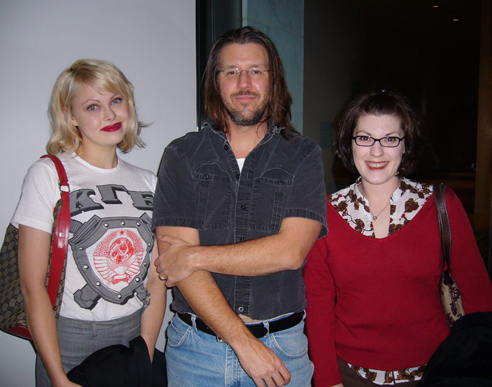
Photo courtesy of Claudia Sherman.
The term “creative nonfiction” has picked up a great deal of traction over the past decade — perhaps too much, depending upon how valid or invalid you find it. Meaningful or not, the label has come into its current popularity in part thanks to the essays of novelist David Foster Wallace: whether writing nonfictionally about the Illinois State Fair, David Lynch, professional tennis, or a seven-night Caribbean cruise, he did it in a way unlike any other man or woman of letters. While nobody can learn to write quite like him — this we’ve seen when Wallace-imitators write pastiches of their own — he did spend time teaching the art of creative nonfiction as he saw it,
a broad category of prose works such as personal essays and memoirs, profiles, nature and travel writing, narrative essays, observational or descriptive essays, general-interest technical writing, argumentative or idea-based essays, general-interest criticism, literary journalism, and so on. The term’s constituent words suggest a conceptual axis on which these sorts of prose works lie. As nonfiction, the works are connected to actual states of affairs in the world, are “true” to some reliable extent. If, for example, a certain event is alleged to have occurred, it must really have occurred; if a proposition is asserted, the reader expects some proof of (or argument for) its accuracy. At the same time, the adjective creative signifies that some goal(s) other than sheer truthfulness motivates the writer and informs her work. This creative goal, broadly stated, may be to interest readers, or to instruct them, or to entertain them, to move or persuade, to edify, to redeem, to amuse, to get readers to look more closely at or think more deeply about something that’s worth their attention… or some combination(s) of these.
This comes straight from the syllabus of English 183D, a workshop Wallace taught at Pomona College in the spring of 2008, which you can read in its entirety at Salon (reprinted from The David Foster Wallace Reader). As you may remember from the previous Wallace syllabus we featured, from a 1994 semester of English 102 — Literary Analysis I: Prose Fiction at Illinois State University, the man could really assemble a reading list. For his creative nonfiction course, he had students read Jo Ann Beard’s “Werner,” Stephen Elliott’s “Where I Slept,” George Orwell’s classic “Politics and the English Language,” Donna Steiner’s “Cold,” David Gessner’s “Learning to Surf,” Kathryn Harrison’s “The Forest of Memory,” Hester Kaplan’s “The Private Life of Skin,” and George Saunders’s “The Braindead Megaphone.”
In some ways, Wallace syllabi themselves count as pieces of creative nonfiction. What other professor ever had the prose chops to make you actually want to read anything under the “Class Rules & Procedures” heading? In the ninth of its thirteen points, he lays out the workshop’s operative belief:
that you’ll improve as a writer not just by writing a lot and receiving detailed criticism but also by becoming a more sophisticated and articulate critic of other writers’ work. You are thus required to read each of your colleagues’ essays at least twice, making helpful and specific comments on the manuscript copy wherever appropriate. You will then compose a one-to-three-page letter to the essay’s author, communicating your sense of the draft’s strengths and weaknesses and making clear, specific suggestions for revision.
But whatever the rigors of English 183D, Wallace would have succeeded, to my mind, if he’d instilled nothing more than this in the minds of his departing students:
In the grown-up world, creative nonfiction is not expressive writing but rather communicative writing. And an axiom of communicative writing is that the reader does not automatically care about you (the writer), nor does she find you fascinating as a person, nor does she feel a deep natural interest in the same things that interest you.
True to form, DFW’s syllabus comes complete with footnotes.
1 (A good dictionary and usage dictionary are strongly recommended. You’re insane if you don’t own these already.)
You can read the Creative Nonfiction syllabus in full here.
Related Content:
30 Free Essays & Stories by David Foster Wallace on the Web
David Foster Wallace’s 1994 Syllabus: How to Teach Serious Literature with Lightweight Books
David Foster Wallace Breaks Down Five Common Word Usage Mistakes in English
Colin Marshall hosts and produces Notebook on Cities and Culture and writes essays on cities, language, Asia, and men’s style. He’s at work on a book about Los Angeles, A Los Angeles Primer. Follow him on Twitter at @colinmarshall or on Facebook.
Read More...135 Free Philosophy eBooks
This page features a growing list of Free Philosophy eBooks, presenting essential works by Aristotle, Hegel, Kant, Nietzsche, Wittgenstein and many other philosophers. You can generally read these texts on your Kindle, iPad & iPhone, or web browser. For those interested in philosophy, you won’t want to miss our collection of Free Online Philosophy Courses.
- Aquinas, Thomas — Summa Theologiae
- Aristotle — Collected Works
- Aristotle — Nicomachean Ethics
- Aristotle — Physics
- Aristotle - Politics
- Aristotle — The Categories
- Aurelius, Marcus - Meditations
- Ayer, Alfred — Language, Truth and Logic
- Bacon, Sir Francis — Novum Organum
- Benjamin, Walter — “The Work of Art in the Age of Mechanical Reproduction”
- Bentham, Jeremy — An Introduction to the Principles of Morals and Legislation
- Berkeley, George — Three Dialogues between Hylas and Philonous
- Boethius — Consolation of Philosophy
- Burke, Edmund - On the Sublime and Beautiful
- Carroll, Lewis — Symbolic Logic
- Carroll, Lewis — The Game of Logic
- Confucius — The Analects
- Confucius — The Great Learning
- Derrida, Jacques — “Structure, Sign, and Play in the Discourse of the Human Sciences”
- Descartes, Rene - Discourse on the Method
- Dewey, John - Democracy & Education
- Dostoevsky, Fyodor - Brothers Karamazov
- Dostoevsky, Fyodor - Crime and Punishment
- Eliot, Charles - The Harvard Classics (51 Volumes)
- Emerson, Ralph Waldo – Essays
- Emerson, Ralph Waldo - The Complete Works
- Foucault, Michel - Die Ordnung des Diskurses
- Gramsci, Antonio — Selected Writings
- Hegel, GWF — Lectures on the History of Philosophy
- Hegel, GWF — Philosophy of Mind
- Hegel, GWF — Philosophy of Right
- Hegel, GWF — The Phenomenology of the Spirit
- Hobbes, Thomas - Leviathan
- Hume, David - A Treatise of Human Nature
- Hume, David - Dialogues Concerning Natural Religion
- Hume, David - Enquiry into the Principles of Morals
- Hume, David — An Enquiry Concerning Human Understanding
- Hume David — Political Discourses
- James, William — Essay in Radical Empiricism
- James, William - Pragmatism
- James, William - Varieties of Religious Experience
- Kant, Immanuel - Critique of Judgement
- Kant, Immanuel - Critique of Practical Reason
- Kant, Immanuel - Critique of Pure Reason
- Kant, Immanuel - Groundwork for the Metaphysics of Morals
- Kant, Immanuel - Perpetual Peace
- Kant, Immanuel - What is Enlightenment?
- Kierkegaard, Søren - Fear and Trembling
- Kierkegaard, Søren — Philosophical Fragments
- Kierkegaard, Søren - Purity of Heart Is to Will One Thing
- Kierkegaard, Søren — The Sickness Unto Death
- Kierkegaard, Søren - Two Discourses on God and Man
- Leibniz — Theodicy
- Locke, John — An Essay on Human Understanding
- Locke, John - Second Treatise on Government
- Lucretius - On the Nature of the Things
- Machiavelli, Niccolò - The Prince
- Madison, Hamilton & Jay - The Federalist Papers
- Maimonides — Guide for the Perplexed
- Marx and Engels - The Communist Manifesto
- Marx, Karl — Das Kapital
- Mencken, H.L. — The Philosophy of Friedrich Nietzsche
- Mill, John Stuart- On Liberty
- Mill, John Stuart - Utilitarianism
- Montaigne — Essays
- Montesquieu - The Persian Letters
- Montesquieu - The Spirit of the Laws
- More, Thomas - Utopia
- Nietzsche, Friedrich - Beyond Good and Evil
- Nietzsche, Friedrich- Ecce Homo
- Nietzsche, Friedrich — Genealogy of Morals
- Nietzsche, Friedrich - Homer and Classical Philology
- Nietzsche, Friedrich - Human, All Too Human
- Nietzsche, Friedrich - Selected Letters
- Nietzsche, Friedrich - The Anti Christ
- Nietzsche, Friedrich — The Birth of Tragedy
- Nietzsche, Friedrich - The Case Against Wagner
- Nietzsche, Friedrich — The Dawn of Day
- Nietzsche, Friedrich - The Gay Science
- Nietzsche, Friedrich - Thus Spake Zarathustra
- Nietzsche, Friedrich - Twilight of the Idols
- Paine, Thomas - Common Sense
- Paine, Thomas - Rights of Man
- Paine, Thomas — The Age of Reason
- Pascal, Blaise — The Pensées
- Pascal, Blaise — The Provincial Letters
- Plato — Collected Works
- Plato - Symposium
- Plato - The Apology, Phaedo, and Crito of Plato
- Plato - The Republic
- Popper, Karl — The Logic of Scientific Discovery
- Read Online Now
- Rousseau, Jean Jacques — Emile
- Rousseau, Jean Jacques — Julie; ou, la Nouvelle Héloïse
- Rousseau, Jean-Jacques - The Confessions
- Rousseau, Jean-Jacques - The Social Contract & Discourses
- Russell, Bertrand — Free Thought and Official Propaganda
- Russell, Bertrand - Introduction to Mathematical Philosophy
- Russell, Bertrand — Mysticism and Logic and Other Essays
- Russell, Bertrand - Political Ideals
- Russell, Bertrand — The Conquest of Happiness
- Russell, Bertrand - The Problems of Philosophy
- Russell, Bertrand - Western Philosophy
- Russell, Bertrand — Why I Am Not a Christian
- Santayana, George — Some Turns of Thought in Modern Philosophy: Five Essays
- Santayana, George — The Life of Reason
- Santayana, George — These Sense of Beauty
- Santayana, George — Three Philosophical Poets: Lucretius, Dante and Goethe
- Sartre, Jean-Paul - Existentialism Is a Humanism
- Sartre, Jean-Paul — Nausea
- Read Online Now (French versions)
- Schopenhauer, Arthur - The World as Will and Representation
- Schopenhauer, Arthur — The Essays of Arthur Schopenhauer; On Human Nature
- iPad/iPhone — Kindle + Other Formats (find German version here)
- Schopenhauer, Arthur — Studies in Pessimism
- Seneca - On Benefits
- Smith, Adam - The Theory of Moral Sentiments
- Smith, Adam - The Wealth of Nations
- Spinoza — The Chief Works of Benedict de Spinoza, 2 vols.
- Spinoza — Ethics
- St. Augustine — Confessions
- Sun Tzu - The Art of War
- Tocqueville, Alexis de - Democracy in America Vol 1.
- Tocqueville, Alexis de - Democracy in America Vol 2.
- Thoreau, Henry David - Walden
- Tolstoy, Leo — What is Art?
- Voltaire - Candide
- Voltaire — Micromégas
- Voltaire — The Philosophical Dictionary
- Voltaire — The Works of Voltaire
- Wittgenstein, Ludwig — The Blue Book
- Wittgenstein, Ludwig — The Brown Book
- Wittgenstein, Ludwig - Notebooks, 1914–1916
- Wittgenstein, Ludwig — Notes on Logic
- Wittgenstein, Ludwig — Philosophical Investigations (German)
- Wittgenstein, Ludwig - Tractatus Logico-Philosophicus
- Wittgenstein, Ludwig - Tractatus Logico-Philosophicus (German-English Side by Side Edition)
- Wollstonecraft, Mary — A Vindication of the Rights of Women
General Resources
- 80 Philosophy ebooks from UC Press
- 70 Philosophy eBooks from University of Pittsburgh Press

Kandinsky, Klee & Other Bauhaus Artists Designed Ingenious Costumes Like You’ve Never Seen Before
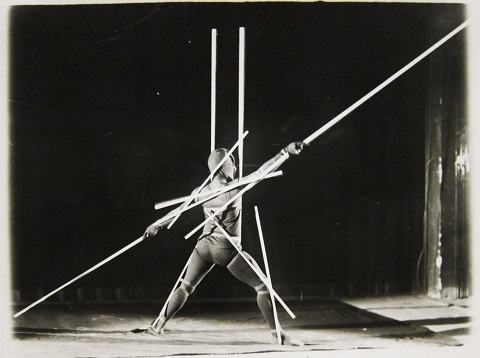
Artists of the Bauhaus school—including founder Walter Gropius, Paul Klee, Wassily Kandinsky, Piet Mondrian and others—broke radically with familiar tradition and made minimalist, abstract, and sometimes shocking statements with their work. We know this history, but you probably haven’t seen these cultural figures physically embody their aesthetic principles as they do in the photographs here, from costume parties the Bauhaus school held throughout the twenties.
As Rachel Doyle at Curbed wrote, “if you thought Bauhaus folk were good at designing coffee tables, just have a look at their costumes—as bewitching and sculptural as any other student project, but with an amazing flamboyance not oft ascribed to the movement.”
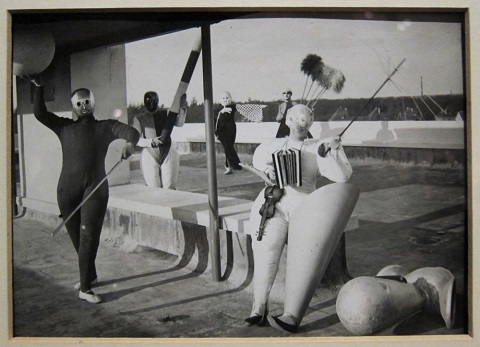
The whimsical costume parties—to which, wrote Hungarian architect Farkas Molnár, artists devoted “the greatest expenditures of energy”—represented further attempts to transcend “medieval conditions” and integrate “today’s scientific and technological advances… into general culture.” So wrote Molnár in a 1925 essay, “Life at the Bauhaus,” where he describes the playfully serious conditions at the school. These parties, he asserts, were superior to “fancy-dress balls” organized by artists in other cities in that “our costumes are truly original. Everyone prepares his or her own. Never a one that has been seen before. Inhuman, or humanoid, but always new.” Everyone participated, it seems, from the newest student to, as Molnár calls them, “the bigwigs”:
Kandinsky prefers to appear decked out as an antenna, Itten as an amorphous monster, Feininger as two right triangles, Moholy-Nagy as a segment transpierced by a cross, Gropius as Le Corbusier, Muche as an apostle of Mazdaznan, Klee as the song of the blue tree. A rather grotesque menagerie…
Might that be Kandinsky in the photograph at the top? Just who is this luminous figure? Why did Gropius dress up as Le Corbusier, and what, exactly, does “the song of the blue tree” look like? We can identify at least one of these artists—the bald man in black at the center of the photograph below is Oskar Schlemmer, painter, sculptor, designer, and choreographer. Schlemmer gave Bauhaus costume design its most formal context with the Triadic Ballet, a production, writes Dangerous Minds, that “combined his work in both sculpture and theater to create the internationally acclaimed extravaganza which toured from 1922 to 1929.”
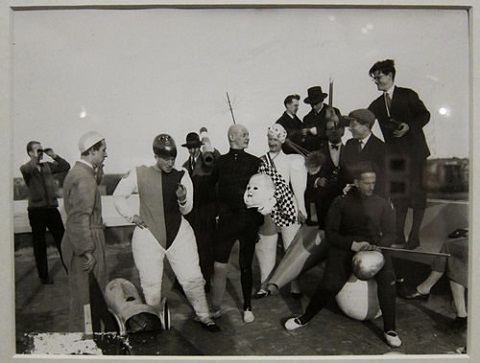
The ballet’s “18 costumes,” writes Curbed, “were designed by matching geometric forms with analogous parts of the human body: a cylinder for the neck, a circle for the heads…. These elaborate costumes [see photo of performers below]… totally upped the ante at the Bauhaus school’s regular costume balls.” Schlemmer “made no secret of the fact that he considered the stylized, artificial movements of marionettes to be aesthetically superior to the naturalistic movements of real humans.” His ballet, Dangerous Minds remarks, may be “the least ‘human’ dance performance ever conceived.”

It may come as no surprise then that the Triadic Ballet influenced some of the hyper-stylized alien costuming of David Bowie’s Ziggy Stardust tour. Perhaps even more than the photographs of revelers from the costume parties, the Triadic Ballet, which has been periodically revived since its 1922 debut, preserves the fascinating innovations Bauhaus artists envisioned for the human form. Just below, watch a 1970 film production recreating many of the original designs, and see more photographs of Bauhaus costumes at The Charnel-House.
Related Content:
Watch an Avant-Garde Bauhaus Ballet in Brilliant Color, First Staged in 1922
The Homemade Hand Puppets of Bauhaus Artist Paul Klee
Time Travel Back to 1926 and Watch Wassily Kandinsky Create an Abstract Composition
Bauhaus, Modernism & Other Design Movements Explained by New Animated Video Series
Josh Jones is a writer and musician based in Durham, NC.
Read More...
Happy Halloween! Louis Armstrong Performs Skeleton in the Closet (1936)
Should you happen to be in the vicinity of Corona, Queens this Halloween afternoon, the Louis Armstrong House Museum will be welcoming trick-or-treaters ’til 6pm. (Fun-sized Snickers be damned! Go anyway, just to see “To Jack Bradley, the ‘Greatest’ Photo Taker,” a collection of candid, private moments captured by the friend Satchmo described as his “white son.”)
If pre-existing engagements prevent you from haunting Corona today, virtual chills await you, above, with “The Skeleton In The Closet,” Armstrong’s show-stopping number from 1936’s Pennies From Heaven. (That masked man on the drums is frequent collaborator Lionel Hampton.)
The vintage Halloween content is a real treat. Gimme ghosts, goblins, and an “old deserted mansion on an old forgotten road” over psycho gore or depressed prefab sexiness any day, not just October 31.
Pennies From Heaven was Armstrong’s first major screen appearance. At the insistence of star Bing Crosby, his turn as a mathematically-challenged bandleader snagged him a main title credit, a first for an African-American actor appearing opposite whites.
The role itself is not a pillar of race advancement, but Ricky Riccardi, the Armstrong House’s Archivist notes that Armstrong remained fond of the work, reenacting an entire scene from memory when he and Crosby appeared as guests on the David Frost Show in 1971.
Riccardi subjects “The Skeleton in the Closet” to a close musical and performance analysis on his Wonderful World of Louis Armstrong blog, a major source of year round goodies for Armstrong fans.
Rattle your bones!
Related Content:
Louis Armstrong Plays Historic Cold War Concerts in East Berlin & Budapest (1965)
Ayun Halliday is an author, homeschooler, and Chief Primatologist of the East Village Inky zine. Follow her @AyunHalliday
Read More...Support Us
We're hoping to rely on loyal readers, rather than erratic ads. Please click the Donate button and support Open Culture. You can use Paypal, Venmo, Patreon, even Crypto! We thank you!

About Us

Open Culture scours the web for the best educational media. We find the free courses and audio books you need, the language lessons & educational videos you want, and plenty of enlightenment in between.
Advertise With Us
FREE UPDATES!
GET OUR DAILY EMAIL
Get the best cultural and educational resources on the web curated for you in a daily email. We never spam. Unsubscribe at any time.
FOLLOW ON SOCIAL MEDIA
Open Culture editor Dan Colman scours the web for the best educational media. He finds the free courses and audio books you need, the language lessons & movies you want, and plenty of enlightenment in between.
Advertise With Us