Carl Reiner & Mel Brooks’ Timeless Comedy Sketch: The 2000-Year-Old-Man
I read the obits. If I’m not in it I’ll have breakfast. —Carl Reiner
Up until this week week, it seemed as if Mel Brooks and Carl Reiner could keep their 2000-Year-Old Man routine going forever.
The premise was simple—Reiner as the serious minded announcer, interviewing Brooks as an elder with a Middle European Yiddish accent about some of the historic moments, trends, and celebrities he’d had personal contact with over the years.
The idea originated with Reiner, who, as a young staff writer for Sid Caesar’s Your Show of Shows, thought there was comic gold to be mined from We the People, a weekly news program that dramatized important current events—notably a plumber who claimed to have overheard some toe curling plans while repairing a faucet in Stalin’s bathroom.
Unfortunately, or rather fortunately, no one else in the writers room had caught the show, so he drafted coworker Brooks to play along, interviewing him as if he were the host of We the People, and Brooks were an average Joe who’d been at the Crucifixion:
Mel, aging before our eyes, sighed and allowed a sad “Oooooh, boy” to escape from the depths of his soul…
I pressured the Old Man and asked, “You knew Jesus?”
“Jesus … yes, yes,” he said, straining to remember, “thin lad … wore sandals … always walked around with twelve other guys … yes, yes, they used to come into the store a lot … never bought anything … they came in for water … I gave it to them … nice boys, well-behaved… .”
For a good part of an hour Mel had us all laughing and appreciating his total recall of life in the year 1 A.D. I called upon Mel that morning because I knew that one of the characters in his comedy arsenal would emerge. The one that did was similar to one he did whenever he felt we needed a laugh break. It was a Yiddish pirate captain who had an accent not unlike the 2,000-Year-Old Man.
The durable, always unscripted 2000-Year-Old Man made an instant splash with friends and family, but his accent—which came quite naturally to the Brooklyn-born Brooks—caused the duo to question the wisdom of trotting him out before a wider audience.
In the 20’s and 30’s Yiddish accents had been a comic staple on the radio, and in Broadway, vaudeville, and burlesque houses, but that changed when the Nazis came to power, as Reiner recalled in his 2003 memoir, My Anecdotal Life:
…when Adolf Hitler came along and decreed that all Jews were dirty, vile, dangerous, subhuman animals and must be put to death, Jewish and non-Jewish writers, producers, and performers started to question the Yiddish accent’s acceptability as a tool of comedy. The accent had a self-deprecating and demeaning quality that gave aid and comfort to the Nazis, who were quite capable of demeaning and deprecating Jews without our help. From 1941 on, the Yiddish accent was slowly, and for the most part, voluntarily, phased out of show business.
Eventually, however, the character found his way onto their 1961 LP 2000 Years with Carl Reiner & Mel Brooks.
They buttressed his 12-minute appearance with sketches involving astronauts, teen heartthrob Fabian, and Method actors, hedging their bets lest the accent flop with both reference-challenged WASPs and fellow Jews nervous about reinforcing problematic stereotypes.
One wonders what the 2000-Year-Old Man—who as a caveman had trouble determining “who was a lady”—would have had to say about the movements for Trans Equality, #MeToo, and Black Lives Matter.
A quote on Brooks’ website may provide a hint:
It’s OK not to hurt the feelings of various tribes and groups, however, it’s not good for comedy. Comedy has to walk a thin line, take risks. It’s the lecherous little elf whispering in the king’s ear, telling the truth about human behavior.
Brooks delighted by putting imminently quotable, off-the-cuff punchlines in the mouth of the 2000-Year-Old Man, hooking many young listeners, like veteran comedian and stand up comedy teacher Rick Crom:
The 2000-Year-Old Man was the first comedy album I ever listened to. I was quoting it at 10. I told my Sunday school teacher that before God, people worshipped “a guy…Phil.”
But it was Reiner—who maintained a wish list of questions for the 2000-Year-Old Man and who left us earlier this week at the not-too-shabby age of 98—who steered the act, often by pressing his subject to substantiate his wild claims.
As Anne Libera, Director of Comedy Studies at The Second City and Columbia College Chicago, notes:
Carl Reiner was a master of the underrated art of the setup. Most “straight men” are known for their responses that release the laugh. Carl did that too, but even more brilliantly, he subtly puts all of the pieces into play for Mel Brooks to push off of into the comedy stratosphere. You see it in the Dick Van Dyke Show as well —he knew how to create the exact space for a comic character to do their best work.
Copies of the Complete 2000 Year Old Man can be purchased on Amazon.
Related Content:
Hear 30 of the Greatest Standup Comedy Albums: A Playlist Chosen by Open Culture Readers
Judd Apatow Teaches the Craft of Comedy: A New Online Course from MasterClass
Steve Martin Performs Stand-Up Comedy for Dogs (1973)
Ayun Halliday is an author, illustrator, theater maker and Chief Primatologist of the East Village Inky zine. Here latest project is an animation and a series of free downloadable posters, encouraging citizens to wear masks in public and wear them properly. Follow her @AyunHalliday.
Read More...Behold Octavia Butler’s Motivational Notes to Self
Handwritten notes on the inside cover of one of Octavia E. Butler’s commonplace books, 1988
I was attracted to science fiction because it was so wide open. I was able to do anything and there were no walls to hem you in and there was no human condition that you were stopped from examining. —Octavia E. Butler
Like many authors, the late Octavia E. Butler took up writing at a young age.
At 11, she was churning out tales about horses and romance.
At 12, she saw Devil Girl from Mars, and figured (correctly) she could tell a better story than that, using 2 fingers to peck out stories on the Remington typewriter her mother bought at her request.
At 13, she found a copy of The Writer magazine abandoned on a bus seat, and learned that it was possible to submit her work for publication.
After a decade’s worth of rejection slips, she sold her first two stories, thanks in part to her association with the Clarion Science Fiction Writing Workshop, which she became involved with on the recommendation of her mentor, science fiction writer Harlan Ellison.
She went on to become the first science fiction writer to receive a prestigious MacArthur “genius” award, garnering multiple Hugo and Nebula awards for her work.
An asteroid is named after her, as is a mountain on Pluto’s moon.
Hailed as the Mother of Afro Futurism, she won the PEN American Center lifetime achievement award in writing.
But professional success never clouded her view of herself as the 10-year-old writer who was unsure if library-loving black kids like her would be allowed inside a bookstore.
Identifying as a writer helped her move beyond her crippling shyness and dyslexia. As she wrote in an autobiographical essay, “Positive Obsession”:
I believed I was ugly and stupid, clumsy, and socially hopeless. I also thought that everyone would notice these faults if I drew attention to myself. I wanted to disappear. Instead, I grew to be six feet tall. Boys in particular seemed to assume that I had done this growing deliberately and that I should be ridiculed for it as often as possible.
I hid out in a big pink notebook—one that would hold a whole ream of paper. I made myself a universe in it. There I could be a magic horse, a Martian, a telepath….There I could be anywhere but here, any time but now, with any people but these.
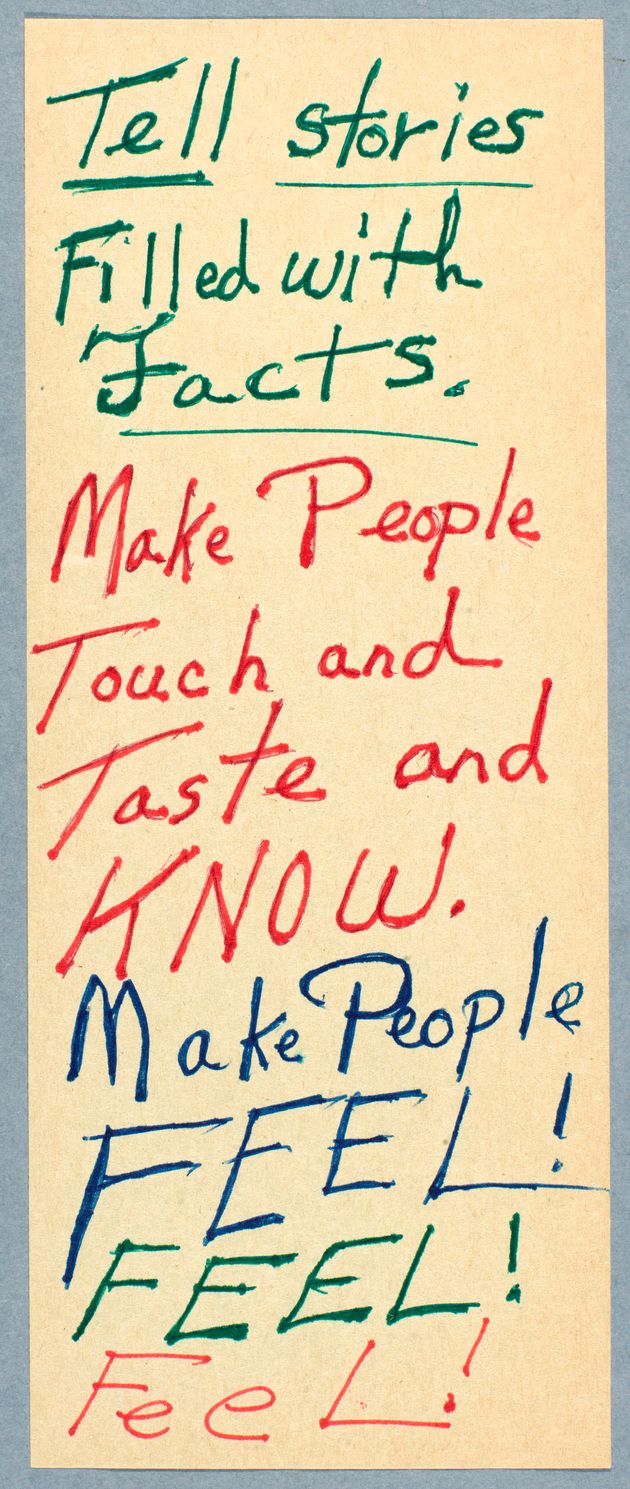
She developed a lifelong habit of cheering herself on with motivational notes, writing them in her journals, on lined notebook paper, in day planners and on repurposed pages of an old wall calendar.
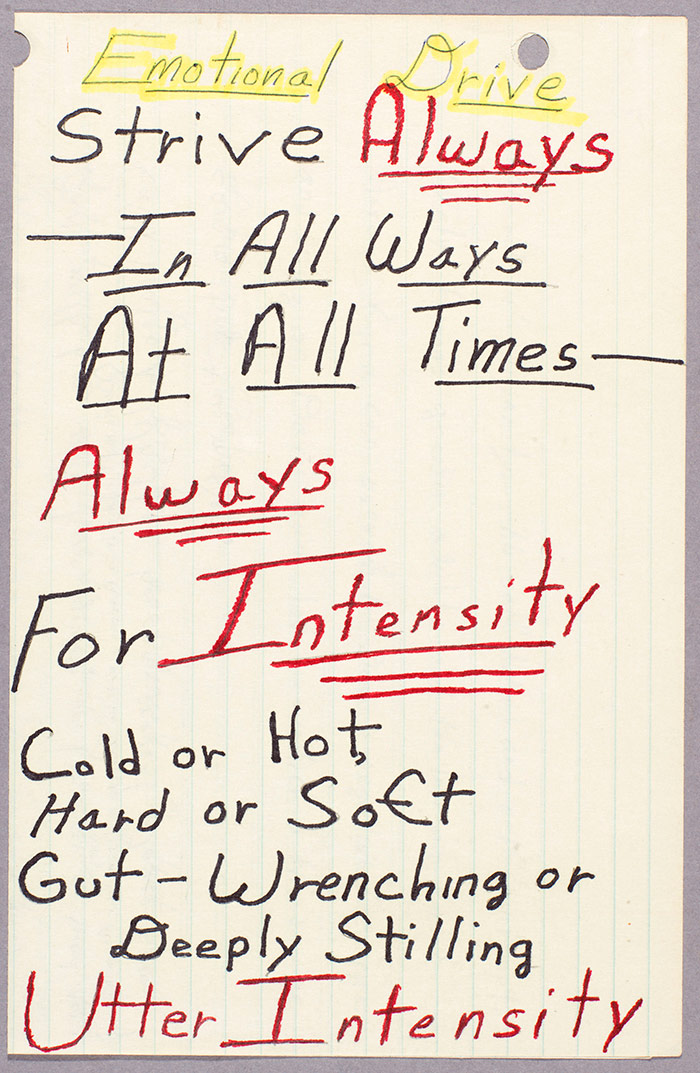
She held herself accountable by writing out demanding schedules to accompany her lofty, documented goals.
And though she wearied of the constant invitations to serve on literary panels devoted to science fiction writers of color, at which she’d be asked the same questions she’d answered dozens of times before, she was resolute about providing opportunities for young black writers … and readers, who found reflections of themselves in her characters. As she remarked in an interview with The New York Times:
When I began writing science fiction, when I began reading, heck, I wasn’t in any of this stuff I read. The only black people you found were occasional characters or characters who were so feeble-witted that they couldn’t manage anything, anyway. I wrote myself in, since I’m me and I’m here and I’m writing.
Her brand of science fiction—a label she often tried to duck, identifying herself on her business card simply as “writer”—serves as a lens for considering contemporary issues: sexual violence, gun violence, climate change, gender stereotypes, the problems of late-stage capitalism, the plight of undocumented immigrants, and, not least, racism.
She sidestepped utopian science fiction, believing that imperfect humans are incapable of forming a perfect society. “Nobody is perfect,” she told Vibe:
One of the things I’ve discovered even with teachers using my books is that people tend to look for ‘good guys’ and ‘bad guys,’ which always annoys the hell out of me. I’d be bored to death writing that way. But because that’s the only pattern they have, they try to fit my work into it.
Learn more about the life and work of Octavia E. Butler (1947–2006) here.
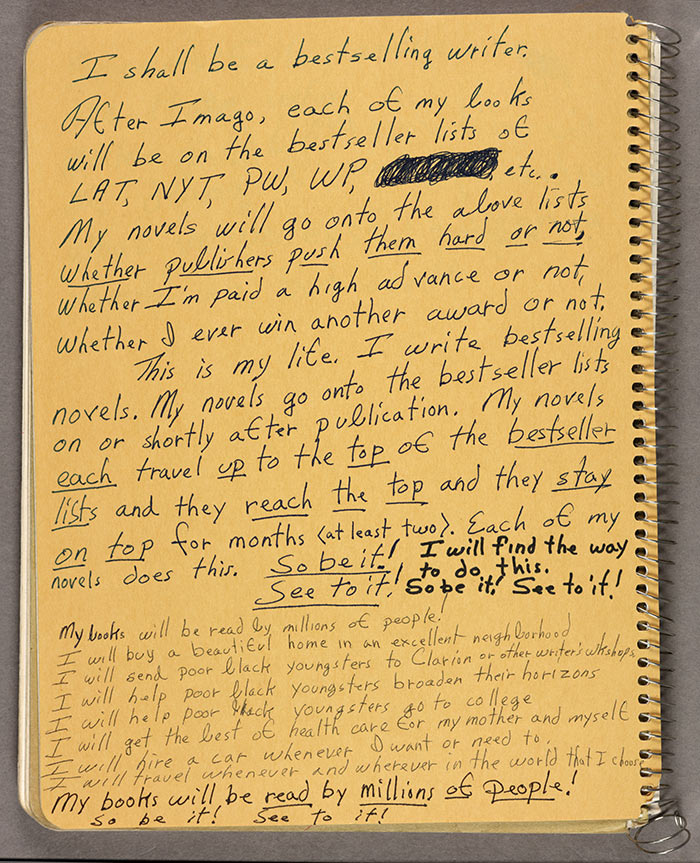
I shall be a bestselling writer. After Imago, each of my books will be on the bestseller lists of LAT, NYT, PW, WP, etc. My novels will go onto the above lists whether publishers push them hard or not, whether I’m paid a high advance or not, whether I ever win another award or not.
This is my life. I write bestselling novels. My novels go onto the bestseller lists on or shortly after publication. My novels each travel up to the top of the bestseller lists and they reach the top and they stay on top for months . Each of my novels does this.
So be it! I will find the way to do this. See to it! So be it! See to it!
My books will be read by millions of people!
I will buy a beautiful home in an excellent neighborhood
I will send poor black youngsters to Clarion or other writer’s workshops
I will help poor black youngsters broaden their horizons
I will help poor black youngsters go to college
I will get the best of health care for my mother and myself
I will hire a car whenever I want or need to.
I will travel whenever and wherever in the world that I choose
My books will be read by millions of people!
So be it! See to it!
via Austin Kleon
Related Content:
Why Should We Read Pioneering Sci-Fi Writer Octavia Butler? An Animated Video Makes the Case
Ayun Halliday is an author, illustrator, theater maker and Chief Primatologist of the East Village Inky zine. Follow her @AyunHalliday.
Read More...
Hear Brian Eno’s Rarely-Heard Cover of the Johnny Cash Classic, “Ring of Fire”
“Ring of Fire” has been covered many times and in many ways since Johnny Cash released it in 1963. But for all its recognition as one of his signature songs, Cash’s “Ring of Fire” is itself a cover — or another interpretation, in any case, of a tune originally written by Cash’s wife June Carter and songwriter Merle Kilgore for June’s sister, Anita Carter. Though it made nothing like the mark Cash’s recording did, the original “Ring of Fire” has its appreciators, a group that may well include Brian Eno. Or at least one feels an affinity between Anita Carter’s take on the song and Eno’s own, the latter of which you can listen to above.
Unlikely enough to begin with, in an artistic sense, the recording’s availability on the internet has saved it from near-complete obscurity. “In 1990, Brian Eno and John Cale made a wonderful experimental pop/art rock record called Wrong Way Up, released by Warner Bros. Records,” writes Boing Boing’s David Pescovitz.
“At the time, the label would send out 7” records to alt.rock/college radio stations to promote their new releases. The promo series, called Soil Samples, featured different artists on each side of the record performing songs that weren’t included on their new albums.” Cale’s contribution to the sample was an instrumental called “Shuffle Down to Woodbridge,” and the flip side of this translucent-vinyl rarity featured “Merry Christmas” by the two-man Americana group House of Freaks.
As the legend goes — for every story connected with Johnny Cash becomes a legend — the idea for how to do “Ring of Fire” came to the Man in Black in a dream. The “Mexican horns” that had risen up from his subconscious “sound like they’ve stumbled in from somewhere else on the radio dial and are trying desperately not to fall over Cash’s standard shave-and-a-haircut clomping beat,” writes The Atlantic’s Noah Berlatsky. “Cash, for his part, turns in one of the most awkward vocals of his career.” And yet “all those elements knocking against each other,” he continues “fit the song’s lyrics perfectly.” Eno’s flowing, languid, Mexican-horn-free recording may sound more like the original “Ring of Fire” than any other cover, but it also befits its artist, the man who popularized ambient music. Neither Cash nor Eno sing like men especially subject to “wild desire,” but what song isn’t enriched by a bit of counterpoint?
via Boing Boing
Related Content:
Johnny Cash Sings “Man in Black” for the First Time, 1971
Johnny Cash & Joe Strummer Sing Bob Marley’s “Redemption Song” (2002)
Inside the 1969 Bob Dylan-Johnny Cash Sessions
Based in Seoul, Colin Marshall writes and broadcasts on cities, language, and culture. His projects include the book The Stateless City: a Walk through 21st-Century Los Angeles and the video series The City in Cinema. Follow him on Twitter at @colinmarshall, on Facebook, or on Instagram.
Read More...Neil Armstrong Sets Straight an Internet Truther Who Accused Him of Faking the Moon Landing (2000)

Image via Wikimedia Commons
People have been graduating from college this year who are as old as the role of internet truther. It is a venerable hobby (some might call it a cult) leading increasing numbers of people to bizarre conclusions drawn from dubious evidence proffered by spurious sources; people convinced that some wild allegation or other must be true because they saw it on the Internet, shared by people they knew and liked.
Twenty years ago, one pioneering truther wrote Mr. Neil Armstrong to put him in his place about that bugbear, the faked moon landing. The author of the letter, a Mr. Whitman, identifies himself as a “teacher of young children” charged with “a duty to tell them history as it truly happened, and not a pack of lies and deceit.” His letter shows some difficulty with grammar, and even more with critical thinking and standards of evidence.
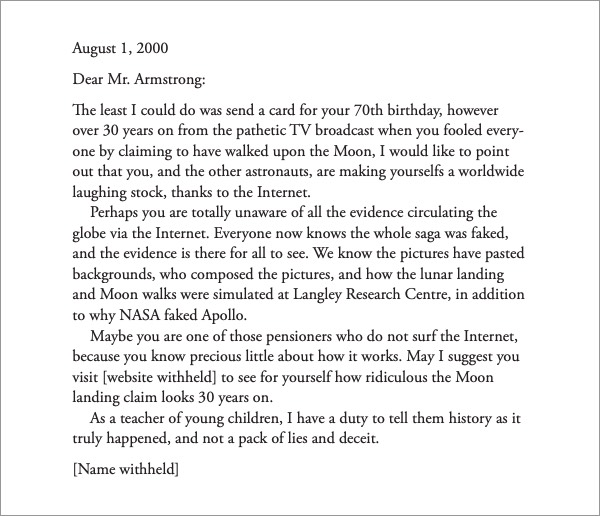
Mr. Whitman makes his accusations with certainty and smugness. “Perhaps you are totally unaware,” he writes, “of all the evidence circulating the globe via the Internet,” which he then summarizes.
He also sends Neil Armstrong—an astronaut who either walked on the Moon or engaged in perhaps the greatest conspiracy in history—a URL, “to see for yourself how ridiculous the Moon landing claim looks 30 years on.” Whitman sent Armstrong the letter on the astronaut’s 70th birthday.
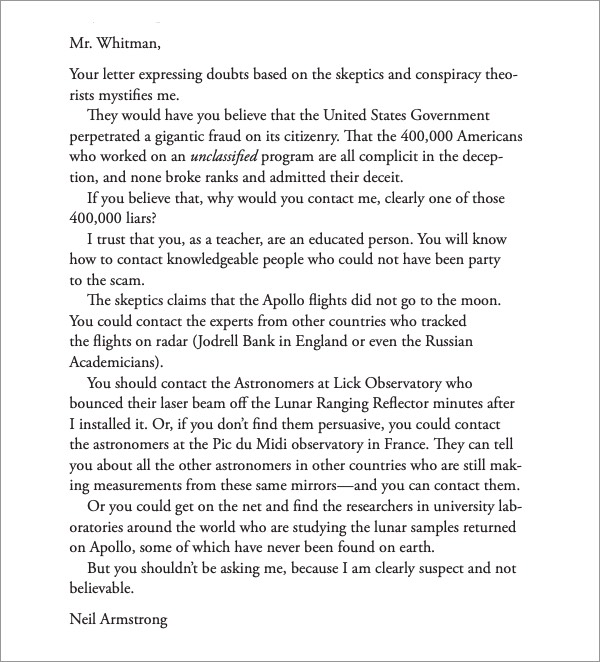
Armstrong’s response, via Letters of Note, can be read in full above. Perhaps Mr. Whitman learned something from the exchange—or had a moment of clarity about his methods of investigation. One can hope. In any case, Armstrong’s unsparing reply serves as a template for responding—should someone be so inclined—to internet truthers armed with wild conspiracy theories 20 years later. These letters have been collected in A Reluctant Icon: Letters to Neil Armstrong.
Related Content:
Stanley Kubrick Faked the Apollo 11 Moon Landing in 1969, Or So the Conspiracy Theory Goes
Josh Jones is a writer and musician based in Durham, NC. Follow him at @jdmagness
Read More...When John Maynard Keynes Predicted a 15-Hour Workweek “in a Hundred Year’s Time” (1930)
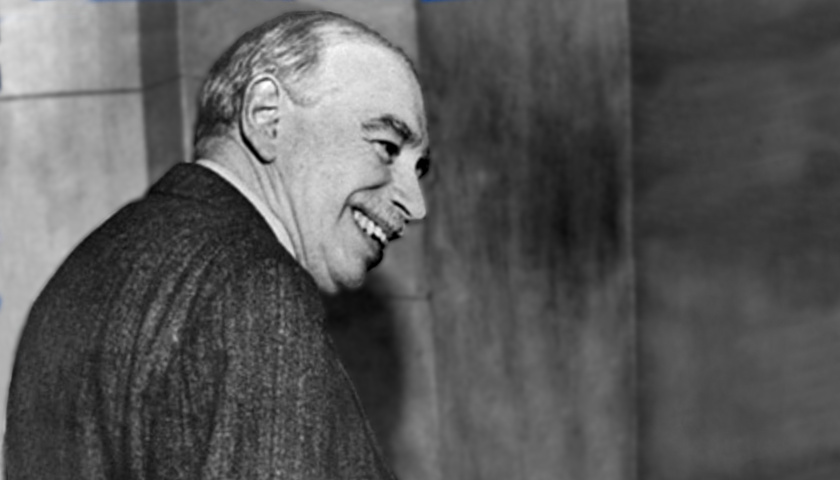
Image by IMF, via Wikimedia Commons
That which stands first, and is most to be desired by all happy, honest and healthy-minded men, is ease with dignity.
—Cicero, Pro Sestio, XLV., 98
There is much to admire in Roman ideas about the use of leisure time, what Michel Foucault referred to as “the care of the self.” The Latin words for work and leisure themselves give us a sense of what should have priority in life. Negotium, or business, is a negation, with the literal meaning of “the nonexistence of leisure” (otium). The English word—considered in its parts as “busy-ness”—doesn’t really sound much more appealing.
The notion that everyone, not just a propertied elite, however, should be entitled to leisure time came about only relatively recently—mostly advocated by radicals and trade unionists. In the U.S., anarchists and striking workers in Chicago fought against police in 1886 during the Haymarket Affair to achieve “Eight Hours for Work, Eight Hours for Rest, Eight Hours for What We Will.” In 1912, women-led immigrant strikers chanted “Bread and Roses” in Lawrence, Massachusetts, proclaiming their right to more than bare survival.
After the achievement of the 40-hour workweek, paid vacations, and other labor concessions, many influential figures believed that egalitarian access to leisure would only increase in the 20th century. Among them was economist John Maynard Keynes, who forecast in 1930 that labor-saving technologies might lead to a 15-hour workweek when his grandchildren came of age. Indeed, he titles his essay, “Economic Possibility for our Grandchildren.”
Writing at the start of the Great Depression, Keynes finds reason for optimism. “We are suffering,” he writes, “not from the rheumatics of old age, but from the growing-pains of over-rapid changes, from the painfulness of readjustment between one economic period and another.” Keynes’ essay concerns what he calls the “economic problem,” which is not only the problem of mass unemployment but also, in his estimation, the ability of capitalism to provide a decent standard of living for everyone. He did not see its failure to do so as evidence of a more fundamental dysfunction:
[T]his is only a temporary phase of maladjustment. All this means in the long run that mankind is solving its economic problem. I would predict that the standard of life in progressive countries one hundred years hence will be between four and eight times as high as it is to-day. There would be nothing surprising in this even in the light of our present knowledge. It would not be foolish to contemplate the possibility of afar greater progress still.
Many economists shared Keynes’ optimism through the 1970s, “a time when revolutionary change still seemed like an imminent possibility,” writes John Quiggan, professor of economics at the University of Queensland.” Utopian ideas were everywhere, exemplified by the Situationist slogan of 1968: ‘Be realistic. Demand the impossible.’” Cult figures like Buckminster Fuller explained, as had Keynes decades earlier, how technology could free everyone from the tyranny of the labor market and the scourge of “useless jobs.”
Keynes and others made a “case for leisure, in the sense of free time to use as we please, as opposed to idleness”—a distinction that draws from the ancient philosophers. “But Keynes offered something quite new: the idea that leisure could be an option for all, not merely for an aristocratic minority.” He was, obviously, mistaken. “At least in the English-speaking world,” Quiggan writes, “the seemingly inevitable progress towards shorter working hours has halted. For many workers it has gone into reverse.”
That has certainly been the case for the majority of workers in the U.S., at least before the novel coronavirus led to mass layoffs and reduced hours. What happened? For one thing, the ascension of neoliberal economics in the late 1970s, and the elections of Ronald Reagan and Margaret Thatcher, began a long slow decline of organized labor. “Employers have had increasing desire for workers to work long hours,” says Juliet Schor, professor of sociology at Boston College. “And workers haven’t had the power to resist that upward pressure.”
Keynes’ predictions resonated with NPR’s David Kestenbaum, who interviewed some of Keynes’ descendants, the closest thing he had to grandchildren, in a short segment on Planet Money in 2015. One Keynes relation points out the irony that the man himself “died from working too hard.” How can those of us who aren’t globally famous economists help end the tyranny of overwork? Maybe a lot more striking workers making demands; maybe a universal basic income or something like Bhutan’s “gross domestic happiness” index?
Keynes may have erred in his predictions of the future (though he seems to have understood the needs of his moment well enough), but he may not have been wrong to view the economic turmoil of his time as a radical opportunity for utopian change and better living for everyone. Overturning the dire conditions of the present for our own grandchildren will require not only hard work, but the leisure to do some visionary futurist thinking. Read Keynes’ full essay here.
Related Content:
An Animated Introduction to Economist John Maynard Keynes
The Case for a Universal Basic Income in the Time of COVID-19
Josh Jones is a writer and musician based in Durham, NC. Follow him at @jdmagness
Read More...After MLK’s Assassination, a Schoolteacher Conducted a Famous Experiment–“Blue Eyes/Brown Eyes”–to Teach Kids About Discrimination
Getting history across to young students is challenging enough, but what should a teacher do when actual history-making events happen on their watch? They have to be acknowledged, but to what extent do they have to be explained, even “taught”? Of the teachers who have turned history-in-the-making into a lesson, perhaps the most famous is Jane Elliott of Riceville, Iowa. On April 5, 1968, the day after Martin Luther King Jr.‘s assassination, she divided her classroom of third-graders along color lines: blue-eyed and brown-eyed. On the first day she granted the brown-eyed students such special privileges as desks in the front rows, second helpings at lunch, and five extra minutes of recess. The next day she reversed the situation, and the blue-eyed kids had the perks.
What brought serious attention to Elliott’s small-town classroom experiment was the resulting article in the Riceville Recorder, which reported some of what her students wrote in their assignments responding to the experience. The Associated Press picked up the article and soon Elliott received a call from The Tonight Show inviting her to come chat with Johnny Carson about her “Blue Eyes/Brown Eyes” exercise on national television.
“I didn’t know how this exercise would work,” Elliott tells Jimmy Fallon on the clip from the current Tonight Show at the top of the post. “If I had known how it would work, I probably wouldn’t have done it. If I had known that, after I did that exercise, I lost all my friends, no teacher would speak to me where they could be seen speaking to me, because it wasn’t good politics to be seen talking to the town’s only ‘N‑word lover.’ ”
Elliott’s family also experienced severe blowback from her sudden fame, but it didn’t stop her from furthering the clearly resonant idea she had devised. She continued to perform Blue Eyes/Brown Eyes in class: the third time, it was filmed and became the 1970 television documentary The Eye of the Storm. (Some of the language used by her students surely wouldn’t make it to the air today.) Fifteen years later, PBS’ Frontline reunited Elliott’s third-grade class of 1970 for its Emmy Award-winning episode A Class Divided, and a decade thereafter German filmmaker Bertram Verhaag would again film Elliott performing her signature exercise for the documentary Blue Eyed. In a variety of settings across America and the world, Elliott continues, in her late eighties, to make her point. It isn’t always well received, as she reveals in this Frontline follow-up interview, and at times has even drawn threats of violence. “I can be scared, but I won’t be scared to death,” she says. “Or, at my age, of death.”
via Boing Boing
Related Content:
How Martin Luther King, Jr. Used Nietzsche, Hegel & Kant to Overturn Segregation in America
Based in Seoul, Colin Marshall writes and broadcasts on cities, language, and culture. His projects include the book The Stateless City: a Walk through 21st-Century Los Angeles and the video series The City in Cinema. Follow him on Twitter at @colinmarshall, on Facebook, or on Instagram.
Read More...An Anti-Racist Reading List: 20 Books Recommended by Open Culture Readers
You may have received an email from your favorite online retailer, your boss, university president, or the CEO of your bank: “It has come to our attention that racism is real, and it is really, really bad.” Opportunism is real too, but a significant number of individuals seem to have finally drawn the same conclusion and feel morally compelled to do something about an epidemic that has—very discriminately—killed tens of thousands of black, indigenous, and people of color in the U.S. through the unequal distribution of medical resources, and dozens more at the hands of the police and racist vigilantes. That’s only in the past three months.
But racism isn’t new; the current conflict has been on its way for a very long time. How long? Anti-racist scholar and activist Ibram X. Kendi, author of the National Book Award-Winning Stamped from the Beginning, would say from the country’s earliest settlement and enslavement of African people. “For nearly six centuries,” he writes, “antiracist ideas have been pitted against two kinds of racist ideas: segregationist and assimilationist,” Kendi wrote during the protests in Ferguson and other U.S. cities. At the time, antiracists were largely characterized in mainstream media as fringe agitators, naïve Gen‑Z neophytes, and possible foreign agents, not “real Americans.”
How things have changed in six years. Antiracism has become a default position, all of a sudden, for perhaps the first time in U.S. history, so much so that every company and institution has issued some sort of statement in support of Black Lives Matter, and everyone is collecting and sharing Anti-Racist Reading Lists, nearly all of which contain Kendi’s follow-up book, last year’s How to Be an Anti-Racist (which he discusses above with Brené Brown). How long this will last is anyone’s guess, but it is without a doubt a cultural sea change a long time in the making.
Kendi and White Fragility author Robin DiAngelo are the “mac daddies of the bunch” of recent antiracist authors, Lauren Michele Jackson writes at Vulture, and it’s become a crowded field as more and more Americans attempt to come to grips with a national history many of them are learning for the first time. As Kendi and Pulitzer Prize-winning journalist Nikole Hannah-Jones, creator of the 1619 project, discuss on Chris Hayes’ podcast at the top, the country’s past as it is taught to us and as it happened are two entirely different things. Antiracism has always recognized the vicious, ceaseless murder, disenfranchisement, and ransacking of black and brown people, and has pushed against the narratives that deny or excuse these acts.
Carol Anderson, author of White Rage, has given us one of the most raw, compelling, and exhaustively researched accounts of the violence of Reconstruction and the lynchings of the early 20th century. Above, she links the murder of 25-year-old Ahmaud Arbery and recent police killings to the shockingly brutal racism that followed the Civil War. Anderson’s book also routinely appears on suggested reading lists, and well it should. All of these scholars and authors have produced accessible work full of histories one might previously have only encountered in graduate-level college and university courses. It is essential information for people committed to overturning racist systems, which is exactly why it has been left out of the textbooks.
For all the urgency of education, the anti-racist booklist is an ambiguous kind of currency. Jackson wonders what function it serves, exactly. Reading lists can be an erudite brush-off, a polite way of saying, “go away and read a book.” They can be a way to signal mastery and work for online merit badges rather than real beneficial action. They can “feel good to solicit, good to mete out, but someone at some point has to get down to the business of reading. And there, between giving and receiving, lies a great gulf. No one can quite account for what happens. Reading, hopefully, but you never can be sure.”
Jackson’s critique of the anti-racist reading list is worth reading before engaging with lists of books, recent and historical, that oppose racist ideas, policies, and systems. What are we looking for in such lists? And can we really make good use of them? She makes a case for why fiction, poetry, and drama should not appear, since they deserve the status of art, not as instrumental works of social change. “It is unfair,” Jackson writes, “to beg other literature and other authors, many of them dead, to do this sort of work for someone,” when the work they set out to do is primarily creative. Ignoring genre “reinforces an already pernicious literary divide that books written by or about minorities are for educational purposes” only.
Despite many potential blind spots, despite the fact that “our customarily wan attention spans have been decimated” by pandemic and protest, the reading “has to get done,” Jackson wearily admits. Anti-racist booklists must circulate. And readers must make critical judgments about which books to read and what to take away from them, since we’re given the equivalent of a syllabus without a class or an instructor. We trust that our readers can find their way and will make a good faith effort to do the reading. There won’t be a graded exam; the test is far more consequential than that.
We solicited an anti-racist reading list on Twitter and chose the books below submitted by our readers. Since there’s no such thing as a definitive list, and different kinds of readers have different needs, we include other collections of readings lists here, including “41 Children’s Books to Support Conversations on Race, Racism, and Resistance.” You’ll find an anti-racist reading list on Twitter, here, compiled by doctoral researcher Victoria Alexander, and a list on LinkedIn entitled “Why White People Stay Silent on Racism, and What to Read First,” from organizational psychologist Adam Grant.
If this is overwhelming but you feel you must start to engage with the history and theory of anti-racism, don’t despair or buy a pile of books you know you can’t read right now. All of the most prominent anti-racist authors have been in high demand for interviews. “There are snappier places to glean the long-story-short of America, like podcasts, if it took someone this long to care,” writes Jackson, or if, like so many millions of other stressed out, angry, grieving, out-of-work Americans, you’re simply too burned out to crack another book. But if you’re willing and able to dig in, see our reader-submitted list below and suggest other titles you’d recommend in the comments. If you prefer audiobooks, many of these texts also exist as audiobooks on Audible. Get details on Audible’s free trial here.
Between the World and Me—Ta-Nehisi Coates: Hailed by Toni Morrison as “required reading,” a bold and personal literary exploration of America’s racial history by “the most important essayist in a generation and a writer who changed the national political conversation about race” (Rolling Stone)
Biased: Uncovering the Hidden Prejudice That Shapes What We See, Think, and Do—Jennifer L. Eberhardt PhD: How do we talk about bias? How do we address racial disparities and inequities? What role do our institutions play in creating, maintaining, and magnifying those inequities? What role do we play? With a perspective that is at once scientific, investigative, and informed by personal experience, Dr. Jennifer Eberhardt offers us the language and courage we need to face one of the biggest and most troubling issues of our time. She exposes racial bias at all levels of society—in our neighborhoods, schools, workplaces, and criminal justice system. Yet she also offers us tools to address it.
Black Like Me—John Howard Griffin: The history-making classic about crossing the line in America’s segregated south. The Atlanta Journal & Constitution calls it “One of the deepest, most penetrating documents yet set down on the racial question.”
How To Be An Antiracist — Ibram X. Kendi: “What do you do after you have written Stamped From the Beginning, an award-winning history of racist ideas? … If you’re Ibram X. Kendi, you craft another stunner of a book.… What emerges from these insights is the most courageous book to date on the problem of race in the Western mind, a confessional of self-examination that may, in fact, be our best chance to free ourselves from our national nightmare.”—The New York Times
I Can’t Breathe: A Killing on Bay Street—Matt Tiabbi: A work of riveting literary journalism that explores the roots and repercussions of the infamous killing of Eric Garner by the New York City police.
Just Mercy: A Story of Justice and Redemption—Bryan Stevenson: “Every bit as moving as To Kill a Mockingbird, and in some ways more so … a searing indictment of American criminal justice and a stirring testament to the salvation that fighting for the vulnerable sometimes yields.”—David Cole, The New York Review of Books
On the Courthouse Lawn: Confronting the Legacy of Lynching in the Twenty-First Century—Sherrilyn A. Ifill: “This pathbreaking book by Sherrilyn Ifill shows how the ugliest messages from our racial history and politics can hide openly in the public square. Her unflinching memory restores hope for the common good.”—Taylor Branch, Pulitzer Prize–winning author of Parting the Waters
So You Want to Talk About Race—Ijeoma Oluo: “Ijeoma Oluo’s [book] is a welcome gift to us all — a critical offering during a moment when the hard work of social transformation is hampered by the inability of anyone who benefits from systemic racism to reckon with its costs. Oluo’s mandate is clear and powerful: change will not come unless we are brave enough to name and remove the many forces at work strangling freedom. Racial supremacy is but one of those forces.” ―Darnell L. Moore, author of No Ashes in the Fire
Stamped from the Beginning: The Definitive History of Racist Ideas in America—Ibram X. Kendi: The National Book Award winning history of how racist ideas were created, spread, and deeply rooted in American society. In this deeply researched and fast-moving narrative, Kendi chronicles the entire story of anti-black racist ideas and their staggering power over the course of American history. He uses the life stories of five major American intellectuals to drive this history: Puritan minister Cotton Mather, Thomas Jefferson, abolitionist William Lloyd Garrison, W.E.B. Du Bois, and legendary activist Angela Davis.
Stamped: Racism, Antiracism, and You—Jason Reynolds and Ibram X. Kendi: “Readers who want to truly understand how deeply embedded racism is in the very fabric of the U.S., its history, and its systems will come away educated and enlightened. Worthy of inclusion in every home and in curricula and libraries everywhere. Impressive and much needed.” ―Kirkus
Sundown Towns—James Loewen: In this groundbreaking work, sociologist James W. Loewen brings to light decades of hidden racial exclusion in America. In a sweeping analysis of American residential patterns, Loewen uncovers the thousands of “sundown towns”—almost exclusively white towns where it was an unspoken rule that blacks weren’t welcome—that cropped up throughout the twentieth century, most of them located outside of the South.
The Autobiography of Malcolm X: As Told to Alex Haley: In the searing pages of this classic 1964 autobiography, Malcolm X outlines the lies and limitations of the American Dream, along with the inherent racism in a society that denies its nonwhite citizens the opportunity to dream.
The Color of Law—Richard Rothstein: Rothstein argues with exacting precision and fascinating insight how segregation in America—the incessant kind that continues to dog our major cities and has contributed to so much recent social strife—is the byproduct of explicit government policies at the local, state, and federal levels.
The Fire Next Time—James Baldwin: “Baldwin’s bestseller from 1963, which commemorated the centennial of the signing of the Emancipation Proclamation, still resonates powerfully today. The late author’s book consists of two essays that examine racial injustice in America, including his own experience growing up as a black teenager in Harlem.”
The New Jim Crow: Mass Incarceration in the Age of Colorblindness —Michelle Alexander: The New Jim Crow “took the academy and the streets by storm, and forced the nation to reconsider the systems that allowed for blatant discrimination.”—The Chronicle of Higher Education
The Other by Wes Moore: “This is a fascinating book about two young men from Baltimore with the same name. One, the author, became a Rhodes Scholar while the other landed in jail. It’s as much a meditation on circumstance and luck as it is a commentary on how successful our society is in managing those who are on the precipice, both socially and economically.”
The Person You Mean to Be: How Good People Fight Bias—Dolly Chugh: An inspiring guide from Dolly Chugh, an award-winning social psychologist at the New York University Stern School of Business, on how to confront difficult issues including sexism, racism, inequality, and injustice so that you can make the world (and yourself) better.
The Warmth of Other Suns—Isabel Wilkerson: In this epic, beautifully written masterwork, Pulitzer Prize–winning author Isabel Wilkerson chronicles one of the great untold stories of American history: the decades-long migration of black citizens who fled the South for northern and western cities, in search of a better life.
White Fragility: Why It’s So Hard for White People to Talk About Racism—Robin DiAngelo: The New York Times best-selling book exploring the counterproductive reactions white people have when their assumptions about race are challenged, and how these reactions maintain racial inequality.
White Rage—Carol Anderson: “White Rage is a riveting and disturbing history that begins with Reconstruction and lays bare the efforts of whites in the South and North alike to prevent emancipated black people from achieving economic independence, civil and political rights, personal safety, and economic opportunity.” — The Nation
Why Are All the Black Kids Sitting Together in the Cafeteria?—Beverly Daniel Tatum: Walk into any racially mixed high school and you will see Black, White, and Latino youth clustered in their own groups. Is this self-segregation a problem to address or a coping strategy? Beverly Daniel Tatum, a renowned authority on the psychology of racism, argues that straight talk about our racial identities is essential if we are serious about enabling communication across racial and ethnic divides. This fully revised edition is essential reading for anyone seeking to understand the dynamics of race in America.
Related Content:
Josh Jones is a writer and musician based in Durham, NC. Follow him at @jdmagness
Read More...Sir Isaac Newton’s Cure for the Plague: Powdered Toad Vomit Lozenges (1669)

Nearly 300 years after his death, Isaac Newton lives on as a byword for genius. As a polymath whose domain encompassed astronomy, physics, and mathematics, he mastered and expanded the domain of scientific knowledge available to 17th-century Europe. But if we remember him as a one-man engine of the scientific revolution, we should also bear in mind his contrasting intellectual frailties: Newton was no financial genius, as evidenced by his loss of $3 million in the South Sea Bubble of 1720, and though his inquiries into alchemy may be fun to re-enact today, we wonder now why he didn’t see them as a dead end even then. And then we have his forays into medicine, one of which involves toad vomit.
“Two unpublished pages of Newton’s notes on Jan Baptist van Helmont’s 1667 book on plague, De Peste, are to be auctioned online by Bonham’s this week,” reported The Guardian’s Alison Flood earlier this month. “Newton had been a student at Trinity College, Cambridge, when the university closed as a precaution against the bubonic plague, which killed 100,000 people in London in 1665 and 1666. When the polymath returned to Cambridge in 1667, he began to study the work of Van Helmont,” a famous Belgian physician. While some of the conclusions Newton drew from his study of Van Helmont’s work remain practical today — “places infected with the plague are to be avoided,” for instance — his suggested cures may not hold up to scrutiny.
In the “best” plague treatment observed by Newton, “a toad suspended by the legs in a chimney for three days, which at last vomited up earth with various insects in it, on to a dish of yellow wax, and shortly after died. Combining powdered toad with the excretions and serum made into lozenges and worn about the affected area drove away the contagion and drew out the poison.” Learning how, exactly, Newton found his way to such a procedure will inspire enthusiastic collectors to bid on these papers, which remain on the Bonham’s online auction block until June 10th. Newton may, as we recently noted here on Open Culture, have had some of his most groundbreaking ideas during the era of the plague, but even a mind as formidable as his by its very nature missed a few times, sometimes wildly, for every hit. Yet as the world’s scientific-industrial complex races to develop a vaccine for COVID-19, we might consider what unorthodox solutions have gone overlooked in our Newton-less era.
Related Content:
Isaac Newton Conceived of His Most Groundbreaking Ideas During the Great Plague of 1665
Videos Recreate Isaac Newton’s Neat Alchemy Experiments: Watch Silver Get Turned Into Gold
In 1704, Isaac Newton Predicts the World Will End in 2060
Sir Isaac Newton’s Papers & Annotated Principia Go Digital
Based in Seoul, Colin Marshall writes and broadcasts on cities, language, and culture. His projects include the book The Stateless City: a Walk through 21st-Century Los Angeles and the video series The City in Cinema. Follow him on Twitter at @colinmarshall, on Facebook, or on Instagram.
Read More...Watch Free Films by African American Filmmakers in the Criterion Collection … and the New Civil Rights Film, Just Mercy
The Michael B. Jordan- and Jaime Foxx-starring Just Mercy had “the misfortune of hitting theaters at the same time as Clemency, a more daring and better film set on a prison’s Death Row,” wrote Odie Henderson in a December 2019 review at RogerEbert.com. Reading the statement now feels like looking through the wrong end of a telescope (“hitting theaters?”). None of the movie’s middling reviews could have predicted the kinds of misfortunes that lay just around the corner.
If Just Mercy is your kind of distraction, you can watch it free of charge through June. Henderson’s review gives me the impression it may not be equal to the moment.
Since the days of ’50s-era message pictures, the majority of films about African-American suffering have always been calibrated the way “Just Mercy” is, with an eye to not offending White viewers with anything remotely resembling Black anger. We can be beaten, raped, enslaved, shot for no reason by police, victimized by a justice system rigged to disfavor us or any other number of real-world things that can befall us, yet God help us if a character is pissed off about this. Instead, we get to be noble, to hold on to His unchanging hand while that tireless Black lady goes “hmmm-HMMMMM!” on the soundtrack to symbolize our suffering. There’s a lot of “hmmm-HMMMMM”-ing in this movie, so much so that I had to resist laughing.
Only one critic’s opinion, but if such pious, boilerplate films haven’t changed anything since the 50s they probably aren’t about to now.
The Criterion Collection offers a refreshing alternative for representations of the black experience on film, as envisioned by black filmmakers, writers, actors, producers, etc. “This has been a powerfully emotional time,” the Collection writes, citing a string of high-profile, well-documented racist threats and murders that lead up to the breaking point:
Black Lives Matter. The anguish and fury unleashed all across the country are rooted in centuries of dehumanization and death. This pattern must stop. We support the protesters who have taken to the streets to demand justice, and we share their hopes. We are committed to fighting systemic racism.
The Collection has established an “employee-guided fund with a $25,000 initial contribution and an ongoing $5000 monthly commitment to support organizations fighting racism in America.”
More to the point of their central mission, they’re allowing visitors to the Criterion Channel to stream “works by early pioneers of African American Cinema” as well as those by current filmmakers. These are films that can be difficult to find outside of arthouse cinemas and college screening rooms. “Titles streaming for free,” notes IndieWire, “include Julie Dash’s Daughters of the Dust, Maya Angelou’s Down in the Delta, Shirley Clarke’s Portrait of Jason, Agnès Varda’s Black Panthers, Kathleen Collins’ Losing Ground, and many more.”
Also streaming free on the site is “contemporary work by Khalik Allah and Leilah Weinraub; and documentary portraits of the black experience by white filmmakers Les Blank and Shierley Clarke,” Criterion writes, noting that they’ve “taken down the paywall on as many of these titles as we can.”
This announcement will have little effect on people committed to a particularly vicious way of seeing things, but it offers a rare opportunity to watch a diverse collection of enlightening, often bracing, often deeply moving films, stretching over a century, for free. This body of work offers new perspectives on the past and wider understanding of film history. They may just be what you need to get through June. Check out the Criterion Channel collections here.
Related Content:
Watch the Pioneering Films of Oscar Micheaux, America’s First Great African-American Filmmaker
Josh Jones is a writer and musician based in Durham, NC. Follow him at @jdmagness
Read More...When Afrobeat Legend Fela Kuti Collaborated with Cream Drummer Ginger Baker
At the end of the 60s, superstar drummer and angriest man in rock Ginger Baker was on the verge of collapse. Strung out on heroin, deeply grieving Jimi Hendrix’s death, and alienated from his former Cream and Blind Faith bandmates, he needed a new direction. He found it in Nigeria, where he decamped after driving a Range Rover from Algeria across the Sahara Desert. (A madcap adventure captured in the 1971 documentary Ginger Baker in Africa). Once in Lagos, Baker started jamming with Afrobeat legend Fela Kuti.
The meeting of these two musical forces of nature produced a suite of recordings. “Baker’s drumming appeared on several albums alongside the Nigerian king of afrobeat,” writes Okay Africa, “including Why Black Man Dey Suffer (1971), Live! (1972) and Stratavarious (1972).”
Kuti’s longtime drummer and arranger—and inventor of the “afrobeat”—Tony Allen was highly impressed with Baker’s range, and Nigerians, as Jay Bulger writes at Rolling Stone, loved him.
Arriving in Lagos, Nigeria, Baker set up west Africa’s first 16-track recording studio and formed a lifelong friendship with Afrobeat star Fela Kuti. Performing with the musical icon for crowds of 150,000, Baker became famous throughout Nigeria as the “Oyinbo” (White) Drummer. “If Ginger wants to play jazz, he plays jazz,” says the Nigerian drummer Tony Allen. “If he wants to play rock, he starts Cream. If he wants to play Afrobeat, he moves to Nigeria. Whatever he plays, he brings his own pulse and sound. He understands the African beat more than any other Westerner.”
High praise, but Baker didn’t seek the spotlight, his enormous ego offstage notwithstanding. He trained and he learned. Always a collaborative player, by his own description, Baker adapted himself to the needs of the music. In Kuti’s band, he found a well-drilled ensemble and in Fela himself, a kindred spirit with a personality as grandiose and captivating as his own, though Baker’s particular charms were maybe best appreciated at a distance. Hear the loose, sprawling Live! above, with annotations telling the story of the two legends in brief.
Baker and Kuti first met in the early 60s in London when Fela studied at Trinity College of Music. Once they finally connected musically, the sound was explosive, thanks to Baker’s recording studio and Fela’s New Afrika Shrine, the performance space where the live magic happened night after night. Then there are the war stories—not only sex, drugs, and rock and roll, but also the actual Nigerian Army trying to shut down Fela’s compound, which he called the Kalakuta Republic, and which housed his 27 backup singers and his studio. The bandleader was beaten and jailed over and over, and the commune was finally burned to the ground in 1977.
The video above from YouTuber Bandsplaining gives an entertaining synopsis of the Baker/Fela story, though beware, as several commenters have pointed out, it contains several inaccuracies, including at the outset the suggestion that Fela has only recently received widespread recognition. This, of course, is totally false—Latin American musicians have celebrated his fusion of African polyrhythms, big band funk, and psychedelic rock for decades; in Nigeria and elsewhere in Africa, Fela was as big a musical god as Clapton in England, as well as a powerful spiritual and political symbol of Pan-African socialism; and in the US and UK, New Wave bands like Talking Heads made entire albums building on Fela’s inspiration.
One might think of Baker’s collaboration with Fela Kuti and the Afrika ‘70 as an early international supergroup, of the kind that would become commonplace in later decades. But Baker didn’t use Fela’s music as a backdrop for his own brand. He was thrilled just to be there in the band.
Related Content:
See Why Ginger Baker (RIP) Was One of the Greatest Drummers in Rock & World Music
Josh Jones is a writer and musician based in Durham, NC. Follow him at @jdmagness.
Read More...Support Us
We're hoping to rely on loyal readers, rather than erratic ads. Please click the Donate button and support Open Culture. You can use Paypal, Venmo, Patreon, even Crypto! We thank you!

About Us

Open Culture scours the web for the best educational media. We find the free courses and audio books you need, the language lessons & educational videos you want, and plenty of enlightenment in between.
Advertise With Us
FREE UPDATES!
GET OUR DAILY EMAIL
Get the best cultural and educational resources on the web curated for you in a daily email. We never spam. Unsubscribe at any time.
FOLLOW ON SOCIAL MEDIA
Open Culture editor Dan Colman scours the web for the best educational media. He finds the free courses and audio books you need, the language lessons & movies you want, and plenty of enlightenment in between.
Advertise With Us


_(cropped).jpg)
