Behold a Beautiful 400-Year-Old ‘Friendship Book’ Featuring the Signatures of Historic Figures
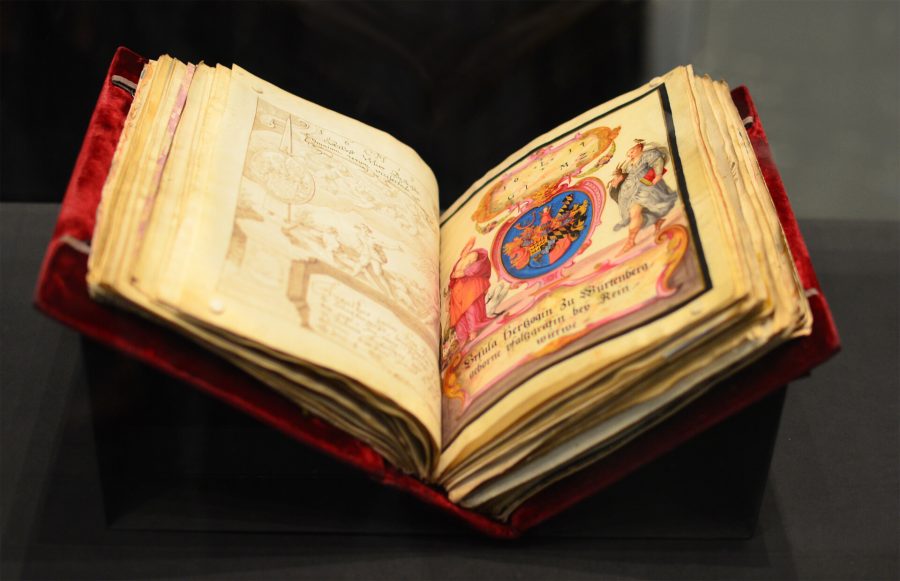
Maintaining the balance of power among European states has always been a fraught affair, but it was especially so in the years when mercantilism made fragile alliances during the religious wars of the 17th century. This was a time when merchants made excellent diplomats, not only because they traveled extensively and learned foreign tongues and customs, but because they spoke the universal language of trade.
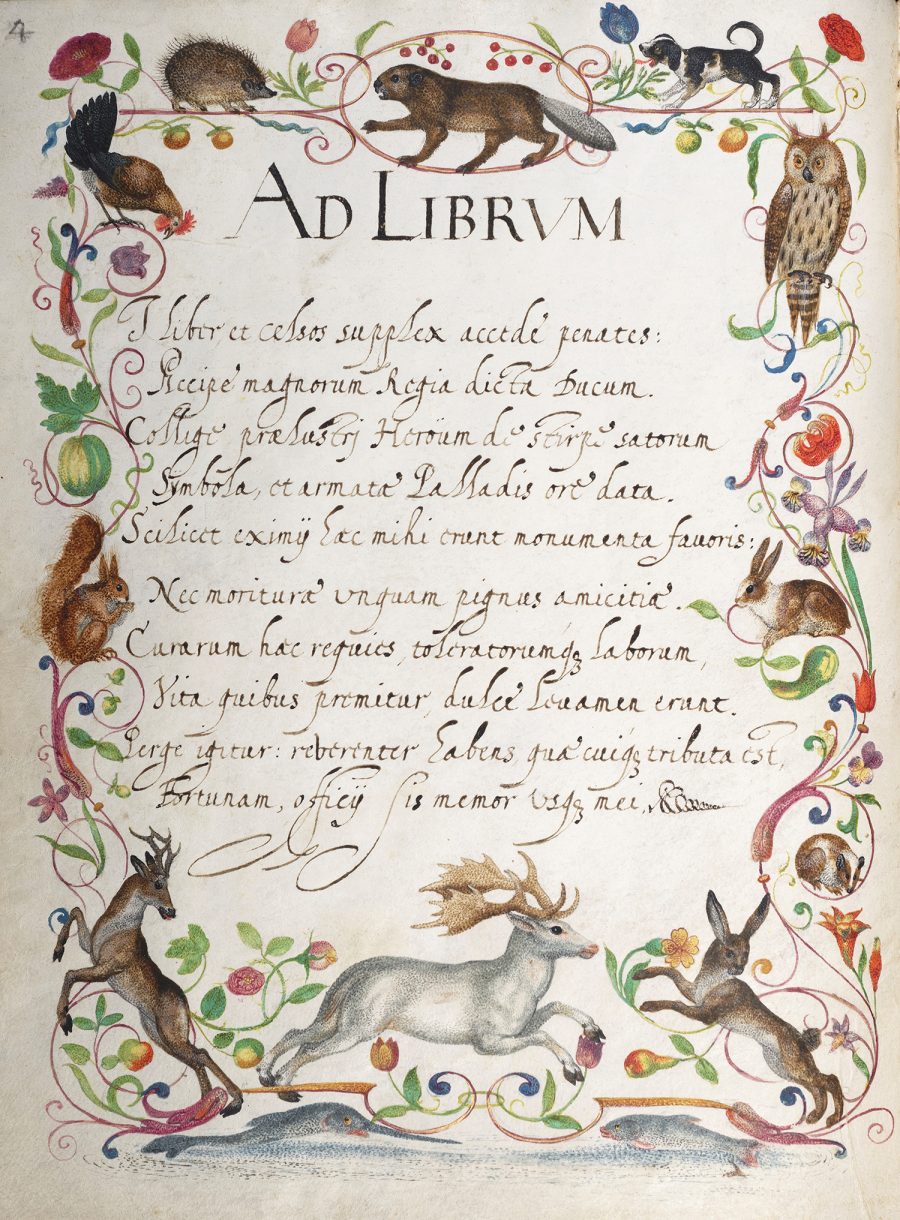
German merchant and diplomat Philipp Hainhofer from Augsburg was such a figure, traveling from court to court to meet with Europe’s renowned dignitaries. As he did so, he would ask them to sign his album amicorum, or “friendship book,” also called a stammbuch. Each signer would then “commission an artist to create a painting accompanying their signatures,” Alison Flood writes at The Guardian.
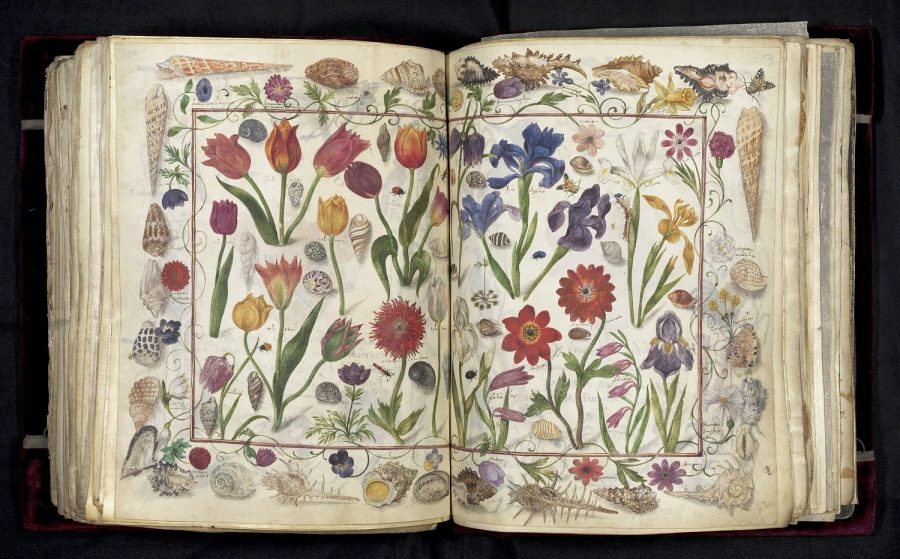
“There are around 100 drawings” in his autograph book, known as the Große Stammbuch, “which took more than 50 years to compile.” After Hainhofer’s death in 1647, his friend August the Younger—who helped collect the hundreds of thousand of books in the Herzog August Bibliothek—tried to acquire the book but failed. Now it has finally landed in the huge library, one of the world’s oldest, almost 400 years later, after a purchase at a private auction this week.
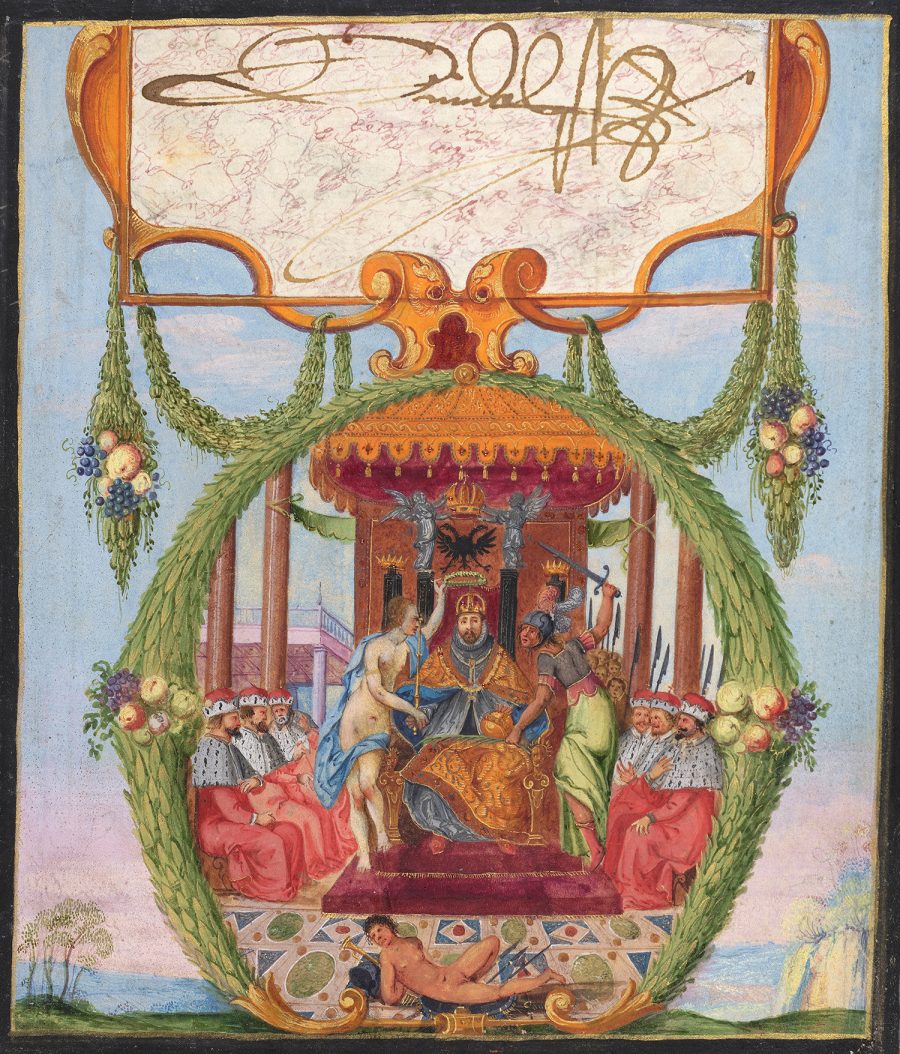
Friendship books were commonly used at the time to record the names of family and friends. Students used them as yearbooks, and Hainhofer began his collection of signatures as a college student. He gradually gained a select clientele as his career advanced. Signatories, the History Blog points out, “include Holy Roman Emperor Rudolf II, another HRE Matthias, Christian IV of Denmark and Norway, Cosimo II de’Medici, Grand Duke of Tuscany…” and many others.
Hainhofer’s Große Stammbuch is, as you can see, a beautiful work of art—or almost 100 collected works of art—in its own right. “The elaborateness of the illustrations directly corresponds to the signatory’s status and rank in society,” as Grace Ebert notes at Colossal. It is also a fascinating record of Early Modern European politics, trade, and diplomacy, a fine art all its own.
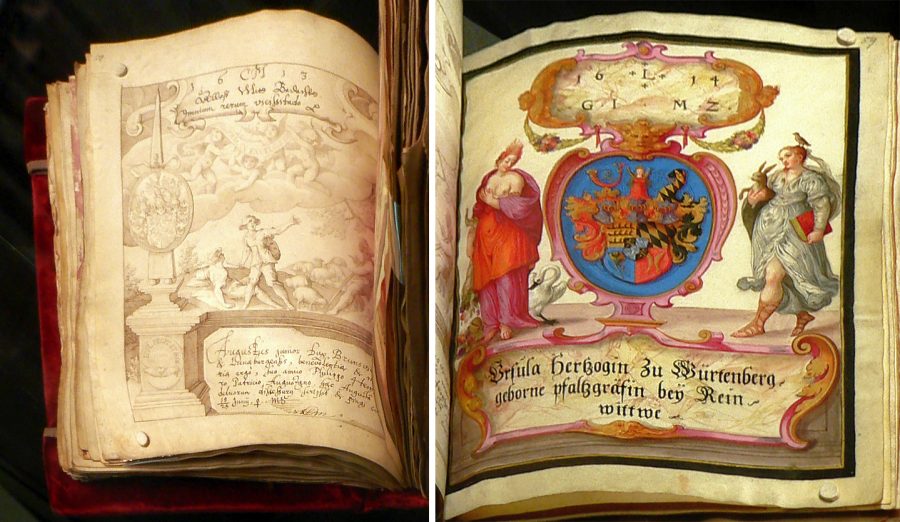
via Colossal
Related Content:
Josh Jones is a writer and musician based in Durham, NC. Follow him at @jdmagness
Read More...Nina Simone Writes an Admiring Letter to Langston Hughes: “Brother, You’ve Got a Fan Now!” (1966)
Nina Simone’s creative and political community meant everything to her, and the many losses she suffered in the 60s sent her deeper into the depression of the last decades of her life. “Langston Hughes, James Baldwin, and Lorraine Hansberry [were] prominent,” writes Malik Gaines at LitHub, “among… socially engaged writers and dramatists” whom she considered not only her “political tutors” but also her heroes and closest friends. She never stopped grieving the loss of Hansberry and Hughes and frequently memorialized them in tributes like “Backlash Blues.”
Written by Hughes, and one of Simone’s fiercest and most timely civil rights songs, “Backlash Blues” represents the significant influence the poet had on her and her art. In a live 1967 recording, she sings, “When Langston Hughes died—He told me many months before—Nina keep working until they open up that door.” The two first met when Simone was still Eunice Waymon from Tryon, North Carolina: an aspiring classical pianist, “president of the 11th-grade class and an officer with the school’s NAACP chapter,” explains Andrew J. Fletcher, a board member of the Nina Simone Project in Asheville.
This was 1949, and Hughes had come to Asheville to address Allen High School, the private school for African American girls Simone attended through a scholarship that her music teacher and early champion collected from her hometown. The poet “could not have known,” Maria Popova writes at Brain Pickings, “that [Simone] would soon revolutionize the music canon under her stage name.” But nearly ten years later, he recognized her talent immediately.
On the release of Simone’s first album, Little Girl Blue, Hughes was “so stunned that he lauded it with lyrical ardor” in his column for the Chicago Defender.
She is different. So was Billie Holiday, St. Francis, and John Donne. So in Mort Sahl. She is a club member, a coloured girl, an Afro-American, a homey from Down Home. She has hit the Big Town, the big towns, the LP discs and the TV shows — and she is still from down home. She did it mostly all by herself. Her name is Nina Simone.
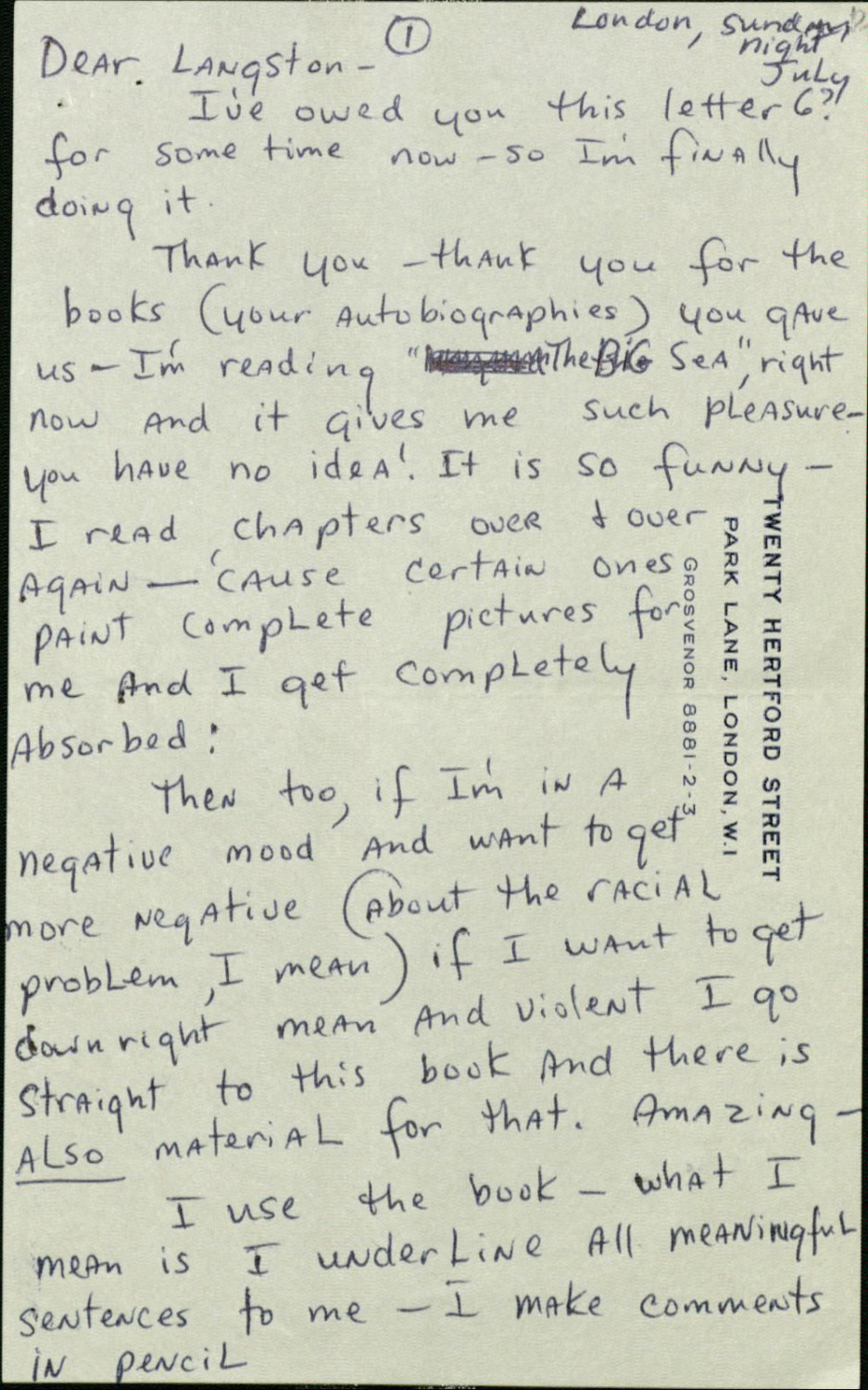
They would become close friends and mutual admirers. Hughes sent her “books he thought would inspire her,” including several of his own, and wrote “words for her to set to song.” She wrote to him with earnest expressions of appreciation, especially in the letter here, penned in 1966 just before Hughes’ death.
Simone had just read Hughes’ autobiography The Big Sea. The book, she says, “gives me such pleasure—you have no idea! It is so funny.” She also writes, with candor:
Then too, if I’m in a negative mood and want to get more negative (about the racial problem, I mean) if I want to get downright mean and violent I go straight to this book and there is also material for that. Amazing—
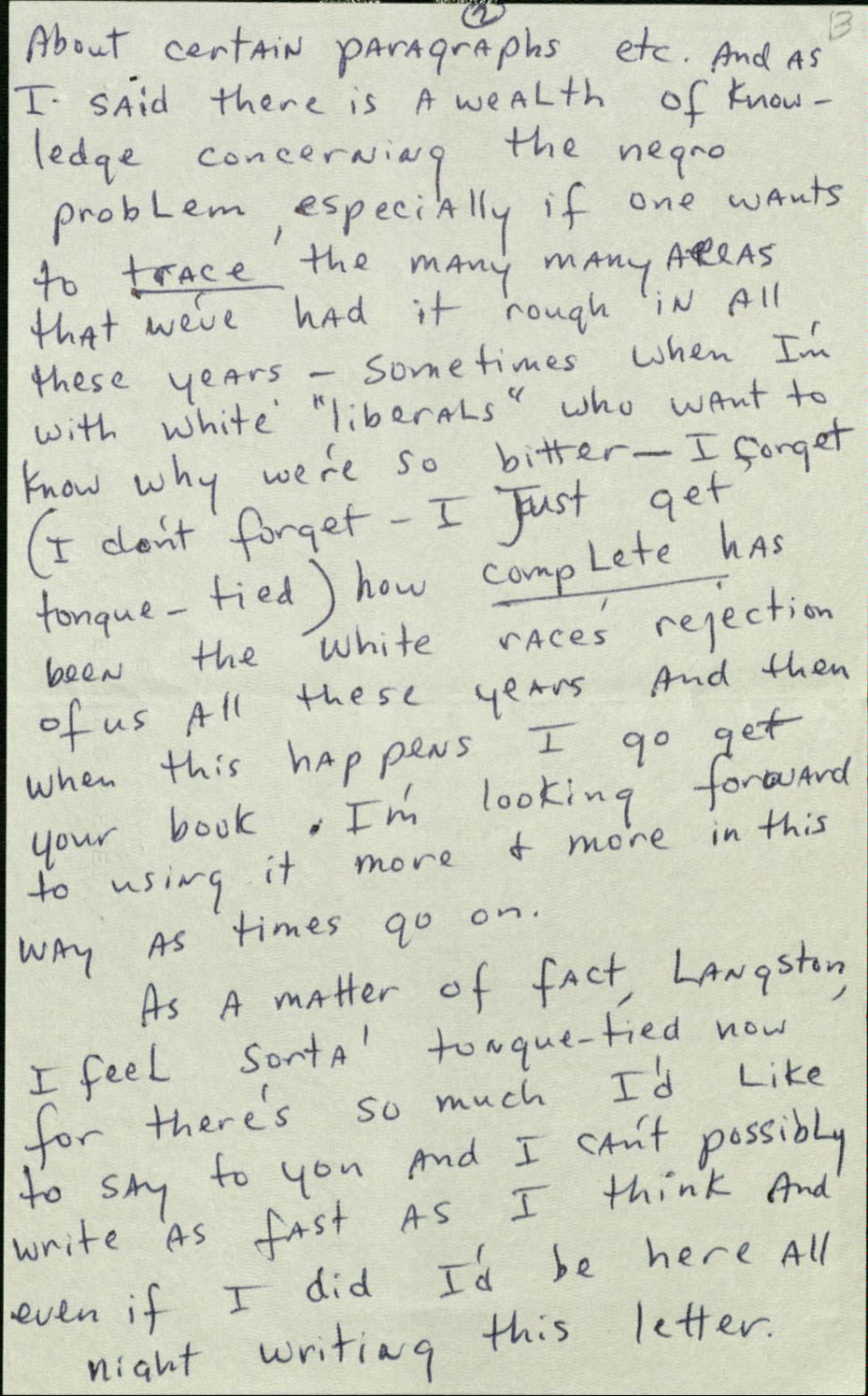
I use the book—what I mean is I underline all meaningful sentences to me…. And as I said there is a wealth of knowledge concerning the negro problem, especially if one wants to trace the many many areas that we’ve had it rough in all these years—sometimes when I’m with white “liberals” who want to know why we’re so bitter—I forget (I don’t forget—I just get tongue-tied) how complete has been the white races’ rejection of us all these years and then when this happens I go get your book.
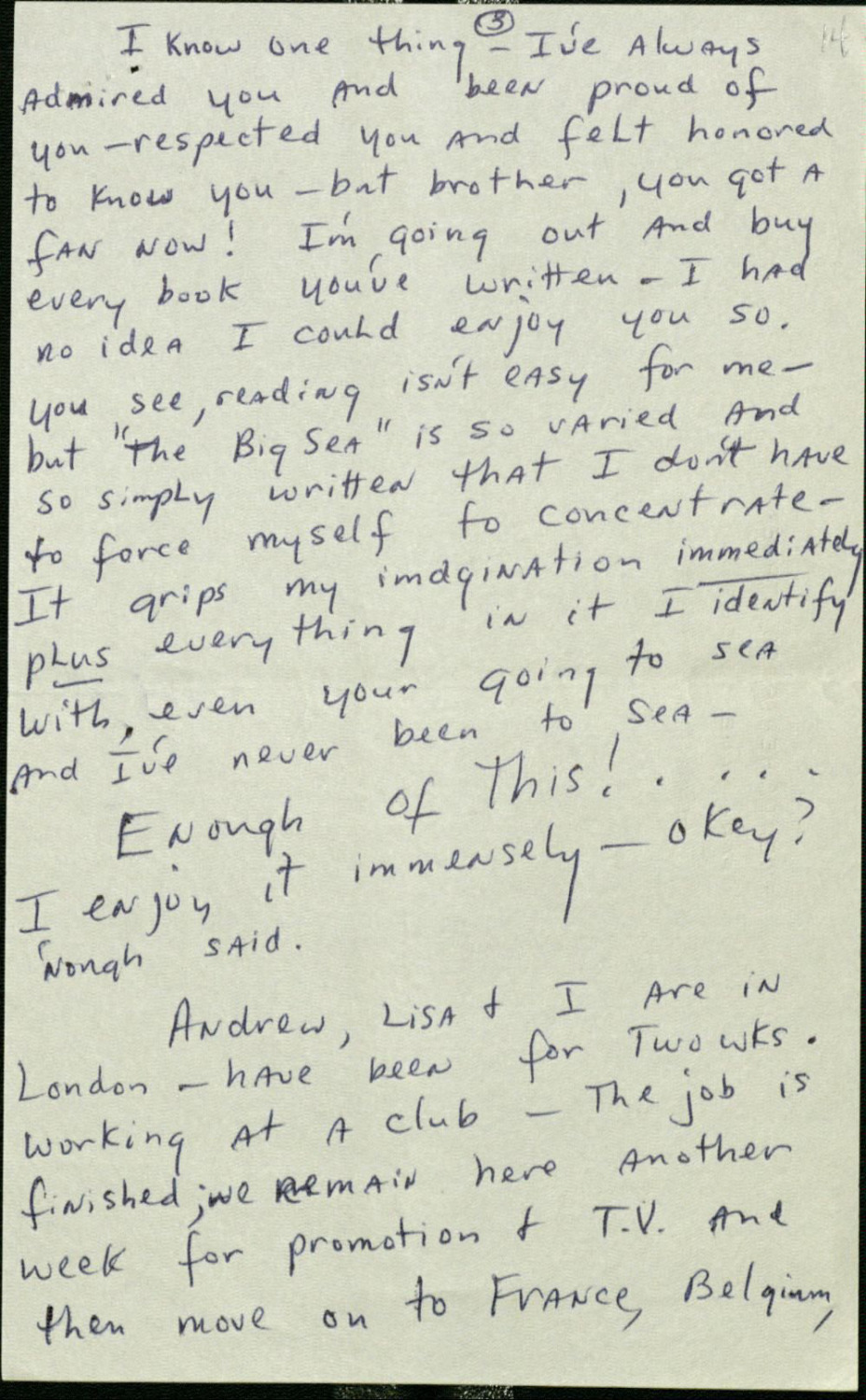
Hughes’ is rarely “mean and violent,” but Simone brought to her reading her own despair and rage and raw sense of rejection, emotions she was never afraid to explore in her work or talk about with humor and fierce ire in her life. “Brother, you’ve got a fan,” she gushes. The Big Sea “grips my imagination immediately plus everything in it I identify with, even your going to sea and I’ve never been to sea.” She had not been to sea, but she had been adrift, “depressed, alienated and low,” as she sang at Morehouse College in 1969 in a performance of her civil rights anthem and tribute to Lorraine Hansberry, “To Be Young, Gifted and Black.”
The adlib framed Simone’s feelings with the same “emotional and political dimensions,” writes Gaines, she found in Hughes’ work. Though she does not mention it in her letter, her annotated copy of The Big Sea surely marks up the passage below, in which Hughes’ describes his early unhappiness and his transformative encounter with art:
When I was in the second grade, my grandmother took me to Lawrence to raise me. And I was unhappy for a long time, and very lonesome, living with my grandmother. Then it was that books began to happen to me, and I began to believe in nothing but books and the wonderful world in books–where if people suffered, they suffered in beautiful language, not in monosyllables, as we did in Kansas.
For Simone, music gave her suffering purpose, but not the music she played for audiences and on record. One of the saddest ironies of her career is that the woman dubbed “The High Priestess of Soul” had little interest in playing soul. She embarked on her popular music career to fund her classical education. However, the opportunities to play the way she wanted to did not arise. “Nina closed her letter on a strangely down note,” writes Nadine Cohodas in Princess Noire: The Tumultuous Reign of Nina Simone. “Her melancholy overwhelmed any excitement about playing for the first time in France and Belgium. ‘No pleasure,’ she told Langston, ‘just work.’”
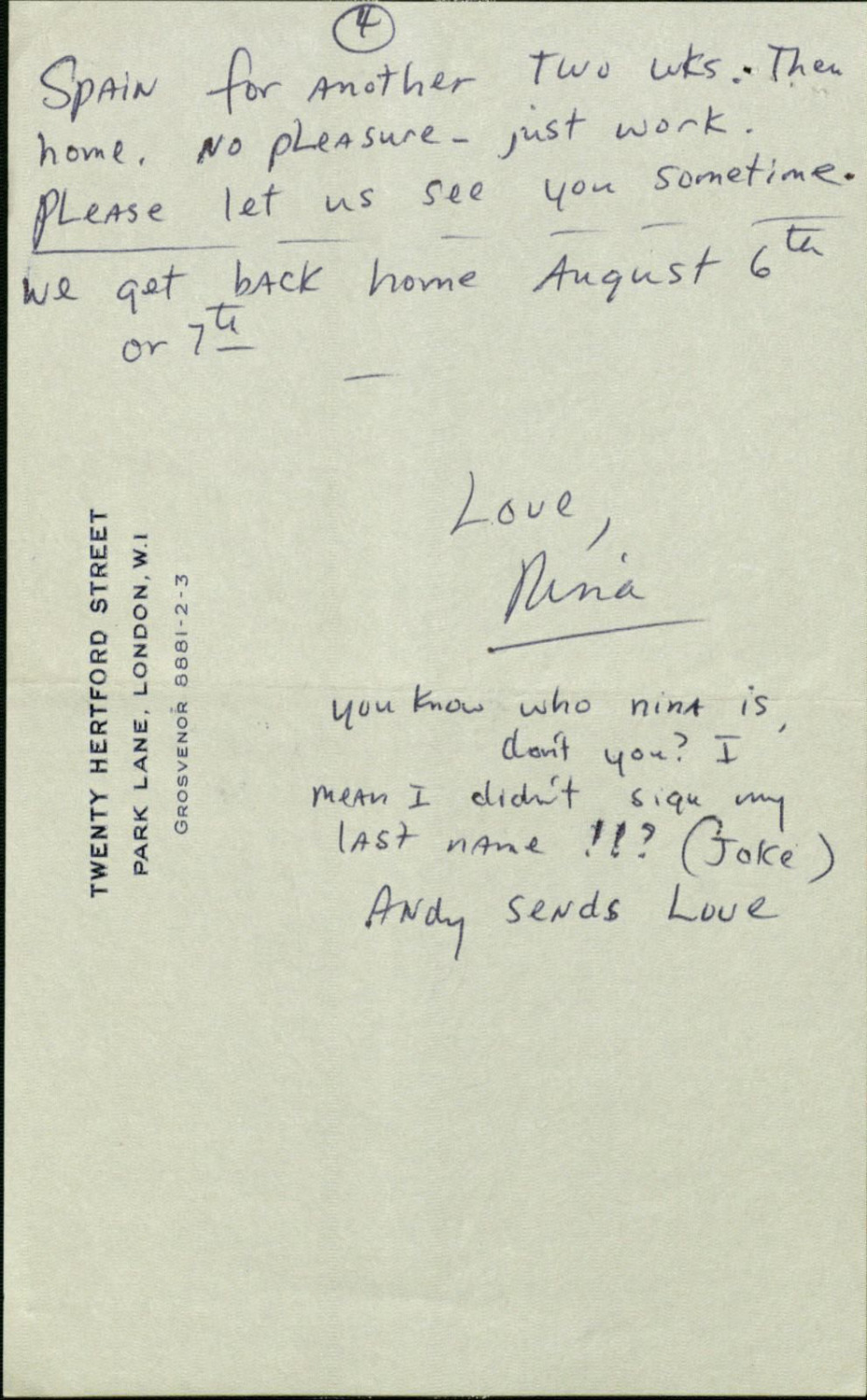
So much of Simone’s frustration and burnout in the music industry came out of a deep sense of alienation from her work. The shy Eunice Waymon had never craved the spotlight, something Hughes must have come to know about her in the years of their acquaintance. In his first note of praise, however, he gets one thing wrong. As she was always the first to point out, Simone did not do it “mostly all by herself.”
The support of her mother, her teacher, and her small “down home” community took her as far as it could. Her relationships with Hansberry, Hughes, and other artists/activists carried her the rest of the way. Until they were gone. But when Hughes died, Popova writes, “a devastated Simone turned her coveted set at the Newport Jazz Festival into a tribute and closed it with an exhortation to the audience: ‘Keep him with you always. He was a beautiful, a beautiful man, and he’s still with us, of course.’” See much more of their correspondence at the Beinecke.
via the Beinecke
Related Content:
Nina Simone’s Live Performances of Her Poignant Civil Rights Protest Songs
Nina Simone Song “Color Is a Beautiful Thing” Animated in a Gorgeous Video
Langston Hughes Reads Langston Hughes
Josh Jones is a writer and musician based in Durham, NC. Follow him at @jdmagness
Read More...Free Courses to Maintain Mental & Physical Health During a Pandemic
As I write this, the smoke from the numerous forest fires across California are making the air quality terrible, so we are being told to stay inside. However, the heatwave is making it insufferable to *be* inside. And we also have to be wary of COVID-19 and wear a mask. You could say this is a slightly stressful situation. And a lot of us are dealing with even more than that–job stability, rent, and on and on. Just typing this made me anxious!
During this time we should try not to neglect our mental health. Fortunately Coursera offers free online courses about Mental Health and Well-Being.
The Coursera video above comes from a Facebook live event that features Yale University’s Laurie Santos, who teaches Coursera’s Science of Well-Being course. This 30 minute Q&A dives right in to our current situation, with Santos outlining a protocol for mental health that should be as much a part of your regimen as wearing a mask and washing your hands with soap (while singing Happy Birthday to yourself, don’t forget.)
Here’s a top ten of Coursera’s most popular health & well-being courses to check out:
- Mind Control: Managing Your Mental Health During COVID-19 from University of Toronto
- The Science of Well-Being from Yale University
- Finding Purpose and Meaning In Life: Living for What Matters Most from University of Michigan
- Stanford Introduction to Food and Health from Stanford University
- A Life of Happiness and Fulfillment from Indian School of Business
- Positive Psychiatry and Mental Health from The University of Sydney
- Hacking Exercise For Health. The surprising new science of fitness. from McMaster University
- Introduction to Self-Determination Theory: An approach to motivation, development and wellness from University of Rochester
- Biohacking Your Brain’s Health from Emory University
- Managing Your Health: The Role of Physical Therapy and Exercise from University of Toronto
Santos answers questions from viewers, covering topics like avoiding tension and arguments with our loved ones, staying informed on the world without creating more anxiety, how can frontline/healthcare workers combat anxiety, how to keep yourself positive when living alone without family or friends, how to keep productive and healthy at work with the threat of layoffs, how to look for a new job after being laid off because of COVID, how to help your child who is missing their school friends, how do we create good experiences to create good memories, what we can do about sleep problems, how to care for family members with COVID while also working a job, and how to show random acts of kindness during this time (which is what Santos covers often in her Happiness Lab podcast).
Overall, focus on self-compassion, Santos says, which has to be the starting point for all of this. When you enroll in these courses, Coursera gives you two options. You can enroll as a paid student and get a certificate at the end. Or choose to “audit” the course (as shown here) and the course is free. Just like in college! All the learning, none of the blue book essays!
Related Content:
Free Online Psychology & Neuroscience Courses
1,500 Free Online Courses from Top Universities
Free Courses on the Coronavirus: What You Need to Know About the Emerging Pandemic
Ted Mills is a freelance writer on the arts who currently hosts the Notes from the Shed podcast and is the producer of KCRW’s Curious Coast. You can also follow him on Twitter at @tedmills, and/or watch his films here.
Read More...Classic Punk Rock Sketches from Saturday Night Live, Courtesy of Fred Armisen
Comedian Fred Armisen is best known for his years on Saturday Night Live, his eight seasons of surreal sketch comedy (with Carrie Brownstein) on Portlandia, and his unnerving command of regional accents and impressions. True fans also know that for much of his career he’s also been a musician, primarily a drummer, since college. Starting in high school, he’s been in various bands, including Trenchmouth, the Blue Man Group, and sometimes sitting in with Seth Meyers’ house band.
So the above skit from SNL is fun because Armisen gets to indulge his love of punk music. It’s a basic set-up, a 40-something groom and his best buds “getting the band back together” to play one more song at a wedding. But here the band used to be a political punk band along the lines of Fear, The Dead Kennedys, and Suicidal Tendencies, and the anti-Reagan lyrics (you too, Alexander Haig, you fascist!) have been preserved in amber.
Like most SNL sketches it unfolds kind of how you expect (and just kinda…ends), but man, this must have been fun to shoot. And yes, that’s the Foo Fighters/Nirvana’s Dave Grohl on drums.
If that skit was a tribute to American punk, then this other one is a nod to the Sex Pistols and the steady rightward drift of John Lydon. Armisen plays lead singer Ian Rubbish (you know, of Ian Rubbish and the Bizarros) whose lyrics decry and attack everything…except for Margaret Thatcher. The Queen? She’s useless (and other words we can’t write on Open Culture), but Maggie? Ian has a soft spot.
This 2013 skit came shortly after Thatcher died and Americans were treated to videos of some Britons (not all, but *a lot*) celebrating her death much as you would the death of Hitler or Mussolini. Goodbye, good riddance, and let me know where she’s located so we can pee on her grave. That sorta thing. And if that’s where you’re at, you might find the turn this sketch takes a bit too nice. But kudos to ex-Pistol Steve Jones for turning up and doing the Rutles-like thing. There’s even a nice parody of the infamous Bill Grundy interview.
(Bonus info: Ian Rubbish and the Bizarros played some actual shows.)
Armisen had another crack, by the way, at the reunion joke. In Season 8 of Portlandia, the “Band Reunion” skit brought together Henry Rollins (Black Flag), Krist Novoselic (Nirvana), and Brendan Canty (Fugazi) to bring back Armisen’s character’s band “Riot Spray” and record one more time. (Brownstein only figures a bit in the skit, but her reaction is priceless). The humor is just a little bit more mellow, a bit more empathetic, and hurts just that little bit more.
Related Content:
The Sex Pistols’ 1976 Manchester “Gig That Changed the World,” and the Day the Punk Era Began
The Sex Pistols Play in Dallas’ Longhorn Ballroom; Next Show Is Merle Haggard (1978)
Ian Rubbish (aka Fred Armisen) Interviews the Clash in Spinal Tap-Inspired Mockumentary
Never Mind the Bollocks, Here’s … John Lydon in a Butter Commercial?
Ted Mills is a freelance writer on the arts who currently hosts the Notes from the Shed podcast and is the producer of KCRW’s Curious Coast. You can also follow him on Twitter at @tedmills, and/or watch his films here.
Read More...Winston Churchill Praises the Virtue of “Brevity” in Memos to His Staff: Concise Writing Leads to Clearer Thinking
George Orwell and Winston Churchill didn’t agree on much. For example, while Orwell wrote with deep sympathy about coal miners in The Road to Wigan Pier, Churchill, as home secretary, brutally crushed a miner’s strike in Wales. Orwell’s early years as “an apparatchik in the last days of the empire… left him with a hatred of authority and imperialism,” writes Richard Eilers. Churchill was a committed imperialist all his life, instrumental in prolonging a famine in British India that killed “at least three million people.”
Importantly for history’s sake, they agreed on the need to confront, rather than appease, the Nazis, against both the British left and right of the 1930s. “At a time not unlike today,” says journalist Tom Ricks, “when people were wondering whether democracy was sustainable, when a lot of people thought you needed authoritarian rule, either from the right or the left, Orwell and Churchill, from their very different perspectives, come together on a key point. We don’t have to have authoritarian government.”
Maybe somewhat less important—but strenuously agreed upon nonetheless by these two figures—was the need for clear, concise prose that avoids obfuscation. In Politics and the English Language—an essay routinely taught in college composition classes—Orwell describes politically misleading writing as overstuffed with “pretentious diction” and “meaningless words.” These are, he writes, signs of a “decadent… civilization.” Churchill has had at least as much influence as Orwell on a certain kind of political writing, though not the kind most of us read often.
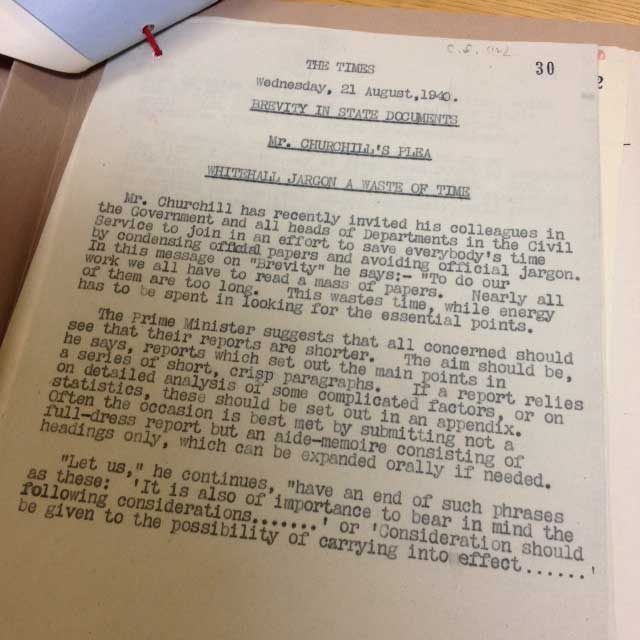
In 1940, Churchill issued a memo to his staff titled “Brevity.” He did not express concerns about creeping fascism in bureaucratic communiques, but decried the problem of wasted time, “while energy has to be spent in looking for the essential points.” He ends up, however, saying some of the same things as Orwell, in fewer words.
I ask my colleagues and their staffs to see to it that their Reports are shorter.
- The aim should be Reports which set out the main points in a series of short, crisp paragraphs.
- If a Report relies on detailed analysis of some complicated factors, or on statistics, these should be set out in an Appendix.
- Often the occasion is best met by submitting not a full-dress Report, but an Aide-memoire consisting of headings only, which can be expanded orally if needed.
- Let us have an end of such phrases as these: “It is also of importance to bear in mind the following considerations…,” or “Consideration should be given to the possibility of carrying into effect….” Most of these woolly phrases are mere padding, which can be left out altogether, or replaced by a single word. Let us not shrink from using the short expressive phrase, even if it is conversational.
Reports drawn up on the lines I propose may at first seem rough as compared with the flat surface of officialese jargon. But the saving in time will be great, while the discipline of setting out the real points concisely will prove an aid to clearer thinking.
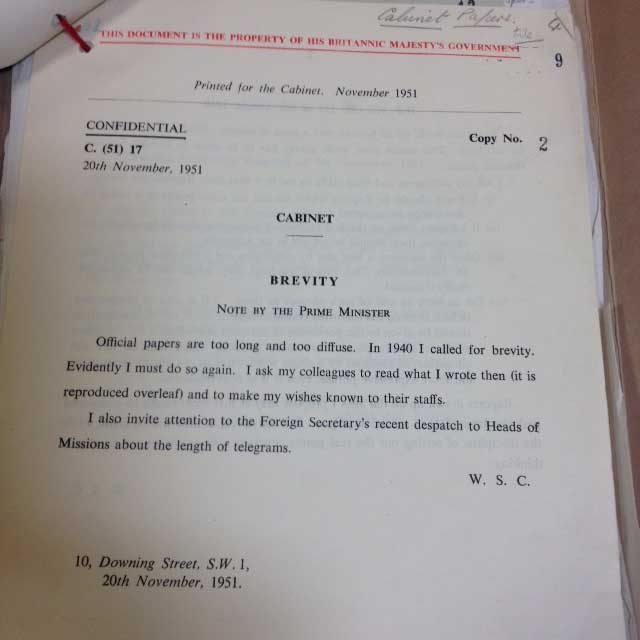
The message “cascaded through the civil service,” writes Laura Cowdry at the UK National Archives. A 1940 article in the Times picked up the story. But the problem persisted, as it does today and maybe will till the end of time (or until machines start to do all our writing for us). Frustrated, Churchill issued another admonition, shorter even than the first, in 1951.
Official papers are too long and too diffuse. In 1940 I called for brevity. Evidently I must do so again. I ask my colleagues to read what I wrote then… and to make my wishes known to their staffs.
These memos, Cowdry notes, “may shed some light onto government communications work of the past,” and on the Churchillian style that may have taken hold for decades in government documents, as well as—of course—far beyond them. His emphatic statements also articulate “key elements of good communication that would resonate with the thinking of any modern communicator,” whether Orwell, Kurt Vonnegut, or Cormac McCarthy, who has become a sought-after scientific editor for his strict minimalism.
Churchill did not seem overly concerned with wordiness as a political problem. Orwell did not approach the problem philosophically. That task fell to the Logical Positivists of the early 20th century. In his attempt to explain the wordiness of both undergraduates and world-renowned thinkers, “neo-Positivist” philosopher David Stove goes so far as to ascribe overwriting to “defects of character… such things as an inability to shut up; determination to be thought deep; hunger for power; fear, especially the fear of an indifferent universe….”
Something to consider, maybe, when you’re looking at your next draft email, Facebook comment, or Slack message, and wondering whether it actually needs to be an essay….
Related Comment:
George Orwell’s Six Rules for Writing Clear and Tight Prose
Kurt Vonnegut Explains “How to Write With Style”
Josh Jones is a writer and musician based in Durham, NC. Follow him at @jdmagness
Read More...How Scholars Finally Deciphered Linear B, the Oldest Preserved Form of Ancient Greek Writing
In the early 1900s, British archaeologist Sir Arthur Evans unearthed almost 3,000 tablets on the island of Crete, inscribed with a language he had never seen before. The discovery began a decades-long race to read the language of Europe’s oldest civilization. And the final deciphering of the script, which Evans called Linear B, ended up overturning an accepted history of ancient Greek origins as we learn in the TED-Ed video above scripted by classics professor Susan Lupack.
The tablets, found among the ruins of the ancient city of Knossos, belonged to a people who thrived 3,000–4,000 years ago, and whom Evans named the Minoans after the mythical king Minos, keeper of the Minotaur. Evans spent a good part of thirty years trying to decipher Linear B with no success, keeping most of the tablets locked away. He did, however, find two keys that allowed future researchers to translate the ancient language.
One of those scholars, Alice Kober, became interested in the Minoan script while an undergraduate at Hunter College in New York. By the time she earned her doctorate, she had “devoted herself to the decipherment of the phonetic signs,” notes Rutgers University. “To do so, she studied archaeology in New Mexico and at the ASCSA, acquainting herself with the scripts of as many ancient languages and cultures as she could.”
Scholars around the world speculated about Linear B. “Was it the lost language of the Etruscans?” they asked. “Or an early form of Basque?” Kober herself spent two decades trying to decode the script. Like Evans, she died before she could complete her work, but she came closer than anyone had before. Meanwhile, architect Michael Ventris became obsessed with Linear B, even working on it while he served in World War II.
Building on Kober’s methods and new tablets excavated at a Greek site, Pylos, he was able to isolate the names of ancient places. From these geographical references, Ventris “unraveled Linear B, with each word revealing more clearly” that the language it represented was not Minoan, but Greek. It is, in fact, “the oldest preserved form of written Greek that we know of,” the Ancient History Encyclopedia explains, likely “devised in Knosses (Crete), somewhere around 1450 BCE when the Mycenaeans took control of Knosses, and spread from here to Mainland Greece.”
It had previously been assumed that the opposite occurred, that the Minoans had invaded Greece. This was Evans supposition, but Ventris’ discovery showed, “whether by peaceful annexation or armed invasion… the Minoan culture was replaced, both in Crete and in mainland Greece, by the Mycenean culture”—Greeks from the mainland who adopted the Minoan script to write in Greek.
This means that the ancient Minoan language Evans hoped to find still remains a mystery, locked away in the labyrinth of another ancient script, called Linear A. When this primal linguistic ancestor is finally deciphered, it will probably not be through decades of painstaking efforts by dedicated scholars, but through the singular breakthrough of a machine language.
Related Content:
Learn Latin, Old English, Sanskrit, Classical Greek & Other Ancient Languages in 10 Lessons
Josh Jones is a writer and musician based in Durham, NC. Follow him at @jdmagness
Read More...New Digital Archive Opens Access to Thousands of Digitized African American Funeral Programs (1886–2019)
Funeral rites, burials, and other rituals are held near-universally sacred, not only due to religious and cultural beliefs about death: We preserve our connection to our ancestors through the records of their births and deaths. For many Black Americans in the U.S. south, grief and loss have been compounded by centuries of violence and tragedy, but funerals have still tended to be “celebrations of life” rather than mournful events, says Derek Mosley, archivist at the Auburn Avenue Research Library on African American Culture and History.” African American “funeral programs tend to reflect that,” and therefore offer a wealth of information for historians and genealogists as well as family members.
Mosley is a contributor to a new digital archive that “currently boasts more than 11,500 digitized pages and is expected to grow as more programs are contributed.” These historical documents date from between 1886 to 2019, though “most of the programs are from services during the late twentieth and early twenty-first centuries,” notes the Digital Library of Georgia, who houses the collection. “A majority of the programs are from churches in the Atlanta, Georgia area, with a few programs from other states such as South Carolina, Tennessee, Florida, Michigan, New Jersey, and New York, among others.”
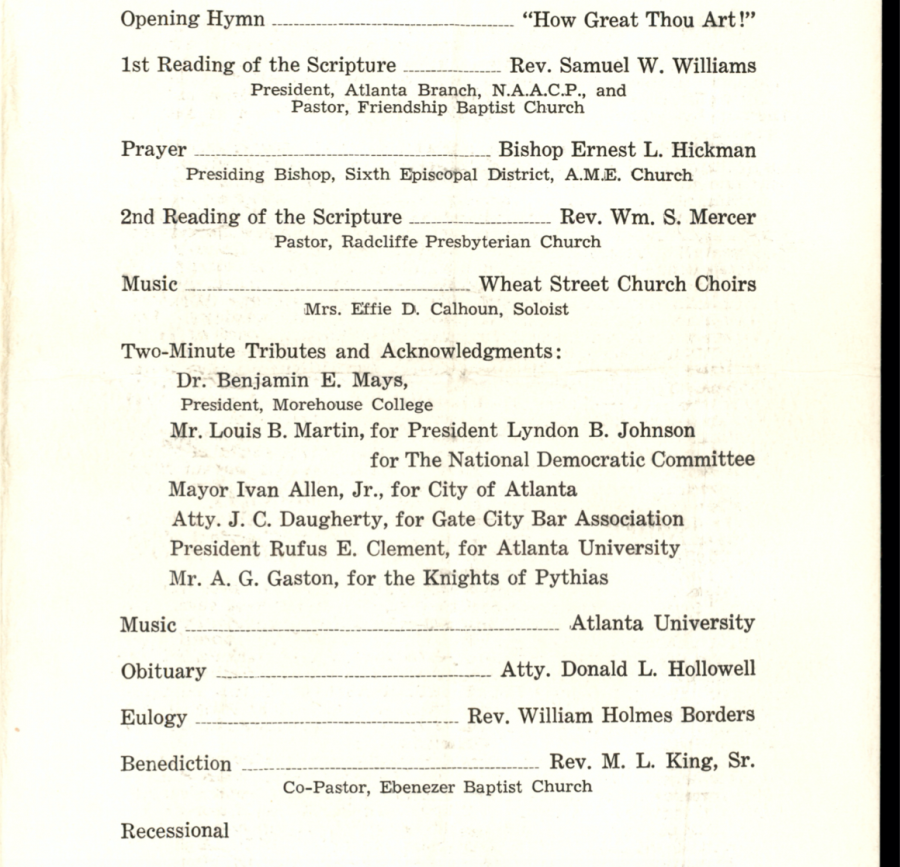
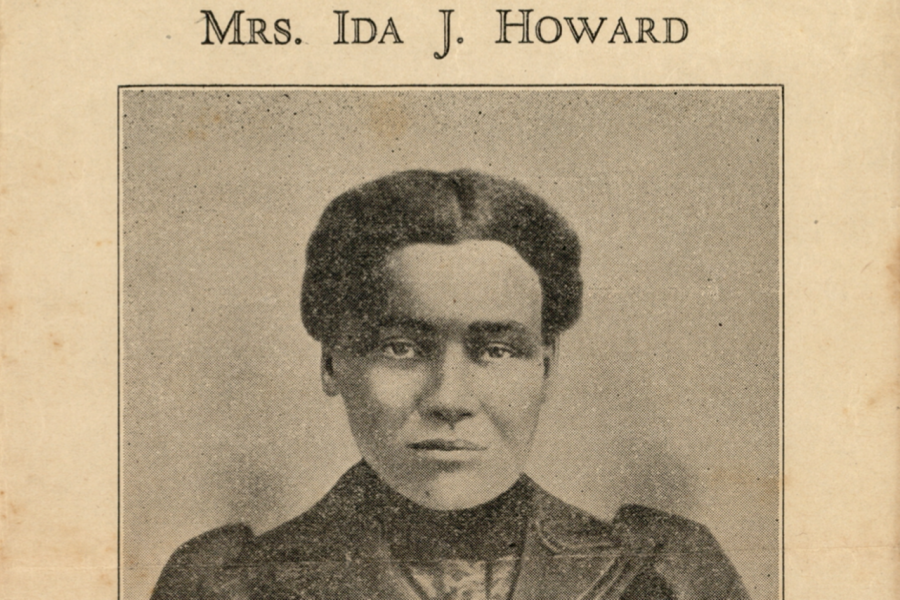
The archive offers an incredible resource for people looking for information about relatives. For researchers “these documents also represent a gold mine of archival information,” Nora McGreevy writes at Smithsonian, including “birth and death dates, photos, lists of relatives, nicknames, maiden names, residences, church names, and other clues that can help reveal the stories of the deceased.”
In many cases, those stories were lost when Jim Crow, poverty, and redevelopment displaced families and erased burial sites. The collection, says Mosley, offers “a public space for legacy.”
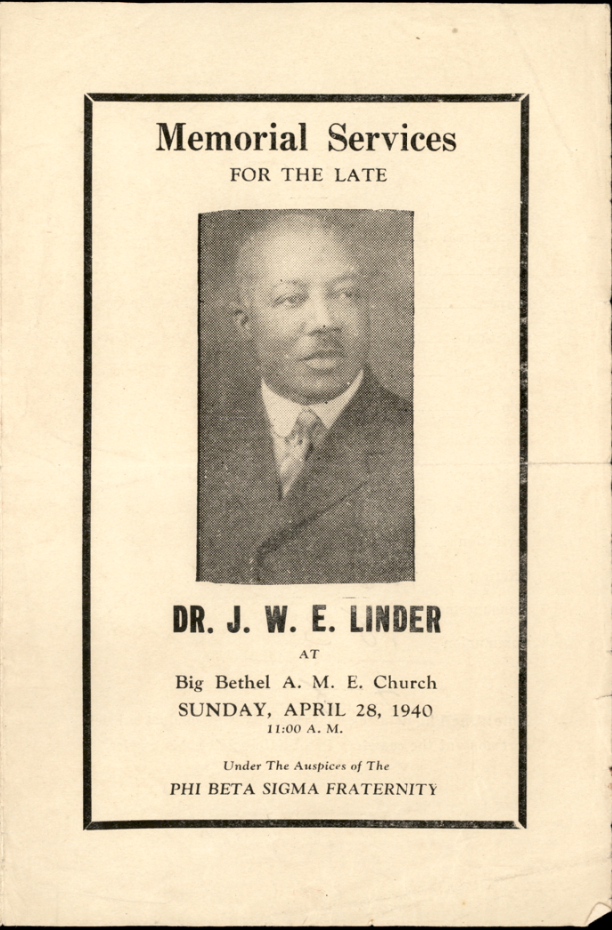
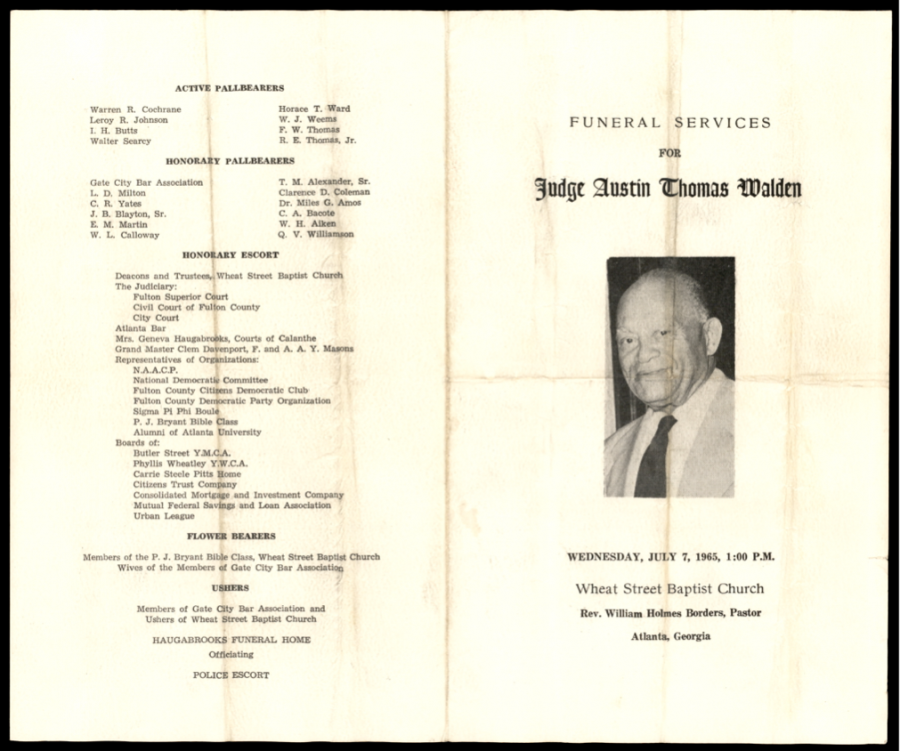
It is a way for local historians to recover important community figures. One program, for Dr. J.W.E. Linder, “who died in 1939,” Atlas Obscura’s Matthew Taub writes, “and whose memorial service was held in 1940” informs us that the deceased was the son of “Congressman George W. Linder, of the Georgia House of Representatives during the Reconstruction Period.” In the program for Judge Austin Thomas Walden, who died in 1965, we learn that he served as the first municipal judge in Georgia since Reconstruction. His benediction was delivered by the Reverend Martin Luther King Sr. and he received tributes from the Mayor of Atlanta, the President of Morehouse College, and the office of President Johnson.
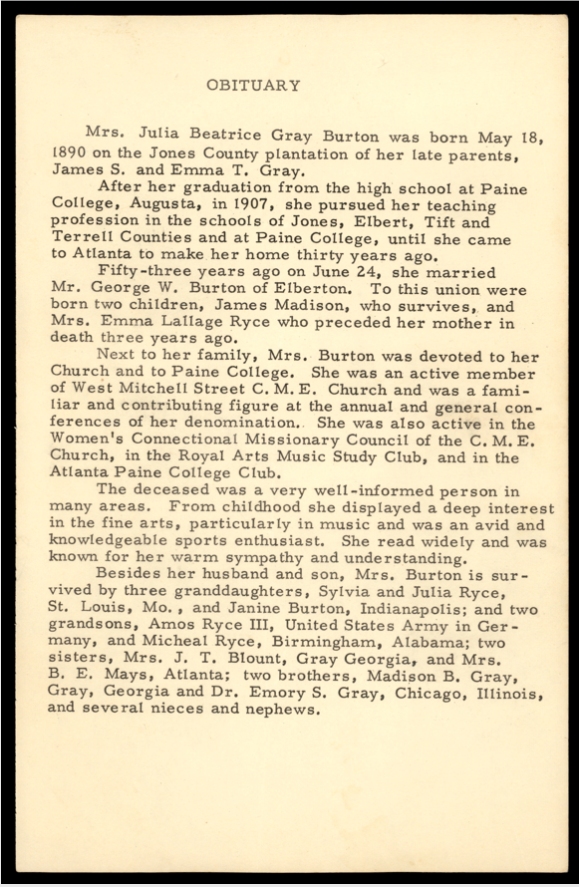
Such pillars of the community can be found among a host of programs memorializing ordinary, everyday people. The descriptions in the funeral literature open fascinating windows onto their lives and their extended family connections. Mrs. Julia Burton’s program from 1960, for example, tells us she was born on the plantation where her parents were likely enslaved. Her obituary not only describes her many clubs and her character as “a well-informed person in many areas,” but also lists the names of her husband and son, three granddaughters, two grandsons, two sisters, and two brothers—invaluable information for people searching for relatives.
“The challenge for African American genealogy and family research continues to be the lack of free access to historical information that can enable us to the tell the stories of those who have come before us,” remarks Tammy Ozier, president of the Atlanta Chapter of the Afro-American Historical and Genealogical Society. “This monumental collection helps to close the gap.” As it grows, it will likely come to represent greater geographical areas around the country. For now, the roughly 3300 digitized funeral programs, some a single page, some elaborate, full-color productions, focus on an area to which thousands of families around the country can trace their lineage, and to which many may find their way back through public archives like this one.
via Atlas Obscura
Related Content:
Josh Jones is a writer and musician based in Durham, NC. Follow him at @jdmagness
Read More...W.E.B. Du Bois Devastates Apologists for Confederate Monuments and Robert E. Lee (1931)
Who won the U.S. Civil War? “The north, of course,” you say… but ah… if you did not know the answer, you would have reason to be confused. Who loses a war and puts up statues of its heroes on the victor’s land? In the south, say, in Northern Virginia, you’ll find public shrines to Stonewall Jackson, public highways named for Jefferson Davis, and public schools named after Robert E. Lee and J.E.B. Stewart. These are not historical monuments, i.e. preserved battlefields, graveyards, or historic homes. They were erected decades after the war. You’ll find them in California, Oregon, and Washington state, which did not exist at the time.
Next question: who did the Confederacy fight in the Civil War? The Union, of course. But the leaders of the region also warred with another enemy, as they had for over two hundred years: millions of enslaved people kept in brutal subjection. In many respects, they won this war, though they lost the privileges of legal slavery. Once Andrew Johnson came to power, the south reinstituted conditions that were often more or less the same for Black people as they had been before the war. Grant struggled to reverse the tide, but Reconstruction ultimately failed.
This is the victory the south commemorated when organizations like the United Daughters of the Confederacy and Sons of Confederate Veterans put up monuments to southern generals all over the country. It is the victory invoked by the Battle Flag of the Army of Northern Virginia (or the “Confederate Flag”). A defiance of multi-racial democracy and a government that serves the needs of all its citizens; a menacing promotion of white supremacist mythology, maintained with public funds on public lands. Those symbols include:
- 780 monuments, more than 300 of which are in Georgia, Virginia or North Carolina;
- 103 public K‑12 schools and three colleges named for Robert E. Lee, Jefferson Davis or other Confederate icons;
- 80 counties and cities named for Confederates;
- 9 observed state holidays in five states; and
- 10 U.S. military bases.
But, no, one might say, these are observances for the southern dead, who were, after all, Americans too. This is what we’ve heard, over and over. It was a hoary old story when W.E.B. Du Bois heard it in the early decades of the twentieth century. “Lost Cause” ideology had done its work, flooding the culture with sympathetic portrayals of the Confederacy, a wave of propaganda that reached its apex in the spectacle of 1915’s Birth of a Nation (first titled The Clansman), responsible for resurrecting the Ku Klux Klan.
The story went something like this: “No nobler young men ever lived; no braver soldiers ever answered the bugle call nor marched under a battle flag,” proclaimed southern industrialist Julian Carr at the 1913 dedication of Confederate statue Silent Sam, which stood on the campus of the University of North Carolina in Chapel Hill until activists tore it down recently. “They fought, not for conquest, not for coercion, but from a high and holy sense of duty. They were like the Knights of the Holy Grail.”
Carr goes on like this at length, reciting poetry and making constant references to Greek heroes and gods. His purpose, he says, is to memorialize “the Sacred Cause.” But he never says what that cause is, though he has many exalted words for “the noble women of my dear Southland, who are to-day as thoroughly convinced of the justice of that cause.” The speech is boilerplate Confederate apologism: an almost hysterically bombastic defense of the south that never once mentions slavery.
Yet in an odd moment, Carr breaks off—during a rant about “what the Confederate soldier meant to the welfare of the Anglo Saxon race”—to make a “rather personal… allusion” for seemingly no reason:
One hundred yards from where we stand, less than ninety days perhaps after my return from Appomattox, I horse-whipped a negro wench until her skirts hung in shreds, because upon the streets of this quiet village she had publicly insulted and maligned a Southern lady, and then rushed for protection to these University buildings where was stationed a garrison of 100 Federal soldiers. I performed the pleasing duty in the immediate presence of the entire garrison, and for thirty nights afterwards slept with a double-barrel shot gun under my head.
What does it say about his audience that Carr thinks this admission reflects well on him? Du Bois understood it. He had diagnosed the fear and violent hatred men like Carr embodied and seen their cowardice and desperate overcompensation. “They preach and strut and shout and threaten,” he wrote in The Souls of White Folk, “crouching as they clutch at rags of facts and fancies to hide their nakedness, they go twisting, flying by my tired eyes and I see them ever stripped—ugly, human.”
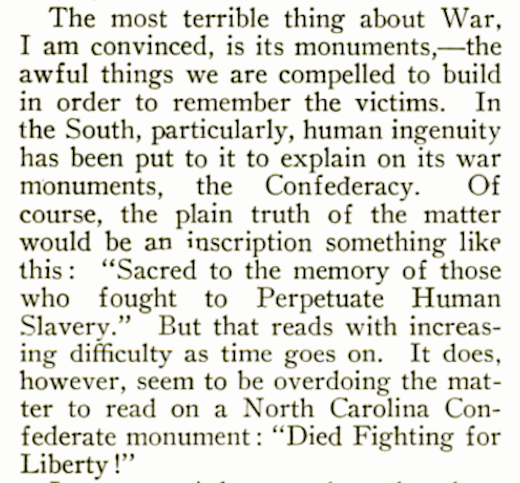
Du Bois knew what Confederate monuments were meant to represent. In 1931, he cut to the heart of the matter in brief remarks published in The Crisis (top). “Du Bois pushes right back against the myth of the Lost Cause,” writes historian Kevin M. Levin. “He refuses to draw a distinction between the Confederate government and men in the ranks,” as represented by statues like Silent Sam. “Du Bois clearly understood that as long as white southerners were able to mythologize the war through their monuments, African Americans would remain second class citizens.”
He did not refer to monuments put up in Confederate cemeteries, as many had been immediately after the war, but to the hundreds of statues and other memorials erected in prominent places of government beginning around 1900. “All of these monuments were there to teach values to people,” says Mark Elliott, professor of history at University of North Carolina, Greensboro. “That’s why they put them in the city squares. That’s why they put them in front of state buildings.” It’s why there are Confederate statues in the U.S. Capital, gifts to the nation from southern states, gladly accepted.
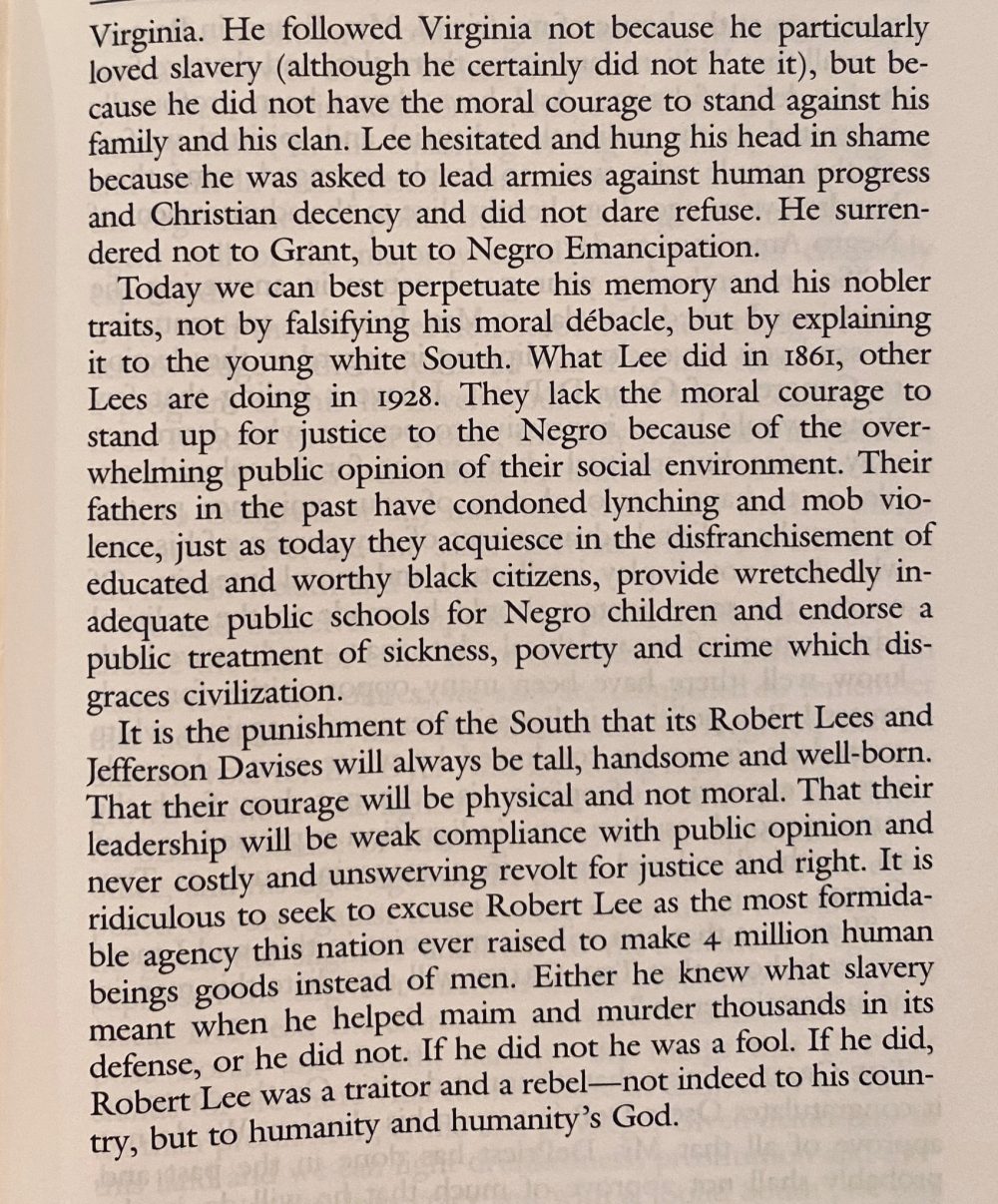
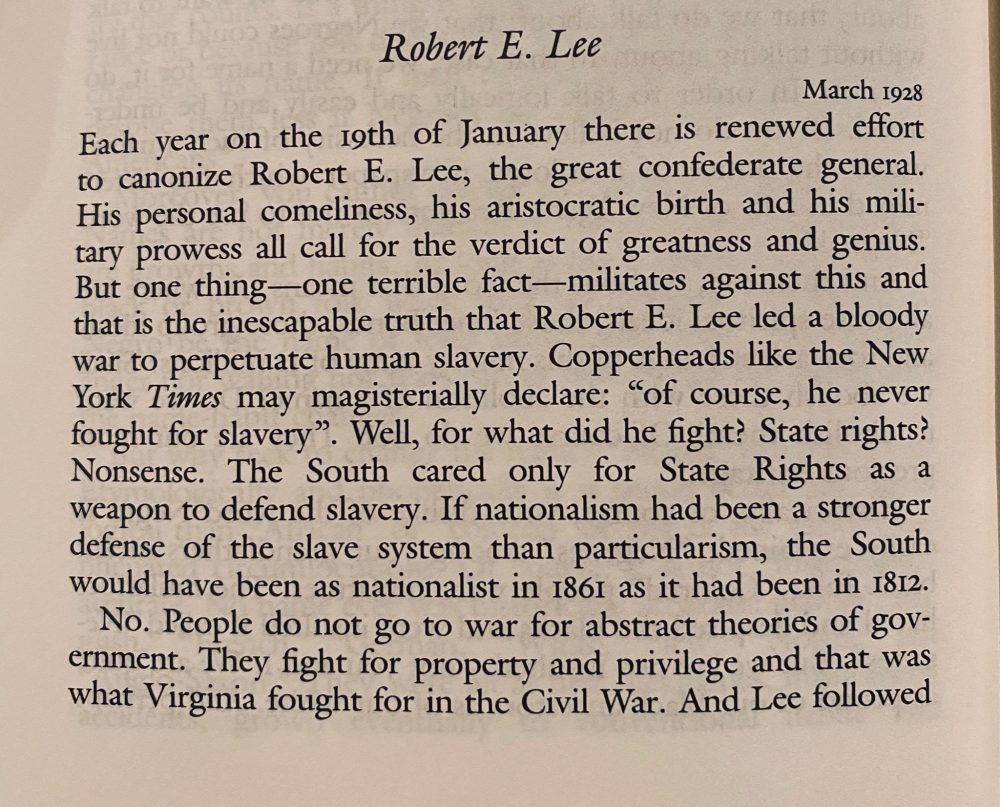
Three years earlier, Du Bois had written many choice words about attempts to deify Confederate leaders like Robert E. Lee (who himself opposed monuments). He also countered the argument that the war was about “States Rights” in one incisive sentence: “If nationalism had been a stronger defense of the slave system than particularism, the South would have been as nationalist in 1861 as it had been in 1812.” None of the high-flown rhetoric about “the cause” of governing principles had anything to do with it, Du Bois argues. “People do not go to war for abstract theories of government. They fight for property and privilege.”
One statue in North Carolina, Du Bois notes wryly in his Crisis remarks, goes so far as to claim that Confederate soldiers “Died Fighting for Liberty!” This would not strike Lost Cause defenders like Carr as ironic. They too fought for liberty, of a kind—the freedom to punish, kill, imprison, exploit, disenfranchise, and otherwise terrorize and impoverish Black Americans at will.
Related Content:
The Civil War & Reconstruction: A Free Course from Yale University
Josh Jones is a writer and musician based in Durham, NC. Follow him at @jdmagness
Read More...Dr. Fauci Reads an Undergrad’s Entire Thesis, Then Follows Up with an Encouraging Letter

Photo via the National Institute of Allergy and Infectious Diseases
What are some qualities to look for in a leader?
- A thirst for knowledge
- A sense of duty
- The scruples to give credit where credit is due
- A calm, clear communication style
- Humility
Dr. Anthony Fauci brings these qualities to bear as Director of the National Institute of Allergy and Infectious Diseases at the National Institute of Health.
They’re also on display in his message to then-undergrad Luke Messac, now an emergency medicine resident at Brown University, whose research focuses on the histories of health policy in southern Africa and the US, and who recently tweeted:
13 years ago, I emailed Dr. Fauci out of the blue to ask if I might interview him for my undergrad thesis. He invited me to his office, where he answered all my questions. When I sent him the thesis, HE READ THE WHOLE THING (see his overly effusive review below). Who does that?!
Here’s what Fauci had to say to the young scientist:
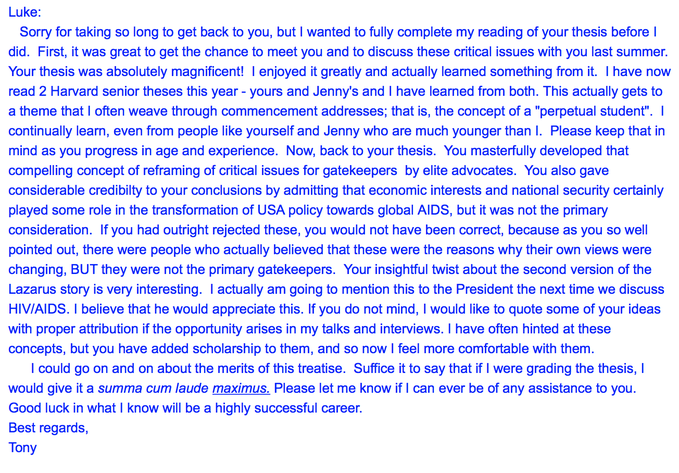
It certainly reads like the work of a class act.
In addition to serving as one of the COVID-19 pandemic’s most recognizable faces, Dr. Fauci has acquired another duty—that of scapegoat for Donald Trump, the 6th president he has answered to in his long career.
He seems to be taking the administration’s potshots with a characteristically cool head, though compared to the furious criticisms AIDS activists directed his way in the 80s and 90s, he’s unlikely to find much of educational value in them.
Last March, The Body Pro, a newsletter for workers on the front lines of HIV education, prevention, care, and services quoted ACT UP NY’s Jim Eigo on the doctor’s response to a letter demanding parallel tracking, a policy revision that would put potentially life-saving drugs in the hands of those who tested positive far earlier than the existing clinical trial requirements’ schedule would have allowed:
Lo and behold, he read the letter and liked it, and the following year he started promoting the idea of a parallel track for AIDS drugs to the FDA. Had he not helped us push that through, we couldn’t have gotten a lot of the cousin drugs to AZT, such as ddC and ddI, approved so fast. They were problematic drugs, but without them, we couldn’t have kept so many people alive.
Fauci, despite being straight and Catholic, was not only not homophobic, which much of medical practice still was in the late 1980s, he also wouldn’t tolerate homophobia among his colleagues. He knew there was no place for that in a public-health crisis.
Speaking of correspondence, Dr Messac seems to have taken the “perpetual student” concept Dr. Fauci impressed upon him back in 2007 to heart, as evidenced by a recent tweet, regarding a lesson gleaned from Arnold Schwarzenegger in Pumping Iron, a 1977 documentary about bodybuilders:
Schwarzenegger explained how he would figure out what to work out every day by looking in a mirror and finding his weakest muscles. It’s pretty good advice for studying during residency. Every shift reveals a weakness, and greats never stop looking for their own.
In writing to Messac, Dr. Fauci alluded to his commencement speeches, so we thought it appropriate to leave you with one of his most recent ones, a virtual address to the graduating class of his alma mater, College of the Holy Cross:
“Now is the time, if ever there was one” he tells the Class of 2020, “to care selflessly about one another… Stay safe, and I look forward to the good work you will contribute in the years ahead.”
Related Content:
Real Women Talk About Their Careers in Science
Richard Feynman’s Technique for Learning Something New: An Animated Introduction
Ayun Halliday is an author, illustrator, theater maker and Chief Primatologist of the East Village Inky zine. Follow her @AyunHalliday.
Read More...How Cannonball Adderley Shared the Joy of Jazz
Jazz has always had big personalities. In the mid-20th century, an explosion of major players became as well known for their personal quirks as for their revolutionary techniques and compositions. Monk’s endearing oddness, Miles Davis’ brooding bad temper, Charles Mingus’ exuberant shouts and rages, Ornette Coleman’s cryptic philosophizing, Coltrane’s gentle mysticism…. These were not only the jazz world’s greatest players; they were also some of the century’s most interesting people.
The same can be said for Julian Edwin “Cannonball” Adderley, saxophonist and bandleader who was heralded as a new Charlie Parker on arrival in the New York scene from Ft. Lauderdale, Florida, where he had worked as a popular high school band director and local musician before deciding to pursue graduate studies. Music had other plans for him. Instead of going back to school when he arrived in Manhattan in 1955, he fell in with the right crowd and became an instant critical sensation.
Adderley ended up playing onstage and recording with greats like Davis, Coltrane, Art Blakey, Bill Evans, and his brother, Nat Adderley, who joined him to play in his Quintet, completed the Cannonball Adderley Sextet in the sixties with Yusef Lateef, and helped him make some of the best music of his career. Adderley joined Miles Davis’s band when Coltrane left and played on Kind of Blue and Milestones, leaving “a deep impression on Davis and his sextet,” notes one biography.
Unlike some of his famous peers, Adderley had none of the traits of the difficult or enigmatic artiste. Where most jazz musicians remained silent and mysterious onstage, Adderley engaged boisterously with his audience, in monologues one can imagine him shouting gregariously over a band room full of students warming up. With his irrepressible charm, he established an “amusing and educational rapport with his audience, often-times explaining what he and his musicians were about to play” (hear him do so before launching into his popular 1966 soul jazz single “Mercy, Mercy, Mercy,” below.)
Adderley’s personality helped put jazz newcomers at ease, but he didn’t teach from the textbook, experimenting broadly with several genres and incorporating electronic elements and African polyrhythms in the 60s and 70s, when he also became “a jazz spokesman. Whether it was television, residencies at several colleges, or film appearances.” Adderley helped pioneer soul jazz, post-bop, and other experimental subgenres, many of which crossed over into the pop charts. “Two words best encapsulate the music of alto saxophonist Julian “Cannonball” Adderley,” writes Nick Morrison at NPR: “’joy’ and ‘soul.’”
The Polyphonic video at the top focuses on the role of joy in Adderley’s music, making the case that he “exemplifies joy more than anyone else in jazz.” His voracious appetite for life—reflected in his high school nickname “Cannibal,” which morphed into “Cannonball”—propelled him into the “center of the jazz universe.” It also led him to devour influences other jazz musicians avoided. He had no pretensions to jazz as high art, though he was himself a high artist, and he joyfully embraced pop music at a time when it was scorned by the jazz elite.
“Adderley’s great ambition was to share the joy of jazz with the world, and he knew that no matter how technically impressive a piece of music was, people wouldn’t listen to it if it wasn’t fun, so Cannonball made his music fun and accessible.” Records like The Cannonball Adderley Sextet in New York sound like “a party,” writes CJ Hurtt at Vinyl Me, Please: “a party with some far-out nearly free jazz post-bop elements to it” but no shortage of straight-ahead grooves. The album kicks off with Cannonball “telling the audience that they are actually hip and not merely pretending to be.” It’s tongue-in-cheek, of course; Adderley never pretended to be anyone but his own outgoing self. But his unrelenting cheerfulness, even when he played the blues, also made him one of the hippest cats around.
Related Content:
How Jazz Helped Fuel the 1960s Civil Rights Movement
Herbie Hancock’s Joyous Soundtrack for the Original Fat Albert TV Special (1969)
Josh Jones is a writer and musician based in Washington, DC. Follow him at @jdmagness
Read More...Support Us
We're hoping to rely on loyal readers, rather than erratic ads. Please click the Donate button and support Open Culture. You can use Paypal, Venmo, Patreon, even Crypto! We thank you!

About Us

Open Culture scours the web for the best educational media. We find the free courses and audio books you need, the language lessons & educational videos you want, and plenty of enlightenment in between.
Advertise With Us
FREE UPDATES!
GET OUR DAILY EMAIL
Get the best cultural and educational resources on the web curated for you in a daily email. We never spam. Unsubscribe at any time.
FOLLOW ON SOCIAL MEDIA
Open Culture editor Dan Colman scours the web for the best educational media. He finds the free courses and audio books you need, the language lessons & movies you want, and plenty of enlightenment in between.
Advertise With Us

