The Dance Theatre of Harlem Dances Through the Streets of NYC: A Sight to Behold
It’s nearly impossible to find an unblemished square of pavement in New York City.
Unless the concrete was poured within the last day or two, count on each square to boast at least one dark polka dot, an echo of casually discarded gum.
Confirm for yourself with a quick peek beneath the exuberant feet of the Dance Theatre of Harlem company members performing on the plaza of the Adam Clayton Powell Jr. State Office Building during the 46th annual Harlem Week festival.
For obvious reasons, this year’s festival took place entirely online, but the Dance Theatre’s offering is a far cry from the gloomy Zoom‑y affair that’s become 2020’s sad norm.
Eight company members, including co-producers Derek Brockington and Alexandra Hutchinson, hit the streets, to be filmed dancing throughout Harlem.
Those who gripe about the discomfort of wearing a mask while exerting themselves should shut their traps until they’ve performed ballet on the platform of the 145th and St. Nicholas Subway Station, where the dancers’ pristine white shoes bring further buoyancy to the proceedings.
The City College of New York—in-state tuition $7,340—provides the Neo-Gothic stage for four ballerinas to perform en pointe.
The Hudson River and the George Washington Bridge serve as backdrop as four young men soar along the promenade in Denny Farrell Riverbank State Park. Their casual outfits are a reminder of how company founder Arthur Mitchell, the New York City Ballet’s first black principal dancer, deliberately relaxed the dress code to accommodate young men who would have resisted tights.
The piece is an excerpt of New Bach, part of the company’s repertoire by resident choreographer and former principal dancer, Robert Garland, described in an earlier New York Times review as “an authoritative and highly imaginative blend of classical vocabulary and funk, laid out in handsome formal patterns in a well-plotted ballet.”
The music is by J.S. Bach.
And in these fractious times, it’s worth noting that only one of the dancers is New York City born and bred. The others hail from Kansas, Texas, Chicago, Louisiana, Delaware, Orange County, and upstate.
The group seizes the opportunity to amplify a much needed public health message—wear a mask!—but it’s also a beautiful tribute to the power of the arts and the vibrant neighborhood where a world-class company was founded in a converted garage at the height of the civil rights movement.
Contribute to Dance Theater of Harlem’s COVID-19 Relief Fund here.
Related Content:
Ballerina Misty Copeland Recreates the Poses of Edgar Degas’ Ballet Dancers
Ayun Halliday is an author, illustrator, theater maker and Chief Primatologist of the East Village Inky zine. Follow her @AyunHalliday.
Read More...A Creepy 19th Century Re-Creation of the Famous Ancient Roman Statue, Laocoön and His Sons
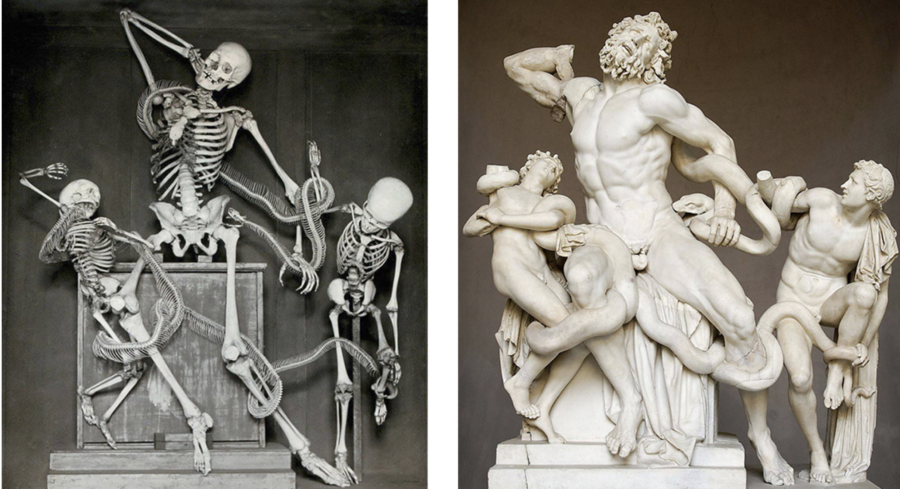
Beware of Greeks bearing gifts. We’ve all heard that proverb, but few of us could name its source: the Trojan priest Laocoön, a historical character in the Aeneid. “Do not trust the Horse, Trojans,” Virgil has him say. “Whatever it is, I fear the Greeks even bearing gifts.” He was right to do so, as we all know, though his death came not at the hands of the Greek army let into Troy by the soldiers hidden inside the Horse, but those of the gods. As Virgil has it, an enraged Laocoön threw a spear at the Horse when his compatriots disregarded words of caution, and in response the goddess Minerva sent forth a couple of sea serpents to do him in.
The Aeneid, of course, offers only one account of Laocoön’s fate. Sophocles, for instance, had him spared and only his sons killed, and his ostensible crime — being a priest yet marrying — had nothing to do with the Trojan Horse. But whatever drew the serpents Laocoön’s way, the moment they set upon him and his sons was immortalized by Rhodian sculptors Agesander, Athenodoros, and Polydorus in Laocoön and His Sons, among the most famous ancient sculptures in existence since its excavation in 1506. (The sculpture was originally created somewhere between 200 BC and 70 AD.) Various tributes have been paid to it over the centuries, most notably by an Austrian anatomist named Josef Hyrtl, whose built his highly Halloween-suitable recreation out of skeletons — both human and snake.
“According to Christopher Polt, an assistant professor in the classical studies department at Boston College who tweeted a side-by-side comparison of the two versions, Hyrtl created his take on the sculpture at the University of Vienna around 1850,” writes Hyperallergic’s Valentina Di Liscia. In response, a historian named Gregory Stringer tweeted that Hyrtl must have been able to intuit the “proper pose” of Laocoön’s right arm, since in the mid-19th century the sculpture’s original arm was still missing, yet to be rediscovered and reattached, and since 1510 had been replaced in copies with an incorrectly outstretched substitute. Laocoön and His Sons now resides at the Vatican (learn more about it in the Smarthistory video below), but Hyrtl’s skeletal Laocoön and His Sons was destroyed in the 1945 Allied bombing of Vienna.
In 2018, a similar project was attempted again for an exhibit at the Houston Museum of Natural Science. The new all-skeleton version of Laocoön and His Sons was created, as the Houston Press’ Jef Rouner reports, by taxidermist Lawyer Douglas, taxidermy collector Tyler Zottarelle, and artist Joshua Hammond. “It looks a lot like interpretative dance,” Rouner quotes Douglas as saying of Hyrtl’s work. “It’s a beautiful piece, but I was concerned it wasn’t able to capture the original struggle of animal versus human.” Though Agesander, Athenodoros, and Polydorus’ original is known as a “prototypical icon of human agony,” it turns out that “getting perpetually grinning skulls to seem in agony is harder than you might think.” But if any time of the year is right for grinning skulls to express the human experience, surely this is it.
via Hyperallergic
Related Content:
Free Art & Art History Courses
How Ancient Greek Statues Really Looked: Research Reveals Their Bold, Bright Colors and Patterns
An Artist Crochets a Life-Size, Anatomically-Correct Skeleton, Complete with Organs
Celebrate The Day of the Dead with The Classic Skeleton Art of José Guadalupe Posada
Based in Seoul, Colin Marshall writes and broadcasts on cities, language, and culture. His projects include the Substack newsletter Books on Cities, the book The Stateless City: a Walk through 21st-Century Los Angeles and the video series The City in Cinema. Follow him on Twitter at @colinmarshall, on Facebook, or on Instagram.
Read More...The 1937 Experiment in Distance Learning: When Chicago Schools Went Remote, Over Radio, During a Polio Outbreak

As all of us have noticed in recent months, living in a viral pandemic really messes with your sense of time. A few months feels like a decade. Time slows to a crawl. If you’re a parent, however, you have before you walking, talking, growing, complaining reminders that no matter what’s happening in the world, children still grow up just the same. They need new experiences and new clothes just as before, and they need to keep their brains engaged and try, at least, to build on prior knowledge.
Maybe we’re learning new things, too. (Adult brains also need exercise.) Or not. We have some control over the situation; kids don’t. “Learning loss” over inactive months is real, and the government still has the responsibility (for what the word is worth) to educate them. Online learning may feel like a bad compromise for many families, and its success seems largely dependent—as in regular school—on parent involvement and access to resources. But it’s better than eight months of the more mindless kind of screen time.
It may help to know that remote learning isn’t new, even if we’re still adjusting to technology that lets teachers (and bosses) into our homes with cameras and microphones. The challenges “may seem unprecedented,” Stanford professor Michael Hines writes at The Washington Post, but “educators may be surprised to learn that almost 100 years ago Chicago’s schools faced similar circumstances” during the polio epidemic and met them in a similar way. In 1937, an outbreak forced the city to close schools, and prompted “widespread alarm about lost instructional time and students left to their own devices” (so to speak).
Administrators were “determined to continue instructions for the district’s nearly 325,000 elementary age students” through the only remote technology available, radio, “still fairly new and largely untested in education in the 1930s.” According to Hines, a historian of education in the U.S., the program was very well organized, the lessons were engaging, and educators “actively sought to involve parents and communities” through telephone hotlines they could call with questions or comments. On the first day, they logged over 1,000 calls and added five additional teachers.
You might be wondering—given digital divide problems of online learning today—whether all the students served actually owned a radio and telephone. Katherine Foss, a professor of Media Studies at Middle Tennessee State University, notes that in the late 1930s, “over 80% of U.S. households owned at least one radio, though fewer were found in homes in the southern U.S., in rural areas and among people of color.” Those who didn’t were left out, and school authorities had no way to track attendance. “Access issues received little attention” in the media. School Superintendent William Johnson had no idea how many students tuned in.
The local program lasted less than three weeks before schools reopened. Some felt the instruction moved too quickly and “students who needed more attention or remediation struggled through one-size-fits-all radio lessons,” notes Hines. Educators today will sympathize with the overall sense at the time that those who benefitted most from the radio lessons were students who needed them least.
Learn more about the experiment in Hines’ history lesson (also see Foss’ recent article), and consider the lessons we can apply to the present. Remote education still has flaws, and parents still struggle to find time for involvement, but the technology has made it a viable option for much longer than three weeks, and maybe, given future uncertainties, far longer than that.
Related Content:
Dyson Creates 44 Free Engineering & Science Challenges for Kids Quarantined During COVID-19
Free Online Drawing Lessons for Kids, Led by Favorite Artists & Illustrators
Josh Jones is a writer and musician based in Durham, NC. Follow him at @jdmagness
Read More...What Caused the Mysterious Death of Edgar Allan Poe?: A Brief Investigation into the Poet’s Demise 171 Years Ago Today
Edgar Allan Poe died 171 years ago today, but we still don’t know why. Of course, we all must meet our end sooner or later, as the literary master of the macabre would well have understood. His inclination toward the mysterious would have prepared him to believe as well in the power of questions that can never be answered. And so, perhaps, Poe would have expected that a death like his own — early, unexpected, and of finally undeterminable cause — would draw public fascination. But could even he have imagined it continuing to compel generation after generation of urban-legend and American-lore enthusiasts, whether or not they’ve read “The Raven” or “The Fall of the House of Usher”?
Poe’s end thus makes ideal material for Buzzfeed Unsolved, a video series whose other popular episodes include the death of Vincent van Gogh, the disappearance of D.B. Cooper, and the assassination of John F. Kennedy. In 25 minutes, “The Macabre Death Of Edgar Allan Poe” summarizes the writer’s remarkably unlucky life and gets into the detail of his equally unlucky death, beginning on September 27th, 1849, when “Poe left Richmond by steamer, stopping the next day in Baltimore. For the next five days, Poe’s whereabouts are unknown.” Then, on October 3rd, he was found “delirious, immobile, and dressed in shabby clothing” in “a gutter outside of a public house that was being used as a polling place.”
“Rapping at death’s chamber’s door, Poe was taken to Washington College Hospital that afternoon.” (The narration works in several such references to his writing.) “Assumed to be drunk, the weak and weary Poe was brought to a special room reserved for patients ill from intoxication.” Alas, “Poe never fully regained consciousness to be able to detail what had happened to him,” and expired on October 7th at the age of 40. The hosts examine several of the theories that attempt to explain what happened (nineteen of which we previously featured here on Open Culture): did a binge trigger his known physical intolerance of alcohol? Did he have a brain tumor? Did he get beaten up by his fiancée’s angry brothers? Was he a victim of “cooping”?
Cooping, a “violent form of voter fraud that was extremely common in Baltimore at that time,” involved roving gangs who “would kidnap a victim and force him to vote multiple times in a variety of disguises.” This jibes with the location and state in which Poe was found — and because “voters were often given some alcohol after voting as a celebration,” it also explains his apparent stupor. But none of the major theories actually contradict each other, and thus more than one could be true: “Edgar Allan Poe may very well have been beaten and kidnapped in a cooping scheme, sent into a stupor with alcohol after voting, and unable to recover due to a brain tumor.” However it happened, his death became a final story as enduring as — and even grimmer than — many of his tales of the grotesque.
Related Content:
The Mystery of Edgar Allan Poe’s Death: 19 Theories on What Caused the Poet’s Demise
Why Should You Read Edgar Allan Poe? An Animated Video Explains
5 Hours of Edgar Allan Poe Stories Read by Vincent Price & Basil Rathbone
Download The Complete Works of Edgar Allan Poe: Macabre Stories as Free eBooks & Audio Books
Based in Seoul, Colin Marshall writes and broadcasts on cities, language, and culture. His projects include the Substack newsletter Books on Cities, the book The Stateless City: a Walk through 21st-Century Los Angeles and the video series The City in Cinema. Follow him on Twitter at @colinmarshall, on Facebook, or on Instagram.
Read More...Understanding Chris Marker’s Radical Sci-Fi Film La Jetée: A Study Guide Distributed to High Schools in the 1970s
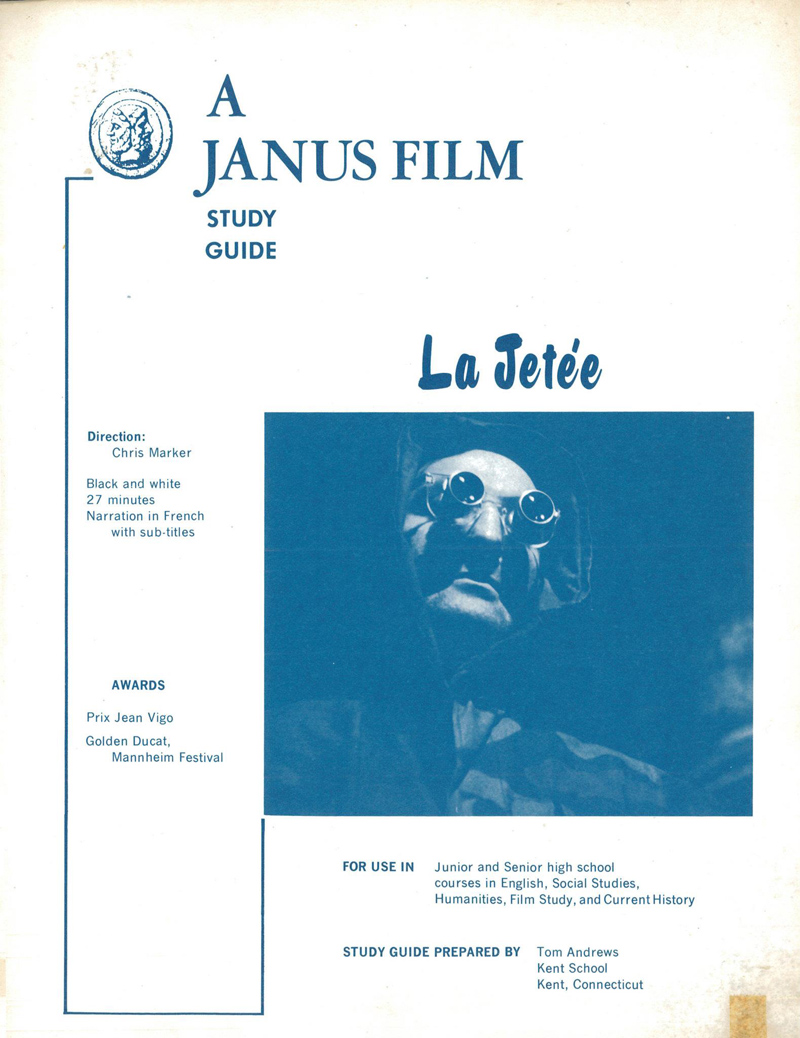
Pop quiz, hot shot. World War III has devastated civilization. As a prisoner of survivors living beneath the ruins of Paris, you’re made to go travel back in time, to the era of your own childhood, in order to secure aid for the present from the past. What do you do? You probably never faced this question in school — unless you were in one of the classrooms of the 1970s that received the study guide for Chris Marker’s La Jetée. Like the innovative 1962 science-fiction short itself, this educational pamphlet was distributed (and recently tweeted out again) by Janus Films, the company that first brought to American audiences the work of auteurs like Ingmar Bergman, Federico Fellini, and Akira Kurosawa.
Written by Connecticut prep-school teacher Tom Andrews, this study guide describes La Jetée as “a brilliant mixture of fantasy and pseudo-scientific romance” that “explores new dramatic territory and forms, and rushes with a stunning logic and a powerful impact to its shocking climax.”
The film does all this “almost entirely in still photographs, their static state corresponding to the stratification of memory.” More practically speaking, at “twenty-seven minutes in length, La Jetée is an ideal class-period vehicle” that “can help students speculate on the awesome potential of life as it may exist after a third world war” as well as “man’s inhumanity to man, not only as it may occur in the future, but as it already has occurred in our past.”
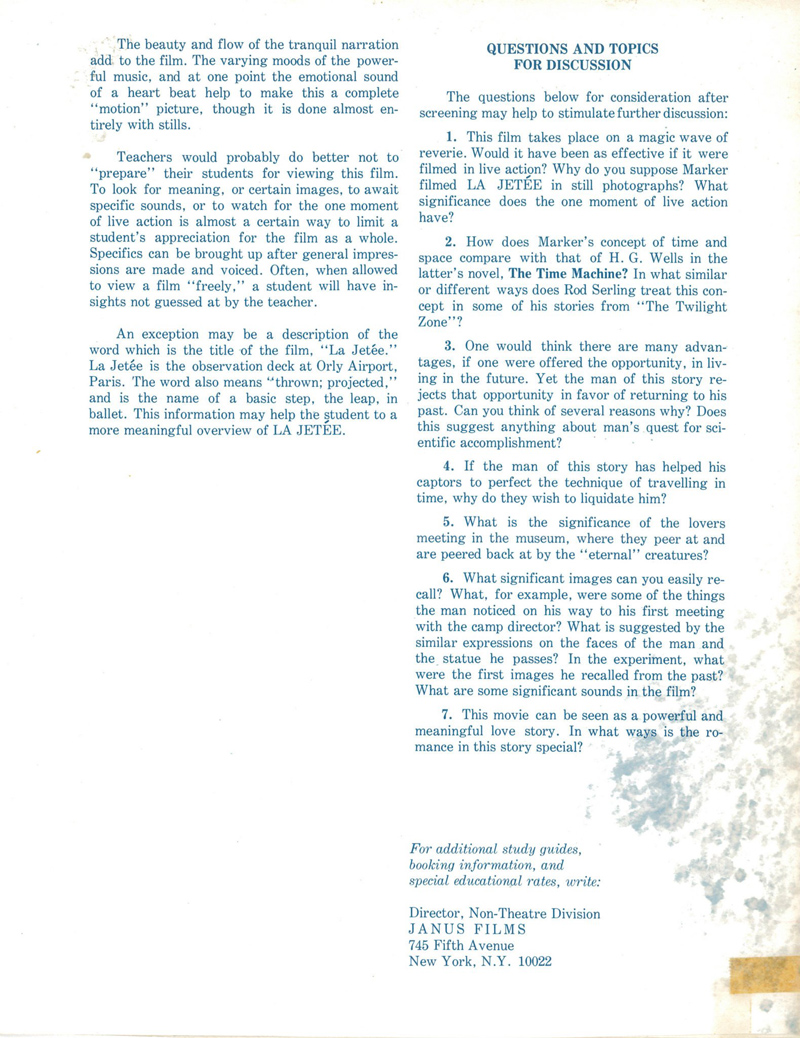
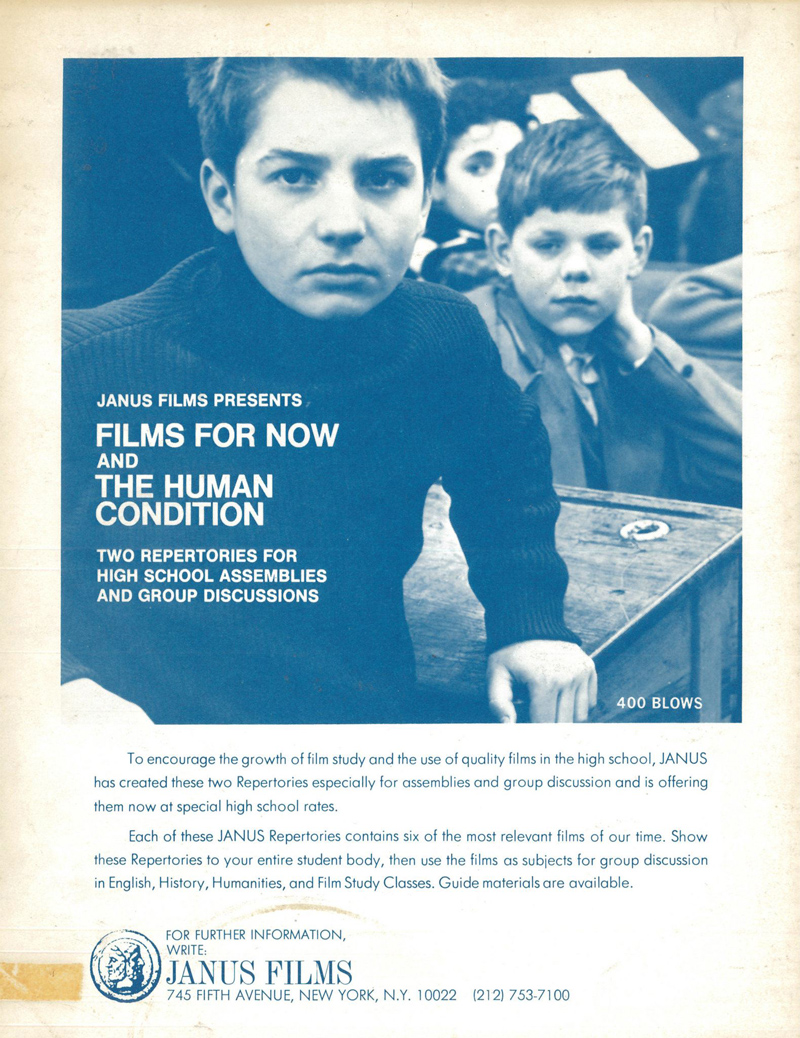
“Why do you suppose Marker filmed La Jetée in still photographs? What significance does the one moment of live action have?” “How does Marker’s concept of time and space compare with that of H.G. Wells in the latter’s novel, The Time Machine?” “If the man of this story has helped his captors to perfect the technique of time travel, why do they wish to liquidate him?” These and other suggested discussion questions appear at the end of the study guide, all of whose pages you can read at Socks. It was produced for Films for Now and The Human Condition, “two repertories for high school assemblies and group discussions” based on Janus’ formidable cinema library. (François Truffaut’s The 400 Blows also looks to have been among their educational offerings.) You can see further analysis of La Jetée in A.O. Scott’s New York Times Critics’ Picks video, as well as the Criterion Collection video essay Echo Chamber: Listening to La Jetée.
Much later, in the mid-1990s, Terry Gilliam would pay tribute with his Hollywood homage 12 Monkeys, and Marker himself still had many films to make, including his second masterpiece, the equally unconventional Sans Soleil. But at time of this study guide’s publication, La Jetée’s considerable influence had only just begun to manifest. It was around then that pioneering cyberpunk novelist William Gibson viewed the film in college. “I left the lecture hall where it had been screened in an altered state, profoundly alone,” he later remembered. “My sense of what science fiction could be had been permanently altered.” Perhaps his instructor heeded Andrews’ advice that “teachers would probably do better not to ‘prepare’ their students for viewing this film.” Not that anyone, in the 58 years of the film’s existence, has anyone ever truly been prepared for their first viewing of La Jetée.
Related Content:
Petite Planète: Discover Chris Marker’s Influential 1950s Travel Photobook Series
A Concise Breakdown of How Time Travel Works in Popular Movies, Books & TV Shows
Based in Seoul, Colin Marshall writes and broadcasts on cities, language, and culture. His projects include the Substack newsletter Books on Cities, the book The Stateless City: a Walk through 21st-Century Los Angeles and the video series The City in Cinema. Follow him on Twitter at @colinmarshall, on Facebook, or on Instagram.
Read More...The Liberal Arts Can Make People Less Susceptible to Authoritarianism, a New Study Finds
“Correlation does not equal causation” isn’t always a fun thing to say at parties, but it is always a good phrase to keep in mind when approaching survey data. Does the study really show that? Might it show the opposite? Does it confirm pre-existing biases or fail to acknowledge valid counterevidence? A little bit of critical thinking can turn away a lot of trouble.
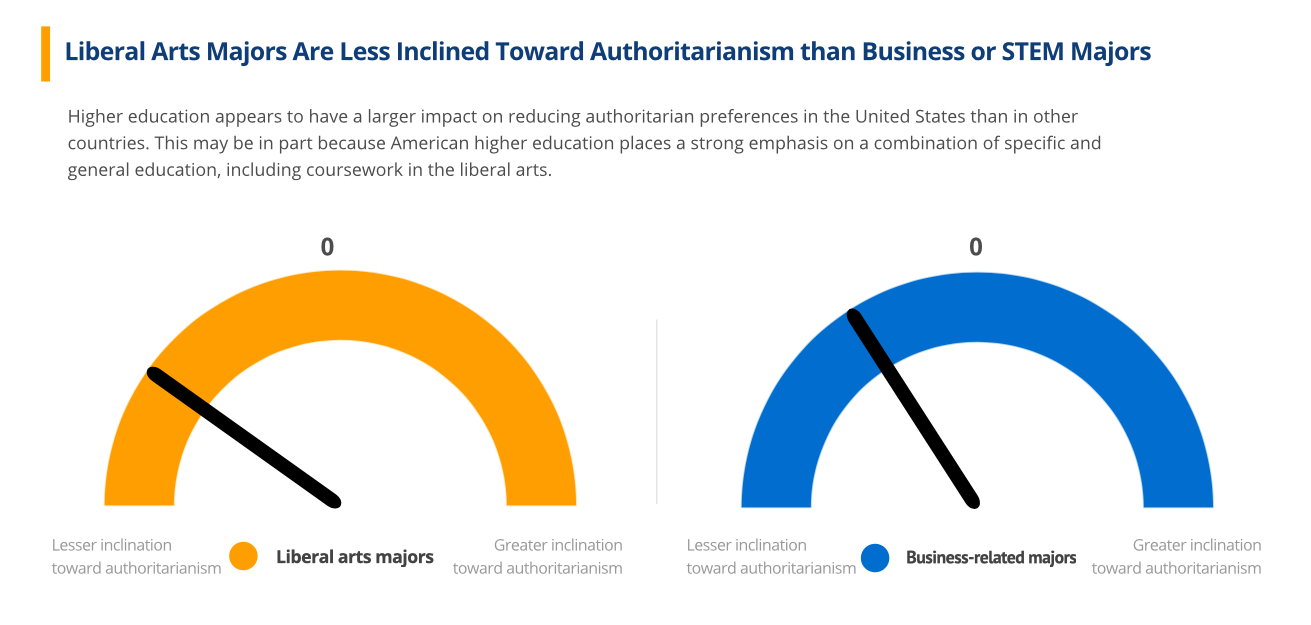
I’ll admit, a new study, “The Role of Education in Taming Authoritarian Attitudes,” confirms many of my own biases, suggesting that higher education, especially the liberal arts, reduces authoritarian attitudes around the world. The claim comes from Georgetown University’s Center on Education and the Workforce, which analyzed and aggregated data from World Values Surveys conducted between 1994 and 2016. The study takes it for granted that rising authoritarianism is not a social good, or at least that it poses a distinct threat to democratic republics, and it aims to show how “higher education can protect democracy.”
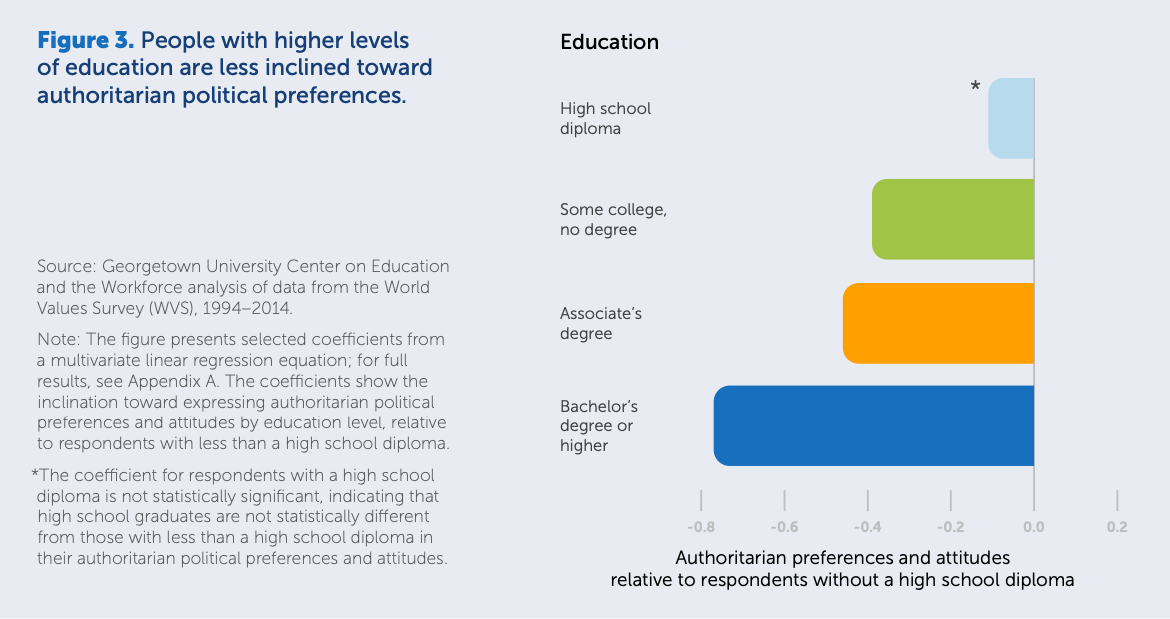
Authoritarianism—defined as enforcing “group conformity and strict allegiance to authority at the expense of personal freedoms”—seems vastly more prevalent among those with only a high school education. “Among college graduates,” Elizabeth Redden writes at Inside Higher Ed, “holders of liberal art degrees are less inclined to express authoritarian attitudes and preferences compared to individuals who hold degrees in business or science, technology, engineering and mathematics fields.”
The “valuable bulwark” of the liberal arts seems more effective in the U.S. than in Europe, perhaps because “American higher education places a strong emphasis on a combination of specific and general education,” the full report speculates. “Such general education includes exposure to the liberal arts.” The U.S. ranks at a moderate level of authoritarianism compared to 51 other countries, on par with Chile and Uruguay, with Germany ranking the least authoritarian and India the most—a 6 on a scale of 0–6.
Higher education also correlates with higher economic status, suggesting to the study authors that economic security reduces authoritarianism, which is expressed in attitudes about parenting and in a “fundamental orientation” toward control over autonomy.

The full report does go into greater depth, but perhaps it raises more questions than it answers, leaving the intellectually curious to work through a dense bibliography of popular and academic sources. There is a significant amount of data and evidence to suggest that studying the liberal arts does help people to imagine other perspectives and to appreciate, rather than fear, different cultures, religions, etc. Liberal arts education encourages critical thinking, reading, and writing, and can equip students with tools they need to distinguish reportage from pure propaganda.
But we might ask whether these findings consistently obtain under actually existing authoritarianism, which “tends to arise under conditions of threat to social norms or personal security.” In the 2016 U.S. election, for example, the candidate espousing openly authoritarian attitudes and preferences, now the current U.S. president, was elected by a majority of voters who were well-educated and economically secure, subsequent research discovered, rather than stereotypically “working class” voters with low levels of education. How do such findings fit with the data Georgetown interprets in their report? Is it possible that those with higher education and social status learn better to hide controlling, intolerant attitudes in mixed company?
Learn more at this report summary page here and read and download the full report as a PDF here.
Related Content:
Why We Need to Teach Kids Philosophy & Safeguard Society from Authoritarian Control
Critical Thinking: A Free Course
Josh Jones is a writer and musician based in Durham, NC. Follow him at @jdmagness
Read More...Is Mail-In Voting New in the United States?: It Actually Goes Back to the Civil War
Let’s say you go home for the holidays. Anything’s possible, who knows. It’s a wild world. Let’s say you get there and someone starts laying on you that trip about how Q Continuum said mail-in voting was orchestrated by satanic cables from Anarchist HQ. Let’s say you overhear something more down-to-earth, like how if mail-in voting happens, billions of people will vote illegally… even more people than live in the country, which is how you’ll know….
Maybe you’ll want to speak up and say, hey I know something about this topic, except then maybe you realize you don’t actually know much, but you know something ain’t right with this talk and maybe it’s probably good to have a functioning Postal Service and maybe people should be able to vote. In such situations (who can say how often these things happen), you might wish to have a little information at the ready, to educate yourself and share with others.
You might share information about how mail-in voting has been around since 1775. It has worked pretty well at scale since “about 150,000 of the 1 million Union soldiers were able to vote absentee in the 1864 presidential election in what became the first widespread use of non-in person voting in American history,” Alex Seitz-Wald explains at NBC News. Since the federal government has managed to make mail-in voting work for soldiers serving away from home for over 150 years, “it’s now easier in some ways for a Marine in Afghanistan to vote than it is for an American stuck at home during the COVID-19 lockdown.”
“Some part of the military has been voting absentee since the American Revolution,” Donald Inbody, former Navy Captain turned political science professor at Texas State University, tells NBC News. Inbody refers to one of the first documented instances, when Continental Army soldiers voted in a town meeting by proxy in New Hampshire. But history is complicated, and “mail-in voting has worked just fine so shut up” needs some nuance.
In the very same election in which 150,000 Union soldiers mailed their ballots, Lincoln urged Sherman to send troops stationed in Democratic-controlled Indiana—which had banned absentee voting—back to their home states so that they could vote. The practice has always had its vocal critics and suffered accusations of fraud from all sides, though little evidence seems to have emerged. Absentee voting helped win the Civil War, Blake Stilwell argues at Military.com, in spite of a conspiracy theory alleging fraud that might have unseated Lincoln.
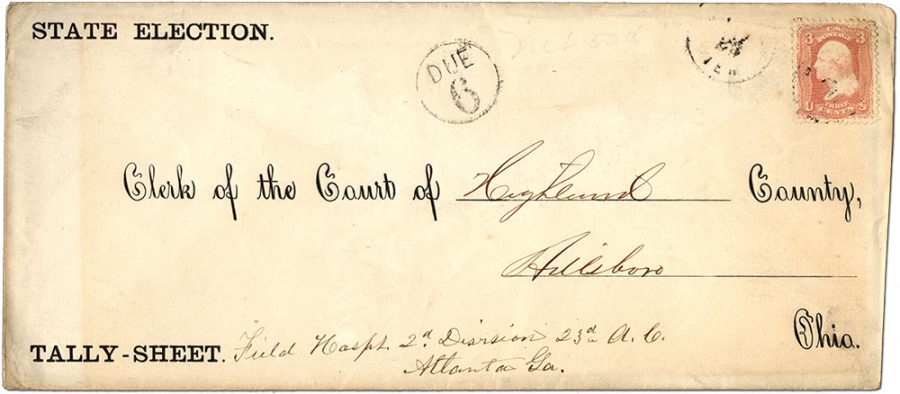
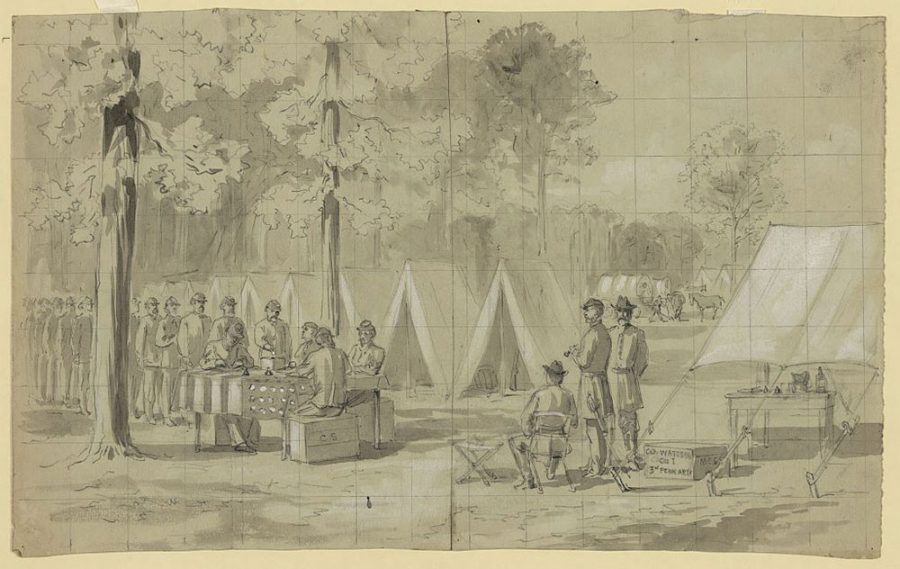
There are several remnants from the time of careful record-keeping, like the pre-printed envelope above that “contained a tally sheet of votes from the soldiers of Highland County the Field Hospital 2nd Division 23rd Army Corps,” notes the Smithsonian National Postal Museum. (The drawing at the top shows Pennsylvania soldiers voting in 1864.) And this is all fascinating stuff. But soldiers are actually absent, which is why they vote absentee, right? I mean, if you’re at home, why can’t you just go to the polling place in the global pandemic in your city that closed all the polling places?
It’s true that civilian mail-in voting often works differently from military absentee voting. While every state offers some version, some restrict it to voters temporarily out of state or suffering an illness. Currently, only “30 states have adopted ‘no-excuse absentee balloting,’ which allows anyone to request an absentee ballot,” Nina Strochlic reports at National Geographic. State laws vary further among those 30.
“In 2000,” for example, “Oregon became the first state to switch to fully vote-by-mail elections.” Things have rapidly changed, however. “In the face of the coronavirus pandemic, voters in every state but Mississippi and Texas were allowed to vote by mail or by absentee ballot in this year’s primaries.” If you live in the U.S. (or outside it) and don’t know what happened next… bless you. It involves defunding the post office instead of the police.
Voting by mail has expanded to meet major crises throughout history, says Alex Keyssar, history professor at the Kennedy School of Government at Harvard. “That’s the logical trajectory” and “we are not in normal times.” If a highly infectious disease that has killed at least 200,000 Americans on top of ongoing voter suppression and an election security crisis and massive civil unrest and economic turmoil aren’t reasons enough to expand the vote-by-mail franchise to every state, I couldn’t say what is.
Should only soldiers have the ability to vote easily? I imagine someone might say YES, loudly over the centerpiece, because voting is a privilege not a right!
You, empowered purveyor of accurate information, understander of absentee voting history, change-maker, will pull out your pocket Constitution and ask someone to find the word “privilege” in amendments that start with “The right of citizens of the United States to vote shall not be denied or abridged by the United States or by any State,” etc. That’ll show ’em. But if the gambit fails to impress, you’ve still got a better understanding of why voting by mail may not be one of the signs of the end times.
Related Content:
Take The Near Impossible Literacy Test Louisiana Used to Suppress the Black Vote (1964)
Three Public Service Announcements by Frank Zappa: Vote, Brush Your Teeth, and Don’t Do Speed
Sal Khan & the Muppets’ Grover Explain the Electoral College
Josh Jones is a writer and musician based in Durham, NC. Follow him at @jdmagness
Read More...30 Buster Keaton Films: “The Greatest of All Comic Actors,” “One of the Greatest Filmmakers of All Time”
The greatest of the silent clowns is Buster Keaton, not only because of what he did, but because of how he did it. —Roger Ebert
In 1987, Video magazine published a story titled “Where’s Buster?” lamenting the lack of Buster Keaton films available on videotape, “despite renewed interest” in a legend who was “about to regain his rightful place next to Chaplin in silent comedy’s pantheon.” How things have changed for Keaton fans and admirers. Not only are most of the stone-faced comic genius’ films available online, but he has maybe eclipsed Chaplin as the most popularly revered silent film star of the 1920s.
Keaton has always been held in the highest esteem by his fellow artists. He was dubbed “the greatest of all the clowns in the history of the cinema” by Orson Welles, and served as a significant inspiration for Samuel Beckett. (He was the playwright’s first choice to play Waiting for Godot’s Lucky, though he was too perplexed by the script to take the role). In Peter Bogdanovich’s new documentary, The Great Buster: A Celebration, Mel Brooks and Carl Reiner discuss his foundational influence on their comedy, and Werner Herzog calls him “the essence of movies.”
For many years, however, the state of Keaton’s filmography made it hard for the general public to fully appraise his work. “The General, with Buster as a train engineer in the Civil War, has always been available,” Roger Ebert wrote in 2002, and has been “hailed as one of the supreme masterpieces of silent filmmaking. But other features and shorts existed in shabby, incomplete prints, if at all, and it was only in the 1960s that film historians began to assemble and restore Keaton’s lifework. Now almost everything has been recovered, restored, and is available on DVDs and tapes that range from watchable to sparkling.”
Access to Keaton’s films has further expanded as a dozen or so entered the public domain in recent years, including two features, Sherlock, Jr. and The Navigator, this year and three more to come in 2021. You can watch thirty-one of Keaton’s restored, recovered films on YouTube, at the links below, shared by MetaFilter user Going to Maine, who writes, “where, oh where, in this modern world, can we find the gems of his golden era? The obvious place.”
Keaton starred in his first feature-length film, The Saphead, in 1920. For the next decade, until the end of the silent era, he dominated the box office, alongside Chaplin and Harold Lloyd, with his canny blend of daredevil slapstick and everyman pathos. After the twenties, his career floundered, then rebounded. His last picture was a return to silent film in Beckett’s 1966 short, “Film,” made the year of his death. Since then, Keaton appreciation has become almost a form of worship.
In 2018, The General came in at number 34 on Sight & Sound’s Greatest Films of All Time list. But the BFI’s Geoff Andrew argued that it deserved the top spot, and Keaton deserves recognition as “not merely the greatest of the silent comedians,” but “the greatest of all comic actors to have appeared on the silver screen… not only a great American filmmaker of the silent era,” but “one of the greatest filmmakers of all time, anywhere.” Andrew likens him to a god, but “unlike gods… Buster has the advantage of being able to make us laugh. And laugh. And laugh.”
Don’t we all need a steady supply of that medicine these days? See Keaton’s classic silent comedy The General further up and watch 29 more Keaton films at the links below. Many will be added to our collection, 4,000+ Free Movies Online: Great Classics, Indies, Noir, Westerns, Documentaries & More.
Short Films
One Week (September 1, 1920)
Convict 13 (October 27, 1920)
Neighbors (December 22, 1920)
The Scarecrow (December 22, 1920)
The Haunted House (February 10, 1921)
Hard Luck (March 14, 1921)
The High Sign (April 12, 1921)
The Goat (May 18, 1921)
The Playhouse (October 6, 1921) (This contains a faux minstrel show segment with blackface.)
The Boat (November 10, 1921)
The Paleface (January, 1922) (Racist depictions of Native Americans)
Cops (March, 1922)
My Wife’s Relations (May, 1922)
The Blacksmith (July 21, 1922)
The Frozen North (August 28, 1922)
The Electric House (October, 1922)
Day Dreams (November, 1922)
The Balloonatic (January 22, 1923)
The Love Nest (March, 1923)Features
Three Ages (September 24, 1923)
Our Hospitality (November 19, 1923)
Sherlock Jr. (May 11, 1924)
The Navigator (October 13, 1924)
Seven Chances (March 15, 1925)
Go West (November 1, 1925)
Battling Butler (September 19, 1926)
The General (December 31, 1926)
College (November 1927)
Steamboat Bill, Jr. (May 20, 1928)Bonus! Two of Keaton’s Last Films
The Railrodder, for the National Film Board of Canada (October 2, 1965)
Film, directed by Samuel Beckett (January 8, 1965)
Related Content:
A Supercut of Buster Keaton’s Most Amazing Stunts
Buster Keaton: The Wonderful Gags of the Founding Father of Visual Comedy
List of Great Public Domain Films
Josh Jones is a writer and musician based in Durham, NC. Follow him at @jdmagness
Read More...The Philosophy of Tragedy: A Free Course on the Philosophy of Great Greek Tragedies
This course features lectures by Michael Davis, Professor of Philosophy, delivered in the fall semester of 2018 at Sarah Lawrence College. All 28 lectures in this course can be viewed above, or on this YouTube playlist. This course is now added to our collection, 1,700 Free Online Courses from Top Universities.
Professor Bio:
Davis works primarily in Greek philosophy, in moral and political philosophy, and in what might be called the “poetics” of philosophy. He is the translator, with Seth Benardete, of Aristotle’s On Poetics and has written on a variety of philosophers from Plato to Heidegger and of literary figures from Homer and the Greek tragedians to Saul Bellow and Tom Stoppard.
Course Description:
Greek tragedy has been performed, read, imitated and interpreted for twenty-five hundred years. From the very beginning it was thought to be philosophically significant—somehow pointing to the truth of human life as a whole (the phrase the “tragedy of life” first appears in Plato). As a literary form it is thought especially revealing philosophically by Aristotle, Hegel, Nietzsche and Heidegger to name only a few. Among others, Seneca, Corneille, Racine, Voltaire, Goethe, Shelley, O’Neill and Sartre wrote versions of Greek tragedies. And, of course, there is Freud. Greek tragedy examines the fundamental things in a fundamental way. Justice, family, guilt, law, autonomy, sexuality, political life, the divine—these are its issues. The lectures that follow treat three plays by each of the great Athenian tragedians—Aeschylus, Sophocles and Euripides—with a view to understanding how they deal with these issues and with the question of the importance and nature of tragedy itself.
Translations Used:
Aeschylus, The Oresteia, Hugh Lloyd-Jones trans.
Sophocles I, Grene and Lattimore eds.
Ten Plays by Euripides, Moses Hadas trans.
Lectures:
Lecture 1: Introduction
Lecture 2: Aeschylus’s Agamemnon
Lecture 3: Agamemnon
Lecture 4: Aeschylus’s Libation Bearers
Lecture 5: Aeschylus’s Eumenides
Lecture 6: Eumenides
Lecture 7: Eumenides
Lecture 8: Eumenides
Lecture 9: Eumenides
Lecture 10: Sophocles’ Oedipus Tyrannus
Lecture 11: Oedipus Tyrannus
Lecture 12: Oedipus Tyrannus
Lecture 13: Sophocles’ Oedipus at Colonus
Lecture 14: Oedipus at Colonus
Lecture 15: Oedipus at Colonus
Lecture 16: Oedipus at Colonus
Lecture 17: Sophocles’ Antigone
Lecture 18: Antigone
Lecture 19: Antigone
Lecture 20: Euripides’ Bacchae
Lecture 21: Bacchae
Lecture 22: Euripides’ Iphigenia among the Taurians
Lecture 23: Iphigenia among the Taurians
Lecture 24: Iphigenia among the Taurians
Lecture 25: Iphigenia among the Taurians
Lecture 26: Euripides’ Hippolytus
Lecture 27: Hippolytus
Lecture 28: Conclusion
Google Introduces 6‑Month Career Certificates, Threatening to Disrupt Higher Education with “the Equivalent of a Four-Year Degree”
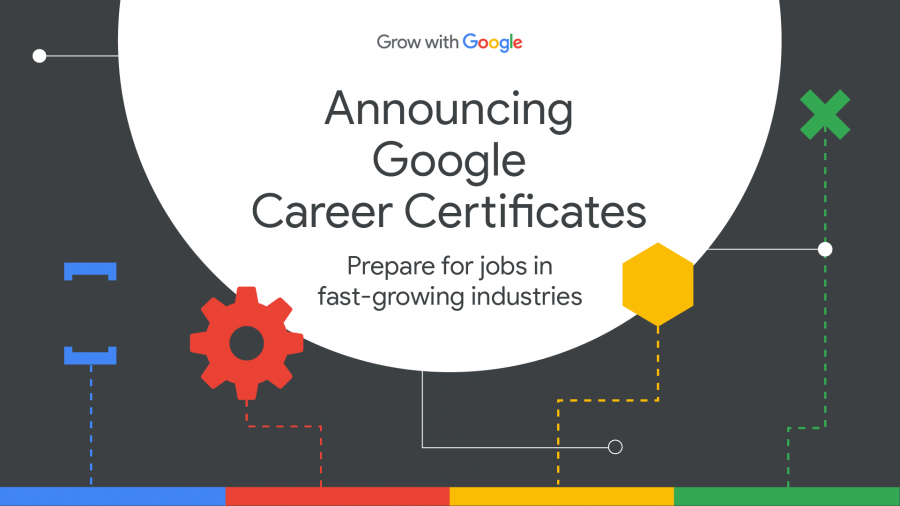
Update: You can find the first of the Google Career Certificates here. They’re also added to our collection 200 Online Certificate & Microcredential Programs from Leading Universities & Companies.
I used to make a point of asking every college-applying teenager I encountered why they wanted to go to college in the first place. Few had a ready answer; most, after a deer-in-the-headlights moment, said they wanted to be able to get a job — and in a tone implying it was too obvious to require articulation. But if one’s goal is simply employment, doesn’t it seem a bit excessive to move across the state, country, or world, spend four years taking tests and writing papers on a grab-bag of subjects, and spend (or borrow) a large and ever-inflating amount of money to do so? This, in any case, is one idea behind Google’s Career Certificates, all of which can be completed from home in about six months. Find the first ones here.
Any such remote educational process looks more viable than ever at the moment due to the ongoing coronavirus pandemic, a condition that also has today’s college-applying teenagers wondering whether they’ll ever see a campus at all. Nor is the broader economic harm lost on Google, whose Senior Vice President for Global Affairs Kent Walker frames their Career Certificates as part of a “digital jobs program to help America’s economic recovery.” He writes that “people need good jobs, and the broader economy needs their energy and skills to support our future growth.” At the same time, “college degrees are out of reach for many Americans, and you shouldn’t need a college diploma to have economic security.”
Hence Google’s new Career Certificates in “the high-paying, high-growth career fields of Data Analytics, Project Management, and User Experience (UX) Design,” which join their existing IT Support and IT Automation in Python Certificates.
- Google UX Design Professional Certificate
- Google Data Analytics Professional Certificate
- Google Project Management Professional Certificate
- Google IT Support Professional Certificate
- Google IT Automation Professional Certificate
Hosted on the online education platform Coursera, these programs (which run about $300-$400) are developed in-house and taught by Google employees and require no previous experience. To help cover their cost Google will also fund 100,000 “need-based scholarships” and offer students “hundreds of apprenticeship opportunities” at the company “to provide real on-the-job training.” None of this guarantees any given student a job at Google, of course, but as Walker emphasizes, “we will consider our new career certificates as the equivalent of a four-year degree.”
Biggest tech & higher ed story of the last 2 weeks — #Google entering higher ed, offering BA-equivalent degrees@YahooFinance pic.twitter.com/bsGgwHsnRn
— Scott Galloway (@profgalloway) August 30, 2020
Technology-and-education pundit Scott Galloway calls that bachelor’s-degree equivalence the biggest story in his field of recent weeks. It’s perhaps the beginning of a trend where tech companies disrupt higher education, creating affordable and scalable educational programs that will train the workforce for 21st century jobs. This could conceivably mean that universities lose their monopoly on the training and vetting of students, or at least find that they’ll increasingly share that responsibility with big tech.
This past spring Galloway gave an interview to New York magazine predicting that “ultimately, universities are going to partner with companies to help them expand.” He adds: “I think that partnership will look something like MIT and Google partnering. Microsoft and Berkeley. Big-tech companies are about to enter education and health care in a big way, not because they want to but because they have to.” Whether such university partnerships will emerge as falling enrollments put the strain on certain segments of the university system remains to be seen, but so far Google seems confident about going it alone. And where Google goes, as we’ve all seen before, other institutions often follow.
Note: You can listen to Galloway elaborate on how Google may lead to the unbundling of higher ed here. Listen to the episode “State of Play: The Sharing Economy” from his Prof G podcast:
Related Content:
200 Online Certificate & Microcredential Programs from Leading Universities & Companies.
Based in Seoul, Colin Marshall writes and broadcasts on cities, language, and culture. His projects include the book The Stateless City: a Walk through 21st-Century Los Angeles and the video series The City in Cinema. Follow him on Twitter at @colinmarshall, on Facebook, or on Instagram.
Read More...Support Us
We're hoping to rely on loyal readers, rather than erratic ads. Please click the Donate button and support Open Culture. You can use Paypal, Venmo, Patreon, even Crypto! We thank you!

About Us

Open Culture scours the web for the best educational media. We find the free courses and audio books you need, the language lessons & educational videos you want, and plenty of enlightenment in between.
Advertise With Us
FREE UPDATES!
GET OUR DAILY EMAIL
Get the best cultural and educational resources on the web curated for you in a daily email. We never spam. Unsubscribe at any time.
FOLLOW ON SOCIAL MEDIA
Open Culture editor Dan Colman scours the web for the best educational media. He finds the free courses and audio books you need, the language lessons & movies you want, and plenty of enlightenment in between.
Advertise With Us

