How Martin Luther King Jr. Got C’s in Public Speaking–Before Becoming a Straight‑A Student and a World Class Orator
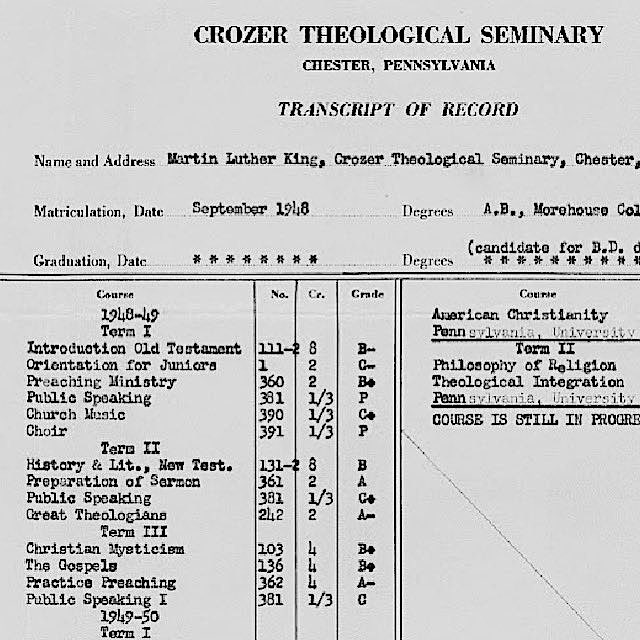
How many Americans have never heard the name of Martin Luther King Jr.? And indeed, gone more than half a century though he may be, how many Americans have never heard his voice, or can’t quote his words? Long though King will doubtless stand as an example of the English language’s greatest 20th-century orators, he once showed scant academic promise in that department. Tweeting out an image of his transcript from Crozer Theological Seminary, where King earned his Bachelor of Divinity, Harvard’s Sarah Elizabeth Lewis notes that King “received two Cs in public speaking,” and “actually went from a C+ to a C the next term.”
Still, that beat the marks King had previously received at Morehouse College. In an article for The Journal of Blacks in Higher Education, Stanford’s Clayborne Carson quotes religion professor George D. Kelsey as describing King’s record there as “short of what may be called ‘good,’ ” but also adding that King came “to realize the value of scholarship late in his college career.” This early underachievement may have been a consequence of King’s entrance into college at the young age of fifteen, which was made possible by Morehouse’s offering its entrance exam to junior high schoolers, its student body having been depleted by enlistment in the Second World War.
But King “probably realized that he would have to become more diligent in his studies if he were to succeed at the small Baptist institution in Chester, Pennsylvania, a small town southwest of Philadelphia,” writes Carson. “Evidently wishing to break with the relaxed attitude he had had toward his Morehouse studies,” he “quickly immersed himself in Crozer’s intellectual environment” and adopted a mien of high seriousness. “If I were a minute late to class, I was almost morbidly conscious of it,” King later recalled. “I had a tendency to overdress, to keep my room spotless, my shoes perfectly shined, and my clothes immaculately pressed.”
The young King eventually rose to the role in which he’d cast himself, thanks in part to the rigor of certain professors who knew what to expect from him. Apart from the sole minus blemishing his grade in “Christianity and Society,” his transcript for 1950–51 shows straight As. “By the time of his graduation,” Carson writes, “King’s intellectual confidence was reinforced by the experience of having successfully competed with white students during his Crozer years.” Named student body president and class valedictorian, “he was also accepted for doctoral study at Boston University’s School of Theology, where he would be able to work directly with the personalist theologians he had come to admire.” Even then, one suspects, King knew the real work lay ahead of him — and well outside the academy, at that.
Related Content:
How Martin Luther King, Jr. Used Nietzsche, Hegel & Kant to Overturn Segregation in America
Albert Einstein’s Grades: A Fascinating Look at His Report Cards
Based in Seoul, Colin Marshall writes and broadcasts on cities, language, and culture. His projects include the Substack newsletter Books on Cities, the book The Stateless City: a Walk through 21st-Century Los Angeles and the video series The City in Cinema. Follow him on Twitter at @colinmarshall, on Facebook, or on Instagram.
Read More...Carl Sagan on the Importance of Choosing Wisely What You Read (Even If You Read a Book a Week)
More than a few of us have a reading goal for 2021: a book a week, say. Some of us may have had the idea planted in our heads long ago by Carl Sagan, in his capacity as creator and host of the PBS series Cosmos: A Personal Voyage. “If I were to read a book a week for my entire adult lifetime,” he says in the clip above, “I would have read maybe a few thousand books. No more.” This is part of a longer monologue set in a library, a background that provides Sagan an ideal visual reference for how many volumes that is. Even seen as a portion of just the shelf space he stands by, it doesn’t look like a terribly impressive amount. Indeed, it makes up “only tenth of a percent or so of the total number of books in the library.”
The trick, Sagan adds, “is to know which books to read.” He himself got started addressing this question rather early, having drawn up an ambitious reading list previously featured here on Open Culture while still an undergraduate at the University of Chicago.
Sagan included (see the list here) everything from the Bible and Plato’s Republic to André Gide’s The Immoralist and Aldous Huxley’s Young Archimedes to Communication Circuit Fundamentals and Thermodynamics: An Advanced Treatment — those last being course readings, but impressive ones nevertheless. Though Sagan lived an abbreviated life, dying at the age of 62, we can rest assured that he nevertheless got his few thousand books in. Can we do the same?
To gear up for your reading year to come, consider watching this short documentary on the world’s most beautiful bookstores, which recommends daily reading habits that add up to surprisingly many books over a lifetime. But if you choose your books without discernment, as Sagan implies, it doesn’t matter how many you read. Before drawing up your own reading list, have a look at the ones other serious readers, writers, and thinkers have used before: Charles Darwin, for instance, or the many names in our personal reading-list roundup including Neil DeGrasse Tyson, Jorge Luis Borges, Patti Smith, Bill Gates, and David Bowie. Mark Twain also composed a reading list for kids and adults alike, but whatever we take from it, we should enter the new year with one of his famous aphorisms in mind: “The man who does not read good books has no advantage over the man who can’t read them.”
Related Content:
7 Tips for Reading More Books in a Year
100 Books to Read in a Lifetime
Based in Seoul, Colin Marshall writes and broadcasts on cities, language, and culture. His projects include the Substack newsletter Books on Cities, the book The Stateless City: a Walk through 21st-Century Los Angeles and the video series The City in Cinema. Follow him on Twitter at @colinmarshall, on Facebook, or on Instagram.
Read More...How Do Vaccines (Including the COVID-19 Vaccines) Work?: Watch Animated Introductions
The other day, I found myself reading about what life is like in countries that have successfully minimized the pandemic: worry free holidays, meeting friends and family without the danger of infection, a general air of normalcy thanks to a combination of rigorous public health efforts and public cooperation. I live in the U.S., where the political party currently in power (and desperate to keep it) convinced millions of my fellow citizens that the virus was a hoax, a scam, a political ploy. The reality of a virus-free existence seems like a fairy tale.
But perhaps, after a year of death, suffering, and lunacy, we will begin to see the tide turn once enough people get vaccinated… if we can overcome the massive wave of anti-science bias and disinformation about vaccines…. “The anti-vaccination movement is going to make Covid-19 more difficult to get under control,” says Scott Ratzan, distinguished lecturer at the CUNY Graduate School of Public Health and Health Policy.
Long before the vaccine arrived, Katherine O’Brien, a director at WHO, noted there was already a prominent “anti-vaccination voice” on social media. “We have to take this seriously,” she told The BMJ. “Vaccination isn’t just an individual choice; it protects those who can’t be vaccinated.” We’ve seen the term “herd immunity” misused a lot lately. What it essentially means is that a small number of people can be shielded from the virus if the vast majority get vaccinated. Or as WHO puts it, “herd immunity is achieved by protecting people from a virus, not by exposing them to it.”
All of this means there will likely never be a more critical moment to educate ourselves and others on the science of vaccines. We may not sway those faithful to a certain narrative, but it can help shift the conversation from fears of the unknown to the long history of the known when it comes to eradicating highly infectious, deadly diseases. A great way to start is with the basics, which you’ll find in the videos above from TED-Ed, Mechanisms of Medicine, and PBS. Watch them yourself, share them on social media, and keep the conversation about vaccines’ efficacy going.
In the TED-Ed lesson just above, we learn some more specific information about the key phases of developing a new vaccine: exploratory research, clinical testing, and manufacturing. You’ll find much more detailed information on the history of vaccines, spurious anti-vaccination claims, and the coronavirus vaccines now on the market and currently shipping around the world, at the award-winning site, The History of Vaccines, from the College of Physicians of Philadelphia.
The COVID-19 vaccine is a special kind of vaccine (mRNA) that works differently from most, and you can learn about how it works here. A quick primer on herd immunity appears at the bottom.
Related Content:
19th Century Maps Visualize Measles in America Before the Miracle of Vaccines
Josh Jones is a writer and musician based in Durham, NC. Follow him at @jdmagness.
Read More...Study Less, Study Smart: A Longtime Psych Professor Explains How to Study (or Do Any Intellectual Work) Effectively
If you’ve left formal education, you no doubt retain a few good memories from your years as a student. None of them, safe to say, involve studying — assuming you managed to get any studying done in the first place. The unfortunate fact is that few of us ever really come to grips with what it means to study, apart from sitting by oneself with a textbook for hours on end. Despite its obvious inefficiency as a learning method, we’ve all found ourselves doing that kind of “studying” at one time or another. Having taught psychology classes for 40 years, Pierce College professor Marty Lobdell has seen thousands of students laboring, indeed suffering, under similar studying-related assumptions, and in his 8.7‑million-times-viewed talk “Study Less, Study Smart,” he sets out to correct them. He has also dispensed his wisdom in a book by the same title.
Not many of us can get much out of a textbook after a few hours with it, or indeed, after more than about thirty minutes. It’s thus at such an interval that Lobdell suggests taking a regular five-minute break to listen to music, play a game, talk to a friend, meditate — to do anything but study — in order to recharge your ability to focus and head off these diminishing returns of absorption. At the end of each entire study session, you’d do well to schedule a bigger reward in order to reinforce the behavior of engaging in study sessions in the first place. Ideally, you’ll enjoy this reward in a different place than you do your studying, which itself shouldn’t be a room that comes with its own distracting primary use, like the bedroom, kitchen, or living room.
Even if you have a dedicated study area (and better yet, a dedicated study lamp that you turn on only while hitting the books), you won’t get much accomplished there if you rely on simply reading texts over and over again in hopes of eventually memorizing their contents. Lobdell recommends focusing primarily on not facts but the broader concepts that organize those facts. An effective means of checking whether you understand a concept is to try explaining it in your own words: Richard Feynman premised his “notebook technique” for learning, previously featured here on Open Culture, on just such a process. You’ll also want to make use of the notes you take in class, but only if you take them in a useful way, which necessitates a process of expansion and revision immediately after each class.
Lobdell has much more advice to offer throughout the full, hourlong talk. In it he also covers the value of study groups; the more questionable value of highlighting; genuine remembering versus simple recognition; the necessity of a good night’s sleep; the “survey, question, read, recite, review” approach to textbooks; and the usefulness of mnemonics (even, or perhaps especially, silly ones). If you’re a student, you can make use of Lobdell’s techniques right away, and if you once were a student, you may find yourself wishing you’d known about them back then. But properly adapted, they can benefit the intellectual work you do at any stage of life. Never, after all, does concentration become less valuable, and never can we claim to have learned something unless we can first make it understood to others – or indeed, to ourselves.
If you want the cliff notes version of the Study Less, Study Smart lecture, watch the video below:
Related Content:
The “Feynman Technique” for Studying Effectively: An Animated Primer
Richard Feynman’s Technique for Learning Something New: An Animated Introduction
What’s a Scientifically-Proven Way to Improve Your Ability to Learn? Get Out and Exercise
Based in Seoul, Colin Marshall writes and broadcasts on cities, language, and culture. His projects include the Substack newsletter Books on Cities, the book The Stateless City: a Walk through 21st-Century Los Angeles and the video series The City in Cinema. Follow him on Twitter at @colinmarshall, on Facebook, or on Instagram.
Read More...The Power of Empathy: A Quick Animated Lesson from Brené Brown
Several years back, the RSA (Royal Society of the Arts) created a series of distinctive animated shorts where well-known intellectuals presented big ideas, and a talented artist rapidly illustrated them on a whiteboard. Some of those talks featured the likes of Slavoj Zizek, Carol Dweck, Steven Pinker and Barbara Ehrenreich. Now RSA presents a video series created in an entirely different aesthetic. Above, you can watch the first of many “espresso shots for the mind.” This clip features Dr. Brené Brown, a well-known research professor at the University of Houston Graduate College of Social Work, providing some quick insights into the difference between sympathy and empathy, and explaining why empathy is much more meaningful. To learn more about The Power of Empathy, you can watch Brown’s complete RSA lecture below . You can also watch her very popular TED Talk on The Power of Vulnerability here.
Note: An earlier version of this post appeared on our site in December, 2013.
If you would like to support the mission of Open Culture, consider making a donation to our site. It’s hard to rely 100% on ads, and your contributions will help us continue providing the best free cultural and educational materials to learners everywhere. You can contribute through PayPal, Patreon, and Venmo (@openculture). Thanks!
Related Content:
Free Online Psychology Courses (Part of our list of Free Online Courses)
Meditation 101: A Short, Animated Beginner’s Guide
The Psychology of Blame: Another Animated Lesson That Can Make You a Better Person
Read More...Watch How to Be at Home, a Beautiful Short Animation on the Realities of Social Isolation in 2020
I think, as social primates, we want to feel a strong sense of belonging either in a relationship or to a community—or both. But also intrinsic to our humanity is a feeling that we are truly alone.
—Filmmaker Andrea Dorfman, 2010
When they first became friends, poet Tanya Davis and filmmaker Andrea Dorfman talked a lot about the pleasures and hardships of being alone. Davis had just gone through a break up, and Dorfman was just embarking on a relationship after four years of flying solo.
These conversations led to a collaboration, 2010’s How to Be At Alone (see below), a whimsical videopoem that combines live action and animation to consider some of solitude’s sweeter aspects, like sitting on a bench as signal to the universe that one is available for impromptu conversation with a stranger.
That bench reappears in their 2020 follow up, How to Be At Home, above. Now it is cordoned off with black and yellow caution tape, a familiar public health measure in 2020.
As with the earlier project, a large part of Davis’ purpose was to reflect and reassure, both herself, and by extension, others.
Although she has become a poster child for the joys of solitude, she also relishes human contact, and found herself missing it terribly while sheltering alone in the early days of the pandemic. Writing the new poem gave her “an anchor” and a place to put her anxiety.
Dorfman notes that the project, which was commissioned by the National Film Board of Canada as part of a short film collection about Canadians navigating life during the pandemic, was “essentially catalyzed by COVID.”
As she embarked on the project, she wondered if the pandemic would be over by the time it was complete. As she told the CBC’s Tom Power:
There was this feeling that this could go away in a month, so this better be finished soon, so it’s still relevant. So as an artist, as a filmmaker, I thought, “I have to crank this out” but there’s no fast and easy way to do animation. It just takes so long and as I got into it and realized that this was going to be a marathon, not a sprint, the images just kept coming to me and I really just made it up as I went along. I’d go into my studio every day not knowing what lay ahead and I’d think, “Okay, so, what do we have up next? What’s the next line? And I’d spend maybe a week on a line of the poem, animating it.
It appears to have been an effective approach.
Dorfman’s painted images ripple across the fast turning pages of an old book. The titles change from time to time, and the choices seem deliberate—The Lone Star Ranger, Le Secret du Manoir Hanté, a chapter in The Broken Halo—“Rosemary for Remembrance.”
“It’s almost as though the way the poem is written there are many chapters in the book. (Davis) moves from one subject to another so completely,” Dorfman told the University of King’s College student paper, The Signal.
In the new work, the absence of other people proves a much heavier burden than it does in How To Be Alone.
Davis flirts with many of the first poem’s settings, places where a lone individual might have gone to put themselves in proximity to other humans as recently as February 2020:
Public transportation
The gym
A dance club
A description from 2010:
The lunch counter, where you will be surrounded by chow-downers, employees who only have an hour and their spouses work across town, and they, like you, will be alone.
Resist the urge to hang out with your cell phone.
In 2020, she struggles to recreate that experience at home, her phone serving as her most vital link to the outside world, as she scrolls past images of a Black Lives Matter protests and a masked essential worker:
I miss lunch counters so much I’ve been eating [pickles and] toasted sandwiches while hanging unabashedly with my phone.
See How to Be at Home and the 29 other films that comprise The Curve, the National Film Board of Canada series about life in the era of COVID-19 here.
How to be at Home
By Tanya Davis
If you are, at first, really fucking anxious, just wait. It’ll get worse, and then you’ll get the hang of it. Maybe.
Start with the reasonable feelings – discomfort, lack of focus, the sadness of alone
you can try to do yoga
you can shut off the radio when it gets to you
you can message your family or your friends or your colleagues, you’re not supposed to leave your home anyway, so it’s safe for you
There’s also the gym
you can’t go there but you could pretend to
you could bendy by yourself in your bedroom
And there’s public transportation
probably best to avoid it
but there’s prayer and meditation, yes always
employ it
if you have pains in your chest ‘cause your anxiety won’t rest
take a moment, take a breath
Start simple
things you can handle based on your interests
your issues and your triggers
and your inner logistics
I miss lunch counters so much I’ve been eating [pickles and] toasted sandwiches while hanging unabashedly with my phone
When you are tired, again of still being alone
make yourself a dinner
but don’t invite anybody over
put something green in it, or maybe orange
chips are fine sometimes but they won’t keep you charged
feed your heart
if people are your nourishment, I get you
feel the feelings that undo you while you have to keep apart
Watch a movie, in the dark
and pretend someone is with you
watch all of the credits
because you have time, and not much else to do
or watch all of the credits to remember
how many people come together
just to tell a story
just to make a picture move
And then, set yourself up dancing
like it’s a club where everyone knows you
and they’re all gonna hold you
all night long
they’re gonna dance around you and with you and on their own
it’s your favourite song
with the hardest bass and the cathartic drums
your heart pumps along/hard, you belong
you put your hands up to feel it
With the come down comes the weeping
those downcast eyes and feelings
the truth is you can’t go dancing, not right now
not at any club or party in any town
The heartbreak of this astounds you
it joins old aches way down in you
you can visit them, but please don’t stay there
Go outside if you’re able, breathe the air
there are trees for hugging
don’t be embarrassed
it’s your friend, it’s your mother, it’s your new crush
lay your cheek against the bark, it’s a living thing to touch
Sadly, leave all benches empty
appreciate the kindness in the distance of strangers
as you pine for company and wave at your neighbours
savour the depths of your conversations
the layers uncovered
in this strange space and time
Society is afraid of change
and no one wants to die
not now, from a tiny virus
not later from the world on fire
But death is a truth we all hate to know
we all get to live, and then we all have to go
In the meantime, we’re surrounded, we’re alone
each a thread woven in the fabric, unravelling in moments though
each a solo entity spinning on its axis, forgetting that the galaxy includes us all
Herein our fall
from grace from each other from god whatever, doesn’t matter
the disaster is that we believe we’re separate
we’re not
As evidenced by viruses taking down societies
as proven by the loneliness inherent in no gatherings
as palpable as the vacancy in the space of one person hugging
If this disruption undoes you
if the absence of people unravels you
if touch was the tether that held you together
and now that it’s severed you’re fragile too
lean into loneliness and know you’re not alone in it
lean into loneliness like it is holding you
like it is a generous representative of a glaring truth
oh, we are connected
we forget this, yet we always knew.
How to Be at Home will be added to the Animation section of our collection, 4,000+ Free Movies Online: Great Classics, Indies, Noir, Westerns, Documentaries & More.
Related Content:
Watch “Ryan,” Winner of an Oscar and 60 Other Awards
Ayun Halliday is an author, illustrator, theater maker and Chief Primatologist of the East Village Inky zine. Follow her @AyunHalliday.
Read More...A Free Stanford Course on How to Teach Online: Designed for Middle & High School Teachers
Update: You can find the video recording of the workshop here.
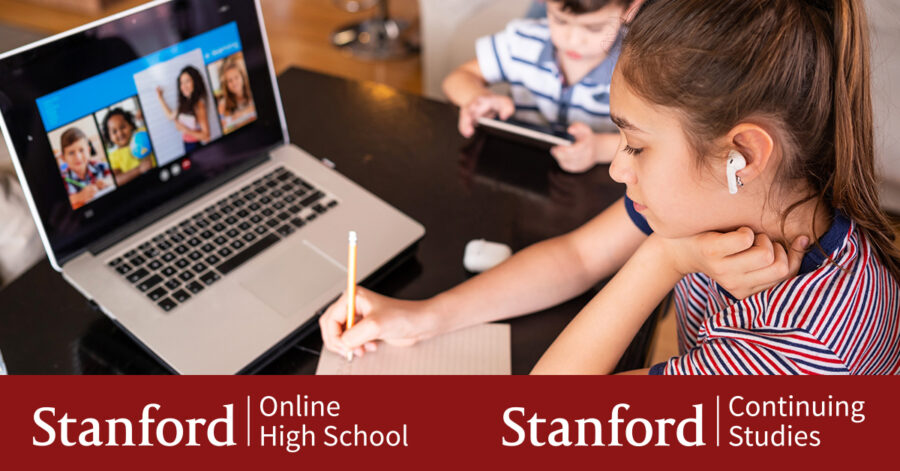
This past spring, teachers and students everywhere got an abrupt introduction to online learning. When classrooms moved online in March, many teachers experimented with online pedagogy for the first time, often without much training or support. To help ease this transition, the Stanford Online High School–an independent high school that operates entirely online–launched a free course designed to help teachers get comfortable teaching in this new medium. 7,000 teachers signed up. To continue providing support, an updated version of this free course will be offered again this weekend.
“Teaching Your Class Online” will take place this Saturday (November 21) and Sunday (November 22), and run from 9:00 am — 11:00 am Pacific time each day. (Update: The lectures are now available online.) Designed mainly for instructors teaching grades 7–12, the course can be helpful for elementary and college instructors as well. Topics covered will include “challenges [such] as student engagement and discussion (including for large groups, breakout rooms, and hybrid groups), effective communication with students and parents, assessment and curriculum adaptation for online pedagogy, and strategies for supporting both students and yourselves.”
“Teaching Your Class Online” is supported by Stanford Online High School and Stanford Continuing Studies. You can enroll in the course on the Continuing Studies website here.
If you know any teachers who could benefit from this free course, please feel free to share this post with them.
Related Content:
1,700 Free Online Courses from Top Universities200 Free Kids Educational Resources: Video Lessons, Apps, Books, Websites & More
“I Will Survive,” the Coronavirus Version for Teachers Going Online
Read More...Martin Luther King: “You Know Who to Vote For. I’m Just Asking You to Vote!” (1964)
The more things change, the more they stay the same.
At another turning point in U.S. history–when LBJ ran against Barry Goldwater in the 1964 presidential election–Martin Luther King, Jr. urged voters to stand up and be counted. To set the scene, the UCLA Film & Television Archive writes:
King, who had just been named the winner of the Nobel Peace Prize for his commitment to nonviolent resistance, embarked on a cross-country get-out-the-vote campaign in support of incumbent Democrat Lyndon B. Johnson. Republican challenger Barry Goldwater opposed the Civil Rights Act of 1964 in favor of states’ rights and represented, for King, a setback for the civil rights movement and “a great dark night of social destruction” (Los Angeles Times). King also advocated for more African American representation in Congress and spoke against ballot measures that would perpetuate discrimination. To vote was not only a civic duty, it was a moral imperative.
His words speak to our moment today as much, if not more, than they did to the events of 56 years ago. Speaking to a crowd in LA, King said:
“Suffice it to say that we stand in one of the most momentous periods of human history. And in these days of emotional tension, when the problems of the world are gigantic in extent and chaotic in detail, all men of good will must make the right decisions.”
“We must decide whether … we will allow our nation to be relegated to a second-rate power in the world with no moral voice.”
“We must decide next Tuesday whether America will take the high road of justice and peace, compassion for the poor and underprivileged, or whether this nation will tread the low road of man’s inhumanity to man, of injustice, of short-sightedness.”
“Each of us has a moral responsibility, if we are of voting age and if we are registered, to participate in that decision. I come here to urge every person under the sound of my voice to go to the polls on the 3rd of November and vote your convictions.”
Amen.
Related Content:
How Martin Luther King, Jr. Used Nietzsche, Hegel & Kant to Overturn Segregation in America
Read More...The Craft of Writing Effectively: Essential Lessons from the Longtime Director of UChicago’s Writing Program
Academic writing has a bad reputation. “When a scholar’s vanity/insecurity leads him to write primarily to communicate and reinforce his own status as an Intellectual,” as David Foster Wallace diagnosed the problem nearly two decades ago, “his English is deformed by pleonasm and pretentious diction (whose function is to signal the writer’s erudition) and by opaque abstraction (whose function is to keep anybody from pinning the writer down to a definite assertion that can maybe be refuted or shown to be silly).” Indeed. But the disorders behind the kind of prose that inspires provocations like Philosophy and Literature’s “Bad Writing Contest” are, if you believe University of Chicago Writing Programs director Larry McEnerney, even more basic than that.
“You think that writing is communicating your ideas to your readers,” McEnerney declares to a roomful of academics in the video above. “It is not.” In this 80-minute talk, titled “The Craft of Writing Effectively,” he identifies the core misconceptions that cause academic writing to be bad — or more to the point, uninteresting, uninfluential, unread. Most all of us grow up learning to write in school, where we need not give much consideration to our audience: a teacher, or in college perhaps a teaching assistant, who’s paid to read what we’ve written. But when nobody’s next meal is coming from reading our papers anymore, we come face to face with an essential mismatch between our assumed goals as a writer and the desires of an unpaid reader.
“I got no problem with somebody writing an essay because they want to think,” says McEnerney. “What I have a problem with is when they come to my office and say, ‘My readers don’t appreciate me.’ ” But “they don’t owe you their appreciation,” nor even their attention — not if you neglect your core task as a writer, “to change the way your readers think.” This has little to do with the task of writing back in school, which involved the presentation of your ideas and knowledge in exchange for a grade. To produce “clear, organized, persuasive, and valuable” writing, to McEnerney’s mind, you must “identify the people with power in your community and give them what they want,” which necessitates mastering the “code” of that community.
This doesn’t simply mean sucking up to the higher-ups. While you should, of course, demonstrate familiarity with the work already accomplished in your field, you’ve also got to tell those higher-ups — who, like most anyone else, read to have their ideas changed — that something they know is wrong. This requires saving the explanation of your subject for later, after first setting up a problem with the language of instability (words like “but,” “however,” “inconsistent,” and “anomaly”), then offering your own solution. You can see these and other techniques in use, as well as examples of what not to do, in the lecture’s PDF handout. Are there valid objections to McEnerney’s view of writing? He acknowledges that there are, such as as the moral critique mounted by critical theorist Homi K. Bhabha, then a professor at the University of Chicago — and also, as it happens, a second-placer in the Bad Writing Contest.
Related Content:
10 Writing Tips from Legendary Writing Teacher William Zinsser
Martin Amis Explains His Method for Writing Great Sentences
Based in Seoul, Colin Marshall writes and broadcasts on cities, language, and culture. His projects include the Substack newsletter Books on Cities, the book The Stateless City: a Walk through 21st-Century Los Angeles and the video series The City in Cinema. Follow him on Twitter at @colinmarshall, on Facebook, or on Instagram.
Read More...A Master List of 1,500 Free Courses From Top Universities: 50,000 Hours of Audio/Video Lectures to Enrich Your Mind
For the past 14 years, we’ve been busy rummaging around the internet and adding courses to an ever-growing list of Free Online Courses, which now features 1,500 courses from top universities. Let’s give you the quick overview: The list lets you download audio & video lectures from schools like Stanford, Yale, MIT, Oxford, Harvard and many other institutions. Generally, the courses can be accessed via YouTube, iTunes or university web sites, and you can listen to the lectures anytime, anywhere, on your computer or smart phone. We haven’t done a precise calculation, but there’s about 50,000 hours of free audio & video lectures here. Enough to keep you busy for a very long time–something that’s useful during these socially distant times.
Right now you’ll find 200 free philosophy courses, 105 free history courses, 170 free computer science courses, 85 free physics courses and 55 Free Literature Courses in the collection, and that’s just beginning to scratch the surface. You can peruse sections covering Astronomy, Biology, Business, Chemistry, Economics, Engineering, Math, Political Science, Psychology and Religion.
Here are some highlights from the complete list of Free Online Courses. We’ve added a few unconventional/vintage courses in the mix just to keep things interesting.
- A History of Philosophy in 81 Video Lectures: From Ancient Greece to Modern Times — Free Online Video — Arthur Holmes, Wheaton College
- A Romp Through Ethics for Complete Beginners - Various Formats – Marianne Talbot, Oxford University
- Ancient Greek History — Various Formats — Donald Kagan, Yale
- Creative Reading and Writing by William S. Burroughs — Free Online Audio — Naropa University
- Critical Reasoning for Beginners — Various Formats – Marianne Talbot, Oxford
- Deep Learning — Free Online Video — Vincent Vanhoucke, Google
- Edible Education 101 – Free Online Video – Michael Pollan, UC Berkeley
- Financial Markets — Various Formats — Robert Shiller, Yale
- Growing Up in the Universe – Free Online Video – Richard Dawkins, Oxford
- Harvard’s Introductory Computer Science Course - Free Online Course — David Malan, Harvard
- Hemingway, Fitzgerald, Faulkner – Various Formats – Wai Chee Dimock, Yale
- Heidegger’s Being & Time – Free Online Audio — Hubert Dreyfus, UC Berkeley
- How to Listen to Music — Various Formats — Craig Wright, Yale
- Human Behavioral Biology – Various Formats – Robert Sapolsky, Stanford
- Introduction to the Old Testament (Hebrew Bible) – Free Online Video — Christine Hayes, Yale.
- Lectures on Digital Photography — Free Online Video — Marc Levoy, Stanford/Google
- Physics for Future Presidents – Free Online Video – Richard Muller, UC Berkeley
- Science and Cooking: From Haute Cuisine to the Science of Soft Matter — Various Formats — Team taught, Harvard
- Speak Italian with Your Mouth Full - Various Formats — MIT, Dr. Paola Rebusco
- The American Novel Since 1945 – Various Formats – Amy Hungerford, Yale
- The Central Philosophy of Tibet — Free Online Audio – Robert Thurman, Columbia University
- The Character of Physical Law (1964) - Free Online Video — Richard Feynman, Cornell
- The Hobbit – Free iTunes Video – More – Corey Olsen, Washington College
- The Tempest - Free Online Audio — Allen Ginsberg, Naropa
- Walter Kaufmann Lectures on Nietzsche, Kierkegaard and Sartre — Free Online Audio
The complete list of courses can be accessed here: 1,700 Free Online Courses from Top Universities. For more enriching material, see our other collections below.
Related Content:
1,000 Free Audio Books: Download Great Books for Free.
4,000+ Free Movies Online: Great Classics, Indies, Noir, Westerns, Documentaries & More.
Learn 45+ Languages Online for Free: Spanish, Chinese, English & More.
200 Online Certificate & Microcredential Programs from Leading Universities & Companies.
Read More...
Support Us
We're hoping to rely on loyal readers, rather than erratic ads. Please click the Donate button and support Open Culture. You can use Paypal, Venmo, Patreon, even Crypto! We thank you!

About Us

Open Culture scours the web for the best educational media. We find the free courses and audio books you need, the language lessons & educational videos you want, and plenty of enlightenment in between.
Advertise With Us
FREE UPDATES!
GET OUR DAILY EMAIL
Get the best cultural and educational resources on the web curated for you in a daily email. We never spam. Unsubscribe at any time.
FOLLOW ON SOCIAL MEDIA
Open Culture editor Dan Colman scours the web for the best educational media. He finds the free courses and audio books you need, the language lessons & movies you want, and plenty of enlightenment in between.
Advertise With Us

