Leonard Bernstein Awkwardly Turns the Screws on Tenor Jose Carreras While Recording West Side Story (1984)
What have we here?
Evidence that the Maestro is a monster?
Or a behind the scenes reminder that Arrested Development’s wannabe actor Tobias Fünke is not too far off base when he says that to make it in “this business of show, you have to have the heart of an angel and the hide… of an elephant.”
Both? Neither? Any way you slice it, the recording session above is not for your typical cast album.
West Side Story, with a book by Arthur Laurents, music by Leonard Bernstein, and lyrics by Stephen Sondheim, opened on Broadway in 1957.
The film, starring Natalie Wood and Richard Beymer as star-crossed lovers Maria and Tony, came along four years later.
After which it’s been an endless round of community, college, and high school productions.
Are you a Jet or a Shark?
The celebrated tenor José Carreras does not make a particularly believable Jet.
While untold numbers of white kids have attempted Puerto Rican accents to play Maria, Bernardo, Anita, and Chino, that knife has seldom cut the other way.
Perhaps a dialect coach could have transformed Carreras’ thick Spanish accent into Tony’s New York street punk vernacular, but the prep time for these September 1984 recording sessions was minimal, and not tied to any actual production.
Carreras was also, at 38, a bit long in the tooth to be tackling the part.
But what might have been deal breakers for a Broadway revival were permissible for this weeklong special event in which world-caliber artists, “whose main reason for existing,” according to Bernstein, was their singing, would be laying down the score in the studio, backed by a full orchestra.
As he told his associate and eventual biographer, classical music television presenter Humphrey Burton:
l’d always thought of West Side Story in terms of teenagers and there are no teenage opera singers, it’s just a contradiction in terms. But this is a recording and people don’t have to look 16, they don’t have to be able to dance or act a rather difficult play eight times a week. And therefore we took this rather unorthodox step of casting number-one world-class opera singers. I suppose the only foreseeable problem was that they might sound too old—but they don’t, they just sound marvelous!
Bernstein’s approving mood is nowhere in evidence in the above clip, in which he hectors Carreras for screwing up the tempo, as the instrumentalists and sound engineers squirm.
Carreras’ discomfort and chagrin is so palpable that you can find the sequence on YouTube under the title “Tenor Keeps Screwing Up while Bernstein Conducts—Awkward Sequence,” as if he were some weedy upstart, still wet behind the ears, when in fact, he had just flown in from Verona, where he’d been appearing as Don José in Carmen.
Dame Kiri Te Kanawa, Carreras’ Maria, supplied a taste of what it was like to sing for the composer:
He’s a man of many emotions. You can see his moods, his frustrations, his happiness, his wanting to perform to people. That’s the thing that makes the man interesting. One is constantly trying to read him, but he’s on another planet!
In the end, Bernstein declared himself pleased with what had been accomplished, or at least with the enduring power of the material.
But readers with an anti-authoritarian streak may not feel satisfied until they’ve seen the clip below, in which a rogue BBC Orchestra trumpet isn’t quite so deferential in the face of the Maestro’s criticism.
Listen to the 1984 recording of West Side Story for free on Spotify.
Related Content:
Watch Leonard Bernstein Conduct the Vienna Philharmonic Using Only His Eyebrows
Leonard Bernstein Presents “The Greatest 5 Minutes in Music Education”
Ayun Halliday is an author, illustrator, theater maker and Chief Primatologist of the East Village Inky zine. Join her for the next installment of her book-based variety show, Necromancers of the Public Domain in New York City this April. Follow her @AyunHalliday.
Read More...The Band Everyone Thought Was The Beatles: Revisit the Klaatu Conspiracy of 1976
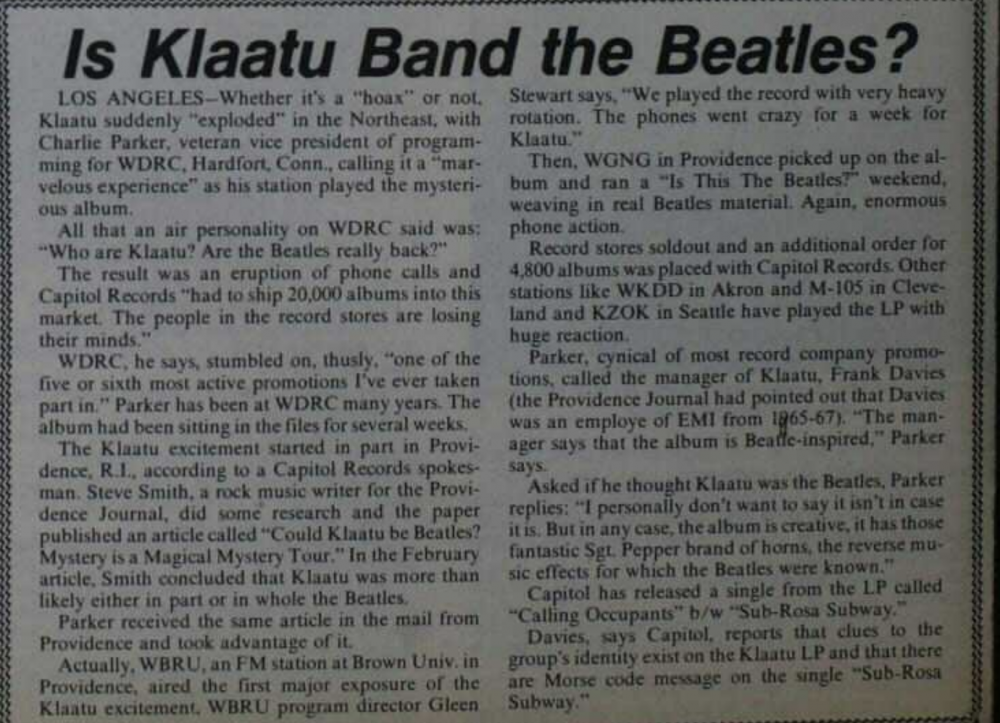
In 1976, hundreds of diehard Beatles fans became convinced that the mysterious album 3:47 EST by the band Klaatu was actually a new release from The Beatles in disguise, after a DJ in Providence, Rhode Island played one of its songs on the radio. Shortly afterward, Steve Smith discovered the album at the newspaper he worked for, Rhode Island’s The Providence Journal, listened to it, and became immediately intrigued.
The album contained no photographs, no identifying information at all, and the band’s The Day the Earth Stood Still reference echoed the cover of Ringo Starr’s album Goodnight Vienna. Smith heard Starr’s drumming, Harrison’s guitars, Lennon and McCartney’s voices in the psychedelic songs. Though he wasn’t a music critic or reporter himself, he persuaded the paper to publish a feature in which he suggested Klaatu could be The Beatles.
The “Klaatu Konspiracy” spread. An Australian fan issued a 34-page booklet on the case. Executives at Klaatu’s label, Capital Records Canada, refused to confirm or deny, enjoying the publicity, as Smith recalled in a 1997 interview.
More specifically, “hedging his bets,” writes Ken Raisanen for WOAS FM, Smith concluded that “the mystery band could be 1) The Beatles. 2) A couple of the Beatles with other people. 3) A Beatles-backed band. 4) A completely unknown but ingenious and talented band.” If the American Smith had caught an episode of Keith Hampshire’s Music Machine on CBC two years earlier, he would have seen the evidence of number four (see the real Klaatu play “California Jam” in 1974, above). But the band otherwise made an effort to obscure their identity.
As Klaatu bassist Jon Woloshuck told Goldmine magazine in 2013, one reason for the air of mystery they cultivated is that “we were just three guys from Toronto.” They wanted the music to speak for itself, and “nobody knew who were anyway.” They were amused by the rumor. “It caught us by surprise,” says drummer Terry Draper, but they “didn’t think much of it at the time…. We were all big Beatles fans, and we were hoping they would reunite. At the time, the idea of a reunited Beatles wasn’t all that far-fetched at all.”
These attitudes may have been prevalent, but Klaatu wasn’t deliberately setting out to tap into them, they say, but to “do music that was on par” with “late ‘60s progressive bands like King Crimson and The Moody Blues.” They’re clearly also channeling The Beatles, whether they admit it or not. Still the “rumor did us as much harm as good,” says guitarist Dee Long. “It got us noticed, which was great, but also led to a situation where we could not ever really measure up to expectations.” Hear what Beatles fans and Klaatu conspiracists heard in 1976 in the song “Sub Rosa Subway” above from 3:47 EST, and learn more about the Klaatu conspiracy theory in the Polyphonic video at the top.
Related Content:
Josh Jones is a writer and musician based in Durham, NC. Follow him at @jdmagness
Read More...Take a Free Online Course on the Great Medieval Manuscript, the Book of Kells
Last week, we called your attention to the digitization of the Book of Kells, one of the great manuscripts from the medieval period. The digitized manuscript, we should note, comes accompanied by another great resource–a free online course on the Book of Kells. Both digital initiatives are made possible by Trinity College Dublin.
The six-week course covers the following topics:
- Where and how the manuscript was made
- The social context from which the manuscript emerged, including early medieval faith and politics
- The artistic context of the manuscript, reflecting local and international styles
- The theology and interpretations of the text
- How and why the manuscript survived
- The Book of Kells and contemporary culture
The course “is for anyone with an interest in Ireland, medieval studies, history, art, religion and/or popular culture.” Sign up for the free course today.
If you would like to support the mission of Open Culture, consider making a donation to our site. It’s hard to rely 100% on ads, and your contributions will help us continue providing the best free cultural and educational materials to learners everywhere. You can contribute through PayPal, Patreon, and Venmo (@openculture). Thanks!
Related Content
80 Free Online History Courses from Great Universities, a subset of our larger collection, 1,700 Free Online Courses from Top Universities
The Medieval Masterpiece, the Book of Kells, Is Now Digitized & Put Online
Read More...Why Should We Read Sylvia Plath? An Animated Video Makes the Case
In “Morning Song,” from Sylvia Plath’s posthumous 1965 collection Ariel, published two years after her suicide, a newborn infant is a “fat gold watch.” Among the incessant lists of adjectives in both her work, “fat” is one that stands out, appearing often, in several synonyms, as a celebration of abundance and real anxiety over weight gain and a general too-muchness. In the same poem, the baby is a work of art, a “new statue.” Its mother, on the other hand, is in one stanza a cloud effaced by the wind in a mirror, and a clumsy animal, “cow-heavy and floral / In my Victorian nightgown. / Your mouth opens clean as a cat’s.”
Plath’s images are bracing and unexpected, awed and stricken, usually at once. She deploys them so quickly and adroitly that even when one fails to land, the others immediately take up the slack, making even her less-great poems impressive for a line or stanza that takes hold in the mind for days. This ability was not the result of either divine inspiration or mental illness, but talent honed through hard work and commitment. Plath “chose the artist’s way. Poetry was her calling,” the animated TED-Ed video by Iseult Gillespie tells us above. As such, she persevered even through severe bouts with depression and many suicide attempts before she finally succumbed at age 30.
Plath’s semi-autobiographical novel, The Bell Jar, which dramatizes these themes, as well as a handful of her darkest poems, have come to popularly symbolize her legacy. You’ve heard of them even if you’ve never read them. Yet she composed a “large bulk of poetry,” her husband, poet Ted Hughes, wrote in the introduction to her Collected Works, published and unpublished, never throwing anything out. “She brought every piece she worked on to some final form acceptable to her, rejecting at most the odd verse…. Her attitude to her verse was artisan-like: if she couldn’t get a table out of the material, she was quite happy to get a chair, or even a toy.”
His characterization may not sound like the most charitable, and as her literary executor, Hughes was accused of refusing to publish some of her work. But he was also a fellow poet who watched her tirelessly write and revise. Quoting from her journals, Hughes shows how her first collection, 1960’s The Colossus and Other Poems, came together over a period of many years, its title changing every few months, new poems appearing and old ones falling away. The result is a debut whose “breathtaking perspectives on emotion, nature, and art continue to captivate and resonate,” notes the video’s narrator.
Despite her major presence in the literary magazines and the respect she won especially in the UK, The Colossus and Other Poems would be Plath’s only published collection in her lifetime. It made her a well-respected poet, but did not make her the celebrity she became after the publication of The Bell Jar three years later and her suicide the following month. “Within a week of her death,” writes Time magazine in its review of Ariel in 1966, “intellectual London was hunched over copies of a strange and terrible poem she had written during her last sick slide toward suicide. ‘Daddy’ was its title.”
After the publication of Ariel, readers fixed on “Daddy” and “Lady Lazarus,” sensational poems in which “fear, hate, love, death and the poet’s own identity become fused at bleak heat with the figure of her father, and through him, with the guilt of the German exterminators and the suffering of their Jewish victims.” These are poems, wrote Robert Lowell in his preface, that “play Russian roulette with six cartridges in the cylinder.” As feminist scholars embraced her work in the 1970s, a morbid fascination with her image only grew. This is the Plath many people know by word of mouth. But those who haven’t read more of her will miss out.
Plath doesn’t shy away from staring at suicide, abuse, and mass murder. She helped to “break the silence surrounding issues of trauma, frustration, and sexuality.” Ariel and her dozens of uncollected poems are also “filled with moving meditations on heartbreak and creativity,” including the heartbreak and creativity of motherhood, a theme always fraught with fears of love and death. Plath’s work can be dark, and it can be at once luminous in its imaginative candor. In writing about life with depression and the domestic misery visited on her in her marriage to Hughes, she celebrates life’s sublime pleasures and mourns its depths of suffering, in poem ofter poem, with near-constant ingenuity, wit, and courage.
Related Content:
Hear Sylvia Plath Read 50+ of Her Dark, Compelling Poems
Sylvia Plath, Ted Hughes & Peter Porter Read Their Poetry: Free Audio
Sylvia Plath, Girl Detective Offers a Hilariously Cheery Take on the Poet’s College Years
Josh Jones is a writer and musician based in Durham, NC. Follow him at @jdmagness
Read More...John Cleese Revisits His 20 Years as an Ivy League Professor in His New Book, Professor at Large: The Cornell Years

Creative Commons image by Paul Boxley
It takes real intelligence to successfully make dumb comedy. John Cleese and his Monty Python colleagues are a premium example. You can call sketches like the “Ministry of Silly Walks” and “Dead Parrot” surrealist, and they are comparable to the absurdist stunts favored by certain early 20th century modern artists. But you can also call them very smart kinds of stupid, a description of some of the highest forms of comedy, I’d say, and one that applies to so much of Cleese’s best work, from the Pythons, to Fawlty Towers, to A Fish Called Wanda. We are moved by stupidity, Cleese believes, and silliness is the engine of good comedy. “Sometimes very, very silly things,” he says in the interview with Cornell University Press director Dean Smith below, “have the power to touch us deeply.” Then he tells the old joke about a grasshopper named Norman.
Is Cleese still funny? Depends. Many listeners of a recent BBC Radio 4 show found his act a little stale. He has also come off lately as a “classic old man yelling at a cloud,” writes Fiona Sturges at The Guardian. (He called, surely in jest, for the hanging of EU president Jean Claude Juncker, for example, during the Brexit campaign).
In curmudgeonly interviews, he complains about hypersensitivity with examples of jokes contemporary audiences simply don’t find amusing, or at least not coming from him. Cleese has railed about the evils of political correctness, especially on college campuses, while spending the past 20 years as a “professor-at-large” on the prestigious campus of Cornell University, where he has delivered “incredibly popular events and classes—including talks, workshops, and an analysis of A Fish Called Wanda and The Life of Brian.”
These appearances draw hundreds of people, and their enormous popularity should offer Cleese some reassurance that he may not need to fear censorship, and that his wit—while it might not be as well appreciated in today’s mass entertainment—still has plenty of currency in places where smart people gather. From seminars on script writing to lectures on psychology and human development, Cleese’s appearances at Cornell lead to riveting, sometimes hilarious, and often controversial conversations.
In the episodes here from the Cornell University Press podcast, you can hear Cleese’s full conversation with Smith, part of the promotion of his 2018 book Professor at Large: The Cornell Years, in which he includes an interview with Princess Bride screenwriter William Goldman, a lecture about creativity called “Hare Brain, Tortoise Mind,” a discussion of facial recognition technology, and a talk on group dynamics with business students and faculty. Like Cleese’s mind, these lectures and discussions range far and wide, demonstrating, once again in his long career, that it takes real smarts to not only speak with ease on several academic subjects, but to understand the mechanics of stupidity. You can pick up a copy of Professor at Large: The Cornell Years here.
Related Content:
John Cleese Explains the Brain — and the Pleasures of DirecTV
John Cleese’s Philosophy of Creativity: Creating Oases for Childlike Play
Josh Jones is a writer and musician based in Durham, NC. Follow him at @jdmagness
Read More...When Fred Rogers and Francois Clemmons Broke Down Race Barriers on a Historic Episode of Mister Rogers’ Neighborhood (1969)
Last year’s Fred Rogers documentary, Won’t You Be My Neighbor, propelled François Clemmons—better known to generations of Mister Rogers Neighborhood viewers as Officer Clemmons—back into the international spotlight.
One of the most striking anecdotes in the doc concerns a 1969 episode in which Mister Rogers, who was white, invited Officer Clemmons, who is black, to join him in soaking his bare feet in a backyard baby pool on a hot summer’s day.
It was one of those giant leaps for mankind moments that passes itself off as a homey, fairly unremarkable step, though as Clemmons told his friend Karl Lindholm in a StoryCorps interview, Rogers understood the powerful message this gesture would send.
Likewise, his choice of Clemmons to embody a friendly cop for his television neighborhood, a part Clemmons, who played the role for 30 years, was initially hesitant to accept:
Fred came to me and said, “I have this idea, you could be a police officer.” That kind of stopped me in my tracks. I grew up in the ghetto. I did not have a positive opinion of police officers. Policemen were sicking police dogs and water hoses on people. And I really had a hard time putting myself in that role. So I was not excited about being Officer Clemmons at all.
Rogers, who had met Clemmons in a Pittsburgh area church where the trained opera singer was performing, prevailed, stressing the impact such a positive portrayal of a black authority figure could have on the community.
Officer Clemmons, the first recurring black character on a children’s series, paved the way for the multiracial casts of Sesame Street and The Electric Company, also on PBS.
If a picture is worth a thousand words, a song can also pack quite a wallop. It’s hard not to get choked up hearing Clemmons sing “There Are Many Ways to Say I Love You,” above, a tune he reprised in 1993, for his final appearance on the show.
Such sentiments are a natural fit in programs aimed at the preschool crowd, whose love of their families is reinforced at every turn, but it’s still unusual to see these feelings articulated so purely when the only people in sight are grown men.
Clemmons learned not to doubt Roger’s sincerity when he said, “I like you just the way you are.”
And Rogers grew to accept his friend’s sexual orientation, though this embrace came a bit less naturally. In an interview with Vanity Fair’s Chris Azzopardi, Clemmons was philosophical, recalling his “surrogate father’s” request to steer clear of gay clubs so as not to endanger the show’s wholesome image:
Sacrifice was a part of my destiny. In other words, I did not want to be a shame to my race. I didn’t want to be a scandal to the show. I didn’t want to hurt the man who was giving me so much, and I also knew the value as a black performer of having this show, this platform. Black actors and actresses—SAG and Equity—90 percent of them are not working. If you know that and here you are, on a national platform you’re gonna sabotage yourself?
I weighed this thing, the pros and the cons. And I thought, I not only have a national platform, I’m getting paid. I was also getting a promotion that I simply could not have afforded to pay for. Every time I did the show, and every time Fred took us across the country to do three, four, five personal appearances, my name was being written into somebody’s heart—some little kid who would grow up and say, “Oh, I remember him, I remember that he could sing, I remember that he was on Mister Rogers’ Neighborhood.” I didn’t have the money to pay for that, but I was getting it free. There were so many things that I got back for that sacrifice that I kept my big mouth shut, kept my head down, kept my shoulder to the plough.
Students at Middlebury College, where Clemmons was a long time faculty presence, were well acquainted with the self-proclaimed “Divaman’s”’ flamboyant side:
Clemmons has added color and soul to the Middlebury College scene for nearly 25 years. As Alexander Twilight Artist in Residence and director of the Martin Luther King Spiritual Choir, he is known by many names: the divo, the maestro, the reverend, doctor-madam-honey-man, sportin’ life, and even black magic. He has played the role of professor, choirmaster, resident vocal soloist, advisor, confidant, and community cheerleader. Yet his purpose is singular: to share hope through song.
Listen to StoryCorps podcast episode #462 about Mister Rogers’ and Francois Clemmons’ famous foot bath, as well as an incident that took place five years prior where protesters staged a “wade in” at the “Whites Only” pool at St. Augustine, Florida’s Monson Motor Lodge.
Related Content:
Mr. Rogers Takes Breakdancing Lessons from a 12-Year-Old (1985)
Ayun Halliday is an author, illustrator, theater maker and Chief Primatologist of the East Village Inky zine. See her onstage in New York City on March 11 as host of Theater of the Apes book-based variety show, Necromancers of the Public Domain. Follow her @AyunHalliday.
Read More...Why Should We Read Flannery O’Connor? An Animated Video Makes the Case
Every time a story of mine appears in a Freshman anthology, I have a vision of it, with its little organs laid open, like a frog in a bottle. –Flannery O’Connor, “A Reasonable Use of the Unreasonable”
Why did Flannery O’Connor write? To convert us? The devout Catholic was not immune to a certain apologetic impulse, or a sense of her own purpose as a vessel for divine truth. Or did she, like Greek tragedians, write to inspire pity and terror? “I don’t have any pretensions,” she once demurred, “to being an Aeschylus or Sophocles and providing you in this story with a cathartic experience.” In any case, what drove her may be a less interesting question than what should drive us to read her.
O’Connor wrote, as most great writers do, because she was compelled to write. What we gain as readers is the deeply unsettling, but also deeply pleasurable experience of recognizing our own flawed humanity in her violent, manipulative characters, none of whom, somehow, are ever beyond redemption. O’Connor’s authorial voice does not judge or condemn but exposes to light the flaws that even, or especially, her most respectable characters would rather hide from themselves and others.
By use of what she called “a reasonable use of the unreasonable” she shows murder, contempt, and deception as shockingly ordinary states of affairs, belying the polite fictions of civility and social niceness. Perhaps no setting could better illuminate the contrasts than the piously violent segregated mid-century American South. O’Connor’s “mastery of the grotesque,” notes the TED-Ed video above by Iseult Gillespie, “and her explorations of the insularity and superstitions of the South led her to be classified as a ‘Southern Gothic’ writer.”
The label may fit superficially, but “her work pushed beyond the purely ridiculous and frightening characteristics associated with the genre to reveal the variety and nuance of human character.” O’Connor herself suggested that what set her apart were “the assumptions… of the central Christian mysteries.” Though we need not read her work this way, she grants, there is “none other by which it could have been written.” We might say that her committed belief in the idea of universal human depravity gave her unique insight into the meaninglessness of class and race distinctions. Few writers have taken the idea as seriously, or approached it with more wicked playfulness.
Why did she write? One reason is she “took pleasure in challenging her readers,” as the video explains. But it was pleasure that she chiefly desired to share. We can vivisect her stories, carve them up and seal them in jars labeled with politics and theologies. Yet “properly, you analyze to enjoy,” she wrote. “It’s equally true that to analyze with any discrimination, you have to have enjoyed already, and I think that the best reason to hear a story read is that it should stimulate that primary enjoyment.” Lovers of O’Connor know the answer to the question of why we should read her. Because they take as much pleasure in reading her stories as she did in writing them.
Discover this enjoyment on your own. Hear Studs Terkel read her story “Revelation,” hear Estelle Parsons read “Everything that Rises Must Converge,” and hear O’Connor herself read that 1959 classic of her Southern grotesque style, “A Good Man is Hard to Find.”
Related Content:
Hear a Rare Recording of Flannery O’Connor Reading “A Good Man is Hard to Find” (1959)
Flannery O’Connor Renders Her Verdict on Ayn Rand’s Fiction: It’s As “Low As You Can Get”
Flannery O’Connor’s Satirical Cartoons: 1942–1945
Josh Jones is a writer and musician based in Durham, NC. Follow him at @jdmagness
Read More...Download Free Coloring Books from 113 Museums
One can only color so many floral-trimmed affirmations before one begins to crave something slightly more perverse. An emaciated, naked, anthropomorphized mandrake root, say or…
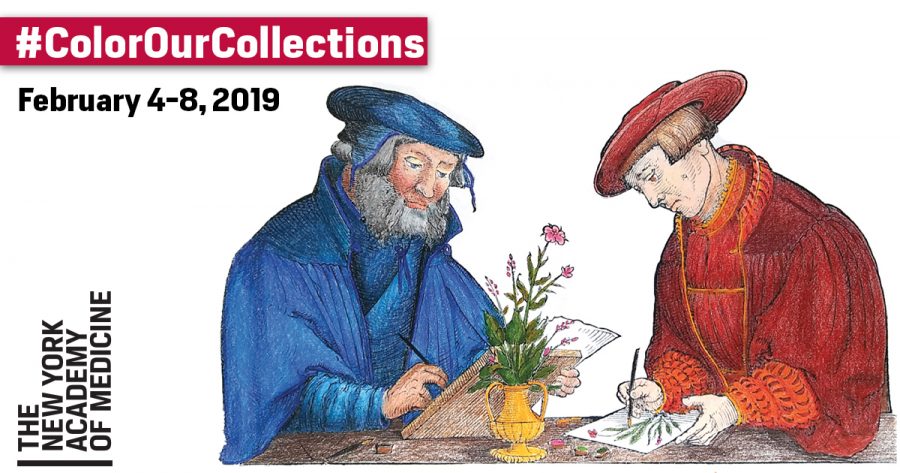
Thy wish is our command, but be prepared to hustle, because today is the final day of Color Our Collections, a compellingly democratic initiative on the part of the New York Academy of Medicine.
Since 2016, the Academy has made an annual practice of inviting other libraries, archives, and cultural institutions around the world to upload PDF coloring pages based on their collections for the public’s free download.
This year 113 institutions took the bait.
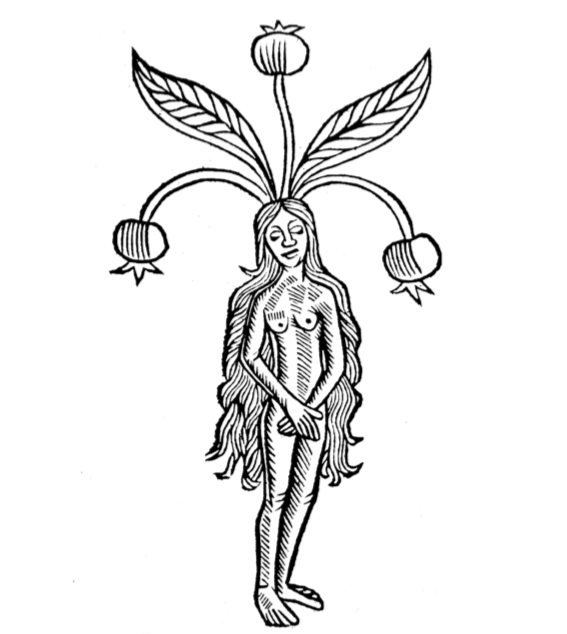
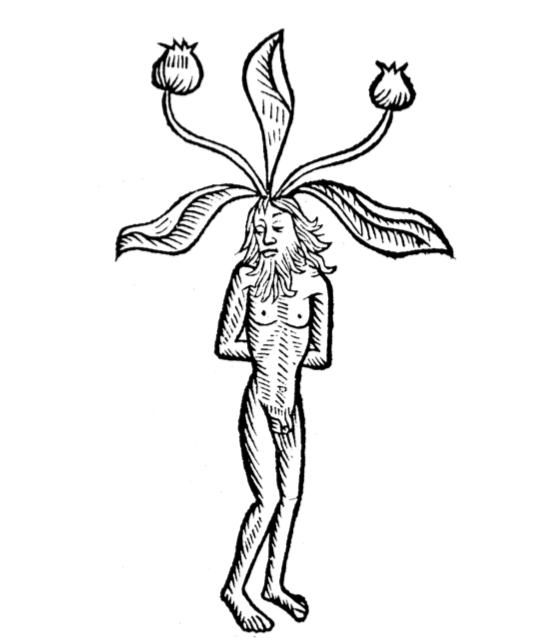
Our host, the New York Academy of Medicine kicks things off with the aforementioned mandrakes, and then some.
Medical subjects are a popular theme here. You’ll find plenty of organs and other relevant details to color, compliments of Boston’s Countway Library’s Center for the History of Medicine, London’s Royal College of Physicians, and the Historical Medical Library of The College of Physicians of Philadelphia (aka the Mütter Museum).
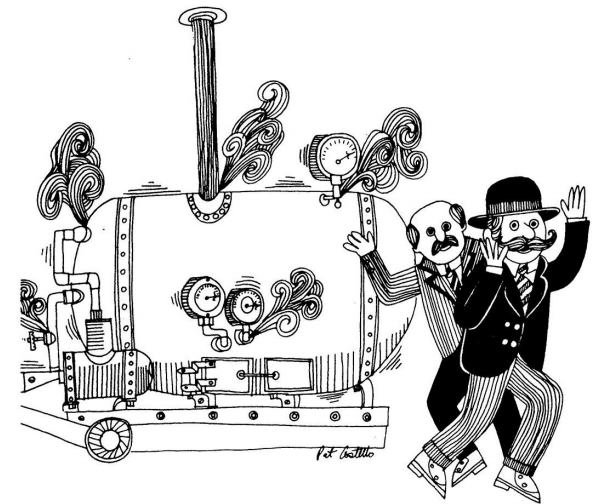
The coloring book of the Richardson-Sloane Special Collections Center at the Davenport Public Library is a bit more all-ages. They certainly remind me of my childhood. The work of native son, Patrick J. Costello, above, figures heavily here. Either he deserves a lot of credit for developing the School House Rock aesthetic, or he was one of a number of hard working illustrators tapping into the cartoon‑y, thick-nibbed zeitgeist
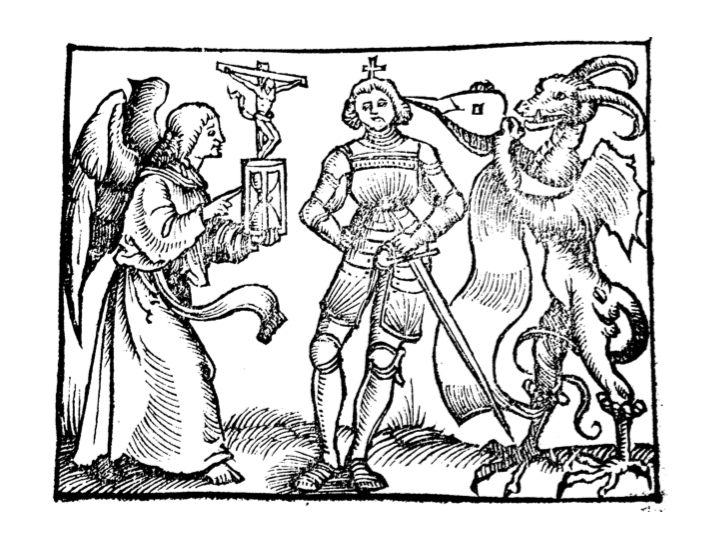
The Andover-Harvard Theological Library’s coloring book has some divine options for those who would use their coloring pages as DIY 16th-century bookplates or alphabet primers.

Those who need something more complex will appreciate the intricate maps of the Lithuanian Art Museum’s coloring book. Coloring Franz Hogenberg’s 1581 map of Vilnius is the emotional equivalent of walking the labyrinth for god knows how many hours.
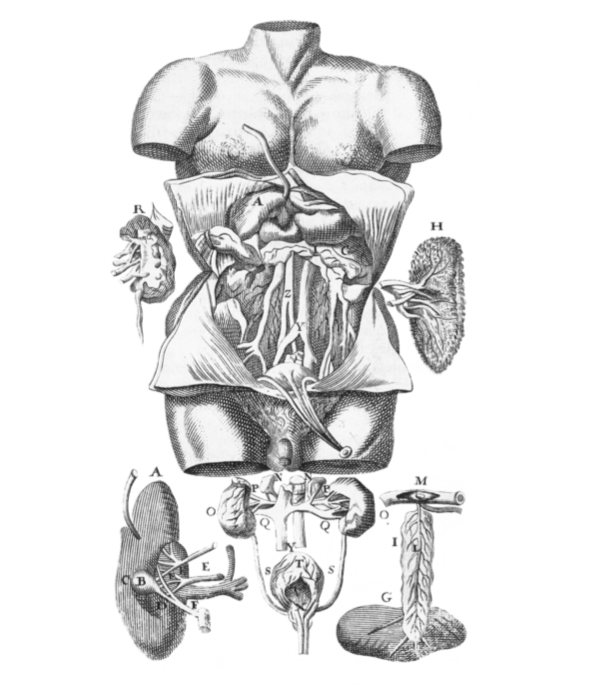
As befits a content website-cum-digital-National-Library, the Memoria Chilena Coloring Book 2019 has something for every taste: flayed anatomical studies, 1940’s fashions, curious kitty cats, and a heaping helping of jesters.
Check out all your options here.
Once you’ve had your way with the Crayolas, please share your creations with the world, using the hashtag #ColorOurCollections.
Participating Institutions 2019
The New York Academy of Medicine Library
Royal College of Physicians, London
OHSU Historical Collections & Archives
University of Wisconsin-Milwaukee Special Collections
Swarthmore College Libraries
South Carolina State Library
Shenandoah County Library, Truban Archives
Biblioteca de la Universidad de Zaragoza
Christ’s College Library, Cambridge
Tower Hill Botanic Garden
University of Waterloo Special Collections & Archives
Wageningen University & Research
Brunel University Special Collections
Hawaii State Foundation on Culture and the Arts
Washington State Library
Saint Francis de Sales Parish United by the Most Blessed Sacrament Parish History Archives
Getty Research Institute
Auckland Museum
Loyola University Chicago Archives & Special Collections
Seton Hall University Libraries
Bibliotheque interuniversitaire de Sante, Paris
Digital Library at Villanova University
West Virginia and Regional History Center
Bass Library, Yale University Library
University of Kansas Libraries
Medical Heritage Library
The Ohio State University Health Sciences Library
University of Massachusetts Amherst Libraries
Rutgers University Special Collections and University Archives
University of British Columbia Library
National Library of Medicine
Science History Institute
Ricker Library of Architecture and Art at the University of Illinois
Chautauqua Institution Archives
Bibliotheque et Archives nationales du Quebec
The LuEsther T. Mertz Library of the New York Botanical Garden
Auburn University Special Collections and Archives
Open Museum, Academia Sinica Center for Digital Cultures
Les Champs Libres
Lithuanian Art Museum
Memoria Chilena
Barret Library, Rhodes College
Wales Higher Education Libraries Forum (WHELF)
Royal Anthropological Institute
Delaware Museum of Natural History
James Madison University Libraries
Utah State University Libraries Special Collections & Archives
Stevens Institute of Technology / Archives & Special Collections
Waring Historical Library of the Medical University of South Carolina
Bernard Becker Medical Library at Washington University in St. Louis
University of Puget Sound
Drexel University College of Medicine Legacy Center Archives and Special Collections
Queens’ College Library, Cambridge
Stadtbibliothek Koeln
Andover-Harvard Theological Library
Rare Book and Manuscript CRAI Library at University of Barcelona
Newberry Library
Historical Medical Library of The College of Physicians of Philadelphia
Lambeth Palace Library
Folger Shakespeare Library
University of Glasgow Archives and Special Collections
John J. Burns Library
Biodiversity Heritage Library
The University of Iowa Libraries, Iowa Digital Library
Tennessee State Museum
Center for the History of Medicine, Countway LIbrary
Russian State Library
South Carolina Historical Society
Library Company of Philadelphia
The Burke Library at Union Theological Seminary
Pratt Institute Archives
The Children’s Museum of Indianapolis
Wangensteen Historical Library of Biology and Medicine, University of Minnesota Libraries
Washington University Libraries Julian Edison Department of Special Collections
Libraries and Cultural Resources, University of Calgary
Leonard H. Axe Library, Pittsburg State University
Susquehanna University, Blough-Weis Library
Richardson-Sloane Special Collections Center, Davenport Public Library
Denver Public Library, Western History and Genealogy
Findlay-Hancock County Public Library
Northern Illinois University
Escuela Superior de Artes de Yucatan
Lake County Public Library
United Nations Library Geneva
Jeleniorskie Centrum Informacji i Edukacji Regionalnej Ksiaznica Karkonoska
Women and Leadership Archives, Loyola University Chicago
Grand Portage National Monument Archives Collection
Jagiellonian Library
Botanical Research Institute of Texas
University of North Texas Libraries
Lehigh University Libraries Special Collections
Rare Book and Manuscript Library at the University of Illinois at Urbana-Champaign
Massachusetts General Hospital Archives & Special Collections
Clark Special Collections, McDermott Library, USAFA
Bibliotheque nationale de France
Centre for Chinese Contemporary Art Archive & Library
Shangri La Museum of Islamic Art, Culture & Design
British Library
Western University Archives and Special Collections
Europeana
Denver Botanic Gardens
MedChi, The Maryland State Medical Society
Grinnell College Libraries
University of Maryland, Baltimore County (UMBC)
Historical Society of Pennsylvania
National Library of Russia
Eastern Kentucky University Special Collections & Archives
Numelyo
Louisiana State University Special Collections
New York State Library
North Carolina Pottery Center
Royal Horticultural Society Libraries
Library of Virginia
Related Content:
Ayun Halliday is an author, illustrator, theater maker and Chief Primatologist of the East Village Inky zine. See her onstage in New York City this Monday as host of Theater of the Apes book-based variety show, Necromancers of the Public Domain. Follow her @AyunHalliday.
Read More...Where Did the Monk’s Haircut Come From? A Look at the Rich and Contentious History of the Tonsure
One might assume from a modern viewpoint that the hairstyles worn by monks arose to deal with male pattern baldness anxiety. As in the school uniform approach, you can’t single out one person’s baldness when everyone is bald. But this, again, would be a modern view, full of the vanity the tonsured—those with religiously shaven heads—ostensibly vowed to renounce. According to the Catholic Encyclopedia, the tonsure (from the Latin verb for “to shear”) began as a “badge of slavery” among Greeks and Romans. It was adopted “on this very account” by early monastic orders, to mark the total surrender of the will.
Would it surprise you, then, to learn that there were tonsure wars? Probably not if you know anything about church history. Every article of clothing and of faith has sparked some major controversy at one time or another. So too with the tonsure, of which—we learn in the Vox video above—there were three styles. The first, the coronal (or Roman or Petrine) tonsure, is the one we see in countless Medieval and Renaissance paintings: a bald pate at the crown surrounded by a fringe of hair, possibly meant to evoke the crown of thorns. Next is the Pauline, a fully shaved head, seen much less in Western art since it was “used more commonly in Eastern Orthodoxy.”
The third style of tonsure caused all the trouble. Or rather, it was this style that served as a visible sign of religious differences between the Roman Catholic Church and the churches in Britain and Ireland. “Celtic Catholicism was ‘out of sync’ with the Roman Catholic Church,” notes Vox. “Roman Catholics would use the differences between them to portray Celtic Catholicism as pagan, or even as an offshoot, celebrating the power-hungry magician, Simon Magus.” The Celtic tonsure fell under a cloud, but how exactly did it differ from the others? Since it disappeared in the early Middle Ages and few images seem to have survived, no one seems sure.
Daniel McCarthy, fellow emeritus at Trinity College, Dublin set out to solve the mystery. He speculates the Celtic tonsure, as you’ll see on a computer-simulated monk’s head, was a triangular shape, with the apex at the front. When the Roman Catholics took over Ireland, all of the vestments, dates, and haircuts were slowly brought into line with the dominant view. The practice of tonsure officially ended in 1972, and fell out of favor in English-speaking countries centuries earlier, according to the Catholic Encyclopedia. But in any case, McCarthy sees the tonsure not as a spurning of fashion, but as a cult-like devotion to style. In that sense, we can see people who adopt similar haircuts around the world as still visually signaling their membership in some kind of order, religious or otherwise.
Related Content:
How a Baltimore Hairdresser Became a World-Renowned “Hair Archaeologist” of Ancient Rome
Animated: Stephen Fry & Ann Widdecombe Debate the Catholic Church
50 Years of Changing David Bowie Hair Styles in One Animated GIF
Josh Jones is a writer and musician based in Durham, NC. Follow him at @jdmagness.
Read More...Meet the Hurdy Gurdy, the Hand-Cranked Medieval Instrument with 80 Moving Parts
Donovan’s “Hurdy Gurdy Man” may be the creepiest song ever written about an obscure medieval instrument (made all the more so by its use in David Fincher’s Zodiac), but the Hurdy Gurdy did not give his recording its ominous sound. Those droning notes come from an Indian tanpura. Yet they evoke the title instrument, an ingenious musical invention “set up primarily for the purpose of making drones,” Case Western Reserve’s College of Art and Sciences explains. “In the Middle Ages, it was known in Latin as the organistrum and the symphonia, and in French as the vielle à roue (the vielle with the wheel).”
With a sound produced by a “rosined wooden wheel, turned by a crank” that set “a number of strings in continuous droning vibration,” the hurdy gurdy can, it’s true, give off a bit of a folk horror vibe. From its very early, maybe 10th or 11th century origins in liturgical music, hurdy gurdy expert Jim Kendros tells us in the video above, the instrument became associated with European folk music, shrinking from a beast played by two people to more portable dimensions, about the size of a large guitar and resembling a hand-cranked violin with keys for playing melodies on certain strings.
Though it grew smaller and more maneuverable, however, the instrument grew no less complicated. Kendros calls it “the equivalent of a medieval spaceship,” with its more than 80 moving parts.
The hurdy gurdy, or “wheel fiddle,” played in the TED Talk above by Caroline Phillips looks less like a fiddle, or a spaceship, and more like a medieval keytar—just one of the many shapes the instrument could take. All of them, however, had one important feature in common: the hurdy gurdy is “the only musical instrument that uses a crank to turn a wheel to rub strings like the bow of a violin to produce music.” Historically, it was used in medieval dance music “because of the uniqueness of the melody combined with the acoustic boom box” of its large body. Try not to shake your body, or to shiver, when Phillips plays a haunting, droning Basque folk song.
The Hurdy Gurdy spread all over Europe, from Britain to France, Spain, Italy, Germany, Hungary, and Sweden, where stringed-instrument enthusiasts The Stringdom caught up with virtuoso Hurdy Gurdy player Johannes Geworkian Hellman. He tells us how the hurdy gurdy and its droning sonic cousin, the bagpipes, set off “an early folk revival” as composers took inspiration from peasant music. The interest from medieval upper classes meant better luthiers and higher-quality hurdy gurdies. Now modern interest in the Hurdy Gurdy is growing. While it may take two to three years to handcraft one, “a lot of new instruments are getting made,” says Hellman.
Should you doubt that the 1000-year old hurdy gurdy can still sound hip, listen to Hellman play an electrified version in his hurdy gurdy/accordion duo, Symbio, or hurdy gurdy/dulcimer two-piece, Maija & Johannes. He coaxes from the instrument such a range of rhythms and timbres that it’s easy to see why it was so immensely popular for so long. Yet for all its musical appeal, it is a complex machine, difficult to tune and subject to any number of mechanical problems. Not for the casual amateur, the instrument still requires a dedicated Hurdy Gurdy man or woman to make it sing—a much more common sight than in Donovan’s day but an exceedingly rare one compared to the many centuries of the hurdy gurdy’s heyday. See more hurdy gurdies at the Vintage News.
Related Content:
How an 18th-Century Monk Invented the First Electronic Instrument
Visit an Online Collection of 61,761 Musical Instruments from Across the World
Watch a Musician Improvise on a 500-Year-Old Music Instrument, The Carillon
New Order’s “Blue Monday” Played with Obsolete 1930s Instruments
Josh Jones is a writer and musician based in Durham, NC. Follow him at @jdmagness
Read More...Support Us
We're hoping to rely on loyal readers, rather than erratic ads. Please click the Donate button and support Open Culture. You can use Paypal, Venmo, Patreon, even Crypto! We thank you!

About Us

Open Culture scours the web for the best educational media. We find the free courses and audio books you need, the language lessons & educational videos you want, and plenty of enlightenment in between.
Advertise With Us
FREE UPDATES!
GET OUR DAILY EMAIL
Get the best cultural and educational resources on the web curated for you in a daily email. We never spam. Unsubscribe at any time.
FOLLOW ON SOCIAL MEDIA
Open Culture editor Dan Colman scours the web for the best educational media. He finds the free courses and audio books you need, the language lessons & movies you want, and plenty of enlightenment in between.
Advertise With Us


