Inmates in New York Prison Defeat Harvard’s Debate Team: A Look Inside the Bard Prison Initiative
If you want to prepare for a career practicing law, you could do much worse than joining Harvard University’s debate team. But if, far on the other end of the spectrum of the American experience, you end up deep on the wrong side of the law, going to prison rather than college, you need not relinquish your dreams of excelling at this traditional intellectual sport. We now have the precedent to prove it: “Months after winning a national title,” reports the Guardian’s Lauren Gambino, “Harvard’s debate team has fallen to a group of New York prison inmates.”
“The showdown,” which revolved around the question of whether public schools should be allowed to turn away undocumented students, “took place at the Eastern correctional facility in New York, a maximum-security prison where convicts can take courses taught by faculty from nearby Bard College, and where inmates have formed a popular debate club.” They call this program the Bard Prison Initiative, under which inmates have the chance to earn a Bard College degree (through a non-vocational “liberal arts curriculum, including literature, foreign language, philosophy, history and the social sciences, mathematics, science, and the arts”) at satellite campuses established in six New York state prisons. You can see this selective, rigorous and highly unusual educational institution in action in the Washington Post video above. And also in a 2011 PBS News Hour profile below.
The Bard Prison Initiative’s debate victory over Harvard made for a notable event in the program’s history indeed. “But it’s also worth pointing out,” writes Peter Holley, author of the Post article, “the fallacy of our underlying assumptions about such a matchup — the first (and most pernicious) being that criminals aren’t smart. If a definitive link between criminality and below-average intelligence exists, nobody has found it.” The Bard Prison Initiative has operated on that premise since 2001, and its debate team’s previous high-profile win saw it beating that of West Point — all, you may hardly believe, through old-fashioned research, without any kind of access to the internet. If you’d like to leave your condolences for the Harvard College Debating Union, you may do so at their Facebook page. You can also make a worthwhile financial contribution to the Bard Prison Initiative here.
Related Content:
James Baldwin Debates Malcolm X (1963) and William F. Buckley (1965): Vintage Video & Audio
Norman Mailer & Marshall McLuhan Debate the Electronic Age
Clash of the Titans: Noam Chomsky & Michel Foucault Debate Human Nature & Power on Dutch TV, 1971
The Historic LSD Debate at MIT: Timothy Leary v. Professor Jerome Lettvin (1967)
1,700 Free Online Courses from Top Universities
Colin Marshall writes elsewhere on cities, language, Asia, and men’s style. He’s at work on a book about Los Angeles, A Los Angeles Primer, the video series The City in Cinema, and the crowdfunded journalism project Where Is the City of the Future? Follow him on Twitter at @colinmarshall or on Facebook.
Read More...1902 French Trading Cards Imagine “Women of the Future”
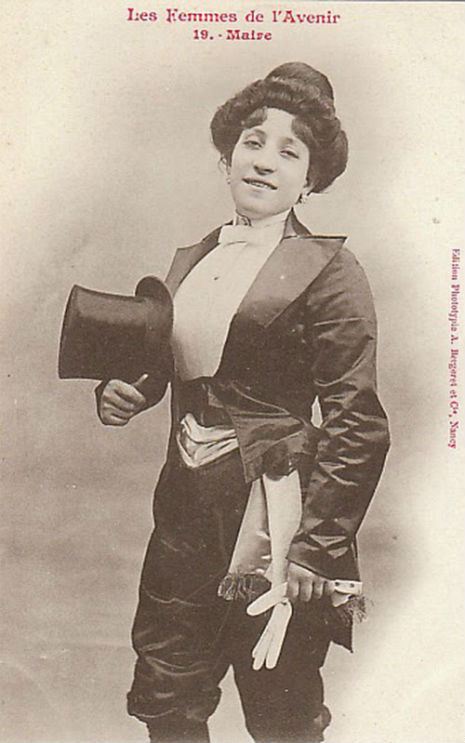
The lag time between our imagining of social equality and its arrival can be significantly long indeed, or it least it can seem so, given the limitations of human mortality. 113 years may not be an especially long time for a tree, say, or even a very healthy Galapagos tortoise, but if you or I had been alive in 1902, chances are we’d never know that in 2015 the president of Europe’s most powerful nation is a woman, as are two major presidential candidates in the United States. Given the amount of inequality we still see worldwide, this may not always feel like a triumph. In 1902, it might have seemed like “nothing but fantasy.”
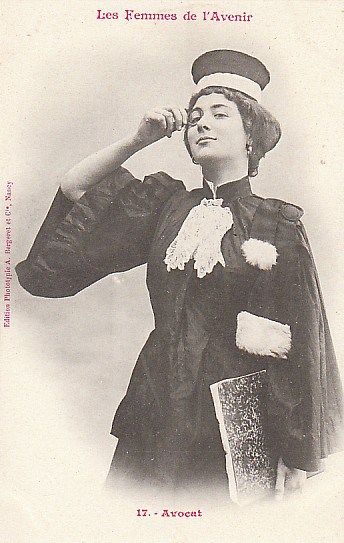
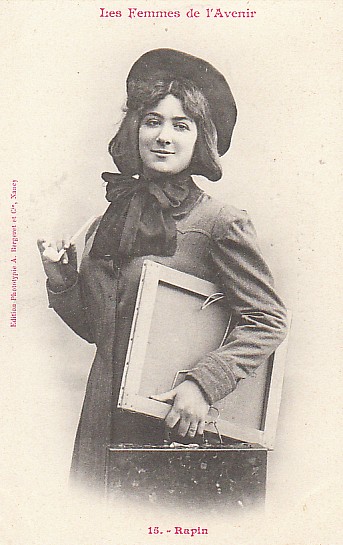
And yet even then, it was certainly possible to foresee women occupying all the roles that men did, through the lenses, writes Laura Hudson at Boing Boing, of “fantasy and science fiction,” which “can often help us open our minds behind the limitations of the world we live in and imagine a better one instead.” In 1902, artist Albert Bergeret was commissioned to create the trading cards you see here—just a small selection of twenty total photographs called “Les Femmes de l’Avenir”—Women of the Future. Only one theme among many in a series of different sets of cards, this “retrofuturistic attempt to expand the role of women in society” showed us a “small and fashionable world” where “women were given a more equal role in society, not to mention spectacular hats.”
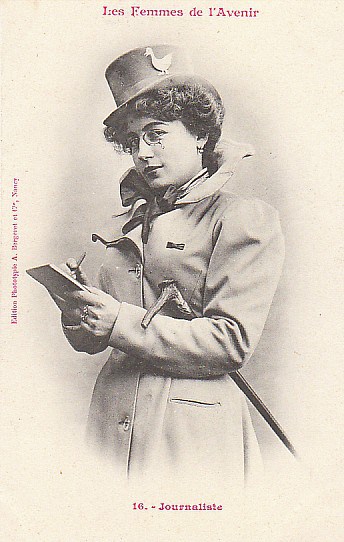
That may be so, but just as we can never accurately see the future, we can also never reach consensus on the meaning of the past. The Daily Mail’s Maysa Rawi agrees with Hudson about the “pin-up quality to many of the images,” which show “an awful lot of arm.” And yet Rawi disparages the entire set as “meant to capture men’s fantasies rather than be part of any feminist movement.” I’ll admit, I don’t see the cards this way at all, nor do I think the categories are mutually exclusive. Pin-up girls have also represented social power, albeit mainly sexual power. Scantily-clad female superheroes like Wonder Woman, though crafted to appeal to the fantasies of teenage boys, are also powerful because… well, they have superpowers.

Perhaps that’s one way to look at Bergeret’s cards. He is not mocking his subjects, nor hyper-sexualizing them, but presenting, as each card indicates, advanced futuristic beings who didn’t yet exist in his time. The Daily Mail captions several of the photos with factoids about women’s advances in French history. In some cases, Bergeret did not have to extrapolate far. Women could practice law in 1900; women served in the army during the French Revolution, but did not fight. Colleges had been open to women since 1879. A few women worked as doctors and journalists in Bergeret’s time. Marie Curie, you’ll recall, had discovered polonium, coined the term “radioactivity,” and would win the Nobel Prize in 1903. Queen Victoria had ruled over half the world.
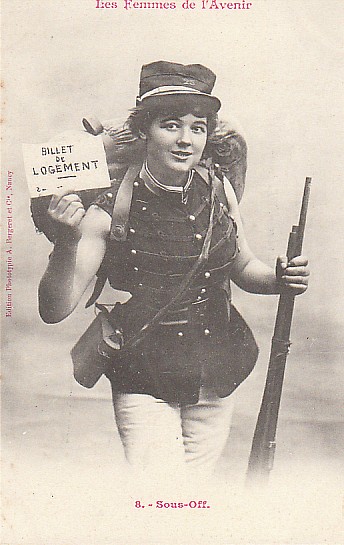
But French women would have to wait several more decades to enter most of the professions represented. No matter how sexy—and in some cases ridiculous—some of the costumes in these photos, Bergeret shot the models with poise, style, and dignity. Perhaps he and many in his audience could easily imagine female generals, mayors, firewomen, soldiers, etc. Yet one particular card stands out. It portrays a self-satisfied, Bohemian model labeled “rapin”—which a reader below informs us is “an argot word for (bad) painter.”
Related Content:
In 1900, Ladies’ Home Journal Publishes 28 Predictions for the Year 2000
How French Artists in 1899 Envisioned Life in the Year 2000: Drawing the Future
Josh Jones is a writer and musician based in Durham, NC. Follow him at @jdmagness
Read More...8,400 Stunning High-Res Photos From the Apollo Moon Missions Are Now Online
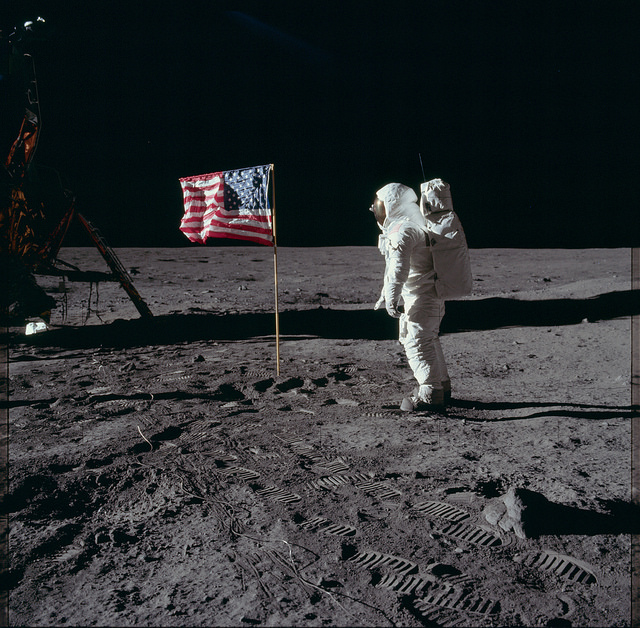
The Apollo program, launched in 1961 by John F. Kennedy, flew its first manned mission in 1968, and the following summer, Neil Armstrong, Michael Collins, and Buzz Aldrin met the program’s mandate, making their historic Apollo 11 Moon Landing. In the ensuing few years, several more spacecraft and crews either orbited or landed on the Moon, and for a brief moment, popular magazines and newspapers regularly featured photographs of those expeditions on their covers and front pages. Looking every bit the authentic vintage Hasselblad photos they are, the images you see here were taken by Apollo astronauts on their various missions and sent home in rolls of hundreds of similar pictures.
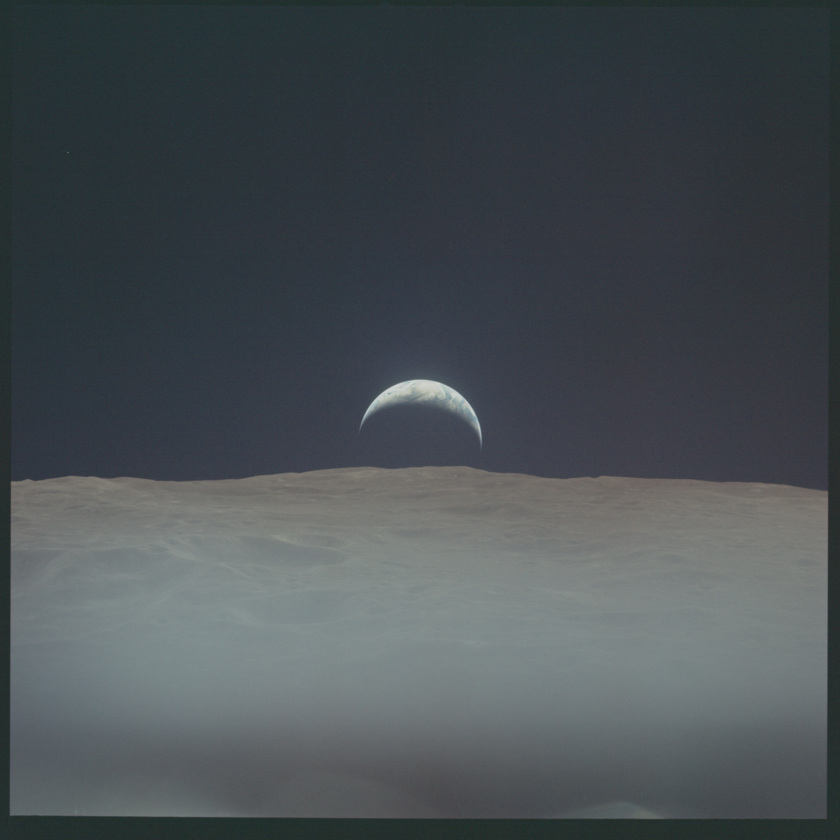
These astronauts snapped photos inside and outside the spacecraft, in orbit and on the moon’s surface, and in 2004 NASA began digitizing the resulting cache of film. Luckily for the public, devoted space enthusiast and archivist, Kipp Teague—an IT director at Lynchburg College in Virginia—has posted a huge number of these photos (8,400 to be exact) on his Project Apollo Archive Flickr account.
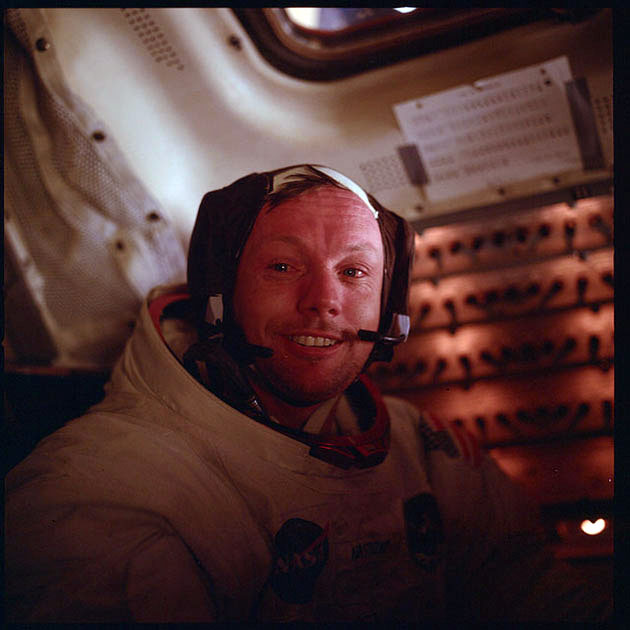
Teague initially began acquiring the photos in collaboration with Eric Jones’ Apollo Lunar Surface Journal, “a record of the lunar surface operations conducted by the six pairs of astronauts who landed on the Moon from 1969 to 1972.” Understandably, so many people expressed interest in the photographs that Teague reformatted them in higher resolution and gave them their own home on the web. The Planetary Society informs us, “every photo taken on the lunar surface by astronauts with their chest-mounted Hasselblad cameras is included in the collection.”
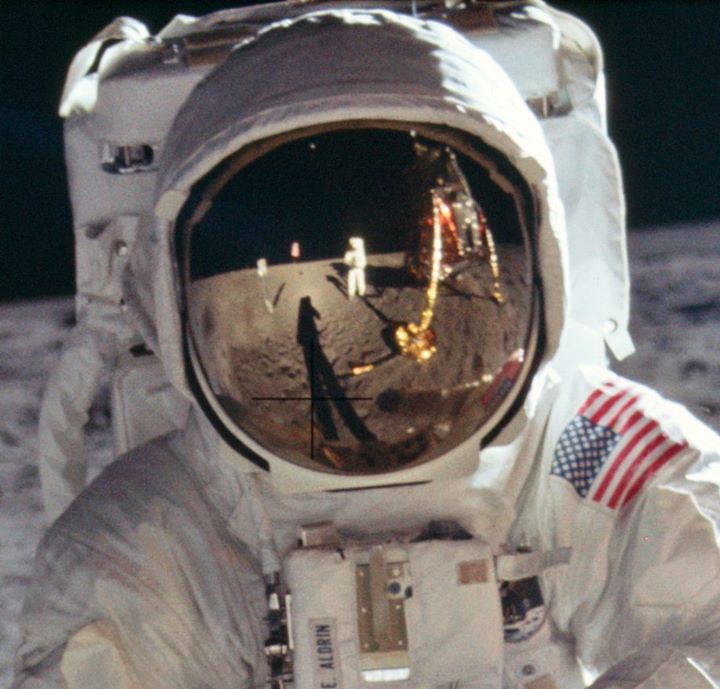
While Teague and Jones’ other sites use photos that have been processed to increase their clarity, lighting, and color, the photos on Project Apollo Archive remain in their original state. “Browsing the entire set,” writes the Planetary Society, “takes on the feeling of looking through an old family photo album.” Indeed, especially if you grew up in the late-sixties/early-seventies at the height of the space program’s popularity.

A good many of the photos are rather procedural shots of craters and clouds, especially those from earlier missions. But quite a few frame the breathtaking vistas, technical details, and awestruck, if exhausted, faces you see here. So many photos were taken and uploaded in succession that clicking rapidly through a photostream can produce an almost flipbook effect. You can browse the archive by album, each one representing a reel from different Apollo missions—including that famous 11th (top, and below)—though Teague has yet to post high resolution images from Apollo 8 and 13.
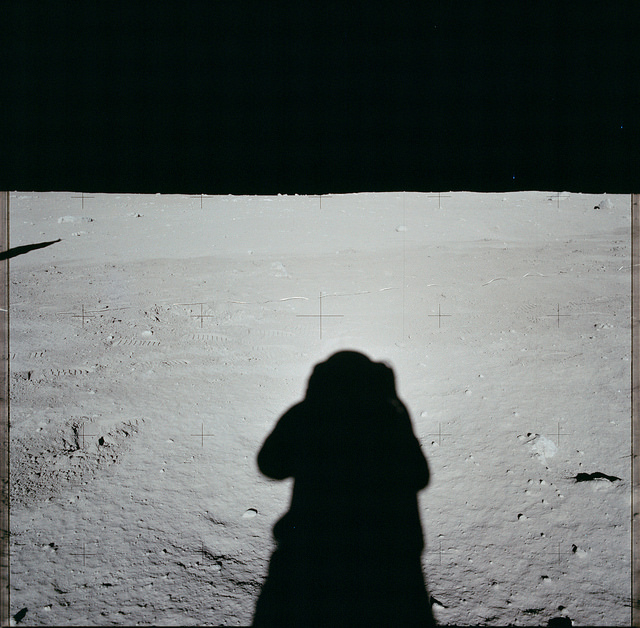
It seemed after Apollo’s demise in the mid-seventies that photographs like these documented a lost age of NASA exploration, and that the once-great government agency would cede its innovative role to private companies like Elon Musk’s Space X, who have been much less forthcoming about releasing media to the public, making proprietary claims over their space photography in particular. But thanks in part to Space X and the cooperation of Canadian, European, Russian, and Japanese space programs, NASA’s International Space Station has raised the agency’s public profile considerably in the past several years. Though still painfully underfunded, NASA’s cool again.
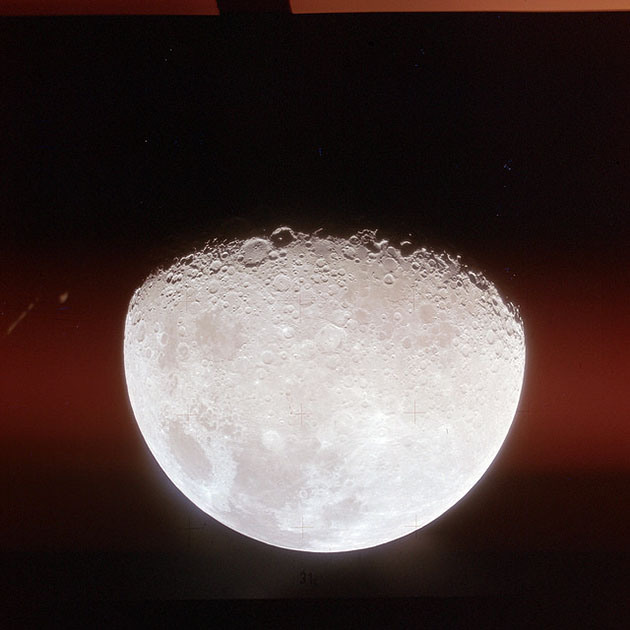
Even more profile-raising is the Mars Rover program, whose recent finding of water has refueled speculations about life on the Red Planet. As films like the recent, astronaut-approved The Martian and a raft of others show, our collective imagination has long bent toward human exploration of Mars. Establishing a base on Mars, after all, is Space X’s stated mission. Looking at these stunning vintage photos of the Apollo Lunar missions makes me long to see what the first astronauts to walk on Mars send back. We probably won’t have to wait long once they’re up there. We’ll likely get Instagram uploads, maybe even some with fake vintage Hasselblad filters. It won’t be quite the same; few current events can compete with nostalgia. But I like to think we can look forward in the near future to a renaissance of manned—and woman-ed—space exploration.

See many hundreds more Apollo Lunar Mission photos at Project Apollo Archive and follow the archive on Facebook for updates.
Related Content:
Landing on the Moon: July 20, 1969
Mankind’s First Steps on the Moon: The Ultra High Res Photos
Josh Jones is a writer and musician based in Durham, NC. Follow him at @jdmagness
Read More...It’s Banned Books Week: Listen to Allen Ginsberg Read His Famously Banned Poem, “Howl,” in San Francisco, 1956
According to Ruth Graham in Slate, Banned Books Week is a “crock,” an unnecessary public indulgence since “there is basically no such thing as a ‘banned book’ in the United States in 2015.” And though the awareness-raising week’s sponsor, the American Library Association, has shifted its focus to book censorship in classrooms, most of the challenges posed to books in schools are silly and easily dismissed. Yet, some other cases, like that of Persepolis—Marjane Satrapi’s graphic novel memoir of her Iranian childhood during the revolution—are not. The book was pulled from Chicago Public School classrooms (but not from libraries) in 2013.
Even now, teachers who wish to use the book in classes must complete “supplemental training.” The ostensibly objectionable content in the book is no more graphic than that in most history textbooks, and it’s easy to make the case that Persepolis and other challenged memoirs and novels that offer perspectives from other countries, cultures, or political points of view have inherent educational value. One might be tempted to think that school officials pulled the book for other reasons. Perhaps we need Banned Books Week after all.
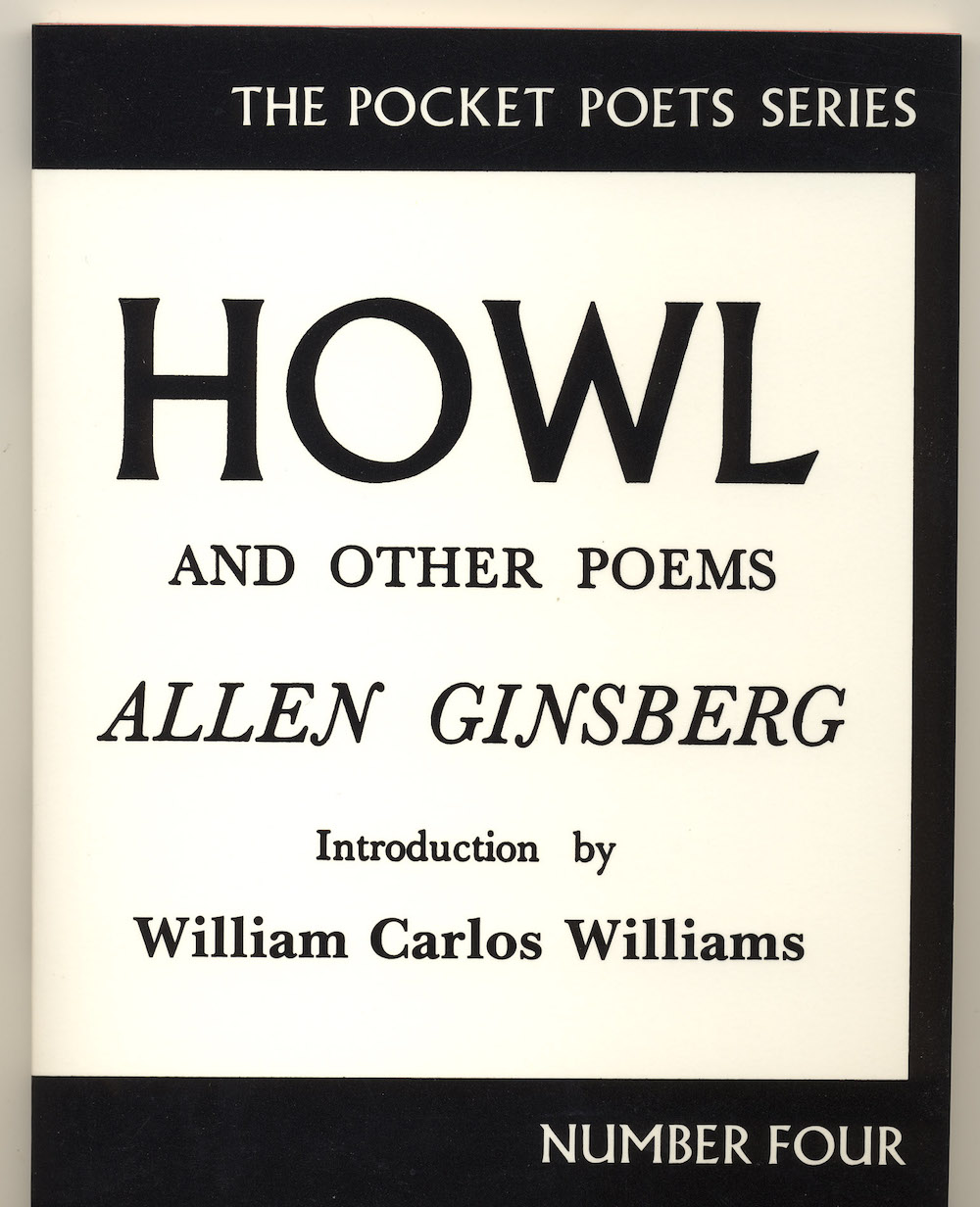
Another, perhaps fuzzier, case of a “banned” book—or poem—from this year involves a high school teacher’s firing over his classroom reading of Allen Ginsberg’s pornographic poem “Please Master.” The case of “Please Master” should put us in mind of a once banned book written by Ginsberg: epic Beat jeremiad “Howl.” When the poem’s publisher, Lawrence Ferlinghetti, attempted to import British copies of the poem in 1957, the books were seized by customs, then he and his business partner were arrested and put on trial for obscenity. After writers and academics testified to the poem’s cultural value, the judge vindicated Ferlinghetti, and “Howl.”
But the trial demonstrated at the time that the government reserved the right to seize books, stop their publication and sale, and keep material from the reading public if it so chose. As with this year’s dust-up over “Please Master,” the agents who confiscated “Howl” supposedly objected to the sexual content of Ginsberg’s poem (and likely the homosexual content especially). But that reasoning could also have been cover for other objections to the poem’s political content. “Howl,” after all, was very subversive in its day, and in a way served as a kind of manifesto against the status quo. It had a “cataclysmic impact,” writes Fred Kaplan, “not just on the literary world but on the broader society and culture.”
We’ve featured various readings of “Howl” in the past, and if you’ve somehow missed hearing those, never heard the poem read at all, or never read the poem yourself, then consider during this Banned Books Week taking the time to read it and hear it read—by the poet himself. You can hear the first recorded reading by Ginsberg, in 1956 at Portland’s Reed College. You can hear another impassioned Ginsberg reading from 1959. And above, hear Ginsberg read the poem in 1956, in San Francisco, where it was first published and where it stood trial.
You can also hear Ginsberg fan James Franco—who played the poet in a film called Howl—read the poem over a visually striking animation of its vivid imagery. And if Ginsberg isn’t your thing, consider checking out the ALA’s list of challenged or banned books for 2014–2015. (I could certainly recommend Persepolis.) While prohibiting books from the classroom may seem a far cry from government censorship, Banned Books Week reminds us that many people still find certain kinds of books deeply threatening, and should push us to ask why that is.
Related Content:
High School Teacher Reads Allen Ginsberg’s Explicit Poem “Please Master” and Loses His Job
The First Recording of Allen Ginsberg Reading “Howl” (1956)
Allen Ginsberg Reads His Famously Censored Beat Poem, Howl (1959)
James Franco Reads a Dreamily Animated Version of Allen Ginsberg’s Epic Poem ‘Howl’
Find great poems in our collection, 800 Free eBooks for iPad, Kindle & Other Devices
Josh Jones is a writer and musician based in Durham, NC. Follow him at @jdmagness
Read More...The History of Philosophy Without Any Gaps Podcast, Now at 370 Episodes, Expands into Eastern Philosophy
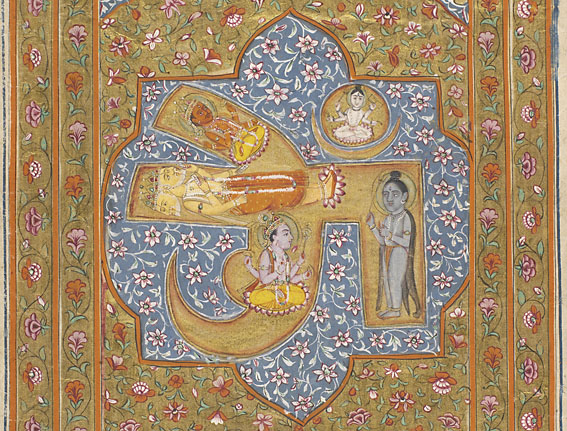
Perhaps you’ve heard of a phenomenon called “podfade,” wherein a podcast — particularly an ambitious podcast — begins by putting out episodes regularly, then misses one or two, then lets more and more time elapse between each episode, one day ceasing to update entirely. It pleases us to report that The History of Philosophy Without Any Gaps, the podcast offering just that, on whose progress we’ve kept you posted over the past three years, not only shows no signs of podfade, but has even broadened its mandate to include a greater variety of philosophical traditions than before.
For those who haven’t heard the show, The History of Philosophy Without Any Gaps comes from Peter Adamson, philosophy professor at Ludwig Maximilians University Munich and King’s College London, and “looks at the ideas, lives and historical context of the major philosophers as well as the lesser-known figures of the tradition.”
The main show has put out 379 episodes so far, beginning with the pre-Socratics (specifically Thales) and most recently examining Franciscan poverty, and now a new branch has grown, starting from Adamson and collaborator Jonardon Ganeri’s introduction to Indian Philosophy. (Hear the first episode of the Indian Philosophy series below.)
Episodes of this new series on the Indian tradition, Adamson writes, “will appear in alternating weeks with episodes on European philosophy.” He also mentions a “further ambition to cover the other philosophical traditions of Asia (especially Chinese) and also African philosophy and the philosophy of the African diaspora, but of course India will take a while so you’ll have to be patient if you are waiting for me to get to that!”
You can subscribe to The History of Philosophy Without Any Gaps’ Indian philosophy series on its very own podcast RSS feed, or on iTunes here. Philosophically-minded binge-listeners beware; you could lose a lot of time to these two shows. “I’ve been doing my laundry to it for months and I’m only up to Maimonides,” says one commenter on a Metafilter thread about the new series. “I am totally not ready for this Patañjali.”
Related Content:
200+ Free Online Philosophy Courses
Death: A Free Philosophy Course from Yale
Introduction to Political Philosophy: A Free Online Course from Yale University
Colin Marshall writes elsewhere on cities, language, Asia, and men’s style. He’s at work on a book about Los Angeles, A Los Angeles Primer, the video series The City in Cinema, and the crowdfunded journalism project Where Is the City of the Future? Follow him on Twitter at @colinmarshall or on Facebook.
Read More...18-Year-Old James Joyce Writes a Fan Letter to His Hero Henrik Ibsen (1901)
When it comes to theories of artistic lineage, few have been as influential as Harold Bloom’s The Anxiety of Influence, in which the august literary critic argues, “Poetic Influence—when it involves two strong, authentic poets—always proceeds by a misreading of the prior poet, an act of creative correction that is actually and necessarily a misinterpretation.” This kind of misreading—what Bloom calls “misprision”—often takes place between two artists separated by vast gulfs of time and space: the influence of Dante on T.S. Eliot, for example, or of Shakespeare on Herman Melville.
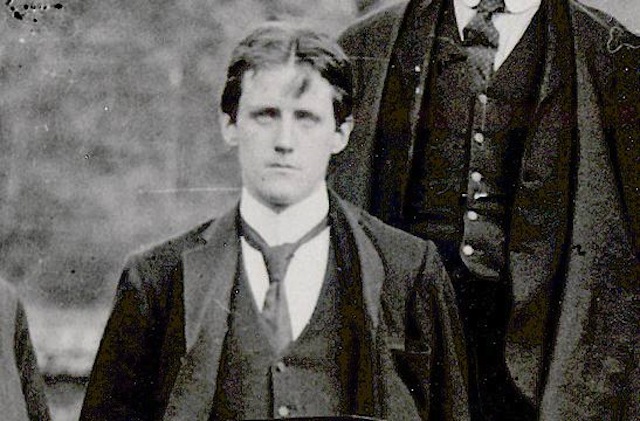
When we come to a study of James Joyce (1882–1941), however, we find the groundbreaking modernist corresponding directly with one of his foremost literary heroes, Norwegian playwright Henrik Ibsen (1828–1906), whom Maria Popova calls Joyce’s “spiritual and mental ancestor.” As Bloom points out, Joyce described Ibsen’s work as being “of universal import.” He extolled and defended Ibsen’s then-controversial work in his student days, both in a 1900 lecture he delivered at University College, Dublin, and in an essay he published that same year in the London journal Fortnightly Review. (See the young Joyce above in 1902, at 20 years of age.)
Joyce’s article, “Ibsen’s New Drama,” focused on the playwright’s latest, When We Dead Awaken, and was warmly received by Ibsen himself, who—through his English translator William Archer—described the essay as “velvillig,” or “benevolent.” Archer conveyed Ibsen’s sentiments in a letter soon after the essay’s publication, and thereafter, Joyce’s essay—writes the James Joyce Centre—was “no longer just a review but a review that Ibsen had read and praised.”
Thus began a three-year correspondence between Joyce and Archer, and a friendly relationship—at some remove—between Joyce and Ibsen. In 1901, on the playwright’s 73rd birthday, Joyce wrote a letter to Ibsen directly. He mentions the circumstances of the review and expresses much youthful admiration, self-confidence, and gratitude for Ibsen’s response. The young Joyce laments that his “immature and hasty article” came to Ibsen’s attention first, “rather than something better,” and boasts, “I have claimed for you your rightful place in the history of drama.”
Read the letter in full below, in all its exuberant egotism. According to James Joyce A to Z: The Essential Reference to the Life and Work, as he matured, the novelist “drew upon Ibsen less for creative encouragement than for psychological inspiration. In Joyce’s mind, Ibsen remained the model of the artist who defies conventional creative approaches and who remains true to the demands of an individual aesthetic.” Whether Joyce “misread” and “creatively corrected” Ibsen is a question I leave for others. You can read many more “fan letters” written by other famous authors to their literary heroes—including George R.R. Martin to Stan Lee, Charles Dickens to George Eliot, and Ray Bradbury to Robert Heinlein—at Flavorwire.
Honoured Sir,
I write to you to give you greeting on your seventy-third birthday and to join my voice to those of your well-wishers in all lands. You may remember that shortly after the publication of your latest play ‘When We Dead Awaken’, an appreciation of it appeared in one of the English reviews — The Fortnightly Review — over my name. I know that you have seen it because some short time afterwards Mr. William Archer wrote to me and told me that in a letter he had from you some days before, you had written, ‘I have read or rather spelled out a review in the Fortnightly Review by Mr. James Joyce which is very benevolent and for which I should greatly like to thank the author if only I had sufficient knowledge of the language.’ (My own knowledge of your language is not, as you see, great but I trust you will be able to decipher my meaning.) I can hardly tell you how moved I was by your message. I am a young, a very young man, and perhaps the telling of such tricks of the nerves will make you smile. But I am sure if you go back along your own life to the time when you were an undergraduate at the University as I am, and if you think what it would have meant to you to have earned a word from one who held so high a place in your esteem as you hold in mine, you will understand my feeling. One thing only I regret, namely, that an immature and hasty article should have met your eye, rather than something better and worthier of your praise. There may not have been any willful stupidity in it, but truly I can say no more. It may annoy you to have your work at the mercy of striplings but I am sure you would prefer even hotheadedness to nerveless and ‘cultured’ paradoxes.
What shall I say more? I have sounded your name defiantly through a college where it was either unknown or known faintly and darkly. I have claimed for you your rightful place in the history of the drama. I have shown what, as it seemed to me, was your highest excellence — your lofty impersonal power. Your minor claims — your satire, your technique and orchestral harmony — these, too, I advanced. Do not think me a hero-worshipper. I am not so. And when I spoke of you, in debating-societies, and so forth, I enforced attention by no futile ranting.
But we always keep the dearest things to ourselves. I did not tell them what bound me closest to you. I did not say how what I could discern dimly of your life was my pride to see, how your battles inspired me — not the obvious material battles but those that were fought and won behind your forehead — how your willful resolution to wrest the secret from life gave me heart, and how in your absolute indifference to public canons of art, friends and shibboleths you walked in the light of inward heroism. And this is what I write to you of now.
Your work on earth draws to a close and you are near the silence. It is growing dark for you. Many write of such things, but they do not know. You have only opened the way — though you have gone as far as you could upon it — to the end of ‘John Gabriel Borkman’ and its spiritual truth — for your last play stands, I take it, apart. But I am sure that higher and holier enlightenment lies — onward.
As one of the young generation for whom you have spoken I give you greeting — not humbly, because I am obscure and you in the glare, not sadly because you are an old man and I a young man, not presumptuously, nor sentimentally — but joyfully, with hope and with love, I give you greeting.
Faithfully yours,
James A. Joyce
Related Content:
James Joyce Reads From Ulysses and Finnegans Wake In His Only Two Recordings (1924/1929)
James Joyce’s “Dirty Letters” to His Wife (1909)
The Very First Reviews of James Joyce’s Ulysses: “A Work of High Genius” (1922)
Josh Jones is a writer and musician based in Durham, NC. Follow him at @jdmagness
Read More...The Drawings & Paintings of Richard Feynman: Art Expresses a Dramatic “Feeling of Awe”
I first encountered bongo-playing physicist Richard Feynman in a college composition class geared toward science majors. I was not, mind you, a science major, but a disorganized sophomore who registered late and grabbed the last available seat in a required writing course. Skeptical, I thumbed through the reading in the college bookstore. As I browsed Surely You’re Joking, Mr. Feynman!—the first of many popular memoirs released by the affable contrarian scientist—the humanist in me perked up. Here was a guy who knew how to write; a theoretical physicist who spoke the language of everyday people.
Feynman cultivated his populist persona to appeal to those who might be otherwise turned off by abstract, abstruse scientific concepts. Like Carl Sagan and Neil deGrasse Tyson, his name has come to stand for the best examples of popular science communication. It is often through one of Feynman’s accessible, non-specialist books or presentations that people learn of his work with the Manhattan project, his contributions to quantum mechanics, and his Nobel Prize. But Feynman’s extracurricular pursuits—from safe-cracking to drumming to experimenting with LSD—were also genuine expressions of his idiosyncratic character, as was another of his passions for which he is not very well known: art.
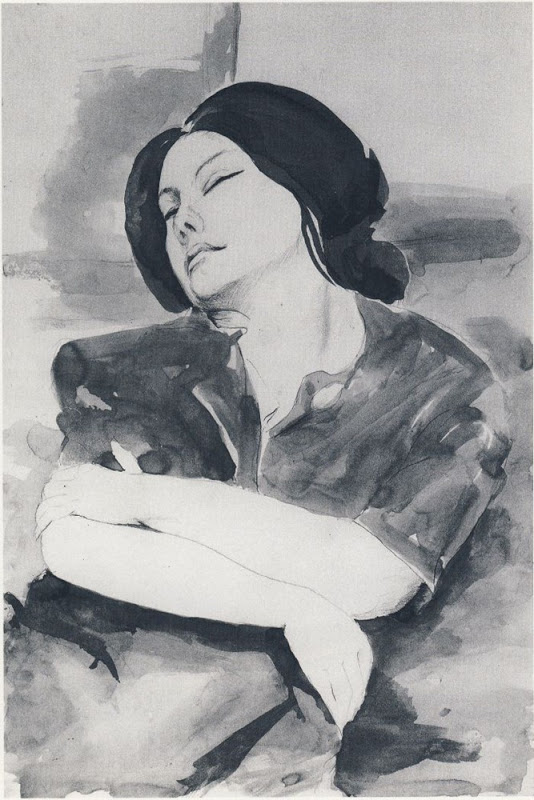
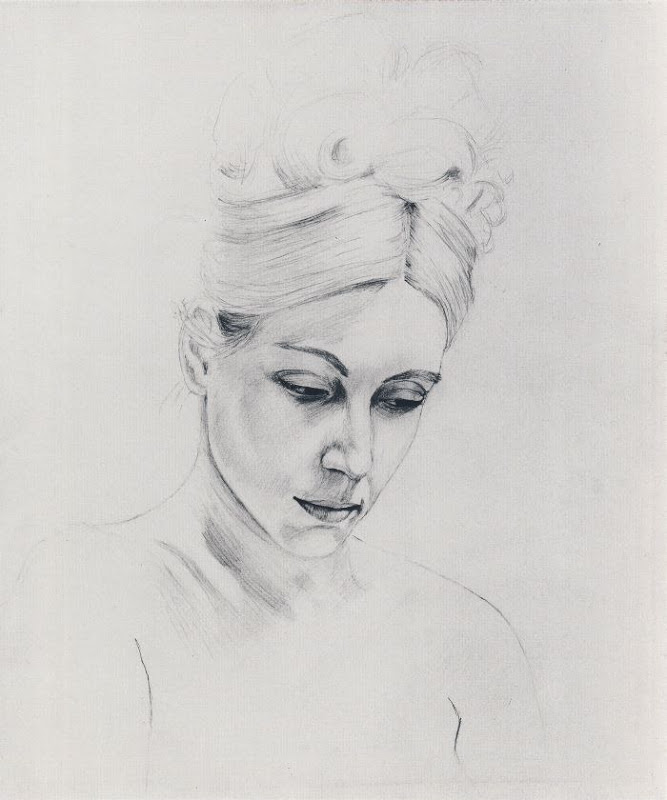
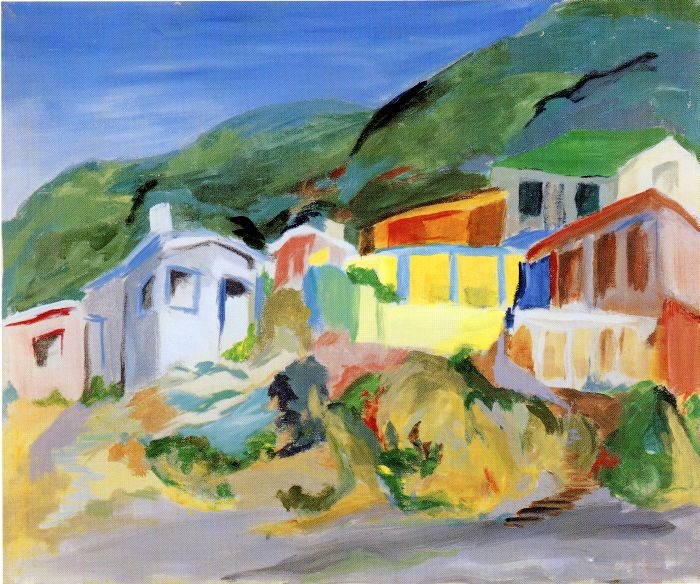
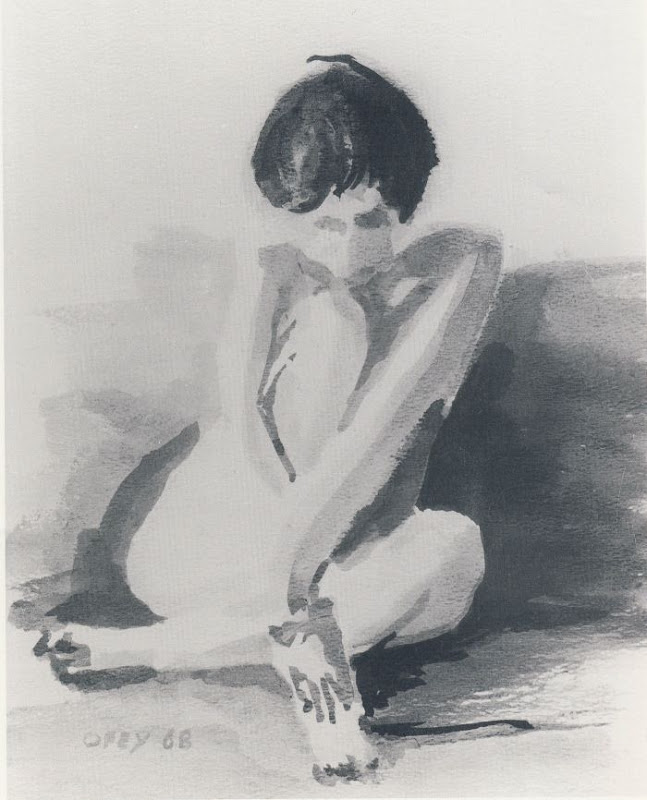
Feynman took up the pursuit at the age of 44, and continued to draw and paint for the rest of his life, signing his work “Ofey.” Many of his drawings display the awkward, off-kilter perspective of the beginner, and a great many others look very accomplished indeed. In an introductory essay to a published collection of his artwork, Feynman describes what motivated him to take up this particular avocation:
I wanted very much to learn to draw, for a reason that I kept to myself: I wanted to convey an emotion I have about the beauty of the world. It’s difficult to describe because it’s an emotion. It’s analogous to the feeling one has in religion that has to do with a god that controls everything in the universe: there’s a generality aspect that you feel when you think about how things that appear so different and behave so differently are all run ‘behind the scenes’ by the same organization, the same physical laws. It’s an appreciation of the mathematical beauty of nature, of how she works inside; a realization that the phenomena we see result from the complexity of the inner workings between atoms; a feeling of how dramatic and wonderful it is. It’s — of scientific awe — which I felt could be communicated through a drawing to someone who had also had that emotion. I could remind him, for a moment, of this feeling about the glories of the universe.
As you can see above, he took his work seriously. Most of his drawings consist of portraits and nudes, with the occasional landscape or still life. You can see more extensive galleries of Feynman’s art at AmusingPlanet, Museum Syndicate and Brain Pickings.
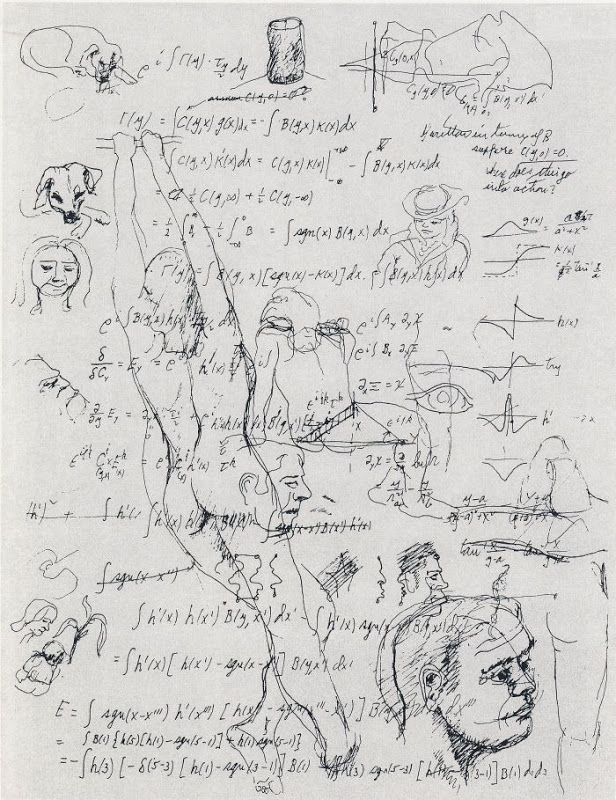
Feynman’s preoccupation—and full immersion—in the relationship between the arts and sciences marks him as a Renaissance man in perhaps the purest definition of the term: his approach closely resembles that of Leonardo da Vinci, a likeness that comes to the fore in the work below, which is either a collection of sketches doodled over with formulae, or a collection of formulae covered with doodles. Either way, it’s a perfect representation of the visionary mind of Feynman and his regard for ordinary language, people, and objects—and for “scientific awe.”
Related Content:
Learn How Richard Feynman Cracked the Safes with Atomic Secrets at Los Alamos
Josh Jones is a writer and musician based in Durham, NC. Follow him at @jdmagness
Read More...The History of Cartography, the “Most Ambitious Overview of Map Making Ever,” Now Free Online
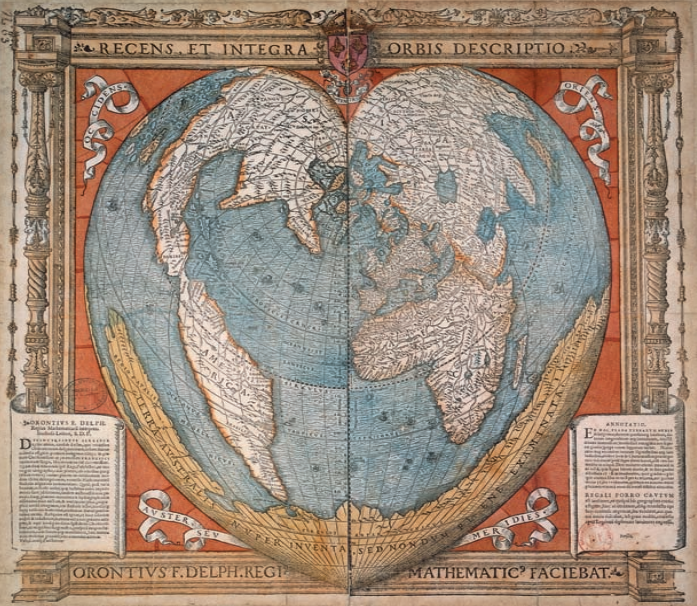
Worth a quick mention: The University of Chicago Press has made available online — at no cost — the first three volumes of The History of Cartography. Or what Edward Rothstein, of The New York Times, called “the most ambitious overview of map making ever undertaken.” He continues:
People come to know the world the way they come to map it—through their perceptions of how its elements are connected and of how they should move among them. This is precisely what the series is attempting by situating the map at the heart of cultural life and revealing its relationship to society, science, and religion…. It is trying to define a new set of relationships between maps and the physical world that involve more than geometric correspondence. It is in essence a new map of human attempts to chart the world.
If you head over to this page, then look in the upper left, you will see links to three volumes (available in a free PDF format). My suggestion would be to look at the gallery of color illustrations for each book, links to which you’ll find below. The image above, appearing in Vol. 2, dates back to 1534. It was created by Oronce Fine, the first chair of mathematics in the Collège Royal (aka the Collège de France), and it features the world mapped in the shape of a heart. Pretty great.
Volume 1
Gallery of Color Illustrations
Volume 2: Part 1
Gallery of Color Illustrations (Plates 1–24)
Gallery of Color Illustrations (Plates 25–40)
Volume 2: Part 2
Gallery of Color Illustrations (Plates 1–16)
Gallery of Color Illustrations (Plates 17–40)
Volume 2: Part 3
Gallery of Color Illustrations (Plates 1–8)
Gallery of Color Illustrations (Plates 9 –24)
Volume 3: Part 1
Gallery of Color Illustrations (Plates 1–24)
Gallery of Color Illustrations (Plates 25–40)
Volume 3: Part 2
Gallery of Color Illustrations (Plates 41–56)
Gallery of Color Illustrations (Plates 57–80)
Note: If you buy Vol 1. on Amazon, it will run you $248. As beautiful as the book probably is, you’ll probably appreciate this free digital offering. The series will be added to our collection, 800 Free eBooks for iPad, Kindle & Other Devices.
Related Content:
A Wonderful Scientific Map of the Moon from 1679: Can You Spot the Secret Moon Maiden?
Galileo’s Moon Drawings, the First Realistic Depictions of the Moon in History (1609–1610)
New York Public Library Puts 20,000 Hi-Res Maps Online & Makes Them Free to Download and Use
Read More...Woody Allen Tells a Classic Joke About Hemingway, Fitzgerald & Gertrude Stein in 1965: A Precursor to Midnight in Paris
The character we know as “Woody Allen,” the persona we see in his films, the stammering neurotic weighed down by existential angst and a desperate horniness laced with intellectuality, was created not in his movies, but in his stand-up, recordings of which have been in and out of circulation since 1964. (They’re now available here.)
The director is reportedly even more embarrassed of these recordings than his films–and anyone who has seen his sit-down with critic Mark Cousins can attest, he can’t even stand to watch his films–but maybe that’s about the performance itself, and not the material.
I say that because in the clip above, a routine that Allen loved enough that he often used it to end his sets in the 60s, we can see the nascent idea for his Oscar-winning 2011 film Midnight in Paris.
Riffing on The Lost Generation, he imagines himself back in time, carousing with Hemingway, Gertrude Stein, Picasso, F. Scott and Zelda Fitzgerald, and famed Spanish bullfighter Manolete. It’s a one-two-three-and punchline joke we won’t ruin, but it’s interesting that consciously or subconsciously, this idea returned some five decades later to be fleshed out into one of Allen’s best late-period films. Was he always thinking of this routine as a someday film? In interviews from the time of the film’s release, he never mentions the stand-up bit.
Creating art is often like composting, and one never knows what might float to the top after years of influences and absorption. Listening to his stand-up, one can find the joke that he recycled for Annie Hall (“I was thrown out of NYU my freshman year, I cheated on my metaphysics final in college, I looked within the soul of the boy sitting next to me.”).
There’s also this routine about a scary subway ride:
The scene was later recreated in Bananas with a young Sylvester Stallone.
Allen’s pre-film career, when he was writing for television and his own stand-up, when his goals were to “write for Bob Hope and host the Oscars” makes for fascinating reading, and we’ll leave you with this history from WMFU. Nerdist has more thoughts on the relationship between The Lost Generation joke and Midnight in Paris here.
Related Content:
Woody Allen’s Typewriter, Scissors and Stapler: The Great Filmmaker Shows Us How He Writes
Watch an Exuberant, Young Woody Allen Do Live Stand Up on British TV (1965)
Ted Mills is a freelance writer on the arts who currently hosts the FunkZone Podcast. You can also follow him on Twitter at @tedmills, read his other arts writing at tedmills.com and/or watch his films here.
Read More...Very Early Concert Footage of the B‑52s, When New Wave Music Was Actually New (1978)
I recall with uncharacteristic clarity the first time I heard the B‑52s. Forced on a youth-group ski trip by my parents, I arrived an angry thirteen-year-old wanna-be punk: mohawk, ripped jeans, patched leather jacket, disaffected scowl, and feigned air of adolescent cynical world-weariness. Pop music, I had already decided, was for suckers. The only sounds that spoke to me were loud, abrasive, and deliberately unlovely. Then someone in our dorm put on “Rock Lobster” and it blew my narrow mind. Though the ostensible purpose of this church-sponsored vacation was to stir up some Protestant piety, I came away converted instead to the gospel of new wave. I credit my awakening to Kate Pierson’s otherworldly wail, Cindy Wilson’s throaty harmonies, and Ricky Wilson’s bizarrely tuned guitar.
Maybe it wasn’t quite that dramatic, but it was a decisive moment in my young fandom, after which I found myself seeking out the odd, angular, jangly sounds I’d first heard on that B‑52s record—and finding them in Johnny Marr’s Smiths guitar work, every early R.E.M. album, and in more morose form, in The Cure, Psychedelic Furs, and countless mopey British post-punks. What surprised me at the time was learning how many of these bands arrived on the scene at the same time as the nastier, grittier bands that scored my angst-ridden entry into callow teenage-hood. We’re familiar with the story of new wave bands like Talking Heads and Television’s beginnings at CBGB’s. But around that same time, in 1976, Georgia’s B‑52s got their start in the college town of Athens. As one interviewee says—in the above short documentary on the Southern art-rock scene that also birthed R.E.M.—“the B‑52s started the music scene as we think of it.”
Taking their sound from surf rock, 50s doo-wop and girl group harmonies, and a weirdness that is Athens’ own, the B‑52s carved out a space for themselves within music that had something in common with the Ramones except it was hyper-colorful, thrift-store kitschy, and unapologetically campy. Their warped take on 50s and 60s dance rock—complete with Pierson and Wilson’s “B‑52” beehives—first broke out with “Rock Lobster” (a song John Lennon once credited with influencing his comeback). You can see them open with the song at the top in 1978 at Atlanta’s Downtown Cafe, just prior to the release of their debut album. (Stick around to watch the rest of the 28-minute set.) Fred Schneider, the band’s wry, flamboyant frontman, introduces each band member with a series of quirky pseudonyms. Above, they do my personal favorite, “52 Girls”—with its pounding tom-tom surf rhythms and sung-shouted lyrics about “The principal girls of the USA.” Just below catch another early gig from 1980, at New Jersey’s Capitol Theater.
The B‑52s plugged along through the 80s—suffered the loss of Ricky Wilson to AIDS—then hit it very big on the pop charts with “Love Shack” and “Roam” from 1989’s Cosmic Thing . For my money, though, nothing beats the glorious joyfulness of their debut, which sounds like the most fun any band has ever had making a record together.
Though the band has always been a highly collaborative ensemble, Kate Pierson’s huge voice came to shape their sound over the years. She would go on to record the torch song “Candy” with Iggy Pop and the ridiculous, love-it-or-hate-it “Shiny Happy People” with her hometown peers R.E.M. Now, at 67, she’s putting out her first solo album, Guitars and Microphones . Listen to the super-catchy title track above, and hear an interview with Pierson on NPR here and another on WBEZ’s Sound Opinions here. For more on the B‑52s early years, see retrospectives on Dangerous Minds and Pitchfork. You owe it to yourself to get to know this band. They may not change your life like they did mine, but they might just expand your understanding of pop music’s possibilities.
Related Content:
Watch the Talking Heads Play a Vintage Concert in Syracuse (1978)
The Ramones in Their Heyday, Filmed “Live at CBGB,” 1977
Blondie Plays CBGB in the Mid-70s in Two Vintage Clips
Josh Jones is a writer and musician based in Durham, NC. Follow him at @jdmagness
Read More...Support Us
We're hoping to rely on loyal readers, rather than erratic ads. Please click the Donate button and support Open Culture. You can use Paypal, Venmo, Patreon, even Crypto! We thank you!

About Us

Open Culture scours the web for the best educational media. We find the free courses and audio books you need, the language lessons & educational videos you want, and plenty of enlightenment in between.
Advertise With Us
FREE UPDATES!
GET OUR DAILY EMAIL
Get the best cultural and educational resources on the web curated for you in a daily email. We never spam. Unsubscribe at any time.
FOLLOW ON SOCIAL MEDIA
Open Culture editor Dan Colman scours the web for the best educational media. He finds the free courses and audio books you need, the language lessons & movies you want, and plenty of enlightenment in between.
Advertise With Us

