H.P. Lovecraft’s Monster Drawings: Cthulhu & Other Creatures from the “Boundless and Hideous Unknown”
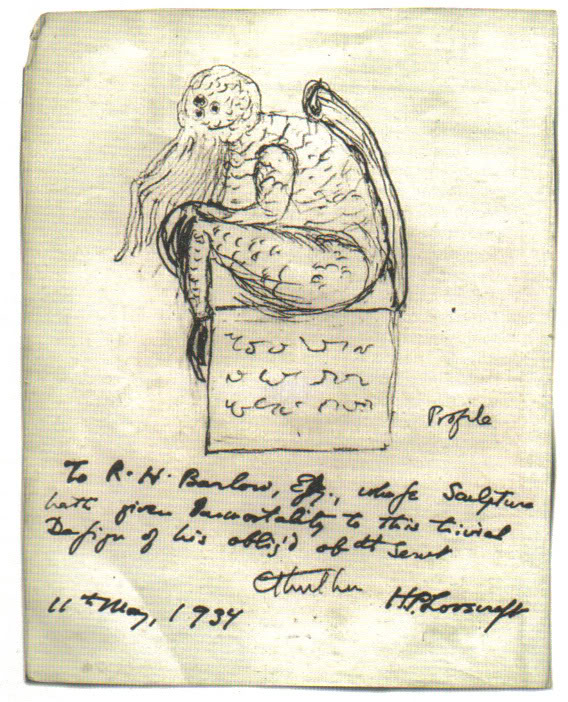
If you’ve ever played Call of Cthulhu, the tabletop role-playing game based on the writing of H.P. Lovecraft, you’ve felt the frustration of having character after painstakingly-created character go insane or simply drop dead upon catching a glimpse of one of the many horrific beings infesting its world. But as the countless readers Lovecraft has posthumously accumulated over nearly eighty years know, that just signals faithfulness to the source material: Lovecraft’s characters tend to run into the same problem, living, as they do, in what French novelist Michel Houellebecq (one of his notable fans, a group that also includes Stephen King, Joyce Carol Oates, and Jorge Luis Borges) calls “an open slice of howling fear.”
Read enough of Lovecraft’s middle-class east-coast professional narrators’ mortal struggles for the words to convey what he called “the boundless and hideous unknown” that suddenly confronts them, and you start to wonder what these creatures actually look like. The clearest word-picture comes in the 1928 story “The Call of Cthulhu,” whose narrator describes the titular ancient malevolence—avoiding instantaneous mental breakdown by looking at an idol rather than the being itself—as “a monster of vaguely anthropoid outline, but with an octopus-like head whose face was a mass of feelers, a scaly, rubbery-looking body, prodigious claws on hind and fore feet, and long, narrow wings behind.”
And so modern Lovecraftians have enjoyed a new variation of that giant octopus-dragon-man form on “Cthulhu for President” shirts each and every election year. (You can find one for 2016 here.) While that phenomenon would surely have surprised Lovecraft himself, constantly and fruitlessly as he struggled in life, I like to think he’d have approved of the designs, which align in fearsome spirit with the sketches he made. At the top of the post you can see one sketch of the Cthulhu idol, drawn in 1934 on a piece of correspondence with writer R.H. Barlow, Lovecraft’s friend and the eventual executor of his estate.
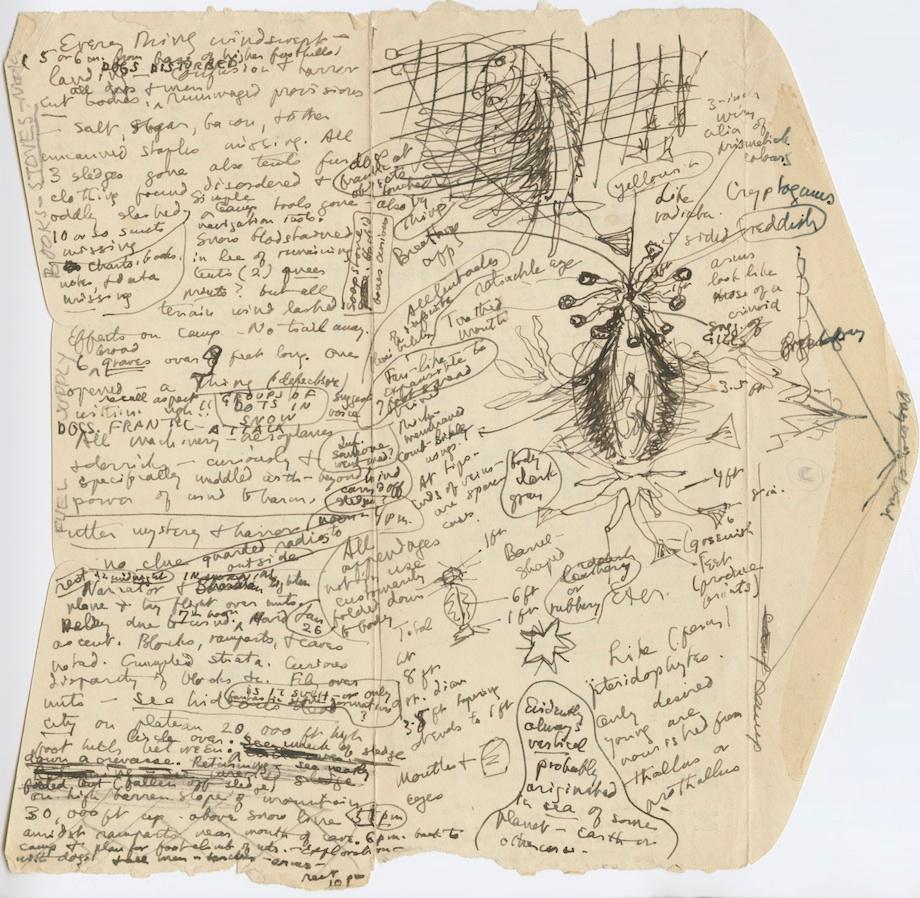
If “The Call of Cthulhu” ranks as Lovecraft’s best-known work, his 1936 novella At the Mountains of Madness surely comes in a close second. Just above, we have an illustrated page of the writer’s plot notes for this unforgettable cautionary tale of an Antarctic expedition that happens disastrously upon the mind-bending ruins of a city previously thought only a myth – and the monsters that inhabit it. It exemplifies the defining quality of Lovecraft’s mythology, where, as Slate’s Rebecca Onion puts it, “ancient beings of profound malevolence lurk just below the surface of the everyday world.”
“Mountains featured several species of forgotten, intelligent beings, including the ‘Elder Things.’ The sketch on the right side of this page of notes (click here to view it in a larger format), with its annotations (‘body dark grey’; ‘all appendages not in use customarily folded down to body’; ‘leathery or rubbery’) represents Lovecraft working out the specifics of an Elder Thing’s anatomy.” That such things lurked in Lovecraft’s imagination have made his state of mind a subject of decades and decades of rich discussion among his enthusiasts. But just the body count racked up by Cthulhu, the Elder Things, and the other denizens of this unfathomable realm should make us thankful that Lovecraft saw them in his mind’s eye so we wouldn’t have to.
Note: The second image on this page was featured in the 2013 exhibition held at Brown University, “The Shadow Over College Street: H. P. Lovecraft in Providence.” The Brown University Library is the home to the largest collection of H. P. Lovecraft materials in the world.
Related Content:
H.P. Lovecraft Gives Five Tips for Writing a Horror Story, or Any Piece of “Weird Fiction”
H.P. Lovecraft Highlights the 20 “Types of Mistakes” Young Writers Make
H.P. Lovecraft’s Classic Horror Stories Free Online: Download Audio Books, eBooks & More
Lovecraft: Fear of the Unknown (Free Documentary)
Colin Marshall writes on cities, language, Asia, and men’s style. He’s at work on a book about Los Angeles, A Los Angeles Primer, and the video series The City in Cinema. Follow him on Twitter at @colinmarshall or on Facebook.
Read More...A Look Inside Hannah Arendt’s Personal Library: Download Marginalia from 90 Books (Heidegger, Kant, Marx & More)
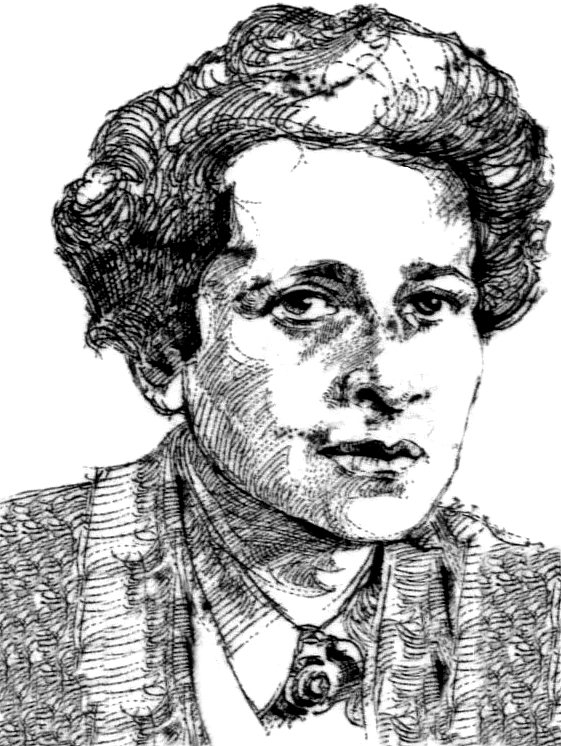
It does seem possible, I think, to overvalue the significance of a writer’s library to his or her own literary productions. We all hold on to books that have long since ceased to have any pull on us, and lose track of books that have greatly influenced us. What we keep or don’t keep can be as much a matter of happenstance or sentiment as deliberate personal archiving. But while we may not always be conscious curators of our lives’ effects, those effects still speak for us when we are gone in ways we may never have intended. In the case of famous—and famously controversial—thinkers like Hannah Arendt, what is left behind will always constitute a body of evidence. And in some cases—such as that of Arendt’s teacher and onetime lover Martin Heidegger’s glaringly anti-Semitic Black Notebooks—the evidence can be irrevocably damning.
In Arendt’s case, we have no such smoking gun to substantiate arguments that, despite her own background, Arendt was anti-Jewish and blamed the victims of the Holocaust. During the so-called “Eichmann wars” in the mid-twentieth century, a torrent of criticism bombarded Arendt’s Eichmann in Jerusalem, the compilation of dispatches she penned as an observer of the Nazi arch-bureaucrat’s trial. These days, writes Corey Robin in The Nation, “while the controversy over Eichmann remains, the controversialists have moved on.” The debate now seems more centered on Arendt’s book itself than on her motivations. What do Arendt’s observations reveal to us today about the logic of totalitarianism and genocidal state actions? One way to approach the questions of meaning in Eichmann, and in her monumental The Origins of Totalitarianism, is to examine the sources of her thought—and her use of those sources.
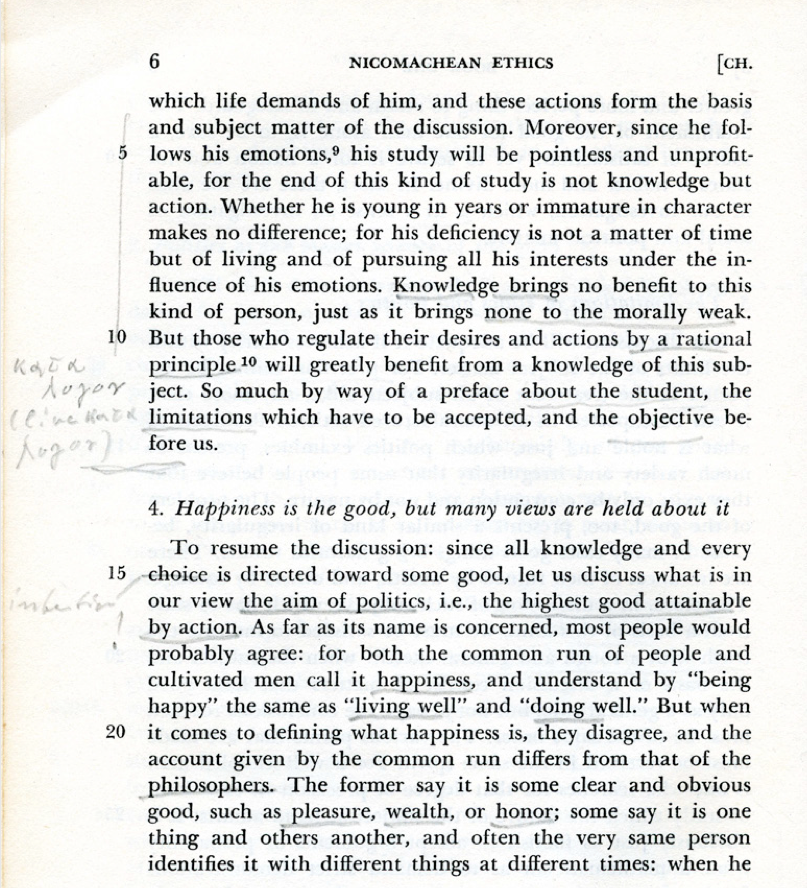
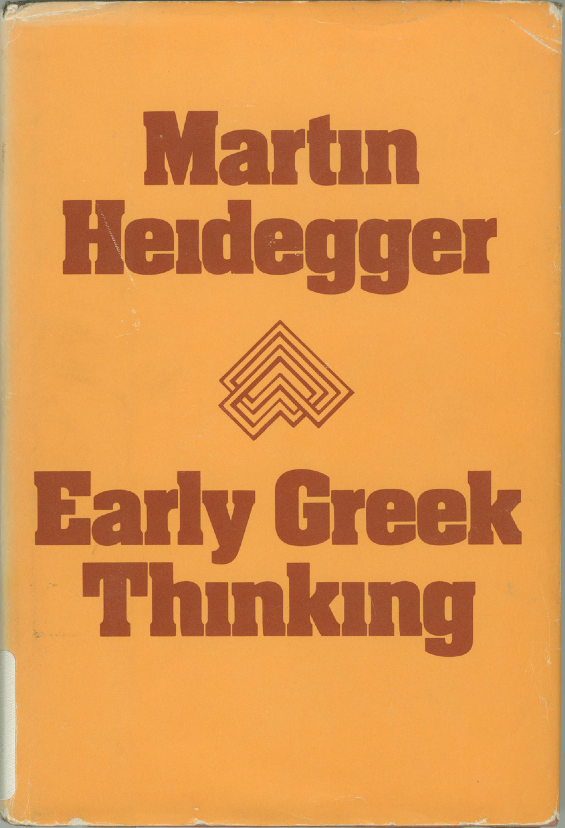
Arendt’s library—much of it on view online thanks to Bard college—offers us a unique opportunity to do just that, not only by giving us access to the specific editions and translations that she herself read and saved (for whatever reason), but also by offering insight into what Arendt considered important enough in those texts to underline and annotate. In Bard’s digital collection of “Arendt Marginalia”—selections of her annotated books in downloadable PDFs—we see a political philosophy informed by Aristotle (see a page from her copy of Nicomachean Ethics above), Plato, and Kant, but also by conservative German political theorist Carl Schmitt, a member and active supporter of Nazism, and of course, by Heidegger, whose work occupies a central place in her library: in German and English (like his Early Greek Thinking above, inscribed by the translator), and in primary and secondary sources.
While it may go too far to claim, as prominent scholar Bernard Wasserstein did in 2009, that an examination of Arendt’s sources shows her internalizing the values of Nazis and anti-Semites, the preponderance of conservative German thinkers in her personal library does give us a sense of her intellectual leanings. But we cannot draw broad conclusions from a cursory survey of a lifetime of reading and re-reading, though we do see a particularly Aristotelian strain in her thinking: that the individual is only as healthy as his or her political culture. What scholars of Arendt will find in Bard’s digital collection are ample clues to the development and evolution of her philosophy over time. What lay readers will find is the outline of a course on the sources of Arendt-ian thought, including not only Greeks and Germans, but the American poet Robert Lowell, who wrote a glowing profile of Arendt and contributed at least four signed books of his to her library.
I say “at least” because the Bard digital collection is yet incomplete, representing only a portion of the physical media in the college’s physical archive of “approximately 4,000 volumes, ephemera and pamphlets that made up the library in Hannah Arendt’s last apartment in New York City.” What we don’t have online are books inscribed to her by Jewish scholar and mystic Gershom Scholem, by W.H. Auden and Randall Jarrell, and many others. Nonetheless the “Arendt Marginalia” gives us an opportunity to peer into a writer and scholar’s process, and see her wrestle with the thought of her predecessors and contemporaries. The full Arendt collection gives us even more to sift through, including private correspondence and recordings of public speeches. The digitization of these sources offers many opportunities for those who cannot travel to New York and access the physical archives to delve into Arendt’s intellectual world in ways previously only available to professional academics.
Related Contents:
Hannah Arendt Discusses Philosophy, Politics & Eichmann in Rare 1964 TV Interview
Hannah Arendt’s Original Articles on “the Banality of Evil” in the New Yorker Archive
Josh Jones is a writer and musician based in Durham, NC. Follow him at @jdmagness
Read More...Get a Free Subscription to the Beta Version of The Great Courses Plus (Space Limited)

We’ve told you about the Great Courses Plus (now called Wondrium) before–a new video subscription service that lets you watch free courses (about 8,000 lectures in total) across a wide range of subjects, all taught by some of the best lecturers in the country. The topics cover everything from History, Philosophy, Literature, and Economics, to Math, Science, Professional Development, Cooking, and Photography. And you can binge-watch entire college courses in a matter of days by watching videos on your TV, tablet, laptop and smart phone, with the help of apps designed for Apple, Google Play, Kindle Fire, and Roku.
Interested in trying out this service? Right now, the Great Courses Plus/Wondrium is offering a special deal for Open Culture readers. If you click here, and sign up for a free trial, you can use this service for 30 days … for free. And then, if you would like, you can continue to subscribe and pay their normal prices. If you have time on your hands, this is a great way to keep your mind engaged and stream what PC Magazine has called “an excellent library of college-level lectures.”
Note: The Great Courses is a partner with Open Culture. So if you sign up for a free trial, it benefits not just you and Great Courses Plus. It benefits Open Culture too. So consider it win-win-win.
Read More...Learn to Speak 48 Languages for Free: Everything from Arabic to Indonesian to Yiddish on One Page
Even by the standards of United States Presidents, Barack Obama has led a pretty unusual life. His early experiences included a childhood plunge into internationalism in the form of not just his Kenyan father but his Indonesian stepfather, to whose homeland the family moved when Obama was six years old. For the next four years, the young future Commander in Chief attended local schools in Jakarta, and the language he picked up then has stuck with him today. It certainly served him well when he returned to Indonesia as President to give the speech above, in which he talks about his love for that country and his belief in its importance to the future, speaking bits and pieces in Indonesian throughout — and drawing great applause each time.
If you want to be like Barry and meet with a similarly rapturous reception when next you give a public address in the Emerald of the Equator, start by learning the basics of the Indonesian language at our Free Foreign Language Lessons page. There, you’ll find a wealth of podcasts like Learning Indonesian (iTunes), Indonesianpod101 (iTunes), and Indonesian Survival Phrases (iTunes). [Advanced learners might prefer tuning in to news-in-Indonesian podcasts from SBS (iTunes) and NHK World (iTunes) radio.] Indonesianpod101 even has a Youtube page with video lessons like the one just above.
Even if you don’t plan on becoming President, you may still have plenty of reasons to learn Indonesian. With its familiar alphabet and simple grammar without tenses, gender forms, noun cases, and the like, it ranks as one of the very easiest languages in which to attain fluency. I know an American college professor in South Korea who constantly urges his students to study Indonesian, since it offers the “golden tip” of a wedge into the rest of Asia: master it, and you’ll have built up momentum to learn the other, more complicated languages of the region, from Mandarin to Cantonese to Japanese and beyond — all of which you can also begin studying at, of course, our Free Language Lessons page.
If your linguistic interests slant toward Europe rather than Asia, don’t worry, we’ve still got your back: our lists include learning resources for languages of that continent as major as Spanish, French, Italian, Russian, English, and German to niche languages like Catalan, Finnish, Hungarian, and Serbo-Croatian. If you notice we’ve missed any language you’ve harbored a burning desire to learn, drop us a line so we can start gathering podcasts, videos, and PDFs on it. In the meantime, surely the Free Language Lessons page offers you something to start on and get that incomparable feeling of breaking into a new language for the first time. Semoga beruntung, as we say in Jakarta!
Related Content:
Learn 48 Languages Online for Free: Spanish, Chinese, English & More
Study 40+ Languages with Free Lessons from the U.S. Foreign Service Institute
Let’s Learn Japanese: Two Classic Video Series to Get You Started in the Language
Learn Latin, Old English, Sanskrit, Classical Greek & Other Ancient Languages in 10 Lessons
Colin Marshall writes on cities, language, Asia, and men’s style. He’s at work on a book about Los Angeles, A Los Angeles Primer, and the video series The City in Cinema. Follow him on Twitter at @colinmarshall or on Facebook.
Read More...A 68 Hour Playlist of Shakespeare’s Plays Being Performed by Great Actors: Gielgud, McKellen & More
A couple of years ago we published a post on “what Shakespeare sounded like to Shakespeare” which highlighted some prominent linguists’ attempts to recreate the Elizabethan speech patterns and accents of the playwright’s day. There may be some small debate about whether or not they succeeded, but we’ll never know for certain since his day is long behind us.
In some ways, the nature of Shakespeare’s language may have been more French, or more Latinate, or more Saxon, than the English we speak today—depending on the proportion of regionalisms commingling in any given play, like characters in a national bazaar.
Our current version of the language may have absorbed another four hundred years of global influence, but in the process it has also become more homogenized and standardized. Shakespeare’s language was both more provincial and more riotously diverse–in spelling and pronunciation–than many kinds of English we speak today.
Perhaps this is one reason we think of Shakespeare as a universal poet—the heterodoxy of his speech, and hence a variability of characters found in few other literatures. Even his stock types seem to have individual voices. The degree of interplay between high and low speech—city and country, comic and tragic, lyric and prosaic—may be why nearly every world language has found a way to adapt his work, accenting some qualities and muting others. You don’t have to take my word for it. You can see for yourself at the MIT Global Shakespeare’s Video & Performance Archive, which hosts dozens of Shakespeare stagings in dozens of languages, like the mesmerizing Japanese Lear above, or the heartracingly intense one-woman clip from the Argentine Hamlet la metamorphosis at the top, a melodramatic production that would thrill David Lynch. Additionally, the database aggregates “essays and metadata provided by scholars and educators in the field” of international Shakespeare studies.
Even among the thousands of English-language adaptations of Shakespeare’s work we find an international diversity of speech. The Spotify playlist above, brought to us by Ulysses Classical (makers of the Stanley Kubrick Playlist), presents a huge collection of recorded Shakespeare plays and poems, as well as the scores and incidental music for English-language productions. The actors represented–Sirs Gielgud, Olivier, and McKellen, Derek Jacobi, Edith Evans–are mostly English stage royalty, but we also have Welsh poet Dylan Thomas and actor Richard Burton, and Americans Paul Robeson, Rosalind Russell, and Orson Welles. The value of such a collection is inestimable–68 hours of Shakespeare read and performed by some of the world’s finest actors. But it is indeed a specific slice of the world. Even in English it feels (forgive the puns) that all the world could be represented here, doing Shakespeare in every kind of English around the globe. Perhaps such a global approach to teaching Shakespeare in English would add nuance to debates about whether his work is still relevant in American high school and college classrooms. In any case, there seem to be few barriers to actors and directors for approaching Shakespeare with new translations and with fresh eyes, ears, and costumes, again and again.
You can access the Spotify playlist on the web here. If you need to download Spotify, find it here.
Related Content:
Read All of Shakespeare’s Plays Free Online, Courtesy of the Folger Shakespeare Library
Free Online Shakespeare Courses: Primers on the Bard from Oxford, Harvard, Berkeley & More
Orson Welles’ Radio Performances of 10 Shakespeare Plays
1,000 Free Audio Books: Download Great Books for FreeJosh Jones is a writer and musician based in Durham, NC. Follow him at @jdmagness.
Read More...2,200 Radical Political Posters Digitized: A New Archive
I recently heard someone say his college-bound nephew asked him, “What’s a union?” Whether you love unions, loathe them, or remain indifferent, the fact that an ostensibly educated young person might have such a significant gap in their knowledge should cause concern. A historic labor conflict, after all, provided the occasion for Ronald Reagan to prove his bona fides to the new conservative movement that swept him into power. His crushing of the Professional Air Traffic Controllers Organization (PATCO) in 1981 set the tone for the ensuing 30 years or so of economic policy, with the labor movement fighting an uphill battle all the way. Prior to that defining event, unions held sway over politics local and national, and had consolidated power blocks in the American political landscape through decades of struggle against oppressive and dehumanizing working conditions.
In practical terms, unions have stood in the way of capital’s unceasing search for cheap labor and new consumer markets; in social and cultural terms, the politics of labor have represented a formidable ideological challenge to conservatives as well, by way of a vibrant assemblage of anarchists, civil libertarians, anti-colonialists, communists, environmentalists, pacifists, feminists, socialists, etc. A host of radical isms flourished among organized workers especially in the decades between the 1870s and the 1970s, finding their voice in newsletters, magazines, pamphlets, leaflets, and posters—fragile mediums that do not often weather well the ravages of time. Thus the advent of digital archives has been a boon for students and historians of workers’ movements and other populist political groundswells. One such archive, the Joseph A. Labadie Collection at the University of Michigan Library, has recently announced the digitization of over 2,200 posters from their collection, a database that spans the globe and the spectrum of leftist political speech and iconography.
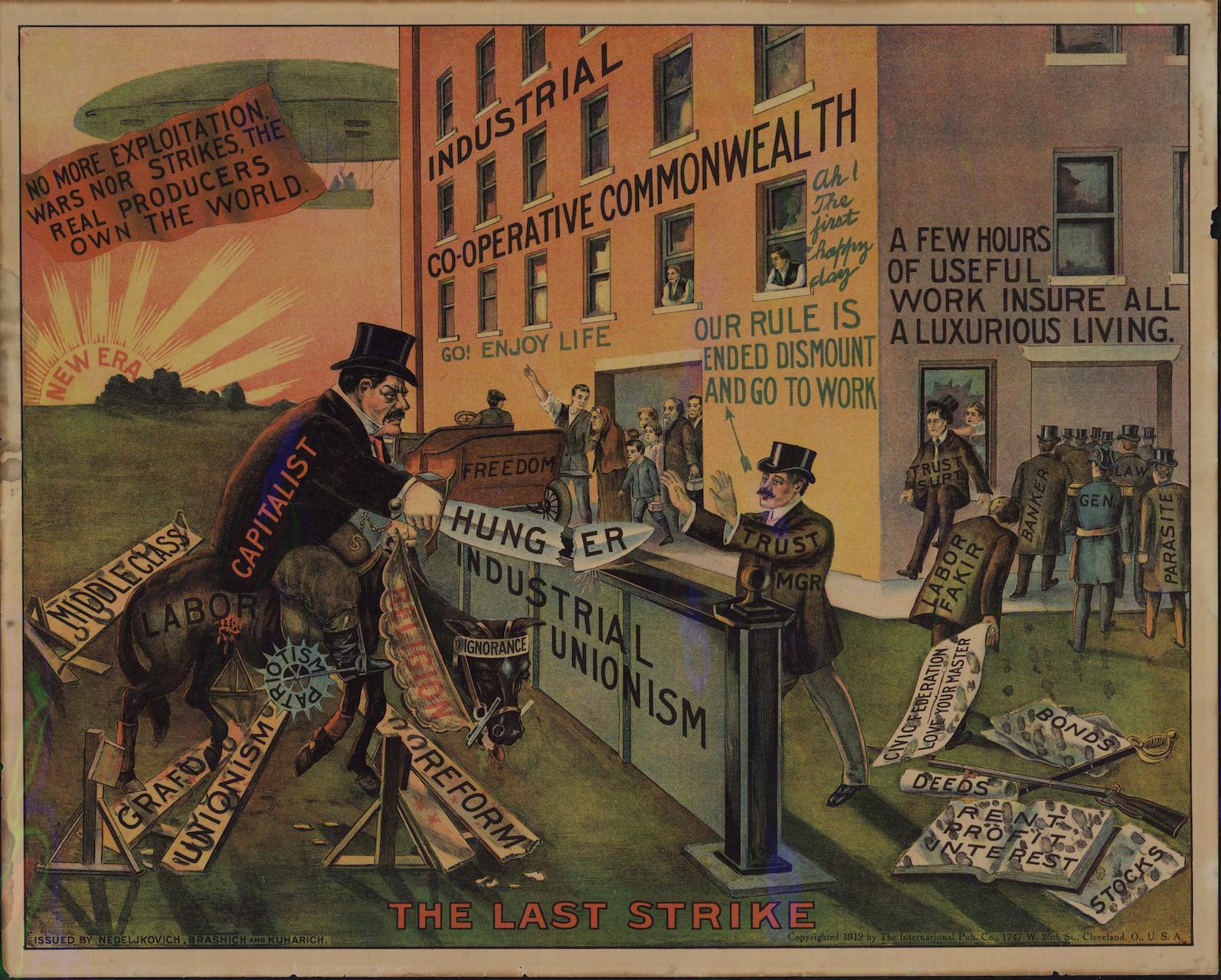
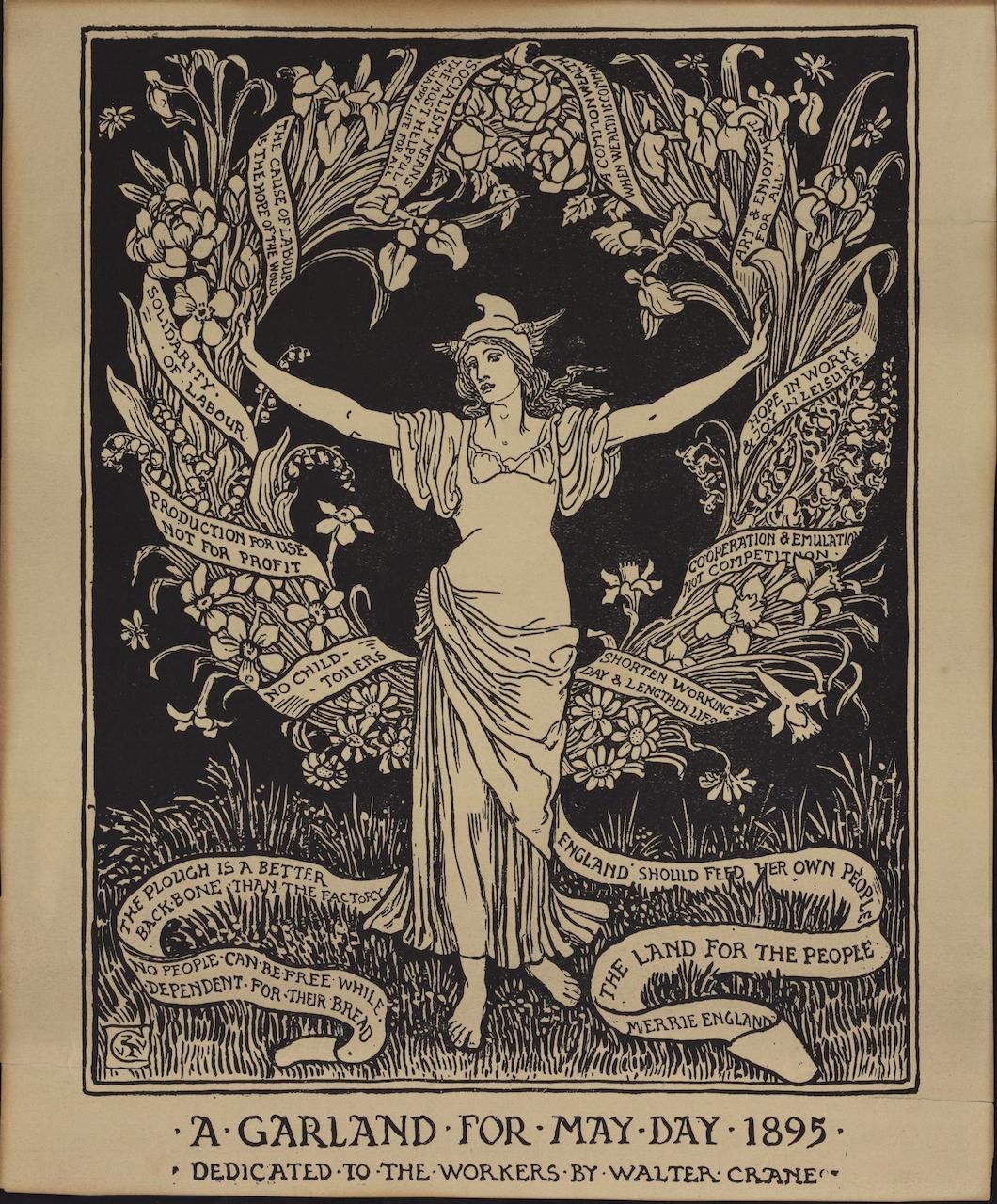
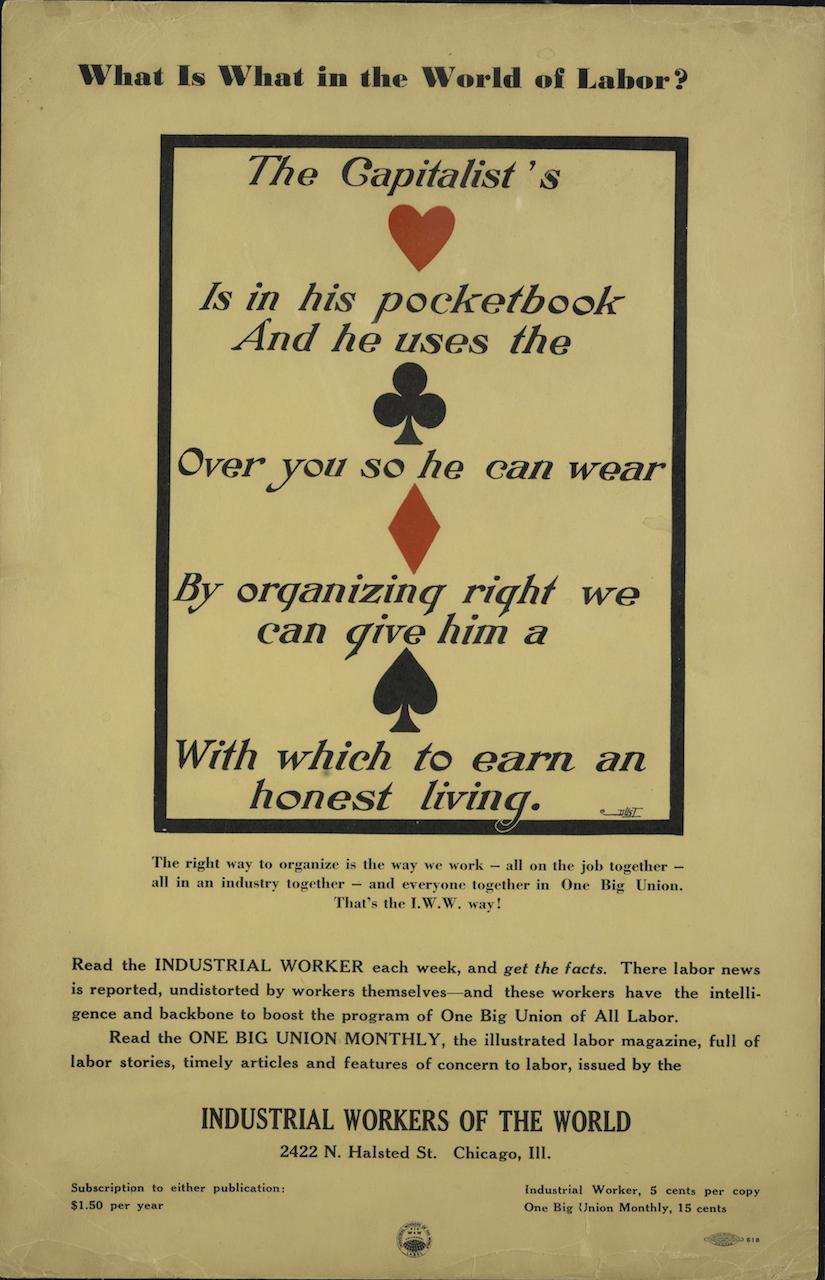
We have cleverly-designed visual puns like the Chicago Industrial Workers of the World poster just above, titled “What is what in the world of labor?” Promoting itself as “One Big Union of All Labor,” the IWW made some of the most ambitious propaganda, like the 1912 poster (middle) in which an “Industrial Co-Operative Commonwealth” replaces the tyranny of the capitalist, who is told by his “trust manager” peer, “Our rule is ended, dismount and go to work.” In this post-revolutionary fantasy, the IWW promises that “A few hours of useful work insure all a luxurious living,” though it only hints at the details of this utopian arrangement. Up top, we have an ornate May Day poster from 1895 by Walter Crane, hoping for a “Merrie England” with “No Child Toilers,” “Production for Use Not For Profit,” and “The Land For the People,” among other, more nationalist, sentiments like “England Should Feed Her Own People.”
“While all of the posters were scanned at high resolution,” writes Hyperallergic, “they appear online as thumbnails with navigation to zoom.” You can download the images, but only the smaller, thumbnail size in most cases. These hundreds of posters represent “just a portion of the material in the Labadie Collection”—named for a “Detroit-area labor organizer, anarchist, and author” who “had the idea for the social protest archive at the university in 1911.” You can view other political artifacts in the UMich library’s digital collections here, including anarchist pamphlets, political buttons, and a digital photo collection. The collection as a whole gives us a potentially inspiring, or infuriating, mosaic of political thought at its boldest and most graphically assertive from a time before online petitions and hashtag campaigns took over as the primary circulators of popular radical thought.
via Hyperallergic (where you can find some other big, visually striking posters)
Related Content:
Wonderfully Kitschy Propaganda Posters Champion the Chinese Space Program (1962–2003)
Free Online Political Science Courses
Josh Jones is a writer and musician based in Durham, NC. Follow him at @jdmagness
Read More...See Flannery O’Connor’s Story “The Displaced Person” Adapted to a Film Starring a Young Samuel L. Jackson (1977)
There are strong people quietly willing to do “what needs to be done” for the public good, and then there are those who enjoy insinuating that they are that sort of person, usually as justification for their self-serving, frequently racist or xenophobic actions. When the latter reaches for the Bible as back up, look out!
No one ever had more fun with this monstrous type than the writer Flannery O’Connor, a devout Catholic with a knack for wrapping her characters’ foul purposes in the “stinking mad shadow of Jesus.”
In her longest story “The Displaced Person,” the boorish, Bible-thumping Mrs. Shortley is not the only baddie. The refined Mrs. McIntyre, widowed mistress of the dairy operation that employs the Shortleys and a couple of African-American farmhands, is just as quick to indict those with whom she imagines herself at cross-purposes.
Transfer them to the small screen, and every actress over 40 would be clamoring for the chance to sink her teeth into one or the other.
In 1977, PBS hired playwright Horton Foote to adapt “The Displaced Person” for “The American Short Story,” and the roles of Shortley and McIntyre went to Shirley Stoler and Irene Worth, both excellent.
(See above…it’s always so much more amusing to play one of the villains than the hardworking, uncomplaining, titular character, here a Polish refugee from WWII.)
The audio quality is not the greatest, but stick with it to see Samuel L. Jackson, not quite 30, as the younger of the two farmhands.
O’Connor buffs will be interested to know that Andalusia, the writer’s own Georgia farm, served as the location for this hour-long project. (No need to rent a peacock!)
Despite the stately production values that were de rigeur for quality viewing of the period, the story retains the unmistakable tang of O’Connor—it’s a bitter, comic brew.
Related Content
Flannery O’Connor Reads ‘Some Aspects of the Grotesque in Southern Fiction’ (c. 1960)
Rare 1959 Audio: Flannery O’Connor Reads ‘A Good Man is Hard to Find’
Flannery O’Connor’s Satirical Cartoons: 1942–1945
Ayun Halliday is an author, illustrator, and Chief Primatologist of the East Village Inky zine. Follow her @AyunHalliday
Read More...Watch Lynda Barry’s Graduation Speech; Give a Shout Out to the Teachers Who Changed Your Life
The University of the Arts’ most recent grads are lucky ducks to have had a speaker as engaging as cartoonist and educator Lynda Barry delivering their commencement’s keynote address.
Speaker Barry was also made an Honorary Doctor of Fine Arts, an award that occasioned the ill-fitting tam seen in the video above, as well as a new title—Doctor Nursey—conferred by pre-kindergarteners with whom she works at the University of Wisconsin. (Previous aliases include Professor Chewbacca and Professor Old Skull)
Barry kept things lively by mixing in some tried and true material from other public appearances, including her Filipino grandmother’s belief in the aswang, a poem set to music (here “Cotton Song” by Harlem Renaissance poet, Jean Toomer) and the story of the collaborative cartoon, “Chicken Attack by Jack.”
This last anecdote contains a strong indictment of contemporary society’s screen addiction, and it is heartening to see the graduates—members of the last generation to pre-date the Internet—listening so attentively, no one texting or tweeting as the camera pans the crowd.
When Barry exhorted them to shout out the names of their three most inspiring teachers on the count of three, most did!
For me, this was the most thrilling moment, though I also appreciated the advice on the best time to schedule oral surgery, and a blissful untruth about Evergreen State College’s application process circa the mid-70s.
Not your typical commencement speech… those lucky, lucky ducks!
Readers, we invite you to get in the spirit and celebrate the Class of 2015 by “shouting” the names of your most inspirational teachers in the comment section below.
Related Content:
Join Cartoonist Lynda Barry for a University-Level Course on Doodling and Neuroscience
John Waters’ RISD Graduation Speech: Real Wealth is Never Having to Spend Time with A‑Holes
Robert De Niro Tells Graduating NYU Arts Grads, “You Made It… And You’re F*cked”
Ayun Halliday is an author, illustrator, and Chief Primatologist of the East Village Inky zine. Congratulations, graduates, especially the members of NYC’s most freshly forged theater company, Rascal Arts. Follow her @AyunHalliday
Read More...An Animated Ayn Rand Dispenses Terrible Love Advice to Mike Wallace (1959)
In the past, the good folks over at Blank on Blank have turned rarely-seen interviews with the likes of Ray Bradbury and John Coltrane into brilliant little animated shorts. This week, their latest installment is on Ayn Rand.
Rand, of course, is the mind behind Objectivism, the patron saint of laissez faire capitalism, and the author of such unwieldy tomes as The Fountainhead and Atlas Shrugged. Among Wall Street bankers, Washington conservatives and insufferable college sophomores, Rand is a revered figure. Former vice presidential candidate Paul Ryan and presidential candidate Rand Paul are both acknowledged followers. Former Federal Reserve head Alan Greenspan was Rand’s protégé. To a lot of other people, of course, her theories are little more than a shrill justification of sociopathy, an empathy-challenged vision of social interaction that flies in the face of basic ideas of human decency.
The interview dates back to a 1959 interview by Mike Wallace (see the original here) who grills Rand on her concept of love and happiness, which leads to this exchange:
Ayn Rand: I say that man is entitled to his own happiness. And that he must achieve it himself. But that he cannot demand that others give up their lives to make him happy. And nor should he wish to sacrifice himself for the happiness of others. I hold that man should have self-esteem.
Mike Wallace: And cannot man have self-esteem if he loves his fellow man? Christ, every important moral leader in man’s history, has taught us that we should love one another. Why then is this kind of love in your mind immoral?
Ayn Rand: It is immoral if it is a love placed above oneself. It is more than immoral, it’s impossible. Because when you are asked to love everybody indiscriminately. That is to love people without any standard. To love them regardless of whether they have any value or virtue, you are asked to love nobody.
Watching the piece, I kept hearing the title of Raymond Carver’s brilliant short story run through my mind, “What We Talk About When We Talk About Love.” (Hear Carver read that story here.) My sense is that her version of love is very different from mine. Watch the full animated video above.
Jonathan Crow is a Los Angeles-based writer and filmmaker whose work has appeared in Yahoo!, The Hollywood Reporter, and other publications. You can follow him at @jonccrow. And check out his blog Veeptopus, featuring pictures of vice presidents with octopuses on their heads. The Veeptopus store is here.
Related Content:
Flannery O’Connor: Friends Don’t Let Friends Read Ayn Rand (1960)
Ayn Rand Adamantly Defends Her Atheism on The Phil Donahue Show (Circa 1979)
The Outspoken Ayn Rand Interviewed by Mike Wallace (1959)
Ayn Rand Trashes C.S. Lewis in Her Marginalia: He’s an “Abysmal Bastard”
Read More...A Creepy Cut Out Animation of Samuel Beckett’s 1953 Novel, The Unnamable
Morning, friend! Ready to kick off your week with a Beckettian nightmare vision?
Samuel Beckett scholar Jenny Triggs was earning a masters in Visual Communications at the Edinburgh College of Art when she created the unsettling, cut out animation for his 1953 novel, The Unnamable, above. (Her PhD exhibition, a decade later, was a multi-screen video response to Beckett’s short story, Ping.)
The wretched creatures haunting the film conjure Bosch and Gilliam, in addition to Ireland’s best known avant-garde playwright.
Triggs seem to have drawn inspiration from the nameless narrator’s physical self-assessment:
I of whom I know nothing, I know my eyes are open because of the tears that pour from them unceasingly. I know I am seated, my hands on my knees, because of the pressure against my rump, against the soles of my feet? I don’t know. My spine is not supported. I mention these details to make sure I am not lying on my back, my legs raised and bent, my eyes closed.
Despite the narrator’s effort to keep track of his parts, Triggs ensures that something will always be missing. Her characters make do with rods, bits of chess pieces or nothing at all in places where limbs should be.
Are these birth defects or some sort of wartime disability that precludes prosthetics?
One character is described as “nothing but a shapeless heap… with a wild equine eye.”
The narrator steels himself “to invent another fairy tale with heads, trunks, arms, legs and all that follows.” Meanwhile, he’s tormented by a spiritual push-me-pull-you that feels very like the one afflicting Vladimir and Estragon in Waiting for Godot:
Where I am, I don’t know, I’ll never know, in the silence you don’t know, you must go on, I can’t go on, I’ll go on.
Triggs describes The Unnamable as a book that begs to be read aloud, and her narrators Louise Milne and Chris Noon are deserving of praise for parsing the meandering text in such a way that it makes sense, at least atmospherically.
To go on means going from here, means finding me, losing me, vanishing and beginning again, a stranger first, then little by little the same as always, in another place, where I shall say I have always been, of which I shall know nothing, being incapable of seeing, moving, thinking, speaking, but of which little by little, in spite of these handicaps, I shall begin to know something, just enough for it to turn out to be the same place as always, the same which seems made for me and does not want me, which I seem to want and do not want, take your choice, which spews me out or swallows me up, I’ll never know, which is perhaps merely the inside of my distant skull where once I wandered, now am fixed, lost for tininess, or straining against the walls, with my head, my hands, my feet, my back, and ever murmuring my old stories, my old story, as if it were the first time.
Related Content:
Rare Audio: Samuel Beckett Reads From His Novel Watt
Take a “Breath” and Watch Samuel Beckett’s One-Minute Play
Hear Samuel Beckett’s Avant-Garde Radio Plays: All That Fall, Embers, and More
Ayun Halliday is an author, illustrator, and Chief Primatologist of the East Village Inky zine. Follow her @AyunHalliday
Read More...Support Us
We're hoping to rely on loyal readers, rather than erratic ads. Please click the Donate button and support Open Culture. You can use Paypal, Venmo, Patreon, even Crypto! We thank you!

About Us

Open Culture scours the web for the best educational media. We find the free courses and audio books you need, the language lessons & educational videos you want, and plenty of enlightenment in between.
Advertise With Us
FREE UPDATES!
GET OUR DAILY EMAIL
Get the best cultural and educational resources on the web curated for you in a daily email. We never spam. Unsubscribe at any time.
FOLLOW ON SOCIAL MEDIA
Open Culture editor Dan Colman scours the web for the best educational media. He finds the free courses and audio books you need, the language lessons & movies you want, and plenty of enlightenment in between.
Advertise With Us

