High School Teacher Reads Allen Ginsberg’s Explicit Poem “Please Master” and Loses His Job
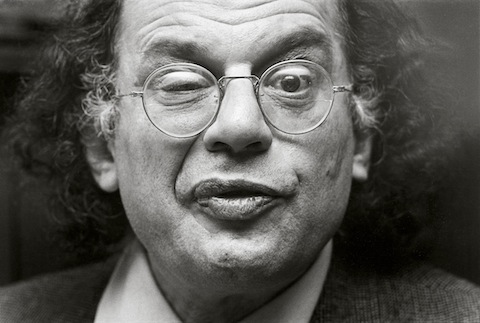
Image by Michiel Hendryckx.
Although the boundaries of what should pass for free speech in high school English classrooms will be forever in debate, most everyone would agree some boundaries must exist. But what of the speech of famous authors? Of towering figures of 20th century poetry? Should their speech be subject to review? What of an English teacher who allows the most risqué Beat poem you’ve ever heard to be read aloud in class by the poet himself, Allen Ginsberg, via an online video (perhaps this one)? Award-winning English teacher David Olio, a beloved 19-year veteran, did just that when a student asked to share Ginsberg’s ecstatic, and very explicit, poem “Please Master” with the class.
After complaints from several students, the school administration suspended Olio, then forced him to resign. Whether or not this decision was just is a debate that extends beyond the scope of this post. The variables are many, as Slate’s sympathetic Mark Joseph Stern admits, including the fact that Olio did not exactly prepare his students for what was to come, nor give them the opportunity to opt out. The high school seniors—on the threshold of adulthood and some already with one foot in college—may not have had their “emotional health” endangered, as Olio’s termination letter alleged, but it’s little wonder some of them found the material shocking.
Ginsberg’s poem, which you can hear him read above, describes a “fantasized sexual encounter between Ginsberg and Neal Cassady, the inspiration for the Dean Moriarty character in Jack Kerouac’s On the Road.” It is graphic, writes Stern, but “not obscene.” Instead—in its allusions to St. Teresa’s angelic visitation in a “profane description of anal sex as a nearly divine act”—Ginsberg’s poem is “dangerous because it juxtaposes tenderness with masochism; dangerous because it rapturously celebrates a vision of same-sex intimacy we are only supposed to whisper about.” Read the poem, listen to Ginsberg read it, and judge for yourself.
Of course, this is hardly the first time Ginsberg’s work has caused controversy. His Beat epic “Howl” (1955), with its sexually charged lines, irked the U.S. government, who seized copies of the poem and put its publisher, poet and City Lights’ bookseller Lawrence Ferlinghetti, on trial for obscenity. Well over sixty years later, Ferlinghetti has written in defense of David Olio. We can safely assume that Ginsberg, who died in 1997, also would approve. And while we have every right to be shocked by Ginsberg’s poem, or not, and find the decision to fire Olio warranted, or not, I tend to agree with Stern when he writes “if every English teacher were that enthusiastic about his subject, America would be a much more literate, educated and interesting place.”
Related Content:
The First Recording of Allen Ginsberg Reading “Howl” (1956)
Allen Ginsberg Reads a Poem He Wrote on LSD to William F. Buckley
Allen Ginsberg Talks About Coming Out to His Family & Fellow Poets on 1978 Radio Show (NSFW)
Josh Jones is a writer and musician based in Durham, NC. Follow him at @jdmagness.
Read More...Flannery O’Connor to Grace New U.S. Postage Stamp
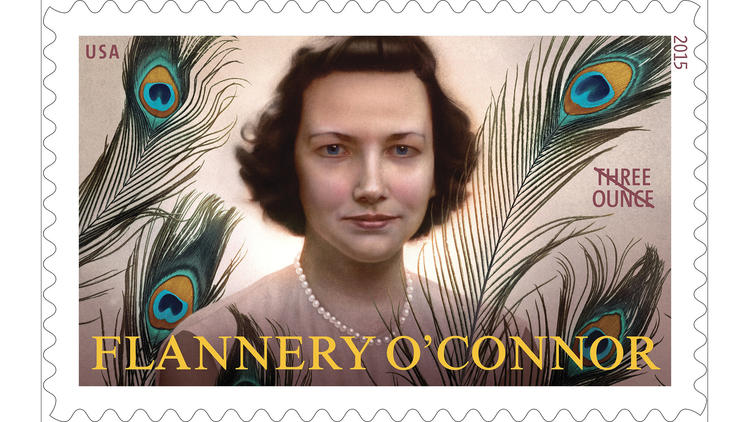
Since 1979, the US Postal Service has made a practice of issuing postage stamps honoring “skillful wordsmiths” who have “spun our favorite tales — and American history along with them.” Edgar Allan Poe, Richard Wright, Julia De Burgos, Mark Twain, O. Henry, and Ralph Ellison have all been fêted since 2009. And soon we can add the Southern Gothic writer Flannery O’Connor to the list. Her stamp will make its debut on June 5th. Until then, we’d encourage you to stream rare recordings of O’Connor reading her famous story, ‘A Good Man is Hard to Find’, and her witty essay, “Some Aspects of the Grotesque in Southern Fiction.” These are the only known recordings of O’Connor reading her work, and they provide a wonderful introduction to O’Connor’s literary talents.
Related Content:
Flannery O’Connor: Friends Don’t Let Friends Read Ayn Rand (1960)
Flannery O’Connor’s Satirical Cartoons: 1942–1945
Read More...Michael Moore’s 13 Rules for Making Documentaries — Really Powerful & Entertaining Documentaries
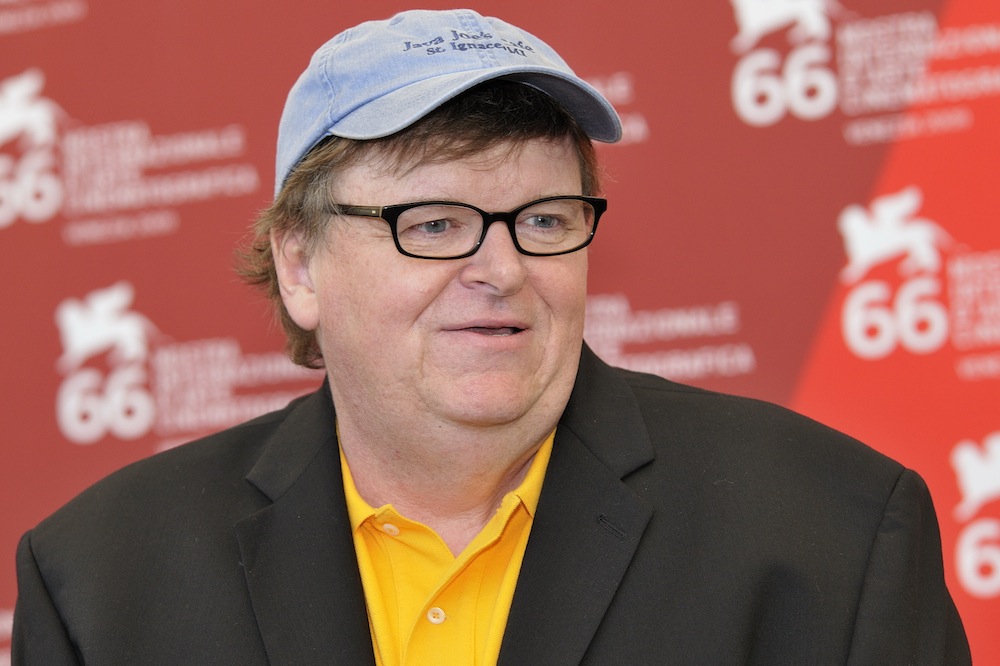
Flickr Commons Image by Nicolas Genin
You don’t rile up as many people as Michael Moore has without mastering the art of button pushing. Clint Eastwood threatened to kill him (allegedly). Christopher Hitchens, echoing the sentiments of many Iraq war supporters, called his work “dishonest and demagogic.” And the State Department—opponents of both socialized healthcare and the Cuban government—attempted to discredit Moore with lies about his film Sicko. Those are some powerful enemies, especially for a “comedian and a populist” whose only weapons are cameras, microphones, and bestselling topical rants. On the other hand, Moore inspires millions of regular folks. As far back as 2004, a profile in The New Yorker described the simultaneously angry and jovial documentarian as “a political hero” to millions who “revere” him.
How does a documentary filmmaker create such passion? Moore, writes The New Yorker, intentionally provokes; but he is also “exquisitely sensitive to his audience’s mood and response. The harshness of his comedy, the proportion of comedy to political anger, the flattery or mockery of the audience, the number and type of swearwords he uses….” All carefully controlled. And all of it adds up to something more than documentary. Moore treats the term almost as a pejorative, as he told an audience in his keynote speech at the 2014 Toronto International Film Festival’s Doc Conference. Typical documentarians, Moore said, “sound like a scold. Like you’re Mother Superior with a wooden ruler in your hand.”
Some critics of Moore make this very charge against him. Nonetheless, his ability to move people, both in theaters and live audiences, to tears, peals of laughter, and fits of rage, speaks of much more than humorless moralism. Documentarians, Moore says in the 13-point “manifesto” of his speech, should aspire to more. Hence his first rule, which he derives partly from Fight Club. Below it, see abridgments of the other twelve guidelines, and read Moore’s speech in its entirety at Indiewire. If he repeats himself, and he does, a lot, I suppose it’s because he feels the point is important enough to drive home many times:
1. The first rule of documentaries is: Don’t make a documentary — make a MOVIE.
…the audience, the people who’ve worked hard all week — it’s Friday night, and they want to go to the movies. They want the lights to go down and be taken somewhere. They don’t care whether you make them cry, whether you make them laugh, whether you even challenge them to think — but damn it, they don’t want to be lectured, they don’t want to see our invisible wagging finger popping out of the screen. They want to be entertained.
2. Don’t tell me shit I already know.
Oh, I see — you made the movie because there are so many people who DON’T know about genetically modified foods. And you’re right. There are. And they just can’t wait to give up their Saturday to learn about it
3. The modern documentary sadly has morphed into what looks like a college lecture, the college lecture mode of telling a story.
That has to stop. We have to invent a different way, a different kind of model.
4. I don’t like Castor Oil…. Too many of your documentaries feel like medicine.
The people don’t want medicine. If they need medicine, they go to the doctor. They don’t want medicine in the movie theaters. They want Goobers, they want popcorn, and they want to see a great movie.
5. The Left is boring.
…we’ve lost our sense of humor and we need to be less boring. We used to be funny. The Left was funny in the 60s, and then we got really too damn serious. I don’t think it did us any good.
6. Why don’t more of your films go after the real villains — and I mean the REAL villains?
Why aren’t you naming names? Why don’t we have more documentaries that are going after corporations by name? Why don’t we have more documentaries going after the Koch Brothers and naming them by name?
7. I think it’s important to make your films personal.
I don’t mean to put yourself necessarily in the film or in front of the camera. Some of you, the camera does not like you. Do not go in front of the camera. And I would count myself as one of those. … But people want to hear the voice of a person. The vast majority of these documentary films that have had the most success are the ones with a personal voice.
8. Point your cameras at the cameras.
Show the people why the mainstream media isn’t telling them what is going on.
9. Books and TV have nonfiction figured out. People love to watch Stewart and Colbert. Why don’t you make films that come from that same spirit?
Why wouldn’t you want the same huge audience they have? Why is it that the American audience says, I love nonfiction books and I love nonfiction TV — but there’s no way you’re dragging me into a nonfiction movie! Yet, they want the truth AND they want to be entertained. Yes, repeat after me, they want to be entertained!
10. As much as possible, try to film only the people who disagree with you.
That is what is really interesting. We learn so much more by you training your camera on the guy from Exxon or General Motors and getting him to just blab on.
11. The audience is part of the film.
While you are filming a scene for your documentary, are you getting mad at what you are seeing? Are you crying? Are you cracking up so much that you are afraid that the microphone is going to pick it up? If that is happening while you are filming it, then there is a very good chance that’s how the audience is going to respond, too. Trust that. You are the audience, too.
12. Less is more. You already know that one.
Edit. Cut. Make it shorter. Say it with fewer words. Fewer scenes. Don’t think your shit smells like perfume. It doesn’t.
13. Finally… Sound is more important than picture.
Pay your sound woman or sound man the same as you pay the DP, especially now with documentaries. Sound carries the story. It’s true in a fiction film, too.
So there you have it aspiring filmmakers. Should you to wish to galvanize, polarize, move, and inspire your audience as you tell them the truth (as you see it), you’d do well to take a few pointers from Michael Moore. Political differences—and homicidal urges—aside, even particularly right-leaning documentary directors might consider taking a few pages from Moore’s playbook. A few media personalities, it seems, already have, at least when it comes to defining their purpose. One last time, with feeling, for the TL;DR crowd: “Yes, repeat after me, [audiences] want to be entertained! If you can’t accept that you are an entertainer with your truth, then please get out of the business.”
via Indiewire
Related Content:
Michael Moore Tells Wisconsin Teachers “America Isn’t Broke”
Josh Jones is a writer and musician based in Durham, NC. Follow him at @jdmagness
Read More...Maurice Sendak’s Bawdy Illustrations For Herman Melville’s Pierre: or, The Ambiguities
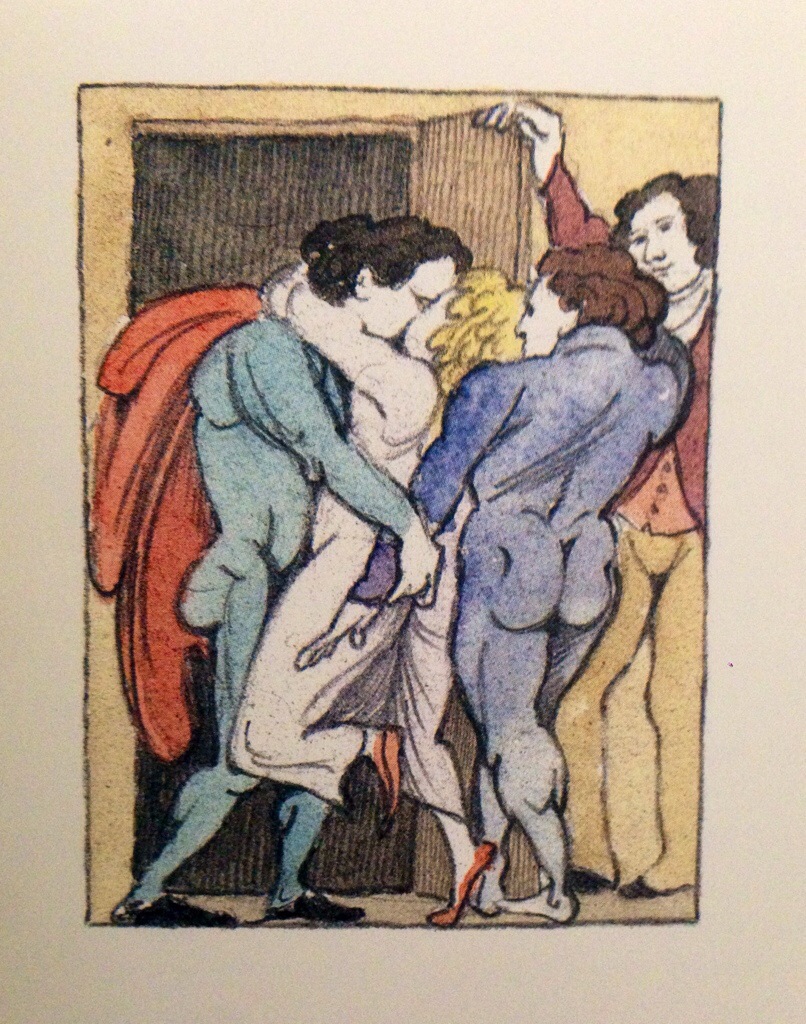
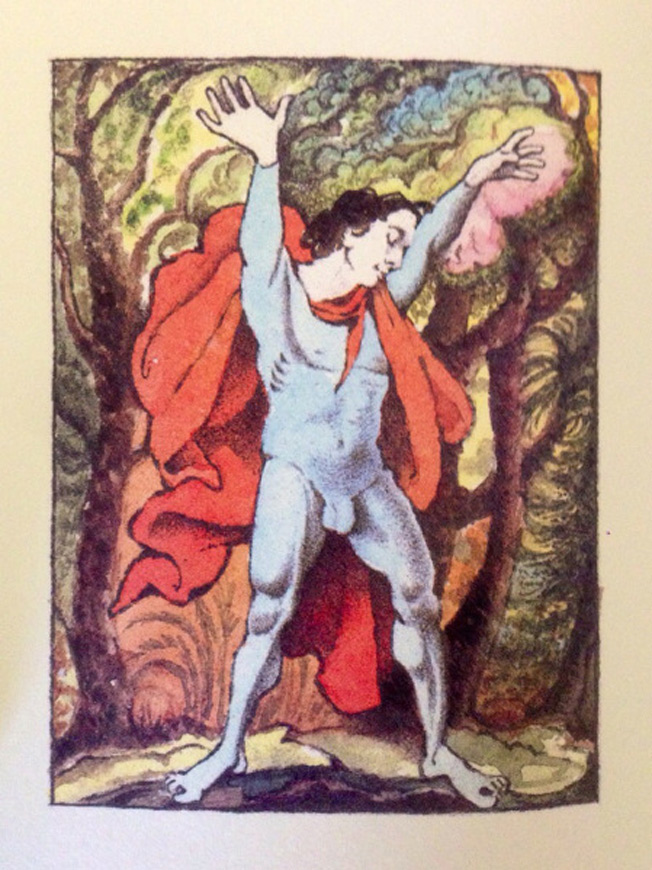
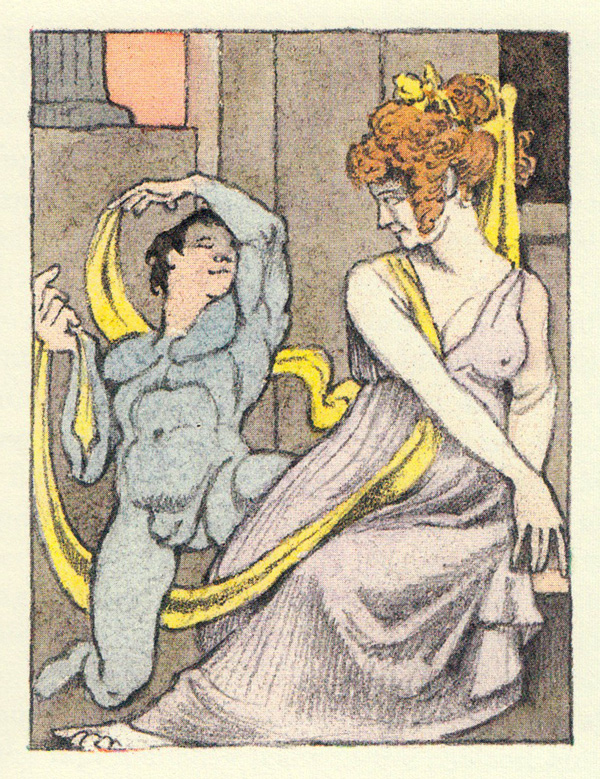
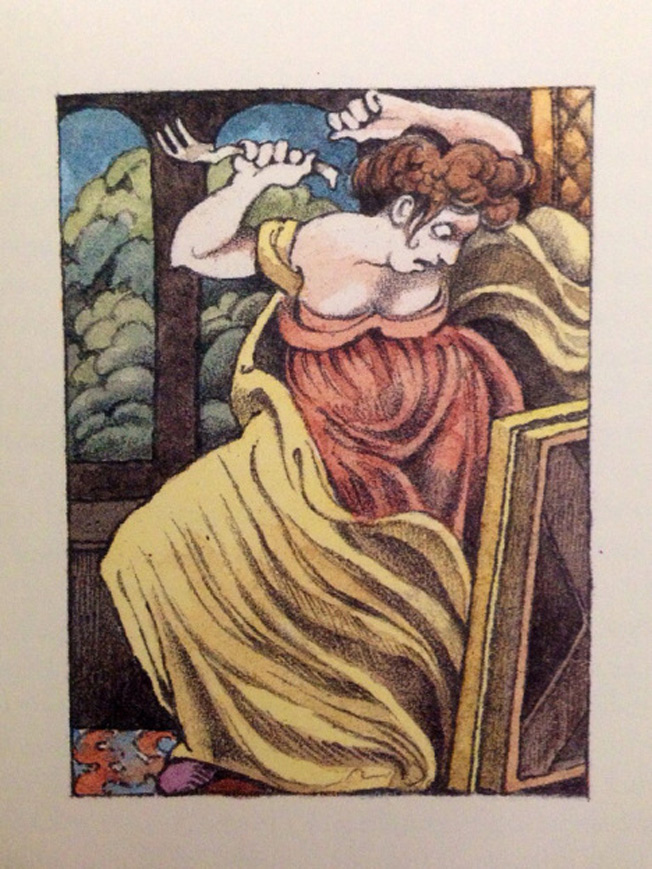
Maurice Sendak—like some few other exceptional children’s authors—also did work for adults, and in at least one case, did adult work, in his illustrations for a controversial 1995 edition of Herman Melville’s Pierre: or, The Ambiguities. The drawings are erotic, as well as homoerotic, illustrating the gay subtext in the novel. Sendak may seem like an unlikely illustrator for the Moby Dick author’s work; he was already an unlikely American children’s literary icon—“Jewish, gay, poor,” he nonetheless became “a major cultural influence,” writes blog BLT. As Sendak declared in an interview with Bill Moyers, he learned to “find a separate peace” from his own anxiety not through religious faith but through a “total faith in art.” “My gods,” Sendak told Moyers, “are Herman Melville, Emily Dickinson, Mozart,” among others. The author of Pierre figured highly in that divine hierarchy.
But Melville, at the time of Pierre’s publication, was not loved as a god. Shunned by critics and the reading public after the devastating reception accorded Moby Dick, his self-professed greatest work, Melville felt further humiliated when his publisher demanded he accept 20 cents on the dollar instead of 50 for the next novel, Pierre. Crushed, he signed the new contract. Then, though he had been satisfied with Pierre, considering the novel finished at the end of 1851, he added 150 pages, much of it a scathing, sardonic indictment of the literary establishment, including a non-too-subtle chapter titled “Young Literature in America.”
Whether the expansion was, as Maria Popova suggests at Brain Pickings, an eloquent riposte to his critics, or, as Library Journal suggests, made at the behest of his publishers (unlikely) is unclear. University of Delaware professor Herschel Parker, the Melville scholar who edited the Sendak edition of Pierre, admits, “we had NOT known when the expansion started and had not known just why.” Sendak himself describes Pierre as “a great and ingenious work of art.” Of the notion that Melville’s additions were “a vindictive diatribe against all his critics” Sendak speculates, “he might have been mad and hurt—He must have been mad and hurt. But he wouldn’t have spent that much time on a book being just mad and hurt.”
Sendak, a lifelong amateur Melville scholar, knows what he’s talking about. His familiarity with the author is such that his opinion was cited approvingly in the acknowledgments of a scholarly edition of Moby Dick. Despite Sendak’s comments in defense of Melville’s later additions, his and Parker’s version of Pierre attempts to strip them out and restore the novel to its earlier form, one Melville called his “Kraken book.” Sendak apparently initiated the project in order to publish the drawings. In them, writes John Bryan in a review for College English, “Pierre is a full-blown adolescent: muscular, ecstatic, desperate, devoted, and lonely; he is the man-child invincible.” The novel’s hero spends much of his time a blue Superman outfit, “red cape and all,” so tight “that it is skin itself, concealing nothing.”
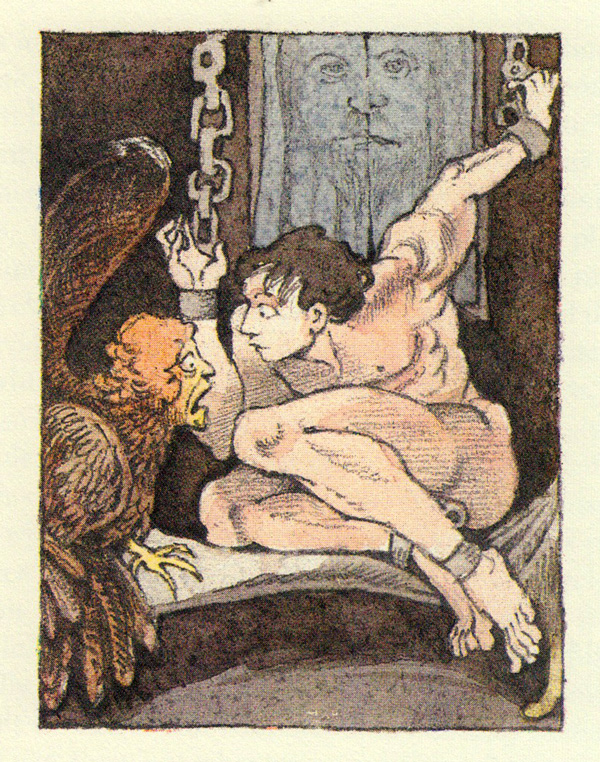
Bibliokept compares the illustrations to William Blake. They also contain references to Goya and other artists who explored the grotesque, as well as the morbid, transgressive sexuality of the Pre-Raphaelite painters. “Nowhere else in the history of Melville illustration,” writes John Bryan, “do we find such openings into the latent sexuality of Melville’s prose.” Brain Pickings describes the drawings as “the most sexually expressive of any of his work, featuring 27 discernible nipples and 11 male ‘packages’…. Bold, unapologetic, and incredibly sensual, the illustrations are also subtly subversive in their treatment of gender identity and stereotypes.”
See many more of these heroic and sensual illustrations at Brain Pickings. “The Kraken Edition”—as Sendak’s Pierre is called—can be had in rather pricey hardcover or used, and apparently now out of print, paperback.
Related Content:
The Only Drawing from Maurice Sendak’s Short-Lived Attempt to Illustrate The Hobbit
An Animated Christmas Fable by Maurice Sendak (1977)
Josh Jones is a writer and musician based in Durham, NC. Follow him at @jdmagness
Read More...Do Not Track: Interactive Film Series Reveals the Personal Information You’re Giving Away on the Web
If Facebook knows everything about you, it’s because you handed it the keys to your kingdom. You posted a photo, liked a favorite childhood TV show, and willingly volunteered your birthday. In other words, you handed it all the data it needs to annoy you with targeted advertising.
(In my case, it’s an ancient secret that helped a middle aged mom shave 5 inches off her waistline. Let me save you a click: acai berries.)
Filmmaker Brett Gaylor (a “lefty Canadian dad who reads science fiction) seeks to set the record straight regarding the web economy’s impact on personal privacy.
Watching his interactive documentary web series, Do Not Track, you’ll inevitably arrive at a crossroads where you must decide whether or not to share your personal information. No biggie, right? It’s what happens every time you consent to “log in with Facebook.”
Every time you choose this convenience, you’re allowing Google and other big time trackers to stick a harpoon (aka cookie) in your side. Swim all you want, little fishy. You’re not exactly getting away, particularly if you’re logged in with a mobile device with a compulsion to reveal your whereabouts.
You say you have nothing to hide? Bully for you! What you may not have considered is the impact your digital easy-breeziness has on friends. Your network. And vice versa. Tag away!
In this arena, every “like”—from an acquaintance’s recently launched organic skincare line to Star Trek—helps trackers build a surprisingly accurate portrait, one that can be used to determine how insurable you are, how worthy of a loan. Gender and age aren’t the only factors that matter here. So does your demonstrated extraversion, your degree of openness.
(Ha ha, and you thought it cost you nothing to “like” that acquaintance’s smelly strawberry-scented moisturizer!)
To get the most out of Do Not Track, you’ll want to supply its producers with your email address on your first visit. It’s a little counter-intuitive, given the subject matter, but doing so will provide you with a unique configuration that promises to lift the veil on what the trackers know about you.
What does it say about me that I couldn’t get my Facebook log-in to work? How disappointing that this failure meant I would be viewing results tailored to Episode 3’s star, German journalist Richard Gutjahr?
(Your profile… says that your age is 42 and your gender is male. But the real gold mine is your Facebook data over time. By analyzing the at least 129 things you have liked on Facebook, we have used our advanced algorithm techniques to assess your personality and have found you scored highest in Openness which indicates you are creative, imaginative, and adventurous. Our personality evaluation system uses Psycho-demographic trait predictions powered by the Apply Magic Sauce API developed at the University of Cambridge Psychometrics Centre.)
I think the takeaway is that I am not too on top of my privacy settings. And why would I be? I’m an extrovert with nothing to hide, except my spending habits, browsing history, race, age, marital status…
Should we take a tip from our high school brethren, who evade the scrutiny of college admissions counselors by adopting some ridiculous, evocative pseudonym? Expect upcoming episodes of Do Not Track to help us navigate these and other digital issues.
Tune in to Do Not Track here. You can find episodes 1, 2 and 3 currently online. Episodes 4–6 will roll out between May 12 and June 9.
Related Content:
The Internet’s Own Boy: New Documentary About Aaron Swartz Now Free Online
How Brewster Kahle and the Internet Archive Will Preserve the Infinite Information on the Web
Ayun Halliday an author, illustrator, and Chief Primatologist of the East Village Inky zine invites you to look into her very soul @AyunHalliday
Read More...An Animated Ray Bradbury Explains Why It Takes Being a “Dedicated Madman” to Be a Writer
The good folks at Blank on Blank have been breathing new life into long-lost recorded interviews with cultural icons by turning them into animated shorts. In the past, they have made films featuring the likes of Janis Joplin, David Foster Wallace, Jim Morrison and Dave Brubeck. For their most recent release, they do Ray Bradbury, the beloved sci-fi author and monorail enthusiast. You can watch it above.
In 2012, Lisa Potts found a cassette tape wedged behind a dresser. It contained an interview she did with Bradbury back in 1972 when she was a student journalist. Potts and fellow student Chadd Coates talked to the author in the back of a car while they were making their way from Bradbury’s West L.A. home to Chapman College in Orange County where he was slated to give a lecture.
In the interview, Bradbury expounds on a wide range of topics – from the importance of friends – “That’s what friends are, the people who share your crazy outlook and protect you from the world” – to his fear of driving – “The whole activity is stupid.”
But the area where he seems to get the most passionate is, not surprisingly, about the act of creating. According to Bradbury, you don’t need a fancy, overpriced MFA to write. He never went to college after all. His school was his local public library. What you really need to be a writer is an obsessive love of writing, friends who are willing to nourish your obsession and a willingness to be a little crazy.
I am a dedicated madman, and that becomes its own training. If you can’t resist, if the typewriter is like candy to you, you train yourself for a lifetime. Every single day of your life, some wild new thing to be done. You write to please yourself. You write for the joy of writing. Then your public reads you and it begins to gather around your selling a potato peeler in an alley, you know. The enthusiasm, the joy itself draws me. So that means every day of my life I’ve written. When the joy stops, I’ll stop writing.
For anyone sweating blood in a coffee shop over a stubborn screenplay or novel, lines like that are balm for the soul. The whole interview has this same infectious joy of creating. Bradbury, by the way, wrote up until he died at the age of 91.
Related Content:
Ray Bradbury Gives 12 Pieces of Writing Advice to Young Authors (2001)
A Day in the Afterlife: Revisiting the Life & Times of Philip K. Dick
Animations Revive Lost Interviews with David Foster Wallace, Jim Morrison & Dave Brubeck
Jonathan Crow is a Los Angeles-based writer and filmmaker whose work has appeared in Yahoo!, The Hollywood Reporter, and other publications. You can follow him at @jonccrow. And check out his blog Veeptopus, featuring lots of pictures of badgers and even more pictures of vice presidents with octopuses on their heads. The Veeptopus store is here.
Read More...Watch a Japanese Craftsman Lovingly Bring a Tattered Old Book Back to Near Mint Condition
Remember disfiguring binders with band logos and lyrics, doodling in the margins of textbooks, idly marking the fore edges with ball point designs?
At most, such pursuits helped pass a few minutes in study hall.
How long would it take to undo all this handiwork?
Clearly much, much longer than it took to create. In the above episode of the Japanese documentary series, The Fascinating Repairmen, Tokyo-based book conservator Nobuo Okano brings over 30 years of experience to bear on a tattered, middle school English-to-Japanese dictionary. This is not the sort of job that can be rushed.
Its original owner must be driven by sentiment in hiring a master craftsman to restore the book as a present for his college-bound daughter. Surely it would be just as easy, possibly even more convenient, for the young woman in question to look up vocabulary online. If keeping things old school is the goal, I guarantee a recently published paperback would prove far cheaper than conservator Okano’s laborious fix.
He spends four hours just turning and pressing its battered pages—all 1000 of them—with tweezers and a tiny pink iron.
He also scrapes the spine free of crumbling glue, resets tattered maps, preserves the old cover’s title as a decorative element for the new one, and dispatches the initials of a teenage crush with one chop of his blade. (So much for sentiment…)
One need not speak Japanese to admire the painstaking craftsmanship that will keep this beat-up old book out of the landfill.
Other episodes follow other craftspeople as they lavish attention on a suitcase, grater, and a stuffed toy penguin. Watch a complete playlist here.
via Colossal
Related Content:
Artist Takes Old Books and Gives Them New Life as Intricate Sculptures
The Chemistry Behind the Smell of Old Books: Explained with a Free Infographic
The Craft and Philosophy of Building Wooden Boats by Hand
Ayun Halliday is an author, illustrator, and Chief Primatologist of the East Village Inky zine. Follow her @AyunHalliday
Read More...Animated Philosophers Presents a Rocking Introduction to Socrates, the Father of Greek Philosophy
Would there be such a thing as philosophy had there been no such person—or literary character, at least—as Socrates? Surely people the world over have always asked questions about the nature of reality, and come up with all sorts of speculative answers. But the particular form of inquiry known as the Socratic method—a blanket presumption of ignorance—would not have become the dominant force in Western intellectual history without its namesake. And that is, of course, not all. In the work of Socrates’ highly imaginative student, interpreter, and biographer Plato, we find, as Alfred North Whitehead suggested, a “wealth of general ideas” that have made for “an inexhaustible mine of suggestion” for philosophers since antiquity.
As bluesman Robert Johnson did for rock and roll, Socrates more or less single-handedly invented the formulas of Western thought. He might be called the first philosophical rock star—and judging by the Guns N’ Roses soundtrack to the animated video above, the producers of the Greek Public Television series Animated Philosophers seem to feel the same. Dubbed into English, and with character animation that owes more than a little to South Park, this episode makes the case for Socrates’ importance to philosophy as tantamount to Christ’s in Christianity. Overstated? Perhaps, but the argument is by no means a thin one.
To make the point, writer, editor, and host George Chatzivasileiou interviews Greek philosophers like Vasilis Karamanis and Vasilis Kalfas, who basically agree with Roman orator Cicero’s characterization of Socrates bringing “philosophy down from the heavens to the earth”… as well as, says Kalfas, “into the city” as a “teacher of the citizen” in a modern democratic city-state. A key part of Socrates’ appeal is that he “did not take anything for granted, no matter how obvious it may have seemed.” Though this attitude is as much a performance as it is a genuine admission of ignorance, the Socratic approach nonetheless set the standards of intellectual integrity in the West.
The comparison with Christ is relevant in more ways than one. The fathers of the Christian church relied as much on Plato and his student Aristotle—sometimes it seems even more so—as they did on the Bible. Perhaps chief among early theologians, Bishop Augustine of Hippo receives the animated rock star treatment above in another episode of Animated Philosophers, this one subtitled in English. The many other episodes in the series—on Plato, Aristotle, Democritus, Empedocles, Parmenides, Plotinus, Epicurus, Heraclitus, and Pythagoras—are all available on Youtube, but only in the original Greek with no titles or dubbing. It’s no great surprise the series focuses almost exclusively on Greek philosophers. And yet, national pride notwithstanding, the ancient civilization does have legitimate claim to the origins of the discipline, especially in that most influential figure of them all, Socrates.
Related Content:
140 Free Online Philosophy Courses
The History of Philosophy … Without Any Gaps
Allan Bloom’s Lectures on Socrates (Boston College, 1983)
Josh Jones is a writer and musician based in Durham, NC. Follow him at @jdmagness
Read More...Slavoj Žižek Calls Political Correctness a Form of “Modern Totalitarianism”
Opinions on what we generally mean by the phrase “political correctness” vary widely. Does it refer to the ways we try to maintain basic politeness and common decency in what we like to think of as a pluralistic, egalitarian society? Or is it a form of Orwellian, state-sponsored mind control that squashes dissent and banishes unpopular ideas from public discourse? On the one hand, stories of unacceptably abusive behavior in workplaces, classrooms, and government buildings abound, seeming to require placing reasonable limits on speech. On the other hand, extreme examples of rampant “trigger warnings” and other such qualifiers—on college literature syllabi, for example—can seem hypersensitive, patronizing, and silly at best.
In the Big Think video above, Marxist theorist, cultural critic, and professional provocateur Slavoj Žižek approaches the term as a kind of enforced niceness that obscures oppressive power relationships. He begins with an example, of a so-called “postmodern, non-authoritarian father,” who uses a subtle form of emotional coercion, playing on feelings of guilt, to enforce love and respect for a grandparent. This model, says Žižek, is “paradigmatic” of “modern totalitarianism”:
This is why the formula of modern totalitarianism is not “I don’t care what you think, just do it.” This is traditional authoritarianism. The totalitarian formula is, “I know better than you what you really want.”
“In this sense,” says Žižek, “I am horrified by this new culture of experts.” In his typically animated style, he leaps from case to case—the banning of public e‑cigarette smoking, for example—to show how concerns about public health or racism give way to meaningless, culturally stultifying moralizing. His point that political correctness can be a humorless “self-discipline” is persuasive. Whether his examples of “progressive racism”—or the social release valve of obscene or racist jokes—translate to an American context is debatable. (Trigger warning: Žižek drops a couple n‑words).
Does the uncouth Žižek get a pass because he disavows personal prejudice, even as he makes light of it? Is there really a “great art” to the racist joke that can bring people closer together? Do we need a “tiny exchange of friendly obscenities” to establish “real contact” with other people? I for one wouldn’t want to live in a society without obscene humor and honest, open conversation. But whether all forms of political correctness— whatever it is—are “modern totalitarianism,” I leave to you to decide. It does seem to me that if we can’t have political debates without fear and shame then we really have lost some measure of freedom; but if we’re unable to debate with good will and sensitivity, then we’ve lost some important measure of our humanity.
Related Content:
Slavoj Žižek: What Fullfils You Creatively Isn’t What Makes You Happy
Slavoj Žižek on the Feel-Good Ideology of Starbucks
Slavoj Žižek’s Pervert’s Guide to Ideology Decodes The Dark Knight and They Live
Josh Jones is a writer and musician based in Durham, NC. Follow him at @jdmagness
Read More...Henry Miller Makes a List of “The 100 Books That Influenced Me Most”
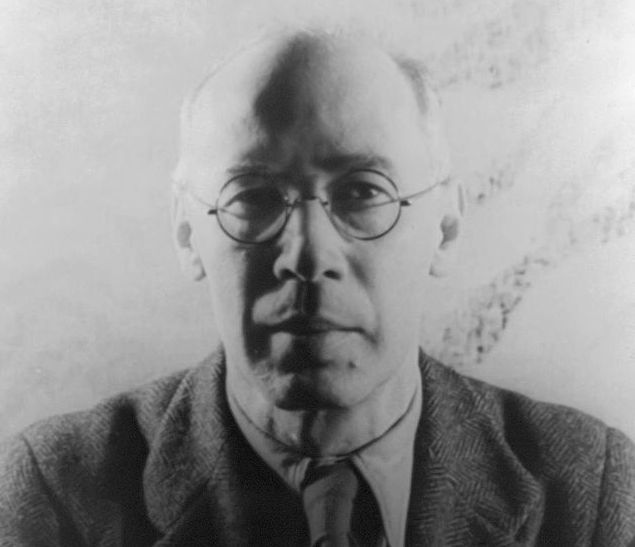
Image licensed under Public Domain via Wikimedia Commons
Take a survey of a hundred writers from the mid- to late-twentieth century about the books that influenced them most and you’re bound to find plenty of Henry Miller tucked in with the Victorians, the Russians, and the Beats. The Brooklyn-raised author of such notoriously banned novels as Tropic of Capricorn and Tropic of Cancer has long appealed to contemporary writers not only because of his frank explorations of sexuality and other taboo subjects but also because—like so many avant-garde and not so avant-garde writers after him—he had the audacity to present his own life and loves as literary material. Long before the memoir became the dominant force in American letters, with all of the attendant controversies about truth-telling in the form, Miller blended fact and fiction in ways that made it hard to tell where one ended and the other began.
Miller’s reputation for living his fiction—or fictionalizing his life—may have led many readers with only a passing familiarity with his books to regard him as a kind of shameless self-mythologizer. The characterization isn’t necessarily wrong, but it only captures part of the story. Like every serious writer, Miller was also a serious reader, and his work is as much informed by the books he loved as by the women he loved.
Miller freely acknowledged the literary relationships in his life, the authors who exerted influence on his work and whose styles and ideas he borrowed and made his own. He wrote an entire book on the subject, The Books in My Life, which Maria Popova at Brain Pickings describes as “a singular lens on his approach to reading.” In the book, Miller’s “central concern is a kind of anatomy of influence,” Popova writes, taking a phrase from literary critic Harold Bloom.
In his meditation on “his sources of creative spark,” Miller discusses at length his ideas about education, and its many failings. And in the book’s appendix—as if anticipating our current mania for lists—he makes a comprehensive record of “The 100 Books that Influenced Me Most.” See Miller’s complete list below, and read The Books in My Life free at the Open Library. A fair number of the books on Miller’s list can be found in our collection, 800 Free eBooks for iPad, Kindle & Other Devices.
1 Ancient Greek Dramatists
2 Arabian Nights (for children)
3 Elizabethan Playwrights (excepting Shakespeare)
4 European Playwrights of 19th Century
5 Greek Myths and Legends
6 Knights of King Arthur’s Court
7 Abèlard, Pierre, The Story of My Misfortunes
8 Alain-Fournier, The Wanderer
9 Andersen, Hans Christian, Fairy Tales
10 Anonymous, Diary of a Lost One
11 Balzac, Honoré de, Seraphita
12 Balzac, Honoré de, Louis Lambert
13 Bellamy, Edward, Looking Backward
14 Belloc, Hilaire, The Path to Rome
15 Blavatsky, Mme. H. P., The Secret Doctrine
16 Boccaccio, Giovanni, The Decameron
17 Breton, André, Nadja
18 Bronte, Emily, Wuthering Heights
19 Bulwyer-Lytton, Edward, Last Days of Pompeii
20 Carroll, Lewis, Alice in Wonderland
21 Céline, Louis-Ferdinand, Journey to the End of the Night
22 Cellini, Benvenuto, Autobiography
23 Cendrars, Blaise, Virtually the complete works
24 Chesterton, G.K., Saint Francis of Assisi
25 Conrad, Joseph, His works in general
26 Cooper James Fenimore, Leatherstocking Tales
27 Defoe, Daniel, Robinson Crusoe
28 De Nerval, Gérard, His works in general
29 Dostoievsky, Feodor, His works in general
30 Dreiser, Theodore, His works in general
31 Duhamel, Geoges, Salavin Series
32 Du Maurier, George, Trilby
33 Dumas, Alexander, The Three Musketeers
34 Eckermann, Johann, Conversations with Goethe
35 Eltzbacher, Paul, Anarchism
36 Emerson, Ralph Waldo, Representative Men
37 Fabre, Henri, His works in general
38 Faure, Elie, The History of Art
39 Fenollosa, Ernest, The Chinese Written Character as a Medium for Poetry
40 Gide, André, Dostoievski
41 Giono, Jean, Refus d’Obéissance
42 Giono, Jean, Que ma joie domeure
43 Giono, Jean, Jean le Bleu
44 Grimm Brothers, Fairy Tales
45 Gutkind, Erich, The Absolute Collective
46 Haggard, Rider, She
47 Hamsun, Knut, His works in general
48 Henty, G. A., His works in general
49 Hesse, Hermann, Siddhartha
50 Hudson, W. H., His works in general
51 Hugo, Victor, Les Misérables
52 Huysmans, Joris Karl, Against the Grain
53 Joyce, James, Ulysses
54 Keyserling, Hermann, South American Meditations
55 Kropotkin, Peter, Mutual Aid
56 Lao-tse, Tao Teh Ch’ing
57 Latzko, Andreas, Men in War
58 Long, Haniel, Interlinear to Cabeza de Vaca
59 M, Gospel of Ramakrishna
60 Machen, Arthur, The Hill of Dreams
61 Maeterlinck, Maurice, His works in general
62 Mann, Thomas, The Magic Mountain
63 Mencken, H. L., Prejudices
64 Nietzsche, His works in general
65 Nijinsky, Diary
66 Nordhoff & Hall, Pitcairn Island
67 Nostradamus, The Centuries
68 Peck, George Wilbur, Peck’s Bad Boy
69 Percival, W. O., William Blake’s Circle of Destiny
70 Petronius, The Satyricon
71 Plutarch, Lives
72 Powys, John Cowper, Visions and Revisions
73 Prescott, William H., Conquest of Mexico
74 Prescott, William H., Conquest of Peru
75 Proust, Marcel, Remembrance of Things Past
76 Rabelais, Gargantua and Pantagruel
77 Rimbaud, Jean-Arthur, His works in general
78 Rolland, Romain, Jean-Christophe
79 Rolland, Romain, Prophets of the New India
80 Rudhyar, Dane, Astrology of Personality
81 Saltus, Edgar, The Imperial Purple
82 Scott, Sir Walter, Ivanhoe
83 Sienkiewicz, Henry, Quo Vadis
84 Sikelianos, Anghelos, Proanakrousma
85 Sinnett, A. P., Esoteric Buddhism
86 Spencer, Herbert, Autobiography
87 Spengler, Oswald, The Decline of the West
88 Strindberg, August, The Inferno
89 Suarès, Carlo, Krishnamurti
90 Suzuki, Daisetz Teitaro, Zen Buddhism
91 Swift, Jonathan, Guilliver’s Travels
92 Tennyson, Alfred, Idylls of the King
93 Thoreau, Henry David, Civil Disobedience & Other Essays
94 Twain, Mark, Adventures of Huckleberry Finn
95 Van Gogh, Vincent, Letters to Theo
96 Wassermann, Jacob, The Maurizius Case (Trilogy)
97 Weigall, Arthur, Akhnaton
98 Welch, Galbraith, The Unveiling of Timbuctoo
99 Werfel, Franz, Star of the Unborn
100 Whitman, Walt, Leaves of Grass
If you would like to support the mission of Open Culture, consider making a donation to our site. It’s hard to rely 100% on ads, and your contributions will help us continue providing the best free cultural and educational materials to learners everywhere. You can contribute through PayPal, Patreon, and Venmo (@openculture). Thanks!
Related Content:
Leo Tolstoy Creates a List of the 50+ Books That Influenced Him Most (1891)
28 Important Philosophers List the Books That Influenced Them Most During Their College Days
Stephen King Creates a List of 96 Books for Aspiring Writers to Read
Josh Jones is a writer and musician based in Durham, NC. Follow him at @jdmagness
Read More...Support Us
We're hoping to rely on loyal readers, rather than erratic ads. Please click the Donate button and support Open Culture. You can use Paypal, Venmo, Patreon, even Crypto! We thank you!

About Us

Open Culture scours the web for the best educational media. We find the free courses and audio books you need, the language lessons & educational videos you want, and plenty of enlightenment in between.
Advertise With Us
FREE UPDATES!
GET OUR DAILY EMAIL
Get the best cultural and educational resources on the web curated for you in a daily email. We never spam. Unsubscribe at any time.
FOLLOW ON SOCIAL MEDIA
Open Culture editor Dan Colman scours the web for the best educational media. He finds the free courses and audio books you need, the language lessons & movies you want, and plenty of enlightenment in between.
Advertise With Us

