David Chase Reveals the Philosophical Meaning of The Soprano’s Final Scene
Eight years after it aired, the final scene of the final episode of The Sopranos still has people guessing: What happened when the screen suddenly went black? Did Tony Soprano get whacked? Or did he live to see another quasi-ordinary day? Could he really die as Journey sings, “Don’t Stop Believing?”
In a new interview appearing on The Directors Guild of America web site, David Chase, creator of The Sopranos, revisits the making of the final scene. Chase doesn’t directly answer the questions about Tony’s fate. But he does give us some insight into the deeper philosophical questions raised in the scene (watch it above) and how much they’re bound up in the lyrics of Journey’s soundtrack. There’s some deeper meaning in the small town girl and the city boy taking “the midnight train goin’ anywhere”:
I love the timing of the lyric when Carmela enters: ‘Just a small town girl livin’ in a lonely world, she took the midnight train goin’ anywhere.’ Then it talks about Tony: ‘Just a city boy,’ and we had to dim down the music so you didn’t hear the line, ‘born and raised in South Detroit.’ The music cuts out a little bit there, and they’re speaking over it. ‘He took the midnight train goin’ anywhere.’ And that to me was [everything]. I felt that those two characters had taken the midnight train a long time ago. That is their life. It means that these people are looking for something inevitable. Something they couldn’t find. I mean, they didn’t become missionaries in Africa or go to college together or do anything like that. They took the midnight train going anywhere. And the midnight train, you know, is the dark train.
And there’s meaning packed in the idea of “Strangers waiting up and down the boulevard.”
Cutting to Meadow parking was my way of building up the tension and building up the suspense, but more than that I wanted to demonstrate the lyrics of the song, which is streetlights, people walking up and down the boulevard, because that’s what the song is saying. ‘Strangers waiting.’ I wanted you to remember that is out there. That there are streetlights and people out there and strangers moving up and down. It’s the stream of life, but not only that, it’s the stream of life at night. There’s that picture called History Is Made at Night [from 1937]. I love that title. And that kind of echoes in my head all the time.
But if you’re looking for the philosophical essence of the scene, then look no further than the mantra, “Don’t stop believin.’ ” That’s what it’s all about:
I thought the ending would be somewhat jarring, sure. But not to the extent it was, and not a subject of such discussion. I really had no idea about that. I never considered the black a shot. I just thought what we see is black. The ceiling I was going for at that point, the biggest feeling I was going for, honestly, was don’t stop believing. It was very simple and much more on the nose than people think. That’s what I wanted people to believe. That life ends and death comes, but don’t stop believing. There are attachments we make in life, even though it’s all going to come to an end, that are worth so much, and we’re so lucky to have been able to experience them. Life is short. Either it ends here for Tony or some other time. But in spite of that, it’s really worth it. So don’t stop believing.
Read Chase’s complete account of the famous final scene here.
Thanks to Ted Mills for flagging this. Follow him at @TedMills.
Follow us on Facebook, Twitter, Google Plus and LinkedIn and share intelligent media with your friends. Or better yet, sign up for our daily email and get a daily dose of Open Culture in your inbox.
Read More...The Talking Heads’ First TV Appearance Was on American Bandstand, and It Was a Little Awkward (1979)
“I guess he’s…organically shy.”–Tina Weymouth
As Talking Heads went from CBGBs (see some vintage video) to college radio to a European tour opening for The Ramones in 1977, the band was slowly making its way out of New York City poverty while their art school rock was seeping into American culture at large. When “Take Me To the River,” their airy, nervous but still funky Eno-produced cover of the Al Green song became their first Billboard Top 30 hit, the band took a step towards national recognition.
And that leads us to this awkward March 17, 1979 appearance of the band on ABC’s American Bandstand, their first on American TV. Longtime host Dick Clark was pretty square–rock critic Nik Cohn described him as “a disc jockey who looked like an all-American choirboy”–but American Bandstand was a prime opportunity. In 1979, the New Wave and Post-Punk scenes were raging at the show’s doors. Talking Heads were one of the few acts that year from NYC’s creative cauldron of a music scene, apart from Blondie and Grace Jones, to make it onto Bandstand.
In the above clip, Clark apologizes for getting Tina Weymouth’s name wrong, then jumps in to interview David Byrne, who responds to Clark’s questions by shutting them down with embarrassed looks and matter-of-fact answers. Clark then turns back to Tina for some psychoanalytic help. “Is he always this enthusiastic?” he asks. It crumbles from there.
Weymouth remembered it slightly differently in this recent (2014) interview in New York Magazine:
I couldn’t explain to the record-label people why David’s behavior could be so incredibly odd. He had a freak-out on our first television appearance, on Dick Clark, on American Bandstand. David sort of froze, and Dick Clark sort of whirled around, and hands the microphone to me. And there were other things going on, too. I don’t think any person is one thing, or defined by a condition that they might have.
It’s not exactly freezing, but it is odd…for rock frontmen. And asking Byrne “Do you flog yourself into this?” tells you a bit more about Clark’s state of mind than anything else.
You can see the mimed performance of their hit here:
The other song they performed on the broadcast “Thank You for Sending Me an Angel” has not popped up on YouTube…yet.
Parting note: The other guest that night on Bandstand was twee, blue-eyed disco act Brooklyn Dreams with their single Make It Last.
Related content:
Hear the Earliest Known Talking Heads Recordings (1975)
Talking Heads Live in Rome, 1980: The Concert Film You Haven’t Seen
Jim Jarmusch’s Anti-MTV Music Videos for Talking Heads, Neil Young, Tom Waits & Big Audio Dynamite
The Talking Heads Play CBGB, the New York Club that Shaped Their Sound (1975)
Ted Mills is a freelance writer on the arts who currently hosts the FunkZone Podcast. You can also follow him on Twitter at @tedmills and/or watch his films here.
Read More...The Psychology of Blame: Another Animated Lesson That Can Make You a Better Person
The last time we checked in with Dr. Brené Brown, a research professor at the University of Houston Graduate College of Social Work, we learned all about the difference between sympathy and empathy, and why empathy is much more meaningful in the end. Now, in a sequel to that first video, we discover an important barrier to empathy — blame. Can you relate? Both videos come from RSA (the Royal Society of the Arts), the same cultural organization that brought us those whiteboard animations illustrating lectures by Slavoj Zizek, Steven Pinker, Barbara Ehrenreich, and others. You can watch Brown’s complete (unanimated) lecture here.
Follow us on Facebook, Twitter, Google Plus and LinkedIn and share intelligent media with your friends. Or better yet, sign up for our daily email and get a daily dose of Open Culture in your inbox.
Related Content:
Free Online Psychology Courses (Part of our list of 1100 Free Online Courses)
Jacques Lacan’s Confrontation with a Young Rebel: Classic Moment, 1972
New Animation Explains Sherry Turkle’s Theories on Why Social Media Makes Us Lonely
Read More...What Happens When a Cheap Ikea Print Gets Presented as Fine Art in a Museum
The entity to whom Dutch group, Lifehunters, attributes the museum quality artwork in the video prank above doesn’t exist. The “famous” Swedish artist’s handle –IKE Andrews –is but a puckish reference to IKEA, the purveyor of the 10€ print (oh snap, it’s not even an original!) various unnamed “art experts” are asked to evaluate, having been led to believe it’s something rare and wonderful. IKE Andrews’ fellow fictional entity, Borat, would be gratified by how readily these experts accept presenter Boris Lange’s suggestions as to the value of this work.
So how bad is this “painting”? Walter Keane bad? Margaret Keane bad? Is it a Velvis? A sad clown? The sort of crummy landscape artist Wayne White might snap up in a thrift store?
Only if you think IKEA achieved global dominance by choosing designs, patterns, and images in order for snotty hipsters to buy them ironically…
As several YouTube, Twitter, and blog commenters have mentioned, the print itself is pretty cool.
It’s a media frenzy, but interestingly, the artist is not coming forward to herald his or her role in the hoax.
Make that artists. Turns out IKE Andrews is a pair of Swiss street artists, Christian Rebecchi and Pablo Togni, who collaborate as NEVERCREW.
They have a fascination with cross sections. As their website somewhat murkily explains [all sic]:
These models, as such, from time to time actually contain more or less extensive realities, represented as autonomous systems of which the reality of the viewer becomes a part. This then the rapport becomes the very subject, mainly highlighted as the relationship between man and nature (between human being and its nature), but automatically extended to a vision of total and inevitable relationship between everything, between every part, where it is only the point of view, the position within a system, to define a selection.
IKEA streamlines the artists’ philosophy for the masses thusly:
We call the theme “living structures” and we like to see them as models of living systems. We would like our art to generate interest and curiosity, and the viewer to become a part of the mechanism with his or her thoughts, perspective and emotions.
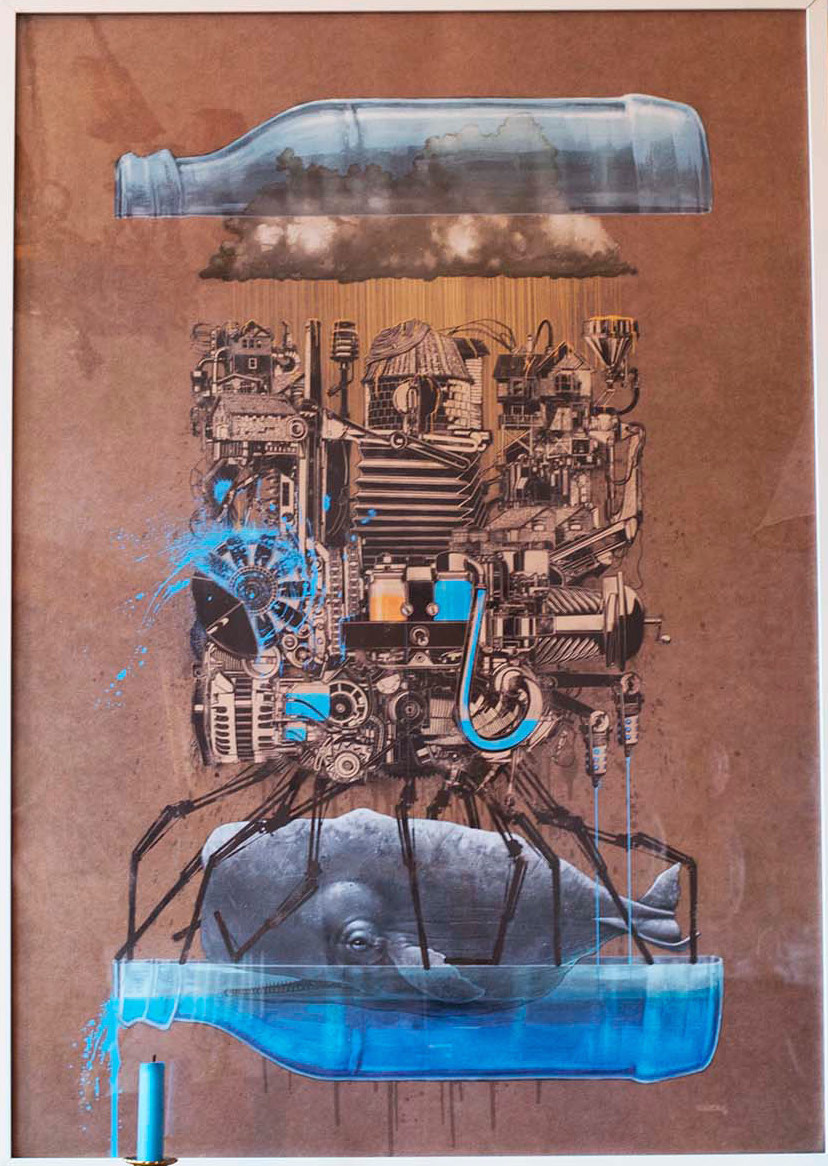
Philosophy’s all well and good, but what’s it actually look like, this “Message in a Bottle”?
Well, it seems to me to be a bottle, implausibly halved lengthwise to reveal a bunch of steampunk stuff balanced atop robot spider legs, forming a cage around an ancient-looking whale. Also, a cloud raining yellow liquid, or possibly light. (Hopefully the latter). Oh! And it appears to have been painted on a brown paper bag.
I can think of plenty of people who’d not only like it, but find meaning in it, as the experts do. The only difference is the experts do so on camera, a fact not all of them are willing to laugh at, when host Lange informs them they’ve been punked.
The artists aren’t the only ones playing it cool. The internet may be exploding, but so far, neither IKEA, nor the Netherlands’ Arnhem Museum, where the prank was staged, have made mention of this business.
via Hyperallergic
Related Content:
F for Fake: Orson Welles’ Short Film & Trailer That Was Never Released in America
The Great Dr. Fox Lecture: A Vintage Academic Hoax (1970)
Ayun Halliday is an author, illustrator, and mother of a teen filmmaker whose best known work was shot guerrilla style in a Red Hook, Brooklyn Ikea. Follow her @AyunHalliday
Read More...Take a “Breath” and Watch Samuel Beckett’s One-Minute Play
As Samuel Beckett’s writing progressed through the ’60s, it became even more minimal, despairing, and bleak. It was as if he was paring away as much as he could to see if theater was left standing. If a painting could be one color like Ad Reinhardt, what would be the Reinhardt of theater? Jonathan Crow mentioned yesterday how Beckett’s 1969 play Breath, for instance, “runs just a minute long and features just the sound of breathing.” There is a bit more to it than that. Not a lot more, but yes, more. Here’s the play’s script in full:
Curtain.
1. Faint light on stage littered with miscellaneous rubbish. Hold for about five seconds.
2. Faint brief cry and immediately inspiration and slow increase of light together reaching maximum together in about ten seconds. Silence and hold about five seconds.
3. Expiration and slow decrease of light together reaching minimum together (light as in I) in about ten seconds and immediately cry as before. Silence and hold for about five seconds.
Beckett adds some notes:
Rubbish. No verticals, all scattered and lying.
Cry. Instant of recorded vagitus. Important that two cries be identical, switching on and off strictly synchronized light and breath.
Breath. Amplified recording.
Maximum light. Not bright. If 0 = dark and 10 = bright, light should move from about 3 to 6 and back.
The play came about when one of the most important English theater critics of his time Kenneth Tynan asked for short skits for an erotic revue he was putting on in 1969, called Oh! Calcutta. Others invitees included Jules Feiffer, John Lennon, Edna O’Brien, Jacques Levy, Sam Shepard, and Leonard Melfi. The plan was to perform each skit but keep each writer’s name a secret. Beckett reportedly wrote the play on a postcard and sent it to Tynan, then became enraged when he heard that instead of rubbish on stage, Tynan had used naked bodies *and* in fact had explicitly credited Beckett in the program. Breath wouldn’t get a proper staging until 1999 in London’s West End, as part of an evening with Beckett’s more substantial Krapp’s Last Tape. You can read reports of how the audience reacted.
Several directors have brought Breath to life. Artist Damien Hirst had a go for the 2002 Beckett on Film project. As seen above, his version has very spectacular rubbish gathered from a hospital and, glimpsed in the final seconds, a cigarette butt swastika.
Below, check out a more “traditional” interpretation of the play from the National Theatre School of Canada’s Tech Production class. After that comes a repeat of Hirst’s version, and then one more alternative, Darren Smyth’s 2009 TV static-filled attempt. (The rest of the video is a mixed bag of the Alan Parsons Project and a Tim Burton short, don’t ask why.)
Despite Beckett’s morose reputation, there’s always a black humor underneath it all. And if you’re going to ask the man to write an “erotic skit,” this is what you get, the futility of life from womb to tomb in a minute.
Finally, you can watch an informative mini lecture on the play, presented by Dr. Catherine Brown for the New College of the Humanities.
Related Content:
Watch the Opening Credits of an Imaginary 70s Cop Show Starring Samuel Beckett
Samuel Beckett Directs His Absurdist Play Waiting for Godot (1985)
Monsterpiece Theater Presents Waiting for Elmo, Calls BS on Samuel Beckett
Ted Mills is a freelance writer on the arts who currently hosts the FunkZone Podcast. You can also follow him on Twitter at @tedmills and/or watch his films here.
Read More...Take the 146-Question Knowledge Test Thomas Edison Gave to Prospective Employees (1921)
I remember opening my college newspaper one day, and out of it fell what looked like an advertising supplement of unusually utilitarian design. Upon closer inspection, it contained a series of math‑y looking problems for the reader to work out and, if they did so, mail in to an address provided. Word soon began to circulate that this unusual leaflet came from no less an institution than Google itself, already well known as a provider of advanced search services but not quite yet as a benevolent provider of dream jobs (an image now satirized in movies like The Internship).
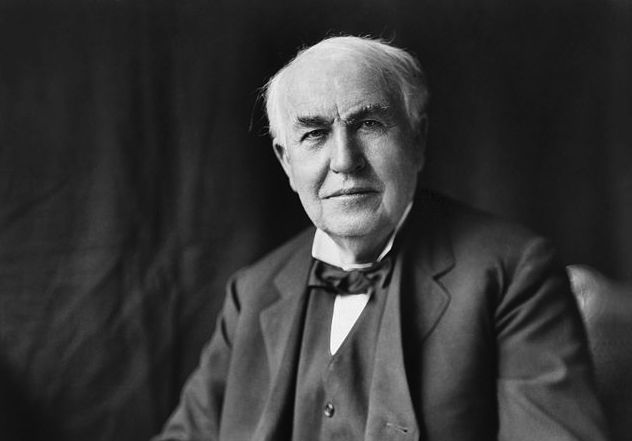
The unusual hiring practices of giant, innovative American technology companies have become the stuff of modern myth, but the usage of seemingly job-unrelated intellectual tests as a filter for potential employees has a much longer history. Thomas Edison, that original giant of American technological innovation, put forward the first famous example: a 146-question test on subjects of general knowledge from geography to history to physics to the price of gold.
“Americans obsessed over the test following [the] publication of many questions in the May 11, 1921 New York Times,” writes Paleofuture’s Matt Novak. “From there the test was debated, copied, and parodied in newspapers and magazines around the country.” If you’d like to get a sense of how you’d have fared in the scramble for a sweet Edison job, set your mind back to the early 1920s and tackle these questions as best you can:
1. What countries bound France?
2. What city and country produce the finest china?
3. Where is the River Volga?
4. What is the finest cotton grown?
5. What country consumed the most tea before the war?
6. What city in the United States leads in making laundry machines?
7. What city is the fur centre of the United States?
8. What country is the greatest textile producer?
9. Is Australia greater than Greenland in area?
10. Where is Copenhagen?
11. Where is Spitzbergen?
12. In what country other than Australia are kangaroos found?
13. What telescope is the largest in the world?
14. Who was Bessemer and what did he do?
15. How many states in the Union?
16. Where do we get prunes from?
17. Who was Paul Revere?
18. Who was John Hancock?
19. Who was Plutarch?
20. Who was Hannibal?
21. Who was Danton?
22. Who was Solon?
23. Who was Francis Marion?
24. Who was Leonidas?
25. Where did we get Louisiana from?
26. Who was Pizarro?
27. Who was Bolivar?
28. What war material did Chile export to the Allies during the war?
29. Where does most of the coffee come from?
30. Where is Korea?
31. Where is Manchuria?
32. Where was Napoleon born?
33. What is the highest rise of tide on the North American Coast?
34. Who invented logarithms?
35. Who was the Emperor of Mexico when Cortez landed?
36. Where is the Imperial Valley and what is it noted for?
37. What and where is the Sargasso Sea?
38. What is the greatest known depth of the ocean?
39. What is the name of a large inland body of water that has no outlet?
40. What is the capital of Pennsylvania?
41. What state is the largest? Next?
42. Rhode Island is the smallest state. What is the next and the next?
43. How far is it from New York to Buffalo?
44. How far is it from New York to San Francisco?
45. How far is it from New York to Liverpool?
46. Of what state is Helena the capital?
47. Of what state is Tallahassee the capital?
48. What state has the largest copper mines?
49. What state has the largest amethyst mines?
50. What is the name of a famous violin maker?
51. Who invented the modern paper-making machine?
52. Who invented the typesetting machine?
53. Who invented printing?
54. How is leather tanned?
55. What is artificial silk made from?
56. What is a caisson?
57. What is shellac?
58. What is celluloid made from?
59. What causes the tides?
60. To what is the change of the seasons due?
61. What is coke?
62. From what part of the North Atlantic do we get codfish?
63. Who reached the South Pole?
64. What is a monsoon?
65. Where is the Magdalena Bay?
66. From where do we import figs?
67. From where do we get dates?
68. Where do we get our domestic sardines?
69. What is the longest railroad in the world?
70. Where is Kenosha?
71. What is the speed of sound?
72. What is the speed of light?
73. Who was Cleopatra and how did she die?
74. Where are condors found?
75, Who discovered the law of gravitation?
76. What is the distance between the earth and sun?
77. Who invented photography?
78. What country produces the most wool?
79. What is felt?
80. What cereal is used in all parts of the world?
81. What states produce phosphates?
82. Why is cast iron called pig iron?
83. Name three principal acids?
84. Name three powerful poisons.
85. Who discovered radium?
86. Who discovered the X‑ray?
87. Name three principal alkalis.
88. What part of Germany do toys come from?
89. What States bound West Virginia?
90. Where do we get peanuts from?
91. What is the capital of Alabama?
92. Who composed “Il Trovatore”?
93. What is the weight of air in a room 20 by 30 by 10?
94. Where is platinum found?
95. With what metal is platinum associated when found?
96. How is sulphuric acid made?
97. Where do we get sulphur from?
98. Who discovered how to vulcanize rubber?
99. Where do we import rubber from?
100. What is vulcanite and how is it made?
101. Who invented the cotton gin?
102. What is the price of 12 grains of gold?
103. What is the difference between anthracite and bituminous coal?
104. Where do we get benzol from?
105. Of what is glass made?
106. How is window glass made?
107. What is porcelain?
108. What country makes the best optical lenses and what city?
109. What kind of a machine is used to cut the facets of diamonds?
110. What is a foot pound?
111. Where do we get borax from?
112. Where is the Assuan Dam?
113. What star is it that has been recently measured and found to be of enormous size?
114. What large river in the United States flows from south to north?
115. What are the Straits of Messina?
116. What is the highest mountain in the world?
117. Where do we import cork from?
118. Where is the St. Gothard tunnel?
119. What is the Taj Mahal?
120. Where is Labrador?
121. Who wrote “The Star-Spangled Banner”?
122. Who wrote “Home, Sweet Home”?
123. Who was Martin Luther?
124. What is the chief acid in vinegar?
125. Who wrote “Don Quixote”?
126. Who wrote “Les Miserables”?
127. What place is the greatest distance below sea level?
128. What are axe handles made of?
129. Who made “The Thinker”?
130. Why is a Fahrenheit thermometer called Fahrenheit?
131. Who owned and ran the New York Herald for a long time?
132. What is copra?
133. What insect carries malaria?
134. Who discovered the Pacific Ocean?
135. What country has the largest output of nickel in the world?
136. What ingredients are in the best white paint?
137. What is glucose and how made?
138. In what part of the world does it never rain?
139. What was the approximate population of England, France, Germany and Russia before the war?
140. Where is the city of Mecca?
141. Where do we get quicksilver from?
142. Of what are violin strings made?
143. What city on the Atlantic seaboard is the greatest pottery centre?
144. Who is called the “father of railroads” in the United States?
145. What is the heaviest kind of wood?
146. What is the lightest wood?
Some of these questions, like those on the location of Copenhagen or the identity of Leonidas (you need think back only to 300), have grown easier with time. Some — “What is coke?” “What is vulcanite and how is it made?” — have grown harder. Others will require you to call upon not current knowledge, but period knowledge: sure, you know the number of states in the union now, but how about in 1921? And sure, you know which city is the fur center of the United States now, but how about in 1921?
Once you’ve made your guesses, you can check your answers over at Paleofuture. Edison’s test will almost certainly frustrate you — and if it doesn’t, you may have a career waiting not at Google, but on Jeopardy! — and it may even fill you with gratitude that we live in an age where hot employers check for raw brainpower, not the ability to memorize a seemingly random assortment of facts. But the test itself, like several of its questions, pulls a bit of a trick. The tremendous amount of attention it received when the public caught a glimpse of it reveals Edison’s mastery of the highest American force: publicity.
Note: Thanks to one of our readers, you can see how Edison defended the test in the pages of The New York Times.
via Paleofuture
Related Content:
Thomas Edison & His Trusty Kinetoscope Create the First Movie Filmed In The US (c. 1889)
Take The Near Impossible Literacy Test Louisiana Used to Suppress the Black Vote (1964)
Colin Marshall hosts and produces Notebook on Cities and Culture as well as the video series The City in Cinema and writes essays on cities, language, Asia, and men’s style. He’s at work on a book about Los Angeles, A Los Angeles Primer. Follow him on Twitter at @colinmarshall or on Facebook.
Read More...Watch Charles Burns’ Illustrations Come to Life in the Animated French Horror Film, Fear of the Dark
Since Charles Burns’ ‘70s-set sex-horror graphic novel Black Hole won a Harvey, Eisner, and an Ignatz Award in 2006, Hollywood has been toying with bringing the cartoonist’s dark visions to the screen. David Fincher was rumored to be developing Black Hole, until he picked up a copy of The Girl with the Dragon Tattoo instead.
But why wait to see Burns turned into a live-action film when the comic artist himself wrote and directed a segment for an animated French horror anthology called Peur(s) du noir/Fear(s) of the Dark in 2007.
The film never received American distribution, which is a shame, because this CG-animation brings Burns’ beautiful black and white brushwork to life, with a story of a college romance gone horribly, obsessively wrong. It’s close in subject matter to the “bug” at the center of Black Hole, but (maybe it’s the French dialog) with a nouvelle vague twist. There are creepy insects aplenty, too.
The film also contains animated horror tales directed by other cartoonists who might not be as familiar to American audiences: Blutch, Marie Caillou, Pierre di Sciullo, Lorenzo Mattotti, and Richard McGuire. Having seen the whole film, despite being hit-and-miss like all anthology features, it makes one wish there was more opportunities for comic artists to venture into film without having to compromise for live action, or exhaust an idea for a big budget.
In the meantime, the future of a live action Black Hole is up in the air. According a year-old posting on ScreenRant, Fincher was out and Rupert Sanders was in. But that was before he signed on to direct a live action version of the manga Ghost in the Shell (with ScarJo!). However, he did have the idea to make an 11-minute short film teaser just in case.
Related Content
The Confessions of Robert Crumb: A Portrait Scripted by the Underground Comics Legend Himself (1987)
Cartoonist Lynda Barry Shows You How to Draw Batman in Her UW-Madison Course, “Making Comics”
Ted Mills is a freelance writer on the arts who currently hosts the FunkZone Podcast. You can also follow him on Twitter at @tedmills and/or watch his films here.
Read More...Devo’s Mark Mothersbaugh & Other Arists Tell Their Musical Stories in the Animated Video Series, “California Inspires Me”
I’ve lived all of my life in various cities on the East Coast, north and south. Various cultural and geographic features of the mid-Atlantic have shaped me in ways I’m probably only partially aware of. But this past summer I spent more time on the West Coast—L.A. to be precise—than I ever have before, and I found it completely refreshing. Of course, mass commerce being what it is, no matter where you go in the U.S., you run smack into a Target, usually flanked by strips of other tediously familiar chains. But instead of the towering pines of my current locale, I gazed up at languid palm fronds, and instead of the typical East Coast swelter, I relished the arid heat and the faint ocean tang in the air. A change in climate changes one’s perceptions of the world, and that’s not even to mention my—admittedly superficial—tourist’s appreciation of myriad architectural, culinary, and other SoCal eccentricities.
On returning and settling back into the grind, I still felt the pull westward, toward L.A.’s weirdness. This is unsurprising—it’s a city, and a state, that have always symbolized escapism, as well as disappointment, whether that of the Joads, Norma Desmond, or countless real anonymous hopefuls. The story of moving west in pursuit of some American Dream is as old as Lewis and Clark and as new as Devo, one of whose founding members, native Californian Mark Mothersbaugh, narrates above his journey to Hollywood with his bandmates after college at Kent State (at the top of the post). He begins with some formative childhood experiences—getting his first pair of glasses in 2nd grade (Mothersbaugh is legally blind), seeing the Beatles on Ed Sullivan. He then tells, in brief, the story of Devo vs. the record company, or how a quirky art-rock band co-opted Madison Avenue strategies to “tell the good news of de-evolution,” only to themselves become a commodity after scoring a hit with “Whip It.”
The video is part of a series called “California Inspires Me,” a collaboration between Google Play and California Sunday magazine. Beneath Mothersbaugh’s animated story, see one from filmmaker and artist Mike Mills, who talks about skateboarding and punk rock in his L.A. youth. In the video above, singer/songwriter Thao Nguyen shares her “really deep appreciation for the history of San Francisco in music.” And below, Jack Black relates his experiences growing up in the “deep, deep South” of Southern California, specifically Hermosa Beach, with its surf culture, and “free-wheeling hippie love.” If there’s one thing that ties all four videos together—besides the music by Shannon Ferguson—it’s the mellow personalities of the four Californian artists. Watching the series from my currently blustery winter climate gave me the East Coast jitters, firing up that urge again to hit the dusty trail and revisit, or maybe relocate to the Sunshine State.
Related Content:
Watch Huell Howser’s Decades of Television Travels Online. It’s California Gold!
The Mastermind of Devo, Mark Mothersbaugh, Shows Off His Synthesizer Collection
Josh Jones is a writer and musician based in Durham, NC. Follow him at @jdmagness
Read More...Errol Morris Celebrates The Madness of Sports with Six New Mini-Docs: Watch Them Free Online
In honor of Errol Morris’ 67th birthday, which just passed on February 9, Grantland.com is celebrating with a full week of new documentaries shot for ESPN by the filmmaker. Frequently named one of the most important documentary filmmakers of our times, he rose to fame with 1978’s pet cemetery doc Gates of Heaven, then cemented it with The Thin Blue Line, which helped save a man from the electric chair. (It also started his long collaboration with composer Philip Glass.) Morris has been a private investigator, a journalist, and a maker of commercials, all of which provide the mental fuel (and funding) for his filmmaking. He invented the “Interrotron” a variation on the teleprompter, which allowed his subjects to talk straight into the camera while he interviewed them. It added an unsettling jolt to his two conversations with the men voted most likely to be war criminals, Robert McNamara and Donald Rumsfeld. But as Morris says in a Grantland interview, he is not here to accuse or prosecute.
When I was interviewing killers years ago, I enjoyed talking to them. I enjoyed being with them. I wasn’t there to moralize with them or temporize with them, I was there to talk to them. And I think that’s still true. Rumsfeld pushed it, I have to say.
It’s been two years since his last film, the Rumsfeld interview The Unknown Known, and, while we wait for his next feature and possibly a third book, Morris has given us six short docs that range between 10 and 20 minutes. The Subterranean Stadium (at the top of this post) delves into the sub-culture of tabletop electronic football games that have been around since the 1940s, and the grown-ups who still play them.
The Heist examines, with diagrams and suspenseful music, the four college students who stole Michael Jordan’s jersey from the vaulted heights of a stadium.
The Streaker profiles Mark Roberts, the affable Liverpudlian who has streaked at “every major sporting event in the world.”
There are three more videos waiting to be doled out. (Find them here.) One is on A.J. Mass, a writer for ESPN; another about sports collectibles; and the other about horse racing. The constant theme is the particular madness of sports fans, obsession being a major theme of Morris’ work.
The other link in all these films is the sound of Morris, who chooses not to edit out his offscreen voice. It’s the sound of a man clearly having a good time. However:
“I’m sick of interviewing,” he says. “I am really sick of it. I’m not gonna say I do it better than anybody else, but I do it differently than anybody else. I am good at it, for whatever reason. There are a lot of different reasons, but if that’s all I’m going to do for the rest of my life is stick a camera in front of people and say to them, “I don’t have a first question, what’s your first answer?” I think I would be very sad.”
So let’s celebrate Morris before he changes his mind.
This new series of short films will be added to our meta collection, 285 Free Documentaries Online. Find more films in our collection of 700 Free Movies Online.
Related content:
30 Errol Morris Movies That Can Be Streamed Online
Werner Herzog Loses a Bet to Errol Morris, and Eats His Shoe
“They Were There” — Errol Morris Finally Directs a Film for IBM
Ted Mills is a freelance writer on the arts who currently hosts the FunkZone Podcast. You can also follow him on Twitter at @tedmills and/or watch his films here.
Read More...Two Short Films on Coffee and Cigarettes from Jim Jarmusch & Paul Thomas Anderson
When American society relinquished cigarettes, American cinema lost one of its most dramatic visual devices. You still see smoking in the movies, but its meaning has changed. “A cigarette wasn’t always a statement,” wrote David Sedaris when he himself kicked the habit. “Back when I started, you could still smoke at work, even if you worked in a hospital where kids with no legs were hooked up to machines. If a character smoked on a TV show, it did not necessarily mean that he was weak or evil. It was like seeing someone who wore a striped tie or parted his hair on the left — a detail, but not a telling one.”
These two short films show American auteurs keeping the cinematic centrality of the cigarette alive well after its heyday had ended. At the top of the post, you can watch Jim Jarmusch’s 1986 short Coffee and Cigarettes, which stars Steven Wright and Roberto Benigni sitting down for and talking about those very same consumables. It began a long-term project that culminated in Jarmusch’s 2003 feature of the same name, which comprises eleven such coffee- and cigarette-centric short films (one of them featuring Iggy Pop and Tom Waits, another featuring Bill Mur) shot over those eighteen years.
While one might naturally have met a friend specifically to enjoy caffeine and nicotine in the mid-1980s, a decade later the situation had changed: only in America’s seedier corners could you even find a coffee-serving establishment to smoke in. Paul Thomas Anderson used this very setting to begin his career with Cigarettes and Coffee below. Eschewing film school, he gathered up his college fund, some gambling winnings, his girlfriend’s credit card, and various other bits and pieces of funding in order to commit this short story to film.
It worked: Cigarettes and Coffee scored Anderson an invitation to the Sundance Filmmakers Lab, a setting that allowed him to adapt the short into his feature debut Hard Eight. Like Cigarettes and Coffee, Hard Eight stars Philip Baker Hall, a favorite actor of Anderson’s that he went on to use in both Boogie Nights and Magnolia. Thematically, this tale of a group of low-living but in their own ways hard-striving characters all connected by a $20 bill presages the themes that, in his pictures of higher and higher profile, he continues to work with today.
And can it be an accident that Anderson has, in the main, set his films in past eras that not only accepted smoking, but expected it? Jarmusch, for his part, seems to prefer milieus at increasing distance from our everyday experience, amid urban samurai, assassins in foreign lands, immortal vampires in Detroit, that sort of thing. So if these filmmakers want to keep using smoking, they have ways. I just hope coffee doesn’t fall out of style. That would bring about a world that, as a filmgoer and a human being, I doubt I’d be prepared to live in.
Related Content:
John Cleese Stars in a Morbidly Funny Anti-Smoking Campaign (1992–1994)
An Anti, Anti-Smoking Announcement from John Waters
Bertrand Russell: “I Owe My Life to Smoking”
Colin Marshall hosts and produces Notebook on Cities and Culture as well as the video series The City in Cinema and writes essays on cities, language, Asia, and men’s style. He’s at work on a book about Los Angeles, A Los Angeles Primer. Follow him on Twitter at @colinmarshall or on Facebook.
Read More...Support Us
We're hoping to rely on loyal readers, rather than erratic ads. Please click the Donate button and support Open Culture. You can use Paypal, Venmo, Patreon, even Crypto! We thank you!

About Us

Open Culture scours the web for the best educational media. We find the free courses and audio books you need, the language lessons & educational videos you want, and plenty of enlightenment in between.
Advertise With Us
FREE UPDATES!
GET OUR DAILY EMAIL
Get the best cultural and educational resources on the web curated for you in a daily email. We never spam. Unsubscribe at any time.
FOLLOW ON SOCIAL MEDIA
Open Culture editor Dan Colman scours the web for the best educational media. He finds the free courses and audio books you need, the language lessons & movies you want, and plenty of enlightenment in between.
Advertise With Us


