David Carr Gives 10 Pieces of Work & Life Advice to UC Berkeley Graduates
David Carr took seven years to get through college. He didn’t have a Master’s degree or a PhD. Before he made it big writing for The New York Times, he spent time in rehab and on welfare. David Carr didn’t fit the profile of your average commencement speaker.
And yet Carr, who died in the Times newsroom on Thursday night, earned his spot speaking before the 2014 graduating class at UC Berkeley’s Graduate School of Journalism. Known for his insightful reporting on changes in publishing, television and social media, Carr understood the world these young journalists were entering. And when he offered 10 pieces of graduation advice, you know the students took note. You should too:
1.) Someone who is underestimated will be the one who changes the world. It’s not the person everyone expects. It might be you.
2.) “Do what is front of you.” Focus on the small steps ahead of you.
3.) Don’t worry about achieving a master plan, about the plot to take over the world.
4.) Be a worker among workers. It’s more important that you fit in before you stick out.
5.) Follow the “Mom Rule.” Don’t do anything you couldn’t explain or justify to your mom.
6.) Don’t just do what you’re good at. Get outside of your comfort zone. Being a journalist is permission for lifetime learning.
7.) Be present. Don’t worry about documenting the moment with your smartphone. Experience it yourself.
8.) Take responsibility for the good and the bad. Learn to own your failures.
9.) Be honest, and be willing to have the difficult conversation.
10.) Don’t be afraid to be ambitious. It’s not a crime.
He says it’s a listicle that won’t appear on Buzzfeed. But it fits perfectly on OC. David, we’re so sorry to see you go.
If you would like to support the mission of Open Culture, consider making a donation to our site. It’s hard to rely 100% on ads, and your contributions will help us continue providing the best free cultural and educational materials to learners everywhere. You can contribute through PayPal, Patreon, and Venmo (@openculture). Thanks!
Related Content:
Michael Pollan Presents an Edible Education, A Free Online Course From UC Berkeley
“Wear Sunscreen”: The Story Behind the Commencement Speech That Kurt Vonnegut Never Gave
David Foster Wallace’s 2005 Commencement Speech “This is Water” Visualized in Short Film
NPR Launches Database of Best Commencement Speeches Ever
Read More...
William Faulkner Outlines on His Office Wall the Plot of His Pulitzer Prize Winning Novel, A Fable (1954)

Image courtesy of enotes
This past summer I had occasion to visit Oxford Mississippi for a conference on William Faulkner, hosted by the university he briefly attended, Ole Miss. Owner of Faulkner’s estate, Rowan Oak, since 1972, the university often stages events on the novelist’s former grounds—particularly to celebrate meetings devoted to his work. While I had wandered around the property a few times during my stay on campus, I thought I’d wait until the capstone barbecue at the conference’s close to enter the house itself. More fool me. A rainstorm forced the festivities into a college hall, and I had to depart early the following morning.
And so, sadly, I missed out on walking Faulkner’s floorboards, peering out through his windows, and, especially, seeing firsthand the notes he scrawled on the walls of his study to outline the plot of his 1954 novel A Fable. The Pulitzer Prize and National Book Award-winning book, which—depending on your tolerance for Faulkner’s excesses is either a “crowning achievement or self-indulgent mess”—occupied the author for over a decade. He began A Fable—set in France during World War 1—just after the end of the Second World War, and did much of the writing in the small office he added to the house in 1950, the year after he won the Nobel Prize. (Hear him read his Nobel Prize Speech here.)

Photo by Nick Russell
Plotting the chronology on the walls helped him become fully immersed in the novel’s density, but, writes education blog Enotes, “not everybody was so pleased with the method”: “Faulkner’s wife, disappointed with the decision, had the walls repainted. In return, Faulkner rewrote the outline and then shellacked the wall to ensure a permanent record.”
There are much worse ways to antagonize one’s spouse, I suppose, but I’m sure that wasn’t his primary intent. Faulkner considered the novel his masterpiece—Pulitzer and National Book Award committees agreed—but critics have not been so kind. It’s now one of his lesser-known works, one of the few not set in the fictional Yoknopatawpha, a stand-in for his own Lafayette county, which he mined for stories all of his mature career after some brief adventuring abroad.
Perhaps his defiant preservation of the plan for A Fable represents his deep desire to leave behind the “postage stamp” of Oxford and its surrounds—to venture into other imaginative territories. If so, his plan failed. Faulkner will be forever associated with the South—with Mississippi, and with Rowan Oak. And like so many devotees, I’ll likely make my pilgrimage to his well-preserved home a yearly event. The next time I’m down there, however, I’ll actually make it inside to see the writing on the walls.
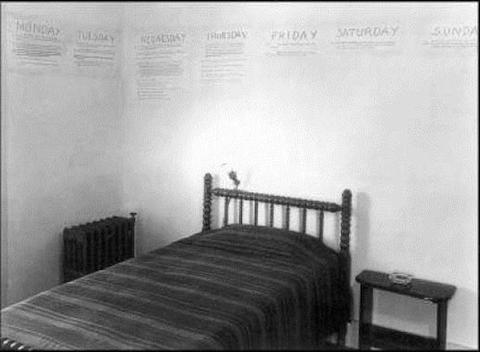
Photo by John Lawrence, from Faulkner’s Rowan Oak , by John Lawrence and Dan Hise
Related Content:
Rare Audio: William Faulkner Names His Best Novel, And the First Faulkner Novel You Should Read
William Faulkner Reads His Nobel Prize Speech
The Art of William Faulkner: Drawings from 1916–1925
How Famous Writers — From J.K. Rowling to William Faulkner — Visually Outlined Their Novels
Josh Jones is a writer and musician based in Durham, NC. Follow him at @jdmagness
Read More...All You Need is Love: The Keys to Happiness Revealed by a 75-Year Harvard Study
The latest installment from PBS’ BrainCraft video series introduces us to two scientific studies that teach us a thing or two about what brings us happiness. One set of results comes from Dr. John Gottman’s Family Research Laboratory (a.k.a. the “Love Lab”); the other from the Harvard Grant Study, a 75-year study that has traced the lives and development of 268 Harvard sophomores from the classes of 1939–1944. Although the study focuses on privileged white men (the demographic that attended Harvard College during the 1930s and 40s), the Harvard Grant Study has yielded conclusions that apply to a broader population.
One of the longest-running studies of adult development, the study has found, for example, that alcoholism has some of the most ruinous effects on marriages, family finances and personal health. Likewise, it reveals that liberals have sex much further into old age than their conservative peers.
But those aren’t the big takeaways — the conclusions that talk about happiness. If you watch the interview below with George Vaillant, the longtime director of the study, you will hear him conclude that happiness isn’t about “conforming, keeping up with the Joneses. It is about playing, and working, and loving. And loving is probably the most important. Happiness is love.”
According to Vaillant, “warmth of relationships throughout life have the greatest positive impact on ‘life satisfaction.’ ” When we have warm relationships with our parents, spouses, friends and family, we experience less daily anxiety and a greater sense of overall pleasure; we have better health (including lower levels of dementia later in life); and we’re more effective at work and make more money.
Essentially The Beatles had it right, “All you need is love. Love is all you need.”
You can read more about the Harvard study over at The Atlantic.
Related Content:
A Guide to Happiness: Alain de Botton Shows How Six Great Philosophers Can Change Your Life
Take the ‘Happiness Experiment’
Free Online Psychology Courses
A Crash Course on Psychology: A 30-Part Video Series from Hank Green
Read More...Rare Interview: Tim Curry Discusses The Rocky Horror Picture Show, During the Week of Its Release (1975)
A defining role can be both blessing and curse. In August of 1975, the week the The Rocky Horror Picture Show opened, its 29-year-old star, Tim Curry gave an interview to STOIC, the Student Television Of Imperial College.
In between clips of Curry’s Frank-n-Furter sashaying through such destined-to-become cult favorites as “Sweet Transvestite” and “The Time Warp,” in fishnets, merry widow, and maquillage designed by David Bowie’s personal makeup artist, the actor entertained questions…in luscious black and white!
Kudos to the young interviewer, Mark Caldwell, for never interrupting or trying to elbow his way into the spotlight with jokey asides or double entendres. The reward is a serious consideration of the filmmaking process and the actor’s craft.
(Bear in mind that it would be at least a year until midnight audiences at New York’s Waverly Theater started throwing toast, rice, and toilet paper at the screen, thus initiating an entire script’s worth of audience participation.)
Having originated the role on the London stage (he auditioned with Little Richard’s “Tutti Frutti”) and reprised it in L.A., Curry was clearly ready to put some space between himself and his iconic creation, announcing—correctly, as it turns out—that any sequels would have to proceed without him.
Then he clammed up for three decades, refusing to discuss his most iconic role until 2005, when he broke the silence during an interview on NPR’s Fresh Air .
It’s clear that Curry saw the making of the film as a serious business, but Rocky Horror fans will find plenty of juicy morsels to feed their obsession. Even virgins will enjoy the story of Frank’s evolving accent —from middle European to “Belgravia Hostess with the Mostest.”
Ayun Halliday is an author, illustrator, and Chief Primatologist of the East Village Inky zine. Follow her @AyunHalliday
Read More...Watch a Young Bob Marley and The Wailers Perform Live in England (1973): For His 70th Birthday Today
If you’ve spent any time at all on a college campus, you’ve heard Bob Marley and the Wailer’s 1984 compilation album Legend wafting from dorm rooms and frat house windows. The longest charting album in the history of Billboard magazine, it contains all of the band’s top 40 hits and more or less stands as every young American’s introduction to the iconic Jamaican singer, if not to reggae music itself. Before Legend, there was Eric Clapton’s cover of Marley’s 1973 single “I Shot the Sheriff.” Clapton’s version hit number one on the Billboard Hot 100 in ’74—his only number one hit in the U.S.—and introduced American audiences to Marley’s fiery politics, if not always to Marley himself. On what would have been Marley’s 70th birthday, we bring you some early footage of the man and his band.
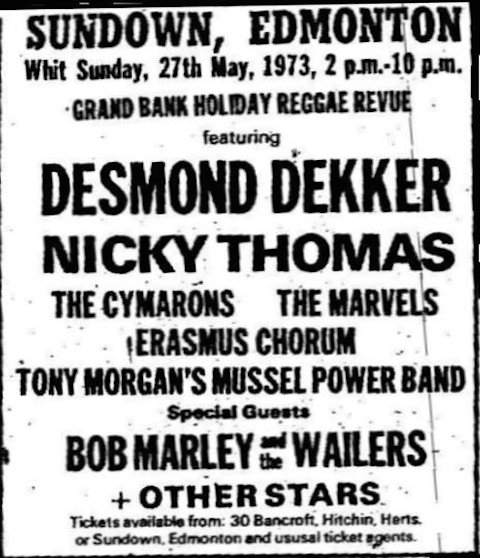
While many Americans may been rather late to the Bob Marley party, and to reggae, the English have long had a fascination with West Indian music. Ska pioneers like Desmond Dekker drew huge crowds in the UK while remaining much less popular stateside (though Dekker had a number one hit in the U.S. in 1969). But even some Brits didn’t quite know what to do with Marley when he and the Wailers hit English shores in the spring of 1973. Playing the Sundown Theater in the London suburb of Edmonton in support of Dekker and a host of other acts (top), Marley, writes Dangerous Minds, “was still somewhat of an enigma and the Wailers were sonically much more adventurous than some of the other acts on the bill that day…. According to reports at the time, most of the audience at this Wailers gig didn’t ‘get’ the group.”
Nevertheless, that ’73 tour changed the band’s fortunes forever. After three albums, a previous UK tour, and several attempts to break into the pop charts, the Wailer’s fourth record, major label-debut Catch a Fire, finally made them international stars, if not yet every American college freshman’s favorite band. Just above, hear an FM broadcast of another date from the UK leg of the Catch a Fire tour (see the Youtube page for the full setlist). After Britain, the band played a run of shows at Paul’s Mall in Boston, then four nights at New York’s Max’s Kansas City. Just a few months later, they hit major cities all over the U.S. before returning to England in November in support of Burnin’, and the song Clapton made famous.
While we tend to associate Marley with peace, love, and patchouli—an impression furthered by Legend, which leans rather heavily on the love songs—these early albums are fierce and militant, and do not hold back from explicit calls for violent revolution and condemnation of historical oppression. It’s a somewhat neglected side of Marley’s legend, but in these concerts, we see just how multifaceted a songwriter and performer he was. Charismatic and vibrant, and flanked by the talented Peter Tosh, Marley exudes star power. Today on his 70th birthday, it’s still as good a time as any to celebrate his life and remember his strident yet soulful calls for love and justice.
Related Content:
Video: The Day Bob Marley Played a Big Soccer Match in Brazil, 1980
Johnny Cash & Joe Strummer Sing Bob Marley’s “Redemption Song” (2002)
Bill Graham’s Concert Vault: From Miles Davis to Bob Marley
Josh Jones is a writer and musician based in Durham, NC. Follow him at @jdmagness
Read More...Richard Dawkins Reads “Love Letters” from “Fans” (NSFW)
Richard Dawkins — some know him as the Oxford evolutionary biologist who coined the term “meme” in his influential 1976 book, The Selfish Gene; others consider him a leading figure in the New Atheism movement, a position he has assumed unapologetically. In recent years, Dawkins has made his case against religion though different forms of media: books, documentaries, college lectures, and public debates. He can be aggressive and snide, to be sure. But he dishes out far less than he receives in return. Just witness him reading the “love letters” (as he euphemistically calls them) that he has received from the general public. They are not safe for work. You can see him reading a previous batch of letters here.
Related Content:
Richard Dawkins’ Documentary The God Delusion Tackles Faith & Religious Violence (2006)
Richard Dawkins Explains Why There Was Never a First Human Being
Free Online Biology Courses
Read More...
Flannery O’Connor to Lit Professor: “My Tone Is Not Meant to Be Obnoxious. I’m in a State of Shock”

When Flannery O’Connor started writing in the middle of the 20th century, short stories — or at least fashionable short stories that were published in The New Yorker –unfolded delicately revealing gossamer-like layers of experience. O’Connor’s stories, in contrast, were pungent, grotesque, often violent moral tales dealing with unabashedly Christian themes. They definitely weren’t fashionable at the time. Yet since her untimely death at age 39 in 1964, O’Connor’s reputation has only increased. Even for readers who aren’t immersed in Catholic theology, her stories — which pair outlandish, often comic characters with harrowing, existential situations — have a way of burrowing into your consciousness and staying there. For O’Connor, the gothic tales were a means to an end: “To the hard of hearing you shout, and for the almost-blind you draw large and startling figures.”
In 1961, an English professor wrote to O’Connor hoping to help his students understand “A Good Man is Hard to Find.” The story, perhaps the author’s most famous, is a slippery, troubling work about a family of six casually murdered by an escaped convict called the Misfit in the backwoods of Georgia. The story’s main character is clearly the Grandmother. The story is seen through her eyes, and she is the one who ultimately dooms the family. Yet the professor didn’t quite see it that way:
We have debated at length several possible interpretations, none of which fully satisfies us. In general we believe that the appearance of the Misfit is not ‘real’ in the same sense that the incidents of the first half of the story are real. Bailey, we believe, imagines the appearance of the Misfit, whose activities have been called to his attention on the night before the trip and again during the stopover at the roadside restaurant. Bailey, we further believe, identifies himself with the Misfit and so plays two roles in the imaginary last half of the story. But we cannot, after great effort, determine the point at which reality fades into illusion or reverie. Does the accident literally occur, or is it part of Bailey’s dream? Please believe me when I say we are not seeking an easy way out of our difficulty. We admire your story and have examined it with great care, but we are not convinced that we are missing something important which you intended us to grasp. We will all be very grateful if you comment on the interpretation which I have outlined above and if you will give us further comments about your intention in writing ‘A Good Man is Hard to Find.’
O’Connor was understandably baffled by this reading. Her response:
28 March 1961
The interpretation of your ninety students and three teachers is fantastic and about as far from my intentions as it could get to be. If it were a legitimate interpretation, the story would be little more than a trick and its interest would be simply for abnormal psychology. I am not interested in abnormal psychology.
There is a change of tension from the first part of the story to the second where the Misfit enters, but this is no lessening of reality. This story is, of course, not meant to be realistic in the sense that it portrays the everyday doings of people in Georgia. It is stylized and its conventions are comic even though its meaning is serious.
Bailey’s only importance is as the Grandmother’s boy and the driver of the car. It is the Grandmother who first recognized the Misfit and who is most concerned with him throughout. The story is a duel of sorts between the Grandmother and her superficial beliefs and the Misfit’s more profoundly felt involvement with Christ’s action which set the world off balance for him.
The meaning of a story should go on expanding for the reader the more he thinks about it, but meaning cannot be captured in an interpretation. If teachers are in the habit of approaching a story as if it were a research problem for which any answer is believable so long as it is not obvious, then I think students will never learn to enjoy fiction. Too much interpretation is certainly worse than too little, and where feeling for a story is absent, theory will not supply it.
My tone is not meant to be obnoxious. I am in a state of shock.
Flannery O’Connor
You can hear O’Connor read “A Good Man is Hard to Find” below. We have more information on the 1959 reading here:
Via Letters of Note
Related Content:
Flannery O’Connor: Friends Don’t Let Friends Read Ayn Rand (1960)
Flannery O’Connor Reads ‘Some Aspects of the Grotesque in Southern Fiction’ (c. 1960)
Flannery O’Connor’s Satirical Cartoons: 1942–1945
Jonathan Crow is a Los Angeles-based writer and filmmaker whose work has appeared in Yahoo!, The Hollywood Reporter, and other publications. You can follow him at @jonccrow. And check out his blog Veeptopus, featuring lots of pictures of badgers and even more pictures of vice presidents with octopuses on their heads. The Veeptopus store is here.
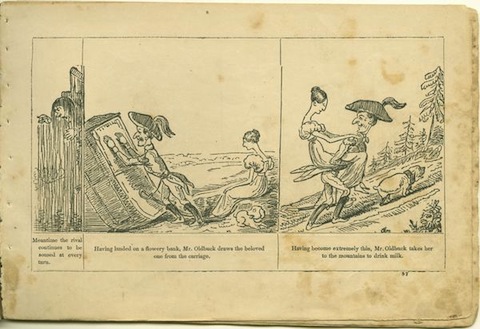
Read More...Read The Very First Comic Book: The Adventures of Obadiah Oldbuck (1837)
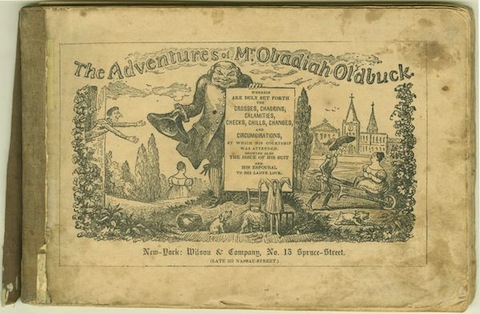
Comic books, as any enthusiast of comics books won’t hesitate to tell you, have a long and robust history, one that extends far wider and deeper than the 20th-century caped musclemen, carousing teenagers, and wisecracking animals so many associate with the medium. The scholarship on comic-book history — still a relatively young field, you understand — has more than once revised its conclusions on exactly how far back its roots go, but as of now, the earliest acknowledged comic book dates to 1837.
The Adventures of Obadiah Oldbuck, according to thecomicbooks.com’s page on early comic-book history, “was done by Switzerland’s Rudolphe Töpffer, who has been considered in Europe (and starting to become here in America) as the creator of the picture story. He created the comic strip in 1827,” going on to create comic books “that were extremely successful and reprinted in many different languages; several of them had English versions in America in 1846. The books remained in print in America until 1877.”
Also known as Histoire de M. Vieux Bois, Les amours de Mr. Vieux Bois, or simply Monsieur Vieuxbois, the original 1837 Adventures of Obadiah Oldbuck earned Töpffer the designation of “the father of the modern comic” from no less an authority on the matter than Understanding Comics author Scott McCloud, who cites the series’ pioneering use of bordered panels and “the interdependent combination of words and pictures.” You can see for yourself at the web site of Dartmouth College’s Library.
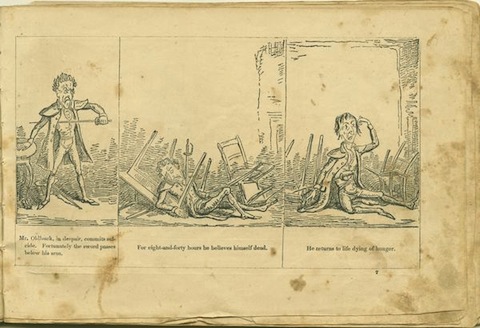
Alas, contemporary critics — and to an extent Töpffer himself, who considered it a work targeted at children and “the lower classes” — couldn’t see the innovation in all this. They wrote off Obadiah Oldbuck’s harrowing yet strangely lighthearted pictorial stories of failed courtship, dueling, attempted suicide, robbery, drag, elopement, ghosts, stray bullets, attack dogs, double-crossing, and the threat of execution as mere trifles by an otherwise capable artist. So the next time anyone gets on your case about reading comic books, just tell ’em they said the same thing about Obadiah Oldbuck. Then send them this way so they can figure out what you mean. You can read The Adventures of Obadiah Oldbuck in its totality here.
Related Content:
Download Over 22,000 Golden & Silver Age Comic Books from the Comic Book Plus Archive
Download 15,000+ Free Golden Age Comics from the Digital Comic Museum
The Religious Affiliation of Comic Book Heroes
Colin Marshall hosts and produces Notebook on Cities and Culture as well as the video series The City in Cinema and writes essays on cities, language, Asia, and men’s style. He’s at work on a book about Los Angeles, A Los Angeles Primer. Follow him on Twitter at @colinmarshall or on Facebook.
Read More...How Paul Thomas Anderson Dropped Out of NYU Film School in 2 Days; Studied Literature with David Foster Wallace
Seeing how the ever-more-distinctive cinema of Paul Thomas Anderson has developed from his feature debut Hard Eight to his new Thomas Pynchon adaptation Inherent Vice, you have to wonder how he learned his craft. Boogie Nights, Magnolia, Punch-Drunk Love, The Master: ambitious pictures like these, artistically unusual and heavily referential but also surprisingly popular, make you sense an unschooled filmmaker behind the camera (a path to filmmaking greatness best exemplified by Quentin Tarantino).
But Anderson didn’t get this far entirely without higher education: let the record show that he did spend two semesters at Emerson College — a brief period, but one in which he took an English class from none other than David Foster Wallace. “It was the first teacher I fell in love with,” he told Marc Maron in an interview on Maron’s podcast WTF . “I’d never found anybody else like that at any of the other schools I’d been to.” Anderson even called Wallace, a professor “generous with his phone number,” to discuss “a couple crazy ideas” on a paper he was writing about Don DeLillo’s White Noise at “midnight the night before it was due.”
(At The Paris Review, Dan Piepenbring has more on the intersection of Anderson’s life and Wallace’s, including the latter’s opinions on the former’s movies: “he was a fan of Boogie Nights, which he told a friend was ‘exactly the story’ he’d wanted to write. He was less jazzed about Magnolia, though, which he found pretentious, hollow, and ‘100% gradschoolish in a bad way.‘”)
Anderson also enrolled at New York University’s film school, but rather than staying only two semesters, he stayed only two days. In the clip up top, from an interview with critic Elvis Mitchell, Anderson recounts the whole of his NYU experience. His first instructor announced, “If anyone is here to write Terminator 2, get out.” And so Anderson thought, “What if I do want to write Terminator 2? Terminator 2’s a pretty awesome movie.” (An assessment, incidentally, from which Wallace’s greatly differs.) When he turned in a page from a David Mamet script for his first assignment and his unsuspecting teacher gave it a C+, Anderson knew he had to leave. Living off of the tuition NYU returned to him, he got to work on a short film of his own.
“My filmmaking education consisted of finding out what filmmakers I liked were watching, then seeing those films,” he told the Los Angeles Times. “I learned the technical stuff from books and magazines, and with the new technology you can watch entire movies accompanied by audio commentary from the director. You can learn more from John Sturges’ audio track on the Bad Day at Black Rock laserdisc than you can in 20 years of film school.” He said that just a few years after leaving NYU, when he hit it big with Boogie Nights — a film whose highly entertaining DVD commentary from Anderson himself provides another few years’ worth of film school at least.
Related Content:
David Foster Wallace’s 1994 Syllabus: How to Teach Serious Literature with Lightweight Books
Werner Herzog’s Rogue Film School: Apply & Learn the Art of Guerilla Filmmaking & Lock-Picking
Colin Marshall hosts and produces Notebook on Cities and Culture as well as the video series The City in Cinema and writes essays on cities, language, Asia, and men’s style. He’s at work on a book about Los Angeles, A Los Angeles Primer. Follow him on Twitter at @colinmarshall or on Facebook.
Read More...Download 140 Free Philosophy Courses: Develop Critical Thinking Skills & Live the Examined Life

What is “Philosophy”? Yes, we know, the word comes from the Greek philosophia, which means “the love of wisdom.” This rote etymological definition does little, I think, to enhance our understanding of the subject, though it may describe the motivation of many a student. Like certain diseases, maybe philosophy is a spectrum, a collection of loosely related behaviors. Maybe a better question would be, “what are all the symptoms of this thing we call philosophy?” The medical metaphor is timely. We live in an age when the discipline of philosophy, like many of the humanities, gets treated like a pathology, in universities and in the wider culture. See, for example, popular articles on whether science has rendered philosophy (and religion) obsolete. There seems to be an underlying assumption in our society that philosophy is something to be eradicated, like smallpox.
Perhaps this sort of thing is just an empty provocation; after all, many logical positivists of the early 20th century also claimed to have invalidated large areas of philosophical inquiry by banishing every unclear concept to the dustbin. And yet, philosophy persists, infecting us with its relentless drive to define, inquire, critique, systematize, problematize, and deconstruct.
And of course, in a less technical sense, philosophy infects us with the drive to wonder. Without its tools, I maintain, we would not only lack the basis for understanding the world we live in, but we would also lack important means of imagining, and creating, a better one. If this sounds grandiose, wait till you encounter the thought of Plato, Spinoza, Hegel, Kant, Nietzsche, Kierkegaard, and jazz-futurist Sun Ra—all unaccustomed to thinking small and staying in their lane.
Some philosophers are more circumspect, some more precise, some more literary and imaginative, some more practical and technologically inclined. Like I said, many symptoms, one disease.
We at Open Culture have compiled a list of 140 free philosophy courses from as much of the wide spectrum as we could, spanning such diverse ways of thinking as University of Chicago’s Leo Strauss on Aristotle’s Ethics (Free Online Audio) and Plato’s Laws (Free Online Audio), to Columbia University Buddhist scholar Robert Thurman (Uma’s dad) on “The Central Philosophy of Tibet” (Free Online Audio). We have specific courses on Medical Ethics, taught by Notre Dame’s David Solomon (Free Online Audio) and the University of New Orlean’s Frank Schalow (Free iTunes Audio). We have hugely general courses like “The History of Philosophy Without Any Gaps,” from King’s College’s Peter Adamson (Free Course in Multiple Formats). We have philosophy courses on death, love, religion, film, law, the self, the ancients and the moderns…. See what I mean about the spectrum?
Perhaps philosophy incurs resentment because it roams at large and won’t be packaged into neatly salable—or jailable—units. Perhaps its amorphous nature, its tolerance of uncertainty and doubt, makes some kinds of people uncomfortable. Or perhaps some think it’s too abstruse and difficult to make sense of, or to matter. Not so! Visit our list of 140 philosophy courses and you will surely find a point of entry somewhere. One class will lead to another, and another, and before you know it, you’ll be asking questions all the time, of everything, and thinking rigorously and critically about the answers, and… well, by then it may be too late for a cure.
Looking for a good place to start? Try Oxford’s Critical Reasoning for Beginners…
Related Content:
Download 55 Free Online Literature Courses: From Dante and Milton to Kerouac and Tolkien
Download 78 Free Online History Courses: From Ancient Greece to The Modern World
Learn 48 Languages Online for Free: Spanish, Chinese, English & More
Josh Jones is a writer and musician based in Durham, NC. Follow him at @jdmagness
Read More...Support Us
We're hoping to rely on loyal readers, rather than erratic ads. Please click the Donate button and support Open Culture. You can use Paypal, Venmo, Patreon, even Crypto! We thank you!

About Us

Open Culture scours the web for the best educational media. We find the free courses and audio books you need, the language lessons & educational videos you want, and plenty of enlightenment in between.
Advertise With Us
FREE UPDATES!
GET OUR DAILY EMAIL
Get the best cultural and educational resources on the web curated for you in a daily email. We never spam. Unsubscribe at any time.
FOLLOW ON SOCIAL MEDIA
Open Culture editor Dan Colman scours the web for the best educational media. He finds the free courses and audio books you need, the language lessons & movies you want, and plenty of enlightenment in between.
Advertise With Us

