Watch Art on Ancient Greek Vases Come to Life with 21st Century Animation
Every student of history surely feels impressed by one achievement or another of the ancient Greeks, whether in the field of engineering, art, or the convergence of the two. Even a bored college undergrad in a thousand-seat lecture hall has to admire ancient Greek vases when they pop up in the lecturer’s Powerpoint slides. That much-studied culture’s penchant for stylizing images of their society on their pottery has allowed us to see their world as, in some sense, a living, breathing one — or to see it through the eyes of the artisans who lived to see it themselves. But for all their mastery of the art of the vase, they never actually got their images to live nor breathe. For that, we must turn to 21st-century technology, specifically as applied by Panoply, a project animator of Steve K. Simons and ancient Greece scholar Sonya Nevin, which was designed to bring these vases to life.
“Panoply covers a lot of aspects of culture as method tying the artifacts to information about Greek life,” writes io9’s Katharine Trendacosta. “There are ones on myths, sport, and warfare,” the last of which, “Hoplites!,” you can watch at the top of the post. Simons and Nevin made this seven-minute battle scene out of the foot soldiers actually depicted on a vase dating to about 550 BCE currently held by the Ure Museum of Greek Archaeology at the University of Reading.
Just above, we have “The Cheat,” a short and humorous scene from the ancient Olympics that plays out on the surface of a shard. The animation below features a figure of Greek myth that even the most inattentive student will know: a certain Pandora, and far be it from her to resist the temptation to open a certain box. (Actually it was a vase/pithos.) You can watch more on Panoply’s Youtube channel. As unconventional means of visualizing ancient Greece go, it’s got to beat 300 for accuracy.
via io9
Related Content:
Modern Artists Show How the Ancient Greeks & Romans Made Coins, Vases & Artisanal Glass
What Ancient Greek Music Sounded Like: Hear a Reconstruction That is ‘100% Accurate’
How the Ancient Greeks Shaped Modern Mathematics: A Short, Animated Introduction
Hear Homer’s Iliad Read in the Original Ancient Greek
Download 78 Free Online History Courses: From Ancient Greece to The Modern World
Colin Marshall hosts and produces Notebook on Cities and Culture and writes essays on cities, language, Asia, and men’s style. He’s at work on a book about Los Angeles, A Los Angeles Primer. Follow him on Twitter at @colinmarshall or on Facebook.
Read More...Noam Chomsky Almost Appeared on Saturday Night Live During the 90s

Image by jeanbaptisteparis
There are those guest hosts on Saturday Night Live who immediately become exemplary cast members they fit in so well. I’m thinking mostly of Alec Baldwin. Then there are those—certain pop stars and athletes—who are too awkward even to make for unintentional humor. Sometimes the show will choose a host for obvious cultural or political reasons, whether or not that person has any sense of humor whatsoever. Lorne Michaels even once considered asking notoriously stiff then-presidential candidate Mitt Romney to host in 2012, a prospect that excited no one except maybe Romney.
Given the show’s many questionable choices, it’s maybe not too surprising that it would consider asking an academic to host. Some extroverted public intellectuals, like Cornell West and Slavoj Zizeck, are natural entertainers. But that they would think of Noam Chomsky—known for his rumpled sweaters and incisive, unsparing geopolitical analysis, delivered in the driest monotone this side of Ben Stein’s Ferris Bueller’s Day Off character—is, well, pretty odd.
It does make a little bit more sense considering that they only asked Professor Chomsky to play himself on the show, not deliver a monologue or do impersonations. According to his assistant Bev Stohl, the show called sometime in the late 90s and told her that the “writers had written a loose script for Noam. The only thing he needed to do was show up on the set and play it straight, answering the questions that were put to him. Sort of like, ‘I’m Noam Chomsky, and I play myself on TV.’” Mostly, writes Stohl on her blog, “I liked the idea of Noam appearing in mainstream media, something that was just beginning to happen in small ways in the 1990’s.”
And how did Chomsky himself feel about the request? It seems he was vaguely familiar with the show and open to the idea. His wife, on the other hand, was not. “After a brief exchange” with her, writes Critical Theory, “he informed Stohl that ‘Carol says no.’” We’ll never know if we were “robbed of either the greatest SNL skit ever” or spared “another terribly unfunny segment,” but the question of whether Chomsky can be funny is still an open one. Matthew Alford at The Guardian writes that during the Q&A after a lecture he attended, “Chomsky was successful not only at conveying his radical political message but also at raising belly laughs from the audience with dark-laced, insightful humour about his politics.” Alford says he measured “a laugh every couple of minutes—very high for a public intellectual but of course not close to the professional comic’s benchmark of one gag every 20 seconds.” He offers some typical Chomsky-an one-liners, such as:
“[The Bush administration’s] moral values are very explicit: shine the boots of the rich and powerful, kick everyone else in the face, and let your grandchildren pay for it.”
“If you’ve resisted the temptation to tell the teacher ‘you’re an asshole’ which maybe he or she is, and if you don’t say ‘that’s idiotic’ when you get a stupid assignment… you will end up at a good college and eventually with a good job.”
And “It’s to the point where Ronald Reagan could put on his cowboy boots and cowboy hat and declare a national emergency because the national security of the United States was in danger from the government of Nicaragua… whose troops were two days from Texas.”
Above, you can catch a glimpse of the lighter side of Chomsky.
Related Content:
Noam Chomsky Went Gangnam Style … Ever So Briefly?
Filmmaker Michel Gondry Presents an Animated Conversation with Noam Chomsky
Noam Chomsky Spells Out the Purpose of Education
Josh Jones is a writer and musician based in Durham, NC. Follow him at @jdmagness
Read More...John Cage Performs Water Walk on US Game Show I’ve Got a Secret (1960)
Back in 2011, we featured John Cage’s 1960 television performance of his piece Water Walk. Its video quality may have left something to be desired, but now, thanks to the YouTube channel of Bard College’s Richard B. Fisher Center for the Performing Arts, you can watch the entire ten-minute segment in much crisper quality than most surviving programs from that era. This unlikely happening occurred on I’ve Got a Secret, the long-running occupation-guessing game show whose guest roster also included chess prodigy Bobby Fischer, “fifth Beatle” Pete Best, and fried-chicken icon Colonel Harland Sanders. For this particular episode, we wrote in our earlier post, “the TV show offered Cage something of a teachable moment, a chance to introduce the broader public to his brand of avant-garde music.”
For Water Walk, Cage rounded up a variety of “instruments” all to do with that liquid — a bathtub, a pitcher, ice cubes in a mixer — and the unconventional symphony they produce culminates in the Rube Goldbergian mixing of a drink, the sipping of which the composition dictates about two and a half minutes in. Naturally, Cage being Cage, the piece incorporates audience reaction noises; when host Gary Moore warns him that certain members of the studio audience will laugh, Cage responds, “I consider laughter better than tears.”
You can learn more about this intersection of far forward-thinking artistry and the midcentury televisual mainstream in Laura Paolini’s piece “John Cage’s Secret,” available at johncage.org. “At that moment in 1960, a rupture was being deepened,” Paolini writes. “High art and low were becoming more and more comfortable with one another over the airwaves. At this moment, as the screens glow their blue auras into the homes of North America, everyone sees something they haven’t seen before. And everyone has an opinion about it.” And those opinions, I like to think Cage would have said, only extend the art further.
If you would like to support the mission of Open Culture, consider making a donation to our site. It’s hard to rely 100% on ads, and your contributions will help us continue providing the best free cultural and educational materials to learners everywhere. You can contribute through PayPal, Patreon, and Venmo (@openculture). Thanks!
Related Content:
John Cage Performs Water Walk on “I’ve Got a Secret” (1960)
10 Rules for Students and Teachers Popularized by John Cage
Hear Joey Ramone Sing a Piece by John Cage Adapted from James Joyce’s Finnegans Wake
Watch a Surprisingly Moving Performance of John Cage’s 1948 “Suite for Toy Piano”
Colin Marshall hosts and produces Notebook on Cities and Culture and writes essays on cities, language, Asia, and men’s style. He’s at work on a book about Los Angeles, A Los Angeles Primer. Follow him on Twitter at @colinmarshall or on Facebook.
Read More...Animated Introductions to Quantum Mechanics: From Schrödinger’s Cat to Heisenberg’s Uncertainty Principle
If you never quite got a hang of quantum mechanics, you can take another run at it by watching four animated Ted-Ed primers, created by Chad Orzel, Associate Professor in the Department of Physics and Astronomy at Union College. He’s also the author of How to Teach Quantum Physics to Your Dog. In Particles and waves: The central mystery of quantum mechanics (above), Orzel briefly traces the conceptual development of quantum mechanics, highlighting the contributions of physicists like Max Planck, Niels Bohr and Louis de Broglie.
Next up, Orzel tackles the famous thought experiment known as Schrödinger’s cat, devised, of course, by the Nobel-prize winning Austrian physicist Erwin Schrödinger in 1935. For another primer on this topic, you should also check out this lesson presented by Sixty Symbols, a web site specializing in physics and astronomy videos hosted by The University of Nottingham. The two remaining videos in Orzel’s series appear below.
Einstein’s brilliant mistake: Entangled states
What is the Heisenberg Uncertainty Principle?
Related Content:
64 Free Online Physics Courses
Albert Einstein Reads ‘The Common Language of Science’ (1941)
“Do Scientists Pray?”: A Young Girl Asks Albert Einstein in 1936. Einstein Then Responds.
New Archive Puts 1000s of Einstein’s Papers Online, Including This Great Letter to Marie Curie
Read More...Future Shock: Orson Welles Narrates a 1972 Film About the Perils of Technological Change
The beginning of the 1972 documentary Future Shock, directed by Alex Grasshof, shows Orson Welles, bearded and chomping on a cigar, standing on an airport people mover. He turns to the camera and delivers a monologue in his trademark silken baritone. “In the course of my work, which has taken me to just about every corner of the globe, I see many aspects of a phenomenon which I’m just beginning to understand. Our modern technologies have changed the degree of sophistication beyond our wildest dreams. But this technology has exacted a pretty heavy price. We live in an age of anxiety and time of stress. And with all our sophistication, we are in fact the victims of our own technological strengths –- we are the victims of shock… a future shock.”
The documentary itself is wonderfully dated. From its bizarre opening montage; to its soundtrack, which lurches from early electronic music to jazz funk; to some endearing video special effects, which, for whatever reason, mostly centers around Orson Welles’s head, the film feels thoroughly rooted in the Nixon administration. Yet many of the ideas discussed in the movie are, if anything, more relevant now than in the 1970s.
The term “future shock” was invented in Alvin Toffler’s hugely bestselling book of the same name to describe the constant, bewildering barrage of new technologies and all the resulting societal changes those technologies bring about. Anyone who has struggled to comprehend a new, baffling and supposedly essential social media platform, anyone who has been driven to paralysis over the number of choices on Netflix, anyone who found their livelihood decimated because of a hot new app knows what “future shock” is.
Toffler (along with his wife and uncredited co-writer Heidi Toffler) argued that we are in the midst of a massive structural change from an industrial society to a post-industrial one – a society that boggles the mind with an overload of information and an overload of consumer choices. “Change,” as they wrote, “is the only constant.”
Along the way, the Tofflers managed to predict the collapse of America’s manufacturing sector, along with things like Prozac, temp jobs, the internet and the meteoric rise and fall of insta-celebs (Alex from Target, we hardly knew you.) Other predictions – underwater cities, paper clothes and being able to choose your own skin color – haven’t yet come to pass. Still, they had a surprisingly good track record considering these predictions were written over four decades ago.
The video ends with a plea from not Welles, but Toffler himself, who is seen addressing college students.
If we can recognize that industrialism is not the only possible form of technological society, if we can begin to think more imaginatively about the future, then we can prevent future shock and we can use technology itself to build a decent, democratic and humane society. […] We can no longer allow technology just to come roaring down at us. We must begin to say “No” to certain kinds of technology and begin to control technological change, because we have now reached the point at which technology is so powerful and so rapid that it may destroy us, unless we control it. But what is the most important is we simply do not accept everything; that we begin to make critical decisions about what kind of world we want and what kind of technology we want.
Find other short films narrated by Welles in our collection, 4,000+ Free Movies Online: Great Classics, Indies, Noir, Westerns, Documentaries & More.
Related Content:
Isaac Asimov Predicts in 1964 What the World Will Look Like Today — in 2014
Arthur C. Clarke Predicts the Future in 1964 … And Kind of Nails It
Walter Cronkite Imagines the Home of the 21st Century … Back in 1967
The Internet Imagined in 1969
Marshall McLuhan Announces That The World is a Global Village
Jonathan Crow is a Los Angeles-based writer and filmmaker whose work has appeared in Yahoo!, The Hollywood Reporter, and other publications. You can follow him at @jonccrow. And check out his blog Veeptopus, featuring lots of pictures of badgers and even more pictures of vice presidents with octopuses on their heads. The Veeptopus store is here.
Read More...H.P. Lovecraft Highlights the 20 “Types of Mistakes” Young Writers Make

Image by Lucius B. Truesdell, via Wikimedia Commons
H.P. Lovecraft is remembered as a brilliant fantasist, a creator of a completely unique universe of horror. He’s also remembered, unfortunately, as a bigot. But the author whose head—to the chagrin of some—provided the model for the World Fantasy Award is not often remembered as a particularly good writer. Or rather, I should say, a particularly good stylist. His writing can sound stiflingly archaic, overstuffed with Victorianisms. “His prose, “writes Scott Malthouse, “can be turgid and adjectives suffocating,” and “his characters tend to be as thin as the paper they’re printed on.”
Writers love him, Malthouse argues, because he was such an original “world builder,” not because he was a fine artist. Elizabeth Bear at Tor echoes the sentiment, writing that Lovecraft’s work is “criticized for its style, for its purpleness and density and failures of structure,” yet still evokes such a potent response that “the Lovecraftian universe must be considered a collaborative effort at this point,” since so many writers have furthered his “appealingly bleak” vision. You can download a good part of his collected works in ebook and audiobook formats here.
So perhaps he isn’t such a bad writer after all? In any case, he’s certainly a very distinctive one whose style, like Joseph Conrad’s, say, or even William Faulkner’s, endears readers precisely for its feverish excesses. Lovecraft himself was very self-conscious about his craft and took writing very seriously—enough to have published a lengthy, highly detailed essay called “Literary Composition” which tackles in several paragraphs a host of issues the writer must contend with: grammar, “reading,” vocabulary, “elemental phrases,” description, narration, “fictional narration,” “unity, mass, coherence,” and “forms of composition.” We won’t recite the whole of his advice here—you can read the whole thing for yourself. But to give you some of the flavor of Lovecraft’s pedagogy, we bring you his list of twenty “types of mistakes” young writers make.
See his complete list below.
- Erroneous plurals of nouns, as vallies or echos.
- Barbarous compound nouns, as viewpoint or upkeep.
- Want of correspondence in number between noun and verb where the two are widely separated or the construction involved
- Ambiguous use of pronouns.
- Erroneous case of pronouns, as whom for who, and vice versa, or phrases like “between you and I,” or “Let we who are loyal, act promptly.”
- Erroneous use of shall and will, and of other auxiliary verbs.
- Use of intransitive for transitive verbs, as “he was graduated from college,” or vice versa, as “he ingratiated with the tyrant.”
- Use of nouns for verbs, as “he motored to Boston,” or “he voiced a protest,”
- Errors in moods and tenses of verbs, as “If I was he, I should do otherwise”, or “He said the earth was”
- The split infinitive, as “to calmly ”
- The erroneous perfect infinitive, as “Last week I expected to have met”
- False verb-forms, as “I pled with him.”
- Use of like for as, as “I strive to write like Pope wrote.”
- Misuse of prepositions, as “The gift was bestowed to an unworthy object,” or “The gold was divided between the five men.”
- The superfluous conjunction, as “I wish for you to do this.”
- Use of words in wrong senses, as “The book greatly intrigued me”, “Leave me take this”, “He was obsessed with the idea”, or “He is a meticulous”
- Erroneous use of non-Anglicised foreign forms, as “a strange phenomena”, or “two stratas of clouds”.
- Use of false or unauthorised words, as burglarise or supremest.
- Errors of taste, including vulgarisms, pompousness, repetition, vagueness, ambiguousness, colloquialism, bathos, bombast, pleonasm, tautology, harshness, mixed metaphor, and every sort of rhetorical awkwardness.
- Errors of spelling and punctuation, and confusion of forms such as that which leads many to place an apostrophe in the possessive pronoun its.
Most of this is solid, common sense writing advice. Some of it isn’t. As with all things Lovecraft, you would be wise to use your discretion. A full read of Lovecraft’s treatise on composition will give you some sense of how to begin writing your own Lovecraft pastiche. For even more of his advice on the writing of fiction—particularly, as he called it, “weird fiction,” see his list of five tips for horror writing, which we featured in October.
Related Content:
H.P. Lovecraft Gives Five Tips for Writing a Horror Story, or Any Piece of “Weird Fiction”
H.P. Lovecraft’s Classic Horror Stories Free Online: Download Audio Books, eBooks & More
Lovecraft: Fear of the Unknown (Free Documentary)
Stephen King’s Top 20 Rules for Writers
Writing Tips by Henry Miller, Elmore Leonard, Margaret Atwood, Neil Gaiman & George Orwell
Josh Jones is a writer and musician based in Durham, NC. Follow him at @jdmagness
Read More...Discover the 1950s & 1960s Computer & Cut-Up Animation of Pioneering Filmmaker Stan VanDerBeek
Hey, lovers of animation and experimental film: do you know the name Stan VanDerBeek? If not, you’ll enjoy learning it, for more reasons than that it allows you to type four capital letters. Endlessly adventurous in his quest to find new ways to craft (not to mention display) moving images, VanDerBeek, who in college encountered the likes of John Cage, Merce Cunningham, and Robert Rauschenberg, mobilized for his animation a variety of technologies that, in his day, people didn’t have much of a sense of what to do with, artistically or otherwise. “Everything that artists made art from, or with, in the second half of the 20th century, he pretty much touched,” this NPR piece quotes MIT LIST Visual Arts Center curator Joao Ribas as saying about him. “The medium, whatever he was working with, was not adequate enough. Painting was too static, and then one film was too linear, and then four films were too cumbersome.”
You can see here some of the fruits of this drive that kept VanDerBeek “constantly trying something else that could get closer and closer to what he saw.” At the top, we have a 1966 example of the animated poetry he created with Bell Labs computer graphics pioneer Ken Knowlton, using a programming language of Knowlton’s own design and a score by jazz drummer Paul Motian. But VanDerBeek built more of his reputation with his mastery of cut-and-paste animation, the kind you see in action in 1959’s Science Friction just above. Five years later, he would put out Breathdeath below, which Tate calls “a surreal fantasy based on 15th century woodcuts of The Dance of the Dead” made of “cut-up photos and newsreels, reassembled into a black comedy dedicated to Charlie Chaplin and Buster Keaton.” Does this all remind you a bit of Terry Gilliam? It should. The Monty Python animator, a notable VanDerBeek fan, named Breathdeath one of the best animated films of all time.
Find more experimental films in our collection, 4,000+ Free Movies Online: Great Classics, Indies, Noir, Westerns, Documentaries & More.
Related Content:
The Best Animated Films of All Time, According to Terry Gilliam
Watch 13 Experimental Short Films by Tezuka Osamu, the Walt Disney of Japan
Optical Poems by Oskar Fischinger, the Avant-Garde Animator Hated by Hitler, Dissed by Disney
Colin Marshall hosts and produces Notebook on Cities and Culture and writes essays on cities, language, Asia, and men’s style. He’s at work on a book about Los Angeles, A Los Angeles Primer. Follow him on Twitter at @colinmarshall or on Facebook.
Read More...Chrissie Hynde’s 10 Pieces of Advice for “Chick Rockers” (1994)
 Chrissie Hynde knows a few things about being a female rocker. When at the tender age of 14 she saw Mitch Ryder and the Detroit Wheels play at a fairground in her hometown of Akron, Ohio, the band got into a fistfight with each other during the performance. She was hooked. “I thought,” she said to The Guardian ‘That’s got to be the life!’ ”
Not long after college at Kent State, where she was in a band with Devo’s Mark Mothersbaugh, she ended up in London. There she worked at Malcolm McLaren’s notorious store SEX alongside the future members of The Sex Pistols. She even asked Sid Vicious and Johnny Rotten to marry her for the work visa. She tried to start a band with Mick Jones of The Clash, but that didn’t take. She was kicked out of the band Masters of the Backside before they changed their name to The Damned and became famous. Then in 1978, she formed the band The Pretenders and quickly became a rock icon with hit tunes like “Don’t Get Me Wrong” and “Message of Love.”
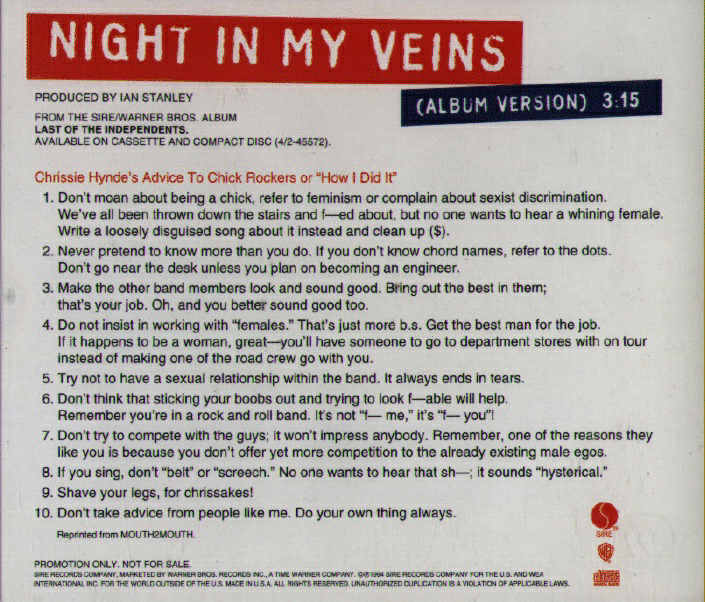
In short, Hynde has been rocking for over 40 years now and she has some advice for aspiring lady rockers, which was originally printed as a promo for her 1994 release “Night in my Veins.”
1. Don’t moan about being a chick, refer to feminism or complain about sexist discrimination. We’ve all been thrown down the stairs, and f—ed about, but no one wants to hear a whining female. Write a loosely disguised song about it instead and clean up. ($)
2. Never pretend to know more than you do. If you don’t know chord names, refer to the dots. Don’t go near the desk unless you plan on becoming an engineer.
3. Make the other band members look and sound good. Bring out the best in them; that’s your job. Oh, and you better sound good too.
4. Do not insist in [sic] working with “females.” That’s just more b.s. Get the best man for the job. If it happens to a woman, great – you’ll have someone to go to department stores with on tour instead of making one of the road crew go with you.
5. Try not to have a sexual relationship with the band. It always ends in tears.
6. Don’t think that sticking your boobs out and trying to look f—able will help. Remember you’re in a rock and roll band. It’s not “f—me,” it’s “f—you”!
7. Don’t try to compete with the guys; it won’t impress anybody. Remember, one of the reasons they like you is because you don’t offer yet more competition to the already existing male egos.
8. If you sing, don’t “belt” or “screech.” No one wants to hear that sh–; it sounds “hysterical.”
9. Shave your legs, for chrissakes!
10. Don’t take advice from people like me. Do your own thing always.
A lot of this is just sound advice for getting along at the workplace – don’t act like you know more than you do, don’t complain, make your workmates look good but don’t doink them. But probably the key points for Hynde is number one and number seven.
In that interview with the Guardian, she indeed proved to be reluctant to “moan” about sexual discrimination in the rockdom. “There’s always been women doing this, just not that many,” she said. “I don’t know what the feminists have to say about it. Over the years, you’d hear, ‘We weren’t encouraged.’ Well, I don’t think Jeff Beck’s mother was saying, ‘Jeffrey! What are you doing up in your room? Are you rehearsing up there?’ No one was ever encouraged to play guitar in a band. But I never found it harder because I’m a woman. If anything I’ve been treated better. Guys will carry my guitars and stuff – who’s going to say no? Guys always tune my guitars, too.”
Check out the video for “Night in my Veins” below:
Related Content:
Four Female Punk Bands That Changed Women’s Role in Rock
The Art of Punk Presents a New Documentary on The Dead Kennedys and Their Gritty Aesthetics
Jonathan Crow is a Los Angeles-based writer and filmmaker whose work has appeared in Yahoo!, The Hollywood Reporter, and other publications. You can follow him at @jonccrow. And check out his blog Veeptopus, featuring lots of pictures of badgers and even more pictures of vice presidents with octopuses on their heads. The Veeptopus store is here.
Read More...
The Red Menace: A Striking Gallery of Anti-Communist Posters, Ads, Comic Books, Magazines & Films
By its very nature, propaganda distorts the truth or tells outright lies. It targets our basest impulses—fear and anger, flight or fight. While works of pure propaganda may pretend to make logical arguments, they eliminate nuance and oversimplify complicated issues to the point of caricature. These general tendencies hold true in every case, but nowhere, perhaps, is this gross exaggeration and fear mongering more evident than in times of war.
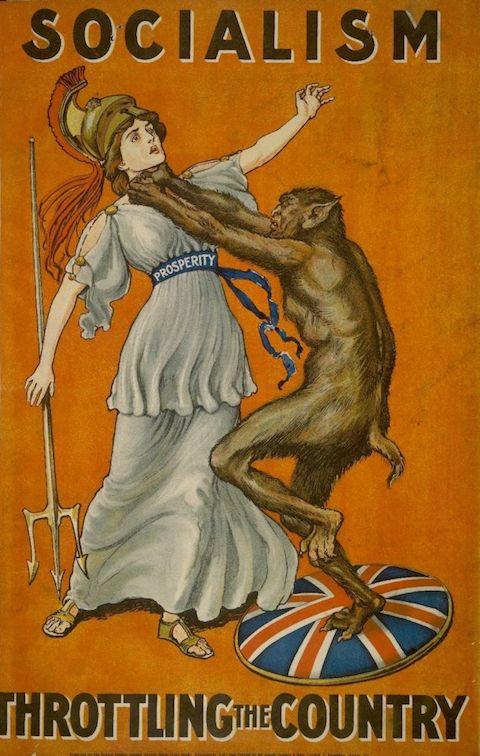
And while we’ve all seen our share of wartime propaganda, we may be less familiar with the decades-long propaganda war the U.S. and Western Europe waged against socialism and Communism, even decades before the Cold War era. It may surprise you to learn that this offensive began even before the start of World War One, as you can see above in a British Conservative Party poster from 1909.

Representing socialism as an ape-like demon strangling some sort of goddess of “prosperity,” this striking piece of poster art sets the tone for almost all of the anti-Communist propaganda to come in the wake of the Russian Revolution. At least since this early graphic salvo, Communists and socialists have generally been depicted as terrifying monsters. See, for example, an early, post-WWI example of Russian anti-Communist propaganda above, portraying the Communist threat as an apocalyptic horseman of death.

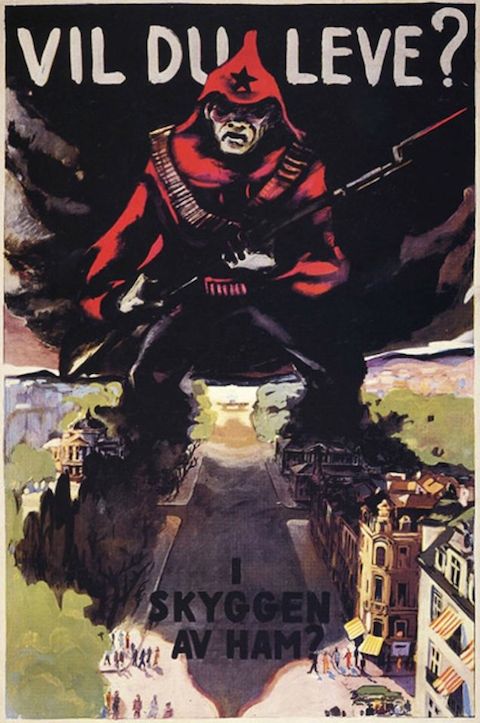
As the perceived threat increased, so too did the scale of the monstrous caricatures. In the post-WWI era German and Norwegian posters above, Godzilla-sized Communists lay waste to entire cities. Below, in “Bolshevism Unmasked,” an example from the Second World War, the skeletal Communist destroyer straddles the entire globe.

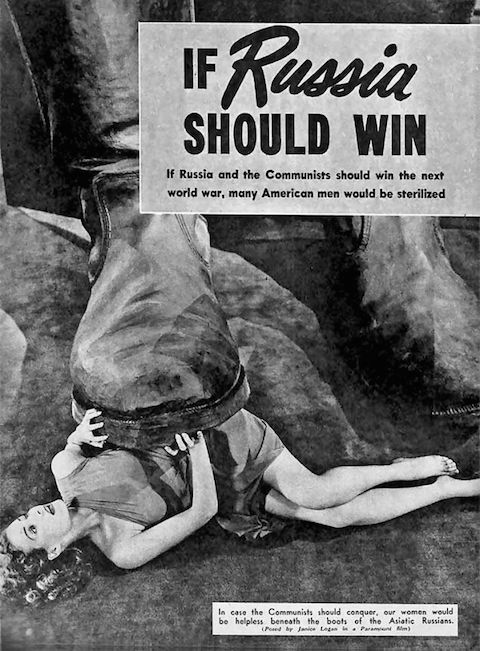
Occasionally the racial dimensions of these depictions were explicit. More often, they were strongly implied. But a 1953 Cold War example below is particularly unsubtle. Showing a scene literally right out of a schlocky Paramount horror film, featuring actress Janet Logan, the text tells us, “In case the Communists should conquer, our women would be helpless beneath the boots of the Asiatic Russians.” At the top of this rather lurid piece of agit-prop, we’re also told that “many American men would be sterilized” should Russia win the “next world war.”
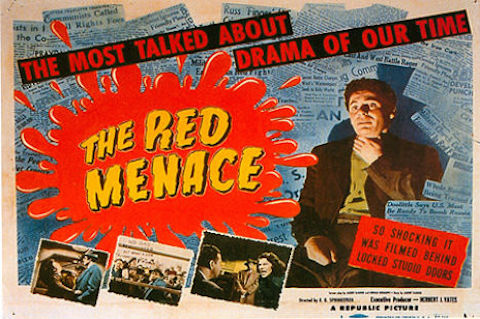
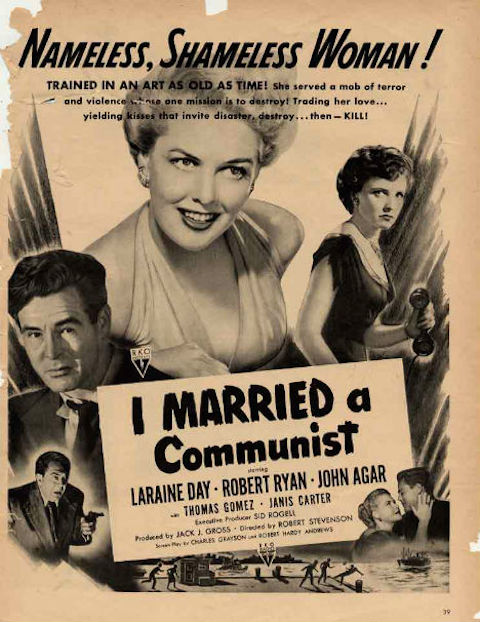
In the 50s and 60s, pop culture media like film and comic books lent themselves particularly well to anti-Communist propaganda, and they were exploited relentlessly by government agencies, production companies, and corporations. Films like I Married a Communist (below) and The Red Menace (top), both from 1949, offered sensationalized pulpy takes on the red scare.
In these peak Cold War decades, anti-Communist sentiment flourished as the U.S.’s former ally the Soviet Union became its primary enemy. Comic books provided the perfect platform for the broad strokes of anti-Communist propaganda. As psychiatrist Fredric Wertham waged war against the corrupting influence of comic books, advertisers and the government found them increasingly effective at spreading messages. “If there was any entity that believed in the power of comic books to indoctrinate and instruct as Wertham did,” writes Greg Beato at Reason, “it was the U.S. government.”
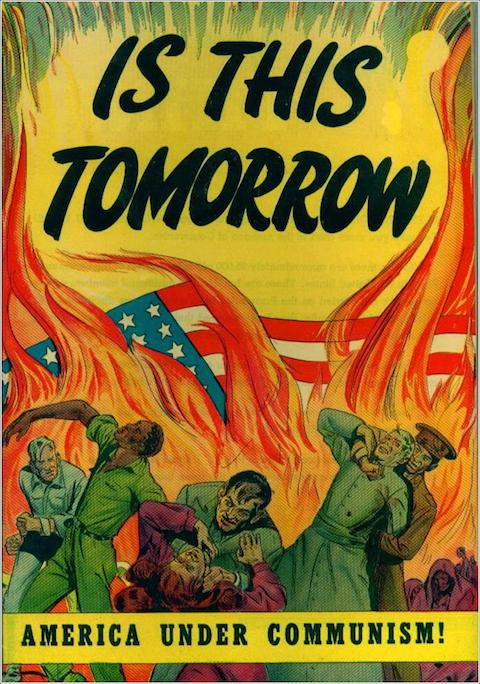
But private entities did their share in the comic book war against Communism as well. Witness a particularly wild example, Is This Tomorrow?, above. Published by the “Catechetical Guild Educational Society” in St. Paul, MN, this 1947 comic implicates government regulation of business, social welfare programs, anti-religious sentiment, and “people giving up their silly ideas about ‘sacredness’ of life” in a fiendishly orchestrated plot to take over America. Workers who embrace Communist doctrine are little more than dupes and pawns. You can read the whole feverish scenario here.
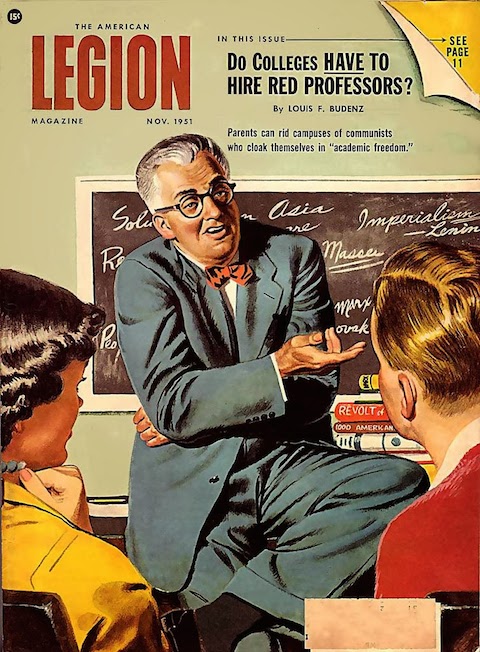
These cartoon scare tactics may seem outlandish, but of course we know that red scare propaganda had real effects on the lives and livelihoods of real Americans, particularly those in the arts and academia. Freethinking, left-leaning creative types and intellectuals have long been targets of anti-Communist paranoia. The American Legion Magazine cover above illustrates the fear—one still very prevalent now—that college professors were bent on corrupting young, malleable minds. “Parents,” the magazine states, “can rid campuses of communists who cloak themselves in ‘academic freedom.’” At the height of the red scare, many college professors, like Stanley Moore at Reed College, were dragged before the House Un-American Activities Committee and summarily fired.
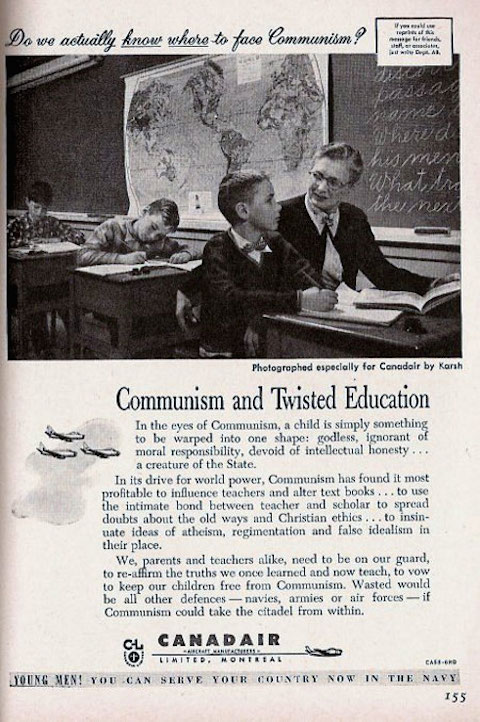
More confident, it seems, than the propaganda of previous decades, the Cold War variety shrunk the Communist threat back to human dimensions. But Communists were no less monstrous than before—only more insidious. They looked like your neighbors, your co-workers, and your children’s teacher. Instead of purveyors of brute force, they were depicted as devious manipulators who used ideological machinations to pervert democracy and cripple capitalism. As in the American Legion college professor cover story, education was often posed as the cultural battlefield on which—as the heated Canadair ad above states—“Communism could take the citadel from within” by spreading “doubts about the old ways” and insinuating “ideas of atheism, regimentation and false idealism.”

Post-WWII, of course, the greatest threat was not a full-scale invasion—it was total nuclear annihilation. It was a grim possibility—as Kubrick’s Dr. Strangelove satirically pointed out—in which no one would win. Web Urbanist points us toward one particularly chilling and dishonest piece of propaganda distributed by the government. In the poster above, we are assured that “After total war can come total living.” Unless the happy couple is gazing out over a manicured suburb in the afterlife, this scene of “total living” post-nuclear war is absurd given the strategy of Mutually Assured Destruction. Nevertheless, what the poster depicts is an analogue of the Soviets’ totalitarian ethos—it’s a future of total ideological purity, in which the Earth has been cleansed of the hulking monstrous hordes of Communism, as well as, presumably, the crypto-Communist teachers, artists, intellectuals, and bureaucrats who threaten from within.
via Web Urbanist/io9/Kuriositas
Related Content:
How to Spot a Communist Using Literary Criticism: A 1955 Manual from the U.S. Military
Soviet Artists Envision a Communist Utopia in Outer Space
The Curious Story of How Bootlegged Hollywood Movies Helped Defeat Communism in Romania
Josh Jones is a writer and musician based in Durham, NC. Follow him at @jdmagness
Read More...Download 135 Free Philosophy eBooks: From Aristotle to Nietzsche & Wittgenstein

Just wanted to give you a quick heads up that we’ve recently spun out a collection of Free Philosophy eBooks (from our larger, more diverse collection of 600 Free eBooks). Right now, you will find 110 classic works on the new list — foundational texts written by Aristotle, Descartes, Hegel and Kant, not to mention Kierkegaard, Wittgenstein and Nietzsche, too. The list will keep growing at a steady clip. But if you see any crucial texts missing, please let us know, and we will try to get them added ASAP. Of course, we’re looking for works in the public domain.
You can generally download the Free Philosophy eBooks to your Kindle, iPad, iPhone and other devices. (Kindle users can use these instructions to get .mobi files onto their devices.) Or, in most cases, we give you the option to read the books in your web browser. Take your pick.
As a quick last note, you might want to complement the Philosophy eBooks with our big list of Free Online Philosophy Courses. The two collections go hand in hand.
Follow us on Facebook, Twitter and Google Plus and share intelligent media with your friends. Or better yet, sign up for our daily email and get a daily dose of Open Culture in your inbox.
Related Content:
28 Important Philosophers List the Books That Influenced Them Most During Their College Days
The Epistemology of Dr. Seuss & More Philosophy Lessons from Great Children’s Stories
44 Essential Movies for the Student of Philosophy
Download 100 Free Philosophy Courses and Start Living the Examined Life
The Harvard Classics: A Free, Digital Collection
1,700 Free Online Courses from Top Universities
Read More...Support Us
We're hoping to rely on loyal readers, rather than erratic ads. Please click the Donate button and support Open Culture. You can use Paypal, Venmo, Patreon, even Crypto! We thank you!

About Us

Open Culture scours the web for the best educational media. We find the free courses and audio books you need, the language lessons & educational videos you want, and plenty of enlightenment in between.
Advertise With Us
FREE UPDATES!
GET OUR DAILY EMAIL
Get the best cultural and educational resources on the web curated for you in a daily email. We never spam. Unsubscribe at any time.
FOLLOW ON SOCIAL MEDIA
Open Culture editor Dan Colman scours the web for the best educational media. He finds the free courses and audio books you need, the language lessons & movies you want, and plenty of enlightenment in between.
Advertise With Us


