David Foster Wallace’s Syllabus for His 2008 Creative Nonfiction Course: Includes Reading List & Footnotes
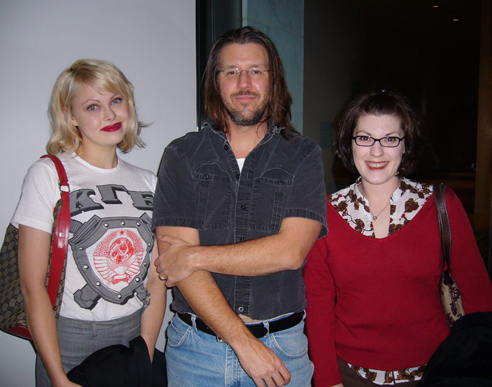
Photo courtesy of Claudia Sherman.
The term “creative nonfiction” has picked up a great deal of traction over the past decade — perhaps too much, depending upon how valid or invalid you find it. Meaningful or not, the label has come into its current popularity in part thanks to the essays of novelist David Foster Wallace: whether writing nonfictionally about the Illinois State Fair, David Lynch, professional tennis, or a seven-night Caribbean cruise, he did it in a way unlike any other man or woman of letters. While nobody can learn to write quite like him — this we’ve seen when Wallace-imitators write pastiches of their own — he did spend time teaching the art of creative nonfiction as he saw it,
a broad category of prose works such as personal essays and memoirs, profiles, nature and travel writing, narrative essays, observational or descriptive essays, general-interest technical writing, argumentative or idea-based essays, general-interest criticism, literary journalism, and so on. The term’s constituent words suggest a conceptual axis on which these sorts of prose works lie. As nonfiction, the works are connected to actual states of affairs in the world, are “true” to some reliable extent. If, for example, a certain event is alleged to have occurred, it must really have occurred; if a proposition is asserted, the reader expects some proof of (or argument for) its accuracy. At the same time, the adjective creative signifies that some goal(s) other than sheer truthfulness motivates the writer and informs her work. This creative goal, broadly stated, may be to interest readers, or to instruct them, or to entertain them, to move or persuade, to edify, to redeem, to amuse, to get readers to look more closely at or think more deeply about something that’s worth their attention… or some combination(s) of these.
This comes straight from the syllabus of English 183D, a workshop Wallace taught at Pomona College in the spring of 2008, which you can read in its entirety at Salon (reprinted from The David Foster Wallace Reader). As you may remember from the previous Wallace syllabus we featured, from a 1994 semester of English 102 — Literary Analysis I: Prose Fiction at Illinois State University, the man could really assemble a reading list. For his creative nonfiction course, he had students read Jo Ann Beard’s “Werner,” Stephen Elliott’s “Where I Slept,” George Orwell’s classic “Politics and the English Language,” Donna Steiner’s “Cold,” David Gessner’s “Learning to Surf,” Kathryn Harrison’s “The Forest of Memory,” Hester Kaplan’s “The Private Life of Skin,” and George Saunders’s “The Braindead Megaphone.”
In some ways, Wallace syllabi themselves count as pieces of creative nonfiction. What other professor ever had the prose chops to make you actually want to read anything under the “Class Rules & Procedures” heading? In the ninth of its thirteen points, he lays out the workshop’s operative belief:
that you’ll improve as a writer not just by writing a lot and receiving detailed criticism but also by becoming a more sophisticated and articulate critic of other writers’ work. You are thus required to read each of your colleagues’ essays at least twice, making helpful and specific comments on the manuscript copy wherever appropriate. You will then compose a one-to-three-page letter to the essay’s author, communicating your sense of the draft’s strengths and weaknesses and making clear, specific suggestions for revision.
But whatever the rigors of English 183D, Wallace would have succeeded, to my mind, if he’d instilled nothing more than this in the minds of his departing students:
In the grown-up world, creative nonfiction is not expressive writing but rather communicative writing. And an axiom of communicative writing is that the reader does not automatically care about you (the writer), nor does she find you fascinating as a person, nor does she feel a deep natural interest in the same things that interest you.
True to form, DFW’s syllabus comes complete with footnotes.
1 (A good dictionary and usage dictionary are strongly recommended. You’re insane if you don’t own these already.)
You can read the Creative Nonfiction syllabus in full here.
Related Content:
30 Free Essays & Stories by David Foster Wallace on the Web
David Foster Wallace’s 1994 Syllabus: How to Teach Serious Literature with Lightweight Books
David Foster Wallace Breaks Down Five Common Word Usage Mistakes in English
Colin Marshall hosts and produces Notebook on Cities and Culture and writes essays on cities, language, Asia, and men’s style. He’s at work on a book about Los Angeles, A Los Angeles Primer. Follow him on Twitter at @colinmarshall or on Facebook.
Read More...Learn The History of Philosophy in 247 Podcasts (With More to Come)
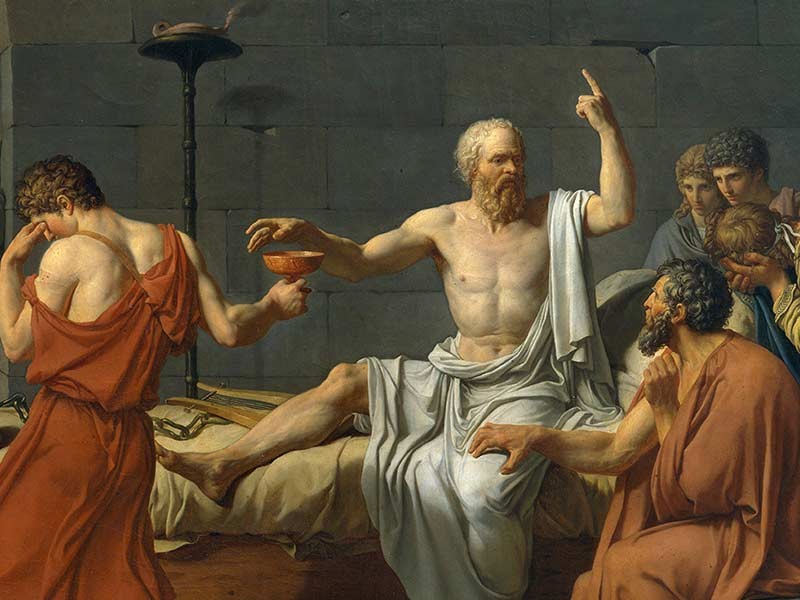
Yesterday we took a look at, or rather a listen to, the “podcasting renaissance,” highlighting a few of the new wave of shows and recommending some of the pre-existing ones you may have missed. Many Open Culture readers will remember our addiction to philosophy podcasts — The Partially Examined Life, Philosophy Bites, and Philosophize This!, to name but three of our favorites — and some may wonder if The History of Philosophy Without Any Gaps (iTunes – RSS Feed – Web Site), which we featured back in 2011 and again in 2012, survived the dark ages into which podcasting had apparently fallen. Could its host Peter Adamson, professor at Ludwig Maximilian University of Munich and King’s College London, have succumbed to the dreaded podfade somewhere between Plotnius on the soul and Christian asceticism?
Worry not, students of thought, for Adamson has continued these past few years, still regularly and gaplessly, to provide “the ideas and lives of the major philosophers as well as the lesser-known figures of the tradition.” Just this past weekend, he put up a twenty-minute episode on the Carolingian Renaissance. If you haven’t kept up with the show since we last posted about it, you’ve got a great deal of intellectually rich catching up to do. You will find more than 100 new podcasts, featuring short talks on Latin Platonism, Aristotelian philosophy’s “Baghdad school,” philosophy’s reign in Spain, Illuminationism, and women scholars and Islam. If you’ve wanted to learn the entire history philosophy in the most convenient possible manner, now’s the time to jump aboard. If you planned on waiting until Adamson gets to, say, Derrida, I fear you’ll have a bit of a daunting backlog on your hands — not to mention your ears and brain.
Note: This article was first published in November, 2014. As of February, 2016, there are 247 episodes in this series. The title of the post has been updated to reflect that.
Related Content:
The Partially Examined Life: A Philosophy Podcast
The History of Philosophy Without Any Gaps – Peter Adamson’s Podcast Still Going Strong
Philosophy Bites: Podcasting Ideas From Plato to Singularity Since 2007
Download 100 Free Philosophy Courses and Start Living the Examined Life
Take First-Class Philosophy Courses Anywhere with Free Oxford Podcasts
Colin Marshall hosts and produces Notebook on Cities and Culture and writes essays on cities, language, Asia, and men’s style. He’s at work on a book about Los Angeles, A Los Angeles Primer. Follow him on Twitter at @colinmarshall or on Facebook.
Read More...Albert Camus’ Lessons Learned from Playing Goalie: “What I Know Most Surely about Morality and Obligations, I Owe to Football”
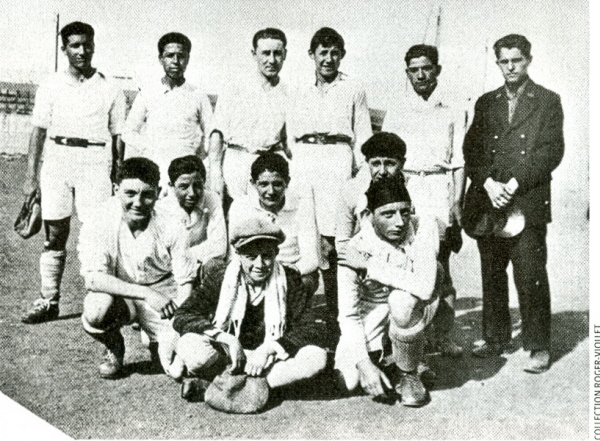
Albert Camus, born 101 years ago today, once said, “After many years in which the world has afforded me many experiences, what I know most surely in the long run about morality and obligations, I owe to football.”
He was referring to his college days when he played goalie for the Racing Universitaire Algerios (RUA) junior team. Camus was a decent player, though not the great player that legend later made him out to be. For Jim White, author of A Matter of Life and Death: A History of Football in 100 Quotations, soccer perhaps taught Camus a few things about selflessness, cooperation, bravery and resilience. That’s a sunny way of looking at things. But perhaps The Telegraph gets at the deeper, darker life lessons Camus took away from soccer:
[T]here is something appropriate about a philosopher like Camus stationing himself between the sticks [that is, in goal]. It is a lonely calling, an individual isolated within a team ethic, one who plays to different constraints. If his team scores, the keeper knows it is nothing to do with him. If the opposition score, however, it is all his fault. Standing sentinel in goal, Camus had plenty of time to reflect on the absurdist nature of his position.
And perhaps the absurdist nature of life itself…
Camus — who appears in the picture above, wearing the dark color jersey in the front row — contracted tuberculosis when he was only 18 years old. His lungs too damaged to continue playing sports, the young man turned to philosophy. When Camus moved from Algeria to France, he learned that philosophy was a rough and tumble game too — something his soccer days prepared him for. He once quipped, “I learned … that a ball never arrives from the direction you expected it. That helped me in later life, especially in mainland France, where nobody plays straight.”
Related Content:
Jorge Luis Borges: “Soccer is Popular Because Stupidity is Popular”
Video: The Day Bob Marley Played a Big Soccer Match in Brazil, 1980
Read More...Edward Snowden Explains Why He Blew the Whistle on the NSA in Video Interview with Lawrence Lessig
Most likely everything you know about Edward Snowden’s unmasking of government surveillance programs has come through an indirect source — meaning, you haven’t had the chance to learn about Snowden’s motivations, thought processes, goals, etc. from Snowden himself. Here’s a chance to change that.
In the video interview recorded on October 20th at Harvard Law School, Lawrence Lessig spent an hour talking with Snowden on a Google Hangout. Lessig, a law professor with dual interests in keeping information open and limiting government corruption, was a natural choice to conduct the interview. However, I wouldn’t say that he gives Snowden a soft interview. He asks some good questions, which gives Snowden the chance to spell out his thinking — to explain the problem he observed while working in the NSA and how he went about addressing it.
One thing that comes across is that Snowden has thought things through. Snowden might not have the credentials of the Harvard Law students in the audience — he got a GED and took a few community college courses, after all — but you get the sense that he could teach a pretty good Introduction to American Government course, if not a thought-provoking seminar on constitutional law. Regardless of what position you take on Snowden, it’s worth watching this interview before you declare final judgement.
Follow us on Facebook, Twitter and Google Plus and share intelligent media with your friends. Or better yet, sign up for our daily email and get a daily dose of Open Culture in your inbox.
Read More...
Lynda Barry, Cartoonist Turned Professor, Gives Her Old Fashioned Take on the Future of Education
With college tuitions ballooning to the point of implosion, and free educational content proliferating online, the future of education is a scorching hot topic.
So where are we heading?
Coursera and Khan Academy? Video game-based curricula? Experience-driven microlearning?
Or school buildings that moonlight as candy?
So suggested one of the younger participants in a workshop led by the University of Wisconsin’s Assistant Professor of Interdisciplinary Creativity, cartoonist and author Lynda Barry (aka Professor Long-Title).
Barry’s messianic embrace of the arts has proved popular with students of all ages. When the university’s Counterfactual Drawing Board Project invited faculty, staff, and others to consider what the “appearance, purpose, atmosphere and community of the campus” would be like in 100 years time, Barry deliberately widened the pool to include children.
Yes, their innovations tended toward volcano schools that erupt at dismissal, but presumably some of those same children will be in the vanguard when it’s time for initiatives that seem unimaginable now to be implemented. Rome wasn’t built in a day, and all that.
Or as one gimlet-eyed youth put it, in a hundred years “the teachers will all be dead.”
No wonder few adult participants can see past a button-driven, hermetically sealed, digital future wherein every student has a chip implanted in his or her head.
Barry, no stranger to depression, manages to laugh such gloomy forecasts off, despite what they portend for the tactile, handmade ephemera she reveres. A sense of humor—and humanity—is at the core of every educational reform she practices.
Rather than rip each other’s writing to shreds during in-class critiques, her students call each other by outlandish pseudonyms and draw meditative spirals as each others’ work is read aloud. Every reader is assured of a hearty “good!” from the teacher. She wants them to keep going, you see.
Surely there are institutions where this approach might not fly, but why poo-poo it? Isn’t fueling the creative spirit a practical investment in the future?
“It’s there in everybody,” Barry believes. “You have to give people an experience of it, a repeated experience of it that they generate themselves.”
Maybe someday, some kid who hasn’t had the love of learning squelched out of him or her will apply all that creativity toward curing cancer. That’d be great, huh? At worst, that carefully tended spark can give solace in the dark days ahead. As fans of Barry’s work well know, art exists to carry us through times of “sorrow and grief and trouble.”
Related Content:
Cartoonist Lynda Barry Reveals the Best Way to Memorize Poetry
Join Cartoonist Lynda Barry for a University-Level Course on Doodling and Neuroscience
Read More...IAI Academy Now Offers Free Courses: From “The Meaning of Life” to “A Brief Guide to Everything”
This month, The Institute of Art and Ideas (IAI), an organization committed to fostering “a progressive and vibrant intellectual culture in the UK,” launched IAI Academy — a new online educational platform that features courses in philosophy, science and politics. The initial lineup includes 12 courses covering everything from theoretical physics, the meaning of life, the future of feminism, the often vexed relationship between science and religion, and more.
IAI Academy offers its courses for free. But, like other course providers, they charge a nominal fee (right now about $25) if you would like a Verified Certificate when you’ve successfully completed a course. Here’s the initial lineup:
For more evergreen courses that you can download and enjoy whenever you want, don’t miss our collection, 1,700 Free Online Courses from Top Universities.
For MOOCs being provided in real-time, see our list of MOOCs from Great Universities.
Related Content:
Take First-Class Philosophy Courses Anywhere with Free Oxford Podcasts
Download 100 Free Philosophy Courses and Start Living the Examined Life
Read More...Professor Michael Stipe: R.E.M.‘s Frontman Now Teaching Art Classes at NYU

Admirers of Michael Stipe will know that he before he became a famous rock star with R.E.M., he was an art student at the University of Georgia. He may have skipped the degree, but he never stopped making things, including the photography and design of the band’s album covers, the lighting and stage design of their live shows, and several of their videos. Now a rock star emeritus, Stipe makes things full time in an official capacity as the visiting artist and scholar in residence at the NYU Steinhardt Department of Art. He has recently curated an “evolving exhibition project” called NEW SIGHTS, NEW NOISE, writes Eric Alper, “produced collaboratively with Jonathan Berger” and including “contributions from special guests Douglas Coupland, Jefferson Hack, Peaches,” and others.
Appearing at NYU’s 80 WSE Gallery, the exhibition also includes work from Stipe’s students. That’s right, Michael Stipe is a “shiny happy” college professor, as this pun-happy Spin article tells us, and the show comes from his class assignments: “Each week, Stipe and a different special guest will give the class’ 18 students a prompt, and they’ll respond with ‘100 images and gifs, both found and made, all of which will be uploaded to a private class website.’” It’s all centered around themes Stipe has pursued for some time, as you can see from his Tumblr. He describes the project on R.E.M.’s website as referring to “the glut and onslaught of information made available by the internet, often without context or authorship; the disproportionate and impulsive reactions that it provokes, and the reckless cynicism of a 24 hour news cycle.” Read much more about the project at Alper’s blog, and see much more of Stipe’s work—with sculpture, painting, and film—at the Creator’s Project video above from 2011.
photo by David Shankbone.
Related Content:
Why R.E.M.’s 1991 Out of Time May Be the “Most Politically Important Album” Ever
Two Very Early Concert Films of R.E.M., Live in ‘81 and ‘82
Josh Jones is a writer and musician based in Durham, NC. Follow him at @jdmagness.
Read More...Take Big History: A Free Short Course on 13.8 Billion Years of History, Funded by Bill Gates
Last month, The New York Times Magazine published a long piece called “So Bill Gates Has This Idea for a History Class …”, which begins with these very words:
In 2008, shortly after Bill Gates stepped down from his executive role at Microsoft, he often awoke in his 66,000-square-foot home on the eastern bank of Lake Washington and walked downstairs to his private gym in a baggy T‑shirt, shorts, sneakers and black socks yanked up to the midcalf. Then, during an hour on the treadmill, Gates, a self-described nerd, would pass the time by watching DVDs from the Teaching Company’s “Great Courses” series. On some mornings, he would learn about geology or meteorology; on others, it would be oceanography or U.S. history.
As Gates was working his way through the series, he stumbled upon a set of DVDs titled “Big History” — an unusual college course taught by a jovial, gesticulating professor from Australia named David Christian. Unlike the previous DVDs, “Big History” did not confine itself to any particular topic, or even to a single academic discipline. Instead, it put forward a synthesis of history, biology, chemistry, astronomy and other disparate fields, which Christian wove together into nothing less than a unifying narrative of life on earth.
Captivated by Dr. Christian’s ability to connect big and complex ideas, Gates thought to himself, “God, everybody should watch this thing!” And, soon enough, the philanthropist contacted the professor and suggested making “Big History” available as a course in high schools across the US (with Bill footing the bill.)
In 2011 the Big History Project, a course with a significant digital component, was piloted in five high schools. Now, a few years later, it’s being made freely available, says the Times, “to more than 15,000 students in some 1,200 schools, from the Brooklyn School for Collaborative Studies in New York to Greenhills School in Ann Arbor, Mich., to Gates’s alma mater, Lakeside Upper School in Seattle. And if all goes well, the Big History Project will be introduced in hundreds of more classrooms by next year and hundreds, if not thousands, more the year after that, scaling along toward the vision Gates first experienced on that treadmill.”
Why do I tell you this? Partly because the Big History Project is open to you as well. On the Big History website, you will find a public course, offering a four-to-six hour tour of Big History. It’s an abbreviated introduction to 13.8 billion years of history. I could think of less efficient ways to spend an afternoon.
After you’re done, if you want to fill in a few gaps, don’t miss our collection: 1,700 Free Online Courses from Top Universities. It covers history, biology, physics and all of the rest.
Related Content:
The History of the World in 46 Lectures From Columbia University
Free Download of The History Manifesto: Historians New Call for Big-Picture Thinking
Download 78 Free Online History Courses: From Ancient Greece to The Modern World
Read More...The 430 Books in Marilyn Monroe’s Library: How Many Have You Read?
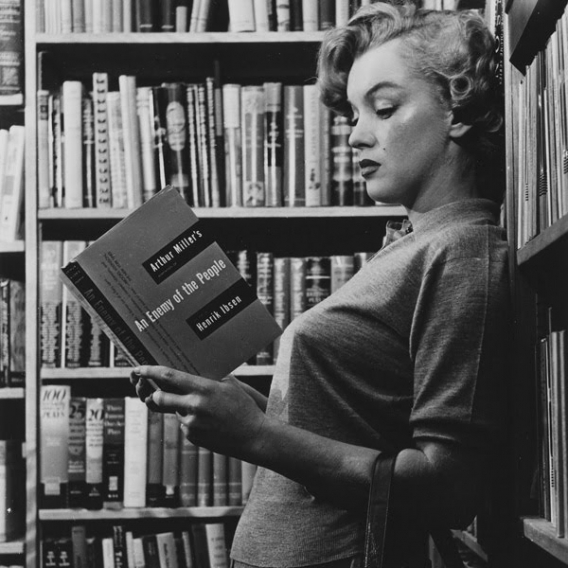
If you’re a reader and user of social media, you’ve likely tested your lifetime reading list against the BBC Book Quiz.
Or perhaps you’ve allowed your worth as a reader to be determined by the number of Pulitzer Prize winners you’ve made it through.
The National Endowment for the Arts’ Big Read, anyone?
The 142 Books that Every Student of English Literature Should Read?
The 50 Best Dystopian Novels?
Being young is no excuse! Not when the American Library Association publishes an annual list of Outstanding Books for the College Bound and Lifelong Learners.
So… how’d you do? Or should I say how’d you do in comparison to Marilyn Monroe? The online Monroe fan club Everlasting Star used photographs, interviews, and a Christie’s auction catalogue to come up with a list of more than 400 books in her possession.
Did she read them all? I don’t know. Have you read every single title on your shelves? (There’s a Japanese word for those books. It’s Tsundoku.)
Feminist biographer Oline Eaton has a great rant on her Finding Jackie blog about the phrase “Marilyn Monroe reading,” and the 5,610,000 search engine results it yields when typed into Google:
There is, within Monroe’s image, a deeply rooted assumption that she was an idiot, a vulnerable and kind and loving and terribly sweet idiot, but an idiot nonetheless. That is the assumption in which ‘Marilyn Monroe reading’ is entangled.
The power of the phrase Marilyn Monroe reading’ lies in its application to Monroe and in our assumption that she wouldn’t know how.
Would that everyone searching that phrase did so in the belief that her passion for the printed word rivaled their own. Imagine legions of geeks loving her for her brain, bypassing Sam Shaw’s iconic subway grate photo in favor of home printed pin ups depicting her with book in hand.
Commemorative postage stamps are nice, but perhaps a more fitting tribute would be an ALA poster. Like Eaton, when I look at that image of Marilyn hunched over James Joyce’s Ulysses (or kicking back reading Walt Whitman’s Leaves of Grass), I don’t see someone trying to pass herself off as something she’s not. I see a high school dropout caught in the act of educating herself. If I saw it taped to a library shelf emblazoned with the word “READ,” I might just summon the resolve to take a stab at Ulysses myself. (I know how it ends, but that’s about it.)
See below, dear readers. Apologies that we’re not set up to keep track of your score for you, but please let us know in the comments section if you’d heartily second any of Marilyn’s titles, particularly those that are lesser known or have faded from the public view.
Marilyn Monroe’s Reading Challenge
(Thanks to Book Tryst for compiling Everlasting Star’s findings)
1) Let’s Make Love by Matthew Andrews (novelization of the movie)
2) How To Travel Incognito by Ludwig Bemelmans
3) To The One I Love Best by Ludwig Bemelmans
4) Thurber Country by James Thurber
5) The Fall by Albert Camus
6) Marilyn Monroe by George Carpozi
7) Camille by Alexander Dumas
8) Invisible Man by Ralph Ellison
9) The Boston Cooking-School Cook Book by Fannie Merritt-Farmer
10) The Great Gatsby by F Scott Fitzgerald
11) From Russia With Love by Ian Fleming
12) The Art Of Loving by Erich Fromm
13) The Prophet by Kahlil Gilbran
14) Ulysses by James Joyce
15) Stoned Like A Statue: A Complete Survey Of Drinking Cliches, Primitive, Classical & Modern by Howard Kandel & Don Safran, with an intro by Dean Martin (a man who knew how to drink!)
16) The Last Temptation Of Christ by Nikos Kazantzakis
17) On The Road by Jack Kerouac
18) Selected Poems by DH Lawrence
19 and 20) Sons And Lovers by DH Lawrence (2 editions)
21) The Portable DH Lawrence (more…)
Read More...Peter Thiel’s Stanford Course on Startups: Read the Lecture Notes Free Online
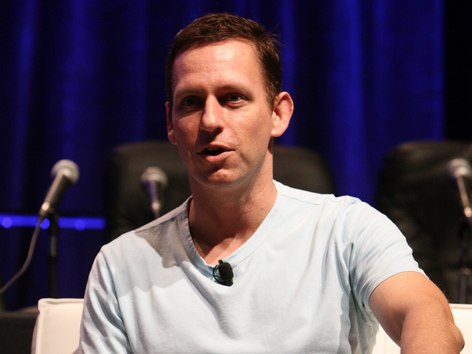
Peter Thiel has many claims to fame in Silicon Valley. He co-founded PayPal in 1998, before selling it to eBay for $1.5 billion in 2002. He later launched various hedge funds, and made early investments in Facebook. He’s an unabashed libertarian, a proponent of Seasteading and Singularity, a critic of the American university system, and the creator of the annual Thiel Fellowship, which pays promising college-age students to “stop out” of school for two years and launch business ventures instead.
Finally, Thiel is also now the bestselling author of Zero to One: Notes on Startups, or How to Build the Future. Published in mid-September, the book received a pretty rave review in The Atlantic, where Derek Johnson calls it “a lucid treatise on capitalism and entrepreneurship” and perhaps “the best business book I’ve read.”
The book itself is actually a distillation of thoughts Thiel presented in a course he taught at Stanford in 2012. And it just so happens that the notes from that course — CS138 Startups — are freely available online. They come courtesy of Blake Masters, a student in Thiel’s class, who later helped the entrepreneur write Zero to One.
Below, you can find the lecture notes for 19 classes, which, when originally published on Masters’ site, became pretty popular in the tech community. Links to these lectures will be permanently housed in our collections of Free Online Business Courses and Free Online Computer Science Courses. Other Stanford courses on entrepreneurship can be found here: Start Your Startup with Free Stanford Courses and Lectures.
Lectures Notes: CS138 Startups
Class 1: The Challenge of the Future
Class 2: Party Like it’s 1999?
Class 4: The Last Mover Advantage
Class 5: The Mechanics of Mafia
Class 9: If You Build It, Will They Come?
Class 13: You Are Not A Lottery Ticket
Class 16: Decoding Ourselves
Class 18: Founder as Victim, Founder as God
Class 19: Stagnation or Singularity?
For a huge collection of free courses, please see our large and ever-expanding collection: 1,700 Free Online Courses from Top Universities.
Read More...Support Us
We're hoping to rely on loyal readers, rather than erratic ads. Please click the Donate button and support Open Culture. You can use Paypal, Venmo, Patreon, even Crypto! We thank you!

About Us

Open Culture scours the web for the best educational media. We find the free courses and audio books you need, the language lessons & educational videos you want, and plenty of enlightenment in between.
Advertise With Us
FREE UPDATES!
GET OUR DAILY EMAIL
Get the best cultural and educational resources on the web curated for you in a daily email. We never spam. Unsubscribe at any time.
FOLLOW ON SOCIAL MEDIA
Open Culture editor Dan Colman scours the web for the best educational media. He finds the free courses and audio books you need, the language lessons & movies you want, and plenty of enlightenment in between.
Advertise With Us

