Read 14 Great Banned & Censored Novels Free Online: For Banned Books Week 2014
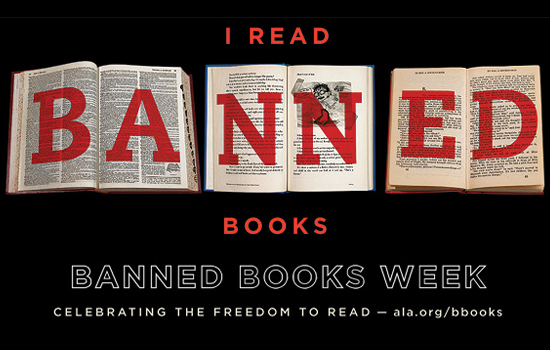
We well know of the most famous cases of banned books: James Joyce’s Ulysses, Henry Miller’s Tropic of Cancer, Allen Ginsberg’s Howl. In fact, a full 46 of Modern Library’s “100 Best Novels” have been suppressed or challenged in some way. The American Library Association maintains a page that details the charges against each one. Harper Lee’s To Kill a Mockingbird saw a challenge in the Vernon Verona Sherill, New York school district in 1980 as a “filthy, trashy novel” and in 1996, Lindale, Texas banned it from the advanced placement English reading list because it “conflicted with the values of the community.” Steinbeck’s Grapes of Wrath has a lengthy rap sheet, including total banning in Ireland (1953), Morris, Manitoba (1982), and all high school classes in Kanawha, Iowa (1980). The list of censored undisputed classics—every one of which surely has its own piece of giant store art in Barnes & Nobles nationwide—goes on.
In many ways this is typical. “The banned books lists you’ll find in many libraries and bookstores,” writes John Mark Ockerbloom at Everybody’s Libraries, “doesn’t [sic] focus much on the political samizdat, security exposés, or portrayals of Mohammed that are the objects of forcible suppression today. Instead, they’re often full of classics and popular titles sold widely in bookstores and online—or dominated by books written for young readers, or assigned for school reading.” Are these lists—and the banned books celebrations that occasion them—just “shameless propaganda” as conservative Thomas Sowell alleges? “Is it wrong to call these books banned?” asks Ockerbloom in his essay “Why Banned Books Week Matters.” Of course he answers in the negative; “not if you take readers seriously. An unread book, after all, has as little impact as an unpublished book.” Books that don’t pass muster with administrators, school boards, library associations, and legislators of all kinds, argues Ockerbloom, can be as inaccessible to young readers as those that get destroyed or fully suppressed in parts of the world without legal provisions for free speech.
This situation is in great part remediated by the free availability of texts on the internet, whether those currently under a ban or those that—even if they line the shelves in brick and mortar stores and Amazon warehouses—still meet with frequent challenges from community organizations eager to control what their citizens read. Today, in honor of this year’s Banned Books Week, we bring you free online texts of 14 banned books that appear on the Modern Library’s top 100 novels list. Next to each title, see some of the reasons these books were challenged, banned, or, in many cases, burned.
- The Great Gatsby, by F. Scott Fitzgerald (Read Online)
This staple of high school English classes everywhere seems to mostly get a pass. It did, however, see a 1987 challenge at the Baptist College in Charleston, SC for “language and sexual references.”
- Ulysses, by James Joyce (Read Online)
Seized and burned by postal officials in New York when it arrived stateside in 1922, Joyce’s masterwork generally goes unread these days because of its legendary difficulty, but for ten years, until Judge John Woolsey’s decision in its favor in 1932, the novel was only available in the U.S. as a bootleg. Ulysses was also burned—and banned—in Ireland, Canada, and England.
- 1984, by George Orwell (Read Online)
Orwell’s totalitarian nightmare often seems like one of the very few things liberals and conservatives can agree on—no one wants to live in the future he imagines. Nonetheless, the novel was challenged in Jackson County, Florida in 1981 for its supposedly “pro-communist” message, in addition to its “explicit sexual matter.”
- Animal Farm, by George Orwell (Read Online)
Again the target of right-wing ire, Orwell’s work was challenged in Wisconsin in 1963 by the John Birch Society, who objected to the words “masses will revolt.” A 1968 New Survey found that the novel regularly appeared on school lists of “problem books.” The reason most often cited: “Orwell was a communist.”
- Slaughterhouse Five, by Kurt Vonnegut (Audio)
Vonnegut’s classic has been challenged by parents and school boards since 1973, when it was burned in Drake, North Dakota. Most recently, it’s been removed from a sophomore reading list at the Coventry, RI high school in 2000; challenged by an organization called LOVE (Livingstone Organization for Values in Education) in Howell, MI in 2007; and challenged, but retained, along with eight other books, in Arlington Heights, IL in 2006. In that case, a school board member, “elected amid promises to bring her Christian beliefs into all board decision-making, raised the controversy based on excerpts from the books she’d found on the internet.” Hear Vonnegut himself read the novel here.
- The Call of the Wild, by Jack London (Read Online)
London’s most popular novel hasn’t seen any official suppression in the U.S., but it was banned in Italy and Yugoslavia in 1929. The book was burned in Nazi bonfires in 1933; something of a historical irony given London’s own racist politics.
- The Jungle, by Upton Sinclair (Read Online)
The Nazis also burned Sinclair’s novel because of the author’s socialist views. In 1959, East Germany banned the book as “inimical to communism.”
- Lady Chatterley’s Lover, by D.H. Lawrence (Read Online)
Lawrence courted controversy everywhere. Chatterly was banned by U.S. customs in 1929 and has since been banned in Ireland (1932), Poland (1932), Australia (1959), Japan (1959), India (1959), Canada (1960) and, most recently, China in 1987 because it “will corrupt the minds of young people and is also against the Chinese tradition.”
- In Cold Blood, by Truman Capote (Read First Section Online)
This true crime classic was banned, then reinstated, at Savannah, Georgia’s Windsor Forest High School in 2000 after a parent “complained about sex, violence, and profanity.”
- Sons and Lovers, by D.H. Lawrence (Read Online)
Lawrence endured a great deal of persecution in his lifetime for his work, which was widely considered pornographic. Thirty years after his death, in 1961, a group in Oklahoma City calling itself Mothers Unite for Decency “hired a trailer, dubbed it ‘smutmobile,’ and displayed books deemed objectionable,” including Sons and Lovers.
- Naked Lunch, by William S. Burroughs (Audio)
If anyone belongs on a list of obscene authors, it’s Burroughs, which is only one reason of the many reasons he deserves to be read. In 1965, the Boston Superior Court banned Burroughs’ novel. The State Supreme Court reversed that decision the following year. Listen to Burroughs read the novel here.
- Women in Love, by D.H. Lawrence (Read Online)
Poor Lawrence could not catch a break. In one of many such acts against his work, the sensitive writer’s fifth novel was declared obscene in 1922 by the rather unimaginatively named New York Society for the Suppression of Vice.
- An American Tragedy, by Theodore Dreiser (Read Online)
American literature’s foremost master of melodrama, Dreiser’s novel was banned in Boston in 1927 and burned by the Nazi bonfires because it “deals with low love affairs.”
You can learn much more about the many books that have been banned, suppressed, or censored at the University of Pennsylvania’s “Banned Books Online” page, and learn more about the many events and resources available for Banned Books Week at the American Library Association’s website.
Related Content:
74 Free Banned Books (for Banned Books Week)
Allen Ginsberg Reads His Famously Censored Beat Poem, Howl (1959)
Josh Jones is a writer and musician based in Durham, NC. Follow him at @jdmagness.
Read More...Let’s Learn Japanese: Two Classic Video Series to Get You Started in the Language
Say the name “Yan-san” to anyone who’s studied Japanese in the last thirty years, and you’ll probably get a reaction of delighted recognition. It means that, inside or outside the classroom, they studied with Let’s Learn Japanese, a series of educational videos produced by the Japan Foundation. The first “season,” if you like, came out in 1984, the time of an enormous Asian economic bubble that made the world’s future look Japanese, sending the language straight to the top of every international business-minded student’s to-do-list. (Sound familiar, current strugglers with Mandarin?) Its hero, a young man of deliberately ambiguous nationality named Yan — the Japanese all address him with the everyday honorific -san — turns up in Japan for a few years of life in Tokyo and works at an architecture firm, helped along by his host family the Katos, his eagerly team-playing co-workers (one of whom introduces himself, in English, with the phase, “We are friends — okay?”), and a variety of helpful citizens and professionals all across the Land of the Rising Sun.
This may sound like dull stuff — the stuff of run-of-the-mill language-learning videos — but Let’s Learn Japanese raised the bar for this sort of thing, in terms of not just production value and teaching effectiveness but sheer rewatchability. In addition to Yan-san’s life among the Japanese people, Let’s Learn Japanese also offers instructional segments led by Mary Althaus, still a professor at Tokyo’s Tsuda College, and imaginative illustrative skits performed by the indefatigable trio of Mine, Kaihō, and Sugihara. In the more advanced Season 2, released over a decade later in 1995, they’ve become the eerily similar Kodama, Andō, and Koyanagi, and Yan-san has become a graduate student with girlfriend troubles. Having watched all 52 episodes several times through, I can vouch for both its entertainment value and its effectiveness. (It also spurred me to start volunteering at the Japan Foundation, Los Angeles.) So can the foreigners who give a hero’s welcome to star Nick Muhrin (who, last I heard, still lives in Japan) when they run into him. I know I’ve learned enough to buy Yan-san a drink.
You can find more useful Japanese-learning materials to supplement all this in our archive of free language lessons. It includes resources ranging from the Foreign Service Institute’s digitized textbooks and tapes to podcasts like the life abroad-oriented Japanesepod101 [iTunes Free — Feed] and the anime-geared Japancast [iTunes Free — Feed]. 皆さんがんばって!
Related Content:
Learn 48 Languages Online for Free: Spanish, Chinese, English & More
Woody Allen Lives the “Delicious Life” in Early-80s Japanese Commercials
Wim Wenders Visits, Marvels at a Japanese Fake Food Workshop
Colin Marshall hosts and produces Notebook on Cities and Culture and writes essays on cities, language, Asia, and men’s style. He’s at work on a book about Los Angeles, A Los Angeles Primer. Follow him on Twitter at @colinmarshall or on Facebook.
Read More...A Crash Course on Psychology: A 30-Part Video Series from Hank Green
Novelist, educator, and vlogger John Green has drawn a lot of press lately, including but not limited to a New Yorker profile by Margaret Talbot, in the wake of the film version of his popular young-adult novel The Fault in Our Stars. But we here at Open Culture can say we featured him before that magazine of cultural record did: in 2012 we posted his Crash Course in World History, and last October, his Crash Course on Literature. If you keep up with this site, you probably know Green less as a coming-of-age-tragedy-writing “teen whisperer” (in the words of the New Yorker) than as the mile-a-minute, constantly wisecracking, but nevertheless wholesome teacher you never had. You may not know that he has an equally educational brother named Hank, who first came to internet prominence in a back-and-forth video series of John’s devising called Vlogbrothers, which Talbot describes as “less a conversation than an extended form of parallel play.”
Now you can find Hank, possessed of a similarly fast and funny delivery style, prepared to inform you on a whole range of other subjects, teaching crash courses just like John does. At the top of the post, we have his 30-part Crash Course in Psychology, in which he covers everything about the study of the human mind from sensation and perception to the theory of the homunculus to remembering and forgetting to language to depression. (You can watch the series from start to finish above.) Psychology has long ranked among the most popular undergraduate majors in American universities, and given humanity’s ever-increasing curiosity (and gradually accumulating knowledge) about the workings of its brains, that shouldn’t come as a surprise. But those of us who felt compelled to pick a more “practical” course of study back in college, can now turn to Hank Green, who offers us a surprisingly thorough psychological grounding with only about five hours of “lecturing” — much less than the major would have taken us, and with many more corny jokes. Perhaps the course will help you understand why we laugh at them anyway.
Related Content:
Free Online Psychology Courses
A Crash Course in World History
How To Think Like a Psychologist: A Free Online Course from Stanford
Colin Marshall hosts and produces Notebook on Cities and Culture and writes essays on cities, language, Asia, and men’s style. He’s at work on a book about Los Angeles, A Los Angeles Primer. Follow him on Twitter at @colinmarshall or on Facebook.
Read More...“The Civil War and Reconstruction,” a New MOOC by Pulitzer-Prize Winning Historian Eric Foner
It ended in early April 149 years ago. But it begins again on Wednesday. Columbia University’s “The Civil War and Reconstruction,” the latest salvo in the MOOC wars, opens Wednesday, September 17, for free to the world – a 27-week series of three courses on the nonprofit edX platform taught by Eric Foner, the university’s Pulitzer-Prize winning history professor and one of the world’s leading experts on 19th-century America. You can enroll for free here.
“If you want to know where the world you’re living in today comes from,” Foner says in the series promotional trailer, “you need to know about the Civil War era.“ Headline issues of the moment – black-white race relations first among them, but also more general issues of equal justice under law, the power and proper role of government, and how lawmakers should deal with extremism, terror, and violence – all find roots in this conflict and its aftermath, a four-year war that saw approximately 700,000 Americans killed, and scores more injured, at the hands of their countrymen.
Foner’s general history books on the subject have sold thousands of copies – his new work on the underground railroad publishes in January – and he’s the author of the leading American history textbook taught in U.S. high schools. He’s crossed over from academe into mainstream media in other ways – with appearances on The Daily Show with John Stewart, The Colbert Report, The Charlie Rose Show, Bill Moyers’s Journal, and more.
Columbia’s effort in free history education on screen dates back decades – as Foner makes clear in the promo video. Columbia’s history professors Richard Hofstadter and James Patrick Shenton reached thousands of people in their books and lectures, with Shenton even teaching a 76-part survey course on WNET Public Television called “The Rise of the American Nation” – which premiered in 1963! But many of the great lecturers from this university – literary critics and scholars Jacques Barzun and Lionel Trilling, art historian Meyer Shapiro, and others – were never filmed systematically, and Foner, who will formally retire from teaching in a few years, was determined to ensure his courses were recorded, well-produced, and preserved for posterity – and available as educational resources to all.
The series, generously supported by Columbia’s provost, historian John Coatsworth, is produced by the Columbia Center for New Media Teaching and Learning (CCNMTL), coincidentally celebrating its 15th anniversary this year. It’s the university’s first set of online courses on edX, after more than a dozen MOOCs on Coursera – and with more to come on both. The course promises some tantalizing new perspectives on the world then and now – as the two highlights reels show above.
Come & enlist – oops! — that is, enroll – today!
Peter B. Kaufman works at the Columbia Center for New Media Teaching and Learning and is Executive Producer of Intelligent Television and YouTube’s Intelligent Channel.
Related Content:
The History of the World in 46 Lectures From Columbia University
Download 78 Free Online History Courses: From Ancient Greece to The Modern World
Read More...Flannery O’Connor Explains the Limited Value of MFA Programs: “Competence By Itself Is Deadly”

Flannery O’Connor once wrote, “because fine writing rarely pays, fine writers usually end up teaching, and the [MFA] degree, however worthless to the spirit, can be expected to add something to the flesh.” That phrase “worthless to the spirit” contains a great deal of the negative attitude O’Connor expressed toward the institutionalization of creative writing in MFA programs like the one she helped make famous at the University of Iowa. The verbiage comes from an essay she wrote for the alumni magazine of the Georgia College for Women after completing her degree in 1947, quoted in the Chad Harbach-edited collection of essays MFA vs. NYC. Although fresh from the program, O’Connor was already on her way to literary success, having published her first story, “The Geranium,” the year previous and begun work on her first novel, Wise Blood. Nevertheless, her insights on the MFA are not particularly sanguine.
On the one hand, she writes with characteristic dark humor, writing programs can serve as alternatives to “the poor house and the mad house.” In graduate school, “the writer is encouraged or at least tolerated in his odd ways.” An MFA program may offer some small respite from the loneliness and hardship of the writing life, and ultimately provide a credential to be “pronounced upon by his future employers should they chance to be of the academy.” But the time and effort (not to mention the expense, unless one is fully funded) may not be worth the cost, O’Connor suggests. Her own program at Iowa was “designed to cover the writer’s technical needs […], and to provide him with a literary atmosphere which he would not be able to find elsewhere. The writer can expect very little else.”
Later, in her collection of essays Mystery and Manners, O’Connor expressed similar sentiments. Concluding a lengthy discussion on the very limited role of the teacher of creative writing, she concludes that “the teacher’s work is largely negative […] a matter of saying ‘This doesn’t work because…’ or ‘This does work because….’” Remarking on the common observation that universities stifle writers, O’Connor writes, “My opinion is that they don’t stifle enough of them. There’s many a best-seller that could have been prevented by a good teacher.” Creative writing teachers may nod their heads in agreement, and shake them in frustration. But we should return to that phrase “worthless to the spirit,” for while MFA programs may turn out “competent” writers of fiction, O’Connor admits, they cannot produce “fine writing”:
In the last twenty years the colleges have been emphasizing creative writing to such an extent that you almost feel that any idiot with a nickel’s worth of talent can emerge from a writing class able to write a competent story. In fact, so many people can now write competent stories that the short story as a medium is in danger of dying of competence. We want competence, but competence by itself is deadly. What is needed is the vision to go with it, and you do not get this from a writing class.
O’Connor probably overestimates the degree to which “any idiot” can learn to write with competence, but her point is clear. She wrote these words in the mid-fifties, in an essay titled “The Nature and Aim of Fiction.” As Harbach’s new essay collection demonstrates, the debate about the value of MFA programs—which have expanded exponentially since O’Connor’s day—has not by any means been settled. And while there are certainly those writers, she notes wryly, who can “learn to write badly enough” and “make a great deal of money,” the true artist may be in the same position after the MFA as they were before it, compelled to “chop a path in the wilderness of his own soul; a disheartening process, lifelong and lonesome.”
Related Content:
William S. Burroughs Teaches a Free Course on Creative Reading and Writing (1979)
Flannery O’Connor: Friends Don’t Let Friends Read Ayn Rand (1960)
Flannery O’Connor Reads ‘Some Aspects of the Grotesque in Southern Fiction’ (c. 1960)
Flannery O’Connor’s Satirical Cartoons: 1942–1945
Josh Jones is a writer and musician based in Durham, NC. Follow him at @jdmagness
Read More...Tap Into Timeless Wisdom: Download 36 Free Courses in Ancient History, Literature & Philosophy
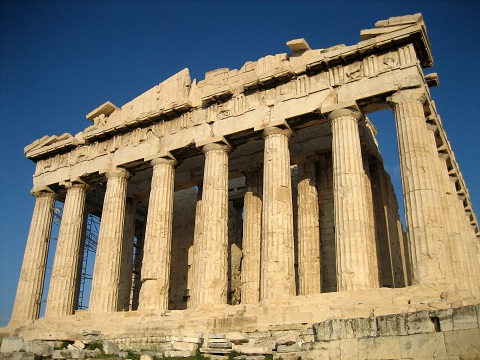
I know, it’s a dated reference now, but since I still watch the remade Battlestar Galactica series on Netflix, the mystical refrain—“All of this has happened before and will happen again”–still seems fresh to me. At any rate, it’s fresher than the clichéd “history repeats itself.” However you phrase it, the truism looks more and more like a genuine truth the more one studies ancient history, literature, and philosophy. The conflicts and concerns that feel so of the moment also occupied the minds and lives of people living hundreds, and thousands, of years ago, and whatever you make of that, it certainly helps put the present into perspective. Can we benefit from studying the wisdom, and the folly, of the ancients? To this question, I like to turn to an introductory essay C.S. Lewis penned to the work of a certain church father:
Every age has its own outlook. It is specially good at seeing certain truths and specially liable to make certain mistakes. We all, therefore, need the books that will correct the characteristic mistakes of our own period. And that means the old books. […] If we read only modern books […] where they are true they will give us truths which we half knew already. Where they are false they will aggravate the error with which we are already dangerously ill. The only palliative is to keep the clean sea breeze of the centuries blowing through our minds, and this can be done only by reading old books.
I may disagree with Lewis about many things, including that “clean sea breeze” of history, but I take to heart his point about reading the ancients to mitigate our modern biases and shine light on our blind spots. To that end, we present links to several excellent online courses on the ancients from institutions like Yale, NYU, and Stanford, free to peruse or take in full. See our master list—Free Courses in Ancient History, Literature & Philosophy—for 36 quality offerings. As always, certain courses provide more resources than others, and a few only offer their lectures through iTunes. These are decisions course administrators have made, not us! Even so, these free resources are invaluable to those wishing to acquaint, or reacquaint, themselves with the study of ancient humanities.
You can, for example, take a course on Ancient Israel from NYU’s Daniel Fleming (Free Online Video & Course Info — Free Online Video), study Plato’s Laws with the renowned Leo Strauss from the University of Chicago (Free Online Audio) or Socrates ( Free Online Audio) with that university’s equally renowned Alan Bloom. Take a course called “Ancient Wisdom and Modern Love” (Syllabus - Free iTunes Video — Free Online Video) with Notre Dame’s David O’Connor or study Virgil’s Aeneid ( Free iTunes Audio) with Susanna Braund, whose lectures were recorded at Stanford Continuing Studies. You’ll find many more ancient history, lit, and philosophy classes—36 in all, including five more Leo Strauss Plato seminars—on our meta list: Free Courses in Ancient History, Literature & Philosophy. Read, study, repeat.
Related Content:
Download 55 Free Online Literature Courses: From Dante and Milton to Kerouac and Tolkien
Learn 47 Languages Online for Free: Spanish, Chinese, English & More
Italo Calvino Offers 14 Reasons We Should Read the Classics
Josh Jones is a writer and musician based in Durham, NC. Follow him at @jdmagness
Read More...Hear Roland Barthes Present His 40-Hour Course, La Préparation du roman, in French (1978–80)
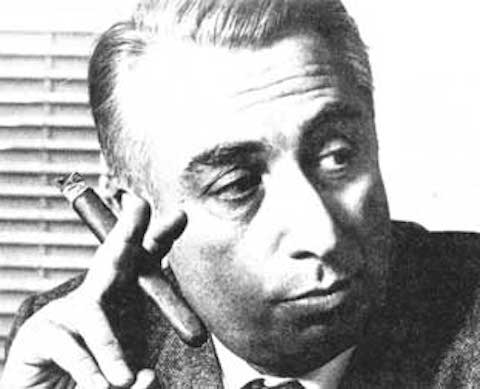
A key figure in such academic areas as semiology, structuralism, and post-structuralism, and author of such theoretical classics as Mythologies, The Pleasure of the Text, and S/Z, Roland Barthes is familiar to students across the humanities. His prolific output encompassed books on literary theory, philosophy, linguistics, anthropology, and theoretical essays on photography, music, fashion, sports, and love. In addition to his wide-ranging writings, Barthes lectured in the U.S., Switzerland, and at the Collège de France, where he was elected Chair of Semiology in 1977.
Barthes’ 1978–1980 lecture course at the Collège de France—titled The Preparation of the Novel—has been preserved in an English translation by Kate Briggs. Speakers of French, however, can hear Barthes himself deliver the lecture series in audio archived at Ubuweb. Listen to the first session from December, 1978 at the top of the post, and hear the fifth, with some musical accompaniment, above.
Delivered shortly after publication of the seminal texts mentioned above, these lectures, writes editor Nathalie Léger in her introduction, “form a diptych—the two parts can be accessed independently of each other, yet each one is indispensable to the other.” The last two lecture courses Barthes taught at the Collège de France, both, Léger writes, represent not a systematic theory, but “the peregrination of a quest,” exploring “one question and one question only: that of literary utopia.” Such probing investigations propelled Barthes’ entire career, and opened up new critical paths for a great many thinkers who dared to trace his winding intellectual steps and often intensely personal explorations.
La Préparation du roman will be added to our list of Free Online Literature Courses, part of our larger collection, 1,700 Free Online Courses from Top Universities.
Related Content:
Susan Sontag Lectures On Literary Pornography (1964)
Walter Kaufmann’s Classic Lectures on Nietzsche, Kierkegaard and Sartre (1960)
Josh Jones is a writer and musician based in Durham, NC. Follow him at @jdmagness
Read More...The First Animations of Mike Judge, Creator of Beavis and Butt-head & Office Space (1991)
Mike Judge first became famous for creating the crude and crudely drawn cartoon series Beavis and Butt-head (find complete episodes online here). The show was about two high school burnouts whose running commentary on the latest music videos was so boneheaded and baldly vulgar that you couldn’t help but laugh. Prissy culture warriors pointed to the show as yet another symptom of America’s decline while legions of stoned college students gleefully tuned in. In 1998, Judge made the jump to live action features with Office Space, a hilarious, if uneven, take on the banalities of American corporate culture. It’s one of those movies that no one saw in the theater but, thanks to cable, everyone of a certain age can quote. (“If you can come in on Saturday, that would be great.”) Currently, he is the creator for the hit HBO series Silicon Valley.
Judge started in animation after working for a spell as first a computer programmer and then a blues bassist. After seeing an animation cel on display in a local movie theater in 1989, he ran out and bought a Bolex 16mm camera and started making movies. Two years later, he was producing odd, thoroughly unpolished animated shorts that made the rounds in film festivals, eventually launching a career in Hollywood.
Above is a short about Milton, the nebbish stapler-obsessed cubicle dweller who was the genesis for Office Space. Stephen Root played him in the movie. His boss is the same passive-aggressive prick as in the movie though played with less unctuous zeal as Gary Cole’s performance. The short proved to be such a success that MTV’s Liquid Television ordered more.
Next is The Honky Problem, about an emotionally unbalanced country singer named ‘Inbred Jed.’ He wants you to know that he is really, really, really happy to be playing at a remote trailer parker populated by a bunch of characters out of a David Lynch movie. In fact, if it weren’t for the jokey voice over at the end, this short is creepy enough to almost pass for an episode of Lynch’s own animated series, Dumbland.
And there’s this short also from 1991 called simply Huh?, which pits the shrill against the oblivious.
You can find more Animations in our collection, 4,000+ Free Movies Online: Great Classics, Indies, Noir, Westerns, Documentaries & More.
Related Content:
Dumbland, David Lynch’s Twisted Animated Series (NSFW)
Watch All of Terry Gilliam’s Monty Python Animations in a Row
Tim Burton’s The World of Stainboy: Watch the Complete Animated Series
Jonathan Crow is a Los Angeles-based writer and filmmaker whose work has appeared in Yahoo!, The Hollywood Reporter, and other publications. You can follow him at @jonccrow.
Read More...Sun Ra’s Full Lecture & Reading List From His 1971 UC Berkeley Course, “The Black Man in the Cosmos”
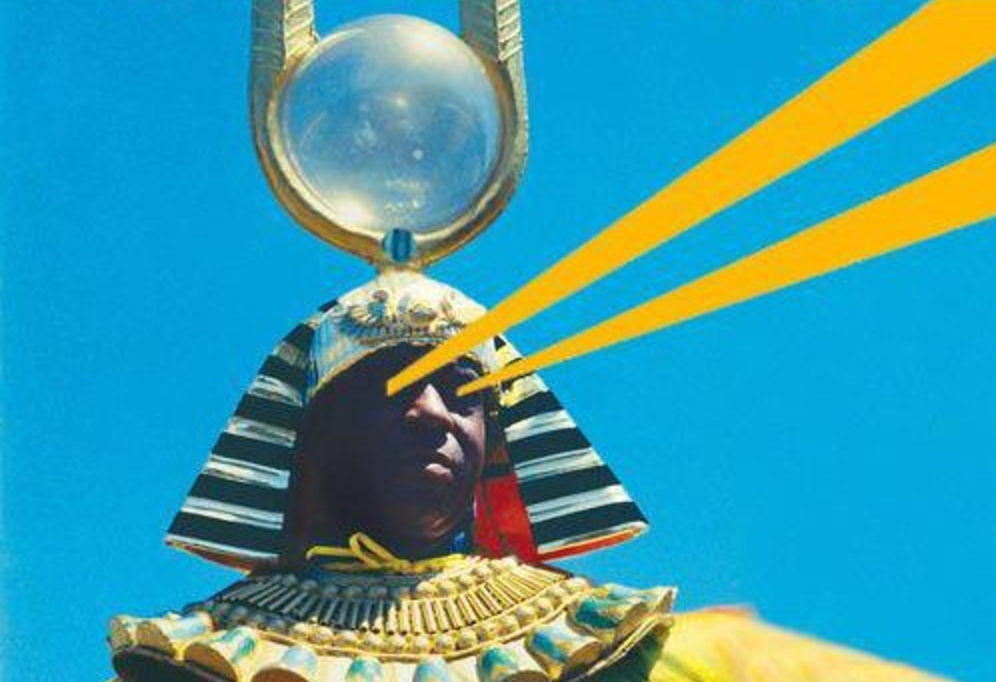
A pioneer of “Afrofuturism,” bandleader Sun Ra emerged from a traditional swing scene in Alabama, touring the country in his teens as a member of his high school biology teacher’s big band. While attending Alabama Agricultural and Mechanical University, he had an out-of-body experience during which he was transported into outer space. As biographer John Szwed records him saying, “my whole body changed into something else. I landed on a planet that I identified as Saturn.” While there, aliens with “little antenna on each ear. A little antenna on each eye” instructed him to drop out of college and speak through his music. And that’s just what he did, changing his name from Herman Blount and never looking back.
Whether you believe that story, whether Sun Ra believes it, or whether his entire persona is a theatrical put-on should make no difference. Because Sun Ra would be a visionary either way. Combining Afrocentric science fiction, esoteric and occult philosophy, Egyptology, and, with his “Arkestra,” his own brand of free jazz-futurism that has no equal on earth, the man is truly sui generis. In 1971, he served as artist-in-residence at UC Berkeley and offered a spring semester lecture, African-American Studies 198, also known as “Sun Ra 171,” “The Black Man in the Universe,” or “The Black man in the Cosmos.” The course featured readings from—to name just a few—theosophist Madame Blavatsky, French philosopher Constantin Francois de Chasseboeuf, black American writer and poet Henry Dumas, and “God,” whom the cosmic jazz theorist reportedly listed as the author of The Source Book of Man’s Life and Death (otherwise known as the King James Bible).
Now we have the rare opportunity to hear a full lecture from that class, thanks to Ubu.com. Listen to Sun Ra spin his intricate, bizarrely otherworldly theories, drawn from his personal philosophy, peculiar etymologies, and idiosyncratic readings of religious texts. Hearing him speak is a little like hearing him play, so be prepared for a lot of free association and jarring, unexpected juxtapositions. Szwed describes a “typical lecture” below:
Sun Ra wrote biblical quotes on the board and then ‘permutated’ them—rewrote and transformed their letters and syntax into new equations of meaning, while members of the Arkestra passed through the room, preventing anyone from taping the class. His lecture subjects included Neoplatonic doctrines; the application of ancient history and religious texts to racial problems; pollution and war; and a radical reinterpretation of the Bible in light of Egyptology.
Luckily for us, some sly student captured one of those lectures on tape.
For more of Professor Ra’s spaced out presentation, see the Helsinki interview above, also from 1971. And if you decide you need your own education in “Sun Ra 171,” see the full reading list from his Berkeley course below, courtesy of the blog New Day.
The Egyptian Book of the Dead
Radix
Alexander Hislop: Two Babylons
The Theosophical works of Madame Blavatsky
The Book of Oahspe
Henry Dumas: Ark of Bones
Henry Dumas: Poetry for My People eds. Hale Charfield & Eugene Redmond, Carbondale: Southern Illinois University Press 1971
Black Fire: An Anthology of Afro-American Writing, eds. Leroi Jones & Larry Neal, New York: William Morrow 1968
David Livingston: Missionary Travels
Theodore P. Ford: God Wills the Negro
Rutledge: God’s Children
Stylus, vol. 13, no. 1 (Spring 1971), Temple University
John S. Wilson: Jazz. Where It Came From, Where It’s At, United States Information Agency
Yosef A. A. Ben-Jochannan: Black Man of the Nile and His Family, Alkibu Ian Books 1972
Constantin Francois de Chasseboeuf, Comte de Volney: The Ruins, or, Meditation on the Revolutions of Empires, and the Law of Nature, London: Pioneer Press 1921
The Source Book of Man’s Life and Death (Ra’s description; = The King James Bible)
Pjotr Demianovitch Ouspensky: A New Model of the Universe. Principles of the Psychological Method in Its Application to Problems of Science, Religion and Art, New York: Knopf 1956
Frederick Bodmer: The Loom of Language. An Approach to the Mastery of Many Languages, ed. Lancelot Hogben, New York: Norton & Co. 1944
Blackie’s Etymology
Countless other free courses from UC Berkeley can be found in our collection, 1,700 Free Online Courses from Top Universities.
via Dangerous Minds and audio courtesy of Sensitive Skin Magazine
Related Content:
Space Jazz, a Sonic Sci-Fi Opera by L. Ron Hubbard, Featuring Chick Corea (1983)
Josh Jones is a writer and musician based in Durham, NC. Follow him at @jdmagness
Read More...Ayn Rand Trashes C.S. Lewis in Her Marginalia: He’s an “Abysmal Bastard”
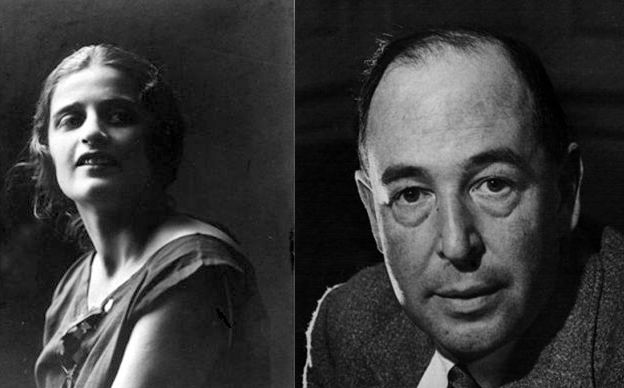
Images via Wikimedia Commons
The political intersection of Ayn Randian libertarians and Evangelical conservatives is a baffling phenomenon for most of us outside the American right. It’s hard to reconcile the atheist arch-capitalist and despiser of social welfare with, for example, the Sermon on the Mount. But hey, mixed marriages often work out, right? Well, as for Rand herself, one would hardly find her sympathetic to religion or its expositors at any point in her career. Take her sound lashing of writer, scholar, and lay theologian C.S. Lewis, intellectual hero of Protestant Christianity. (Wheaton College houses his personal library, and there exists not only a C.S. Lewis Institute, but also a C.S. Lewis Foundation.) Lewis’ The Abolition of Man (1943), while ostensibly a text on education, also purports, like Aquinas’ Summa Theologica, to expound the principles of natural law and objective moral value. Rand would have none of it.
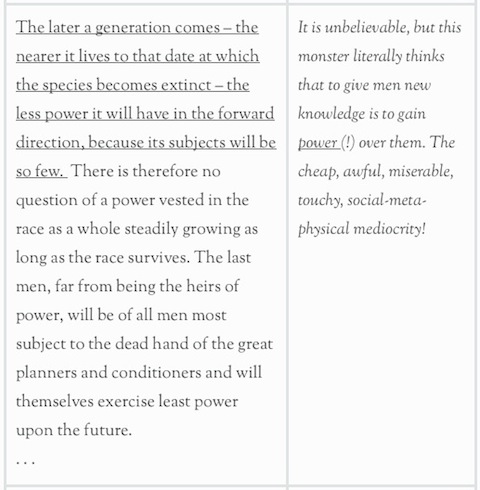
Religion journal First Things brings us excerpts from the edited collection, Ayn Rand’s Marginalia: Her critical comments on the writings of over 20 authors. In it, Rand glosses Lewis’s Abolition of Man with savage ferocity, calling the author an “abysmal bastard,” “cheap, drivelling non-entity” [sic], and “abysmal scum!” The screenshot above (Lewis left, Rand’s annotations right) from the First Things’ blog post offers a typical representation of Rand’s tone throughout, and includes some particularly elaborate insults.
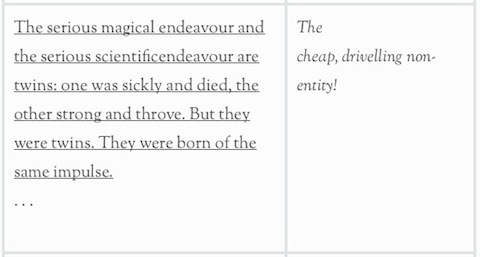
The C.S. Lewis Foundation comments that Lewis “probably would not have approved of the level of venom, but he probably would not have liked Rand’s philosophy much either.” Another Christian academic has successfully squared an appreciation for both Rand and Lewis, but writes critically of Rand, who “seems to have interpreted Lewis’s book as a Luddite screed against science and technology,” part of her “tendency to caricature her opponents.” Certainly no one ever accused her of subtlety. “It’s pretty clear,” our professor continues, “that when showing students how to engage in scholarly discourse, Ayn Rand should not be the model.” No, indeed, but how she would thrive on the Internet.
Read more at First Things, and download a PDF of the Rand-annotated Lewis excerpts here.
Related Content:
Free Audio: Download the Complete Chronicles of Narnia by C.S. Lewis
The Only Known Recordings of C.S. Lewis (1944–1948)
Watch Hand-Drawn Animations of 7 Stories & Essays by C.S. Lewis
Flannery O’Connor: Friends Don’t Let Friends Read Ayn Rand (1960)
Josh Jones is a writer and musician based in Durham, NC. Follow him at @jdmagness
Read More...Support Us
We're hoping to rely on loyal readers, rather than erratic ads. Please click the Donate button and support Open Culture. You can use Paypal, Venmo, Patreon, even Crypto! We thank you!

About Us

Open Culture scours the web for the best educational media. We find the free courses and audio books you need, the language lessons & educational videos you want, and plenty of enlightenment in between.
Advertise With Us
FREE UPDATES!
GET OUR DAILY EMAIL
Get the best cultural and educational resources on the web curated for you in a daily email. We never spam. Unsubscribe at any time.
FOLLOW ON SOCIAL MEDIA
Open Culture editor Dan Colman scours the web for the best educational media. He finds the free courses and audio books you need, the language lessons & movies you want, and plenty of enlightenment in between.
Advertise With Us

