Flannery O’Connor’s Satirical Cartoons: 1942–1945
Sci-fi author B.C. Kowalski recently posted a short essay on why the advice to write every day is, for lack of a suitable euphemism, “bullshit.” Not that there’s anything wrong with it, Kowalski maintains. Only that it’s not the only way. It’s said Thackeray wrote every morning at dawn. Jack Kerouac wrote (and drank) in binges. Every writer finds some method in-between. The point is to “do what works for you” and to “experiment.” Kowalski might have added a third term: diversify. It’s worked for so many famous writers after all. James Joyce had his music, Sylvia Plath her art, Hemingway his machismo. Faulkner drew cartoons, as did his fellow Southern writer Flannery O’Connor, his equal, I’d say, in the art of the American grotesque. Through both writers ran a deep vein of pessimistic humor, oblique, but detectable, even in scenes of highest pathos.
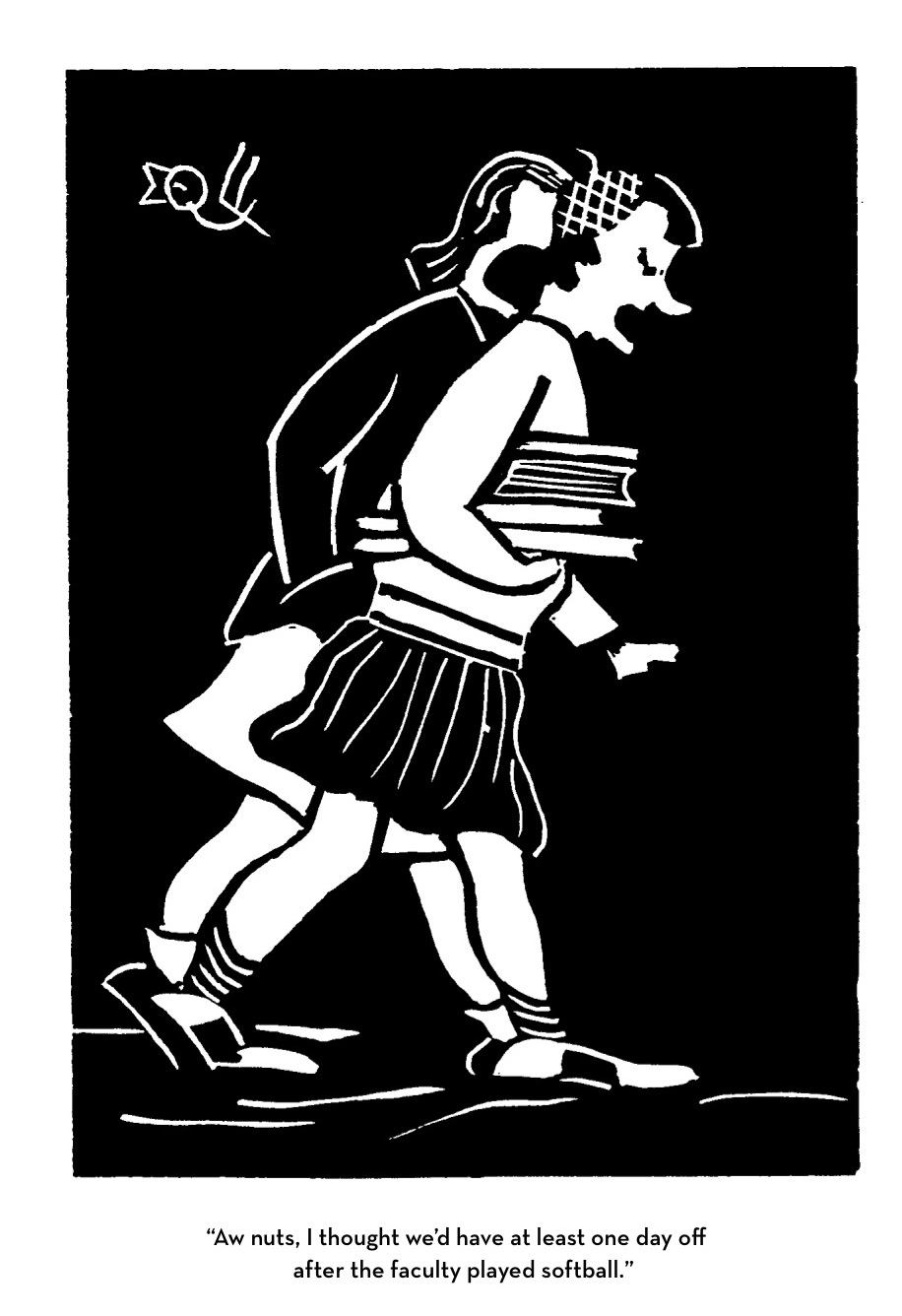
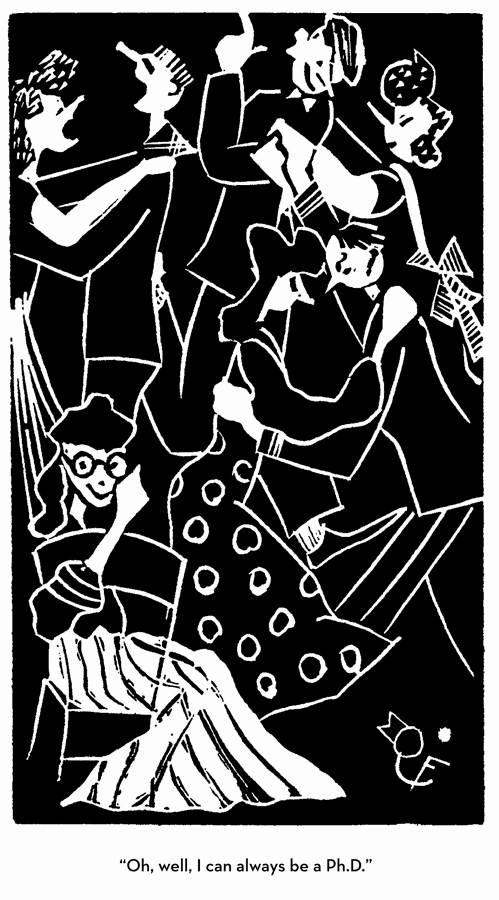
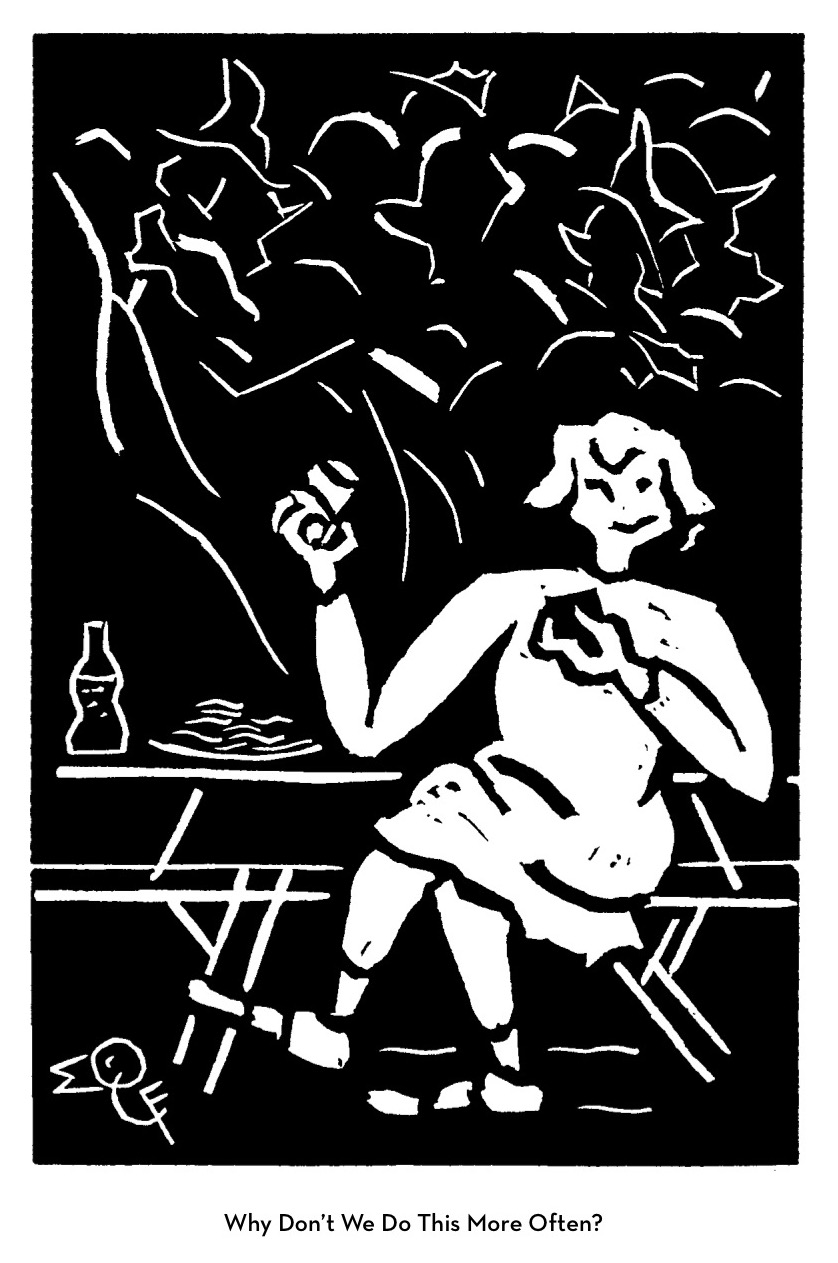
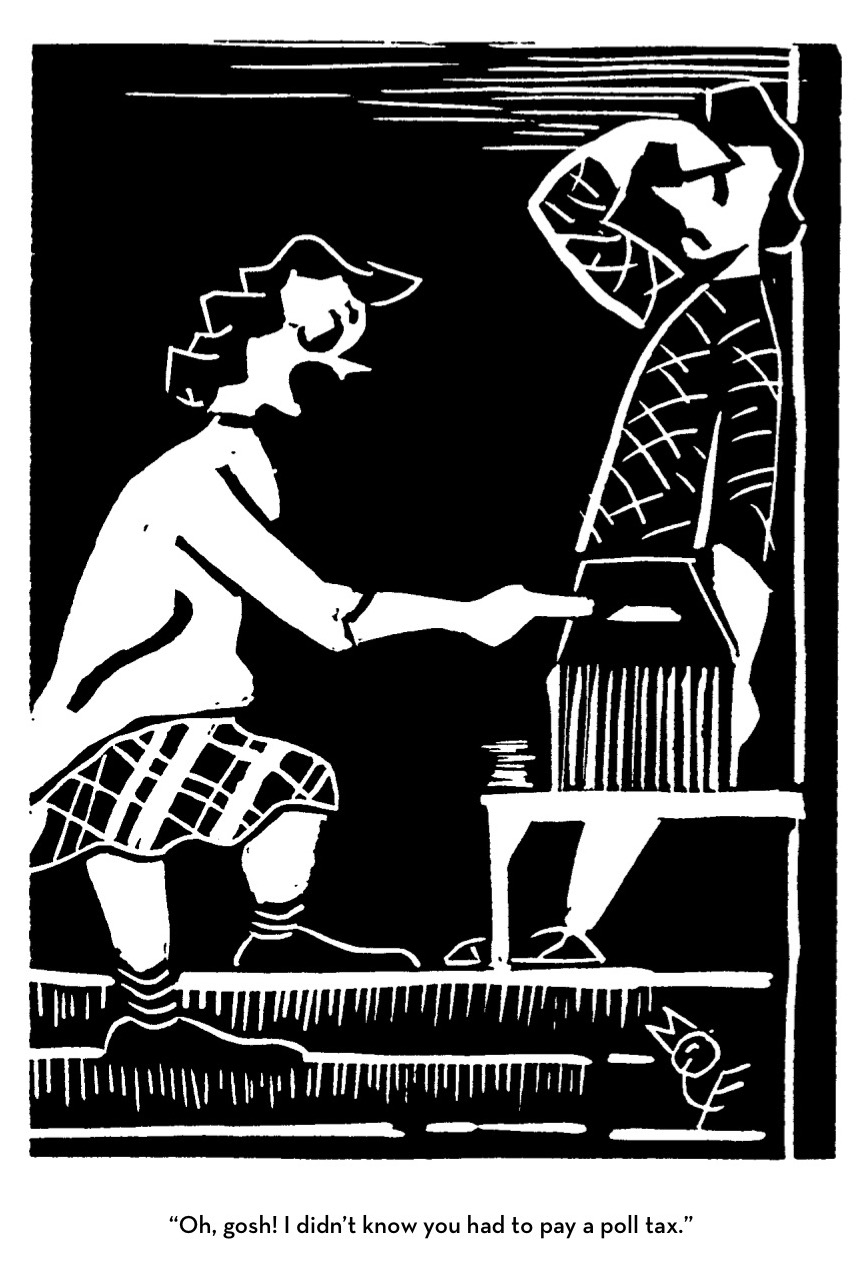
O’Connor’s visual work, writes Kelly Gerald in The Paris Review, was a “way of seeing she described as part of the ‘habit of art’”—a way to train her fiction writer’s eye. Her cartoons hew closely to her authorial voice: a lone sardonic observer, supremely confident in her assessments of human weakness. Perhaps a better comparison than Faulkner is with British poet and doodler Stevie Smith, whose bleak vision and razor-sharp wit similarly cut through mountains of… shall we say, bullshit. In both pen & ink and linoleum cuts, O’Connor set deadpan one-liners against images of pretension, conformity, and the banality of college life. In the cartoon at the top, she seems to mock the pursuit of credentials as a refuge for the socially disaffected. Above, a campaigner for a low-level office deploys bombastic pseudo-Leninist rhetoric, and in the cartoon below, a cranky character escapes a horde of identical WAVES.
O’Connor was an intensely visual writer with, Gerald writes, a “natural proclivity for capturing the humorous character of real people and concrete situations,” fully credible even at their most extreme (as in the increasingly horrific self-lacerations of Wise Blood’s Hazel Motes). She began drawing at five and produced small books and sketches as a child, eventually publishing cartoons in almost every issue of her high-school and college’s newspapers and yearbooks. Her alma mater Georgia College, then known as Georgia State College for Women, has published a book featuring her cartoons from her undergraduate years, 1942–45.
More recently, Gerald edited a collection called Flannery O’Connor: The Cartoons for Fantagraphics. In his introduction, artist Barry Moser describes in detail the technique of her linoleum cuts, calling them “coarse in technical terms.” And yet, “her rudimentary handling of the medium notwithstanding, O’Connor’s prints offer glimpses into the work of the writer she would become” with their “little O’Connor petards aimed at the walls of pretentiousness, academics, student politics, and student committees.” Had O’Connor continued making cartoons into her publishing years, she might have, like B.C. Kowalski, aimed one of those petards at those who dispense dogmatic, cookie-cutter writing advice as well.
Related Content:
The Art of William Faulkner: Drawings from 1916–1925
The Art of Sylvia Plath: Revisit Her Sketches, Self-Portraits, Drawings & Illustrated Letters
The Art of Franz Kafka: Drawings from 1907–1917
Rare 1959 Audio: Flannery O’Connor Reads ‘A Good Man is Hard to Find’
Flannery O’Connor: Friends Don’t Let Friends Read Ayn Rand (1960)
Josh Jones is a writer and musician based in Durham, NC. Follow him at @jdmagness
Read More...Jack Kerouac’s On the Road Turned Into an Illustrated Scroll: One Drawing for Every Page of the Novel
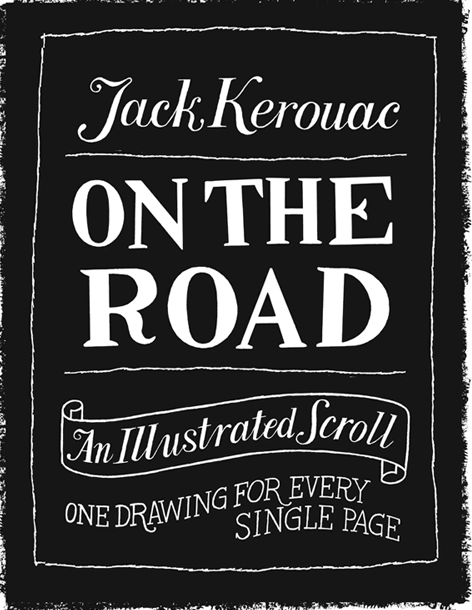
A great deal of mythology has built up around the life of Jack Kerouac, and especially around the experiences that went into his best-known work, the 1957 novel On the Road. Even the very act of its composition — perhaps especially the act of its composition — has, in the imaginations of many of Kerouac’s readers, turned into an image of the man “writing the book on a long scroll of teletype paper in three coffee-soaked-benzedrine-fueled days.” With this image in mind, illustrator Paul Rogers of Pasadena’s Art Center College of Design created On the Road, the illustrated scroll, featuring “a drawing for every page” of the novel, and depicting the historically researched “cars, buses, roadside architecture, and old signs” from Kerouac’s America of the late 1940s and early 50s, one that “looked awfully different than it does now.” You can scroll, as it were, through this work in progress at Rogers’ site.
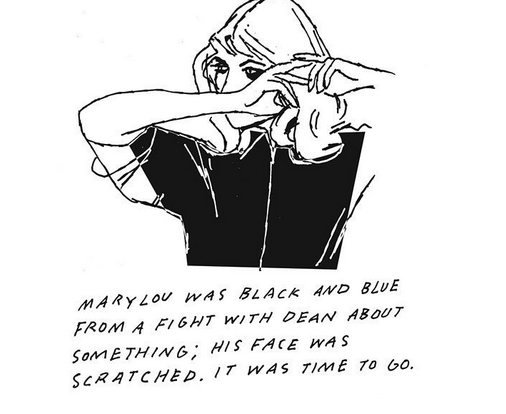
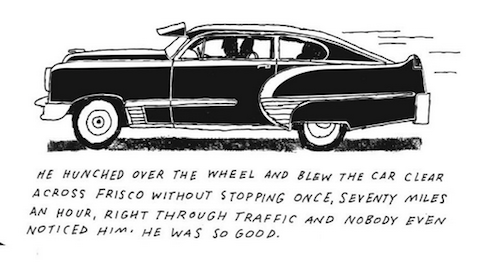
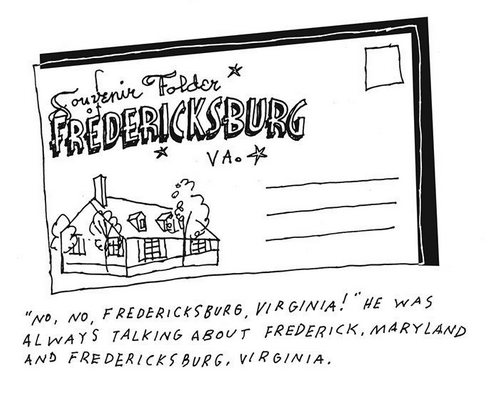
We’ve here included only four of the over 100 drawings Rogers has so far made, but these examples capture the novel’s multigenerationally intoxicating mix of Americana and pure momentum. You’ll also notice that, underneath each image, Rogers excerpts a passage of Kerouac’s. “Adding Kerouac’s words as captions to the drawings makes the series feel like a journal and not a carefully planned out illustrated book,” he writes, “and it seems to capture some of the spirit of Kerouac’s ‘this-happened-then-this-then-this’ writing style.”
You can read the scroll part-by-part on these pages: one through three, four, five, six, seven. Though I never took quite the lifestyle inspiration from On the Road some have, I can’t wait to see what visual inspiration Rogers draws from the bit about fabulous yellow roman candles exploding like spiders across the stars.
Related Content:
Jack Kerouac’s Hand-Drawn Map of the Hitchhiking Trip Narrated in On the Road
Jack Kerouac’s On The Road Turned Into Google Driving Directions & Published as a Free eBook
Jack Kerouac Lists 9 Essentials for Writing Spontaneous Prose
Colin Marshall hosts and produces Notebook on Cities and Culture and writes essays on cities, language, Asia, and men’s style. He’s at work on a book about Los Angeles, A Los Angeles Primer. Follow him on Twitter at @colinmarshall or on Facebook.
Read More...Digital Dubliners: Free, 21st Century Ways to Read Joyce’s Great Story Collection on its 100th Anniversary
Read nearly any critical commentary on James Joyce’s Dubliners, his 1914 collection of short stories that chronicle the lives of ordinary Irish residents of the title city, and you’re sure to come across the word “epiphany.” This is not some academic jargon, but the word Joyce himself used to describe the way that each story builds to a shock of recognition—often in the form of painful self-awareness—for key characters. Short-circuiting the typical climax-resolution-dénouement of conventional narrative, Joyce’s epiphanies give his stories a verisimilitude that can still feel very unsettling, given our typical expectations that realist fiction still obey the rules of fiction. Dramatic moments in our lives rarely have neat and tidy endings. But in stories like “Eveline,” “Araby,” “A Little Cloud,” and the collection’s capstone piece, “The Dead,” the often feckless characters find themselves paralyzed in states of existential dread by sudden flashes of self-knowledge, unable to assimilate new and painful insights into their limited perspectives.
That final story (adapted into John Huston’s final film) “elevates the book to the level of the supreme artworks of the 20th century,” writes Mark O’Connell in Slate. O’Connell’s essay commemorates the centenary of Dubliner’s publication this month. Dubliners remains, he writes, a book that “writers of the short story form seem basically resigned to never surpassing.” Written in the author’s early 20s, the stories, as Ulysses would eight years later, “reveal something profound and essential and unrealized about the city and its people”: “Dublin can feel less like a place that James Joyce wrote about than a place that is about James Joyce’s writing.” All of us non-Dubliners can enter the city through Joyce’s exquisite stories, and in an increasing variety of ways, thanks to digital technology. At the top of the post, find a digitized first edition of Dubliners. Just above, we have a reading of “Eveline” by “velvet-voiced” Dubliner Tadhg Hynes, and below, hear Irish actor Jim Norton read “The Sisters.”
You’ll find many more readings of Dubliners’ stories online, such as this deadpan reading of “Araby” from one of our favorites, Tom O’Bedlam, a Bloomsday reading of “Eveline” by award-winning Irish playwright Miriam Gallagher, and this Librivox collection of readings from various voices. I think Joyce would have very much appreciated the use of technology to keep his work alive into the 21st century. Part of his literary mission—certainly in many of Dubliners’ stories—was to illustrate the stultifying effects of clinging to the past. An eager adopter of new technologies, Joyce in fact brought the first cinema, The Volta, to Dublin in 1909. So it seems fitting that 100 years after the publication of Dubliners, his book receive the multimedia app treatment in the form of Digital Dubliners, a free, “engaging and authoritative edition” of the book designed by Boston College students and featuring “three hundred-odd images, seven hundred or so notes and explanations, two dozen videos, critical essays and hyperlinks, interactive maps sourced from contemporary newspaper, sound, film and photographic archives, with essays, film, recordings, background and expert discussion.” Watch a short promo video for Digital Dubliners below, and download the book on iTunes here.
Finally, you may wish to read the text in a more late-20th-century, and more open, format with this fully searchable “hypertextual, self-referential edition” prepared for Project Gutenberg. Whichever way you read Joyce’s Dubliners, you should, I presume to suggest, read Joyce’s Dubliners. And if you have read these stories before, even “somewhere in the double figures,” as Mark O’Connell has, then you’ll know how richly they reward re-reading, or hearing, or studying along with other readers and lovers of Joyce and a well-worn map of Dublin, or its shimmering touch-screen digital equivalent.
Dubliners also appears in our two collections, 1,000 Free Audio Books: Download Great Books for Free and 800 Free eBooks for iPad, Kindle & Other Devices.
Related Content:
James Joyce’s Ulysses: Download the Free Audio Book
James Joyce’s Dublin Captured in Vintage Photos from 1897 to 1904
Josh Jones is a writer and musician based in Durham, NC. Follow him at @jdmagness
Read More...Animated Films Made During the Cold War Explain Why America is Exceptionally Exceptional
The CIA fought most of the Cold War on the cultural front, recruiting operatives and placing agents in every possible sphere of influence, not only abroad but at home as well. As Francis Stoner Saunders’ book The Cultural Cold War: the CIA and the World of Arts and Letters details, the agency funded intellectuals across the political spectrum as well as producers of radio, TV, and film. A well-financed propaganda campaign aimed at the American public attempted to persuade the populace that their country looked exactly like its leaders wished to see it, a well-run capitalist machine with equal opportunity for all. In addition to the agency’s various forays into jazz and modern art, the CIA also helped finance and consulted on the production of animated films, like the 1954 adaptation of George Orwell’s Animal Farm we recently featured. We’ve also posted on other animated propaganda films made by government agencies, such as A is for Atom, a PR film for nuclear energy, and Duck and Cover, a short suggesting that cleanliness may help citizens survive a nuclear war.
Today we bring you three short animations funded and commissioned by private interests. These films were made for Arkansas’ Harding College (now Harding University) and financed by longtime General Motors CEO Alfred P. Sloan. The name probably sounds familiar. Today the Alfred P. Sloan Foundation generously supports public radio and television, as well as medical research and other altruistic projects. In the post-war years, Sloan, widely considered “the father of the modern corporation,” writes Karl Cohen in a two-part essay for Animation World Network, supposedly took a shine to the bootstrapping president of Harding, George S. Benson, a Christian missionary and crusading anti-Communist who used his position to promote God, family, and country. According to Cohen, Sloan donated several hundred thousand dollars to Harding as funding for “educational anti-Communist, pro-free enterprise system films.” Contracted by the college, producer John Sutherland, former Disney writer, made nine films in all. As you’ll see in the title card that opens each short, these were ostensibly made “to create a deeper understanding of what has made America the finest place in the world to live.” At the top, watch 1949’s “Why Play Leap Frog?” and just above, see another of the Harding films, “Meet King Joe,” also from 1949.
Just above, watch a third of the Harding propaganda films, “Make Mine Freedom,” from 1948. Each of these films, calling themselves “Fun and Facts about America,” present simplistic patriotic stories with an authoritative narrator who patiently explains the ins and outs of American exceptionalism. “Why Play Leapfrog?” tells the story of Joe, a disgruntled doll-factory worker who learns some important lessons about the supply chain, wages, and prices. He also learns that he’d better work harder to increase his productivity (and cooperate with management) if he wants to keep up with the rising cost of living. “Meet King Joe” introduces us to the “king of the workers of the world,” so called because he can buy more stuff than the poor schlubs in other countries. Joe, “no smarter” and “no stronger than workers in other lands” has such advantages only because of, you guessed it, the wonders of capitalism. “Make Mine Freedom” reminds viewers of their Constitutional rights before introducing us to a snake oil charlatan selling “ism,” a Commie-like tonic, to a group of U.S. labor disputants—if only they’ll sign over their rights and property. The assembled crowd jumps at the chance, but then along comes John Q. Public, who won’t give up his freedom for “some imported double-talk.”
You can read much more about the relationship between Sloan and Benson and the other films Sutherland produced with Sloan’s money, in Cohen’s essay, which also includes information on Cold War animated propaganda films made by Warner Brothers and Disney.
Related Content:
Animal Farm: Watch the Animated Adaptation of Orwell’s Novel Funded by the CIA (1954)
A is for Atom: Vintage PR Film for Nuclear Energy
How a Clean, Tidy Home Can Help You Survive the Atomic Bomb: A Cold War Film from 1954
Josh Jones is a writer and musician based in Durham, NC. Follow him at @jdmagness
Read More...
Hear Isolated Tracks From Five Great Rock Bassists: McCartney, Sting, Deacon, Jones & Lee
Last week we sparked some heated debate (and some typical internet vitriol) with a post featuring isolated drum tracks from six of rock’s best drummers. Well, here we go again, this time with isolated bass tracks…. Bear in mind that the bassists featured here are some of the top players in rock who actually have bass tracks available online. There are many more I’d love to hear out of the mix—and no shortage of jazz, reggae, funk, and soul bassists I deeply dig. If you don’t see your favorite player here… really, don’t take it personally.
The bass guitar tends to be a forgotten instrument, sometimes not even missed when it’s gone (think Black Keys, The Doors), but despite the success of the rare bass-less band, it’s hard to imagine some of the songs represented here without the fundamental thump and groove of well-played basslines. We begin with John Deacon’s bassline for Queen and David Bowie’s “Under Pressure,” above. As we mentioned in a recent post on that song’s evolution, Stylus named this the #1 bassline of all time.
I don’t know what that accolade is worth, but the bassline is at least one of the most recognizable, thanks in no small part to Vanilla Ice. In the context of Queen, Deacon’s perhaps best known for the pounding stomp of “Another One Bites the Dust,” one of many songs he wrote for the band. He has very deliberately disappeared from the spotlight since Freddie Mercury’s death, but his tasteful, melodic playing is in no danger of being forgotten.
Led Zeppelin’s John Paul Jones, on the other hand, refuses to leave the stage, for which the several dozen musicians he’s toured and recorded with since Zeppelin’s demise are all grateful. Currently one-third of supergroup Them Crooked Vultures (with Dave Grohl and Queens of the Stone Age’s Josh Homme), Jones also plays mandolin (on Zep’s “Going to California,” for example), lap steel, and this triple-necked monster. For all his continued relevance into the 21st century, Jones’s sometimes smooth, sometimes burly basslines for Led Zeppelin, such as the unforgettable “Ramble On” riff above, will be his enduring legacy. One would have to be a hell of a bass player to keep up with John Bonham, and John Paul Jones is exactly that. He got his start playing jazz at age 15, and while still a teenager, played in a jazz-rock collective that included John McLaughlin (whom Jeff Beck has called “the best guitarist alive”). Want to learn how Jones does it? Check out this bass lesson with the master himself.
When the subject of rock bassists arises, Geddy Lee’s name will invariably come up. Like his bandmate Neil Peart, Lee’s musicianship astounds, his prog-rock stylings seem inimitable, except perhaps by Primus’ Les Claypool (who Lee names as one of his favorites). Bass magazine No Treble calls Rush’s “YYZ” (above) “one of the greatest bass lines of all time.” It’s not exactly my cup of tea, but I do know at least one bass player who left for Berklee College of Music hating Rush, then came back listening to this song over and over in hushed awe. Not everyone loves Lee’s over-the-top high pitched vocals, but one has to admire the fact that he plays basslines like this while singing some of the most philosophical lyrics in rock, courtesy of drummer Peart.
The last two bass tracks feature bassists who, like Lee, are also singers. No one pulls that off with more grace and style than Paul McCartney. In the bassline to The Beatles “Come Together” (above), you can hear the deep, resonant tone of McCartney’s semi-hollow Hofner violin bass (many of which have been “nicked” over the years). Of McCartney’s playing, John Lennon once said, “Paul was one of the most innovative bass players ever. And half the stuff that is going on now is directly ripped off from his Beatles period.” In my own bass-playing days, I certainly stole my share of ideas from McCartney—or more probably, his basslines were etched into my music brain, and my fingers automatically plucked out McCartney-style patterns. Music Radar puts “Come Together” at the top of a list of “Paul McCartney’s 12 greatest Beatles bass performances,” for the “spooky, sinuous, throbbing and groovy” track above, “as original as it gets.”
Our isolated drum tracks post happened to feature the other rhythmic halves of every player on this list except John Deacon, and while this wasn’t exactly by design, it’s no surprise to me that’s how it worked out. A great rhythm section works as a closely-aligned team, finding locked grooves, creating emphasis and punctuation, building structures and spaces for lead players to fill. A drummer like the Police’s Stewart Copeland needed a bassist as precise yet passionate as Sting. Very few other bands have successfully fused punk, jazz, and reggae rhythms into a greater whole, a feat accomplished in part because of Sting’s versatility as a player. From the muted “train engine” punk of “Next to You” to the left-field pop of “Message in a Bottle” (above), Sting’s aggressive playing, often fretless, mostly finger-picked—to quote that reputable source Uncyclopedia—“makes him better than all other musicians combined by 12 orders of magnitude, and that’s a pop fact.”
But seriously, he’s good, and so are dozens of other rock bassists who don’t appear above. Name your favorites, and if you find their bass tracks online, share ‘em! Alright, let the bass slugfest begin, and be sure to check out No Treble’s “Isolated Bass Track Week” posts, with tracks from undisputed masters of the instrument like James Jamerson and Jaco Pastorious.
Related Content:
Isolated Drum Tracks From Six of Rock’s Greatest: Bonham, Moon, Peart, Copeland, Grohl & Starr
Paul McCartney Offers a Short Tutorial on How to Play the Bass Guitar
The Story of the Bass: New Video Gives Us 500 Years of Music History in 8 Minutes
Josh Jones is a writer and musician based in Durham, NC. Follow him at @jdmagness
Read More...Famous Writers’ Report Cards: Ernest Hemingway, William Faulkner, Norman Mailer, E.E. Cummings & Anne Sexton
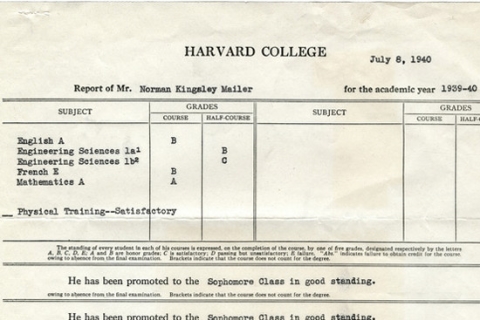
“It’s not about the grade,” I’d say to perturbed students asking me to change theirs: “it’s about what you learned.” No one will care what you got in first-year English Composition; they’ll care if you can write a sentence, a paragraph, a professional, elegant, or moving text. All of this is true, and yet (of course I never told them this) I still remember every grade I earned in every class I took in high school, college, and graduate school. Obsessive? Maybe. But it’s also symptomatic of that same compulsion that drives students to try, by any means, to get professors to bump their grades up at the end of the semester—fear of the “permanent record.” Like Seinfeld’s Elaine, struggling to expunge a black mark from her medical chart, we all fear the reams of documents—or archives of data—that catalogue our every misstep, stumble, failure or faux pas.
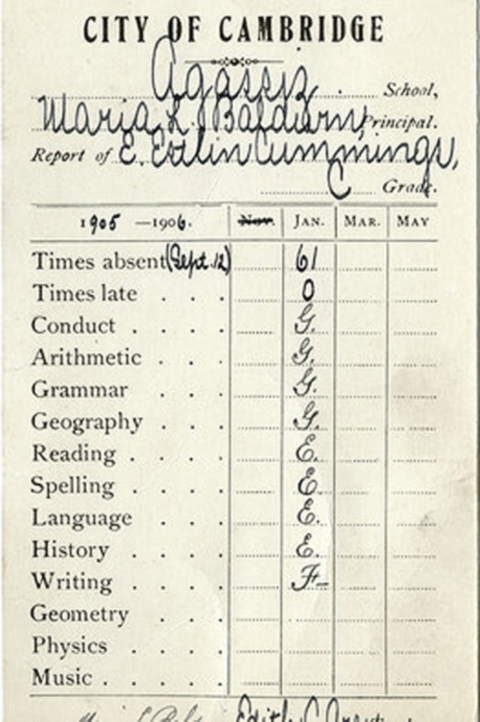
In many cases, this anxiety is justifiable, but as you can see here, the occasional bad mark didn’t stop famed writers Norman Mailer or E.E. Cummings from achieving literary greatness, even if those grades remain, in ink, on record today. See Mailer’s first-year Harvard College report card at the top of the post, academic year 1939–40. The bearish novelist did well, but for the C in his second semester of Engineering Science. Just above, we have Cummings’ report card from what is likely his fifth grade year given his age of 11 at the time. The 1905-06 grading system looks foreign to us now, but the C that Cummings received that year probably did not put him at the top of the class. Nor, I’m sure, did his 61 absences.
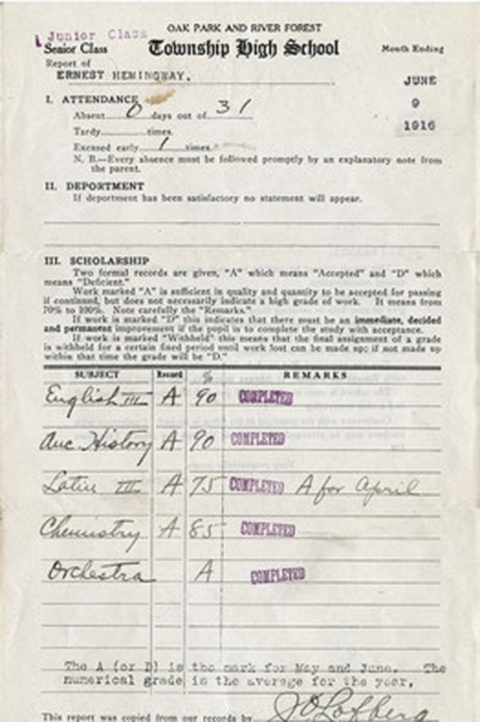
Ernest Hemingway, on the other hand, had little reason to hide the high school report card above, but if you look closely, you’ll see that the column of straight A’s does not mean what we might think. The Oak Park and River Forest Township High School only gave two letter grades, A for “Accepted” and D for “Deficient.” Still, Hemingway’s numerical percentages show his scholarly aptitude, though his 75 in Latin may have haunted him.
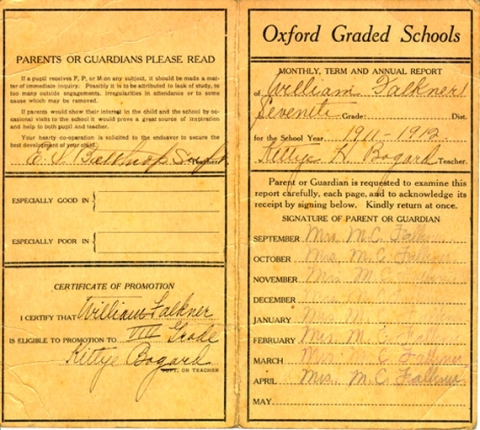
Hemingway’s modernist contemporary William Faulkner, you may know, struggled in school after the fourth grade, and eventually dropped out of high school after the 11th (though his father’s job at Ole Miss meant he could enroll there for the three semesters he attended). The seventh grade report card above does not show us his grades, and Faulkner’s teacher neglected to fill in the “Especially Good In” and “Especially Poor In” boxes. Nevertheless, Faulkner (then William Falkner), did well enough to move up, and his mother signed off on each month of the term but the last.
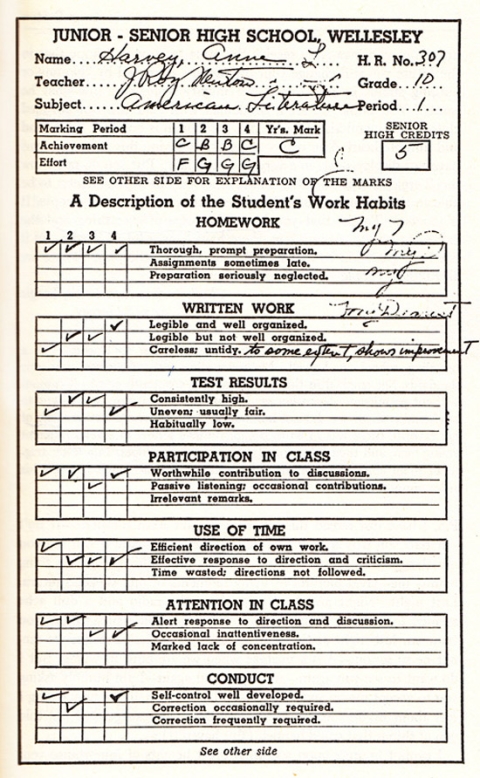
Finally we bring you the report card of Anne Sexton—née Harvey—for a 10th grade American Literature class at the Junior-Senior High School in Wellesley, Massachusetts, from which Sylvia Plath also graduated. As you can see, Sexton received a C in the class, with an F for effort in the first quarter. According to Beth Hinchliffe—a Wellesley native who conducted one of Sexton’s final interviews—the poet remembered the grade. She also remembered her teenage self as “ ‘a pimply, boy-crazy thing’ who was obsessed with flirting.”
Most of these report cards come from collections at the University of Texas’ Harry Ransom Center, a trove of historical and literary documents that, unlike some other archives, I’m very glad keeps permanent records. Anne Sexton’s report card comes to us via the always information-rich Brain Pickings.
Related Content:
Ernest Hemingway Creates a Reading List for a Young Writer, 1934
The Art of William Faulkner: Drawings from 1916–1925
Two Childhood Drawings from Poet E.E. Cummings Show the Young Artist’s Playful Seriousness
Anne Sexton, Confessional Poet, Reads “Wanting to Die” in Ominous 1966 Video
How Famous Writers — From J.K. Rowling to William Faulkner — Visually Outlined Their Novels
Josh Jones is a writer and musician based in Durham, NC. Follow him at @jdmagness.
Read More...Rare Video: Fidel Castro Plays Baseball (1959)
Baseball has the great capacity to transcend politics. People on the right love it. (Think George Will, the columnist who finds himself at the center of a hot controversy this week). The same holds true for folks on the left. One leftist with a deep and abiding love for baseball is Fidel Castro. Before he seized power in 1959, Castro spent some time on the diamond. Baseball-Reference.com tells us that Fidel likely “pitched in intramural competition in college for the University of Havana law school.” But “he was not good enough to pitch on the college’s varsity team.” Nor is the long-standing myth true that “Castro tried out for either the New York Yankees or Washington Senators and failed to impress enough to sign a contract.” He was never going to have a big league career. That’s for sure. But once Castro actually rose to power, no one was going to stop him from hitting or pitching in a 1959 charity game. (Watch above.) As they say, sometimes “it’s good to be the king.” Just ask Vladimir Putin, who recently scored 6 goals, and made 5 assists, in a hockey game.
The 1959 clip above comes from British Pathé, which made an archive of 85,000 historical films available on YouTube in April. Don’t miss it.
Related Content:
Bill Murray’s Baseball Hall of Fame Speech (and Hideous Sports Coat)
The Grateful Dead Rock the National Anthem at Candlestick Park: Opening Day, 1993
Free: Watch Jackie Robinson Star in The Jackie Robinson Story (1950)
Lou Gehrig, Yankee Legend, Stars in 1938 Western Rawhide
Read More...Rik Mayall Voices the Animation “Don’t Fear Death” Just Months Before His Untimely Passing
To paraphrase an acquaintance’s tribute to Rik Mayall (legendary British comedian who died yesterday at age 56), the cult comedy The Young Ones turned a generation of American misfits into Anglophiles before they’d ever set foot in Britain. I was one of those kids, staying up late to catch the riotously slapstick show about four slacker roommates who mercilessly abused each other to insane degrees while attending “Scumbag College.” Featuring musical appearances by British alternative heroes like Madness, Dexys Midnight Runners, Motörhead, and The Damned, the show only ran for 12 episodes, but it had an enormous influence on both sides of the Atlantic as a Monty Python for absurdist post-punk 80s brats.
Mayall co-created and co-wrote the show, and his anarchic gallows humor permeated every episode. He later went on to write and/or star in sitcoms Bottom and The New Statesman, and had a beloved, if brief, role in the Rowan Atkinson comedy Blackadder. Shortly before his death, Mayall voiced the animation above, “Don’t Fear Death,” for Channel 4. Written and produced by Louis Hudson and Ian Ravenscroft, this perfect vehicle for Mayall’s snide sensibilities explores “the benefits of being dead,” including never having to “waste one more single, soul-crushing hour in your mindless dead-end job.” Luckily for his fans, Mayall avoided that horrible fate and instead created some of the most memorably obnoxious characters in British comedy history, although writer Laurence Marks tells the BBC he was “the antithesis” of those characters, “a quiet, polite, caring gentleman.”
See Mayall below do an early version of his Young Ones character in a classic 80s stand-up routine .
Related Content:
New Animated Film Tells the Life Story of Monty Python’s Graham Chapman
Josh Jones is a writer and musician based in Durham, NC. Follow him at @jdmagness.
Read More...Free Physics Textbooks
Free textbooks (aka open textbooks) written by knowledgable scholars are a relatively new phenomenon. Below, find a meta list of Free Physics Textbooks, part of our larger collection 200 Free Textbooks: A Meta Collection. Also see our online collection, 1,700 Free Online Courses from Top Universities.
- Age of Einstein, by Frank W. K. Firk, Yale University.
- Calculus-Based Physics by Jeffrey W. Schnick, Saint Anselm College
- Classical Electrodynamics by Bo Thidé, Uppsala School of Engineering
- College Physics (introductory, algebra-based, two-semester college physics book) by OpenStax
- Conceptual Physics by Benjamin Crowell, Fullerton College
- Conservation Laws by Benjamin Crowell, Fullerton College
- Essential Physics 1, Frank W.K. Firk, Yale University
- Fields by Warren Siegel, SUNY
- General Relativity by Benjamin Crowell, Fullerton College
- Introduction to Groups, Invariants & Particles, by Frank W. K. Firk, Yale University
- Introduction to String Field Theory by Warren Siegel, SUNY
- Introduction to Statics and Dynamics by Andy Ruina and Rudra Pratap, Cornell University
- Mountain Motion by Dr. Christoph Schiller PhD, trained at Université Libre de Bruxelles
- Optics by Benjamin Crowell, Fullerton College
- Principles of Modern Physics — Robert B. Leighton, Caltech
- Programming Languages: Application and Interpretation by Dr. Shriram Krishnamurthi, Brown University
- Simple Nature: An Introduction to Physics for Engineering and Physical Science Students by Ben Crowell, Fullerton College
- Superspace: One Thousand and One Lessons in Supersymmetry by Warren Siegel. Jim Gates, Marc Grisaru, and Martin Rocek, SUNY, McGill, University of Maryland
- The Feynman Lectures on Physics by Richard Feynman, Robert B. Leighton and Matthew Sands
- Volume 1: Read Online Now
- Volume 2: Read Online Now
- Volume 3: Read Online Now
- The Light and Matter Series (Six texts) by Benjamin Crowell, Fullerton College
- Vibrations and Waves by Benjamin Crowell, Fullerton College
- The Modern Revolution in Physics by Benjamin Crowell, Fullerton College
- The People’s Physics Book by James H. Dann, UC Santa Cruz
- 21st Century Physics Flexbook: A Compilation of Contemporary and Emerging Technologies, by the Secretaries of Education and Technology and the Department of Education in the state of Virginia
Free Math Textbooks
Free textbooks (aka open textbooks) written by knowledgable scholars are a relatively new phenomenon. Below, find a meta list of Free Math Textbooks, part of our larger collection 200 Free Textbooks: A Meta Collection. Also see our online collection, 1,700 Free Online Courses from Top Universities.
- Abstract Algebra: The Basic Graduate Year by Robert B. Ash, University of Illinois
- Abstract Algebra: Theory and Applications by Thomas W. Judson, Stephen F. Austin State University
- Advanced Algebra II by Kenny Felder, Raleigh Charter High School
- Advanced Calculus by Sternberg Shlomo and Lynn Loomis, Harvard University
- Algebra 1 (Grades 9 & 10) by Andrew and Anne Gloag, High Tech High in San Diego, California
- Algebra and Analysis for Computer Science by Jean Gallier, University of Pennsylvania.
- Applied Probability by Paul Pfeiffer, Rice University
- Basic Analysis by Jiří Lebl, University of Illinois at Urbana-Champaign
- Basic Concepts of Mathematics by Elias Zakon, The University of Windsor
- Basic Probability Theory by Robert B. Ash, University of Illinois
- Basic Probability and Statistics by Brenda Meery, high school mathematics teacher in Glace Bay, Nova Scotia
- Book of Proof by Dr. Richard Hammack, Virginia Commonwealth University
- Calculus for Beginners and Artists by MIT
- Calculus Online Textbook, by Gilbert Strang, MIT
- Calculus (PDF) by David Guichard, Whitman College.
- Calculus (PDF) by Gilbert Strang, MIT
- Calculus 1 by Paul Dawkins, Lamar University
- Calculus 2 by Paul Dawkins, Lamar University
- Calculus 3 by Paul Dawkins, Lamar University
- Calculus with Applications, by Daniel Kleitman, MIT
- CK-12 Geometry (Grades 10–12) by multiple authors. Covers California curriculum.
- CK-12 Single Variable Calculus (Grades 11–12) by Multiple authors. Covers California curriculum.
- CK-12 Trigonometry — Second Edition (Grades 10–12) by multiple authors. Covers California curriculum.
- Collaborative Statistics by Barbara Illowsky, Ph.D and Susan Dean, De Anza College
- College Algebra by Paul Dawkins, Lamar University
- Complex Analysis by George Cain, Georgia Institute of Technology
- Complex Variables by Robert B. Ash, University of Illinois
- Computational Geometry by Nicholas M. Patrikalakis, Takashi Maekawa, MIT
- A Computational Introduction to Number Theory and Algebra by Victor Shoup, NYU
- A Course In Algebraic Number Theory by Robert B. Ash, University of Illinois
- A Course In Commutative Algebra by Robert B. Ash, University of Illinois
- Design of Comparative Experiments by R. A. Bailey, University of London
- Difference Equations to Differential Equations: An Introduction to Calculus by Dan Sloughter, Furman University
- Differential Equations by Paul Dawkins, Lamar University
- Discrete Mathematics: An Open Introduction by Oscar Levin, University of Northern Colorado
- Dynamical Systems by S. Sternberg, Harvard University
- Electronic Statistics Textbook by T. Hill & P. Lewicki.
- Elementary Abstract Algebra by W. Edwin Clark, University of Southern Florida
- Elementary Calculus: An Infinitesimal Approach by H. Jerome Keisler, University of Wisconsin-Madison
- Elementary Differential Equations (PDF) by William F. Trench, Trinity University
- Elementary Differential Equations with Boundary Value Problems (PDF) by William F. Trench, Trinity University
- Student Solutions Manual for Elementary Differential Equations and Elementary Differential Equations with Boundary Value Problems (PDF) by William F. Trench, Trinity University
- Elementary Linear Algebra by Keith Matthews, University of Queensland
- Elementary Number Theory by W. Edwin Clark, University of Southern Florida
- Elements of Abstract and Linear Algebra by Edwin H. Connell, University of Miami
- First Course in Complex Analysis by Matthias Beck, Gerald Marchesi, and Dennis Pixton, SUNY — Binghamton
- First Course in Linear Algebra by Dr. Robert Beezer, University of Puget Sound
- Functions Defined by Improper Integrals (PDF) by William F. Trench, Trinity University
- GeneratingFunctionology by Herbert Wilf, University of Pennsylvania
- Introduction to Matrix Algebra by Autar K Kaw, University of South Florida
- Introduction to Probability, Statistics, and Random Processes by Hossein Pishro-Nik, UMass Amherst
- Introduction to Probability (PDF) by Charles Grinstead & J. Laurie Snell, Swarthmore & Dartmouth Colleges
- Introduction to Real Analysis (PDF) by William F. Trench, Trinity University
- An Introduction to Statistical Learning (PDF) by Gareth James, Daniela Witten, Trevor Hastie and Robert Tibshirani
- Introduction to Social Network Methods by Robert A. Hanneman and Mark Riddle, UC Riverside
- Introduction to Statistical Thought by Michael Lavine, UMASS
- Introduction to the Theory of Numbers by Leo Moser, McGill
- Introductory Statistics: Concepts, Models, and Applications by David W. Stockburger, Missouri State
- Lectures on Probability, Statistics and Econometrics by Marco Taboga, Economist, Bank of Italy
- Lectures on Statistics by Robert B. Ash, University of Illinois
- Linear Algebra (PDF) by Jim Hefferon, Saint Michael’s College
- Linear Algebra by Paul Dawkins, Lamar University
- Math Alive by Ingrid Daubechies, Princeton University
- Math in Society by David Lipmann, Pierce College
- Math, Numerics, and Programming (for Mechanical Engineers) by Masayuki Yano, MIT
- Mathematical Methods of Engineering Analysis (PDF) by Erhan Çinlar and Robert J. Vanderbei, Princeton University
- Multivariable Calculus by George Cain & James Herod, Georgia Tech
- Proofs and Concepts: The Fundamentals of Abstract Mathematics by Dave Witte Morris and Joy Morris, University of Lethbridge
- Real Variables with Basic Metric Space Topology by Robert B. Ash, University of Illinois
- Statistics by Philip B. Stark, University of California — UC Berkeley
- A Summary of Calculus by Karl Heinz Dovermann, University of Hawaii
- The Book “A=B” by Marko Petkovsek, Herbert Wilf and Doron Zeilberger, Univ. of Pennsylvania and Rutgers
- The Elements of Statistical Learning by Trevor Hastie, Robert Tibshirani and Jerome Friedman
- The Method of Lagrange Multipliers (PDF) by William Trench, Trinity University
- The Calculus of Functions of Several Variables by Dan Sloughter, Furman University
- Yet Another Calculus Text by Dan Sloughter, Furman University
Support Us
We're hoping to rely on loyal readers, rather than erratic ads. Please click the Donate button and support Open Culture. You can use Paypal, Venmo, Patreon, even Crypto! We thank you!

About Us

Open Culture scours the web for the best educational media. We find the free courses and audio books you need, the language lessons & educational videos you want, and plenty of enlightenment in between.
Advertise With Us
FREE UPDATES!
GET OUR DAILY EMAIL
Get the best cultural and educational resources on the web curated for you in a daily email. We never spam. Unsubscribe at any time.
FOLLOW ON SOCIAL MEDIA
Open Culture editor Dan Colman scours the web for the best educational media. He finds the free courses and audio books you need, the language lessons & movies you want, and plenty of enlightenment in between.
Advertise With Us

