Free Textbooks: Computer Science
Free textbooks (aka open textbooks) written by knowledgable scholars are a relatively new phenomenon. Below, find a meta list of Free Computer Science Textbooks, part of our larger collection 200 Free Textbooks: A Meta Collection. Also see our online collection, 1,700 Free Online Courses from Top Universities.
- A Byte of Python, by Swaroop C H
- A First Course in Electrical and Computer Engineering by Louis Scharf, Colorado State
- Artificial Intelligence: Foundations of Computational Agents by David Poole and Alan Mackworth, University of British Columbia
- Bits, Signals, and Packets: An Introduction to Digital Communications and Networks by Hari Balakrishnan, Christopher Terman, and George Verghese, MIT
- Code Like a Pythonista: Idiomatic Python, by David Goodger
- Computational Geometry by Nicholas M. Patrikalakis, Takashi Maekawa, MIT
- Digital Circuit Projects: An Overview of Digital Circuits Through Implementing Integrated Circuits by Charles W. Kann, Gettysburg College
- Dive into Python, by Mark Pilgrim
- Foundations of Computer Science by Al Aho (Columbia) and Jeff Ullman (Stanford)
- High Performance Computing by Charles Severance, University of Michigan
- How to Design Programs: An Introduction to Computing and Programming, Multiple Authors
- How to Think Like a Computer Scientist: C ++ ( PDF) by Allen B. Downey, Olin College
- How to Think Like a Computer Scientist: Java by Allen B. Downey, Olin College
- How to Think Like a Computer Scientist: Python by Allen B. Downey, Olin College
- Implementing a One Address CPU in Logisim by Charles W. Kann III, Gettysburg College
- Information Technology and the Networked Economy by Patrick McKeown, University of Georgia
- Information Theory, Inference, and Learning Algorithms by David MacKay, Cambridge
- Introduction To MIPS Assembly Language Programming by Charles W. Kann III, Gettysburg College
- Neural Networks and Deep Learning, by Michael Nielsen, Research Fellow at the Recurse Center
- Patterns for Beginning Programmers (with Examples in Java), by David Bernstein, James Madison University
- Philosophy of Computer Science by William J. Rapaport, University at Buffalo, The State University of New York
- Principles of Computer System Design: An Introduction (Part II) by Jerome Saltzer and M. Frans Kaashoek.
- Principles of Programming Languages by Grad Students, Johns Hopkins
- Programming Languages: Application and Interpretation by Dr. Shriram Krishnamurthi, Brown University.
- Prolog and Natural-Language Analysis by Fernando C. N. Pereira and Stuart M. Shieber, U Penn & Harvard
- Python for Informatics: Exploring Information by Charles Severance, University of Michigan
- Structure and Interpretation of Computer Programs by Jerry Sussman & Julie Sussman
- Teach Yourself WordPerfect Mac by John Rethorst
- The Princeton Bitcoin Textbook by Arvind Narayanan (Princeton) and colleagues
Matthew Weiner on The Art of Writing Mad Men: The Paris Review Interview
This weekend, AMC aired episode 7 of Mad Men’s final season. The show will now take a break, until episodes 8–14 hit the airwaves early next year. Before you turn your attention elsewhere, you may want to spend some time with the Paris Review’s big interview with Matthew Weiner, the creator of Mad Men. The interview covers a lot of ground.
We learn that Weiner is a particular fan of John Cheever. “[W]ith John Cheever, I recognized myself in the voice of the narrator.” “Cheever holds my attention more than any other writer. He is in every aspect of Mad Men, starting with the fact that Don lives in Ossining on Bullet Park Road.” (Find the Paris Review’s 1976 interview with Cheever here.)
We also discover that Weiner studied poetry in college with Christopher Reeve’s father, Frank Reeve, and there were a couple of years when Weiner considered T.S. Eliot’s The Waste Land “the most interesting thing in the world.”
Then the conversation turns to Mad Men, where Weiner reveals what’s at the heart of the show: “I’ve always said this is a show about becoming white. That’s the definition of success in America—becoming a WASP. A WASP male.” “Don Draper knows he’s poor, very much in the model of [Lee] Iacocca or [Sam] Walton, who came out of the Great Depression, out of really humble beginnings. Or like Conrad Hilton, on the show. These men don’t take no for an answer, they build these big businesses, these empires, but really it’s all based on failure, insecurity, and an identity modeled on some abstract ideal of white power.”
Weiner has lots more to say, including about his days writing for The Sopranos. Read the complete interview here.
Related Content:
Gay Talese: Drinking at New York Times Put Mad Men to Shame
The Paris Review Interviews Now Online
Read More...
Chicken Infinite: A 532 Page Avant-Garde Chicken Recipe

Earlier this year, Gregor Weichbrodt, a German college student, took all of the geographic stops mentioned in Jack Kerouac’s On the Road, plugged them into Google Maps, and ended up with a 45-page manual of driving directions, divided into chapters paralleling those of Kerouac’s original book. Now he’s back with a culinary mashup. Not mashed potatoes, but mashed up recipes for cooking chicken.
“Cooking recipes from the web have been collected and mixed randomly together,” and the result is Chicken Infinite, an avant-garde recipe for making chicken that spans some 532 pages. According to Weichbrodt, Chicken Infinite – available as a free PDF or paperback – “plays with the concept of instructions itself” that you regularly see on websites or in manuals. It’s a concept that cut-up artist William S. Burroughs could love. As for how Chicken Infinite actually tastes, someone (with a little time and a sense of adventure) will have to let us know.
Related Content:
Ernest Hemingway’s Favorite Hamburger Recipe
David Lynch Teaches You to Cook His Quinoa Recipe in a Weird, Surrealist Video
Marilyn Monroe’s Personal, Handwritten Turkey-and-Stuffing Recipe
MIT Teaches You How to Speak Italian & Cook Italian Cuisine All at Once (Free Online Course)
Read More...NPR Launches Database of Best Commencement Speeches Ever
NPR has created a brand new commencement speech database, “an inspiration machine full of wise and funny words going back to 1774.” You can search the database by name, school, date or theme. Take a spin and you will find speeches by Adrienne Rich at Douglass College (1977), the Dalai Lama at Tulane (2013), David Foster Wallace at Kenyon College (2005), J.K. Rowling at Harvard (2008), Jill Abramson at Wake Forest (2014), Joseph Brodsky at U. of Michigan (1988), Ray Bradbury at Caltech (2000) and much more. Most of the speeches are presented in text format, some in video.
On NPR’s blog, they’ve highlighted some of the key takeaways from the long history of commencement speeches: Be kind, dream, remember history, embrace failure, don’t give up, etc. Right above, you can see NPR’s new animation featuring former Clinton and Obama speechwriter Jon Lovett at Pitzer College’s commencement.
Related Content:
“Wear Sunscreen”: The Story Behind the Commencement Speech That Kurt Vonnegut Never Gave
Dissident Poet Joseph Brodsky Gives Six Life Tips to College Grads (1988)
‘This Is Water’: Complete Audio of David Foster Wallace’s Kenyon Graduation Speech (2005)
Meryl Streep Gives Graduation Speech at Barnard
Neil Gaiman Gives Graduates 10 Essential Tips for Working in the Arts
Read More...Jimmy Page Gives Commencement Address at Berklee; Students Perform Led Zep Classics for Him
Graduation season is upon us and, last weekend, the great Jimmy Page had a busy weekend at the Berklee College of Music in Boston. The school gave the Led Zeppelin guitarist an honorary doctoral degree in music, before letting him present — or rather “busk” — a short commencement address to nearly 900 hundred graduates at the Agganis Arena. But probably the highlight came the night before, when Berklee students performed for Page, playing renditions of Kashmir, Stairway to Heaven, Dazed and Confused and Whole Lotta Love, among other Led Zeppelin classics. Happily, some footage from that performance has popped up on Facebook. Watch it right below:
Related Content:
Jimmy Page Tells the Story of “Kashmir”
Jimmy Page, 13, Plays Guitar on BBC Talent Show (1957)
Led Zeppelin Plays One of Its Earliest Concerts (Danish TV, 1969)
Read More...Download 55 Free Online Literature Courses: From Dante and Milton to Kerouac and Tolkien
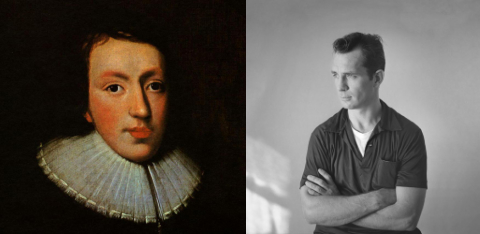
Here at Open Culture, we don’t just feature education in your recommended daily servings of culturally wide-ranging video, audio, text, and image — we also feature it in a form that goes deep: whole courses you can download to your computer or mobile device of choice and experience at your own pace. If you never quite studied all the literature you wanted to — or if you simply can’t get enough study of the stuff — pay a visit to our collection of over 50 free literature courses online. Some of them may even cover the same textual ground as the classes you felt curious about taking in college but could never quite fit into your schedule: “Dante in Translation” (Free Online Video — Free iTunes Audio - Free iTunes Video — Course Materials), for instance, or “Introduction to Theory of Literature” (Free Online Video — Free iTunes Audio – Free iTunes Video — Course Materials), or “Introduction to World Literature (Free Online Video).
Our collection offers courses with relatively broad literary subject matter, such as “American Passages: A Literary Survey” (Free Online Video) and “Contemporary Literature” (Free Online Video – Free Video Download), and others specific to one period or even one writer, like “Oscar Wilde” (Free Online Audio ). and the Allen Ginsberg-taught “Jack Kerouac” (Free Online Audio Part 1 and Part 2). Other offerings in our collection more closely resemble the courses you may have always wanted to take, but never found offered, like these from “Tolkien Professor” Corey Olsen:
- The Hobbit – Free iTunes Video — Free Online Audio — More
- Lord of the Rings I: The Road Goes Ever On — Free iTunes Video & Audio
- Lord of the Rings II: The Two Towers — Free Tunes Video & Audio — Free Online Video & Audio
- Lord of the Rings III: Return of the King — Free iTunes Video & Audio — Free Online Video & Audio
And yes, for those truly intent on continuing their education in Middle-Earth, Olsen also offers a “Silmarillion Seminar” (Free Online Video & Audio). If none of these appeal to your own intellectual curiosity, however, do visit the collection’s page for more options from existentialism to George Eliot to Shakespeare. (Nor should you miss our complete list, 1,700 Free Online Courses from Top Universities, which includes other subjects like philosophy, computer science, psychology, physics, religion and more.) And if you feel like something lighter, might I suggest John Green’s crash course on literature?
Related Content:
Download 100 Free Online Philosophy Courses & Start Living the Examined Life
800 Free eBooks for iPad, Kindle & Other Devices
Colin Marshall hosts and produces Notebook on Cities and Culture and writes essays on cities, language, Asia, and men’s style. He’s at work on a book about Los Angeles, A Los Angeles Primer. Follow him on Twitter at @colinmarshall or on Facebook.
Read More...Watch the Talking Heads Play a Vintage Concert in Syracuse (1978)
We’ve brought you Talking Heads shows from New York’s CBGB in 1975, Dortmund, Germany in 1980, and Rome that same year. Now we’ve got one more valuable live find from that formative, busy era for the David Byrne-led, Rhode Island School of Design-forged new-wave band: their November 1978 performance in Syracuse. The exact venue? Perhaps somewhere at Syracuse University, perhaps not, though a college performance space would make sense, given how many institutions of higher education they played in 1978. The Talking Heads Concert History blog has a complete list, and the total number of shows in that year alone comes in, astonishingly, at over 130, a fair few of them at schools like NYU, Brown, Berklee, Berkeley, UCLA, and the University of Arizona. “It was really an education for us,” the page quotes drummer Chris Frantz as saying of the 1978 tour. “I’m afraid we bit off more than we could chew. We thought that we could play every night, and we found that after four months we were feeling pretty uninspired.”
Yet this Syracuse gig, which came ten months in, sounds pretty inspired to me. It looks it, too, at least from what I can discern from the lo-fi footage. What the image lacks in crispness, though, it makes up for in technological interest; it has the signature look of the Sony Portapak, one of the very early portable consumer video recording systems beloved of the 1970s’ video amateurs and video artists alike. Whoever manned the Portapak for these 92 minutes in Syracuse captured a valuable chapter in the Talking Heads story, one the band spent working as hard as possible — which, of course, meant playing as hard, and as often, as possible — and refining their inimitable sound and sensibility in concert spaces that, while often low-profile, nevertheless provided them with excited and appreciative audiences. College students and otherwise, came eager to hear something new — and given that the 70s, that decade of slick disco and smooth rock, had almost come to a close, something a bit askew. The Talking Heads, as we see them here, could gladly deliver.
Set list:
- The Big Country
- Warning Sign
- The Book I Read
- Stay Hungry
- Artists Only
- The Girls Want to Be with the Girls
- The Good Thing
- Love Goes to Buildings on Fire
- Electricity
- Found a Job
- Take Me to the River
- I’m Not in Love
- No Compassion
Related Content:
Watch the Talking Heads Play Live in Dortmund, Germany During Their Heyday (1980)
Talking Heads Play CBGB, the New York Club that Shaped Their Sound (1975)
Live in Rome, 1980: The Talking Heads Concert Film You Haven’t Seen
David Byrne: How Architecture Helped Music Evolve
Colin Marshall hosts and produces Notebook on Cities and Culture and writes essays on cities, language, Asia, and men’s style. He’s at work on a book about Los Angeles, A Los Angeles Primer. Follow him on Twitter at @colinmarshall or on Facebook.
Read More...Carl Sagan Writes a Letter to 17-Year-Old Neil deGrasse Tyson (1975)
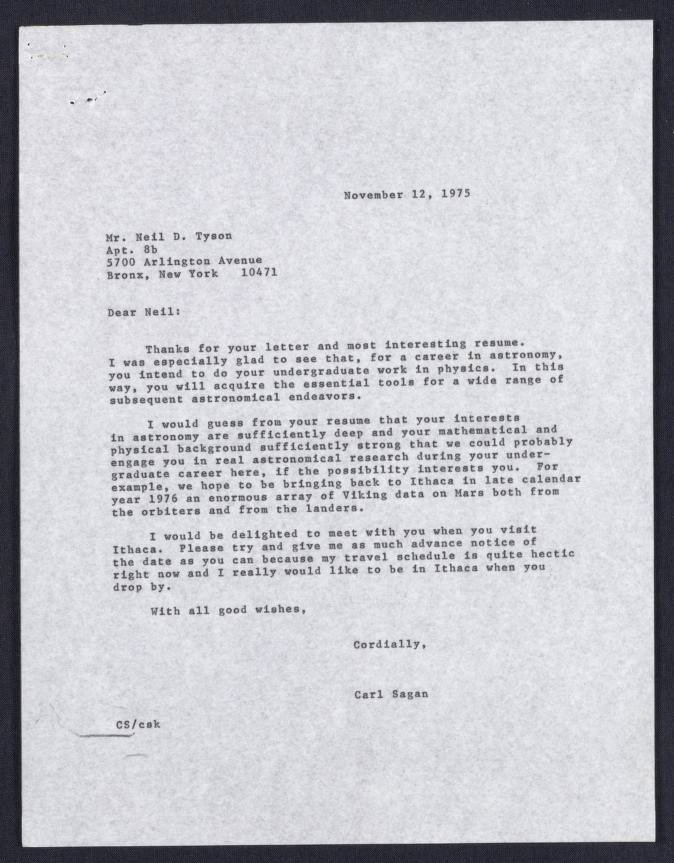
Carl Sagan, the turtleneck-sporting astrophysicist from Cornell, was the greatest communicator of science of his generation. Not only did he publish hundreds of scientific papers and was instrumental in putting together that golden record on the Voyager spacecrafts but he also wrote twenty critically praised best sellers on science, appeared regularly on the Tonight Show, and even had a catch phrase — “billions and billions.” But Sagan is perhaps best known for his landmark 1980 series Cosmos: A Personal Voyage (watch it here). He took viewers through a tour of the universe, showing them things from the mind-boggling big to the infinitesimally small and everything in between. The show proved to be a huge hit; close to a half-billion people tuned in worldwide.
Even before the reboot of Cosmos premiered on FOX in March, Neil deGrasse Tyson — who hosts the show — was already seen as Sagan’s successor. Not only does he serve as the director of the Hayden Planetarium in New York City and was instrumental in kicking Pluto out of the brotherhood of planets, but he also authored numerous books, appears regularly on The Daily Show, and frequently hosts AMAs on Reddit. He’s also one of America’s most vocal defenders of science at a time, unlike Sagan’s heyday, when Creationism, climate change denial, and anti-vaccination hysteria seem to be making inroads in our culture.
Anyone who saw Tyson’s heart felt tribute to Sagan at the beginning of the first episode of Cosmos knows that Sagan’s influence on his younger counterpart extended much further than his media appearances. It was personal. In 1975, Sagan, who was already famous at that time, was so impressed by Tyson’s college application that he personally reached out to him, hoping to convince the high school student to attend Cornell. He even offered to personally show Tyson around his lab.
You can read Sagan’s letter, dated November 12, 1975, below.
Dear Neil:
Thanks for your letter and most interesting resume. I was especially glad to see that, for a career in astronomy, you intend to do your undergraduate work in physics. In this way, you will acquire the essential tools for a wide range of subsequent astronomical endeavors.
I would guess from your resume that your interests in astronomy are sufficiently deep and your mathematical and physical background sufficiently strong that we could probably engage you in real astronomical research during your undergraduate career here, if the possibility interests you. For example, we hope to be bringing back to Ithaca in late calendar year 1976 an enormous array of Viking data on Mars both from the orbiters and from the landers.
I would be delighted to meet with you when you visit Ithaca. Please try and give as much advance notice of the date as you can because my travel schedule is quite hectic right now and I really would like to be in Ithaca when you drop by.
With all good wishes,
Carl Sagan
Tyson was deeply moved by Sagan’s kindness and sincerity. He did venture out to Ithaca from the Bronx on a snowy afternoon. As Tyson recalled years later, “I thought to myself, who am I? I’m just some high school kid.” In the end, Sagan’s personal plea wasn’t quite enough to convince young Tyson to attend his school. As you can read in his response below, dated April 30, 1976, Tyson decided to go to Harvard.
Dear Prof. Sagan
Thank you for your offer concerning the Viking Missions. After long thought and decision making I have chosen to attend Harvard University this September. I chose it not simply because of its “valuable” name but because they have a larger astronomy department in addition to the Smithsonian Astrophysical Observatory, so while I am majoring in physics I will have more surrounding me in the way of on-going research in astronomy.
I want to say that I did enjoy meeting you and I am very grateful for your hospitality and the time you spent with me while at Cornell. I will throughout my undergraduate years keep you informed on any noteworthy news concerning astronomy-related work that I’m involved in. I do plan to apply again for the Viking Internship next summer.
Thanks again
Neil D. Tyson
You can see Tyson talk about his afternoon with Sagan. 40 years later, he still seems incredulous that it happened.
Related Content:
Carl Sagan Presents Six Lectures on Earth, Mars & Our Solar System … For Kids (1977)
Carl Sagan Explains Evolution in an Eight-Minute Animation
Carl Sagan’s Undergrad Reading List: 40 Essential Texts for a Well-Rounded Thinker
Carl Sagan, Stephen Hawking & Arthur C. Clarke Discuss God, the Universe, and Everything Else
Jonathan Crow is a Los Angeles-based writer and filmmaker whose work has appeared in Yahoo!, The Hollywood Reporter, and other publications. You can follow him at @jonccrow.
Read More...Sylvia Plath Annotates Her Copy of The Great Gatsby
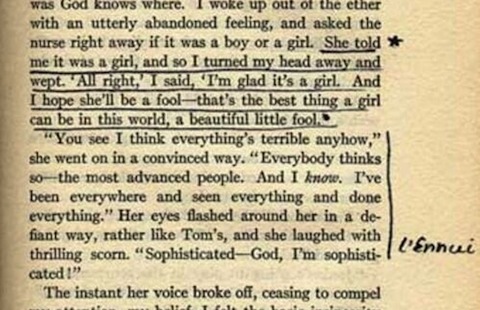
The true fan of a writer desires not just that writer’s complete works, even if they all come signed and in first editions. No — the enthusiast most dedicated to their literary luminary of choice must have, in addition, the books written by that author, those owned by that author, preferably anointed with liberal quantities of revealing marginalia. In the case of such relatively recently deceased writers as David Markson, the whole of whose well-annotated personal library got donated to The Strand shortly after his passing, you can sometimes actually come to possess such treasures. In the case of poet Sylvia Plath, part of a page of whose copy of F. Scott Fitzgerald’s The Great Gatsby you see above, you might have a trickier time getting your hands on them. Justin Ray’s post at Complex, which quotes Plath as calling Fitzgerald “a word painter with a vivid palette” who chooses words with “jewel-cut precision,” has more on the book and its markings.
“Plath studied a crap-ton of literature in school,” Ray writes. “It isn’t immediately clear whether she was in high school or college when she annotated Gatsby,” but whenever she did it, she underlined “Daisy’s prediction of what her daughter will be like” with the word “L’Ennui,” a word she would use to name an early poem that reflects “a post romanticism and the death of idealism, two ideas also in Gatsby, according to an essay by Anna Journey.” Elsewhere, you can also read “Princess Daisy,” Park Bucker’s piece on Plath’s annotated Gatsby. “The volume represents a fascinating piece of evidence of Fitzgerald’s rising reputation and influence in the early 1950s, as well as the academic background and tastes of a major American poet,” writes Bucker. “Although Sylvia Plath and F. Scott Fitzgerald rarely inhabit the same sentence, their association should not appear strained. A young, intense poet would naturally be drawn to the lyric quality of Fitzgerald’s prose.” And just imagine its value to die-hard fans of both of those tragic pillars of American letters — a group in which, if you’ve read this post and everything to which it links, you should perhaps consider counting yourself.
Related Content:
Hear Sylvia Plath Read Fifteen Poems From Her Final Collection, Ariel, in 1962 Recording
Haruki Murakami Translates The Great Gatsby, the Novel That Influenced Him Most
83 Years of Great Gatsby Book Cover Designs: A Photo Gallery
Read F. Scott Fitzgerald’s Great Gatsby & Other Major Works Free Online
Gertrude Stein Sends a “Review” of The Great Gatsby to F. Scott Fitzgerald (1925)
Colin Marshall hosts and produces Notebook on Cities and Culture and writes essays on cities, language, Asia, and men’s style. He’s at work on a book about Los Angeles, A Los Angeles Primer. Follow him on Twitter at @colinmarshall or on Facebook.
Read More...The Drawings of Jean-Paul Sartre
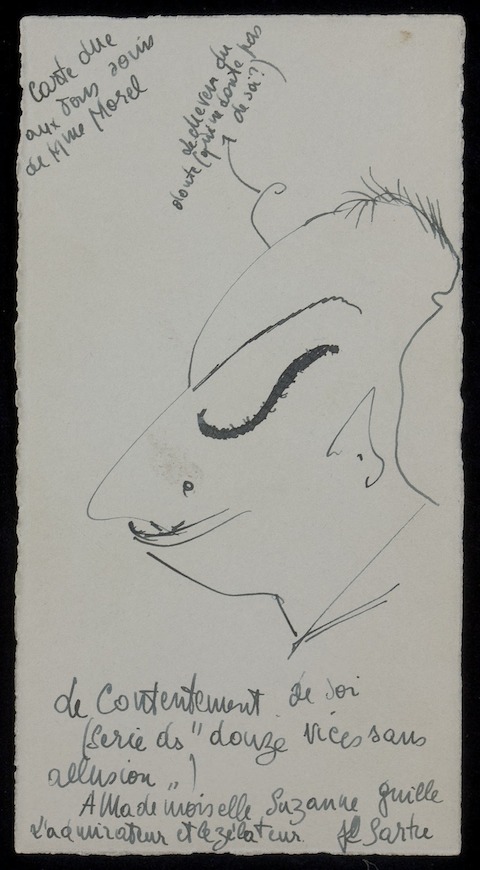
We’ve established something of a tradition here of featuring drawings by famous authors. It seems, unsurprisingly, that skill with the pen often goes hand-in-glove with a keen visual sense, though admittedly some writers are more talented draftsmen than others. William Faulkner, for example, created some very fine pen-and-ink illustrations for his college newspaper during his brief time at Ole Miss. Franz Kafka’s expressionistic sketches are quite striking, despite his anguished protestations to the contrary. And Jorge Luis Borges’ doodles are as quirky and playful as the author himself. Today we bring you the sketches of that great French existentialist philosopher, novelist, and playwright Jean-Paul Sartre—a collection of six rough, childlike caricatures that are, shall we say, rather less than accomplished. It’s certainly for the best—as the cliché goes—that Sartre never quit his day job for an art career.
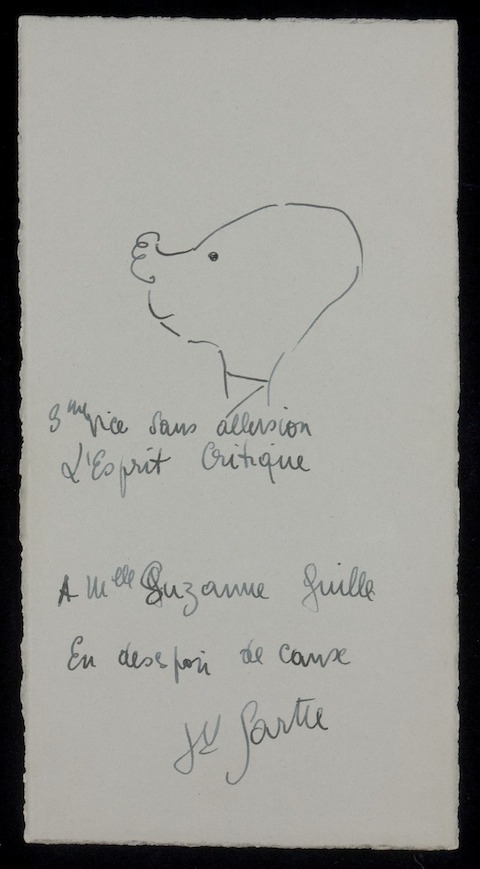
But there is a certain wicked charm in Sartre’s visual satires of human moral failings, which he calls a “series de ‘douze vices sans allusion’”—roughly, “a series of twelve vices without reference.” Either Sartre only completed half the series, or—more likely—half have been lost, since the author assures the recipient of his handiwork, a Mademoiselle Suzanne Guille, that he presents to her a “série complete.” Who was Suzanne Guille? Your guess is as good as mine. Yale’s Beinecke Rare Book & Manuscript Library, which houses these sketches, gives us no indication. Perhaps she was a relative, perhaps the spouse, of Pierre Guille, Simon de Beauvoir’s last lover? Given the many complicated liaisons pursued by both Sartre and his partner, the possibilities are indeed intriguing. As for the drawings? Their subjects hold more interest than their execution, providing us with keys to Sartre’s moral universe.
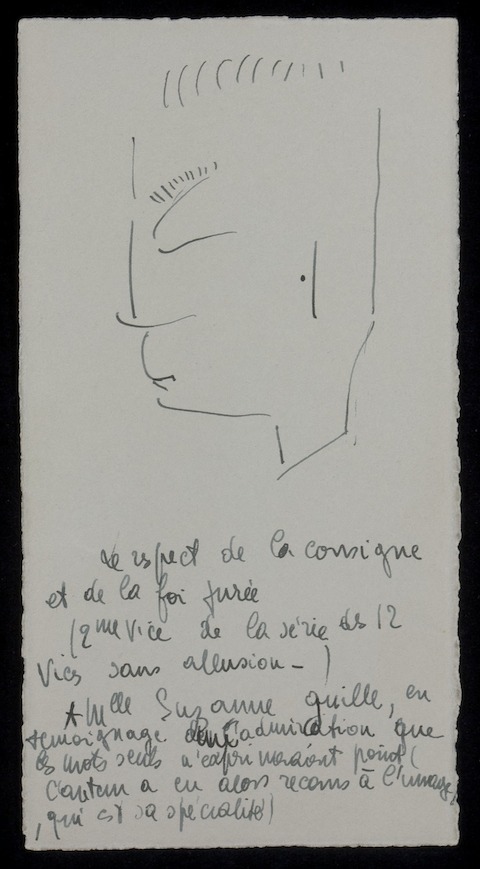
The first caricature, at the top, is titled “Le Contentment de soi”—“Self-Satisfaction”—and the character’s pompous expression says as much. Below it, the curious little fellow with the curlicue nose is called “L’Esprit Critique”—“The Spirit of Criticism.” And above we have “Le respect de la consigne et de la jurée”—“Keeping a Sworn Oath.” You can see the remaining three drawings, and read Sartre’s letter (in French, of course) to Mademoiselle Guille in pdf form here.
Related Content:
James Joyce, With His Eyesight Failing, Draws a Sketch of Leopold Bloom (1926)
Two Childhood Drawings from Poet E.E. Cummings Show the Young Artist’s Playful Seriousness
The Art of Sylvia Plath: Revisit Her Sketches, Self-Portraits, Drawings & Illustrated Letters
Walter Kaufmann’s Classic Lectures on Nietzsche, Kierkegaard and Sartre (1960)
Josh Jones is a writer and musician based in Durham, NC. Follow him at @jdmagness
Read More...Support Us
We're hoping to rely on loyal readers, rather than erratic ads. Please click the Donate button and support Open Culture. You can use Paypal, Venmo, Patreon, even Crypto! We thank you!

About Us

Open Culture scours the web for the best educational media. We find the free courses and audio books you need, the language lessons & educational videos you want, and plenty of enlightenment in between.
Advertise With Us
FREE UPDATES!
GET OUR DAILY EMAIL
Get the best cultural and educational resources on the web curated for you in a daily email. We never spam. Unsubscribe at any time.
FOLLOW ON SOCIAL MEDIA
Open Culture editor Dan Colman scours the web for the best educational media. He finds the free courses and audio books you need, the language lessons & movies you want, and plenty of enlightenment in between.
Advertise With Us