The Art of Sylvia Plath: Revisit Her Sketches, Self-Portraits, Drawings & Illustrated Letters
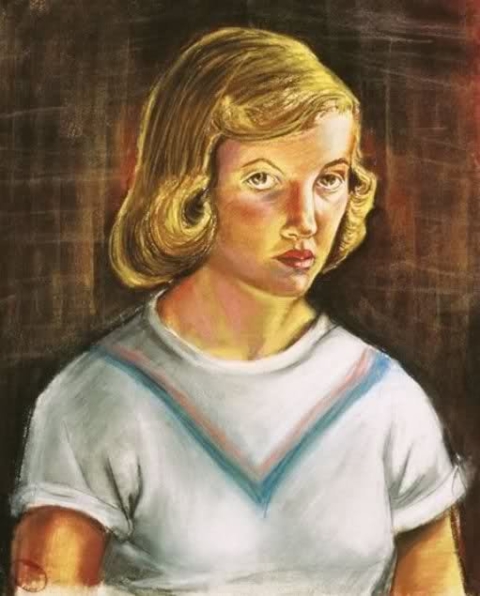
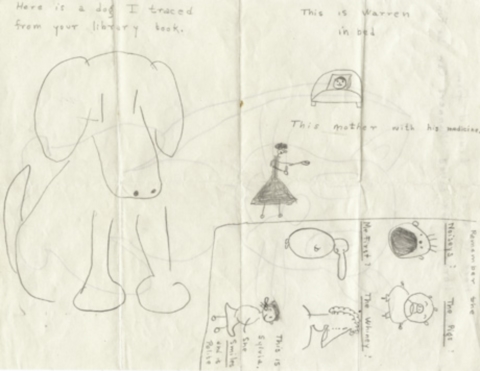
Sylvia Plath’s poetic talent should go unquestioned, but as Plath fans will know, she first intended to become a visual artist, and some of her earliest work—illustrated childhood letters like the adorable dog below—remained hidden away in the family attic until 1996. Editor Kathleen Connors included this juvenilia in a 2007 collection of Plath’s work entitled Eye Rhymes: Sylvia Plath’s Art of the Visual, which also features sketches, photographs, and portraits—such as the brooding 1951 self-portrait above—that represent Plath’s work while an art student at Smith College.
Much of the art-school work is not representative of Plath’s best. While she made the difficult decision at age 20 to abandon aspirations for an art career and focus on her writing, Plath continued to make visual art. For example, at 23, she produced a confidently-rendered series of pen-and-ink drawings—such as the fishing boats below—while she and Ted Hughes honeymooned in Paris and Spain.
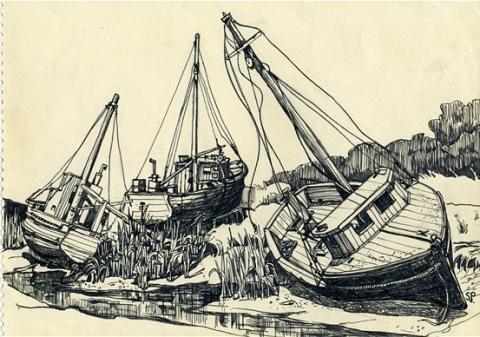
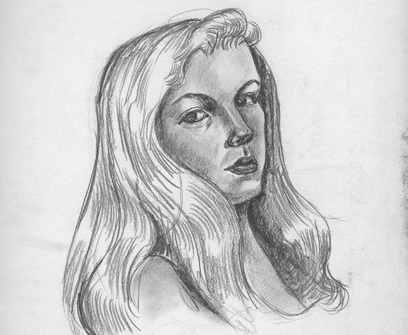
The Telegraph has a gallery of thirty of these drawings, which were on display at London’s Mayor Gallery between November and December of 2011. Plath’s writing has always been remarkably visual, her deft handling of sometimes startling imagery giving her work so much of its ability to seduce, enthrall, and unsettle. As in her poetry, the images of herself seem to attract the most interest. There are other pieces of Plath self-portraiture, but none contrasts so much with the youthful painting above, I think, as the accomplished pencil drawing below, with the poet’s fearless sidelong stare and bare shoulders expressing both her vulnerability and considerable personal and creative power.
Related Content:
On 50th Anniversary of Sylvia Plath’s Death, Hear Her Read ‘Lady Lazarus’
Josh Jones is a writer and musician based in Washington, DC. Follow him @jdmagness
Read More...James Joyce Plays the Guitar (1915)
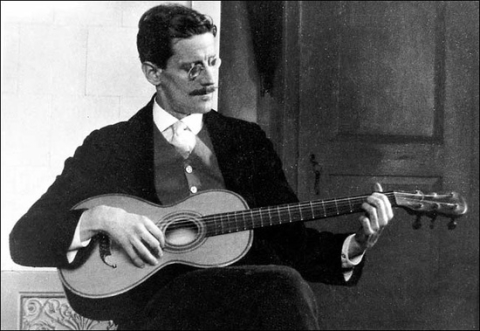
The work of James Joyce has inspired many a musician—from John Cage to Kate Bush, and Lou Reed to Irish band Therapy?. The famed Irish writer was himself a great lover of song (his only collection of poetry is titled Chamber Music); most readers of Joyce know that he packed his stories and novels with thousands of allusions and quotes from popular and classical songs. Fewer know that if the encyclopedic modernist had not become James Joyce the heavyweight author, we might know him as James Joyce, singer and composer. Joyce once shared the stage with opera singer John McCormack and studied and performed music throughout his life.
Joyce the singer is typically pictured “drooping over the keys” of a piano (as Shakespeare and Company founder Sylvia Beach put it). But he also played the guitar, as you can see from the 1915 photo above (taken in Trieste by Joyce’s friend Ottacaro Weiss). Joyce’s small-bodied guitar has been housed at the Joyce Tower Museum in Dublin since 1966, in an unplayable state.
Now, English luthier Gary Southwell has undertaken a restoration of the instrument at the behest of Tower Museum curator Robert Nicholson and Fran O’Rourke, professor of philosophy at Joyce’s alma mater, University College Dublin. A musician himself, O’Rourke will perform Joycean Irish songs during Bloomsweek to offset the cost of the project, accompanied on the restored Joyce guitar by Irish classical guitarist John Feeley
Luthier Southwell describes the guitar as “a fairly standard instrument of the period… not from any great maker of the past or anything like that.” In the video above from The Irish Times, see Southwell, Professor O’Rourke, and Joyce scholar Terence Killeen describe the state of the guitar and its history. And below, listen to Joyce’s only known composition, the melancholy “Bid Adieu to Girlish Days,” sung by tenor Kevin McDermott.
h/t @faraway67 and @matthiasrascher
Related Content:
James Joyce, With His Eyesight Failing, Draws a Sketch of Leopold Bloom (1926)
James Joyce Reads ‘Anna Livia Plurabelle’ from Finnegans Wake
James Joyce’s Ulysses: Download the Free Audio Book
Josh Jones is a writer and musician based in Washington, DC. Follow him @jdmagness
Read More...Animations Revive Lost Interviews with David Foster Wallace, Jim Morrison & Dave Brubeck
David Gerlach left a comfortable job working as a TV producer to launch Blank on Blank, a multimedia nonprofit with a simple mission — to curate journalists’ forgotten interviews with cultural icons, and then bring them back to life again, sometimes as animated shorts. You can start enjoying the fruit of Blank on Blank’s labors by watching a series of web animations, recently produced in collaboration with PBS Digital Studios. Above, we’re starting you off with a four-minute animation of David Foster Wallace reflecting on his early tennis days, the perils of perfectionism, and his tendency to be a “grammar nazi” when teaching college students — something we’ve covered here before. The interview originally aired on WNYC’s Leonard Lopate Show in 1996, and you can listen to the conversation in its entirety here.
Next comes some memorable moments with Jim Morrison, the great singer-songwriter, who met with Village Voice writer Howard Smith back in November, 1969. Going into the meeting, Smith sensed that things wouldn’t be easy. He later recalled, “I had a feeling that it was going to be a tough interview. I just kinda had a feeling that … it was going to be tricky, and I said .… if things get really difficult with him, I’m gonna suggest that we arm wrestle.” As you’ll hear, Smith made his great arm-wrestling escape an inevitability when he needled Morrison, suggesting that the singer had put on too much weight. You can see how things played out above, or catch the complete interview here.
Blank on Blank has produced other animated interviews with Bono, Larry King, and surfer Kelly Slater. But we’re going to wind things down with Dave Brubeck recalling how President Eisenhower sent him to Eastern Europe to fight Communism with Jazz. Brubeck related this story at the Litchfield Jazz Festival in 2008.
If you’re looking to rummage through a big archive of lost interviews, I’d encourage you to spend time with the Blank on Blank podcast available on iTunes and rss.
Related Content:
The Nazis’ 10 Control-Freak Rules for Jazz Performers: A Strange List from World War II
Pakistani Musicians Play Amazing Version of Dave Brubeck’s Jazz Classic, “Take Five”
David Foster Wallace’s 1994 Syllabus: How to Teach Serious Literature with Lightweight Books
An Uplifting Musical Surprise for Dave Brubeck in Moscow (1997)
Read More...Flannery O’Connor Reads ‘Some Aspects of the Grotesque in Southern Fiction’ (c. 1960)
Here is a rare recording of Flannery O’Connor reading an early version of her witty and revealing essay, “Some Aspects of the Grotesque in Southern Fiction.”
O’Connor gives an eloquent outline of her vision as both a Southern and a Catholic writer. She defends her work against critics who say it is highly unrealistic. “All novelists are fundamentally seekers and describers of the real,” she says, “but the realism of each novelist will depend on his view of the ultimate reaches of reality.” In the published version of the essay, she writes:
Whenever I’m asked why Southern writers particularly have a penchant for writing about freaks, I say it is because we are still able to recognize one. To be able to recognize a freak, you have to have some conception of the whole man, and in the South the general conception of man is still, in the main, theological. That is a large statement, and it is dangerous to make it, for almost anything you say about Southern belief can be denied in the next breath with equal propriety. But approaching the subject from the standpoint of the writer, I think it is safe to say that while the South is hardly Christ-centered, it is most certainly Christ-haunted. The Southerner, who isn’t convinced of it, is very much afraid that he may have been formed in the image and likeness of God. Ghosts can be very fierce and instructive. They cast strange shadows, particularly in our literature. In any case, it is when the freak can be sensed as a figure for our essential displacement that he attains some depth in literature.
This passage can be heard, in different form, beginning at the 3:40 mark in the recording. Like many of O’Connors essays, “Some Aspects of the Grotesque in Southern Fiction” was written not for publication, but for public reading. She was known to rewrite and rearrange these pieces between readings. In this recording, O’Connor is using the piece as a preparatory statement for a reading of her classic story, “A Good Man is Hard to Find.”
We don’t know the date of the recording, but the text differs significantly from the posthumously published version, so perhaps it is an early version. The earliest extant recording of the essay that we know of was made on October 28, 1960 for the Dorothy Lamar Blount Lecture Series at Wesleyan College in Macon, Georgia. There is also known to be a recording of O’Connor reading the piece on November 16, 1962 at East Texas State University.
To compare the recorded version to the one eventually published in Mystery and Manners: Occasional Prose, you can click here to open the essay in a new window.
Related Content:
Rare 1959 Audio: Flannery O’Connor Reads ‘A Good Man is Hard to Find’
Flannery O’Connor’s “Everything That Rises Must Converge” Read by Estelle Parsons
Read More...The Police Sing “Message in a Bottle” for the First Time Live (1979)
The Police pulled off the most unlikely of musical feats. While several bands combined the restless, raw energy of punk with the rhythmic, tuneful urgency of reggae, these guys wrapped it all up in the accomplished musicianship and off-kilter key changes and shifting time signatures of jazzy prog rock. This had never been done before, and anyone who’s tried it since owes a tremendous debt to Sting, Andy Summers, and Stewart Copeland (no one comes to mind, though). The fact that they were able to retain rock credibility while winning pop stardom and a Grammy for a rock instrumental (1979’s krautrock-influenced “Regatta de Blanc”) are all further testaments to the phenomenal oddity that was this band. While I’ve never been much of a fan of Sting’s solo work, The Police have always kind of astonished me with their bravery and virtuosity.
And so we come to the act of bravery above: in a live appearance at Hatfield Polytechnic (now the University of Hertfordshire) in February of 1979, the band decides to drop a new, untested song on the enthusiastic crowd. The song? “Message in a Bottle” from the ’79 album Regatta de Blanc, the same record that produced that Grammy-winning title-track instrumental. What’s so brave about that, you ask? There’s often no better way to try out new material than in front of an already appreciative audience. Well, this gig was recorded for a BBC series called “Rock Goes to College.” Although The Police were skirting stardom with the single “Roxanne” from their first album, they hadn’t quite made it yet, and their first TV appearance was a risky venue for demoing a new tune. But they pull it off. The crowd bounces in time and the three Police, who seem on the edge of a mistake or dropped note somewhere, give the song a flawless turn.
You can watch the full “Rock Goes to College” concert below, which also includes early hits like “Can’t Stand Losing You” (the opener) and “Roxanne” (at 29:45).
Related Content:
Pavarotti Sings with Lou Reed, Sting, James Brown and Other Friends
The First Live Performance of Nirvana’s “Smells Like Teen Spirit” (1991)
Two Very Early Concert Films of R.E.M., Live in ‘81 and ‘82
Josh Jones is a writer and musician based in Washington, DC. Follow him @jdmagness
Read More...Free: Watch Jackie Robinson Star in The Jackie Robinson Story (1950)
This weekend, the new Jackie Robinson biopic, 42, opened up well in the box offices, bringing in $27.3 million in ticket sales. That puts it at the top of the charts, which is a real rarity for a baseball film.
This isn’t the first time Jackie Robinson’s story has been told on film. And today we’re bringing you another noteworthy production, The Jackie Robinson Story from 1950. As reviewers are quick to note, it’s not a work of art. It’s a simple film with low production values. But, it has one thing that other Jackie Robinson films do not — Jackie Robinson playing himself, and quite well at that. Running 76 minuters, the fast-paced film takes the audience through the life and times of the great baseball player and civil rights figure. His youth, college football days, military service, minor league career, amazing 1949 season with the Brooklyn Dodgers — they all get covered here.
The Jackie Robinson Story (which is now in the public domain) has been added to our collection of 525 Free Movies Online.
via Slate
Related Content:
Lou Gehrig, Yankee Legend, Stars in 1938 Western Rawhide
Bill Murray’s Baseball Hall of Fame Speech (and Hideous Sports Coat)
The Grateful Dead Rock the National Anthem at Candlestick Park: Opening Day, 1993
Read More...Tom Lehrer’s Mathematically and Scientifically Inclined Singing and Songwriting, Animated
I went through childhood listening to Tom Lehrer’s “New Math”. The 1965 song, performed in part like standard spoken-word comedy, made me laugh every time. “In the new approach,” the satirist says of the revolutionary mathematics he purports to teach us, “the important thing is to understand what you’re doing rather than to get the right answer.” Working aloud through a subtraction problem at the piano, Lehrer sings the operations: “And so you’ve got thirteen tens and you take away seven and that leaves five. Well, six, actually, but the idea’s the important thing.” This struck me at the time as nothing more than an amusingly goofy numeric riff, and perhaps one with harsh implications for the flaky educational fads of the nineties my peers and I then endured. Only years later did I find out that Cold War America of the early sixties actually went through a New Math phase, shaken hard enough by Sputnik to desperately foist abstract, set theory-driven math textbooks upon its elementary schoolers.
Lehrer, who turned 85 on Tuesday, knows the subject well: he holds degrees in mathematics from Harvard, has co-authored such papers as “Random walks with restraining barrier as applied to the biased binary counter” and “The distribution of the number of locally maximal elements in a random sample”, and, after retiring from music in the early seventies, taught math classes at the University of California, Santa Cruz. Legend has it that he would incorporate relevant songs from his catalog into lectures. But he never sang only about mathematics; he also sang about physics, as you can see in the animated version of his 1959 song “The Elements” above, a tribute simultaneously to the periodic table and The Pirates of Penzance. Nobody can deny the importance of learning how to subtract or how to tell one element from another, but we’d do well to keep Lehrer’s sharp human insights, present implicitly in all his music and explicitly in some of it, in mind. So put one of his records on the next time you have a birthday of your own, taking a bracing shot of his wit before you continue, as he put it in “Bright College Days”, “sliding down the razor blade of life.”
Colin Marshall hosts and produces Notebook on Cities and Culture and writes essays on literature, film, cities, Asia, and aesthetics. He’s at work on a book about Los Angeles, A Los Angeles Primer. Follow him on Twitter at @colinmarshall.
Read More...History of Rock: New MOOC Presents the Music of Elvis, Dylan, Beatles, Stones, Hendrix & More
Here’s something I can get pretty jazzed about. Er, maybe that’s not quite the right verb. But close enough.…
On May 13, the Eastman School of Music at the University of Rochester will launch the first of two MOOCs that will trace the history of rock music. Taught by John Covach, a professor of music theory, The History of Rock, Part One will revisit the 1950s and 1960s, the halcyon days of rock ’n’ roll, which gave us the music of Elvis Presley, Chuck Berry, Phil Spector, Bob Dylan, the Beatles, the Rolling Stones, Jimi Hendrix, Cream, and other bands. The course will focus on the music itself, the cultural context from which rock emerged, and how changes in the music business and music technology shaped this new musical form. The second course (scheduled to start on July 8) will move forward to the 1970, 80s and 90s and cover the music of Led Zeppelin, the Allman Brothers, Carole King, Bob Marley, the Sex Pistols, Donna Summer, Michael Jackson, Madonna, Prince, Metallica, Run-DMC, Nirvana, and other artists. Students who successfully complete the course will receive a “Statement of Accomplishment” signed by the instructor.
Other music courses listed in our collection of 300 Free MOOCs from Great Universities include Introduction to Guitar and Introduction to Improvisation. They’re both created by the Berklee College of Music and start on April 22.
Related Content:
A History of Rock ‘n’ Roll in 100 Riffs
Carnegie Hall MOOC Will Teach You How to Listen to Orchestras (Free)
Read More...A Young, Clean Cut Jim Morrison Appears in a 1962 Florida State University Promo Film
Here’s a weird one: weirdo Doors frontman Jim Morrison, native of Florida, the weirdest state in the Union (well, it is!), stars in a promo film for Florida State University. Morrison’s character gets a bummer of a letter informing him that he has been rejected from FSU, and later meets with an administrator who gives him the lowdown. Of course, as one YouTube commenter quips, “when one door closes, The Doors open” (heh). So, fine, Morrison didn’t need Florida State—he lived fast, died young, and left the most famous grave in history.
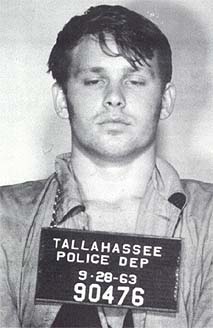
But as his fans know, the well-read Morrison was no intellectual slouch; he started the Doors while studying film at UCLA, to which he’d transferred from Florida State, where he enrolled in 1962. In addition to getting cast in the promo above, while at FSU Morrison got arrested for a school prank (see his ’63 mugshot at left), made some short films, and did his share of carousing. One fellow student, Gerry McClain, remembers Morrison from his FSU days in an interview with the site American Legends:
He hung around with a bohemian crowd: people who liked to wear pants with holes in them. Jim posed as a model for the art department, and they would all sell blood to the Red Cross to get a few bucks. Once, I saw Jim go around the college coffee shop eating scraps off tables. I felt he–and the others–were living an image–the starving young artist.
But Morrison wasn’t exactly a starving artist. He was, in fact, the son of Rear Admiral George Stephen Morrison, commander of the U.S. Naval forces in the incident that sparked the Vietnam War. Weird, right? Watch the elder Morrison and Jim’s sister Anne in interview remembrances of Jim in the video below.
Related Content:
See Jimi Hendrix’s First TV Appearance, and His Last as a Backing Musician (1965)
A Young Frank Zappa Plays the Bicycle on The Steve Allen Show (1963)
Jimmy Page, 13, Plays Guitar on BBC Talent Show (1957)
Josh Jones is a writer and musician based in Washington, DC. Follow him @jdmagness
Read More...Rock and Roll Heart, 1998 Documentary Retraces the Remarkable Career of Lou Reed
From the album that launched a million bands to possibly the worst rap song of all time—from perfect, career-reviving collaborations to abysmal career-killing ones—Lou Reed’s rock and roll run has seen its share of highs and rock-bottom lows. Reed warrants comparison with Neil Young for his longevity, hit-and-miss prolific output, and gadfly ability to flit from project to project, sound to sound, while still sounding distinctively himself. And like Young, there are too many phases, too many albums, great and terrible, to really do the life’s work justice in any one retrospective.
But the 1998 documentary above, from the PBS American Master’s series, makes an admirable attempt. Called Rock and Roll Heart after Reed’s 1976 album and single of the same name, the film lets Reed tell much of his own story: his teenage years as a devotee of 50s rock and doo wop, his college-days association with poet Delmore Schwartz, episodes in his life that very much came to define his art, which marries a finely-tuned literary sensibility to the simplicity and tunefulness of classic rock and roll. Reed’s warped, lyrical takes on streetlife psychodrama and his love for drone notes and feedback, however, took rock songwriting places it had never been before. At the opening of the film, Reed delivers an epigrammatic gem about himself: “I disliked groups, disliked authority. Uh… I was made for rock and roll.”
Reed’s dislike of groups translates throughout his career into a reputation for difficulty that sent collaborators running from him, either because he fired them (as he most famously did to the brilliant John Cale) or because they’d had enough of his egotism. Nonetheless, many of those same people—Cale included—came back to work with Reed again. Cale shows up above, telling stories of the genesis of The Velvet Underground—of him and Reed playing “Waiting for the Man” and “Heroin” on a Harlem streetcorner on viola and acoustic guitar. Other confreres of Reed’s genius also appear in interviews: Velvet’s drummer Maureen Tucker, David Bowie, Patti Smith, Jim Carroll, Philip Glass, and of course the man Reed credits most for his success, Andy Warhol, in archival footage from 1966.
The love/hate pairing of The Velvets and Nico gets an airing, and there’s loads of film of Lou performing, but at 73 minutes, Rock and Roll Heart feels a little thin, and its tone is almost entirely celebratory, eliding the musical low points (like the stab at rap) and ending with Reed’s forays into theater with Time Rocker. But these are forgivable flaws. There’s no way to cover all the ground Reed’s broken (he’s released an album roughly every year since 1972). And at 71 (if he can recover from that Metallica mash-up), he’s still at it—as he says in an interview above, until he dies.
Related Content:
Philip Glass & Lou Reed at Occupy Lincoln Center: An Artful View
Andy Warhol Quits Painting, Manages The Velvet Underground (1965)
Josh Jones is a writer, editor, and musician based in Washington, DC. Follow him @jdmagness
Read More...Support Us
We're hoping to rely on loyal readers, rather than erratic ads. Please click the Donate button and support Open Culture. You can use Paypal, Venmo, Patreon, even Crypto! We thank you!

About Us

Open Culture scours the web for the best educational media. We find the free courses and audio books you need, the language lessons & educational videos you want, and plenty of enlightenment in between.
Advertise With Us
FREE UPDATES!
GET OUR DAILY EMAIL
Get the best cultural and educational resources on the web curated for you in a daily email. We never spam. Unsubscribe at any time.
FOLLOW ON SOCIAL MEDIA
Open Culture editor Dan Colman scours the web for the best educational media. He finds the free courses and audio books you need, the language lessons & movies you want, and plenty of enlightenment in between.
Advertise With Us

