Rare Audio: Samuel Beckett Reads From His Novel Watt
Samuel Beckett was notoriously shy around recording devices. He would spend hours in a studio working with actors, but when it came to recording a piece in his own voice he was elusive. Only a handful of recordings are known to exist. So the audio above of Beckett reading a pair of his poems is extremely rare.
The recordings were made in 1965 by Lawrence Harvey, professor of comparative literature at Dartmouth College, who traveled to Paris to meet with Beckett a number of times from 1961 to 1965 while researching his 1970 book Samuel Beckett, Poet and Critic. At one point during their discussions, Beckett recited several passages from his third but second-published novel, Watt. The book was written in English in the 1940s, mostly while Beckett was hiding from the Nazis in southern France. It’s an experimental novel (Beckett called it an “exercise”) about a seeker named Watt who journeys to the house of the enigmatic Mr. Knott and works for a time as his servant. “Watt” and “Knott” are often interpreted as stand-ins for the question “what?” and unanswerable “not,” or “naught.”
The two poems recited by Beckett are from his 37 intriguing Addenda at the end of Watt. Harvey also recorded Beckett reading a prose passage from the book. The full four-minute tape is now in the collection of the Baker Library at Dartmouth. The short clip above is from the 1993 film Waiting For Beckett. The image quality is poor and there are distracting Dutch subtitles, so perhaps the best way to enjoy the reading is to scroll down and look instead at Beckett’s words while you listen to his voice. He begins with the 4th Addenda, later published as “Tailpiece” in Collected Poems, 1930–1978:
who may tell the tale
of the old man?
weigh absence in a scale?
mete want with a span?
the sum assess
of the world’s woes?
nothingness
in words enclose?
The images in the poem are, according to scholars S.E. Gontarski and Chris Ackerley in their essay “Samuel Beckett’s Watt,” a reworking by Beckett of the biblical passage Isaiah 40:12, which says, “Who hath measured the waters in the hollow of his hand, and meted out heaven with a span, and comprehended the dust of the earth in a measure, and weighed the mountains in scales, and the hills in a balance?” The next poem is the 23rd Addenda. It tells of Watt’s long and fruitless journey through barren lands:
Watt will not
abate one jot
but of what
of the coming to
of the being at
of the going from
Knott’s habitat
of the long way
of the short stay
of the going back home
the way he had come
of the empty heart
of the empty hands
of the dim mind wayfaring
through barren lands
of a flame with dark winds
hedged about
going out
gone out
of the empty heart
of the empty hands
of the dark mind stumbling
through barren lands
that is of what
Watt will not
abate one jot
If Beckett seems to mispronounce certain consonant sounds, it may have something to do with a surgery he had in November of 1964 to remove a tumor in his jaw. The surgery temporarily left Beckett with a hole in the roof of his mouth. According to a 1998 article by Peter Swaab in The Times Literary Supplement, the recordings were probably made in March of 1965, when Beckett was awaiting a follow-up surgery to fix his palate. Still, many listeners have been struck by the beauty of the recordings. As Swaab writes:
Beckett’s voice is unexpectedly soft, and seems more suited to the serenely commiserative vein of his writing than the splenetic and cynical one. He reads the poems a lot more slowly than the prose–with a pronounced chanting mellifluousness.… The overall effect of these rare and fascinating recordings is of a delivery like that which Beckett recommended to the actor David Warrilow for Ohio Impromptu, “calm, steady, designed to soothe”–or (to bring in two of the central words in Watt) a “murmur” meant to “assuage.” The tape evidently records a sort of rehearsal, and the perfectionist Beckett would surely not have been satisfied with it, but it is good to know that his voice has not altogether disappeared.
Special thanks to Dr. Mark Nixon, reader in Modern Literature at the University of Reading and director of the Beckett International Foundation, for confirming the authenticity of the recording and pointing us on the way to more information.
Related content:
Samuel Beckett Directs His Absurdist Play Waiting for Godot (1985)
Find Works by Beckett in our Free Audio Books and Free eBooks collections
Read More...Donald Barthelme’s Syllabus Highlights 81 Books Essential for a Literary Education
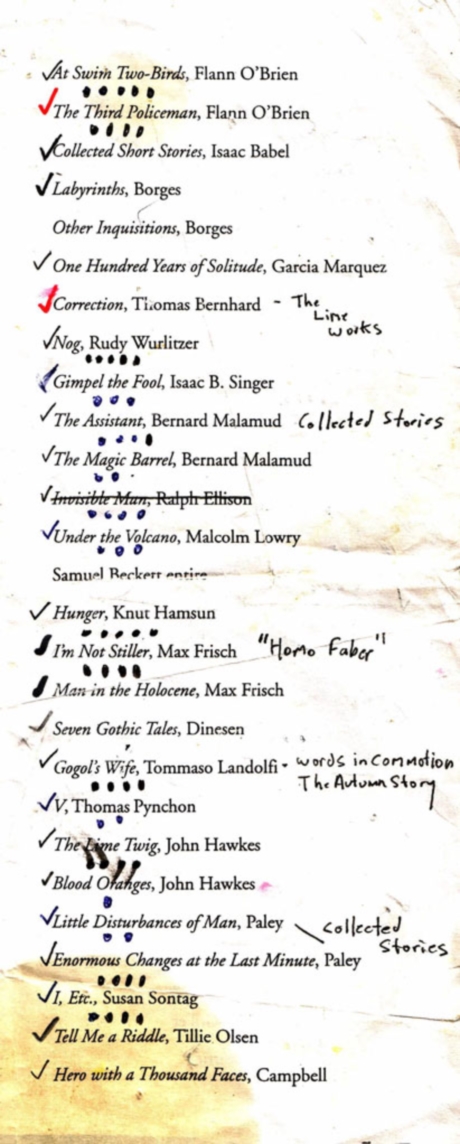
We’ve had a lot of fun—and some debate—lately with reading lists from people like Carl Sagan, Neil DeGrasse Tyson, and even Marilyn Monroe (via her library). And we’ve featured undergraduate syllabi from the teaching days of David Foster Wallace and W.H. Auden. Now for something more-or-less formal than those. This one comes via a 2003 piece by Kevin Moffett in McSweeney’s spin-off The Believer (10 years old this month—I know, right?). The list (first page above and full list below) has a somewhat illustrious heritage. Compiled by postmodernist writer Donald Barthelme for his students at the University of Houston, it then made its way to Barthelme’s student, Southern writer Padgett Powell. The list then came to Moffett when he was a student of Powell’s at the University of Florida.
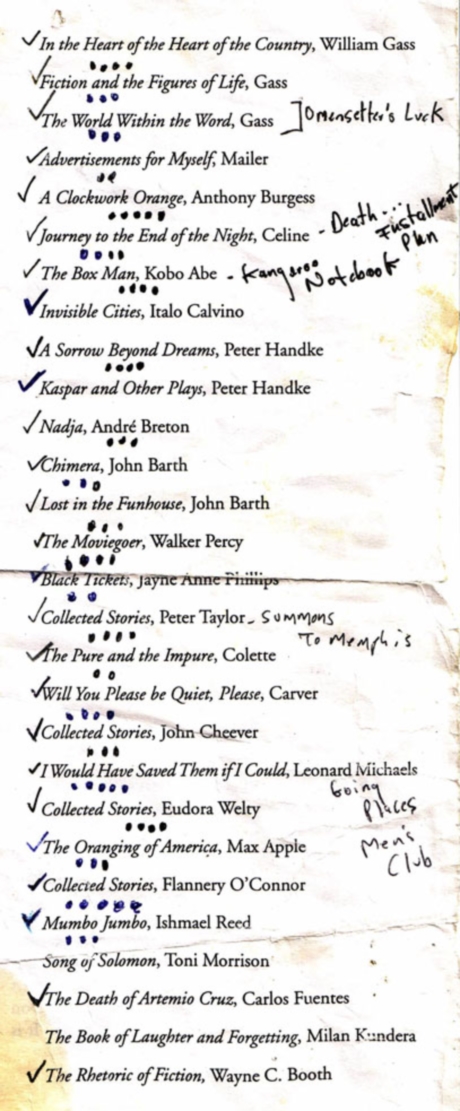
Consisting of 81 books, mostly novels and short story collections (and the work of Samuel Beckett—“entire”), and mostly twentieth-century modernist fiction, the list came to Powell with Barthelme’s instruction to attack the books, “in no particular order, just read them.”
This Moffett did, and his story of how he sought the books—in the used bookshops, warehouse sales, and libraries of north Florida—lends to his experience the air of a suburban knight’s quest tale, with Moffett as underdog hero. The list spans a range of difficulty, from the academic obscurantism of Roland Barthes to the general accessibility of Updike (Barthelme modestly exempts himself). But the text that turns Moffett from diffident to avid reader, Flannery O’Connor’s “A Late Encounter With the Enemy,” also turns his “resolution into a vow.” It’s almost as though his engagement with Barthelme’s list initiates him into a mystical order of language.
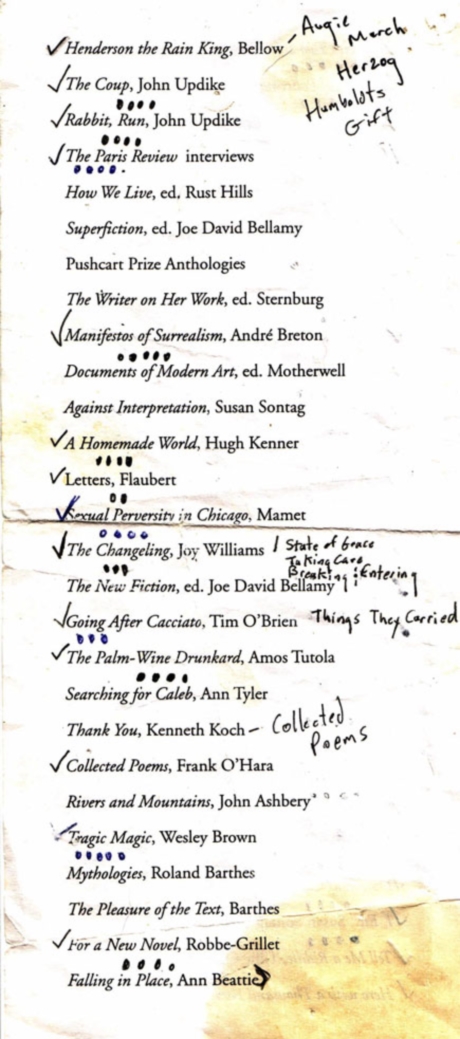
The list itself, as you can see from the scans, shows the wear of several pairs of hands—hands holding late-night coffees in college-town cafes and felt-tip pens with which to make tiny checkmarks of accomplishment. We do not know from Moffett’s piece whose hands did the coffee-spilling, checkmarking, and annotating, whether Powell’s, Moffett’s, or some student or private reader unmentioned. Some of the books left unchecked are those with which I have had readerly epiphanies: Borges’ Other Inquisitions, Barthes’ Mythologies, Beckett (“entire”), Toni Morrison’s Song of Solomon. And what strikes me, as with all such lists, are the number of books I haven’t read but have wished to, meant to, promised that I would. Perhaps it’s not too late to turn a resolution to a vow and hit the stacks.
Here is the complete list:
- Flann O’Brien, At Swim Two-Birds
- Flann O’Brien, The Third Policeman

- Isaac Babel, Collected Short Stories
- Borges, Labyrinths
- Borges, Other Inquisitions
- Garcia Marquez, One Hundred Years of Solitude
- Thomas Bernhard, Correction
- Rudy Wurlitzer, Nog
- Isaac B Singer, Gimpel the Fool
- Bernard Malamud, The Assistant
- Bernard Malamud, The Magic Barrel
- Ralph Ellison, Invisible Man
- Malcolm Lowry, Under the Volcano
- Samuel Beckett entire
- Knut Hamsun, Hunger
- Max Frisch, I’m Not Stiller
- Max Frisch, Man in the Holocene
- Dinesen, Seven Gothic Tales
- Tommaso Landolfi, Gogol’s Wife
- Thomas Pynchon, V
- John Hawkes, The Lime Twig
- John Hawkes, Blood Oranges
- Paley, Little Disturbances
- Paley, Enormous Changes at the Last Minute
- Susan Sontag, I, Etc.
- Tillie Olsen, Tell Me a Riddle
- Campbell, Hero with a Thousand Faces
- Bellow, Henderson the Rain King
- John Updike, The Coup
- John Updike, Rabbit, Run
- The Paris Review interviews
- Rust Hills (ed.), How We Live
- Joe David Bellamy (ed.), Superfiction
- Puschart Prize Anthologies
- Sternburg (ed.), The Writer on Her Work
- André Breton, Manifestos of Surrealism
- Motherwell (ed.), Documents of Modern Art
- Susan Sontag, Against Interpretation
- Hugh Kenner, A Homemade World
- Flaubert, Letters
- Mamet, Sexual Perversity in Chicago
- Joy Williams, The Changeling
- Joe David Bellamy (ed.), The New Fiction
- Tim O’Brien, Going After Cacciato
- Amos Tutola, The Palm-Wine Drunkard
- Ann Tyler, Searching for Caleb
- Kenneth Koch, Thank You
- Frank O’Hara, Collected Poems
- John Ashbery, Rivers and Mountains
- Wesley Brown, Tragic Magic
- Roland Barthes, Mythologies
- Barthes, The Pleasure of the Text
- Robbe-Grillet, For a New Novel
- Ann Beattie, Falling in Place
- William Gass, In the Heart of the Heart of the Country
- Gass, Fiction and the Figures of Life
- Gass, The World Within the Word
- Mailer, Advertisements for Myself
- Anthony Burgess, A Clockwork Orange
- Celine, Journey to the End of the Night
- Kobo Abe, The Box Man
- Italo Calvino, Invisible Cities
- Peter Handke, A Sorrow Beyond Dreams
- Peter Handke, Kaspar and Other Plays
- André Breton, Nadja
- John Barth, Chimera
- Walker Percy, The Moviegoer
- Jayne Anne Phillips, Black Tickets
- Peter Taylor, Collected Stories
- Colette, The Pure and the Impure
- Carver, Will You Please be Quiet, Please
- John Cheever, Collected Stories
- Leonard Michaels, I Would Have Saved Them if I Could
- Eudora Welty, Collected Stories
- Max Apple, The Oranging of America
- Flannery O’Connor, Collected Stories
- Ishmael Reed, Mumbo Jumbo
- Toni Morrison, Song of Solomon
- Carlos Fuentes, The Death of Artemio Cruz
- Milan Kundera, The Book of Laughter and Forgetting
- Wayne C Booth, The Rhetoric of Fiction


Related Content:
Neil deGrasse Tyson Lists 8 (Free) Books Every Intelligent Person Should Read
Carl Sagan’s Undergrad Reading List: From Plato and Shakespeare, to Huxley and Gide
Josh Jones is a writer, editor, and musician based in Washington, DC. Follow him @jdmagness
Read More...David Foster Wallace Breaks Down Five Common Word Usage Mistakes in English
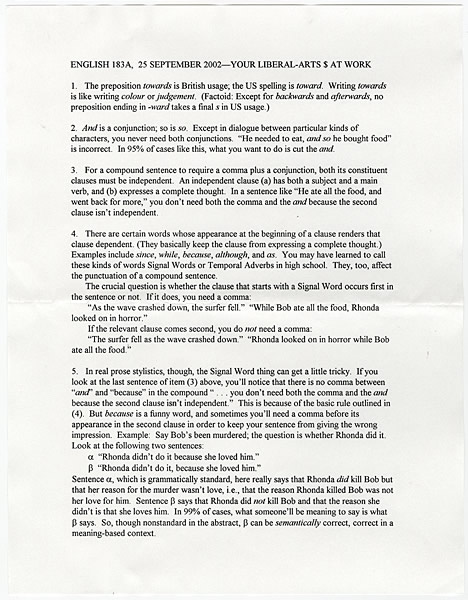
What advantage, I recently asked a trilingual writer, could you possibly find in using such an improvised, confusing, irregular patchwork of a language as English? She replied that this very improvisation, irregularity, and even confusion comes from the vast freedom of expression (and of invention of new expressions) that English offers over other European tongues. This goes even more so for American English, the variant with whose combination of carefully shaded nuances and smashing colloquialisms David Foster Wallace so dazzled his readers. Like many writers, Wallace also taught writing, but those of us not lucky enough to receive his direct instruction can still behold his teaching materials, archived online at the University of Texas at Austin’s Harry Ransom Center.
See, for instance, Wallace’s handout on five common usage mistakes, from his Fall 2002 section of English 183A at Pomona College (an advanced fiction writing class, taught last Spring by Jonathan Lethem). “The preposition towards is British usage; the US spelling is toward.” Fair enough. “And is a conjunction; so is so,” he continues. “Except in dialogue between particular kinds of characters, you never need both conjunctions.” Handy to know! Then, things get more technical: “For a compound sentence to require a comma plus a conjunction, both its constituent clauses must be independent.” As Wallace goes deeper, I feel even more sympathy for those who learn English as a second language, as I did when I read “Tense Present,” his Harper’s review of Bryan A. Garner’s A Dictionary of Modern American Usage. If the hardcore grammar talk tires you, feel free to peruse the Ransom Center’s other artifacts of Wallace’s time in the classroom—which we covered in a post last week—such as his syllabus for English 102: Literary Analysis, his guidelines for papers, and the marginalia in his copy of Carrie.
Related Content:
30 Free Essays & Stories by David Foster Wallace on the Web
David Foster Wallace: The Big, Uncut Interview (2003)
David Foster Wallace’s 1994 Syllabus
Colin Marshall hosts and produces Notebook on Cities and Culture and writes essays on literature, film, cities, Asia, and aesthetics. He’s at work on a book about Los Angeles, A Los Angeles Primer. Follow him on Twitter at @colinmarshall.
Read More...The Only Known Footage of George Orwell (Circa 1921)
?t=49s
Although he died in 1950, George Orwell seemingly escaped the reach of modern media. Orwell’s voice was never captured on audio. And his image never appeared on film. Historians and literature scholars lamented this for decades.
But then, in 2003, on the hundredth anniversary of Orwell’s birth, two researchers stumbled upon a tantalizing piece of footage in the The Pathay Film Library in London. The very brief footage — watch in full here, or at the 50 second mark in the video above — shows an 18-year-old Orwell, then named Eric Blair, marching across a sports field at Eton College, where he spent his formative years and studied French with Aldous Huxley. In the line of marching students, Orwell is the fourth student from the left.
Note: the video above comes from a British Pathe clip that features celebrities before they became famous. If you’re curious who appears in the film, see the list below the jump.
Read More...Seven Tips From F. Scott Fitzgerald on How to Write Fiction
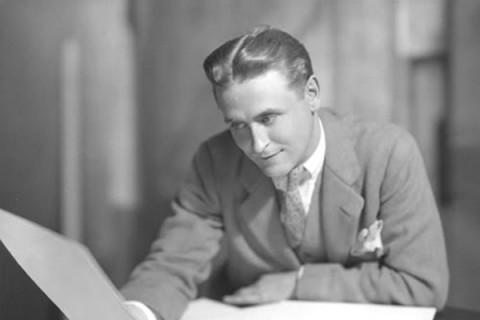
F. Scott Fitzgerald is often portrayed as a natural-born writer. “His talent,” says Ernest Hemingway in A Moveable Feast, “was as natural as the pattern that was made by the dust on a butterfly’s wings.” But Fitzgerald saw himself in a different light. “What little I’ve accomplished,” he said, “has been by the most laborious and uphill work.”
Last week we brought you Seven Tips From Ernest Hemingway on How to Write Fiction. Today we’re back with a similar list of advice from Hemingway’s friend and rival Fitzgerald. We’ve selected seven quotations from F. Scott Fitzgerald on Writing, which was edited by Larry W. Phillips and published in 1985 as a companion to the Hemingway book. As in the previous post, we’ve organized the advice under our own headings and added some brief commentary.
1: Start by taking notes.
Fitzgerald made a habit of recording his stray thoughts and observations in notebooks. He organized the entries into categories like “Feelings and emotions,” “Conversations and things overheard” and “Descriptions of girls.” When Fitzgerald was giving writing advice to his mistress Sheilah Graham in the late 1930s, he advised her to do the same. In her 1940 memoir, Beloved Infidel, Graham quotes Fitzgerald as saying:
You must begin by making notes. You may have to make notes for years.… When you think of something, when you recall something, put it where it belongs. Put it down when you think of it. You may never recapture it quite as vividly the second time.
2: Make a detailed outline of your story.
When Fitzgerald was working on a novel, he would surround himself with charts outlining the various movements and histories of his characters. In a 1936 letter to novelist John O’Hara, he advises the younger novelist to start with a big outline:
Invent a system Zolaesque…but buy a file. On the first page of the file put down an outline of a novel of your times enormous in scale (don’t worry, it will contract by itself) and work on the plan for two months. Take the central point of the file as your big climax and follow your plan backward and forward from that for another three months. Then draw up something as complicated as a continuity from what you have and set yourself a schedule.
3: Don’t describe your work-in-progress to anyone.
Fitzgerald’s policy was never to talk with other people about the book he was working on. In a 1940 letter to his daughter Scottie, he says:
I think it’s a pretty good rule not to tell what a thing is about until it’s finished. If you do you always seem to lose some of it. It never quite belongs to you so much again.
4: Create people, not types.
Fitzgerald was known for creating emblematic characters, but he said it was accidental. “I had no idea of originating an American flapper when I first began to write,” he said in a 1923 interview for Metropolitan magazine. “I simply took girls who I knew very well and, because they interested me as unique human beings, I used them for my heroines.” In the opening sentence of his 1926 short story, “The Rich Boy,” Fitzgerald explains the principle:
Begin with an individual, and before you know it you find that you have created a type; begin with a type, and you find that you have created–nothing.
5: Use familiar words.
In a 1929 letter to his college friend and fellow writer John Peale Bishop, Fitzgerald says:
You ought never to use an unfamiliar word unless you’ve had to search for it to express a delicate shade–where in effect you have recreated it. This is a damn good prose rule I think.… Exceptions: (a) need to avoid repetition (b) need of rhythm © etc.
6: Use verbs, not adjectives, to keep your sentences moving.
In a 1938 letter to his daughter, Fitzgerald writes:
About adjectives: all fine prose is based on the verbs carrying the sentences. They make sentences move. Probably the finest technical poem in English is Keats’ “Eve of Saint Agnes.” A line like “The hare limped trembling through the frozen grass,” is so alive that you race through it, scarcely noticing it, yet it has colored the whole poem with its movement–the limping, trembling and freezing is going on before your own eyes.
7: Be ruthless.
A writer has to make some hard choices. Fitzgerald warns about the danger of becoming too attached to something you’ve written. Keep an objective eye on the whole piece, he says, and if something isn’t working get rid of it. In a 1933 Saturday Evening Post article titled “One Hundred False Starts,” he writes:
I am alone in the privacy of my faded blue room with my sick cat, the bare February branches waving at the window, an ironic paper weight that says Business is Good, a New England conscience–developed in Minnesota–and my greatest problem:
“Shall I run it out? Or shall I turn back?”
Shall I say:
“I know I had something to prove, and it may develop farther along in the story?”
Or:
“This is just bullheadedness. Better throw it away and start over.”
The latter is one of the most difficult decisions that an author must make. To make it philosophically, before he has exhausted himself in a hundred-hour effort to resuscitate a corpse or disentangle innumerable wet snarls, is a test of whether or not he is really a professional. There are often occasions when such a decision is doubly difficult. In the last stages of a novel, for instance, where there is no question of junking the whole, but when an entire favorite character has to be hauled out by the heels, screeching, and dragging half a dozen good scenes with him.
Related content:
Seven Tips From Ernest Hemingway on How to Write Fiction
Rare Footage of Scott and Zelda Fitzgerald From the 1920s
Winter Dreams: F.Scott Fitzgerald’s Life Remembered in a Fine Film
F. Scott Fitzgerald Reads From Shakespeare’s Othello and John Masefield’s ‘On Growing Old’ (c.1940)
Read More...The BBC’s Horrible Histories Videos Will Crack You Up and Teach You About WWI (and More)
My 12-year-old, home-schooled son recently expressed an interest in studying World War I. This was encouraging, but also nerve-wracking, given the disdain that led me to spend most of World History passing notes and doodling (not in the Lynda Barry college course / this will help you absorb the information better way). I retained nothing of what I’d been formally taught. My most solid knowledge of the period was gleaned from the second season of Downton Abbey and an Audrey Tautou movie that was rated R for sex and violence. (There’s also a family photograph of us posing on the Sarajevo street corner where Franz Ferdinand was assassinated, but the significance of the spot had to be explained to me first.)
Some online scrabbling led me to the BBC’s Horrible Histories’ brief overview of the “causes of World War I” (above). Wow. If only this series—and, ahem, the Internet—had existed when I was the boy’s age! I think it’s safe to say my attention would have been captured. It’s silly, yes, but that’s the whole point. The players’ over-the-top comedic style ensures that even the driest of historical facts will stick, as anyone who’s watched Michael Cera bring Alexander Hamilton to life in Drunk History can attest. It’s the perfect gateway for further study.
Horrible Histories’ take on World War I proved such a hit, the boy immediately delved into other periods, often when he was supposed to be doing other things, like playing Minecraft or watching YouTube (technically, I guess this sort of counts). Still it’s gratifying to hear him studding his conversation with casual references to the Borgias, the Tudors, and Martin Luther. It makes me want to learn more, or at least bring myself up-to-speed on the videos. In the words of Schoolhouse Rock, knowledge is power.
A WWI centennial’s looming, folks. Don’t get caught with your drawers down.
Related Content:
Drunk History: An Intoxicated Look at the Famous Alexander Hamilton – Aaron Burr Duel
The Dead Authors Podcast: H.G. Wells Comically Revives Literary Greats with His Time Machine
Schoolhouse Rock at 40: Revisit a Collection of Nostalgia-Inducing Educational Videos
200 Free Kids Educational Resources: Video Lessons, Apps, Books, Websites & More
Ayun Halliday graduated from Northwestern University with a degree in theater and has been making up for it ever since. Follow her @AyunHalliday
Read More...David Foster Wallace’s 1994 Syllabus: How to Teach Serious Literature with Lightweight Books
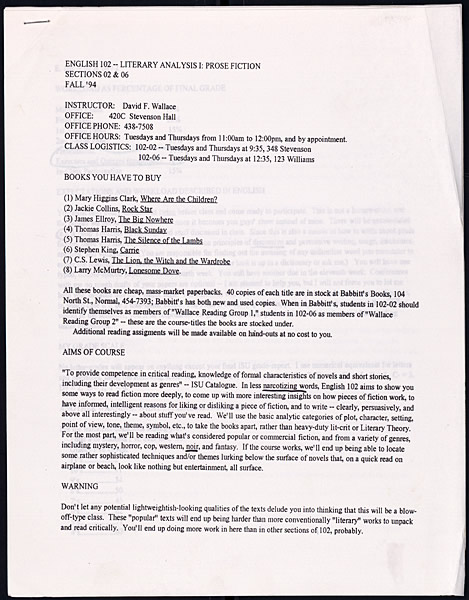
Note: click here to see the full syllabus and other related teaching materials.
As anyone who’s ever done it knows, the art of syllabussing is a fine one. (Yes, it’s a word; don’t look it up, take my word for it—Syllabussing: creating the perfect syllabus for a college-level course). It requires precision planning, stellar formatting and copy-editing skills, and near-perfect knowledge of the college-student psyche. For one, the syllabus must explain in clear terms what students can expect from the class and what the class expects from them. And it must do this without sounding so dry and pedantic that half the class drops in the first week. For another, the perfect syllabus (there’s no such thing, but one must strive) should function as both an FAQ and a contract: need to know how to format your papers? See the syllabus. Forgot when the paper was due? Too bad—see the syllabus. And so on. Most teachers learn over time that a class can stand or fall on the strength of this document.
Which brings us to the syllabussing skills of one David Foster Wallace, encyclopedic literary obsessive, modern-day moralist, English professor. Love his work or hate it, it may be safe to say that Wallace was perhaps one of the most careful (or care-full) writers of his generation. And given the criteria above, you might just have to admire the fine art of his syllabi. Well, so you can, thanks to the University of Texas at Austin’s Harry Ransom Center, which has scans available online of the syllabus for Wallace’s intro course “English 102-Literary Analysis: Prose Fiction” (first page above), along with other course documents. These documents—From the Fall ’94 semester at Illinois State University, where Wallace taught from 1993 to 2002—reveal the professionally pedagogical side of the literary wunderkind, a side every teacher will connect with right away.
The text in the image above is admittedly tiny (you can request higher resolution scans on the UT Austin site), but if you squint hard, you’ll see under “Aims of Course” that Wallace quotes the official ISU description of his class, then translates it into his own words:
In less narcotizing words, English 102 aims to show you some ways to read fiction more deeply, to come up with more interesting insights on how pieces of fiction work, to have informed intelligent reasons for liking or disliking a piece of fiction, and to write—clearly, persuasively, and above all interestingly—about stuff you’ve read.
Having taught my own versions of such a class, I’m a little jealous of his (uncharacteristically?) informal concision.
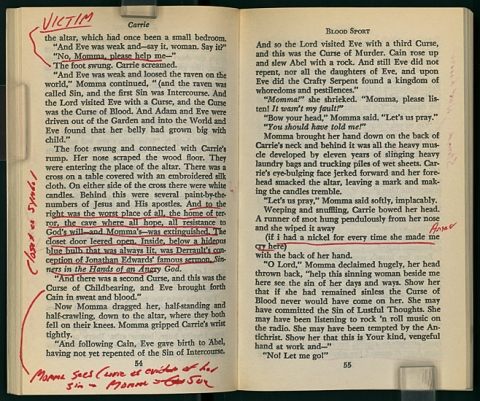
Wallace’s choice of texts is of interest as well—surprising for a writer most detractors call “pretentious.” For his class, Wallace prescribed airport-bookstore standards—what he calls “popular or commercial fiction”—such as Jackie Collins’ Rock Star, Stephen King’s Carrie, Thomas Harris’s The Silence of the Lambs, and James Elroy’s The Big Nowhere. The UT Austin site also has scans of some well-worn paperback teacher’s copies, with the red-ink marginal notes, discussion questions, and underlines one finds behind every podium. In the image above, Wallace has underlined a line of dialogue in Carrie, annotating it with the word “victim” in all-caps. Of the books Wallace requires, he writes in a section of the syllabus above called “Warning”:
Don’t let any potential lightweightish-looking qualities of the texts delude you into thinking that this will be a blow-off-type class. These “popular” texts will end up being harder than more conventionally “literary” works to unpack and read critically. You’ll end up doing more work in here than in other sections of 102, probably.
Something about that “probably” at the end grabs me (again: the precision… the college-student psyche). I admire this brave approach. Having taught conventionally “literary” stuff for years, I can say that some so-called literary fiction is formulaic in the extreme, all but containing checkboxes for the standard lit-crit categories. The commercial stuff isn’t always so careful (which is why it’s so often more fun).
UT Austin’s Harry Ransom Center houses David Foster Wallace’s library and papers, but you’ll have to make a trip to Texas (and present some academic credentials) to access most of the archive. They have scanned a few other choice pieces, however, such as the handwritten first page from a draft of his literary masterpiece/dorm-room doorstop, Infinite Jest.
Related Content:
Download 55 Free Online Literature Courses: From Dante and Milton to Kerouac and Tolkien
Donald Barthelme’s Syllabus Highlights 81 Books Essential for a Literary Education
30 Free Essays & Stories by David Foster Wallace on the Web
David Foster Wallace: The Big, Uncut Interview (2003)
Josh Jones is a writer, editor, musician, and oftentime English teacher to easily-distracted undergraduates. Follow him @jdmagness
Read More...“Nothing Good Gets Away”: John Steinbeck Offers Love Advice in a Letter to His Son (1958)
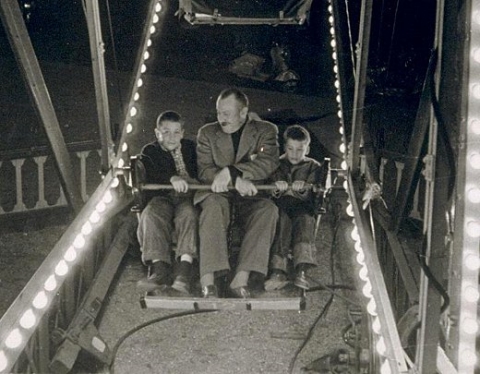
Certain readers may turn, for general solace, to the novels of John Steinbeck. But how many, in particular need of romantic advice, open up Of Mice and Men, East of Eden, or The Grapes of Wrath? Yet on matters of the heart, Steinbeck knew of what he spoke, as his son Thom found out after mentioning a new school sweetheart in a note home. In what must surely count as the most eloquent, relevant piece of unsolicited parental love advice ever given—not, admittedly, a high bar to cross—the formidable man of American letters explained how best to navigate this richest of all experiences:
First—if you are in love—that’s a good thing—that’s about the best thing that can happen to anyone. Don’t let anyone make it small or light to you.
Second—There are several kinds of love. One is a selfish, mean, grasping, egotistical thing which uses love for self-importance. This is the ugly and crippling kind. The other is an outpouring of everything good in you—of kindness and consideration and respect—not only the social respect of manners but the greater respect which is recognition of another person as unique and valuable. The first kind can make you sick and small and weak but the second can release in you strength, and courage and goodness and even wisdom you didn’t know you had.
This excerpt comes from a full text available at a favorite site of ours, Letters of Note. One of the internet’s finest repositories of man’s wisdom and folly, Letters of Note has offered William Faulkner’s take-this-job-and-shove-it, a young Kurt Vonnegut’s wartime report home after his release from a Dresden work camp, the first American fan letter sent to David Bowie, and Aldous Huxley’s death as described by his widow. My personal favorite remains the simultaneously astute and unhinged lament Ted Turner received from his father after changing his college major to classics. Turner père wrote, in his askew fashion, in the same spirit of fatherly support as Steinbeck. But Ted didn’t get to read any lines half as reassuring as those Thom Steinbeck did: “Don’t worry about losing,” his father advised. “If it is right, it happens—The main thing is not to hurry. Nothing good gets away.”
Related content:
John Steinbeck’s Six Tips for the Aspiring Writer and His Nobel Prize Speech
This is Your Brain in Love: Scenes from the Stanford Love Competition
Face to Face with Bertrand Russell: ‘Love is Wise, Hatred is Foolish’
Colin Marshall hosts and produces Notebook on Cities and Culture and writes essays on literature, film, cities, Asia, and aesthetics. He’s at work on a book about Los Angeles, A Los Angeles Primer. Follow him on Twitter at @colinmarshall.
Read More...Simulate the Damage Caused by Comet and Asteroid Collisions with Impact: Earth!
 On Friday, the world had its eyes focused on the big asteroid flyby. For weeks, we knew it was coming, and we watched it buzz by with mild curiosity. But, that same day, we were all caught off guard by a ten-ton meteorite that blasted into the Siberian town of Chelyabinsk, injuring 1,200 people and causing considerable structural damage. (Watch footage here.) This abrupt and unexpected event has given governments a reason to start taking the risk of asteroid impacts a bit more seriously. And it might renew interest in a tool created by scientists at Purdue University and Imperial College London in 2010.
In a nutshell, Impact: Earth! is an interactive tool that lets anyone calculate the damage a comet or asteroid would cause if it happened to collide with our planet. You can customize the size and speed of the incoming object, and then find out if mankind survives. (Usually it does.) A grainy primer appears below. You can enter the website and start running your own scenarios right here.
via @moseshawk
Read More...Download Eight Free Lectures on The Hobbit by “The Tolkien Professor,” Corey Olsen
The name Corey Olsen may already be familiar to some readers—or at least those readers who venerate the literary accomplishments of one J.R.R. Tolkien. And if you don’t know Olsen by his real name, you may know him as “The Tolkien Professor,” his internet moniker since 2009, when Olsen, an English Professor at Washington College and lifelong student of Tolkien’s writing, decided to share his own scholarly work with a public “eager to be included in thoughtful, literary conversation” about The Hobbit and The Lord of the Rings trilogy.
For the past four years, Olsen has published specifically online lectures about Tolkien’s work, as well as recordings of his Washington College seminars on Tolkien’s fiction and academic work. He has most recently founded Signum University, an online, non-profit Liberal Arts college that aims to open the experience of high-quality higher ed to everyone, regardless of their means or their location. Signum has, in turn, spawned the Mythgard Institute, which seems (as the name implies) more exclusively focused on the fantasy and science fiction genres that are Olsen’s métier. (There are also college prep options in Signum and Mythgard Academies).
So, Professor Olsen is busy, and he’s happy to be sharing his wealth of Tolkien knowledge with a very receptive public. His most recent course, an eight-part lecture series on The Hobbit, is now available on his site. (iTunes U also has it as of January 31st. Watch the promo for the course above. We also have the class listed in our collection of 650 Free Courses Online.) The course comes via the Mythgard Institute and begins at the beginning in a lecture entitled “Took & Baggins” focused on The Hobbit’s first chapter, “An Unexpected Party.” Recorded before the release of Peter Jackson’s first installment of his trilogy of Hobbit films, the lecture starts with Olsen’s speculations about what those films might look like. He says:
From the beginning, I have thought this was a mistake… a big mistake to go backwards. It seems to me that an audience familiar with the epic grandeur of Peter Jackson’s trilogy is going to bring expectations to a new Tolkien movie that’s going to set a Hobbit film up for one of two very likely failures. Either the movie is going to try tell Bilbo’s story in the mode and register of the Lord of the Rings, and therefore strip the story of the light-heartedness and whimsicality that makes it so delightful, or it’s going to try to be true to the tone and spirit of the book, and will therefore seem kind of silly and childish to an audience hoping for a successor to Peter Jackson’s films.
This is a very canny prediction, and such canniness distinguishes Olsen’s approach to everything Tolkien. He is attuned not only to all of the scholarly minutiae that distinguishes academic Tolkien studies, but he is also well-aware of issues of audience reception and the ever-evolving role of Tolkien’s work in popular culture. As his first lecture continues, Professor Olsen makes it quite clear that The Hobbit was deliberately written as a children’s story, and the successive books were meant to be as well. The Lord of the Rings books became more adult, darker and more fraught with heavy theological and mythical significance, as Tolkien composed them. This happened in part because Tolkien was writing with his own children in mind as his readers, and as he wrote, his kids grew up.
Tolkien, Olsen points out, was by training a philologist—a scholar who specializes in the study of languages—so he thought about not only what words mean, but where they come from and when. As such, he intended The Hobbit to possess a “linguistic playfulness,” mixing ancient and modern words and usages, making up words a la Lewis Carroll, to create a lighthearted and comic atmosphere from the beginning of the novel. Olsen provides us with several examples of this method in his first lecture. Overall, his analysis is a thorough evaluation of the novel in the terms of its language, its composition, its many layers of genre and style—drawing from Tolkien’s explicitly articulated theories of narrative—and its historical and literary allusions. All presented in a very enthusiastic and accessible style that is aimed at every adult reader and lover of Tolkien, not just fellow scholars, who tend to speak a specialized language that excludes nearly everyone outside their narrow coterie.
In the video above—a TED talk Olsen delivered at TEDx Chester River—he discusses how the world of academe, that specialized world that excludes almost everyone, had become a stifling and rather meaningless place for him when he decided to become the online Tolkien Professor. Olsen had what he calls an existential crisis about academia and scholarly publishing—What’s the point?, he thought. Who’s going to read it? Since most people can’t access scholarly publications even if they wanted to, and since he was writing on Tolkien, one of the world’s most popular authors, he felt doubly irrelevant as a cloistered academic, since Tolkien fans are everywhere. Then he discovered something everybody else already knew about the internet—it’s an ideal medium for publishing and disseminating any kind of information, and it’s crowded with people desperate to learn about and discuss the liberal arts. As more and more academics discover this as well, more also cure their existential malaise by opening up their work to everyone online, becoming resources, not gatekeepers, for knowledge.
Related Content:
Listen to J.R.R. Tolkien Read a Lengthy Excerpt from The Hobbit (1952)
Fantastic BBC Footage of J.R.R. Tolkien in 1968
Free Audio: Download the Complete Chronicles of Narnia by C.S. Lewis
Josh Jones is a writer, editor, and musician based in Washington, DC. Follow him @jdmagness
Read More...Support Us
We're hoping to rely on loyal readers, rather than erratic ads. Please click the Donate button and support Open Culture. You can use Paypal, Venmo, Patreon, even Crypto! We thank you!

About Us

Open Culture scours the web for the best educational media. We find the free courses and audio books you need, the language lessons & educational videos you want, and plenty of enlightenment in between.
Advertise With Us
FREE UPDATES!
GET OUR DAILY EMAIL
Get the best cultural and educational resources on the web curated for you in a daily email. We never spam. Unsubscribe at any time.
FOLLOW ON SOCIAL MEDIA
Open Culture editor Dan Colman scours the web for the best educational media. He finds the free courses and audio books you need, the language lessons & movies you want, and plenty of enlightenment in between.
Advertise With Us

